Quantifying Everything For Great Justice
Graph by: Catharascotia
Tagged: language , french , Pie Chart Share on Facebookfirehosere: my name
Quantifying Everything For Great Justice
Graph by: Catharascotia
Tagged: language , french , Pie Chart Share on FacebookfirehoseBuried lede: 'Bill Richardson of Google posted on Thursday that the Pixel can boot Linux Mint, and explained how users can follow his example, by taking advantage of new support for a user-provided bootloader.'


Read more of this story at Slashdot.


Movie Secrets: Pulp Fiction
In the end of credits for Pulp Fiction, the Coffee Shop Manager is credited as just Coffee Shop. Quentin Tarantino said this was because when Tim Roth puts the gun to his head and says “Are you gonna be a hero?”, the manager only says “I’m just a Coffee Shop-” before Tim Roth cuts him off and starts yelling again.
Here’s another case of an ancient cat defacing things—the best one yet. As documented on the website medievalfragments, a cat peed on a fifteenth-century manuscript, ticking off the scribe no end!

The caption on the website:
Although the medieval owner of this manuscript [shown previously on this site] may have been quite annoyed with these paw marks on his otherwise neat manuscript, another fifteenth-century manuscript reveals that he got off lucky. A Deventer scribe, writing around 1420, found his manuscript ruined by a urine stain left there by a cat the night before. He was forced to leave the rest of the page empty, drew a picture of a cat and cursed the creature with the following words:
“Hic non defectus est, sed cattus minxit desuper nocte quadam. Confundatur pessimus cattus qui minxit super librum ostum in nocte Daventrie, et consimiliter omnes alii propter illum. Et cavendum valde ne permittantur libri aperti per noctem uni cattie venire possunt.”
[Here is nothing missing, but a cat urinated on this during a certain night. Cursed be the pesty cat that urinated over this book during the night in Deventer and because of it many others [other cats] too. And beware well not to leave open books at night where cats can come.]
Well, maybe the scribe could do letters, but he couldn’t draw cats. The offending beast looks like a cross between a hyena and a donkey!
But I love the fingers pointing at the stain.


Read more of this story at Slashdot.

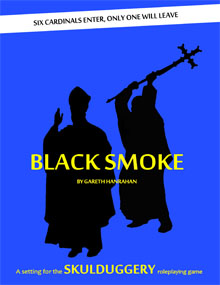 SIX CARDINALS ENTER, ONLY ONE WILL LEAVE AS POPE!
Black Smoke is the brand new setting for Skulduggery, the roleplaying game of verbal fireworks and sudden reversals!
The previous pope, Celestine, has died under mysterious circumstances so it’s time for the cardinals to gather in the Sistine Chapel to elect a new leader. This is where the conniving, back-stabbing and underhandedness begins!
You want to be the new Pope and you will do anything to achieve your goal from spreading malicious rumours about your competitors to poisoning the wine and ordering arrests. The Holy Roman Emperor, a hairy, ambitious German, and his army are encamped outside the city, threatening an invasion he is not made a saint before his death.
All this makes for an exciting setting, ripe with opportunities for subtefuge and less-than-holy tactics! Complete with hilarious taglines and a full set of player cards, this setting will have you competing for the papacy again and again.
Univision has bested NBC every single night of the sweep so far among adults 18-49 and is poised to overtake NBC for its first fourth-place sweep finish in the demo.
Read more of this story at Slashdot.

firehosevestments beat

Father Humberto Alvarez isn’t a typical Catholic priest. Every Sunday, the 40-year-old dons a tunic emblazoned with images of Superman, Batman and Spider-Man, and, armed with a Super Soaker loaded with holy water, delivers a special Mass to the children of Saltillo, Mexico.
It’s an unconventional approach, but one that appears to work, drawing parishioners young and old to the service. Alvarez told Zocalo magazine, that he embraced the superheroes because, “We talk about attitudes of struggle and effort to achieve overcome fears, find peace and forgiveness.” He began using the water gun to bless the congregation following a series of fatal shootings in Saltillo.
While not everyone agrees with Alvarez’s tactics, he’s undaunted, saying, “Jesus was different and always sought justice, we must follow his example.”


(via ComicMix, lainformacion)
Recognize the tune? Let us know in the comments below!
Submitted by: Unknown
Tagged: only in russia , army , spongebog squarepants , Video , g rated , win Share on Facebook
People will make a tournament bracket out of anything, and the process of selecting the next Pope is just too tempting to resist -especially as it will be held in March. This bracket is divided into four regions, including the tri-state regional, which contains four men not actually considered "papabili" (two are deceased). The rounds have wonderful names, the best being the Sweet Sistine. Each candidate comes with Vegas odds, so get your office pools ready! Link -via Metafilter
If best-selling albums had been books instead…
…and there’s more in The Record Books II
As Pope Benedict XVI prepares to step down on February 28th, his Twitter account will go dark as well. CNN reports that @Pontifex will close at the same time he formally leaves office, as will the eight accounts that distribute Papal messages in other languages. "It seems unimaginable that one could continue to use a communication tool so popular and powerful during the 'sede vacante' period" during which the Pope's seat is vacant, says Vatican Radio. The Pope is expected to give his last tweet on February 27th along with his final general audience, one of only a few posted since he announced his upcoming resignation.
While this would have eventually happened whenever the Pope's seat was vacated, his sudden resignation means it's taking place only a few months after @Pontifex was created. CNN doesn't specify, but it implies the account will be completely deactivated, not simply left without updates. Vatican Radio also declined to state whether the nascent Twitter tradition will be maintained by Benedict XVI's successor. The account was at least specifically chosen to refer to the office rather than a specific man, so the next Pope could well take up the cause of beating Justin Bieber in retweet counts.

If you've been paying any attention to the security breaches hitting Apple, Facebook, Twitter, NBC, and others these past few weeks, you've probably noticed a common culprit: our poor old pockmarked friend, Java.
Oracle's aging code deployment platform has practically been a revolving door for widespread malware attacks recently, and for years the general consensus has often been that its risks have outgrown its usefulness. After spending a week Java-free back in 2010, PCMag's Larry Seltzer concluded that the Java platform as a whole "is pretty clearly a failure, and all that remains of it is a big fat attack surface on your computer."
The situation doesn't look to be getting any better: since last year, zero-day exploits have been appearing with a crippling consistency, and lately Oracle has found itself fervently rushing to apply patches on an almost monthly basis. One of them, which emerged in January, caused Apple to start blocking Java 7 completely on OS X. And even after it had been patched, the US Department of Homeland Security's Computer Emergency Readiness Team (CERT) joined security experts in recommending that users keep their Java browser plugins disabled indefinitely. Now many are beginning to wonder, as they have many times before, whether the platform and its associated language are finally on their last legs, about to be being pummeled out of existence by hackers and a declining developer base.
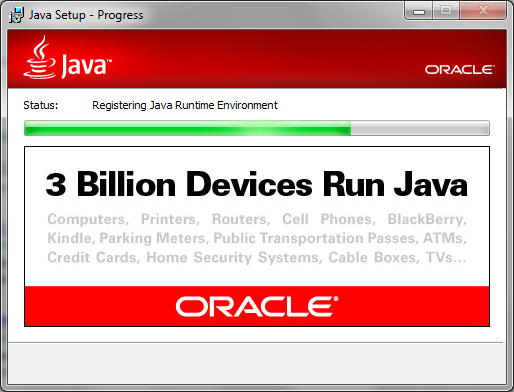
The thing is, like many successful platforms, part of what makes Java so dangerous is also its main selling point: it's everywhere. Java's original stewards, the now-defunct Sun Microsystems, built it as an intermediary for cross-platform code deployment, and today its new owners at Oracle brag that Java runs on more than 3 billion devices — the allure is that you only need to write code once and you've got your software running on Windows, Mac, and Linux PCs, plus a whole host of compatible mobile devices to boot.
It should be no surprise, then, that the criminal hacking underground has taken such a keen interest. Less than 24 hours after Oracle patched a critical vulnerability in mid-January, security researcher Brian Krebs observed that yet another unpatched exploit was already being sold on the black market to two buyers at $5,000 a pop. After loading those exploits into crimeware tools to foist malicious code onto heavily-trafficked websites, malicious actors suddenly have an open doorway to millions upon millions of devices that merely connect to an infected URL. That's exactly what happened with the recent exploit that attacked iPhoneDevSDK.com and led to an attack on Apple itself. From there, they can run targeted attacks which exfiltrate data, install remote access tools, and do all manner of other nasty stuff until Oracle manages to patch the vulnerability. And since developers are involved, there's even the opportunity to inject malicious code directly into the apps themselves.
"Java will be hacked on until it’s dead or disabled"
"Java is the flavor of the day, just like Flash and others were before it," says independent security researcher Elliott Cutright in an email sent to The Verge. "It will be hacked on until it’s dead or disabled, then hackers will move on to the next piece of software."
But the solution isn't as simple as giving Java the boot. "I'm not sure if we could just 'ditch' Java right now even if we wanted to. While its not used as widely in businesses these days as it once was, it is still prevalent enough to make dropping it altogether very difficult," says Cutright. For example, Android developers depend on a host of development tools which all require a Java installation, leaving them all vulnerable whenever a new exploit comes along. Though it's worth noting that Android itself remains unaffected, since the OS runs on software that's only derivative of Java, and it doesn't include a plugin for its browser. There's also the fact that many businesses intentionally stay on older, unpatched versions of Java, because upgrading would break their software.
The best way to stay safe right now, security experts keep saying, is to keep Java unplugged from the browser on your PC (read here on how to do that) and maybe keep an extra browser with Java enabled for the rare occasions you actually need it. But in the long-term, the only way for users to break the cycle — and for Java to survive — depends on whether Oracle decides to open up the way it mitigates risk to other security firms.
"Oracle is just playing an endless game of Whac-A-Mole."
"It’s very frustrating that we don't already have a copy of the Java exploit that affected Apple," says Sean Sullivan, a security advisor at F-Secure. "We could be doing so much testing already. And by sharing the load, antivirus (and other security) vendors can help give Java users the security that they need. Otherwise, Oracle is just playing an endless game of Whac-A-Mole."
"They are known for taking their time with vulnerabilities disclosed by researchers before releasing patches," says Cutright. "They really need to improve their relations with the community and have a more efficient process for effectively handling and fixing security vulnerabilities before they open the floodgates with a [Google-like] bug bounty."
Oracle did not respond to a request for comment.
Adobe's Flash, another browser plugin with a sordid history, was once the same kind of low-hanging fruit. But that changed two years ago, Sullivan says, when Adobe joined MAPP, an early access disclosure program headed up by Microsoft that gives security companies a head-start in finding vulnerabilities. "With that information, we can better prepare for exploit detection and mitigations," says Sullivan. "Basically, Adobe became a team player."
In the future, HTML5 is probably the best hope of relieving the need for browser plugins like Flash and Java. But in the meantime, the onus lies on Oracle to weather the storm using all the resources available — and on users to seal off the offending attack vectors. "This goes for everything, not just Java," says Cutright. "Limit your attack surface and you will be more secure at the end of the day. But you will never be 'hack proof.' No matter what the sales guys tell you."
For Slacktory, Debbie Saslaw edited a supercut video of people saying “It’s a no brainer” in movies and television.
No one says it in real life, but everyone says it in movies and TV.
submitted via Laughing Squid Tips
firehosechrist, what an asshole
firehoseuhh

We don’t often cover fashion here at The A.V. Club, but then again, it’s not often that fashion crosses over with one of our favorite subjects: classic Hollywood horror films. Leave it to Fashion Week’s most reliable absurdists, The Blonds—who last season presented a collection that included a Jaws-themed corset and, um, this—to provide us with that happy middle ground with their Fall 2013 collection, presented last week in New York. Featuring pieces with names like “The Raven,” “The Butcher,” “Redrum,” and so on, and shown to the soundtrack of Talking Heads’ “Psycho Killer,” the collection married The Blonds’ corset-loving-drag-queen-on-Halloween aesthetic with inspiration from films like The Birds, The Shining, Psycho, Carrie, and others, with varying degrees of literalness. (Hello, Rope.) Oh, there was also a fur straightjacket and this terrifying thing:
 milkmade.com
You can check out photos of the whole collection ...
Read morefirehose1. This map shows every area code in which Ludacris has "hoes":
2. This is what the world would look like if the water and land masses were inverted:
3. This is how much space the Great Lakes would take up if they were in Europe:
4. Here's how much space the world's population would take up if everyone lived in one city:
5. This is a map of every country England has ever invaded:
(That's all but 22 countries.)
6. This map shows the population density in the United States by decade:
7. Here's a map of everything New Yorkers call 311 to complain about most:
8. This is what the U.S. might look like if state borders were redrawn to evenly distribute the population:
9. Here's another stab at the concept:
10. Ever wonder what time zones look like in Antarctica? Here's your answer:
11. A guide to the writing system of the world:
12. A Super Mario Bros. take on the world map:
13. The U.S. according to which cities have their own Craigslist section:
14. Here's what the world might look like if it weren't spherical:
15. A map of the U.S. with the original city names:
16. A guide to the popularity of various sports around the world:
17. This map uses a different center point than you're used to:
18. A map showing what's on the exact opposite side of the planet:
19. A map of the worst light pollution in the U.S.:
20. Here's how Google auto-complete describes all 50 states:
21. The U.S. drawn like a map from a fantasy novel:
22. The U.S. high-speed rail system that will never be:
23. An America that almost was from 1814:
24. A map of the countries that consume the most milk:
25. A map of the most popular surnames in the U.S.:
26. Here are all the landlocked countries of the world:
27. All the countries that share just one border with another country:
28. The most popular web browsers by country:
29. Here's every country with a McDonald's:
30. The world according to power outlets:
31. How the world looked during the last ice age:
32-38. Maps of the U.S. according to how often the Seven Deadly Sins are committed:
Some prime examples of map porn for all my fellow amateur cartographers to get lost in. Get it?

Source: michiganstate.247sports.com

Source: ircimg.net

Source: greatlakesguru.com

Source: marshallstanton.com
 Palestinian cartoonist Mohammad Saba’aneh, a contributor to the Cartoon Movement comics journalism site, was arrested by Israeli authorities on Saturday and is being held without access to a lawyer, a situation that could continue indefinitely. The Cartoon Movement blog has been tracking the story as well as the reaction by international organizations.
Saba’aneh is a political cartoonist for Al-Hayat al-Jadida, the official newspaper of the Palestinian National Authority, the governing body for the West Bank and the Gaza Strip, and his cartoons comment on the political and human rights situation of the region, often criticizing the Israeli detention of Palestinians. He also works in the public relations department of the Arab American University. He visited the United States in 2010 as a participant in the State Department’s International Visitor Leadership Program.
On Thursday, an Israeli military court extended Saba’aneh’s detention for nine days, and further extensions are possible. According to the International Council for Human Rights, “The Israeli security forces refuse to disclose any details on Mohammed Sabaana’s whereabouts and further deny to grant access to his lawyer or his family members. He is also at serious risk of torture and ill-treatment.”
The reason for Saba’aneh’s arrest is not clear; the New York-based Committee to Protect Journalists, which has called for Saba’aneh’s release, said he is accused of “providing services to unspecified ‘hostile organizations.” However, the CPJ’s Sharif Mansour said “Israel has a history of using administrative detention to silence critical reporting. This flies in the face of international law. The Israeli authorities must explain why they have used such an overbroad security statute against political cartoonist Mohammad Saba’aneh.”
The CPJ and Cartoonists Rights Network International have called for Saba’aneh’s immediate release; Saba’aneh is the CRNI’s representative in Palestine, and the head of the organization has written to the Israeli ambassador to the U.S. asking that Saba’aneh be set free. Reporters Without Borders has also condemned the arrest. The International Council for Human Rights has issued a call to action, urging people to send letters to the Israeli authorities and international organizations demanding that Saba’aneh be released.
A gallery of Saba’aneh’s cartoons is here.
(via The Daily Cartoonist )
firehoseThe Nuge: world-class trolling
That’s one way to mark Black History Month: When Ted Nugent hits the road this year, he’s calling his tour “Ted Nugent Black Power 2013,” he writes on the conservative website World Net Daily.
In a column that describes “dirty Democrat politicians” as the enemies of black Americans, the right-wing rocker reels off a string of statistics he says demonstrate how ineffective Democratic policies, including Franklin Roosevelt’s New Deal and Lyndon Johnson’s Great Society, have been at helping African-Americans overcome poverty, crime and a lack of education.
“The truth is that the Democratic Party has been the engineer of the destruction of black Americans, and everyone knows it except the very people who need to know it the most – black Americans,” he writes.
Nugent, on the other hand, says he celebrates Black History Month “every day,” because his “fire-breathing musical career was literally launched by black musical thundergods” including Bo Diddley, Little Richard, James Brown, Wilson Pickett and more.
“There is no doubt that my 2013 tour will be the best of my life,” he writes. “With world-class virtuosos paying tribute to our black heroes nightly, it is only fitting that this year’s tour is aptly titled, ‘Ted Nugent Black Power 2013.’ Say it loud: my music is black and I’m proud!”


When first viewing the artwork of Shintaro Ohata up close it appears the scenes are made from simple oil paints, but take a step back and you’re in for a surprise. Each piece is actually a hybrid of painted canvas and sculpture that blend almost flawlessly in color and texture to create a single image. The cinematic figures are sculpted from polystyrene while the backgrounds are made from traditional painting techniques. Via his artist statement:
Shintaro Ohata is an artist who depicts little things in everyday life like scenes of a movie and captures all sorts of light in his work with a unique touch: convenience stores at night, city roads on rainy day and fast-food shops at dawn etc. His paintings show us ordinary sceneries as dramas. He is also known for his characteristic style; placing sculptures in front of paintings, and shows them as one work, a combination of 2-D and 3-D world. He says that it all started from when he wondered “I could bring the atmosphere or dynamism of my paintings with a more different way if I place sculptures in front of paintings”. Many viewers tend to assume that there is a light source set into his work itself because of the strong expression of lights in his sculpture.
Ohata will have work later this year at the Akita Museum of Modern Art, and you can see much more of his work online here. (via toxel)