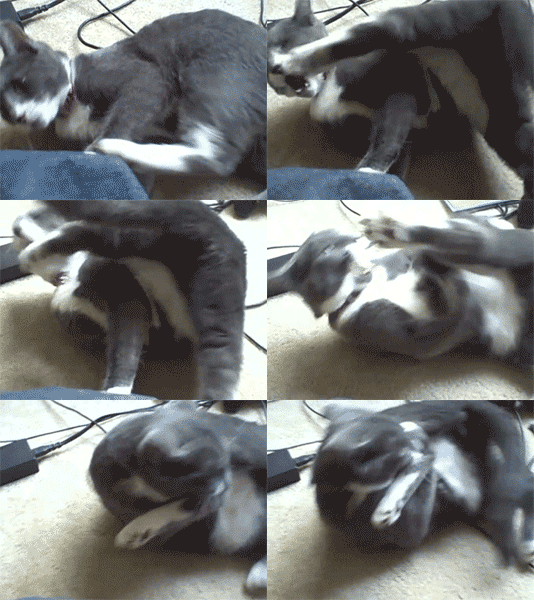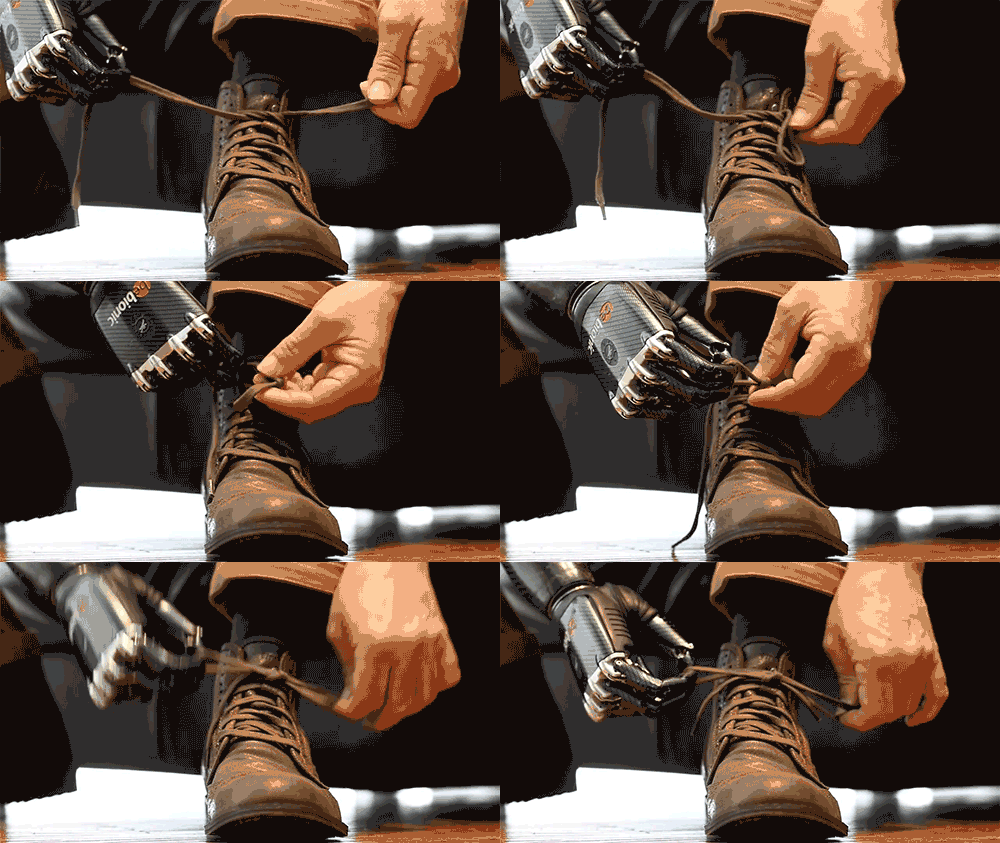
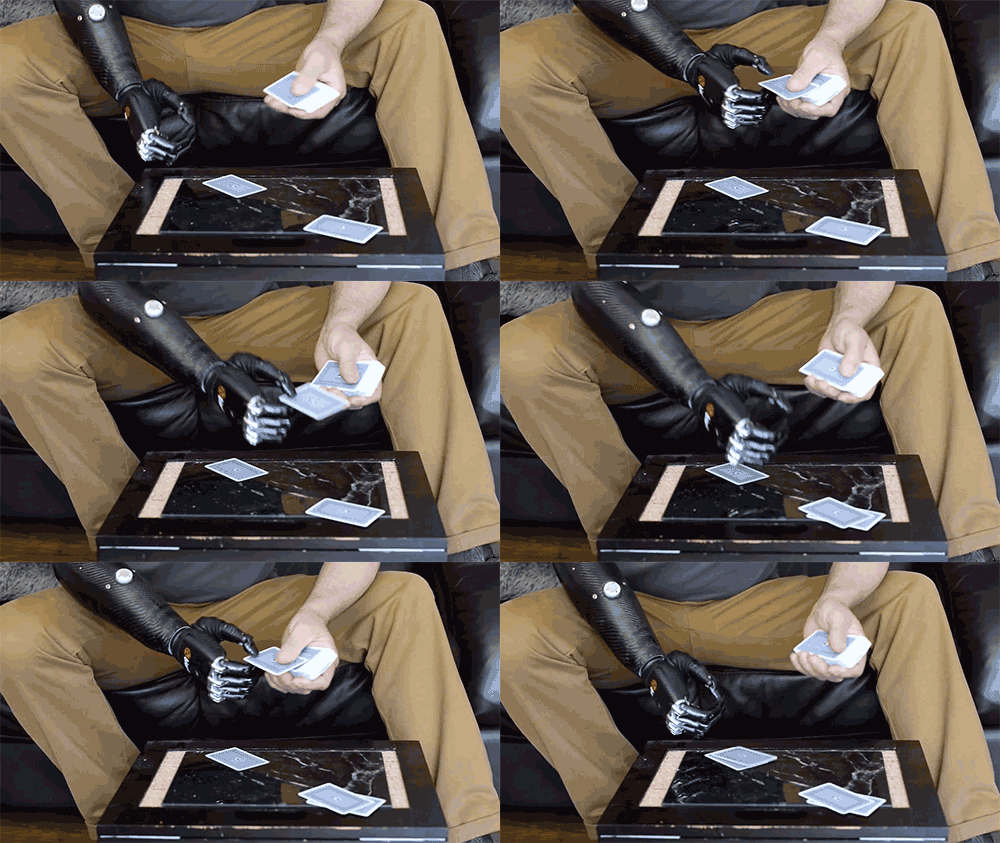

Bebionic Prosthetic Hand Ties Shoelace And Deals Cards
If π is expressed in base 26, then each of its digits can be associated with a letter of the alphabet (0=A, 1=B, … 25=Z). This produces an endless string of letters:
D.DRSQLOLYRTRODNLHNQTGKUDQGTUIRXNEQBCKBSZIVQQVGDMELM …
If the digits of π are truly random, then this string “emulates the mythical army of typing monkeys spewing out random letters,” writes Mike Keith. “Among other things, this implies that any text, no matter how long, should eventually appear in the base-26 digits of π.”
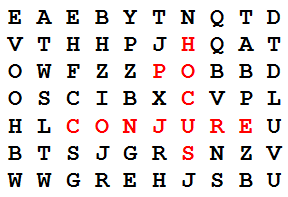
In examining the first million letters, Keith has found that the word CONJURE appears at position 246,556. If a carriage return is added after each 2,736 letters, then we have a two-dimensional field in which further words appear, in the style of a word search. Now HOCUS and POCUS appear, intersecting CONJURE (with POCUS in the shape of an L).
When each row is 14,061 digits long, then ALPHA, OMEGA, and GOD appear in a group near position 148,655. And when rows are 13,771 digits long, then DEMON and SATAN appear interlocked near position 255,717. Keith even found the makings of a charming haiku near position 554,766 when rows are 1,058 letters long:
Sun, elk in water;
Oho! For her I’ll try to
Be a hero yet.
More here. See also A Hidden Message and Equidistant Letter Sequences.
So ToastMasters feels a bit like a high school speech and debate club: a lot of setting of agendas, calling to order, speaking in turns for timed segments, and clapping politely.
And, of course, roles up the yin-yang: president, VP of membership, treasurer, secretary, sergeant-at-arms, grammarian, timer, ah-counter, evaluators, and the ToastMaster itself (the emcee role rotated weekly).
Table Topics are probably the most interest bit. The emcee prepares half a dozen or so questions in advance, and as each question is announced immediately picks a speaker out of the audience – either a volunteer or at random – to expound for 1-2 min off the cuff. Being short and improvised brings a challenge, spontaneity and excitement lacking in the formal prepared speeches. It’s a great way to stand out as a public speaker; accordingly, I’ve volunteered for a TT speech 5 sessions in a row now.
Still, at 2 hours per session with 2-3 formal speeches running 5-7 min each, half by Koreans whose explicit goal of membership is to simply improve their English, and almost all content falling under either empty canned rhetoric or a slideshow of their most recent vacation, the 1-2 min in the spotlight would probably not sustain my interest in participating in TM.
Were it not for second round, that is.
Second round, or 이차 (“ii-chah”), is the Korean term for the second venue you hit when going bar-hopping. For TM, it’s the afterparty at the local bulgogi house or izakaya-style gastropub: lotsa food unhealthy food washed down with less healthy beer.
And great, great, great conversation.
Last week’s 이차 was where I learned about the Seoul Global Center, the one-stop shop for all my expat needs. This week, as usual, I was asked what I’m doing in Seoul and proceeded to outline my business plan.
Once again was told it’s a great idea but might be hard to generate any revenue.
I was ready for that: the first year will be just about building up a popular base of users by distributing the software for free. And supplementing my income by teaching English just exposes me to more foreigners, who can in turn spread word of mouth.
Then he warned me how the government is really rigid and insists that the current standard is the best way to do spelling.
I was ready for that, too: buy-in from large institutions like universities (for language instruction), municipalities (for street and subway signs), and Samsung (for OS-level Android integration) won’t happen until I’ve built up a popular following, hence the initial focus on free browser, smartphone, and karaoke integration. Starting at the grassroots level, and then working my way from the bottom up the power chain.
Finally, he told me that I should be prepared for Samsung to rip off my software because they’re unethical in business and corrupt in politics.
I wasn’t ready for that.
Turns out a significant chunk of the Korean population dislikes Samsung. What’s amazing is how much of the criticism echoes narratives we’ve heard before in the US, but never concentrated in one company. Supposedly it is:
God bless America. At least we keep our corruption in separate silos.


firehoseTDD is for mature applications or can't-ever-fail applications. It's not a good fit for startups, practically or culturally, but once you move past startup and growth into the market leader, you aren't keeping that lead or growing it further with enterprise-scale sales if you're selling unstable software. Even if it _mostly_ works and even if it's better than the competition.
Yesterday Uncle Bob put up a post on using TDD in start up environments “The Startup Trap” its a good read. Check it out.
Nate soon after posted:
It’s funny, you never see someone with the title “Master Craftsman” at a startup. I wonder why?
— Nate Kohari (@nkohari) March 5, 2013
then
I take it all back. I would strongly encourage startups to use TDD while developing any products that compete with ours.
— Nate Kohari (@nkohari) March 5, 2013
I wanted to write a few comments about TDD in startups. Good code is the least of the risks in a startup. Sorry but worrying about technical debt making us go slower when we have a two month runway and likely will pivot four times to quote Bob.
Captain Sulu when the Klingon power moon of Praxis exploded and a young Lieutenant asked whether they should notify Star-Fleet: “Are you kidding?” ARE YOU KIDDING?
One of the biggest mistakes in my career was building something appropriate…
It was just after Hurricane Katrina. I was living in a hotel. An acquaintance asked me if we could hack together this business idea they had for a trading system. He had the knowledge but not the know how. I said sure, hell I was living in a hotel!
In less than two weeks we had an algorithmic trading system. It was a monstrosity of a source base. It was literally a winforms app connected directly to the stock market. UI interactions happened off events directly from the feed! Everything was in code behinds (including the algos!) Due to the nature of the protocol if anything failed during the day and crashed the app (say bad parsing of a string?) the day for the trader was over as they could not restart.
But after two weeks we put it in front of a trader who started using it. We made about 70-80k$ the first month. We had blundered into the pit of success. A few months later I moved up with the company. We decided that we were going to “do things right”. While keeping the original version running and limping along as stable as we could keep it while adding just a few features.
We ended up with a redundant multi-user architecture nine months or so later, it was really quite a beautiful system. If a client/server crashed, no big deal just sign it back on, multiple clients? no problem. We moved from a third party provider to a direct exchange link (faster and more information!). We had > 95% code coverage on our core stuff, integration suites including a fake stock exchange that actually sent packets over UDP so we could force various problems with retry reconnects etc/errors. We were very stable and had a proper clean architecture.
In fact you could say that we were dealing with what Bob describes in:
As time passes your estimates will grow. You’ll find it harder and harder to add new features. You will find more and more bugs accumulating. You’ll start to parse the bugs into critical and acceptable (as if any bug is acceptable!) You’ll create modules that are so fragile you won’t trust yourself, or anyone else, to modify them; so you’ll work around them. You’ll build a festering pile of code that, with every passing week, requires more and more effort just to keep running. Forward progress will slow and falter. It may even reverse as each release becomes buggier and buggier, and less and less stable. Catastrophes will become more and more common as errors, that should never have happened, create corruptions and damage that take huge traunches of time to repair.
We had built a production prototype and were suffering all the pain described by Bob. We were paying down our debt in an “intelligent” way much the way many companies that start with production prototypes do.
However this is still a naive viewpoint. What really mattered was that after our nine months of beautiful architecture and coding work we were making approximately 10k/month more than what our stupid production prototype made for all of its shortcomings.
We would have been better off making 30 new production prototypes of different strategies and “throwing shit at the wall” to see what worked than spending any time beyond a bit of stabilization of the first. How many new business opportunities would we have found?
There are some lessons here.
1) If we had started with a nine month project it never would have been done
2) A Production Prototype is common as a Minimum Viable Product. Yes testing, engineering, or properly architecting will likely slow you down on a production prototype.
3) Even if you succeed you are often better to stabilize your Production Prototype than to “build it right”. Be very careful about taking the “build it right” point of view.
4) Context is important!
Never underestimate the value of working software.

“Carson is a private person. She prefers to be alone. (When her husband is traveling, Carson will call and tell him, “I miss you, but I’m having a great time.”) Her book jackets have no author photo. Her back-flap biography — “Anne Carson was born in Canada and teaches ancient Greek for a living” — is so minimalist that it sounds like a parody of a back-flap biography. […]
Carson is usually referred to as a poet, but just about no one finds that label satisfying: her fans (for whom she does something more than poetry), her critics (for whom she does something less than poetry) or herself. She often labels her work in conspicuously nonpoetic terms. Her book “The Beauty of the Husband” is subtitled “A Fictional Essay in 29 Tangos.” Her book “Decreation” is subtitled “Poetry, Essays, Opera.” Carson gives the impression — on the page, at readings — of someone from another world, either extraterrestrial or ancient, for whom our modern earthly categories are too artificial and simplistic to contain anything like the real truth she is determined to communicate. For two decades her work has moved — phrase by phrase, line by line, project by improbable project — in directions that a human brain would never naturally move. The approach has won her awards (MacArthur, Guggenheim, Lannan) and accolades and an electric reputation in the literary world.
In her day job, Carson, who is 62, is a professor of erratic subjects (ancient Greek, attention, artistic collaboration) at various universities around North America, where she appears for a semester at a time as — as she often puts it — “a visiting [whatever].” (Even when she says this out loud, she makes the bracket sign with her hands.) This, I think, is the best catchall description of Carson. Wherever she goes, whatever she does, she is always a “visiting [whatever].””
SAN FRANCISCO — They’re called national security letters and the FBI issues thousands of them a year to banks, phone companies and other businesses demanding customer information. They’re sent without judicial review and recipients are barred from disclosing them.
On Friday, a federal judge in San Francisco declared the letters unconstitutional, saying the secretive demands for customer data violate the First Amendment.
The government has failed to show that the letters and the blanket non-disclosure policy “serve the compelling need of national security,” and the gag order creates “too large a danger that speech is being unnecessarily restricted,” U.S. District Judge Susan Illston wrote.
”firehosehuh
Catalyst Game Labs has worked hard to create a Year of Shadowrun unlike any experienced in the game line’s nearly twenty-five year legacy. From a new edition of the classic RPG to a deck building card game, miniatures game to board game, as well as coordinating extensively with the return of authentic  Shadowrun computer games in Shadowrun Returns and Shadowrun Online, Catalyst has strived to bring Shadowrun’s passionate fans an even deeper journey into the game’s dark, dangerous world.
Now, one of the last missing parts to create the full experience to fans of this brilliant universe has fallen into place: new print novels.
“The seeds of Catalyst were planted a decade ago as authors gathered together to create an online fiction subscription website for BattleTech,” said Randall N. Bills, Managing Developer for Catalyst Game Labs. “Our passion for storytelling and the scope and depth that print fiction delivers is a love affair we’ll never lose. To reach a point where we can add this critical aspect to all we’re doing with Shadowrun is a fantastic milestone. And of course, the success of this line will help ensure that we’ll able to launch print novel lines for our other great universes in the future.”

Catalyst Game Labs will launch the new print novel line in the fall of 2013, and is committing to six all-new, original Shadowrun fiction novels. Additionally, Catalyst is working on releasing omnibus editions of the favorite works of past Shadowrun novels by such authors as Nigel Findley, Robert Charrette, Nyx Smith and more.
With Barnes & Noble enthusiastically embracing this print line, Catalyst is bringing on John Helfers to helm the project and help ensure its success. During his sixteen years working for Martin H. Greenberg at Tekno Books, John edited more than fifteen short story anthologies for DAW, as well as dozens more for other publishers in all genres. He has also worked with well-known authors and co-editors such as Charlaine Harris, Stephen Coonts, Kim Harrison, Dale Brown, Mike Resnick, Harold W. Coyle, Mercedes Lackey, Margaret Weis, and Kevin J. Anderson.
John is also no stranger to the world of Shadowrun. He has written short stories (in the Shadowrun 20th Anniversary Edition and Seattle: 2072) and novel-length fiction (Aftershock, co-authored with Jean Rabe) set in the world. He is also the editor of the Origin award-winning Shadowrun anthology Spells & Chrome, as well as also helming the Shadowrun Returns Anthology project working alongside Jordan Weisman.
“Bringing back original fiction novels in the Shadowrun universe has been one of Catalyst Game Labs’ top priorities, and I’m excited to have a hand in bringing this spellbinding world back into new novels,” John Helfers said. “We have a terrific group of authors who can’t wait to tell new stories in the Shadowrun world, and I’m looking forward to seeing what they come up with and getting these stories out to the fans.”
Check out www.catalystgamelabs.com and www.shadowrun.com in the future for more details!
Catalyst Game Labs
Catalyst Game Labs is dedicated to producing high-quality games and fiction that mesh sophisticated game mechanics with dynamic universes, all presented in a form that allows beginning players and long-time veterans to easily jump into our games, while helping fiction readers enjoy our stories even if they don’t know the games.
Catalyst Game Labs is an imprint of InMediaRes Productions, LLC, which specializes in electronic publishing of professional fiction. This allows Catalyst to participate in a synergy that melds printed gaming material and fiction with all the benefits of electronic interfaces and online communities, creating a whole-package experience for any type of player or reader. Find Catalyst Game Labs online at www.catalystgamelabs.com.
firehoselibrary wars, david bowie shares
is it summer already


Read more of this story at Slashdot.

firehose'what do I have to point to that I am proud of? I review a lot of PDF editors. That's not tombstone material.'
Often I write about technology or curiosities. Occasionally I write about comedy or politics. Rarely I write other things.
On those rare occasions, I press a publish button that hurts just a little. I put skin in the game. Sometimes I ask myself why. It hurts to write things down that matter. It hurts more to pull back the skin to reveal the tissue and sinew to the world. Why do I do it?
The world is not a clean place. It's made of dirt, puke and scars. We are all made of dirt, puke and scars. In some way, I'm trying to be a real human at the other end of a web browser. I'm not a URL or IP address. I exist beyond an avatar or Twitter handle. Behind every snarky article and questionable rumor there is a deeply flawed person pretending to be a writer or artist. There are charlatans among us.
My dents are small but they are mine. I've tried to leave the world in a slightly better condition than I found it, but I try to leave a mark. App reviews and keyboard shortcuts are fun, but what do I have to point to that I am proud of? I review a lot of PDF editors. That's not tombstone material.
Who am I? Who do you think I am? Well, I'm a collection of things that I put into the world. I am the things that I do over and over. As far as you know, I am this Web site. So this Web site has a tiny bit of me floating around. It has letters to my daughter and conversations with my father. It has mother's day cards and motorcycle accidents. It has love and hate and disappointment. It has cracks because the world is not an app review.
“What is a library? Until fairly recently, the answer to that question was simple: It’s a storehouse for books and manuscripts. The fact that books are increasingly “printed” on something other than paper doesn’t change the fundamental purpose of libraries. They are our collective memory. Fortunately for posterity, a well-made book isn’t hard to preserve. But in 1877, Thomas Edison invented a new way to preserve the past. He called it the phonograph, and it took a long time for librarians to figure out that the echoes of speech and music that Edison and his successors etched on discs were as important a part of our collective memory as the words that Johannes Gutenberg and his successors printed on paper.”
via WSJ.com
firehose'It's possible that the social norms in this brave new domain will change once more — with users shunning meanspirited attacks from posters hiding behind pseudonyms and cultivating civil debate instead'
Read more of this story at Slashdot.

firehose#ok

According to The Wall Street Journal, Menlo Park-based Facebook is looking to incorporate the hashtag functionality to its popular social network. The hashtag is a way to tag data using a “#” symbol and is most commonly associated with rival company Twitter (Chris Messina proposed the use of hashtags at Twitter in 2007).
 We've talked about how mild ambient noise can keep you motivated and productive, but finding the right sounds and the right amount of ambient noise to help you focus can be tricky. Soundrown can help. Instead of locking you into one type of sound, the webapp lets you choose, adjust the volume, and offers clean recordings that fit right into your flow on their own or behind music. More »
 Flight search site Kayak's chief scientist booked multiple one-way tickets on different airlines for years, finding that this option was often cheaper than booking round trips with the same carrier. Because this method became so commonly effective, they decided to make it a feature of the site. More »
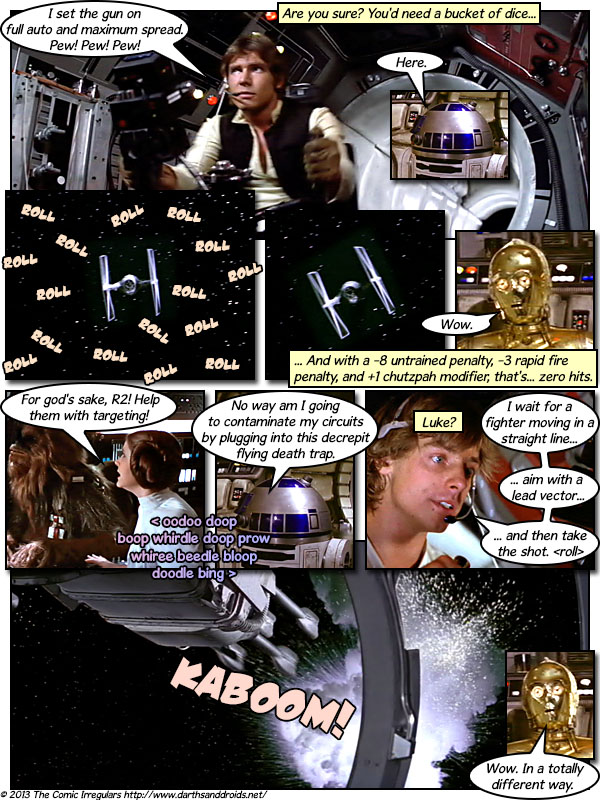
Good roleplaying in combat situations can be good for dice modifiers. Just remember that "good roleplaying" doesn't necessarily mean playing someone competent in combat, and "dice modifiers" doesn't necessarily mean positive ones.
firehosewe're like 81% there

Last month, researchers created an electronic link between the brains of two rats separated by thousands of miles. This was just another reminder that technology will one day make us telepaths. But how far will this transformation go? And how long will it take before humans evolve into a fully-fledged hive mind? We spoke to the experts to find out.
I spoke to three different experts, all of whom have given this subject considerable thought: Kevin Warwick, a British scientist and professor of cybernetics at the University of Reading; Ramez Naam, an American futurist and author of NEXUS (a scifi novel addressing this topic); and Anders Sandberg, a Swedish neuroscientist from the Future of Humanity Institute at the University of Oxford.
They all told me that the possibility of a telepathic noosphere is very real — and it's closer to reality than we might think. And not surprisingly, this would change the very fabric of the human condition.
My first question to the group had to do with the technological requirements. How is it, exactly, that we’re going to connect our minds over the Internet, or some future manifestation of it?
“I really think we have sufficient hardware available now — tools like Braingate,” says Warwick. “But we have a lot to learn with regard to how much the brain can adapt, just how many implants would be required, and where they would need to be positioned.”
Naam agrees that we’re largely on our way. He says we already have the basics of sending some sorts of information in and out of the brain. In humans, we’ve done it with video, audio, and motor control. In principle, nothing prevents us from sending that data back and forth between people.
“Practically speaking, though, there are some big things we have to do,” he tells io9. “First, we have to increase the bandwidth. The most sophisticated systems we have right now use about 100 electrodes, while the brain has more than 100 billion neurons. If you want to get good fidelity on the stuff you’re beaming back and forth between people, you’re going to want to get on the order of millions of electrodes.”
Naam says we can build the electronics for that easily, but building it in such a way that the brain accepts it is a major challenge.
The second hurdle, he says, is going beyond sensory and motor control.

“If you want to beam speech between people, you can probably tap into that with some extensions of what we’ve already been doing, though it will certainly involve researchers specifically working on decoding that kind of data,” he says. “But if you want to go beyond sending speech and get into full blown sharing of experiences, emotions, memories, or even skills (a la The Matrix), then you’re wandering into unknown territory.”
Indeed, Sandberg says that picking up and translating brain signals will be a tricky matter.
“EEG sensors have lousy resolution — we get an average of millions of neurons, plus electrical noise from muscles and the surroundings,” he says. “Subvocalisation and detecting muscle twitches is easier to do, although they will still be fairly noisy. Internal brain electrodes exist and can get a lot of data from a small region, but this of course requires brain surgery. I am having great hopes for optogenetics and nanofibers for making kinder, gentler implants that are less risky to insert and easier on their tissue surroundings.”
The real problem, he says, is translating signals in a sensible way. “Your brain representation of the concept "mountain" is different from mine, the result not just of different experiences, but also on account of my different neurons. So, if I wanted to activate the mountain concept, I would need to activate a disperse, perhaps very complex network across your brain,” he tells io9. “That would require some translation that figured out that I wanted to suggest a mountain, and found which pattern is your mountain.”

Sandberg says we normally "cheat" by learning a convenient code called language, where all the mapping between the code and our neural activations is learned as we grow. We can, of course, learn new codes as adults, and this is rarely a problem — adults already master things like Morse code, SMS abbreviations, or subtle signs of gesture and style. Sandberg points to the recent experiments by Nicolelis connecting brains directly, research which shows that it might be possible to get rodents to learn neural codes. But he says this learning is cumbersome, and we should be able to come up with something simpler.
One way is to boost learning. Some research shows that amphetamine and presumably other learning stimulants can speed up language learning. Recent work on the Nogo Receptor suggests that brain plasticity can be turned on and off. “So maybe we can use this to learn quickly,” says Sandberg.
Another way is to have software do the translation. It is not hard to imagine machine learning to figure out what neural codes or mumbled keywords correspond to which signal — but setting up the training so that users find it acceptably fast is another matter.
“So my guess is that if pairs of people really wanted to ‘get to know each other’ and devoted a lot of time and effort, they could likely learn signals and build translation protocols that would allow a lot of ‘telepathic’ communication — but it would be very specific to them, like the ‘internal language’ some couples have,” says Sandberg. “For the weaker social links, where we do not want to spend months learning how to speak to each other, we would rely on automatically translated signals. A lot of it would be standard things like voice and text, but one could imagine adding supporting ‘subtitles’ showing graphics or activating some neural assemblies.”
In terms of the communications backbone, Sandberg believes it’s largely in place, but it will likely have to be extended much further.

“The theoretical bandwidth limitations of even a wireless Internet are far, far beyond the bandwidth limitations of our brains — tens of terabits per second,” he told me, “and there are orbital angular momentum methods that might get far more.”
Take the corpus callosum, for example. It has around 250 million axons, and even at the maximal neural firing rate of just 25 gigabits, that should be enough to keep the hemispheres connected such that we feel we are a single mind.
As for the interface, Warwick says we should stick to implanted multi-electrode arrays. These may someday become wireless, but they’ll have to remain wired until we learn more about the process. Like Sandberg, he adds that we’ll also need to develop adaptive software interfacing.
Naam envisions something laced throughout the brain, coupled with some device that could be worn on the person’s body.
“For the first part, you can imagine a mesh of nano-scale sensors either inserted through a tiny hole in the skull, or somehow through the brain’s blood vessels. In Nexus I imagined a variant on this — tiny nano-particles that are small enough that they can be swallowed and will then cross the blood-brain barrier and find their way to neurons in the brain.”
Realistically, Naam says that whatever we insert in the brain is going to be pretty low energy consumption. The implant, or mesh, or nano-particles could communicate wirelessly, but to boost their signal — and to provide them power — scientists will have to pair them with something the person wears, like a cap, a pair of glasses, a headband — anything that can be worn very near the brain so it can pick up those weak signals and boost them, including signals from the outside world that will be channeled into the brain.
Warwick believes that the technologies required to build an early version of the telepathic noosphere are largely in place. All that’s required, he says, is “money on the table” and the proper ethical approval.
Sandberg concurs, saying that we’re already doing it with cellphones. He points to the work of Charles Stross, who suggests that the next generation will never have to be alone, get lost, or forget anything.
“As soon as people have persistent wearable systems that can pick up their speech, I think we can do a crude version,” says Sandberg. “Having a system that’s on all the time will allow us to get a lot of data — and it better be unobtrusive. I would not be surprised to see experiments with Google Glasses before the end of the year, but we’ll probably end up saying it’s just a fancy way of using cellphones.”
At the same time, Sandberg suspects that “real” neural interfacing will take a while, since it needs to be safe, convenient, and have a killer app worth doing. It will also have to compete with existing communications systems and their apps.
Similarly, Naam says we could build a telepathic network in a few years, but with “very, very, low fidelity.” But that low fidelity, he says, would be considerably worse than the quality we get by using phones — or even text or IM. “I doubt anyone who’s currently healthy would want to use it.”
But for a really stable, high bandwidth system in and out of the brain, that could take upwards of 15 to 20 years, which Naam concedes is optimistic.
“In any case, it’s not a huge priority,” he says. “And it’s not one where we’re willing to cut corners today. It’s firmly in the medical sphere, and the first rule there is ‘do no harm’. That means that science is done extremely cautiously, with the priority overwhelmingly — and appropriately — being not to harm the human subject.”
I asked Sandberg how the telepathic noosphere will disrupt the various way humans engage in work and social relations.
“Any enhancement of communication ability is a big deal,” he responded. “We humans are dominant because we are so good at communication and coordination, and any improvement would likely boost that. Just consider flash mobs or how online ARG communities do things that seem nearly supernatural.”
Cell phones, he says, made our schedules flexible in time and space, allowing us to coordinate where to meet on the fly. He says we’re also adding various non-human services like apps and Siri-like agents. “Our communications systems are allowing us to interact not just with each other but with various artificial agents,” he says. Messages can be stored, translated and integrated with other messages.
“If we become telepathic, it means we will have ways of doing the same with concepts, ideas and sensory signals,” says Sandberg. “It is hard to predict just what this will be used for since there are so few limitations. But just consider the possibility of getting instruction and skills via augmented reality and well designed sensory/motor interfaces. A team might help a member perform actions while ‘looking over her shoulder’, as if she knew all they knew. And if the system is general enough, it means that you could in principle get help from any skilled person anywhere in the world.”
In response to the same question, Naam noted that communication boosts can accelerate technical innovation, but more importantly, they can also accelerate the spread of any kind of idea. “And that can be hugely disruptive,” he says.
But in terms of the possibilities, Naam says the sky’s the limit.
“With all of those components, you can imagine people doing all sorts of things with such an interface. You could play games together. You could enter virtual worlds together,” he says. “Designers or architects or artists could imagine designs and share them mentally with others. You could work together on any type of project where you can see or hear what you’re doing. And of course, sex has driven a lot of information technologies forward — with sight, sound, touch, and motor control, you could imagine new forms of virtual sex or virtual pornography.”
Warwick imagines communication in the broadest sense, including the technically-enabled telepathic transmission of feelings, thoughts, ideas, and emotions. “I also think this communication will be far richer when compared to the present pathetic way in which humans communicate.” He suspects that visual information may eventually be possible, but that will take some time to develop. He even imagines the sharing of memories. That may be possible, he says, “but maybe not in my lifetime.”
Put all this together, says Warwick, and “the body becomes redundant.” Moreover, when connected in this way “we will be able to understand each other much more.”
We also talked about the potential risks.

“There’s the risk of bugs in hardware or software,” says Naam. “There’s the risk of malware or viruses that infect this. There’s the risk of hackers being able to break into the implants in your head. We’ve already seen hackers demonstrate that they can remotely take over pacemakers and insulin pumps. The same risks exist here.”
But the big societal risk, says Naam, stems entirely from the question of who controls this technology.
“That’s the central question I ask in Nexus,” he says. “If we all have brain implants, you can imagine it driving a very bottom’s up world — another Renaissance, a world where people are free and creating and sharing more new ideas all the time. Or you can imagine it driving a world like that of 1984, where central authorities are the ones in control, and they’re the ones using these direct brain technologies to monitor people, to keep people in line, or even to manipulate people into being who they’re supposed to be. That’s what keeps me up at night.”
Warwick, on the other hand, told me that the “biggest risk is that some idiot — probably a politician or business person — may stop it from going ahead.” He suspects it will lead to a digital divide between those who have and those who do not, but that it’s a natural progression very much in line with evolution to date.
In response to the question of privacy, Sandberg quipped, “Privacy? What privacy?”
Our lives, he says, will reside in the cloud, and on servers owned by various companies that also sell results from them to other organizations.
“Even if you do not use telepathy-like systems, your behaviour and knowledge can likely be inferred from the rich data everybody else provides,” he says. “And the potential for manipulation, surveillance and propaganda are endless.”
Without a doubt, the telepathic noosphere will alter the human condition in ways we cannot even begin to imagine. The Noosphere will be an extension of our minds. And as David Chalmers and Andy Clark have noted, we should still regard external mental processes as being genuine even though they’re technically happening outside our skulls. Consequently, as Sandberg told me, our devices and “cloud exoselves” will truly be extensions of our minds.
“Potentially very enhancing extensions,” he says, “although unlikely to have much volition of their own.”
Sandberg argues that we shouldn’t want our exoselves to be too independent, since they’re likely to make mistakes in our name. “We will always want to have veto power, a bit like how the conscious level of our minds has veto on motor actions being planned,” he says.
Veto power over our cloud exoselves? The future will be a very strange place, indeed.
Top image: agsandrew/Shutterstock, Nicolesis lab.
firehoseall my favorite APIs
 Cloud services are everywhere, and you probably have at least a few accounts all over the web. Jolidrive takes all those services and rolls them into one, simple interface. More »
The lost final episode of "The Tenth Planet" is being restored in animated form, using the original sound track.
Как вы уже, наверное, знаете, 1 июля 2013 года будет остановлена работа RSS-читалки Google Reader. Многих наших читателей эта проблема не застанет врасплох — Big Echo можно читать в твиттере, фейсбуке, вконтакте и, конечно, на самом сайте. Но если для вас, также как и для меня, Google Reader был основным инструментом для получения ежедневной дозы информации, предлагаю альтернативу, за которой стоит один из наших читателей: The Old Reader.
Среди явных преимуществ этого сервиса:
firehoseattn: lg
The lattice tries to steal the show, but the mac and cheese — made with brie, gruyere, and cheddar — is actually the best part.

Image by Macey Foronda/Buzzfeed

Image by Macey J. Foronda/Buzzfeed
Inspired by Breakfast for Dessert and chef Matt Jennings' Cheesemonger's Mac and Cheese:
INGREDIENTS
For the crust
3½ cups all-purpose flour (from the freezer if possible)
1 cup (2 sticks) very cold unsalted butter, cut into ½" cubes
¼ cup cold vegetable shortening
1 Tbsp. plus 1 tsp sugar
1 Tbsp. kosher salt
1 Tbsp. scant apple cider vinegar + enough ice water to make ¾ cup liquid
For mac 'n' cheese filling
5 slices thick-cut bacon, cut into 1-inch pieces
4 cups dried macaroni
4 Tbsp. of butter (½ a stick)
4 Tbsp. flour
2.5 cups heavy cream
2 tsp mustard powder
1 egg yolk
1 pound grated cheese — an equal parts mixture of gruyere, sharp cheddar, brie (no rind)
Kosher salt and freshly ground black pepper
For the bacon lattice
8 slices bacon
1 Tbsp. brown sugar
PREPARATION
For the crust
1. Measure out all of your ingredients for the crust and make sure your butter and shortening are very cold. (It helps to put them in the freezer after they're measured and cut into pieces. It also helps to keep the flour in the freezer.)

Image by Macey J. Foronda/Buzzfeed