When Susie and I got married twenty-five years ago, one of the lesser items she brought to our new combined household was a big clunky ceramic ashtray. Since neither of us smoked, she took to using it as a depository, by the side of her bed, for earrings, glasses, her watch, and such like things. One day, as I was making the bed, I thought to look at the underside of the ashtray, and found inscribed there "Editions Picasso." "Huh," I thought, "Do you suppose this ugly thing is worth something?" So I took it along to an art shop in the mall and asked, in a studiedly neutral voice, "Can you tell me the market value of this ashtray?" The owner of the shop turned it over, looked at it, went into the back room to consult some books, and came back. "Well," he said, "at auction it should bring about five thousand dollars."
I am forced to admit that in this case the mystifications of capitalism failed me. Try as I might, I could not feel the slightest tingle of divinity emanating from the ashtray. To this day, it sits on Susie's bed table, holding earrings, glasses, her watch, and such like things. There are limits.
firehose
Shared posts
24 Mar 15:20
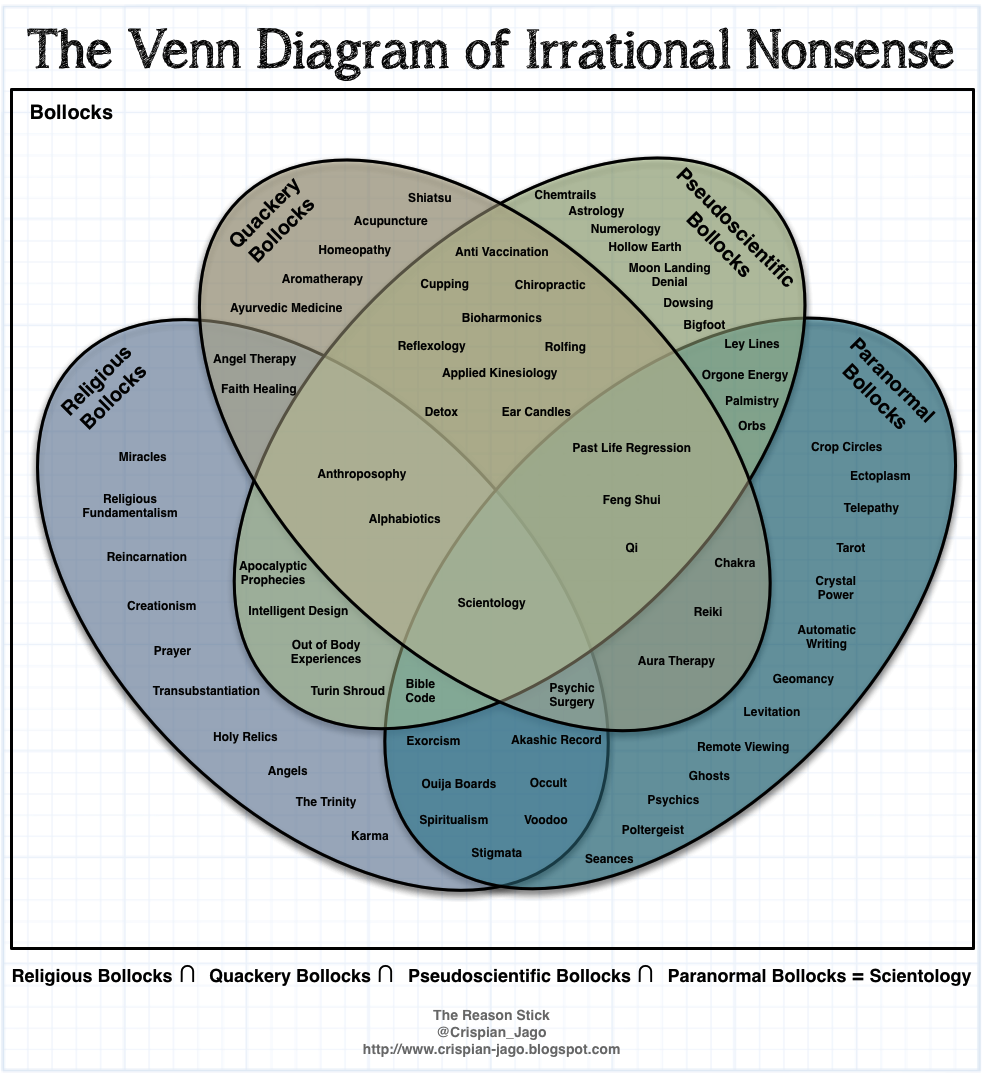
The curiously revered world of irrational nonsense has seeped into almost every aspect of modern society and is both complex and multifarious. Therefore rather than attempt a comprehensive taxonomy, I have opted instead for a gross oversimplification and a rather pretty Venn Diagram.
In my gross over simplification the vast majority of the multitude of evidenced-free beliefs at large in the world can be crudely classified into four basic sets or bollocks. Namely, Religion, Quackery, Pseudoscience and the Paranormal.
However as such nonsensical beliefs continue to evolve they become more and more fanciful and eventually creep across the bollock borders. Although all the items depicted on the diagram are completely bereft of any form of scientific credibility, those that successfully intersect the sets achieve new heights of implausibility and ridiculousness. And there is one belief so completely ludicrous it successfully flirts with all forms of bollocks.
Religious Bollocks ∩ Quackery Bollocks ∩ Pseudoscientific Bollocks ∩ Paranormal Bollocks = Scientology
UPDATE 24th March 2013
Many thanks for the retweets and shares.
I have also received the first translated copy of the Venn Diagram produced by Pavle Močilac of the Croatian Society for Promotion of Science and Critical Thinking.

Italian translation courtesy of Andrea Mirra

Spanish translation via @Cienciaaldía
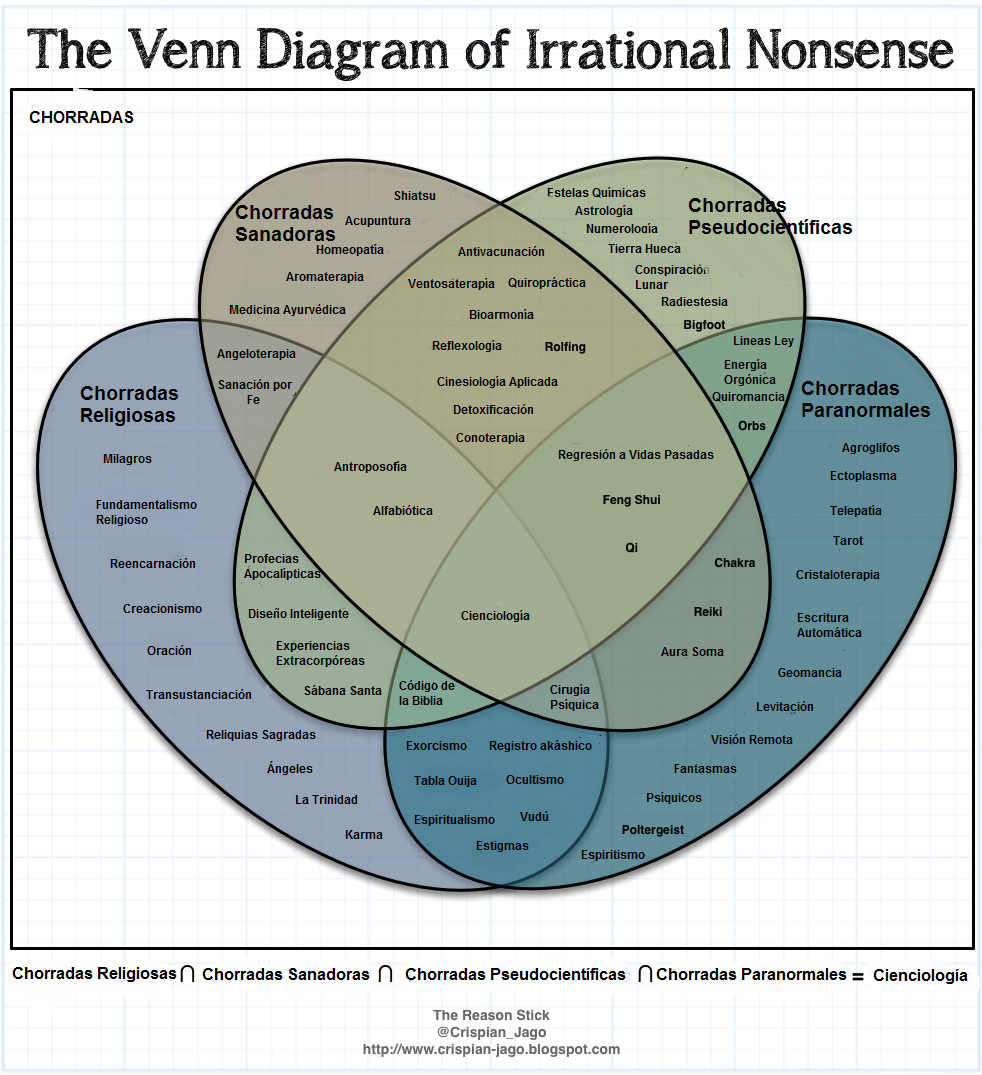
If I receive any other translations I shall post them here with the original.
BTW, Its been awfully nice to have seen the Diagram popping up all over the interwebs in the last few days, but if you could so kind as to link back to here you'll be sure to have the latest version in case I make any updates.
FURTHER UPDATE 27th March
I conceived the Venn Diargram of Irrational Nonsense in the car on my way home from work last Wednesday, and quickly knocked it up when I got home. However, I didn't publish it immediatley as I was pondering the feasability of adding a fifth set.
I spent a few hours the following night attempting to add a fifth set, but the diagram was getting cluttered and the fonts too small, so eventually I reluctantly abondened the five set version and posted the original four set version from the previous night.
I have however, seen a fair few comments suggesting that the diagram might benefit from a conspiracy theorist dimension, however, before I've had a chance to have another crack at it, I noticed dehydrationstation has beaten me to it. I think it came out OK.(although I would have used the word "bollocks" a bit more myself.
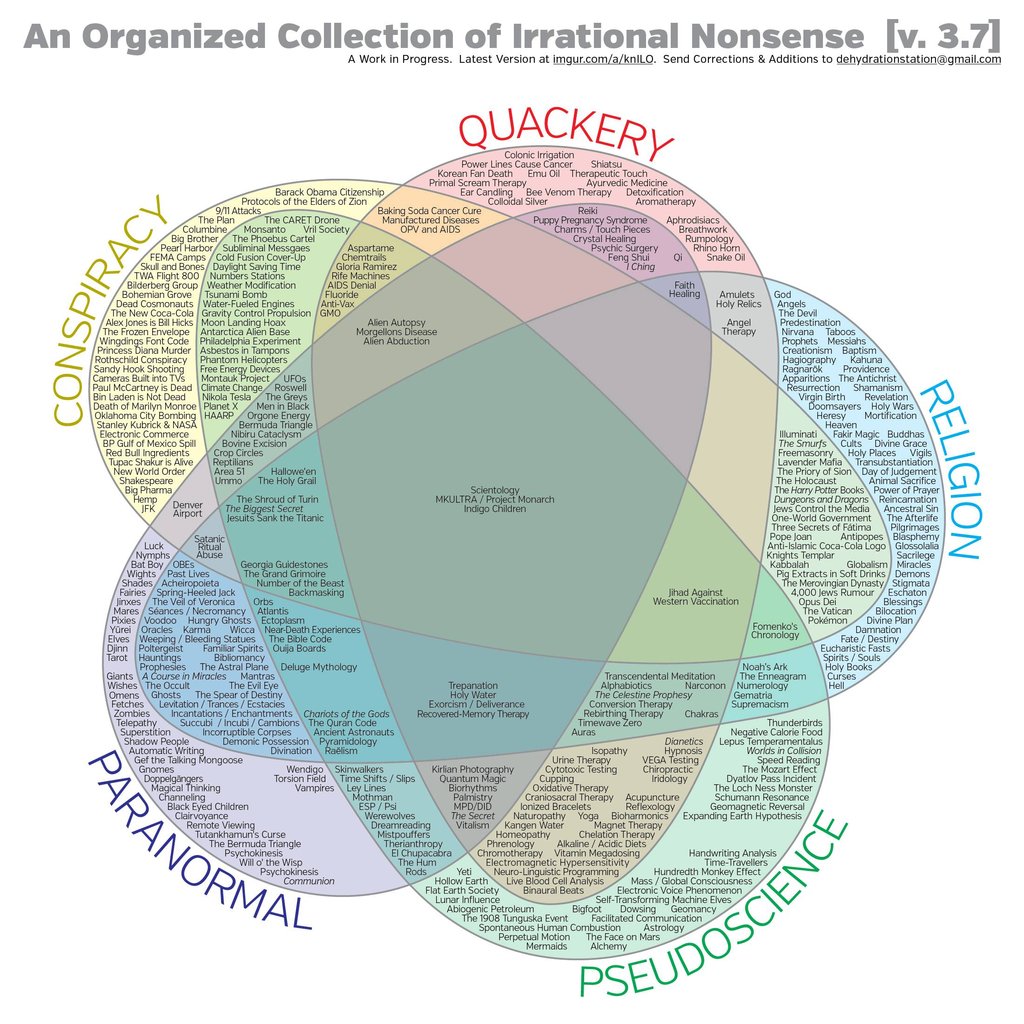
The Venn Diagram of Irrational Nonsense
by Crispian Jago
The curiously revered world of irrational nonsense has seeped into almost every aspect of modern society and is both complex and multifarious. Therefore rather than attempt a comprehensive taxonomy, I have opted instead for a gross oversimplification and a rather pretty Venn Diagram.
In my gross over simplification the vast majority of the multitude of evidenced-free beliefs at large in the world can be crudely classified into four basic sets or bollocks. Namely, Religion, Quackery, Pseudoscience and the Paranormal.
However as such nonsensical beliefs continue to evolve they become more and more fanciful and eventually creep across the bollock borders. Although all the items depicted on the diagram are completely bereft of any form of scientific credibility, those that successfully intersect the sets achieve new heights of implausibility and ridiculousness. And there is one belief so completely ludicrous it successfully flirts with all forms of bollocks.
Religious Bollocks ∩ Quackery Bollocks ∩ Pseudoscientific Bollocks ∩ Paranormal Bollocks = Scientology
*****************
UPDATE 24th March 2013
Many thanks for the retweets and shares.
I have also received the first translated copy of the Venn Diagram produced by Pavle Močilac of the Croatian Society for Promotion of Science and Critical Thinking.
Italian translation courtesy of Andrea Mirra
Spanish translation via @Cienciaaldía
If I receive any other translations I shall post them here with the original.
BTW, Its been awfully nice to have seen the Diagram popping up all over the interwebs in the last few days, but if you could so kind as to link back to here you'll be sure to have the latest version in case I make any updates.
FURTHER UPDATE 27th March
I conceived the Venn Diargram of Irrational Nonsense in the car on my way home from work last Wednesday, and quickly knocked it up when I got home. However, I didn't publish it immediatley as I was pondering the feasability of adding a fifth set.
I spent a few hours the following night attempting to add a fifth set, but the diagram was getting cluttered and the fonts too small, so eventually I reluctantly abondened the five set version and posted the original four set version from the previous night.
I have however, seen a fair few comments suggesting that the diagram might benefit from a conspiracy theorist dimension, however, before I've had a chance to have another crack at it, I noticed dehydrationstation has beaten me to it. I think it came out OK.(although I would have used the word "bollocks" a bit more myself.
Russian Sledges, Zione_04 and one other like this
24 Mar 15:20
Supercut of all the alternate endings to the Animaniacs theme
by Cory Doctorow
Here's TammieRD's compilation of all the alternate endings to the Animaniacs theme song, each better than the last. As I mentioned before the complete seasons 1-3 DVDs are a huge hit around our house. Really some of the best kids' (and grownups') TV of the last century.
Animaniacs alternate theme song lyrical endings
(Thanks, Fipi Lele!)
Russian Sledges, firehose and one other like this

24 Mar 15:18
Left-wing stranglehold on academia
by thuudung
Neil Gross has gathered the data, and now the results are in. College professor is the most-liberal occupation in America. Surprised, right?… more»
24 Mar 13:46
"How a TV Show Episode Gets Written" - A PSA
Hey everyone - So if you’re following me, you know that I’m not really a ‘fandom’ guy; more of a ‘casual viewer’, hence why I don’t post fandom-related things very often.
However! I was having a conversation with Octoswan yesterday, who is an active member of the Tumblr-SPN community, about a lot of the drama going on with y’all lately and I checked out some of the posts related to said drama. I noticed that, in many cases, there were a lot of accusations and questions being thrown around about “the writers.”
“Do the writers just not know how to write women??”
“Why do the writers think that there always needs to be a romance??”
“Why do the writers…?”
And so on. What I started to notice was that there was a trend of blaming the writers for the problems that fans are having with the show or the direction it’s going, or for ‘baiting’ the fans in various ways, so as a screenwriter working in the industry (if not on SPN) I wanted to clear up a few misconceptions and notions about how a TV show episode gets written.
This is right on the money, so everyone who’s curious about this process should read this post and acquire a basic understanding. (NB that in European series production there may be slight differences, as the “writer’s room” concept is not as widely liked / accepted here; but the basic reality — that the producers decide what they want to happen in a series, and the writers execute that vision — remains.)
firehose likes this
24 Mar 13:42
Lovable Things → The smell of old books
firehoseappreciate your books
friendzone your books


firehose likes this
24 Mar 13:37
Little Cat Demonstrates Phenomenal Climbing Skills
Russian Sledges, firehose likes this
24 Mar 13:04
Block users from following or commenting – Customer Feedback for The Old Reader
firehoseplease
firehose, Russian Sledges and -1 others like this
24 Mar 05:40
How the Digital Millennium Copyright Act punishes people with disabilities
by Cory Doctorow
Blake E. Reid's "The Digital Millennium Copyright Act Is Even Worse Than You Think" is a potted history of the ways that the US Digital Millennium Copyright Act (DMCA) has confounded the efforts of disability-rights groups to make media more accessible to people with various disabilities. The Copyright Office holds hearings every three years to establish temporary exemptions to the DMCA, but this has been totally inadequate as a way of dealing with this problem:
I’m a teaching fellow and staff attorney at Georgetown Law’s Institute for Public Representation clinic, where I work on media and accessibility issues. In 2011, my students and I filed a new exemption request on behalf of the nonprofit TDI (which advocates for equal media access for people who are deaf or hard of hearing) to allow researchers to develop advanced closed captioning and video description features to help make video programming more accessible—development hindered by the DMCA. (Gallaudet University and the Participatory Culture Foundation also signed the petition.) Crowdsourcing, customized user interfaces, error correction, and other innovations could help realize the goal of equal access to video programming on the Internet—a goal enshrined by Congress and President Obama in the 21st Century Communications and Video Accessibility Act of 2010.
But our proposal faced opposition from a coalition of copyright lobbyists who insisted, for example, that errors in closed captions were a “mere inconvenience” to people with disabilities and that developing accessibility features might even constitute copyright infringement. In the end, the librarian issued an exemption, but it was so riddled with caveats that it was difficult to identify precisely what accessibility research it was intended to enable, if any.
We also proposed a general exemption for accessibility technology, urging the librarian to take action in light of the widespread and demonstrated negative impact of the DMCA on the ability for people with disabilities to experience copyrighted works on equal terms. The Copyright Office did not even solicit comment on the proposal, and the librarian effectively ignored it.
Requiring nonprofit disability groups to ask permission from the government every three years and navigate a complex legal minefield to implement urgently needed accessibility technology is not compatible with progressive, conservative, or libertarian values; the goal of equal access for people with disabilities; or common sense. Even the librarian admitted in 2010 that the DMCA exemption process “is at best ill-suited to address the larger challenges of access.”
Especially poignant is the closing quote from Helen Keller: "Literature is my Utopia. Here I am not disenfranchised. No barrier of the senses shuts me out from the sweet, gracious discourse of my book-friends."
The Digital Millennium Copyright Act Is Even Worse Than You Think
(via Freedom to Tinker)
firehose, Luke.stirling and -1 others like this
24 Mar 05:39


Overheard On The Subway: The Coolest Conversation Ever Between Two Dads With Gay Sons
by Dan Avery
 New York blogger Rafi D’Angelo recently overheard a conversation on the subway between two “construction- worker types” who discovered they had something in common.
“I’ve been doing this for about six months now, trying to catch interesting things on the subway,” posted D’Angelo. “But I haven’t had any luck so far because I ride boring trains. Today was good, though.”
Guy #1: “My wife wants me to get fixed like a dog but I don’t see why she can’t just keep taking the pill.”
Guy #2: No more kids for you two?
Guy #1: No, she figures we’re both getting too old for a baby.
Guy #2: How is your boy anyway? Haven’t seen him in awhile.
Guy #1: Oh John’s good, pitching this year varsity.
Guy #2: He’ll definitely have the girls hanging around him now.
Guy #1: Yeah if he had any time for them.
Guy #2: Focused on baseball?
Guy #1: Focused on boys.
Guy #2: You’re shittin’ me!
Guy #1: I kid you not. Came out to me and Mary Ann bold as daylight last year.
Guy #2: Well I’ll be damned! I’m not supposed to know it but I overheard Patrick Jr. tell his sister he might be gay not two months ago.
Guy #1: We all saw that coming though.
Guy #2: You’re the second person to say that. How’d everybody see it but me?
Guy #1: It was just a feeling, Pat. He was always a little soft, ya know?
Guy #2: I guess you’re right. But damn Charlie, we both have gay kids. What do we do now? Both our sons are gay.
Guy #1: We don’t do anything. We let em be gay and if some kid calls ‘em a faggot we go to their house and raise hell with the parents like normal.
Guy #2: Well I guess John and Lucinda won’t be getting together like we thought awhile ago.
Guy #1: Guess not.
**long pause**
Guy #2: Hey Charlie, you thinkin’ what I’m thinkin’?
Guy #1: I was for about half-a-second then it got weird and I started thinkin’ about somethin’ else instead.
The future is here, folks.
Gustavo Eulalio and -1 others like this
24 Mar 05:36

Why Ruby?
I've been a Microsoft developer for decades now. I weaned myself on various flavors of home computer Microsoft Basic, and I got my first paid programming gigs in Microsoft FoxPro, Microsoft Access, and Microsoft Visual Basic. I have seen the future of programming, my friends, and it is terrible CRUD apps running on Wintel boxes!
Of course, we went on to build Stack Overflow in Microsoft .NET. That's a big reason it's still as fast as it is. So one of the most frequently asked questions after we announced Discourse was:
Why didn't you build Discourse in .NET, too?
Let me be clear about something: I love .NET. One of the greatest thrills of my professional career was getting the opportunity to place a Coding Horror sticker in the hand of Anders Hejlsberg. Pardon my inner fanboy for a moment, but oh man I still get chills. There are maybe fifty world class computer language designers on the planet. Anders is the only one of them who built Turbo Pascal and Delphi. It is thanks to Anders' expert guidance that .NET started out such a remarkably well designed language – literally what Java should have been on every conceivable level – and has continued to evolve in remarkably practical ways over the last 10 years, leveraging the strengths of other influential dynamically typed languages.
All that said, it's true that I intentionally chose not to use .NET for my next project. So you might expect to find an angry, righteous screed here about how much happier I am leaving the oppressive shackles of my Microsoft masters behind. Free at last, free at least, thank God almighty I'm free at last!
Sorry. I already wrote that post five years ago.
Like any pragmatic programmer, I pick the appropriate tool for the job at hand. And as much as I may love .NET, it would be an extraordinarily poor choice for an 100% open source project like Discourse. Why? Three reasons, mainly:
-
The licensing. My God, the licensing. It's not so much the money, as the infernal, mind-bending tax code level complexity involved in making sure all your software is properly licensed: determining what 'level' and 'edition' you are licensed at, who is licensed to use what, which servers are licensed... wait, what? Sorry, I passed out there for a minute when I was attacked by rabid licensing weasels.
I'm not inclined to make grand pronouncements about the future of software, but if anything kills off commercial software, let me tell you, it won't be open source software. They needn't bother. Commercial software will gleefully strangle itself to death on its own licensing terms.
-
The friction. If you want to build truly viable open source software, you need people to contribute to your project, so that it is a living, breathing, growing thing. And unless you can download all the software you need to hack on your project freely from all over the Internet, no strings attached, there's just … too much friction.
If Stack Overflow taught me anything, it is that we now live in a world where the next brilliant software engineer can come from anywhere on the planet. I'm talking places this ugly American programmer has never heard of, where they speak crazy nonsense moon languages I can't understand. But get this. Stand back while I blow your mind, people: these brilliant programmers still code in the same keywords we do! I know, crazy, right?Getting up and running with a Microsoft stack is just plain too hard for a developer in, say, Argentina, or Nepal, or Bulgaria. Open source operating systems, languages, and tool chains are the great equalizer, the basis for the next great generation of programmers all over the world who are going to help us change the world.
-
The ecosystem. When I was at Stack Exchange we strove mightily to make as much of our infrastructure open source as we could. It was something that we made explicit in the compensation guidelines, this idea that we would all be (partially) judged by how much we could do in public, and try to leave behind as many useful, public artifacts of our work as we could. Because wasn't all of Stack Exchange itself, from the very first day, built on your Creative Commons contributions that we all share ownership of?
You can certainly build open source software in .NET. And many do. But it never feels natural. It never feels right. Nobody accepts your patch to a core .NET class library no matter how hard you try. It always feels like you're swimming upstream, in a world of small and large businesses using .NET that really aren't interested in sharing their code with the world – probably because they know it would suck if they did, anyway. It is just not a native part of the Microsoft .NET culture to make things open source, especially not the things that suck. If you are afraid the things you share will suck, that fear will render you incapable of truly and deeply giving back. The most, uh, delightful… bit of open source communities is how they aren't afraid to let it "all hang out", so to speak.
So as a result, for any given task in .NET you might have – if you're lucky – a choice of maybe two decent-ish libraries. Whereas in any popular open source language, you'll easily have a dozen choices for the same task. Yeah, maybe six of them will be broken, obsolete, useless, or downright crazy. But hey, even factoring in some natural open source spoilage, you're still ahead by a factor of three! A winner is you!
As I wrote five years ago:
I'm a pragmatist. For now, I choose to live in the Microsoft universe. But that doesn't mean I'm ignorant of how the other half lives. There's always more than one way to do it, and just because I chose one particular way doesn't make it the right way – or even a particularly good way. Choosing to be provincial and insular is a sure-fire path to ignorance. Learn how the other half lives. Get to know some developers who don't live in the exact same world you do. Find out what tools they're using, and why. If, after getting your feet wet on both sides of the fence, you decide the other half is living better and you want to join them, then I bid you a fond farewell.I no longer live in the Microsoft universe any more. Right, wrong, good, evil, that's just how it turned out for the project we wanted to build.
However, I'd also be lying if I didn't mention that I truly believe the sort of project we are building in Discourse does represent most future software. If you squint your eyes a little, I think you can see a future not too far in the distance where .NET is a specialized niche outside the mainstream.
But why Ruby? Well, the short and not very glamorous answer is that I had narrowed it down to either Python or Ruby, and my original co-founder Robin Ward has been building major Rails apps since 2006. So that clinched it.
I've always been a little intrigued by Ruby, mostly because of the absolutely gushing praise Steve Yegge had for the language way back in 2006. I've never forgotten this.
For the most part, Ruby took Perl's string processing and Unix integration as-is, meaning the syntax is identical, and so right there, before anything else happens, you already have the Best of Perl. And that's a great start, especially if you don't take the Rest of Perl.
But then Matz took the best of list processing from Lisp, and the best of OO from Smalltalk and other languages, and the best of iterators from CLU, and pretty much the best of everything from everyone.
And he somehow made it all work together so well that you don't even notice that it has all that stuff. I learned Ruby faster than any other language, out of maybe 30 or 40 total; it took me about 3 days before I was more comfortable using Ruby than I was in Perl, after eight years of Perl hacking. It's so consistent that you start being able to guess how things will work, and you're right most of the time. It's beautiful. And fun. And practical.
Steve is one of those polyglot programmers I respect so much that I basically just take whatever his opinion is, provided it's not about something wacky like gun control or feminism or T'Pau, and accept it as fact.
I apologize, Steve. I'm sorry it took me 7 years to get around to Ruby. But maybe I was better off waiting a while anyway:
-
Ruby is a decent performer, but you really need to throw fast hardware at it for good performance. Yeah, I know, interpreted languages are what they are, and caching, database, network, blah blah blah. Still, we obtained the absolute fastest CPUs you could buy for the Discourse servers, 4.0 Ghz Ivy Bridge Xeons, and performance is just … good on today's fastest hardware. Not great. Good.
Yes, I'll admit that I am utterly spoiled by the JIT compiled performance of .NET. That's what I am used to. I do sometimes pine away for the bad old days of .NET when we could build pages that serve in well under 50 milliseconds without thinking about it too hard. Interpreted languages aren't going to be able to reach those performance levels. But I can only imagine how rough Ruby performance had to be back in the dark ages of 2006 when CPUs and servers were five times slower than they are today! I'm so very glad that I am hitting Ruby now, with the strong wind of many solid years of Moore's law at our backs.
-
Ruby is maturing up nicely in the 2.0 language release, which happened not more than a month after Discourse was announced. So, yes, the downside is that Ruby is slow. But the upside is there is a lot of low hanging performance fruit in Ruby-land. Like.. a lot a lot. On Discourse we got an across the board 20% performance improvement just upgrading to Ruby 2.0, and we nearly doubled our performance by increasing the default Ruby garbage collection limit. From a future performance perspective, Ruby is nothing but upside.
-
Ruby isn't cool any more. Yeah, you heard me. It's not cool to write Ruby code any more. All the cool people moved on to slinging Scala and Node.js years ago. Our project isn't cool, it's just a bunch of boring old Ruby code. Personally, I'm thrilled that Ruby is now mature enough that the community no longer needs to bother with the pretense of being the coolest kid on the block. That means the rest of us who just like to Get Shit Done can roll up our sleeves and focus on the mission of building stuff with our peers rather than frantically running around trying to suss out the next shiny thing.
And of course the Ruby community is, and always has been, amazing. We never want for great open source gems and great open source contributors. Now is a fantastic time to get into Ruby, in my opinion, whatever your background is.
(However, It's also worth mentioning that Discourse is, if anything, even more of a JavaScript project than a Ruby on Rails project. Don't believe me? Just go to try.discourse.org and view source. A Discourse forum is not so much a website as it is a full-blown JavaScript application that happens to run in your browser.)Even if done in good will and for the best interests of the project, it's still a little scary to totally change your programming stripes overnight after two decades. I've always believed that great programmers learn to love more than one language and programming environment – and I hope the Discourse project is an opportunity for everyone to learn and grow, not just me. So go fork us on GitHub already!
| [advertisement] Hiring developers? Post your open positions with Stack Overflow Careers and reach over 20MM awesome devs already on Stack Overflow. Create your satisfaction-guaranteed job listing today! |
Anton Dubenchuk, Dsamojlenko and one other like this
24 Mar 05:32


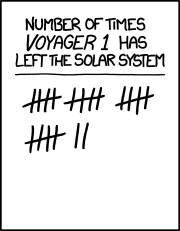
We Have a Solution!
Submitted by: Unknown
Russian Sledges, firehose and -1 others like this
24 Mar 05:32
 With spring here for half of us, it's time to start thinking about planting a garden. It's never as easy as it sounds, but Sprout It is a webapp that guides you through the best time to plant those vegetables depending on where you are. More »


Sprout It Guides You Through the Best Time to Plant Vegetables
by Thorin Klosowski
With spring here for half of us, it's time to start thinking about planting a garden. It's never as easy as it sounds, but Sprout It is a webapp that guides you through the best time to plant those vegetables depending on where you are. More »
joaocosta_pt, Nellynette Torres Ramirez and one other like this
24 Mar 05:30

Interactive: Common chord progressions in 1,300 songs
by Nathan Yau
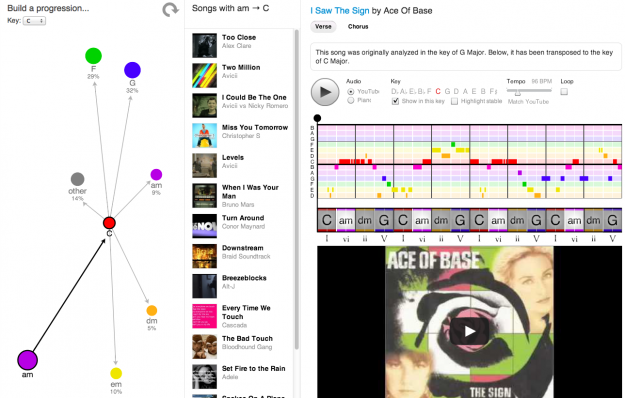
If you listen to the radio long enough, you've probably noticed that many songs sound similar or remind of you of a song you've heard before. Hooktheory shows you just how similar some songs are via chord progressions in over 1,300 songs. The small group analyzed the data last year and presented some static charts, but this interactive version takes it a step further.
Simply start by selecting a chord in the network diagram. Songs that use that chord appear on the right. Then select another chord in the network diagram to find songs that use the chord progression from the original to the new. Keep selecting chords to filter further.
So in the end, there are two main things you can do: (1) Find songs that use the same chord progression and (2) see the most likely chord given the current selection.
My musical knowledge from middle school jazz band is long gone, but it's fun to explore, and you'll likely find relationships to songs that you didn't expect. [Thanks, Dave]
Idsardi, Russian Sledges and 5 others like this
24 Mar 05:28
 The full voice cast of the original DuckTales cartoon will reprise their respective roles for the newly announced nostalgiapocalypse DuckTales Remastered, Capcom senior vice-president Christian Svensson revealed in a Capcom Unity forum thread yesterday.
"We have ALL the original voice actors from the show," Svensson said, including Scrooge voice actor Alan Young, who "still came into the studio and did his thing like a pro. The voice work really adds a lot to the package."
"Scrooge's voice actor," as a quick aside, is a man named Alan Young, who's been in the entertainment industry since the 1940s. Before he endeared himself to the hearts of millions as a penny-pinching old duck, Young's original claim to fame was as Wilbur Post, the star of Mister Ed. We wonder if Young knew at the time that talking animals would become a running theme for his 70-odd years in show business?
Update: Joystiq has been contacted by a representative for Alan Young, who clarified the details of Mr. Young's entertainment career.
Original voice actors return for DuckTales Remastered
by Jordan Mallory
The full voice cast of the original DuckTales cartoon will reprise their respective roles for the newly announced nostalgiapocalypse DuckTales Remastered, Capcom senior vice-president Christian Svensson revealed in a Capcom Unity forum thread yesterday."We have ALL the original voice actors from the show," Svensson said, including Scrooge voice actor Alan Young, who "still came into the studio and did his thing like a pro. The voice work really adds a lot to the package."
"Scrooge's voice actor," as a quick aside, is a man named Alan Young, who's been in the entertainment industry since the 1940s. Before he endeared himself to the hearts of millions as a penny-pinching old duck, Young's original claim to fame was as Wilbur Post, the star of Mister Ed. We wonder if Young knew at the time that talking animals would become a running theme for his 70-odd years in show business?
Update: Joystiq has been contacted by a representative for Alan Young, who clarified the details of Mr. Young's entertainment career.
 Original voice actors return for DuckTales Remastered originally appeared on Joystiq on Sat, 23 Mar 2013 14:30:00 EST. Please see our terms for use of feeds.
24 Mar 05:26
Filed under: security hacks


HTML link tag hack sends you to the wrong place
by Mike Szczys
firehosegreat

We consider ourselves fairly cautions Internet warriors. We know when to watch out for malicious links and tread lightly during those times. But this hack will still bite even the most cautions of link followers. It’s a hack that changes where a link is sending you after you click on it.
The concept is driven home right away by a link in the post which lists PayPal as the target when you hover over it with your mouse. Clicking on it will give you a warning that it could have been a malicious page you were redirected to. Of course the address line of the page shows that you were sent somewhere else, but it’s still an interesting issue. The hack is accomplished with just a few lines of JavaScript. In fact, the original example was 100 characters but a revision boils that down to just 67.
So who’s vulnerable to this kind of thing? It sounds like everyone that’s not using the Opera browser, which has been patched against the exploit. There are also some updates at the bottom of the post which mention that Firefox has been notified about it and Chrome is working on a patch.
[via Reddit]
Filed under: security hacks
24 Mar 05:25

XCOM: Enemy Unknown was just announced for iPad and iPhone during a PAX East panel.
"It is a straight port. We have not made any gameplay exceptions," XCOM: Enemy Unknown Lead Designer Jake Solomon told us. "You play the exact same game [as on PC or consoles], it's just now fully playable on an iPhone or an iPad."
Asked about the game's pricing, Solomon wouldn't give specifics, saying, "It's going to be priced appropriately for what it is. It's going to be a premium price point. It is the game. It is the full game."
In case you're looking for a definition of "premium" on iOS, expect to be more than $1 and probably push the limits like The Walking Dead does at $15.
The game should be out by summer. We've been told it will not include the Slingshot pack downloadable content, however the Elite Soldier DLC will be included. Meanwhile, the free Second Wave update has not yet been ruled out.
XCOM: Enemy Unknown announced for iOS
by Alexander Sliwinski
firehoseohhhhh shiiiiiit
"It is a straight port. We have not made any gameplay exceptions."
XCOM: Enemy Unknown was just announced for iPad and iPhone during a PAX East panel.
"It is a straight port. We have not made any gameplay exceptions," XCOM: Enemy Unknown Lead Designer Jake Solomon told us. "You play the exact same game [as on PC or consoles], it's just now fully playable on an iPhone or an iPad."
Asked about the game's pricing, Solomon wouldn't give specifics, saying, "It's going to be priced appropriately for what it is. It's going to be a premium price point. It is the game. It is the full game."
In case you're looking for a definition of "premium" on iOS, expect to be more than $1 and probably push the limits like The Walking Dead does at $15.
The game should be out by summer. We've been told it will not include the Slingshot pack downloadable content, however the Elite Soldier DLC will be included. Meanwhile, the free Second Wave update has not yet been ruled out.
XCOM: Enemy Unknown announced for iOS originally appeared on Joystiq on Sat, 23 Mar 2013 17:30:00 EST. Please see our terms for use of feeds.
24 Mar 05:25

The Civilization 5: Brave New World expansion has been given a launch date of July 9 for North America, July 12 internationally.
During today's Firaxis PAX East panel, the team also announced that the game will feature XCOM squads as late-game units. The units are paratroopers who can drop in 40 units away (delivered by Skyranger), the standard is 9. Would you expect any less from the elite squad of humanity's last hope?


Civilization 5: Brave New World launches in July, XCOM units playable
by Alexander Sliwinski
firehosewhat
The Civilization 5: Brave New World expansion has been given a launch date of July 9 for North America, July 12 internationally.
During today's Firaxis PAX East panel, the team also announced that the game will feature XCOM squads as late-game units. The units are paratroopers who can drop in 40 units away (delivered by Skyranger), the standard is 9. Would you expect any less from the elite squad of humanity's last hope?
Gallery: Civilization V - Brave New World
Civilization 5: Brave New World launches in July, XCOM units playable originally appeared on Joystiq on Sat, 23 Mar 2013 17:54:00 EST. Please see our terms for use of feeds.
24 Mar 05:24
Nokia Officially Lists Patents Google's VP8 Allegedly Infringes
by timothy
firehoseNOKIA!
An anonymous reader writes "Google just settled video codec patent claims with MPEG LA and its VP8 format, which it wants to be elevated to an Internet standard, already faces the next round of patent infringement allegations. Nokia submitted an IPR declaration to the Internet Engineering Task Force listing 64 issued patents and 22 pending patent applications it believes are essential to VP8. To add insult to injury, Nokia's declaration to the IETF says NO to royalty-free licensing and also NO to FRAND (fair, reasonable and non-discriminatory) licensing. Nokia reserves the right to sue over VP8 and to seek sales bans without necessarily negotiating a license deal. Two of the 86 declared IPRs are already being asserted in Mannheim, Germany, where Nokia is suing HTC in numerous patent infringement cases. A first VP8-related trial took place on March 8 and the next one is scheduled for June 14. In related Nokia-Google patent news, the Finns are trying to obtain a U.S. import ban against HTC to force it to disable tethering (or, more likely, to pay up)." 


Read more of this story at Slashdot.
24 Mar 05:24
Filed under: 3d Printer hacks, chemistry hacks


Smoothing 3D Prints with Acetone Vapor
by Eric Evenchick

If you’ve ever used an extruding 3D printer, you know that the resulting prints aren’t exactly smooth. At the Southackton hackerspace [James] and [Bracken] worked out a method of smoothing the parts out using vapor. The method involves heating acetone until it forms a vapor, then exposing ABS parts to the vapor. The method only works with ABS, but creates some good looking results.
Acetone is rather flammable, so the guys started out with some safety testing. This involved getting a good air to fuel mixture of acetone, and testing what the worst case scenario would be if it were to ignite. The tests showed that the amount of acetone they used would be rather safe, even if it caught fire, which was a concern several people mentioned last time we saw the method.
After the break, [James] and [Bracken] give a detailed explanation of the process.
Filed under: 3d Printer hacks, chemistry hacks
firehose likes this
24 Mar 05:23
 Humble Heart's 2012 XBLA debut Dust: An Elysian Tail is headed to Steam and could potentially be available as soon as next month, Polygon reports. The announcement was made by Dust designers Alex Kain and Dean Dodrill during a panel at PAX East, wherein Dodril explained that he isn't going to "do a whole lot different" with the PC port, being satisfied with the current experience.
Dodril also teased the possibility of a Dust 2 at some point in the future, with Kain adding that there is "no shortage" of ideas for a sequel.
Dust: An Elysian Tail coming to Steam
by Jordan Mallory
Humble Heart's 2012 XBLA debut Dust: An Elysian Tail is headed to Steam and could potentially be available as soon as next month, Polygon reports. The announcement was made by Dust designers Alex Kain and Dean Dodrill during a panel at PAX East, wherein Dodril explained that he isn't going to "do a whole lot different" with the PC port, being satisfied with the current experience.Dodril also teased the possibility of a Dust 2 at some point in the future, with Kain adding that there is "no shortage" of ideas for a sequel.
Dust: An Elysian Tail coming to Steam originally appeared on Joystiq on Sat, 23 Mar 2013 20:30:00 EST. Please see our terms for use of feeds.
24 Mar 05:23
KDE's Calligra Office Suite For Android Released
by timothy
jrepin writes "Coffice is a new project that tries to make KDE's Calligra office suite available on mobile platforms like Android, Blackberry 10, Jolla SailfishOS and Ubuntu Phone. Calligra already has some presence on smartphones, since document viewer on Nokia N9 is based on it. The first release brings Calligra Words viewer for OpenDocument Text documents and is currently available for Android only. Plans for later releases include viewers for spredsheets and presentations. Editing and saving as well as support for proprietary Microsoft Office formats are coming later." 


Read more of this story at Slashdot.
24 Mar 05:22

colchrishadfield: Venice, Italy - the red roofs and white docks...
Venice, Italy - the red roofs and white docks of the famed island city are visible from orbit.
firehose likes this
24 Mar 05:21


fiyerro: i’ve been angry about this for my entire life I...
i’ve been angry about this for my entire life
I wouldn’t say I ever got as far as anger, precisely, but it is One Of Those Damn Things.
firehose likes this


24 Mar 05:18
P.IM.P [Political Impermanence of Place] by Kekan Jeyifo
firehosenice pictures and best use of PIMP as an acronym


