Shared posts

04 Apr 18:52

Wireless Temperature Control for a Microbrewery

by Eric Evenchick

Wireless Temperature Control

When brewing your own beer, temperature control is important. If the temperature isn’t regulated correctly, the yeast will be killed when it’s added to the wort. It’s best to cool the wort from boiling down to about 25 C quickly before adding yeast.

To do this, [Kalle] came up with a wireless temperature controller for his home brewing setup. The device uses a heat exchanger to cool the wort. An ATmega88 connected to a H-bridge controls a valve that regulates flow through the heat exchanger. It reads the current temperature from a LM35 temperature sensor and actuates the valve to bring the wort to a set point.

A neat addition to the build is a wireless radio. The nRF24L01 module provides a wireless link to a computer. There’s an Android application which communicates with the computer, providing monitoring of the temperatures and control over the set point from anywhere [Kalle] can get an internet connection.


Filed under: beer hacks
04 Apr 18:52

The Freefarers Of Catan: Expanze Impressions

by Alec Meer

By Alec Meer on April 4th, 2013 at 7:00 pm.

The boardgame I’ve played the most times, by far, is Settlers of Catan – and that’s not something I expect to change by time I reach my deathbed. Sure, it’s obvious, but it’s also a sweetspot of strategy and competition, as early co-operation turns to bitter rivalry and even the merest mention of sheep can reduce grown adults to shivering balls of purest hatred. I gravitated towards Lukáš Beran’s free, boardgame-like Expanze, which made no secret of its Catanic ways, with mixed excitement and anxiety. Excitement: Catan! Anxiety: But is it just a cheap’n'nasty, slavish rip-off?

No, it isn’t. It’s based on Catan’s essential mechanics – the gathering of brick, wood, sheep, ore and wheat, and the spending of these on the expansion of your agrarian empire – but it goes off and does its own thing with them. Better still, it turns them into a surprisingly workable singleplayer game.

First impressions do suggest a straight-up Catan clone, but quickly you’re mucking around with new types of structures – Monasteries, Markets and Forts – which enable gathering, trading and building boons in addition to the more familiar roads and settlements. You’re also generating vast numbers of resources, able to wind up with, for example, hundreds of sheep in your corner, as opposed to the half dozen or so which characterise a more bounteous Catan hand. Building costs are in keeping with this – a town costs 30 of most resources and 60 of the rest, while you’ll need to rustle up 100 sheep and 30 corn for a Market. That’s probably not a terribly interesting fact to share – I guess I’m just amusing myself with the idea of turning up with a wheelbarrow full of sheep and asking if someone wants to swap them for some awning.

In singleplayer, trading rapidly becomes the key strategy: how much of something you’ve got decent amounts of are you prepared to exchange at a scandalous 4:1 rate for something you desperately need? And is better to spend/trade everything to try and hit the level’s objective as quickly as possible and hope the turn-timer doesn’t run out before you can make it all the way there, or to play the long game of gradually, expensively building the upgrades which turn exchange rates and resource generation hugely in your favour? The latter means enormous rewards, but with each level requiring the meeting of certain construction goals within an arbitrary amount of turns, it’s a hard fight to get to that point.

It’s well-designed, tight and challenging without being frustration. Those turn-counts might be arbitrary, but they seem very carefully arranged to ensure a little bit of sweating. Amazingly, I didn’t even once think ‘why am I playing a singleplayer version of a multiplayer game?’ as was the unfortunate case with Talisman Prologue, and that’s because Expanze has made its own rules to suit that structure, rather than attempted to brute-force someone else’s into something it was never designed for.


Ingame video – Indie DB

Presentation values are all over the shop unfortunately. It looks a bit Quake II, the menu text is in mangled English in a horrible font, and important concepts and features are barely introduced, let alone explained, but you’ll figure it yourself without too much weeping and screaming. I can’t begrudge it that given it’s free and in all other regards feels as thought it warrants a pricetag. I’m yet to try the multiplayer, though the occasional appearances in the campaign of rival ‘players’ lends a decent sense of the land-grab war I’d be in for there.

Expanze lacks the clean lines of logic and chance of Catan, but it spins off into its own game that merely evokes, rather than plagiarises, Klaus Teuber’s cardboard classic. Grab it for free from IndieDB, before the dev reverses his unwise decision to keep it freeware.

04 Apr 18:51

goddessofcheese: nathanthenerd: saffythegeek: elinious: found...

by experimentaltimeorder


goddessofcheese:

nathanthenerd:

saffythegeek:

elinious:

foundhergrail:

pjcalamity:

Luke Youngblood, the actor who played Lee Jordan in the HP Films,also plays the role of Magnitude in Community

OH MY GOD

um. 

04 Apr 18:48

Disney closes LucasArts

by Alexander Sliwinski
firehose

HOLY FUCKING SHIT

http://www.blogcdn.com/www.joystiq.com/media/2013/04/lucasartslogo.png Disney, which acquired Lucasfilm and LucasArts last year in a $4.05 billion deal, has shut down the legendary LucasArts division.

"After evaluating our position in the games market, we've decided to shift LucasArts from an internal development to a licensing model, minimizing the company's risk while achieving a broader portfolio of quality Star Wars games," Disney informed Game Informer in a statement. "As a result of this change, we've had layoffs across the organization. We are incredibly appreciative and proud of the talented teams who have been developing our new titles."

Although a Star Wars game factory in recent years, the publisher will be remembered for its work defining the adventure genre from the '80s to the '90s, on such titles as Maniac Mansion, The Secret of Monkey Island, Grim Fandango and Day of the Tentacle. The soul of those games and that era moved on from the company after the departure of Ron Gilbert and Double Fine's Tim Schafer.

The last announced LucasArts project was Star Wars 1313, but rumors have circulated for months about the action-adventure's halted development. The fate of Star Wars: First Assault, a multiplayer shooter, has been just as unclear.

As for Disney, the company is all-in on Disney Infinity and mobile games, having shut down the last of its core developers.

JoystiqDisney closes LucasArts originally appeared on Joystiq on Wed, 03 Apr 2013 13:29:00 EST. Please see our terms for use of feeds.

Permalink | Email this | Comments
04 Apr 18:31

The CG Captain Harlock movie still looks completely badass, if you were wondering

by Rob Bricken

A second trailer for Toei's phenomenal-looking Space Pirate Captain Harlock movie has arrived, and man, I cannot wait until this movie arrives in Japanese theaters this fall so someone can license the damn thing and bring it to America. Hey, if loving a spaceship with a giant skull on the front ramming into another spaceship is wrong, I don't wanna be right.

Read more...


04 Apr 18:29

Huey Lewis as Doubles Guy

by Don
Fullsize

Huey Lewis and Weird Al remake a scene from the 1991 horror film American Psycho.

04 Apr 18:25

Music: Newswire: Prince serves Vine with a DMCA notice, isn't okay with even micro-clips of his songs being online

by Marah Eakin

Prince might be down with Jesus, but he’s not down with Vine. Twitter, who owns the micro-video app, has been served with a DMCA copyright complaint from NPG Records, the label owned by the purple rocker. NPG asked that eight six-second video clips posted on Vine be taken down, claiming they contained “unauthorized recordings” and “unauthorized synchronizations”—which basically means that a tiny bit of Prince’s music could be heard somewhere in the clip. Twitter complied with the request, and the videos were removed from Vine.

This isn’t Prince’s first go-around with DMCAs. The artist is notorious for using them, and even issued a statement in 2007 saying that, no matter the content of the video, it’s “a matter of principle” that no one should be able to use his music without his consent. He's even said that no one should be able to ...

Read more
04 Apr 18:25

Games: Great Job, Internet!: These Super Mario Bros. transit maps will take your commute to the next level

by John Potter

As if the sometimes-perilous world of public transportation didn’t already threaten to push the limits of the surreal, Super Mario Bros. 3-style transit maps are here to add the possibility of sprouting a raccoon tail and ears.

Dave’s Geeky Ideas blogger Dave Delisle has Mario-ized public-transit maps of several North American metro areas, including Portland, Washington, D.C., the Bay Area (Mario Kart-style!), Vancouver, Calgary, Montreal, and Toronto. Inspired by Delisle, ChicagoNow’s Robert Bacon also designed a CTA version.

So, if your area’s not yet represented, and you’ve got the talent and the time—good God, so much time—maybe you can whip one up yourself. Just don’t forget to hold “down” on the arrow pad until you can walk behind your city’s buildings to get the Warp Whistle. Obviously.  

Read more
04 Apr 18:23

Games: The Gameological Society: Frog Fractions and the problem of defying players’ expectations a second time

by Drew Toal
Feature: Frog Fractions

We live in the age of the sequel. We’ll pay $13 for a ticket to a Spider-Man “reboot” less than 10 years after Tobey Maguire first strapped on the spandex. Any video game that sells more than a dozen copies is fast-tracked for the “franchise” treatment. But Frog Fractions may be the one un-sequel-able game.

The game’s title screen promises an unremarkable edutainment vehicle, something in mold of Where In The World Is Carmen Sandiego? or Number Munchers. You control a frog on a lily pad, and your tongue shoots like a laser into oncoming swarms of insects, slurping them into your bottomless frog stomach. Each bug caught reveals a new fraction, but the fraction’s effect on the game or score is unclear. And there are other odd elements of questionable educational value—the game tracks a tally of something called “zorkmids,” there is a meter measuring ...

Read more
04 Apr 18:22

UK Police Say Goths Can Be Hate Crime Victims

If you punch a punk in Manchester, it could be a hate crime.
04 Apr 18:21

States With Weakest Firearm Laws Lead In Gun Deaths

Many states with the weakest firearms laws have the highest rates of gun-related homicides and suicides, according to a study released on Wednesday by a liberal think tank.
04 Apr 18:20

thisisevenharderthannamingablog: Fantastic Four #57 Surfer...


thisisevenharderthannamingablog:

Fantastic Four #57 Surfer visits Chez Doom

My guess is they’ll make it as far as the starter course before the Surfer quietly texts someone to ask them to call him and say that Galactus needs him to fry some other planet.

04 Apr 18:19

GDC 2013: A Worrisome, Hopeful Contradiction

by Nathan Grayson

By Nathan Grayson on April 3rd, 2013 at 9:00 pm.

RPS’s own wayward ronin word master Cara Ellison, during a post-convention victory dinner, put it best: “GDC is where we first hear about all the stuff everyone will be talking about next year.” Maybe it’s a trend-setter, or maybe it’s just a megaphone for gentle tickles of trends that are already in motion, but the point remains: GDC tends to be pretty indicative of where we’re at. People often view E3 in that light, but the fact is, it’s a dinosaur wreathed in fireworks, frilly undergarments, and little else. E3 is a projection. GDC has evolved into its opposite: introspection. We look inward, and then we discuss. And this year – thanks to things like the renewed prominence of PC gaming, a focus on indies, and the #1ReasonToBe talk – I came away quite optimistic. That warm feeling does not, however, come without some rather glaring caveats. Same-y looking “next-gen” games. The IGDA’s insulting use of scantily clad dancers. A worrisome gulf between triple-A and indie. For each positive, there was an ugly negative.

This year’s GDC in one word? Contradiction.

EA’s mid-GDC Battlefield 4 reveal event was really, really, really weird.

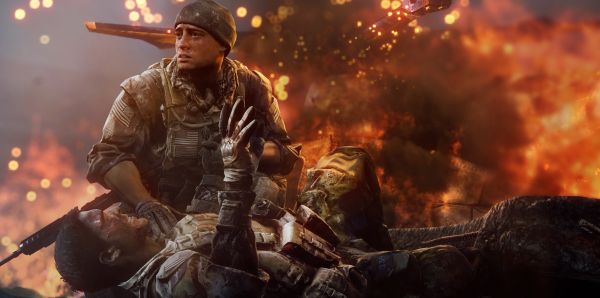
John and I stormed the San Francisco Metreon’s carpet-walled corridors, making snarky remarks about the excessive display for what, in actuality, amounted to a glorified gameplay trailer in a movie theater. Army men who looked like they were made of more plastic than tiny green army toys shot and shouted, and – Total Eclipse of the Heart gag aside – it all felt like business as usual. Then EA herded our thrumming crowd of journos off to an extravagant after-party, lights dimmed to the point of seduction – a cherry atop a slab of substance-lacking cake atop a sundae we didn’t really want in the first place. It all felt completely bizarre, like we’d stepped out of GDC proper and into a time machine.

It was, in other words, a triple-A game reveal. Thing is, earlier that day, I’d sat in on two separate talks about games that argued for more self-reflection in this exact genre. Other panels, meanwhile, discussed the merits of using novel game mechanics to tell more personal, specific stories or simply to make everyone’s brains implode. And don’t even get me started on how strange it felt to later that week attend Lost Levels – an outdoor picnic/un-conference focused on new ideas and inclusiveness – not even a block away from Battlefield 4′s old haunt. On one side: ruthlessly targeted status quo maintenance. On the other: eccentric idealists whose dreams were far too big for their wallets. If you follow the gaming industry, this probably isn’t particularly revelatory to you, but seeing these tidal waves crash into each other and – in some cases – publicly drown each other out was utterly striking.
Don’t get me wrong: I’m not arguing that wily indies are inherently superior to entrenched triple-A behemoths or anything like that. What I witnessed at GDC, however, was an industry characterized by borders. You’re either bombastically brainless entertainment or more modest, smaller-scale expression. Overlap is worrisomely rare, and its results are mixed.

But there is hope. It’s just that, like many forms of change, gaming’s ideological shift is proving extremely slow-moving, for many reasons. For instance, I asked Warren Spector point-blank, and he said large-scale development rarely leaves him with the time (or the will, for that matter) to play other games. And while he acknowledged that it’s a huge problem, he wasn’t able to conjure up a solution. Meanwhile, Spec Ops: The Line writer Walt Williams chalked it up to the bottom line. His game and others like it – whether due to slow-building narrative focus, mechanics, or some mixture of factors – simply haven’t sold well. Publishers, then, are often hesitant to greenlight more.

However, one of Witcher 3′s principle gameplay designers told me that, in the past couple of years, he’s turned to smaller games as his primary source of inspiration. Also, both Spector and Williams answered my questions while mobbed by chatty indies and students, exchanging various wisdoms, brewing up a brain storm that hummed electricity. Meanwhile, plenty of former triple-A devs gone indie – for example, the BioShock-tempered Fullbright Company and their brilliantly contemplative Gone Home – were in attendance, displaying comfortable confidence in their newly carved out middle ground. And of course, let’s not forget the elephant in the room: the (sadly console-only) Journey, which married small game experimentation with big budget production values to be met with critical acclaim, strong sales, and every award ever conceived – including the first annual “No But Seriously We’re Not Going To Give This One To Journey But Oh No We’re Doing It Anyway Hmmm Welp We Gave It Our Best Shot I Guess” award.

Where to from here, though? Well, I’m a-okay with gaming’s maddest hatters keeping largely to themselves, but I do think there’s room for something that lets creators break outside their normal boxes. Spec Ops’ Williams suggested a system more akin to Hollywood (which, admittedly, isn’t the healthiest industry itself these days), with box office dynamos still having leeway to cleanse their palettes on pet projects between major hits – sometimes via specialized studio divisions like Fox Searchlight. And it’s not hard to see (once again, only in console-land at the moment, unfortunately) something like Sony’s indie outreach program evolving to take on that role. The once-closed-off living room lord this year put the likes of Hotline Miami and Lone Survivor on a pedestal, which makes sense given that the PlayStation 4 is just a PC having a sleek, sexy identity crisis.

But there’s also the other side of gaming’s new equation: not the what or the who, but who it’s all for. Once again, GDC held a colossal mirror up to the industry and reflected progress, however slow. On one hand, big steps back only served to emphasize massive (though still very much in-progress) steps forward, with the Independent Game Developers Association getting swiftly reprimanded for alienating women via scantily clad dancing girls, stilt walkers, and stage performers. Meanwhile, panels like the brilliant #1ReasonToBe – which saw luminaries like Brenda Romero, Robin Hunicke, and RPS chum Leigh Alexander give one of the most important, impassioned talks of the entire show – and similarly themed panels from BioWare and Microsoft drew both cheers and tears.

It was, frankly, amazing to simply exist in that environment. After the #1Reason talk, hordes of people – men and women alike – rushed the stage to express gratitude. This wasn’t some targeted strike on all that longtime, exceedingly white/male gamers hold dear. It was a community no longer feeling excluded. Suffocating loneliness finally giving way to a little fresh air. Smiles, hugs, laughter. There was still plenty of hate (I got some for merely tweeting about the event; I can’t even imagine what fucking horrific nonsense the panelists had to deal with), but it felt like a hard-fought win. One battle in a long, nauseatingly drawn-out war, certainly, but that’s sometimes all it takes to turn a tide.

And while we could (and should, honestly, very soon) delve more deeply into the lack of similarly high-profile visibility for racial, queer, and other painfully marginalized issues, the big contradiction on this front involved blame and responsibility. Whose fault was the IGDA party debacle, which – to put things in perspective – saw a self-described advocacy group put this industry’s absolute worst foot forward, causing multiple talents including Brenda Romero and board of directors member Darius Kazemi to resign? Well, to hear the IGDA tell it, San-Francisco-based developer and partial party host Yetizen was entirely to blame. Yetizen, meanwhile, contends that the IGDA’s flubbing facts and it – for its part – hired “avid gamers, who happened to be models, to discuss gaming with the invited guests.” Uh-huh. Also, Brenda Romero’s apparently eeeeeeeeeeeeeevil and out to get them or something. I don’t even know anymore.

Here, let me solve the great mystery for you: both party-hosting parties screwed up. Everyone was wrong. Shock. That never happens all the damn time in the case of nearly every mistake made ever. But hastily hurling the buck into someone else’s hands – at the absolute best – makes you look like a complete coward and, at worst, stops the learning process dead in its tracks. Case in point: Yetizen has made the exact same incredibly dumb choice multiple years in a row. Despite this, the IGDA for some reason decided to get involved with them.

Gaming companies: accept responsibility, learn, and for the love of god or whomever else, don’t do this.

And yet, even in light of all sorts of back steps, side steps, and face-palm-worthy face-plants, I do think this year’s GDC represented forward motion. We still have all kinds of mountains to tear down, but we’re making real, tangible progress both in terms of what we create and who feels like they’re welcome at the table when we consume it. The real takeaway here? Now is not the time for pats on the back. The gaming industry has momentum. So let’s keep pushing. It’s a shame that GDC only brings this many brilliant people into the same building once per year, but eh, walls are overrated. So let’s bust them down year ’round.

How’s that for destructible cover, EA?

04 Apr 18:16

Super Spice Bros 2, Intense Old Spice Commercials to the Tune of the ‘Super Mario Bros.’ Video Game

by Kimber Streams

MowtenDoo has created “Super Spice Bros 2,” a video combining Terry Crews’ intense Old Spice commercials with the classic video game Super Mario Bros., to celebrate a landmark one million views on his previous video, “Super Spice Bros 64.”

via Geekologie

04 Apr 18:10

The Gorburger Show, Comedy Talk Show About a Blue Monster Who Interviews Musicians & Then Sometimes Eats Them

by Justin Page

The Gorburger Show” is a bizarre and comedic web-based talk show by The Warner Sound and Funny or Die. The show’s host is Gorburger, a blue man-eating monster (played by actor and comedian T.J. Miller) who interviews various well-known musicians. He sometimes, however, decides to actually go ahead and consume the musicians. You can view more episodes from Season 1 and 2 online.

Gorburger back invading your internet waves every Monday starting March 11th satisfying his blood lust, interviewing bands and not having sex with them because his genitalia is incompatible. This season’s guests include Flea, Mellowhype, Grouplove, Henry Rollins, Carson Daly, Andrew WK, King Tuff, Bleached, Wayne Coyne, Josh Homme, Jesse Hughes, this one guy named Jack Black.

Gorburger photo by Scott Beale

photo by Scott Beale

vine by Scott Beale

04 Apr 18:10

buriedluck: Look at that smug motherfucker. He’s the happiest...

firehose

year of the fox


buriedluck:

Look at that smug motherfucker. He’s the happiest damn thing on this planet.

04 Apr 18:09

Martin Luther King’s hotel room hours after he was shot,...


Martin Luther King’s hotel room hours after he was shot, Memphis, Tennessee. April 4, 1968.

04 Apr 18:09

MIT To End Open-Network Policy In Response To Recent Attacks

by samzenpus
firehose

oh man why do they want to declare a cracking war with MIT students

An anonymous reader writes "MIT announced that despite a long history of running an open network (so that any student can run a server on any port, without any questions asked), it will now end this policy due to recent denial-of-service attacks and gunman hoax. From a letter sent by Executive Vice President and Treasurer Israel Ruiz: 'I am deeply and personally committed to safeguarding our community, protecting our campus and securing our systems. Together with our colleagues dedicated to campus safety and security, with the support of senior academic leadership and in collaboration with the campus community, we are deploying all necessary resources to this effort. It will require the dedication of all of us to promote safety awareness, complete necessary emergency training, and adhere to reinforced cyber security guidelines. IS&T staff members are working with information technology (IT) leadership and partners across campus in making the changes described above. We continue to explore all opportunities to further strengthen our preparedness, and will communicate additional information as these plans evolve.'"

Share on Google+

Read more of this story at Slashdot.


04 Apr 18:08

Torchlight 2 in-house dev tool 'GUTS' released

by Jordan Mallory
Torchlight 2 inhouse dev tools 'GUTS' released Runic Games has released a consumer version of the internal development tools it used to build Torchlight 2. Dubbed "GUTS," the suite of tools allows the user to change everything "from item and skill balance, to level layouts, animations, quests, and much more," according to the game's official blog.

Mods created with GUTS can be shared online and also support multiplayer, sessions for which can be found in a separate "modded games lobby." The tool also includes a utility to help convert pre-existing mods into the new GUTS format.

As part of the GUTS addition, Torchlight 2 now features full Steam Workshop integration, allowing users to subscribe to (and subsequently receive automatic updates for) the mods they're particularly fond of. The full GUTS wiki can be found here, along with instructions for its installation.

JoystiqTorchlight 2 in-house dev tool 'GUTS' released originally appeared on Joystiq on Wed, 03 Apr 2013 23:59:00 EST. Please see our terms for use of feeds.

Permalink | Email this | Comments
04 Apr 18:03

RIP LucasArts: An Obituary

by John Walker
firehose

"I swear that they were still a company bursting with the potential to revive themselves. Everyone I spoke to there believed it. If only, it was said, there could be management who’d let it happen."

Rock Paper Shotgun Feature There will be friendship between our species forever.

By John Walker on April 4th, 2013 at 11:00 am.

It’s always genuinely sad when a game developer closes down. People lose jobs, many lives are affected, and the industry as a whole loses a degree of potential. But no news of a studio closing has ever brought me close to tears. The death of LucasArts, while perhaps inevitable to anyone following closely enough, has made me very sad indeed.

No developer has ever had such a wide-reaching, hobby-defining impact on my life.

It’s certainly the case that the developer has made little I’ve cared about in a very long while. The Monkey Island remakes were as close as they got to me in the last, what, decade probably. But even they were emblematic of what the studio was capable of, of how much the people working their cared about their projects, no matter how successful they might have been.

At a GDC gathering last week, I was chatting to a LucasArts employee I’ll obviously not name. For me, he captured the sense that so many had at LucasArts – he loved it there, and he loved the people he worked with there, but he was planning to hand in his notice in a couple of weeks. He was working on a project he couldn’t mention, but was incredibly excited about. Thrilled to be working on. (A game we’ll likely of course never even know the name of now.) But still feeling like his time there was done.

Churning through CEOs, constantly horrendously mismanaged, and cancelling so many projects as to become farcical, it’s a wonder that LucasArts kept going until 2013. Cranking out Star Wars licenses, or indeed cancelling numerous Star Wars licenses, it had certainly lost a significant portion of its heritage. But it never seemed to lose its potential. Whomever you spoke to there, they still had the drive, the sense of a history that pushed them forward. They had some of the best in the business in many areas, especially sound and voice recording, and it always felt like they could at any time turn themselves around.

But of course no matter their recent state, they were and always will be the studio that brought us Day Of The Tentacle, Sam & Max: Hit The Road, X-Wing Vs. TIE Fighter, Zak McKracken And The Alien Mindbenders, Indiana Jones And The Fate Of Atlantis, The Secret Of Monkey Island, Dark Forces, Grim Fandango, Full Throttle, Jedi Knight: Mysteries Of Sith, Maniac Mansion…

God, that’s a list of games.

The same studio in the same year gave us the incredible FPS Dark Forces, Tim Schafer classic Full Throttle, and adventure epic The Dig. That was some of 1995 for LucasArts. It’s a lineage the like of which gaming has never known since. This is who we’re losing.

These are games that defined my teenage years, and without question, defined gaming for me. I loved Dark Forces so much more than Doom – hell, you could talk to the monsters. Full Throttle may have been relatively short, and may have had racing sections, but it was an exceptional adventure game, packed with brilliant writing the likes of which the genre hadn’t seen before. And The Dig – I implore you to go back and play it again now. While its ending doesn’t quite match its potential, it’s an incredibly thoughtful, gentle and brilliantly paced game.

And clearly anyone alive for enough years will have a LucasArts game they wish to celebrate at immense length. Whether it’s the original X-Wing, or the peculiar god game Afterlife, or idiotic time wasted away on Indiana Jones Desktop Adventures, their genre-spanning genius reached everyone. It’s this that we’re losing now.

In the last few years I went back to many of their games for Eurogamer, finding that so many of them still stand out today. Here are my thoughts on Dark Forces, The Dig, Jedi Knight, Zak McKracken, Day Of The Tentacle, Armed & Dangerous, The Curse Of Monkey Island, Indiana Jones And The Fate Of Atlantis, and Escape From Monkey Island.

Yes, a look at their recent releases isn’t the most cheerful sight. A string of Star Wars prefixed titles stretches back for a decade, interrupted only by the peculiar misfire of Lucidity, an experimental platformer that never quite came together. For a new generation of gamers, that’s who LucasArts were – the Star Wars people, occasionally seeming to stumble on something decent, but mostly cashing in on the success of Clone Wars. And it seems their final release, their swansong, shall be Kinect Star Wars. It couldn’t be a more degrading end.

But I swear that they were still a company bursting with the potential to revive themselves. Everyone I spoke to there believed it. If only, it was said, there could be management who’d let it happen. Management confident enough to let a non-Star Wars licence make it through to release, and then remember to promote it when it got there. Management not resentful of a more successful past, willing to make the incredibly obvious moves of releasing their extraordinary catalogue of games for tablets and phones. Day Of The Tentacle on iOS is so stupidly clearly a sensible move, and yet one that was never taken. Damn, even getting their classic games onto Steam seemed to require juggernauts to drive them – and they absolutely always refused to speak about what they were hoping to get on there next, as if they were determined to flatten any excited buzz.

And now, in the hands of Disney – a company that couldn’t prove itself incapable of managing gaming more – LucasArts is gone forever. In a time when the adventure has revived itself, when digital distribution allows far smaller scale games to achieve big success, when people are desperate for that personal touch on the FPS, a studio – that with the correct management, the correct downscaling, and the important freeing of staff – could have taken such strong advantage of it all, is gone. No, of course they don’t have Schafer, Gilbert, Grossman, or Stemmle. But with their heritage, their IPs, and the passion of those still working there, it’s hard to believe the magic couldn’t be revived.

So goodbye, LucasArts. I bloody loved you. You were so damned important to me. You helped make 1988 to 1998 some of the most special years in gaming, and provided my childhood and teenage years with genuine joy. In truth, I was already missing you. I’ll miss you more now.

04 Apr 18:02

Frommer's guidebooks to live on as Google sells brand to founder

by Aaron Souppouris

Google has sold the rights to the Frommer's travel guidebook series to Arthur Frommer, the man that created the brand. The announcement means that the popular line of guides is safe for the foreseeable future — news broke recently that Google wasn't likely to continue publishing print editions. It's not clear how much of the content is included in the deal, as Google is using a lot of Frommer content on Google+ Local and Zagat. A spokesperson for Google told Skift it had "returned the Frommer’s brand to its founder" and is "licensing certain travel content to him," so Frommer may not have to start from scratch.

Arthur Frommer hasn't owned the rights to his eponymous guides for over 35 years. He sold up to publisher Simon & Schuster in 1977, and the brand changed hands several times before Google snapped it up last August for an undisclosed fee. Speaking with the Associated Press, Frommer said "it's a very happy time for me," adding that he will be publishing paper and e-book versions of the guides, as well as running the Frommers.com site.

04 Apr 18:01

Games: The Gameological Society: Dust off your plastic guitars—it’s time for our Ultimate Rock Band Set List

by The A.V. Club and Gameological Society Staff
The Ultimate Rock Band Set List

On Tuesday, the Harmonix studio released the final downloadable song for its Rock Band games—Don McLean’s “American Pie.” That ends a stretch of 281 weeks during which Harmonix steadily expanded the Rock Band library of songs with downloadable content (DLC). McLean’s tale of The Day The Music Died serves as a dignified capper to a music-game craze that—a mere five years ago—felt like it would never end. But as Harmonix and Activision (the publisher of the Guitar Hero series) flooded the market with plastic instruments and seemingly infinite variations on their games, players got weary, and the market fizzled.

Rock Band is still a hell of a lot of fun, though, so we’re paying tribute with our Ultimate Rock Band Set List. Contributors from The A.V. Club and The Gameological Society have chosen some of our favorite tracks from the library of 4 ...

Read more
04 Apr 18:00

Film: Movie Review: Upstream Color

by Scott Tobias
firehose

"Imagine an entire romantic subplot cut together with the elliptical cool of the hotel scene in Steven Soderbergh’s Out Of Sight, and that’s reasonably close to how it plays out, minus the sci-fi contortions."

also Malick comparisons and the phrase "many viewers have and will be baffled by it"

When Shane Carruth came out of nowhere—nowhere being the suburbs of Dallas, Texas—to win the 2004 Grand Jury Prize at Sundance with his exceptionally frugal brainteaser Primer, the story of its making got ahead of its significant accomplishment. And it was a great story: In the face of a still-nascent digital revolution, well before the technology caught up with the impulse to shoot on video, Carruth rejected the cheaper format and shot Primer on 16mm for $7,000, a near-impossible feat of planning and resourcefulness. Never mind that the time-traveling thriller, taken on its own merits, represented one of the few recent examples of serious, idea-driven science fiction to surface in a sea of pricey space adventures. This was El Mariachi redux, another Texan doing a lot with a little—and Carruth’s subsequent struggles to get another film off the ground seemed to resign him to outsider-artist ...

Read more
04 Apr 17:58

T-Mobile stops hemorrhaging customers in 2013, adds half a million in first quarter

by Vlad Savov
firehose

most of them MVNO/unbranded

Not yet ready to make its full financial disclosure for the first quarter of 2013, T-Mobile has nonetheless decided to release some preliminary customer churn numbers to show its improving performance. Having spent most of the past few years losing customers, the company's rather delighted to disclose that in Q1 of this year it actually saw an improvement in net customer growth. That increase was a paltry 3,000 in terms of new clientele on the T-Mobile-branded service, however once you include MVNO and other unbranded users of its network, the net number is a far more satisfying 579,000.

As CEO John Legere points out, even the infinitesimally small growth in total T-Mobile customers is notable, as it's a marked improvement from the previous quarter's net loss of 349,000. Plus it's the first time in some four years where T-Mobile's branded services have added more customers than they've lost. These improvements have come in advance of the network operator's big "

04 Apr 17:57

Bill Gates, 18-year-old Harvard freshman, is looking for a job

by Sam Byford

The event that saw Microsoft co-founders Bill Gates and Paul Allen pose for a classic photo reenactment has turned up another gem from the pair's early history. Seattle's Living Computer Museum held a gathering last night for many of founder Paul Allen's friends and fellow technological luminaries, and it also managed to dig up Gates' and Allen's pre-Microsoft resumes.

At the time Gates was a freshman at Harvard; he said he'd be available from June 1974, would be happy to work "anywhere" and suggested a salary baseline of $15,000. Both Gates and Allen worked at Honeywell in the summer of 1974, before Gates dropped out of Harvard the following year to start Microsoft. Two decades later, Gates would be anointed the world's richest man.

Bg5mvvfcuaa-ysf

Also at the Living Computer Museum's event were noted figures such as Atari founder Nolan Bushnell, Wi-Fi pioneer Vic Hayes, and Bob Frankston, who co-created VisiCalc, the first spreadsheet software.

04 Apr 17:57

Hail To The Thief: Monaco Coming Later This Month

by Nathan Grayson
firehose

finalllllyyyy

By Nathan Grayson on April 4th, 2013 at 9:00 am.

Being a good thief requires patience. Co-op heist darling Monaco, for instance, has been on the radar for ages (we first posted about it back before thievery was even invented, in the primordial mists of 2010), so it’s methodically slipped in and out of hiding to avoid detection and subsequent ejection. Or, you know, it’s a hyper-ambitious independent videogame, and hammering its many moving parts into working order was akin to coordinating a hitch-free heist of the world’s foremost exceedingly loud clown shoe, whoopee cushion, and  landmine museum. Regardless, its release is now finally, mercifully right around the corner.

Creator Andy Schatz – in maybe a first for this sort of thing – eschewed words, a trailer, or a traditional feast on freshly slaughtered goat in favor of a handy, dandy announcement GIF.

Monaco, says the almighty moving square, will be available to all on April 24th. It’ll run you $14.99 on Steam, or you can pre-order it on its official site for the same price and receive a DRM-free version, a Steam key, and a few extra goodies. Or you can not buy the game at all, but that seems kind of silly given all the painstaking, white-knuckle work you’ve gone through to read this post.

Also, it’s kind of a great, super intriguing game and stuff. That’s another reason you might want to give its brand of class-based, disco-colored looting a try. Oh, and while you wait, you can steal a glance at the most precious crown jewel of all – knowledge – via Jim’s colossal interview with Schatz. So yes, go on then.

04 Apr 17:56

Yep. :)


Yep. :)

04 Apr 17:54

Designer Star Wars Watches

by Justin Page
firehose

#shredding
"As we grow older, our desire for fandom-related products evolves."
uhh

Designer Star Wars Watches

ThinkGeek utilized their force powers and released two Designer Star Wars Watches. You can choose between either a light side (Luke Skywalker) or dark side (Darth Vader) themed timepiece. They are available to purchase online.

As we grow older, our desire for fandom-related products evolves. When we were young Star Wars fans, we loved plastic and rubber watches that could be flashed like nerdy gang signs on the elementary school playground. We still want to flash our geek cred, but we’ve outgrown cheap accessories. We want something built to last as long as our love for Star Wars.

Designer Star Wars Watches

images via ThinkGeek

04 Apr 17:53

How Jason Rohrer Won The Game Design Challenge

by John Walker
firehose

how to win GDC: make a game nobody can play

By John Walker on April 4th, 2013 at 12:00 pm.

A real high-point of every GDC is the Game Design Challenge. Well, was. Sadly the tenth year of this annual treat was the last, with organiser Eric Zimmerman bringing proceedings to an end. And wow, did it go out in style. With the apposite topic, “Humanity’s Last Game”, some of the biggest names in the industry put forth their pitches for the last game we’d ever need. And one man entirely stole the show. For a second year, that man was Jason Rohrer.

The calibre of the entrants was impressively high. We’re talking about the likes of Harvey Smith, Steve Meretzky and Will Wright sharing a stage, each having put some considerable work into a concept for their game. But as with last year, only one developer actually went ahead and made their game. And that was Jason Rohrer. Rohrer won in 2011 with Chain World, a Minecraft map that only exists on a single USB key. Only those who have received the key know about the game, and no one knows who has received the key, nor where it might be now. Then last year he was robbed of the prize by a dubious judgment of audience noise, with his money destroying game, Frog Skins. This year there was no doubt who would win even before the votes were cast, because his entry stood shoulders above the rest.

And that was no mean feat. Will Wright pitched a game that would unify all of humanity’s memories into an explorable experience, such that aliens could understand what it is to be human. I know that sounds impossible, but he had incredibly convincing diagrams, and he is Will Wright. He came a distant second.

Harvey Smith began by explaining that he genuinely believed that the best means to pass on information to a future humanity would be a game. That play is crucial, and it’s the ideal medium for expressing the necessary complexity. He then proposed a game called Fleeting, coded in DNA itself. DNA that would live in the form of… meerkats. A game about “the memorable essence of humanity”, passed on through generations of mongeese. It sounded beautiful. It came last!

Steve Meretzky proposed starting a third world war. He seemed pretty intent on this. Inspired by Wargames, but with a very different ending in mind, he suggested hiring teams of hackers to break into the nuclear armouries of the largest nations, and have them fire the missiles at the same time. But in order to add extra tension, and make it more accessible, it was suggested that this be televised, in a documentary series called No Survivor. It’s worth remembering that Meretzky also brought us Spellcasting 101, so it wasn’t his first attempt at world destruction.

Erin Robinson, of Puzzle Bots fame, suggested The Quoggle Invasion. A game using reality-changing glasses that caused you to see strange monsters in the real world, which could be attacked for points. A game that, in her narrative, eventually became so popular that almost everyone was playing it, whereupon the monsters were revealed as evil aliens, um, something something, nuclear war! Message: most games end in nuclear war.

Richard “Uncharted” Lemarchand had the rather unfortunate position of following Rohrer as the last to pitch. His idea, based on the 5% Doctrine, was called Ludosapiens. Look, I’ll be honest – it was very complicated, very clever, and I’ve completely forgotten it. Because I was still thinking about Rohrer’s.

Jason Rohrer’s game, A Game For Someone, began with the idea that it should not be played for at least 2,000 years. That brought about two issues: 1) How to make a game that would last for 2,000 years. 2) How to stop anyone from playing it for 2,000 years. Rohrer addressed both angles adequately.

Showing an image of a mighty cathedral, that took over 300 years to build, Rohrer explained that there was something extraordinary about a project for which those digging the foundations knew they would be dead generations before it was complete. He wanted to recapture something of that timelessness in his concept – a game that he nor anyone else would ever live to see played. So he realised that to do this, it would need to be a board game.

With a game devised, the next obstacle was clearly that it would need to be made of something that would last for millennia. Obviously cardboard and plastic were out. So metal. But which metal? What wouldn’t rust or erode? He realised, titanium. And I think it should be stressed at this point that no one in the room suspected Rohrer’s game might exist any more than the other concepts that had been shown. Then one of the titanium pieces was shown on the screen.

Even seeing it I remember thinking, “I wonder what that really is?” assuming it to be some Googled image. Then he talked about the board itself, and pictures appeared of its being crafted, and then the eventually completed hefty square of metal. He had really made it. He’d really somehow got hold of enough titanium, and the equipment necessary to work it, and built himself a board game.

Next up: instructions. How to pass on the instructions for how to play a game to those thousands of years in the future? Written language would obviously have no certainty of success. Numbers couldn’t be relied upon for a future civilisation. So instead he picked pictograms. Fairly elaborate ones, since they’d need to convey not just the rules, but also the entire concept of playing. And yes, he’d drawn this all out, including a primer to explain the intricacies. We weren’t allowed to see all the details – much was redacted, lest we interpret the information and try to make the game for ourselves.

But those instructions needed to last too. So after printing them on paper, he (and I mean, he really did this, with pictures to prove it) sealed them in vacuum sealed glass tubes. Tubes that were then inserted in titanium cylinders he built for the purpose.

Why weren’t we seeing this stuff in the room? Why only pictures on the screen? Because again, Rohrer didn’t trust that it wouldn’t be played if he ever let anyone else near it. So he buried it. In the middle of the Arizona desert.

No, he really did. Working out all the unpopulated areas of Arizona, he divided the state up into over a million coordinates, picked one at random, drove there, dug a hole, and buried the lot. He drove home, having no idea exactly where he’d gone, and not having memorised the 20 digit coordinate that would let him return.

At this point everyone in the room was asked to open a sealed envelope that had been on their chair, marked “Please do not open yet.” Inside each envelope was a sheet of paper covered in tiny print. Each had 900 unique coordinates printed on it, and with just over a thousand printed, that meant each of the million possible locations was now out there. My sheet contains coordinates 856,801 to 857,701. One person’s sheet has the correct coordinate on it.

Rorher had worked out that if everyone in the room made a concerted effort to locate the buried metal with a metal detector, and indeed instructed future generations to do the same, then there was a 100% chance that the game would be found within 2,700 years. Then there was long applause.

Immediately an effort was made by a few to gather all the codes. There were a few empty chairs, so those were snatched up. I saw one guy going through a cleaner’s trash bag looking to see if any had been cleared away before they could be begged not to. Others were collecting them at the door, to prevent any correct coordinate from being lost. But no – we live in an age of Reddit, a time when nothing stays hidden for 2,700 years. With the concerted efforts of a united internet force, it’d be found by May. No indeed, I’ve kept my sheet, and I can assure you I shan’t be looking in my lifetime. I fully intend for this piece of paper to be discovered in a vault by my great, great great grandchild, carefully moving the fragments with tweezers to identify all the remaining locations that have yet to be searched. I intend to preserve Rohrer’s dream.

He is a mad, brilliant man.

04 Apr 17:50

Apparently, Apple's iMessage Encryption Can't Be Broken By The Feds

The DEA is not happy about Apple's iMessage transmissions, which it says are "considered encrypted communication and cannot be intercepted."