firehose
Shared posts
11 Apr 05:21
A Detailed Explanation of How Photoshop Blend Modes Work - Photoshop Blend Modes Explained | Photo Blog Stop
firehose likes this
11 Apr 05:21
"LONDON (Reuters) - Rudeness and throwing insults are cutting online friendships short with a survey..."
“
- Friendships cut short on social media as people get ruder: survey - Yahoo! News
LONDON (Reuters) - Rudeness and throwing insults are cutting online friendships short with a survey on Wednesday showing people are getting ruder on social media and two in five users have ended contact after a virtual altercation.
As social media usage surges, the survey found so has incivility with 78 percent of 2,698 people reporting an increase in rudeness online with people having no qualms about being less polite virtually than in person.
”- Friendships cut short on social media as people get ruder: survey - Yahoo! News
11 Apr 04:51

Photo
firehoseenjoying this trend of dark sailor moon
firehose and -1 others like this
11 Apr 04:12
So What's This Dying River I Keep Hearing About?
A river in the east of Iceland called Lagarfljót has had its ecosystem
collapse.
11 Apr 04:11
Raspberry Pi GSM gateway
by liz
firehosehot shit!
If you travel a lot, you’ll be used to absurd roaming charges when you use your mobile phone. But sometimes your phone’s an absolute necessity – those of us at the Foundation can’t really go overseas for work or for holiday without paying those charges, because we need to be in touch with the office and with a lot of other people around the world who need to talk about things Pi. (And we like to be able to phone our mothers.)
Holger Leusch, Benjamin Reichel and Karina Hochstein have found themselves with a similar problem. Worse still, Holger travels to Cambodia a lot, and his German phone provider doesn’t even have a roaming agreement with any of the Cambodian telcos, so he’s not able to use his phone there at all. He found VoIP unusable in Cambodia, with patchy calls, lousy bandwidth, delays and dropouts. Like us, he needed to be in constant touch with his office.
Enter (you knew this was coming, didn’t you?) the Pi.

Many of those in Holger’s position would look into buying a SIP-based GSM gateway. GSM gateways are expensive things: Holger’s research found that a single GSM port (and you’ll need two, one at each end) was priced between €200 and €400. “For this to pay off, I would have to make a whole lot of phonecalls.” So he, Benjamin and Karina built their own, using a Pi running RasPBX; a Huawei dongle for 3G; a Chan dongle which works as an Asterisk channel driver; and a USB modeswitch. The whole kit came to €75.
Holger says:
Now when a caller in Europe calls my german GSM number, first my domestic Snom phone rings, then after 5 seconds, my Cambodian mobile phone gets called. As a sideffect, my Cambodian friends from now on can call and SMS my German phone back at local rates of a few cents…
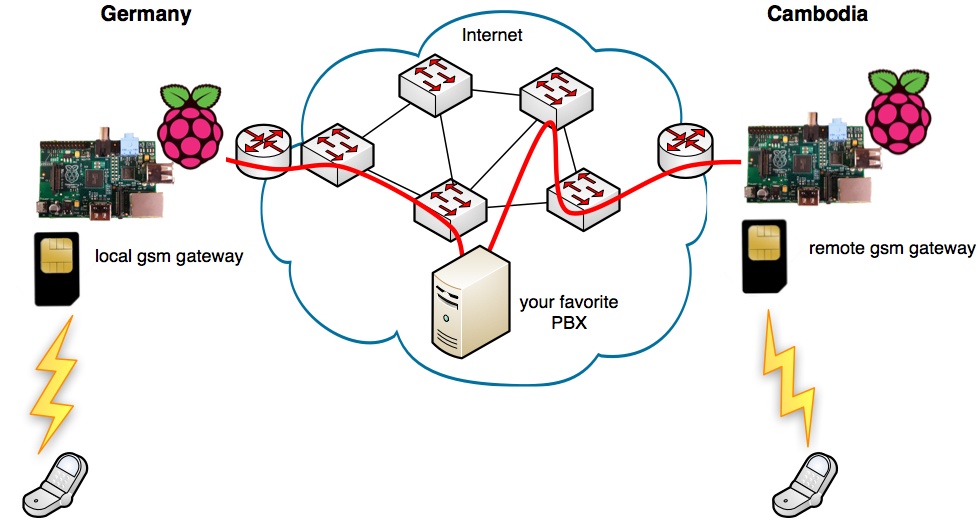
The connection quality over the 10.000 km spanning 64 kbps Asterisk SIP trunk between both gateways actually is so amazing that none of the callers even noticed that I was out of the country at the time!
Please be aware that in some countries, telecoms law around GSM gateways is a bit fuzzy. In the UK, Ofcom says:
Ofcom has recently clarified that it is entirely legal under UK law for end-users (whether businesses or ordinary consumers) to buy, install and use GSM gateways for their own use. However it is currently illegal under UK law for anyone to use GSM gateway equipment to provide a communications service by way of business to another person or organisation, irrespective of where the gateway equipment is located, or how many or few end-users are connected to each gateway. This prohibition on ‘commercial’ use applies equally to the mobile network operators (MNOs) as to other organisations, since the MNOs’ licences do not currently extend to the installation and use of GSM gateways.
Basically, you can build a gateway yourself in the UK – but woe betide you if you try to sell or lease one. The mobile network operators sometimes take this even further (for reasons which you might, when you consider all the lovely money that results from those roaming charges, think to be a bit…venal): for example, if Vodaphone suspects you’re using one of its sim cards in a GSM gateway it says it will disable the card. So be sure to research what the local rules are carefully before you implement something similar yourself.
You can read more about Holger, Benjamin and Karina’s setup at Carrier Connect Shout Out.
Tertiarymatt, firehose and -1 others like this

11 Apr 04:08
Women Are Better Off Without Bras
Women should forget everything they've been told about bras. According to a new French study, published on Wednesday, wearing a bra does nothing to reduce back pain, and the chest supports actually cause increased breast sagging.
11 Apr 04:07
Watson and Holmes, An African-American Sherlock Holmes Comic Book Series Set in Harlem, NYC
by Kimber Streams
firehosewould be way, way more interested in Elementary if it had been this
Watson and Holmes by Karl Bollers and Rick Leonardi is a comic book reimagining of Sir Arthur Conan Doyle’s stories featuring Sherlock Holmes and John Watson as African Americans in New York City’s Harlem district. The project, which claims to be the “first African-American Sherlock Holmes series” is currently seeking funding on Kickstarter.

Tertiarymatt, firehose and -1 others like this
11 Apr 04:06
Windows 8 Killing PC Sales
by samzenpus
yl-roller writes "IDC says Windows 8 is partly to blame for PC sales suffering the largest percentage drop ever. 'As if that news wasn't' troubling enough, it appears that a pivotal makeover of Microsoft's ubiquitous Windows operating system seems to have done more harm than good since the software was released last October.' According to a ZDNet article, IDC originally expected a drop, but only half the size." 


Read more of this story at Slashdot.
Jay McDaniel, firehose likes this

11 Apr 04:06

MetroPCS vote on T-Mobile merger postponed as Deutsche Telekom sweetens the deal
by Jeff Blagdon
MetroPCS is putting a Friday vote on the proposed merger with T-Mobile USA on hold until April 24th. MetroPCS announced the postponement today, and according to All Things D, the revised terms will reduce MetroPCS’s debt burden in the aftermath — from $15 billion to $11.2 billion. The Wall Street Journal reports that the interest rate on that debt would also be cut by half a percentage point in what T-Mobile’s German parent Deutsche Telekom called its "best and final offer." Shareholders had reportedly been prepared to reject the previous terms of the deal if it had gone to a vote as planned.
Since 2011’s failed attempt to sell T-Mobile USA off to AT&T, Deutsche has overseen a massive restructuring at the company, scrapping thousands of jobs, hiring a new CEO, adopting a major rebranding, and pursuing an aggressive LTE rollout plan to compete with the more modern networks of America’s top two carriers, AT&T and Verizon. If the MetroPCS merger indeed goes ahead, it will give the combined company significantly more spectrum to devote to expanding LTE coverage. According to T-Mobile VP Brad Duea, the total could approach 20MHZ in some markets — in comparison, both AT&T and Verizon have more than twice as many customers as T-Mobile, and neither has more than 20MHz active in any one market. The deal has already been given the go-ahead by both the FCC and the Justice Department last month, as well as both companies' boards, so aside from the upcoming shareholder vote, there's little left to stop the merger from moving forward.
- Source MetroPCS (PR Newswire)All Things DWSJ
- Related Items vote postponed merger t-mobile acquisition deutsche telekom metropcs T-Mobile Verizon
firehose likes this
11 Apr 04:05

The Bow Tie Crowd. Samuel Eliot Morison, 1957.
The Bow Tie Crowd.
Samuel Eliot Morison, 1957.
firehose and -1 others like this

11 Apr 04:04
Excerpts From the Taxi Compliments File
by By NICK CORASANITI
Roughly 700 compliments were received in 2012. The following is a sampling of some of the more unusual entries, which include a story about a lost engagement ring and the offer of a gift made by a late relative.
firehose likes this
11 Apr 03:59
The Stupefying Limpet City
by markwallace
This beautifully drawn map of a steampunk city was done by DeviantArt member Ramah Palmer for a monthly challenge at the Cartographer’s Guild. The map comes with some backstory…
The City of Limpet is situated where it is for two main reasons – firstly, the engines of the steammancer university provide a source of electricity for the city and secondly, the cliffs to which many of the workers houses cling are home to the best gem mines on the continent. . . . Presiding over all this is the self-styled Lord Sebastian Farquhar – the original discoverer and owner of the gem-rich cliffs. He rents out the land to the hopeful miners and takes a cut of all gems discovered. This has made him a very rich man and one of the ways in which he uses his wealth is to fund the steammancer university and put pressure on where their research is headed in order to best serve his own needs . . .
…and the tantalizing promise of a follow-up map “that shows the results of the steammancer’s messing with the elements and the effects it had on the city.” (Discovered on Time For Maps!)
Be sure to click the image and explore at higher resolution, or see the stunning full-resolution image here.


firehose likes this
11 Apr 03:39


For the Record, This is Vin Diesel on Helium
firehose1:20
spoiler alert: sounds like warwick davis
Submitted by: Unknown
Tagged: vin diesel , helium , Video , celebs , g rated , win Share on Facebook
Sina, Rebeccasaskia likes this
11 Apr 03:36
How Google Fiber Could Do Some National Good, Or At Least Scare the Carriers
by Soulskill
firehoseall carriers suck forever
Nerval's Lobster writes "Within hours of Google announcing that Austin, Texas would be the next lucky recipient of its Google Fiber initiative, AT&T released a statement indicating that it was willing to build a high-speed broadband network in the city, too. 'AT&T announced that in conjunction with its previously announced Project VIP expansion of broadband access, it is prepared to build an advanced fiber optic infrastructure in Austin, Texas, capable of delivering speeds up to 1 gigabit per second,' read the statement. But there's a not-so-slight catch: AT&T wants whatever conditions Google received from the city of Austin. Google itself has provided precious little guidance about its future plans. 'We are still in the very early stages of it,' Google CEO Larry Page told media and analysts during the company's Jan. 22 earnings call, according to a transcript. 'Obviously, we are going to a small number of people and so, but we are excited about the possibilities.' But if Google Fiber keeps expanding, it could compel AT&T and other infrastructure providers to boost their broadband service and offer it on more reasonable terms — nothing like some competition to make things a little better for the collective customer base. In that sense, even if Google Fiber doesn't expand into a national program (and imagine the costs of that), its existence will still do some larger good." 


Read more of this story at Slashdot.
Jay McDaniel, Jakewastaken and -1 others like this
11 Apr 03:35
Sport Balls Replaced With Cats
firehosedoes what it says on the tin
Russian Sledges, firehose and -1 others like this
11 Apr 01:58
 They say if you build a better mouse trap the world will beat a path to your door. And the same will probably hold true for the first coffee shop to adopt this clever spoon-securing NOTA coffee mug designed by Lee Hae Seung Scott. More »


The Best Coffee Mug Improvement Since the Handle
by Andrew Liszewski
They say if you build a better mouse trap the world will beat a path to your door. And the same will probably hold true for the first coffee shop to adopt this clever spoon-securing NOTA coffee mug designed by Lee Hae Seung Scott. More »
Adam Victor Brandizzi, Mazhechao likes this
11 Apr 00:44
Teens Are Abandoning Social Networks
Profiles are out, ephemera is in.
Russian Sledges, firehose likes this
11 Apr 00:43
Adam Orth leaves Microsoft following 'always-on' console controversy
by Sam Byford
firehosechrist
Adam Orth, the Microsoft Studios creative director who came under fire for controversial comments on "always-on" consoles, has left the company. The news was first reported by Game Informer, and Polygon has been able to confirm his departure with two sources. It's unclear, however, whether Orth was fired or left his position voluntarily. Microsoft declined to comment to Polygon, saying ""We do not comment on private personnel matters."
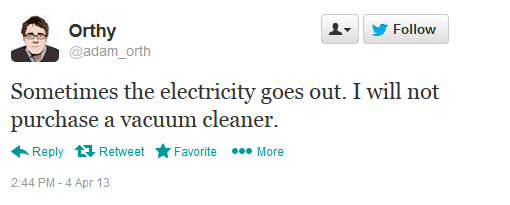
Orth tweeted that he didn't "get the drama" over rumors that the upcoming Xbox would require an internet connection to start games, comparing the situation to purchasing a vacuum cleaner knowing that the electricity might go out. Microsoft later issued a statement apologizing for Orth's tweet and clarifying that he was not a company spokesperson.
- Via Game Informer
- Source Polygon
- Related Items adam orth xbox microsoft studios always-on controversy fired leaves resigns Microsoft
firehose likes this
11 Apr 00:43
 In the absence of GDC Canada (the first, and last, installment took place in 2010), a group of Vancouver developers have decided to throw their own conference. The Full Indie Summit is a collaborative effort by the Full Indie Group and VBlank's Brian Provinciano (no stranger to taking on massive organizational tasks on his own), to create a one-day event with developer talks and plenty of networking opportunities.
Presenters include Klei Entertainment's Nels Anderson, 17-BIT's Jake Kazdal, and more, with both Sony and Nintendo in attendance to help developers learn how to get their games onto consoles. Interested Vancouver or Vancouver-adjacent indies can pick up tickets here. The event takes place April 20.
'Full Indie Summit' brings Vancouver dev industry together
by JC Fletcher
In the absence of GDC Canada (the first, and last, installment took place in 2010), a group of Vancouver developers have decided to throw their own conference. The Full Indie Summit is a collaborative effort by the Full Indie Group and VBlank's Brian Provinciano (no stranger to taking on massive organizational tasks on his own), to create a one-day event with developer talks and plenty of networking opportunities.Presenters include Klei Entertainment's Nels Anderson, 17-BIT's Jake Kazdal, and more, with both Sony and Nintendo in attendance to help developers learn how to get their games onto consoles. Interested Vancouver or Vancouver-adjacent indies can pick up tickets here. The event takes place April 20.
 'Full Indie Summit' brings Vancouver dev industry together originally appeared on Joystiq on Wed, 10 Apr 2013 19:00:00 EST. Please see our terms for use of feeds.
firehose likes this
11 Apr 00:42
Bejeweled: The Board Game
by drew

If you love Bejeweled, you’ll hate the board game.
The manufacturer’s photo is above. These girls can hardly believe they have to pretend they like playing Bejeweled: The Board Game.

This poor girl is trying so hard to be happy about Bejeweled: The Board Game, but her eyes betray her. She’s smiling, but her eyes are sad. Because she has to move the gems around herself and keep score with chips, and because she paid $18 for a free cellphone game.
11 Apr 00:24
Man Acquitted Of Molestation Charges After Court Finds He Suffers From 'Sexsomnia'
A Danish man has been acquitted of molesting two 17-year-old girls after he was found to suffer from a rare sleep disorder known as "sexsomnia."
11 Apr 00:00
Hands On: Retro Cyberpunk Comedy Jazzpunk
by Nathan Grayson
By Nathan Grayson on April 10th, 2013 at 9:00 pm.

Jazzpunk isn’t like other games. I mean, I guess you could draw lines to old-school adventures and maaaaaybe Thirty Flights Of Loving and other Blendo works for visual stylings, but it doesn’t really take any moment-to-moment cues from either. Instead, it’s a vaguely noir retro cyberpunk romp whose goal is Airplane/Naked-Gun-esque humor first and foremost. All those things sound absolutely wonderful, of course, but games and comedy haven’t really played nicely together ever since games sprouted interactive bits and decided to get all high and mighty about it. But why not make hilarity the focus of those interactions? And I mean for real – not, like, as a byproduct of solving a puzzle or in the interest of creating a black hole where all humor goes to die (also known as creating a Postal game). That’s Jazzpunk’s main aim, and at GDC, I got to find out whether or not it has any chance of achieving that goal.
I hate going to stand-up shows where someone in the audience insists on screaming their own ham-fisted one-liners back at the comedian. At best, it’s a consistent annoyance – like a fly mesmerized by the seductive curves of your inner ear, buzzing pure, stupid fly delight – and at worst, it makes the entire evening downright painful. Same goes for a movie or any other sort of large-scale group viewing event, really. I mean, we’re gathered to sponge up somebody else’s silliness for an hour or two. Afterward, that window slams shut, and all that’s left is silence – which has been near-unanimously panned for being horrendously unfunny and, quite frankly, boring on some occasions. Why talk over a paid entertainer when you can fill up empty air any other time?
That said, I think those moments speak to an innate quality of humor that games have never quite fulfilled: it’s an inherently interactive form. That’s why, in many cases, people can’t help but speak up, even in social scenarios where it would normally be an offense punishable by supreme embarrassment Jokes are just more fun when you’re playing along in an equally funny fashion – or at least, one that you perceive to be that way. It’s why we sit around and yuck it up with our close friends, hone running jokes, and generally pick humor as our main means of leisurely communication. The back-and-forth is key. And hey, I have heard from one or two well-placed sources that videogames are sometimes also interactive. Hmmmmmmm.
Of course, we can’t rightly tell a joke to a computer, can we? Sad to say, we’re probably still a decade or two away from that level of artificial intelligence (or until Siri reveals she assimilated Steve Jobs, gained his powers, and achieved sentience long before any of us could adequately prepare for her new world order). Games, then, have largely been forced to make the ancient art of uproarious goofery a one-way street. I mean, yes, gigantic punchline domino chains like Monkey Island and Portal 2 coerced laughs out of our lungs as forcefully as any movie or utterly scandalous funny page, but they told their jokes, waited a couple seconds for laughs, and then moved on. Sure, we occasionally got our hands on a rubber chicken with a pulley in the middle or something involving potatoes, but related actions were still pre-planned and – at best – relegated to secondary status. Jokes, in other words, were there, but they weren’t the stars of the show. Mechanics had center stage.
So, right then, seven-hundred-thousand-katrillion words later: Jazzpunk. Its goal, creators Luis Hernandez and Jess Brouse explained to me as I took a hands-on tour during GDC, is to make comedy priority number one. In doing so, the duo’s done their damndest to marry laughs to mechanics, resulting in an experience that… well, it’s certainly unique.
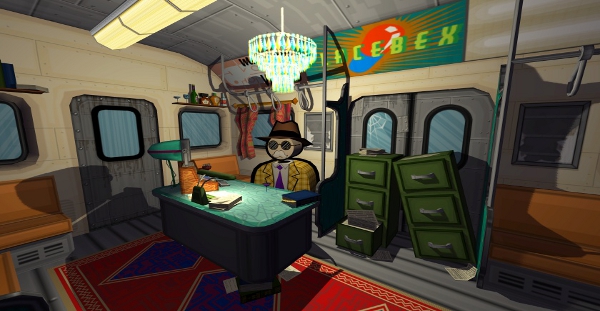
Let’s get the most important thing out of the way first: the two levels of Jazzpunk I played made me laugh. A lot. Very loudly. So, assuming it can keep up that level of quality, I think it’ll be a success on that merit alone. But then, humor is also subjective, so it remains a wild card for now. That said, I don’t want to spoil too many specific jokes, because they are – for better or worse – Jazzpunk’s primary selling point.
What intrigued me, however, was the way Jazzpunk’s gags operated on one of two levels. Plenty, admittedly, were lobbed at me with the searing determination (and subtlety) of a thousand flying fastballs, but others were mine to discover and even, in some much-appreciated cases, create. So, for example, the first level tasked me with infiltrating a monolithic Russian consulate in an otherwise sleepy block of neon cartoon city. Initially, jokes hurled themselves in my path as though I was the only 18-wheeler that could end their miserable un-told limbo state of an existence.
Simply walking across a bridge sent a man hurtling over the edge into traffic, emitting a classic Wilhelm Scream as he went. My Russian foes’ schedule had a time specifically set aside for vodka and biscuits. Methodically clambering through a window produced a sudden, hilariously jarring Hollywood-style dynamic action roll for no apparent reason. I found a magazine called “Reader’s Digestive Organs.” Those kinds of things. When Jazzpunk was first announced, Hernandez and Brouse cited ’80s spoof films like Airplane and Naked Gun as their biggest inspirations, and – in this one instance – they certainly weren’t kidding. Those films’ fusions of keen wit and rib-rattling slapstick absolutely pervaded the demo I played.

A quick look around, however, revealed where Jazzpunk’s potential really lies. Put simply, nearly everything – each character, item, and location – is a potential goof ripe for the picking. For example, I found a street performer making his saxophone sing in what was, I guess, the seedier part of town. His instrument case, naturally, had a couple coins clinking around in it, so I grabbed one for myself. Turns out, I could put it in tons of different things, including a fairly scandalous-looking lady robot who abruptly gyrated on my face in response. I also managed to stumble across some wonderful uses of the cyberpunk motif (here’s a tantalizing hint: pizza-themed survival-horror VR game) and discovered that I could throw just about anything at anyone. Ultimately, though, the message was clear: developer Necrophone wanted me to be an agent in the creation of jokes. If I went looking for them or opted to think outside the box, I’d be handsomely and hilariously rewarded.
That said, the pseudo-sandbox of random, contextual gag interactions did strike me as a bit directionless. Sure, I had a goal, but it took a little while to figure out exactly how to get to it. Also, the whole world felt weightless and insubstantial, like I was rolling through my best comedic material as an audience of mannequins stared on, silent and unblinking. There was plenty of personality, but oddly little life.
The second level, meanwhile, struck out in almost the complete opposite direction. Taking place in a Japanese-themed retro cybercity, it was largely linear, overrun with NPCs, and saw me on a single-minded quest to retrieve a “valuable” mechano-kidney from a sushi-loving cowboy. Honestly, it ended up being a far more subdued affair than the first mission, but my funny bone didn’t escape entirely unscathed. Neither, for that matter, did my spider bone, which reacts by fleeing in puke-stained revulsion any time my primary objective involves lobbing the twitchy, fear-hungry creatures at someone’s naked face. Related: all of my bones double as spider bones.

So Jazzpunk feels fairly rough-around-the-edges, and it may not end up having the most bottomless bag of tricks, but the demo I played was unabashedly weird and silly, not to mention refreshingly fearless in its pursuit of comedy above all else. Honestly, I wish there was an even greater focus on creating my own on-the-fly humor, but I was glad to not feel entirely passive here. No, we’re not quite at the point where humor simply emerges from interactions with hyper-sophisticated AI (or really dumb/awkward AI, ala, say, some of Skyrim’s most unintentionally hilarious moments), but baby steps forward are better than none. Especially when the baby slips on a banana peel, and a stand-up comedian heckler somehow dies horribly as a result.
firehose likes this
10 Apr 23:51
Top Coders Can Now Get Agents
Top coders are already treated like Hollywood stars. It was only a matter of time before they started being represented in the same way.
10 Apr 23:50
New York City vs. San Francisco, A Disposition Comparison Webcomic
by Rusty Blazenhoff

Former New York resident turned San Francisco denizen Teddy Hose created a New York City vs. San Francisco webcomic that is a “parody census of similar and differing traits, in the form of common phrases you might hear as disposition levels on a scale.”
submitted via Laughing Squid Tips
Tertiarymatt, firehose likes this
10 Apr 23:28
Maris Wicks kicks you outside with ‘Yes, Let’s’ picture book
by Chris Arrant
firehoseMaris autoshare
 There’s more to life than staying indoors. And while comics fans might be typecast as more of the shut-in type, there’s more to us than that — but even for the reclusive among us, this book’s for you.
Yes, Let’s is a new picture book, illustrated by Maris Wicks and written by Galen Goodwin Longstreth, that follows a family’s day trip into the woods where a sing-song-type rhyming dialogue complements the adventures they’re drawn into. Here’s an excerpt of some of the text:
Let’s get into the station wagon, roll those windows down,
Let’s sing out loud and wave to cows as we drive out of town.
Let’s park the car beneath the trees and trade our shoes for boots,
Let’s set the timer, all say “Cheese!” then head into the woods.
Although not comics in the traditional sense, it tells a story using words and pictures, and Wicks is herself a comics creator — and this makes a great read for a comics fan or just someone who wants something for the family. The book even gives you a list of things to bring for your next outdoor trek. Here are three double-page spreads from the book:


firehose likes this
10 Apr 23:27
Steinberger's statement from the ComiXology blog:
TWIST: Apple Didn't Ban 'Saga' #12 from App Store, ComiXology Never Submitted It
by Andy Khouri
firehose"The situation inspired the Thrillbent digital comics publisher Mark Waid to reread the language in the agreement he signed with ComiXology:
Hey, look. There, under the qualifiers defining what material cannot be published through apps but only through the web, is this one: "Explicit pornographic depiction of sexual activity or genitalia." Okay, call me an old biddy, but I could make a reasonable case that an illustration of gang-bang bukkake could be interpreted as "explicitly pornographic."
I think most people would agree with Mark Waid with respect to space bukkake. And yet, Saga #12 was accepted by Apple when they finally got a look at it. As I said above, the standards applied to this kind of material are consistently inconsistent, and this will remain a problem for digital comics as long as the current curator-based system is in place.
But the Saga #12 situation complicates that gatekeeper question in a profound way, because it's confirmed that ComiXology has changed its position from that of a pure retailer to a kind of content curator. To wit, we can infer that someone at ComiXology judged that graphic heterosexual intercourse in an earlier issue of Saga would meet with Apple's approval, but that graphic oral sex between men would not. There are many possible implications built into that decision, but the ultimate result was that ComiXology was wrong and the company's second-guessing of Apple's admittedly oblique guidelines tipped the first domino in this embarrassing and painful story."

As it turns out, Vaughan's statement was inaccurate. ComiXology CEO David Steinberger confirmed Wednesday that not only did Apple not ban Saga #12 from sales within its iOS marketplace, ComiXology never actually offered the issue in the first place.

Steinberger's statement from the ComiXology blog:
To our customers -
In the last 24 hours there has been a lot of chatter about Apple banning Saga #12 from our Comics App on the Apple App Store due to depictions of gay sex. This is simply not true, and we'd like to clarify.
As a partner of Apple, we have an obligation to respect its policies for apps and the books offered in apps. Based on our understanding of those policies, we believed that Saga #12 could not be made available in our app, and so we did not release it today.
We did not interpret the content in question as involving any particular sexual orientation, and frankly that would have been a completely irrelevant consideration under any circumstance.
Given this, it should be clear that Apple did not reject Saga #12.
After hearing from Apple this morning, we can say that our interpretation of its policies was mistaken. You'll be glad to know that Saga #12 will be available on our App Store app soon.
We apologize to Saga creator Brian K. Vaughan and Image Comics for any confusion this may have caused.
For his part, Vaughan released a second statement that said:
Yesterday, I was mistakenly led to believe that this issue was solely with Apple, but it's now clear that it was only ever Comixology too conservatively interpreting Apple's rules. I'm truly sorry. I never thought either company was being homophobic, only weirdly inconsistent about what kind of adult material was permissible.
(one of the not-so-offending images, which we had to censor per our content guidelines)
More will be written about this in the coming days, and basically everywhere, for the implications are wide-reaching. On the surface there's the obvious question of how Vaughan came to understand that his and Staples' comic was "banned" or "rejected" or otherwise disapproved of by Apple, and for depictions of "gay sex" specifically.
That ComiXology allowed Apple to take the blame -- and to be branded by many as a homophobic entity -- for 24 hours of passionate blog posts, news articles and high profile tweets (and retweets) before Apple had to step in to defend itself is problematic on a number of levels. By remaining largely silent (and occasionally tweeting with language like "concerned citizens"), ComiXology branded itself as the liberal, sex-positive David to Apple's oppressive, prejudicial Goliath. I've spoken to industry insiders today who wonder what potential harm this bogus narrative may have done to ComiXology's lucrative relationship with Apple, a company with a gay CEO and an extremely high rating by the Human Rights Campaign, a company that offered the offending Saga issue in its own iBooks store without any fuss, and a company that seems to have had to approach ComiXology directly to correct the record.
Staples put it bluntly in a tweet:
In the wake of Steiberger's statement, several comics creators and industry commentators who criticized the company as homophobic have tweeted apologies to Apple.Comixology never stopped us from blaming Apple until this morning's statement.
The other major surface-level question is one of money. While sales figures are unavailable to us, we can safely assume from the media (both social and news) activity of the last 24 hours that casting Apple as a prude or even homophobic villain drove Saga readers -- who are plentiful -- away from in-app ComiXology purchases and towards ComiXology's web-based stores, where Apple is not entitled to a 30% commission. As has been testified by numerous creators, buying digital comics from the ComiXology Web store or its branded publisher Web stores, while arguably less convenient than doing so within the iOS apps, increases the profit margins for creators and publishers, and we assume ComiXology as well. It's extremely likely that these events are the consequence of the bad call Steiberger referenced and not any kind of malice, but by not submitting Saga #12 to Apple at all and by not stepping in with the facts much sooner, ComiXology has created a situation where its motives have been questioned.
(Apple never reviewed this image, which we pixelated, of several men ejaculating on another man's face)
Beneath the surface of the Saga fiasco lies the more important questions for the digital comics scene going forward: who are the gatekeepers, and what do they care about? In my experience in digital media, guidelines with respect to sexual content are extremely strict not so much because of morality but because of liability. Retailers, television networks, websites and application developers care less about sex or anything having to do with human anatomy (except for violence, of course) than they do about somebody's parents flipping out and suing them, so consequently anything "flagged" on sites like Facebook or apps like Instagram or content websites or products in digital marketplaces like Apple's App Store is zapped just as a matter of course -- often without even inspecting the offending material to make sure it's in violation of anything! C.Y.A. is the order of the day.
But that's not a tenable position anymore; certainly not as Apple's app stores become the most populated and influential digital marketplaces on Earth, where adult consumers demand access to the same kinds of material they've been trusted to purchase in the analog world since ancient times. So guidelines have to become more flexible. We've seen it evidence of it. Previous issues of Saga, which have featured breastfeeding and a woman giving birth, complete with umbilical cord biting and breastfeeding; aliens with televisions for heads going at it "doggy style"; and visible heterosexual penetration have passed through the halls of Apple's app store without incident. But we also know that some comics haven't, and that some of those were accepted eventually.
Content creators and consumers want to see explicit rules as to what is and is not permissible in the iOS marketplace, and the current language in Apple's Terms of Service is vague:
Apps containing pornographic material, defined by Webster's Dictionary as "explicit descriptions or displays of sexual organs or activities intended to stimulate erotic rather than aesthetic or emotional feelings", will be rejected
It should be noted that in-app purchases like comics are reviewed by Apple on a case by case basis.
ComiXology offers even less helpful guidelines for those seeking to sell their independently created comics via its Submit platform:
The approval process is a work in progress. First and foremost, we want to maintain a level of professional content that comiXology users have come to expect from our platform. What the definition of professional content is will certainly be something that we refine as we progress into this brave new world.
The situation inspired the Thrillbent digital comics publisher Mark Waid to reread the language in the agreement he signed with ComiXology:
Hey, look. There, under the qualifiers defining what material cannot be published through apps but only through the web, is this one: "Explicit pornographic depiction of sexual activity or genitalia." Okay, call me an old biddy, but I could make a reasonable case that an illustration of gang-bang bukkake could be interpreted as "explicitly pornographic."
I think most people would agree with Mark Waid with respect to space bukkake. And yet, Saga #12 was accepted by Apple when they finally got a look at it. As I said above, the standards applied to this kind of material are consistently inconsistent, and this will remain a problem for digital comics as long as the current curator-based system is in place.
But the Saga #12 situation complicates that gatekeeper question in a profound way, because it's confirmed that ComiXology has changed its position from that of a pure retailer to a kind of content curator. To wit, we can infer that someone at ComiXology judged that graphic heterosexual intercourse in an earlier issue of Saga would meet with Apple's approval, but that graphic oral sex between men would not. There are many possible implications built into that decision, but the ultimate result was that ComiXology was wrong and the company's second-guessing of Apple's admittedly oblique guidelines tipped the first domino in this embarrassing and painful story.
The questions raised in the discussion of this situation matter because of just how successful ComiXology has become. In the realm of digital comics -- the realm that many smart people believe is to be American comics' sales salvation -- ComiXology is the undeniable industry leader. ComiXology is the digital equivalent of Diamond Comic Distributors, the print wholesaler behind the vast majority of comic book store business around the world. And like Diamond, how ComiXology chooses to operate will define its increasingly important dimension of the comic book industry.