|
Myanmar's pro-democracy leader Aung San Suu Kyi 'wants to run for president'
Daily Mail Mynamar's pro-democracy leader Aung San Suu Kyi has said she wants to run for president. The Nobel peace prize laureate made the admission during the first day of open discussions at the World Economic Forum today. 'I want to run for president and I'm ... and more » |
firehose
Shared posts
06 Jun 23:09
Myanmar's pro-democracy leader Aung San Suu Kyi 'wants to run for president' - Daily Mail
firehoseI wish a pro-democracy leader would run for president here
06 Jun 23:09


TV: Newswire: Danny McBride's cartoon about a gay white rapper will be FXX's first original series
by Mike Vago
firehose'SNL's Bobby Moynihan as the voice of a gay, white rapper'
welp
'and sitcom veteran Method Man'
FXX—FX's attempt to court a younger audience by turning into a hardcore porn channel so gradually you'll hardly notice (they're only one X away!)—has announced its first original series. Created by Danny McBride, Chozen stars SNL's Bobby Moynihan as the voice of a gay, white rapper who has recently been released from prison, and will be scripted by soon-to-be-available Eastbound and Down writer Grant Dekernion. The rest of the voice cast includes stand-up comedy fixtures Hannibal Buress, Michael Pena, Nick Swardson, Kathryn Hahn, and sitcom veteran Method Man. FXX launches in September; Chozen is slated to air in early 2014.
Read more
06 Jun 23:08
House votes to resume deportation of young immigrants, sending message on ... - Washington Post
firehosegreat
|
House votes to resume deportation of young immigrants, sending message on ...
Washington Post WASHINGTON — The Republican-controlled House voted Thursday to resume the deportation of hundreds of thousands of immigrants brought illegally to the United States as children, a largely symbolic move in the first immigration-related vote in either ... and more » |
06 Jun 23:07
Broke Eats is launching another series with Paul Prado called Eat Broke Love. Check it out!

June 05, 2013
firehosevia Tadeu
Broke Eats is launching another series with Paul Prado called Eat Broke Love. Check it out!
06 Jun 23:05
Vesper
firehose"From the outside, then, it’s easy to be dismissive or even resentful: How can these guys launch a relatively expensive text-note app that’s missing so many features of competing text-note apps?
Balls."
Balls: the timeless source of dumb ideas
Three friends of mine — John Gruber, Dave Wiskus, and Brent Simmons — secretly got together to build an app, and today they released the first version to the public.
You’ve probably heard about Vesper by now. I’ve been testing it for a while, and I think of it as a note shoebox with optional tagging. Many other apps, most of them for less money, allow you to write and store notes and photos, so it’s perfectly reasonable to ask why you should use Vesper over your existing text-notes app of choice.
Even for a 1.0, it’s pretty light on marketable features by 2013’s standards. It’ll lose a feature checklist comparison to almost every other popular text-notes app. Notably, Vesper can attach a photo to each note, or have photos that are notes without additional effort, which most Dropbox-syncing text-note apps can’t do. But Vesper can’t even sync to Dropbox.
From the outside, then, it’s easy to be dismissive or even resentful: How can these guys launch a relatively expensive text-note app that’s missing so many features of competing text-note apps?
Balls.
It takes balls to release an iOS app in 2013 for $4.99.
It takes balls to enter this extremely crowded category.
It takes balls to release a note-shoebox app in 2013 that has no sync, import, or export.
It takes balls to name your note-shoebox app after a cocktail nobody has heard of, then to age-rate the app “12+ for mild alcohol references” just so the cocktail’s recipe can be included in the Credits screen.
It takes balls to give your note-shoebox app a nondescript, abstract icon to match its cocktail name so nobody who sees just the name and icon will have any idea what it does or likely be enticed to find out.
And it takes balls for these three high-profile people, whose collaboration naturally earns extremely high expectations and polarizing reactions, to build and release anything together.
The best thing I can tell you about Vesper is that the app reflects its creators. I imagine they’ll add sync in time because it’s critical and very useful — otherwise, I don’t expect Vesper to get many more features.
But every feature in the app is extremely deliberate and thought-out: every mechanic, every restriction, every interaction, every animation. Every detail.
It’s a nuanced, polished app that’s pleasant to use and exudes craftsmanship. Simple flavors, executed extremely well. A vesper.
06 Jun 23:05
Counting Crows Frontman Reveals The Identity Of 'Mr. Jones'
firehoseHuffPo video, don't click.
too dumb;didn't watch: Marty Jones, a friend and frequent bass player in Duritz's previous bands, as well as son of flamenco guitarist David Serva ("she dances while his father plays guitar")
Adam Duritz of Counting Crows reveals the true identity of "Mr. Jones."
06 Jun 23:01
Amazon: Publishers Strong-Armed Us On E-Books
by timothy
Nerval's Lobster writes "Strengthened by an agreement with Apple that set the prices for their respective e-books higher, publishers strong-armed Amazon into giving them similar terms, an executive for the online retailer has testified in Manhattan federal court. The U.S. Department of Justice has taken Apple to court over the alleged price-fixing, after reaching out-of-court settlements with five publishers (HarperCollins Publishers LLC, Simon & Schuster, Hachette Book Group, Penguin Group, and MacMillian). Apple, which competes with Amazon in the e-book space, refused a similar settlement. "Certainly if someone offered reseller, we would have taken them up on that offer," Russell Grandinetti, Amazon's vice president for Kindle content, testified before the court, according to Reuters. "Reseller" means a company sells goods to a retailer for a particular price (usually wholesale), allowing the retailer to set the actual sales price. Under the terms of that model, Amazon could sell e-books for super-cheap, even if it meant going beneath the publisher's wholesale price. Macmillan and Amazon ended up in conflict over the issue, with Amazon temporarily yanking the publisher's e-books from its digital shelves. "We will have to capitulate and accept Macmillan's terms because Macmillan has a monopoly over their own titles, and we will want to offer them to you even at prices we believe are needlessly high for e-books," Amazon wrote in a statement at the time. "Amazon customers will at that point decide for themselves whether they believe it's reasonable to pay $14.99 for a bestselling e-book." But Amazon eventually relented to Macmillan's demands, along with those of other publishers, and submitted to the agency model, in which publishers have a heavier hand in setting retail pricing." 


Read more of this story at Slashdot.
06 Jun 23:01

Eric Schmidt says the internet will solve global warming's 'fact problem'
by Adi Robertson
firehoseglwt
While Google leverages its phones and web services in the mundane service of advertising, executive chairman Eric Schmidt gives an almost mythological vision of the company's place in history. To Schmidt, Google's projects aren't merely new economic opportunities — they're solving the greatest problems mankind faces today, from acid attacks in Pakistan to medical care in Kenya. And in a short speech at Google's "How green is the internet?" summit, Schmidt offered a utopian take on technological progress and free speech, which he posits as the tools that will help us overcome the climate changes humans have wrought.
"You can lie about the effects of climate change, but eventually you'll be seen as a liar."
"The math says there's a couple billion people who want our carbon footprint," Schmidt said, laying out the problem. "And we can't afford that carbon footprint as a global thing." But the real issue, he said, is "the fact problem," a dearth of information that allows people to ignore climate change. "The media gets confused because they don't believe in facts, and public policy people get confused because they don't believe in innovation." But the real-world effects of climate change can't be ignored forever. "The thirst for information is ultimately the solution to the problems we talk about here," he said. "You can hold back knowledge, you cannot prevent it from spreading. You can lie about the effects of climate change, but eventually you'll be seen as a liar."
But while the speech was aimed at motivating experts who can develop carbon capture systems or other fixes for global warming, much of it touched on one of Schmidt's favorite themes: how Google is solving problems in the developing world. In America and other "high-bandwidth" countries, he said, "our futures are going to be fantastic." He touted futuristic personal assistants who will advise us on such picayune matters as when to wake up to catch a flight. "Do you think you're gonna use it? Yes. You know why? You want the 30 minutes of sleep."
"You're killing their kid and they only have one."
But he painted a dismal, often exoticized version of places like the Congo or Myanmar, places plagued by corrupt officials, a lack of running water, despotic governments, and terrible treatment of women — all of which, he said, can be mitigated by technology. He described a "colorfully robed head" of a Maasai village in Africa, who carried "his spear in one hand, his mobile phone in another, and his four wives around him. He shows off his mobile phone as a symbol of everything," Schmidt said.
The same access to information that can help people provide medical care or rebuild their lives after being disfigured by acid, he believes, can help them understand and protest climate change, especially as its effects become more obvious in day-to-day life. "In China, people are so upset about what's going on that they're risking the secret police and imprisonment to go to public demonstrations that are illegal in their country," he said. "Why? Because you're killing their kid and they only have one."
But an unasked question shadowed the talk: why, in nations that have none of the information gaps Schmidt describes, haven't we seen more dramatic results? Recent studies reveal only 12 percent of Americans believe climate change is not real, and 54 percent believe that it's caused mostly by human activity — while it's taken years, global warming is increasingly considered a real and pressing problem. But it's often still seen as distant or inevitable, and solutions have been in short supply; even the most incremental policy changes can generate outsized vitriol.
"You'll have an audience that you didn't have before, and they'll show you what the market looks like," says Schmidt. Popular support, though, doesn't necessarily equal meaningful change, and a market for innovation may not emerge until climate change's effects are well underway.
06 Jun 23:01
Paraplegic Woman Goes Duct Tape Surfing on a Friend’s Back
by Rusty Blazenhoff
Pascale Honore, an Australian woman who has been wheelchair-bound for 18 years, recently went ‘duct tape surfing‘ on the back of her friend and experienced surfer, Ty Swan. To ride the waves, Honore first slips into a simple Kmart backpack (with leg holes cut out), then straps onto Swan’s back with duct tape, and then goes tandem surfing off the South Australia’s west coast. This was the first time she had ever gone surfing but had wanted to for a long time. Donations are being taken for the Duct Tape Surfing Foundation.
Adelaidenow has more of the story:
Pascale says she loved watching her boys – Tom and Morgan – surf the waves that break on the reefs outside of town, but couldn’t help but feel frustrated that she couldn’t ride them herself. That’s when Ty, a professional diver and good friend of her sons, came up with a plan.
“We were just sitting around one night having a few beers when I thought, `yeah, I reckon I could surf with Pascale on my back’,” Ty says.
Eventually that seed of an idea took root, and the pair began to seriously look at the logistics of surfing together.
Pascal Honore rides a wave near Elliston, on the Eyre Peninsula, duct-taped to the back of local surfer Tyron Swan.
“Everyone said we were crazy,” Ty says. “Even the loosest people I know said we were crazy.

photo by Hayden Richards
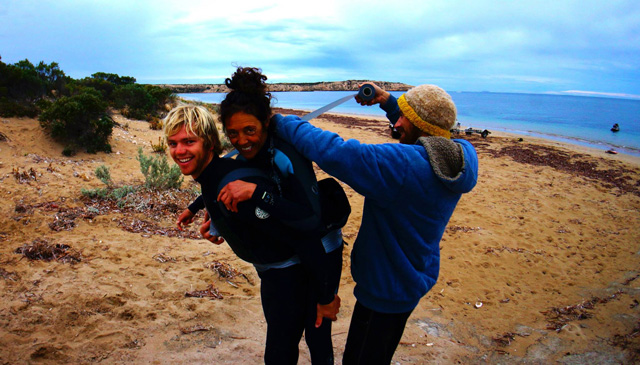
photo by Jesse R Cas
video via BestVidsDaily
via Daily of the Day
firehose likes this
06 Jun 22:59
'Phineas And Ferb' Sign On For 'Mission Marvel' [Video]
by Josh Wigler
firehoseit begins
Jun 6th 2013 By: Josh Wigler

It was only a matter of time before the Disney toons got themselves mixed up with the greatest heroes of the Marvel Universe. The first two on that hit-list: Phineas Flynn and Ferb Fletcher.
USA Today reports that Phineas and Ferb: Mission Marvel will be premiering this summer on the Disney Channel. It's the first TV cartoon crossover between the House of Mouse and the House of Ideas. [Editor's note: Or is it the House of Mouse Ideas????? - Caleb]
The special features a whole host of characters from both universes: the titular Phineas and Ferb and their platypus pal Perry, teaming up with four of Earth's mightiest heroes: Iron Man, Thor, Hulk and Spider-Man. (Sorry, no Captain America. Dude's busy.)
No crossover would be complete without an all-star roster of villains, and the Mission Marvel event promises to bring the bads: Red Skull, Whiplash, Venom and M.O.D.O.K. come to Phineas and Ferb's hometown of Danville to battle their superhero rivals, rendered powerless thanks to the nefarious Dr. Heinz Doofenshmirtz.
Check out the trailer for Phineas and Ferb: Mission Marvel below!

06 Jun 22:59
Krispy Kreme Sloppy Joes to Debut at the San Diego County Fair
by Rusty Blazenhoff
firehosefuck yoWAFFLE DOG????? YES YES

“Chicken” Charlie Boghosian, the man behind deep-fried Kool-Aid balls and deep-fried breakfast cereal, will debut the Krispy Kreme Sloppy Joe sandwich at the San Diego County Fair in Del Mar, California (June 8-July 4, 2013). This fair fare is made with a Krispy Kreme doughnut split in half and stuffed with meaty Sloppy Joe fixings and cheese. He’s also debuting the Totally Fried Bacon Wrapped Pickle (on a stick), Totally Fried Cookie Dough, and the Waffle Dog (also on a stick).

06 Jun 22:58


The editor of SFWA's bulletin resigns over sexist articles
by Charlie Jane Anders
firehosethe only woman directly involved quit
no word about Beavesnick and Buttzberg

Jean Rabe, editor of the SFWA Bulletin, has stepped down in the wake of tons of criticism of the organization's official magazine, which featured regular contributors talking about "lady editors" and commenting on thier appearance. (Plus the cheesetastic cover you see at left.)
    
|
firehose and -1 others like this
06 Jun 22:54
Xbox One pubs can decide whether games can be resold
by Samit Sarkar
The Xbox One will allow users to resell and trade in their games and play used games without a fee, Microsoft announced today.
The announcement confirms Polygon's report from last month in which our sources indicated Microsoft would not charge a fee for playing used games.
Disc-based games can be traded in and resold at retailers like GameStop for cash or in-store credit, and Microsoft said it will "not charge a platform fee to retailers, publishers or consumers for enabling transfer of these games." The Xbox One also lets users give disc-based titles to friends by transferring the game's license, as long as the person has been on the user's Xbox Live friends list for at least 30 days; each game can only be given in this fashion once, and there's no fee for that, either. It's unclear at this point how the process of permanently giving a game to a friend would differ from trading it in at a retailer.
As a first-party publisher, Microsoft Studios won't charge for the aforementioned transactions. However, Microsoft is leaving it open for third-party publishers as to whether they want to charge fees to customers or retailers. Third parties may even choose not to support reselling or trading of their games in the first place.
Developing ...
06 Jun 22:53
 The Xbox One needs to connect to the internet at least once every 24 hours, or its ability to play games is shut down, a post on Xbox Wire says. This is for a player logged into his own console - if a player logs into his account on a separate console at a friend's house, for example, the Xbox One needs to be connected to the internet at least once every hour.
"With Xbox One you can game offline for up to 24 hours on your primary console, or one hour if you are logged on to a separate console accessing your library," Xbox Wire writes. "Offline gaming is not possible after these prescribed times until you re-establish a connection, but you can still watch live TV and enjoy Blu-ray and DVD movies."
This is the clearest explanation of the Xbox One's internet requirements since Microsoft's reveal on May 21. In a post it removed from Xbox Wire, Microsoft said the console "does not have to be always connected, but Xbox One does require a connection to the Internet."
Microsoft recommends a broadband internet connection of 1.5Mbps for the Xbox One, and suggests mobile broadband for those without access to an Ethernet connection. Xbox One has two wireless antennas, and a gigabit Ethernet port and 802.11n wireless.
"Because every Xbox One owner has a broadband connection, developers can create massive, persistent worlds that evolve even when you're not playing," Xbox Wire says.
Xbox One requires online connection every 24 hours, at least
by Jessica Conditt
firehose"for a player logged into his own console - if a player logs into his account on a separate console at a friend's house, for example, the Xbox One needs to be connected to the internet at least once every hour. ... 'Offline gaming is not possible after these prescribed times until you re-establish a connection' "
even dumber
"Microsoft recommends a broadband internet connection of 1.5Mbps for the Xbox One, and suggests mobile broadband for those without access to an Ethernet connection"
tl;dr: GFY, poors
"With Xbox One you can game offline for up to 24 hours on your primary console, or one hour if you are logged on to a separate console accessing your library," Xbox Wire writes. "Offline gaming is not possible after these prescribed times until you re-establish a connection, but you can still watch live TV and enjoy Blu-ray and DVD movies."
This is the clearest explanation of the Xbox One's internet requirements since Microsoft's reveal on May 21. In a post it removed from Xbox Wire, Microsoft said the console "does not have to be always connected, but Xbox One does require a connection to the Internet."
Microsoft recommends a broadband internet connection of 1.5Mbps for the Xbox One, and suggests mobile broadband for those without access to an Ethernet connection. Xbox One has two wireless antennas, and a gigabit Ethernet port and 802.11n wireless.
"Because every Xbox One owner has a broadband connection, developers can create massive, persistent worlds that evolve even when you're not playing," Xbox Wire says.
 Xbox One requires online connection every 24 hours, at least originally appeared on Joystiq on Thu, 06 Jun 2013 18:15:00 EST. Please see our terms for use of feeds.
06 Jun 22:52

Addressing recent concerns raised by Germany's federal commissioner for data protection and other sources, Microsoft has detailed how users can maintain their personal privacy when using the Xbox One's motion-sensing Kinect camera.
Emphasizing that "You are in control of what Kinect can see and hear," Microsoft notes that individual user and family privacy settings can be accessed during Xbox One setup or at any time afterward. In addition, the company assures that conversation and other background noise will not be recorded or monitored by Kinect in any way.
"By design, you will determine how responsive and personalized your Xbox One is to you and your family during setup," Microsoft said. "The system will navigate you through key privacy options, like automatic or manual sign in, privacy settings, and clear notifications about how data is used. When Xbox One is on and you're simply having a conversation in your living room, your conversation is not being recorded or uploaded."
Microsoft also notes that the Kinect can be disabled at any time during console operation, though some games may require the peripheral to be active for certain gameplay features.
While Kinect monitoring will play a key role in certain game types (Microsoft cites exercise apps and multiplayer card games as examples), alternate control schemes for menus and other functions will be available via the Xbox One's controller and connected mobile devices while the Kinect is paused.
"You can play games or enjoy applications that use data, such as videos, photos, facial expressions, heart rate and more, but this data will not leave your Xbox One without your explicit permission," Microsoft states.
Microsoft addresses Xbox One Kinect privacy concerns
by Danny Cowan
firehose"'When Xbox One is on and you're simply having a conversation in your living room, your conversation is not being recorded or uploaded.'
Microsoft also notes that the Kinect can be disabled at any time during console operation, though some games may require the peripheral to be active for certain gameplay features.
...
"You can play games or enjoy applications that use data, such as videos, photos, facial expressions, heart rate and more, but this data will not leave your Xbox One without your explicit permission," Microsoft states.'
again, my concern isn't (as much) with Microsoft having an always-powered microphone and IR camera in every house. It's having a Microsoft-secured Internet-accessible mic and cam in every house.
Addressing recent concerns raised by Germany's federal commissioner for data protection and other sources, Microsoft has detailed how users can maintain their personal privacy when using the Xbox One's motion-sensing Kinect camera.
Emphasizing that "You are in control of what Kinect can see and hear," Microsoft notes that individual user and family privacy settings can be accessed during Xbox One setup or at any time afterward. In addition, the company assures that conversation and other background noise will not be recorded or monitored by Kinect in any way.
"By design, you will determine how responsive and personalized your Xbox One is to you and your family during setup," Microsoft said. "The system will navigate you through key privacy options, like automatic or manual sign in, privacy settings, and clear notifications about how data is used. When Xbox One is on and you're simply having a conversation in your living room, your conversation is not being recorded or uploaded."
Microsoft also notes that the Kinect can be disabled at any time during console operation, though some games may require the peripheral to be active for certain gameplay features.
While Kinect monitoring will play a key role in certain game types (Microsoft cites exercise apps and multiplayer card games as examples), alternate control schemes for menus and other functions will be available via the Xbox One's controller and connected mobile devices while the Kinect is paused.
"You can play games or enjoy applications that use data, such as videos, photos, facial expressions, heart rate and more, but this data will not leave your Xbox One without your explicit permission," Microsoft states.
Microsoft addresses Xbox One Kinect privacy concerns originally appeared on Joystiq on Thu, 06 Jun 2013 18:40:00 EST. Please see our terms for use of feeds.


06 Jun 22:39
paintdoktahwho: 11’s regeneration
firehosevia saucie
attn multitasksuicide




Tertiarymatt, Cooper Griggs and -1 others like this
06 Jun 22:30


Silicon Bayou rising: New Orleans' drive to be the next great tech city
by Jesse Hicks
firehoseNolatech beat; startyuppie gentrification beat
For young techies that might mean laptops, and coffee shops in which to use them — a particular kind of coffee shop, even, one aesthetically pleasing and conducive to long work sessions, with free Wi-Fi. Tulane geographer Richard Campanella has documented the new style of eateries arriving in the Bywater, which he finds interchangeable with similar restaurants in Austin, Portland, or Brooklyn, “from the artisanal food on the menus to the statement art on the walls to the progressive worldview of the patrons.” Long sees that cultural change as virtually inevitable: “We bring that to a city. Do we do that to a place that displaces the current working culture, which may not rely at all on those things and care at all about those things? How do you keep both?”
attn: saucie, considerable discussion of New Orleans bar-arcades
tl;dr, here's the natives' problem--statements like this made by people like this:
Chris Boyd is an young app developer who moved to New Orleans in 2012. Ready to leave Houston, he was looking at apartments in Williamsburg and Park Slope in New York City. ... "I don't see Bourbon Street being displaced by tech.”
MOTHERFUCK BOURBON STREET, PLEASE REPLACE IT WITH TECH, LEAVE _THE FUCKIN' REST_ ALONE
By Jesse Hicks and Andrew Thompson
From a distance it looked like a typical New Orleans street party: a tree-lined, brick walkway just blocks from the Mississippi River, thronged with people enjoying the late-March weather. The air crackled with excitement, a sense of common purpose. Large speakers flanked the walkway, filling the street with sound.
What came out of those speakers was more surprising: talk of venture capital and startups, and of a city renewed. Under a gazebo, men with microphones spoke with the frenetic energy of sports commentators, their amplified conversations washing over the crowd. One of them asked Wendell Pierce, the charismatic New Orleans native and star of HBO’s Treme, what he thought of the scene before him. “I lived in San Francisco for three years,” he said, “And this is the same thing that’s happening in San Francisco.”
Tim Williamson of Idea Village
A new kind of transplant began settling in: young, ambitious, and self-consciously entrepreneurial
“This” was the culminating day of New Orleans Entrepreneur Week — NOEW, pronounced NO-ee — a flurry of speeches, competitions, and networking events among startups, students, and venture capitalists. The organizers claim 3,000 energetic, well-caffeinated attendees, up from 1,000 just two years ago; it’s part conference, part investment negotiation, part Mardis Gras-style festival, the kind of event where advice on exit strategies is delivered and the phrase “entrepreneurial ecosystem” is consistently invoked, repetition turning the words into something like a conjuration.
It’s a local event, showcasing 42 New Orleans-based startups, with a local flavor. It emerged post-Hurricane Katrina, after the catastrophic storm had flooded 80 percent of the city and displaced more than 400,000 of its inhabitants. Many of them never returned; while storm-scattered public records make it difficult to estimate just how many, according to the 2010 census, the overall population had decreased 29 percent over the previous decade — a loss of 140,000 people. Meanwhile, a new kind of transplant began settling in: young, ambitious, and self-consciously entrepreneurial. Among new New Orleanians a “tech scene” began to grow, leading to events like NOEW.
In a bigger sense, though, “this” fits a national trend of cities looking to yoke their economic futures to the fortunes of the technology industry. After all, long before it became home to the likes of Craigslist, Twitter, and Yelp, San Francisco was a struggling port city undergoing a drastic process of urban renewal, with mayor George Christopher as a left-coast Robert Moses; in a single generation, San Jose went from being an agricultural center to becoming the pulsing heart of Silicon Valley.
Looking to evoke such cultural and economic transformations, pundits and civic boosters have long touted other cities’ tech sectors with cutely allusive monikers, from New York’s “Silicon Alley” to London’s “Silicon Roundabout” to Washington, DC, which received the decidedly less creative label, “Silicon Valley of the East.” Austin is “Silicon Hills,” while Portland, Oregon, claims “Silicon Forest.” Dallas is sometimes known as “Silicon Prairie” — unless you’re talking about Chicago, part of Wyoming, or Omaha-Des Moines-Kansas City.
The brands have become not just descriptive, but prescriptive, evoked with the same hopeful tones as “entrepreneurial ecosystem” among a group of similar thinkers with familiar ideas about economic development. A leading proponent of this view is Richard Florida, whose influential book The Rise of the Creative Class popularized a view of cities as playgrounds for young, educated, and unmarried “creatives” — including techies. Florida recently hosted an event encouraging Miami’s drive to become “Start-up City.” Tony Hsieh, CEO of online apparel shop Zappos, has pursued Florida’s vision of a creative-class destination in Las Vegas, where Hsieh’s $350 million Downtown Project is remaking the city center, complete with yoga studios, charter schools, and rentable Tesla Model S sedans. And ziplines.
New Orleans is a city with a complex past — an accumulation of more than 300 years that no mere hurricane could wash away
Jim Coulter, co-founder of TPG Capital
Then there’s “Silicon Bayou,” the New Orleans brand of technology boosterism. The Bayou may not yet have a Tony Hsieh, someone with the money and clout to remake an entire neighborhood, but it’s got people like Tim Williamson, president and co-founder of Idea Village, the nonprofit tech incubator-accelerator-advocacy group that organizes NOEW. It’s run out of the IP Building, a former law-firm tower now filling with co-working spaces and startups. And lured by generous tax discounts, GE Capital has moved into the city to develop software and mobile apps, joining established local outfits such as 3D modeler TurboSquid and Drop the Chalk, which builds software for teachers.
Yet New Orleans is a city with a complex past — an accumulation of more than 300 years that no mere hurricane could wash away. It’s a complicated city, like most, but in its own inimitable way. It’s the birthplace of jazz and a “living museum of music.” It’s a world of second lines and jazz funerals, Mardi Gras and krewes, crawfish and gumbo. It’s a city of notoriously corrupt politics and bone-wrenching poverty, where a Mother’s Day parade in the 7th Ward drew gunfire that wounded 19 people. It’s a city of all the things an outsider would never know to list, and the things a native would never need to say.
But might an eagerness to transform New Orleans into a Silicon-something, even if it does succeed in turning the city around economically, render it just another blandly efficient tech town and, in the worst case, replace the local culture — with all its wonders and problems — with the tech-obsessed monoculture that so rankles some San Franciscans? Can the Big Easy remake itself as the Silicon Bayou? And if so, how will that change the city?
Williamson is sanguine about the question. He invites the comparison to San Francisco; like New Orleans, it’s a port city rich in history and known for cultural diversity. Yet he doesn’t see his city becoming some cookie-cutter, technophilic metropolis. “I think New Orleans is very unique,” he says, “and this entrepreneurial ecosystem will not be like anyone else’s, because not much of what we do is like anyone else. Who else has Mardi Gras?”

The Crescent City’s Idea Village
Like many an influential project, Idea Village began in a bar. Williamson and four friends were having drinks after work at Loa Bar, a business-district hotel lounge, in 2000. All five were locals who’d left for better opportunities in the 1980s. An Uptown native who’d majored in business at Tulane University, Williamson joined New York’s financial industry, even working a stint at Bear Stearns before founding several multimedia companies along the East Coast. Like his friends, he found himself returning to New Orleans, only to wonder why the city was in such dire straits. They saw a 25-year decline that’d left their hometown with a leadership vacuum. What the city needed, they decided, was new leadership. It needed a network of entrepreneurs.
“So for 20 years, New Orleans was trying to hold on. There was just no push in trying to be aggressive and grow.”
Elliot Sanchez, CEO and Founder of mSchool
They pooled $10,000 to launch a business-plan competition — Idea Village had been born. Its project of mentorship and advocacy began small: between 2002 and 2005, the group assisted 80 startups. It was by necessity a DIY affair; Williamson says that the city’s established business leaders, including the Chamber of Commerce, didn’t show much interest in promoting entrepreneurship.
Instead, according to Bill Hines, chairman of Idea Village’s board of directors, too much time was spent hoping for a renewal of past glories, and not enough looking to the future. “I call it a maintenance model. It was trying to hold on to our energy industry,” he says, which in the 1980s had begun to move to Houston, the nation’s oil capital. Houston offered a better standard of living and better access to potential business partners, luring away companies such as Exxon Mobil. There were also tax incentives, including Texas’ lack of a personal income tax. “It was hold on, hold on,” Hines says. “So for 20 years, New Orleans was trying to hold on. There was just no push in trying to be aggressive and grow.”
Idea Village enjoyed modest success through 2005. Then came the storm. As the city rebuilt, outsiders began offering to help Williamson. In spring 2007 a Stanford MBA named Daryn Dodson called him — he had a half-dozen MBA students ready to spend their spring break in New Orleans to rebuild the economy. “I said, sure, bring some people, bring some money,” Williamson recalls. Dodson arrived not just with eager business students, but with $25,000 from an anonymous donor. Idea Village matched the funds, then paired each entrepreneur with a local business. By the end of the week, Williamson says, they’d seen a remarkable impact, “but what we didn't realize was that this was an experience that changed our lives.”
Williamson consistently points to Hurricane Katrina as a life-changing event. And it changed the shape of the city. “Everyone in New Orleans became an entrepreneur the day after Katrina,” he says. That belief attracted people who wanted to help: The anonymous donor turned out to be Jim Coulter, co-founder of TPG Capital, a $50 billion buyout firm. “After the Red Cross and the things that had to happen, it was clear that what the community needed was a rebirth of jobs and commerce,” Coulter, whose wife, Penny, is from the region, says. “And as I looked around the community, Idea Village had a pretty interesting model beyond a typical accelerator and typical incubator in that it's focused on the ecosystem.” He’s been funding and participating ever since.
Five years later, NOEW is 10 times its original size. It has forged partnerships with Google, Chase, J.P. Morgan, and almost 30 other companies and organizations. It attracts speakers from Avram Glazer, the co-chairman of Manchester United, to Aspen Institute CEO Walter Isaacson, to Jeff Pulver, co-founder of Vonage. Last year, participants invested over a million dollars in almost 500 New Orleans entrepreneurs; this year, attendance ran so high the event was hosted at Gallier Hall — the former city hall, a Greek Revival building where New Orleans inaugurates its mayors and buries its most respected dead.

Joe Peters, New Orleans entrepreneur
Gallier Hall is in the Central Business District. Head just three miles northeast and the neighborhood begins to change. Paralleling the bend in the Mississippi, St. Claude Avenue leads into the Bywater. At the intersection with Louisa Street sits St. Claude Used Tires. Out front sits Joe Peter.
He’s an entrepreneur and a small businessman; his business is the tires stacked tall and long, crowding around him. He sits on a chair worn down to the foam, shaded by a large wooden awning. A hand-lettered sign on the building lists his fees: “Patch $20.00” and below that, “Labor $5.00.” And nearby: “No cash refunds.” A printed sign reads, “Beware of dog” — there’s a pitbull roaming the yard. During the rescue efforts following Hurricane Katrina, searchers left behind X-codes, the now-iconic markings indicating what they’d found inside. In Peters’ neighborhood, some houses bore the spray-painted X-codes for years afterward. Some still wear them today.
But cities do have character, and that character can change
He used to work at the shipyards, but he’s been working at the tire shop off and on since 1975. When the orders came to evacuate, Peters stayed. He survived the storm. The receding waters revealed a ground strewn with nails and other debris; in the days after the deluge, Peters and his crew handled 30 flat tires a day. He charged the media, reasoning that reporters with expense accounts wouldn’t suffer, but allowed police and city workers IOUs, figuring they’d settle up later. He took money for his work, but when he looked around at the damage wrought to his neighborhood, he told The New York Times, he often wonders “where I'm going to spend it at?”
A woman approaches and asks Peters to borrow $10. Her grandkids are sick. She already owes him $60; he takes a ten from his pocket and gives it to her. “You got a little money, people wanna borrow a little money,” he says. “Most of ‘em pay back.” When another man asks for a loan, Peters refuses — the man has failed to pay back before.
Seeing a reporter taking notes on an iPhone, he says, “I know, all you kids got smartphones.” He remembers penmanship. “A lot of things are gonna be lost because we don’t use them. Everyone wanna get bigger and faster. But some things take time. Like a good bottle of wine. Everything takes time.” Later he says, “Eventually there won’t be no need for us,” in a voice that suggests he’s all at once talking about the tires, the man who changes the tires, and something much bigger than both.
To Tim Williamson, that might sound like the kind of resignation he heard among local business leaders — an acquiescence to whatever might come, even a blithe fatalism about the future. But this too is New Orleans, still sometimes known as “The City That Care Forgot.” A complicated city, from the historic mansions of the Garden District, to the carefully wrought, tourist-friendly nostalgia of the Quarter, to the Treme’s Congo Square, where hundreds of slaves once gathered to sing, dance, and make music. Walker Percy, among its most insightful chroniclers, wrote that, “it is as if Marseilles had been plucked up off the Midi, monkeyed with by Robert Moses and Hugh Hefner, and set down off John O'Groats in Scotland." No, that wasn’t quite it, he decided: "Actually the city is a most peculiar concoction of exotic and American ingredients, a gumbo of stray chunks of the South, of Latin and Negro oddments, German and Irish morsels, all swimming in a fairly standard American soup. What is interesting is that none of the ingredients has overpowered the gumbo yet each has flavored the others and been flavored."
Inevitable, that gumbo metaphor, and clear-eyed Percy didn’t overlook Nawlins’ tendency toward self-mythologizing. New Orleans, the city of performers, tended to perform, to strut and swagger, to draw attention to its quaintness and its potential for mischief, its careful embrace of vice. In short, it’s a place easy to romanticize, because the city has long romanticized itself.
But cities do have character. And that character can change, often before we realize how or why. Joshua Long, a professor of environmental studies at Southwestern University, wrote Weird City: Sense of Place and Creative Resistance, detailing how Austin, Texas, became a new tech boomtown, thanks to cooperation among the local Chamber of Commerce, the University of Texas, and companies like Dell. Through the 1990s, Long says, Austin experienced a disorienting degree of growth and change, and went from a mid-size college town to a city with an international reputation.
The character of the area changed; driven mostly by good intentions, the local identity became something else. As New Orleans is doing today, Austin set out to attract the best and brightest: Florida’s creative class, among them the tech workers looking for not just middle-class jobs, but upper middle-class jobs. They’d grow the tax base and, in Florida’s formulation, other businesses would follow them. Unlike some industries — say, natural gas extraction — tech was relatively clean, with little worry of environmental damage. Among cities increasingly in competition with one another, courting technology companies and their employees wasn’t just an option, it was an inevitability. Austin was no different.
New Orleans resident, Karl
“But you can’t really separate the economic and cultural relationship here,” says Long; money changes things. An in-demand knowledge worker might move from the Bay Area or San Jose or San Francisco, or even from Washington, DC, or Boston, selling a house for $1.4 million. An equally attractive house in Austin could cost a third of that. “The positives are that suddenly you have an influx of money in your urban economy,” Long says. “On the other hand, they start pricing everyone else out. And even though you’ve given them a more livable city, it’s become livable for a select few.”
Long sees a similar trajectory in New Orleans. After the storm, investors saw opportunities in the city. Much of the inflowing money has gone to the kind of white collar, knowledge-worker businesses that appealed to Austin. “What happens,” Long says, “is you start getting two NOLAs. One is still recovering from Katrina: the working class individuals who provide services to the new creative class.” Artists and musicians, beloved in Florida’s theorizing, can't afford to move in. The ripple effect of all that new money reshapes neighborhoods; people are forced to leave certain parts of the cities. “Many of the jobs that are left, if you're not college educated or in that specific group, youʼre the service class, or retail workers,” Long says. “You end up polarizing your city.” (This might sound familiar to San Franciscans who’ve noticed the private shuttles operated by companies such as Apple, Google, and Facebook, which offer employees air-conditioned commutes while avoiding the city’s less-than-stellar public transportation system.)
“People are attracted to real places, “ Long says, “but they almost have to bring with them the things that are necessary to our lifestyle now.” For young techies that might mean laptops, and coffee shops in which to use them — a particular kind of coffee shop, even, one aesthetically pleasing and conducive to long work sessions, with free Wi-Fi. Tulane geographer Richard Campanella has documented the new style of eateries arriving in the Bywater, which he finds interchangeable with similar restaurants in Austin, Portland, or Brooklyn, “from the artisanal food on the menus to the statement art on the walls to the progressive worldview of the patrons.” Long sees that cultural change as virtually inevitable: “We bring that to a city. Do we do that to a place that displaces the current working culture, which may not rely at all on those things and care at all about those things? How do you keep both?”
Making the future
Chris Boyd is an young app developer who moved to New Orleans in 2012. Ready to leave Houston, he was looking at apartments in Williamsburg and Park Slope in New York City. Instead he found himself selected for NOLAbound, an outreach project run in conjunction with NOEW that brought 25 people to see the city’s economic recovery firsthand. The city’s underdog status appealed to him — “It's a city people want to believe in,” he says — but he also saw potential. “When I jumped in,” he says, “it was like, this is a moment in this history of New Orleans when everything is ready for this scene to explode.”
"I think we can keep our culture because we’ve kept it for so long.”
“When I graduated as as senior from LSU,” he says, “all you could do was hospitality or tourism. You could work for a hotel or Harrahʼs. Now if you’re a senior grad from LSU or Tulane or New Orleans thereʼs a shit-ton of startups you can work with. And thatʼs a huge difference.”
He says this while drinking at Barcadia, a bar stocked with old arcade games, its name and logo stenciled on an exposed brick wall. The local technology news site Silicon Bayou News organizes weekly meetups there. In Philadelphia, a local technology news site organizes occasional meetings at Barcade, a bar stocked with old arcade games, its name and logo stenciled on an exposed brick wall. There’s a Barcade in Brooklyn, too, and Jersey City, New Jersey — it’s a growing company.
Boyd laughs at the impending ubiquity of the bar-arcade concept. As to whether the city’s economic fortunes will change its character, he says, “Of course you don't want your culture to be displaced by tech. But I don't see Las Vegas not being what it is. And I don't see Bourbon Street being displaced by tech.” Adriana Lopez, a New Orleans native and reporter for Silicon Bayou News, says, “I think you’re right. I think the more this happens, the more it becomes like any other town. But I think we can keep our culture because we’ve kept it for so long.”
Tim Williamson takes up the question at Loa Bar, back where it all began over a decade ago, when he and four friends decided their city needed a change. He talks about the things they wanted to change: the crime rate, the political corruption, the failing schools. “It’s not acceptable to be corrupt. It used to be acceptable to us. It’s not okay to have the worst education system in the country, the worst health care system.” He won’t accept those things as given, facts to which one must be resigned. The entrepreneurial movement, he believes, will hold people accountable.
He knows there will be disagreements. He knows people will have differing views about the future of their city — the city in which they all, ultimately, will have to find a place. He’s ready to talk. “Everyone wants progress,” he says, “but when we start talking progress, people start talking about the downside of it. The good thing is we’re having this conversation. We weren’t having this conversation 12 years ago.”
Cover portrait of Joe Peters, of St. Claude Used Tires
Photography by Brady Fontenot


06 Jun 22:01
Chinese Firm Approved To Raise World's Tallest Building In 90 Days
by samzenpus
firehosegreat
arcology beat
kkleiner writes "The long anticipated Chinese construction project called Sky City, a 220-story building that can house 30,000 people, has finally received approval from the central government to break ground. The firm Broad Sustainable Building previously constructed a prefab 30-story building in 15 days, but for Sky City, they have an even more aggressive schedule: 90 days to build 2,750 feet into the air. Once completed, the building will be a place for people to both live and work, with recreational facilities, theaters, a school, and a hospital all within the structure." 


Read more of this story at Slashdot.
06 Jun 21:58


TV: Newswire: Jim Henson Company combining puppets with game shows for That Puppet Game Show
by Mike Vago
firehose'New Muppet character Dougie Colon (pronounced "cologne") will be the host, which means somewhere Guy Smiley is screaming at his agent over the phone as we speak.'
The Jim Henson Company and BBC1 will team up to produce That Puppet Game Show, set to air later this year. As its title suggests, the puppet/game show hybrid will feature two celebrity contestants fielding questions from a cast of puppet characters, as well as Muppet Show-like backstage antics. New Muppet character Dougie Colon (pronounced "cologne") will be the host, which means somewhere Guy Smiley is screaming at his agent over the phone as we speak. The show is only set to air in the UK, so American commenters have plenty of lead time to prepare their complaints about the inevitably inferior U.S. remake.
Read more
06 Jun 21:58
Prometheus


Batman Returns

Sid and Nancy

The Matrix

Terminator

Fantastic Mr. Fox

Dredd

Sin City

V for Vendetta

The Avengers

Inglourious Basterds

TheMatrix

10 Things I Hate About You

Office Space

Drive

Looper

Winter's Bone

The Master

The Runaways

Ferris Bueller's Day Off

Dune

Marie Antoinette
Tech Noir website
via [reddit]
Mesmerizing GIFs of Living Movie Stills
by Pinar
firehosethat Looper GIF should win some sort of Oscar
 |
rachel
shared this story
from  Everyone's Blog Posts - My Modern Metropolis. Everyone's Blog Posts - My Modern Metropolis.
|
Prometheus
Tech Noir is a blog that features a growing gallery of captivating animated gifs created exclusively from movies. There are countless memorable scenes throughout film history but sometimes all it takes to move an audience is one visually stunning moment. Tech Noir captures those moments in an endless loop of isolated motion.
Like the astounding cinemagraphs of Jamie Beck and Kevin Burg, these "living movie stills" (as Tech Noir likes to call them) exhibit a remarkable appreciation for the subtleties in any given moment. In some cases it may be a roaring fire, engulfing the room around an unwavering Sid and Nancy, and at other times it's the understated shifting of one's eyes when reading text. In either example, there is a brilliant blend of stillness and movement that makes it hard to look away.
Be sure to look closely at some of the gifs. They may appear as though they're frozen, but the movement is actually very subtle. (In case you're having trouble figuring out what's moving in the Drive gif, below, keep an eye on the actress's breathing.)
Batman Returns
Sid and Nancy
The Matrix
Terminator
Fantastic Mr. Fox
Dredd
Sin City
V for Vendetta
The Avengers
Inglourious Basterds
TheMatrix
10 Things I Hate About You
Office Space
Drive
Looper
Winter's Bone
The Master
The Runaways
Ferris Bueller's Day Off
Dune
Marie Antoinette
Tech Noir website
via [reddit]
06 Jun 21:48


Film: Movie Review: Hey Bartender
by Nick Schager
firehose"incapable of comprehensively contextualizing the craze and only somewhat convincing in its portrait of the power of cocktails to reenergize the traditional local-dive scene"
also, entirely focused on stupid fucking New York
Hey Bartender may not fully convince parents that bartending is a respectable profession, but Douglas Tirola’s documentary is an enthusiastic showcase for the many men and women responsible for the burgeoning cocktail revolution going on in metropolises around the world. Tirola mercifully eschews usual pop-doc conventions by featuring, but not pivoting his material around, the competitions and awards show at New Orleans’ annual Tales Of The Cocktail festival, instead choosing to focus on a legion of behind-the-bar mixologists in New York City—one of the subculture’s nexus points—who aim to provide a more refined and adventurous drinking experience. These bartenders are dedicated to making elaborate liquor drinks that are elevated on a par with the culinary arts—an ambition that would seem lofty if not for the amazing-looking drinks they construct. Tirola salivates over many of them in interludes that highlight select bartenders concocting, in sumptuous slow ...
Read more
06 Jun 21:30
Double Fine's MASSIVE CHALICE by Double Fine Productions » Comments — Kickstarter
by gguillotte
firehoseI hate gamers
Jose Mena about 2 hours ago ///// Just some thoughts on the LGBT stuff. ///// My understanding of the concept behind Massive Chalice is that the entire point is to ensure that your bloodline succeeds through the history of the game. This would be mediated through success in combat/quests and through finding appropriate matches for breeding heirs. In this way, it would be very similar to Crusader Kings II, only with a badass fantasy setting. ///// I don't oppose same-sex unions being part of the game mechanics, but I think it's patently ludicrous that they have anything whatsoever to do with passing traits on from one generation to next. I'm a biologist; I understand, scientifically, what it means when Melisandre says that "there's power in king's blood." I'm aware of the fact that nature/nurture debates are very unsettled, but to suggest that nature plays literally no role in the kinds of traits MC characters will possess - brute strength, raw cunning - is silly. ///// Now, that isn't to say that same-sex unions can't have an important role to play in the game - I can envision them being a critical part of forming diplomatic alliances across families. They could be a safety valve for raising legitimate children of the bloodline whose parents die to war or invasion. It's the notion that biology has nothing to do with traits that I would strongly urge Double Fine to refrain from implementing. ///// I'm also concerned about Double Fine implementing a situation where my Bad-Ass Mother-Fucker Warrior-Mage won't do his duty for his kingdom because he's declared for Renly. Presumably in a situation where resources are limited, medical technology is poor or nonexistent, child death rates are high, kingdoms are perpetually at war and there's a fucking demon invasion, the only rational course of action is to maximize your realm's fertile output. (The argument is structurally identical to the one we make today for slowing population growth in response to climate change, resource depletion, and overpopulation.) I play Football Manager, so I'm used to the pixelly dudes not doing what I want them to do, but I think it's important to have some modicum of control over the proceedings.
06 Jun 21:18
Putin's divorce breaks taboo in Russian politics - Newsday
firehoseLADIES
HE BACK ON THE MARKET
HE DOOOOOO
RT |
Putin's divorce breaks taboo in Russian politics
Newsday MOSCOW - (AP) -- Vladimir Putin's divorce from his wife of nearly 30 years has broken a taboo for Russian officials, who almost never speak publicly about their personal life let alone their personal problems. The Russian president also chose an unusual way ... Why it's easy to forget Vladimir Putin was marriedGlobe and Mail 'Looking so happy' - Russians react to Putin divorceBBC News Russians React With Humor To Putin's Divorce AnnouncementRadioFreeEurope/RadioLiberty Detroit Free Press -Myjoyonline.com -Russia Beyond The Headlines all 426 news articles » |
06 Jun 21:11
Filed under: clock hacks, google hacks, Raspberry Pi


Alarm clock uses Raspberry Pi to poll Google Calendar
by Mike Szczys
firehoseGCal + sunrise alarm lights = ffsaucie TAL
although we don't really need a sunrise light now that we, you know, don't live underground anymore

We know a lot of people love using their smart phone as a bedside alarm clock. The problem is that a mobile phone is mobile by nature and eventually you’ll forget to put it in the bedroom one night. That’s why we like the solution that [Devon Bray] has chosen. He set up his Raspberry Pi as an alarm clock that is set using Google Calendar.
The setup which he shows off in his video is quite simple. The Raspberry Pi is connected to a set of powered computer speakers. It plays a song whenever an appointment called “wake” comes up on his Google Calendar. This is accomplished by using the Google Data APIs Python Client Library (isn’t that a mouthful?).
This only scratches the surface of what is possible. With this in place you could easily add LEDs to the room for a sunrise alarm. But if you’d prefer a more bare-bones hardware side of things that’s possible too.
Filed under: clock hacks, google hacks, Raspberry Pi
firehose likes this
06 Jun 21:09


Music: Newswire: Nine Inch Nails announces new record, debuts new single, reveals huge North American tour
by Marah Eakin
firehoseOct. 11—TD Garden—Boston, Massachusetts w/Godspeed You! Black Emperor
Nov. 18—Rose Garden Arena—Portland, Oregon w/Explosions In The Sky
Nov. 22—Key Arena—Seattle, Washington w/Explosions In The Sky
Industrial giants Nine Inch Nails have announced a new record, Hesitation Marks, out Sept. 3 on Columbia Records. In tandem, the group also dropped a thumping new single, “Came Back Haunted,” which is streaming below. And, as if that all wasn’t news enough, the group also blasted out a full fall tour schedule with openers Godspeed You! Black Emperor and Explosions In The Sky. Those dates are also below.
If listening to “Came Back Haunted” on repeat doesn’t entirely satiate your NIN senses, check out the Soundcloud playlist Trent Reznor put together of every one of the band’s singles, dating all the way back to 1989.
Nine Inch Nails tour 2013
July 26—Fuji Rocks Festival—Niigata, Japan
July 28—Ansan Valley Festival—Ansan, South Korea
Aug. 2-4—Lollapalooza—Chicago, Illinois
Aug.9-11—Outside Lands—San Francisco, California
Aug. 15—Pukkelpop—Hasselt, Belgium
Aug. 16—Lowlands Festival ...
Lblock likes this
06 Jun 21:06
Silicon Valley's Awful Race And Gender Problem In 3 Mind-Blowing Charts
firehose"In 2010, the latest year for which Bracy could find data, 89 percent of California companies that got crucial seed funding were founded by men. What percentage were all-female founding teams? Just three percent.
Bracy looked at that funding breakdown by race—and there's even less diversity. In 2010, less than 1 percent of the founders of Silicon Valley companies were black, a figure so small Bracy didn't put it on her white-guy-dominated pie chart.
And when looking at the economic winners and losers in Silicon Valley, that racial disparity really pops out. From 2009 to 2011, income for blacks living in Silicon Valley dropped by 18 percent, compared to a decrease of 4 percent nationally. Hispanics fared badly, too. The big winners were whites and Asian Americans.
Oh, one more thing: According to Bracy, women make 49 cents for every dollar men make in Silicon Valley. You don't need a chart to feel the force of that statistic."
There is a jarring inequality visible everywhere in Silicon Valley—between rich and poor, between men and women, between white people and, well, everyone else.
06 Jun 21:05
 It's a giant ship! It's a Megadungeon! It's the HMS Apollyon!
Gus's creativity is spectacular. He runs a gonzo game, but it is not a game where players find a laser gun and think "Oh, now I'm more powerful than everything else!" What they really think is "Now that giant metal monstrosity has FIVE holes in it, and yet I'm still dead."
There is a Rustgate. There are ship spirits. There is boiler plate armor.
Blah, blah, blah, you think. READ THIS NEXT SENTENCE:
The HMS Apollyon is a miles long demon and monster haunted cruise ship that travels between worlds and frequently 'rescues' individuals from the seas it traverses.
Seriously. The full introduction is here! Follow Dungeon of Signs! Follow Gus L. on G+!
Pitch me on you and your blog right now before I get bored and stop reading this article!
http://dungeonofsigns.blogspot.com/
It's a blog that I write stuff on. Mostly about the games I run or the games I play. Lots of ASE stuff and lots of stuff on my own diesel/steam/witchcraft punk settling aboard a giant rotting luxury liner. Occasionally I write about my thoughts on games and how they work - but not often, mostly a put up game content.
Which cartoon not named "Dungeons & Dragons" is most like Dungeons & Dragons?
Well Adventure Time is pretty obvious - and sort of captures the bizarre sensibility of most games worth playing. Not really sure - as for written stuff, maybe the new Prophet, or Dungeon Quest by Joe Daly?
If you ran across a group of baby orcs in a game; what do you do with them?
Try to sell them as pets at the local bazaar, return them to their parents with a note about parental responsibility and an offer for mercenary service? There aren't any orcs in the games I play though. Orc equivalents, which usually means nasty people - I think it's more a matter of how I encounter said beasts, and what kind of PC I'm playing. I really hate simplistic play where humanoids are just something to hack up, and I think orcs have pretty much been rehabilitated in the past few years - noble savage and all that. Also humanoids should be some of the scariest opponents and one should be forced to scheme to deal with them rather than charge and collect their babies from the ruins of the orc huts.
You all have highly creative blogs. Bryce over at tenfootpole.org has reviews of adventures that are simple and direct, mostly involving killing things in rooms and getting +1 swords. Describe your philosophy behind why those aren't good enough for you?
Well Bryce has some pretty nice stuff to say about my work - which I am pretty proud of. I think we have a similar sensibility in that running a by the book Tolkien and Gygax generic fantasy doesn't really appeal and has been cliched to death. The hard part of GMing isn't figuring out that the bandits are stealing from the village and have an ogre with them., it's making that interesting by either pushing aside cliches or slipping in some great detail. Simplistic fantasy has become the domain of video games, but even there the best ones are well beyond the cliched AD&D style world. Tabletop games don't really have much to offer that a video game can't outside the open world aspect, and to make an open world interesting it has to actually be varied and interesting. With history and plot and strange things that a player can engage with if they want. If not at least the scene dressing should be fun, and an ogre guarding 300GP and a +1 dagger is not fun or compelling anymore.
What is the most important house rule or change you make to the game?
Hmmm? depends - I am fond of my save or die rules with a statistic reducing injury if you survive.
The HMS Apollyon gun rules are rather game changing, but I think I most enjoy my "On a critical hit you can do double damage, or do something cool." This allows a player to have some nice moments in combat - like the time the moleman got to ride atop that giant face colored fungal worm and wail on it with his axe. It created a pretty good image.
What's your favorite edition and why?
B/X - because everyone plays it? Seriously though I don't know any addition beyond AD&D 1e - and that I only vaguely remember the lazy house-ruled 12 year old boy version of. I am enjoying the 1979 whitebox rules lately (or Little Brown Books) because they are so simple and make combat a terrible idea.
Thieves? Clerics?
Yes? I like Clerics but I tend to encourage them to be nuts. ASE has the best version of Clerics I've seen, with an infinity of unreasonable AI satellites as gods, and every PC must obey all of them - especially the one the player made up. Thieves need more variation - assassin, scout, dubber, yegg, duelist, con man, bounder - all should be options within the class. The D&D classic is just a pile of skills without much sense. Also I hate thieves guilds.
What are your thoughts on the proliferation of rulesets for sale?
Well honestly I don't buy rulesets... I have a 1979 Whitebox I found in my folks basement, and the Labyrinth Lord book - not likely I'll need much more. Wish people would write setting books that were cool (like a decent Mesoamerican one) rather than rules.
How long before the inevitable saturation occurs and we go though the classic fox/hare die-off?
I'm pretty optimistic - I think humanity has proven itself remarkably able to avoid a serious die-off and that technological progress will continue until we change ourselves into something else rather than wipe ourselves out.
Do you get to play?
Yes, I run a game almost every week and play one as well - via Google Hangouts
What is your favorite class?
Fighter perhaps, though these days I have a thief, an assassin and a old West wizard that I'm fond of. It's more how well the PC hangs together, not what they can do.
There is an alternate universe where the tedious 1980's sitcom was bypassed and instead replaced by D&D. What is the worst thing about this alternate reality?
War, famine, pestilence, religious fanaticism? As far as the worst thing about these D&D themed television shows, I suppose it's that they've become trite and cliched? Sort of like most D&D products seem these days - glossy and terribly boring.
What is the worst player you've ever had?
Not sure - I've been lucky.
What is your favorite base version to use?
B/X or LBB OD&D - it's all I know
Which is best: Adventure, hexcrawl or mega-dungeon? Why?
A megadungeon, adventure hexcrawl! I think there's a false dichotomy there. The best game is one run by someone who has a style and world you enjoy. I personally think I'm best at running dungeons and social situations and have found my efforts at overland travel to be shoddy. Of course others are good at them, crafting interesting hex encounters and such.
What is your own personal appendix N?
I've read a lot of books, I think my D&D is currently informed by the New Corbuzon novels by China Mieville. There's something about the oppressive social fabric of the 19th century laid over a weird fantasy world that works for me. Also I read a lot of wikipedia.
What can we expect from you in the future?
Nothing really, I'll keep doing what I do until I get bored. I'm thinking about self-publishing some stuff. Either an HMS Apollyon setting book designed for OD&D play (with a few house rules) or a bundled set of small adventures for levels 1-6 focusing on Patrick Wetmore's Land of 1,000 Towers (ASE). Basically the idea is that when your party gets tired of the megadungeon there's a bit of other weird going on outside. I'm going to put out a PDF of one of those soon - entitled "Tomb of the Rocketmen", but none of these plans are set in stone.
On the OSR New Wave: Gus L of Dungeon of Signs
by -C
firehoseI like this guy despite the OSR because fuck yeah gonzo gaming
"Wish people would write setting books that were cool (like a decent Mesoamerican one) rather than rules."
THIS, FOREVER
FUCK YOUR SYSTEM

Gus's creativity is spectacular. He runs a gonzo game, but it is not a game where players find a laser gun and think "Oh, now I'm more powerful than everything else!" What they really think is "Now that giant metal monstrosity has FIVE holes in it, and yet I'm still dead."
There is a Rustgate. There are ship spirits. There is boiler plate armor.
Blah, blah, blah, you think. READ THIS NEXT SENTENCE:
The HMS Apollyon is a miles long demon and monster haunted cruise ship that travels between worlds and frequently 'rescues' individuals from the seas it traverses.
Seriously. The full introduction is here! Follow Dungeon of Signs! Follow Gus L. on G+!
Pitch me on you and your blog right now before I get bored and stop reading this article!
http://dungeonofsigns.blogspot.com/
It's a blog that I write stuff on. Mostly about the games I run or the games I play. Lots of ASE stuff and lots of stuff on my own diesel/steam/witchcraft punk settling aboard a giant rotting luxury liner. Occasionally I write about my thoughts on games and how they work - but not often, mostly a put up game content.
Which cartoon not named "Dungeons & Dragons" is most like Dungeons & Dragons?
Well Adventure Time is pretty obvious - and sort of captures the bizarre sensibility of most games worth playing. Not really sure - as for written stuff, maybe the new Prophet, or Dungeon Quest by Joe Daly?
If you ran across a group of baby orcs in a game; what do you do with them?
Try to sell them as pets at the local bazaar, return them to their parents with a note about parental responsibility and an offer for mercenary service? There aren't any orcs in the games I play though. Orc equivalents, which usually means nasty people - I think it's more a matter of how I encounter said beasts, and what kind of PC I'm playing. I really hate simplistic play where humanoids are just something to hack up, and I think orcs have pretty much been rehabilitated in the past few years - noble savage and all that. Also humanoids should be some of the scariest opponents and one should be forced to scheme to deal with them rather than charge and collect their babies from the ruins of the orc huts.
You all have highly creative blogs. Bryce over at tenfootpole.org has reviews of adventures that are simple and direct, mostly involving killing things in rooms and getting +1 swords. Describe your philosophy behind why those aren't good enough for you?
Well Bryce has some pretty nice stuff to say about my work - which I am pretty proud of. I think we have a similar sensibility in that running a by the book Tolkien and Gygax generic fantasy doesn't really appeal and has been cliched to death. The hard part of GMing isn't figuring out that the bandits are stealing from the village and have an ogre with them., it's making that interesting by either pushing aside cliches or slipping in some great detail. Simplistic fantasy has become the domain of video games, but even there the best ones are well beyond the cliched AD&D style world. Tabletop games don't really have much to offer that a video game can't outside the open world aspect, and to make an open world interesting it has to actually be varied and interesting. With history and plot and strange things that a player can engage with if they want. If not at least the scene dressing should be fun, and an ogre guarding 300GP and a +1 dagger is not fun or compelling anymore.
What is the most important house rule or change you make to the game?
Hmmm? depends - I am fond of my save or die rules with a statistic reducing injury if you survive.
The HMS Apollyon gun rules are rather game changing, but I think I most enjoy my "On a critical hit you can do double damage, or do something cool." This allows a player to have some nice moments in combat - like the time the moleman got to ride atop that giant face colored fungal worm and wail on it with his axe. It created a pretty good image.
What's your favorite edition and why?
B/X - because everyone plays it? Seriously though I don't know any addition beyond AD&D 1e - and that I only vaguely remember the lazy house-ruled 12 year old boy version of. I am enjoying the 1979 whitebox rules lately (or Little Brown Books) because they are so simple and make combat a terrible idea.
Thieves? Clerics?
Yes? I like Clerics but I tend to encourage them to be nuts. ASE has the best version of Clerics I've seen, with an infinity of unreasonable AI satellites as gods, and every PC must obey all of them - especially the one the player made up. Thieves need more variation - assassin, scout, dubber, yegg, duelist, con man, bounder - all should be options within the class. The D&D classic is just a pile of skills without much sense. Also I hate thieves guilds.
What are your thoughts on the proliferation of rulesets for sale?
Well honestly I don't buy rulesets... I have a 1979 Whitebox I found in my folks basement, and the Labyrinth Lord book - not likely I'll need much more. Wish people would write setting books that were cool (like a decent Mesoamerican one) rather than rules.
How long before the inevitable saturation occurs and we go though the classic fox/hare die-off?
I'm pretty optimistic - I think humanity has proven itself remarkably able to avoid a serious die-off and that technological progress will continue until we change ourselves into something else rather than wipe ourselves out.
Do you get to play?
Yes, I run a game almost every week and play one as well - via Google Hangouts
What is your favorite class?
Fighter perhaps, though these days I have a thief, an assassin and a old West wizard that I'm fond of. It's more how well the PC hangs together, not what they can do.
There is an alternate universe where the tedious 1980's sitcom was bypassed and instead replaced by D&D. What is the worst thing about this alternate reality?
War, famine, pestilence, religious fanaticism? As far as the worst thing about these D&D themed television shows, I suppose it's that they've become trite and cliched? Sort of like most D&D products seem these days - glossy and terribly boring.
What is the worst player you've ever had?
Not sure - I've been lucky.
What is your favorite base version to use?
B/X or LBB OD&D - it's all I know
Which is best: Adventure, hexcrawl or mega-dungeon? Why?
A megadungeon, adventure hexcrawl! I think there's a false dichotomy there. The best game is one run by someone who has a style and world you enjoy. I personally think I'm best at running dungeons and social situations and have found my efforts at overland travel to be shoddy. Of course others are good at them, crafting interesting hex encounters and such.
What is your own personal appendix N?
I've read a lot of books, I think my D&D is currently informed by the New Corbuzon novels by China Mieville. There's something about the oppressive social fabric of the 19th century laid over a weird fantasy world that works for me. Also I read a lot of wikipedia.
What can we expect from you in the future?
Nothing really, I'll keep doing what I do until I get bored. I'm thinking about self-publishing some stuff. Either an HMS Apollyon setting book designed for OD&D play (with a few house rules) or a bundled set of small adventures for levels 1-6 focusing on Patrick Wetmore's Land of 1,000 Towers (ASE). Basically the idea is that when your party gets tired of the megadungeon there's a bit of other weird going on outside. I'm going to put out a PDF of one of those soon - entitled "Tomb of the Rocketmen", but none of these plans are set in stone.
06 Jun 21:01
Curiosity Rover To Explore Massive Martian Synagogue
PASADENA, CA—Nearly a year after Curiosity’s triumphant Mars landing, scientists at the Jet Propulsion Laboratory announced today that the NASA rover is preparing to explore a large structure six kilometers south of the Gale Crater, which...
firehose likes this