This is an interesting article about a new breed of malware that also hijack's the victim's phone text messaging system, to intercept one-time passwords sent via that channel.
firehose
Shared posts
28 Jun 23:41
Scripting News: Create a presentation in Fargo.
I'm starting to blog more in Fargo, and less in the desktop-based environment.
Eventually I'll move my whole act over there, but in the meantime, here's a pointer to my latest piece.
http://dave.smallpict.com/2013/06/28/howToCreateAPresentationInFargo
Fairly quietly we shipped a very deep OPML-based content management system to run behind Fargo. It's written in Javascript and runs on Linux. Gradually we're smoothing out all the components, and will introduce them one by one to writers and designers who use the Fargo outliner.
This is the system I've been dreaming of, and finally it's coming into view.
I couldn't have done it without the incredible JavaScript, CSS and server depth of my young programming partner, Kyle Shank. He started programming in the mid-90s, and the first bit of code he conquered was in a website. After that he got a computer engineering degree, so he knows the techniques you need to create serious stuff.
It's very true that there are advantages to being young and starting fresh. I learned the web too, but at the time, I already had a couple of careers under my belt.
On the other hand, there are also advantages to having experience. The great movie Any Given Sunday is a perfect theme for how programmers work together, as it tells the story of the struggles of a coach and a young quarterback to win the Superbowl. Excellent acting and storytelling by Al Pacino, Jamie Foxx and Oliver Stone. If you haven't seen it, go. It'll open your eyes. I recommend it to all the programmers I work with.
PS: If you want to hook into my new feed, it's here: http://dave.smallpict.com/rss.xml. If your aggregator has trouble reading it, let me know. I'm sure we haven't worked out all the kinks yet.
28 Jun 16:34
Chick-fil-a president deletes gay marriage remark - Yahoo! News
by gguillotte
"Sad day for our nation; founding fathers would be ashamed of our gen. to abandon wisdom of the ages re: cornerstone of strong societies," Cathy wrote, according to The Atlanta Journal-Constitution (http://bit.ly/12qjRKF ). The post was later deleted.
28 Jun 16:32

Hey, MSM: All Journalism is Advocacy Journalism | Matt Taibbi | Rolling Stone
by djempirical
Glenn Greenwald
AP Photo/Vincent Yu
So New York Times Dealbook writer Andrew Ross Sorkin has apologized to journalist Glenn Greenwald for saying he'd "almost arrest" him, for his supposed aid and comfort of NSA whistleblower Edward Snowden. "I veered into hyperbole," was Sorkin's explanation.
I got into trouble the other day on Twitter for asking if David Gregory may have just had a "brain fart" when he asked Greenwald his infamous question, "To the extent that you have aided and abetted Snowden, even in his current movements, why shouldn't you be charged with a crime?" I hadn't seen the show and had only read the quote, and quite frankly, I don't watch a lot of David Gregory. Apparently, in context, even the question I asked is absurd (more on that later). But Sorkin is different. For Sorkin to call his outburst an accident, that I know is hilarious.
Did he also "veer into" a long career as a shameless, ball-gargling prostitute for Wall Street? As Jeff Cohen eloquently pointed out on HuffPo, isn't Sorkin the guy who's always bragging about how close he is to top bankers and parroting their views on things? This is a man who admitted, in print, that he only went down to Zucotti Park after a bank C.E.O. asked him, "Is this Occupy thing a big deal?"
(Sorkin's reassuring response: "As I wandered around the park, it was clear to me that most bankers probably don't have to worry about being in imminent personal danger . . .")
And when Senator Carl Levin's report about Goldman's "Big Short" and deals like Abacus and Timberwolf came out, it was Sorkin who released a lengthy screed in Dealbook defending Goldman, one I instantly recognized as being nearly indistinguishable from the excuses I'd heard from Goldman's own P.R. people.
But the biggest clue that Sorkin's take on Greenwald was no accident came in the rest of that same Squawk Box appearance (emphasis mine):
I feel like, A, we've screwed this up, even letting him get to Russia. B, clearly the Chinese hate us to even let him out of the country.
I would arrest him . . . and now I would almost arrest Glenn Greenwald, who's the journalist who seems to want to help him get to Ecuador.
We? Wow. That's a scene straight out of Malcolm X. ("What's the matter, boss, we sick?") As a journalist, when you start speaking about political power in the first person plural, it's pretty much glue-factory time.
The irony of all of this is that this whole discussion is taking place in a phony "debate" that's now being cooked up about the legitimacy of advocacy journalism, which is exactly what Sorkin practices when he goes down to Zucotti Park on behalf of a bank CEO or when he talks about how "we" screwed up, letting Snowden out of the country. Preposterously, they've made the debate about Glenn Greenwald, who absolutely does practice advocacy journalism. But to pretend he's the only one is lunacy.
All journalism is advocacy journalism. No matter how it's presented, every report by every reporter advances someone's point of view. The advocacy can be hidden, as it is in the monotone narration of a news anchor for a big network like CBS or NBC (where the biases of advertisers and corporate backers like GE are disguised in a thousand subtle ways), or it can be out in the open, as it proudly is with Greenwald, or graspingly with Sorkin, or institutionally with a company like Fox.
But to pretend there's such a thing as journalism without advocacy is just silly; nobody in this business really takes that concept seriously. "Objectivity" is a fairy tale invented purely for the consumption of the credulous public, sort of like the Santa Claus myth. Obviously, journalists can strive to be balanced and objective, but that's all it is, striving.
Try as hard as you want, a point of view will come forward in your story. Open any newspaper from the Thirties or Forties, check the sports page; the guy who wrote up the box score, did he have a political point of view? He probably didn't think so. But viewed with 70 or 80 years of hindsight, covering a baseball game where blacks weren't allowed to play without mentioning the fact, that's apology and advocacy. Any journalist with half a brain knows that the biases of our time are always buried in our coverage.
Like many others, in my career I decided early on that I'd rather be out in the open about my opinions, and let readers know what my biases are to the extent that I can. I recognize, however, that there's value in the other kind of reporting, where papers like the Times strive to take personal opinions out of the coverage and shoot for a "Just the facts, Ma'am" style. The value there is that people trust that approach, and readers implicitly enter into a contract with the newspaper or TV station that takes it, assuming that the organization will honestly try to show all points of view dispassionately.
Some organizations do a great job of that, but others often violate that contract, and carefully choose which "Just facts" to present and which ones to ignore, so as to put certain political or financial interests in a better light. But that doesn't mean the approach per se is illegitimate. It's just different.
What's frightening now is that we suddenly have talk from people who ought to know better, not only advancing the childish lie that Glenn Greenwald and his ilk are the world's only advocacy journalists, but also that the legitimacy of such journalists is even in question.
Gregory, I later found out, shamelessly went there in his exchange with Greenwald, saying, "Well, the question of who's a journalist may be up to a debate with regards to what you're doing."
But even crazier was a subsequent Washington Post article, also cited by Cohen, entitled "On NSA disclosures, has Glenn Greenwald become something other than a reporter?" The article was unintentionally comic and surrealistic because despite writer Paul Farhi's above-the-fray tone, the mere decision to write such a piece is a classic demonstration of the aforementioned brand of hidden-bias, non-advocacy advocacy.
I mean, why not write exactly the same piece, but ask whether Andrew Ross Sorkin or David Gregory in this scandal has become something other than a reporter? One could make exactly the same argument using the behaviors of those two as the hook. The editorial decision to make it about Glenn was therefore a major piece of advocacy, despite the "agnostic" language employed in the piece (straight-news editors love the term "agnostic" and hilariously often think it applies to them, when in fact they usually confine their doubts to permitted realms of thought).
The Post piece was full of the usual chin-scratching claptrap about whether it's appropriate for journalists to have opinions, noting that "the line between journalism – traditionally, the dispassionate reporting of facts – and outright involvement in the news seems blurrier than ever."
This is crazy – news organizations are always involved in the news. Just ask the citizens of Iraq, who wouldn't have spent the last decade in a war zone had every TV network in America not credulously cheered the White House on when it blundered and bombed its way into Baghdad on bogus WMD claims. Ask Howard Dean, whom I watched being driven literally bonkers by the endless questions posed by "dispassionate" reporters about whether or not he was "too left" or "too strident" to be president, questions they were being spoon-fed in bars along the campaign trail late at night by Democratic Party hacks who resented the fact that Dean went through outside channels (i.e. the Internet) to get campaign funding, and in his speeches was calling out the Dems' pathetic cave-in on the Iraq issue.
Even worse was this quote in the Post piece from a University professor:
Edward Wasserman, dean of the University of California at Berkeley's journalism school, said having a "social commitment" doesn't disqualify anyone from being a journalist. But the public should remain skeptical of reporters who are also advocates. "Do we know if he's pulling his punches or has his fingers on the scale because some information that should he should be reporting doesn't fit [with his cause]?" Wasserman asked in an interview. "If that's the case, he should be castigated."
Wasserman, the piece pointed out, noted that he hadn't seen such cause for alarm in Greenwald's case. But even so, his opinion is astonishing. We should be skeptical of reporters who are advocates, because they might be pulling punches to advance a cause?
Well . . . that's true. But only if we're talking about all reporters, because all reporters are advocates. If we're only talking about people like Glenn Greenwald, who are open about their advocacy, that's a crazy thing to say. People should be skeptical of everything they read. In fact, people should be more skeptical of reporters who claim not to be advocates, because those people are almost always lying, whether they know it or not.
The truly scary thing about all of this is that we're living in an age where some very strange decisions are being made about who deserves rights, and who doesn't. Someone shooting at an American soldier in Afghanistan (or who is even alleged to have done so) isn't really a soldier, and therefore isn't really protected by the Geneva Conventions, and therefore can be whisked away for life to some extralegal detention center. We can kill some Americans by drone attacks without trial because they'd ceased to have rights once they become enemy combatants, a determination made not collectively but by some Star Chamber somewhere.
Some people apparently get the full human-rights coverage; some people on the other end aren't really 100 percent people, so they don't.
That's what makes this new debate about Greenwald and advocacy journalism so insidious. Journalists of all kinds have long enjoyed certain legal protections, and those protections are essential to a functioning free press. The easiest way around those protections is simply to declare some people "not journalists." Ten years ago, I would have thought the idea is crazy, but now any journalist would be nuts not to worry about it. Who are these people to decide who's a journalist and who isn't? Is there anything more obnoxious than a priesthood?
Tertiarymatt likes this
28 Jun 15:15

Microsoft's secrecy is a growing problem for Xbox One apps
by Sean Hollister
For four years now, Microsoft has been telling us that the future would be Windows, running across "three screens and a cloud." Now that Windows 8, Windows Phone, and the Xbox One are all being built on top of the same common core, we expected the company would have more to share about the realization of that vision, and this week's Build developer conference would have been a good place to do it. Developers need to know how to create, port, and publish apps and games across all three platforms, and we were particularly optimistic to hear whether the Xbox One and Windows PCs might share code.
Xbox One under lock and key
Unfortunately, Xbox has no real presence here at Build. It's on display on the show floor, but it's under lock and key with a dedicated security guard. There are no developer sessions devoted to creating Windows apps or games that could appear on Xbox One, or that address whether the Xbox and Windows might share a store. Microsoft employees we approached couldn't speak to how these things might work. Even sessions with promising names like "Beautiful Apps at Any Size on Any Screen" were completely focused on computer screens, not televisions. And though the Xbox One's new Kinect sensor is now coming to Windows computers, there was no suggestion that the peripheral would necessarily allow the Xbox and a Windows computer to play the same games this time around.
During the Wednesday morning keynote, there was one auspicious moment when we thought that Steve Guggenheimer, Microsoft's VP of developer evangelism, was going to address the topic. "One of the questions that I get from developers quite often is 'How do I think about targeting the Xbox platform? It's a curated platform, I can't just go and host it up there,'" related Guggenheimer. However, Guggenheimer didn't go on to actually address that question at all — only hinting that devs might be able to get a "head start" on Xbox apps by building Metro-style apps for Windows. While even that tiny mention might be exciting to developers starved for Xbox news, it's not particularly surprising that apps built using web technologies could run on any particular modern platform.
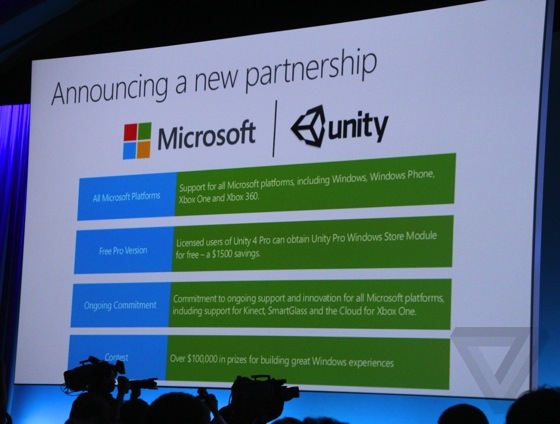
Later, Guggenheimer announced a partnership with Unity, a cross-platform game engine, to support Windows PC, Windows Phone, Xbox One, and Xbox 360. That could definitely be good news. However, it could also be a tacit admission that Microsoft developers will need a cross-platform engine to create games that target both Windows and Xbox, rather than the ability to simply run them on a console. It lends credence to the idea that the Xbox One might only leverage "Windows" to run web applications instead of providing a full computing platform.
Is Windows just a buzzword for Xbox?
At the Xbox One event last month, Microsoft's Marc Whitten said the new console had "three operating systems in one," but we're starting to wonder if "Windows" is more a marketing buzzword than a meaningful inclusion for Windows developers. When the PlayStation 3 launched, Sony's Ken Kutaragi called it a computer, but that didn't make it a particularly useful one. It certainly wasn't useful enough as a computer to keep Sony from removing the ability to install Linux on it with a firmware update in 2010.
It's possible that Microsoft's just not doing a good job of explaining the relationship between Xbox and Windows yet, the same way it didn't do a good job of explaining its policies on used games and always-on connectivity. Microsoft might even be letting Xbox lay low for a while to avoid further fallout before the console's holiday launch. But if there's real value to Windows on Xbox, the company needs to tell developers. Where would it do that, if not its premiere developer's conference?
28 Jun 14:54
Netflix's 'Max' adds character to PS3 content recommendations
by Matt Brian
firehoseClippy beat
Netflix has begun testing "Max," a new intelligent suggestion engine designed to match movie and TV shows to your current mood. Rolling out today to US PlayStation 3 owners, Netflix operates similarly to Apple's Siri but instead asks questions to better provide content suggestions. One time it may ask you to rate a selection of movies, other times it could ask you to pick between two genres — displaying new or interesting content depending on your choice.
Netflix says that once Max gets to know your preferences, it will begin to offer movie and TV show suggestions without warning. The assistant will live between the third or fourth row of the main Netflix screen but will drop further down the listing should you decide not to use it. The company hopes to roll out its new experience in the "upcoming weeks," expanding it to other devices — including the iPad — in the future.
- Source Netlfix Blog
- Related Items streaming ps3 max playstation 3 netflix siri assistant intelligent
28 Jun 14:53


Not really a family-friendly word As pointed out by Alientonx,...
by ericisawesome
Not really a family-friendly word
As pointed out by Alientonx, it looks like former presidential candidate Rick Santorum’s "Google problem" has seeped (ughhh) over to Animal Crossing: New Leaf.
BUY Animal Crossing: New Leaf, AC:NL guide, upcoming games
firehose and -1 others like this
28 Jun 14:52
Official: Satellite Reign To Be True Syndicate Successor
by Jim Rossignol
By Jim Rossignol on June 28th, 2013 at 2:11 pm.

As predicted, Satellite Reign has appeared on Kickstarter, promising to make the Syndicate-style game we always wanted. Watch these chaps get a million quid in no time. Slick-as-rain pitch video below.
28 Jun 14:51
 The Mac version of XCOM: Enemy Unknown is available now on Steam for $40. The news represents a curious turnaround for the Mac version's developer and general Mac specialist Feral Interactive, who told us back in May it "doesn't release games on Steam."
A month later, Feral announced the arrival of the Mac version on Steam, which it says supports cross-platform multiplayer across Windows PC and Mac. Also, if you've bought the PC version on Steam, you'll have free access to the Mac version.
XCOM: Enemy Unknown launched a full-scale invasion of our Top 10 of 2012 list, eventually notching a commendable second place behind Journey. Since then, Firaxis' extraterrestrial strategy game has hovered across to iOS, where it's currently available for $20.
XCOM: Enemy Unknown for Mac comes to Steam
by Sinan Kubba
A month later, Feral announced the arrival of the Mac version on Steam, which it says supports cross-platform multiplayer across Windows PC and Mac. Also, if you've bought the PC version on Steam, you'll have free access to the Mac version.
XCOM: Enemy Unknown launched a full-scale invasion of our Top 10 of 2012 list, eventually notching a commendable second place behind Journey. Since then, Firaxis' extraterrestrial strategy game has hovered across to iOS, where it's currently available for $20.
 XCOM: Enemy Unknown for Mac comes to Steam originally appeared on Joystiq on Fri, 28 Jun 2013 08:30:00 EST. Please see our terms for use of feeds.
28 Jun 14:49


The most important person entering US government you’ve never heard of
by Josh Meyer
firehose"Wong’s real passion and expertise is in using companies like Google, Twitter and YouTube (which Google bought in 2006) to promote freedom and democracy and fight repression and censorship.
...
Here’s her verbatim testimony:
First and foremost, the U.S. government should promote internet openness as a major plank for our foreign policy. The free flow of information is an important part of diplomacy, foreign assistance, and engagement on human rights.
Second, internet censorship should be part of our trade agenda because it has serious economic implications. It tilts the playing field towards domestic companies and reduces consumer choice. It affects not only U.S. and global Internet companies, but also hurts businesses in every sector that use the internet to reach customers.
Third, our government and governments around the world should be transparent about demands to censor or request information about users or when a network comes under attack. This is a critical part of the democratic process, allowing citizens to hold their governments accountable.
Finally, Google supports the commitment of Congress and the administration to provide funds to make sure people who need to access the internet safely have the right training and tools."
The first week on the job for Nicole Wong, dubbed by many as the US’s first chief privacy officer, has been fairly, well, private. The White House has named Wong, 44, a former top lawyer for Google and Twitter, as the new deputy US chief technology officer in the Office of Science and Technology Policy. But the appointment came with little fanfare or official communication about her role, even though Wong could have influence far and wide—not only on internet issues, but on foreign policy, trade and human rights. Here’s why.
Wong is serving as a top deputy to the White House’s chief technology officer, Todd Park, according to OSTP spokesman Rick Weiss. Beyond that, Weiss wouldn’t elaborate on what Wong will be doing. He did say, however, that characterizing her simply as a “chief privacy officer” doesn’t fully describe her role.
In the very least, Wong’s appointment appears to be part of an effort by the Obama administration to reassure citizens that their privacy rights will be protected. The White House has been under the gun about the government’s role in data mining and surveillance, thanks in part to controversy over its PRISM spying program. “The fact that this position exists reflects the importance we attach to the issue,” White House spokesman Jay Carney told reporters last week. “I would point you to everything I just said about the president’s views on the balance that we need to strike between our national security interests and protecting the American people, as well as protecting our values and our privacy.”
Wong has a stellar reputation for aggressively protecting individual privacy rights, earned during many battles she fought against the Bush and Obama administrations during her eight years as Google’s vice president and deputy general counsel. She joined Twitter as its legal director just seven months ago. Friends and former colleagues say she has mastered the complexities of cutting-edge internet and social media technologies and how the law should or shouldn’t apply to them.
But beyond individual privacy, Wong’s real passion and expertise is in using companies like Google, Twitter and YouTube (which Google bought in 2006) to promote freedom and democracy and fight repression and censorship. At Google in particular, she fought against more than 25 countries, including China, Turkey and Pakistan, that tried to limit the flow of information and videos as a way to stifle dissent and free speech.
A 2008 New York Times Magazine article on “Google’s Gatekeepers” detailed Wong’s work in preventing autocratic regimes from blocking access to protest videos on YouTube. She also wielded enormous power over free expression by determining what controversial material could appear on Google.com and on the local search engines that Google operates in dozens of countries. By doing so, the article said, Wong and her team “have arguably more influence over the contours of online expression than anyone else on the planet.”
That year, Google, along with Yahoo and Microsoft, launched the Global Network Initiative in conjunction with internet companies, human rights groups, investors and academics. The initiative advocated for collective action and economic leverage to force governments into guaranteeing free expression online. Based on the United Nation’s Universal Declaration of Human Rights, the group established a uniform code of conduct on freedom of expression and privacy for internet companies and governments to follow.
In 2010, Wong appeared before the US House Foreign Affairs Committee at a hearing titled, “The Google Predicament: Transforming U.S. Cyberspace Policy To Advance Democracy, Security and Trade.” In lengthy testimony, she laid out a four-point plan for how the US government should work hand-in-hand with internet companies.
Here’s her verbatim testimony:
- First and foremost, the U.S. government should promote internet openness as a major plank for our foreign policy. The free flow of information is an important part of diplomacy, foreign assistance, and engagement on human rights.
- Second, internet censorship should be part of our trade agenda because it has serious economic implications. It tilts the playing field towards domestic companies and reduces consumer choice. It affects not only U.S. and global Internet companies, but also hurts businesses in every sector that use the internet to reach customers.
- Third, our government and governments around the world should be transparent about demands to censor or request information about users or when a network comes under attack. This is a critical part of the democratic process, allowing citizens to hold their governments accountable.
- Finally, Google supports the commitment of Congress and the administration to provide funds to make sure people who need to access the internet safely have the right training and tools.
Now that Wong has the ear of the US president, who is following these issues closely, she may have room to run with her passions. Her job is behind-the-scenes but can be influential, according to Andrew McLaughlin, the US deputy chief technology officer for internet policy from 2009 to 2011, who is now the CEO of the social news website Digg. “By executive order, the CTO is the principal on a lot of policy committees,’’ and the CTO’s deputies are given a lot of authority, said McLaughlin, a friend of Wong’s from their six years together as top lawyers for Google. Among other accomplishments, McLaughlin and his successor, Daniel Weitzner, led the White House’s efforts on a consumer privacy bill of rights that grants consumers internet-surfing protections such as a “do not track” capability, a technology adopted by web browsers to blocks advertisers from using cookies to track internet users.
Wong’s remit is broader than McLaughlin’s and Weitzner’s, according to the White House, which says it will make her available to the media at some later date, and explain her portfolio more explicitly then. In the meantime, Wong will be doing what she does best: keeping things private. In a recent tweet, she said only that, “It’s official! Thrilled to join @whitehouseostp as Deputy US CTO. It’s an honor to serve with such a talented and dedicated team.”
28 Jun 14:47


Why you’ll share this story: The new science of memes
by Christopher Mims
More and more of the things that set the internet on fire are of that species of charmingly moronic pairing of text and image that allows even the post-literate to feel like they have partaken of a shared cultural moment. And now, scientists are beginning to understand how the curiously addictive visual tropes known as “memes” are born, why they die, and whether or not it’s possible to predict which will “go viral” and be harvested by the night-soil merchants up at meme warehouses like Cheezburger.
Treating memes like genes tells us which are likely to spread
The internet, of course, was barely in its infancy when Richard Dawkins, a British evolutionary biologist, coined the term “meme” back in 1976. And he meant it as a much more nuanced concept, encompassing pretty much any idea that is good at propagating from one human brain to another—whether it is dialectical materialism or the tune to Happy Birthday.
But Dawkins was deliberate in his comparison of memes to genes. Like the molecular units of inheritance, memes “reproduce” by leaping from one mind to another, “mutate” as they are re-interpreted by new humans, and can spread through a population. The internet has radically accelerated the spread of memes of all kinds; but it has also led to the rise of a specific kind of meme, the kind encapsulated by a phrase or a picture. And importantly for scientists, the life of a such a meme is highly measurable.
New research from Michele Coscia of Harvard University goes so far as to suggest a decision tree—which is sort of like a flow chart—that can show at any given point in an internet meme’s life how likely it is to go viral. In order to generate this chart, Coscia tracked 178,801 variants of 499 memes, all gathered from what is arguably the internet’s biggest clearinghouse for memes, Quickmeme.
This is how you sort out how likely your meme is to go viral.
Michele Coscia
This decision tree is a bit challenging to parse, but here goes. The number at the top, 35.47%, is the total proportion of all the memes Coscia analyzed that were “successful.” By his definition, success meant receiving a high enough score on Memebase, where users can vote a meme up or down. (His threshold for “success” was necessarily somewhat arbitrary.)
Among these successful memes, an interesting phenomenon emerges. Those that hit an above-average peak of popularity at some point in their life were less likely, overall, to ultimately break the “success” threshold. Memes that were shared more consistently over time, rather than a great deal all at once, were more likely to ultimately rack up enough points.
In the attention economy, memes do battle to the death
If you think Nature is red in tooth and claw, you have yet to stare longingly at a website’s analytics dashboard, quietly willing an article you wrote to go viral. (Not that anyone at Quartz has ever done this.) In the attention economy, memes compete for a finite pool of attention, representing all the time everyone spends on the internet. Which means that for one meme to become popular, some other meme must pass into obscurity.
Coscia’s data crunching revealed that memes that were “more competitive” than others—that is, whose rise in popularity tended to correlate with the fall in popularity of other memes—were more likely to succeed overall.
But memes that travel in packs do best of all
Coscia identified a number of “meme organisms”—clusters of memes that tend to do well together. He doesn’t speculate about why, exactly, these memes’ fates seem to be linked together, but a look at meme cluster #45, consisting of two memes (the average number in a cluster was 4.8) suggests a strange sort of logic to their linkage.
Only meme-meisters know why some memes tend to succeed at the same time as others.
Michele Coscia
Perhaps (this is my speculation) one interpretation of meme organisms is that certain memes seem to capture the zeitgeist. Thus, memes could have seasonal patterns, or even follow the anxieties and fads of the day, as suggested by trends in the news. Or perhaps memes that remind you of one another do well because they feed off one another’s attention. Just as genres emerge in music, literature and art, so too in internet memes.
Memes have a life of their own, independent of who shares them
Coscia notes that most previous research on how things go viral has sought to map the social interconnections of those who are sharing content. Thus, studies of how news is shared on, say, Twitter seek to map who are the most influential sharers of information in any given news cycle.
Nodes at the center of these maps of how news spreads represent people with influence online.
Weng et al.
But Coscia completely ignored who was sharing which memes—all of his data came entirely from the scores that memes receive on Quickmeme—and yet he was still able to discern patterns about which kind of memes would go viral. It’s not surprising that the underlying structure of the internet, a given website, and the human brain should all have an effect on making some things more likely to spread than others, but in his attempt to qualify the characteristics of this collective system, Coscia showed that memes can have intrinsic characteristics that make them more likely to succeed. Granted, these qualities aren’t apparent until a meme has already begun to spread, but once identified, they help predict how well it might do at some point in the future.
People get bored quickly, and are surprisingly predictable about what they’ll share
Past research about memes shows two things that should surprise no one, but are worth emphasizing: If you can figure out what someone is interested in, you can predict how likely she is to share a piece of content. And the more similar a piece of content is to what she has shared before, the more likely she is to share it. In other words, affinity groups rule the web.
“Relationship between the probability of retweeting a message and its similarity to the user’s interests, inferred from prior posting behavior.”
Weng et al.
Also, memes have a half-life. They become popular, and then, taken as a whole, they are consumed and then tossed on the scrap-heap of history.
While their individual histories vary, on average the slow disappearance of interest in a meme is highly predictable.
Weng et al.
No one has any idea what makes something go viral in the first place
Attempts to predict what will go viral on the internet are based on the past behavior of a meme. As Coscia emphasizes in his work, no one has yet to rigorously demonstrate, in advance, why any particular type of content goes viral. This sort of prognostication remains an art rather than a science.
28 Jun 14:46
The Suicide Detective
Recently more human beings have been dying by suicide annually than by murder and warfare combined. Matthew N. Nock is trying to figure out why we're so bent on our own destruction.
28 Jun 14:45
BB10 fails to turn a profit for BlackBerry in first full quarter of availability
by Aaron Souppouris
After two quarters of meagre profits, BlackBerry has posted its Q1 2014 results (for the three-month period ending June 1st 2013), revealing an $84 million loss from $3.1 billion revenue. Compared to last quarter, when the Canadian manufacturer made $94 million from $2.7 billion revenue, the results are fairly positive.

With smartphone shipments, BlackBerry's position strengthened for the first time in a while. After five consecutive quarters of falling shipments, this quarter saw a rise from six million to 6.8 million. Of those, it's not clear how many were BlackBerry 10 devices. It's worth noting that today's figures don't give us a full picture of BlackBerry's recent performance; the much-anticipated Q10 QWERTY smartphone was released in the US after this financial period ended, although it had been on sale in Europe and elsewhere for some time.
Developing...
- Source BlackBerry (MarketWire)
- Related Items q1 2014 bbry blackberry bb10 earnings financial Q10 Z10 BlackBerry
28 Jun 14:44
The Pokemon Company is cracking down on cheaters
by Emily Gera
firehosepshaw
The Pokemon Company has issued a statement warning users who use methods of hacking Pokemon video games of bans and corruptions to saved games.
The statement highlights the use of smart phone apps that can be used to hack the game by imitating the game's servers in order to distribute Pokemon. According to the company, these unauthorized apps can corrupt the user's save game and the game of the player the user is playing against.
Additionally both The Pokemon Company and Nintendo warns that neither company will be able to return save game data to normal. Users who are caught using hacks during official tournaments will be disqualified from competing and barred from future events.
The fully published statement is available on the official Pokemon Japan website.
28 Jun 14:44
NC becomes 1st state to drop federal jobless funds - York Daily Record
San Francisco Chronicle |
NC becomes 1st state to drop federal jobless funds
York Daily Record Lee Creighton looks for a job on the internet at his home in Cary, N.C., Thursday, June 27, 2013. Creighton has been unemployed since October and will receive his last bit of unemployment aid this week. With changes to its unemployment law taking effect ... Unemployment benefits cut in MaineHouston Chronicle all 63 news articles » |
28 Jun 14:44


Entrepreneurs need not apply: Companies shun the self employed
by Commentary
firehoseof course
In this economy, some unlucky workers are getting snubbed—twice.
Recession prompted millions of laid off workers and new graduates to jump into self-employment—some with enthusiasm and others with reluctance because they couldn’t find anything better. Now, according to new research, it seems they aren’t wanted back.
That’s only ironic because company executives and human resources say they want self starters, innovative hires, a certain entrepreneurial spirit.
Entrepreneurs and freelancers attract fewer interview invitations than comparable candidates who have spent the last few years working for someone else, according to research which will be presented to the Academy of Management annual conference in August. In the UK, the self-employed received almost two-thirds fewer interview requests than people with similar professional experience who worked only at employers.
“The choice to become an entrepreneur can result in an involuntary lock-in, a factor that should be taken into account in planning one’s future career,” wrote the five professors from the University of Vienna, Munich School of Management and Erasmus University Rotterdam.
Men who were self employed fared far worse than women at landing job interviews, a difference the researchers cannot explain but say they hope to look into later.
The stigma against the self-employed may indicate that hiring managers just don’t see them as a good fit in their corporate culture. Traits that work for start-ups—risk-taking, taking charge and adopting “unusual points of view”—don’t necessarily work well in corporate careers, the paper noted.
“My hunch is that many entrepreneurs would actually not fit very well into established organizations, although they may be very productive and able managers themselves—as long as they don’t have a boss,” said Philipp Koellinger, an associate professor of economics at the Erasmus University Rotterdam, and one of the study’s authors. “Employers may attach that stereotype to everyone who was self-employed.”
He estimates that approximately one in seven entrepreneurs who started their businesses in the last four years did so because they couldn’t find jobs, and his previous research shows they are considerably less satisfied with their start-up than others. (That 2008-2009 research was called ”I Can’t Get No Satisfaction.”(abstract))
In the latest experiment, researchers sent pairs of cover letters and fictional resumes to real human resources management jobs in the UK over two years. In both fictional candidates’ CVs, the skills and training in the first seven years of the “applicant’s” careers were the same, with experience at large- and mid-sized companies. The key difference showed up after 2009: One of them was said to have owned a small HR consultancy with three employees while the other worked in a company’s HR department consulting with different groups.
The latest findings sound a lot like discrimination—except freelancers or consultants have few protections. Judging by a similar reception the unemployed have received, it’s likely best for applicants to sell their entrepreneurial spirit more than the actual record.
Follow Vickie Elmer on Twitter @WorkingKind. We welcome your comments at ideas@qz.com.
28 Jun 14:43
Julian Gollop’s Chaos Reborn Summons A Screenshot
by Alec Meer
By Alec Meer on June 28th, 2013 at 11:00 am.

It is, however, only a screenshot of placeholder art for the X-COM co-creator’s remake of wizard wars classic Chaos, but it is nonetheless a fine thing to see this new vision of the landmark Speccy game taking shape.
You should take a look at the full res version over on Julian Gollop’s site, not least because without my cropping it shows a little more of how the mechanics will work. Specifically, “The Spider is selected, and his possible actions are clearly highlighted by the interface. The orange circles indicate spaces that it can move to and still do combat. The green circles show spaces that can be moved to, but without combat. The red circles highlight possible enemy targets, with the percentage chance of killing that target displayed.”
Gollop also claims that he now has a working build of the game. “In the last two months my expanded team of programmers have been busy making a playable prototype of the game, and I am proud to announce that Chaos Reborn is born! One thing we decided to do is not worry about graphics and animation, but focus on game play – so everything in this prototype is placeholder only (although I think Felix did rather too good a job on the placeholder graphics!). Testing is underway and a few bugs are being fixed.”
Six-person multiplayer is even up and running apparently, featuring random spell selection and five different maps. He’s also posted the full list of spells, but I think I’d be a bit of a turd to just paste the whole lot in here, so go have a read.
As for the placeholder art, I kinda like it. Obviously it needs a bit of tarting up, but it evokes the hyper-coloured weirdness of the original well, without disrupting things with too much focus on shallow whizzbang.

28 Jun 14:39
Microsoft working on third-party and current-gen peripheral support for Xbox One
by Jenna Pitcher
firehosemake up your fucking mind
Following news that only Xbox One headsets and peripherals will be compatible with Microsoft's next-generation console, the company confirmed that it will work on solutions to allow other brands of gaming headsets to connect to the controller for gaming and chat audio, it told Polygon in a prepared statement.
"The Wireless Controller has been redesigned to allow for higher data transfer speed between the controller and the console," Microsoft Australia told Polygon the statement. "This also required creating a new expansion port design for headsets and future controller add-on devices which is different from a standard audio plug input. Xbox plans to develop solutions in the near future to allow consumers to connect many brands of wired gaming headsets to the Wireless Controller for gaming and chat audio."
News about the planned support was first broached on the Official Xbox Twitter account when it tweeted that the company was developing an adapter for current-gen headsets to connect to the console.
A few days ago, Microsoft confirmed that only Xbox One controllers and accessories will work with the hardware. Around the same, it also announced that Xbox One headsets will not be included in the base system, stressing that the packaged Kinect sensor will enable voice inputs for in-game chat and other communication apps. However, an Xbox One headset will be available from the console's launch in November.
Gaming gear manufacturer Astro revealed earlier this week that it is pushing for a developer license for the Xbox One to produce compatible peripherals for the next-gen hardware. The company said that voice chat on current Astro headsets will not work on the new console and it will have to make Xbox One-specific peripherals, instead of universal products.
28 Jun 14:37
Comic for June 28, 2013
firehosewell fuck you then dilbert
Dilbert readers - Please visit Dilbert.com to read this feature. Due to changes with our feeds, we are now making this RSS feed a link to Dilbert.com.
Martin and -1 others like this
28 Jun 14:35


Games: The Gameological Society: Members of the metal band Kylesa imagine their latest album as a video game
by Anthony John Agnello
firehose"A VR helmet with a vaporizer system would be the ultimate Kylesa merch."
In What Are You Playing This Weekend?, we discuss gaming and such with prominent figures in the pop-culture arena. We always start with the same question.
Of the many metal bands to emerge out of Savannah, Ga., in the past decade, Kylesa is among the most approachable. Laura Pleasants and Phil Cope, the band’s two persistent members (who are pictured above with the band’s current drummer, Carl McGinley, center), write swirling, spacey hard rock with a dollop of psychedelia on top. The Gameological Society spoke with the duo just before a show supporting their new album Ultraviolet. We talked Wipeout, the politics of coolness, and sweet, Lawnmower Man merch.
The Gameological Society: What are you playing this weekend?
Laura Pleasants: We’re playing in Albany, New York, tomorrow and then to Philly after that, or D.C. Is it D.C.?
Phil Cope: Maybe?
Pleasants: Well, we’re ...
Read more
28 Jun 14:31
Last Thursday
by Anonymous
firehosepassive aggression is the Portland way
I hope you had fun at the festival. I noticed you illegally parked in front of my driveway. I hope the dog poop spread across your windshield and air intake vents is easy to clean. Wouldn't want to inconvenience such a considerate person such as you.
28 Jun 14:29
The Shutter: Closed: Beaker & Flask Has 'Served Its Final Drink'
by Erin DeJesus
firehosenever found it

Image of Beaker & Flask courtesy Avila/EPDX
Three weeks ago, Beaker & Flask owner Kevin Ludwig announced a temporary closure for his eastside bar and restaurant, saying that the restaurant would be taking a break to revamp the food menu into something "more simple." Now, after earlier rumormongering by FoodDude, Ludwig confirms that the Beaker & Flask shutter is permanent, effective immediately. Via an official Twitter message last night:
With some sadness, I do report that Beaker has, indeed, served its final drink. I had a great time & as always, Thank You for Drinking.
Beaker & Flask debuted in June 2009 as a long-stewing project by Ludwig and founding chef Ben Bettinger (who left the B&F kitchen in 2012 to open downtown's Imperial). The restaurant collected early accolades: three months after opening, WWeek crowned Beaker its Restaurant of the Year. No word yet on Ludwig's next move or future plans for the space; more information as it becomes available.
· Beaker & Flask [Official site]
· All Previous Beaker Coverage [Eater PDX]

28 Jun 14:27
DOD Contractors to Get New Whistleblower Protections
firehosevia multitasksuicide
Beginning July 1, whistleblowers working for Defense Department subcontractors will begin receiving protection against reprisals through a new law intended to better protect those who expose possible wrongdoing.
In addition, as part of the National Defense Authorization Act for Fiscal Year 2013, contractors who report suspected waste, fraud and abuse within their company rather than directly to the DOD inspector general also will be protected, a modification of previous laws aimed at better protecting whistleblowers working on DOD contracts.
Nilgun Tolek, who directs investigations against whistleblower reprisals for the Defense Department inspector general’s office, explained the new law to reporters yesterday at the Pentagon.
“Since internal complaints weren’t covered under the statute, those people who did make an internal hotline complaint and believed they were retaliated against had nowhere to get protection,” Tolek said, adding that the measure “brings the statute up to par with existing whistleblower protections.”
The new law will apply to all DOD contracts beginning on or after July 1, as well as to new amendments to existing contracts.
Marguerite C. Garrison, deputy inspector general for administrative investigations, said complaints about abuse from DOD subcontractors revealed the need for the new law.
“Congress has recognized that there have been some loopholes in the provisions, and that the protections didn’t expand to everyone,” she explained.
The law will provide added protection to whistleblowers from retaliation by requiring “clear and convincing evidence” that a contractor would have taken the same disciplinary action against an employee even if he or she had not come forward with an allegation of abuse, Tolek said.


28 Jun 14:18

Race and Gender in Doctor Who: Beyond Who Plays The Doctor
by Joseph
firehosevia Jhameia.goh: "Guess I'm never sitting down to properly watch DW until Moffat goes away and never comes back."
By Guest Contributor Joy Ellison
Current executive producer Stephen Moffatt on the Doctor Who set. Image via WhatCulture!
Over the last few weeks, fans have called for a person of color and/or a woman to star in Doctor Who. If you care about race and gender presentation in Doctor Who, then pay attention to who serves as the show’s next executive producer.
When it comes to who should replace Matt Smith as the next star of the TV show Doctor Who, many fans are hoping for one thing: anyone but another white guy.
For nearly 50 years, the Doctor, the time-traveling main character of Doctor Who, has been portrayed by white men. Fans concerned with social justice are right to clamor for a different sort of Doctor. While the Doctor may be an alien, over the course of the show the character has come to represent the best of humanity. That’s why it is especially important that the Doctor be portrayed by a person of color or a woman – or, dare we dream, a woman of color, a person with a disability, a queer person, or transgender person, or a combination of all the above.
But while we wait to meet the new incarnation of this beloved sci-fi character, fans should turn their attention to racial and gender representation in an area of Doctor Who that isn’t immediately visible on screen: the executive producer.
Who serves as the executive producer for Doctor Who may affect the show almost as much as who portrays the Doctor. Since the re-launch of the series in 2005, the executive producer of Doctor Who has also served as showrunner, filling both the roles of producer and lead writer, giving the position tremendous influence on not only the content of the show, but also casting and staffing.
Just as all 11 Doctors have been portrayed by white men, so have all 13 of the show’s executive producers been white.
The impact of Doctor Who’s executive producer is obvious to fans who have watched the revival of the series. When Russell T. Davies re-launched the show as executive producer, he brought with him an increased commitment to diversity. Davies cast Christopher Eccleston, a white man, as the 9th Doctor and David Tennent, another (surprise!) white man, as the 10th Doctor. Nonetheless, under Davies, fans saw a more diverse cast, full of many different types of heroines, as well as queer characters and people of color. Davies didn’t handle diversity perfectly, but his influence demonstrates just how important an executive producer can be.
Under current showrunner Steven Moffat’s leadership, Doctor Who has become undeniably whiter, straighter, and more sexist. Moffat hasn’t developed any recurring characters of color and his women characters leave much to be desired. While both River Song and Amy Pond are competent and spunky, they are defined exclusively in relation to the Doctor and Rory. In the place of women with independent interests and developed characters, Moffat substitutes bossy women and hopes no one notices.
Moffat presented women in the same way in his previous show Coupling, a situation comedy about dating and romance. In light of Moffat’s own statements to the press, he seems to write his women characters this way because he actually believes that’s how women behave. Take a look at this Moffat quote, which is almost breath-taking in its racism, classism, heterosexism, and misogyny:
“There’s this issue you’re not allowed to discuss: that women are needy. Men can go for longer, more happily, without women. That’s the truth. We don’t, as little boys, play at being married – we try to avoid it for as long as possible. Meanwhile women are out there hunting for husbands. The world is vastly counted in favour of men at every level – except if you live in a civilised country and you’re sort of educated and middle-class, because then you’re almost certainly junior in your relationship and in a state of permanent, crippled apology. Your preferences are routinely mocked. There’s a huge, unfortunate lack of respect for anything male.”
Thank you, Steven. This explains so much.
Contrasting Doctor Who under Moffat and Davies lays bare just how profound an effect the executive producer of Doctor Who has on the show. It’s not just what the Doctor looks like that matters, though who portrays the Doctor does matter very much indeed. If the role of the Doctor is finally given to an actor who isn’t a white man, that actor will need to be supported by an executive producer who able to write for such a character and committed to doing justice to a new vision of Doctor Who.
But why does writing matter so much? Fans hoping for a more diverse Doctor should pause to reflect: A black woman doctor has already saved our planet once. Remember Dr. Martha Jones?
Despite the consummate acting of the talented Freema Agyeman, Martha is one of the most maligned of the Doctor’s companions. Some commentators have argued that fans despised Martha because of her race and gender – a well-documented phenomenon in geek culture. Others have said that the writers didn’t give Doctor Who’s first Black companion a fair shot. Both analyses are correct. Martha is a kick-ass character who doesn’t deserve the racist misogyny leveled at her by some fans. But, she was also written as a rebound for a lovesick Doctor who is still pining for Rose. Martha, an otherwise brilliant woman with tremendous initiative, nurses an adolescent crush on the Doctor that seems out of character. The Doctor, portrayed by David Tennant, is shockingly indifferent to her obvious feelings. This aspect of Martha’s storyline is deeply disappointing. It also reveals an important truth: diversity is important, but it needs to be supported by good writing.
Storytelling matters. The problems of Doctor Who won’t be solved simply by casting a new actor in the starring role. The show needs to tell new stories shaped by new visions.
Current showrunner Steven Moffat and executive producer Brian Minchin will likely be with the show for a while. When it comes time for a new executive producer to take control of the TARDIS, I hope that fans will pressure the BBC to let what happens to our favorite time-traveler be decided by someone who isn’t white.
Joy Ellison is a writer and activist who is building a full-scale replica of the TARDIS. You can follow Joy on Twitter @j_in_tuwani.
Darlingniki821, Mabatubatu and -1 others like this
28 Jun 12:40
Martha Stewart Admits To Sexting, Reveals She 'Maybe' Had A Threesome
Stewart also revealed that she's never visited a strip club, nor did she ever take a hit of acid.
28 Jun 11:20


Women's Wear Wednesday | Donya Patrice...New Oxford Street, London
by Lougè Delcy
firehosevia Rosalind
nice hat; #strapup
Russian Sledges, Tertiarymatt and one other like this