Read more of this story at Slashdot.

Read more of this story at Slashdot.
Read more of this story at Slashdot.

Pootling around the Raspberry Pi forums late last night, I found something that rightfully shouldn’t exist. It’s a two-player chess game for the Pi – nothing so unusual there – written in assembly language, with no OS. Which is highly unusual.
Xu Ji, one of the three Imperial College students who wrote this piece of…bravura showing-off, had this to say in the forums:
My two friends and myself have successfully written a chess game for the Pi. It’s a graphical game with a colourful chess board, so we interface with the GPU and whatnot, and we do it all in assembly without an OS running on it.
We actually wrote the assembler too (in fact this was the actual assignment for the project), but it was based on the ARM7 assembler so it’s probably compatible with official assemblers (although we have not tested this).
It is due to the fact that we ourselves wrote the assembler (in C) and we only had 2 weeks for this that we only support a limited number of instructions in (our version of) assembly language. For example we are forced to use labels for variable names.
The game is written to replace kernel.img inside the OS and is about 15 thousand lines.
We thought some people may find the chess game interesting as a project, and it may inspire others to try writing games in assembly, so we are posting the link to the repo here:
https://github.com/xu-ji/assembly_chess/
Given our restrictive language we didn’t think we’d make it, but somehow it actually works…
It really does, too. Here are Xu Ji, Bora Mollamustafaoglu and Gun Pinyo, giving a storming demo. We hope you got top marks for this, guys: you totally deserve it.
If you’d like to learn more about assembly language, we highly recommend that you get your Pi out and start working through Baking Pi, a course developed last year by Alex Chadwick at the University of Cambridge, which will take you from knowing nothing at all to being able to build a simple operating system on the Pi. You can read more about Baking Pi here.
Released 25 years ago, the Nintendo Power Pad, a plastic mat that plugged into an NES, saw very limited success despite its prevalence in basements and attics. In total, only six games for the Power Pad were released in North America, and only 13 worldwide. The guys over at cyborgDino thought they should celebrate the sliver anniversary of the Power Pad by creating its 14th game, using an Arduino and a bit of playing around in Unity 3D.
The first order of business was to read the button inputs on the Power Pad. Like all NES peripherals, the Power Pad stores the state of its buttons in a shift register that can be easily read out with an Arduino. With a bit of help from the UnoJoy library, it was a relatively simple matter to make the Power Pad work as intended.
The video game cyborgDino created is called Axis. It’s a bit like a cross between Pong and a tower defense game; plant your feet on the right buttons, and a shield pops up, protecting your square in the middle of the screen from bouncing balls. It’s the 14th game ever created for the Power Pad, so that’s got to count for something.
Video of the game below.


We've seen several breakthroughs in HIV treatment this year — early treatment and helped fourteen adults go off HIV drugs — and now researchers from Boston's Brigham and Women's Hospital have discovered another advancement. At the International AIDS society conference, Timothy Henrich described how two men with longstanding HIV infections received bone marrow transplants that appear to have removed all traces of the virus from their blood, allowing them to go off medication. One man became infected with HIV in the early years of the disease's epidemic while the other contracted it as a baby, and both were receiving the bone marrow transplant to battle. At this point, it's been seven weeks and four months, respectively, since the men stopped taking HIV suppression drugs but the virus hasn't returned.
Of course, the doctors cautioned that the virus could return at any time. "Long-term follow up of at least one year will be required to understand the full impact of a bone marow transplant on HIV persistence," said Henrich. And he also cautioned that this treatment only worked in a very specific situation, as the men already needed to receive the bone marrow transplant for their blood cancers. Generally speaking, bone marrow transplants are a risky surgery with a 20 percent mortality rate — not the kind of surgery you'd want to go into unless it was really necessary. "This is not a practical strategy that we can do for most people with HIV," Henrich said. "It's also very expensive, so it's not scalable." Still, the researchers believe there's a lot that can be learned from these cases that can be applied to future HIV treatment options.

Patton Oswalt’s comments on rape jokes convinced me to make this chart to help answer the question, “Should I tell my rape joke?”
The debate between feminists and comedians is ongoing, but luckily some of us are both feminists and comedians so I made this chart in hopes that it will help some of us consider who else might be listening to our jokes. It doesn’t cover all the bases but I hope it’s a good start.
The difference between rape and cancer and genocide and other taboo joke topics is that cancer is not a violent act forced upon the person with it. No one (realistically) blames genocide victims for that tragedy. But mere days ago, the Wall Street Journal published an editorial by one of its columnists that calls sexual assault prevention “criminalizing male sexuality.” We live in a culture that blames the raped and not the rapist to such an extent that most rapes are not even reported and many victims blame themselves.
I’ve done so many shows to so many people that I know I’ve performed for rape survivors and rapists alike. It’s a statistical probability. To think that I’ve caused a survivor to relive that crime to any extent, and to think that there’s a possibility I may have made a rapist feel a little less guilty — that really bothers me.
That being said, I also believe that nothing is off limits if done in the correct way and that’s why I made this chart. The weight of the subject of the joke means you should spend an equal amount of time considering the impact. The heavier something is, the more it hurts when it lands on you, after all. I’m not saying certain jokes should be banned, but we need to quit acting like we’re the victim when someone in the audience (in all its forms) doesn’t like what we say.
I do comedy to make people think but I also do comedy so they don’t have to think. Life can be pretty freaking rough, especially if you have to be serious all the time. But the main reason I do comedy is because I want to make people laugh. It makes them feel good and it makes me feel even better. Why would I want to risk that with a joke about something of which I know nothing?
We’re just telling jokes here, after all.
And again, do all the jokes you want. All I ask is that as comedians, we all consider why we’re telling them and who we’re telling them to.
One of the selling points of Windows Phone is the tight social integration and ability to pull photos from Facebook into the built-in photo application. Microsoft mimicked this same functionality in Windows 8, but it appears the company is removing some of it for Windows 8.1. Although the photos app in Windows 8.1 has been improved with editing functionality, the app has dropped Facebook and Flickr integration alongside the removal of support for images on network storage.
In a posting to Microsoft's community forums, a spokesperson explains that the software maker introduced the Facebook and Flickr integration originally in Windows 8 as very few apps would initially be available. "Now there are many apps in the store that offer ways to view photos on other services," explains the Microsoft spokesperson. "We’re confident Facebook will offer great ways to view and engage socially with photos on Facebook. We welcome Flickr to do the same."
The reaction in follow up comments appears to be one of disappointment that Microsoft has retreated from its original vision of combining services into one useful app or hub. Facebook recently committed to building a Windows 8 app, and it's possible Microsoft could be planning to allow the Photos and Facebook apps to share data. The people app in Windows 8.1 will continue to include the usual Facebook integration. We've reached out to Microsoft to confirm whether the decision to remove the Facebook and Flickr photo integration is final, but it certainly appears so from the representative in the community thread.
Thanks, James!
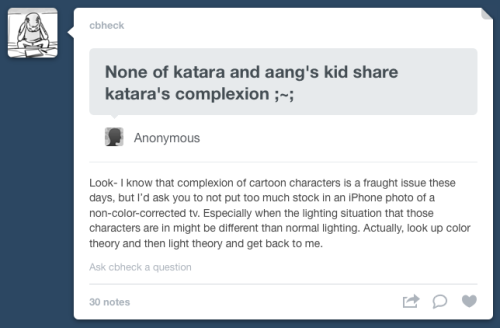
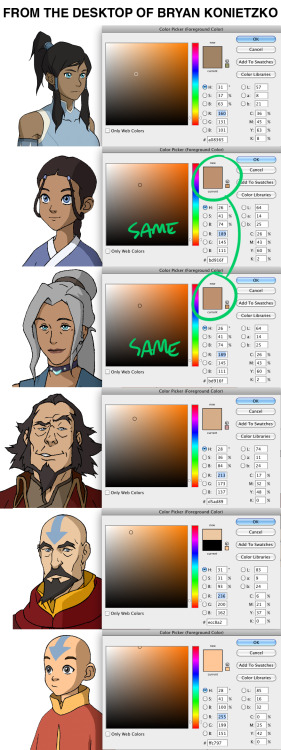
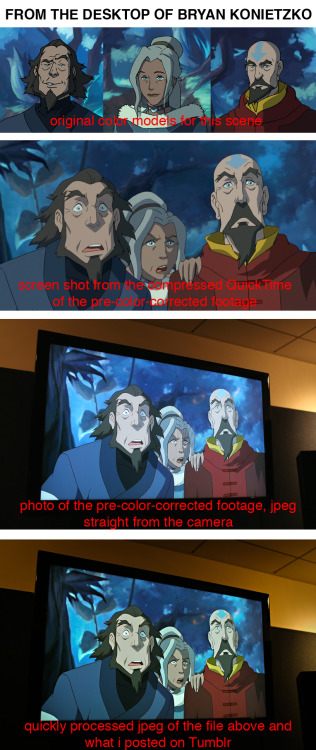
This past Friday I published this post which featured a photo of a monitor showing Katara and Aang’s grown-up children, Bumi, Kya, and Tenzin. Later that night at work I saw Colin’s answer to an anonymous “ask" (I can’t figure out how to link or reblog it properly in my browser, so the screen shot at the top will have to suffice). It is a shame the anonymous asker drew an incorrect assumption based on one image created in relatively uncontrolled conditions, and I feel that Colin’s answer hit the nail on the head.
Normally I would leave it at that. I prefer to stay out of this type of discourse on Tumblr and let the large body of work Mike and I have put out there over the years speak for itself (which obviously DOES NOT include the gross misinterpretations and misrepresentations of our work in this guy’s work). There’s nothing perfect about me or my work, but I am proud of it and the diverse, inclusive, atypical-for-American-TV world it portrays and the characters that populate it, and what it means to many people all over this globe.
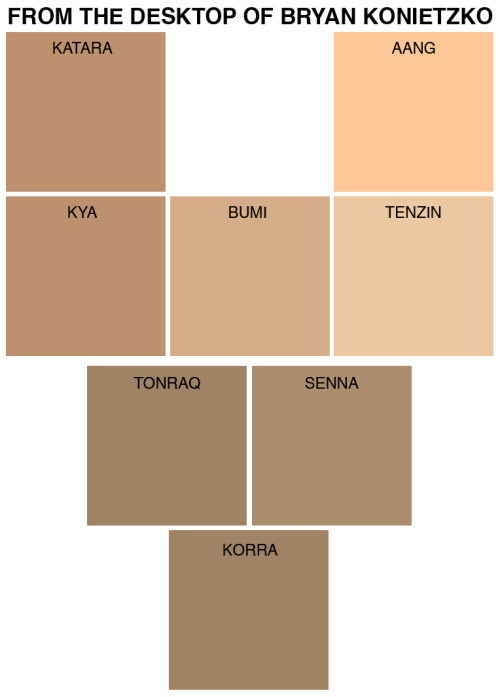
But, like most people, I don’t like seeing the spreading of misinformation, nor being falsely accused of something, nor fans of Avatar and Korra believing we have let them down regarding a very sensitive issue when they are mistaken. The claim that “none of Katara and Aang’s kids share Katara’s complexion" is unequivocally false. Kya’s color model shares the exact same skin color as Katara’s; Tenzin’s skin is a touch darker and less saturated than Aang’s; and Bumi’s is just about in the middle of his siblings’. I made a color swatch chart above, with all the colors taken directly from the characters’ normal color models. I included Korra’s and her parents’ skin tones on there as well, just for reference. I also compiled screen shots of all the characters with the color picker open, sampling their skin tones. You can see for yourself that Katara and her daughter Kya share the same color code: #bd916f
Depicting diverse characters is an issue that is very important to me. But as an art director, depicting a variety of lighting situations, light temperatures, colored light sources, color atmospheres, contrast levels, dynamic ranges, tinted filters, tones, styles, moods, exposure settings, diffusion levels, etc., is all very important to me too, all in an attempt to make great, inspired, sophisticated, beautiful art that reflects something of the complex world in which we live.
Real flesh and blood skin is shiny in places, matte in others, translucent, reflective, uneven, smooth in places, textured in others. It reacts to light and color in such complex ways that while most people rarely even think about it in our normal day experiences, the properties are so intricate and subtle that mastering its accurate representation eludes students of painting such as myself for years on end. On the other hand, 2D cartoon character skin is a flat field of projected or printed color. It is an abstracted, simplified representation. If one adds lighting to a 2D animated character, that whole color field of skin tone is lightened––uniformly, unless you apply a the few limited techniques at our disposal in TV animation involving gradations. If one adds lighting to real flesh and blood skin, highlights and core shadows are formed, light models surfaces and bounces onto others, colors are reflected from surrounding objects… on and on. 3D animation certainly has many more tools at its disposal to depict skin in a realistic fashion, but even that isn’t a cakewalk and many attempts plummet into the uncanny valley.
As Colin made reference to, color theory is an incredibly fascinating, frustrating, and bewildering pursuit. I’ve been studying and trying to apply it for twenty years, and I’m still in its awe. There are so many factors to consider before trusting your own perception. For example, in the image above with the characters’ heads, Kya’s skin appears to my eye to be slightly lighter than Katara’s, despite the fact that I know they are absolutely the same color. This is most likely due to the effect of simultaneous contrast, also known as contrast effect: in simple terms, colors are pushed lighter, darker, warmer, and cooler based on what other colors are next to them. I’ve taken a sample of Korra’s normal skin tone and applied it to an illustration with a painted background and all of a sudden it looks green. On another background it might appear gray. Or bright orange. The average 2D animated show out there in the world has stock normal color models for its characters that they use for almost every scene (occasionally with a “night" version that is a bit darker and cooler). Typically the character models are presented in a vacuum, with no change in lighting, atmosphere, contrast, etc… no regard for any of the artistic properties mentioned above that I am trying to utilize in my animation art direction.
I’m not going to make that kind of show. Instead, I’m going to add lighting, change contrast levels, mix up the colors of light sources, try to inject some atmosphere into the world we’re creating. And as a result, characters’ skin tones are going to appear different depending on the context of the scene. The colors on a normal color model sheet are what’s called local color in color theory. This is the color of an object in neutral, even light. But it’s just a starting point, a flat color field in a vacuum. On Avatar we dialed every single color model from its normal model to match the lighting and color atmosphere of the background painting for each sequence in all sixty-one episodes. On Korra we do that too, and take it many steps further by adding lighting and atmosphere effects in the compositing stage, all in a pursuit of a dramatic, cinematic aesthetic. Sometimes it works out and I’m satisfied with the results. Sometimes the effects are too heavy-handed and even I’m saying, “His/her skin looks too light!" Unfortunately, this is a TV show production where we are frantically making dozens of episodes at once and we don’t get to finesse the final composites like they are able to do in feature productions. I fix what I can in retakes and color correction, but there’s only so much I can do. But I’d rather have a few fumbles in the pursuit of good art than make a flat show with no lighting or atmosphere.
And I enjoy sharing sneak peeks of the work we’re making with you guys, which often means I take a snapshot on my iPhone or DSLR of a screen and post it on Tumblr. Take a look at the last compilation of images above to see how differently colors, particularly skin tones, can vary depending on their sources. This opens up another vastly complex subject of which I am a frustrated student: photography. Take color theory and multiply it by optical engineering and then by computer science and then pull all of your hair out as you try to get your meticulously processed photo to appear the same color and contrast level on a variety of digital devices and non-color-managed web browsers and non-color-calibrated monitors. Or try the simpler task of taking a picture of something on a TV screen and see how different the photo looks than the image you saw. Everything goes out the window. While you’re at it, take digital pictures of the same red apple at different times of day, in different rooms, under different lights, outside in different weather. Then pull all of those photos into your computer and make color swatches of what you thought you knew to be “red." Then try painting a picture of that apple using just those sampled color swatches. You’ll start to see how complex this all is.
I am all for social justice and breaking down ignorance and oppressive, hurtful social constructs, particularly when the path to that is to inform, educate, open minds, and promote empathy and equality. I am not a fan of self-righteousness in any form and I struggle to keep from drifting in that direction with my own views and convictions. The internet provides a great platform to call BS on a lot of things, and I encourage people to use it for that. But now that you have the official local color swatches of these characters’ “normal" skin tones in the image above, I can assure you that using it like some Behr color chip ammunition to lambast every fanart depiction of Korra that doesn’t match #a08365 is a flawed pursuit. Ask yourself if any of the things listed above in this post might be factoring into a color variation before you shoot from the hip with your judgement. And if the depiction of Korra in some fanart is without a doubt offensive to you, consider phrasing your response in a way that could help them see it your way. Art is hard! Maybe he or she is trying to get the hang of painting and working with color (skin being one of the hardest things to master). Maybe he or she is still ignorant to the worldly views that are obvious and significant to you. You could take this opportunity to turn it into what they call in parenting “a teaching moment." You could open some eyes and educate someone who might turn around and share their enlightenment with many others.
I haven’t even scratched the surface of all there is to discuss on this topic in this overlong post. But I urge you to consider any number of the factors listed and described above before you jump to false conclusions, get your feelings hurt, or lash out with self-righteous condemnation based on a variable rather than a constant.
Love, Bryan
The inimitable sound of a professional talking, and a pleasure to read just for the sake of that.
 |
popular
shared this story
from  Marco.org. Marco.org.
|
Officially, Google killed Reader because “over the years usage has declined”.1 I believe that statement, especially if API clients weren’t considered “usage”, but I don’t belive that’s the entire reason.
The most common assumption I’ve seen others cite is that “Google couldn’t figure out how to monetize Reader,” or other variants about direct profitability. I don’t believe this, either. Google Reader’s operational costs likely paled in comparison to many of their other projects that don’t bring in major revenue, and I’ve heard from multiple sources that it effectively had a staff of zero for years. It was just running, quietly serving a vital role for a lot of people.
This is how RSS and Atom have always worked: you put in some effort up front to get the system built,2 and in most instances, you never need to touch it. It just hums along, immune to redesigns, changing APIs, web-development trends, and slash-and-burn executives on “sunsetting” sprees.3
RSS was the original web-service API. The original mashup enabler. And it’s still healthy and going strong.
Mostly.
RSS grew up in a boom time for consumer web services and truly open APIs, but it especially spread like wildfire in the blogging world. Personal blogs and RSS represented true vendor independence: you could host your site anywhere, with any software. You could change those whenever anything started to suck, because there were many similar choices and your readers could always find your site at the domain name you owned.
The free, minimally restricted web-service-API era has come and gone since then. As Jeremy Keith wrote so well a few weeks ago (you should read the whole thing), those days aren’t coming back:
But [Facebook] did grow. And grow. And grow. And suddenly the AOL business model didn’t seem so crazy anymore. It seemed ahead of its time.
Once Facebook had proven that it was possible to be the one-stop-shop for your user’s every need, that became the model to emulate. Startups stopped seeing themselves as just one part of a bigger web. Now they wanted to be the only service that their users would ever need… just like Facebook.
Seen from that perspective, the open flow of information via APIs — allowing data to flow porously between services — no longer seemed like such a good idea.
(He also addresses RSS. Read it. I’ll wait here.)
This isn’t an issue of “openness”, per se — Twitter, for instance, has very good reasons to limit its API. You aren’t entitled to unrestricted access to someone else’s service. Those days are gone for good, and we’ll all be fine. We don’t need big web players to be completely open.
The bigger problem is that they’ve abandoned interoperability. RSS, semantic markup, microformats, and open APIs all enable interoperability, but the big players don’t want that — they want to lock you in, shut out competitors, and make a service so proprietary that even if you could get your data out, it would be either useless (no alternatives to import into) or cripplingly lonely (empty social networks).
Google resisted this trend admirably for a long time and was very geek- and standards-friendly, but not since Facebook got huge enough to effectively redefine redefined the internet and refocus Google’s plans to be all-Google+, all the time.4 The escalating three-way war between Google, Facebook, and Twitter — by far the three most important web players today — is accumulating new casualties every day at our expense.
Google Reader is just the latest casualty of the war that Facebook started, seemingly accidentally: the battle to own everything.5 While Google did technically “own” Reader and could make some use of the huge amount of news and attention data flowing through it, it conflicted with their far more important Google+ strategy: they need everyone reading and sharing everything through Google+ so they can compete with Facebook for ad-targeting data, ad dollars, growth, and relevance.
RSS represents the antithesis of this new world: it’s completely open, decentralized, and owned by nobody, just like the web itself. It allows anyone, large or small, to build something new and disrupt anyone else they’d like because nobody has to fly six salespeople out first to work out a partnership with anyone else’s salespeople.
That world formed the web’s foundations — without that world to build on, Google, Facebook, and Twitter couldn’t exist. But they’ve now grown so large that everything from that web-native world is now a threat to them, and they want to shut it down. “Sunset” it. “Clean it up.” “Retire” it. Get it out of the way so they can get even bigger and build even bigger proprietary barriers to anyone trying to claim their territory.
Well, fuck them, and fuck that.
We need to keep pushing forward without them, and do what we’ve always done before: route around the obstructions and maintain what’s great about the web. Keep building and supporting new tools, technologies, and platforms to empower independence, interoperability, and web property ownership.
Over the years, comma usage after prepositional phrases has also apparently declined.↩
Then you spend twice as much time figuring out how to deal with poorly crafted feeds, ambiguities, and edge cases — especially for Atom, which is a huge, overengineered pain in the ass that, as far as I can tell, exists mostly because people always argue with Dave Winer and do their own contrarian things even when he’s right, because they can’t stand when he’s right.↩
They never hear about it, and don’t know what it is if someone starts explaining it. To most “business” people, RSS might as well be NTP or SMB. “Something the servers do.”↩
This plan is particularly problematic because Google+ is, relatively, a clear failure so far.↩
Apple dragged Google into a similar war for extreme mobile-OS lockdown — that’s why Google had to do Android.↩
 Halo 4 is the "best-selling Microsoft Studios title ever in the U.S. market,*" performing better than Halo 3 did during its fiscal launch year, according to ol' Microsoft. That all-important asterisk denotes that claim as being "according to Microsoft retail sales sell-through data for each respective fiscal year."
 Halo 4 is Microsoft Studios' best seller so far originally appeared on Joystiq on Wed, 03 Jul 2013 06:00:00 EST. Please see our terms for use of feeds.
Do you like to read old handwritten manuscripts? Do you like to contribute to the collective knowledge of the world? Well then, Smithsonian has something for you. Their new transciption project lets volunteers signup to transcribe and review some old texts like "Observations on the Indians of the Colorado River" or the diary of Mary Henry, 1858-1863.
This seems like a really compelling project. I'm anxious to see how successful it is without some kind of gamification. Feels like if they made this work part of an Elder Scrolls quest, it would be done in a weekend.
firehose'Well, at least we know it's temporary'
THERE'S STILL HOPE FOR RANDOM PENGUIN HOUSE


(Est. 2013) Penguin Random House is the world's first truly global trade book publisher. It was formed on July 1, 2013, upon the completion of an agreement between Bertelsmann and Pearson to merge their respective trade publishing companies, Random House and Penguin, with the parent companies owning 53% and 47%, respectively. Penguin Random House comprises the adult and children's fiction and nonfiction print and digital trade book publishing businesses of Penguin and Random House in the U.S., U.K., Canada, Australia, New Zealand, and India, Penguin's trade publishing activity in Asia and South Africa; Dorling Kindersley worldwide; and Random House's companies in Spain, Mexico, Argentina, Uruguay, Colombia, and Chile. Penguin Random House employs more than 10,000 people globally across almost 250 editorially and creatively independent imprints and publishing houses that collectively publish more than 15,000 new titles annually. Its publishing lists include more than 70 Nobel Prize laureates and hundreds of the world's most widely read authors.
Design by: N/A
Opinion/Notes: Well, at least we know it's temporary, and as a band-aid solution I guess it's not bad. What is sure is that whatever the new parent company logo is, it will have to withstand way too much scrutiny. I am guessing the Penguin and Random House logos will continue to exist as consumer brands but will disappear completely in the business-to-business corporate logo.
Related Links: Press release
Twitter announcement
Select Quote: Logo is temporary so stay tuned. #penguinrandomhouse


firehoseJH Williams III beat
'(Batwoman's) differences with Batman are going to come to a head. The problem with so many Gotham-related titles crossing over all of the time is that they easily fall into the trap of becoming Batman's story and no longer that title character's own story. So we felt it very important that if Batman and others were to appear in "Batwoman," that it had to be a Batwoman story, no one else's. Batwoman has to hold her own, build her own legacy and mythos; it would be a disservice to her to handle it any other way. And ultimately it has made the series stronger for it.'

China is the fourth largest condom maker in the world, and yet its people don’t tend to use condoms—at least not until recently.
China’s condom market will grow by nearly 60% in the next five years, according to Bloomberg, which cites research by Global Industry Analysts. That could spell big profits for foreign condom makers, particularly the Jissbon and Durex brands.
So what’s changing? Talking about sex in public has long been taboo in China, so much so that sex education is seldom taught in schools. Even though a rapidly rising percentage of Chinese youth are having premarital sex, 90% of them know little or nothing about contraception, as a 2013 study found. Here’s a look at how they receive information about sex:

Even when young people adopt birth control measures such as intrauterine devices, sterilization and even abortions, they don’t tend to use condoms to prevent transmission of sexually transmitted diseases.
Unsurprisingly, then, rates of sexually transmitted diseases are climbing. In relatively prosperous Guangdong province, one in 2,000 people have syphilis, as Nandu Daily recently reported. New AIDS cases grew nearly 13% in the first ten months of 2012, compared with the same period in 2011. (And it’s not just young people; HIV rates among retirees have soared in the last few years.)
But as more young people have gained access to information about sexual health—through the internet and increasingly through universities and the government—the tide has started to turn.
That’s good news for Reckitt Benckiser, which owns the Durex brand with 30% of China’s condom market, making it the country’s biggest manufacturer. Jissbon, which is owned by the Australian company Ansell, claims 10% of China’s condom market and is its second-biggest manufacturer, according to Bloomberg.
Of course, those brands have to compete with China’s booming domestic condom manufacturing market. But like foreign infant formula makers, foreign condom brands have a big advantage: unlike with Chinese brands, consumers trust the quality control regimes of foreign companies, thanks to a slew of high-profile scandals involving faulty Chinese condoms that aren’t well regulated.

firehoselol

Hutchinson family home, Lynn, Massachusetts (1881)
 C.A. Shaw's Home of the Hutchinson Family, High Rock, Lynn, Massachusetts in 1881. Home of the Hutchinson Family, High Rock, Lynn, Massachusets Date: 1881 Author: C.A. Shaw Dwnld: Full Size (19.0mb) Print Availability: See our Prints Page for more details pff C.A. Shaw's vanity map for the Hutchinson family of Lynn, Massachusetts [gmap] in 1881. For more maps and images from this period in the region's history, visit the Massachusetts Historical...
the BIG Map Blog - Interesting maps, historical maps, BIG maps.

Vessel is a limited edition carbon fiber bathtub with a swoopy design based on a hammock. Designed by Splinter Works in the U.K., the nine-foot-long bathtub is suspended above the floor by wall brackets. It is available in a variety of colors including classic carbon fiber black, pink, and silver. Your bath is ready, Mr. Bond.

via Contemporist, My Modern Metropolis
photos by Stéphane Rocher
firehose"They will literally fuck anything that moves, or doesn't move."