by @itsomp
One day after presenting a six-point, low-cost plan to address homelessness in front of Portland City Council, and two days after he was the victim in a brawl outside city hall, one of the leaders of what's been a nearly two-year-old homelessness protest at the city's front door has announced that he and other advocates are pulling their support.
The statement came from Mike Withey, who'd been in contact with Mayor Charlie Hales' office in recent days to discuss his plan for addressing homelessness. It says the protest has become too unsafe—something closer to a chaotic, unmanaged camp—and that bad headlines associated with it are hurting the protest's overall cause.
The "vigil to end the camping ban" that has lasted nearly 2 years, has been unsuccessful. At this time, the organizers of the protest are not able to gather support from those in attendance, to participate in the protest in any fashion. In fact, those at Terry Schrunk Plaza and Chapman Square have perpetrated violence and intimidation on camping ban protestors, driving them away. The few organizers left, have decided that this "protest" is no longer a safe or peaceful place to protest homelessness. We feel that our message of safe sleep has been diminished to such a degree that it is having the opposite effect on public support for our cause. Therefore, I am sorry to say that I (and others) am withdrawing my support for the "vigil to end the camping ban" and will no longer participate in that action. However, we will continue to vigorously fight for the homeless cause and utilize all legal means to bring safety, comfort and hope to those terribly effected by the loss of their homes, no matter the cause.
It's unclear what the real effect of Withey and others leaving might be. The protest, since displaced to Chapman Square, and now Terry D. Schrunk Plaza, has amassed its own gravity in recent months. Others will likely keep flying the protest flag.
But having senior organizers declare an end to the protest—organizers who have built relationships with guards and cops and rangers and city officials and also provided some stability—could provide the police and city hall with more leverage when it comes to attempts to clear campers away once and for all.


Read more of this story at Slashdot.


 Of course you want this Cacodemon plushy originally appeared on Joystiq on Thu, 05 Sep 2013 21:30:00 EST. Please see our terms for use of feeds.

life:
The story behind John Dominis’ hair-raising portrait of a leopard and a baboon, made moments before the huge cat kills its terrified prey.
(Photo: John Dominis—TIme & Life Pictures/Getty Images)
Read more of this story at Slashdot.


Have a look at some 221B Baker Streets!
(1) The Great Mouse Detective (2) Star Trek TNG set, (3) Lenfilm/Russian set (4) BBC Sherlock set, (5) the Sherlock Holmes museum, (6) Russell Stutler’s awesome illustration (7) 2009 film set, (8) Legos (lol why not?), (9) Lenfilm/Russian set, (10) Granada setDon’t mind if we do!
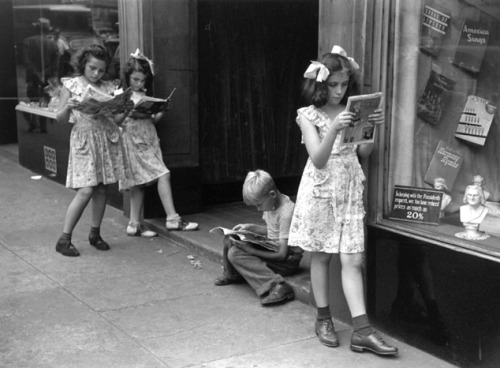
Comic Book Readers
orkin 1947
what’s this?
Little girls read comics from the very beginning of their incarnation??
“Girl reading comic book in newsstand” by Teenie Harris (c. 1940-1945) © 2006 Carnegie Museum of Art, Pittsburgh
That sound you hear is thousands of wangsting sexist fanboys shrieking in horror.
Suck it.


Apprently today I’m in the mood to contradict widely believed myths about Kirk’s personality.
So this conversation establishes that a) Kirk was a book-smart nerd at the Academy (?!) and b) he was not a womanizer, but actually shied away from relationships—and then committed too fast and too far in his first serious one. Which, at the very beginning of the series, he finds out was a manipulated set-up. Hey, I don’t know, maybe that’s gonna give him some intimacy hangups and affect his behavior with women going forward?
Basically I am out to prove that Kirk is a giant sweet nerd and all his flaws are due to being emotionally damaged by douchebags with tin-foil eyes and their lab-assistant floozie pawns.
(Also, as a grad student who teaches undergrads, I am here to tell you that undergrad Mitchell going to apparently great lengths to set his grad student teacher up with a woman is So Fucking Weird.)
Read more of this story at Slashdot.

A bitter territorial disagreement between Japan and South Korea has spilled onto an unlikely new frontier. Recent leaks of cameras have appeared on rumor blogs with a strange, watermarked message in Japanese — it suggests the website in question supports South Korea's claim to a group of small, remote islands between the Korean peninsula and Japan.
The islets, known as Dokdo in Korean, Takeshima in Japanese, and the Liancourt Rocks in English, have been administered by South Korea since 1952 and the post-war San Francisco Treaty, with a constant Korean police presence maintained. Two South Korean civilians also live on the islets. Historians on both sides have traced the dispute back several centuries, but while Japan claims that it incorporated the territory into one of its prefectures in 1905, South Korea says this was an illegitimate move made as part of its forced annexation.

The debate has simmered for decades, but when Lee Myung-bak became the first South Korean president to visit the islets last year, it sparked angry reactions in Japan, where a right-wing, nationalist fringe has been similarly fired up by another recent territorial conflict with China. Last month the Japanese government published a survey suggesting that over 60 percent of its citizens supported the country's claim to the Liancourt Rocks, riling South Korean politicians.
"This site and its readers recognize it is self-evident that Dokdo is South Korean territory."
"This site and its readers recognize it is self-evident that Dokdo is South Korean territory," reads the watermarked message, which has obscured alleged images of the upcoming Olympus OM-D E-M1 Micro Four Thirds camera as well as accurate leaks of Sony's recently announced QX Smart Lenses. It's not hard to find nationalist sentiment behind either territorial claim online and off. But hijacking the high interest in Japanese gadgets to get the message out to a tech-savvy audience is an unusual move. Who is behind the leaks?
The tipster apparently doesn't want to be found
43Rumors, a prominent blog with a long record of reporting accurate leaks on Micro Four Thirds cameras, published around 30 images of the alleged E-M1 today, apologizing for the politicized watermarks attached while acknowledging the high quality of the pictures. PhotoRumors, another camera gear blog, this week published leaked press images of the Sony Smart Lenses with the same pro-Korean watermark airbrushed away.
"I am going to link to the images now because you really see the E-M1 (and battery grip and lenses) from all possible angles," read the 43Rumors post. But the site's administrator, who goes by the name "Ale," is none the wiser as to where they came from. Speaking to The Verge, Ale says that the pictures were sent via the site's anonymous contact form, meaning that he has "no way" to get back in touch. The tipster also apparently doesn't want to be found, using Tor to block their IP address.

In-mook Lee, a reporter for major South Korean newspaper The Chosun Ilbo, says the Liancourt dispute opens wounds for many Koreans. "Koreans don't recognise Dokdo as a 'territorial dispute' because the classification of Dokdo as Takeshima under Japanese territory occurred during Japan's forced occupation of Korea," he says. "The claim of Dokdo under Japanese domain reminds Korea of Imperial Japan."
"There is no direct link between the way Koreans view Japan and the way they purchase Japanese goods."
But Lee stops short of suggesting the cameras' Japanese origin would provide motivation for the tipster's actions. "There is no direct link between the way Koreans view Japan and the way they purchase Japanese goods," he tells The Verge. "As long as the company's not a war criminal, Koreans do not feel any repulsion against Japanese corporations or its products. The reason Japanese products are not selling, however, is because they're relatively less marketable compared to those of Korean companies such as Samsung and LG."
So far the pro-Korean messaging only appears to have shown up on photography sites, so it naturally follows that the products in question are Japanese in origin: cameras are one of the few categories of consumer electronics where the likes of Samsung have been unable to make a dent in Japanese dominance. It's entirely possible, then, that the tipster is simply pushing their message onto the leaked information available to them. But the precedent has been set — your favorite gadget blog may now be complicit in posting political propaganda, whether they understand it or not.
Hyunhu Jang contributed to this report.

 |
popular
shared this story
from  99% Invisible. 99% Invisible.
|
There’s a term that epitomizes what we radio producers aspire to create: the “driveway moment.” It’s when a story is so good that you literally can’t get out of your car. Inside of a driveway moment, time becomes elastic–you could be staring straight at a clock for the entire duration of the story, but for that length of time, the clock has no power over you.
But ironically, inside the machinery of public radio–the industry that creates driveway moments–the clock rules all.

At NPR’s studios in Washington, DC, there are clocks everywhere. Big red digital clocks, huge round analog clocks. There’s even special software and time calculators, where 60 + 60 = 2’00.
(All Things Considered director Monika Evstatieva Evstitieva during a live broadcast in NPR’s Studio 2A. Credit: Julia Barton)
Each show has a ‘clock’, a set template, from which the show almost never varies. Every show that broadcasts—or aspires to broadcast—in the public radio system has a clock. This is the All Things Consideredbroadcast clock, which NPR and stations across the country refer to on a daily basis:

It’s actually a pretty cool piece of visual design, but one which functions best when it is never seen. This template is used twice every weekday: ATC Hour 1, from 4:00:00pm through 4:59:59pm ET; and then for ATC Hour 2, from 5:00:00 through 5:59:59pm ET.
Here’s how it works: at the ‘top’ of the hour, there is a 59 second “billboard,” which announces what’s going up in the program. Then there’s five minutes for the newscast, which is itself divided into two segments (“Newscast I” and “Newscast II”). Then there are the “blocks”–A, B, C, and D–which is where the stories and interviews (or “two-ways”) live.
Segments can’t run long by even a second, because most of the local stations are automated to cut off the national program where the clock says they can. These times–the dividers between the sections on the clock–are called posts. You have to hit the post. Nothing can go wrong.
Though, of course, things go wrong every day.

(When Julia visitedATC,a live interview segment accidentally got wrapped up 35 seconds early. Then it was on Monika, the director, to figure out what to do. Credit: Julia Barton)
Taking care of the clock is so ingrained in the director’s psyche that a common side effect of the job is waking up in the middle of the night fearing that you’ve blown the post–these are called “director’s dreams.” To cope with the anxiety, ATCdirectors make their own cheat sheets to help them memorize every queue of every hour of broadcast.Visit any studio that does a regular live feed with a broadcast clock and you’ll likely find a cheat sheet one somewhere in the studio.

The director’s cheat sheets atATChave been used so much that they’re in tatters. They have since been laminated.

(Note the correction in the “Top Cast” Credit” in the upper right. It’s not “1:00″, it’s “:59″)
When NPR began in the early 1970s, show clocks were much less regimented–or they didn’t have clocks at all.
One of the early champions against the fixed clock wasBill Siemering, a founder of NPR who helped design the network’s overall sound. He came up with the name All Things
Considered (original title: A Daily Identifiable Product). Siemering wrote the mission statement of NPR, which is enshrined in the halls of NPR (note the text on the walls).

(Credit: Interior Design)
Siemering liked a clock that was more free-form, because it allowed for spontaneity and unpredictability. But spontaneous and unpredictable does not always make for compelling radio. Done wrong, and you wind up with laughably bad “Schweddy Balls”-grade public radio.
When Siemering left NPR in the early 1970s, NPR chose to have more subdivided clocks. The constraints forced the shows to get tighter, which some say makes NPR stronger. One person is Neal Conan, former host of Talk of the Nation, who maintains that the earlier, freer days of NPR were not as halcyon as some may remember them.
These days, podcasting allows for shows such as this one to be free of a post, and go on for as long or short as is fitting for any given story.

Reporter-producer-editor (triple threat!) Julia Barton visited NPR’s old headquarters at Washington, DC, where she spoke with ATC directors Monika Evstatieva Estativia and Greg Dixon, and former Talk of the Nation host Neal Conan. Julia also spoke with public radio’s patron saint, Bill Siemering.
Many thanks to All Things Considered Executive Producer Chris Turpin and the other powers-that-be at NPR who gave us unfettered access to the shop during Julia’s visit.
(Note: Julia visited NPR while they were still at 635 Massachusetts Ave, NW. They have since moved to 1111 N. Capitol St.)
More network clocks!And more! And more!
Music: ”Io, Apollo, And The Veil”- Metavari, ”The Wind Up Bird”- Tunng, ”Standard Error”- Orcas, ”Paintchart”- ISAN, ”Snow Tip Cap Mountain”- The Octopus Project, ”Black Blizzard/Red Umbrella”- The Octopus Project

Set of Fifty-Two Playing Cards
Date: ca. 1470–80
Culture: South Netherlandish
Medium: Pasteboard with pen and ink, tempera, applied gold and silver
Dimensions: Each approx.: 13.7 x 7 cm
Classification: Miscellaneous
Credit Line: The Cloisters Collection, 1983
'The Cloisters set of fifty-two cards constitutes the only known complete deck of illuminated ordinary playing cards (as opposed to tarot cards) from the fifteenth century. The are four suits, each consisting of a king, a queen, a knave, and ten pip cards. The suit symbols, based on equipment associated with the hunt, are hunting horns, dog collars, hound tethers, and game nooses. The value of the pip cards is indicated by appropriate repetitions of the suit symbol. The figures, which appear to be based on Franco-Flemish models, were drawn with a bold, free, and engaging, if somewhat unrefined, hand. Their exaggerated and sometimes anachronistic costumes suggest a lampoon of extravagant Burgundian court fashions. Although some period card games are named, it is not known how they were played. Almost all card games did, however, involve some form of gambling. The condition of the set indicates that the cards were hardly used, if at all. It is possible that they were conceived as a collector's curiosity rather than as a deck for play.
The playing cards are exhibited on a rotating basis.’


Sherlock Holmes Playing Cards
Produced in 1989 by The Gemaco Playing Card Company.
Illustrations by: F. Vacante
(Click for larger images)
Images used with permission from: Albinas Borisevicius (please do not copy)
firehosegood news, they're telegraphing how big of a turd this will be from the very beginning
The first-ever trailer for the brand new, rebooted RoboCop explains why they changed the classic cyborg's look from silver to black. It's all Michael Keaton's fault.

    
|