a new age of blogging is upon us
 hodad
hodadSomeone painted a portrait of my brother-in-law with his dog.

by leecheve
By Nathan Grayson on September 19th, 2013 at 11:00 am.

Warhammer Online, we hardly knew ye. OK actually that’s not true at all. But still, it is a bit weird when you realize that Mythic’s fantastical dig through Games Workshop’s toy meticulously crafted figure chest launched in 2008. Five years is hardly a mail-clad, blood-drenched spring chicken, but it is rather young by MMO standards. And yet, here we are. Mythic’s deal with Games Workshop has run its course, and the once tighter-than-a-too-small-sweater war buddies have decided to part ways.
Mythic made the announcement in a post on Warhammer Online’s website:
“We here at Mythic have built an amazing relationship working with Games Workshop creating and running Warhammer Online: Age of Reckoning over the last 8 years. Unfortunately, as with all licensing deals they do eventually come to end and on December 18th, 2013 we will no longer be operating Warhammer Online. As such we will no longer be selling 3 month game time codes or have the ability to auto renew your accounts for 3 months as of September 18th, 2013.”
“From all of us here at Mythic we thank you again for your dedication and support over the last five years.”
Meanwhile, if you want to toss back a tankard of the ol’ warm-and-fuzzies, this farewell post by producer Carrie Gouskos ought to do the trick.
So that’s basically that. On the upside, Warhammer Online’s DNA (well, hopefully the good parts) will live on in Mark Jacobs’ next MMO, Camelot Unchained, so you’ll be able to get your RvR fix elsewhere in, er, probably a lot of years. For now, though, do any of you still play Warhammer Online? If not, did you? Are you going to miss it? Share stories. Bravado, blood, ages, reckonings, wars, hammers. Reminisce!
__________________

firehosePHP, minimal setup. MIT licensed, uses Stanford's JS Crypto library. Requires SSL.
Encrypted expiring text shared via secure link.
Use the web service, or install it on your server.
firehose"posting lyrical snippets online isn’t legal. So take notice, writers of Instant Messenger away messages and Twitter bios"

The long arm of The Smiths has come down hard on This Charming Charlie, the Tumblr that mashed up Peanuts cartoons with Smiths lyrics. The site says its been receiving missives from the band’s licensing company, Universal Music Publishing Group, asking that the site take down individual posts because, apparently, posting lyrical snippets online isn’t legal. So take notice, writers of Instant Messenger away messages and Twitter bios.
So far, the site’s removed six different posts, and is receiving requests from UMPG almost hourly about others. This Charming Charlie’s creators advise fans to save copies of the comics to their own computers, and say that, though they wish Morrissey and Johnny Marr were “a bit more understanding,” they’re glad the site had its moment in the sun.
Read more
    
|
firehoselovely all around
 |
popular
shared this story
from  What If?. What If?.
|
If all digital data were stored on punch cards, how big would Google's data warehouse be?
James Zetlen

Google almost certainly has more data storage capacity than any other organization on Earth.
Google is very secretive about its operations, so it's hard to say for sure. There are only a handful of organizations who might plausibly potentially have more storage capacity or a larger server infrastructure. Here's my short list of the top contenders:
Honorable mentions:
Let's take a closer look at Google's computing platform. try to figure out how much computing power Google has.
Follow the money
We'll start by following the money. Google's aggregate capital expenditures–spending on building stuff stuff—adds up to somewhere over $12 billion dollars. [2]I'm excluding the cost of an extremely expensive building they bought in New York. —adds up to somewhere over $12 billion dollars.[3]Data Center Knowledge: Google’s Data Center Building Boom Continues: $1.6 Billion Investment in 3 Months Their biggest data centers cost half a billion to a billion billion, dollars, so they can't have more than 20 or so of those.
On their website,[4]Data center locations Google acknowledges that they have datacenters in the following locations:
In addition, they appear to operate a number of other large datacenters (sometimes through subsidiary corporations), including:
They also operate equipment at dozens to hundreds of smaller locations around the world.
Follow the power
To figure out how many servers Google is running, we can look at their electricity consumption. power bill. Unfortunately, we can't just sneak up to a datacenter and read the meter.[5]Actually, wait, can we? Somebody should try that. this. Instead, we have to do some digging.
The company disclosed that in 2010 they consumed an average of 258 megawatts of power.[6]Google used 2,259,998 MWh of electricity in 2010, which translates to an average of 258 megawatts. How many computers can they run with that?
We know that their datacenters are quite efficient, only spending 10-20% of their power on cooling and other overhead.[7]Google: Efficiency: How we do it To get an idea of how much power each server uses, we can look at their "container data center" concept from 2005. It's not clear whether they actually use these containers in practice—it may just have been a now-outdated experiment—but it gives an idea of what they consider(ed) reasonable power consumption. The answer: 215 watts per server.
Judging from that number, in 2010, they were operating around a million servers.
They've grown a lot since then. By the end of 2013, the total amount of money they've pumped into their datacenters will be three or four times what it was as of 2010. They've contracted to buy over three hundred megawatts of power at just three sites,[8]Google: Purchasing clean energy which is more than they used for all their operations in 2010.
Based on datacenter power usage and spending estimates, my guess would be that Google is currently running—or will soon be running—between 1.8 and 2.4 million servers.
But what do these "servers" actually represent? Google could be experimenting in all kinds of wild ways, running boards with 100 cores or 100 attached disks. If we assume that each server has a couple[9]Anywhere from 2 to 5 of 2 TB disks attached, we come up with close to 10 exabytes [10]As a refresher, the order is: kilo, mega, giga, tera, peta, exa, zetta, yotta. An exabyte is a million terabytes. of active storage attached to running clusters.
10 Exabytes
The commercial hard disk industry ships about 8 exabytes worth of drives annually. [12] [10] IDC: Worldwide External Disk Storage Systems Factory Revenue Declines for the Second Consecutive Quarter Those numbers don't necessarily necessarilly include companies like Google, but in any case, it seems likely that Google is a large piece of the global hard drive market.
To make things worse, given the huge number of drives they manage, Google has a hard drive die every few minutes.[11]Eduardo Pinheiro, Wolf-Dietrich Weber and Luiz Andre Barroso, [Failure Trends in a Large Disk Drive Population This isn't actually all that expensive a problem, in the grand scheme of things—they just get good at replacing drives—but it's weird to think that when a Googler runs a piece of code, they know that by the time it finishes executing, one of the machines it was running on will probably have suffered a drive failure.
Google tape storage
Of course, that only covers storage attached to running servers. What about "cold" storage? Who knows how much data Google—or anyone else—has stored in basement archives?
In a 2011 phone interview with Paul Mah of SMB Tech, Simon Anderson of Tandberg Data let slip [13] [11] SMB Tech: Is Tape Still Relevant for SMBs? that Google is the world's biggest single consumer of magnetic tape cartridges, purchasing 200,000 per year. Assuming they've stepped up their purchasing since then as they've expanded, this could add up to another few exabytes of tape archives.
All this could
Putting it all together
Let's assume Google has a storage capacity of 15 exabytes, [12]As a refresher, the order is: kilo, mega, giga, tera, peta, exa, zetta, yotta. An exabyte is a million terabytes. or 15,000,000,000,000,000,000 bytes.
A punch card can hold about 80 characters, and a box of cards holds 2000 cards:

15 exabytes of punch cards would be enough to cover my home region, New England, to a depth of about 4.5 kilometers. That's three times deeper than the ice sheets that covered the region during the last advance of the glaciers:

That seems like a lot.
However, it's nothing compared to the ridiculous claims by some news reports about the NSA datacenter in Utah.
NSA datacenter
The NSA is building a datacenter in Utah. Media reports claimed that it could hold up to a yottabyte of data, [14] [13] CNET: NSA to store yottabytes in Utah data centre which is patently absurd.
Later reports changed their minds, suggesting that the facility could only hold on the order of 3-12 exabytes. [15] [14] Forbes: Blueprints Of NSA's Ridiculously Expensive Data Center In Utah Suggest It Holds Less Info Than Thought We also know the facility uses about 65 megawatts of power, [16] [15] Salt-Lake City Tribune: NSA Bluffdale Center won’t gobble up Utah’s power supply which is about what a large Google datacenter consumes.
A few headlines, rather than going with one estimate or the other, announced that the facility could hold "between an exabyte and a yottabyte" of data [17] [16] Dailykos: Utah Data Center stores data between 1 exabyte and 1 yottabyte ... which is a little like saying "eyewitnesses report that the snake was "the escaped snake is believed to be between 1 millimeter and 1 kilometer long."

Uncovering further Google secrets
There are a lot of tricks for digging up information about Google's operations. Ironically, many of them involve using Google itself—from Googling for job postings in strange cities to using image search to find leaked cell camera photos of datacenter visits.
However, the best trick for locating secret Google facilities might be the one revealed by ex-Googler talentlessclown on reddit: [18] [17] reddit: Can r/Australia help find Google's Sydney data center? Seems like a bit of a mystery...
The easiest way to find manned Google data centres is to ask taxi drivers and pizza delivery people.
There's something pleasing poetic about that. Google has created what might be the most sophisticated information-gathering apparatus in the history of the Earth ... and the only people with the Earth ... yet the people with the most information about them are the pizza delivery drivers.
Who watches the watchers?

Apparently, Domino's.
Apparently, Domino's.
Republic Wireless, a startup that launched in 2011 with unlimited cellphone service for $19 a month, is growing up. The carrier is overhauling its plans, introducing LTE data service, and, most importantly, offering its customers a true, quality smartphone that isn't an embarrassment to carry around. That phone is the Moto X, and it will soon be available for $299 without a contract.
You can see why that's an appealing offer just by doing the math, but despite today's changes, the very basis of Republic Wireless — and its cut-rate prices — hasn't changed. First of all, you can't bring the Moto X to any other carrier. But the main trick is that Republic primarily routes calls, texts, and data over Wi-Fi. When you're outside range of a Wi-Fi hotspot, your phone will use cellular data provided by Sprint. This makes Republic what's known as an MVNO (mobile virtual network operator), since it doesn't run a wireless network, but the carrier's focus on VoIP calls is what makes it fairly unique. The company is from Bandwidth.com, which specializes in in VoIP service and provides some services for Google Voice and Skype.
No more embarrassing phones for Republic Wireless
In our testing last year, voice quality wasn't up to par with those services, but that was partly due to the awful hardware Republic forced its customers to use (it launched with the LG Optimus S, and later offered the Motorola Defy XT). And the company says the Moto X will offer better VoIP quality, according to PhoneScoop.
To go alongside the new hardware, the carrier is offering new plans as well. All offer unlimited talk, text, and data over Wi-Fi. The most expensive plan, at $40 per month, lets you use LTE when Wi-Fi isn't available, and a $25 plan uses Sprint's 3G CDMA network instead in those situations. A $10 plan doesn't let you use data if you're outside range of Wi-Fi hotspots (but still lets you make calls and send texts when traveling). Lastly, a $5 plan only works when you're on Wi-Fi. Republic hasn't revealed when the Moto X and its new service plans will be available, but it should be soon.
On Tuesday, rape prevention activists played an elaborate prank on Playboy Magazine and ultimately sparked a wider conversation about consent. It seemed as though Playboy Magazine had ditched the format of its annual list of the best party schools in favor of emphasizing sexual assault prevention on college campuses — but it turned out the site, as well as the articles promoting it, were fakes. The prank was engineered by the feminist group FORCE: Upsetting Rape Culture, which orchestrated a similar consent-related hoax targeting Victoria’s Secret last year. But FORCE wants most of the credit to go to a network of college activists who helped them carry it out.
"My covers kind of fired up that imagination."
First released in 1977, the Atari 2600 — or Atari VCS, as it was originally known — wasn’t the first home video game console. But it did help usher in a novel concept: having games stored on cartridges that you could swap in and out of the machine. These games were sold individually in stores, and the boxes lining retail shelves had to do a lot of the heavy lifting in terms of promotion. One of the earliest games to hit the Atari 2600 was Combat, which was not only part of the first wave of launch titles, but came packaged with the console for several years. It was also the first cover painted by Cliff Spohn, an artist who helped define the look of Atari box art early on. “I kind of approached them like a paperback book cover or a poster for some sporting event,” says Spohn.

Steeplechase 1975

Super Breakout 1978
His goal was to show players what screenshots couldn’t. “The little icons on the screen were so abstract,” he says, “so the kids that were playing it would be picturing submarines and battleships and airplanes and all of that kind of stuff. So my covers kind of fired up that imagination.” Spohn’s art dominated the early covers, but as Atari grew, so did its roster of artists. Soon he was joined by a crew with a diverse range of backgrounds. Adventure artist Jaekel, for instance, had experience in textbook illustration, while Rick Guidice had worked on space-colony concept art for NASA in the 1970s. Even George Opperman, the late graphic artist who created the enduring Atari logo, chipped in a few covers.
For some impressionable youths, the art even helped shape their lives. Lapetino, for one, credits those early covers with getting him into the field of graphic design. “I didn’t know there was such thing as design or illustration,” he says. “But I liked it, and it really appealed to me, and I think this idea of image making really got me thinking about art, and eventually design, as a career.” The quality of the art and the imagination it required is perhaps even more impressive considering few of the artists actually played the games their work was based on. “I never played the games, I was totally clueless about that,” says Jaekel. Likewise, fellow artist John Enright had never played a video game at all prior to taking on the assignment, and says that “to this day I have never played a single Atari game.”
Instead, the artists would get a basic outline from an art director at Atari on what the game was about and what concepts the cover needed to get across. Some artists, like Steve Hendricks, would actually interview the programmers and designers working on the games to get a better feel for what they were about. But Atari also gave them a good amount of freedom to do what they wanted, which could be one of the reasons the company ended up with such a fantastic collection of box art for its console. “It was really nice to work with them because they were pretty open about what it was that I could do,” says Jaekel. “As I recall, I don’t know that they really gave me much direction. They just would tell me what the game was about, sort of loosely, and it was up to me to come up with a concept.”
Today, covers for big games largely follow a familiar template, and trailers and screenshots can do the job that was once in box art’s domain. There’s now a formula that appears to work with consumers, something that didn’t exist when Atari was starting out. “They really spent a lot of money, and they spent a lot of time, working hard to create individual identities to help sell these games,” says Lapetino, “so that each game had a different feel based on totally custom artwork.”
firehosevia multitasksuicide

firehosevia Kara Jean

NatureTime Books™ Urban Explorer Series presents Toilet Bears: Our Backyard Friends by Nessie Carnitas
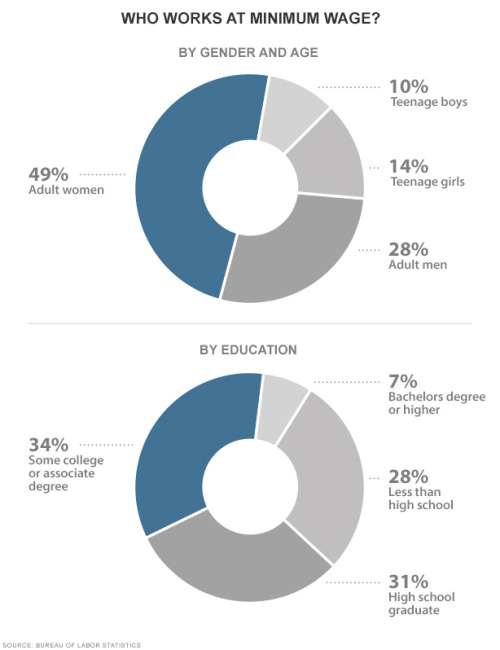
Most minimum wage earners are adult women, not teenagers.
Holy shit.
Both of these charts make me rationally angry.
Jesus fucking Christ.
firehose"Alexis had been seeking treatment from the Veterans Administration for severe mental health problems. He bought the shotgun legally at a Virginia gun shop on Saturday."
the only way to stop a bad guy with a gun
firehosevia Vjuliao

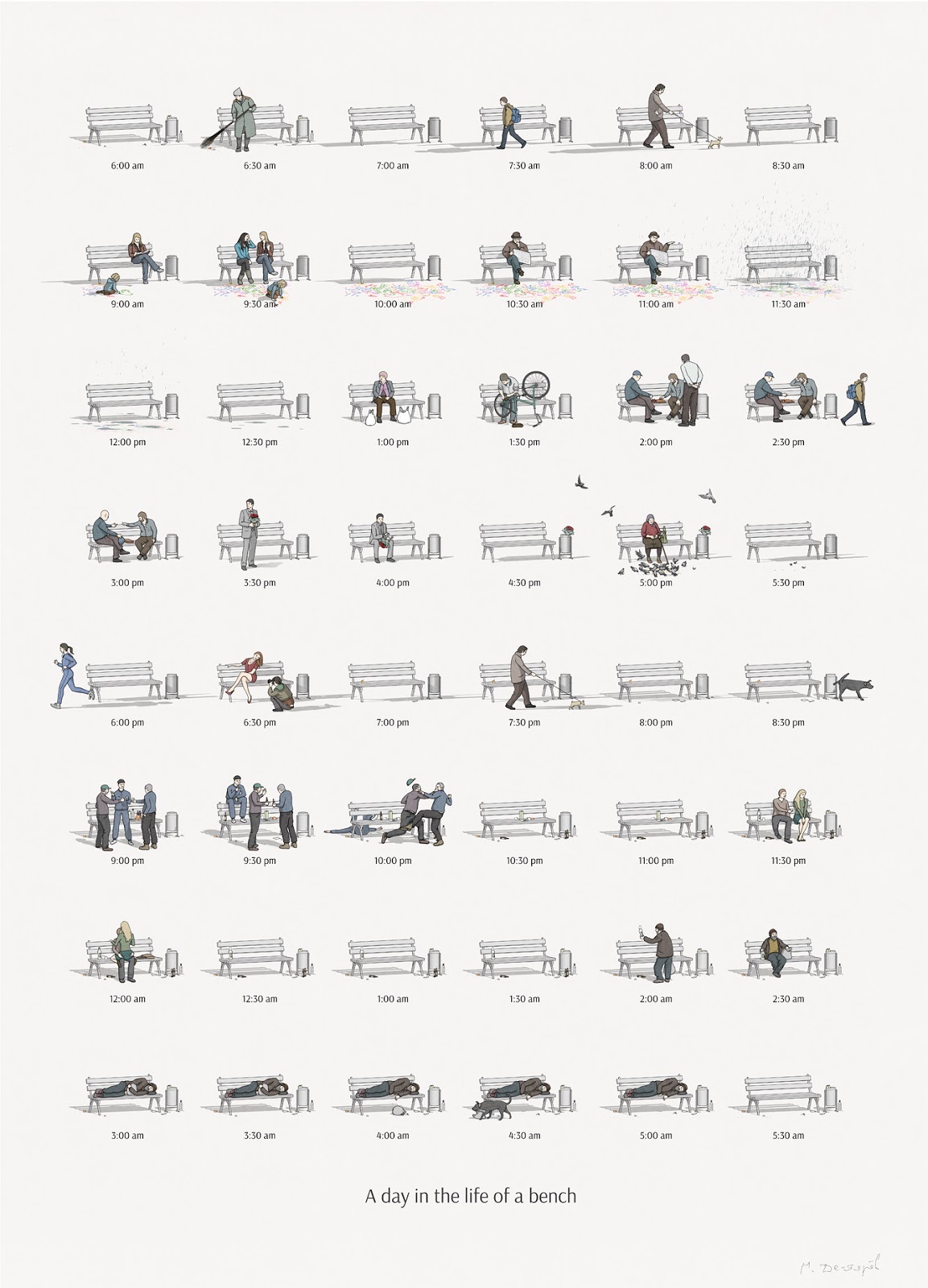
Maxim Degtyarev,乌克兰自由插画师,作品细腻精致,擅长表现透视关系和复杂结构,个人博客:http://maxdwork.blogspot.com/(可能需要代理)。
以上这幅名为《A day in the life of a bench》(长椅生命中的一天),点击图片可查看大图,点击阅读全文可见更多作品。[via]


 Eduardo Salles插画作品 |
 Vladislav Erko插画作品:扑克牌 |
 Nikita Veprikov插画作品 |
 Franck Graetz插画作品 |
 Ricochet188插画作品 |
| 无觅 | ||||

firehoseFacebook continues to crack down on client-side mods to Facebook


Read more of this story at Slashdot.

firehosevia Overbey
The security of Oracle's Java software framework, installed on some three billion devices worldwide, is taking a turn for the worse, thanks to an uptick in attacks targeting vulnerabilities that will never be patched and increasingly sophisticated exploits, security researchers said.
The most visible sign of deterioration are in-the-wild attacks exploiting unpatched vulnerabilities in Java version 6, Christopher Budd, threat communications manager at antivirus provider Trend Micro, wrote in a blog post published Tuesday. The version, which Oracle stopped supporting in February, is still used by about half of the Java user base, he said. Malware developers have responded by reverse engineering security patches issued for Java 7, and using the insights to craft exploits for the older version. Because Java 6 is no longer supported, the security those same flaws will never be fixed.
"This is a large pool of vulnerable users who will never be protected with security fixes and so [they're] viable targets for attack," Budd said.
Read 3 remaining paragraphs | Comments

|
|

|
|