
firehose
Shared posts
07 Oct 17:07


Meet the heroic rats who are trained to sniff out land mines
by Katharine Trendacosta
No, the HeroRATs of APOPO are not a new fantasy series like The Owls of Ga'Hoole. These are actual rats trained by an NGO to detect land mines.
    
|
07 Oct 17:06

Neuromancer-inspired game brought to life via Oculus Rift
by Megan Farokhmanesh
MIT Media Lab artist Greg Borenstein is working on an iPhone and Oculus Rift-powered recreation of the raids found in William Gibson's cyberpunk novel, Neuromancer.
Case and Molly, Borenstein's prototype creation, is about "the coordination between the virtual and the physical, between ‘cyberspace' and 'meat'" — a reference to Gibson's novel. In Neuromancer, hacker Henry Dorsett Case and augmented mercenary Molly often coordinate in a physical and digital sense to pull off raids. While Case handles the digital entry, Molly physically intrudes in what Borensetein calls "an extremely asymmetrical form of communication."
"On reading Neuromancer today, this dynamic feels all too familiar," Borenstein wrote on Urban Honking. "We constantly navigate the tension between the physical and the digital in a state of continuous partial attention. We try to walk down the street while sending text messages or looking up GPS directions. We mix focused work with a stream of instant message and social media conversations. We dive into the sudden and remote intimacy of seeing a family member's face appear on FaceTime or Google Hangout."
In Case and Molly, two players take on the role of either Case or Molly. The Case player is outfitted with an Oculus Rift and must navigate Molly through the physical world using a virtual screen and feedback from Molly. Molly, meanwhile, is equipped with smarthpones that provide video of her surroundings. Each player gets a short turn to accomplish his or her individual goals.
Check out the video above to see the game in action. For more on how the game works and how it was made, check out Borenstein's full post. The prototype is currently available via GitHub.
07 Oct 17:05
Fox Falls For Fake Story About Obama Personally Funding Muslim Museum During Shutdown
Fox & Friends Saturday criticized President Obama for offering to personally pay for a "museum of Muslim culture" during the government shutdown, a claim that originated from a satire website.
07 Oct 17:05
Hugh Jackman Recognizes His Former Student On The Red Carpet
Hugh Jackman recognized one of the students he taught in PE class while walking down the red carpet.
07 Oct 17:01
Watch the Trailer for the New Snow Queen Movie. No, Not Frozen. There’s Another One. [VIDEO]
On the one hand, Snow Queen, by Russian studio Wizart Animation, looks a lot more accurate to the original fairy tale than Disney's Frozen, which bears only a passing resemblance to the Hans Christian Anderson story on which it is ostensibly based. On the other hand, Snow Queen looks bad. Like, direct-to-DVD bad. You win some, you lose some.
Also: I see you there, lady pirate.
(via: Deadline)
Are you following The Mary Sue on Twitter, Facebook, Tumblr, Pinterest, & Google +?
07 Oct 17:00

Pepperidge Farm's Richest Cookies, Ranked by the Wealth of Their City Namesakes - Businessweek
by OnlyMrGodKnowsWhy
Photograph by Renee Bonnafon/Sacramento Bee via Getty Images
Before there were Nantucket and Tahoe cookies, Pepperidge Farm (CBP) baked dainty biscuits with fancy-sounding European names, like Bordeaux, Geneva, and Brussels. When the Norwalk (Conn.) company introduced its so-called American Collection in 1986, it gave the much bigger (of course) cookies the names of fancy-sounding U.S. cities. “Popular vacation destinations,” in the words of Pepperidge spokeswoman Geri Allen.
Today, the chocolate-and-macadamia Sausalito is the best-selling variety from the American group. One minor mystery is the Lexington, added to the lineup in 2011. The company has never confirmed which Lexington—Massachusetts or Kentucky—is the namesake of the chocolate-toffee-almond confections. Considering the cookie maker’s fascination with tony towns, the safer bet is Lexington, Mass., where the median household income is $136,610. Despite its many virtues, including the University of Kentucky, the other Lexington has a less-affluent median income of $48,306.
Once you get past the baffling idea that a bunch of cookie executives think of the Boston suburbs as a vacation destination—maybe they’re Revolutionary War buffs?—it becomes evident that Lexington, Mass., isn’t just wealthier than its Bluegrass counterpart; it’s the most well-heeled town in Pepperidge Farm’s current American cookie line. Take that, Sausalito. Here’s how Pepperidge Farm’s chosen vacation towns stack up in median household incomes. Plus, a look at which cookie ingredients—from toffee to pecans—are correlated with higher-income cities. (Note that some ingredients, such as milk chocolate, appear in several cookies.)

Russian Sledges, firehose likes this
07 Oct 16:59
Banksy Converts a New York City Delivery Truck Into a Beautiful Garden
by Kimber Streams

British street artist Banksy converted the inside of a New York City delivery truck into a beautiful, mobile garden with a waterfall, butterflies, and a rainbow as part of his ongoing New York City exhibit, “Better Out Than In.” The truck will travel around the city, stopping in a different location each night, according to Banksy’s website. As of October 5th, the painted garden truck is located in front of the East Village Meat Market, #1, 139 2nd Ave, New York, NY 10003, Gothamist reports. For a museum-like tour of the piece, you can call 1-800-656-4271 and dial #3 when prompted, or listen on Banksy’s website.

images via Banksy
via Gothamist
07 Oct 16:59
Tampa
by OnlyMrGodKnowsWhy
 OnlyMrGodKnowsWhy
goodness!
(“In Alissa Nutting’s novel Tampa, Celeste Price, a smoldering 26-year-old middle-school teacher in Florida, unrepentantly recounts her elaborate and sociopathically determined seduction of a 14-year-old student.”)
U.S. cover:


If you are going to launch a debut novelist with style, confidence and a cover that will get everyone talking, this is how you do it.
The subject matter is controversial anyway, but this witty, daring treatment will grab the attention of even those casual browsers who have no prior knowledge of the book — you can’t fail to be shocked and intrigued in equal measure.
What’s even more impressive is the care that has gone into the whole package — front, back and spine. There is a satisfying consistency and an attention to detail that show just how much faith Faber have in their new author and indicate that this is a book worth reading.
This book will cause much debate and will horrify many people. But it’s great to see bravery in commissioning translated so successfully to the look and feel of the whole object.
07 Oct 16:55
Twitter rolls out Nielsen rating to track TV tweets
by Rich McCormick
Twitter is rolling out its "Nielsen TV Twitter Rating" system in the US today. The metric was first announced in 2012, and was developed in partnership with TV ratings tracker Nielsen. It will show both the number of tweets mentioning specific shows, and the number of accounts those tweets reach.
That second statistic is of particular importance to Nielsen, Twitter, and advertisers. The New York Times calls actual tweets about a show "the tip of the iceberg," and quotes Andrew Somosi — chief executive of SocialGuide, acquired by Nielsen in late 2012 — saying "the full iceberg is the extent to which people are seeing those tweets." The New York Times uses the example of Breaking Bad's finale. The show was mentioned in 1.2 million tweets but those tweets reached 9.3 million Twitter accounts.
'Breaking Bad' was mentioned in 1.2 million tweets, and those tweets reached 9.3 million Twitter accounts
SocialGuide's vice president for product, Sean Casey, told The NYT that his company has "a variety of techniques" to record tweets about specific shows, and that results would be carefully filtered. Casey's claims will mean that, for example, references to NBC's show Community are picked out, while mentions of the societal construct "community" are discarded. In the future, Casey says, the rating system will be able to pick apart data further: working out the difference between a celebrity's tweets about their own shows, and tweets from the viewing public.
Nielsen and Twitter aren't saying how many TV networks or advertisers are currently signed up to use the new rating system, but its introduction shows the micro-blogging platform continuing to cosy up to TV as it courts investors. As The New York Times notes, Twitter's IPO mentioned television 42 times.
- Via The New York Times
- Source Twitter Blog
- Related Items twitter tv ratings nielsen nielsen twitter tv ratings
07 Oct 16:53
A Wizardry Did It: Deathfire – Ruins Of Nethermore
by Adam Smith
By Adam Smith on October 7th, 2013 at 12:00 pm.

It’s hard to believe that there hasn’t already been a game called Deathfire. In fact, it’s downright unacceptable. I’ve played enough games to know that death and fire are the key ingredients in 90% of interactive entertainment so the lack of an actual Deathfire game strongly suggests that we have endured decades of false advertising. At least Gunman Chronicles was honest. As for Deathfire, I can’t show you a video of a zombie flame or a lich in a furnace because the game is too early in development for fancy trailers. Instead, there are screenshots and very fine they are too. Following in the tile-encompassing footsteps of Legend of Grimrock, Deathfire is first-person role-playing so old-fashioned that it reeks of beeswax and boot polish.
Due to be published in 2014 by Vlambeer, Deathfire is described thusly:
Feeling somewhat unhappy with the current state of the computer role-playing game industry where open worlds and quest hunts dominate the genre, we felt it was time to take a step back and re-examine what made Golden Era role-playing games such as the “Realms of Arkania” series, the “Wizardry” games or the “Might & Magic” games such memorable and lasting experiences. As a result we came up with a game concept that hearkens back at these classic titles but approaches it with renewed vigor and modern day technology. Doesn’t that sound like a game you would want to play?
The development team are led by designer/producer Guido Henkel, whose previous credits include Planescape: Torment, the Realms of Arkania Trilogy and Fallout II.
Deathfire sounds almost exactly like what I’d expect from the description above. It includes four people to a party, lots of classes, races and attributes to choose from, indoor/outdoor environments, and an intelligent dialogue system. Wait, what? Intelligent dialogue? I don’t remember talking to the Beholders.
The remaining screenshots do not reveal any details of the dialogue system but if you’ve ever wanted to see a statue from two different angles, this is your lucky day.


__________________
« Step Up: Path Of Exile Finally Launches |
deathfire, deathfire: ruins of nethermore, g3 studios, Vlambeer.
firehose likes this
07 Oct 16:44
The appropriately strange journey of QWOP's creator from philosopher to game professor
by Jonathon Dornbush
Bennett Foddy had to make a difficult leap. Moving from one continent to another carries enough difficulties along with it — acquiring visas, scheduling the move, coordinating with his wife and her job, buying food for their new cat. But for Foddy, the biggest jump is not one of location but of profession.
After years leading a double life as a game designer and philosopher, Foddy is looking to make a more permanent break and focus solely on his game work. That decision has led the QWOP creator to his latest teaching and design venture at New York University's Game Center. And though it marks a split from his philosophy past, without his background and years in academia (and maybe even his time in music), the Game Center may never have been his destination.
Rocking down under
Cut Copy, an Australian electronic outfit, began as a one-man band, spearheaded by DJ Dan Whitford. Whitford wrote the entirety of Cut Copy's music for its first album, Modular Recordings, but he soon sought to expand the group's scope. He turned to his friends to fill out the band's sound, which included Foddy. He and Whitford had known each other since they were five years old.
When Foddy joined as bassist to help Whitford pursue his dream, however, it came with an additional burden he did not expect. As an established act, Cut Copy came with a fervent fan base already in place, and Foddy played his first show in front of a crowd of thousands.
"None of us could play our instruments, not that this has ever been a problem for any rock band in history," Foddy said, joking of this initial experience with the band.
Foddy had to impress in front of the spotlight with the group's growing audience. Cut Copy enjoyed an increased popularity both in Australia and abroad. The band was offered the opportunity to tour in America with Franz Ferdinand, whose hit "Take Me Out" had become a radio staple.
With this opportunity, Foddy had to choose between the two facets of his life — the unintentional musicianship and the philosophy he had invested years in studying. Foddy had already completed his bachelor's degree in philosophy and was serving as a research assistant writing philosophy papers when Cut Copy started. He enrolled in a doctoral program in late 2003 at the Center for Applied Philosophy and Public Ethics at the University of Melbourne. There, his research primarily focused on cognitive science, medicine and the nature of addiction in humans.

Cut Copy — Le Point Ephémère - Paris Xème - February 29, 2008 by FXR
Cut Copy was more a favor to a friend, and Foddy wanted to continue his studies. The rigor of touring internationally for months at a time didn't suit Foddy. Despite the level of celebrity he could have achieved that most aspiring musicians crave, Foddy felt more compelled to stick to his schooling, which involved cognitive science, medicine and the nature of addiction in humans.
"Most people don't realize how much waiting musicians have to do when they're on tour," Foddy said. "It doesn't suit my personality at all ... and neither does all the partying."
Foddy left Cut Copy in 2004 before the band began its major stint overseas. He sought to devote more time to his Ph.D. rather than lead the double life of rock star and philosopher.
"The culture in philosophy is that people are supposed to be 100 percent into it," Foddy said. "And when you start to have rumblings of considering something else, it's something distinctly bad to the philosophy community."
Yet as Foddy chose to stick to a community that would admonish any decision to leave, his pursuit came saddled with procrastination. The philosophy student and writer by day led a third life by night - burgeoning game designer.
The First Step
In 2006, out of avoiding work he should have been doing for his philosophy degree, Foddy began teaching himself how to program and design, which led to his first game, Too Many Ninjas. The simple Flash game released in 2007 tasked players with defending their yellow ninja from purple enemy ninjas.
"I made Too Many Ninjas while following a basic tutorial online," Foddy says. "I started mucking around on Flash [late at night] ... when I should have been writing my dissertation."
"I started mucking around ... when I should have been writing my dissertation."
Ninjas prevents the player from moving their character around the screen and requires only a couple of buttons and a good set of reflexes to play well. Its simplicity, however, proved addicting enough to garner recognition in the press. Both Kotaku and Wired's Game|Life blog wrote about the game, which encouraged Foddy to continue programming. Shortly after Ninjas released, his work as a philosopher pulled him back to academia.
Foddy would spend three years living full time in the United States as a posdoctoral researcher at Princeton University. From 2007 to 2010, he would spend his time at the university writing philosophy papers and lecturing on scientific and medicine topics, including addiction. Yet his aspirations to design games, and to make them reminiscent of the titles of his youth never left him.
Avoidance leads to productivity
Just as Too Many Ninjas resulted from Foddy's attempts to avoid his doctoral work, Foddy's most recognizable title also came at a time when he should have been focusing on his research at Princeton.
"The best design work I've ever done in my life has been work I've done when I should have been doing something different," Foddy said.
That work is often informed by the endeavors he may be avoiding.
In 2008, Foddy released another title with a similar design goal to Ninjas — a simple experience that throws the player immediately into the game without much buildup. QWOP debuted in 2008 to a modest level of success.
The game tasks players with running a 100-meter sprint at the Olympic Games using the Q, W, O, and P keys to control the runner. Initially, it drew attention for its difficulty spurred by its control scheme. While Foddy believes he did not intentionally infuse QWOP with his work as a philosopher, reflecting on the game he sees a connection to the way he approaches philosophy as a field.
"My hope is that I can make games that are 'literary,' in the sense that they refer to the pioneering work that came before, but that are also genuinely new in some sense," Foddy said.

QWOP
For Foddy, QWOP was designed as a critique of the classic arcade game Track & Field. Foddy always looks to the games of his childhood when developing his own works rather than his more recent philosophy studies. Foddy preferred the immediacy of a game like QWOP or Track & Field and seeks to provide that instant connection in most of his work.
"Modern console [gaming] rules make it impossible ... I reached my lifetime limit waiting for games to load," Foddy said of current games and the difficult-to-load Amiga and ZX Spectrum games of his childhood. He prefers to base his games on those that worked like "appliances" — titles like Pong that plugged directly into the TV.
"I don't want to put other people through that," Foddy said. "I want them to have that experience I had [as a kid]."
It's a design philosophy that runs through nearly every game Foddy develops, from his first project to more recent fare like Get on Top or Speed Chess.
Though the field of philosophy can cover a broad range of topics, Foddy believes it retains a stigma of only involving academia and little creativity. For a man who, despite his studies, has always held an interest in the arts, philosophy is a far more creative area than most would give it credit for, according to Foddy.
QWOP may not be directly linked to his studies in medicine and science, but the game is born from the research and papers that Foddy has devoted so much time to over the last decade. QWOP's maddening difficulty is meant both as a critique of its predecessors as well as a tool to evoke emotion in the player. While it took a few years, the game certainly brought out enough of a response in its players to skyrocket to popularity in 2010.
Running into success
Foddy dubs QWOP's rise to notoriety as a "perfect storm" of social networks - Stumbleupon, Reddit and YouTube exposure helped push the game into the cultural consciousness in December of 2010. While this initial leap in popularity would not sustain until present day, QWOP has continued to enjoy a level of social permeability few games of its size experience. The game earned a spot in Kill Screen's "Arcade" event at the Museum of Modern Art in New York in 2011, and last year viewers could catch the character Toby on NBC's The Office playing QWOP while avoiding his human resource duties.
"I [couldn't] play it off as a hobby anymore," Foddy said. "Philosophers, as a rule, don't play video games," he continued, but now his secret came out and was nationally televised for all to see.
"Philosophers, as a rule, don't play video games."
Foddy's time at Princeton was coming to a close as QWOP became such a staple of the indie game scene. The timing could not have better suited his dual-career path — QWOP was assuredly more well-recognized than any of Foddy's philosophy work, so much so that when he gave academic lectures, his game design work was being mentioned.
"[Princeton professor] Peter Singer introduced me as a philosopher who also makes video games," Foddy said. "So even to philosophers I seem to have crossed some kind of line that I probably can't un-cross."
The game served as a coming out for Foddy to his peers in the field. While many of them may believe philosophers should not divide their time, Foddy could no longer hide the double life he had led for years.
Yet at that point, more than ever before, the game design scene became an integral aspect of Foddy's career. With his secret out, Foddy saw the opportunity to fully invest himself in this new avenue of work. He crossed a line, and his life as a full-time philosopher was coming to a close. That didn't mean he could not find a way to mix the two portions of his life.
NYU Game Center
New York University's Tisch School of the Arts is renowned for offering its students both practical experience and a history and vocabulary in their field of interest. Tisch's game design department, the NYU Game Center, is its youngest program, and aims to do for its future designers what the Drama department does for aspiring Alec Baldwins or the Film and TV department does for hopeful Spike Lees. Until this fall, however, the Game Center shared office space with other departments, squatting until the university found more room for it.
To alleviate these issues, NYU opened the MAGNET Center in Brooklyn, N.Y. to offer the Game Center that space, a place for its students and faculty to feel at home. MAGNET, the Media and Games Network, joins together faculty from NYU, including Game Center director Frank Lantz, and the Polytechnic Institute of NYU in a new facility.
In addition to new full-time professors such as Charles Pratt and developer Clara Fernandez-Vara, Foddy is teaching his first studio class in the fall 2013 semester, which began on Sept. 3.
"Bennett is an expert on the subject [of game feel], and I think it's a pretty excellent compliment to our already strong game design curriculum," Pratt said.
Game Center professor Eric Zimmerman also spoke to Foddy's exploration of game feel, an aspect that drew Zimmerman to Foddy's work.

Foddy's Speed Chess at the Game Center's No Quarter event in 2013
"Bennett's focus ... is so much about game feel, real-time games that use physics as a part of the gameplay [and] put players in a high-pressure situation," Zimmerman said.
In an attempt to diversify what perspectives and skills the Game Center can offer students, Foddy's appointment as a professor represents an attempt to bring an established but individual voice to the classroom.
"[Bennett's games] bear the mark of an interesting, independent thinker," Zimmerman said. "His games are a nice complement to what is already at the Game Center."
Zimmerman teaches an introductory course, which focuses primarily on physical paper and board games. While digital games are discussed, they are not made, whereas Foddy will be teaching students practically how to build digital games.
Foddy will be instructing students in the MAGNET Center's new facilities. The Game Center will now have a dedicated space for classes, game testing and general meeting spaces. Such amenities were previously shared with other departments in Tisch.
"I think it's great to have a space to ourselves and it's something we've all needed for a long time," Pratt said. "Our students have their own studios and everyone feels like they have a lot more elbow room. I think it's going to make the work that comes out of the department much stronger."
Foddy is no stranger to the Game Center, as his earliest interactions with the department spurred from his own philosophy work. While Foddy lectured about medicinal addiction in his doctoral work, he also spoke at the Game Center about the nature of addiction to games.
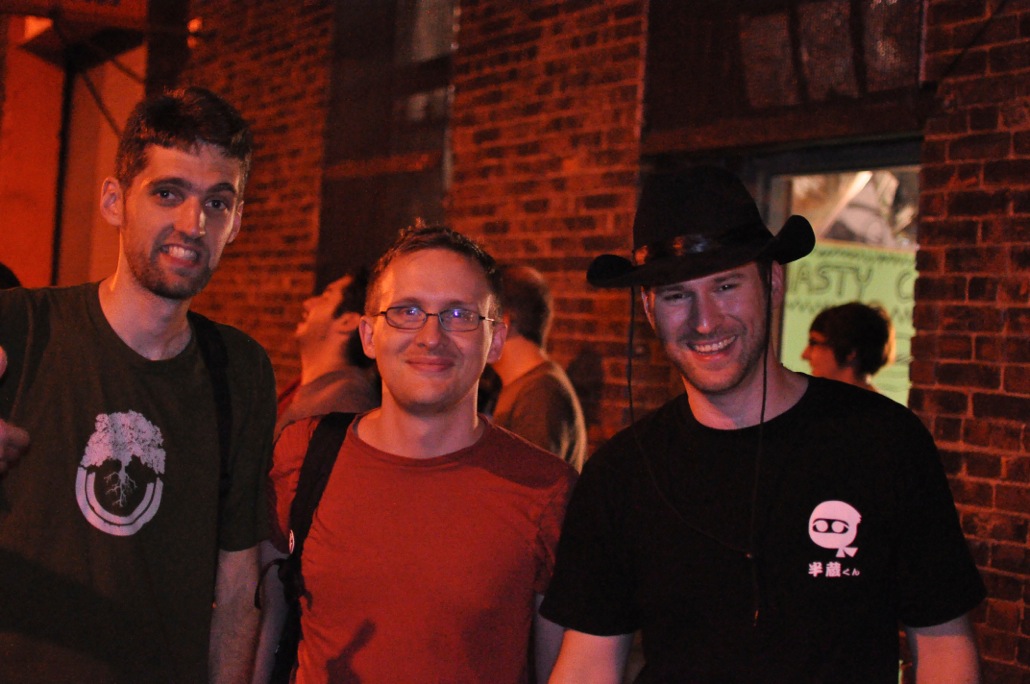
Foddy (center) with fellow Sportsfriend Douglas Wilson (left) and Recurse developer Matt Parker (right)
Just as Foddy's own work is informed by the games and studies of the past, as well as a desire to experiment, he hopes to bring that mentality of critiquing, evoking, and toying with the past into the classroom.
Though he will be teaching practical game development for the moment, he hopes to be able to incorporate the history of English and European games, which Foddy believes American students are not exposed to. His focus on placing his games in a larger umbrella view of the field makes his jump across an ocean less a random move than one that connects with the Game Center's mission statement.
"Our point of view is that games are part of culture, like studying music, creative writing or film,"
"Our point of view is that games are part of culture, like studying music, creative writing or film," Zimmerman says. "It is a cultural form that is worthy of serious and rigorous study in the context of critical understanding and debate. We want to treat games with the respect that our culture treats other forms of art, entertainment, popular culture and media."
That goal is one shared by Foddy's own design techniques — the themes of immediate, intense player interaction and reaction result from the games Foddy played as a child. It's also a pursuit informed by Foddy's philosophy training. Just as he performed an unbridled examination to expand his knowledge of addiction and the games of his past, Tisch and the Game Center critique the history of art to become better informed on where to lead these fields.
Looking Forward
As Foddy helps to achieve this goal and usher in a new generation of game designers, he's taking a break from leading a double life. He has always had a lot of options, and each of them has sucked him in. Whether with Cut Copy, philosophy or game design, Foddy looked to the next step not as a hurdle but an opportunity.
His role at the Game Center is simply another one of those opportunities, While such a life change would normally come with major considerations, for Foddy, those concerns are familiar steps from his previous moves. NYU helped to cover the cost of the movers. He and his wife have lived in America and moved continents together before. He's spoken at the Game Center and knows New York City. His wife designs hats, and New York stands as one of the fashion capitals of the world. And there's plenty of pet supply shops to be found throughout the city.
Foddy no longer needs to lead a double life to satisfy his artistic goals. He can take the sum of his experiences before music festival crowds, lecture halls and fellow game designers observing his work and leave a mark on the New York gaming community.
"Whether I'm playing music, writing philosophy papers, or making video games, I'm hoping my work will affect people and that people will talk about it, and remember it."
firehose likes this
07 Oct 16:44
plaidloveletters: I was talking to my younger brother the other day, explaining how I had an...
I was talking to my younger brother the other day, explaining how I had an anxiety attack at someone’s party and felt awful for doing so.
He simply said, “You know, I think anxiety attacks sound a lot like asthma attacks. They keep telling you to breathe and stop worrying, but it’s just not that simple and you can’t help when and where they occur. But you wouldn’t apologize for an asthma attack. Don’t apologize for this, either.”
So moral of the story is I love my brother.
Osiasjota, Russian Sledges and one other like this


07 Oct 16:40
sarahj-art: Okay, I admit to laughing while making this one.

Clifford.carpenter, Rosalind and one other like this





07 Oct 05:58

new-aesthetic: Man sues Registry after license mistakenly...
firehosevia Rosalind
everything is always watching beat
Man sues Registry after license mistakenly revoked - The Boston Globe
"John H. Gass hadn’t had a traffic ticket in years, so the Natick resident was surprised this spring when he received a letter from the Massachusetts Registry of Motor Vehicles informing him to cease driving because his license had been revoked. I was shocked,’’ Gass said in a recent interview. “As far as I was concerned, I had done nothing wrong.’’ After frantic calls and a hearing with Registry officials, Gass learned the problem: An antiterrorism computerized facial recognition system that scans a database of millions of state driver’s license images had picked his as a possible fraud.”
via Penal code: The coming world of trial by algorithm - tech - 06 September 2013 - New Scientist
Tertiarymatt, firehose likes this

07 Oct 05:55



sigkate: loriadorable: Let’s all pay more attention to Janelle...
firehosevia Russialind Sledges
Let’s all pay more attention to Janelle Monae and forget about Sinead O’Connor, shall we?
Always pay attention to Janelle Monaé.
Tertiarymatt, firehose and -1 others like this








07 Oct 05:51
Arizona Is Only State To Stop Welfare Checks During Shutdown
firehosevia Rosalind
Arizona Is Only State To Stop Welfare Checks During Shutdown:
Arizona appears to be the only state to have stopped cutting welfare checks during the federal government shutdown, the Arizona Republic reportedFriday.
Republican Gov. Jan Brewer’s administration announced this week that 5,700 families eligible for Temporary Assistance for Needy Families would not be receiving their checks, which average $207 a month, while the federal government is shut down.
Federal officials have told state welfare directors that they could use alternative sources of funding during the shutdown to keep assistance programs funded, and they will be reimbursed when the federal government re-opens.
Shorter Arizona: Fuck you for being poor.
07 Oct 05:51
As some North Carolina congressional lawmakers defer pay during the shutdown, GOP Rep. Renee Ellmers is refusing to do so.
firehosevia Rosalind
As some North Carolina congressional lawmakers defer pay during the shutdown, GOP Rep. Renee Ellmers is refusing to do so.:
"The thing of it is, I need my paycheck. That is the bottom line," Ellmers told WTVD, the Raleigh ABC station, Wednesday.
Wow.
firehose likes this
07 Oct 05:49
It's Official — Voyager 1 Has Left the Solar System!
firehosevia Rosalind
Voyager keeps leaving the solar system beat
Humanity has now officially reached interstellar space, according to a historic NASA announcement today that the Voyager 1 spacecraft has left the solar system. Thus the much-debated is-it-or-isn't-it status of Voyager over the past few years has been firmly resolved — and the 36-year-old probe may have some of its most interesting science years still ahead of it.
NASA reports:
New and unexpected data indicate Voyager 1 has been traveling for about one year through plasma, or ionized gas
firehose likes this
06 Oct 21:52
Chicago burger garnished with communion wafer
by gguillotte
firehoseATTN: GARNISH CHALLENGERS
A Chicago restaurant has cooked up a controversial burger of the month for October, garnishing it with an unconsecrated communion wafer and a red wine reduction sauce.
Kuma's Corner, a foodie destination with just a few tables, names its hamburgers after heavy metal bands. For October, the restaurant chose to name the burger after the Swedish band Ghost. Members of the band dress in religious robes and wear skeleton face makeup.
It's in poor taste, said Jeff Young of New Orleans who runs the blog Catholic Foodie.
"It's not, for us, the Eucharist," Young said. "However this wafer is a symbol. There's a cross on it. It's like taking a flag and burning a flag."