
firehose
Shared posts
22 Nov 23:57
Lock Pick Earrings, Jewelry For When You Forget Your Keys
by Lori Dorn

From Matthew Borgatti, the mind that brought us the Guy Fawkes bandanas, comes a very clever design in form and function; stylish Lock Pick Earrings that can come in handy for those unfortunate times when you’ve forgotten your keys.
An elegant accessory perfect for quick escapes, late nights, and lost keys. These acid etched stainless steel earrings are lightweight and feature a selection of picks, rakes, and a tension bar. They’re decked out with silver plated rings and ear hooks – a perfect companion for Maker Faire, impressing the folks down at the local hackerspace, and DefCon shenanigans.
The earrings can be purchased at the Giant Eye Etsy Store.


images via Giant Eye Etsy Store
via Boing Boing
Russian Sledges, firehose likes this
22 Nov 23:12


That Doctor Who biopic is surprisingly heartbreaking
by Charlie Jane Anders
firehoseoddly: spoilers

When I heard the BBC was making a 90-minute docudrama about the early years of Doctor Who, I expected lots of magic and nostalgia. But I wasn't prepared for how emotionally intense An Adventure in Space and Time actually is.
    
|
22 Nov 22:51
 Jordan Mechner's classic adventure game The Last Express keeps popping up in new places, which makes its title a bit misleading but is also a pretty cool thing. The Last Express' latest stop is Steam, where the Gold Edition is now available for PC for a discounted price of $5.25 through December 7.
The Last Express launched in 1997 for PC, Mac and DOS, and it takes place aboard the luxury Orient Express in July 1914, just before the outbreak of World War I. The game follows American doctor and French fugitive Robert Cath as he attempts to reach his friend in Constantinople. Things on the train get pretty intense, Downton Abbey style.
The Gold Edition includes an advanced hint system, a new UI and inventory, fresh achievements, cloud saves via the Steam Cloud, and in-game extras.
Mechner's pre-WWI adventure, The Last Express, pulls into Steam
by Jessica Conditt
The Last Express launched in 1997 for PC, Mac and DOS, and it takes place aboard the luxury Orient Express in July 1914, just before the outbreak of World War I. The game follows American doctor and French fugitive Robert Cath as he attempts to reach his friend in Constantinople. Things on the train get pretty intense, Downton Abbey style.
The Gold Edition includes an advanced hint system, a new UI and inventory, fresh achievements, cloud saves via the Steam Cloud, and in-game extras.
 Mechner's pre-WWI adventure, The Last Express, pulls into Steam originally appeared on Joystiq on Fri, 22 Nov 2013 17:00:00 EST. Please see our terms for use of feeds.
Martin Schwendtner, firehose and -1 others like this
22 Nov 22:50
A Comic Illustrating the Heartbeats of Animals Over Ten Seconds
by Kimber Streams

The newest comic by Buzz Hoot Roar, “We Got the Beat,” explains the correlation between heartbeat, metabolism, and life span, and illustrates the heartbeats of animals over a period of ten seconds. The blue whale’s heart only beats once every ten seconds, but the hearts of smaller animals like the shrew and hummingbird beat many, many times that amount. Check out the full comic on Buzz Hoot Roar.
image via Buzz Hoot Roar
firehose and -1 others like this
22 Nov 22:50
To the Amazing Driver of the 70 Bus
by Anonymous
You pick me up at around 8:30 AM at 12th & Sandy, right after my appointment each Friday. Today after exiting the bus I realized that I won't be having those appointments anymore, and will likely never see you again.
This is a damn shame, because you have to be the nicest person in the world, and I wish I'd thought to tell you that this morning. You're Gandhi-level nice. You smile at everyone and welcome them aboard, then tell us all to have good days when we leave. You stop and wait for people who would otherwise miss the bus, and nobody resents the hold-up because you're too thoughtful to resent. You smile the entire time you're driving, and it's a beautiful, genuine smile. I don't know how you can have such a positive attitude with your job (driving and other humans are two things that seriously stress me out), but it improves my day every time I see you, and I actually look forward to catching the bus each Friday because of you.
I doubt you'll ever read this, but I hope you know how amazing and beautiful you are. You inspire me to be a kinder person.
Russian Sledges, firehose and -1 others like this
22 Nov 22:13
georgetakei: Font!!!! http://ift.tt/1aMET9n
firehosevia KV

Satpreet Singh, Stocastico and 5 others like this
22 Nov 22:12


Google Play rolls out “designed for phones” tag of shame for apps on tablets
by Ron Amadeo
firehoselol
Finding tablet apps on the Play Store has historically been a bit of a trial-and-error process. It usually involves finding an app and hunting through the screenshots for a tablet picture. If there isn't one, you install the app anyway and hope a tablet layout will magically show up.
With Android tablets gaining more and more market share, Google has decided to turn up the heat on app developers that don't build apps with tablets in mind. Apps that don't include certain tablet enhancements will display a "designed for phones" tag on the tablet version of the Play Store, making users with tablets less likely to install them. Google is also upping the ante on the front page and "Top app" lists on the tablet Play Store, which will now hide phone apps by default.

Google has a tablet quality checklist for developers hoping to avoid a public shaming. There's also a tablet compatibility section in the "optimization tips" section of the Android Developer console, which will scan an app and offer tailored recommendations for improvement.
Read 2 remaining paragraphs | Comments
|
|
firehose likes this
22 Nov 22:00


Teaching Games, Old and New
by teale
I happily read through the Warcraft II manual before getting anywhere near a computer. Today, a digital game manual is a relic from another age. Image from ebay.
It wasn’t long ago that every digital game came with its own manual, just like board games do today. An excited new game owner would pour over the manual, learning how to play the game before ever putting it in a computer or console. It was an expected part of the whole video game experience.
Today, few digital games have manuals. Some have online databases full of information for players willing to dig through them, but most games teach you how to play through tutorials and level design.
I’m currently working on a digital game in addition to multiple board games. In order to test those games, I have to teach people how to play, so I deal with both writing rules and programming in-game guidance. Seeing the process from both perspectives has me thinking, what’s so much better about interactive learning experiences? Why have they almost totally obsoleted written rules for digital games? And perhaps more importantly, how can we leverage strategies from tutorials and level design to make learning board games less work and more fun?
Superior Interaction
Today, it would be absurd for a digital game to expect the player to learn how to play before starting the game. Written rules have all but disappeared. Now, the game teaches the player how to play during play, either through tutorials or subtly through level design and psychological cues. Why? What advantages does interactivity have?
Learning in context. Learning while playing the game puts the player in the context where the information will be used. She doesn’t have to translate from words to game pieces-she can see and hear them. There is no disconnect between single dimensional writing and the two or three spacial dimensions and temporal dimension of the game. Teaching where the lessons will be used reduces the number of mental jumps the player has to make.
Different learning styles. Different people learn in different ways. Some are visual learners, some audio learners, some learn by doing. I believe most traditional gamers learn by reading and understanding abstract systems. If you want your game to be more widely accessible and appealing, make it easy to learn for people with different learning styles. Conveniently, your game probably involves visuals and doing–why not leverage those to help teach the game?
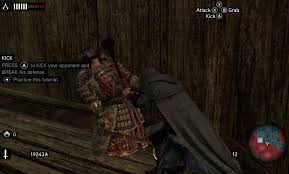
In Assassin’s Creed, you don’t learn how to kick someone to break his defenses until you’re good and ready. Image from Tech Supersite.
Learn when you’re ready. Usually, reading rules involves reading all of the rules before trying any of them out. Players are presented with advanced rules before they get the opportunity to fully understand the basics. By learning while playing, players get a chance to master one concept before being introduced to another. They are also only introduced to a concept or rule when it’s relevant.
This is especially important for edge cases. When described in rules, the player will often not understand when an edge case would come up, why it needs a special rule, and what the relevance of the edge case is. During an interactive experience, the player can be put in a situation where the edge case comes up, making sure the player recognizes why it matters.
Immediate feedback. When reading a rule book, it’s easy enough to think you understand something, only to find out when you start playing that your grasp is more tenuous than you thought. By learning as you play, you can rest assured that it will be immediately apparent if you don’t understand something, so you can correct your understanding while the concept is still fresh in your mind.
Motivation. Your player wants to play the game, right? By teaching the player while she plays, she’s getting whatever reward your game offers (experience, unlocked levels, points, story progression, bragging rights, etc), which is a much more direct motivation than eventually being able to play the game.
Stuck in the Stone Age
Digital games have abandoned written instructions, but they are still standard for board games. Is there any way for board game designers to leverage the strategies employed by digital game designers to make their games easier to learn?
I’m not proposing that all of the following strategies were inspired by digital game tutorials, but I do believe they take advantage of many of the same strategies.
Stack the deck. Often employed for demos, if the deck is stacked, or the scenario is carefully controlled, the new player will encounter rules in an orderly fashion. Simple encounters can precede complex ones, so players get a chance to learn the basic rules before being exposed to advanced rules.
For some games, namely scenario based games, this works great. Unfortunately, many games are not so orderly, so controlling them is much more trouble than when a computer can take care of most of the work. Asking your player to order the cards (or learn how to set up a scenario) before trying to play is asking a lot.
Hide some content. Many games advise first time players to ignore certain rules or remove certain game components when learning the game. This way, complex content can be saved for a later play session, and the game can grow with the players.

Risk Legacy shelters new players from advanced rules in a thematic way that actually adds to the fun. Image from Thoughts from the Game Room.
Risk Legacy takes this to unprecedented levels, actually keeping content sealed until players have completed specific tasks in game. This not only offers a fun reward, it ensures that players are ready before being introduced to more complex rules.
Expansions. A natural extension to omitting some rules the first play through is to not buy all of the game when you try it. Game expansions hide complex content from new players by not providing all of the content when the game is first opened.
In game progression. Some games employ different decks of cards or other components that players encounter sequentially while playing (think ages in 7 Wonders). When using this strategy, game designers can save complex content for later stages of the game, after players are familiar with the base rules.
If you can’t beat them, join them. Perhaps copping out a little, digital versions of board games can just employ tutorials and clever level design to teach a player, who can then translate the rules to the cardboard version. In a world where everyone has computers in their pockets and access to thousands of games at the tap of a finger, spending a few minutes letting the computer teach you how to play a game has never been easier.
Reviews and online videos. Reviews aren’t only a great way to validate and get word out about your game–they can also teach a good portion of your game to anyone with an internet connection. I also recommend creating your own how-to-play and game-in-action videos, especially if you’re running a Kickstarter.
Examples. A tried and true strategy, including examples in the rules gives an excuse to use images to help visual learners. They are also a great way to emphasize unusual rules and edge cases.
Graphic design. While cardboard can’t be animated, highlighted, or hidden at will, graphic design can still be employed to make a game easier to understand. Spatially group related elements together. Use typefaces, colors, and icons to convey meaning. Have a natural progression on your board for your players to follow. In this way, players can focus on what’s relevant at a given time and ignore everything else.
Quick references. Having an abridged version of the rules for players to quickly reference is a great way to make them easier to digest. Players then only have to reference the complete rules when confusion arises.
Similarly, giving each player a reference card is a great way to highlight important information and group related rules, such as allowed actions and scoring.
Theme. Not exactly borrowed from digital games, employing theme is one of the most useful ways to make a player understand how something works. For games with well executed themes, players can often anticipate how a game piece will work without needing to reference the rules. Giving a rule a thematic justification makes it more meaningful and gives your players an extra way to remember it. I recommend giving thematic justifications to unusual, important rules and edge cases whenever possible.
Learning from the Future
While board games can’t fully leverage the tutorials and level design employed by digital games these days, many of the underlying strategies can be employed.
Today I’ve shared all the ways I’ve come up with. Did I miss anything? How else can non-digital games break free from the shackles of front-loaded textual rules?
firehose and -1 others like this
22 Nov 21:59


India could replace the US as Facebook’s #1 market in a matter of months
by Roberto A. Ferdman
Facebook has had wild success with its push into emerging markets.
Now Jana CEO Nathan Eagle is predicting that it will only be months before India supplants the US and becomes Facebook’s largest market in terms of users. Eagle earlier this month had forecast that most of the social networking company’s revenue could come from emerging markets by 2015. Today at the Paley International Council’s IC Summit 2013, he discussed his predictions for India.
India will be #1 Facebook market in a matter of months, overtaking US says Nathan Eagle of @Jana at #PaleyIC http://t.co/hSsHXd8iC2—
Rich Greenfield (@RichBTIG) November 22, 2013
As Eagle’s chart included in media research analyst Rich Greenfield’s tweet above shows, India is just over 30 million Facebook users short of the US, but growing at closer to 40 million users a year, nearly eight times the rate of the US.
Eagle’s projections are calculated in spreadsheets using Facebook’s current revenue by region and extrapolating into the future, assuming current growth rates. (Eagle’s mobile surveys business reaches about two billion people in the developing world.) Facebook didn’t immediately respond to a request for comment.
There’s no guarantee that this will indeed play out as Eagle predicts. But, even if it doesn’t precisely, this latest prediction highlights the remarkable pace of Facebook’s growth in the developing world. It also likely points to potential challenges Facebook could face in raising its average revenue per user, particularly since so much of Facebook’s usage in India is on mobile phones.
Eagle predicts that revenue will follow as advertisers learn how to better market their products via mobile platforms. The company’s most immediate priority should probably be to get as many of India’s more than one billion people to use it before a competing social network gets to them. “Convincing people to switch over [to Facebook] is a lot harder than simply getting them to join,” says Eagle.
firehose likes this
22 Nov 21:59
 John Carmack, co-founder of Doom developer id Software, has left the company in order to pursue new projects outside the field of game development, reports IGN.
"John Carmack, who has become interested in focusing on things other than game development at id, has resigned from the studio," id Software studio director Tim Willits told IGN. "John's work on id Tech 5 and the technology for the current development work at id is complete, and his departure will not affect any current projects. We are fortunate to have a brilliant group of programmers at id who worked with John and will carry on id's tradition of making great games with cutting-edge technology. As colleagues of John for many years, we wish him well."
Carmack joined up with Oculus VR as Chief Technology Officer in August, but remained with id in the months afterward, serving in a leadership role for unspecified projects.
Carmack's resignation follows up on former CEO Todd Hollenshead's recent departure from id, ending a 17-year tenure with the company.
John Carmack departs id Software
by Danny Cowan
"John Carmack, who has become interested in focusing on things other than game development at id, has resigned from the studio," id Software studio director Tim Willits told IGN. "John's work on id Tech 5 and the technology for the current development work at id is complete, and his departure will not affect any current projects. We are fortunate to have a brilliant group of programmers at id who worked with John and will carry on id's tradition of making great games with cutting-edge technology. As colleagues of John for many years, we wish him well."
Carmack joined up with Oculus VR as Chief Technology Officer in August, but remained with id in the months afterward, serving in a leadership role for unspecified projects.
Carmack's resignation follows up on former CEO Todd Hollenshead's recent departure from id, ending a 17-year tenure with the company.
John Carmack departs id Software originally appeared on Joystiq on Fri, 22 Nov 2013 15:45:00 EST. Please see our terms for use of feeds.
firehose likes this
22 Nov 21:58
Wildfang's WILD.LIFE.
by Marjorie Skinner
firehose"as is Wildfang tradition, they made a video featuring tough girls and lofty pronouncements"
Last night, Wildfang held the launch party for WILD.LIFE., the new private label put out by the tomboy-branded, Portland-based store that opened its brick 'n' mortar on SE Grand earlier this year. It's only four pieces, each emblazoned with the new wolf mascot logo (which they were offering to tattoo you with for free at the party, and no I didn't get one), but it's a start, and the embroidered wolf on the black sweatshirt is beautiful up close. They're also loosely based on different Wildfang-style archetypes: the the jock, the prep, the rebel, the "urban." It was all manufactured in Canada (better than overseas, not as great as USA, but ok), and as is Wildfang tradition, they made a video featuring tough girls and lofty pronouncements that serves as a more stimulating lookbook than static photos. And this time they added a couple adorable pets, too:
22 Nov 21:57
Dining With Dear Leader
North Korea has its own restaurant chain. It’s good, even if the sea cucumber liquor and dog casserole are overpriced.
22 Nov 21:57
Open Letter in Response to the Message from a Socially Unconscious Berkeley Professor | UC Berkeley Student-Workers Union
by hodad
firehoseattn: Overbey


Open letter in response to this message from a socially unconscious Berkeley Professor as well as part of the reason why I went on strike as a GSI last Wednesday:
By Michal Olszewski, Graduate Student Instructor in Molecular and Cell Biology
Dear anonymous UCB Professor,
In your recent letter, you mentioned that you have been on the wrong side of political judgments before, unfortunately I am afraid that this might be the case again. Education is a process that also happens outside of classrooms. It is communal, it is complicated and it is impossible to achieve when we isolate ourselves and ignore what is going on with the rest of our society.
Your letter though extensive in length, does not contain any logic. From what I can gather, your argument is that we live in a world of developing technology and as students at UCB are part of an elite and exceptional group; therefore we don’t have to worry about the society we live in. I cannot condone this argument. In fact, I find it extremely disturbing that as a professor you are encouraging your students to embrace egoism and to focus on their own education and merit rather than be socially conscious human beings. Education and social justice are not mutually exclusive. Disturbingly, throughout the entirety of your long and disjointed tirade, you do not once mention any of the reasons behind Wednesday’s strike, which makes me believe that you have already made a choice to focus purely on what you refer to as the “technological life”.
I too believe that the education of young people is important, which is exactly why I went on strike yesterday. Unfortunately, I doubt if you are aware that your students have a right to a public education because others were fighting and striking for it in the past. I wonder if you or your students know that the AFSCME workers including custodians, cafeteria workers, gardeners etc. were striking with the GSIs to prevent the 81% tuition fee hikes on undergrads back in 2011. The same people standing in the pouring rain Wednesday protesting the University’s unfair labor practices are part of the reason why students, including your particular math class, are able to “be *obsessed* with [their] education”.
It is sad that many UC Berkeley students and professors have forgotten what has happened at the steps of Sproul Plaza decades ago. Yes, social issues are complicated, but that does not mean they should be ignored! In the not so distant past, students were arrested and beaten by police because they wanted to make their voices heard. Our right to engage in political discourse on campus has literally been paid for with the blood UCB alumni.
I am a graduate student in the Sciences, however unlike so many others in our field, I refuse to solely focus on just my own career and education. Students and universities are not isolated entities outside of the realm of society. The fact that we have had a chance to access higher education does not make us better or more deserving than those who have been deprived of this opportunity. We are the lucky ones. Our success doesn’t mean that we can turn our back on those who are less fortunate. We have a duty to pull others up alongside us.
22 Nov 21:56
Irene McGee Talks About Her Experience on MTV’s ‘The Real World: Seattle’ in 1998
by Lori Dorn
firehosemeanwhile, in Seattle
In 1998, viewers of MTV’s The Real World: Seattle all looked on in disbelief as a beloved stuffed animal went flying off a Seattle dock and Irene McGee became the recipient of “the slap heard ’round the world“. Now, 15 years later, Irene has slapped back in a in a article she wrote for Vulture.
I got into my friend’s car to go to a hotel, and as we drove away, Stephen opened the door and slapped me hard in the face. I don’t remember laughing, even though I see myself doing so on the tape; I think I was just in shock. I remember crying a lot. The side of my face where he hit me was red for hours. I had terrible nightmares for weeks, seeing a huge hand coming at my face and then staring at the camera crew who did nothing more than film while a female got assaulted in front of them. I get that Stephen was just pushed to a point of extreme anger, but the crew, the crew just stood there and watched. What kind of men just stand there while a female gets assaulted?
Since The Real World, Irene started No One’s Listening, a podcast about the American media. She has also been an advocate for education about Lyme Disease, having appeared in the documentary, Under Our Skin, The Untold Story of Lyme Disease..
People always ask me if I regret being on the show. I don’t know, I can’t say. I was on the show, and my life is forever changed because of it. Even though the show was not for me, I’m really proud I walked off it. That was very brave back then, and if it will be forever misunderstood, so be it.

image via Vulture
submitted via Laughing Squid Tips
22 Nov 21:55
Here's The Thing About Lois Lane
I love Lois more than Mouse loves cheese.
If you have any sense, you do, too.
There’s a Lois Lane one-shot coming out in February and it looks great. If you ask your shop to order you a copy, it will make a difference, shops will order more, and it will show support for the most badass of badass female characters.
Lois is not a supporting character. She had her own book ages. She is an essential part of the Superman myth, the DCU, and comics in general. She showed more grit and determination in her first few appearances than many modern female characters have in their whole careers.
I have lost count of the women who told me that Lois was a role model to them. If you look at the best retellings of the Superman story, nearly every single one had Lois front and center. I think she’s vital, no, I think she is indispensable, to Superman’s story.
Buying this book says you love Lois and you want her to have a prominent place in the DCU. If the numbers are good, it sends a loud message, and they have already said that more Lois comics are on the way if this does decent business.
If you are ever going to vote with your pocketbook, this is a good time.
firehose and -1 others like this
22 Nov 21:55
How To Get A Gun In Canada
In some countries, such as New Zealand, reference checks are conducted by the police, in person. Officers question the applicant’s partner or a parent in a separate room. My references were, on the other hand, contacted by some public servant in a call center, who ran through a list of yes-no questions. That year 99.8% of PAL applications were approved.
firehose likes this
22 Nov 21:42
The Return Of The Logo Culture
firehoseugh
The recent rise in logos is in part a rejection of the anti-capitalist, grunge, no-logo 1990s.

22 Nov 21:41
A Very Clever Technique!
firehosevia Osiasjota
firehose likes this
22 Nov 21:40
In Victory for Open-Carry Advocates, Michigan Supreme Court Declines to Hear Library's Appeal
by Sterling Beard
firehosevia Overbey: "Shoot your books."
Michigan libraries will no longer be able to regulate firearms on their property after the state’s supreme court declined to hear an appeal on the issue.Michigan Open Carry, a Second Amendment rights group, challenged the Capital Area District Library’s ban on open carry of handguns in February 2011, alleging that it violated state law as well as the Michigan and U.S. constitutions. A trial court upheld the ban, but in October 2012, a Michigan Court of Appeals panel ruled that the library system lacked the ability to regulate firearms on its property because of the state’s regulations on where the
Read More ...
Read More ...
22 Nov 21:17

Internet Cats Embroidered on Fancy Shirts by Hiroko Kubota
by OnlyMrGodKnowsWhy


Japanese embroidery artist Hiroko Kubota was in the process of making custom sized clothes for her smaller-framed son when he made a small request: could some of the shirts have cats on them? Kubota explains her son was somewhat obsessed with cats and had collected a small library of adorable images found around the web.
After making a few cat shirts shirts the artist posted photos of the pieces online and unsurprisingly they quickly went viral, spurring Kubota to open an Etsy shop under the brand Go!Go!5 where she started selling the shirts at an impressive price tag of around $250-$300 apiece. But price was no object for internet cat fanatics and the shirts have been snapped up almost as quickly as Kubota embroiders them.
You can see many more shirts here. All photos courtesy the artist. (via Spoon & Tamago)
Rosalind, Tertiarymatt likes this
22 Nov 20:44

Photo
firehosestreet countdown is like regular countdown except I don't care
firehose likes this
22 Nov 20:35
Seahawks cornerback Richard Sherman’s ‘Sound FX’ is as funny as you’d imagine | Shutdown Corner - Yahoo Sports
by gguillotte
firehosehey Overbey
how is there not a Sherm/Lynch sitcom yet
Sherman needs to be wired for every game. If his unedited commentary during games was available for subscription, we'd pay up immediately.
22 Nov 20:11


House intel bill adds $75 million to NSA budget to stop future Snowdens
by Sean Gallagher
On Thursday, the House Intelligence Committee approved a spending bill to fund the National Security Agency and other intelligence organizations. Included in the bill is a provision that would set aside $75 million for the NSA to improve its internal security and mitigate insider threats to classified material. In other words, the bill seeks to prevent future Edward Snowdens.
Earlier this month, the Senate Intelligence Committee advanced its own bill authorizing funding for the NSA and its surveillance programs. The bill also provides additional money for countering insider threats, but it includes protections for "legitimate" whistle blowers, the Hill's Brendan Sasso reported.
The NSA had previously deployed security software that was intended to prevent insider threats, according to an October Reuters report. However, the software, purchased from Raytheon, was allegedly not installed at the Hawaii station Snowden worked at due to the limitations of the station's network connection back to the continental US.
Read 1 remaining paragraphs | Comments
|
|
22 Nov 20:05


Tired of social media? Why not have Google tweet for you
by Ron Amadeo
firehosegreat
Tweets, Likes, +1s—with so many social media services, keeping up can be very tiring. Wouldn't it just be easier to get a computer to do it for you? Just unlock your phone and have a message pop up: "Please approve this automatically generated tweet," complete with a personalized computer approximation of something you would normally say. Press "OK" and you're finished! No thought required, and no time wasted from your day. That's the idea Google is trying to patent. Apparently humans have proven to be an unnecessary inefficiency in the social media landscape.
The basic gist of the patent is that Google knows so much about you (the patent application specially mentions using data from "e-mail, SMS, social networks, and other systems") that it could "generate personalized reactions" on social media on your behalf. It's not quite fully automated—the patent, which was first spotted by the BBC, does mention keeping a human in the loop, with a UI popping up and asking for approval for each tweet. A fully automated version could get quite creepy quite fast. Imagine signing up for it and dying—then you would be tweeting from beyond the grave!
While it sounds silly, the most plausible use for a social media robot would likely involve celebrities or companies. Twitter and reddit AMAs are being used more and more for promotional purposes, and while the marketing team may be all for the idea, the celebrities supposed to be doing them aren't necessarily that interested. Recently, a Morgan Freeman AMA promoting Oblivion was highly suspected to be conducted by his publicist, and plenty of celebrities do not run their own Twitter accounts. Companies would no doubt be on board with the idea of a robo-tweeter, too. The level of interaction with each user could go way up with automation.
Read 1 remaining paragraphs | Comments
|
|
22 Nov 20:02
Health Law's Enrollment Period Is Extended by 8 Days - New York Times
The Hill |
Health Law's Enrollment Period Is Extended by 8 Days New York Times WASHINGTON — The Obama administration said Friday that it would give people eight more days, until Dec. 23, to sign up for health insurance coverage that takes effect on Jan. 1 under the new health care law. White House: Politics aren't pushing back start date of 2015 Obamacare enrollmentCNN Obamacare enrollment deadline for 2014 extended a weekCBS News White House Extends Enrollment Deadline for Health InsuranceU.S. News & World Report The Atlantic -Fox News -Wall Street Journal all 157 news articles » |
22 Nov 19:56
Food Stamp Cuts Leave Rural Areas, And Their Grocers, Reeling
Food Stamp Cuts Leave Rural Areas, And Their Grocers, Reeling:
In communities grappling with high unemployment, customers rely on the assistance program to get by.
