Vote for Odin
firehose'A video of adults, who are off-camera, exchanging profanities, insults and sexual comments with a young, diaper-clad boy has stirred online discussion and raised questions about why the Omaha police union would post the video on Facebook '
Police union posts video of adults exchanging profanities, sexual comments with ... Omaha World-Herald A video of adults, who are off-camera, exchanging profanities, insults and sexual comments with a young, diaper-clad boy has stirred online discussion and raised questions about why the Omaha police union would post the video on Facebook and its ... and more » |
On a recent episode of Conan, host Conan O’Brien presented a supercut video of Patton Oswalt getting the crap kicked out of him.
There’s just something about Patton’s roles that makes people want to punch the hell out of him.
submitted via Laughing Squid Tips

Brazilian artist Henrique Lima (aka “gringo“) has created Mestre Fungo, a bizarre series of animated GIFs that show a disturbed group of people melting, crying, and straight up flipping out. Here are the original photographs that Henrique used for reference.



images via MSTRFNG
firehose'Over the past 87 odd years we have not been able to create a dragon or dragon eggs. We have sighted an eastern bearded dragon at one of our telescopes, observed dragonflies and even measured body temperatures of the mallee dragon. But our work has never ventured into dragons of the mythical, fire breathing variety.
And for this Australia, we are sorry.'

Australia's got its very own pint-sized Khaleesi in 7-year-old Sophie Lester of Queensland, who over Christmas wrote a letter to the national science agency CSIRO asking for a dragon of her own. Both the letter and the agency's response are so cute you're going to feel like passing out.

    
|
firehosenever go
firehose'a single bitcoin mining collective known as Ghash.io reached 45% of the computing power of all global bitcoin miners, just six points short of the 51% that would be required to break bitcoin by arbitrarily re-writing the transaction history upon which it rests. The result could be, at minimum, “double spending” of existing bitcoins, which would render the currency effectively unusable.'

A doomsday scenario that has long been dismissed by bitcoin’s biggest boosters is now a clear and present danger. At 3am ET this morning, a single bitcoin mining collective known as Ghash.io reached 45% of the computing power of all global bitcoin miners, just six points short of the 51% that would be required to break bitcoin by arbitrarily re-writing the transaction history upon which it rests. The result could be, at minimum, “double spending” of existing bitcoins, which would render the currency effectively unusable.
To put this in context: Imagine that tomorrow, a single corporate entity gained the ability to clone all of its dollars, and then immediately went on an asset buying spree. To say that it would undermine trust in the US dollar would be an understatement. That’s what could happen to bitcoin.
Popular discussion boards devoted to bitcoin are freaking out about this possibility, and every post on the homepage of, for example, the portion of Reddit devoted to Bitcoin is currently devoted to the dangerous rise of Ghash.io:

The entreaties of bitcoin fans on Reddit is having some effect: Between 3am ET and the writing of this article at 10am ET, the power of Ghash.io has diminished by seven points, to 38%, probably because of people leaving the collective in response to the backlash. But how close it came illustrates the long-term problem.
A little background for the uninitiated: The way bitcoin works (see our recent explainer on the topic) is that computers “mine” for the currency by solving tough math problems. In the process, they verify all the recent transactions that have been made via bitcoin. This is part of the genius of bitcoin: The only way to produce new bitcoins is to create the computing infrastructure required to make bitcoin work.
Because so many different people mine for bitcoin by running bitcoin software and solving these hard math problems, the logic of bitcoin boosters has always been that the currency is safe because the bitcoin network is distributed across so many different computers. As long as at least 50% of the network is owned by “honest” bitcoin miners whose incentive is to keep bitcoin intact, no nefarious manipulations of the record of bitcoin transactions (known as the “blockchain”) will take place.
What the maker of bitcoin apparently did not anticipate is that many bitcoin miners might band together into “pools” in which their total computing power is harnessed together as if it were one giant supercomputer. Being part of a pool means sharing the profits of that pool, which can lead to a steadier stream of income for individual miners.
We’ve reached out to the founders of Ghash.io and await their comment. In the meantime, many commenters are pointing out that in the past, someone using nothing but Ghash.io’s pool to mine bitcoin has already attempted to spend the same bitcoins twice, at a gambling site called Bitcoin Dice. Whether this person is a rogue actor or more intimately connected with the leaders of Ghash.io, it suggests that at least someone in this mining pool has already realized that they could make a temporary profit by gaming bitcoin, even if it threatens the currency itself.
Even if Ghash.io doesn’t reach 51% of world capacity of bitcoin computation and mining, the fact that a single pool came this close illustrates that it’s at least possible. Worse, a November 2013 paper from computer scientists at Cornell illustrated that it might be possible to hijack bitcoin with far less than 51% of the world’s mining power, or as little as 33% of the global bitcoin computational pool, which Ghash.io is already well in excess of.
Currencies are based on trust. If community trust in bitcoin is destroyed, the “dreams” on which bitcoin is based might turn out to be only as robust as the real thing.
Hat tip: Christoph Möller, who brought this story to our attention


The more we hear about the Rosemary's Baby miniseries remake, the more excited we get. And now that Zoe Saldana has been cast in the lead, we're hooked. Just look at that talent behind this 4-hour feature.

|
|
firehoseconsiderable ankle damage done; kid's got mad dribbles and apparently a good three
4th-grader Jaden Newman is playing varsity high school basketball and KILLING IT.
firehoseR.O.F.L

The Expanded Universe as we knew it will soon be no more. Disney has created a special committee whose job it will be to figure out what is and isn't part of a complete Star Wars canon — meaning all the EU material created over the years will be judged, and either become official or deemed invalid.

|
|
firehoseyay
Master of Luck changed his gamertag to “Xbox Sign Out” and then tried to trick other players into saying his name, prompting their video game consoles to ask if they want to sign out. YouTube user videogames has posted a funny video collecting different players’ reactions to the troll.

video via videogames, GIF via Kotaku
via Kotaku
 Former Call of Duty series Creative Strategist Robert Bowling played a heroic role in an attempted robbery last night at the Robotoki offices, scaring off a pair of burglars during a late-night shift.
An on-site security video captures the dramatic ...
Former Call of Duty series Creative Strategist Robert Bowling played a heroic role in an attempted robbery last night at the Robotoki offices, scaring off a pair of burglars during a late-night shift.
An on-site security video captures the dramatic ...
Location: Washington, Dist. Columbia, United States, 20004
URL: http://www.Click2apply.net/gcqyn3b
To apply: Apply Here: http://www.Click2apply.net/gcqyn3b
firehosevia Russian Otters


A deck of marked cards, showing the keen eyesight required to detect the marking. The cloverleaf pattern in the center indicates suit, depending on the position of the gap. The points of the star indicate number—one is printed more lightly than the others, starting with ace in the one o’clock position. The cards shown in the animation are the four of hearts, three of clubs, two of diamonds and the ace of spades.
SG 3102.106.1
Houghton Library, Harvard University
firehosevia Tadeu
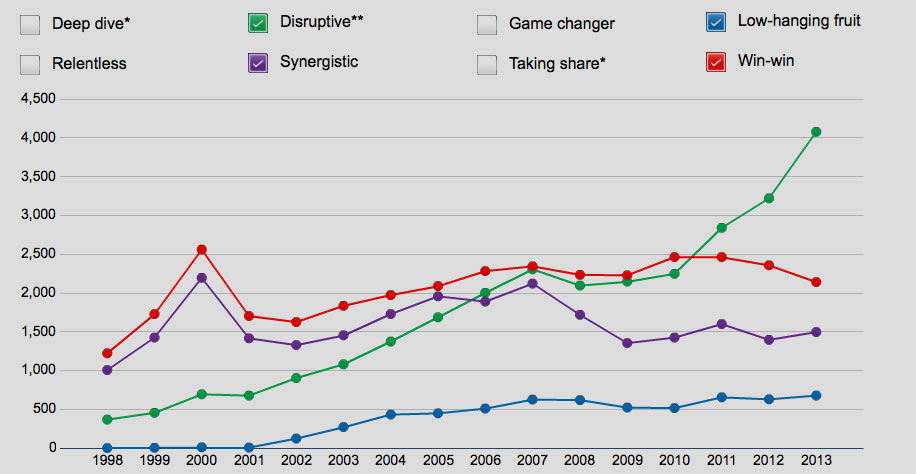
Thomson Reuters' chart about business buzzwords is perfect storm of game-changing interactivity. A disruptive deep-dive into what is, admittedly, a low-hanging fruit, it's a win-win for the web. [via Felix Salmon]
|
|
firehosevia saucie
Singer and guitarist Annie Clark shares exclusive previews of brand-new music and recounts how meeting a live rattlesnake and the specter of a dead political activist inspired her fourth LP.
Here's a nice article about the considerations for keyboard shortcuts in designing a web application. These are actually pretty good things to think through for any kind of keyboard shortcut.
As an aside, I still don't understand why people choose to write on Medium. In this case I think the author is one of the people behind Checkvist, which has great keyboard shortcuts, but I can't tell.
I link to Derek Lowe for this one because the first comment nails it (and I think Derek gets it too). I'll quote the same bit Derek does because it summarizes my entire experience:
Compared with standard offices, employees experienced more uncontrolled interactions, higher levels of stress, and lower levels of concentration and motivation. . .
When interviewing "younger" workers, the original author notes:
But they believed that the trade-offs were ultimately worth it, because the open space resulted in a sense of camaraderie; they valued the time spent socializing with coworkers, whom they often saw as friends.
Open offices were designed by people that don't need to think hard. I'm guessing it was an H.R. decision.
firehose"It was potential for the Doctor to have a relationship with a companion that was nearly angst-free. If River didn’t travel with him fulltime, there was no danger of losing her too quickly. The next time a note reached him on the psychic paper it could have been three days from the last trip for her, but decades for him.
In River’s introduction, she has all the power: she is the one who calls the Doctor, she is the one who scolds him when he’s being obstinate, she is the one who rallies the group and moves them along. In a telling move for the Davies era, it is she who grabs the Doctor’s hand when the first run together, not the other way around. She is taking him on as a companion in that first meeting. Ten is so moved by her near-death plea to preserve their time together, to never rewrite a word, that the loss of her hurts him as though he has known her for centuries. We’re left with the impression that she is one tough act to beat.
Then River returns.
And she’s still feisty and competent and one step ahead. But everything that makes her special, that recommended her from the get-go is stripped away from her step by step in the service of complex plotting.
...
You see the frustration, don’t you? It’s easy to gloss over, to just watch and enjoy, but on more careful inspection you find that nothing means anything. Everything just gets written over for a bigger speech, more tears, another world/universe saved because the Doctor is brilliant and that’s what he does. And the Doctor is brilliant, but so are the people he loves. So are Amy and Rory, so is Craig, so were Sarah Jane and the Brigadier, Rose and Martha and Donna, so is Captain Jack Harness. So is River Song.
So was River Song. But she never quite showed us her real potential."
 |
popular
shared this story
from  tor.com / frontpage_full. tor.com / frontpage_full.
|

With the Eleventh Doctor now passed into Whovian memory, it would seem that the Era of River Song has ended as well. And while it should be bittersweet, it is also honestly something of a relief.
Let me be clear—I happen to love River Song. Well, let me be clearer... I love what River Song might have been. And it’s telling that what she became is a symptom of everything that fans are lately bemoaning about Doctor Who.
[Hello, Sweetie]
The mysterious introduction to River Song in season four’s “Silence in the Library”/“Forests of the Dead” two-parter leaves a trail of clues that paints a fascinating picture of her relationship with the Doctor. We find out that she knows the Doctor intimately, that they might even be married, that he comes whenever she calls him, that she’s an archaeologist with a taste for adventure and her sexuality has more in common with Captain Jack Harkness than any other character on the series. (Remember, she states that Mr. Lux is the only remember of their expedition that she doesn’t fancy and that she’s dated androids before. Not too picky, then.) We know that her Doctor is a future incarnation, and it seems possible that she has bounced off of other versions as well, given her lack of surprise at running into Ten.

What makes River interesting is the fact that she is remote for the Doctor. Rather than living on the TARDIS, we learn that she is largely in charge of their time together; she calls the Doctor, he attends, they run off and enjoy the time. Then he deposits her back where she was. It was potential for the Doctor to have a relationship with a companion that was nearly angst-free. If River didn’t travel with him fulltime, there was no danger of losing her too quickly. The next time a note reached him on the psychic paper it could have been three days from the last trip for her, but decades for him.
In River’s introduction, she has all the power: she is the one who calls the Doctor, she is the one who scolds him when he’s being obstinate, she is the one who rallies the group and moves them along. In a telling move for the Davies era, it is she who grabs the Doctor’s hand when the first run together, not the other way around. She is taking him on as a companion in that first meeting. Ten is so moved by her near-death plea to preserve their time together, to never rewrite a word, that the loss of her hurts him as though he has known her for centuries. We’re left with the impression that she is one tough act to beat.

Then River returns.
And she’s still feisty and competent and one step ahead. But everything that makes her special, that recommended her from the get-go is stripped away from her step by step in the service of complex plotting. It starts with the revelation that she is in prison for a terrible crime—the murder of the Doctor. He’ll come when she calls, certainly, but only to free her from the tedium of a dark cell. So much for having a life of her own on the other side. To make things more involved, the Doctor finds out that River has a closer connection to him than he had anticipated; she’s the daughter of his current companions. And then she is kidnapped as an infant and brainwashed to kill him. So River essentially spends her formative years with an existence that orbits around the Time Lord. She has no ambitions of her own, no purpose beyond his destruction.

Once River realizes that killing the Doctor might be a mistake, she promptly gives up all of her regenerative energy to save his life. (You can’t really blame her for the choice; she’s just beginning to recover from her conditioned psychopathy and her parents essentially tell her to save him.) So she winks away thousands of years of her own future for a man she really doesn’t know, having no idea how that’s going to turn out for her. And then in order to get to know that man she saved better, she becomes an archaeologist... so she can find out everything possible about the Doctor.
Let me reiterate; River Song’s occupation as an archaeologist is retconned so that it’s all due to her obsession with a man who is nearly a stranger to her. Not because she adores history, or loves to explore, or needs to answer unanswerable questions. It’s because she doesn’t know her future boyfriend all that well, and textbooks are the easiest place to find him at the start.
Because outside forces still want her to do the job she was programmed for from birth, River is press-ganged to kill the Doctor once again. But rather than let that happen—she went to school to learn to love the guy, come on!—she decides that she’d rather destroy the universe than fulfill that function. But the universe has to be righted, so to appease her, the Doctor agrees to marry her.

So to put it another way, their marriage is not due to any sort of trust built or great romance between them. It is to mollify River the way one might a tantrum-throwing child. “Hey, if I put on a fake ceremony and agree to make you important to me, will you not let every living thing die? Thanks.” Didn’t River get her education in the 51st century? Isn’t is possible (or even likely) that 3000 years from now there will be passages and rights outside of the marriage that allow people to show their affection for and dedication to each other? But apparently being the Doctor’s wife is everything that she was ever hoping for, and she promptly puts the timeline right once they give their ‘I do’s.
In addition, River Song’s sexuality is practically never addressed again. Who knows about those liaisons that she claims in the future? They’re clearly irrelevant once her importance to the Doctor is established. Which isn’t to say that River Song’s sexuality ever needed to be important to her character—but establishing a person with a wide range of tastes in that regard and then proceeding to ignore those tastes once that person is in a heteronormative relationship… well, it sort of leaves a bad taste in the mouth. As though it was used in the first place to make her ever-so-intriguing and then discarded as soon as she finally had the man in her life.

River’s journey, while heartbreaking, exists as a simple countdown. When we first meet her, she is surprised to find that Ten doesn’t know her, and that lack of recognition is immediately painful. But once we get to the heart of that dilemma in Season 6, we learn that River has always existed in this odd limbo with the Doctor, waiting for the inevitable point in their history where he knows her less and less with each encounter. Her confusion in their first meeting no longer plays—it should have been resignation, perhaps, but not the shock that we see in the Library. Is she just acting, then? We know she is pretending through half of her time with Eleven and Amy because there are things she is not allowed to reveal for fear of confusing the whole timeline.
Everything that makes this character interesting and dynamic is pared down so she makes a good mystery, something to fit into Steven Moffat’s puzzle box universe. What’s distressing is that every time he explains a bit of her away, we’re left with the clarified image of a woman who is entirely defined by her relationship to one person, specifically to one man. And while the Doctor does clearly have feelings for River, they are not of the same caliber, not nearly so encompassing. So on top of all this, she’s putting all of her life’s energy (quite literally) into a person who doesn’t focus the same sort of passion on her. It diminishes River, makes her so much less than she seemed in the beginning, an adventurer with her own plans and dreams, someone who the Doctor had to respect and acquiesce to on occasion. Because Gallifrey forbid the Doctor ever has to answer to anyone other than himself.

And this is in keeping with many problems fans pick out as Steven Moffat continues building his own mythology with the show. The Weeping Angels, one of the most terrifying villains on television after a single appearance, have now been reduced to gimmicky pop-ups that barely hold up under scrutiny. They are meant to “kill you nicely,” but suddenly in Season 5, they have an army and will blow a hole in the universe. One of them is the Statue of Liberty, and can apparently amble through New York City without being seen by a single person. Angels are waiting in a forest to grab Clara in “The Time of the Doctor” because… just because. Because scary. Because danger. Danger that has nothing to do with the central plot of the episode.
The Silent Silence arc is the same. Those besuited fellas desperately needed explaining. So in the twilight hour we get something to grab onto—Why are they working with an organization that wants to kill the Doctor? They were commandeered by a splinter sect of a religion that we’ve never heard of previously. A religion with a great deal of power that we’ve never seen before. A one-off, the same as the splinter sect that snapped the Silents Silence up (because we only find out that Madame Kovarian and her cohorts are a religious lot in “A Good Man Goes to War” and it is never really brought up again). These ideas are not laid out ahead of time—they are decided in the moment, for whatever the plot needs to create a lot of explosions and heroism.
Take this example: The Pandorica will open and Silence will fall. Except then the Pandorica did open and there was no Silence, so now… Silence will fall when the Question is asked! Except it didn’t the first dozen times we were told that the Question was Doctor Who, so now… the Question comes on the Fields of Trenzalore, at the Fall of the Eleventh? These aren’t clues—they are morphing tag lines to keep people interested and guessing. But they have to shift every time the story shifts and no longer accommodates the same mystery.
The same as most details surrounding River Song’s entire character.

Which isn't to say that there are no affecting moments on the show where River is concerned—it’s quite the opposite, in fact. But those moments are not grounded in any sort of devotion to her continual development as a character. You see the frustration, don’t you? It’s easy to gloss over, to just watch and enjoy, but on more careful inspection you find that nothing means anything. Everything just gets written over for a bigger speech, more tears, another world/universe saved because the Doctor is brilliant and that’s what he does. And the Doctor is brilliant, but so are the people he loves. So are Amy and Rory, so is Craig, so were Sarah Jane and the Brigadier, Rose and Martha and Donna, so is Captain Jack Harness. So is River Song.
So was River Song. But she never quite showed us her real potential. We never got to see her date an android or excavate a lost civilization or save an entire species because the Doctor comes when she calls and no one else.
And that’s the woman I feel cheated out of knowing.
Emily Asher-Perrin still loves the River Song she thought she was going to meet. You can bug her on Twitter and read more of her work here and elsewhere.

Eccentric Chinese millionaire Chen Guangbiao, the irrepressible publicity hound who says he wants to buy the New York Times (or, failing that, the Wall Street Journal) is earning international guffaws with this business card. In particular, Chen’s claim to be “Most Charismatic Philanthropist of China,” is generating particular ridicule on Chinese social media, reflecting citizens’ broad mistrust of philanthropy, which has become synonymous with corruption and fraud.
One blogger (registration required)—among tens of thousands on Sina Weibo and other forums who chimed in about Chen’s new card and the attention it is getting—contrasted him with the recently deceased Hong Kong entertainment mogul Run Run Shaw, who gave generously to hospitals and schools on the mainland. “If you compare Chen and Run Run, you’ll see the difference between true charity and pseudo-charity. What Chen leaves to this world is just a bunch of noise and gimmick,” the user said. Another blogger responded: ”I’ll give you another title: Most Shameless Person in China.”
High-profile charity work doesn’t have a great reputation in China, where as many as a third of registered charity groups don’t meet international standards for transparency, according to a government report last year. China’s Red Cross infamously misused donations for Sichuan earthquake victims in 2008, and recently Chinese media have questioned whether actor Li Yapeng is profiting from a fund (link in Chinese) for children with cleft palates.
Chinese media have also accused Chen of faking donations. In 2010, Chen claimed to have donated 1 million yuan (about $165,000) to China Foundation of Human Rights for relief work in Haiti, but reporters with the China Business Journal found that the organization didn’t exist.
Thus, it’s not a surprise that some say Chen—whose charity work includes personally rescuing earthquake victims, giving cash to villagers, and most recently, paying for reconstructive plastic surgery for burn victims—cares most about appearances. As we wrote, it wasn’t until Chen became famous that his recycle waste business began to win lucrative government contracts. Perhaps Chen should just focus on one of the other titles on his card: “China’s Foremost Environmental Preservation Demolition Expert.”
Gang Yang contributed additional reporting.