The lesson takes the form of a puzzle that goes through the actual game mechanics of Flappy Bird step-by-step, from flapping the bird's wings each time you click your mouse, to deciding what happens when your character either hits or misses the large green pipes. At each step along the way, you need to figure out how to reconfigure the game to make it work the way it's supposed to. The end result is a very basic lesson for what's required to build the game, something that's been distilled down to a drag-and-drop interface. And when you're done learning, you can adjust every facet of the game, right down to choosing whether your bird sounds like a jet engine or a laser every time it flaps.
The code your own Flappy Bird game was made to coincide with Code.org's one year anniversary. In an interview with GeekWire, Code.org co-founder Hadi Partovi said the idea for the project was born during an employee happy hour when the group realized it would be a good game to turn into a code lesson. Similar efforts have tapped Rovio's Angry Birds series, Frogger, and PopCap's Plants vs. Zombies, though those games still exist.
As a result of the myriad of pending lawsuits challenging the legality of the National Security Agency’s bulk metadata collection program, the United States government now wants to keep its records beyond the existing five-year limit.
As the government argued Tuesday in its 14-page court filing (PDF) in the Foreign Intelligence Surveillance Court:
Based upon the issues raised by Plaintiffs in the above-referenced lawsuits and the Government’s potential defenses to those claims, the United States must ensure that all potentially relevant evidence is retained which includes the [business records] metadata obtained in bulk from certain telecommunications service providers pursuant to this Court’s production orders. To meet this obligation, the Government seeks an order that would allow the NSA to retain the [business records] metadata for non-analytic purposes until relieved of its preservation obligations or until further order of this Court under the conditions described below. Based upon the claims raised and the relief sought, a more limited retention of the [business records] metadata is not possible as there is no way for the Government to know in advance and then segregate and retain only that [business records] metadata specifically relevant to the identified lawsuits.
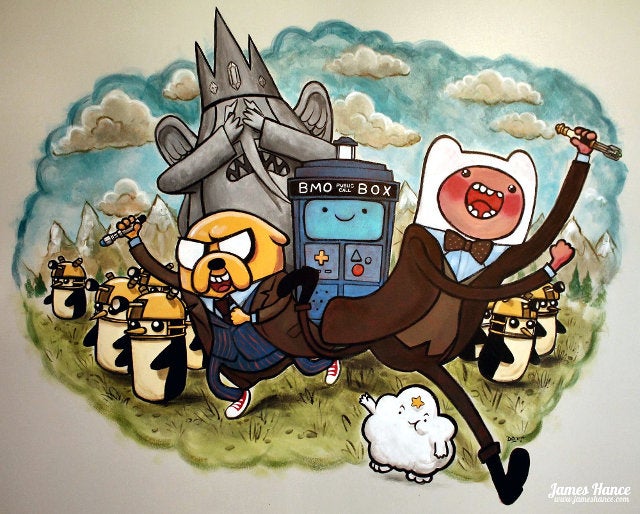
<3 would likely make Jake the TARDIS and B-MO into K-9 but still, liked
The creator of Wookie the Chew , and a multitude of additional wondrous works of art , James Hance, painted this on his daughter's wall. We are so jealous.
'Culture Contributing Researcher Contributing researchers will research entertainment and culture stories, track news, and write posts. The researcher will learn how to spot a good story, and how to distinguish important news from publicity machine chaff. He or she will contribute research daily to our popular Morning Spoilers feature, and help with fact-gathering for research-intensive stories on pop culture history and trivia. There will be opportunities for him or her to contribute reviews and news stories as well. These jobs pay $500/month, for 10 hours of work per week, but we are flexible about when and where you work.
Science Editorial Fellow The science editorial fellow will research and suggest science stories, keep up with breaking news in scientific journals, and write posts. He or she must have some experience with scientific research. This position will allow him or her to build on basic scientific knowledge to spot important discoveries and learn how to translate complicated or technical concepts into stories that a popular audience can appreciate. He or she will work 20 hours per week doing research for io9 reporters, combing through scientific papers and looking into the research of working scientists for information. The fellow will also have the opportunity to develop and write stories on topics of his or her choice. Editorial fellows are hourly employees, and you'll be paid an hourly wage for 20 set hours per week. You must have the legal ability to work in the United States, but you can work from anywhere, as long as you are working your hours online during daylight hours, Pacific Time.
How to Apply
Please send a cover letter (in the body of your email only, please) and a resume (attached) to: community@io9.com by midnight on Monday, March 10. And please include links to two of your writing samples that we can read online. And please include either "Culture Contributing Researcher" or "Science Editorial Fellow" in the email subject line. We're looking forward to hearing from you!'
Are you just starting your career, and want to get your feet wet with a research job at io9? We've got three openings — two for contributing researchers who focus on culture and entertainment, and one for a half-time editorial fellow in the sciences who will do research, writing, and outreach in the science community.
'Portland police and the Multnomah County District Attorney's office are leveraging the state's "interfering with a peace officer" law, which makes it a class A misdemeanor to refuse "to obey a lawful order." Under COPP, cops who see a person littering/drinking/peeing in public issue a warning and put the person on a list. If the offender is caught literring/drinking/peeing again, they're taken to jail for not following the earlier order.
The project began last summer, and cops and prosecutors say its intent is two-fold: to persuade people to seek treatment, and to persuade people to leave Portland.'
As the Mercury reported in today's issue, a fairly new effort from police and prosecutors has aimed tougher enforcement at certain nuisance crimes often affiliated with homelessness, but not too many people know it exists.
Among those left in the dark: Commissioner Amanda Fritz, who in recent months spearheaded an effort to find a new home for the Right 2 Dream Too rest area. And to say Fritz is not pleased might be putting it mildly.
The commissioner was "horrified and very disturbed," she says, to learn of the so-called Chronic Offender Pilot Project (COPP) today. She thinks Mayor Charlie Hales—commissioner in charge of the Portland Police Bureau—should have briefed her on the policy change.
"I've been quite involved in houselessness issues and caring for people that live outside," Fritz tells the Mercury. "The communication obviously is lacking, and how to correct that more than a year into this council is an ongoing challenge."
The COPP takes a novel approach to certain crimes—littering, public intoxication, public urination—which have historically been treated lightly. Whereas offenders in past years were cited, given a court date, and met virtually no consequences if they didn't show, the COPP targets lawbreakers with arrest, then bench warrants if they miss a court date.
To do so, the Portland police and the Multnomah County District Attorney's office are leveraging the state's "interfering with a peace officer" law, which makes it a class A misdemeanor to refuse "to obey a lawful order." Under COPP, cops who see a person littering/drinking/peeing in public issue a warning and put the person on a list. If the offender is caught literring/drinking/peeing again, they're taken to jail for not following the earlier order.
The project began last summer, and cops and prosecutors say its intent is two-fold: to persuade people to seek treatment, and to persuade people to leave Portland.
According to a procedure document detailing the program, it "should serve to make Portland less attractive to people who want to come here and openly violate the law and degrade community livability." That's a fairly bald reference to the "travelers" known to descend on Portland during the summer, a group that's been a focus of police lately, especially since a teen struck a septuagenarian with a skateboard last summer.
"We found the guy who hit somebody with a skateboard and he's going to jail for five years," Fritz says. "That's a problem. That's criminal behavior. Littering twice is not criminal behavior."
Fritz appears to be weighing her options. She holds a weekly meeting with Hales—it was yesterday—and he's never mentioned the policy change despite her work around homelessness. She intends to bring it up next week.
"We're in a (US) Department of Justice settlement agreement," Fritz says. " We understand that some of those interactions (between police and the homeless) in the past have not turned out well.
"I can no longer sit back and say: 'I'm not the police commissioner. This is not my problem.'"
Meanwhile, a spokesman for Hales, Dana Haynes, says the mayor's aware of the policy. And, though he hadn't fully read the Mercury's story, he took issue with a headline reading "A Tough New Policy Targets the Homeless."
"We are going to disagree with you that it is targeting the homeless," Haynes says.
Rhode Island state Senator James Sheehan requested copies of "all depositions and exhibits" pertaining to the civil lawsuit filed against the people and companies involved in the $75 million loan guarantee provided to 38 Studios.
According to a press release from the Rhode Island General Assembly, Sheehan believes "this information will help answer many questions still left unanswered about how the ill-fated deal came about."
Sheehan sent a letter earlier this week to Thomas E. Carlotto, the attorney from Shechtman Halperin Savage representing the Rhode Island Commerce Corporation (formerly known as the Rhode Island Economic Development Corporation). Sheehan, who is chairman of the state's Committee on Government Oversight, plans to present those documents to the Committee.
"I would like to make these records available for review by the Government Oversight Committee to help complete the public record as well as to help policymakers avoid a recurrence of such a failed deal in the future," he wrote.
Sheehan also explained that investigations and the lawsuit have hindered the Committee's work.
"I believe there is a way to accomplish this while minimizing any potential harm to the lawsuit."
"Public hearings involving witnesses to the 38 Studios deal potentially could have interfered with the criminal investigations or potentially injured the state's ability in ongoing efforts to recover monies from civil litigation against those responsible for the failure of that deal," he wrote.
Reviewing the documents within the committee, Sheehan believes, is a way for lawmakers to learn what transpired while minimizing harm to the ongoing lawsuit, which the state filed in November 2012 against executives at 38 Studios and the Rhode Island Commerce Corporation.
"I believe there is a way to accomplish this while minimizing any potential harm to the lawsuit, and that is to review witness depositions and exhibits," he wrote.
The state of Rhode Island backed a $75 million loan guarantee for former Red Sox pitcher Curt Schilling's development studio in 2010, designed to bring the developer and 450 jobs to the state. 38 Studios declared bankruptcy in June 2012, having shipped Kingdoms of Amalur: Reckoning but not its unfinished massively multiplayer online role-playing game codenamed Project Copernicus. The state filed suit maintaining that those involved in the loan guarantee did not fully disclosed the associated risks.
Over the aggressive beats of "Freaky Money," Freedia announces herself with an unmistakable power, and her parts could dominate the song if she and RuPaul weren't sisters in experience in so many ways. "Don't gimme your love/ I don't want it," Freedia sings. "I want your money, money, money. ... / Make you throw your freaky money in the air." '
Big Freedia attends the Guinness World Record and Big Freedia Twerking Event in New York City on Sept. 25, 2013.
Photo by Ilya S. Savenok/Getty Images
RuPaul is America's most trusted name in drag queens.
She's always carried herself with a reserved poise (perhaps that comes from an Atlanta upbringing) that's disarming: No one sees a skinny, middle-aged man in drag. She's legit: Thirty years of hustling her Charisma, Uniqueness, Nerve, and Talent have made her an actual supermodel, a Billboard-charting singer, and a media mogul. She's taken seriously as a businessperson in a role that's historically been played for camp.
Advertisement
Tonight, her reality show, RuPaul's Drag Race, enters its sixth season on gay TV network Logo, and her sixth album, Born Naked drops today. ("You're born naked & the rest is drag," she explains in her Twitter bio.)
But perhaps the most unexpected contribution RuPaul has made with her show and her music is to bring the spectrum of male-to-female performance and femininity into mainstream popular culture.
RuPaul lives as a man and performs as a woman. As such, she uses interchangeable pronouns, as do most of the Drag Race contestants. But the show's rules don't specify that a contestant must identify as male, or even queer; there's no mandate that you can't have modified your body through surgery. In fact, there have been several genderqueer or transitioning contestants on the show, including Season 3 contestant Carmen Carrera, who recently tried to expand Katie Couric's understanding of trans identity in an awkward but importantinterview, along with Orange Is the New Black trans actress Laverne Cox.
Thanks to Drag Race, more people understand that drag queens are performing femininity, and that it's a long tradition.
Which leads us back to RuPaul, the consummate performer. Her albums have long been where the wheels fly off her regal demeanor. And at 53, she's got a den-mother image to shed now, too.
Enter Big Freedia, an incredibly talented New Orleans-based trans singer and rapper, known in her hometown for the last decade as "The Queen of Bounce." We have Freedia and the booty-bounce genre to thank for the twerking revolution we are enduring/enjoying today. (Freedia, too, is free with pronouns; she's on a trans spectrum and has used both he and she.)
Freedia had been grinding for years with other Southern trans and queer rappers (such as Katey Red) before she broke out with 2010's Big Freedia Hitz Vol. 1 and the single "Excuse." (In the video, she tries heroically to teach hipsters to wobbledy-wobble.)
Freedia gained major attention with her guest spot on RuPaul's 2013 single "Peanut Butter." The svelte RuPaul had more booty in that video than the world had ever seen, and the lyrics were ... well this was a very different lady "spreadin' that jelly." Freedia's voice and delivery—she's a dance drill sergeant—provided the bounce inspiration and a fresh foil to Ru.
Freedia has her own family-focused reality show on Fuse, which was just renewed for a second season. And today, she is fresh off a tour, on billboards in Times Square, and on the very first track of RuPaul's new record.
Over the aggressive beats of "Freaky Money," Freedia announces herself with an unmistakable power, and her parts could dominate the song if she and RuPaul weren't sisters in experience in so many ways. "Don't gimme your love/ I don't want it," Freedia sings. "I want your money, money, money. ... / Make you throw your freaky money in the air."
There's a social-change saying, "You must lift as you climb." The entertainment world doesn't really work that way, and the space for gender-variant performers in the mainstream has never been large enough to be shared. That's changing, so shake your ass in celebration.
Shauna Miller is a writer and editor in Washington, D.C. She is a co-founder of Girls Rock D.C., a rock camp for girls ages 8-18.
…From The Baby’s Own Aesop: the best of Aesop’s Fables retold in limericks, each one with its moral / explanation. I particularly like the moral on this one. :) (Note also the hand holding the document down into the frame. Goofy…)
'there’s also DLC available for the game, called Hell’s Warehouse. It adds zombies.'
By Graham Smith on February 26th, 2014 at 4:00 pm.
Warehouse and Logistics Simulator has just been released on Steam. It contains “original Jungheinrich forklift”, a “huge variety of quests” about lifting pallets from point A to point B, and no collision detection on the people idly milling around the warehouse.
There’s a launch trailer below, and some thoughts from me while I attempt to resist all the easy jokes.
I’m in no real position to make fun of something like this, as I genuinely enjoy a whole range of nerdy simulation games. But as I’ve been reading about it, I wonder how much a game like this is intended to be “genuinely” enjoyed. The Steam reviews suggest its buggy, feature-light, and from a developer known for other similarly iffy games. The Steam forums are mostly populated by people who bought it ‘for the lulz’; in other words, their enjoyment is ironic, and comes mainly from the game’s mere existence. People are buying it as a kind of punchline.
Its publisher – who are also responsible for Agricultural Simulator: Historical Farming – must know that these people are part of their market. I want to know what the ratio is, between people who buy the game because they want it and people who buy it so they can tell people they bought it. I wouldn’t judge either group, but it strikes me that the latter group’s cynical enjoyment is dependent on the idea that there’s a large group of the former. “People really like this stuff? That’s cray.” If its inevitable mockery is built-in, a deliberate part of the game’s appeal, that seems considerably less fun an idea.
Exhibit A to suggest that’s the case: there’s also DLC available for the game, called Hell’s Warehouse. It adds zombies.
Cartoon Network's Adventure Time Season 3 was released on blu-ray and DVD this week and I'm super excited because I'm way behind on the animated series. To help celebrate the BMO-centric packaging (freaking adorable), they're holding a fun photo contest.
it's amazing what you can do with an old PC case, a polaroid camera, and a can of white spray paint
Part of me can't even believe I wrote that headline. But it's true. The voice of Portal's maniacal GLaDOS, Ellen McLain helped with this video fro the education and public outreach department of NASA's Spitzer Space Telescope, focusing on STEM education.
Are you following The Mary Sue on Twitter, Facebook, Tumblr, Pinterest, & Google +?
First Peated American Single Malt Whiskey from Westland Distillery Seattle-based Westland Distillery has released a limited edition peated single malt whiskey titled “First Peated”. Westland’s First Peated American Single Malt Whiskey (SRP $65.00 a 750-ml) is the first peated expression released by the distillery and it serves as a prelude to Westland's Peated Malt Whiskey, which will soon become a mainstay in the distillery’s regular lineup of American Single Malt Whiskies. First Peated began as a mash of two separate malts that was distilled in Seattle by Westland then matured in charred new American oak casks. The first malt was...
Offshore wind farms are popular in Europe and gaining interest in the US, but it's unclear how the turbines will fare in a powerful hurricane. Two studies that came out this week reached seemingly contradictory conclusions. One group says wind turbines would buckle in a serious hurricane, while the other says the turbines would sap the hurricane's strength.
One study, published by researchers from Stanford and the University of Delaware, says current wind turbines placed offshore could actually slow down hurricanes before they hit land. Mark Z. Jacobson, a Stanford researcher who has been building a weather and pollution model for the last 24 years, says today's wind turbines can withstand winds up to 112 miles per hour, reducing a storm's peak wind speeds by up to 92 miles an hour.
One group says hurricanes will destroy wind farms, the other says wind farms will destroy hurricanes
But another study, conducted by researchers at Carnegie Mellon, says that hurricanes with wind speeds of at least 111 miles per hour (category 3) would destroy almost half the turbines in the four hurricane-vulnerable areas under consideration for wind farms. The Carnegie Mellon group believes it may be too expensive to construct wind turbines that could withstand hurricane-force winds by adding things like battery backup, thicker towers, and heavier motors.
The two studies may not be completely irreconcilable. Jacobson's model imagines an array of thousands of turbines, which he believes would have drastically reduced the damage caused by Hurricane Katrina. The Carnegie Mellon researchers are imagining arrays with only 50 turbines.
The answer may be theoretical at this point, but the question is not. The US Department of Energy estimates that the US can generate up to 20 percent of its energy from wind by 2030, which means more than 50 gigawatts will have to come from offshore turbines.
Check out the teaser image here below drawn by Eric Powell (The Goon).
So far, there’s no information yet on who is working on this apparent Big Trouble in Little China series yet, how long its run will be, when it will be released, or if it will be an adaptation of the movie or a prequel/sequel. We’ll let you know once more details are released, but for now, just look below and bask in the glory of what could be the coolest comic book of all time.
We’re still getting a good flow of signups from existing users and users that have been in the free trial, so we’ve decided to keep our discounted pricing in place for a bit longer. This will also give more time to those users who were waiting for paypal support.
Thanks again for all of your support. Make sure to jump on the $2/month pricing while it’s available. And, as always, thanks for using The Old Reader!
Gravity has earned more than $700 million at the worldwide box office and is expected to cross the $750 million mark. Assuming Warners gets 45 percent of that, Bullock's take would be more than $50 million, including her upfront payment. But theatrical revenue is just one part of what she'll make, as she also gets a percentage from home video, TV and ancillary revenue.
"The theatrical window is going to generate a third of the total revenue a movie will earn; it will get another third on DVD; and then the final third comes from pay and free TV," says one veteran finance lawyer. Gravity might earn proportionately more at the box office, says this lawyer, because "pay and free-TV numbers cap out at a certain point."
Even with a conservative estimate, Bullock will make at least $20 million from those other sources, and she might make considerably more. It is unclear who the other Gravity gross participants are; sources say they at one point included co-star George Clooney, Cuaron and producer David Heyman, though the latter two might have renegotiated their deals when the movie's price tag shot up during its challenging shoot.
I think it’s safe to say that Spider-Man has been through some pretty weird stuff in his time, right? I mean, that’s a fifty-year saga that started with a radioactive spider-bite that gave him limited psychic powers and super-strength that he immediately used to try to find fame as a professional wrestler, and the fine folks over at Marvel Comics have somehow managed to top that for weirdness time and time again. Heck, right now, Spider-Man comics are in the midst of a supervillainous Freaky Friday story that has been running for over a year. That should tell you something.
But for my money, the absolute craziest and most hilarious Spider-Man story in years isn’t the one you’ll find in the comic shops on Wednesday. It’s the one that’s happening right now in TheAmazing Spider-Mannewspaper strip, by Stan Lee, Larry Lieber, Alex Saviuk and Joe Sinnott.
Okay, before we go any further, there’s a little bit of background you need to know, and that is that Newspaper Spider-Man is quite possibly the worst version of the character since that part of the J. Michael Straczynski run where he was running around making out with Gwen Stacy’s ten year-old half-goblin ninja daughter, which is a thing that actually happened. Newspaper Spidey is never quite that offensively terrible, but he also has a pretty dismal track record from when it comes to actual superheroism. He’s generally pretty cowardly, gets conked on the head a lot, and doesn’t actually seem all that concerned about this whole using-great-power-with-great-responsibility thing, instead preferring to just sort of lay around waiting for things to sort themselves out.
That might seem like I’m exaggerating, but Josh Fruhlinger has devoted a pretty considerable amount of time to chronicling Newspaper Spidey’s lackluster performance, and I wanted to share a few of his highlights before we moved on, just so we all know what we’re dealing with.
Here’s Spider-Man, whose “spider-sense” gives him an almost supernatural ability to sense danger, being knocked out by a random thug with a tree branch:
And here he is knocking himself out by bashing his head against a pipe:
Here he is forgetting that airports have security (with bonus Mary Jane telling him he sucks compared to Superman):
And here he is solving a murderous rampage by casually standing around watching Wolverine and Sabretooth beating each other into unconsciousness and claiming the victory for himself:
Stuff like that happens a lot, and I actually have to confess that I kind of love it. Spider-Man the slapstick comedy character who isn’t very good at his job is not a great interpretation of the character, but it’s also one that’s genuinely hilarious, and I’m willing to guess that might be the goal here.
As you might be able to guess from a couple of those highlights, the strip tends to do a lot of stories about Marvel Universe guest stars showing up and solving whatever problem Spider-Man should be fully capable of dealing with on its own. It’s occasionally tied to a movie release — I’m pretty sure that Wolverine/Sabretooth bit hit around the same time as The Wolverine — but it’s always a weird look into a Marvel Universe where Spider-Man is everyone’s inept friend that comes over to help you move and ends up sitting on a box of dishes eating your cereal all day while accidentally spoiling Game of Thrones.
Which brings us to the current storyline, which has been running since last November, when Spider-Man returned from a trip to South America (where he teamed up with/stood around watching the Tarantula), and was promptly roped into J. Jonah Jameson’s latest plot to publicly unmask him. This time, it involved a guest appearance on a morning talk show.
I’ll let that sink in for a second: J. Jonah Jameson challenged Spider-Man to appear as a guest on a morning talk show, and Spider-Man accepted.
Maybe the best part of this sequence is when Jonah challenges Spider-Man to come up with three reasons why he wears a mask, which Spidey promptly fails to do, and then ends the debate by peacing out and leaving. “Running away as soon as things get tough” is to Newspaper Spider-Man what “using webs to swing from buildings” is to the regular version.
Jonah, however, would not be deterred, which is where this story’s team-up aspect comes in. JJJ strikes an agreement with Tony Stark, donating a considerable amount of money to Stark’s favorite charity in exchange for Tony promising that he’ll be in China for the next week or so. So basically, this story really kicks off when Iron Man takes a bribe. While Tony’s off seeing the sights, Jonah gets hold of an old suit of Iron Man armor (the gold one from the early Avengers days, although nobody told the colorist responsible for the daily strips that) and has a scientist rig it up as a remote control robot, and sends it after Spider-Man. You would think that guy would’ve learned his lesson about the whole “creating robots to kill Spider-Man” thing, but alas, Newspaper Jonah is doomed to repeat history.
Believe it or not, the part of the story where Spider-Man is swinging around trying to avoid being unmasked (and possibly murdered) on live television by a remote-controlled suit of Iron Man armor, which is a pretty fantastic premise, is actually really boring. Part of that is down to the format of a three panel strip where the first panel is always devoted to recapping the previous day’s strip and the last panel is always a cliffhanger for the next, but the other part is that it’s a fight where nothing happens that lasted for the entire month of January.
The only real highlights are that Newspaper Spidey complains about never fighting someone who can’t break through his webs, a nice reminder that he is completely inept, and then winning the fight with a double-stomp kick right to the robo-junk:
Then he smashed it into the van that Jonah’s technician was using to control the robot. Please note that Newspaper Spidey did not know that was the van being used by the technician, he just saw a van in the middle of Manhattan and decided it was probably up to no good.
Like I said, it’s not exactly thrilling action, even by the standards of stuff you’re meant to skim over a bowl of cereal and a cup of coffee. But after Spider-Man beats the “Iron Manbot,” that’s where things start to get crazy. First, Spider-Man is now onto Jameson’s plan. He knows there’s someone out there trying to unmask him, something that would put his friends and family in danger. He knows he’s up against impossible odds, because Iron Man’s armor, even an obsolete model, is still a technologically advanced juggernaut. But what do heroes do when the people they love are in danger and they’re facing impossible odds? What do they do with their great powers when they’re faced with the burden of responsibility?
Well, if they’re Newspaper Spider-Man, they just sort of run away until the whole thing blows over.
That’s not the crazy part. That’s actually to be expected, all things considered.
The crazy part is that, as seen above, J. Jonah Jameson decides to put on the Iron Man armor himself so that he can personally unmask Spider-Man and conquer his arch-nemesis. That in and of itself is actually something we should’ve expected, it’s the natural progression of this story from the moment a plot point like “J. Jonah Jameson has some Iron Man armor” gets introduced. What makes it amazing is that when he puts on his helmet, his face glows through the metal.
I don’t know if this is being done purely for the benefit of the reader, or if Newspaper Jonah actually gained X-Ray Face Powers in a previous story that I missed, but it is magical. Like, imagine that you’re a reader who’s never actually seen Spider-Man before, or maybe you have but you don’t really know much about his supporting cast. So you get your newspaper, and there on the comics page, right next to the death-march that is Funky Winkerbean, you see The Amazing Spider-Man. So you read it, shrug, and then the next time someone asks you if you know anything about Spider-Man, you answer “Is that the comic strip about Robot Hitler?”
And then it gets better.
Since Spider-Man has pretty much tapped out of this whole superheroing game, Jonah is left to his own devices, flying around Manhattan all by his lonesome in search of crime. And crime, my friends, does he find in last Sunday’s strip.
There is so much I love about this comic strip. It is beautiful and perfect in so many ways, and all of those ways are monumentally dumb. Just the very idea of the National Guard Armory in the middle of Manhattan being a single, clearly labeled door with no guards whatsoever, leading directly to a room full of crates and one gassed up, fully armed Sherman tank. And that’s going to fight Iron Jonah aka Robot Hitler.
It is, and I mean this sincerely, my single favorite thing going on in superhero comics right now.
You can catch up on the last month’s worth of Amazing Spider-Man strips at Comics Kingdom.
BARCELONA, SPAIN—Samsung has such a large presence at Mobile World Congress that it doesn't just have one giant booth; there are also several smaller ones scattered around the show halls. While the main booth exclusively shows Android phones and the biggest product of the show was the Android-based Galaxy S5, one of the most important areas for Samsung is a small booth tucked away in the last hall of MWC: a Tizen booth. Here, in the "App Planet" section of Mobile World Congress, Samsung has actual Tizen phones on display—phones with an OS that is fully under Samsung's control. Samsung's choice between Android and Tizen is one of the more interesting stories in tech right now, so when we stumbled upon this booth, we immediately grabbed our cameras and started snapping.
The OS runs on "prototype" hardware that very closely resembles a Galaxy S4. Tizen is a Linux-based OS primarily developed by Samsung, and, the theory goes, Samsung's grand plot is to eventually turn Tizen into a drop-in Android replacement, own the market with an OS of its own making, and never have to deal with Google again. So far, Tizen seems a pretty accurate Android clone, but it's shocking how far along it is. On the surface, it seemed just as capable as a TouchWiz Android device. Samsung has done such a good job of replicating the Android interface that there is very little to write about—everything looks and works similarly to the way it does on Android, just without any kind of ecosystem.
Tizen uses the same button configuration as many Android Samsung phones, with Menu, Home, and Back buttons. Samsung's OS runs really, really well—it seems just as snappy and customizable as Android. Tizen has an app drawer, home screen pages, a pull-down notification panel, and widgets just like Android. The big differences are round app icons and lots of widget functionality. Widgets are expandable—a swipe down on the weather widget, for instance, will expand a multi-day forecast panel from the bottom of the widget. Widgets and icons are actually the same thing—the widgets are resizable just like they are on Android, but shrinking a widget down to a 1x1 square will turn it into an icon, and expanding an icon to 2x2 will turn it into a widget. Both features are very slick, and they're something we wouldn't mind seeing Android adopt.
Rhythm & Hues Studios won an Academy Award for its groundbreaking work on "Life of Pi" — just two weeks after declaring bankruptcy. The film explores rapidly changing forces impacting the global VFX community and the Film Industry as a whole.
When it comes to comics inspired by tabletop roleplaying games, many titles focus solely on stories using general concepts from the realms they pull from. Dynamite seems to be going the extra mile this May, though, with the launch of the new Pathfinder: City of Secrets #1 by writer Jim Zub and artist Leandro Oliveira that includes “an exclusive Pathfinder Roleplaying Game encounter, sourcebook appendix, and a bonus removable playable tactical map/art poster,” which are all things regular Pathfinder player CA Staff Writer Chris Sims assures me are “neat.”
The new series follows Zub’s previous ongoing Pathfinder title with Andrew Huerta, along with the Pathfinder: Goblins spinoff miniseries that was written and illustrated by a host of creators anthology-style.
Here’s how Dynamite’s official synopsis describes City of Secrets:
In Pathfinder: City of Secrets #1, the Pathfinder heroes head to the city of Magnimar, and danger isn’t far behind. As the wizard Ezren seeks an audience with the Pathfinder Society, his adventuring allies explore the city’s ancient magic, well-hidden secrets, and deep political divides. The dangers and opportunities of the big city could bring the adventurers closer together-or tear them apart!
Even if you can’t make heads or tails of the Pathfinder Wikipedia entry (So Pathfinder is Dungeons & Dragons but NOT Dungeons & Dragons???), the previous Pathfinder comic made for a solid read by following group of warriors while they did their fantasy realm questing thing and conversed in a manner befitting each of their in-game archetypes. It’s kind of like how Battlechasers would’ve been if…well, a lot of things.
To sweeten the RPG player deal, however, Dynamite has partnered with Pathfinder maker Paizo’s Pathfinder Society Organized Play program “to connect retail stores with volunteer Game Masters who can run in-store Pathfinder RPG demo events based on the encounters featured in the series.” This will effectively allow Pathfinder players to defend their comic or gaming retailer from the game’s goblins in a game scenario.
You can take a look at four covers from Pathfinder: City of Secrets #1 by artists Genzoman, Carlos Gomez, Sean Izaakse and Steven Cummings below.
oh yeah, you could technically buy a T-Mobile phone in SWLA in 2002 but it didn't work if you were more than 500 feet off I-10, inside a building, or outside Lake Charles or Lafayette, WHICH IS NOT WHERE ANYONE ON THIS FUCKING SHOW APPARENTLY SPENDS ANY OF THEIR FUCKING TIME
shit, I think T-Mo is still that bad in LA _today_
Close watchers of HBO drama TrueDetectivemay have been surprised to see T-Mobile figure into this week’s episode. After all, the wireless carrier is a relatively young and only recently fashionable brand in the United States, and the television scenes in question are set in 2002.
Was it another piece of clever marketing from the so-called “un-carrier,” which has been employing unorthodox tactics in its quest to shake up America’s wireless industry?
It wasn’t. HBO has a longstanding policy against paid product placements. Jeff Cusson, a spokesman for the premium cable network, told Quartz that no money changed hands with T-Mobile for the True Detective cameo. All products and companies included in HBO shows, he wrote in an email, come from “the creative mind of a writer or director.” T-Mobile was considered an authentic brand for the time and setting of the episode, he said.
So how accurate is the portrayal? Very, it turns out.
Back in 2002, T-Mobile had only just launched as a brand in America. In June 2001, German telecom giant Deutsche Telekom closed on two major US acquisitions as it sought a foothold in the world’s largest economy. At the time, cell phones were still far from ubiquitous, and the wireless industry still had a lot of easy growth ahead of it.
Deutsche Telekom spent a combined $28.5 billion on Bellevue, Washington-based VoiceStream and Georgia-based PowerTel, which at the time was present in 12 states in America’s southeast, including Louisiana, where True Detective takes place. Not long after the acquisitions closed, Deutsche Telekom rebranded those companies as T-Mobile, to be consistent with its German mobile operations.
The T-Mobile handset used by Woody Harrelson’s character, Marty Hart, also proves important to the episode’s plot (but we won’t spoil it for you).
It appears to be a camera phone. Camera phones arrived in the US in 2002, and T-Mobile started selling them in November of that year. The above model looks more like a Motorola T720i than the Sony Ericsson T300. Either way, that would make Marty a pretty early adopter of the technology.
What does all of this tell us? HBO goes to great lengths to ensure the accuracy of its shows. And America’s wireless industry has come a long way over the past decade.
I no longer own any laptops. Everything in our house is a tablet: multiple Nexus 7s, multiple iPad 4s, and a Surface Pro. In fact, the only traditional computers I own are my triple-monitor desktop home office beast, and the small Home Theater PC (HTPC) that drives all our home entertainment in the living room.
It's a Mini-ITX case with compact, console-like 3.8" × 8.7" × 12.9" dimensions. It is a class act, totally at home in any civilized home theater environment.
I love that little HTPC to death. It is such a versatile, flexible, always-on box. The longer I work on my HTPC project, the more I believe the evolution of the HTPC is a nice metaphor for the overall future direction of the PC. In summary:
15 watts at idle! Incredible, isn't it? But you probably also noticed how some of these stats aren't improving so much. Basically, they don't need to – we've reached such an absurd overabundance of computing power that slathering more on top no longer gets us much. It's been about 2½ years since my last HTPC build, and (*) all I did this year is swap out the motherboard, CPU, and RAM:
I started by removing the overhead drive tray, then pulling out the motherboard and anything attached to it. Notice there's a ton of room in the front of the case where the old power supply used to be. No need for it. We're using a more efficient and way smaller PicoPSU. That space is now available for an extra 2TB 2.5" drive, sitting there on some mildly sticky sheets of sorbothane. Once you factor in the PicoPSU, it's a roomy build despite the compact dimensions.
Then I mounted the motherboard, attached the front USB and eSATA headers, the power/reset switches, and the aforementioned PicoPSU, which you can see sticking out of the motherboard's power header near the hard drive. Note that everything not directly attached to the motherboard is driven off a single power connector, so there are two SATA splitters in use. This particular PicoPSU and power brick are rated to 60 watts which is enough for what we're doing.
The top drive tray slides in with 3 screws. There's also a place just underneath the two drives above for a slimline Blu-ray or DVD drive, but I found I have virtually no use for optical media any more, so I've skipped it.
The main motivation for this upgrade is the lower power usage and better GPU performance of the Haswell CPU, versus the Sandy Bridge CPU that was in there. Everything else remains the same, though I have been selectively upgrading bits and pieces since 2011:
Yes, that's right, 4.5 terra-friggin-bytes of storage. What can I say? I like me some media, man. The 512GB boot SSD is a little excessive, I'll grant you that, so feel free to replace the drives with something more modest in your build. I'm just addicted to SSD speed and didn't want to compromise too much on total storage.
You may wonder why I bothered upgrading memory, since the trusty DDR3-1333 RAM in the old HTPC works fine in the new motherboard. Fair question. Normally, RAM speeds are little more than a curiosity on modern computers, as minor improvements in memory speed have long since ceased to produce meaningful differences in benchmarks. But we are using Haswell's on-die GPU, and it relies on main memory as graphics memory. Even a low-end video card will have 1GB of ram on it these days, and games certainly expect GPUs with at least 256MB or 512MB of dedicated, extremely high speed graphics memory. This is the rare case where you do care about memory performance. Consider these AnandTech game benchmark results:
It's a bit difficult to read, but think of it as "percent better than vanilla DDR3-1333", since that's the baseline zero value here. The sweet spot is DDR3-1866 CL9 (light blue bar). That grade of memory is only nominally more expensive, and gets you reasonably near the top of each graph, but this motherboard doesn't support anything higher than 1600. DDR3-2133 CL9 (dark purple bar) is also out there.
Other than lower power consumption, and a modest bump in CPU power, the really big improvement is GPU performance. It's kind of a complicated matrix, but the i3-4130T chip has an Intel HD 4400 GPU, compared to the HD 2000 GPU that was in the i3-2100T I upgraded from. For example, Dirt 3 on medium detail at 1024x768 notebookcheck.net shows a gain from 21.4 fps to 44.6 fps for these specific GPUs – more than double the GPU performance, at the same 35 watt TDP!
That's the other reason I was excited about this upgrade: Steam's Big Picture mode. With that doubling of GPU power, this 15 watt idle HTPC we just built … is now a credible gaming machine!
You will need an Xbox 360 Wireless kit for PC, which works perfectly with Steam Big Picture mode. Just plug and play, provided you stick to the 190 Steam games with full controller support. You'll still have to tinker a bit sometimes to get things to work, and you won't be running Battlefield 4 in hi-def at 60fps or anything, but overall it's quite promising and bodes well for a console-like future. I've had solid results with slightly older games in 720p using medium and occasionally high detail levels, depending on the game.
So what exactly do we get for our upgrade troubles, 2½ years on?
A 32% drop in idle power, from 22 watts to 15 watts. And an overall reduction in power consumption when the machine does happen to be doing something. 17 watts when in an active torrent, for example, up to around 50 watts when playing GRID 2.
A credible gaming box for the first time, thanks to 2× the GPU power. It also coincides nicely with the maturing of Steam's Big Picture mode. When Gabe Newell talks about Linux as the future of gaming, this is the sort of machine he's referring to.
I'm not sure how much lower we can go on power, but I'm absolutely certain that Intel's on-die GPUs will continue to roughly double in power each generation for the forseeable future. This little HTPC box just keeps getting more versatile over time, while costing me less (in power consumption, at least) every year. It's the funnest build ever. HTPC, I love you, man!
wow what I mean yeah sure, that thing was awful but the reasoning is it "infringed on the copyright of California actress Cindy Lee Garcia, who wanted the film pulled after claiming filmmaker Mark Basseley Nakoula tricked her into making the movie"
yeah, that won't be a fucked up precedent for anything
By now, Mt. Gox's fate is more or less sealed. The Bitcoin exchange probably won't be bailed out, CEO Mark Karpeles will move on, and the rest of the Bitcoin economy will move on as if this was just a bump in the road. But as the community recovers, it's left a single, thorny question unanswered: who took $400 million worth of bitcoins from Mt Gox's vault?
The thefts "went unnoticed for several years."
According to the leaked "Crisis Strategy Draft," the thefts "went unnoticed for several years," which means the attackers had access long before price surges turned Bitcoin into a hot topic for the startup crowd. Almost from the beginning, Mt Gox's accounts were leaking money, and as the currency grew in value, the leak turned into one of the largest bank heists ever — more than 1 out of every 20 bitcoins in the world vanished without a trace. In a system built on technologically assured security and transparency, how could something like this happen?
Much of the story doesn't make sense
The polite, public explanation for this is that a transaction bug in Mt. Gox’s system enabled the theft, and the team just wasn't sharp enough to spot it — but there's a lot about the story that doesn't make sense. Mt. Gox seems to have been uniquely unprepared for the bug, targeted early, and hit with losses on an unprecedented scale. Other exchanges shut down briefly over the bug, but most reopened within a matter of days and without significant losses. Whoever was exploiting the bug prioritized Mt. Gox over all other targets, maintaining the exploit for years before any red flags were raised.
Then there's the scale of the theft: 744,408 bitcoins, roughly 6 percent of all the bitcoins in the world. Even the sloppiest of audits should have shown that something had gone wrong, that money was flowing out of Gox accounts — but the company didn't call for help until the last possible minute, when the gap had grown so large that it could no longer function. For many, the story just doesn’t add up.
Even the sloppiest of audits should have shown that something had gone wrong
In recent days, some in the community have even speculated that the heist could have been an inside job. No one has claimed that Karpeles would intentionally steal the coins — Mt. Gox was his baby, after all — but the exchange had as many as 18 employees during various stretches, any of whom could have been aware of the previously published bug. It's still likely that simple incompetence was at fault, especially given recent questions about the exchange's technical competence, but the easily-laundered nature of Bitcoin has made it especially difficult for Mt. Gox to save its tattered reputation.
The same problem cropped up for Silk Road 2.0
The same problem cropped up in the Silk Road 2.0's recent hack, which saw $2.7 million going up in smoke, putting the blame on the very same transaction bug. As soon as the hack was announced, users were accusing admins of stealing the money, calling the entire operation nothing more than a honeypot. With the money disappeared into bitcoin laundering devices and increasingly tiny trails in the public ledger, there's no way to know for sure. The getaway, however tricky, has already happened.
Whoever made the withdrawals performed one of the biggest heists in historyAnd if some in the community have doubts, the tone of the past few weeks reflects it. The turn against Gox has been strong and sudden, with intimations of not just incompetence but corruption. It reflects something more than just well-meaning developers in over their heads. One statement from competing exchanges referred to Gox as "bad actors that need to be weeded out," and in private conversations, others have referred to it straightforwardly as a cancer on the community. The sense of betrayal is personal and palpable.
If we ever find the real culprits for Gox or Silk Road 2.0 it will happen using the old-fashioned tools of the criminal justice system. Already, the same US Attorney prosecuting the Silk Road case has started to investigate Gox, calling in various Bitcoin businesses to see if there's a case to be made. Everyone involved is being watched very closely, on the bet that a sum of money that size won't stay hidden for long. But whoever made the withdrawals just performed one of the biggest heists in history — and they may still get away clean.












 hodad
hodad


 Geeks of Doom.










 Dynamite


