
    
|
|
|


Greetings, Facebook user! Do you want to get a whole bunch of “likes” by posting a fun, fortuitous reference to a popular ‘80s film without the satisfaction of actually being correct? Then try trolling your friends with Today Is The Day Marty McFly Goes To The Future, a Tumblr that posts a new photoshopped image of the DeLorean dashboard from Back To The Future Part 2 for every day of the year.
Or if always being right is more your thing, you could track down those misguided souls on your friends list who have actually fallen for this prank and set them straight, preferably in savage, name-calling fashion. Because every pub trivia champ worth his or her punny team name knows that the actual date of Marty McFly’s trip to the future is October 21, 2015. Either way, you’re kind of a jerk.
If you weren’t aware of it before the past few weeks, even a passing interest in the recent Internet comics community likely informed you of the medical-expense-related plight a high-profile pair of comic book creators have been experiencing . First, there was Stan Sakai, the creator of Usagi Yojimbo, in dire straits because of an extended hospital stay for his wife, Sharon. Then there’s Bill Mantlo, the co-creator of Rocket Raccoon, who was severely injured in a skating accident 22 years ago and has required full-time care ever since. (He’s been under care for two decades, but Rocket’s appearance in the forthcoming Guardians of the Galaxy movie has brought him back into the public eye.)
Both of these men have had to turn to donations from fans and colleagues to help with their considerable expenses, and those people have made admirable efforts to help these creative artists whose work has brightened their lives. Generosity is a good thing. But it shouldn’t have to be this way.
 Comics veteran Stan Sakai and his wife Sharon, who requires medical care their family’s insurance doesn’t cover
Look on the website of the Hero Initiative, the charitable organization that helps comics creators who’ve hit hard times, and you’ll see a few more names of people who have worked in comics but haven’t had the resources to pay for medical care on their own: Steve Gerber, Josh Medors, Gene Colan, Ralph Reese, Tom Ziuko, Russ Heath, Mike Grell, Roger Slifer, Peter David, Robert Washington. That’s just scratching the surface.
The Hero Initiative does important work that provides much-needed assistance, just as Dark Horse and the Cartoon Art Professional Society have done for Sakai with a massive auction of Usagi artwork created by a host of Sakai’s colleagues. But let’s be 100 percent real here: Numerous charities for productive artists who’ve worked steadily for decades in a lucrative medium? That seems outright absurd. Your charity dollars can go to child in a third-world country who is starving, or it can go to one of, say, Daredevil’s defining artists. That our industry is such that this is even a choice we have to make is just nuts. It’s shameful. And comics fans have happily ignored it for a long time. It’s getting to the point that’s not possible anymore.
This is probably where I should note that this isn’t a problem that’s only endemic to comics. Any profession in which work-for-hire freelance jobs are the norm is one where health insurance isn’t going to be part of the package. Which means that workers in those professions have to buy insurance on the open market. Which means they often end up with cheap coverage with high deductibles and big problems, or no coverage at all. Even under the new health care law in the U.S., many citizens have indicated they’ll just take the tax hit that comes with opting out of mandatory care than bothering to pay a monthly premium to protect themselves, and it stands to reason many of those people are freelance workers like comic book professionals.
 Co-creator of Rocket Racoon and other memorable characters, Bill Mantlo’s insurance is such that he’s entitled to a very minimal standard of care for his severe condition
That’s how you end up with someone like Peter David, a multiple-time New York Times bestselling author, asking on his website for financial help for his medical care after his stroke last year. And he had health insurance, too.
I don’t know how to fix this, and I’m not going to pretend I have a solution. Health care in the United States is a puzzle box that reveals a more-complex layer underneath the one you just thought you solved. It isn’t even as simple as comic book publishers making creators full-time employees. That strips a lot of the freedom freelancers value away from them (though there was a trend there, for a while, of creators signing exclusive agreements; one of the conditions for exclusivity should be health coverage).
There are seemingly obvious solutions that seem to not be viable. Unionization, for example, which would mean more leverage to demand benefits from employers. But there is something akin to a comics creators’ union, the Comics Creators Guild, already. It’s been around since the 1970s, and while it has certainly done some good, its clout is limited. The idea of a union doesn’t get very far in an industry where there are hundreds, if not thousands, of fans more than willing to take those freelance jobs as scabs at a moment’s notice, and just for the privilege of working on their favorite characters. Higher freelance wages could mean more resources for creators to buy health insurance on the open market, but that’s still a catch-as-catch-can situation. There are no guarantees and there’s no retirement. Maybe comics creators could get together and join a co-op.
But I do know this: Charity is not a sustainable model for long-term healthcare for comic book creators. Guardians of the Galaxy will come and go in theaters, people will move on to another cause, and Bill Mantlo will still be in that care facility, still needing what he’s been needing for the last 22 years.
 Comics writer Robert Washington III was homeless when he died, and the Hero Initiative raised money to provide him a formal burial
Something has to change. It seems altogether insurmountable, but the comics community should at least begin dialoguing about how unacceptable it is for some of the most accomplished people who worked in the industry have had to, essentially, beg for money when a health crisis arises, or, for that matter, when a disaster that destroys a home; or when they’re the victim of theft; or when some other catastrophe strikes.
For now, we can keep donating, but it’s worth talking about how we can build a world in which the Hero Initiative doesn’t have to carry the load.
The Stan Sakai benefit auction begins March 6, and we will have more details as the event nears. Donations can be made directly to Bill Mantlo’s care via this link.

 |
submitted by jaypeejay [link] [84 comments] |
 |
firehose
shared this story
from  K Tempest Tumbles. K Tempest Tumbles.
|
In honor of Black History Month in the United States, we’re recognizing African American librarians. The Oxford African American Studies Center is free for Black History Month. Simply use Username: blackhistorymonth and Password: onlineaccess to log in.
firehoseoblig.

St. Vincent—the pale-haired, futuristic artist otherwise known as Annie Clark—stopped by The Colbert Report last night to promote her new album and subtly suggest that Stephen Colbert is not exactly who he appears to be. St. Vincent (or “Vinny” as Colbert calls her) performed “Digital Witness” on the show as well as “Birth In Reverse” in an exclusive online clip. She also sat down with Colbert for a delightful interview in which he asks if she modeled her look on Albert Einstein, the two race to list their siblings, and she casually mentions “techno shamanism” like it’s a thing everyone’s heard of. Equal parts charming and strange, the interview is a perfect encapsulation of St. Vincent and a great intro to the artist for those unfamiliar with her work. Anyone looking for more can catch her on tour through June.
The Colbert Report
Get More: Colbert ...
If you still require more blathering about Genesis, this week's Debate Club is an exhaustive (not to mention exhausting) look at the band's early years, when they played elaborate opuses that some people still find remarkably strange and beautiful (I am one). Specifically, we pit 1972's Foxtrot against 1973's Selling England by the Pound. WHO SHALL EMERGE VICTORIOUS? Read (and weep, probably).
firehosejesus, what a weird way to tell this story

It's been almost two years since Jonah Potter—a father and husband who'd been sleeping in his car after robbing a convenience store—was shot by four police officers who said he emerged from the car with a replica air pistol in his hand.
Potter, unlike most people shot by officers, survived and eventually went to jail. The officers who shot him were cleared of wrongdoing and found in policy. And his story hasn't been picked up since—that is, until his wife, Amanda, decided she had something to say.
She wrote a testimonial for Float On, the sensory deprivation flotation tank center on SE Hawthorne, and Float On chose it for its weekly ad spot in last week's Mercury. It's a story in Amanda Potter's own words, and it's one we rarely get to hear—about her float experience, to be sure, but also about how her family and her husband had to put themselves back together after a tragedy.
Today's paper has replaced the one with Potter's story. So here it is below, in case you missed it.
firehosevia Russian Sledges: "But U.S. District Judge Orlando Garcia issued a stay along with the ruling, so the ban remains in place for the time being."
How American evangelicals may be responsible for Uganda's anti-gay law CNN (blog) While Ugandan President Museveni accuses the United States of trying to import social imperialism into Uganda by defending homosexual rights, who do you think is behind some of the anti-gay hysteria in Uganda right now? A group of evangelical ... and more » |
Some days it feels like Google is taking over the world. For the residents of Mountain View, California, that feeling is personal. Two weeks ago, Google signed a deal for its very own airport just east of the Googleplex, complete with a blimp hangar large enough to house the Hindenburg. But building a better blimp probably isn't the reason that Google is leasing the historic Moffett Federal Airfield from the US government. At the same time the search giant is building robots and self-driving cars, Google is on a hometown real-estate binge — and Moffett Field could be the missing piece Google needs to reshape the city in its own image.
In 1999 Google moved into its first Mountain View office at 2400 Bayshore Parkway, with fewer than 50 employees to its name. Fifteen years later, it's the city's biggest employer. Though Microsoft, Symantec, Intuit, and LinkedIn each have a major presence in Mountain View, all are dwarfed by Google: in 2013, Google employed 9.7 percent of the city's entire workforce and owned 10.7 percent of all taxable property. In other words, Google represented one-tenth of Mountain View as of last year.
And it’s only getting bigger.
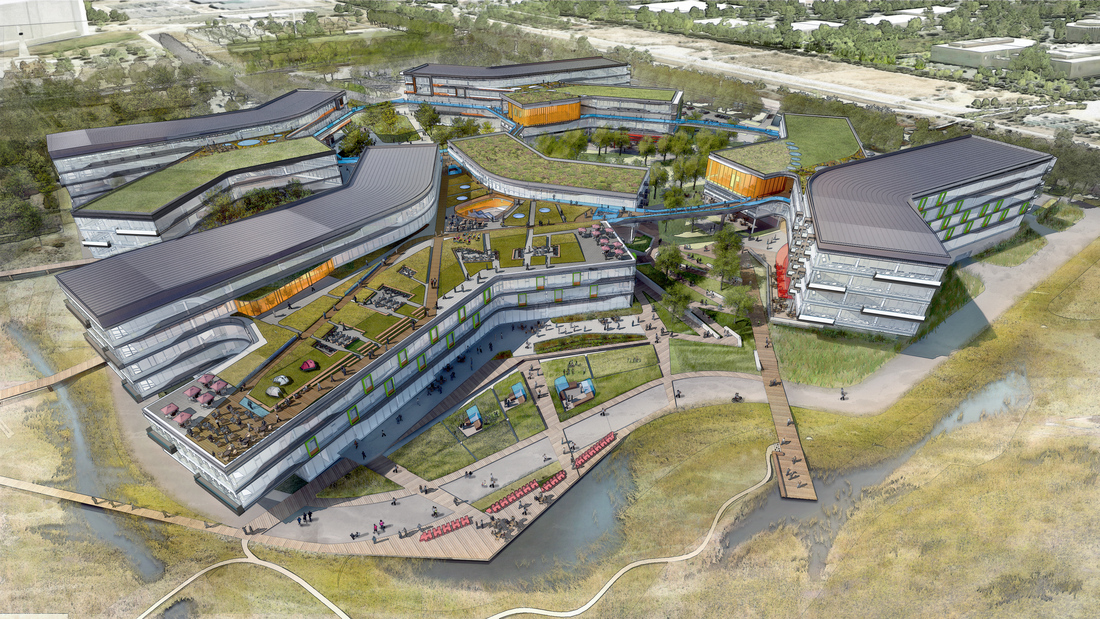
Google's proposed 1.2 million square foot Bay View campus. (NBBJ)
That growth might not be so bad if Google had more to offer than higher property values. City council member Mike Kasperzak is generally proud to call Google a neighbor, but he points out that the company’s presence isn’t the economic windfall you might think. There's no sales tax on Google's search or ad businesses, and no sales tax on the free meals that Google dishes out to employees. "I don’t want them to leave, but they aren’t the cash cow that everyone thinks they are," says Kasperzak.
Meanwhile Google is creating a tremendous amount of traffic. Google now owns or leases practically every office building north of Highway 101, an area known as North Bayshore. The importance of the islandlike geography can't be understated: Highway 101 is the primary thoroughfare that connects Mountain View to the rest of the San Francisco Bay Area, and it completely separates the North Bayshore employees from their houses and apartments. By design there’s little to no housing in North Bayshore, and all traffic in or out of Google has to go across or through Highway 101. As Google grows that traffic is becoming unbearable. "It's a parking lot," says city council member Jac Siegel. "I live on a side street, and there are times I can’t even get out of my driveway to get onto the side street; that's how bad it's gotten."
Google's central hub is cut off from the world
Yet Google has shown no signs of slowing its growth. As of June 2013 Google employed 11,332 workers in Mountain View, but it told the city council that it hopes to add 3.7 million square feet of new development under the city's latest zoning plan — enough to eventually double its workers to 24,000 by a conservative estimate. And that’s without counting any other purchases or leases Google might make in the area. To Google's credit, only 52 percent of its employees drove alone to work in 2012 — one-third opted for company buses — but even 52 percent of 24,000 is daunting when some of Mountain View's roads are already overflowing.
Google declined interview requests for this story, but provided the following statement: "Google and more than 3,000 Google employees call Mountain View home, and to date we’ve added no new development. No matter what happens in the future, we’re committed to being good neighbors for the community and the natural environment. In fact, our shuttle program takes 5,000 cars off the road each day, and thousands more Google employees ride bikes to work."
In 2007, after Google's first shopping spree resulted in the company snapping up roughly one-quarter of local office space, some residents were already becoming concerned. "I worry about us becoming a one-company town," a local told the Silicon Valley Business Journal that year, even as a city council member praised Google for revitalizing the area. In 2009 a Google transportation planner eerily predicted the gridlock that Mountain View might face in five to ten years if growth continued unchecked.
Best viewed fullscreen

Those worries didn't fall on deaf ears. According to Daniel DeBolt, a journalist who's been covering the story for nearly a decade, the Mountain View City Council has repeatedly challenged Google's ambitions. They've opposed Google proposals to build housing, to erect a hotel, and more recently to start any new construction whatsoever in the North Bayshore area. Transportation is one of the council’s concerns, but the environment also ranks high on the agenda: some are worried about impact to the native burrowing owl and other species in North Bayshore’s wildlife refuge.

"Having our employees right next to each other... is critical to our success."
Presently, the city council is leaning towards allowing Google to replace existing offices in the center of North Bayshore or near the freeway with taller, denser ones in exchange for reducing the size of offices near wildlife habitats at the edge of the area. On the transportation front, the city's planning to improve pedestrian and bicycle pathways, and to entrust a nonprofit Transportation Management Association (TMA) including Google, Samsung, and Intuit to coordinate a shared shuttle service in the area. The city's "precise plan" is due at the end of the year.
But Google doesn't appear willing to risk its potential growth on Mountain View’s leadership. At a January 22nd, 2013 meeting, Google's VP of real estate David Radcliffe gave the city council something of an ultimatum. "We can either grow up, taking the buildings we have now and making them bigger and denser, or we can sprawl out in a continued march through neighboring business parks and communities," he said, explaining that Google preferred the former. "Having our employees right next to each other, shoulder to shoulder, is critical to our success."
If that was indeed a threat, Google has been carrying it out in the year since. The company has bought or leased a total of nearly 2 million square feet since that meeting, including giant parcels west, south, and east of the company's traditional North Bayshore haunts. "2013 was a jaw-dropping year in terms of their appetite," says Silicon Valley Business Journal reporter Nathan Donato-Weinstein, whose careful record of local real-estate transactions helped inform this story.
And then there's Moffett Field to consider.

Moffett Field
Google's lease of the 1,000-acre Moffett Federal Airfield is mystifying at first. According to Deborah Feng, associate director of NASA's Ames Research Center, Google can't do whatever it wants with the land. The company will not only need to renovate the historic hangars but also run the actual airport whenever the California Air National Guard or other government entities need to use it. "What they do in the hangars is their own business as long as it's not illegal," says Feng, adding that Google can use Moffett's sizable airspace too. However, an FAA representative tells us that the company still won't be able to do anything special with that airspace — like testing drones — without explicit approval. Feng says that to her knowledge Google will use the hangars as R&D facilities of some sort, but that the company is limited to a relatively small 90,000 square feet of developable space outside the hangar walls.
Moffett Field begins to make more sense, though, when you consider that it could be part of Google's master plan. In 2008 Google leased 42 acres from NASA at the northwestern corner of Moffett Field as well as nine acres at the east end of Charleston Road, and it soon proposed building futuristic new campuses to rival the Googleplex at both locations. Then it proposed a bridge over the creek separating its huge North Bayshore holdings from the Moffett Field area. If you add the Palo Alto tract that Google bought this year and another proposed bridge between that Palo Alto property and Mountain View, Google could soon have a practically unbroken line of property bridging Palo Alto, Mountain View, and Sunnyvale. With a clear corridor connecting those three areas like one that Google has proposed, the company could reduce its dependence on Highway 101. And if it could house employees on federal property, those people could work, eat at Google cafes, and go home again without ever leaving Google’s island.
Work, eat, and sleep on Google property
Though the city of Mountain View has shot down housing in North Bayshore time and again, it doesn’t have any jurisdiction on the federal land, and it just so happens that parts of that land are already zoned to house as many as 5,000 residents. When Google first announced it was leasing NASA’s "Bay View" parcel in 2008, it wrote that housing would be part of the plan. Now, we’re hearing Google may also sublease nearly 2,000 planned housing units from University Associates, a struggling educational venture which has been trying to build a new Silicon Valley college campus on nearby NASA land.

There’s just one problem: Mountain View won't let Google build a bridge to Moffett Field.
"We literally just about threw them out on their ear," says council member Jac Siegel. "It’s totally off the table." In a controversial move, the city council trashed the idea due to environmental concerns — without letting Google actually conduct an environmental impact report to gauge the reality of those fears. In his defense, Siegel says that the results of such studies inevitably wind up favoring the company who pays the bills. "If they don’t come up with the right answers, they don’t get hired again," he relates, saying that he’s personally seen it happen in the past. "I don’t feel that we could get a clean shake."
Backed into a corner
But if Google expands at Moffett Field without such a bridge, it could lead to more transportation woes. By buying up millions of square feet of real estate in and around Mountain View and developing millions more on federal land, Google is effectively forcing the city to choose between its conservation-friendly status quo and catering to Google’s growth. There’s not much Mountain View can do. "We have a council that believes in the free market," says council member Kasperzak. "We’re not going to tell a company that it can’t buy any more land."
Kasperzak believes that Google will do the right thing about the gridlock he fears if allowed to. "We can create a better environmental transition by just letting these companies build, but if you fight them at every turn... you'll never get what you want," he says. "The companies know they've got to keep their employees happy, and employees are increasingly less happy. They’re motivated to try and figure something out."
But Siegel worries that Google’s growth will destroy the character of the town. "The turnover in these apartments is 50 percent a year," says Siegel, addressing the common argument that the city should build more rentals in response to demand. "That means every other person who lives there won’t be there next year. That’s building a strong community, now isn’t it!" he gibes.
After eight years on the beat, Daniel DeBolt also fears that his community is disappearing. He recently interviewed Nilda Santiago, one of the city’s human relations commissioners up until a few weeks ago.
"She’s the kind of person who goes out of their way to help people who aren’t getting help from anyone else, and she’s being forced out of the city due to rent increases," DeBolt tells us. As much as he tries to remain objective in his reporting, he says he believes it’s "just not okay to not take a position" on the issues Mountain View faces, and his position is that Google is tearing the community apart. "The community … is being replaced by people who spend most of their day on the Google campus, no longer contributing to civic life," he says. But at this point DeBolt believes that something has got to give.
More likely than not, Google will get its way before long. At the end of this year, terms expire on three of the city council’s conservative majority members, including Siegel, and even he believes the Moffett bridge will resurface once "the right council members" are in charge. While there’s a possibility that the local population will elect more conservationists, it seems likely that between the new elections and the increased pressure to solve transportation and housing, Mountain View will begin to give Google what it wants.
"What I fear mostly is that Mountain View becomes Googleville," says Siegel. "It’s a town controlled by Google, most of their employees live here, and it just becomes like a old factory town on the East Coast where they control anything and everything they want."
"I’ve been around for a while. I remember when Lockheed had 35,000 people. I remember when SGI had 39 buildings out in North Bayshore," Siegel warns. I’m not saying Google’s going anywhere, but if you look at history, it could change. Somebody in India or China or Pakistan could develop new technology that would be cheaper or better … and then there’d be a blight here. You don’t build a city for the current trends, you build it for the long term."
"I don’t want to build a city where the current residents don’t want to live anymore."
Lead image and design by Dylan C. Lathrop
firehosejohn keough beat

behold the power of social media
Retail space is hard to find in Tokyo's famous shopping district of Harajuku, so designer Duncan Shotton is exploring alternative approaches. After occupying a tree last year, he's now driving a tiny, remote control pop-up shop to show off his "Real Boy" push tacks. The pins are little hand-painted figurines with sharp Pinocchio-style noses to drive your documents into cork.

Although the micro-shop is ostensibly selling the last 100 of Real Boy's initial 1000-unit run, retail performance isn't really the goal. "We concentrated mainly on documenting the project rather than trying to make any sales," Shotton tells The Verge. The store ran into trouble on its first day, too, including being run over by a flat-bed trolley. But Shotton pledges to return to the streets of Harajuku soon, "probably with an entirely different concept shop."
firehose'Working in “flex offices,” which have open plans alongside private spaces for concentrated work or phone calls, increased the number of sick days for men in particular. It’s unclear why that may be.'
because the women are the only ones using the offices, because the bros are playing beer pong with the fucking flu
oh hi HockSnot

The most popular office design in the United States is a large open plan office. People who have seen such offices half empty or full of sniffling people during the winter flu season won’t be surprised to hear they make people more likely to get sick.
Compared to people in mostly or partially private spaces, people in open plan offices of all sizes report taking more sick leave, according to a recent study. Open plan offices were connected to increased instances of sick leave lasting seven days or less, what you’d expect from an employee who caught a bad cold or the flu as opposed to something more serious. (The study doesn’t say whether the instances of sick leave correspond with actual diagnosed infections, but it’s probably safe to infer.) Workers in open plan offices with either four to nine people in the same room or more than 24 people were most likely to take sick leave.
Working in “flex offices,” which have open plans alongside private spaces for concentrated work or phone calls, increased the number of sick days for men in particular. It’s unclear why that may be.
This study, which looked at longitudinal data from 1,852 Swedish workers, seems to be the first to break out different office architectures in real detail. It looked at seven types, including individual private offices with windows, three sizes of open plan office, and hybrids.
Open plan offices make it easier to put more people in the same space. And there’s a management benefit in people being able to quickly talk to colleagues and managers. But they aren’t just potentially less hygienic, the authors say, there’s less personal control. When you have your own space, or at least a cubicle, you can isolate yourself from sick people better. That’s not an option when they’re right next to you.
The other possible reason is mental and environmental. There are more of what the authors call “negative environmental stimuli” in open offices, stuff like noise and the lack of privacy. That could lead people in open offices to take more sick days when they’re not ill, or to stay home when they’re feeling even a little under the weather.
People hoping for their own office shouldn’t get their hopes up. The trend isn’t towards giving people individual spaces, but refining the open plan.
“Our research has shown that it it doesn’t matter if you’re sitting in open office work station or an office, people are more distracted by technology and all of the things going on in their work environment,” Sonya Dufner, a workplace strategist at design firm Gensler told Quartz. ”With certain organizations we zone where those distractions, collisions, and meetings take place, so whether you’re in an office or work station, you have that possibility to put your head down and focus. As our desk spaces have gotten smaller and smaller and smaller, you need to be able to provide different areas for people to choose to go.”
In an open office, people more frequently choose to go home.

firehose"it's nice that he's showing some spine now"
This is significant:
.@GovBrewer: veto of #SB1062 is right.
— Mitt Romney (@MittRomney) February 25, 2014
I appreciate that Romney (or Romney's Twitter-monkey, or whoever) called it the "right" choice to make. Not the financially smart decision, due to the boycott threats, but the right choice. I don't know if we would have seen that kind of courage from Romney the presidential candidate back in 2012, but it's nice that he's showing some spine now.

A/B testing is all the rage in online marketing now, but you could be doing it all wrong. And the results of a poor test can do more harm than good, experts say.
The concept of A/B testing is simple: Compare how two approaches—different email subject lines or a new website design, for instance—affect user response, and go with the better one. But A/B testing can actually fool you into picking the less successful option, if you don’t understand the math. Machine learning specialist and lead scientist at Qubit Martin Goodson outlines three concepts that “come as second nature to statisticians” but are often forgotten by those selling or using A/B testing (pdf).
Statistics isn’t wizardry, and not all tests are created equal. Statistical power is the likelihood that a test will detect a difference between two values when that difference truly exists.
But lots of A/B testing doesn’t run for long enough or use large enough sample sizes to have high statistical power. While it’s important to have a set sample size (more on that in a minute), it needs to be large, or you’re unlikely to spot actual trends. Goodson says that a good rule of thumb is 6000 conversion events (e.g., people clicking on a headline).
A cardinal sin of some A/B testing software, Goodson says, is that it monitors the results constantly and stops as soon as a significant result is achieved. This produces false positives 80% of the time. It’s like running a smaller, weaker test—more error prone and an all-around bad idea—except it’s your own fault for being impatient.
In statistics, regression to the mean is a well-known phenomenon. If 100 people are given a quiz on a subject they’re unfamiliar with, for example, some of them will still do well by a combination of knowledge and chance. But if you take the top 50 scorers and test them again, most of them will do worse: The randomness of the testing will make many of them regress to the mean score and lower.
The same is true in A/B testing: If results seem to be less successful in practice, it’s time to reconsider your statistical methods. That winning headline was probably a fluke, and you’re guilty of bad math.

firehosemotherfucker just drink bud light like the actual motherfuckers in that show would actually fucking drink
I have never in my entire fucking life heard of lone star beer and I was born, raised, and lived about 20 miles from where this was set for 26 years
I heard it's not the best beer, but I think it would be fun to try it while watching the last couple of episodes. Is it for sale in Portland?
firehoseso interested in this
 Gods Will Be Watching is a dark, depressing and mentally taxing point-and-click adventure from Deconstructeam and Hotline Miami publisher Devolver Digital, due out in June for PC, Mac and Linux. Note that when we say "dark, depressing and mentally...
|
firehose shared this story : |
| mmm, commented code, delicious |
Beautiful array from Jagged Alliance 2 source. Estimates relative "look" angles: you looking at my side or my front? pic.twitter.com/DvA32D1JI9

firehosetl;dr, duh: Pizza scales extremely well economically

Good news! Mathematics has confirmed what we already suspected: You should most definitely be ordering a larger pizza.

|
|

|
|

Making good on his recent vow to
disappear from public life, Alec Baldwin is
going to a secluded spot where no one will see him: NBC, where the actor-no-longer will appear on
Law & Order: Special Victims Unit.
News of his appearance on the show came out a few weeks ago, but we now have more details about this well-hyped guest appearance, which will mark a quiet retreat into invisibility for the formerly high-profile actor.
Baldwin will play Jimmy MacArthur, a columnist for a newspaper—yet another place Baldwin could go to escape public notice—“who questions the SVU squad’s motives during the investigation of a potential hate crime/rape case.” Katie Couric will play herself, interviewing Baldwin’s character. The episode will be the first directed by SVU star Mariska Hargitay, and will also be the 337th consecutive
SVU episode whose synopsis ends in the words “-slash-rape case.”


