 Oculus has scooped up Atman Binstock as its new Chief Architect; he's the former Valve virtual reality head and one of the leaders of the VR Room demo at Steam Dev Days. Binstock will head up a new Oculus R&D team in Seattle, Washington, which joins...
firehose
Shared posts
12 Mar 07:25
Oculus has scooped up Atman Binstock as its new Chief Architect; he's the former Valve virtual reality head and one of the leaders of the VR Room demo at Steam Dev Days. Binstock will head up a new Oculus R&D team in Seattle, Washington, which joins...
Valve VR leader joins Oculus R&D with new Seattle team
by Jessica Conditt
Oculus has scooped up Atman Binstock as its new Chief Architect; he's the former Valve virtual reality head and one of the leaders of the VR Room demo at Steam Dev Days. Binstock will head up a new Oculus R&D team in Seattle, Washington, which joins...
firehose likes this
12 Mar 07:21
Major Wikipedia Donors Caught Editing Their Own Articles
by Unknown Lamer
An anonymous reader writes "As reported before on Slashdot, one of the most terrible sins on Wikipedia is to edit articles for pay, or otherwise violate the 'neutral point of view' policy, per their co-founder Jimmy Wales. And yet, the Wikipedia-criticism website Wikipediocracy recently began a study showing that dozens of the Wikimedia Foundation's largest cash donors have violated that policy. Repeatedly, and wantonly. In short, they wrote articles about themselves or their companies, then gave the WMF big donations — and were not confronted about violating the NPOV policy." Do the proposed TOS changes address this? Note that they also found that many of the donors adequately documented their conflict of interest. 


Read more of this story at Slashdot.
firehose and -1 others like this
12 Mar 07:21
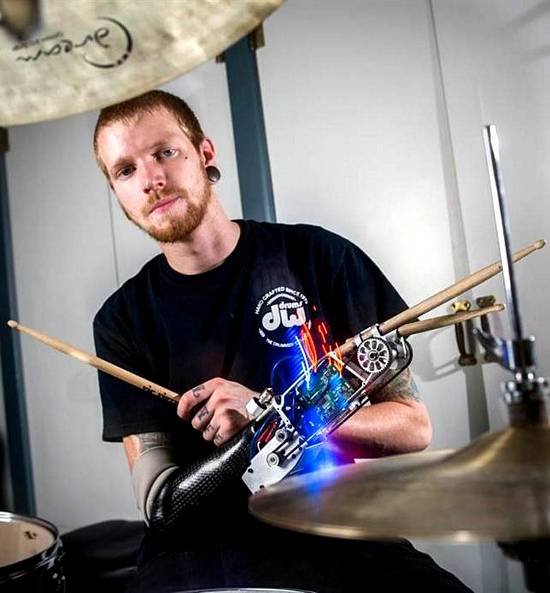


New robotic arm opens up musical worlds for “cyborg” drummer
by Joe Silver
Rob Felt, Georgia Tech
Jason Barnes has a new tool at his disposal that should help him in his quest to become a professional drummer: a drum-enabling robotic arm. The unique prosthesis was announced last week by the Georgia Institute of Technology.
As demonstrated in this video, Barnes, a below-the-elbow amputee, possesses a robotic arm prototype that allows him to experience three-way independence between his two arms—meaning that he can perform three distinctive stick patterns simultaneously. That's a technical capability unimaginable to most drum set players (the inimitable jazz drummer Eric Harland aside).
"The drummer essentially becomes a cyborg," said Gil Weinberg, the professor who created the robot. "The second drumstick has a mind of its own. It's interesting to see him playing and improvising with part of his arm that he doesn't totally control."
Read 7 remaining paragraphs | Comments
firehose likes this
12 Mar 07:20


Attackers trick 162,000 WordPress sites into launching DDoS attack
by Dan Goodin

Security researchers have uncovered a recent distributed denial-of-service (DDoS) attack that used at least 162,000 WordPress-powered websites to knock another site offline.
The technique made it possible for an attacker with modest resources to greatly amplify the bandwidth at its disposal. By sending spoofed Web requests in a way that made them appear to come from the target site, the attacker was able to trick the WordPress servers into bombarding the target with more traffic than it could handle. Besides causing such a large number of unsuspecting sites to attack another one, the attack is notable for targeting XML-RPC, a protocol the sites running WordPress and other Web applications use to provide services such as pingbacks, trackbacks, and remote access to some users.
Researchers from security firm Sucuri recently counted more than 162,000 legitimate WordPress sites hitting a single customer website. They suspect they would have seen more if they hadn't ended the attack by blocking the requests.
Read 6 remaining paragraphs | Comments
firehose likes this
12 Mar 07:18


The greatest trick Netflix ever pulled was convincing the world HBO is its rival
by John McDuling
It will surely go down as one of the great CEO quotes of 2014. Netflix’s visionary CEO, Reed Hastings, was asked about his counterpart at HBO, Richard Plepler, who had recently said he was not concerned about people sharing passwords for HBO’s online service, HBO Go.
“So I guess Plepler, the CEO of HBO, doesn’t mind me sharing his account information. So it’s Plepler@hbo.com and his password is Netflixbitch” remarked Hastings.
The apparent tension between Netflix and HBO, the two iconic companies behind some of America’s most loved shows (and Americans do love their television) has captivated the media, ourselves included. It’s not difficult to understand why. In many ways, it symbolizes the classic 21st-century business story: an upstart challenger from Silicon Valley disrupting an incumbent with a compelling and well-priced product, underpinned by impressive technology.
But the rivalry is grounded less in reality than in clever marketing.
Last year was by any measure a resoundingly successful one for Netflix, which added a 6 million paying users, a 25% increase, in the US market. But how many did HBO lose over the same period? None. In fact, it added 2 million subscribers, its best performance in 17 years. Media analyst Rich Greenfield earlier this year dismissed (registration required) the notion that Netflix’s growth was coming at the expense of premium channels like HBO. “We believe over-the-top video households are among the most passionate about video content—meaning you subscribe to HBO and Netflix, not HBO or Netflix,” he wrote.
The best evidence that this is not a zero-sum game comes from viewing patterns. A survey of nearly 10,000 households by TiVo last year found that those that watched the first season of Netflix’s political drama, House of Cards, watched 85% more HBO content than non-Netflix households did. HBO itself publicly argues that it does not compete directly with Netflix, often describing it as a complementary service.
So why does Hastings keep on fanning the rivalry? According to a report by the New York Times media columnist David Carr (which Netflix has never denied), Hastings has privately told executives at Time Warner that the “comparison benefits Netflix” and that he sees the banter as “harmless mischief.”
But it also serves a subtler purpose.
Americans love HBO shows—the channel’s hits over the past two decades include The Sopranos, The Wire, Game of Thrones and this year’s True Detective. But they also hate their cable companies, who force them to pay for expensive bundles of hundreds of channels in order to get the few, like HBO, that they actually watch. And the cable firms do this because media companies like Time Warner, HBO’s parent, make more money if their channels are all bundled. So the Netflix boss’s quips at HBO are also part of a broader narrative that resonates with almost all Americans: their dissatisfaction with how the pay TV industry works.
A Netflix spokesman describes the rivalry between the two as being like that between baseball’s New York Yankees and Boston Red Sox (“We push each other to do great work”). But as businesses, at least, HBO and Netflix are very different beasts, and that doesn’t look like it’s about to change. At an investor briefing last week, Plepler was again asked whether the company would consider selling HBO Go on a standalone basis, which would make it a lot more like Netflix. (Currently, only subscribers to HBO on cable can use its online service). “We have the capacity to do it. We have the ability to pivot, and if we think that makes sense, we’re going to do it,” he said. “But right now, there are four billion reasons or so to do it the way we’re doing it [now]“. (HBO generated $4.4 billion in revenue last year).
There are, of course, ways the two companies compete directly. They have both tried to acquire the same content in the past: Netflix outbid HBO for House of Cards. They compete for critical acclaim, although at this juncture, HBO retains a commanding lead. But as Jeffrey Katzenberg, the CEO of Dreamworks, succinctly summarized the situation to the New York Times last month. “I think there’s a fiction here that somehow Netflix gains are HBO losses.” And it’s a fiction that Netflix seems quite happy to sustain.
firehose likes this
12 Mar 07:17

The simple way to make airplane wine taste better
by David Yanofsky
Here’s a way to vastly improve the taste of wine on an airplane. Shake it.
The benefits of letting red wine aerate are long established by sommeliers. Decanting wine for a few hours before drinking allows volatile substances in the wine to evaporate and oxygen to enter the liquid, causing the wine to seem “more expressive, more aromatic and better integrated” according to Wine Spectator.
More recently, alternative decanting techniques have shown pouring wine back and fourth between two pitchers or even putting wine in a blender can improve the flavors.
Wine naturally can taste more alcoholic and bitter in flight because of the altitude and the dryness of the cabin air. But none of the usual decanting methods is advisable on an airplane—traditional decanting takes too long, pouring back and forth between two cups is a drippy proposition, and blenders are not allowed in carry-on baggage in the US.
Shaking your wine in its bottle is the viable alternative.
Before you get started, there are some practical considerations. If you’re sitting up front—in first or business class—this generally isn’t for you. This is for travelers who get their airplane wine in a single-serving resealable plastic bottle to pour themselves.
First, when you shake the bottle, be sure that you’re not shaking your whole body. Your seat is connected to the person’s next to yours and shared—through the tray table and pocket—with the person behind you. You want to do this without disturbing either of them.
Second, be sure the cap on the wine is on tight. The last thing you want to do is throw wine over everyone in a six-seat radius. Test the seal on the recapped wine by slowly turning the bottle upside down over your napkin and giving a light shake. If you have any doubt about the ability of the bottle to hold your wine as you shake, don’t shake it.
Start by pouring a little bit of wine out of the bottle and into your cup. To reduce the risk of spilling it, drink this wine before you get to shaking—try to ignore how poor it tastes. Now that there is some extra space in your bottle, shake it for 45 seconds to a minute. If this gets tiring, try shaking for 15 seconds at a time.
That’s it. The acerbic flavors that were there before should have floated away. Hopefully your tastebuds are still responsive enough to taste the difference. Pour and enjoy your flight.

12 Mar 07:14
A portrait of the artist as a young man, Christopher Walken

firehose and -1 others like this

12 Mar 07:11


Newswire: Jason Sudeikis is the latest actor attached to new, gritty Fletch reboot
by Sean O'Neal
The nearly 14-year long con to bring Fletch back to theaters has yielded a litany of proposed directors and stars that reads like a timeline of pop culture obsessions—including Kevin Smith and Jason Lee, Ben Affleck, Joshua Jackson, Zach Braff, a steak sandwich, Ryan Reynolds, Brett Ratner and Chris Tucker, and another steak sandwich. You can now add Jason Sudeikis to that list, as The Hollywood Reporter says the heir to Chevy Chase’s “smirking SNL player turned patriarch of wacky movie road trips” lineage is the latest name to be attached to a project that’s passed through more guises than its titular, unusually-skilled-in-improv reporter.
This newest Fletch is also the oldest. It’s based on Gregory McDonald’s Fletch Won, the eighth novel in his series but the first chronologically, as it’s—yes—an “origin story” that covers Fletch’s early days as a reporter, when ...
12 Mar 07:04


Newswire: The Stooges will finally release an album without distracting presence of Iggy Pop
by Sean O'Neal
For those who enjoy The Stooges, but have long wished that Iggy Pop would sit out a round and maybe give Ariel Pink a shot, the band has just the album for you. Guitarist James Williamson tells Rolling Stone that The Stooges—a group in which only he and saxophone player Steve Mackay can be considered “original” members—will continue its long tradition of just playing with whomever is around by recording the upcoming Re-Licked, an album of songs written and performed live in the wake of Raw Power, but never committed to the studio. Many of them have been heard on bootlegs, but Williamson says, “Recording them properly is something I've always wanted to do.” And when it comes to finally making them a proper Stooges album, he’s not letting the minor hiccup of Iggy Pop not wanting to do it stand in his way.
Instead, Williamson ...
12 Mar 07:03
The Mary Sue Exclusive Preview: Collected Edition Cover & Sketches For Wonder Woman Vol. 4: War

firehose likes this
12 Mar 07:03
Let’s Get Mad: Center for Study of Women in TV and Film Releases 2013 Findings on Female Characters

12 Mar 07:02


Newswire: Harlan Ellison’s legendary Star Trek episode to be released as graphic novel
by Mike Vago
The original Star Trek fielded scripts from a number of veteran sci-fi writers, including Richard Matheson (I Am Legend), Jerome Bixby (Fantastic Voyage, “It’s A Good Life”), and Robert Bloch (Psycho). But perhaps the writers’ room’s biggst get was Harlan Ellison, who penned the classic “The City On The Edge Of Forever,” considered by many to be the series’ best episode. Since it first aired, Ellison has made no secret that he was displeased with the changes series creator Gene Roddenberry made to his script in bringing it to television. Now, 47 years later, Ellison is finally taking matters into his own hands, as IDW is publishing a graphic novel based on his original screenplay.
Ellison was once so outraged over the adaptation, he went so far as to sue Paramount Television in 2009—though really, Roddenberry’s changes are defensible. Besides being too long and too expensive ...
12 Mar 07:00
Street Art Project Improves Ads with Clown Nose Stickers
by EDW Lynch

A mysterious prankster has been improving subway and outdoor ads in the New York City area with the strategic addition of clown nose stickers. The project is entitled: “Clownify Stickers.”


photos via Clownify Stickers
via swissmiss
12 Mar 06:59


Co-author of stem-cell study 'loses faith' in paper
by George Dvorsky

After claiming to have developed a novel technique for coaxing the growth of stem cells in an acid bath, Japanese researchers have come under scrutiny for apparent irregularities . In the latest twist, one of the paper's coauthors has admitted that the study should be retracted.
    
|
12 Mar 06:54
‘The Onion’ Offers Richie Incognito A 5-Year, $50 Million Contract
With NFL free agency officially underway, front offices across the league are rushing to sign the best available talent in the market.


|
|
firehose likes this
12 Mar 06:53


Rose, take Mickey and Arthur, get after it, follow it. Don’t...
Rose, take Mickey and Arthur, get after it, follow it. Don’t approach it, just watch where it goes.
firehose likes this
12 Mar 06:50


Newswire: Keith Richards is writing a children’s book, for your children
by Sean O'Neal
Grim fairy tale Keith Richards has announced that he is currently writing a children’s book due out Sept. 9, aimed at parents who have longed for something to read to their kids right before bedtime that has Keith Richards’ face on it. The book, titled Gus And Me: The Story Of My First Guitar, will draw from the chapters of Richards’ recent autobiography Life that don’t involve doing heroin on a toilet, recalling the Rolling Stones’ guitarist’s introduction to music through his jazz musician grandfather. “I have just become a grandfather for the fifth time, so I know what I’m talking about,” said Richards, who rarely knows what he’s talking about, regarding the “special bond between kids and grandparents” who legally claim them. Richards’ daughter Theodora will do the illustrations, while Richards collaborates on the text with Barnaby Harris and Ed Shapiro. It’s expected ...
firehose likes this

12 Mar 06:46


Every Known Galaxy in the Universe, As Seen From a Spaceship
by Ria Misra
What would it look like to peer outside of the window of a real spaceship moving along at warp speed through our universe? This video gives us a pretty good idea.
|
|
firehose and -1 others like this

12 Mar 06:45
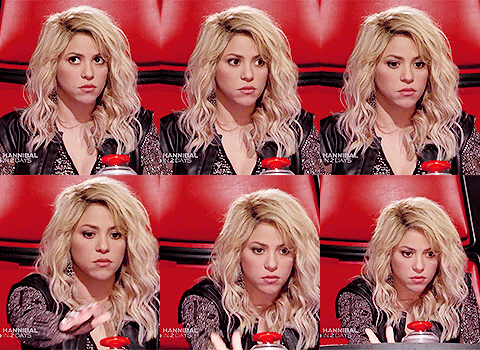
psychoticornumb: When you see a great gifset that has grammar mistakes
When you see a great gifset that has grammar mistakes
firehose and -1 others like this
12 Mar 06:45
tastefullyoffensive: An Outside Threat [buttersafe]

Balint, Claudio Navarro Henriquez likes this
12 Mar 06:45


Newswire: Judd Apatow's whole career is just revenge for Freaks And Geeks being canceled
by Sean O'Neal
For those who have long wondered what drives Judd Apatow to such prolific heights as a writer, director, and producer, the answer is it’s the same thing that drives every single one of us: an unslakable thirst for revenge. Last night, Apatow told a Paley Center audience, “Everything I’ve done, in a way, is revenge for the people who canceled Freaks And Geeks. It’s really demented, but it’s just like ‘you were wrong about that person, and that person and that person. And that writer and that director.’ And I really should get over that.” In the meantime, he’s managed to turn that vendetta into some fairly tidy profits, even if it meant repeatedly dragging his own wife and daughters into the fray. Meanwhile, your own quest for revenge has yielded nothing but irreparably damaged lives. Which is funny, yes, but not $148 million domestic ...
12 Mar 06:24
The PDC thinks $1M of taxpayer money should go to open a brewpub in Lents
 |
submitted by wallsbecametheworld [link] [90 comments] |
firehose likes this


11 Mar 15:52


How big data will haunt you forever: your high school transcript
by Commentary
Excerpted from Learning with Big Data: The Future of Education by Viktor Mayer-Schönberger, Kenneth Cukier.
Arizona State University, like many colleges across the United States, has a problem with students who enter their freshman year ill prepared in math. Though the school offers remedial classes, one-third of students earn less than a C, a key predictor that they will leave before getting a degree. To improve the dismal situation, ASU turned to adaptive-learning software by Knewton, a prominent edtech company. The result: pass rates zipped up from 64% to 75% between 2009 and 2011, and dropout rates were cut in half.
But imagine the underside to this seeming success story. What if the data collected by the software never disappeared and the fact that one had needed to take remedial classes became part of a student’s permanent record, accessible decades later? Consider if the technical system made predictions that tried to improve the school’s success rate not by pushing students to excel, but by pushing them out, in order to inflate the overall grade average of students who remained.
These sorts of scenarios are extremely possible. Some educational reformers advocate for “digital backpacks” that would have students carry their electronic transcripts with them throughout their schooling. And adaptive-learning algorithms are a spooky art. Khan Academy’s “dean of analytics,” Jace Kohlmeier, raises a conundrum with “domain learning curves” to identify what students know. “We could raise the average accuracy for the more experienced end of a learning curve just by frustrating weaker learners early on and causing them to quit,” he explains, “but that hardly seems like the thing to do!”
Big data—the ability to collect, store and process more data than ever—is poised to overturn traditional education. It will add a quantified component to aspects of learning and teaching that never experienced this before, enabling society to improve not only student performance, but the instructor’s work as well. However, there are risks.
Parents and education experts have long worried about protecting the privacy of minors. Also, people have fretted over the consequences of academically “tracking” students, which potentially narrows their opportunities in life. Big data doesn’t simply magnify both of these problems: it changes their very nature. Here, as elsewhere, the change in scale leads to a change in state.
Permanence of the past
Many parents are viscerally alarmed by the huge stockpile of personal data that is starting to accumulate over the course of their children’s schooling. For example, the nonprofit organization inBloom—backed with $100 million by the prestigious Gates Foundation and Carnegie—struck agreements with nine states to be a repository of student data. But after huge parental outcry in 2013, six of those states put the initiatives on hold.
Yet behind the intuitive opposition lies not just the conventional concern over privacy and data protection, but a more unique worry. Where traditional data protection has mostly been focused on addressing the power imbalance that results from others having access to one’s personal data, here the concern is more about the threat posed by an unshakable past. School records may not get stored in cardboard boxes and left to molder before being thrown out: they may be stored and saved forever—and continually called up at the speed of light.
Think about records of student activism being stored and made available to prospective employers when an individual applies for a job a quarter of a century later. Today past records are very hard to access, save for high-profile individuals. But in the future this information will be routinely accessible for everyone. And it may not be just “snapshot” data like standardized college admissions tests—it may be every scrap of data related to our progress as a student, from amount of sick days and visits to the guidance counselor, to number of pages read and passages underlined in Huckleberry Finn.
Hence, the first significant danger with comprehensive educational data is not that the information may be released improperly, but that it shackles us to our past, denying us due credit for our ability to evolve, grow, and change. And there is no reliable safeguard against this danger. We can’t easily change how we evaluate others, and what we take into account. Most of our thought processes happen without our ability to fully control them rationally. On the other hand, not collecting or keeping the data would stunt the benefits that big data brings to learning.
Fixed futures
The second danger is equally severe. The comprehensive educational data collected on all of us will be used to make predictions about our future: that we should learn at this pace, at this sequence, that we will have a 90% likelihood of getting a B or above if we review the material between 8:00pm and 9:00pm, but it drops down to 50% if we do so earlier in the evening, and so on. This is probabilistic prediction—and the danger is that it may restrict our “learning freedom,” and ultimately, our opportunity in life.
The huge promise of big data is that it individualizes learning and improves educational materials and teaching, and ultimately student performance. In the age of big data, these predictions will be far more accurate than today. This puts more pressure on decision makers, from admissions boards to job recruiters, to put more stock in what they foretell. In the past we could argue our case that a group to which we belonged might not apply specifically to us as an individual.
For example, some universities are experimenting with “e-advisors”—big-data software systems that crunch the numbers to help students graduate. Since the University of Arizona implemented such a system in 2007, the proportion of students who move on from one year to the next has increased from 77% to 84%. At Austin Peay State University in Tennessee, when students take a class for which software called Degree Compass indicates they will get at least a B, they have a 90% chance of doing so, compared to around 60% otherwise.
These systems can make a big difference in graduation rates, considering that in the United States only about half of students graduate within six years. But they can have pernicious consequences too. What if the system predicts we’re not likely to do well in one field, like bioinformatics, so subtly directs us toward another, like nursing? We may think it has our best interests at heart—providing us with a comfortable educational trajectory. But that may actually be the problem. Perhaps we should be pushed to succeed against the odds rather than feel content to advance along a smoother track.
One hope, and it’s just a hope, is that big data will make tracking disappear. As students learn at their own pace, and the sequence of material is algorithmically optimized so they learn best, we may see less need to formally track students.
But the reality could well be in the inverse. Customized education may actually lock in these streams more ruthlessly, making it harder for one to break out of a particular track if they wanted to or could. There are now a billion different tracks: one for every individual student. The upside is that education is custom tailored to each individual. The downside is that it may actually be harder to leap out of the canyon-like groove we’re locked into. We’re still trapped in a track, even if it is a bespoke one.
Addressing the anxiety
How to overcome these instinctual and rational fears of the dangers big data poses when applied to education?
In most countries, some form of privacy law currently protects against the comprehensive collection and long-term storage of personal information. Generally, these laws require data users to inform people whose data they collect what it might be used for and get their consent for that use. But much of the appeal of big data is that its value lies in its reuse for purposes that were scarcely contemplated when the data was initially gathered. So, informed consent at the time of collection is often impossible.
Policymakers in Europe and the United States are already discussing how to reform privacy laws to make those who use big data more accountable for any misuse of it. In return for taking on more responsibility (and thus more legal liability), data processors would be able to reuse personal information for new purposes. They would need to define what are acceptable-use categories, as well as uses that are restricted.
In education, this could permit the use of personal data to improve learning materials and tools, while using the same data to predict students’ future abilities may be allowed only under much more stringent safeguards (such as transparency and regulatory oversight). It may require the explicit consent of the students themselves. It will also need tough enforcement, so that firms that use the data know that they cannot afford to break the rules.
Ultimately, how much big-data analysis we would like to see in education, and how we best protect against the dystopian dangers we foresee, will remain a delicate tradeoff between our desire to optimize learning and our refusal to let the past dictate the future.
We welcome your comments at ideas@qz.com.
firehose likes this
11 Mar 15:22

'Cosmos' review: making science cool again
by Bryan Bishop
Whether he’s discussing NASA’s impact on our cultural psyche or emailing James Cameron about the night sky, Dr. Neil deGrasse Tyson has a remarkably consistent message: our future depends on a passionate embrace of science, and for that to happen, science needs to be cool. It should come as no surprise then that Tyson serves as host of the new show Cosmos: A Spacetime Odyssey, which debuts tonight as part of a major global event that will see the show simulcast across 10 domestic networks — with an introduction by President Obama, no less — before reaching more than 180 countries.
A reboot of Carl Sagan’s landmark 1980 program, the new Cosmos aims to be a primer on the incredible grandeur of the world around us, lionizing the scientists that have made our greatest discoveries, and hopefully stoking the fires for education and learning in the process. It’s hard to find fault with such noble ambitions, and while the presence of a new Cosmos is certainly welcome the initial episode tries so hard to appeal to modern audiences that at times feels like it’s missing its own point: that the greatest wonders aren’t CG spectacle, but our own marvelous universe.
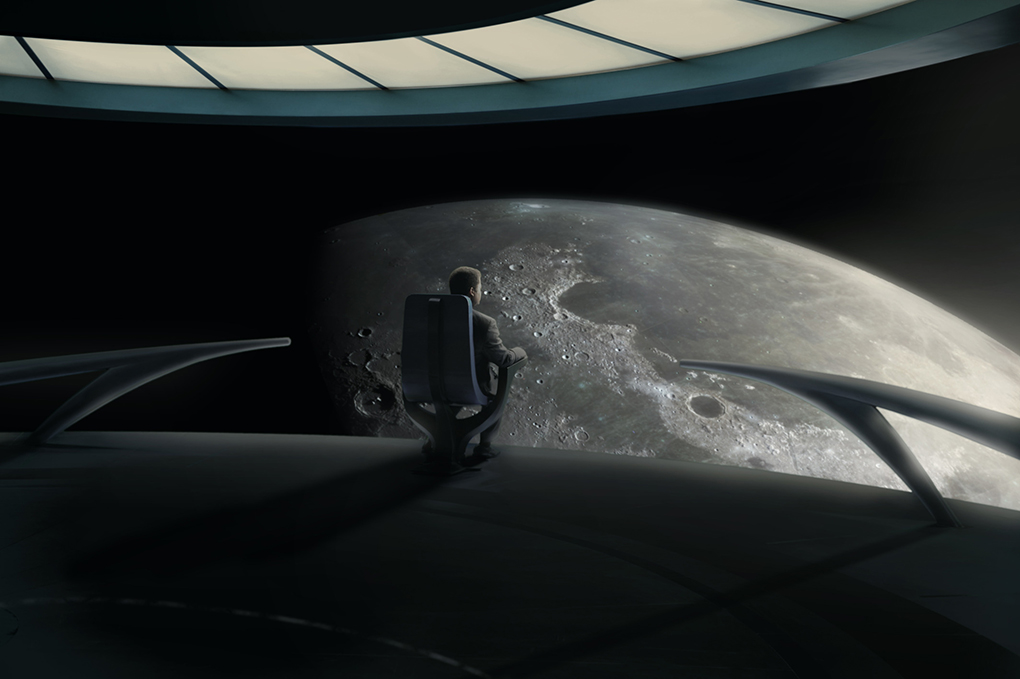
Part Captain Kirk, part travelogue host
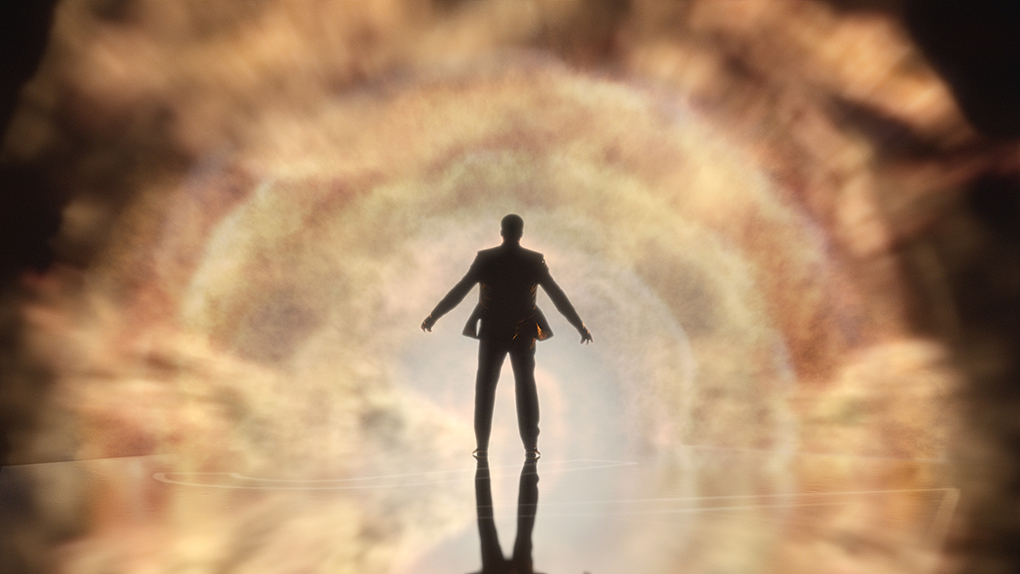
Opening on the same cliff in Northern California where Sagan launched his own show 34 years ago, Cosmos begins with Tyson sounding the call that serves as the program’s main theme. “It’s time to get going again,” he says, before sweeping the viewer away on an exploration of our solar system. The vessel he uses throughout the show is dubbed the “Spaceship of Imagination,” a fictional craft that serves as a vantage point for Tyson and the show’s writers to zip around the universe.
The same concept was used in the original, but Sagan’s craft was primarily just seen from the inside. In the new version, the ship is realized as a shiny metal vehicle that zips to and fro, dodging asteroids and carrying out acrobatic flips. Inside, Tyson gazes intently out of its enormous viewing window — think the viewing screen on J.J. Abrams’ Enterprise — or looks through portals on the ceiling and floor, which give glimpses into the future or the past.
Designed by concept artist Ryan Church (Star Trek Into Darkness), the ship is certainly a flashy piece of effects work, but it ends up spending far too much time as the focal point of the show. Lingering close-ups, with the far reaches of space reflected in its impossibly-mirrored exterior, put the focus on fantasy — not the glory and wonder of the universe.

Tonally the show strikes just the right balance between education and inspiration. The science explored in the opening episode isn’t anything teenaged astronomy fans wouldn’t already be aware of, but the show doesn’t talk down to the viewer. That said, those already familiar with the antics of Dr. Tyson may feel like they’re getting a watered-down version of the real thing. In Cosmos he’s part Captain Kirk, part travelogue host, but he’s missing the charismatic urgency he’s become known for. The passion he displayed during a SXSW Q&A was infinitely more engaging that his performance in the show, even when he’s recounting his own inspirational childhood encounter with Sagan.
Thankfully Cosmos finds its footing in the final stretch, when Tyson visualizes the lifetime of our entire universe through the scale of a human calendar year. The Big Bang starts on January 1st — complete with an epic blast that threatens to envelop the host — whereas the breadth of human history encompass just the final moments of December 31st. It’s the show at its very best: visually conveying an abstract concept, weaved into the context of humanity’s place in the universe.
It’s hard to imagine an educational show about science being any sort of major network hit in 2014 — no doubt part of the reason why Cosmos features so much visual effects eye candy — but Fox is leveraging multiple arms of its media empire to make it work. Even after the splashy debut the entire season will air both on the Fox network and on National Geographic, and as cable has proven shows don’t need to have a Friends-sized audience to work their way into the zeitgeist. One episode in, Cosmos certainly isn’t perfect, but the fact is that right now there’s nothing else like it on television. At SXSW Dr. Tyson said the goal of the show was simply to start a conversation — and by that measure, it’s certainly off to a good start.
José M MC and -1 others like this