Shared posts

10 May 02:00

Pho-jitsu

by bspencer

I first tried Pho about two years ago and was immediately hooked. Pho is basically just a really rich, luxurious broth flavored with things like anise and cinnamon and served over some sort of protein and noodles, along with a bevy of toppings. Unless you’ve got some some time, boiling bones and starting the broth from scratch can be a pain in the butt. So I wanted to find a way to make a phake-out Pho.

Frankly, I didn’t have high hopes. Because I basically just did some research, cobbled together some ingredients from disparate recipes, and made my own Phrankenrecipe. This is how I do most of my cooking, frankly. Well, anyway, the Pho I made rivaled the Pho I tasted from two years back. I was floored. Here’s how I did it.

In a crockpot, I put

  • 4 cups beef broth
  • 4 cups chicken broth
  • 1/4 cup brown sugar
  • 2 tablespoons fish sauce
  • a teaspoon salt and pepper
  • One 3-inch piece of ginger, sliced into rounds or big strips
  • 1 large onion, halved
  • 1 shallot, halved
  • 2 cloves garlic, smashed
  • 1 packet Pho spices

I let it cook on high for 4 hours. When it was done cooking, I strained it through a fine-mesh sieve and served it over some cooked rice noodles and Asian-flavored meatballs I’d made for my son. (It’s more traditional to use something like very thinly-sliced, raw flank steak. [The hot broth immediately cooks the meat.])

Serve it with your choice the following toppings and condiments:

  • Bean sprouts
  • Basil (Thai is ideal)
  • Mint
  • Cilantro
  • Sliced jalapeno peppers
  • Siracha or Sambal Oelek
  • Hoisin sauce
  • Lime wedges

I had some thinly sliced radish, carrots and celery in the fridge, so I used those as well.

Unbelievable.


09 May 23:04

Hive Launch!

by raisins
Brian Stouffer

YAAAAYYYYYYYYY

The time has come. Hive is ready (mostly) for you, the awesome people, to use it. All the core features are in: subscribing to sites, reading those sites, sharing stories, commenting, liking, staring and xml import from google reader. The UI/UX is awesome and getting better. There are still some features I am adding/fixing and I will be doing that forever. Really excited to put this in your hands right away and get feedback.

Announcing the closed beta of HiveReader

not a real logo**
web 3.0 viral rss social synergy network website.***


**not a real logo

*** not a real tagline


Wait a minute. I’m new here. What’s Hive?
Hive is the best place on the internet to read the internet. At it’s core it’s a reader app. You subscribe to your favorite sites and read them all in one simple interface. It’s also so much more.

What happened to Hivemined? Why the name switch?
This was a much discussed topic. After explaining to the 100th person. “no, HiveminEd, with an e. Like miners” Something had to change. We’ve all been calling it Hive anyway. So why not call a horse a horse and a reader a reader? And horse.com is taken. Hivemined has become the default user we all follow (ala tom) also the blog title is still hivemined.


How do the keys work?
When you get a key it has N number of uses. So you can bring your friends in and get down to business or just post it wherever you want. I suggest you hire a plane to skywrite it.


What does it look like on the inside?
Like this:
image
image
(yeah, I liked my own post)

Other Common Questions:


I need a key right now. I am dying with google reader shutting down.
Sign up on Hivereader.com. Bug me on twitter. Send me an email Francis[at]hivereader.com I will be slowly sending keys out for others to send to their friends. Starting with people who are alright with using something that might be a little messy or missing something.

Still working on the experience for people new to readers who don’t have an import file to start with. I hope to have a better ‘getting started’ flow setup soon.

OMGZ!!1! THIS IS THE WORST. ____ IS MISSING AND ____ IS BROKEN!!1 YOU SUCK!! I’M OUT, PEACE!
Pushing code and fixes nearly all day everyday. Keeping my eye on twitter, email, and bug reports. #hivebug

PS: You are amazing. Thanks for sticking around and helping build the best thing on the internet.

Again. Huge thanks to Tivix (especially Andy, Adam, Rex, Bret, Sumit and the rest of the Tivix team) for creating the opportunity to make the reader we all want and need (I hope it becomes everything you’ve ever dreamed of).
09 May 15:51

Depression Part Two

by Allie
Brian Stouffer

So so so glad this is back. Was getting nervous seeing it in the "Dead Feeds" column in The Old Reader.

I remember being endlessly entertained by the adventures of my toys. Some days they died repeated, violent deaths, other days they traveled to space or discussed my swim lessons and how I absolutely should be allowed in the deep end of the pool, especially since I was such a talented doggy-paddler.


I didn't understand why it was fun for me, it just was.


But as I grew older, it became harder and harder to access that expansive imaginary space that made my toys fun. I remember looking at them and feeling sort of frustrated and confused that things weren't the same.


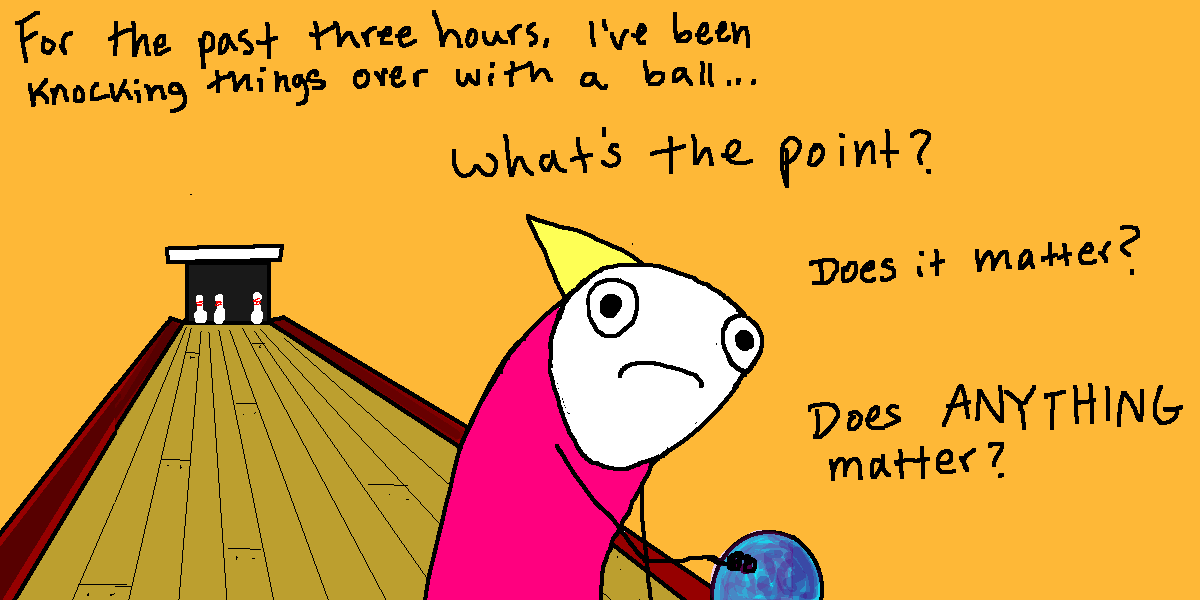
I played out all the same story lines that had been fun before, but the meaning had disappeared. Horse's Big Space Adventure transformed into holding a plastic horse in the air, hoping it would somehow be enjoyable for me. Prehistoric Crazy-Bus Death Ride was just smashing a toy bus full of dinosaurs into the wall while feeling sort of bored and unfulfilled.  I could no longer connect to my toys in a way that allowed me to participate in the experience.


Depression feels almost exactly like that, except about everything.

At first, though, the invulnerability that accompanied the detachment was exhilarating. At least as exhilarating as something can be without involving real emotions.


The beginning of my depression had been nothing but feelings, so the emotional deadening that followed was a welcome relief.  I had always wanted to not give a fuck about anything. I viewed feelings as a weakness — annoying obstacles on my quest for total power over myself. And I finally didn't have to feel them anymore.

But my experiences slowly flattened and blended together until it became obvious that there's a huge difference between not giving a fuck and not being able to give a fuck. Cognitively, you might know that different things are happening to you, but they don't feel very different.


Which leads to horrible, soul-decaying boredom.


I tried to get out more, but most fun activities just left me existentially confused or frustrated with my inability to enjoy them.


Months oozed by, and I gradually came to accept that maybe enjoyment was not a thing I got to feel anymore. I didn't want anyone to know, though. I was still sort of uncomfortable about how bored and detached I felt around other people, and I was still holding out hope that the whole thing would spontaneously work itself out. As long as I could manage to not alienate anyone, everything might be okay!

However, I could no longer rely on genuine emotion to generate facial expressions, and when you have to spend every social interaction consciously manipulating your face into shapes that are only approximately the right ones, alienating people is inevitable.


Everyone noticed.


It's weird for people who still have feelings to be around depressed people. They try to help you have feelings again so things can go back to normal, and it's frustrating for them when that doesn't happen. From their perspective, it seems like there has got to be some untapped source of happiness within you that you've simply lost track of, and if you could just see how beautiful things are...


At first, I'd try to explain that it's not really negativity or sadness anymore, it's more just this detached, meaningless fog where you can't feel anything about anything — even the things you love, even fun things — and you're horribly bored and lonely, but since you've lost your ability to connect with any of the things that would normally make you feel less bored and lonely, you're stuck in the boring, lonely, meaningless void without anything to distract you from how boring, lonely, and meaningless it is.


But people want to help. So they try harder to make you feel hopeful and positive about the situation. You explain it again, hoping they'll try a less hope-centric approach, but re-explaining your total inability to experience joy inevitably sounds kind of negative; like maybe you WANT to be depressed. The positivity starts coming out in a spray — a giant, desperate happiness sprinkler pointed directly at your face. And it keeps going like that until you're having this weird argument where you're trying to convince the person that you are far too hopeless for hope just so they'll give up on their optimism crusade and let you go back to feeling bored and lonely by yourself.


And that's the most frustrating thing about depression. It isn't always something you can fight back against with hope. It isn't even something — it's nothing. And you can't combat nothing. You can't fill it up. You can't cover it. It's just there, pulling the meaning out of everything. That being the case, all the hopeful, proactive solutions start to sound completely insane in contrast to the scope of the problem.

It would be like having a bunch of dead fish, but no one around you will acknowledge that the fish are dead. Instead, they offer to help you look for the fish or try to help you figure out why they disappeared.


The problem might not even have a solution. But you aren't necessarily looking for solutions. You're maybe just looking for someone to say "sorry about how dead your fish are" or "wow, those are super dead. I still like you, though."


I started spending more time alone.


Perhaps it was because I lacked the emotional depth necessary to panic, or maybe my predicament didn't feel dramatic enough to make me suspicious, but I somehow managed to convince myself that everything was still under my control right up until I noticed myself wishing that nothing loved me so I wouldn't feel obligated to keep existing.


It's a strange moment when you realize that you don't want to be alive anymore. If I had feelings, I'm sure I would have felt surprised. I have spent the vast majority of my life actively attempting to survive. Ever since my most distant single-celled ancestor squiggled into existence, there has been an unbroken chain of things that wanted to stick around.


Yet there I was, casually wishing that I could stop existing in the same way you'd want to leave an empty room or mute an unbearably repetitive noise.


That wasn't the worst part, though. The worst part was deciding to keep going.


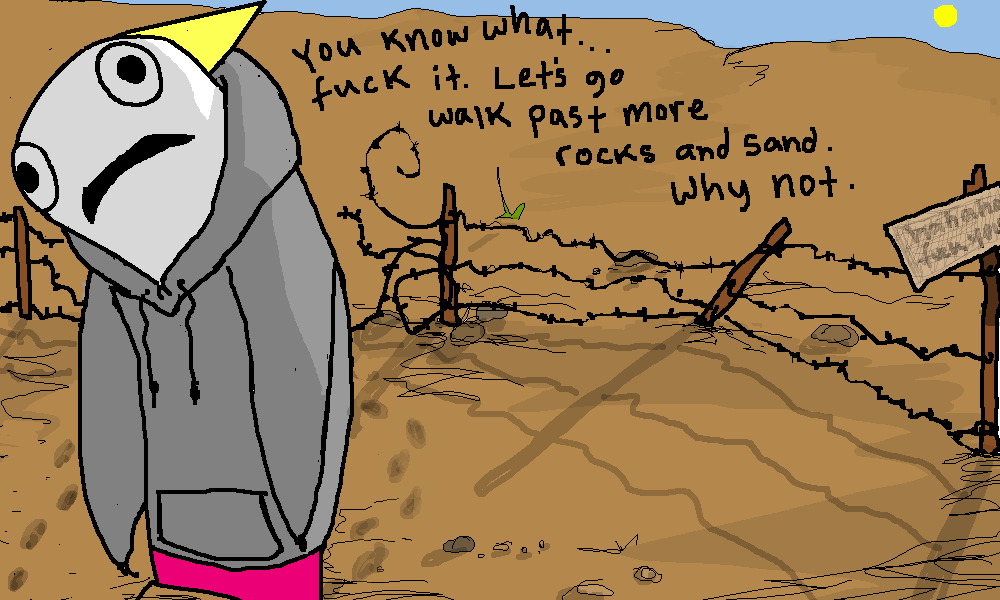
When I say that deciding to not kill myself was the worst part, I should clarify that I don't mean it in a retrospective sense. From where I am now, it seems like a solid enough decision. But at the time, it felt like I had been dragging myself through the most miserable, endless wasteland, and — far in the distance — I had seen the promising glimmer of a slightly less miserable wasteland. And for just a moment, I thought maybe I'd be able to stop and rest. But as soon as I arrived at the border of the less miserable wasteland, I found out that I'd have to turn around and walk back the other way.


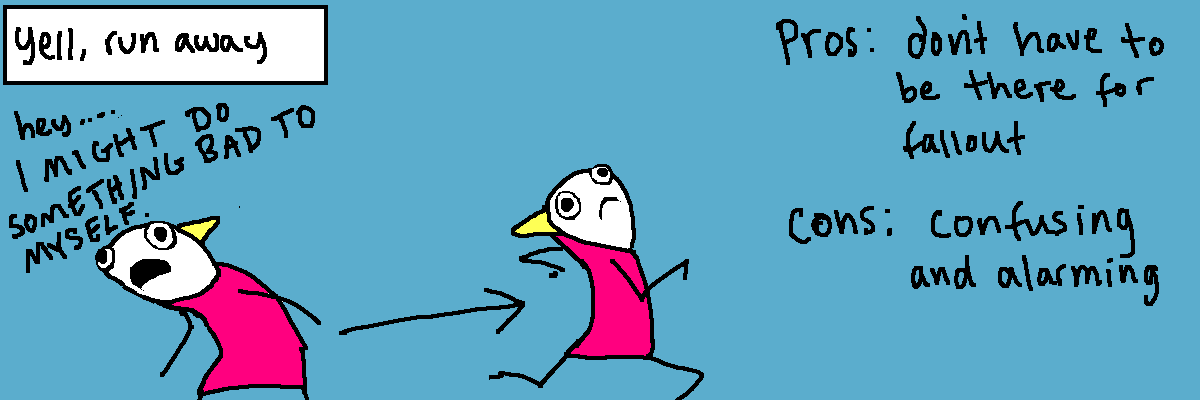
Soon afterward, I discovered that there's no tactful or comfortable way to inform other people that you might be suicidal. And there's definitely no way to ask for help casually.


I didn't want it to be a big deal. However, it's an alarming subject. Trying to be nonchalant about it just makes it weird for everyone.


I was also extremely ill-prepared for the position of comforting people. The things that seemed reassuring at the time weren't necessarily comforting for others.


I had so very few feelings, and everyone else had so many, and it felt like they were having all of them in front of me at once. I didn't really know what to do, so I agreed to see a doctor so that everyone would stop having all of their feelings at me.


The next few weeks were a haze of talking to relentlessly hopeful people about my feelings that didn't exist so I could be prescribed medication that might help me have them again.


And every direction was bullshit for a really long time, especially up. The absurdity of working so hard to continue doing something you don't like can be overwhelming. And the longer it takes to feel different, the more it starts to seem like everything might actually be hopeless bullshit.


My feelings did start to return eventually. But not all of them came back, and they didn't arrive symmetrically.

I had not been able to care for a very long time, and when I finally started being able to care about things again, I HATED them. But hatred is technically a feeling, and my brain latched onto it like a child learning a new word.


Hating everything made all the positivity and hope feel even more unpalatable. The syrupy, over-simplified optimism started to feel almost offensive.


Thankfully, I rediscovered crying just before I got sick of hating things.  I call this emotion "crying" and not "sadness" because that's all it really was. Just crying for the sake of crying. My brain had partially learned how to be sad again, but it took the feeling out for a joy ride before it had learned how to use the brakes or steer.


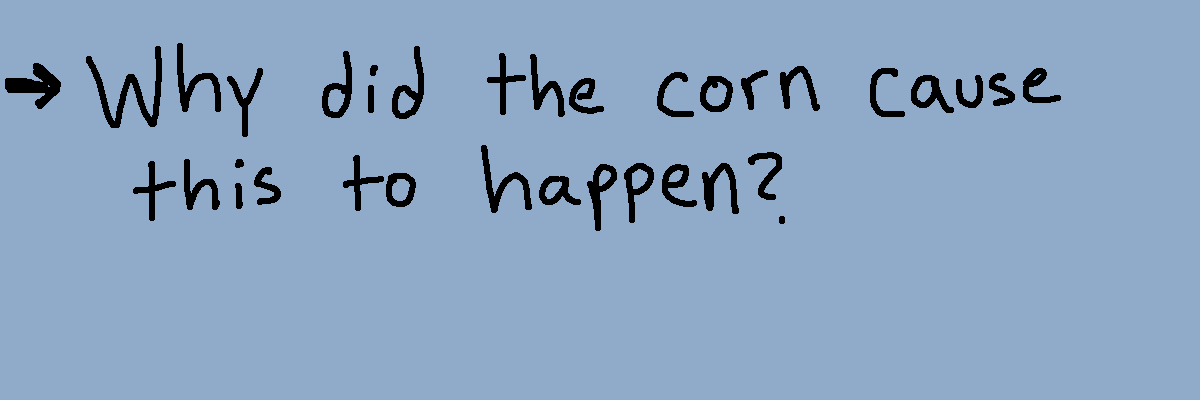
At some point during this phase, I was crying on the kitchen floor for no reason. As was common practice during bouts of floor-crying, I was staring straight ahead at nothing in particular and feeling sort of weird about myself. Then, through the film of tears and nothingness, I spotted a tiny, shriveled piece of corn under the refrigerator.


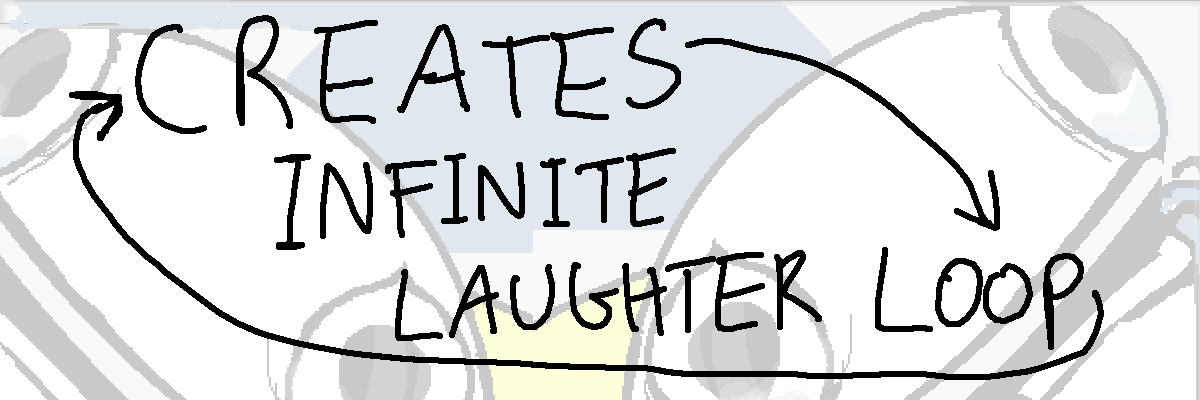
I don't claim to know why this happened, but when I saw the piece of corn, something snapped. And then that thing twisted through a few permutations of logic that I don't understand, and produced the most confusing bout of uncontrollable, debilitating laughter that I have ever experienced.


I had absolutely no idea what was going on.


My brain had apparently been storing every unfelt scrap of happiness from the last nineteen months, and it had impulsively decided to unleash all of it at once in what would appear to be an act of vengeance.


That piece of corn is the funniest thing I have ever seen, and I cannot explain to anyone why it's funny. I don't even know why. If someone ever asks me "what was the exact moment where things started to feel slightly less shitty?" instead of telling a nice, heartwarming story about the support of the people who loved and believed in me, I'm going to have to tell them about the piece of corn. And then I'm going to have to try to explain that no, really, it was funny. Because, see, the way the corn was sitting on the floor... it was so alone... and it was just sitting there! And no matter how I explain it, I'll get the same, confused look. So maybe I'll try to show them the piece of corn - to see if they get it. They won't. Things will get even weirder.


Anyway, I wanted to end this on a hopeful, positive note, but, seeing as how my sense of hope and positivity is still shrouded in a thick layer of feeling like hope and positivity are bullshit, I'll just say this: Nobody can guarantee that it's going to be okay, but — and I don't know if this will be comforting to anyone else — the possibility exists that there's a piece of corn on a floor somewhere that will make you just as confused about why you are laughing as you have ever been about why you are depressed. And even if everything still seems like hopeless bullshit, maybe it's just pointless bullshit or weird bullshit or possibly not even bullshit.


I don't know. 

But when you're concerned that the miserable, boring wasteland in front of you might stretch all the way into forever, not knowing feels strangely hope-like. 


08 May 03:34

Guns as Cultural Markers and Little Else

by bspencer
Brian Stouffer

Okay, this is a bit abrasive, but I think the underlying point is legitimate -- there is a stark asymmetry in seriousness/pragmatism in this gun debate.

I think the thing that makes me angriest about the gun debate as it currently stands is that the gun-humpers are basically just trolling liberals when they protest so vigorously even the smallest, most reasonable control measures. I mean, at this point, this is not about folks who enjoy hunting or target shooting worrying that their sporting/hobby will be hampered/criminalized in some way. No, at this point, this is just about trolling liberals. Gun-humpers have made the calculation, “Liberals are passionate about gun control; therefore I am against it.”

How do I know this? Well, I think it’s pretty obvious. You can defend your home with a rifle. You don’t need a semi-automatic weapon to hunt or shoot skeet or shoot at targets. The only reason I can imagine a person wanting a weapon like that is because it signifies something. Oh, it doesn’t signify the fact that these folks are willing to go to the war with the government. Dumb as they are, they know they don’t stand a chance against the might of the American military. Even a pretty good Koresh-style stash is no match for a SWAT team. So when wingnuts claim they want to defend themselves against the government, they are, of course being disingenuous.

No, this is all about what having a dangerous weapon, about what having a stash signifies. And right now what that signifies is that you are standing in defiance of a blah president and a whole lot of liberals who are really just worried about babies getting shot in Chicago and children getting slaughtered in Connecticut.

Gun-owning now is largely a cultural signifier and little else. It says something about you if you own a gun. It says something about you if you are for gun control. And the bottom line is that gun-humpers are willing to watch a whole lot more children die so they can thumb their noses at liberals.

It’s an interesting sort of compartmentalization. Because when these people (disingenuously) claim they want to fight the amorphous “tyranny” that wakes them in the middle of the night and has them sweatily dry-humping their guns, they’re forgetting that The Government is their friends and neighbors. It’s the cop down the street; it’s their cousin who’s serving in the military. That’s The Government that they’re talking about when the make their empty threats about fighting tyranny. And I wonder…how do they square that with their fetishization of the military and authority in general?

08 May 03:14

Churn, baby, churn: The labor market won't be healthy until people feel like they can quit their jobs

by Neil Irwin
Brian Stouffer

I'll do it... for America!!

America needs more quitters.

Or the job market does, anyway. That's the lesson to draw from the latest Labor Department report, which shows the soft underbelly of the U.S. jobs picture. The unemployment rate may be falling and the number of jobs rising. But there isn't enough "churn" going on, a hallmark of a healthy job market, in which people freely move between positions.

Let's back up a minute. On the first Friday of every month, the world holds its breath at 8:30 a.m. to await the jobs report, telling how many jobs were created in the previous month, what the unemployment rate was, and what happened to wages. But those numbers are a blunt picture of the labor market. Tuesday morning, the Labor Department released the Job Openings and Labor Turnover Survey, or JOLTS, for March. It is the favorite data series of labor market wonks everywhere. It parses the details of how many people quit their jobs, how many were laid off or fired, and how many openings employers are looking to fill.

The more standard job numbers point to solid economic improvement over the last year: In the 12 months ending in March, the unemployment rate fell from 8.2 percent to 7.6 percent, and added an average of 168,000 jobs a month. The JOLTS numbers point to something less sunny.

The number of layoffs and discharges has been stable at a low level over the last year, actually below the rate before the recession began. Companies aren't slashing jobs at a particularly fast pace, which is good news. (Only 1.3 percent of workers were fired in March, which was the same as in March 2012, and the same as in March 2007—in other words, that's a pretty normal rate of discharges even in a healthy economy.)

But the bad news is that while companies aren't slashing jobs, the job market is such that workers aren't comfortable quitting. In March 2007, 2.2 percent of workers voluntarily left their jobs, most of them presumably to take a job elsewhere (that count would also include those who quit to retire, or go back to school, or for other reasons). In March 2013, that was 1.6 percent—unchanged from a year ago and only barely up from the 1.4 percent level of the darkest days of the recession in March 2009).

The trend holds up across sectors. Different industries have different quit rates, ranging from low (Government, 0.6 percent) to high (accommodation and food services, 3.5 percent). But in none of these sectors has the rate of people quitting gotten back up to its 2007 levels.

What that means is people have no sense that if there is something wrong at their job—a terrible boss, or low pay, or few advancement opportunities—that they can risk quitting with confidence they will find something new. Yes, the burden of the weak economy has fallen most heavily on those who are unemployed. But having a quit rate far below normal levels for five years and counting adds up to millions of Americans who would like to be in a different job but aren't.

The flip side of that quits numbers is the job openings level. And that too shows no real progress over the last year. The JOLTS report shows 3.844 million job openings in March, barely changed from 3.848 million in March 2012. That means that the workers who aren't quitting but might like to are judging the market correctly: Companies are not looking to hire more people and finding insufficient supply of workers for the jobs. Rather, everyone is frozen in place, employers content with the staffing levels they have and workers not quitting because they don't see other employment opportunities elsewhere.

It is a job market frozen in place. We'll know the labor market is back when there is finally some serious churn.


08 May 02:42

Photo


08 May 02:39

pot zombie.

Brian Stouffer

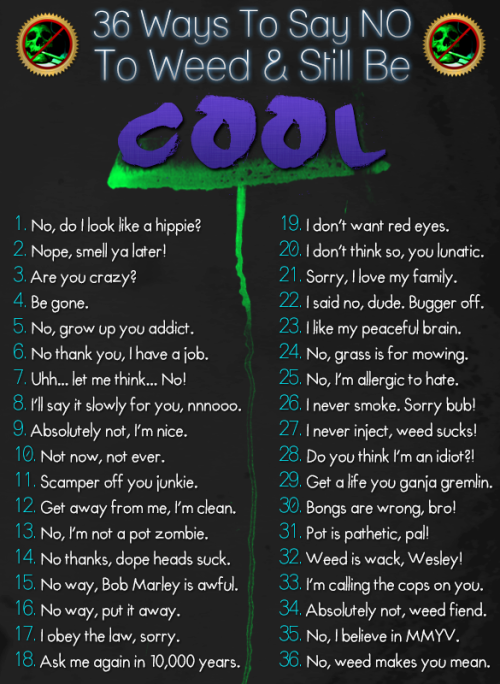
"Weed is wack, Wesley!" Yeah, that'll do the trick.


pot zombie.

06 May 19:24

Obviously Niall Ferguson believes in mandatory inbreeding....

Brian Stouffer

Obviously Niall Ferguson believes in mandatory inbreeding. Sicko.


Obviously Niall Ferguson believes in mandatory inbreeding. Sicko.

06 May 19:16

This Day in Labor History: May 6, 1882

by Erik Loomis
Brian Stouffer

Interesting read about some dark times.

On May 6, 1882, President Chester Alan Arthur signed the Chinese Exclusion Act. Although not often seen by the general public as part of our labor history, the Chinese Exclusion Act was the first legislative victory for organized labor in this country. It generated out of the discontent of white labor in the American West toward Chinese competition in general and specifically out of the Workingmen’s Party, a political organization of California’s white working class that threatened to overthrow the state’s two-party system if its major concern was not addressed.

It is useful to think of Chinese exclusion in the context of Gilded Age capital and labor. With capital so overwhelming labor and the free labor ideology of whites controlling their own future through hard work, white labor looked for any solution to the crisis. Generally, they hoped for a single, simple solution that they could grasp onto. That might be Henry George’s Single Tax, the monetaization of silver, the ideas of Edward Bellamy, the 8-hour day, or Chinese exclusion. Workers might swing from one idea to the next, looking for a panacea to industrial capitalism that allowed them to retake control over their own lives. Why Chinese exclusion? The idea of a white man’s republic seemed under threat from racialized labor who would seem to take any job at any price, driving down wages for white men, channeling profits into the capitalists’ arms, and undermining the ability of white men to control their own lives. Eliminate the Chinese and you go a long ways to resetting the balance of power between labor and capital.

When whites moved to California in the late 1840s, most saw it is as a white man’s country. This meant that any job done by a non-white was stealing a job from a white person. When they flowed across the nation during the Gold Rush, they assumed the gold was there for the taking, without competition. Lo and behold, news of the gold had traveled around the world. Native Americans were already there. Miners streamed northward from Mexico, Peru, and Chile. They came from France and Germany. They traveled across the Pacific from Hawaii, Australia, and especially China. While the Australians and Germans and most other Europeans were acceptable to the miners, the non-whites and the French were not. Mexicans and Chinese found their claims stolen, the French (who were seen on the same level as Mexicans) were made unwelcome. Most of the competitors went back home by the early 1850s in the face of American white supremacy.

There was one caveat for this. California was a nearly all-male space. Miners were totally out of sorts because there were no women to clean and cook for them. It really affected them profoundly, as one can see if you read their diaries. Mostly, they lived in filth. But over time, the Chinese were feminized to take over the jobs the whites did not want. This is the origin of the Chinese restaurant and Chinese laundry. Although gender ratios slowly equalized, the Chinese had developed strong communities in California cities. The Chinese also became the cheap labor of choice for industrialists looking to build railroad with inhumane working conditions that most whites would not accept.


Chinese-American children, late 19th century

So-called “anticoolie clubs” became common among whites resentful of Chinese labor. For example, in 1867, a group of white San Franciscans in an anticoolie club drove a gang of Chinese laborers from their railroad work. These ethnic-based clubs were not so different from the Protestant-supremacist riots of pre-Civil War New England against the Irish. These clubs engaged in a boycott of Chinese-made goods beginning in 1859. They also became connected to the burgeoning trade union movement in California. But unionism had a very difficult time getting established in California and the anti-coolie organizations helped fill that working-class vacuum.

In the aftermath of the Civil War, the Chinese question came to dominate California politics. Into this debate came the Workingmen’s Party. Began among German immigrants in the east in 1876 as a sort of socialist big tent party, in California, the leadership of Denis Kearney turned it into a 1-platform political movement: kick out the Chinese. Kearney, an Irish immigrant, arrived in San Francisco in 1873 and immediately became involved in politics. Combining fervent anti-Chinese hate with violent threats against his political opponents, Kearney took over the Workingmen’s Party to unite white working-class and anti-Chinese politics. At the 1879 California Constitutional Convention, Kearney and his supporters inserted a variety of anti-Chinese laws into the document. The most important of the clauses in the new constitution banned the employment of the Chinese. But business leaders opposed all of this and the Ninth Circuit Court of Appeals overturned these provisions.

Anti-Chinese image

For Kearney and his followers, eliminating the Chinese was just the first step in retaking control of the republic for the working man. Once the Chinese question was settled, Kearney wanted to go after the capitalists. Said Kearney,

”When the Chinese question is settled, we can discuss whether it would be better to hang, shoot, or cut the capitalists to pieces. In six months we will have 50,000 mean ready to go out. . . and if ‘John’ [the Chinese] don’t leave here, we will drive him and his aborts [sic] into the sea… We are ready to do it… If the ballot fails, we are ready to use the bullet.”

Although primarily a California movement, by the late 1870s, the anti-Chinese fears began to spread among whites throughout the nation, despite the fact that outside of New York City and western mining towns, the Chinese population was near zero. In 1876, both parties adapted anti-Chinese planks to their party platforms. Kearney took an eastern tour in 1878, speaking to a crowd of thousands in Boston and campaigning with future Greenback Party presidential candidate Benjamin Butler, although his national star faded quickly, in part because of his anti-capitalist views, and he returned to San Francisco without the national popularity he craved. Congress passed the Chinese Exclusion Act in 1882. Among its provisions was to bar the Chinese from citizenship and required each Chinese to acquire a certificate of residence or face deportation. In 1902, the Geary Act made the Chinese Exclusion Act permanent, as opposed to the 10-year extensions mandated in the original law.

Workingmen’s Party poster

Organized labor strongly supported most laws to end Chinese immigration. The Knights of Labor were strongly anti-Chinese and banned Asians from the organization. A group of Knights in Tacoma, Washington spearheaded anti-Chinese violence in Tacoma, Washington in 1885. The American Federation of Labor began in 1886, after Chinese Exclusion, but AFL head Samuel Gompers supported the extension of the law, as well as other anti-immigration legislation through the 1920s.

The passage of the Chinese Exclusion Act was hardly the end of violence against Chinese labor, as the Chinese community in Rock Springs, Wyoming would find out in 1885. But it was the effective end of the Workingman’s Party and the end of anti-Chinese groups threatening the established political system.

Kearney’s star faded rapidly after the Chinese Exclusion Act. He died in obscurity in 1907.

Legal Chinese immigration effectively stopped until 1943, when the nation’s wartime alliance with China made exclusion politically untenable and when anti-Japanese sentiment put the Chinese in a new light for many Americans. However, with exclusion, the Chinese began to migrate to northern Mexico and British Columbia and crossing into the United States, forcing the U.S. to create the Border Patrol.

This is the 59th post in this series. Previous posts are archived here.

06 May 02:20

Photo

Brian Stouffer

Son of a bitch


05 May 16:53

Keynes, Keynesians, the Long Run, and Fiscal Policy

by By PAUL KRUGMAN

One dead giveaway that someone pretending to be an authority on economics is in fact faking it is misuse of the famous Keynes line about the long run. Here’s the actual quote:

But this long run is a misleading guide to current affairs. In the long run we are all dead. Economists set themselves too easy, too useless a task if in tempestuous seasons they can only tell us that when the storm is long past the ocean is flat again.

As I’ve written before, Keynes’s point here is that economic models are incomplete, suspect, and not much use if they can’t explain what happens year to year, but can only tell you where things will supposedly end up after a lot of time has passed. It’s an appeal for better analysis, not for ignoring the future; and anyone who tries to make it into some kind of moral indictment of Keynesian thought has forfeited any right to be taken seriously.

And there’s an important corollary: how you should go about getting to some desired long-run outcome may depend a lot on how you think the economy works in the short run.

I don’t like the framing of this Blanchard-Leigh piece , which simply takes it as a given that we should be engaged in fiscal consolidation even in the short run, and the only question is how much. The truth is that the economics suggests strongly that we should be engaged in fiscal expansion right now. Still, framing aside, Blanchard and Leigh do get at the right issue: because the short-run effects of fiscal policy may differ greatly depending on the state of the economy, appropriate policy depends hugely on where we are right now.

And look, this isn’t hard. The overwhelming fact about our current situation is that conventional monetary policy is played out, with short-run interest rates at zero. This means that there is no easy way to offset the contractionary effects of fiscal austerity (maybe there are exotic ways to do something, but they’re tricky and unproved). And this in turn means that austerity right now is a terrible idea: any fiscal savings come at the expense of reduced output and higher unemployment. Indeed, even the fiscal savings are likely to be small and maybe even nonexistent: lower output and employment reduces revenues, and may inflict long-run economic damage that actually worsens the long-run fiscal position.

The other things B-L mention,like credit constraints, just reinforce this basic point. (By the way: Gillian Tett notes today that consumer spending is now fluctuating dramatically with the timing of paychecks, suggesting a lot of people living hand to mouth. What she doesn’t point out is that this is a world in which Ricardian equivalence, in which expectations of future taxes drive current spending, is even wronger than usual — and fiscal multipliers will be large).

The point, then, is not to ignore the long run; it is to recognize that the boom, not the slump, is the time for austerity, and spending cuts right now are disastrous policy. In the long run we are all dead; the point is to avoid killing our economy before its time.

This entry passed through the Full-Text RSS service — if this is your content and you're reading it on someone else's site, please read the FAQ at fivefilters.org/content-only/faq.php#publishers. Five Filters recommends: Thatcher's Tyrants - The Tanks, The Guns, The Christmas Cards.

03 May 21:21

Politics is not here to please you

by Ezra Klein

Back when I first began reporting about policy, I got a piece of advice I've tried never to forget. I haven't done a particularly great job of it, because I've forgotten who actually gave it to me. But I've remembered the actual line. "The world isn't here to please you," I was told.

If you're around policy research enough you'll end up reading a lot of studies that violate your intuitions, your theories, your hopes, and even your values. You'll have the instinct to brush them away or come up with some reason they're wrong. In those moments, I was told, it's worth remembering that the world isn't here to please you.

Politics isn't here to please you either. And this, I think, is the core of the debate over whether "presidential leadership," whatever that actually means, can fix Washington.

In general, the difficulty of engaging with "the president should lead" theory of American politics is, as Jonathan Chait writes, "it's not quite coherent enough to rise to the level of wrong." Or, more to the point, it's not quite specific enough to rise to the level of answerable.

In these arguments, "presidential leadership" plays the role of the briefcase in "Pulp Fiction." It drives the entire story, yet we never get to see what's in it. Peggy Noonan says of today's dysfunctional politics, "if you're a leader you can lead right past it." How? Well, uh, look over there!

Maureen Dowd writes that the job of the president "is to somehow get this dunderheaded Congress, which is mind-bendingly awful, to do the stuff he wants them to do. It's called leadership." Actually, I think getting people who disagree with you to do what you want them to do is called "the Jedi mind trick," but I digress.

It's impossible to argue with these columns because they never actually say what they're about. If Noonan or Dowd explained what the president should actually do, we could have a discussion. But they don't, presumably because they can't.

The National Journal's Ron Fournier has also been a big proponent of "the president should lead" theory of American politics, but, to his credit, he has spent a lot of time generously engaging with his critics on the issue. So unlike with a Dowd or a Noonan, it's possible to map the boundaries of his argument.

When asked what kind of presidential leadership could bridge the divisions in American politics, Fournier demurs: That's why he's glad he isn't president, he says. But he's certain that Obama can answer the question, or at least should have to answer the question. His oft-expressed view is that dismissing the power of presidential leadership to fix American politics is simply "giving Obama cover to fail." It's "raising the white flag."

This is a more interesting argument: Fournier is saying that whether presidential leadership can or can't fix the situation is almost immaterial. If the public stops believing presidential leadership can fix the situation, then the situation will get worse, as the president will have less incentive to try and fix it.

Fournier and other adherents of the Green Lantern Theory of the Presidency are caught between a question they can't answer and an answer they can't abide. They don't know exactly what Obama -- or any other president -- could do to overcome the structural polarization that's cracking Congress. But the idea that there's nothing the president can really do is too displeasing to entertain. It suggests that politics is broken, and it won't be fixed, at least not anytime soon. And that's an unacceptable answer, even if rejecting it leaves you with an unanswerable question.

They have it backward. It's raising the white flag to cling to an unanswerable question rather than staring down an unpleasant answer. The problems of American politics today are not overly complicated, or even overly controversial. They're just hard to fix.

The two political parties have polarized. Unlike in the 1960s, when Jesse Helms was a Democrat, and George Romney was a Republican, today's Republicans agree with Republicans, and today's Democrats agree with Democrats. That, plus the zero-sum nature of elections and the rise of an ideological media and interest-group infrastructure that credibly threatens dissenters with primary challenges, has made bipartisan consensus on most big issues structurally impossible.

That's fine. It's how most political systems operate, in fact. But our political system, which is centered around Congress rather than the White House, requires extraordinary levels of consensus to operate smoothly. That leaves us with two choices: Either figure out a way to de-polarize the parties or change the rules of the political system so it can operate more smoothly even amidst polarization.

We're not going to figure out a way to de-polarize the parties. Whenever you think of the irenic Washington of the '50s and '60s, think about Strom Thurmond, one of the most ideologically conservative members of Congress, serving as a Democrat. The de-polarized parties of the mid-20th century were a historic aberration that had more to do with race scrambling our politics than anything else. They're not coming back, and nor should they come back. The most conservative members of Congress shouldn't be in the Democratic Party, and nor should liberals be in the Republican Party. Voters deserve a choice between two distinct political coalitions.

But that means the work of repairing American politics is the work of understanding what tweaks and reforms are needed for the American political system to withstand this new world of polarized political parties. That's going to be a lengthy and difficult project, and many political fights in the coming decades will, on some level or another, be about it.

But that work is made harder by pundits who continue to falsely promise that the glowing briefcase of president leadership can fix what ails us. Telling the American people that the only thing missing is the president being more awesome promises them the easy way out. It says that all they need to do to fix our politics is get inspired by a new presidential candidate and then cast a hopeful vote for him or her at the polls. That's terrifically convenient, because that also happens to be the part of American politics that voters most enjoy participating in and that media most enjoys covering. (It's also convenient for the media, as Greg Sargent writes, because it keeps them from having to take sides in ongoing policy debates, but that's a slightly different issue.)

But since the problem in American politics is not presidential leadership, telling them that the president -- whether this one or a new one -- can fix it traps voters in an endless cycle of inspiration and disillusionment. They vote for presidents expecting them to be "uniters,' expecting them to "change Washington," and then they're bitterly disappointed when their heroes fail. But on this score, presidents are going to continue to fail because they can't possibly succeed.

It's not waving the white flag to say that the president can't fix Washington. It's waving the white flag to resist other explanations because they're too depressing, or because the work they imply is too hard, or the fight they require will take too long. If the first step towards political recovery is admitting we have a problem, surely the second step is admitting what the problem actually is.


03 May 21:18

Warming Up To The Apocalypse

by Andrew Sullivan

last_judgment

A new study draws a connection between the 76% of Republicans who “profess a belief in the Second Coming” and America’s inaction on climate change:

The study, based on data from the 2007 Cooperative Congressional Election Study, uncovered that belief in the “Second Coming” of Jesus reduced the probability of strongly supporting government action on climate change by 12 percent when controlling for a number of demographic and cultural factors. When the effects of party affiliation, political ideology, and media distrust were removed from the analysis, the belief in the “Second Coming” increased this effect by almost 20 percent.

“[I]t stands to reason that most nonbelievers would support preserving the Earth for future generations, but that end-times believers would rationally perceive such efforts to be ultimately futile, and hence ill-advised,” [David] Barker and Bearce explained. That very sentiment has been expressed by federal legislators. Rep. John Shimkus (R-IL) said in 2010 that he opposed action on climate change because “the Earth will end only when God declares it to be over.” He is the chairman of the Subcommittee on Environment and the Economy.

I recall David Brooks’ comment on my book, The Conservative Soul, where he declaimed that my concern with religious fundamentalism taking over the GOP was a function of bad faith or ignorance. And yet here we have a clear policy position distorted beyond reason by fundamentalist claptrap. Add the support for Israeli settlements to the mix as well. It’s those who refuse to see or downplay religious fanaticism in the current GOP who are either writing in bad faith or have no idea what they are talking about.

(Image from Michaelangelo’s Last Judgment, courtesy Wikimedia)


03 May 04:35

Tim Tebow in the CFL: A memoir

by Jon Bois
Brian Stouffer

Words fail. This is the most beautiful thing I've ever read.

Tebow

July 22nd, 2024.

Harbaugh brought me in to throw some balls, see what a 36-year-old Tim Tebow can accomplish in big-boy football. My first throw sailed 10 yards over the target. The ball's so damn light.

I try to compensate, put a little more downspin on the ball. It doesn't work. The tip of my index finger is gone; years ago, an owl bit it off while I was sleeping. An owl! I swear to God, an owl. The ball sort of wobbles like a 4-year-old's drawing of a spiral, and spikes the ground two yards in front of the target.

I have a book to write.

★ ★ ★ ★ ★

August 17th, 2013.

June Jones was a good coach who just couldn't piece it all together in the NFL. That's not a big deal, few coaches can. I didn't really understand that until after I met with Coach June at that Toronto bistro. A few minutes after I signed the contract the check arrived. "No, no, Timmy, put your cage away. I buy for my players." He twisted open his change-cage and tenderly cupped his hand until a gerbil walked into it, then set the little guy on the table.

American football fans think of the CFL as a joke, a necessarily lesser league, a sort of sawdust bin where the has-beens and busts of the NFL end up. It's not lesser. It's just ... a fundamentally different league. (They only have three downs, did you know that?) Getting used to how Canada did things was more of an adjustment for me. They use mammals how we use paper money. A horse is $1,000, a donkey $500, a dog $200. Hamsters are 20 bucks, gerbils are 10 bucks. I stared as $40 of June Jones' money scurried and sniffed around the table.

"Aren't they gonna get lost?" I asked.

"Nah. They know to stay put. Now listen, Timmy." Coach June removed his glasses, leaning forward on the table with his forearms, occasionally offering his money a finger to sniff. "We move really fast up here. That's how the CFL works. Straight into the fire. You'll sort of need to learn the system as you go, and this system is nothing like what you're used to. Are you good with that?"

"Yeah."

"Good. The game starts in 45 minutes Celsius. C'mon."

★ ★ ★ ★ ★

That was about two hours Fahrenheit, I later learned, and that's apparently all the time they needed to get the word out. See, Canada does have phones and the Internet and all that. Of course they do. They just don't secure TV or radio deals with their CFL franchises. Instead, they have shouties.

A shoutie is commonly eight to 12 years old. A long copper pipe, perhaps a hundred or two hundred feet long, protrudes from the Rogers Centre wall. Someone inside the stadium shouts play-by-play results into the pipe: "Two-meter rush up the left side! Second an' eight!" The shoutie cups his ear to listen, turns around, and shouts the same into the next pipe, and another shoutie listens and shouts it into some more pipes. Et cetera, et cetera, until the play-by-play reaches a hushed gathering of football fans, each cocking their heads to catch every syllabic echo. This network is made up of thousands of shouties and untold lengths of piping, and sprawls to cover nearly half of Southern Ontario. Out in Windsor, they gather on Monday to hear Saturday's game.

Of all the lovely things I miss about Ontario, I might miss the ambient yells of the shouties and the rattling of pipes the very most. As I walked through the streets toward the Rogers Centre, I heard them: "Timmy Tebow's buttoning up for the Argos today! He's come straight from Florida! He's won the Heisman! We's got us another Raghib Ismael! We's gonna knock 'em dead!" When you rely on a shoutie network to get your news, you have to temper your expectations of objectivity.

As I entered the stadium, I walked beneath a massive Jumbotron. I craned my neck and stopped for a moment to take it in.
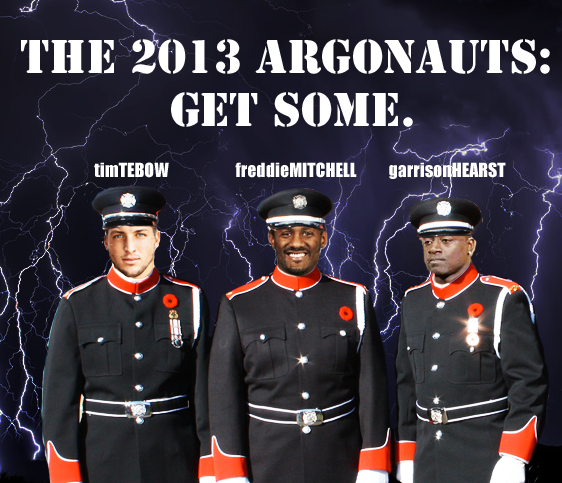
Poster_medium

It wouldn't have been as charming, I don't think, if the Photoshop hadn't looked like such a rush job. There's something warm and genuine in a jagged edge, a crack, a little lost shine. It lets me know humans were involved here. I humored my old coaches back in the League, working on my "mechanics," but I hated the concept. I didn't want to be a machine. I didn't want to spit neat little bite-size passes out on a conveyor belt. I wanted to plant each one in a field of sun, watch it grow, let it become what it will become. Don't tell them this, reader, because I love them, but the decision-makers of the NFL are too worried and conformed to ever understand such a thing.

It was a weekend game, and that meant taking the field in the Argonauts' dress blues, with their special red cufflinks and chevrons. Coach June would trot around the field on horseback, as CFL coaches always did, but today his steed wore a gilded saddle and harness. "You ready, Timmy?" he asked me with a smile. "Just have fun. You've been on the big stage plenty of times before. Just do what you do."

"We have a playbook or anything I should take a look at?"

"Not with you we don't, kid. Not with you. You're a wizard. Do what's in your heart. Hyah!" His horse whinnied, and he continued his inspection of the field.

★ ★ ★ ★ ★

They did use a coin for one thing in this country -- determining possession -- because who would ever want to toss a mouse? We won the toss, and as the Stampeders set up to kick, Dante Hall jogged out to the five to receive. Dante was 34 years old -- ancient for an NFL kick returner, but about right for the CFL. Lots of guys end up returning kicks and punts because they're one-dimensional; maybe they have plenty of speed, but they don't have the tools to hack it as a corner or wideout. And maybe that was true of Dante. But even if it wasn't, even if he was built like Calvin Johnson, he would have stayed a kick returner all his life. It's what he was put on Earth to do, no matter the latitude.

Dante's knees bent as the kick met him in the insides of his elbows, and he sprang forth. Lord, he could accelerate, even at that age. He moved the ball to our 43, and we trotted to the field. Everything seemed familiar enough.

Our offensive line was halfway lined up when the Stampeders' defensive end -- Keenan McCardell, if you believe me, reader -- took his hands off his knees and stood upright. "We gotta meet."

"First play from scrimmage!" Bam exclaimed. "You shittin' me?" (Bam Morris was my center. Since his last NFL rush in 1999, he'd put on a hundred more pounds, and was one of the more dependable centers north of the border.)

"First time we've seen y'all Argos in two years Celsius. Lot's happened since then. C'mon, don't turn me into an asshole here."

I got a nudge in the side from Garrison Hearst, my running back. "We're gonna negotiate. Little early for that if you ask me, but that's just how they do up in Calgary. Hold tight. We'll take care of it."

And then it stopped being the football I knew. "NEGOTIATION" flashed on the Jumbotron. The crowd of 86,000 roared.

The line of scrimmage burst into a flurry of negotiations. Freddie Mitchell, my No. 1 wideout, put a hand on my shoulder. "OK, you know what you do now, is you stand here and look pretty, you got it? Don't pick up the ball. It'll make 'em jittery, you standin' over here lookin' like you might throw it any second. It's a good-faith thing. You got it?" I didn't answer. Men in long-tail tuxedos sprang off the sidelines and brought out folding tables and set them along the line of scrimmage; another draped white tablecloths over them, and another set out pens and stationery and bottles of water. I turned my head to the sound of cracking plastic. A man with white gloves pulled the lid off a snack tray, the sort with the grape tomatoes and ranch dressing and crackers you'd buy at $8 at the Kroger, offered a slight bow in my direction, and walked off, heel-to-toe, gloved hands clasped behind his back.

Freddie stopped me before I could reach for the tray. "Don't touch it. Don't take nobody on their word. Let one of the ponters eat it first. Make sure he don't get the shits in an hour, then you can eat you some. OK?" That was another thing. They weren't "punters." They did roughly the same job as a punter, but they wore these clear Plexiglass globes on their heads instead of helmets. And they were called "ponters."

★ ★ ★ ★ ★

The negotiations carried on for eight, nine hours. Mostly I watched their hands; their fat, taped, dirtied fingers would point and drag across the table, outlining routes and blocking patterns. Occasionally they would lift off the table and point at the guy across the table: "No chance in Hell. You ain't pullin' off my block unless Timmy leaves the pocket. That's the deal. Else, these dozen Tootsie rolls got someone else's name on it." (At the time I'd assumed that was code language. It wasn't.)

I heard once, I forgot where, that no matter how animated a conversation is, no matter how fun, no matter how many people are involved, there's always a lull in the conversation every 20 minutes. That's often true, I've found, but it wasn't here. The wideouts traded smokes and told each other jokes, mostly. Garrison Hearst, my running back, paced behind our guys at the table, occasionally reaching in and reviewing a handwritten contract with licked fingers. "Hold up, hold up. Don't sign that," he said. "This whole graf, throw it out. You sign this, we got a four-second, 20-foot gap on the right side. See? Look. Write it again." He was a kind of advisor. The linemen made all the calls, though. They struck the bargains. They were doing this to protect me, to make sure their little American tourist behind center wouldn't lose his luggage. (That was code, and it unsettled me.)

Around midnight an assistant brought me a big, scratchy blanket, the sort U-Haul will fine you for if they don't count it in the truck. I wrapped it up and caught some sleep on the turf. Hearst shook me awake.

"We got a deal. C'mon, up."

"What time is it?"

"Right up on 7:70."

"What?"

"I don't know what it is Fahrenheit."

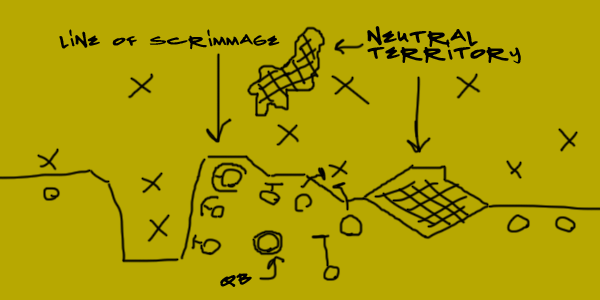
The last of the conference tables were being carried away. I staggered to my feet, but Bam didn't wait for me to finish waking up. "Here's what we got. These are the terms we outlined for you, alright?"
Scrimmage_medium

"It's not all good," said Bam. "We don't like the line cutting down like that on the left side, but you're a rook, you know? You don't give us a ton of leverage. Plus we finished 9-5-3-1-65-3 in the standings last year. This was the best we could get."

★ ★ ★ ★ ★

The ball was heavy when I picked it up. It must have weighed three pounds. I gestured to Hearst, but didn't know which question to ask first. "Is it ... I mean, it's heavy."

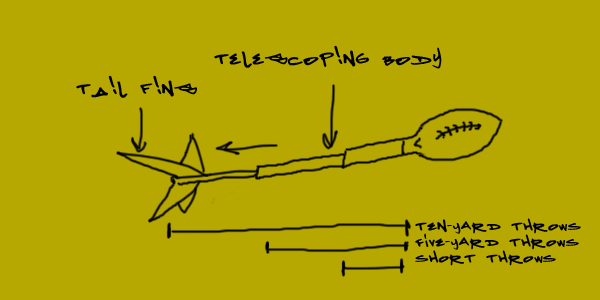
"Huh? Oh. Here." Hearst took the ball from me and unscrewed a nickel-sized rubber cork from the end, then pulled a ribbon out of the nose of the ball that looked like a bookmark from a family Bible. Out came a long, telescoping alloy pole, further and further, that stretched to nearly three feet. Hearst set the ball on the ground, pole up, holding the opposite nose steady with his feet, and then pulled taut four nylon, fold-out fins from the end of the pole.

"It's first down. I mean, Hell. You're the quarterback and all. But this is standard setup for a first-down ball."

I can't know for sure, but I think I was grimacing like I was pulling moldy bread out of a kitchen sink, holding that damn thing.
Ball_medium

Was it a javelin or a ball? How was I even supposed to hold it? I didn't know. The play clock was down to eight, so I handed the ball to Bam, took a few steps back, and gave myself four seconds to wonder what the Hell was going on, how I could possibly know so little about this game and this land, and whether I was in a dream. Most of my dreams, the ones I remember anyway, feature my old youth group pastor pushing a lawnmower across gym carpet, and yelling over the engine that "prayer is a two-way conversation."

I looked around. He wasn't here. The ball hit me in the hands, and I turned it around, placing a hand on the laces for a moment before shifting it down to the middle of the pole. Carl Pickens, my No. 2 wideout, put it upon himself to run a shallow slant across the middle. I chucked it, and its nose took a sharp dive, hitting Pickens in the foot.

Second down. There are only three downs per possession in CFL football; I knew at least that much. That, reader, was the last time I would ever throw a football with that damn telescopic antenna extended. I clicked the spring at the base of the ball, folded in the fins, and shoved it all back in until I was once again left with a three-pound football.

"That setup's just for ponts and handoffs," Hearst said. "You gonna give it to me on second and 10?"

"No. I'm gonna run it myself. I'm sweeping left. Block for me."

Hearst smiled. "What the Hell. Let's get stupid." I would later learn that the last time a CFL quarterback had attempted to run with the ball, in 2004, he was leveled for a loss of four, and the Premier of Alberta unsuccessfully attempted to have him jailed.

The next half-minute or so, in my memory, is just ... colors, really. If you were to walk on air across the lips of the Grand Canyon, you would probably remember as many details as I did. I recall that I swept left, and upon realizing I had open space ahead of me, I cut up the field. Maybe you've seen the end of Raising Arizona? It was like that. But I looked ahead. I squinted. The stands in front of me, past the end zone, were coming apart. Teams of oxen, a dozen on each side, were pulling away the concrete walls on their big wheeled tracks, with their keepers taking turns whipping them into service, and staring wide-eyed at me: "is he going to do it?" I thought I was dreaming now. The walls cracked further and further apart, and I passed the goal line and stopped, and before me, there were the streets of Toronto.

The crowd was either loud or quiet, one of the two. It was either day or night. I stood flat-footed in the end zone. I heard Freddie shout: "RUN, MOTHER****ER! KEEP RUNNING!" What? I began to turn around, caught a 235-pound Stampeder in the side, and hit the ground.

I turned my head. Past the sideline, a shoutie hopped on one foot, struggling to pull off his boot, and once he did, he banged it furiously against the shout-pipe. "AY! AY LISTEN! TIMMY TEBOW DID IT! THE ARGOS IS BOUND-FOR-STREET!" Clang, clang, clang.

★ ★ ★ ★ ★

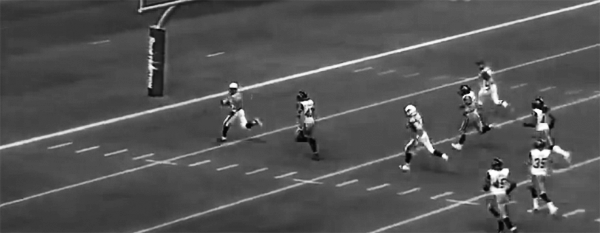
I was the first player to cross a CFL goal line since 1986. They only really got one decent photo of the last one.
Touchdown_medium

You'll run into statues of this all over Canada, if you're lucky enough to visit. One of them, in Vancouver, has everyone in this photo cast in bronze, exactly like this, and fountains spitting up from the ground. Kids play in it when it's hot out. Others just show the Lions' Mervyn Fernandez, forever frozen with one leg on the turf and the other kicking away, head swiveled to survey the chaos he created. An offense advanced the ball more than 50 yards: chaos.

That's another thing I guess I should've been told: prior to my arrival, nobody had passed the goalpost since a year before I was born. Just look at all the Grey Cup finals: 6-3, 18-12, 24-6, 39-36. All permutations of three, all field goals.

No, reader, I didn't call it a touchdown. In the CFL, there aren't any.

★ ★ ★ ★ ★

Play was stopped for an hour. The commissioner of the CFL placed a wreath around my neck and handed me a single rose. I paused for photographs, and answered a few questions through the pipes. I put my ear to the end, and heard a 10-year-old: "'Ello, this is Diane from the Little Italy neighborhood. I have two questions for you. First is, can you hear me okay?"

"Yes, ma'am. I can hear you fine." I chuckled. "What's your second question?" I figured I had a few minutes to wait, so I got comfortable. Coach June rode up and dismounted his horse.

"Doin' well so far, kid."

"Why didn't you tell me about any of this? Like the ball, or how there aren't any touchdowns?"

"Figured you knew. I mean, I knew."

"You're a coach, though."

"Huh?" June sneezed.

(That's what they call a "transition sneeze" up north: when you want to shift the conversation to something new, you sneeze. Everyone understands this, and everyone respects it. It sounds silly, but it's a remarkable custom. As a consequence, Canadian conversations tend to be far more interesting than American conversations -- which, since my return home, have struck me as agonizingly dull and rambling.)

"Now, you know what's next for you?" June continued. "For us? We're just gonna keep goin' forward. When play starts back up again, you'll take the snap from the end zone, and you'll lead us out of the stadium and into the street. We got our folks packin' the wagons right now. Ask them for some Sambas, you don't wanna be wearin' spikes on the asphalt. Any time you need food, clothes, a band-aid, you talk to them, OK?"

"Which direction are we going?"

"Same way the field's pointing. About north-northeast. Now, obviously there ain't any sidelines up ahead. Y'all can change course if you want, if it makes sense strategically. But your goal is north. And you still got the same three downs, remember. They can still stop you. It's still football. If you think you're going down, for the love of God, try to get to some grass or something before they tackle you, you know?"

I cursed for the first time in a long time. It ... wasn't out of frustration, or madness, or confusion. Well, it was a little bit, but it was this strange sort of delight. "I've never heard of any of this shit in my life."

Coach June doffed his officer's cap and wiped his forehead. "Me either. I've never seen it. Me and Hearst have been thinking on it, though. We think we'll be OK."

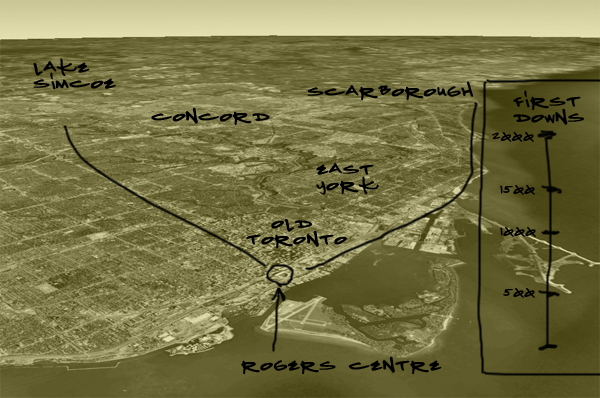
For years, June Jones and Garrison Hearst, the chief architects of the Toronto Argonauts, would stay up into the hours of the morning, in dim light, staring at maps. Maps of downtown Toronto, of the suburbs, the Kawartha Lakes, and beyond, into the furthest reaches of Southern Ontario. Which roads had medians, and which country roads were little more than gravel trails? Was this office building sympathetic to the Argos; would they put us up for the night? Would the folks in this suburban ranch house fix us some abominable casserole straight out of a 1970s cookbook that, nonetheless, we would appreciate?

Hearst knew the answers to all of these things. In his pack he carried volumes of annotated maps and handwritten notes. He was presently sitting cross-legged, thumbing through them, pages neatly set on the turf around him, in accordance with an organizational system only he knew. Iron and copper clanged as the men in tuxedos helped the shouties build impromptu networks of pipes, stretching out where perhaps our offense might advance. Fans yanked the detachable stadium seats from their bases and relocated along the streets of downtown Toronto, their eyes as bugged-out in wild-eyed wonder as mine surely were.

First snap out of the end zone: a run, across the sidewalk that ran along the northwest wall of the Rogers Centre, first down. The second, a bomb: with strength the fibers of my muscles had surely been nesting away all my life, I threw that three-pound football 40 yards into the arms of Freddie Mitchell. He ran to the foot of the CN Tower before falling over a hot dog cart. The vendor threw up his arms in disgust; Freddie flipped him the bird. Another first down. I sprinted to the line of scrimmage. Ahead of me lay the great adventure of my life. I had, at last, found out what I was for.

Toronto_medium

03 May 03:59

The Appeal Of “Progressive Libertarianism”

by Andrew Sullivan
Brian Stouffer

I've completely come around on the privatize the FAA bandwagon.

Edward Glaeser notes that “almost 59 percent of air travel is done by those in households earning more than $100,000 a year” and that “these wealthier Americans fly 10 times more than people in households earning about $50,000 annually.” He therefore sees no reason for taxpayer revenue to fund air-travel:

Sometimes we can make society fairer if the public sector spends less, a policy of progressive libertarianism. Making the FAA and TSA independent entities responsible for funding themselves by charging air passengers would reduce the overall deficit and economic inequality simultaneously. Moreover, as last week’s delays suggest, a shift to independent funding could help the passengers themselves, even if they pay higher costs. User fees could be used to reduce congestion in airport lines and to improve the overall flying experience.


03 May 03:42

tympanista: life in the fast lane


tympanista:

life in the fast lane

03 May 03:41

Photo


02 May 23:04

How Van Halen explains Obamacare, salmon regulation and scientific grants

by Ezra Klein

Right there on Page 40, in the "Munchies" section, nestled between "pretzels" and "twelve (12) Reese's Peanut Butter Cups," is a parenthetical alert so adamant you can't miss it: "M&M's," the text reads, "(WARNING: ABSOLUTELY NO BROWN ONES)."

This is the famed rider to Van Halen's 1982 concert contract. In a sentence fragment that would define rock-star excess forevermore, the band demanded a bowl of M&M's with the brown ones laboriously excluded. It was such a ridiculous, over- the-top demand, such an extreme example of superstar narcissism, that the contract passed almost instantly into rock lore.

It also wasn't true.

I don't mean that the M&M language didn't appear in the contract, which really did call for a bowl of M&M's -- "NO BROWN ONES." But the color of the candy was entirely beside the point.

"Van Halen was the first to take 850 par lamp lights -- huge lights -- around the country," explained singer David Lee Roth. "At the time, it was the biggest production ever." Many venues weren't ready for this. Worse, they didn't read the contract explaining how to manage it. The band's trucks would roll up to the concert site, and the delays, mistakes and costs would begin piling up.

So Van Halen established the M&M test. "If I came backstage and I saw brown M&M's on the catering table, it guaranteed the promoter had not read the contract rider, and we had to do a serious line check," Roth explained.

The Van Halen Principle

Call it the Van Halen Principle: Tales of someone doing something unbelievably stupid or selfish or irrational are often just stories you don't yet understand. It's a principle that often applies to Washington.

One of President Obama's favorite examples of bureaucratic muddle is the government's management of salmon. "The Interior Department is in charge of salmon while they're in fresh water, but the Commerce Department handles them when they're in saltwater," Obama said in his 2011 State of the Union address. "I hear it gets even more complicated once they're smoked."

As the kids say, LOL. Only there's a real issue here. The Department of the Interior supervises rivers and lakes. The Department of Commerce handles oceans. Salmon, inconveniently, live in both. Should there be a new department just to handle salmon? A new department that oversees all water, regardless of salinity? Should the Commerce Department be given all responsibility for salmon regulation even though it doesn't have the infrastructure to manage rivers?

"The salmon issue isn't some kind of blunder," Slate's Matthew Yglesias wrote last week. "It just reflects the fact that large bureaucracies -- whether private sector or public sector in nature -- need to make some choices about dividing up responsibilities. Any set of choices entails dealing with some edge cases. It's tough. But absent a constructive suggestion, just pointing and laughing is silly."


Obamacare exaggerations

Last week, Politico reported that members of Congress were meeting in secret to "exempt" themselves from Obamacare. The story went instantly viral, receiving almost 100,000 "likes" on Facebook. For good reason: It would be shocking if Congress were quietly freeing itself from the Affordable Care Act even as members demand that the rest of us meekly follow its rules.

The truth is much less shocking and far more boring. Back when the Affordable Care Act was being drafted, Republican Sen. Chuck Grassley of Iowa proposed an amendment requiring members of Congress and staff to get their health care from an insurance exchange. Grassley expected the amendment to be defeated, exposing Democrats as hypocrites who wouldn't live under their own health-care regime. Instead, in a moment of apparent political inspiration, Democrats voted for the amendment. They would love to be part of Obamacare!

The problem is that the insurance exchanges aren't open to large employers, and the federal government is the very largest. So there's utter confusion about whether the federal government is allowed to buy health insurance from the exchanges or whether members of Congress and their staffs are on their own. If Congress were given an "exemption" from the Grassley amendment, the law would then apply to members and staff in precisely the same way it applies to every other American citizen, instead of in the unique manner prompted by Grassley's mischief.

Too many pages

Speaking of Obamacare, the administration recently released a draft of its application to join the health-care exchanges. It was 21 pages long and "as daunting as doing your taxes," reported the Associated Press. Lengthy page counts are a constant trope in stories about bureaucratic inanity: Anything that sounds overly long is taken, almost by definition, to be overly complicated.

This week, the administration released the finished product -- at five pages. Reviews have been great. But the difference between the two applications is not so cheer-worthy. Most of the pages in the original were there because the application accommodated families of six. A single adult would simply leave those pages blank.

The new application is designed for single adults -- that's why it's short. If, for example, you have a family of six, you need to get the form for families, then "make a copy of Step 2: Person 2 (pages 4 and 5) and complete" for each additional family member. The administration cut the page count by making the application much more cumbersome for big families. Turns out there was a reason for that 21-page original, after all.

Shrimp on a treadmill

In a similar vein, members of Congress love picking through federal grants to find dubious-sounding research funded by the National Institutes of Health or other agencies. In a report titled "The National Science Foundation: Under the Microscope," Republican Sen. Tom Coburn of Oklahoma promised to identify "over $3 billion in mismanagement at NSF." Mostly, the report just mocks research that, on the surface, sounds amusing.

Coburn takes gleeful aim at scientists who've been running shrimp on treadmills. According to the scientists, the treadmills cost about $1,000 out of a half-million-dollar grant. The point is to determine whether ocean bacteria are weakening shrimp populations, a development that would tip the entire food chain into chaos. Coburn's attack is particularly dangerous because it encourages government researchers to conduct science that sounds good rather than science that does good.

It would be nice if the government's mistakes were typically a product of stupidity, venality or bureaucracy. Then we would need only to remove the idiots, fire the villains and cut the red tape. More often, the outrageous stories we hear are cases of decent people trying to solve tough problems under difficult constraints that we simply haven't taken the time to understand. That isn't to suggest that people in government don't get it wrong. They do, repeatedly. But if we want to get it right, we need to work harder to understand why they decided to remove the brown M&M's in the first place.


02 May 20:55

Early Republican Views of Race and Freedom

by Erik Loomis
Brian Stouffer

"Little more than idle vagrancy". That's in the running for my epitaph.

When we think of the Republican Party in its early years, we often think of it as a party of freedom because it opposed slavery. But that’s way too simplistic on a number of levels. The Republican Party was rife with internal factions over just what opposition to slavery meant. Many did not want to interfere with slavery in the states and simply wanted to keep it out of the territories. Others felt blacks and whites could not live together and promoted colonization, including Abraham Lincoln until well into his presidency. Once that freedom was achieved, what did freedom mean? Was it truly the ability to control your own labor? What was the limitations that race placed upon free labor? These were all highly contested questions.

It wasn’t just black and white either, as Stacey Smith shows in her Disunion piece on the California laws to bind Native American labor to whites, something that was only eliminated with great reluctance by supposedly free California. The core paragraphs:

The incomplete nature of Indian emancipation in California reflected Republicans’ own ambivalence toward Indian freedom. Most Republicans opposed the kidnapping and enslavement of Indians. They believed that Indians, like former African-American slaves, should be entitled to reap the economic rewards of their own work. On the other hand, they asserted that the key to “civilizing” Indians was to force them to participate in the California labor market. They could not be free to support themselves through traditional mobile hunting and gathering practices that removed their labor from white supervision and tied up valuable natural resources. Such a lifestyle was, in Republicans’ minds, little more than idle vagrancy. Just as their Republican colleagues on the East Coast argued that ex-slaves should be schooled to labor by being bound to plantation wage work through long-term contracts, California Republicans began to advocate compulsory labor as the only way to cure Indian vagrancy.

The Republican vision for Indian freedom quickly took shape after the Civil War. Republican appointees who oversaw California’s Indian reservations compelled all able-bodied Indians to work on the reservation farms. Those who refused, or who pursued native food-gathering practices, forfeited the meager federal rations allotted to reservation Indians. By 1867, one Republican agent declared that “the hoe and the broadaxe will sooner civilize and Christianize than the spelling book and the Bible.” He advocated forcing Indians to work until they had been “humanized by systematic labor.” These policies persisted long after the war. At Round Valley Reservation, one critic observed in 1874 that “compulsion is used to keep the Indians and to drive them to work.” Indian workers received no payment for “labor and no opportunity to accumulate individual property.”

As African-Americans learned in late 1865 when they demanded and were denied land and control over their own future, even most northern Republican whites were compelled by white supremacy to support stark racial difference ensconced into the law. We see this all over. John Chivington, the architect of the Sand Creek Massacre, was an abolitionist. Lots of Republicans were perfectly happy to go along with the Compromise of 1876 that effectively let the South control its own race relations now that slavery was in fact dead. Northern Republicans believed that African-Americans proper place was on plantations working for whites. They should just be paid a bit for it. The racial and ethnic exploitation of northern factories after the war was just another side of this.

30 Apr 03:46

Let's cash out of capitalism

Brian Stouffer

Yes, this. This. This.

Let's cash out of capitalism:

Great article. Like, “wake up your sleeping infant son because you jumped out of your seat applauding” great. I’ll just blockquote the whole damned thing.

Interfluidity has a great post up proposing that technological advances are turning the entire global economy into a generalized resource curse. For those who aren’t familiar, the resource curse is the phenomenon whereby the discovery of lucrative natural resources in a previously poor country produces vast inequality and immiseration, as the number of people necessary to exploit those resources is only a small proportion of the population. The way around this resource curse, it turns out, is to socialize the profits, as Norway and Alaska have done. The shift to a generalized resource curse comes as less and less labor is necessary for actual production — vindicating Jameson’s claim that what capitalism produces that is genuinely new in the grand scheme of things is precisely unemployment. And what is necessary is a pre-distribution of wealth, along the lines of Alaska and Norway’s payouts to all citizens regardless of their connection to the oil industry.

While many have claimed that guaranteed minimum income is still “merely” reformist, I believe that the framing in this post points to the way that it could be a step toward communism. A market economy in which access to resources is not strictly correlated with wage labor for the vast majority of the population is significantly different from capitalism. It opens up new possibilities that are currently foreclosed by our insistence on systematically depriving people of freedom unless they agree to be exploited by a capitalist enterprise. For instance, imagine that someone is content with the minimum income and just wants to edit Wikipedia all day — that potentially produces a vast amount of social value that cannot be correlated with waged labor under the current system. One can imagine similar scenarios with other intellectual pursuits, and I expect that other scenarios would arise that are very difficult for us to imagine under current conditions. Yes, some undesirable labor would still be necessary, but once work and income are decoupled, there would no longer be constituencies opposing automation because it would destroy jobs — destroying jobs and setting us all free would instead be the goal.

So much political discourse is focused on “jobs,” but what we most desperately need is a decoupling of work and income. We may not have created the material conditions for full communism, but surely we’re much closer than we’ve ever been — and as Marx predicted, capitalism is increasingly incapable of managing the productive forces it’s produced. As capitalism undermines the need for constant human toil, the demand that everyone work becomes ever more urgent and yet impossible to insist upon. The U.K. is becoming the North Korea of neoliberalism in this regard — one can envision the entire country becoming a vast work camp, with the poor endlessly rearranging the grocery store shelves…

In short, it’s time to cash out of capitalism. We have the technology — and I would argue that fiat currency is actually among the most crucial technologies in this regard, which is why it has always generated an undercurrent of fear and distrust among capitalist ideologues. We all know that the current system doesn’t work anymore. It is easier to imagine the end of the world than the indefinite continuation of capitalism. We owe it to ourselves to try.

30 Apr 03:07

Defeat

by Erik Loomis

As Ezra Klein and others have said, there’s no question that the Republicans have totally defeated the Democrats on all issues sequester. Caving on the FAA was politically almost inevitable and will probably set the stage for Republicans to roll back other parts of the sequester that affect rich people, but what’s so depressing (other than the defeat itself) is how little the Democratic Party was willing to fight for the poor on the sequester or leverage the FAA at all. Theda Skocpol:

Just an observation. I am so often disappointed by Congress, including Democrats, that you would not think the sequester exception for the FAA would matter — but this one is still bothering me days later, even though I fly a lot (too much given how miserable it is nowdays) and the exception personally benefits me.

It just so brazenly pro-elite and upper middle class an exception, unaimous from Senate Democrats who go on and on about caring for ordinary Americans and ask for votes and money in the name of “fairness.”

I teach an undergraduate seminar about Inequality and American Democracy and we go over all the new resarch — especially from Martin Gilens — showing definitively, statistically that government responds to the preferences of the privileged and pretty much ignores everyone else, including the middle-income citizenry as well as the poor. I know all this abstractly, but this particular Senate vote makes it concrete in a hit-you-in-the-gut way. Given the chance to, say, propose exceptions for BOTH Head Start kids and elite travelers, to use one to leverage the other, they just said to hell with it an went for the elites, instantly and unanimously, leaving all others to rot. Elizabeth Warren, too.

Hard to take.

Hard to take indeed. In fact, it is one of those things that make this left-leaning Democrat really shake his head at the future of the nation.

29 Apr 17:35

The Medium Term Is Not The Message

by By PAUL KRUGMAN

Ezra Klein tries to broker peace:

The more modest differences between the various participants in the broader austerity debate are covering up a real area of consensus: We could, and should, do more now, and we could, and should, couple that with policies that reduce deficits in the medium and, more to the point, long term.

The debate between most of the academic “austerians” and the “keynesians” is, in many ways, a fake debate: There’s no serious economic model in which $400 billion in stimulus spending — plus some principal reduction — over the next two years would destabilize the bond markets if it was coupled with $4 trillion in deficit reduction over the next 12 years.

Reinhart and Rogoff could have been doing much more to call out the inanity of this position, which has blocked both more short-term support for the economy and more long-term deficit reduction. That, for them, should be a lesson of this debacle: They got in bed with politicians whose policy agenda had little to do with their actual research, and so now they’re being blamed for that policy agenda.

OK, what I’d say is that it’s not the debate that’s fake; it’s the consensus, because it has nothing to do with actual political possibilities.

Look, we are not going to have a deal that trades short-term stimulus for medium-term deficit reduction. Na ga ha pen. And for a good reason, too: our political parties have fundamentally different visions of what kind of country we should have, and neither is feeling politically weak enough to agree to lock in any of the other side’s vision.This means that any decisions about short-term spending have to be taken along with an asterisk: “*to be offset by longer-run adjustments to be determined later.”

That’s the real world in which macroeconomic analysis plays a role. The question is whether you support austerity now or not — saying that you would oppose austerity if politicians simultaneously did something they aren’t going to do is, de facto, support for austerity. The reality is that as an economist, you’re either trying to calm deficit hysteria or you’re helping to ratchet it up.

And R-R were clearly helping to ratchet up the fear. If that’s not what they meant to do, well, it would have been easy for them to say, clearly, that despite the negative correlation between debt and growth they were opposed to spending cuts right now. They never did that.

This is, I’d say, part of a broader point: the responsibility of public intellectuals in general goes beyond talking about the ideal. I don’t mean that you have to draft legislation that can pass Congress, or whatever; I do mean that you need to make it clear where you stand on the actual decisions being made, as opposed to merely stating what we should do but won’t. And this is especially true when you know full well that many people are invoking your work to push for policies that look nothing like your ideal.

So yes, Ezra is right that my worldview is a lot closer to Reinhart and Rogoff’s than it is to Paul Ryan’s or Olli Rehn’s. So? R-R effectively lent aid and comfort to the Ryans and the Rehns, and knew that they were doing so. They need to own up to that fact.

This entry passed through the Full-Text RSS service — if this is your content and you're reading it on someone else's site, please read the FAQ at fivefilters.org/content-only/faq.php#publishers. Five Filters recommends: Thatcher's Tyrants - The Tanks, The Guns, The Christmas Cards.

27 Apr 02:56

The Democrats have lost on sequestration

by Ezra Klein
Brian Stouffer

If life were an Aaron Sorkin show this would be the time for the dramatic veto/stirring speech that wins over the country. Alas, this is the real world, where we just go around screwing poor people all day long.

The Democrats have lost on sequestration.

That's the simple reality of Friday's vote to ease the pain for the Federal Aviation Administration. By assenting to it, Democrats have agreed to sequestration for the foreseeable future.

Recall the Democrats' original theory of the case: Sequestration was supposed to be so threatening that Republicans would agree to a budget deal that included tax increases rather than permit it to happen. That theory was wrong. The follow-up theory was that the actual pain caused by sequestration would be so great that it would, in a matter of months, push the two sides to agree to a deal. Democrats just proved that theory wrong, too.

In effect, what Democrats said Friday was that in any case where the political pain caused by sequestration becomes unbearable, they will agree to cancel that particular piece of the bill while leaving the rest of the law untouched. The result is that sequestration is no longer particularly politically threatening, but it's even more unbalanced: Cuts to programs used by the politically powerful will be addressed, but cuts to programs that affects the politically powerless will persist. It's worth saying this clearly: The pain of sequestration will be concentrated on those who lack political power.

Democrats had other choices, of course. As Politico's Glenn Thrush pointed out on MSNBC Friday, President Obama could've vetoed the FAA bill while standing at a Head Start that's about to throw needy children out of the program. He could've vetoed it from the home of an jobless worker who just saw her benefits cut. Democrats could simply have insisted that the powerful can't get out of sequestration unless the powerless can, too. But they didn't -- and they show no signs that they'll start.

But that's game, then. Absent the willingness to accept the pain of sequestration and use it to overturn the whole policy, Democrats have no leverage to end it.

It is worth noting how different the Democrats' approach to sequestration has been to the GOP's approach to, well, everything. Over the past five years, Republicans have repeatedly accepted short-term political pain to win the leverage necessary for long-term policy gain. That's the governing political principle behind their threats to shut down the government, breach the debt ceiling, and, for that matter, accept sequestration. Today, Democrats showed they're not willing to accept even a bit of short-term pain for leverage on sequestration. They played a game of chicken with the Republicans, and they lost. Badly.

At this point, it probably makes sense for the White House to push for and accept an expanded version of the Inhofe-Toomey bill giving them some discretion over how the cuts are distributed. So far, they've resisted bills giving them the ability to choose, within sequestration's broad parameters, how to allocate the cuts. But that refusal was based on the theory that making sequestration less painful would make it more permanent. If sequestration is permanent, however, they might as well make it a bit less painful.


27 Apr 02:13

Yglesias takes down Reinhart & Rogoff's weak sauce rebuttal to their debunking

Brian Stouffer

Great analogy. Sadly, the debunking of R&R came several years and millions of murdered sheep too late...

Yglesias takes down Reinhart & Rogoff's weak sauce rebuttal to their debunking:

This Reinhart-Rogoff kerfuffle gets pretty wonky when you get down to the details, but Yglesias does well to point out really the only thing you need to know about the study:

The raw fact that there’s a statistical correlation between debt:GDP being high and GDP growth being low is trivial and offers no policy guidance. Countries with a high ratio of sheep to people generally have low populations, but that doesn’t mean that killing sheep leads to population growth. Right?

The fact of the matter is the study was just self-evidently wrong. When confronted with a correlation and trying to determine which direction the causation goes, R&R eschewed the one that was a simple tautology and instead took a gamble on there being some magic force that made the causation go the other way. And William of Ockham rolled over in his grave…

27 Apr 02:11

The Strike That Didn'€™t Change New York | Jacobin

Brian Stouffer

Worth reading all the way through.

The Strike That Didn'€™t Change New York | Jacobin:

Too much good stuff in this article to put into one quote, but here’s a good passage: 

It’s undemocratic and unfair for America’s mainly local and state-funded schools to bear the burden of being the singular means through which the social welfare of an entire country is either protected or destroyed. But if schools are to be the chosen battlegrounds where corporate “reformers” seek to teach American labor the value of productivity, efficiency, and free markets, it’s a challenge that should be met.

But really, the whole thing needs to be read: a really interesting read on how corporatist “reformers” have viciously used class and race to divide-and-conquer teachers and parents to achieve their goals of austerity under the “students first” fig leaf.

26 Apr 01:38

vhanstiel: girlatsunrise: doppelrahmstufe: (via via bg4Po.jpg...


vhanstiel:

girlatsunrise:

doppelrahmstufe:

(via via bg4Po.jpg 496×672 pixels)

WE FOUND IT.

WE FOUND BETELGEUSE FIVE.

Remember when we read about touchscreen and ebook before those things exist? Now if you’ll excuse me, I need to find myself a nice towel.

26 Apr 01:28

Workplace Safety and the Gilded Age Theory of Risk

by Erik Loomis
Brian Stouffer

Also, the possibility that my employer might one day decide to to hunt me for sport cannot be "priced in" to my compensation.

Matt Yglesias had an odd response to my post yesterday calling for American corporations to be held to American labor standards no matter where in the world they site their plants or whether they subcontract the work out. Yglesias said that less safe conditions in poorer countries was OK and in fact helped the people of Bangladesh.

I think that’s wrong. Bangladesh may or may not need tougher workplace safety rules, but it’s entirely appropriate for Bangladesh to have different—and, indeed, lower—workplace safety standards than the United States.

The reason is that while having a safe job is good, money is also good. Jobs that are unusually dangerous—in the contemporary USA that’s primarily fishing, logging, and trucking—pay a premium over other working class occupations precisely because people are reluctant to risk death or maiming at work. And in a free society it’s good that different people are able to make different choices on the risk-reward spectrum. There are also some good reasons to want to avoid a world of unlimited choice and see this as a sphere in which collective action is appropriate (I’ll gesture at arguments offered in Robert Frank’s The Darwin Economy and Tom Slee’s No One Makes You Shop At Walmart if you’re interested) but that still leaves us with the question of “which collective” should make the collective choice.

Bangladesh is a lot poorer than the United States, and there are very good reasons for Bangladeshi people to make different choices in this regard than Americans. That’s true whether you’re talking about an individual calculus or a collective calculus. Safety rules that are appropriate for the United States would be unnecessarily immiserating in much poorer Bangladesh. Rules that are appropriate in Bangladesh would be far too flimsy for the richer and more risk-averse United States. Split the difference and you’ll get rules that are appropriate for nobody. The current system of letting different countries have different rules is working fine. American jobs have gotten much safer over the past twenty years and Bangladesh has gotten a lot richer.

There’s a number of problems here. I want to be brief, so let me focus on just a few.

Yglesias deploys a Gilded Age theory of risk and work. This I found remarkable and it suggests just how far unregulated capitalism has come back in the minds of even people on the left side of the political spectrum. In saying that workers agree to take on risk when they choose a particular job, Yglesias is fundamentally following the decision of the Massachusetts Supreme Court in Farwell v. The Boston and Worcester Rail Road Corporation. In 1842, Massachusetts decided that employers were not liable for workers’ getting hurt or dying on the job because workers personally assumed a risk when they agreed to work. Farwell set the standard for Gilded Age assumptions of risk on the job that led to a legal system granting workers no rights at work throughout the 19th century.

I know that Yglesias doesn’t go this far, but assuming that people agree to take risks by working dangerous jobs places the onus for safety on workers and not the corporations who could easily grant workers safe working conditions. It rationalizes away antisocial corporate behavior. By deploying a fatalistic history of the Industrial Revolution that countries must go through periods where their workers have no safety before they advance, Yglesias provides a structure to justify the death of 200 workers yesterday.

The Progressive Era and New Deal and Great Society, not to mention the work of unions for the last century once chipped away at this antiquated notion of risk, through workers compensation, union health and safety committees, OSHA, and many other things. But today, the structure of Gilded Age capitalism is again in the ascendant, both at home and overseas, as Yglesias’ argument suggests.

There’s also the issue of democracy and choice. What are workers actually choosing when they make these theoretical choices to enter the plant? They choice many tried to make was not to work in unsafe conditions. They were threatened with severe pay loss that placed their families’ already precarious economic system in even more danger. Bangladeshi workers have tried to organize into unions. What happened? Their organizers were murdered. The building is owned by a local political elite. What chance did workers have to create change? Workers try to make choices. Those choices are denied them by an international corporate-political alliance. The choices are made for workers by Wal-Mart, by their corrupt elites, by the bullet from a police officer’s gun.

Frankly, this line of thinking that Yglesias deployed about risk and choice exists only in university Economics departments, corporate offices, and in the minds of the punditocracy. People don’t actually think and act this way because their “choices” are constrained by such things as government, family, violence, and survival.

A more minor point is Yglesias’ idea that more dangerous work is better paid work. This is just not true. I pressed him on this in the Twitter conversation and he sent me data showing that fallers within the timber industry make more money than other logging jobs. Yeah, sure within industries people get paid more for more dangerous work, especially under union contracts, but I don’t see what that has to do with the point at hand. Across the economy, dangerous work is also low-paid work. Ask Joe Griego, a New Mexico farmworker who was stomped by a bull and who doesn’t qualify for workers’ comp laws. Ask the people of West Virginia, where 125 years of working dangerous coal jobs has led to entrenched poverty. Ask my family in the timber industry.

But what really matters here is that workplace safety is incredibly cheap. Once you start talking about, say, putting in technologies to reduce smoke from steel production you can need to implement relatively expensive technologies. But for basic workplace safety, there is no reason that we can’t implement international standards. The building that collapsed in Bangladesh had huge cracks in it and the workers didn’t want to go in. I think a building that meets basic safety codes is pretty reasonable. So are proper fire escapes, fireproof doors, and sprinkler systems. So are hand protections from saws, face masks for welders, and other extremely inexpensive technologies that save a lot of lives. So Yglesias can talk in these broader theoretical terms about workers and risk and different safety standards being OK. But in the end, that argument leads you to rationalizing American corporations setting up a system that allows 200 people to die because simple fire safety wasn’t followed. That’s a workplace safety standard that should exist everywhere.

….I see Scott has also written a response below, which covers some of the same ground.

…..Also, definitely read David Atkins’ response to Yglesias.

26 Apr 01:16

Mental Health Break

by Andrew Sullivan
Brian Stouffer

Autoshare anytime I see the 45th president of the United States.

The new political ad from the “Rent is Too Damn High” guy and his kickass beard is actually pretty good:


26 Apr 01:14

niknak79: This cat knows how to relax


niknak79:

This cat knows how to relax

24 Apr 14:49

George W. Bush's presidency, in 24 charts

by Dylan Matthews
Brian Stouffer

Damn it, Ralph Nader!

Good news for George W. Bush! His approval rating is the highest it's been in years, just as he's set to open his presidential library at Southern Methodist University. Forty-seven percent of Americans approve of Bush, up from 33 percent when he left office as the economy cratered.

Bad news for George W. Bush! His newfound popularity comes, as my colleague Dan Balz notes, because of "the passage of time and Bush's relative invisibility" rather than any re-evaluation of his record. Majorities still oppose his decision to invade Iraq and disapprove of his handling of the economy.

But in the interest of history, let's take a trip down memory lane and look at Bush's record, issue by issue, and, of course, in charts.

1. Iraq, Afghanistan, and the war on terrorism.

Might as well start with the big one. In 2003, before the invasion, Iraq was a brutal dictatorship suffering under a sanctions regime which, according to UNICEF, killed at least 500,000 children. How does it look in 2013? Well, it's a dictatorship again, at least according to Freedom House, a highly respected arbiter of regime type. Freedom House rates 2013 Iraq as "not free," giving it scores of 6 (out of 7, with 7 being as unfree as is possible) on both political rights and civil liberties. By comparison, Russia also gets a 6 on political rights, and a 5 on civil liberties, and many critics believe that Putin is running a dictatorial regime at this point.

What explains this? I'll leave it to Freedom House:

Iraq's political rights rating declined from 5 to 6 due to the concentration of power by Prime Minister Nouri al-Maliki and increasing pressure on the political opposition, as exemplified by the arrest and death sentence in absentia of Vice President Tariq al Hashimi, the country's most senior Sunni Arab politician.

Maliki is obviously less brutal than Saddam Hussein, but still, that's not exactly the ideal result. As for Afghanistan, it's a similar story. Hamid Karzai is a step up from the Taliban but the country is still "not free," according to Freedom House:

To be fair to Bush, though, at the end of his tenure the country had snuck into the "partly free" category according to Freedom House. It's slid back under President Obama.

And what did it cost to get there? Well, a lot of money, for one thing. The Cost of War project puts the economic tally of both the Iraq and Afghanistan wars at about $4 trillion -- with a "t". And if we don't pay off the debt accumulated as a consequence of going to war, the interest alone could add over $7 trillion more to that by 2053:

This isn't all Bush, as Obama made the decision to continue the war in Afghanistan. But Bush set in motion policies that wound up costing about $4 trillion.

It's also cost a lot of lives. The most accurate data we have are on U.S. military casualties: 6,648 service members have died in Iraq and Afghanistan to date, a large majority of the deaths occurring under Bush's presidency. Civilian casualties are harder to count. The UN mission in Afghanistan estimates that 14,728 civilians died there between 2007 and 2012. That, of course, does not include casualties of the invasion and occupation between 2001 and 2006.

Iraq is even harder to track. Iraq Body Count, an NGO devoted to tallying deaths in that war, puts the number at between 112,114 and 122,644. The real number could be much higher. The World Health Organization published a study in the New England Journal of Medicine putting the death toll between 2003 and 2006 at 151,000. The medical journal Lancet published a study in 2006 estimating that around 655,000 had died. That survey in particular was very controversial, but regardless of whether upwards of 600,000, or "only" over 100,000, have died, the war has killed a whole lot of people.

And of course, this leaves out harder to quantify costs. The U.S. tortured people in the course of all three wars. We flew people to secret prisons and brutally interrogated them, including by using methods that most people would classify as torture. It's hard to put a number on that, but it's a real moral cost.

What about the wars' benefits? Well, it's hard to say, and harder to quantify. Did the war in Afghanistan reduce terrorist attacks on the United States and related targets? Terrorism as a phenomenon is so extraordinarily rare that it's quite possible it didn't, and that's before taking into account potential recruitment effects due to the invasion, which could have made the overall effect positive.

This is a problem for counterterrorism policy more generally. Criminologists Cynthia Lum, Leslie Kennedy, and Alison Shirley did a critical review of the literature in 2008 and found no evidence that any widely used counterterrorism practice actually reduces the incidence of terrorist attacks. Twelve studies found that metal detectors and security screening worked, for instance, but another 13 found they were actually harmful to counterterrorism efforts. All 11 studies on military strikes either found no effect or that the strikes backfired. "Perhaps what is equally (if not more) interesting is what we didn't find from our review," they write. "Most interventions have never been evaluated, which speaks to the lack of an evidence base for counter-terrorism policy."

That counts for Obama too, but it underscores a key problem with the war on terrorism, including as it was conducted by Bush: it never relied on evidence-based practices to address the problem at hand.

As for Iraq, it is, again, tough to draw conclusions. The country has liberalized considerably, to be sure, but all counterproliferation and counterterrorism benefits touted pre-invasion weren't forthcoming. Indeed, according to Peter Bergen and Paul Cruickshank, the war actually ended up increasing worldwide terrorism sevenfold, due to copycat attacks and recruitment effects.

2. The economy.

Overall, the economy under Bush (and Alan Greenspan, and Ben Bernanke) was pretty much all right. Unemployment was low, though not sub-4 percent, as it was under President Clinton:

And while growth was under the 4-5 percent rates it was averaging during the 1990s, it was hardly bad:

Median compensation (or, wages plus benefits) stagnated after growing under Clinton. The bottom three lines are all real average hourly compensation.

Indeed, the Hamilton Project's Michael Greenstone and Adam Looney find that median annual earnings for men actually fell under Bush, after rising under Clinton.

Inequality actually rose more slowly under Bush than it did under Clinton:

Poverty increased, after having fallen under Clinton:

Extreme poverty continued the upward trajectory it's been on ever since welfare reform:

But then 2008 happened. While almost all of the Great Recession has taken place under Obama's presidency, the groundwork was laid during George W. Bush's, and the crisis started in his final year.

Take, for instance, housing prices. One root cause of the financial crisis was the continued overvaluation of housing stock in the United States. That really took off when Bush was in office, though it began under Clinton:

Interestingly, though, the share of the economy devoted to finance didn't grow a lot while Bush was president. "Finance and insurance," in particular, was only 8.2 percent of the economy when Bush took office, and never went above that. The main growth was under Clinton:

The most obvious case for Bush's culpability in the crisis is negligence, that he -- or his appointees -- should have noticed the housing bubble forming, or the dangers of unregulated securities, and acted to stop them. But Bush was also an active deregulator, as his Securities and Exchange Commission exempted large investment banks from limits on their debt-to-equity ratios in 2004, following a lobbying push by, among others, future Bush Treasury Secretary and then Goldman Sachs CEO Henry Paulson.

That led to a sharp increase in the debt-to-equity ratio, or the share of bank assets that are borrowed from somewhere. Many analysts believe high debt-to-equity ratios are the defining danger that caused the crisis, as it increased the damage that certain loans going bad could do to banks. Anat Admati and Martin Hellwig, for example, argue that ratios more like 2 to 1 mean that events like those in 2008 would have just challenged banks rather than sinking them outright.

All the same, Bush's initial response to the crisis was better than some imaginable alternatives, though one could find fault with his administration's failure to bail out Lehman Brothers, which arguably precipitated the crisis outbreak. He worked with Nancy Pelosi to craft a fiscal stimulus package in early 2008, which some researchers concluded increased consumer spending by an average of 3.5 percent. And, of course, Bush and his Treasury secretary Hank Paulson devised the bank bailout package which Alan Blinder and many others credit with preventing an actual depression.

In any case, it's left us with a lot of debt. Even if you don't blame the crisis on Bush, at least half the debt is directly attributable to his policy choices. Racking up debt isn't necessarily a bad thing, and some have even argued that surpluses can be economically dangerous, but for whatever it's worth, Bush played a big role there:

It's also worth noting that Bush was increasing the deficit at a time when the economy was expanding -- which is exactly the opposite of what Keynesians believe makes sense, and which also made it more difficult for the country to respond to the recession.

3. Taxes

Another enduring legacy of the Bush administration is the creation of the current tax structure. With the exception of some minor changes for earners making above $400,000, or $200,000 if you include changes to some tax deductions, the tax code is roughly as it was after Bush's second tax cut in 2003. That means a lot less revenue:

Even at its highest point, revenue under Bush was a full percentage point of GDP below where it was in 2001. That means billions of dollars in annual lost revenue. If, in 2009, the government had taken in as much revenue as a percent of GDP as it had in 2001, it would have gotten about $600 billion more.

What about distribution? Well, let's take a look at the Tax Policy Center's distributive breakdown of Senate Republicans' proposal late last year to extend the tax cuts, relative to letting them expire totally:

Millionaires would have gotten an 8.1 percent tax cut, while those making under $10,000 got an average tax cut of $4. Of course, everyone making under $200,000, and most making between $200,000 and $400,000, got this exact deal. The public perception is correct: the Bush tax cuts were heavily tilted to benefit wealthier taxpayers.

4. Health care

Under Bush, insurance premiums as paid both by workers and their employers roughly doubled, as you can see in this Kaiser Family Foundation chart:

And according to KFF, the percentage of firms offering health benefits fell from 68 percent to 59 percent during his tenure.

But Bush did inaugurate Medicare Part D, which has provided prescription drug coverage to 73 percent of Medicare recipients. As this Kaiser chart shows, the program came in way cheaper than expected:

Then again, that's largely because prescription drug prices have fallen due to lackluster pharmaceutical innovation.

5. Education

Bush's crowning accomplishment in this regard is No Child Left Behind, which established testing standards for all elementary and secondary schools for the first time ever. However, its implementation was been somewhat shaky, with many local districts recoiling against its mandates. One frequent cause of grievance is that, as this New America Foundation chart explains, the Bush administration repeatedly signed budgets that provided less than the authorized funding levels for NCLB:

Whether or not that money would have actually helped student achievement is, of course, another question. So what happened to student achievement? On math, it rose.FFourth grade math scores, for example, rose for students of all races:

But for reading, the results were less impressive. Here's fourth grade again, by race:

Some progress, but not of the same scale you see with math.

6. Environment

The Bush administration was pretty hostile to most efforts to combat climate change, between withdrawing from the Kyoto Protocol to needing to be sued for the EPA to do anything to combat it. As a consequence, greenhouse gas emissions continued to rise (update: before falling in 2008/2009, as Brad points out to me):

As did the sea level:

And U.S. temperatures:

The overall trend is still troubling, and even if year-to-year temperatures didn't rise, they're still higher than they've ever been. It's really really bad, you guys.

7. HIV/AIDS

Map source: PEPFAR Worldwide Activities Map.

One bright spot on Bush's record is the President's Emergency Plan for AIDS Relief (PEPFAR), a program to fight HIV/AIDS in the developing world by, among other things, distributing anti-retroviral drugs, preventing transmission from mothers to children, and preventing initial infection through abstinence and condom programs. It worked. One study found that the program saved 1.2 million peoples' lives, and reduced HIV-related mortality by about 10 percent. It directly supports 5.1 million peoples' antiretroviral drug regimens.