Organic Letters
DOI: 10.1021/acs.orglett.6b02310


 Open Access
   This article is licensed under a Creative Commons Attribution 3.0 Unported Licence.
Hydroalumination of Cl-functionalized alkynylgermanes yielded mixed Al/Ge compounds (1). The Cl atoms adopted bridging positions between the Ge and Al atoms to form four-membered GeCAlCl heterocycles with relatively long endocyclic Ge–Cl and Al–C bonds. Reactions with isocyanates resulted in the insertion of the heterocumulenes into both activated bonds and the formation of four-membered GeC2N heterocycles, which featured exocyclic C–C and C–O double bonds with C–O oxygen atoms coordinated to ClAltBu2 molcules (2). An intermediate (3) was isolated with Ad-NCO (Ad = 1-adamantyl) from the insertion of isocyanate into the endocyclic Al–C bond. These products are characterized by intact Ge–Cl bonds and a chelating coordination of the Al atoms by the OCN groups. They rearranged at elevated temperature to yield compounds of type 2. Quantum-chemical calculations were applied to evaluate the thermodynamics of these isocyanate insertion reactions. An azide reacted similarly by insertion into the Al–C and Ge–Cl bonds and afforded a GeCN3 heterocycle with an intact N3 group.

σ-Bond activation results from an intramolecular interaction between Al and Cl atoms in dialkylaluminum-functionalized chlorogermanes. The concomitant weakening of the Ge–Cl and Al–C(vinyl) bonds facilitates insertion reactions with isocyanate and azide and the formation of unusual structural motifs by C–C and C–N bond formation.
A diverse range of Lewis acidic alkyl, vinyl and aryl boranes and borenium compounds that are capable of new carbon–carbon bond formation through selective migratory group transfer have been synthesised. Utilising a series of heteroleptic boranes [PhB(C6F5)2 (1), PhCH2CH2B(C6F5)2 (2), and E-B(C6F5)2(C6F5)C=C(I)R (R=Ph 3 a, nBu 3 b)] and borenium cations [phenylquinolatoborenium cation ([QOBPh][AlCl4], 4)], it has been shown that these boron-based compounds are capable of producing novel allyl- boron and boronium compounds through complex rearrangement reactions with various propargyl esters and carbamates. These reactions yield highly functionalised, synthetically useful boron substituted organic compounds with substantial molecular complexity in a one-pot reaction.

A diverse range of Lewis acidic alkyl, vinyl and aryl boranes and borenium compounds that are capable of new carbon–carbon bond formation through selective migratory group transfer have been synthesised. Utilising a series of heteroleptic boranes as well as borenium cations, synthetic pathways to highly functionalised, synthetically useful boron-substituted organic compounds with substantial molecular complexity have been achieved in a one-pot reaction.

Activation of dihydrogen by masked dialumenes (Al=Al doubly bonded species) is reported. Reactions of barrelene-type dialumanes, which have the reactivity as masked equivalents of 1,2-diaryldialumenes ArAl=AlAr, with H2 afforded dihydroalumanes ArAlH2 at room temperature (Ar: bulky aryl groups). These dihydroalumanes form hydrogen-bridged dimers [ArHAl(μ-H)]2 in the crystalline state, while a monomer–dimer equilibrium was suggested in solution. The 1,2-diaryldialumenes generated from the barrelene-type dialumanes are the putative active species in the cleavage of H2.

Cut in half by the masked magician: Homolytic dihydrogen splitting was achieved by using barrelene-type dialumanes which serve as masked Al=Al doubly bonded species under ambient conditions. The generated dihydroalumane dimers are presumably in equilibrium with the corresponding monomers in solution.
Open Access  This article is licensed under a Creative Commons Attribution 3.0 Unported Licence.
Invited for the cover of this issue is the group of Matthias Tamm from the Technische Universität Braunschweig, Germany. The cover image shows the structure of an N-heterocyclic-carbene–phosphinidene–tungsten complex, which was used to establish that NHC–phosphinidenes represent a new class of strongly electron-donating phosphorus ligands.

Adducts of N-heterocyclic carbenes and phosphinidenes are exceptionally strong electron-donating phosphorus ligands. Their structural features resemble those of biaryl phosphine ligands of the Buchwald type and might therefore find similar applications as ancillary ligands in homogeneous catalysis…
Read more about the story behind the cover in the Cover Profile and about the research itself on p. 3704 ff.

Nature Chemistry. doi:10.1038/nchem.2571
Authors: Jorge A. Gonzalez, O. Maduka Ogba, Gregory F. Morehouse, Nicholas Rosson, Kendall N. Houk, Andrew G. Leach, Paul H.-Y. Cheong, Martin D. Burke & Guy C. Lloyd-Jones
The staged hydrolysis of N-methylimidodiacetic (MIDA) boronates is a prerequisite for their application in small-molecule constructions. Mechanistic studies now show that two distinct hydrolysis mechanisms operate in parallel, the partitioning — which is dependent on the pH, water activity and homogeneity of the medium — can be readily quantified by 18O incorporation.

Resilient British science will withstand Brexit
Nature 535, 7613 (2016). http://www.nature.com/doifinder/10.1038/535467a
Author: Ehsan Masood
UK scientists have had to fight to stay international before, and they must not stop now, says Ehsan Masood.
Transition-metal-catalyzed electrophilic amination has been developed into a powerful tool for C−N bond construction. So far, O-benzoylhydroxylamines are the most widely used electrophilic aminating reagents. Herein, we summarize the recent advances of O-benzoylhydroxylamines involved in electrophilic amination catalyzed by transition metals. Several pioneering studies and some of the relevant mechanisms are discussed in this review.

Powerful aminating reagent: Application of O-benzoylhydroxylamines in transition-metal-catalyzed electrophilic amination has received rapid development in the construction of the C−N bond (see scheme). In this review, we summarize the recent advances in this field since 2004. Several pioneering works and some of the relevant mechanisms are discussed.
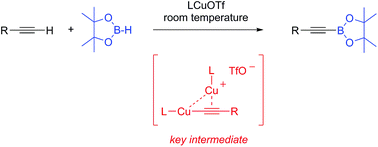
The transition-metal-free hydroboration of various alkenes with pinacolborane (HBpin) initiated by tris[3,5-bis(trifluoromethyl)phenyl]borane (BArF3) is reported. The choice of the boron Lewis acid is crucial as the more prominent boron Lewis acid tris(pentafluorophenyl)borane (B(C6F5)3) is reluctant to react. Unlike B(C6F5)3, BArF3 is found to engage in substituent redistribution with HBpin, resulting in the formation of ArFBpin and the electron-deficient diboranes [H2BArF]2 and [(ArF)(H)B(μ-H)2BArF2]. These in situ-generated hydroboranes undergo regioselective hydroboration of styrene derivatives as well as aliphatic alkenes with cis diastereoselectivity. Another ligand metathesis of these adducts with HBpin subsequently affords the corresponding HBpin-derived anti-Markovnikov adducts. The reactive hydroboranes are regenerated in this step, thereby closing the catalytic cycle.

Scrambled puzzle: Unlike B(C6F5)3, the rarely used boron Lewis acid BArF3 (ArF=3,5-bis(trifluoromethyl)phenyl) initiates the catalytic hydroboration of various alkenes with pinacolborane. No assistance of an external base is required. An unexpected mechanism accounts for this striking reactivity difference leading to a cis-selective hydroboration as opposed to typical Lewis acid-catalyzed hydrometalation reactions.

Activation of SO2 by the donor-stabilized bis(guanidinato)silylene [iPrNC(NiPr2)NiPr]2Si (7) leads to the six-coordinate sulfitosilicon(IV) complex 12 (obtained by treatment of 7 with 1.5 molar equivalents of SO2 in n-hexane) or the six-coordinate dithionitosilicon(IV) complex 13 (a co-crystallizate of cis-13 and trans-13; obtained by treatment of 7 with a vast excess of liquid SO2). Compounds 12 and 13 were characterized by elemental analyses, crystal structure analyses, and multinuclear NMR spectroscopic studies in the solid state and in solution. The six-coordinate silicon(IV) complexes 12, cis-13, and trans-13 represent very rare examples of main-group element compounds with an O,O-chelating sulfito or dithionito ligand.

Activation of SO2 by the donor-stabilized bis(guanidinato)silylene 1 leads to the six-coordinate sulfitosilicon(IV) complex 2 or dithionitosilicon(IV) complex 3 (co-crystallizate of cis-3 and trans-3). Compounds 2 and 3 represent very rare examples of main-group element compounds with an O,O-chelating sulfito or dithionito ligand.
The hydroboration of phosphaalkynes with Piers’ borane (HB(C6F5)2) generated unusual phosphaalkenylboranes [RCH=PB(C6F5)2]2 that persisted as dimers in both solution and the solid state. These P2B2 heterocycles underwent ring opening when subjected to nucleophiles, such as pyridine and tert-butylisocyanide, to yield monomeric phosphaalkenylborane adducts RCH=PB(C6F5)2(L). DFT calculations were performed to probe the nature of the interaction of phosphaalkynes with boranes.

Phosphaalkynes were shown to undergo hydroboration with HB(C6F5)2, yielding P2B2 dimeric species that were characterized by solution and solid-state methods. Rationale for the unexpected regiochemical outcome of this reaction was provided through DFT calculations. These inorganic heterocycles were treated with donors (pyridine and tert-butylisocyanide) and the corresponding monomeric phophaalkenylborane adducts were formed.


Open Access  This article is licensed under a Creative Commons Attribution 3.0 Unported Licence.