08 May 22:10
by Felix M. Mück, Johannes A. Baus, Anna Ulmer, Christian Burschka, Reinhold Tacke
Abstract
To get more information about the reactivity profile of the donor-stabilized guanidinatosilylene [ArNC(NMe2)NAr]Si[N(SiMe3)2] (1; Ar = 2,6-diisopropylphenyl), a series of test reactions was studied. Thus, treatment of 1 with Me3SiN3, (PhO)2P(O)N3, PhC(O)Ph, Me–C≡C–C≡C–Me, Ph–C≡C–C≡C–Ph, CO2, CS2, ZnCl2, or ZnEt2 yielded the respective products 9–17, all of which were characterized by elemental analyses, NMR spectroscopic investigations in the solid state and in solution, and single-crystal X-ray diffraction studies. The formation of compounds 9–17 is based on oxidative addition reactions (for 9–15) or Lewis acid/base reactions (for 16 and 17). In most cases, these typical silylene reactions are coupled with additional reactivity facets, which are correlated with the guanidinato or bis(trimethylsilyl)amido ligand of 1. According to these studies, silylene 1 proved to be a very useful building block with high synthetic potential for the preparation of new silicon(IV) and silicon(II) compounds, with quite novel structural motifs.

The silylene [DippNC(NMe2)NDipp]Si[N(SiMe3)2] (Dipp = 2,6-diidopropylphenyl) proved to be a very useful building block with a high synthetic potential for the preparation of new silicon(IV) and silicon(II) compounds (see examples 1–9).
08 May 22:02
by Yile Wu, Liu Liu, Jue Su, Jun Zhu, Zhe Ji and Yufen Zhao

Organometallics
DOI: 10.1021/acs.organomet.6b00187

01 May 21:33
by Adrian C. Stelzer, Peter Hrobárik, Thomas Braun, Martin Kaupp and Beatrice Braun-Cula

Inorganic Chemistry
DOI: 10.1021/acs.inorgchem.6b00462

01 May 18:14
Dalton Trans., 2016, 45,5925-5928
DOI: 10.1039/C5DT02887F, Communication
David R. Carbery, Michael S. Hill, Mary F. Mahon, Catherine Weetman
A sterically demanding N-aryl carbodiimide reacts with magnesium 1,4-dihydropyridides to initiate heterocyclic ring contraction and pyrrolide formation under unprecedentedly mild conditions.
The content of this RSS Feed (c) The Royal Society of Chemistry

17 Apr 19:44
by Jiawei Chen, Laura Falivene, Lucia Caporaso, Luigi Cavallo and Eugene Y.-X. Chen

Journal of the American Chemical Society
DOI: 10.1021/jacs.6b01497

13 Mar 19:09
by Yuanhong Ma, Baoli Wang, Liang Zhang and Zhaomin Hou

Journal of the American Chemical Society
DOI: 10.1021/jacs.6b01349

06 Mar 12:53
by Zhenbo Mo, Arnab Rit, Jesús Campos, Eugene L. Kolychev and Simon Aldridge

Journal of the American Chemical Society
DOI: 10.1021/jacs.6b01170

21 Feb 19:27
by Valerio Fasano, James E. Radcliffe and Michael J. Ingleson

ACS Catalysis
DOI: 10.1021/acscatal.5b02896

14 Feb 22:24
by Dominika N. Lastovickova and Christopher W. Bielawski

Organometallics
DOI: 10.1021/acs.organomet.5b00997

13 Feb 19:30
by Wei-Chun Shih, Weixing Gu, Morgan C. MacInnis, Samuel D. Timpa, Nattamai Bhuvanesh, Jia Zhou and Oleg V. Ozerov

Journal of the American Chemical Society
DOI: 10.1021/jacs.5b11706

13 Feb 19:24
Chem. Sci., 2016, 7,3384-3389
DOI: 10.1039/C5SC04798F, Edge Article

Open Access
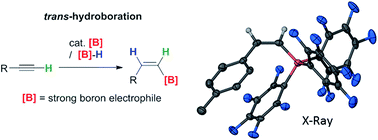
John S. McGough, Samuel M. Butler, Ian A. Cade, Michael J. Ingleson
Transition metal free alkyne trans-hydroboration is achieved using strong boron electrophiles in the presence of a B-H moiety.
The content of this RSS Feed (c) The Royal Society of Chemistry

09 Dec 21:58
by Max M. Hansmann, Rebecca L. Melen, Matthias Rudolph, Frank Rominger, Hubert Wadepohl, Douglas W. Stephan and A. Stephen K. Hashmi

Journal of the American Chemical Society
DOI: 10.1021/jacs.5b09311

30 Aug 22:18
by Antoine Simonneau

Nature Chemistry.
doi:10.1038/nchem.2329
Authors: Antoine Simonneau & Martin Oestreich
Cyclohexa-2,5-dien-1-yl groups bound to silicon act as masked Si–H bonds that can be released by the action of tris(pentafluorophenyl)borane (B(C6F5)3). In this way, hazardous SiH4 is unleashed from appropriately substituted precursors and engages in alkene hydrosilylation promoted by the same boron catalyst. The overall process is a transfer hydrosilylation of alkenes with monosilane.
09 Aug 21:41
by Emily J. Thompson, Louise A. Berben
Abstract
Environmentally sustainable hydrogen-evolving electrocatalysts are key in a renewable fuel economy, and ligand-based proton and electron transfer could circumvent the need for precious metal ions in electrocatalytic H2 production. Herein, we show that electrocatalytic generation of H2 by a redox-active ligand complex of Al3+ occurs at −1.16 V vs. SCE (500 mV overpotential).

Two in one: Proton and electron transfer by a complex comprising Al3+ and a redox-active iminopyridine ligand promotes electrocatalytic H2 evolution. The Al3+ center brings the reduction potential of the ligand into an accessible range for low-overpotential proton production. The proposed mechanism involves two protonation events at the ligand and a subsequent two-electron reduction to liberate hydrogen (see figure).
05 Jul 12:54
Chem. Sci., 2015, 6,5617-5622
DOI: 10.1039/C5SC01309G, Edge Article
Open Access
Olga Ekkert, Andrew J. P. White, Harold Toms, Mark R. Crimmin
We report the addition of M-H bonds (M = Al, Zn, Mg) to a Rh(III) intermediate generated from the reductive elimination of triethylsilane from [Cp*Rh(H)2(SiEt3)2].
The content of this RSS Feed (c) The Royal Society of Chemistry

05 Jul 12:53
Chem. Sci., 2015, 6,5719-5728
DOI: 10.1039/C5SC02086G, Edge Article
Open Access
Marina Uzelac, Alberto Hernan-Gomez, David R. Armstrong, Alan R. Kennedy, Eva Hevia
Using two alternative methodologies, new light has been shed on the stability and rational formation of abnormal NHC-gallium complexes.
The content of this RSS Feed (c) The Royal Society of Chemistry

05 Jul 09:03
by Tatsuya Suzuki, Yuko Wasada-Tsutsui, Takahiko Ogawa, Tomohiko Inomata, Tomohiro Ozawa, Yoichi Sakai, Michael D. Fryzuk and Hideki Masuda

Inorganic Chemistry
DOI: 10.1021/acs.inorgchem.5b00536

28 Jun 21:57
by Thomas Zell and David Milstein

Accounts of Chemical Research
DOI: 10.1021/acs.accounts.5b00027

28 Jun 21:52
by Mattia Veronelli, Sebastian Dechert, Serhiy Demeshko and Franc Meyer

Inorganic Chemistry
DOI: 10.1021/acs.inorgchem.5b00898

28 Jun 21:50
by Igor E. Soshnikov, Nina V. Semikolenova, Konstantin P. Bryliakov, Vladimir A. Zakharov, Wen-Hua Sun and Evgenii P. Talsi

Organometallics
DOI: 10.1021/acs.organomet.5b00263

14 May 15:33
by Johannes Brand, Holger Braunschweig, Rian D. Dewhurst, Florian Hupp, Katharina Lang
Abstract
The first iminoboryl complex with a non-phosphine donor ligand has been isolated and fully characterized. The structural and spectroscopic parameters of the PtII complex, which bears one phosphine and one N-heterocyclic carbene ligand, suggest that the Pt center backdonates less to the iminoboryl ligand than in conventional (iminoboryl)bis(phosphine) complexes, despite the presence of a strongly σ-donating NHC ligand. This iminoboryl complex was found to undergo facile hydroboration with catecholborane, leading to an N-borylated hydroboryl complex.

The first iminoboryl complex with a non-phosphine donor ligand has been isolated and fully characterized. This iminoboryl complex was found to undergo facile hydroboration with catecholborane, leading to an N-borylated hydroboryl complex.
04 May 21:06
by Yuzhong Wang

Nature Chemistry.
doi:10.1038/nchem.2234
Authors: Yuzhong Wang, Mingwei Chen, Yaoming Xie, Pingrong Wei, Henry F. Schaefer, Paul von R. Schleyer & Gregory H. Robinson
Molecular SiO2 and other simple silicon oxides have remained elusive despite the importance of silicon dioxide materials in advanced electronic devices. Clusters Si2O3 and Si2O4 have now been experimentally realized by direct oxidation of a carbene-stabilized disilicon using N2O and O2, respectively.
27 Mar 15:56
Chem. Commun., 2015, 51,7128-7131
DOI: 10.1039/C5CC01772F, Communication
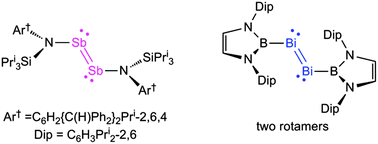
Deepak Dange, Amelia Davey, Joseph A. B. Abdalla, Simon Aldridge, Cameron Jones
The first examples of an amido-distibene and a boryl dibismuthene (see picture) have been prepared by reaction of a lithium boryl complex with extremely bulky amido-group 15 dihalide precursor compounds.
The content of this RSS Feed (c) The Royal Society of Chemistry

27 Mar 15:49
Chem. Commun., 2015, 51,7741-7744
DOI: 10.1039/C5CC00331H, Communication
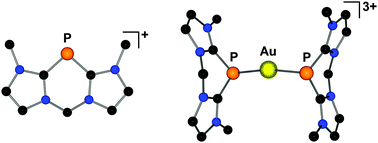
Justin F. Binder, Ala'aeddeen Swidan, Martin Tang, Jennifer H. Nguyen, Charles L. B. Macdonald
Treatment of triphosphenium precursors with bidentate bis-N-heterocyclic carbenes generates remarkably stable phosphamethine cyanine dyes with useful chemical and physical properties.
The content of this RSS Feed (c) The Royal Society of Chemistry

26 Feb 11:14
by Hiroki Minami, Tatsuo Saito, Chao Wang, Masanobu Uchiyama
Abstract
We present a direct cross-coupling reaction between arylaluminum compounds (ArAlMe2⋅LiCl) and organic halides RX (R=aryl, alkenyl, alkynyl; X=I, Br, and Cl) without any external catalyst. The reaction takes place smoothly, simply upon heating, thereby enabling the efficient and chemo-/stereoselective formation of biaryl, alkene, and alkyne coupling products with broad functional group compatibility.

All in Al: Simply heating an arylaluminum (ArAlMe2⋅LiCl) and an organic halide RX (R=aryl, alkenyl, alkynyl; X=I, Br, Cl) without any external catalyst results in a smooth and direct cross-coupling reaction taking place. This approach enables the efficient, chemo-/stereoselective formation of coupling products with broad functional group compatibility.
23 Feb 22:38
by Haixia Li and Michael B. Hall

ACS Catalysis
DOI: 10.1021/cs501875z

07 Feb 23:44
Chem. Sci., 2015, 6,2559-2574
DOI: 10.1039/C4SC03939D, Edge Article
Open Access
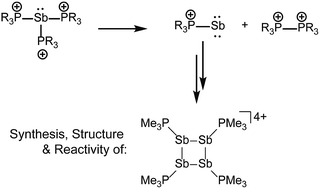
Saurabh S. Chitnis, Alasdair P. M. Robertson, Neil Burford, Jan J. Weigand, Roland Fischer
Reactions of trialkylphosphines with antimony(III) triflates yield catena-antimony(I) cations revealing a new reductive elimination/oxidative coupling reaction for P-Sb coordination complexes.
The content of this RSS Feed (c) The Royal Society of Chemistry

31 Jan 16:42
by Manuel Kapitein, Carsten von Hänisch
Abstract
Monomeric N-heterocyclic carbene (NHC)-stabilized compounds (IMes)R2MP(H)SitBuPh2 (2: M = Al, R = Et; 3: M = Ga, R = Et; 4: M = Ga, R = iPr; 5: M = In, R = Et) have been prepared in moderate yields through the cleavage of four-membered metal phosphine rings like [iPr2GaP(H)SitBuPh2]2 (1) described herein. These compounds were isolated and characterized by means of X-ray crystallographic analysis as well as NMR spectroscopy. On this basis the structural properties, specifically the M–P bond lengths and CNHC–M–P angles, are discussed and compared to literature-known compounds insofar as possible. Proceeding from the cis setting between the phosphorus-bound hydrogen and the metal-bound organic substituent with very low torsion angles, which result in a nearly coplanar arrangement, the results of thermally induced elimination reactions are described. Further, the resulting heterocubane structures 6 and 7 are described.

A series of new N-heterocyclic carbene (NHC)-stabilized monomeric metal silylphosphanides of aluminium, gallium and indium were characterized through single-crystal X-ray diffraction and their structural and thermal properties are described.
27 Jan 13:34
by Melanie W. Lui, Christian Merten, Michael J. Ferguson, Robert McDonald, Yunjie Xu and Eric Rivard

Inorganic Chemistry
DOI: 10.1021/ic5029838

14 Jan 22:21
by Wei Zhao, Patrick K. Yan and Alexander T. Radosevich

Journal of the American Chemical Society
DOI: 10.1021/ja511889y