Well, I can share here. 3qd is one of my favourite feeds for intelligent long form writing. Recommended!
Dear Reader,
I am not particularly against Facebook and actually use it myself to keep in touch with far-flung family and friends. But there is no doubt that in the last five years many smaller websites and the majority of blogs have been killed off by what some people are calling the “Facebook Effect”. Many people find Facebook (and also Twitter, of course) so addictive that they spend too much time on it looking at cat videos (which I like too!) and whatever else their newsfeeds throw at them, and then they feel guilty about spending any more time online and in this way audiences for smaller, more serious sites like 3QD inexorably shrink. We have seen only a small reduction in our readership and have so far avoided turning into what the Japanese call ishikoro: the blogs or websites which have fallen into neglect or are completely abandoned.
If you like 3QD, please help us grow our audience by taking a few minutes to recommend us to your friends by email and by social media (yes, we might as well try to use the same media that is hurting us to get the word out). You could send this link to our “About Us” page which explains what we do: “https://www.3quarksdaily.com/about-us”. Please just do that now, will you?
If you loved this comic you may want to check out the companion Dossier I made about it on Patreon!
It’s full of extras like: sources of inspiration, further secrets of the story world and even a playlist.
New paintings by Jakarta-based artist Elicia Edijanto inspired by her love for nature. Using mostly black watercolor, she tries to create unique works to "remind us of how human-nature relationships are supposed to be: beautiful, harmonious, and living side by side." Her subjects are often "children and animals because they are honest, sincere, unprejudiced and unpretentious," and that they express a particular mood or atmosphere such as tranquility, solemnity, and also wildness and freedom.
See more of Elicia Edijanto's work on Behance or at her website.
All Leslie Du Preez wanted was to add a little tranquillity to her small southern Queensland farm.
"We got these beautiful geese and thought they'd be a wonderful addition to our beautiful zen-like property," she said.
It did not go to plan.
"They terrorised our poor sheep, they made little kids cry. The roosters got pecked and the peacock's tail feathers got pulled out by them. There was no peaceful free-ranging and having a good time. It was mayhem."
So Leslie posted an ad on Facebook:
"I decided honesty was the best policy and it went a little bit viral."
NEW HOME URGENT
We have a small flock of 5 geese. 3 males and 2 females that we need to rehome.
WARNING They are arseholes!!!
A few hours later, she checked on her post.
"I got a bit shocked after a couple of hundred people had shared it, and there were comments that had us in hysterics of people's horrible geese stories," she said.
"We are not strong enough for this. So if you think a couple of cute fluffy geese would suit your needs please PLEASE PLEEEEEEEASE come get them. Bring help and a large box. Don't be fooled by their cute little beady eyes. They stare deep into your soul and know all your fears.
"I asked for $50 and a bottle of scotch, so we could have a drink and relax when they finally leave," Ms Dupreez laughed.
Most dictionaries I consulted classify "arsehole" as vulgar and offensive, but I always thought of it as a jocular, watered-down version of another word.
I've seen "arsehole" used in combination with "gobshites", which I also thought of as jocular. Even BBC tolerates it when used in moderation:
The Oxford Word of the Year is a word or expression chosen to reflect the passing year in language. Every year, the Oxford Dictionaries team debates over a selection of candidates for Word of the Year, choosing the one that best captures the ethos, mood, or preoccupations of that particular year. The 2018 Oxford Word of the Year is: toxic.
It is the sheer scope of the word’s application that has made toxic the stand-out choice for the Oxford Word of the Year. Here, Jean Lipman-Blumen, the author of The Allure of Toxic Leaders, reflects on the lure of following toxic leaders.
School shootings, terrorism, cyberattacks, and economic downturns open the door to toxic leaders. Small wonder these dangerous, seductive leaders attract followers worldwide. Toxic leaders typically enter the scene as saviors. They promise to keep us safe, quell our fears, and infuse our lives with meaning and excitement, perhaps, even immortality. Yet, as history grimly attests, they routinely leave us far worse off than they found us.
We are most vulnerable to toxic leaders when our sense of safety lies at low ebb. Leaders who vow to make us “great again” may actually create, not simply exacerbate, our anxieties. Their grandiose illusions require only the simplest response: total acquiescence. That is the tip off, the smoking gun. Still, their seductive offers usually prove irresistible.
The temptation to follow toxic leaders has deep roots, first, in our existential anxiety, the knowledge that, inevitably, we all physically die. We struggle mightily to ignore that inexorable clock ticking deep inside us. Yet, when cascading massacres and other crises assault our senses, we taste our own mortality. “Active shooters” and exploding packages are just the latest entries in a growing catalogue of death-dealing disasters that stir our existential anxiety.
Predictably, toxic leaders step forward to reassure us that they alone can avert our “appointment in Samarra,” annihilate our human “enemies,” and assuage our social disadvantages—but only if we pledge allegiance to their flag.
A second and related root of our vulnerability to toxic leaders feeds on our deep hunger for meaning and intensity in our lives. This yearning increases our vulnerability to toxic leaders’ promises of an exhilarating existence, etched forever in human memory. We can console ourselves about the prospect of physical death if an intense life opens the door to immortality. As Napoleon knew so well, “There is no immortality but the memory that is left in the minds of men.”
In their call to arms, toxic leaders identify the “Other,” whom we must vanquish to satisfy these needs. Naming the “enemy” not only explains our discontent. It also ignites fierce emotions that goad us on: anger, hatred, distrust, envy, even greed. Meaning and intensity fuse.
In our ordinary lives, we all live intensely at key moments: the birth of a child, the loss of a loved one, the discovery of love. Toxic leaders, however, guarantee us incessant intensity, heated by a flame of fury, hostility, and revenge. They continue to feed that fire until it engulfs not only the despised “Other,” but the followers, and, eventually, even the toxic leader. That followers, themselves, face dangers large and small from toxic leaders is evident in the number of loyalists’ lives lost, careers curtailed, and resources ravaged.
A third deep root of our “fatal attraction” to toxic leaders: by supporting them, we become “the Chosen,” special individuals, sheltered within the privileged “center of action.” Within that sacred space, key decisions are shaped—mostly in our favor. Even when we are not part of the toxic leader’s inner circle, our dedication to that vision anoints us as valued members of “the base.” The catch: as “the Chosen,“ we feel compelled to squelch any rising doubts, much less act upon them, lest we face eviction from the Garden of Eden. Witness the steady stream of ousted White House staff whose slightest deviations have pushed them outside looking in.
What effective countermeasures, if any, can we take?
Most importantly, we can face up to our fears and stare them down. Confronting anxiety stimulates both resilience and creativity. As psychologist Kurt Lewin noted, this exposes us to change, prompting us to experiment, learn, and innovate still more. Innovation, itself, seasons life with fervor. Galvanized to invent novel solutions, we create new institutions that reduce our fears. And, ironically, acting despite our anxiety takes courage, the active ingredient in true heroism, the one real path to immortality.
Next, we can seek “dis-illusioning” leaders, who shatter our illusions, forcing us to face reality, opening the door to self-reliance, confidence, and growth. “Dis-illusioning” leaders teach us to engage in the “valuable inconvenience of leadership,” that is, sharing the hardships of leadership and developing our “leader within.” These tough-minded leaders demonstrate that, far from being the privilege of a select few, leadership is the responsibility of us all, whereby we learn to shoulder life’s burdens with strength and grace.
One more weapon against toxic leaders: select—or better yet—become a “connective leader.” These valuable leaders easily identify even the slimmest mutuality in conflicting agendas of diverse, but interdependent, groups. They help us see ourselves “completed”—not diminished—by our connection to others, as the Nguni Bantu concept of “Ubuntu” suggests. Connective leaders enable us to reject the “we/they” dichotomy, opening possibilities for comradeship, collaboration, and even more creativity. By becoming our most complete selves, we find the intensity and meaning we’ve been seeking.
Living as connective leaders, we engage in enterprises devoted to the common good, beneficial and supportive to all—like global, enduring, and sustainable peace. As “complete” persons, we can join with others to live intensely, with purpose, and possibly—just possibly—set the world on a better trajectory. Combined, these strategies offer strong defenses against toxic leaders.
The choice is ours. The time is now.
Featured image credit: Photo by rob walsh. Public domain viaUnsplash.
An artwork created by Paris-based art collective Obvious using artificial intelligencehas been sold at Christie’s auction house in New York for nearly half a million dollars.
The AI painting, titled Portrait of Edmond de Belamy, sold for for $432,000 (£337,000) – more than 40 times the estimated selling price of $7,000 to $10,000.
Christie’s became the first auction house to put an artwork generated by an algorithm under the hammer, when the abstract portrait was sold by the company’s New York branch.
In this Overview, 25 airplanes are parked in a cluster at the Southern California Logistics Airport in Victorville, California. Also known as Victorville Airport, it is home to Southern California Aviation, a large transitional facility for commercial aircraft. No commercial passenger services are offered at the airport except for fixed-based operator and charter flights.
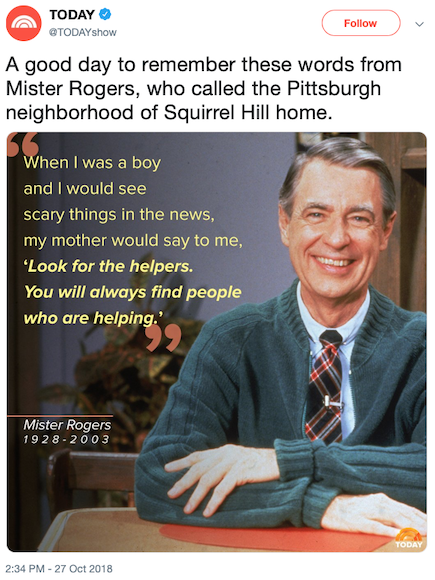
After the senseless calamity of a mass shooting, people seek comforts—even small ones—in the face of horror. One of those small comforts has come to be Fred Rogers’s famous advice to look for the helpers. “When I was a boy and I would see scary things in the news,” Rogers said to his television neighbors, “my mother would say to me, ‘Look for the helpers. You will always find people who are helping.’”
And so it was no surprise when “Look for the helpers” reared its head again after a gunman killed 11 people and wounded six others in a Pittsburgh synagogue on Saturday. Not just because the shooting marked another tragedy in America, but also because Rogers, who died in 2003, was a longtime resident of the Squirrel Hill neighborhood, where the synagogue is located. It’s as if all the other crimes and accidents in which Fred Rogers has been invoked were rehearsing for this one. “A Massacre in the Heart of Mr. Rogers’ Neighborhood,” reads the headline of Bari Weiss’s New York Times column on the slaughter.
Once a television comfort for preschoolers, “Look for the helpers” has become a consolation meme for tragedy. That’s disturbing enough; it feels as though we are one step shy of a rack of drug-store mass-murder sympathy cards. Worse, Fred Rogers’s original message has been contorted and inflated into something it was never meant to be, for an audience it was never meant to serve, in a political era very different from where it began. Fred Rogers is a national treasure, but it’s time to stop offering this particular advice.
Mister Rogers’ Neighborhood aired from 1968 to 2001, and it continues to run in syndication and on streaming services today. It was intended for preschoolers, which means that anyone who had kids under age 5 and owned a television, and anyone who was a child of that age since then, probably became neighbors with Mr. Rogers. That covers just about the entire U.S. population, which explains why the man and his show are so recognizable. The program’s ubiquity also speaks to the applicability of the “Look for the helpers” idea—it’s easy to quote or cite on-air or online, and it binds people of many generations and walks of life in tender recognition.
But it was never meant to do that much work. Rogers was an expert at translating the complex adult world in terms kids could understand: a grown-up emissary to a children’s nation. “Look for the helpers” was advice for preschoolers. But somehow, when it got transformed into a meme, the sentiment was adopted by adults as if they were 3-year-olds.
One of the “Look for the helpers” tweets posted on the day of the Pittsburgh synagogue massacre.
It’s a powerful notion for kids, especially very young ones. Fred Rogers Productions maintains a resource for parents on talking to children about tragic events that explains why. Children are small and fragile. They rely on adults for almost everything, from daily care to emergency rescue. “Look for the helpers” is a tactic that diverts a child’s distress toward safety.
Even for preschoolers, it was never meant to be used alone. On the part of the Fred Rogers website about tragic events, “focusing on the helpers” appears among an eight-bullet list of tips. It also advises parents to turn off the television, maintain regular routines, and offer physical affection. Not only was this advice meant for children; it was intended as part of a holistic approach to managing a small child’s worry during a crisis.
Seen in this context, to extract and deploy “Look for the helpers” as sufficient relief for adults is perverse, if telling. Grown-ups sometimes feel as helpless as children, and on the internet, where this meme mostly proliferates, distressed social-media posts, futile emoji, and forlorn crowdfunding campaigns have taken the place of social and political action. Which isn’t to say that that sort of action is easy to carry out anymore. For a populace grappling with voter suppression, wealth inequality, and the threat of a police state, among other perils, it’s not always clear how citizens can effect change in their communities and their nation. Ironically, when adults cite “Look for the helpers,” they are saying something tragic, not hopeful: Grown-ups now feel so disenfranchised that they implicitly self-identify as young children.
Among critics of “Look for the helpers” as a meme, a common objection is that just looking for the helpers is insufficient, at least for adults. Instead, you’re supposed to strive to “be a helper,” a variation on the original that’s almost become its own meme.
But that assumes anyone knows who counts as a “helper” anymore.
Rogers attributed the line to his mother, who probably gave him the advice during the 1930s. Things were difficult then, but tragedy came in a different form. Illness and death, natural disaster, economic despair, and, soon enough, global war. In all these cases, there remains some clear line between a threat and its relief.
Those matters would complicate themselves in the 1960s and beyond, when Mr. Rogers’ Neighborhood entered its heyday. The show addressed current events, in its own way, from violence to segregation to war. But even in the 1980s, when the Cold War still raged, threats like tornadoes still preoccupied “Look for the helpers” wisdom.
Fred Rogers diligently refined the language he used on his show, transforming simple but ambiguous ideas into polished, sophisticated ones that take children’s lives into account. It is dangerous to play in the street would become Your favorite grown-ups can tell you where it is safe to play. It is important to try to listen to them, and listening is an important part of growing. In that example, your favorite grown-ups accounts for all sorts of circumstances, from guardians who are not parents to authorities the child trusts for established reasons. It’s a genius phrase, and classic Fred Rogers fare.
“Helpers” is a similar one. It covers official authorities like police and firefighters, but also laypeople like bystanders and Good Samaritans.
Even so, it seems that Rogers meant the term to refer mostly to trained service professionals in a position of authority. In a 1986 newspaper column about the helpers concept, Rogers was still leaning on natural disasters as the paradigm for terror, and on childhood memories of newspapers, radios, and newsreels that fomented fear. In a 1999 interview with the Television Academy Foundation, Rogers clarified the idea more, talking about the people “just on the sidelines” of a tragedy. His hope was that media might show actors like “rescue teams, medical people, anybody who is coming in to a place where there’s a tragedy.”
This wisdom should have felt a little romantic in its aspirations, even in the 1980s and ’90s. Who “helps” avert global nuclear catastrophe, or climate change, for example? But today, the idea of helpers on the sidelines of horrific disasters isn’t just quaint. It’s dangerous.
After the Pittsburgh attack, President Donald Trump told reporters that the Tree of Life synagogue should have “had protection in mind,” by which he probably meant armed guards, or “good guys with guns.” Never mind the fact that the shooter had wounded four police officers during the standoff, thanks in part to the semiautomatic rifle with which he was reportedly armed. Those who advocate for guns everywhere see gunmen as the “helpers.” Those who do not construe the people who would limit access to them, or who would curtail domestic terrorism and white supremacy, as the “helpers” instead. The conflict over who gets to count as a helper is a complex amalgam of political and social conditions. But unfortunately, adapting Fred Rogers’s concept for the universe of kids to the world of adults allows any speaker’s favorite notion of “help” to fill in the blank.
The suspect himself, a man named Robert D. Bowers, appears to have construed his own actions as heroic rather than villainous. Bowers reportedly shouted “All Jews must die” before opening fire at Tree of Life. He advanced conspiracy theories about a Jewish incursion of government and society, including the false idea that the Hebrew Immigrant Aid Society, a humanitarian nonprofit, was funded by George Soros to import immigrants for violence. On Fox News, Lou Dobbs gave prominent airtime to an advocate of this view the same day as the synagogue massacre. And Trump has spread similar fears about criminal incursions by immigrants, not to mention other angry falsehoods. Bowers, Trump, Dobbs, and others all consider themselves “the helpers.” For those who want to look for them—or to be them—in a time of crisis, ideas of help and harmful actions are dangerously conflated.
Fred Rogers has a saintlike legacy for good reason. He touched people of all backgrounds and faiths. He modeled goodness and character. But his was never a gospel for grown-ups. It was designed for children, and entrusted to adults to carry out with kids’ interests in mind. (His attempt at a show for adults failed.)
We must stop fetishizing Rogers’s advice to “look for the helpers” as if it had ever been meant for us, the people in charge—even in moments when so many of us feel powerless. As an adult, it feels good to remember how Mr. Rogers made you feel good as a child. But celebratingthatfeelingas adults takes away the wrong lesson. A selfish one. We were entrusted with these insights to make children’s lives better, not to comfort ourselves for having failed to fashion the adult world in which they must live.
An expansive series by self-taught photographer Peter Stewart that explores the dense urban environments and architecture of Hong Kong's high rise public housing. Similar to Michael Wolf's Architecture of Density series, the images capture the urban fabric of one of the most populated and vertical cities in the world to contend with the lack of lateral space. The soaring buildings focus on the repetition of patterns and form as Hong Kong's population rapidly grows and it's architecture expands along with it.
See more of Peter Stewart's work on Behance or at his website.
I was in Singapore last week and while checking out the sights, I walked into this shopping mall to escape the heat and humidity. As I was headed to the food court section, I stumbled on this digital installation by Japanese art collective teamLab entitled Nature's Rhythm and Strokes of Life. The work consists of a 15m diameter circular lighted rink and a 20m cylinder above consisting of a collection of light points. In the first scene, thousands of fish swim and react to the movement of people on the rink while a flock of birds flies through the cylinder in the air. Each person on the rink has a color, and the nearby fish receive the same color. In the second scene, Spatial Calligraphy is drawn in three dimensions when people stand on the rink giving life to flowers, birds and butterflies. The flowers that bloom changes throughout the year. Simultaneously the calligraphy appears in the cylinder above as a three-dimensional light sculpture of brushstrokes. The work is rendered in real time by a computer program, neither a prerecorded animation nor imagery on loop and the work as a whole constantly changes, never repeating previous states. Fortunately, there was this little kid running around the rink interacting with the work that made it even more special.
Rule #1: Consider carefully before asking, “How are you?”
We all do it. It’s actually one of the few shreds remaining of what used to be called “etiquette.” We all ask the question, and when we are asked we mostly answer, “Fine.” It’s just a social convention.
But when someone is in the throes of an illness that causes fatigue, nausea, fever, chills, soaking sweats, deep pain, and/or death — and that’s just the illness; never mind what the treatments do — well, to say the least, it makes for an awkward conversational opener.
The sick person can go with social convention and just say, “Fine,” but you’ll both know it’s a lie: problematic at best. Or he/she could tell you how she/he really is, but that will inevitably be a complex answer that makes you both late for your next appointment. And let’s face it, you didn’t really want to know, did you? The question slipped out before you thought it through.
Rule #2: Do not underestimate the nobility and wisdom of minding your own beeswax.
Unless you are the physician of record, keep your goddamn medical opinions to yourself. It is not your job to determine what, if any, treatments are appropriate. Especially when said treatments are painful, debilitating, and expensive, and the other choice is pushing up daisies, kindly remember that it is not your life on the line. Even if you feel absolutely sure you would make this or that choice were you in the patient’s shoes, those are in fact the patient’s feet in there, not yours. You don’t know what you would do. Nobody does.
Please do not insist that you know, or know of, a fabulous doctor the patient really should see in a city inconveniently distant from the patient’s residence, because of course the doctors in the patient’s own vicinity can’t possibly be as good as the one that a friend’s friend’s son saw for treatment.
Please do not recommend “must-see” websites.
Likewise please bite your tongue — hard — if tempted to recommend against prescribed treatments. Even if you really, really believe that everything is curable with the right herbs, vitamins, positive thoughts, acupuncture, Tesla coils, and cannabis, keep it to yourself. Save it for your own cancer treatment, should that happy occasion arise.
Rule #3: Try listening with your mouth shut.
Avoid the temptation to tell the story of your great-uncle Fred, who had cancer and was given sixteen rounds of chemo and enough radiation to flash-fry a buffalo, yet lived to the ripe old age of 73. (He was 72 when he got diagnosed, but never mind.) You might think these survival stories are helpful/encouraging, but you shift the burden onto the sufferer to listen attentively to you.
Likewise, do not compare the patient’s circumstance with people you know or know of, who had it so much worse. Your Cousin Tilly lost not only all her hair, but her teeth, tongue, and eyeballs? It may surprise you to learn that nobody, ever, was cheered up by hearing how lucky they are not to be even sicker.
A sick person does not wish to hear about your even-worsities. Broken health is not a race to the bottom of the heap of experiences. A sick person has enough to attend to without having to nod understandingly over your tales of woe, and murmur polite nothings. That’s supposed to be your job.
Rule #4: Avoid euphemisms.
People are generally not as stupid as we like to believe, and a person gazing into the double-barreled shotgun of life-threatening illness knows only too well what he/she is facing. Don’t avoid saying the C word thinking the shock will be too much for them to bear. Believe me, if the doctor has already phoned with biopsy results (and it is never good news when the doctor makes the call), they have already borne more reality than you can dish out.
Do not refer to debilitating illness as a “journey.” Life is a journey. A trip to Italy is a journey. Major illness is a road washout at 55 MPH in the dark with no warning signs.
Do not, puh-leeze, especially in the person’s obituary, cite his/her “courageous battle with cancer.” A person doesn’t endure the debilitating indignities of chemo/radiation/surgery because he/she is brave. A person endures these things because the only alternative is daisy-pushing—it is actually the path of least resistance. Doctors might be doing battle with cancer, but the poor patient is simply the battlefield.
Rule #5: Don’t look on the bright side.
Screw the bright side, when a person’s life has just taken a hard left turn. Don’t say, “I hear that hair grows back better after chemo!” This is, to say the least, cold comfort.
Rule #6: Just because you learn of someone’s misfortune, that doesn’t make it your business.
No media postings! Ill health is personal, private, and in its strange way intimate. Please: no Facebook posts, tweets, blanket emails, or blogs. Do not initiate any Make-A-Wish or Kickstarter campaigns on behalf of the patient, without his/her express consent. Remember that you don’t own this situation, for which you may be grateful indeed.
Rule #7: Leave your religion out of it.
Even if someone shares your faith, count on them not being cheered by the news that their extreme illness is part of God’s plan. For someone who does not share your views this comes as the penultimate, if not the ultimate, in ice-cold comfort. If cancer really is part of God’s Intelligent Design for the world, then ole God needs to go back to the drawing board. This is just not something You should inflict on Your children for whom You are supposed to have such infinite love. (Sounds more like an Abusive Father, really.)
Anyway: don’t go there. Offer to pray, if you feel so moved. But above all don’t carry on as though this wouldn’t have happened if only the patient’s faith had been stronger. And if you dare to say, “Everything happens for a reason,” you deserve a longish term in whatever Hell your religion has to offer.
Rule #8: Thank you for offering to help. What exactly did you offer to help with?
“Call me if there’s anything I can do” is another of those situations where you are placing the onus on the sick person: to keep track not only of whirlwind appointments, medications, side effects, and a staggering array of logistics, but now a list of people, including you, no you are not the only one, who have offered nebulous help. What, exactly, are you capable of and willing to do: Rides? Meals? Housework? Shopping? People with overcrowded brains are more likely to remember specific things, and more likely to believe you really meant it and weren’t just salving your conscience so that you will be able to say, “Well, I offered to help, but they never called me.”
Thank you for your best intentions. Thank you for not wanting to be a twit.
Athelstan Spilhaus designed an oceanic thermometer to fight the Nazis, and the weather balloon that got mistaken for a UFO in Roswell.
In 1942, he produced a world map with a unique perspective, presenting the world's oceans as one body of water.
The Spilhaus Projection could be just what the oceans need to get the attention their problems deserve.
This is a world map unlike any other. Uniquely, it centres on Antarctica. Disturbingly, it rips Asia and the Americas to shreds. And compellingly, it presents the seas and oceans – 71% of the Earth's surface – as a unified body of water.The map was designed by a renaissance man who also invented the skyways of Minneapolis and the secret weather balloon that caused the Roswell Incident. And yet you've never heard of him.
Dr Spilhaus was not
just a distinguished meteorologist and oceanographer, but also a prolific
inventor. During the Second World War, he developed the bathythermograph, a
device for measuring sea temperature at great depth – making it easier to
detect German submarines.
In 1948, he moved
to the Minnesota Institute of Technology in Minneapolis. Perhaps because of the
huge contrast between the harsh local winters and Cape Town's Mediterranean
climate, he conceived of a network of elevated covered walkways between
buildings, sheltering people from severe weather. The Minneapolis Skyway System
is currently 11 miles long, connecting buildings across 80 city blocks.
Following his work on the undersea thermometer, Dr Spilhaus
helped develop a similar system of weather balloons for the Air Force, to spy
on Soviet nuclear testing. When one such balloon crashed in New Mexico in 1947,
the wreckage was whisked away with such speed and secrecy that the rumour mill
went into overdrive. Some today still claim the crashed device was an extra-terrestrial
space ship – the infamous 'Roswell UFO'.
A man of many talents, Dr Spilhaus built some 3,000
varieties of children's toys and for 15 years authored a science-focused,
globally syndicated weekly comic strip called Our New Age. In 1954, Dr Spilhaus became America's first
representative on the executive board of Unesco, the UN's educational and
cultural department. A few years later, president Kennedy appointed him to
direct the U.S. exhibit at the 1962 Seattle World's Fair. "The only science I
ever learned was from your comic strip", JFK told him.
"Population" Our New Age. Text by Athelstan Spilhaus, drawn by Gene Fawcette. First published June 19, 1960
Dr Spilhaus also proposed the establishment of Sea Grant
Colleges – a network of institutes of higher learning focusing on the
exploitation and conservation of marine areas. Which brings us back to the sea,
and to this map.
Designed in 1942 while Dr Spilhaus was working on his
bathythermograph, it reverses the land-based bias of traditional cartographic
projections. The Spilhaus projection – a combination of the Hammer and
Spielmann projections – places the poles of the map in South America and China,
ripping up continents to show the high seas as one interrupted whole.
The
earth-sea is perforated by Antarctica and Australia, and fringed by
the other land masses. Two small triangles, one at the top of the map and the
other on the lower right hand side, mark the same spot: the Bering Strait – as
a reminder that what we're looking at is not in fact a vast inland sea, but a
body of water that circles the entire globe.
On most maps, the oceans are so vast that they become easy
to ignore. Rather than just use them as background noise, this map focuses on
the watery bits of our planet. That's not just a refreshingly different
viewpoint but, it could be argued, also a desperately needed one.
Our oceans
produce between 50% and 85% of the world's oxygen and are a major source of
food for humanity. But they are in mortal danger, from overfishing,
acidification, plastic pollution and climate change. Maritime 'dead zones' –
with zero oxygen and zero marine life – have quadrupled since the 1950s. Low-oxygen zones have increased tenfold. The
trend is fuelled by climate change (warmer waters hold less oxygen) and, in
coastal zones, fertiliser and sewage runoff from the land.
Perhaps this map can do what Earthrise did for the planet as a
whole. Taken in 1966 by astronaut Bill Anders of Apollo 8 – the first manned
mission to circle the moon – that picture shows our planet rising above the
lunar surface, an inversion of the moonrises so familiar to humankind. It's
been called "the most influential environmental photograph ever" because it so
clearly visualises the earth as a single, fragile ecosystem.
Earth rising above the lunar horizon; image taken by Bill Anders of Apollo 8 on 24 December 1968. The land mass visible in the lower right-hand side is northwest Africa.
The oceans need a similarly powerful unifying visual. Even though it's
over 80 years old, this projection reminds us that saving the planet is
pointless if we don't also save the seas.
La Frafrak ('Fraraq'), a compound of France and Iraq – a country with 104 million inhabitants, and a surface just under 1 million km2.
L'Ethiotalie ('Ethiotaly'). This reunion of Italy and its former East African colony Ethiopia would have 163 million inhabitants, and cover 1.4 million km2.
1
L'Etasuxique ('Amerexico'), a fusion of Mex, Tex and four dozen other U.S. states. The combination would be home to 450 million Amerexicans, spread over 11.3 million km2.
















 "Population" Our New Age. Text by Athelstan Spilhaus, drawn by Gene Fawcette. First published June 19, 1960
 Earth rising above the lunar horizon; image taken by Bill Anders of Apollo 8 on 24 December 1968. The land mass visible in the lower right-hand side is northwest Africa.
 La Frafrak ('Fraraq'), a compound of France and Iraq – a country with 104 million inhabitants, and a surface just under 1 million km2.
  L'Ethiotalie ('Ethiotaly'). This reunion of Italy and its former East African colony Ethiopia would have 163 million inhabitants, and cover 1.4 million km2.
 L'Etasuxique ('Amerexico'), a fusion of Mex, Tex and four dozen other U.S. states. The combination would be home to 450 million Amerexicans, spread over 11.3 million km2.