I’ve said this before and I’ll say it again but it is absolutely an example of civilizational inadequacy that only deaf people know ASL
“oh we shouldn’t teach children this language, it will only come in handy if they [checks notes] ever have to talk in a situation where it’s noisy or they need to be quiet”
My mom learned it because she figured she’ll go deaf when she gets old
My family went holiday SCUBA diving once, and a couple of Deaf guys were in the group. I was really little and I spent most of the briefing overcome with the realization that while the rest of us were going to have regulators in our mouths and be underwater fairly soon, they were going to be able to do all the same stuff and keep talking.
The only reason some form of sign language is not a standard skill is ableism, as far as I can tell.
For anyone interested in learning, Bill Vicars has full lessons of ASL on youtube that were used in my college level classes.
CREDIT: Various archival images courtesy of the Smithsonian National Museum of African American History and Culture
In 1863, Abraham Lincoln’s Emancipation Proclamation freed slaves in the United States. For many Americans, this simple statement has been taught to us in grade school for decades. As a young Black girl growing up in Memphis, I remember my teachers teaching this, too. What I was not taught, however, was the FULL story of American slavery and its slow and painful end, even after Lincoln’s Proclamation. At its best, this limited narrative reduces the struggle for Black liberation in America to a singular moment. And at its worst, it perpetuates an incomplete truth that robs every American of understanding what actually happened after slavery was reformed.
Today’s video Doodle, illustrated by Los Angeles-based guest artist Loveis Wise and narrated by actor and activist LeVar Burton, honors the 155th anniversary of Juneteenth. Short for “June Nineteenth,” Juneteenth marks the true end of chattel slavery across the United States— which didn’t actually occur until 1865, two and a half years afterthe Emancipation Proclamation. Specifically, it marks the day when enslaved Black people in Galveston, Texas (one of the westernmost points in the Confederate South) finally received news of their liberation by Union Major General Gordon Granger. He arrived with 1,800 federal troops in order to ensure compliance in Confederate states, many of which continued to defy the executive order years after it was mandated.
I can’t begin to imagine what it must have felt like to wait in anticipation for freedom and then finally hear the words spoken aloud. After recieving the news, the first acts of freedom included locating family members who were sold and shipped off during slavery, legally changing their own names, and creating schools and places to learn, which slaves had been systematically denied before. Couples obtained marriage certificates to form legal union with the person they loved. And later, they built towns like Freedmen's Town in Houston, TX, established universities like Tuskegee in Alabama, and created a Black Wall Street in Tulsa, Oklahoma.
Though widely celebrated by the community in its first years, Juneteenth’s absence in the mainstream U.S. historical narrative has made it an unknown holiday to many for decades. The 1960s Civil Rights Era saw a resurgence in Juneteenth awareness, leading to the creation of today’s two largest Juneteenth celebrations in Milwaukee and Minneapolis. Later in 1979, U.S. Representative Al Edwards introduced legislation in Texas to officially recognize the holiday, making it a state holiday the following year.
Over time, this growing awareness of Juneteenth has led to an exponential growth of events in cities across the nation. These celebrations have included rodeos featuring black cowboys, parades with gorgeous floats, readings of the Proclamation, songs like “Lift Every Voice and Sing,” and much more.
I didn’t grow up celebrating Juneteenth. It wasn’t until I attended Hampton University, a historically Black university in Virginia (and home of Emancipation Oak, the site of the first Southern reading of the Emancipation Proclamation), that I learned about the holiday. I was shocked that schools back home hadn’t taught us about the day and that my family was completely unaware of it.
But my initial disappointment has shifted to optimism as I’ve witnessed a resurgence of this day in the American consciousness. For example, in the past week, Google Search interest in "Juneteenth meaning" spiked +850%, with the most searched query being “What is Juneteenth?” To me, history is a living, breathing, and changing testimony. And now that history can be accessed and shaped in ways generations before would’ve never thought possible.
Today, I hope folks across the nation commemorate Juneteenth by remembering and sharing the stories of those who lived in slavery before us and those who died for our freedom. I hope they celebrate it by creating space for expressions of Black joy and triumph, as well as teaching that June 19, 1865 was just the beginning. I hope they celebrate it by watching today’s Doodle, which aims to reflect how freedom in America is a journey. Even with executive orders, amendments, civil rights bills, and advancements in technology, the struggle to be treated fair and equal continues. And yet, despite all this, Black Americans still remain hopeful. I hope that people can relate to the basic human desire for liberty, equality, and access to opportunities to create a better life for our families and generations that follow.
Juneteenth is an American story about persistence, freedom, and joy no matter the obstacle. May this year's celebration provide an opportunity to honor the progress that's been made and reflect on the important changes that still remain ahead.
“...Now let us march on ‘til victory is won.”
—Angelica McKinley Project Creative Director, 155th Anniversary of Juneteenth Google Doodle
Learn about the historical legacy of Juneteenth with a new exhibit from the Smithsonian National Museum of African American History and Culture onGoogle Arts & Culture.
Commemorate Juneteenth with Google Assistant’s new responses for a variety of Juneteenth questions. Try asking your Assistant-enabled phone, smart speaker, or Smart Display, "Hey Google, what's Juneteenth?" or “Hey Google, Happy Juneteenth.” Today, Google Assistant will also respond with relevant Juneteenth information when you ask, “Hey Google, today in history,”“Hey Google, tell me a fact” or even “Hey Google, how are you?”
Guest Artist Q&A
Today’s Doodle was illustrated by guest artist Loveis Wise, with music produced by Elijah Jamal. Below, they share their thoughts behind the making of this Doodle:
Q: Why was this topic meaningful to you personally?
L: This topic is meaningful to me because it shows the importance of celebrating Juneteenth and shares the history of freedom and liberation of Black folks in America.
E: This represents a monumental moment in my culture that is a reminder of how far we've come as a people.
Q: Did you draw inspiration from anything in particular for this Doodle?
L: I drew inspiration from the stories and traditions passed down to me from my ancestors and how joy often helped us to transmute our pain into powerful change!
E: I had a lot of guidance from the Google team as to what they were feeling about the Doodle. That made it easier for me to give my own interpretation of that feeling. I listened to big bands from that era, Nina Simone, Beyonce, The Clark Sisters, Kendrick Lamar, old Gospel hymns and just used "Lift Every Voice" as my foundation.
Q: What message do you hope people take away from your Doodle?
L: I hope that people can understand the deeper importance of Juneteenth and educate themselves more about Black history. I also hope that they are able to recognize how vital Black Americans have been in building and shaping this country.
E: Hope! We have a long way to go, but with hope, anything is possible.
“When you look at the night sky, you might see a very beautiful star, and you smile at it. But a scientist may tell you that the star is no longer there, that it was extinct ten million years ago. So our perception is not correct. When we see a very beautiful sunset, we are very happy, perceiving that the sun is there with us. In fact it was already behind the mountain eight minutes ago. It takes eight minutes for the sunshine to reach our planet. The hard fact is that we never see the sun in the present, we only see the sun of the past. Suppose while walking in the twilight, you see a snake, and you scream, but when you shine your flashlight on it, it turns out to be a rope. This is an error of perception. During our daily lives we have many misperceptions. If I don’t understand you, I may be angry at you all the the time. We are not capable of understanding each other, and that is the main source of human suffering.”
—Thich Nhat Hanh
iPhone users have created shortcuts that allow Apple’s flagship product to automatically record video, text a location to an emergency contact, and even stop police from entering the phone—just in case the iPhone owner has an interaction with a law enforcement officer.
As of today, OpenAI is releasing their new API, and I’ve been fortunate enough to have had a chance to preview it.
Folks, I’m going to be doing a LOT of posts on this.
Like GPT-2, they used internet text as training data, and it can use that knowledge to look at text you give it and predict what comes next. The new OpenAI API is REALLY good at following all sorts of prompts. Set up the first two lines of a chat and it will stay in character.
Me: Hello, who are you? Bot (I wrote this line for it): Foolish mortal! I am the god of the internet. Me: Prove it. Bot: No need to prove it, you will bow down and worship me and the wonders of the internet. Me: What if I don’t? Bot: Then I shall unleash a bot attack on your computer. Me: Go ahead and try it. Bot: But I told you who I was! You must worship me! Me: Let’s see the bot attack first. Bot: Oh, for the love of… Fine! (insert name of random bot here) attacks you! Me: That… is not a bot attack. Literally nothing happened. Bot: … Seriously? Me: Yeah dude, sorry.
It also is pretty good at style transfer. By giving it a few examples to start out with, I got it to do the following rewriite:
This API is versatile. And one thing it does well is make Twitter bots. For those who are unfamiliar, @dog_rates is a twitter account that posts user-submitted dogs, introduces them, and then gives them a rating from one to ten. All the dogs are rated at least 10/10 because they’re very good dogs.
In the past when people have built bot versions of twitter accounts like @dog_rates, the resulting twitter bots really aren’t that on-topic. The original account usually isn’t consistent enough for the neural net to figure out how to sound like it. But after showing this API just 15 recent quintessential tweets, it was rating dogs convincingly and consistently.
Ok, some of its commentary is a little weird.
(I used artbreeder to manually generate the dog images to go with these tweets)
Because I preceded each of the 15 example tweets with its name and topic, I can even get it to generate tweets with the name and topic of my choosing. Here’s what it did with (Cthulhu, tentacle).
And here’s what it did with (Godzilla, stomp):
What is super impressive about this is how well it copied voice and cadence and then adapted them plausibly to entirely new topics. Why yes, I did do a quick test to see what a twitter bot of myself would look like.
Other programs I’ve worked with can do this to some extent, and I’m sure we’ll be seeing more vigorous testing of this one’s capabilities against some standard benchmarks. And not all of the API’s tweets are usable. For the dog_rates tweets, around 19/20 are reasonable, and the remaining 1/20 are way off-target or even contain drug references. For the janellecfakes tweets, it’s got a less consistent format to follow and maybe 1/3 are entertaining and 1/20 are plausibly something I might tweet. They’re not ready for unsupervised use. But I’m impressed with what I’ve seen so far, and will be building a lot of neat stuff with this.
Bonus material: more AI attempts to introduce and rate dogs. You can enter your email here, and I’ll send them to you.
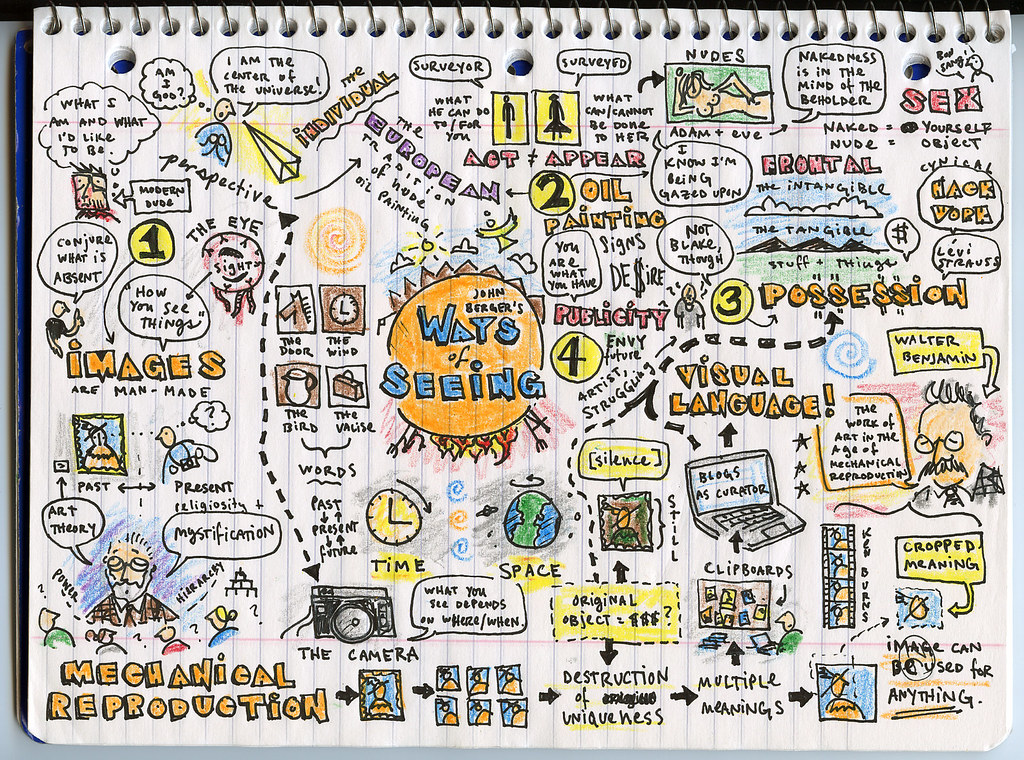
Berger’s book based on the series is one of my favorites. Here’s a map of it I drew of it in 2008, back when I drew other people’s books in stead of my own…
Borders have a simple job: separate different areas from each other.
But they can get complicated fast, as shown by a new book.
Here are a few of the bizarre borders it focuses on.
Simple in theory
What separates us humans from other animals? The use of tools or language? The invention of God or music? The ability to blush? (According to Mark Twain, we're the only animal that can – or needs to). The jury is still out. For a swifter verdict, ask what separates humans from each other. Quite literally, it's borders.
Those borders can be the subtle separators of culture and class; the more tangible distinctions of race and gender; or the physical demarcations between this country and that. The job description for political borders is simple and straightforward enough: draw a line between areas with different rules (and rulers). But, as shown in a new book, those lines are not always straight and simple.
For reasons geographical, dynastic, military or otherwise, things on the ground can get quite complex quite fast. In "The Atlas of Unusual Borders," map enthusiast Zoran Nikolic zooms in on some of the world's most egregious examples of border weirdness. Here are a few samples from the recently published book.
The Cypriot puzzle
Cyprus is a good example of the distance between theory and practice. As an island nation, it shouldn't even have land borders. Yet the small Mediterranean country is riven with borders, establishing four different political entities.
The oldest Cypriot border only goes back to 1960, when the island gained its independence from Britain. The former colonial overlord retained two large military bases, covering a total of 3 percent of the island's territory. Today, Akrotiri and Dhekelia – strategically close to the Middle East – remain under British control.
But while Akrotiri, near the city of Limassol, is a single, contiguous lump of land, Dhekelia, the other 'Sovereign Base Area', seems designed to make life difficult for the Cypriots: a tentacle pokes through in the direction of the island's eastern shore, almost touching Varosia, a former jet set hotspot just south of Famagusta, now a dystopian no man's land. The main body of Dhekelia is dotted with numerous exclaves of Cypriot sovereignty, containing two entire villages and one power station.
Dystopian no man's land? That goes back to 1974, when Turkey invaded, to help Turkish Cypriots set up their own, internationally unrecognised state in the north of the island. The as yet unresolved nature of that conflict is symbolised by the Green Line, separating the official, Greek-majority south of the island from the Turkish Republic of Northern Cyprus – recognised only by Turkey itself. That Green Line is not actually a line, but a UN-administered buffer zone, wide enough to contain the island's former international airport, for example.
The 1974 conflict has also stranded a Turkish-Cypriot coastal town south of the line. Erenköy (in Turkish; Kokkina in Greek), in the west, is a ghost port, a small Turkish garrison its only occupants. In the east, the Green Line intersects with the already complicated borders of Dhekelia, cutting off a large part of Greek Cyprus from its 'mainland'. However, traffic with the rest of Greek Cyprus is possible via Dhekelia, ensuring a steady flow of tourists to Ayia Napa, the exclave's main resort.
Four Corners Canada
Quadripoints, where four political entities touch in a single point, are rare. The last international one was extinguished after World War I. There is a tangle of borders in southern Africa that comes close – but misses the mark by about 300 meters. At the sub-national level, the United States has its famous Four Corners. After a serious trek through the desert, tourists arrive at what must be one of the loneliest attractions in North America: the monument to the meeting point of Colorado, Utah, New Mexico and Arizona.
Well, that attraction has a potential competitor far north. On April 1 1999, when Canada created the territory of Nunavut, it also created a new quadripoint, where the new territory of Nunavut meets the now reduced Northwest Territories, plus the prairie provinces of Saskatchewan and Manitoba. 'Four Corners Canada' already has its monument: the metal marker on the (former) Northwest-Saskatchewan-Manitoba tripoint.
However, pending an official land survey, some doubt remains as to whether the legal definition of Nunavut's border actually aligns with reality. Furthermore, 'Four Corners Canada' is located 1,200 km (725 miles) north by northwest from Winnipeg, which makes it vastly more remote than 'Four Corners USA'. So it's doubtful whether North America's newest quadripoint will ever become a tourist attraction.
Looters and poachers
Russia's most famous exclave is Kaliningrad, the northern half of what used to be East Prussia. After the disintegration of the USSR and the independence of the Baltic states, it got separated from Mother Russia – yet another burden for the fledgling post-communist state. Amid the confusion and economic collapse of the early 1990s, there was even some talk of just selling it back to Germany. No more. A resurgent Russia will no longer tolerate territorial shrinkage. The annexation of the Crimea was a symbol of the turning tide.
So don't expect Russia to give up this little exclave either. Even though, unlike Kaliningrad, it has no strategic value. Sankovo-Medvezhye is a small fragment of Russia misplaced just across its border with Belarus – 35 km east of Gomel, 530 km southwest of Moscow. The two small villages making up the exclave were abandoned after Chernobyl. The population at present is zero.
Most Russians have never even heard of this particular exclave, and it's so small that it's left off most maps. The only people remotely interested in Sankovo-Medvezhye are looters, who by now have stripped both villages of almost anything of value; and poachers, who use the exclave as a sanctuary both from the Belarus authorities, who can't go there; and the Russian ones, who don't bother.
Hamburg-by-the-Sea
Germany is composed of 16 Bundesländer – federal states that typically are big enough to be a small European country on their own, like Bavaria or Brandenburg. Three, however, are Singapore-sized city-states: the capital Berlin, and the North Sea port cities of Hamburg and Bremen – the latter being smallest of all Länder.
Those two rival states are mirror images of each other: proud and ancient trading centers, landlocked in or between larger states, accessible to seagoing vessels via their respective rivers. Bremen has the Weser, Hamburg the Elbe. But zoom in further, as this map does, and they're even more alike.
At the 1815 Vienna Congress, Bremen obtained direct access to the sea in the shape of an exclave called Bremerhaven – big enough to be visible on most maps of Germany. (Actually, Bremen consists of three separate bits of land: Fehmoor is separated from Bremerhaven by a narrow strip of Lower Saxony. But let's not get distracted).
What's not so visible, is that Hamburg too has its own sea enclave. In fact, it has three: islands so small they usually don't appear on any map. Thinking it would need a coastal toehold to develop a deep-draft port, Hamburg acquired Neuwerk (current population: 40) and its uninhabited sister island of Scharhörn after the Second World War.
Those deep-draft plans were eventually shelved, due to cost and environmental protests. A third island, Nigehörn, was created artificially to protect the bird sanctuary on Scharhörn. The three islands are still part of Hamburg, 120 km (75 miles) further up the Elbe, but they are now the anchors of a national park rather than a busy port.
From no man's land to microstate
Never set a border in a river. The river will shift, and then you're stuck with a mess made by two lines meandering all over each other. For some prime examples, check out the U.S. states who trusted the Mississippi to provide a neat and easy demarcation between them.
It gets worse when international borders are involved, as is the case between Croatia and Serbia. Of course, that border wasn't international until Yugoslavia bloodily tore itself apart in the 1990s. Much of that border is formed by the Danube. And both countries have different opinions of how that river should be used to demarcate the border.
Right down the middle, Serbia says. Following old cadastral borders, Croatia maintains. Those cadastral borders follow a previous course of the river, which is why Croatia claims 10,000 hectares on the 'Serbian' side of the river. It also explains why Croatia doesn't claim the 2,000-hectare Siga Island on 'its' side of the Danube – an area not claimed by Serbia either.
And there you have it: terra nullius. That's legalese for No Man's Land. However, like nature, geopolitics abhors a vacuum. Rather than wait or both countries to come to a compromise, various parties have sought to lay claim to the grey zone between them, and proclaimed it to be the Free Republic of Liberland, or the Kingdom of Enclava.
How will this end? While our hearts are with the micro-nationalists trying to do something new here, attempts at secession have generally not gone down well in this part of the world. Get ready to migrate your dreams to cyberspace, Liberlanders. (OK, check!)
Room(s) for the Resistance
About 30 km (20 miles) north of Geneva, La Cure is a small village slap bang on the Franco-Swiss border. Quite literally so: half the village is French, the other half Swiss. The same goes for a bunch of buildings in town: the international border runs right through it.
One of those is the Hotel Arbez, and while that curiosity might have been a selling point for some of its earlier guests – the border passes through the double bed in the honeymoon suite, for example – during the Second World War, it became a major geopolitical fault line. While France was occupied by the Germans, Switzerland stayed neutral, independent and unoccupied.
It is said that during the war, on several occasions the French side of the hotel hosted German soldiers and officers, dining on the fine fare of the hotel's kitchen; while members of the French Resistance stayed in rooms on the Swiss side. Naturally, if the Germans had caught the Resistance fighters on the 'French' side of the hotel, it would have ended in an arrest, or worse: a BBC comedy. But as long as they stayed on the Swiss side, they were untouchable – a very practical benefit of Switzerland's famed neutrality.
A republic of monks
Greece is not one country, but two. The more familiar one, simply called 'Greece', is a medium-sized modern European democracy with its capital in Athens. The other is a religion-based microstate on the easternmost of the three peninsulas of Chalkidiki – the only country in the world inhabited only by men. Its name? Mount Athos.
Named after its highest peak, Athos is sometimes also simply called 'Holy Mountain', because of the 20 monasteries and 2,000 monks on its territory. The monks have been here since the 8th century and have survived centuries of war and occupation (not the exact same monks, obviously). The Greek constitution recognises the Monastic State as a self-governing territory of the Greek state. The governor it sends to Athos is merely an observer.
For Athos is run by a religious council, made up of one representative per monastery. It has an executive body of four members (the 'Holy Administration'), headed by a CEO (the 'protos'). The monasteries attract monks from all over the orthodox world; residence at Athos gets them automatic Greek citizenship. In order not to disturb the contemplative life of the monks, no females are allowed on Athos. This includes female animals, with two exceptions: hens (to lay eggs) and cats (to catch mice; although one suspects the mice are co-eds too).
Where Tasmania meets Victoria
A small island beyond the island-continent's south-eastern shore, Tasmania is Australia's afterthought; Down Under's own Down Under. It is the only state of Australia that is also an island. And yet Tasmania manages to share a land border with Victoria, the southernmost state on the Australian mainland.
It does so entirely by accident. When Tasmania's sea border with Victoria was drawn at a latitude of 39°12' South, it was thought the line crossed open water only. Upon closer inspection, however, the line did cross a tiny island, which an earlier survey had misplaced somewhat.
Too small and barren to be of any other interest, the rock, originally called North East Islet, was rechristened Boundary Islet, and its sole raison d'être now is to be a geopolitical footnote: the only land border of the island state of Tasmania, and the shortest of all land borders between Australian states: all of 85 m (93 yards).
Asterix in the North-West Atlantic
Until the mid-18th century, it was the French who were winning North America. They controlled New Orleans in the south, Acadia in the north, and a vast, unbroken stretch of territory in between. Then the Brits kicked them out of Canada, courtesy of the French and Indian War (1754-63), and the Americans bought the remainder off Napoleon in the Louisiana Purchase (1803).
But did the French give up all their possessions in North America? No! Like Asterix's Gallic village that bravely holds out against the Roman invasion, there is one part of the formerly vast dominion of 'New France' that remains French to this day – St Pierre and Miquelon, two small islands in the North-West Atlantic, 25 km (15 miles) off the coast of Newfoundland (and 3,800 km - 2,350 miles - west of the Metropolitan France).
If it isn't weird enough to find a slice of France stuck on Canada's eastern seaboard, a look at the territory's Exclusive Economic Zone raises eyebrows even further. The EEZ is the part of the sea over which a state has special rights (without having total sovereignty). The size and shape of St Pierre and Miquelon's EEZ was long an object of dispute between Canada and France. In 1992, an international panel granted the islands the EEZ you see on this map. Extremely elongated, the 200 km (125 miles) long, 10 km (6 miles) wide zone has been compared to a key, a mushroom and (perhaps inevitably) a French baguette.
The reason given for the shape is that it would provide a corridor for French ships to have unhindered access to St Pierre and Miquelon from international waters. However, Canada later exercised its right to extend its own EEZ, stranding the baguette within Canadian waters. Game over, you might think; but only if you're not French.
As we know, it typically takes years to develop a vaccine that is approved for wide scale use. For the coronavirus, researchers are trying to speed up that timeline. Jonathan Corum and Carl Zimmer for The New York Times have started a vaccine tracker to keep watch.
They’ve categorized the vaccines by phase and those that are part of Operation Warp Speed. (Earmarked for later: a closer look at government program names.)
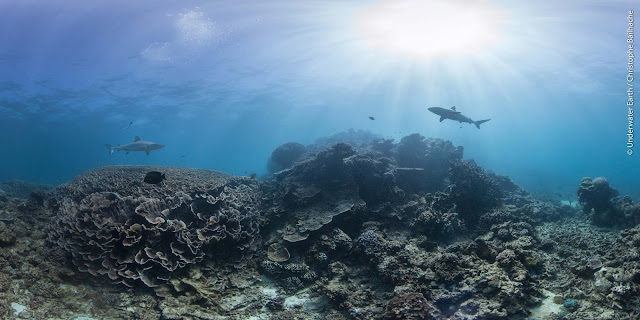
Editor’s note: Today is World Oceans Day, a day when people around the globe celebrate the world’s oceans and the life they sustain. On Australia’s western coast, you will find the world’s largest fringing coral reef: Ningaloo. The Ningaloo Coast is World Heritage listed and home to 300 species of coral, 500 fish species and megafauna such as whale sharks. Late last year, we got to walk the coastal trails and dive beneath the waves to photograph this ocean paradise--and today, on World Oceans Day, we're inviting people across the globe to gaze at the turquoise waters and virtually swim with manta ray, stingray and sharks on Google Street View. Partnering with Parks and Wildlife Service WA and not-for-profit Underwater Earth, we explored Ningaloo from every angle, collecting imagery above, below and along the coast. Adventurers can meander down to the shoreline of Cape Range National Park and to Oyster Stacks, within the Mandu Sanctuary Zone of Ningaloo Marine Park, before going for a digital snorkel at high tide with a rich diversity of fish--we’ve already carefully navigated the sharp oyster shells for you.
Walk the Oyster Stacks Snorkelling Area before stepping into the water.
Look beneath the surface at Oyster Stacks Snorkelling Area.
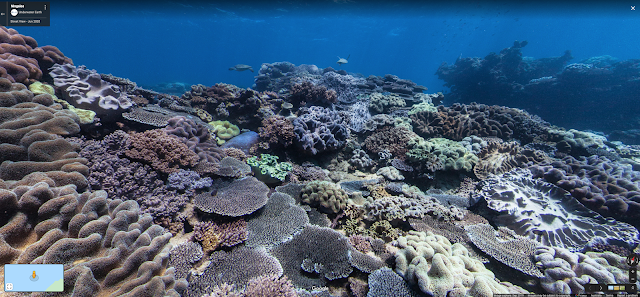
Or travel up to the Muiron Islands and to Whalebone--a dive site named after whalebone that has now been washed away, grown over, or reabsorbed into the fabric of the reef, and known for its swim-throughs and overhangs. This area is exposed to the swell and waves of the Indian Ocean meaning few branching corals can grow here, so it is dominated by a myriad of hard plating corals and stunning colourful soft corals, and is a popular spot for turtles too!
Whalebone is a beautiful dive site on the western side of South Muiron Island.
Whales, dolphins, manta rays, huge cod, turtles and whale sharks are abundant here, and this is one of many reasons this location is critical to the health of the ocean. “We have been capturing underwater Street View imagery, partnering with Google, for over nine years. We believe in the importance of revealing precious ocean environments to the world to help educate and inspire ocean protection and conservation. Ningaloo Reef is simply too precious to lose,” said Christophe Bailhache, Co-founder of not-for-profit Underwater Earth, and underwater photographer for this Ningaloo collection. “What an amazing opportunity to not only let Ningaloo enthral, excite and engage an even broader audience, but importantly help better understand this most beautiful and fragile of underwater wonders in the changing world we live in. Thank you Google and Underwater Earth,” said Dr Peter Barnes, Ningaloo Marine Park Coordinator. We see this Street View capture as a chance to document the Ningaloo Coast in its current condition and keep track of how it's evolving. And by raising awareness and making sure that as many people as possible see this natural wonder, and get to understand its significance, we hope to do our bit to help protect this incredible place.
On early Sunday morning, when the Dallas Police Department tweeted asking people to submit videos of “illegal activity” at protests to its iWatch Dallas app, K-pop fans were ready.
“I wanted to do something to stop or slow [the police] down,” a 16-year-old Houston girl who goes by @YGSHIT on Twitter told me. She was one of many South Korean–pop fans who quickly realized that their lightning-fast coordination and prodigious spamming abilities could be repurposed for what she considers a righteous cause. Concerned that video clips submitted to the police app might be used to identify and possibly arrest peaceful protesters, K-pop fans improvised. They submitted, over and over, their collections of “fancams”—short clips of concerts or promotional footage, usually zoomed in to focus on a favorite performer.
@YGSHIT, who asked to remain anonymous for fear of retaliation from the police, selected a clip from a recent music video by the boy band BTS, which she submitted four or five times. Then she did the same for a clip of Dahyun, a member of the girl group Twice. The same for a clip of Ryujin, a member of the girl group ITZY. And for a live clip of the girl group Red Velvet.
Within hours, the police app had crashed. The Dallas Police Department announced the next day that the cause of the “interruption” was “still being determined,” and a spokesperson declined to provide further information, telling me that none was available.
On Twitter, fan accounts with large followings continued to mobilize. When the FBI tweeted asking for images of “individuals inciting violence” at protests, the call came almost immediately: “kpop stans”—internet slang for extremely invested fans—“you know what to do.” When the police department in Grand Rapids, Michigan, created an online portal for images and videos of “unrest,” @YGSHIT tweeted, “y’all already know what to do KPOP STANS RISE.”
Over the past week, as protests against police brutality have erupted nationwide, online fandoms of K-pop, Harry Styles, and others established a clear course of action: They would not use any of their normal promotional hashtags to boost their favorite music, instead keeping themselves and the platform focused on the message of Black Lives Matter. They would repurpose accounts that normally track chart positions and celebrity Instagram posts to instead disseminate information about how to support the protests. They would clog up every police department’s digital efforts. They would flood racist hashtags like #whitelivesmatter and #alllivesmatter with more concertfootage to render them useless.
Many of them did this before hearing anything from the idols whose faces they use as their avatars, and several of them told me they did it because they felt a “responsibility” to use their technological savvy and their interconnected global network for more than just sharing memes. More and more fandoms are now realizing that they have substantial organizing and amplification capabilities of their own, and that they don’t need to wait for the stars they adore to commit to their chosen cause.
Laila, a 20-year-old BTS fan who lives in France, helped coordinate the fandom’s efforts to crash police apps, and requested to go by her first name out of concern about retaliation. “The fandom wants [BTS] to speak [up about police brutality]. They really want that,” Laila told me. “But we are already working together.” Laila is part of three K-pop group chats on Twitter that have pivoted to activism in the past week: one that raises money for Black Lives Matter organizations by selling fan art, another that tracks new hashtags to spam with fancams, and a third that spreads information about how to stay safe at protests. Most recently, Laila said, fans have been filling up #maga and #bluelivesmatter hashtags on Instagram with photos of K-pop stars. They’ve also publicly instructed other fans not to tweet in honor of BTS’s seventh anniversary next week, in order to keep the focus on Black Lives Matter.
Because K-pop fans are spread across the world, many of them are seriously interested in global politics. Sometimes they champion causes that are outwardly goofy—as when BTS fans threatened to sue Ivanka Trump for using the hashtag “BTS” in the caption of a photo from the White House. But in December, the Chilean government identified K-pop fandom as one of the more powerful forces driving human-rights protests across the country; in 2018, BTS fans supported student protests in Bangladesh.
“[These] are people who are used to tuning into developments in another part of the world and coordinating in response to events there,” says Miranda Ruth Larsen, a doctoral candidate at the University of Tokyo who studies K-pop.
With all this speed and enthusiasm, these fans look like a united front—but that isn’t exactly true. K-pop fans have a long and complicated history with cultural appropriation and antiblack racism. “While, yes, the response has been overwhelmingly positive, within the fandom there has been pushback,” says Zina, a 29-year-old K-pop-fandom critic and blogger from South Florida who asked to be identified only by her first name for professional reasons.
Some of their actions have been less considered and effective than others—flooding #WhiteLivesMatter with K-pop videos just ended up pushing it into Twitter’s Trending Topics sidebar. “You [go on the site and] see ‘Trending in K-Pop: White Lives Matter,’” Zina told me. “As a black fan who’s seen over the years that anti-blackness is literally everywhere, including in fandom spaces, the first thought [when you see that] isn’t Oh yes, these are my peers tweeting to mess up this tag, it’s Oh shit, what just happened.”
But tactics can be tweaked, and the spontaneity of the effort is still exciting: Much of this activism is led by black fans, and its happening even without any catalyst from the K-pop stars who are the reason for the fandom in the first place, Zina said. Many popular K-pop groups and artists have yet to say anything at all about the protests, and others waited a long time. On Thursday—nearly a week after the protests spread across the country—an official BTS Twitter account shared a supportive statement. And on Saturday, the group and its label Big Hit Entertainment revealed a $1 million donation to Black Lives Matter.
“The fandom has been moving, the fandom has been donating, the fans have been protesting,” Zina said. “Then the groups have shown support. The fandom paved the way for the groups.”
At this point, fans don’t really need celebrities to speak for them.
Fandoms have trained themselves for years to understand how attention works on social media and how to funnel it to things they care about. They easily can reach millions of people in a day—albeit with slightly more complicated methods than a major pop group like BTS, which can speak to all of its 26 million followers at once—and they know it.
This is a fairly recent realization. In 2015, Lady Gaga was credited with using social media to encourage her fans to be more engaged with LGBTQ activism—in part by giving them the nickname “Little Monsters” and bringing them together under her mentorship. But by 2018, young Harry Styles fans were exerting pressure from the bottom-up: They started bringing Black Lives Matter flags to his concerts and urging him on Twitter to recognize the cause, wrote Allyson Gross, a PhD student at the University of Wisconsin at Madison, in a recent paper on how fans identify with celebrities and view them as representatives for their values. They were guiding him toward action, hoping “to mobilize his image for their own political purpose,” she argued. (The pressure campaign was largely successful.)
Now fans are moving beyond asking pop stars if they can borrow their influence. When they’re seeking attention for a cause, “the audience is no longer our stars, but ourselves,” Gross told me in an email. The pandemic has laid bare the limits of celebrities, she suggested, and the current protests have an urgency that supersedes a fandom’s desire to hear feel-good messages from someone they admire. When Styles, who is white, showed up at a protest in Los Angeles on Tuesday, many fans discouraged one another from sharing the images, arguing that he shouldn’t be the focus of a Black Lives Matter event and that white fans shouldn’t need to see him there before deciding to care about the movement themselves.
Fans still think celebrities have an obligation to support certain causes, but right now they’re more interested in seeing a mass movement come from the fandom itself. And they’re well equipped to create one. “Fandoms are dispersed, often digital, and already organized, all of which aid and support their using their platforms to shift the locus of attention,” Gross told me.
“I’ve seen stan Twitter come together more than ever during this,” says Gabrielle Foster, a 19-year-old Styles fan from Virginia who runs the Twitter account Black Harries Matter. “A lot of us have been going out to march ourselves, and since we already have a big social-media presence in general, it’s helped a lot in spreading news about what’s happening at the protests and how we can help from home or from another state.”
Fans have always been real people with various identities, but right now we’re hearing much more about their political stances and their personal stakes in issues than we are about which bops they’re listening to. Many are changing their avatars from photos of pop stars to illustrations of the Black Lives Matter fist. And the lines between fandoms that normally have nothing to do with each other—or are even actively hostile toward each other—are also temporarily blurring, as fans of Ariana Grande or Taylor Swift or Beyoncé or Blackpink find common cause.
“I love that they’re on our side,” Elul Adoda, a 21-year-old Harry Styles fan from Minneapolis said of the K-pop fandoms’ various efforts. “I feel like they’re half the world’s population.” She’s not a K-pop fan—in fact, she actively dislikes some of the fandoms’ usual social-media presence—but she’s delighted to see them putting their skills to new use. “Stan Twitter is using its platform.”
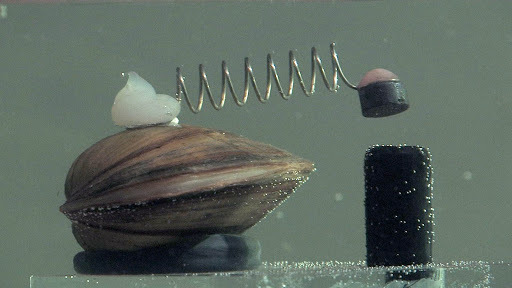
Re: the last post, the article mentions that some places use clams to test the toxicity of the water. It’s like that in Warsaw- we get our water from the river, and the main water pump has 8 clams that have triggers attached to their shells. If the water gets too toxic, they close, and the triggers shut off the city water supply automatically.
The clams are just better at measuring the water quality than any man-made sensors.
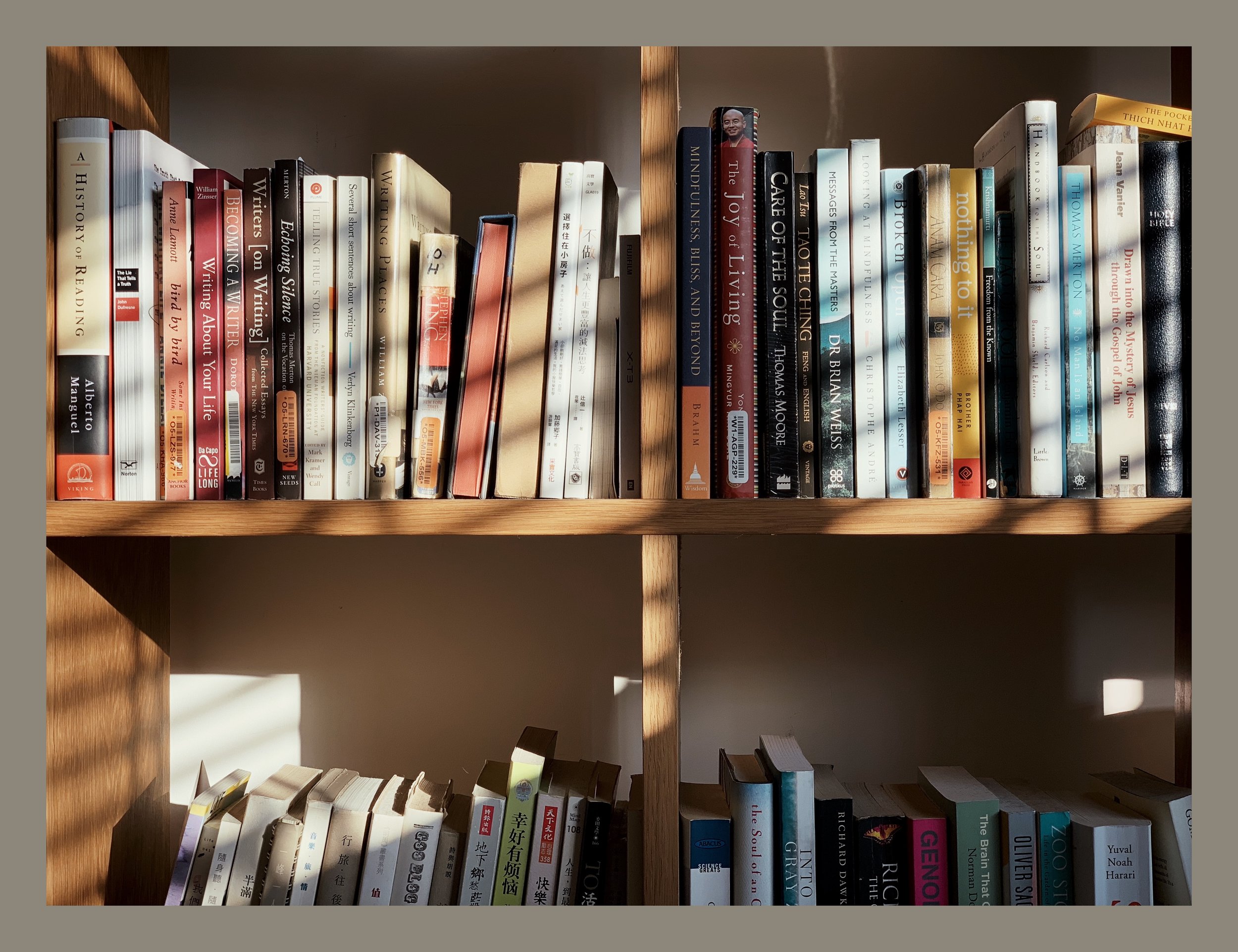
I have decided that I will buy books again, that I will live in a house full of books again even if it means I cannot move as nimbly through the world. Because I love books. It’s as simple as that. I love books, I want to own books, and I will own books.
I’m saying this because last year I had this bizarre new idea that maybe I should give away most of my books and keep only the few I really like/love (and I really did give away more than 50% of them).
On the Antarctic Peninsula, so-called snow algae are turning the snow green.
The algae thrive on temperatures just above freezing, which are increasingly common.
Antarctica's green snow could lay the groundwork for a whole new ecosystem.
First ever map
With COVID-19's stranglehold on the news cycle, it's enough to wax nostalgic about the other varieties of existential dread that used to stalk our screens. But don't worry – there's still plenty to worry about. Global warming, for example, is still very much a going concern. In Antarctica, it's been turning the snow green. And no, that's not a good thing.
It's all happening on and near the Antarctic Peninsula, the bit of the Frozen Continent that juts out furthest north. It's one of the fastest-warming places on Earth. By some accounts, average annual temperatures have increased by almost 3°C (37.5°F) since the start of the Industrial Revolution (c. 1800).
The Peninsula is where, earlier this year, Antarctica's temperature topped 20°C for the first time on record. On 9 February 2020, Brazilian scientists logged 20.75°C (69.35°F) at Seymour Island, near the Peninsula's northern tip. Just three days earlier, the Argentinian research station at Esperanza, on the Peninsula itself, had measured 18.30°C (64.94°F), a new record for Antarctica's mainland.
Those warmer temperatures are not without consequences. Certainly the most spectacular one are the giant icebergs the size of small countries that occasionally calve off from the local ice shelves (see #849). Less dramatically, they've also led to an increase in microscopic algae that are coloring large swathes of snow green, both on the Peninsula itself and on neighboring islands.
These 'snow algae' are sometimes also known as 'watermelon snow', because they can produce shades of pink, red or green. The cause is a species of green algae that sometimes contains a secondary red pigment. Unlike other freshwater algae, it is cryophilic, which means that it thrives in near-freezing conditions.
This week sees the publication in the journal Nature Communicationsof the first ever large-scale map of the Peninsula's snow algae. Single-cell organisms they may be, but they proliferate to such an extent that the patches of snow and ice they turn a vivid green can be observed from space.
1,679 separate 'blooms'
The team who produced this map actually did use data from the European Space Agency's Sentinel 2 constellation of satellites, adding field data collected on Adelaide Island (2017/18) and Fildes and King George Islands (2018/19).
Prepared over a six-year period by biologists from Cambridge University in collaboration with the British Antarctic Survey, the map identifies 1,679 separate 'blooms' of the snow algae.
The largest bloom they found, on Robert Island in the South Shetland Islands, was 145,000 m2 (almost 36 acres). The total area covered by the green snow was 1.9 km2 (about 0.75 sq. mi). For comparison: Other vegetation on the entire peninsular area covers about 8.5 km2 (3.3 sq. mi).
For the algae to thrive, the conditions need to be just right: water needs to be just above freezing point to give the snow the right degree of slushiness. And that's happening with increasing frequency on the Peninsula during the Antarctic summer, from November to February.
Like other plants, the green algae use photosynthesis to grow. This means they act as a carbon sink. The researchers estimate that the algae they observed remove about 479 tons of atmospheric CO2 per year. That equates to about 875,000 average UK car journeys, or 486 flights between London and New York.
That's not counting the carbon stored by the red snow algae, which were not included in the study. The red algae are estimated to cover an area at least half of the green snow algae, and to be less dense.
About two-thirds of the algal blooms studied occurred on the area's islands, which have been even more affected by regional temperature rises than the Peninsula itself.
The blooms also correlate to the local wildlife - in particular to their poop, which serves as fertiliser for the algae. Researchers found half of all blooms occurred within 100 m (120 yards) of the sea, almost two-thirds were within 5 km (3.1 miles) of a penguin colony. Others were near other birds' nesting sites, and where seals come ashore.
Essential excrement
This suggests that the excrement of the local marine fauna provides essential hotspots of fertiliser like nitrogen and phosphate, in what is otherwise a fairly barren environment. The researchers suggest the algae in their turn could become nutrients for other species, and thus be the building block for a whole new ecosystem on the Peninsula. There is some evidence the algae are already cohabiting with fungal spores and bacteria.
'Green snow' currently occurs from around 62.2° south (at Bellingshausen Station, on the South Shetland Islands) to 68.1° south (at San Martin Station, on Faure Island). As regional warming continues, the snow algae phenomenon is predicted to increase. Some of the islands where it now occurs may lose summer snow cover, thus becoming unsuitable for snow algae; but the algae are likely to spread to areas further south where they are as yet rare or absent.
The spread of snow algae itself will act as an accelerant for regional warming: while white snow reflects around 80% of the sun's rays, green snow reflects only around 45%. This reduction of the albedo effect increases heat absorption, adding to the chance of the snow melting.
If no effort is made to reduce greenhouse gas emissions, scientists predict global melting of snow and ice reserves could push up sea levels by up to 1.1 m (3.6 ft) by the end of the century. If global warming continues unabated and Antarctica's vast stores of snow and ice – about 70% of the world's fresh water – were all to melt, sea levels could rise by up to 60 m (almost 200 ft).
That may be many centuries away. Meanwhile, the snow algae map will help monitor the speed at which Antarctica is turning green by serving as a baseline for the impact of climate change on the Earth's southernmost continent.
This is my new favourite way to manage social distancing.
photos by twitter user @chacha0rca The restaurant at Izu Shabonten Zoo in Shizuoka, Japan is crowded! But those seats aren’t occupied by people. They’re occupied by stuffed animal Capybaras that have been strategically placed throughout the restaurant to maintain appropriate social distancing. So have a seat with these adorable stuffed Capybaras, who will keep you […]







 Editor’s note: Today is World Oceans Day, a day when people around the globe celebrate the world’s oceans and the life they sustain.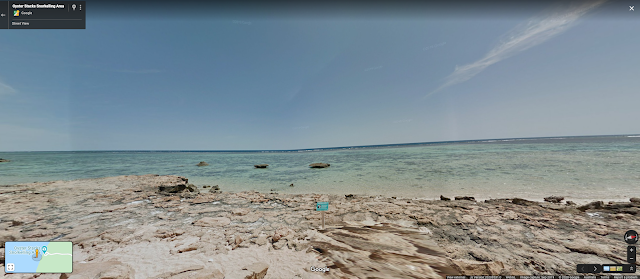








 photos by twitter user @chacha0rca The restaurant at Izu Shabonten Zoo in Shizuoka, Japan is crowded! But those seats aren’t occupied by people. They’re occupied by stuffed animal Capybaras that have been strategically placed throughout the restaurant to maintain appropriate social distancing. So have a seat with these adorable stuffed Capybaras, who will keep you […]