08 Mar 20:37
Org. Chem. Front., 2018, 5,1257-1261
DOI: 10.1039/C7QO01049D, Research Article
Xinming Liu, Huiliang Sun, Wan Xu, Shisheng Wan, Jianwu Shi, Chunli Li, Hua Wang
Based on dithieno[2,3-b:2[prime or minute],3[prime or minute]-d]thiophene, three novel helicenes including helicene (rac-1), double helicene (rac-2), and benzohexathia[7]helicene (rac-3), and one bull's horn-shaped benzohexathienoacene (4) have been synthesized and reported in this paper.
The content of this RSS Feed (c) The Royal Society of Chemistry
06 Mar 11:09
by David Reger, Philipp Haines, Frank W. Heinemann, Dirk M. Guldi, Norbert Jux
Herein, we report on the synthesis of a novel π-extended "superhelicene" based on hexa-peri-hexabenzocoronenes (HBC) via an efficient four-step synthetic procedure starting from diphenylether. Comprehensive structural analyses were performed by means of NMR and mass spectrometry measurements together with X-ray analysis. Physico-chemical analysis of the superhelicene and suitable HBC references revealed among others outstanding fluorescent features with quantum yields of over 80%.
06 Mar 07:36
by Pauline Pieper, Virginie Russo, Benoît Heinrich, Bertrand Donnio and Robert Deschenaux

The Journal of Organic Chemistry
DOI: 10.1021/acs.joc.8b00093

05 Feb 11:16
by Ekkehardt Hahn, Li-Ying Sun, Narayan Sinha, Tao Yan, Yi-Shou Wang, Tristan T.Y. Tan, Le Yu, Ying-Feng Han
Abstract: A synthetic protocol for the synthesis of 3D hexakisimidazolium cage compounds has been developed. Reaction of trigonal trisimidazolium salts H3L decorated with three N-olefinic pendants and silver oxide yielded trinuclear trisilver(I) hexacarbene molecular cylinders of type [Ag3L2]3+ with the olefinic pendants from the two different tricarbene ligands arranged in three pairs. Subsequent UV-irradiation gave via three [2+2]-cycloaddition reactions three cyclobutane links between the two tris-NHC ligands thereby generating a three-dimensional hexakis-NHC ligand. Subsequent removal of the metal ions resulted in the formation of three-dimensional hexakisimidazolium cages with a large internal cavity constituting the first examples for such compounds.
02 Feb 18:55
by Maxime Romain, Cassandre Quinton, Thierry Roisnel, Emmanuel Jacques, Joëlle Rault-Berthelot and Cyril Poriel

The Journal of Organic Chemistry
DOI: 10.1021/acs.joc.7b02834

02 Feb 18:52
by Fabiola Zapata, Lidia González, Antonio Caballero, Adolfo Bastida, Delia Bautista and Pedro Molina

Journal of the American Chemical Society
DOI: 10.1021/jacs.7b12612

01 Feb 07:25
by Amit Ghosh, Indrajit Paul, Matthias Adlung, Claudia Wickleder and Michael Schmittel

Organic Letters
DOI: 10.1021/acs.orglett.7b03996

31 Jan 12:04
by Timothy A. Barendt, Ilija Rašović, Maria A. Lebedeva, George A. Farrow, Alexander Auty, Dimitri Chekulaev, Igor V. Sazanovich, Julia A. Weinstein, Kyriakos Porfyrakis and Paul D. Beer

Journal of the American Chemical Society
DOI: 10.1021/jacs.7b12819

15 Dec 15:13
by Wu, Q., Rauscher, P. M., Lang, X., Wojtecki, R. J., de Pablo, J. J., Hore, M. J. A., Rowan, S. J.
As the macromolecular version of mechanically interlocked molecules, mechanically interlocked polymers are promising candidates for the creation of sophisticated molecular machines and smart soft materials. Poly[n]catenanes, where the molecular chains consist solely of interlocked macrocycles, contain one of the highest concentrations of topological bonds. We report, herein, a synthetic approach toward this distinctive polymer architecture in high yield (~75%) via efficient ring closing of rationally designed metallosupramolecular polymers. Light-scattering, mass spectrometric, and nuclear magnetic resonance characterization of fractionated samples support assignment of the high–molar mass product (number-average molar mass ~21.4 kilograms per mole) to a mixture of linear poly[7–26]catenanes, branched poly[13–130]catenanes, and cyclic poly[4–7]catenanes. Increased hydrodynamic radius (in solution) and glass transition temperature (in bulk materials) were observed upon metallation with Zn2+.
27 Nov 11:10
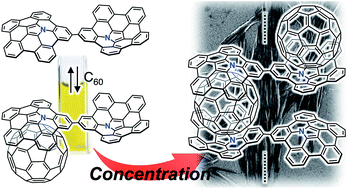
Chem. Sci., 2018, 9,819-824
DOI: 10.1039/C7SC04453D, Edge Article

Open Access
Hiroki Yokoi, Satoru Hiroto, Daisuke Sakamaki, Shu Seki, Hiroshi Shinokubo
A directly connected azabuckybowl dimer forms a 1 : 1 complex with C60 in a diluted solution, while 1D chain supramolecular assemblies are obtained upon increasing the concentration.
The content of this RSS Feed (c) The Royal Society of Chemistry

23 Nov 07:54
by Julio I. Urzúa and Mercedes Torneiro

The Journal of Organic Chemistry
DOI: 10.1021/acs.joc.7b02302

21 Nov 22:32
by Amit Kumar Mandal, James R. Diers, Dariusz M. Niedzwiedzki, Gongfang Hu, Rui Liu, Eric J. Alexy, Jonathan S. Lindsey, David F. Bocian and Dewey Holten

Journal of the American Chemical Society
DOI: 10.1021/jacs.7b09548

21 Nov 22:31
by Taisuke Matsuno, Kanako Kogashi, Sota Sato and Hiroyuki Isobe

Organic Letters
DOI: 10.1021/acs.orglett.7b03534

11 Nov 09:33
by Michel Rickhaus, Andreas Vargas Jentzsch, Lara Tejerina, Isabell Grübner, Michael Jirasek, Timothy D. W. Claridge and Harry L. Anderson

Journal of the American Chemical Society
DOI: 10.1021/jacs.7b10710

04 Nov 18:14
by Fu Huang, Guangxia Wang, Lishuang Ma, Ying Wang, Xuebo Chen, Yanke Che and Hua Jiang

The Journal of Organic Chemistry
DOI: 10.1021/acs.joc.7b01864

26 Oct 20:20
by Bappaditya Gole, Vladimir Stepanenko, Sabrina Rager, Matthias Grüne, Dana D. Medina, Thomas Bein, Frank Würthner, Florian Beuerle
Abstract
Despite significant progress in the synthesis of covalent organic frameworks (COFs), reports on the precise construction of template-free nano- and microstructures of such materials have been rare. In the quest for dye-containing porous materials, a novel conjugated framework DPP-TAPP-COF with an enhanced absorption capability up to λ=800 nm has been synthesized by utilizing reversible imine condensations between 5,10,15,20-tetrakis(4-aminophenyl)porphyrin (TAPP) and a diketopyrrolopyrrole (DPP) dialdehyde derivative. Surprisingly, the obtained COF exhibited spontaneous aggregation into hollow microtubular assemblies with outer and inner tube diameters of around 300 and 90 nm, respectively. A detailed mechanistic investigation revealed the time-dependent transformation of initial sheet-like agglomerates into the tubular microstructures.

Rolling up the COFs: Tetraphenylporphyrins and diketopyrrolopyrroles have been incorporated as functional dye components in covalent organic frameworks by means of reversible imine condensations. Upon formation, these crystalline polymers spontaneously self-assemble to form hollow microtubes.
21 Sep 09:16
by Tetsuo Iwanaga, Tomokazu Yamauchi, Shinji Toyota, Shuichi Suzuki and Keiji Okada

The Journal of Organic Chemistry
DOI: 10.1021/acs.joc.7b01688

13 Sep 19:40
by Toshiaki Ikeda, Hiroaki Adachi, Hiroyuki Fueno, Kazuyoshi Tanaka and Takeharu Haino

The Journal of Organic Chemistry
DOI: 10.1021/acs.joc.7b01520

13 Sep 19:38
by Kun Xu, Xinliang Feng, Reinhard berger, Alexey A Popov, Jan J Weigand, Ilka Vincon, Peter Machata, Felix Hennersdorf, Youjia Zhou, Yubin Fu
Abstract
Herein, we report the design and synthesis of a series of novel cationic nitrogen-doped nanographenes (CNDNs) with nonplanar geometry and axial chirality. Single-crystal X-ray analysis reveals helical and cove-edged structures. Compared to their all-carbon analogues, the frontier orbitals of the CNDNs are energetically lower lying, with a reduced optical energy gap and greater electron-accepting behavior. Cyclic voltammetry shows all the derivatives to undergo quasireversible reductions. In situ spectroelectrochemical studies prove that, depending on the number of nitrogen dopants, either neutral radicals (one nitrogen dopant) or radical cations (two nitrogen dopants) are formed upon reduction. The concept of cationic nitrogen doping and introducing helicity into nanographenes paves the way for the design and synthesis of expanded nanographenes or even graphene nanoribbons with cationic nitrogen dopants.

Nitrogen plus: A new bottom-up synthetic method allows the generation of cationic nitrogen-doped nanographenes with nonplanar helical structures. The new nanographenes have interesting properties and have potential use as optical and electronic materials.
12 Sep 08:16
by Hang Qu, Yu Wang, Zhihao Li, Xinchang Wang, Hongxun Fang, Zhongqun Tian and Xiaoyu Cao

Journal of the American Chemical Society
DOI: 10.1021/jacs.7b07657

11 Sep 13:25
by Sunita Gadakh, Linda J. W. Shimon, Ori Gidron
Abstract
We demonstrate the transformation of oligofurans through sequential Diels–Alder cycloaddition reactions to provide oligoarenes in two chemical steps, regardless of the oligomer length. By this method, oligonaphthalenes containing up to six units were obtained in high yield through the formation of up to 12 new C−C bonds. The versatility of this method was demonstrated for various polyaromatic hydrocarbons. The regioselectivity of this process enabled the synthesis of a library of substituted triarylenes from a single terfuran precursor by modification of the dienophile strength and the order of addition. Overall, this study demonstrates that long oligofurans are interesting not only as organic electronic materials, but also as starting materials for the formation of various conjugated systems.

To cut a long story short: Oligofurans underwent sequential Diels–Alder reactions to provide oligoarenes in two chemical steps, regardless of the oligomer length (see picture). Different maleimide and benzyne dienophiles were also used to construct a range of substituted oligoarenes from a single oligofuran precursor in a highly regioselective manner.
08 Sep 07:01
by Wenlong Yang, Giovanna Longhi, Sergio Abbate, Andrea Lucotti, Matteo Tommasini, Claudio Villani, Vincent J. Catalano, Aleksandr O. Lykhin, Sergey A. Varganov and Wesley A. Chalifoux

Journal of the American Chemical Society
DOI: 10.1021/jacs.7b06848

08 Sep 07:01
by Maximilian Ammon, Tim Sander and Sabine Maier

Journal of the American Chemical Society
DOI: 10.1021/jacs.7b04783

08 Sep 07:00
by San-Jiang Pan, Gang Ye, Fei Jia, Zhenfeng He, Hua Ke, Huan Yao, Zhi Fan and Wei Jiang

The Journal of Organic Chemistry
DOI: 10.1021/acs.joc.7b01579

08 Sep 06:59
by Jie Peng, Jun-Jun Xiang, Hui-Juan Wang, Fa-Bao Li, Yong-Shun Huang, Li Liu, Chao-Yang Liu, Abdullah M. Asiri and Khalid A. Alamry

The Journal of Organic Chemistry
DOI: 10.1021/acs.joc.7b01968

07 Sep 06:53
by Laura Rodríguez-Pérez, Sonia Vela, Carmen Atienza and Nazario Martín

Organic Letters
DOI: 10.1021/acs.orglett.7b02239

21 Aug 20:37
by Daniela Dasler, Ricarda A. Schäfer, Martin B. Minameyer, Jakob F. Hitzenberger, Frank Hauke, Thomas Drewello and Andreas Hirsch

Journal of the American Chemical Society
DOI: 10.1021/jacs.7b04122

21 Aug 10:42
by Jin, E., Asada, M., Xu, Q., Dalapati, S., Addicoat, M. A., Brady, M. A., Xu, H., Nakamura, T., Heine, T., Chen, Q., Jiang, D.
We synthesized a two-dimensional (2D) crystalline covalent organic framework (sp2c-COF) that was designed to be fully -conjugated and constructed from all sp2 carbons by C=C condensation reactions of tetrakis(4-formylphenyl)pyrene and 1,4-phenylenediacetonitrile. The C=C linkages topologically connect pyrene knots at regular intervals into a 2D lattice with conjugations extended along both x and y directions and develop an eclipsed layer framework rather than the more conventionally obtained disordered structures. The sp2c-COF is a semiconductor with a discrete band gap of 1.9 electron volts and can be chemically oxidized to enhance conductivity by 12 orders of magnitude. The generated radicals are confined on the pyrene knots, enabling the formation of a paramagnetic carbon structure with high spin density. The sp2 carbon framework induces ferromagnetic phase transition to develop spin-spin coherence and align spins unidirectionally across the material.
17 Aug 15:22
by Masahiro Miura, Keita Fukuzumi, Yuji Nishii
Abstract
Arene-fused cyclooctatetraenes (COTs) possess unique structural and electronic properties that originate from their saddle-shaped π-conjugated architectures. Considerable attention has been paid to the transition-metal-mediated synthesis of these cyclic compounds; however, there have been limited achievements to date in the efficient construction of heteroarene-fused COTs. In this contribution, we report a novel Pd-catalyzed dehydrogenative cyclodimerization of biheteroarenes through four-fold C−H activation toward the synthesis of a series of heteroarene-fused COTs. A set of mechanistic investigations indicated the involvement of high-valent Pd species prior to the dimerization event in the catalytic cycle. The redox behavior of the obtained COTs is also described briefly.

Ring cycle: A Pd-catalyzed reaction for the construction of thiophene-fused COT frameworks through dehydrogenative cyclodimerization of 3,3′-bithiophenes (X=S, Y=CH) has been developed. The method is applicable to various heteroaromatic compounds, and enables the facile synthesis of “composite” arene-fused COTs. Mechanistic studies indicated the involvement of palladacycle intermediates, as well as high-valent Pd species in the catalytic cycle.
16 Aug 10:17
by Maximilian Wolf, Astrid Herrmann, Andreas Hirsch and Dirk M. Guldi

Journal of the American Chemical Society
DOI: 10.1021/jacs.7b04589