
Adam Victor Brandizzi
Shared posts
03 Apr 23:53
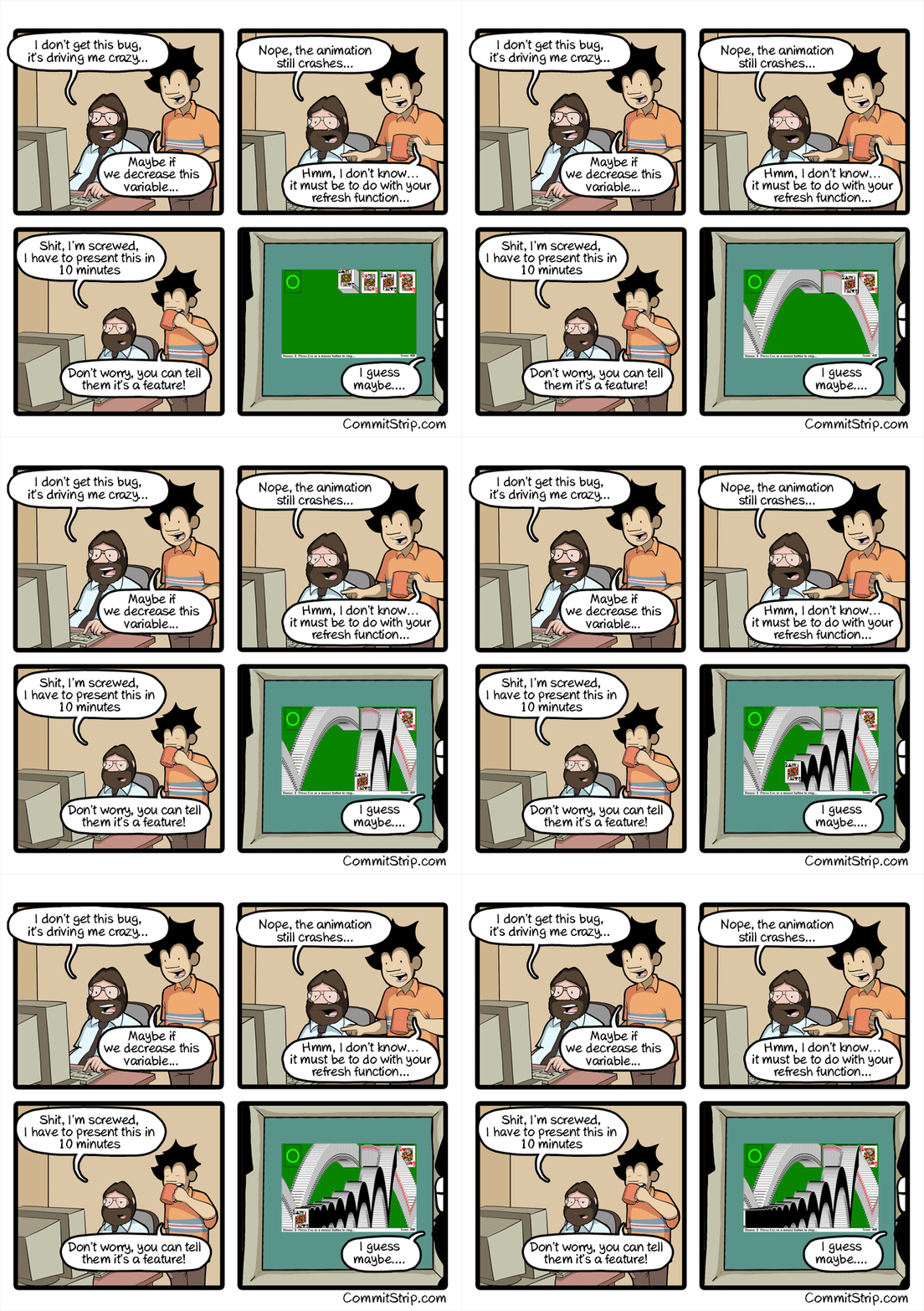
moon comixwebtoon / website / facebook / twitter / patreon

Roslyn , Adam Victor Brandizzi likes this


02 Apr 18:01

Ditadura condenou menos por corrupção que 3 anos de Lava Jato
Durante 21 anos, cinco generais governaram o Brasil apresentando seu regime como um baluarte do combate à corrupção. É verdade que todas as roubalheiras da ditadura cabem nas fortunas de uns poucos petrolarápios, mas aqui vai uma estatística para as vivandeiras do século 21.
A ditadura instituiu uma Comissão Geral de Investigações com poderes excepcionais para pegar corruptos. Entre 1968 e 1979, com cerca de duzentos funcionários, inclusive dois generais, investigou 25 mil pessoas, abriu 1.153 processos e confiscou os bens de 41 pessoas, apurando uma mixaria. (Os grandes tubarões ficaram de fora.)
Em apenas três anos, respeitando as regras do direito, a Operação Lava Jato condenou 130 pessoas a penas que somam 1.377 anos, recuperou R$ 10 bilhões e bloqueou outros R$ 3,2 bilhões.
DEFESA DE RUI
Os doutores do Tribunal de Contas do Rio de Janeiro que estão em liberdade poderiam prestar uma homenagem a Rui Barbosa, retirando o seu nome do prédio em que funciona a repartição
Num caso inverso, em 2015, quando José Maria Marin foi em cana, a Confederação Brasileira de Futebol tirou o seu nome da sede da casa. Não é justo que o nome do baiano continue no TCE.
PREVIDÊNCIA
O governo pode querer reformar a Previdência, mas custa pouco fazer seu serviço direito. Um octogenário, morador da Barra da Tijuca, foi a uma agência do INSS para cuidar de sua aposentadoria. Disseram-lhe que deveria levar os papéis para Macaé, a 160 km de distância, onde ele jamais pusera o pé.
Com esforço, conseguiu que fosse mandado para uma agência na Tijuca, e lá só poderá ser atendido em agosto.
Adam Victor Brandizzi likes this
02 Apr 17:58
Os educatecas estão acabando com a Olimpíada de Matemática
Alguém precisa criar uma Lava Jato para conter a inépcia dos educatecas nacionais. Eles estão destruindo um trabalho de mais de uma década da Olimpíada de Matemática das Escolas Públicas. Era uma coisa que dava certo, levava alegria aos estudantes, e não incomodava ninguém, salvo a onipotência dos burocratas da educação.
A ideia de uma Olimpíada para os estudantes das escolas públicas saiu da Sociedade Brasileira de Matemática e teve o apoio entusiasmado de Lula. O primeiro certame aconteceu em 2005.
Acoplado à Olimpíada, criou-se um Programa de Iniciação Cientifica, o PIC. Ele beneficiava os 6.000 garotos e garotas que conseguiam medalhas, custeando-lhes a ida às universidades federais mais próximas para um dia de aulas mensais com professores da rede de ensino superior. O êxito das medalhistas Fábia, Fabíola e Fabiele, as trigêmeas da zona rural de Santa Leopoldina (ES), comoveu o país em 2015.
Sabe-se lá por quê, a Olimpíada e o PIC ficaram debaixo do teto burocrático do Instituto Nacional de Matemática Pura e Aplicada, o Impa. É um centro de excelência acadêmica, mas não tem nada a ver com o tipo de serviço demandado pelo certame ou pelo PIC. Puseram um orçamento de R$ 60 milhões nas mãos de gestores que cuidavam de R$ 30 milhões para fazer outra coisa.
Apesar dessa girafa, as coisas foram bem até 2015, quando a diretoria de ensino básico da Capes (a central financiadora de bolsas do governo, poderoso braço do ministério da Educação) objetou que o dinheiro destinado ao ensino básico não podia custear o trabalho de professores das federais.
Quem botou o PIC naquela diretoria da Capes que o tirasse, pois o objetivo era aprimorar o conhecimento dos medalhistas. O programa entrara na máquina de moer boas ideias. Como a Capes recusava-se a pagar os R$ 4 milhões que financiavam parte do programa, entrou em ação a máquina de inventar novidades. Tendo-se desmontado o PIC que levava os medalhistas às universidades federais, criou-se um PIC 2.0, com bolsas para mil professores dos municípios, oferecendo cursos especiais de matemática.
Enquanto o programa antigo custava R$ 12 milhões, o novo saía por R$ 8 milhões e dava muito menos trabalho aos burocratas. O Impa aceitou calado a destruição do PIC original e perfilhou o PIC 2.0.
Em 2016 surgiram críticas à extinção do PIC original e o Impa anunciou que, neste ano, ele seria restabelecido. O PIC 2.0, contudo, seria mantido.
Deu-se um milagre da aritmética. Num governo que pretende reduzir seus custos, um instituto de matemática gastava R$ 12 milhões com um programa, substitui-o por outro de R$ 8 milhões e passou a pedir R$ 17 milhões para cuidar da Olimpíada e dos dois programas. Tremenda economia.
A hora da Olimpíada de 2017 está chegando e instalou-se a balbúrdia. O Conselho Nacional de Pesquisas liberou R$ 7 milhões para custear as bolsas que pagam as viagens dos medalhistas, mas a Capes não dá um tostão para os professores federais do PIC original. Donde, não há como rodar o programa. Os educatecas de Brasília oferecem R$ 2 milhões para o PIC 2.0, que custa R$ 7 milhões e, portanto, precisa de mais R$ 5 milhões. Essa conta também não fecha.
A meninada cometeu o pecado de estudar matemática, de disputar a Olimpíada e de querer aprender mais. Os educatecas destruíram o que estava dando certo, toleraram algo que talvez não devesse ter existido (o PIC 2.0) e agora inviabilizam as duas iniciativas.
Leia mais textos da coluna de domingo aqui.
02 Apr 03:58
How I Accidentally Became a Developer
by brandizzi
Adam Victor BrandizziCool story, inspiring even!
I thought my head was going to explode. I’d been working on our new app, Codex, for almost an entire year and it was one brick wall after another. I was in disbelief when the day finally came to release it to the world—the road from finance guy to developer had certainly been long and difficult.
My co-founder Joey Cofone and I launched Baron Fig about 3 years earlier in 2014. Initially we started off on Kickstarter with the Confidant hardcover notebook. We hit our goal of $15,000 in the first 24 hours and went on to raise over $168,000—eleven times our goal. It was hard to believe, but apparently people still want physical analog products, even in this high-tech world of iPhones and iPads.
Back then I was working in finance full time, and I had to make the hard decision to leave a relatively comfortable life to help start a paper notebook company. I thought long and hard about it, and eventually made the decision to go ahead and take the leap.
Shortly after coming out with our hardcover and softcover notebooks we had a number of app ideas. Although I studied computer engineering in college, I hadn’t coded in several years and didn’t know anything about app development. It turns out what they teach you in college and what you need to actually apply it in the real world leaves a bit of a gap (at least for me).
So we took the easiest route and hired an outside developer. The first app’s concept was taking photos of your notebook, which ironically is similar to what I eventually worked on. We found a freelance developer through a friend. The guy seemed smart enough and we agreed on the features and contract. Over the course of the next two months we started designing, meeting, and building the app. All seemed to be progressing reasonably well until he came in one day and abruptly told us he was quitting the project because he didn’t like coding for iOS. The project was dead in the water.
Since we had the time, Joey and I regrouped to think about the app. What if, instead of having an app that only worked with our notebooks, we could make something where the user could take notes directly in it? At the time, this seemed like a great idea. So we did the exact same thing as last app attempt. We came up with a design (Joey is a talented designer and came up with beautiful mockups). Once again shook the grape vine and found another iOS developer through a friend.
Again over the course of 2-3 months we slowly iterated this new app, titled Mosaic. Our developer did a great job and, in just a few months, we found ourselves releasing version 1.0 to the masses in May 2015.
Maybe it was strange that a notebook company wanted to make an app, maybe the offer wasn’t right. Either way, we didn’t have any luck hiring an iOS developer. That left us with one reasonable option: we had to do it ourselves. Since Joey is the designer, it's the natural fit that I would be the programmer. Over the last few months of 2015 I watched loads of videos and tutorials. I struggled and struggled, and over the course of four months managed to produce the super simple app Spark.
It felt great to release something, anything. But it was too much of a struggle, with every new concept taking weeks of work. The slapped-together seat-of-my-pants approach wasn’t the right way of learning iOS development if we really wanted to do it.
Joey and I finally decided we had to make a huge investment if we wanted to be recognized as an analog and technology company: I had to become a true developer. We came to the inevitable conclusion that a full time bootcamp would be worth the investment. In January 2016 I searched all over for the best iOS bootcamps— I wanted to stay in NYC where our studio is, and narrowed it down to three schools here in the city.
I knew that I wanted to focus on learning the newer Swift language instead of primarily on Objective C (I know it's important to still learn both, which I did). Plus, I had still had responsibilities for Baron Fig. I was largely involved at that point in our physical notebook production, logistics, and finances, as well as working on new strategy and ideas with Joey. Most of the bootcamps were completely full time, but I couldn’t do that. I ended up going to TurnToTech, which was project-based. You do your homework at school and primarily work through projects at your own pace instead of attending scheduled classes. For a person who still had to run a business, this was fantastic.

In February 2016 the four month program began. It was immediately brutal. The course matter was relatively difficult, plus I had a lot on my mind with our normal operations— I was still going to the studio on Mondays for our weekly meeting. I’d spend all day Tuesdays and Wednesdays at code school. Thursday mornings Joey and I taught Startup 101 at the School of Visual Arts in NYC, teaching graphic design and advertising students how to create a product and launch a Kickstarter campaign. Then I had Thursday afternoons and Fridays at code school. In total I spend about 3.5 days a week at code school.
During school I was insanely focused. I had to be. It was the only way I could reasonably complete a 4 month full time program in approximately 4 months doing it 3.5 days a week. The school opened at 10am, but I couldn’t contain myself. Every day I’d start work around the corner at Starbucks at 8 or 8:30am, and work there until they finally opened the school doors. The months were agonizing juggling real work and code school work simultaneously, but step by step I made my way through. I knew I was there for a good reason and had to continue to focus.
After many bumps, emotional ups and downs, I finished school in 4.5 months. Not too bad considering I could only be there 70% of the time. In the end I learned a ton. The instructors, Oren, Kaushik, and Patrick, were amazing. So many of the foreign topics I had during my Spark days were now incredibly clear. On top of that, having to teach myself most of the material would be great practice for making our new app.
After I graduated in the middle of June 2016 I went to work on Codex. I was singularly focused on getting this app done. All of our current products work together—you can buy a notebook, a pen, a leather notebook case, and use them together—and we wanted our new app to do the same.
It was a hectic time around Studio Fig. We had a lot of physical manufacturing and logistics issues to work through. Since I used to be the main person handling them, I had the most knowledge about them. But at the same time, I was the only one who could program this new app. It created a lot of tension within myself and in the company trying to figuring out all these issues at once.
I liken it to building a house, one little brick at a time. It was significantly frustrating having to learn so many new technical issues, even after going to code school. Code school was great, but they can only teach you so much in 4 months. You learn the basics, but for each individual app there are specific technologies to work through. I had to learn about using the camera, image quality, finding the edges of a page in an image, syncing data to iCloud, syncing data between iOS devices, and polishing the app to make it look and feel good.
It was an intensely frustrating 6 months. Days would go by with me pounding my head against the wall trying to solve issues and not having anyone to ask for help. I became better at meeting other senior developers at meetups here in New York City. Times would come when I’d hit roadblocks and really need advice or input, it was and is useful having someone to talk about it with. I especially thank Orta and Ash for organizing the Saturday morning CocoaPods Peer Lab at Artsy.

A trick I learned was to get out of our studio to work. I found programming to be significantly different from the business tasks I was used to doing. Instead of being able to switch between tasks frequently, with programming I needed large blocks of time to focus and get into a topic. One of Joey’s friends, Chris, had just started Spacious, a new type of co-working space. (It's a great idea, they take high end restaurants in NYC and convert them into to co-working spaces during the day; only $95/month for a clean, quiet environment and free coffee.) Most weeks I’d work there Tuesday, Wednesday, and Friday mornings and then head into the studio. Unless it was urgent, I asked everyone to save their questions for when I showed up. I made a significant amount of progress this way.
There was still a huge benefit to working at the studio, too. One of the beautiful things about working directly next to my partner and our app designer, Joey, is frequent iteration. The feedback loop was slow when we tried outsourcing things. Finding out if features were technically possible or how they would look and function took weeks. Now Joey and I turn to each other all the time for feedback. Sometimes he’ll have new designs he wants me to look at. Sometimes they look fine, other times they need changes that will make them significantly easier to program. Frequently I have new features or parts of the program I want feedback on. I can get feedback instantly and keep moving forward. Joey is great at giving feedback, except I always tell him which parts of the screen work and which don’t—though he can’t help himself but to always hit the buttons I tell him don’t work yet. Eventually he’ll learn.
After six months of grinding away on the app, feeling like there was no light at the end of the tunnel, the app started to take final form. At the end of December 2016 we submitted the first version to the App Store, 2.5 weeks in advance of our official launch. I remember being at my parents house for winter break, my brother and his family were visiting as well. My first two orders of business were saying hi to them and then telling them to download the app from the App Store to make sure it worked on their phones. There was so much complexity in Codex, I wanted to work out any kinks well before we started emailing all of our customers and telling the world about it.
Over the next two weeks I made a number of changes and updates to get it just right. Then, finally, almost a year after starting code school, we released the app on January 10, 2017. It was quite an exhausting and emotional ride getting there, but it felt great getting it out. I have to admit I was nervous on launch day, even with all the testing I wanted things to go smoothly. In the end, there were a few tiny issues but for the most part it went well.

The next week Joey and I were working hard on updates. I went into the App Store to check something and couldn’t believe my eyes—we were featured first on the App Store homepage under New Apps We Love. I grabbed Joey’s phone to make sure it wasn’t just on mine for some reason. I remember telling Joey very calmly “I have good news and bad news. Good news is we’re featured on the App Store, bad news is I don’t think we’re ready for it yet.” While the app still had some rough edges, it did bring us exposure and a lot of downloads. Being featured by Apple felt like a true validation of my efforts.
Suggestions for Potential Developers
As much of an adventure it was in becoming an iOS developer, building and launching Codex—it's just the beginning. Joey and I have a lot of features and advancements planned. If you’re considering making the switch to developer, here are a few things to think about.
Bootcamp. If you’re relatively new to coding, it helps enormously. Bootcamp gives you the discipline and structure to learn and succeed.
Hard work and tenacity. These are likely your most important ingredients. Learning to program takes a ton of hard work and persistence. There’s a lot of time between that initial excitement and finally delivering something. It took me almost a year of nearly full time dedicated work to go from knowing a little bit about iOS programming to finally delivering a 1.0 product to the App Store. You need to structure your life so you have the time and energy to learn and build something.
Mentorship and senior developers. Although you have to do 99% of the heavy lifting yourself, sometimes you just get stuck. After reading through everything on Stack Overflow and trying what seems like everything, it becomes useful to talk to someone. Ten minutes of discussing the problem with someone who’s been there before can do wonders. I’ve had a number of conversations with Ash that either solved my problems or gave me a different perspective on how to tackle them.
Reading online. You have to be curious and read tutorials, guides, documentation—everything. There’s an enormous amount of material online to consume, it's up to you to turn it into practice. Sometimes just being curious about a topic and independently doing an example on Ray Wenderlich’s site will open your eyes to a world of new possibilities to use in your app.
Design. I would recommend every programmer have a partner or collaborator who’s a designer. As much as I can program the app, Joey is the source of the majority of the design and inspiration for the functionality. He downloads tons of apps and devours everything about them. I think a lot of programmers believe that since they can make the app then they don’t need anyone else. Having a designer will take the quality of the visual appearance and functionality of the app to a whole different level. All of the serious apps in the App Store spend a significant amount of time on design and user experience.
Marketing. We have an advantage when launching our apps. We’ve been around for over 3 years now selling physical products. In this time we’ve been lucky to develop some brand reputation, an email address list, connections to bloggers, and a social media following. When launching something new it has helped a lot in getting the word out.
For us the adventure is really just starting. If you want to become a developer it's certainly possible—work hard, be patient, and you will succeed. If you’d like to check out Codex feel free to send feedback our way. We’re always looking to improve.
Adam Kornfield is Co-Founder and CTO at Baron Fig: Tools for Thinkers. He has traveled to 55 countries, formerly worked as a hedge fund analyst and is a CFA charterholder. You can follow him on Twitter @adamkornfield.
Roslyn , Adam Victor Brandizzi likes this
31 Mar 11:51

Vale a pena ser moderado?
A maioria dos textos apresentados para discussão durante a preparação do próximo Congresso do PT dão a impressão de que foram escritos por gente pensando "Olavo deveria ter tido razão".
Todos querem que o PT seja mais bolivariano, mas intervencionista, mais radical, e ninguém parece entusiasmado com o que André Singer chamou de "reformismo fraco" do lulismo. Há quem faça a autocrítica dos casos de corrupção, mas pouca gente parece disposta à moderação em questões programáticas.
É fácil entender porque isso está acontecendo.
Foram dois anos de massacre depois de dez anos de acordos difíceis. O final do ciclo petista, em que Dilma foi traída por todos os seus aliados de centro e de direita enquanto tentava, finalmente, fazer um ajuste fiscal rigoroso, deixou a militância com pouco entusiasmo por compromissos. Para a militância petista atual, aliado de direita é um sujeito que você tem que comprar para que ele vote a favor do programa do partido dele.
Além disso, o clima político internacional não favorece a moderação. Muita gente acha, por exemplo, que o esquerdismo liberal de Hillary Clinton favoreceu a vitória do populismo conservador de Trump. Ninguém quer abrir o flanco do voto popular para a direita antiliberal de Bolsonaro.
E, finalmente, a esquerda está radicalizando porque ninguém está vendo muita disposição para conversar do outro lado.
No momento atual, a Rede Sustentabilidade tem o melhor programa de governo da esquerda brasileira. Suas propostas combinam satisfatoriamente responsabilidade econômica, redistribuição de renda e ambientalismo.
A Rede tem tentado participar do debate sobre o ajuste fiscal no Congresso de maneira mais propositiva.
E ninguém lhe dá a menor bola.
Tanto na votação da PEC do teto de gastos quanto na votação picareta sobre terceirização na semana passada, lá estava o deputado Alessandro Molon falando em nome da turma de Marina Silva, propondo modificações que tornassem o ajuste mais equitativo. Nenhuma foi discutida a sério pelos governistas.
Os deputados conservadores são maioria, já estão todos comprados com cargos, e ninguém tem medo da esquerda desde que o PT caiu.
Por mais que me deprima dizer isso, não há, no momento, qualquer incentivo para a esquerda moderar seu discurso. A militância de esquerda não quer voltar ao mesmo jogo político, a direita quer comprar sua anistia na Lava Jato com reformas liberais que agradem o empresariado, e o clima político no mundo não é de moderação.
Mas ninguém deve fazer estratégia só pensando no ponto em que se está. Nisso, como em tudo, devemos fazer como o Zico: não lançar a bola onde o centroavante está, mas onde ele vai estar.
A correlação de forças vai mudar nos próximos anos, e talvez antes de 2018. Essa marra com que os parlamentares conservadores têm agido vai murchar quando o voto voltar a contar. A Lava Jato agora vai explodir na direita. E a moderada Hillary pode ter perdido para Trump, mas o radical Corbyn tampouco foi capaz de parar o Brexit. Não adianta proteger demais o flanco esquerdo e perder o centro.
De qualquer forma, será muito ruim se a esquerda ainda estiver no seu trabalho de luto quando a chance de vitória passar de novo na sua frente.
Adam Victor Brandizzi likes this

31 Mar 11:01

How to Display an Item of Great Historical Significance
by Scott Meyer
After this comic ran, I heard from more than one reader informing me that Gandhi had no problem with guns. That may be true. I’ve done minimal research on the web, and found sites claiming both that he was for and against guns.
I stand by this comic’s central premise, however: that Gandhi owning a fancy silver-plated six-shooter with ivory handles engraved “The Passive Resister” would have been, at best, off-brand.
As always, thanks for using my Amazon Affiliate links (US, UK, Canada).
Lani Evitts, Adam Victor Brandizzi likes this
31 Mar 10:53
Privacidade: módulo de segurança de internet banking solicita senha sudo de usuários linux
by Augusto Campos
Tenho uma conta no Banco do Brasil, como muitos outros brasileiros. Utilizo o Internet Banking do BB no meu computador. Sou usuário Ubuntu já há vários anos. Todavia, essa notícia é importante para outros usuários Linux.
Em março de 2017 usuários do Internet Banking do Banco do Brasil começaram a receber a mensagem de que um novo módulo de segurança necessitava ser instalado. Para ver a mensagem de erro basta acessar o site do BB e clicar no botão "ACESSE SUA CONTA" (a mensagem de erro aparece caso você não tenha o módulo instalado. A mensagem aparece tanto em sistemas Windows quanto Linux, e em ambos navegadores, Firefox e IE.
Se você quiser acessar o Internet Banking obrigatoriamente terá que instalar o módulo. As instruções de instalação estão disponíveis nos links da página com o erro.
Eu fiz a instalação no meu sistema Ubuntu e qual não foi a minha surpresa quando percebi que o durante o processo de instalação do módulo foi solicitada a minha senha de administrador (senha sudo).
Aparentemente o software "warsaw", desenvolvido pela GAS Tecnologia, da empresa Diebold, desenvolveu um módulo de segurança que discretamente solicita o usuário ubuntu/linux a sua senha de administrador. Isso fica claro nas próprias instruções para instalação do módulo que estão disponíveis na página de ajuda e tira-dúvidas do BB para o sistema Ubuntu/Mint. O walkthrough com as imagens mostra duas caixas de diálogo durante o processo de instalação: uma caixa apresentada pelo próprio sistema Ubuntu solicitando permissão para instalação de software (o que é um procedimento padrão); e uma segunda caixa de diálogo que é apresentada pelo instalador e que requisita novamente a senha de administrador com a mensagem "Você precisa ter permissões de administrador para instalar softwares. Pode ser inseguro instalar pacotes manualmente. Instale apenas programas de origem confiável."
(...) Note que alguns usuários serão perspicazes o suficiente para perceberem que algo está errado com o instalador, e que ele não deveria solicitar a senha sudo. Porém, grande parte dos usuários não possui conhecimento suficiente para compreender o alcance do processo, e provavelmente digitarão a sua senha novamente nessa segunda caixa de diálogo, permitindo que a GAS Tecnologia tenha acesso ao seu computador de uma forma que não fosse tão séria, seria até banal.
O usuário leigo, que não possui um maior conhecimento de sistemas de computação, não irá duvidar da validade da segunda solicitação por vários motivos. (1) A instalação do software é obrigatória - sem a instalação do módulo de segurança o cliente não tem acesso ao Internet Banking; (2) O software é utilizado por uma instituição financeira de renome e respeitável, além de ser uma das maiores no Brasil (o software também é utilizado por outras instituições financeiras, porém eu sou cliente apenas do BB); (3) a caixa de diálogo do instalador é apresentada de forma a assemelhar-se à caixa de diálogo do sistema Ubuntu, portanto não sendo honesta na sua apresentação e induzindo o usuário a digitar novamente a sua senha.
A comunidade Linux deve levantar-se contra softwares que não respeitam o usuário e seu direito à privacidade. Milhões de usuários estão sendo obrigados a utilizar esse módulo de segurança que, no mínimo, pode ser considerado questionável no seu processo de instalação.
Reclamações em relação à GAS Tecnologia não são raras com atestam as inúmeras reclamações enviadas para o site Reclame Aqui.
Enviado por Daniel Montezano (tnlmontezanoΘgmail·com)
O artigo "Privacidade: módulo de segurança de internet banking solicita senha sudo de usuários linux" foi originalmente publicado no site BR-Linux.org, de Augusto Campos.
31 Mar 01:31
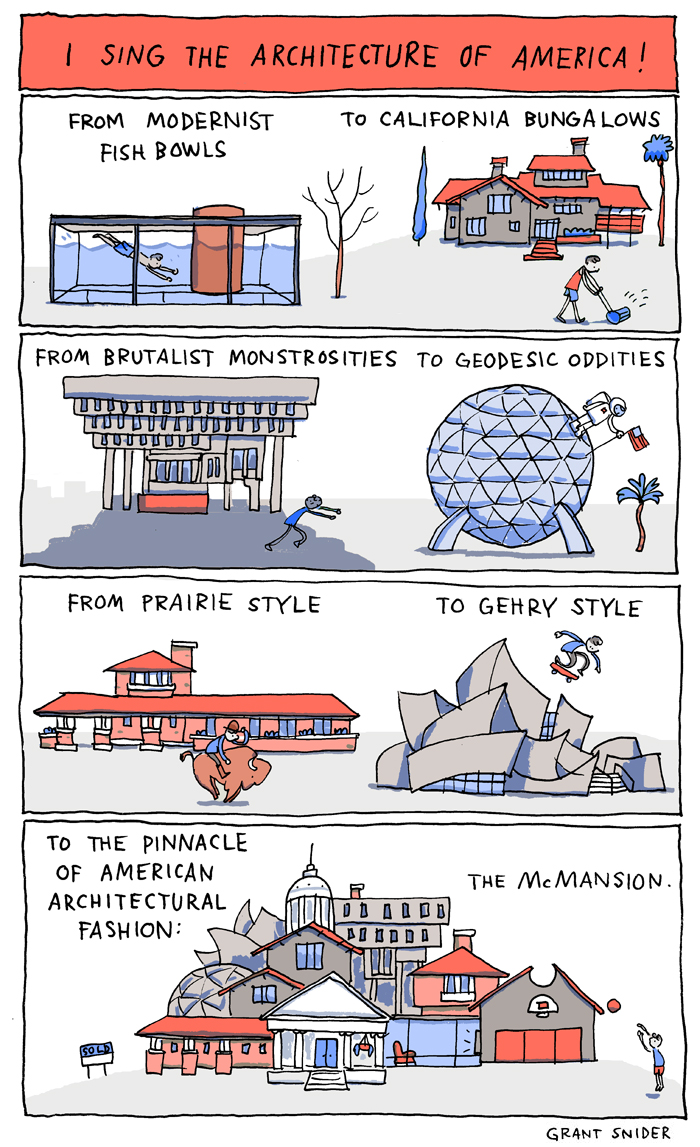
This comic was inspired by Kate Wagner's hilarious website, McMansion Hell. I walk through a neighborhood over my lunch break and pass by a house that looks just like the one in the final panel.
Pre-order my book | Poster Shop | Patreon
American Architecture
by Grant
This comic was inspired by Kate Wagner's hilarious website, McMansion Hell. I walk through a neighborhood over my lunch break and pass by a house that looks just like the one in the final panel.
Pre-order my book | Poster Shop | Patreon
Adam Victor Brandizzi, David Pelaez likes this
31 Mar 01:31
.png)
Click here to go see the bonus panel!
Hovertext:
If you can't remember your password, you spend eternity as a disembodied mind, wandering the Earth.
New comic!
Today's News:
Saturday Morning Breakfast Cereal - Transmitter
by tech@thehiveworks.com
Click here to go see the bonus panel!
Hovertext:
If you can't remember your password, you spend eternity as a disembodied mind, wandering the Earth.
New comic!
Today's News:
Lani Evitts, Adam Victor Brandizzi likes this
31 Mar 01:20

Click here to go see the bonus panel!
Hovertext:
The trick to passwords is to just reset them every time you need to log in.
New comic!
Today's News:
Saturday Morning Breakfast Cereal - Password
by tech@thehiveworks.com
Adam Victor Brandizziheheh
Click here to go see the bonus panel!
Hovertext:
The trick to passwords is to just reset them every time you need to log in.
New comic!
Today's News:
Alrek, Matthew Mellott and 5 others like this


25 Mar 20:02

Click here to go see the bonus panel!
Hovertext:
I'm suddenly realizing that someone out there has probably already had a Star Wars themed funeral.
New comic!
Today's News:
Saturday Morning Breakfast Cereal - Star Wars
by tech@thehiveworks.com
Click here to go see the bonus panel!
Hovertext:
I'm suddenly realizing that someone out there has probably already had a Star Wars themed funeral.
New comic!
Today's News:
Adam Victor Brandizzi and -1 others like this
25 Mar 20:02
Guided By The Beauty Of Our Weapons
by Scott Alexander
[Content note: kind of talking around Trump supporters and similar groups as if they’re not there.]
I.
Tim Harford writes The Problem With Facts, which uses Brexit and Trump as jumping-off points to argue that people are mostly impervious to facts and resistant to logic:
All this adds up to a depressing picture for those of us who aren’t ready to live in a post-truth world. Facts, it seems, are toothless. Trying to refute a bold, memorable lie with a fiddly set of facts can often serve to reinforce the myth. Important truths are often stale and dull, and it is easy to manufacture new, more engaging claims. And giving people more facts can backfire, as those facts provoke a defensive reaction in someone who badly wants to stick to their existing world view. “This is dark stuff,” says Reifler. “We’re in a pretty scary and dark time.”
He admits he has no easy answers, but cites some studies showing that “scientific curiosity” seems to help people become interested in facts again. He thinks maybe we can inspire scientific curiosity by linking scientific truths to human interest stories, by weaving compelling narratives, and by finding “a Carl Sagan or David Attenborough of social science”.
I think this is generally a good article and makes important points, but there are three issues I want to highlight as possibly pointing to a deeper pattern.
First, the article makes the very strong claim that “facts are toothless” – then tries to convince its readers of this using facts. For example, the article highlights a study by Nyhan & Reifler which finds a “backfire effect” – correcting people’s misconceptions only makes them cling to those misconceptions more strongly. Harford expects us to be impressed by this study. But how is this different from all of those social science facts to which he believes humans are mostly impervious?
Second, Nyhan & Reifler’s work on the backfire effect is probably not true. The original study establishing its existence failed to replicate (see eg Porter & Wood, 2016). This isn’t directly contrary to Harford’s argument, because Harford doesn’t cite the original study – he cites a slight extension of it done a year later by the same team that comes to a slightly different conclusion. But given that the entire field is now in serious doubt, I feel like it would have been judicious to mention some of this in the article. This is especially true given that the article itself is about the way that false ideas spread by people never double-checking their beliefs. It seems to me that if you believe in an epidemic of falsehood so widespread that the very ability to separate fact from fiction is under threat, it ought to inspire a state of CONSTANT VIGILANCE, where you obsessively question each of your beliefs. Yet Harford writes an entire article about a worldwide plague of false beliefs without mustering enough vigilance to see if the relevant studies are true or not.
Third, Harford describes his article as being about agnotology, “the study of how ignorance is deliberately produced”. His key example is tobacco companies sowing doubt about the negative health effects of smoking – for example, he talks about tobacco companies sponsoring (accurate) research into all of the non-smoking-related causes of disease so that everyone focused on those instead. But his solution – telling engaging stories, adding a human interest element, enjoyable documentaries in the style of Carl Sagan – seems unusually unsuited to the problem. The National Institute of Health can make an engaging human interest documentary about a smoker who got lung cancer. And the tobacco companies can make an engaging human interest documentary about a guy who got cancer because of asbestos, then was saved by tobacco-sponsored research. Opponents of Brexit can make an engaging documentary about all the reasons Brexit would be bad, and then proponents of Brexit can make an engaging documentary about all the reasons Brexit would be good. If you get good documentary-makers, I assume both will be equally convincing regardless of what the true facts are.
All three of these points are slightly unfair. The first because Harford’s stronger statements about facts are probably exaggerations, and he just meant that in certain cases people ignore evidence. The second because the specific study cited wasn’t the one that failed to replicate and Harford’s thesis might be that it was different enough from the original that it’s probably true. And the third because the documentaries were just one idea meant to serve a broader goal of increasing “scientific curiosity”, a construct which has been shown in studies to be helpful in getting people to believe true things.
But I worry that taken together, they suggest an unspoken premise of the piece. It isn’t that people are impervious to facts. Harford doesn’t expect his reader to be impervious to facts, he doesn’t expect documentary-makers to be impervious to facts, and he certainly doesn’t expect himself to be impervious to facts. The problem is that there’s some weird tribe of fact-immune troglodytes out there, going around refusing vaccines and voting for Brexit, and the rest of us have to figure out what to do about them. The fundamental problem is one of transmission: how can we make knowledge percolate down from the fact-loving elite to the fact-impervious masses?
And I don’t want to condemn this too hard, because it’s obviously true up to a point. Medical researchers have lots of useful facts about vaccines. Statisticians know some great facts about the link between tobacco and cancer (shame about Ronald Fisher, though). Probably there are even some social scientists who have a fact or two.
Yet as I’ve argued before, excessive focus on things like vaccine denialists teaches the wrong habits. It’s a desire to take a degenerate case, the rare situation where one side is obviously right and the other bizarrely wrong, and make it into the flagship example for modeling all human disagreement. Imagine a theory of jurisprudence designed only to smack down sovereign citizens, or a government pro-innovation policy based entirely on warning inventors against perpetual motion machines.
And in this wider context, part of me wonders if the focus on transmission is part of the problem. Everyone from statisticians to Brexiteers knows that they are right. The only remaining problem is how to convince others. Go on Facebook and you will find a million people with a million different opinions, each confident in her own judgment, each zealously devoted to informing everyone else.
Imagine a classroom where everyone believes they’re the teacher and everyone else is students. They all fight each other for space at the blackboard, give lectures that nobody listens to, assign homework that nobody does. When everyone gets abysmal test scores, one of the teachers has an idea: I need a more engaging curriculum. Sure. That’ll help.
II.
A new Nathan Robinson article: Debate Vs. Persuasion. It goes through the same steps as the Harford article, this time from the perspective of the political Left. Deploying what Robinson calls “Purely Logical Debate” against Trump supporters hasn’t worked. Some leftists think the answer is violence. But this may be premature; instead, we should try the tools of rhetoric, emotional appeal, and other forms of discourse that aren’t Purely Logical Debate. In conclusion, Bernie Would Have Won.
I think giving up on argumentation, reason, and language, just because Purely Logical Debate doesn’t work, is a mistake. It’s easy to think that if we can’t convince the right with facts, there’s no hope at all for public discourse. But this might not suggest anything about the possibilities of persuasion and dialogue. Instead, it might suggest that mere facts are rhetorically insufficient to get people excited about your political program.
The resemblance to Harford is obvious. You can’t convince people with facts. But you might be able to convince people with facts carefully intermixed with human interest, compelling narrative, and emotional appeal.
Once again, I think this is generally a good article and makes important points. But I still want to challenge whether things are quite as bad as it says.
Google “debating Trump supporters is”, and you realize where the article is coming from. It’s page after page of “debating Trump supporters is pointless”, “debating Trump supporters is a waste of time”, and “debating Trump supporters is like [funny metaphor for thing that doesn’t work]”. The overall picture you get is of a world full of Trump opponents and supporters debating on every street corner, until finally, after months of banging their heads against the wall, everyone collectively decided it was futile.
Yet I have the opposite impression. Somehow a sharply polarized country went through a historically divisive election with essentially no debate taking place.
Am I about to No True Scotsman the hell out of the word “debate”? Maybe. But I feel like in using the exaggerated phrase “Purely Logical Debate, Robinson has given me leave to define the term as strictly as I like. So here’s what I think are minimum standards to deserve the capital letters:
1. Debate where two people with opposing views are talking to each other (or writing, or IMing, or some form of bilateral communication). Not a pundit putting an article on Huffington Post and demanding Trump supporters read it. Not even a Trump supporter who comments on the article with a counterargument that the author will never read. Two people who have chosen to engage and to listen to one another.
2. Debate where both people want to be there, and have chosen to enter into the debate in the hopes of getting something productive out of it. So not something where someone posts a “HILLARY IS A CROOK” meme on Facebook, someone gets really angry and lists all the reasons Trump is an even bigger crook, and then the original poster gets angry and has to tell them why they’re wrong. Two people who have made it their business to come together at a certain time in order to compare opinions.
3. Debate conducted in the spirit of mutual respect and collaborative truth-seeking. Both people reject personal attacks or ‘gotcha’ style digs. Both people understand that the other person is around the same level of intelligence as they are and may have some useful things to say. Both people understand that they themselves might have some false beliefs that the other person will be able to correct for them. Both people go into the debate with the hope of convincing their opponent, but not completely rejecting the possibility that their opponent might convince them also.
4. Debate conducted outside of a high-pressure point-scoring environment. No audience cheering on both participants to respond as quickly and bitingly as possible. If it can’t be done online, at least do it with a smartphone around so you can open Wikipedia to resolve simple matters of fact.
5. Debate where both people agree on what’s being debated and try to stick to the subject at hand. None of this “I’m going to vote Trump because I think Clinton is corrupt” followed by “Yeah, but Reagan was even worse and that just proves you Republicans are hypocrites” followed by “We’re hypocrites? You Democrats claim to support women’s rights but you love Muslims who make women wear headscarves!” Whether or not it’s hypocritical to “support women’s rights” but “love Muslims”, it doesn’t seem like anyone is even trying to change each other’s mind about Clinton at this point.
These to me seem like the bare minimum conditions for a debate that could possibly be productive.
(and while I’m asking for a pony on a silver platter, how about both people have to read How To Actually Change Your Mind first?)
Meanwhile, in reality…
If you search “debating Trump supporters” without the “is”, your first result is this video, where some people with a microphone corner some other people at what looks like a rally. I can’t really follow the conversation because they’re all shouting at the same time, but I can make out somebody saying ‘Republicans give more to charity!’ and someone else responding ‘That’s cause they don’t do anything at their jobs!'”. Okay.
The second link is this podcast where a guy talks about debating Trump supporters. After the usual preface about how stupid they were, he describes a typical exchange – “It’s kind of amazing how they want to go back to the good old days…Well, when I start asking them ‘You mean the good old days when 30% of the population were in unions’…they never seem to like to hear that!…so all this unfettered free market capitalism has got to go bye-bye. They don’t find comfort in that idea either. It’s amazing. I can say I now know what cognitive dissonance feels like on someone’s face.” I’m glad time travel seems to be impossible, because otherwise I would be tempted to warp back and change my vote to Trump just to spite this person.
The third link is Vanity Fair’s “Foolproof Guide To Arguing With Trump Supporters”, which suggests “using their patriotism against them” by telling them that wanting to “curtail the rights and privileges of certain of our citizens” is un-American.
I worry that people do this kind of thing every so often. Then, when it fails, they conclude “Trump supporters are immune to logic”. This is much like observing that Republicans go out in the rain without melting, and concluding “Trump supporters are immortal”.
Am I saying that if you met with a conservative friend for an hour in a quiet cafe to talk over your disagreements, they’d come away convinced? No. I’ve changed my mind on various things during my life, and it was never a single moment that did it. It was more of a series of different things, each taking me a fraction of the way. As the old saying goes, “First they ignore you, then they laugh at you, then they fight you, then they fight you half-heartedly, then they’re neutral, then they then they grudgingly say you might have a point even though you’re annoying, then they say on balance you’re mostly right although you ignore some of the most important facets of the issue, then you win.”
There might be a parallel here with the one place I see something like Purely Logical Debate on a routine basis: cognitive psychotherapy. I know this comparison sounds crazy, because psychotherapy is supposed to be the opposite of a debate, and trying to argue someone out of their delusions or depression inevitably fails. The rookiest of all rookie therapist mistakes is to say “FACT CHECK: The patient says she is a loser who everybody hates. PsychiaFact rates this claim: PANTS ON FIRE.”
But in other ways it’s a lot like the five points above. You have two people who disagree – the patient thinks she’s a worthless loser who everyone hates, and the therapist thinks maybe not. They meet together in a spirit of voluntary mutual inquiry, guaranteed safe from personal attacks like “You’re crazy!”. Both sides go over the evidence together, sometimes even agreeing on explicit experiments like “Ask your boyfriend tonight whether he hates you or not, predict beforehand what you think he’s going to say, and see if your prediction is accurate”. And both sides approach the whole process suspecting that they’re right but admitting the possibility that they’re wrong (very occasionally, after weeks of therapy, I realize that frick, everyone really does hate my patient. Then we switch strategies to helping her with social skills, or helping her find better friends).
And contrary to what you see in movies, this doesn’t usually give a single moment of blinding revelation. If you spent your entire life talking yourself into the belief that you’re a loser and everyone hates you, no single fact or person is going to talk you out of it. But after however many months of intensive therapy, sometimes someone who was sure that they were a loser is now sort of questioning whether they’re a loser, and has the mental toolbox to take things the rest of the way themselves.
This was also the response I got when I tried to make an anti-Trump case on this blog. I don’t think there were any sudden conversions, but here were some of the positive comments I got from Trump supporters:
— “This is a compelling case, but I’m still torn.”
— “This contains the most convincing arguments for a Clinton presidency I have ever seen. But, perhaps also unsurprisingly, while it did manage to shift some of my views, it did not succeed in convincing me to change my bottom line.”
— “This article is perhaps the best argument I have seen yet for Hillary. I found myself nodding along with many of the arguments, after this morning swearing that there was nothing that could make me consider voting for Hillary…the problem in the end was that it wasn’t enough.”
— “The first coherent article I’ve read justifying voting for Clinton. I don’t agree with your analysis of the dollar “value” of a vote, but other than that, something to think about.”
— “Well I don’t like Clinton at all, and I found this essay reasonable enough. The argument from continuity is probably the best one for voting Clinton if you don’t particularly love any of her policies or her as a person. Trump is a wild card, I must admit.”
— As an orthodox Catholic, you would probably classify me as part of your conservative audience…I certainly concur with both the variance arguments and that he’s not conservative by policy, life, or temperament, and I will remain open to hearing what you have to say on the topic through November.
— “I’ve only come around to the ‘hold your nose and vote Trump’ camp the past month or so…I won’t say [you] didn’t make me squirm, but I’m holding fast to my decision.”
These are the people you say are completely impervious to logic so don’t even try? It seems to me like this argument was one of not-so-many straws that might have broken some camels’ backs if they’d been allowed to accumulate. And the weird thing is, when I re-read the essay I notice a lot of flaws and things I wish I’d said differently. I don’t think it was an exceptionally good argument. I think it was…an argument. It was something more than saying “You think the old days were so great, but the old days had labor unions, CHECKMATE ATHEISTS”. This isn’t what you get when you do a splendid virtuouso perfomance. This is what you get when you show up.
(and lest I end up ‘objectifying’ Trump supporters as prizes to be won, I’ll add that in the comments some people made pro-Trump arguments, and two people who were previously leaning Clinton said that they were feeling uncomfortably close to being convinced)
Another SSC story. I keep trying to keep “culture war”-style political arguments from overrunning the blog and subreddit, and every time I add restrictions a bunch of people complain that this is the only place they can go for that. Think about this for a second. A heavily polarized country of three hundred million people, split pretty evenly into two sides and obsessed with politics, blessed with the strongest free speech laws in the world, and people are complaining that I can’t change my comment policy because this one small blog is the only place they know where they can debate people from the other side.
Given all of this, I reject the argument that Purely Logical Debate has been tried and found wanting. Like GK Chesterton, I think it has been found difficult and left untried.
III.
Therapy might change minds, and so might friendly debate among equals, but neither of them scales very well. Is there anything that big fish in the media can do beyond the transmission they’re already trying?
Let’s go back to that Nyhan & Reifler study which found that fact-checking backfired. As I mentioned above, a replication attempt by Porter & Wood found the opposite. This could have been the setup for a nasty conflict, with both groups trying to convince academia and the public that they were right, or even accusing the other of scientific malpractice.
Instead, something great happened. All four researchers decided to work together on an “adversarial collaboration” – a bigger, better study where they all had input into the methodology and they all checked the results independently. The collaboration found that fact-checking generally didn’t backfire in most cases. All four of them used their scientific clout to publicize the new result and launch further investigations into the role of different contexts and situations.
Instead of treating disagreement as demonstrating a need to transmit their own opinion more effectively, they viewed it as demonstrating a need to collaborate to investigate the question together.
And yeah, part of it was that they were all decent scientists who respected each other. But they didn’t have to be. If one team had been total morons, and the other team was secretly laughing at them the whole time, the collaboration still would have worked. All required was an assumption of good faith.
A while ago I blogged about a journalistic spat between German Lopez and Robert VerBruggen on gun control. Lopez wrote a voxsplainer citing some statistics about guns. VerBruggen wrote a piece at National Review saying that some of the statistics were flawed. German fired back (pun not intended) with an article claiming that VerBruggen was ignoring better studies.
(Then I yelled at both of them, as usual.)
Overall the exchange was in the top 1% of online social science journalism – by which I mean it included at least one statistic and at some point that statistic was superficially examined. But in the end, it was still just two people arguing with one another, each trying to transmit his superior knowledge to each other and the reading public. As good as it was, it didn’t meet my five standards above – and nobody expected it to.
But now I’m thinking – what would have happened if Lopez and VerBruggen had joined together in an adversarial collaboration? Agreed to work together to write an article on gun statistics, with nothing going into the article unless they both approved, and then they both published that article on their respective sites?
This seems like a mass media equivalent of shifting from Twitter spats to serious debate, from transmission mindset to collaborative truth-seeking mindset. The adversarial collaboration model is just the first one to come to mind right now. I’ve blogged about others before – for example, bets, prediction markets, and calibration training.
The media already spends a lot of effort recommending good behavior. What if they tried modeling it?
IV.
The bigger question hanging over all of this: “Do we have to?”
Harford’s solution – compelling narratives and documentaries – sounds easy and fun. Robinson’s solution – rhetoric and emotional appeals – also sounds easy and fun. Even the solution Robinson rejects – violence – is easy, and fun for a certain type of person. All three work on pretty much anybody.
Purely Logical Debate is difficult and annoying. It doesn’t scale. It only works on the subset of people who are willing to talk to you in good faith and smart enough to understand the issues involved. And even then, it only works glacially slowly, and you win only partial victories. What’s the point?
Logical debate has one advantage over narrative, rhetoric, and violence: it’s an asymmetric weapon. That is, it’s a weapon which is stronger in the hands of the good guys than in the hands of the bad guys. In ideal conditions (which may or may not ever happen in real life) – the kind of conditions where everyone is charitable and intelligent and wise – the good guys will be able to present stronger evidence, cite more experts, and invoke more compelling moral principles. The whole point of logic is that, when done right, it can only prove things that are true.
Violence is a symmetric weapon; the bad guys’ punches hit just as hard as the good guys’ do. It’s true that hopefully the good guys will be more popular than the bad guys, and so able to gather more soldiers. But this doesn’t mean violence itself is asymmetric – the good guys will only be more popular than the bad guys insofar as their ideas have previously spread through some means other than violence. Right now antifascists outnumber fascists and so could probably beat them in a fight, but antifascists didn’t come to outnumber fascists by winning some kind of primordial fistfight between the two sides. They came to outnumber fascists because people rejected fascism on the merits. These merits might not have been “logical” in the sense of Aristotle dispassionately proving lemmas at a chalkboard, but “fascists kill people, killing people is wrong, therefore fascism is wrong” is a sort of folk logical conclusion which is both correct and compelling. Even “a fascist killed my brother, so fuck them” is a placeholder for a powerful philosophical argument making a probabilistic generalization from indexical evidence to global utility. So insofar as violence is asymmetric, it’s because it parasitizes on logic which allows the good guys to be more convincing and so field a bigger army. Violence itself doesn’t enhance that asymmetry; if anything, it decreases it by giving an advantage to whoever is more ruthless and power-hungry.
The same is true of documentaries. As I said before, Harford can produce as many anti-Trump documentaries as he wants, but Trump can fund documentaries of his own. He has the best documentaries. Nobody has ever seen documentaries like this. They’ll be absolutely huge.
And the same is true of rhetoric. Martin Luther King was able to make persuasive emotional appeals for good things. But Hitler was able to make persuasive emotional appeals for bad things. I’ve previously argued that Mohammed counts as the most successful persuader of all time. These three people pushed three very different ideologies, and rhetoric worked for them all. Robinson writes as if “use rhetoric and emotional appeals” is a novel idea for Democrats, but it seems to me like they were doing little else throughout the election (pieces attacking Trump’s character, pieces talking about how inspirational Hillary was, pieces appealing to various American principles like equality, et cetera). It’s just that they did a bad job, and Trump did a better one. The real takeaway here is “do rhetoric better than the other guy”. But “succeed” is not a primitive action.
Unless you use asymmetric weapons, the best you can hope for is to win by coincidence.
That is, there’s no reason to think that good guys are consistently better at rhetoric than bad guys. Some days the Left will have an Obama and win the rhetoric war. Other days the Right will have a Reagan and they’ll win the rhetoric war. Overall you should average out to a 50% success rate. When you win, it’ll be because you got lucky.
And there’s no reason to think that good guys are consistently better at documentaries than bad guys. Some days the NIH will spin a compelling narrative and people will smoke less. Other days the tobacco companies will spin a compelling narrative and people will smoke more. Overall smoking will stay the same. And again, if you win, it’s because you lucked out into having better videographers or something.
I’m not against winning by coincidence. If I stumbled across Stalin and I happened to have a gun, I would shoot him without worrying about how it’s “only by coincidence” that he didn’t have the gun instead of me. You should use your symmetric weapons if for no reason other than that the other side’s going to use theirs and so you’ll have a disadvantage if you don’t. But you shouldn’t confuse it with a long-term solution.
Improving the quality of debate, shifting people’s mindsets from transmission to collaborative truth-seeking, is a painful process. It has to be done one person at a time, it only works on people who are already almost ready for it, and you will pick up far fewer warm bodies per hour of work than with any of the other methods. But in an otherwise-random world, even a little purposeful action can make a difference. Convincing 2% of people would have flipped three of the last four US presidential elections. And this is a capacity to win-for-reasons-other-than-coincidence that you can’t build any other way.
(and my hope is that the people most willing to engage in debate, and the ones most likely to recognize truth when they see it, are disproportionately influential – scientists, writers, and community leaders who have influence beyond their number and can help others see reason in turn)
I worry that I’m not communicating how beautiful and inevitable all of this is. We’re surrounded by a a vast confusion, “a darkling plain where ignorant armies clash by night”, with one side or another making a temporary advance and then falling back in turn. And in the middle of all of it, there’s this gradual capacity-building going on, where what starts off as a hopelessly weak signal gradually builds up strength, until one army starts winning a little more often than chance, then a lot more often, and finally takes the field entirely. Which seems strange, because surely you can’t build any complex signal-detection machinery in the middle of all the chaos, surely you’d be shot the moment you left the trenches, but – your enemies are helping you do it. Both sides are diverting their artillery from the relevant areas, pooling their resources, helping bring supplies to the engineers, because until the very end they think it’s going to ensure their final victory and not yours.
You’re doing it right under their noses. They might try to ban your documentaries, heckle your speeches, fight your violence Middlebury-student-for-Middlebury-student – but when it comes to the long-term solution to ensure your complete victory, they’ll roll down their sleeves, get out their hammers, and build it alongside you.
A parable: Sally is a psychiatrist. Her patient has a strange delusion: that Sally is the patient and he is the psychiatrist. She would like to commit him and force medication on him, but he is an important politician and if push comes to shove he might be able to commit her instead. In desperation, she proposes a bargain: they will both take a certain medication. He agrees; from within his delusion, it’s the best way for him-the-psychiatrist to cure her-the-patient. The two take their pills at the same time. The medication works, and the patient makes a full recovery.
(well, half the time. The other half, the medication works and Sally makes a full recovery.)
V.
Harford’s article says that facts and logic don’t work on people. The various lefty articles say they merely don’t work on Trump supporters, ie 50% of the population.
If you genuinely believe that facts and logic don’t work on people, you shouldn’t be writing articles with potential solutions. You should be jettisoning everything you believe and entering a state of pure Cartesian doubt, where you try to rederive everything from cogito ergo sum.
If you genuinely believe that facts and logic don’t work on at least 50% of the population, again, you shouldn’t be writing articles with potential solutions. You should be worrying whether you’re in that 50%. After all, how did you figure out you aren’t? By using facts and logic? What did we just say?
Nobody is doing either of these things, so I conclude that they accept that facts can sometimes work. Asymmetric weapons are not a pipe dream. As Gandhi used to say, “If you think the world is all bad, remember that it contains people like you.”
You are not completely immune to facts and logic. But you have been wrong about things before. You may be a bit smarter than the people on the other side. You may even be a lot smarter. But fundamentally their problems are your problems, and the same kind of logic that convinced you can convince them. It’s just going to be a long slog. You didn’t develop your opinions after a five-minute shouting match. You developed them after years of education and acculturation and engaging with hundreds of books and hundreds of people. Why should they be any different?
You end up believing that the problem is deeper than insufficient documentary production. The problem is that Truth is a weak signal. You’re trying to perceive Truth. You would like to hope that the other side is trying to perceive Truth too. But at least one of you is doing it wrong. It seems like perceiving Truth accurately is harder than you thought.
You believe your mind is a truth-sensing instrument that does at least a little bit better than chance. You have to believe that, or else what’s the point? But it’s like one of those physics experiments set up to detect gravitational waves or something, where it has to be in a cavern five hundred feet underground in a lead-shielded chamber atop a gyroscopically stable platform cooled to one degree above absolute zero, trying to detect fluctuations of a millionth of a centimeter. Except you don’t have the cavern or the lead or the gyroscope or the coolants. You’re on top of an erupting volcano being pelted by meteorites in the middle of a hurricane.
If you study psychology for ten years, you can remove the volcano. If you spend another ten years obsessively checking your performance in various metis-intensive domains, you can remove the meteorites. You can never remove the hurricane and you shouldn’t try. But if there are a thousand trustworthy people at a thousand different parts of the hurricane, then the stray gusts of wind will cancel out and they can average their readings to get something approaching a signal.
All of this is too slow and uncertain for a world that needs more wisdom now. It would be nice to force the matter, to pelt people with speeches and documentaries until they come around. This will work in the short term. In the long term, it will leave you back where you started.
If you want people to be right more often than chance, you have to teach them ways to distinguish truth from falsehood. If this is in the face of enemy action, you will have to teach them so well that they cannot be fooled. You will have to do it person by person until the signal is strong and clear. You will have to raise the sanity waterline. There is no shortcut.
Adam Victor Brandizzi, Landryst and -1 others like this
25 Mar 11:05
The Question
by Doug

Here’s more Shakespeare
Adam Victor Brandizzi, David Pelaez likes this
25 Mar 11:05
Click here to go see the bonus panel!
Hovertext:
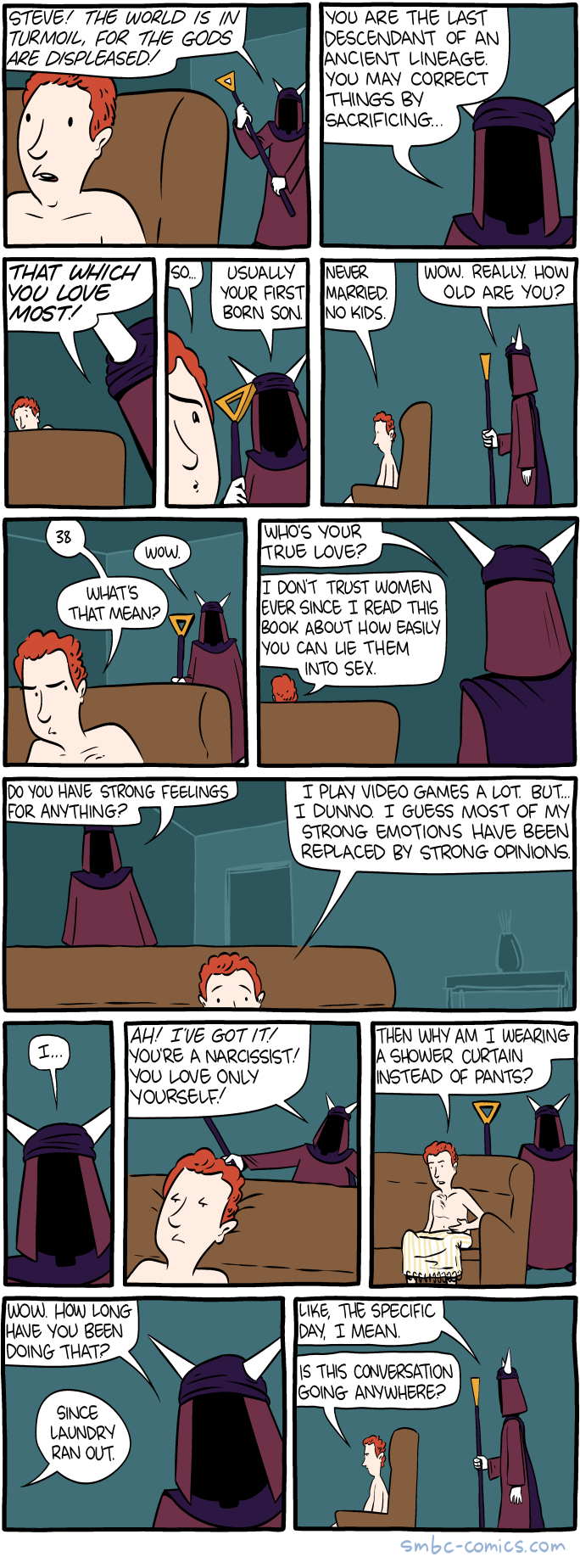
I will never get tired of mystical beings interacting with lazy humans.
New comic!
Today's News:
Saturday Morning Breakfast Cereal - Sacrifice
by tech@thehiveworks.com
Click here to go see the bonus panel!
Hovertext:
I will never get tired of mystical beings interacting with lazy humans.
New comic!
Today's News:
See you at BAHFest London!
Matthew Mellott, Lani Evitts and 2 others like this


24 Mar 16:24
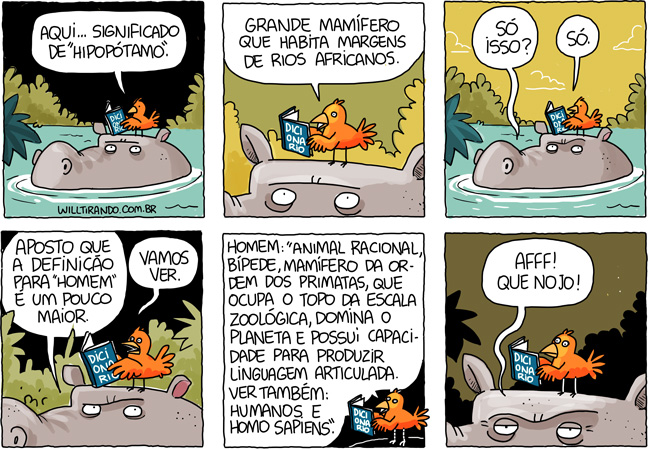
make a wishwebtoon / website / facebook / twitter / patreon

Adam Victor Brandizzi likes this
24 Mar 16:22

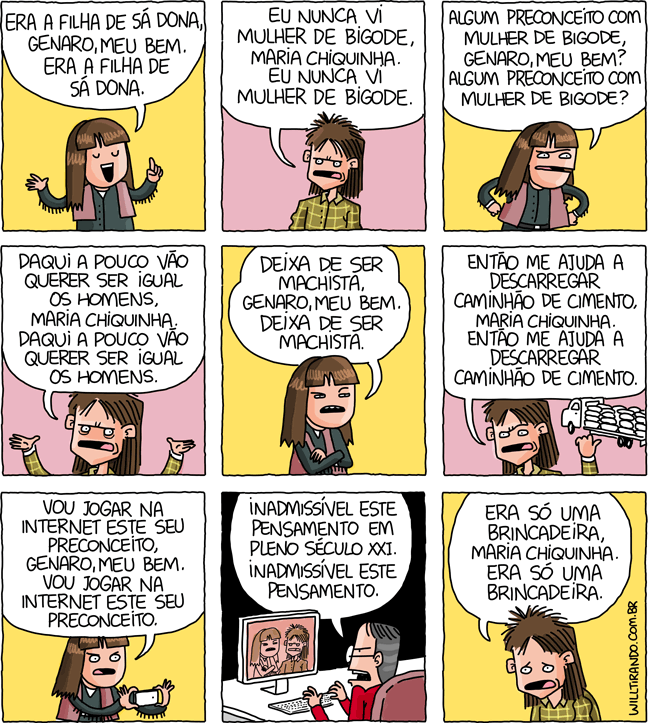
How to Maintain a Peaceful Break Room
by Scott Meyer
I just read about a meme in which people improve the open lines of books by following them with the line “And then the murders began.”
Take the opening line of Fear and Loathing in Las Vegas:
“We were somewhere around Barstow on the edge of the desert when the drugs began to take hold. And then the murders began.”
I would argue that one could also improve almost any book by doing the same thing with Jenkins’ line of dialog from the second panel.
“We were somewhere around Barstow on the edge of the desert when the drugs began to take hold. And then the boobs come out.”
Also, thinking about this comic, I’d be surprised if there isn’t a subgenre of erotic literature made up of stories that take place immediately after the rapture.
As always, thanks for using my Amazon Affiliate links (US, UK, Canada).
Adam Victor Brandizzi likes this
