Shared posts

09 Oct 19:44

The Speed of Sound

by Greg Ross

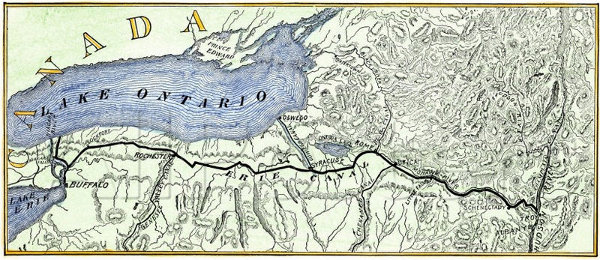
http://commons.wikimedia.org/wiki/File:Erie-canal_1840_map.jpg

When the Erie Canal was opened on Oct. 26, 1825, the fact was known in New York City, 425 miles away, within 81 minutes. This was before the advent of radio or telegraph. How was it done?

Cannons were placed along the length of the canal and the Hudson River, each within earshot of the last. When the crew of each cannon heard the boom of its upstream neighbor, it fired its own gun.

As a result, New Yorkers knew within an hour and half that they had a navigable route to the Great Lakes — the fastest news dispatch, to that date, in world history.

10/07/2013 Wait, that last bit ain’t right — Claude Chappe’s semaphore telegraph covered 120 miles in 9 minutes in 1792. (Thanks, Michael and Lorcan.)

09 Oct 12:00

John McAfee wants to NSA-proof the internet with a device called Decentral

by Melissa Grey

DNP John McAfee wants to NSAproof the internet with Decentral device

The name McAfee is synonymous with the ubiquitous anti-virus software, but in recent years, John McAfee has kept a relatively low profile in the tech industry, preferring instead to take up leisurely pursuits like yoga and evading Belizean police. Until now. Last Saturday, McAfee took the stage at the San Jose McEnery Convention Center to announce his intention to design and manufacture Decentral, a pocket-sized device priced at around $100 that would, in theory, make it difficult for governmental agencies to snoop on your online activities by creating so-called floating networks. According to the San Jose Mercury News, McAfee told an eclectic crowd of engineers and artists, "There will be no way [for the government] to tell who you are or where you are." A gadget like Decentral does sound like a bit of a timely pipe dream, and McAfee admits that the prototype has yet to be produced. But, hey, if you can dream it, then maybe, just maybe, McAfee can do it.

Filed under: Misc, Internet

Comments

Source: San Jose Mercury News

09 Oct 11:59

Standing Out

by Greg Ross

One of the famous whitewashed towns of Andalusia is blue.

The little village of Júzcar, population 243, was made up with 4,200 liters of blue paint in 2011 to celebrate the release of the movie The Smurfs.

Afterward, Sony offered to paint the town white again, but the villagers declined — in the six months since the film’s premiere, they had received 80,000 tourists.

09 Oct 11:58

Are Dogs People, Food, or Friends?

by Jonathan Coppage

In Sunday’s New York Times, neuroscientist Gregory Berns recounted how:

FOR the past two years, my colleagues and I have been training dogs to go in an M.R.I. scanner—completely awake and unrestrained. Our goal has been to determine how dogs’ brains work and, even more important, what they think of us humans.

Now, after training and scanning a dozen dogs, my one inescapable conclusion is this: dogs are people, too.

After years of preparatory work, Berns says that “Although we are just beginning to answer basic questions about the canine brain, we cannot ignore the striking similarity between dogs and humans in both the structure and function of a key brain region: the caudate nucleus.”

He explains:

Specific parts of the caudate stand out for their consistent activation to many things that humans enjoy. Caudate activation is so consistent that under the right circumstances, it can predict our preferences for food, music and even beauty.

In dogs, we found that activity in the caudate increased in response to hand signals indicating food. The caudate also activated to the smells of familiar humans. And in preliminary tests, it activated to the return of an owner who had momentarily stepped out of view. Do these findings prove that dogs love us? Not quite. But many of the same things that activate the human caudate, which are associated with positive emotions, also activate the dog caudate. Neuroscientists call this a functional homology, and it may be an indication of canine emotions.

The ability to experience positive emotions, like love and attachment, would mean that dogs have a level of sentience comparable to that of a human child. And this ability suggests a rethinking of how we treat dogs.

To Berns, “by using the M.R.I. to push away the limitations of behaviorism, we can no longer hide from the evidence. Dogs, and probably many other animals (especially our closest primate relatives), seem to have emotions just like us.”

The neuroscientist believes that he has peered into the mind of his canine, and witnessed a similarity of brains structures that proves that dogs have emotions just like us. And because they have those similar brain structures, dogs have the moral status of a child, and should have their personhood recognized accordingly.

Meanwhile, at First Things, B.D. McClay pushes back against the idea that because dogs aren’t people, they are appropriate food:

Dogs and human beings have a particular relationship, one distinctive among domestic animals: even when we work together, we work alongside. The man working with a dog in the field trusts the animal’s independent judgment. Whether that dog is herding sheep, hunting other animals, or sniffing for bombs, we place our trust in the dog’s intelligence and loyalty. We therefore accord them a respect and a place we do not grant to the other animals.

That respect isn’t irrational, because it is founded in the uniqueness of the relationship. You could say the relationship itself could have been formed just as easily with some other animal—pigs, for instance. That might be true, but it’s irrelevant. Denying the existence of the relationship would be the irrational thing to do here. The relationship is a fact, and like all relationships, it comes with duties and privileges. So don’t eat dogs.

Surely, though, there is a rich and reasonable middle ground between claiming that dogs have emotions identical to humans and considering them fit for the table. Diana Schaub in a recent issue of The New Atlantis finds canine specialness to be rooted in their friendship with us, a friendship in the truest sense of the word:

Of the brute creation, only dogs — by virtue of their alliance with us — can experience the spiritedness that listens to reason and rises above the promptings of pleasure and pain. Dogs become ethical beings through their capacity to pay attention, to care about praise and blame, and to obey. While not themselves rational, they are willing to follow our lead. Man and dog together instantiate the tripartite soul.  …

The education of a dog is always an education for the man as well. Remember, mastery and obedience are desirable not in themselves, but for the shared work they make possible. Obedience points beyond itself to “the practices of friends.” With a little help from Plato and Hegel, Borjesson shows how man and dog may arrive at a spot where the dog knows enough about the common endeavor to hold the man accountable for his failures. He tells the story of a hunter who

“could see his brilliant German shorthair pointer Colter’s disappointment every time he tracked and flushed a bird only to stand by and watch his master shoot and miss the mark. Ashamed to let down his friend, Bass bought a better rifle and went to a Texas ranch for a weekend primer on shooting. Thus Colter pressured Bass to become a better friend, or at least a better shot. Now that’s an example of the power of recognition at work making friends better and more beautiful.”

Follow @joncoppage

08 Oct 11:01

Jazz Guitar After Brain Damage

by Neuroskeptic

The journal World Neurosurgery has just published a remarkable case report: the rather uplifting story of Pat Martino: Jazz, Guitar and Neurosurgery

Martino (born in 1944 in Philadelphia) was playing jazz guitar by the age of 12. By 20 he had a record deal and a series of successful albums followed.

But in 1976, he began to suffer headaches. As these became more intense, he developed psychiatric symptoms including mania and depression, along with seizures that left him confused. He attempted suicide on multiple occasions and was treated in psychiatric hospitals for depression, but to no avail.

In 1980 a severe seizure left him hospitalized. The cause was finally found after a CT scan revealed an arteriovenous malformation in his left temporal lobe. Martino had probably been born with this abnormal mass of blood vessels, as they can lie dormant for many years. In his case, it had begun to haemorrhage, and had become life-threatening.

So a surgeon removed 70% of Martino’s left temporal lobe:

The result was devastating:

When discharged, he showed apparently no aphasia [loss of speech], but presented a profound retrograde amnesia, which included his own person, his environment and familiar people. He also had complete abolition of his musical capabilities.

So he began to relearn everything:

Aided by his father, the patient was gradually introduced back into his past, with the help of photos, encounters with friends, including other musicians, and, mainly, by making him listening to his own records. The patient, in turn credited to a computer the necessary help to revitalize his musical interest: a small Apple Macintosh with a tiny screen, and a 127K system with a music program…

He returned progressively, though slowly and with difficulty, to play the guitar; this time as if it were a toy, “to escape the situation, and to please my father”. The process of memory retrieval took him about two years. Although he never lost his manual dexterity, the necessary skill to play guitar again to his previous musical level took years to bring back.

In 1987 he returned to record a jazz album called, logically, “The Return”.

It was Martino’s first record for 10 years, but he’s recorded 20 albums since and is still working. Though he experiences some memory problems, they don’t affect his daily life, and he says that living more in the “here and now” has its advantages.

The authors of the World Neurosurgery paper (who include Paul Broks, of Into the Silent Land) point out that Martino’s excellent recovery may have been aided by the nature of his illness. If the malformation had been in his left temporal lobe from birth, impairing its development, his healthy right temporal lobe might have taken over additional functions.

ResearchBlogging.orgGalarza M, Isaac C, Porcar OP, Mayes A, Broks P, Montaldi D, Denby C, & Simeone F (2013). Jazz, Guitar and Neurosurgery: the Pat Martino Case Report. World Neurosurgery PMID: 24076057

The post Jazz Guitar After Brain Damage appeared first on Neuroskeptic.
08 Oct 10:59

The Amarildo Case and Rio's Pacification Strategy

by Rio Gringa

Yesterday, Rio special forces occupied the Complexo de Lins, where two new "pacification units" will be installed as a part of the city's ongoing security strategy. In total, Rio will now have 36 police pacification units. But the city's pacification strategy has come under further scrutiny in recent weeks as new details emerge about the high-profile disappearance of a bricklayer from Rio's largest slum, Rocinha.

Rocinha by Eliseu Cavalcante
Amarildo de Souza's July disappearance may have just flown under the radar as one of many disappearances in Rio each year. But the vanishing of a man believed to be an honest working father came after Brazil's big protests and amid increasing scrutiny of the military police, sparking the interest of celebrities, Cariocas, and people throughout Brazil and spawning protests in several Brazilian cities.

And last week, on October 2, homicide investigators announced they would charge 10 military police officers who worked at Rocinha's pacification unit for the torture and murder of Amarildo, even though his body still hasn't been found.

New details have emerged about the case that have raised questions about the military police working in Rio's pacification units. Police allegedly questioned Amarildo about local drug traffickers, and tortured him in the pacification unit building using electric shocks and suffocation with a plastic bag. Investigators believe at least 22 other people were tortured by police in the same location in Rocinha's pacification unit. The then commander of the pacification unit also bribed witnesses to blame Amarildo's disappearance on drug traffickers. The bribe money came from donations by a company to benefit the favela; the commander also stole money from the donations to rent an apartment.

Rio's governor and the state security secretary have said that the Amarildo case is not typical of the pacification strategy. "We have 8,600 military police in pacification units and the overwhelming majority are beloved by the population," said Sérgio Cabral, the governor. "The Amarildo case is a sad one and shows that the only thing that could happen is what happened--investigation and punishment--precisely because we have a pacification unit in Rocinha."

But the problem is that the numbers aren't adding up.

According to a September analysis of 18 pacification units by Folha de São Paulo, homicides in pacified favelas have in fact gone down by 68 percent from 2008 to 2011. However, disappearances have increased, from 85 in 2008 to 133 in 2011. An estimated 553 people disappeared in those 18 communities from 2007 to 2012. The study also found that of Rio's 33 pacification units, 76 percent have at least one accusation of police abuse.

Overall, disappearances have grown steadily in Rio state. By one estimate, there have been over 92,000 disappearances in Rio state in the past 22 years. According to government statistics, disappearances in Rio state have grown by nearly 30 percent in the past decade, while murders decreased by 50 percent.

Some believe that police are reporting disappearances instead of autos de resistência, when a person dies after a confrontation with police. Because this type of death results while a policeman is presumably doing his job, it's viewed as justified by security forces. One specialist even said the practice of reporting autos de resistência has been a common practice over the past two decades, and has been used to cover up unwarranted confrontations and executions.

In addition, watchdog group Rio de Paz believes the city has numerous clandestine cemeteries used by police to dump bodies. And there's also the possibility of police simply failing to report some crimes. Jailson de Souza e Silva, who runs Observatório de Favelas, noted that the Amarildo case could be the beginning of a crisis of the long-term police presence in favelas. He said that no favela residents really disappear. "Everyone knows what goes on there," he explained.

The entire basis of the pacification strategy is to ensure the presence of the state in areas where the government used to have no control. Some referred to the drug traffickers as a "parallel power" who acted in lieu of the state, providing things like money for medicine and enforcing order in communities with their own brand of justice.

But if police are using the same violent methods as traffickers, is that really pacification? Perhaps the problem lies in the law enforcement officers themselves--known to be corrupt, poorly paid and trained, and to have ties to organized crime--rather than the strategy overall. The Amarildo case has helped shine a light on the persistent challenges of the military police force, which if unresolved, will prevent any successful pacification strategy.

Image: Rocinha in Rio de Janeiro, by Eliseu Cavalcante.

08 Oct 00:45

Hitler’s women

by thuudung

In Nazi-occupied Eastern Europe, German women were witnesses to the Holocaust. Some were accessories. And some shot children, one by one… more»

08 Oct 00:41

mmemento: linzb0t: 義足のMoses This is so adorable♥ OH...


mmemento:

linzb0t:

義足のMoses

This is so adorable♥

OH WOW.CUTE

Eu acho que vocês vão entrar em frenesi com isso. O Gizmodo acrescenta algum contexto e um comentarista faz uma ligação interessante da animação com certo personagem, a “menina dos sapatos vermelhos.”

07 Oct 21:05

whyshouldeye: "The ability to experience positive emotions,...


whyshouldeye:

"The ability to experience positive emotions, like love and attachment, would mean that dogs have a level of sentience comparable to that of a human child. And this ability suggests a rethinking of how we treat dogs.

DOGS have long been considered property. Though the Animal Welfare Act of 1966 and state laws raised the bar for the treatment of animals, they solidified the view that animals are things — objects that can be disposed of as long as reasonable care is taken to minimize their suffering.

But now, by using the M.R.I. to push away the limitations of behaviorism, we can no longer hide from the evidence. Dogs, and probably many other animals (especially our closest primate relatives), seem to have emotions just like us. And this means we must reconsider their treatment as property.”

Dogs Are People, Too - NYTimes.com

07 Oct 21:05

Photo


07 Oct 12:18

Photo


07 Oct 12:18

Aaron Paul being confused by fashion

by aishiterushit


Aaron Paul being confused by fashion

07 Oct 12:18

Veja o trailer de “Breaking Bad” em versão espanhol e conheça Walter e José!

by Phelipe Cruz

breaking-bad-espanhol

Sim, isso vai acontecer. Não é piada, não é paródia. Já foi criado e produzido um remake em espanhol para “Breaking Bad”.

Walter Blanco é o protagonista do seriado que se chamará “Metastasis”, uma produção do Canal Sony da Colômbia. A história é a mesma. Um professor de química que descobre ter câncer e decide fazer metanfetamina. Só que tudo direcionado para o público latino, falado em espanhol, com atores latino-americanos.

Olha o trailer que saiu hoje:

Parece piada, mas não é. Até os nomes são traduzidos literalmente. Walter White vira Walter Blanco, Jesse fica Jose, a Skyler vira Cielo e o Hank será Henry Navarrro. Vamos conhecer os atores?

walter-blanco

Walter White vira Walter Blanco, interpretado pelo ator Diego Trujillo (neste print do trailer)

jose-breaking-bad

Jesse será José, interpretado pelo Roberto Urbina (em print do trailer)

SANDRA-REYES-breaking-bad

Skyler será Cielo, interpretada pela atriz Sandra Reyes (em foto que a gente achou na internet)

Julian-Arango-breaking-bad

Hank vira Henry Navarro na pele do ator Julian Arango (nessa foto que a gente achou no IMDB)

Viram o trailer? Não parece paródia? A gente achou isso bem pior que a versão latina para “Gossip Girl”, lembra?

07 Oct 12:14

think-progress: digg: "compromise" A government shutdown...


think-progress:

digg:

"compromise"

A government shutdown “compromise”

(And, hey, my boss is trending.)

07 Oct 12:14

twentypercentcooler: Japanese Spiderman is the best...


twentypercentcooler:

Japanese Spiderman is the best Spider-Man.

07 Oct 12:10

dallonscreams: charmedsevenfold: snoozlebee: lepetitdragon: t...

by aishiterushit


dallonscreams:

charmedsevenfold:

snoozlebee:

lepetitdragon:

tenaciousbee:

destroyer:

WHAT’S GOIN’ ON!

image

Everyone else can go home

OMFG

omg lol

best cosplay of all time

I love that the cheekbones are drawn on her face.

warning: my policy for this blog is to repost this every time it pops up on my dash

can we take a moment to appreciate the fact that every troll cosplayer in this picture is a terezi

OH MY GOD YES

07 Oct 09:27

Photo


07 Oct 09:27

efedra: Dior Homme f/w 2011


efedra:

Dior Homme f/w 2011

07 Oct 09:26

stinkdude: ash i am a foot tall mouse and that is some godzilla...


stinkdude:

ash i am a foot tall mouse and that is some godzilla shit happening over there

04 Oct 20:45

Brasil, The Economist e as indicações contrárias

by Luciano Sobral

Quando a The Economist lançou a famosa edição com o Cristo Redentor decolando na capa (14 de novembro de 2009), o Ibovespa estava em 65.000 pontos, vindo de uma espetacular recuperação de mais de 80% nos doze meses anteriores (no mesmo período, o S&P500 havia subido “só” 28%, tendo feito uma nova mínima em março e só então iniciado uma correção). Uma ação da Petrobras (PETR4) valia R$ 37, uma ação da OGX (OGXP3) valia R$ 14 e gente como Jeremy Grantham, o conservador e respeitado estrategista da gigante americana GMO, dizia que ações de mercados emergentes deveriam operar com um prêmio sobre seus pares em países desenvolvidos, para (aqui cito literalmente de uma das cartas trimestrais dele) “celebrar seu crescimento do PIB obviamente superior comparado ao de um mundo desenvolvido envelhecendo”.

Hoje é fácil olhar para aquela imagem e classificá-la como “indicador contrário”. Essa propriedade é frequentemente atribuída a capas de publicações, tendo por trás uma lógica bastante atraente: preços antecipam notícias, e quando um fenômeno chama atenção o bastante a ponto de virar matéria jornalística de destaque para o grande público, provavelmente já está totalmente incorporado nos preços. Nesse ponto, o próximo movimento mais provável seria na direção oposta do que aponta a mídia. O caso mais célebre (ou infame) é o do livro Dow 36.000, lançado nos Estados Unidos no final de 1999, alguns meses antes do espetacular estouro da bolha do Nasdaq. Conta a lenda que quem correu para vender ações americanas no lançamento do livro se deu bem, assim como quem fugiu da Bovespa ao ver histórias do Brasil que, finalmente, tinha dado certo.

Em ambos os casos, a anedota é mais charmosa e bem menos complexa do que a realidade. A “óbvia” bolha do Nasdaq sobreviveria por mais alguns meses, o suficiente para fazer com que dois dos maiores especuladores da história, Julian Robertson e George Soros, decidissem repensar os respectivos fundos após ficarem para trás com apostas contra a tendência de alta das ações de tecnologia. O mesmo Jeremy Grantham lembra daquela época como a mais difícil de sua carreira, vendo o dinheiro dos seus clientes deixar a GMO para apostas mais “quentes” e de retornos rápidos. No caso do Brasil, quem vendeu ações em novembro de 2009 ainda viu o Bovespa romper mais duas vezes os 70 mil pontos antes de iniciar uma tendência clara de queda, por volta de março de 2011.

Assim, talvez seja cedo para correr para ações brasileiras (ainda que, provavelmente, a margem de segurança dos preços atuais seja maior do que na euforia de 2009). A decepção expressa na última edição da The Economist, creio, pode ser estendida para a decepção geral do investimento estrangeiro no Brasil nos últimos anos. Poucas das narrativas de “país decolando” provaram-se corretas, e voltaram os conhecidos problemas de investimento em emergentes: moeda depreciando, empresas com dificuldades em entregarem lucros aos acionistas, gargalos de infraestrutura, intervenção arbitrária do governo e sensação de que o país rasgou mais um bilhete de ida para o nirvana do desenvolvimento.

Más decisões dos pilotos do foguete-Brasil e problemas com o combustível (preços de commodities) provocaram o pouso forçado recente. Se isso hoje está claro, ainda é difícil ver alguma mudança no comando ou na tecnologia de propulsão. Talvez o que estamos vendo é o fim de uma fase bipolar da relação dos mercados com o país, uma volta ao Brasil mais-ou-menos com o qual nos acostumamos por muito tempo.


Este artigo foi publicado originalmente na AE-News/Broadcast

04 Oct 18:58

Coisas que eu aprendi sobre a China nesta semana

by Leonardo Monasterio
Adam Victor Brandizzi

Bem, diga-se o que quiser da China, menos que não é sempre interessante.

04 Oct 11:04

philv: © Phil Vitnell 2013


philv:

© Phil Vitnell 2013

04 Oct 11:02

America was not shut down properly. Would you like to start...

by wagatwe


America was not shut down properly. Would you like to start America in safe mode, with free healthcare and without guns? (Recommended)

YASSSS

04 Oct 10:57

Fear Itself

by Doug

Fear Itself

Dedicated to Ben, who’s celebrating his birthday tomorrow! Happy birthday Ben!

Here’s more fear.

03 Oct 23:25

O YouTube me recomendou um clipe de R&B mongol (de Mongólia...


O YouTube me recomendou um clipe de R&B mongol (de Mongólia mesmo).

03 Oct 11:34

FOSS Outreach Program for Women: success and new round

by Quim Gil
Adam Victor Brandizzi

Fica a dica, passemos à frente.

Rachel Thomas at work.

Round 6 of the Free and Open Source Software Outreach Program for Women (OPW) has been successfully completed. Our intern, Rachel Thomas worked remotely from Boston (MA, USA) on Browser Test Automation for VisualEditor in a full-time Summer internship. For more detail on her work, check her wrap-up blog post, her project reports and her code contributions.

In total, 37 women took part in this OPW round, working with 16 open source projects including the Linux Kernel, Mozilla and WordPress.

There was only one Wikimedia intern in this round, but only because seven others were also participating in parallel in Google Summer of Code (GSoC). There were 6 interns in the previous editions and we plan (tentatively) to fund 8 positions in the next round, expected to start at the beginning of 2014.

While GSoC interns are paid by Google, in OPW the funds come mainly from the organizations participating in the program. At the Wikimedia Foundation, we’re starting to work on the next round. We consider that OPW is playing an important role in bridging the gender gap in our technical community. In the previous seven years, only one woman got a GSoC internship at Wikimedia. This year, more than a third of our interns were women (8 out of 21).

To make sure that this becomes a trend and not just an exception, we need your help!

  • Spread the news about the program, and encourage your tech friends to join when applications open. Remember that, in many cases, we have to break well-established social inertia: many more women will do the first step if they receive a personal invitation.
  • Propose a technical project, even if it’s a rough idea. We will help you polish it.
  • Volunteer as a technical mentor. Women are welcome! We want to close the gender gap at the mentorship level as well.
  • Fund an intern. Chapters and other organizations willing to pool resources with the Wikimedia Foundation are welcome.

We also welcome ideas to promote other profiles typically underrepresented or discriminated against in technical projects. We strive for equal opportunities, and we believe that diversity will make our community stronger and our projects better. If you agree, get a head start by exploring how to contribute! It will increase your chances of being selected when you apply.

Quim Gil, Technical Contributor Coordinator, Wikimedia Foundation

03 Oct 11:02

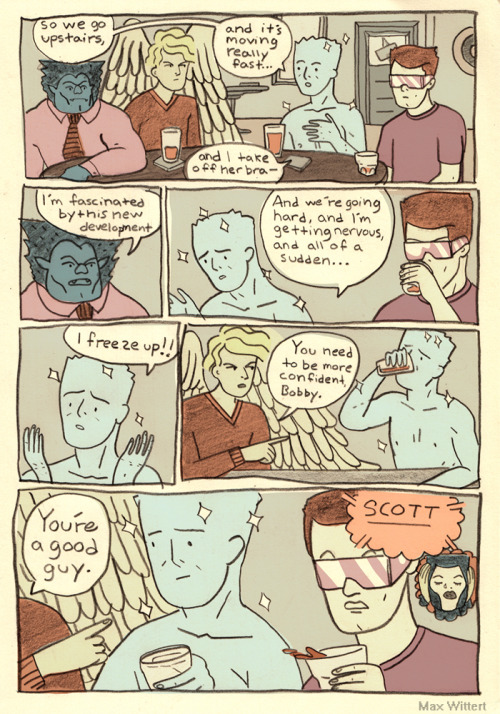
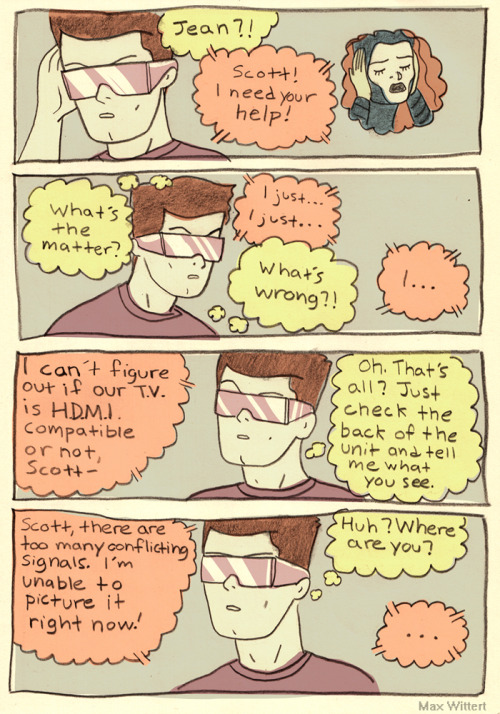
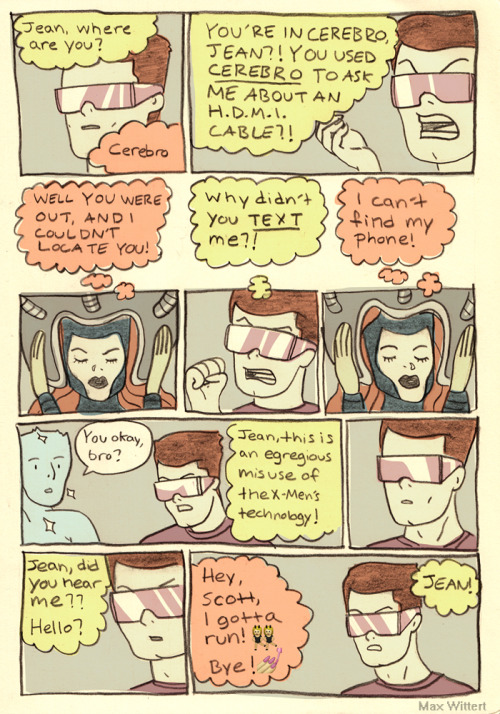
maxwittert: Jean & Scott, episode 3 Check out past episodes...

by brianbendis


maxwittert:

Jean & Scott, episode 3

Check out past episodes here:

Episode 1

Episode 2

(by Max Wittert, 2013)

03 Oct 11:02

A maldição do lobisomem inverso.

by Zanfa

É algo extremamente triste.

lobo

Acho que a namorada morreu ein? Só acho.

02 Oct 23:54

How To Uninstall McAfee Antivirus (com o próprio John Mcafee!)


How To Uninstall McAfee Antivirus (com o próprio John Mcafee!)

02 Oct 23:54

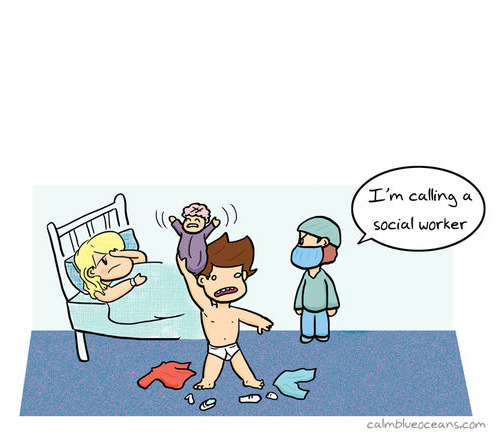
cremedocreme: Quando um homem se torna pai. Anotado para fazer...


cremedocreme:

Quando um homem se torna pai.

Anotado para fazer com o próximo.