Shared posts

21 May 23:21

Conheça o perfil e a motivação dos haitianos que entram no Brasil

Uma pesquisa da PUC-MG traçou o perfil dos imigrantes haitianos que vivem no Brasil, com dados sobre formação, faixa etária, profissão anterior e principais destinos no país.

O trabalho foi divulgado na semana passada e teve como base registros administrativos e entrevistas com 340 haitianos, além de uma pesquisa qualitativa com imigrantes em cinco cidades.

Em linhas gerais, a maioria dos haitianos que vive aqui tem segundo grau incompleto e idade entre 25 e 34 anos, embora também haja bebês e idosos.

Os homens exercem funções técnicas na construção civil, enquanto as mulheres desempenham tarefas de nível técnico que não foram especificadas.

Haitianos no Brasil

São Paulo é, de longe, a cidade que mais concentra esses imigrantes –cerca de 28% deles. A seguir, vêm Manaus e Porto Velho, na região Norte, escolhidas por cerca de 8% dos imigrantes cada uma. Três cidades da região Sul –Curitiba, Caxias do Sul (RS) e Cascavel (PR)– ocupam as posições seguintes.

Recentemente, a vinda de haitianos para São Paulo patrocinada pelo governo do Acre deflagrou uma crise entre os dois Estados, com acusações de preconceito e irresponsabilidade por parte dos governantes. Para os haitianos, São Paulo representa com frequência mais oportunidades de emprego.

As igrejas se tornaram pontos de concentração de imigrantes, como mostra a pesquisa, e têm importante papel na socialização. Em São Paulo, os haitianos vindos do Acre se concentraram na igreja Nossa Senhora da Paz, onde se formou uma “feira” de oferta de empregos.

O caminho de chegada ao Brasil passa quase sempre pelo Panamá. De lá, parte dos imigrantes seguiu direto para Belo Horizonte, Brasília ou São Paulo, enquanto os demais fizeram escalas no Equador e no Peru até entrar no Brasil pelo Amazonas ou pelo Acre.

Alguns dos entrevistados levaram até três meses para chegar ao Brasil e gastaram, em média, 2.900 dólares. Um dos fatores que contribui para encarecer as viagens são os intermediários, “coiotes” que facilitam a travessia, mas exigem dinheiro em troca.

Entre os motivos alegados para deixar o Haiti estão a busca por melhores oportunidades de trabalho e estudo, uma tentativa de ajudar a família que ficou para trás, o terremoto que devastou o país em 2010 e a violência.

“A vida lá no Haiti não está boa; não se pode viver em paz, não se tem possibilidade de ir ao hospital e não se tem segurança nas atividades; somos roubadas em nossos pequenos comércios”, disse uma haitiana, em Curitiba.

Mas nem tudo são flores no novo lar. Muitos se dizem frustrados pelas condições que encontraram ou mesmo arrependidos de terem saído do país.

É o caso de uma migrante que reside em Belo Horizonte. Ela conta que os “coiotes” exigiram sua casa no Haiti, deixando seus filhos desabrigados. Após dois anos no Brasil, ela afirma que ainda não conseguiu metade do dinheiro que esperava.

O trabalho, por sinal, nem sempre condiz com o que os haitianos esperavam encontrar. Além das dificuldades geradas pela língua, aqueles que têm qualificações nem sempre encontram empregos à altura de suas habilitações.

Também há reclamações sobre rotinas exaustivas e mal pagas. Um imigrante em Curitiba conta que trabalha há dois anos com carteira assinada e recebe apenas R$ 687.

Apesar das dificuldades encontradas, como a língua, as diferenças culturais, a falta de tempo e de dinheiro para o lazer e a distância de familiares e amigos, muitos afirmam gostar do Brasil.

É o que diz uma migrante em Belo Horizonte: “Às vezes, eu acordo chorando porque eu não vejo a minha família [...], mas eu gosto muito daqui porque as pessoas daqui têm respeito para com a gente”.


21 May 17:56

De ladrões e Capitalismo

by Manoel Galdino

Algum tempo atrás, convencido do desastre que é andar de carro em São Paulo, e também da crise vindoura do aquecimento global, decidi-me a não ter mais carro. Eu queria compatibilizar meus desejos coletivos com minhas escolhas individuais. Em suma, fazer aquilo que o Rorty recomendou não fazer: fundir público com o privado, exigir do privado coerência com o público e vice-vera.

Bastava então eu vender meu carro. Levaria numa concessionária e conseguiria algum dinheiro. Mas eu sei que vender carro em concessionária é o pior negócio que se pode fazer. Melhor arranjar um comprador particular para meu carro. Mas a gente sabe que aí dá muito mais trabalho. É preciso negociar, garantir que não te darão um calote. Seria preciso talvez até fazer uma revisão no carro. Pois não quereria enganar alguém e vender gato por lebre. Mas a gente sabe que levar carro na oficina dá trabalho. Sem mecânico de confiança, podem te enrolar. Já pensou eu vender gato por lebre porque o mecânico me vendeu gato por lebre? Sem falar que também não quero ter prejuízo e gastar num carro velho e não recuperar o valor justo investido, pois afinal se trata de um mercado de limões, certo?

Eu pensei até em não vender o carro. Como vocês viriam acima, é algo que dá muito trabalho. Poderia ficar com o carro e só usá-lo em emergências ou casos excepcionais. Mas e ficar pagando IPVA e seguro? E, no fim das contas, eu acaba usando várias vezes, porque afinal é cômodo.

Eis que um ladrão veio e furtou meu carro. E resolveu meu problema. Não comprei outro – pois queria justamente me livrar do carro e, além disso, daria trabalho. Fim de papo. Às vezes um ladrão pode trabalhar contra o capitalismo, e não é porque desrespeita a propriedade privada. Aliás, a maior mentira que inventaram é dizer que no capitalismo a propriedade privada é sagrada*. Mas isso é assunto pra outro post.

**************

Meu smartphone, produzido com o suado trabalho semi-escravo da China estava com problemas. Nele não funcionava mais o wi-fi, só o 3g.  A bateria durava pouco, e ele ficava desligando sozinho com frequência. Travava bem na hora de um tuíte importante, quando alguém estava errado na internet. Eu queria comprar um celular novo, mas hesitava justamente pela mesma ideologia que me levou a não ter mais carro. Temos que reduzir o consumismo e não podemos ficar trocando de celular todo ano, ou a cada 2 anos. Mas meu desejo era comprar um celular novo. Só que tem que pesquisar, comparar modelos, achar o melhor preço. Enfim, acabava não trocando.

Veio um ladrão e furtou meu celular. Então comprei outro, novinho, mais moderno, no mesmo dia. Está faltando o chip, mas resolvo logo. Às vezes, um ladrão trabalha a favor do capitalismo, e não estou falando de desrespeitar a propriedade privada.

* Estou pensando aqui em duas coisas. Em primeiro lugar, como a corrupção, pilhagem, expropriação, guerras e o colonialismo foram importantes para o desenvolvimento histórico do capitalismo. Em segundo lugar, num modelo em que quanto mais as pessoas roubam, maior o incentivo a acumular. Basta que, quanto mais dinheiro você tenha, mais fácil seja roubar os outros sem ser punido. Eu não tenho dúvida que é possível construir algum modelo desse tipo, em que o equilíbrio é uma alocação eficiente no sentido de Pareto, como os economistas adoram. Mas a verdade é que eu não preciso apelar pra isso, pois o Ariel Rubinstein já fez algo parecido, criando um modelo formal mais ou menos sobre o assunto.


Arquivado em:Arte e Cultura, ciência, Manoel Galdino, orquídeas selvagens, Política e Economia Tagged: aquecimento global, automóvel, capitalismo, carro, China, consumsimo, Cosma, Cosma Shalizi, ecologia, Economia, furto, ladrão, Rubinstein, the jungle, trabalho escravo
20 May 22:49

29-04-2014

by Laerte
Adam Victor Brandizzi

Piada infame da porra


20 May 22:47

The Congresswoman Whose Husband Called Her Home : It's All Politics : NPR

Rep. Coya Knutson (D-Minn.), is shown shopping in a supermarket in 1955 following her demand to know why her fellow housewives remain saddled with high grocery bills while farm income continues to drop.i i

hide captionRep. Coya Knutson (D-Minn.), is shown shopping in a supermarket in 1955 following her demand to know why her fellow housewives remain saddled with high grocery bills while farm income continues to drop.

Rep. Coya Knutson (D-Minn.), is shown shopping in a supermarket in 1955 following her demand to know why her fellow housewives remain saddled with high grocery bills while farm income continues to drop.

Fifty-six years ago this weekend, newspapers across the nation told a sad tale of a family seemingly imploding.

At the center of the story was Coya Knutson, the opera-singing daughter of a Norwegian farmer, and the first woman from Minnesota elected to Congress.

Voted in on her own merits, not appointed to keep a late husband's seat warm for a successor, the trailblazing mother could only watch as vengeful party rivals, a manufactured scandal, and a feckless, alcoholic husband combined to sabotage her career.

It all came to a head on the eve of Mother's Day 1958.

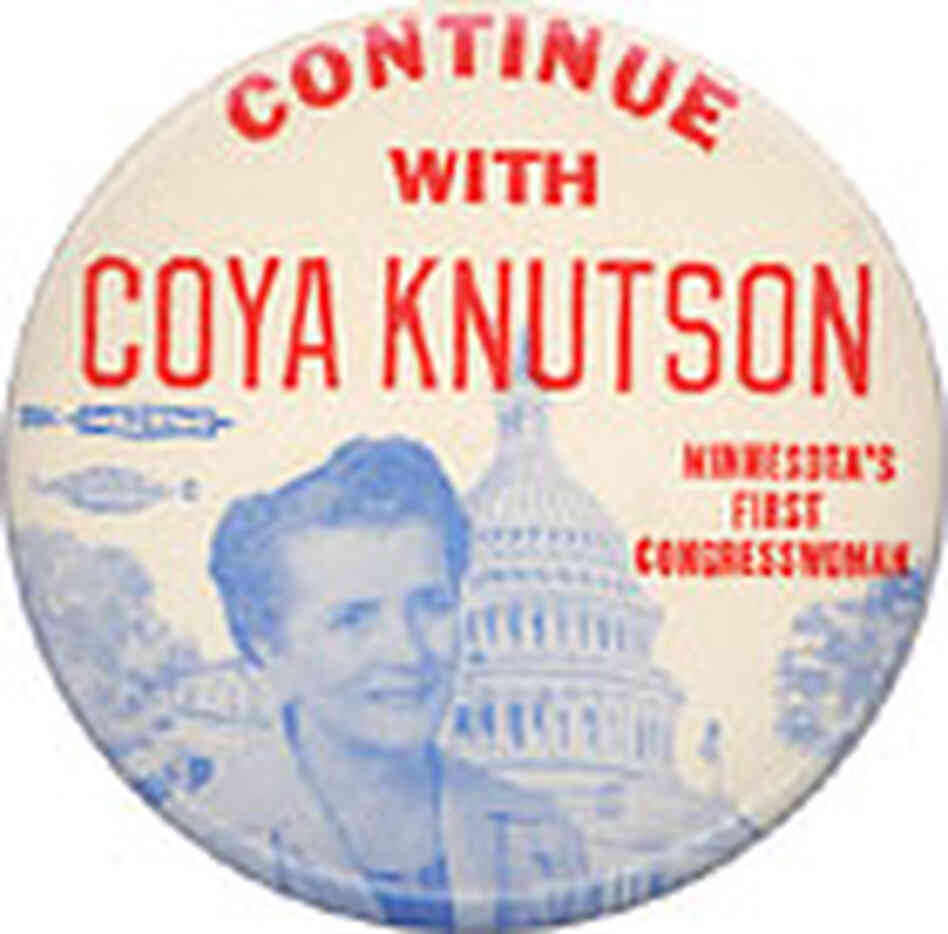
Late 1950s-era Coya Knutson campaign button.

hide captionLate 1950s-era Coya Knutson campaign button.

Never heard of the charismatic Knutson, who briefly studied opera at the Juilliard School in New York before returning home to become a schoolteacher and political activist?

Not many have, even in her home state.

But during the late 1950s, when Knutson was running for her third U.S. House term representing Minnesota's rural 9th District, she briefly but spectacularly made the front pages across the nation.

Not for her work on Capitol Hill establishing the first federal student loan program and first grants for cystic fibrosis research. Or for being the first congresswoman ever appointed to the House Agriculture Committee – at the insistence of House Speaker Sam Rayburn over vehement gender-based objections of its chairman.

It was because of an infamous letter, signed by husband Andy back in tiny Oklee, Minn., but widely believed to have been written by grudge-driven operatives in the congresswoman's own party, the progressive Democratic-Farmer-Labor (DFL) Party.

The letter — urging her to abandon the nation's capital and return to hearth and home — was first published in a regional newspaper under the headline, "Coya Come Home."

It spread like a virus, inspiring overheated stories nationwide. Like one in a Pennsylvania newspaper that described the "honey-blonde" congresswoman looking haggard as she "came out of hiding" to insist she wasn't angry at her husband.

"It's the dirtiest trick I've ever seen in politics," says Gretchen Beito, a Minnesota author who chronicled Knutson's historic path in the book, Coya Come Home.

Knutson's son Terry, now 74, had campaigned with his mother as a teenager but was already in college when the rumpus erupted. He said DFL operatives had also engaged a spurious whisper campaign back in his mother's very religious district that she was having an affair with a young man who was her top aide.

"They wanted to get even with her, to get her out of Congress," Knutson says.

What prompted this enmity? These reprisals? Historians largely agree that the Knutson was vulnerable only in part because of her gender at a time when the prevailing sentiment was that a woman's place was in the home.

"Women themselves resented her," says Beito, the author. "She was doing what women weren't supposed to do."

The populist Knutson's greatest political sin was that she had the temerity to buck party bosses at least twice, and with great success.

First, when, as a state legislator, she used her estimable campaigning skills – which included fluency in Norwegian and a charming ability to sing and play the accordion — to challenge and defeat the DFL's choice on her way to her first term in Washington.

Knutson stepped on toes once again, more significantly, when she chaired in 1956 the state presidential campaign of Tennessee Sen. Estes Kefauver, who was seeking the Democratic nomination. DFL officials, including Sen. Hubert Humphrey, who harbored vice presidential ambitions, had endorsed Illinois Sen. Adlai Stevenson.

Kefauver crushed Stevenson in the Minnesota presidential primary that year, a shocking embarrassment to party bosses, and an end to Humphrey's drive to be on a national ticket. Knutson won re-election that year, but was forced to again beat back a party-backed primary challenge two years later when she set out to win her third term.

Even so, her detractors were persistent, and played their trump card before the fall election.

"They decided to go to Andy," Terry Knutson says, "and pay him cash to sign the letter."

That letter urged the congresswoman to abandon her re-election campaign and "go home a make a home for your husband and son." It went on: "As your husband I compel you to do this...I'm sick and tired of having you run around with other men all the time and not your husband. I love you honey."

Says Terry Knutson: "After that, it was pretty much over," even though his adoptive parents hadn't been living together for years, he says, because of Andy's drinking and abusive behavior.

Coya Knutson lost to a Republican challenger – "A Big Man for A Man-Sized Job" was his slogan — in the fall of 1958. She obtained a divorce few years later, but steadfastly refused to speak ill of her husband. He died of alcoholism in 1969, but not before he admitted he did not write the famous letter.

"She had a philosophy that 'vengeance is mine, sayeth the Lord,'" said Beito. "That was her mantra."

A handful of party old-timers like George Farr, 90, who served as DFL state chairman in the 1960s, still assert that it was the unfounded rumor of the affair that undid Knutson, not any organized effort to oust her.

Her support of Kefauver, Farr insists, "was not a major factor" in her downfall.

"It's one of those deals where, as a candidate, you have to keep your home base secure," he says. "She let it get away from her."

Knutson lost two subsequent runs for Congress, but did return to Washington to work in the Defense Department. She eventually came back to her home state, where she lived with her son and his family until her death nearly two decades ago at age 84.

Legislation to establish a memorial in her honor in or near the State Capitol in St. Paul was vetoed in 1997 by GOP Gov. Arne Carlson. Knutson, he argued, hadn't been dead long enough to qualify.

In Oklee, where, inspired by Eleanor Roosevelt, Knutson launched her historic, if truncated, political career, a billboard that greets visitors proclaims its pride as the home of the state's first female member of Congress. Former Vice President Walter Mondale, a Minnesota Democrat, described Knutson in a 1997 salute to her in the Congressional Record as "electric."

At her funeral, family played an interview Knutson recorded with one of her young relatives. "Just strike out," she said, in what the Star Tribune newspaper reported was a bold, robust voice.

"Go on out and try your wings," she said. "That's what I did."

Bookmarked at brandizzi Delicious' sharing tag and expanded by Delicious sharing tag expander.
20 May 17:48

¿Hábrete? El original AQUÍ


¿Hábrete?

El original AQUÍ

20 May 13:25

Napoleon: Complex

by Tracy R. Walsh
Adam Victor Brandizzi

É porque ele foi maior do que os franceses conseguem compreender.

by Tracy R. Walsh

Jacques_Louis_David_-_Bonaparte_franchissant_le_Grand_Saint-Bernard,_20_mai_1800_-_Google_Art_Project

Brian Eads notes that “200 years on, the French still cannot agree on whether Napoleon was a hero or a villain”:

“The divide is generally down political party lines,” says professor Peter Hicks, a British historian with the Napoléon Foundation in Paris. “On the left, there’s the ’black legend’ of Bonaparte as an ogre. On the right, there is the ’golden legend’ of a strong leader who created durable institutions.”

French politicians and institutions in particular appear nervous about marking the 200th anniversary of Napoleon’s exile. … While the 200th anniversary of the French Revolution that toppled the monarchy and delivered thousands to death by guillotine was officially celebrated in 1989, Napoleonic anniversaries are neither officially marked nor celebrated. For example, a decade ago, the president and prime minister – at the time, Jacques Chirac and Dominque de Villepin – boycotted a ceremony marking the 200th anniversary of the battle of Austerlitz,Napoleon’s greatest military victory. “It’s almost as if Napoleon Bonaparte is not part of the national story,” Hicks tells Newsweek.

20 May 13:20

Photo


20 May 13:19

just a theory

my_comics_only_address_the_most_pressing_issues_facing_humanity
20 May 13:18

Frozach Submitted

20 May 13:17

Iran’s Lifesaving Drone Program

by Jonah Shepp
by Jonah Shepp

Eat your heart out, John McCain. Motherboard takes a look at what these Iranian scientists are up to:

We’ve seen how drones can be a crucial asset to search and rescue operations, but Iran’s RTS Lab has taken an entirely new angle. RTS’s Pars drone carries a payload of life preservers that can be delivered to a drowning swimmer far faster than a lifeguard. As we saw in testing in the Caspian Sea, the drone can also work at night, using bright lights, thermal sensors, and a built-in camera to stream video to rescuers on shore.

The concept works well, and it’s an excellent example of how powerful drones—which are cheaper and easier to use than just about any other aerial delivery vehicle—can actually be.

20 May 13:15

In Defense of Publishers

If you’re making a list of the top three reasons to love RSS, one of them has to be that it exists largely outside of the Internet advertising machine. That is, it’s the only major browsing technology that isn’t trying to directly monetize every second of your online experience. 

But we are taking a stand for the right of one group of advertisers in the RSS universe- publishers. You know, the people who create the great content we all read via The Old Reader.

Publishers have been trying to figure out how to make a living off digital publishing since before there was an Internet. For the most part, they have settled on a free, ad supported model rather than a closed, subscription-based business plan. That’s a good thing.

But we’ve gotten more than a few requests from users that we include ad blocking or even screen scraping technology to deliver syndicated RSS content stripped of ads. Even though RSS is a great way to avoid much of the advertising industry, ads do creep in. Some sites fill feeds with advertising, or put very little content in them to force readers to visit the full, ad-loaded website. 

But it is their content, and it is the publishers right to advertise and drive traffic to their websites. It’s not always our favorite approach, but we won’t get in the way. I certainly understand that ads can be annoying. (I tend to drop the worst offenders from my feed.) But if one of my favorite sites is ad supported, they need to know that their ads are being served and seen by their RSS followers. It’s easy to imagine lots of sites would stop syndicating if RSS became just a hole in their business model. 

Besides, the publisher-driven ad model we’re supporting is much healthier than what is emerging on the social platforms. The reader/aggregator/social networks are taking most of the ad revenue and making it hard for the publisher to get their share. For example, in the Facebook model, publishers pay Facebook to promote their content, then Facebook surrounds that promoted content with their own ads. Only if someone clicks through on the post to the actual content does the publisher even have a chance to get their own ad impression.  

We talk a lot about keeping the web open, neutral, and as free as possible from the insidious influence of advertising. It’s part of our belief in the power of technology to connect our users, deliver them the content they want and with the best possible experience.

But advertising is part of the world we live in. There has to be an acceptable level, or there will be a lot less content worth reading. Our goal is to build a virtuous circle. We want users to want to read content on The Old Reader, where you will be subjected to the lowest level of advertising possible. Hopefully, the publishers will appreciate that courtesy, and keep syndicating that content for you as well.  

20 May 12:41

Photo


20 May 12:30

Mental Health Break

by Andrew Sullivan
by Chris Bodenner

The evolution of special effects since 1878:

20 May 12:28

Quem é menino e quem é menina

 http://feeds.folha.uol.com.br/colunas/contardocalligaris/rss091.xml

"Eu, Mamãe e os Meninos", escrito, dirigido e interpretado por Guillaume Gallienne, é uma boa ocasião para pensar sorrindo.

No filme, que foi um grande sucesso na França (ganhou cinco prêmios César), Gallienne conta sua história: a de um jovem que cresceu, digamos assim, "efeminado", porque a mãe esperava que ele fosse a filha que ela não teve -é difícil não responder a essa expectativa, e o menino acaba procurando na mãe seu maior, se não único modelo.

O título original francês é o grito da mãe: "Os meninos e Guillaume, para mesa!" —deixando claro que, para ela, Guillaume não fazia parte do conjunto dos meninos.

Na saída do cinema, várias questões (garanto: sem spoiler).

1) Guillaume cresce convencido de ser uma menina. Ele prefere tocar piano e conversar a praticar equitação, caça ou qualquer esporte. Mas essa identidade de menina é um estereótipo criado e imposto pela mãe —uma espécie de contraveneno que ela usa para se proteger dos filhos ("os meninos") e do marido. De fato, há maneiras de ser menina muito diferentes da que a mãe de Guillaume parece destinar ao seu filho.

2) A obra (hoje esgotada) de Elena Gianini Belotti (1973) sobre a "fabricação" das identidades de gênero continua importante. Tudo bem, Guillaume é o efeito (a vítima?) do desejo de sua mãe, que quer uma filha. Mas pergunto: "os meninos", dos quais ele não faz parte, será que eles não são as vítimas do desejo do pai deles, que quer dois filhos? Será que é "natural" para menino preferir o rugby à leitura de Jane Austen? Ou será que essas preferências dos meninos, no fundo, são tão forçadas (pela expectativa do pai) quanto as preferências que Guillaume deve à influência de sua mãe?

3) A história de Guillaume ilustra o poder extraordinário (embora não ilimitado —como o filme mostra) da palavra e do desejo maternos na hora de inventarmos e construirmos nossas identificações e nossos hábitos.
De onde vem esse poder? A mãe, em tese, é a que está lá desde o começo, e há uma chantagem de fato, implícita, inevitável: no início da vida, nenhum amor parece tão necessário quanto o materno —para sobreviver, simplesmente. Então, melhor que a mãe goste da gente, não é?

4) Em geral, acreditamos adquirir hábitos sem querer, à força de repetir comportamentos convenientes, esperados etc. Mas esse "sem querer" é quase sempre aparente: frequentemente, adquirimos hábitos por um treino proposital —como alguém que, na primeira tragada, não quisesse começar a fumar, mas se tornar desde já fumante e, logo, queimasse um maço por dia, mesmo não gostando, "para se acostumar".

Na internet, há milhares de vídeos de "treino" de vários comportamentos sexuais. Não são vídeos explicativos (tipo: faça assim, pegue por baixo ou se deixe pegar por cima), mas declaradamente "hipnóticos": a pretensão é que, ao contemplá-los, você seja sugestionado (geralmente, eles propõem uma rápida sucessão de imagens com o fundo sonoro de uma voz cativante). Por que alguém precisaria ser sugestionado para realizar atos que correspondem ao que ele deseja?

Fácil: desejamos coisas que, às vezes, o pudor, o desgosto ou o medo não nos permitem realizar —coisas que povoam nossos devaneios, mas contra as quais resistimos tudo o que podemos. Os vídeos hipnóticos prometem isto: você se tornará capaz de fazer o que você deseja e não consegue se permitir.

Curiosamente, a maior categoria de vídeos hipnóticos na net talvez seja a dos vídeos para homens que queiram se "feminizar", ou seja, se permitir os hábitos sexualmente mais passivos possíveis ("sissyfication", é a palavra-chave).

Esses vídeos não convertem ninguém. Eles só têm interesse para quem já deseja intensamente o que eles mostram; mesmo nesse caso, não sei se eles ajudam alguém a ultrapassar as inibições que o impedem de realizar seus devaneios.

Mas a simples existência desses vídeos mostra que adoramos encontrar nossos próprios desejos sob forma de ordens que vêm de fora: por favor, alguém me mande fazer o que quero fazer e não consigo me autorizar a fazer. É um padrão que explica muitas coisas: desde a complacência com ordens que poderiam (e deveriam) ter sido desobedecidas até a facilidade com a qual acusamos as mães (sempre elas) por ter nos mandado desejar "o que não queríamos". Será mesmo que não queríamos?

20 May 12:20

Before And After

by Jessie Roberts
by Jessie Roberts

Kate Good shares the story of her husband’s physical transition from female to male, writing that she’s “learned that ‘transgender’ is a ridiculously large catch-all”:

There’s no such thing as gender reassignment surgery, despite what various government and news agencies seem to think. There’s a menu of therapies, medications, and surgeries, and people pick what combination works for their body, their health, their mental and emotional needs and, not least, their finances. The government as a whole doesn’t have a good grasp on what it means to be transgender, and definitions and regulations vary wildly from office to office and day to day. What it really takes to get a passport issued is anyone’s guess. Even in the time we’ve been together these things have improved, thanks to hard-working activists, but there’s still a lot of work to do both in writing new regulations and clarifying existing ones.

There’s not a line — before here he was female, after he is male.

I think he’s still deciding on how to think about the person he was before transitioning. Every once in a while I see a picture of him before he cut his hair and changed his name and how he dressed, before he was the man I married. It’s an odd feeling. It’s him but not him. I don’t dwell on it.

I don’t dwell on my own sexuality either. I’m straight. I wasn’t attracted to him when he started transitioning, when there was still a feminine curve to his cheeks and hips. If you had asked me then if we would ever date I would have said no. It took two years of being friends before I realized I liked him (liked liked him). One day he asked me out and I thought well, why not? And then we fell in love, fast. We were almost immediately talking about our future, marriage, kids. His being transgender faded to the background.

It sounds unbelievable but I still sometimes forget. He has to remind me that people he met in the past might not know who he is now. I don’t know, or care, what loving him means for my placement on the Kinsey scale, or whatever spectrum is the going standard. If I lost him I would undoubtedly date cis-men. I love him, and I love being his wife. Figuring out what that labels me as seems like a waste of time.

19 May 12:35

fer1972: Black and White Photography by Pierre Pellegrini


fer1972:

Black and White Photography by Pierre Pellegrini

19 May 12:35

Photo


19 May 12:29

sponsored posts

by tomfishburne


Hugh MacLeod once cartooned “If you talked to people the way advertising talked to people, they’d punch you in the face.”

Nowhere is this more apparent than in social media, particularly as brands migrate their commercial messages from ads on the side to sponsored posts in the center. I had a chance to go to Facebook’s headquarters recently and was struck by something I heard — when your brand message sits in someone’s news feed between a friend’s birth announcement and another friend’s wedding pictures, your brand message had better be worth it.

Yet not enough brand messaging in social media is really worth it. Their content feels re-purposed from traditional advertising. Too frequently, brands come across as party crashers rather than welcome guests.

I’ve also noticed brands take a one-size-fits-all approach across every social media channel. Marketers don’t give enough thought to the platform their content is posted on. Facebook is different than Instagram is different than Twitter is different than LinkedIn is different than Pinterest. To thrive in distinct channels, marketers have to adapt their story to each one.

I liked this quote from Gary Vaynerchuk’s recent book on this topic:

“Today, getting people to hear your story on social media, and then act on it, requires using a platform’s native language, paying attention to context, understanding the nuances and subtle differences that make each platform unique, and adapting your content to match.”

I’d love to hear your thoughts on how to create brand messaging that’s truly native to distinct social networks.

(Marketoonist Monday: I’m giving away a signed print of this week’s cartoon. Just share an insightful comment to this week’s post by 5:00 PST on Monday. Thanks!)

18 May 19:30

Photo


18 May 15:19

James Somers – Web developer money

There’s this great moment in the documentary Jiro Dreams of Sushi (2011) when the world’s most celebrated sushi chef turns to his son, who is leaving to start his own restaurant, and says: ‘You have no home to come back to.’ Which, when you think about it, isn’t harsh or discouraging but is in fact the very best thing you could say to someone setting out on an adventure.

Last October I quit my job to become a freelance journalist. I had only ever made about $900 from writing, but my latest project, a profile of Douglas Hofstadter, had attracted interest from a couple of big American magazines. I stood to make anywhere between $10,000 and $20,000 from the piece.

My plan was to sell that profile and keep writing others like it. This would be a rambling life of the mind. I would find a subject that I was intensely curious about and I’d live with it until I’d learnt everything there was to know. Then I would sit in a room somewhere and tap out a synthesis of such depth and piquant grace that no writer of non-fiction would think to touch my subject again — because I had nailed it, because I had put it to rest forever.

My new life began on a Monday. I’m a late sleeper, but I read somewhere that writers do their best work in the mornings. So I woke up early, put on some coffee, and cracked open my laptop.

When, in 1958, Ernest Hemingway was asked: ‘What would you consider the best intellectual training for the would-be writer?’, he responded:
Let’s say that he should go out and hang himself because he finds that writing well is impossibly difficult. Then he should be cut down without mercy and forced by his own self to write as well as he can for the rest of his life. At least he will have the story of the hanging to commence with.

Writing is a mentally difficult thing — it’s hard to know when something’s worth saying; it’s hard to be clear; it’s hard to arrange things in a way that will hold a reader’s attention; it’s hard to sound good; it’s even hard to know whether, when you change something, you’re making it better. It’s all so hard that it’s actually painful, the way a long run is painful. It’s a pain you dread but somehow enjoy.

I worked on my Hofstadter piece until early Thursday afternoon. On Thursday night I got an unexpected email. It was a job offer, and these were the terms: $120,000 in salary, a $10,000 signing bonus, stock options, a free gym membership, excellent health and dental benefits, a new cellphone, and free lunch and dinner every weekday. My working day would start at about 11am. It would end whenever I liked, sometime in the early evening. The work would rarely strain me. I’d have a lot of autonomy and responsibility. My co-workers would be about my age, smart, and fun.

I put my adventure on hold.

In college I sort of aimlessly played. I read what I wanted and tinkered with my computer, I made little websites for my own amusement, I slept late and skipped class, and though sometimes I saw myself as an intellectual-at-large in the style of Will Hunting, I was basically just irresponsible. It’s only because of an exogenous miracle that, when I graduated in 2009 with a 2.9 GPA and entered a famously bad job market, I didn’t end up in privileged limbo — in Brooklyn, say, on my parents’ dime. In fact, I was among the most employable young men in the world.

The exogenous miracle is that playing around with websites suddenly became a lucrative profession.

‘What about somebody in a coal mine — wouldn’t you say he works as hard as you? Why should you get paid so much more than that guy?’

I am a web developer, and there has never been a better time to do what I do. Here’s how crazy it is: I have a friend who decided, part way into his second year of law school, to start coding. Two months later he was enrolled in Hacker School in New York, and three months later he was working as an intern at a consultancy that helps build websites for start-ups. A month into that internship — we’re talking a total of six months here — he was promoted to a full-time position worth $85,000.

I didn’t think finding good work would be this easy. I always figured I would end up like my sister. My sister set academic records in high school and studied at the University of Chicago but the only position matching her qualifications, when she came out of school, was a job translating airline menus. She had an especially bright and sensitive mind, but no technical specialty; and the market did what it's wont to do to people like that.

I remember one time at dinner she had asked my dad, who was something of a corporate bigshot: ‘You always talk about the value of hard work. But what about somebody in a coal mine — wouldn’t you say he works as hard as you? Why should you get paid so much more than that guy?’

I used to think that was an awfully naive question.

In 1999 a dotcom with no revenue could burn $100 million in one year, with $2 million of that going to a Super Bowl ad. Its namesake website could offer a terrible user experience, and still the company could go public. Investors would chase the rising stock price, which would drive up the price further, which in turn drew more investors, feeding a textbook ‘speculative bubble’ that burst the moment everyone realised there wasn’t any there there.

This kind of stuff isn’t happening any more. It’s not that the internet has become less important, or investors less ‘irrationally exuberant’ — it’s that start-ups have gotten cheaper. A web start-up today has almost no fixed capital costs. There’s no need to invest in broadband infrastructure, since it’s already there. There’s no need to buy TV ads to get market share, when you can grow organically via search (Google) and social networks (Facebook). ‘Cloud’ web servers, like nearly all other services a virtual company might need — such as credit-card processing, automated telephone support, mass email delivery — can be paid for on demand, at prices pegged to Moore’s Law.

You can see why I’m in such good shape. In this particular gold rush the shovel is me

Which means that these days the cost of finding out whether a start-up is actually going to succeed isn’t hundreds of millions of dollars — it’s hundreds of thousands of dollars. It’s the cost of a couple of laptops and the salary you pay the founders while they try stuff. A $100 million pool of venture capital, instead of seeding five or 10 start-ups, can now seed 1,000 small experiments, most of which will fail, one of which will become worth a billion dollars.

And so there is a frenzy on.

You can see why I’m in such good shape. In this particular gold rush the shovel is me. We web developers are the limiting reagent of every start-up experiment, we’re the sine qua non, because we’re the only ones who know how to reify app ideas as actual working software. In fact, we are so much the essence of these small companies that, in Silicon Valley, a start-up with no revenue is said to be worth exactly the number of developers it has on staff. The rule of thumb is that each one counts for $1 million.

It helps that there aren’t enough of us to go around. I’m told by a friend at Bloomberg that they missed their quarterly tech hiring target in New York by 200 people. I get at least two enquiries a week from headhunters trying to lure me from my current job. If I say that I’m actively looking, I become a kind of local celebrity, my calendar fills with coffees and conversations, reverse-interviews where start-ups try to woo me.

It’s as if the basic structure of this sector of the global economy has been designed for my benefit. Since developers are a start-up’s most important — if not their only — asset, start-ups compete by trying to be a better place for developers to work. Just a few weeks ago, an MTV2 camera crew came into my office to film an episode of a show called Jobs That Don’t Suck. Cash bonuses, raises, stock options and gifts are the norm. I once worked at a place that had a special email address where you’d send requests for free stuff — a $300 keyboard, a $900 chair, organic maple syrup. I have yet to take a job where there wasn’t beer readily at hand. Hours are flexible and time off is plentiful. Fuck-ups are quickly forgiven. Your concerns are given due regard. Your mind is prized. You are, in short, taken care of.

You can imagine what it does to the ego, to be courted and called ‘indispensable’ and in general treated like you’re the one pretty girl for miles. When a lot of your contemporaries don’t even have jobs. When work, for most people, has a Damoclean instability to it, a mortal urgency. To be this highly employable is to feel liquid, easy, as if you can do no wrong. I know that I have a great job guaranteed in any major city. And it’s hard not to give a thing like that moral heft. It validates you is what I mean; it inflates your sense of your own character. I tell myself a story, sometimes, that while other people partied or read for pleasure, I was sitting in a room with my head down, fighting — that I worked hard to learn these minute technical things, and now I’m getting paid for it.

Something prima donna-ish can happen when you start believing stories like that. I look at a lot of inbound résumés at my current job, and I throw away everybody who’s not a programmer. I do this enough times each day that a simple association has formed in my mind: if you’re not technical, you’re not valuable.

We’re the ones with the magic powers. Every programmer knows that code looks cool, that eyes widen when we fill our screens with colourful incantations. ‘The programmer,’ the late Dutch computer scientist Edsger Dijkstra wrote in 1988, ‘has to be able to think in terms of conceptual hierarchies that are much deeper than a single mind ever needed to face before.’ We like that idea. We like to think that because we can code, we have unprecedented leverage over the world. We decide what 15 million people will see when they follow a link. Our laptops literally get hot from the electric action we command.

Nobody tells us we’re wrong for thinking this way. In fact, they reinforce the impulse. They congratulate us on being ahead of the curve.

And when you consider my prospects without code and you consider my prospects with code, the lesson really does seem to be: join me! Try Codecademy in New York, go to Hacker School — pledge yourself, like Michael Bloomberg did in 2012, to learn to code.

But that shouldn’t be the lesson.

I was only 21 when I became the chief technical officer of an American corporation. When that happened, I thought of my dad because he, too, had once been among the country’s youngest corporate executives, a chief financial officer (CFO) by the time he was 28. The only difference is that the company he helped to run in his twenties was Hardee’s, a fast-food restaurant chain with more than 1,000 locations, while the company I helped to run was a web start-up. Just about all we did, in our three years of operation, was spend $350,000 of other people’s money. Dad’s company made hamburgers; mine ate them.

I have a friend who’s a mechanical engineer. He used to build airplane engines for General Electric, and now he’s trying to develop a smarter pill bottle to improve compliance for AIDS and cancer patients. He works out of a start-up ‘incubator’, in an office space shared with dozens of web companies. He doesn’t have a lot of patience for them. ‘I’m fucking sick of it,’ he told me, ‘all they talk about is colours.’

Web start-up companies are like play-companies. They stand in relation to real companies the way those cute little make-believe baking stations stand in relation to kitchens.

Take Doormates, a failed start-up founded in 2011 by two recent graduates from Columbia University whose mission was to allow users ‘to join or create private networks for buildings with access restricted to only building residents’. For that they, too, raised $350,000. You wonder whether anyone asked: ‘Do strangers living in the same building actually want to commune? Might this problem not be better solved by a plate of sandwiches?’ (The founders have since moved on to ‘Mommy Nearest’, an iPhone app that points out mom-friendly locations around New York.)

A lot of the stuff going on just isn’t very ambitious. ‘The thing about the advertising model is that it gets people thinking small, lean,’ wrote Alexis Madrigal in an essay about start-ups in The Atlantic last year. ‘Get four college kids in a room, fuel them with pizza, and see what thing they can crank out that their friends might like. Yay! Great! But you know what? They keep tossing out products that look pretty much like what you’d get if you took a homogenous group of young guys in any other endeavour: Cheap, fun, and about as worldchanging as creating a new variation on beer pong.’

Groupon clones are popular, as are apps that help you find nearby bars and restaurants. There are dozens of dating apps with little twists — like Tinder, an iPhone app where you swipe to the right on a potential match’s picture if you like them, and to the left if you don’t; or Coffee Meets Bagel, which gives you one match per day for a low-stakes, let’s-just-grab-a-coffee date. SideTour, whose tech team is run by a former co-worker, lets you buy small 'experiences' around the city, like dinner with a monk. Just yesterday a developer friend of mine who’d recently gone out on his own shared his latest idea: an app that shows you nearby ATMs.

The most successful start-ups, at least if you go by the numbers — $13.5 million to Snapchat, $30 million to Vine, $1 billion to Instagram (each of these windfalls indirectly underwriting 100 low-rent copycats) — seem to be the ones that offer teenagers new ways to share photos with each other.

When I go to the supermarket I sometimes think of how much infrastructure and ingenuity has gone into converting the problem of finding my own food in the wild to the problem of walking around a room with a basket. So much intelligence and sweat has gone into getting this stuff into my hands. It’s my sustenance: other people’s work literally sustains me. And what do I do in return?

We call ourselves web developers, software engineers, builders, entrepreneurs, innovators. We’re celebrated, we capture a lot of wealth and attention and talent. We’ve become a vortex on a par with Wall Street for precocious college grads. But we’re not making the self-driving car. We’re not making a smarter pill bottle. Most of what we’re doing, in fact, is putting boxes on a page. Users put words and pictures into one box; we store that stuff in a database; and then out it comes into another box.

Web development is more like plumbing than any of us, perched in front of two slick monitors, would care to admit

We fill our days with the humdrum upkeep of these boxes: we change the colours; we add a link to let you edit some text; we track how far you scroll down the page; we allow you to log in with your Twitter account; we improve search results; we fix a bug where uploading a picture would sometimes never finish.

I do most of that work with a tool called Ruby on Rails. Ruby on Rails does for web developers what a toilet-installing robot would do for plumbers. (Web development is more like plumbing than any of us, perched in front of two slick monitors, would care to admit.) It makes tasks that used to take months take hours. And the important thing to understand is that I am merely a user of this thing. I didn’t make it. I just read the instruction manual. In fact, I’m especially coveted in the job market because I read the instruction manual particularly carefully. Because I’m assiduous and patient with instruction manuals in general. But that’s all there is to it.

My friends and I who are building websites — we’re kids! We’re kids playing around with tools given to us by adults. In decreasing order of adultness, and leaving out an awful lot, I’m talking about things such as: the Von Neumann stored program computing architecture; the transistor; high-throughput fibre-optic cables; the Unix operating system; the sci-fi-ish cloud computing platform; the web browser; the iPhone; the open source movement; Ruby on Rails; the Stack Overflow Q&A site for programmers; on and on, all the way down to the code that my slightly-more-adult co-workers write for my benefit.

This cascade of invention is a miracle. But as much as I want to thank the folks who did it all, I also want to warn them: When you make it this easy to write and distribute software, so easy that I can do it, you risk creating a fearsome babel of gimcrack entrepreneurship.

Is there another dotcom bubble on? It’s hard to call it a ‘bubble’ when the Nasdaq’s not running wild, when no one’s going to lose their pension — when all anyone’s going to lose is, in fact, time: time pretending at enterprise; time ‘sharing’ and ‘liking’ in forums of no consequence; time tapping out pedestrian code, extracting easy money.

The only rigorous way to think about value is in terms of dollars, in terms of prices arrived at by free exchange. Numbers like that are hard to dispute. If a price is ‘too low’ or ‘too high’, there’s said to be an opportunity for risk-free moneymaking. People tend to gobble up those opportunities. And so the prices of things tend to level out to just where they’re supposed to be, to just what the market will bear.

Am I paid too much to code? Am I paid too little to write? No: in each case, I’m paid exactly what I should be.

It’s like that question my sister asked dad at dinner. There’s an answer to that question — and this is the one I remember hearing that night — that says that my dad was probably paid more than the coal miner because the skills required to be CFO of a Fortune 500 company are scarcer, and more wanted, than the skills required to be a coal miner. It’s the combination of scarcity and wantedness that drives up a salary.

And that answer seems fair, and fine, it seems to settle the question, but we’re not talking about pork belly futures, we’re talking about real people and what they do all day, and my sister, naive as she sounded, had a point, and that point is that the truly naive thing, the glib and facile thing, might be equating value with a market-clearing price.

The price of a word is being bid to zero. That one magazine story I’ve been working on has been in production for a year and a half now, it’s been a huge part of my life, it’s soaked up so many after-hours, I’ve done complete rewrites for editors — I’ve done, and will continue to do, just about anything they say — and all for free. There’s no venture capital out there for this; there are no recruiters pursuing me; in writer-town I’m an absolute nothing, the average response time on the emails I send is, like, three and a half weeks. I could put the whole of my energy and talent into an article, everything I think and am, and still it could be worth zero dollars.

And so despite my esteem for the high challenge of writing, for the reach of the writerly life, it’s not something anyone actually wants me to do. The American mind has made that very clear, it has said: ‘Be a specialised something — fill your head with the zeitgeist, with the technical — and we’ll write your ticket.’

I don’t have the courage to say no to that. I have failed so far to escape the sweep of this cheap and parochial thing, and it’s because I’m afraid. I am an awfully mediocre programmer — but, still, I have a secure future. More than that, I have a place at the table. In the mornings I wake up knowing that I make something people want. I know this because of all the money they give me.

Correction, June 9, 2013: An earlier version of this essay misstated the terms of the job offer extended to the author in October, 2012. In the previous version, the author stated that he was offered a salary of $150,000. This has been changed to reflect that the offer was for $120,000.

6 June 2013

Read more essays on Creativity, Economics and Technology

Bookmarked at brandizzi Delicious' sharing tag and expanded by Delicious sharing tag expander.
18 May 12:50

Educação dos libertos

by Míriam Leitão

Enviado por Míriam Leitão e Alvaro Gribel - |

Coluna no GLOBO

Educação dos libertos

Em 19 de abril de 1889, uma Comissão dos Libertos escreve a Rui Barbosa. “Comissionados pelos nossos companheiros libertos de várias fazendas próximas a estação de Paty, município de Vassouras, para obtermos do governo Imperial educação e instrução para os nossos filhos, dirigimo-nos à Vossa Excelência...” E pediam ajuda para conseguir o cumprimento da lei de 1871.

A Lei do Ventre Livre havia estabelecido que os filhos de escravos nasceriam livres e seriam educados. Não foi cumprida a parte da educação. “Nossos filhos foram imersos em profundas trevas. É preciso esclarecê-los e guiá-los pela instrução”. Isso dizia a carta ao jurista, definido como “verdadeiro defensor do povo”.

Esse é um dos documentos que a Casa de Rui Barbosa exibe na exposição “Abolição e seus registros na vida privada”. É o terceiro ano que a Casa exibe cartas, documentos dele e de outros acervos familiares sobre essa fase da história. Nos dois primeiros, os textos focavam a escravidão. Nesse, se deslocam para o período abolicionista. E mostra como a abolição foi um processo. “Compreendemos perfeitamente que a libertação partiu do povo que forçou a Coroa e o Parlamento a decretá-la”, diz a Comissão dos Libertos.

Há lá a carta de alforria carimbada, registrada em cartório e assinada por Rui dando liberdade à escrava Lia, que herdara. No belo casarão de Botafogo, onde fica o seu acervo, não havia escravos, só libertos.

A exposição mostra as conspirações pela abolição. Numa carta, amigos paulistas informam que estão fundando um jornal para defender a “causa”. Noutro documento, Rui é consultado sobre uma campanha para libertar as meninas escravas de membros da Loja Maçônica. Há várias versões da Lei do Sexagenário, o Projeto Dantas. Ele era assessor parlamentar e escreve num papelzinho azul: “Esse é o meu projeto”. O texto foi todo modificado e, como diz Ana Pessoa, Diretora do Centro de Memória, recebeu a pressão conservadora para reduzir os direitos dos escravos de 60 anos.

Em 24 de maio de 1888, Maria Leonor Barbosa de Oliveira escreveu à prima Francisca. “Tenho estado bem maçada por causa da tal lei 13 de maio por saber que o priminho perdeu muito com isso; essa gente do poder quer fazer as coisas, mas não sabem fazer; fazem com o prejuízo de muitos. Acho isso mau. Eu faria cá de modo que não prejudicasse; porque as pessoas que tinham escravos, compraram.”

Depois que veio a República, os ex-donos pressionaram pela criação de um banco que os indenizasse. E na exposição está um pedaço da minuta do então ministro da Fazenda Rui Barbosa, de 11 de novembro de 1890, negando: “Mais justo seria e melhor se consultaria o sentimento nacional se se pudesse meio de indenizar os ex-escravos não onerando o Tesouro.”

— A ideia da exposição é trazer esses arquivos pessoais para mostrar como isso foi vivido no âmbito da vida privada — diz Lucia Veloso, chefe do arquivo.

Em outro documento, um cidadão se culpa por ter sido um “palerma” ao não ter vendido os escravos antes da abolição.

O presidente da Casa de Rui Barbosa, Manolo Florentino, lembrou a dimensão do tráfico no país:

— O Brasil faz parte, na sua origem, do maior movimento migratório compulsório da História humana antes do século XIX, que foi o tráfico de escravos para as Américas. São 11 milhões de pessoas que chegaram vivas e cinco milhões vieram para o Brasil. Desses, quatro milhões entraram no século XVIII e XIX, portanto, não há na América país com uma raiz tão afro, nem que a face africana seja tão recente.

18 May 10:57

Brain Stimulation Makes Man A Johnny Cash Fan?

by Neuroskeptic

A man developed a passionate love for the music of Johnny Cash after being implanted with a brain stimulation device. The unique story is told in a case report in the Frontiers in Behavioral Neuroscience journal, published on the 6th May.

johnny_cash_brain

The authors, Mariska Mantione and colleagues, describe the case of “Mr. B”, a 58 year old Dutch man who had suffered from severe obsessive-compulsive disorder (OCD) and anxiety since the age of 13.

Numerous medications and psychotherapy had failed to provide relief. So Mr B. was given deep brain stimulation (DBS) as a last resort treatment. The electrodes were placed in the nucleus accumbens.

It worked: his OCD and anxiety symptoms went down, down, down, so much so that he felt like his spirit was finally unchained:

Mr. B. reported he felt very confident, calm and assertive and he started to call himself “Mr. B. II”, the new and improved version of himself.

But it wasn’t just his symptoms that changed; his musical taste did too. Previously Mr B had been quite fond of the Rolling Stones, but he wasn’t really a big music lover. However,

…a half year after DBS surgery, Mr. B. stated that he was turning into a Johnny Cash fan. He had been listening to the radio, when he coincidentally heard “Ring of Fire” of the Country and Western singer and experienced that he was deeply affected by the song. Mr. B. started to listen to more songs of Johnny Cash and noticed that he was deeply moved by the raw and low-pitched voice of the singer

His appreciation for the Man in Black soon progressed from liking into devotion. Mr. B kept Cash on his mind both day and night

Mr. B. reported that he felt good following treatment with DBS and that the songs of Johnny Cash made him feel even better. From this moment on, Mr. B. kept listening simply and solely to Johnny Cash and bought all his CD’s and DVD’s… From the first time Mr. B. heard a Johnny Cash song, [all other music] has been banned.

However, this remarkable Cash-omania apparently vanished on occasions when the DBS stimulation turned off:

His former musical taste reoccurred immediately when stimulation was interrupted due to battery depletion, suggesting a direct causal link between musical preference and stimulation of the accumbens.

What does this mean? It’s a fascinating case, but hard to make sense of. The most direct interpretation would be that stimulation of the accumbens directly made Mr B more receptive to enjoying and becoming a fan of music.

The accumbens is involved in pleasure and motivation so this is plausible, but it begs the question, why Johnny Cash rather than any other musician? Can the specific object of Mr B’s new preference be explained, or is it just one of those inexplicable quirks of human life?

Then again, who’s to say that the nucleus accumbens stimulation was directly responsible for the Cash preference? Perhaps it was the sense of a new perspective on life, secondary to his symptom improvement, that was crucial. Maybe any effective OCD treatment would have had the same consequence? Against this possibility, Mantione and colleagues note that the preference seemed to be contingent on the continuing accumbens stimulation, but this is essentially an anecdote, not a rigorous blinded discontinuation trial.

ResearchBlogging.orgMantione, M., Figee, M., & Denys, D. (2014). A case of musical preference for Johnny Cash following deep brain stimulation of the nucleus accumbens Frontiers in Behavioral Neuroscience, 8 DOI: 10.3389/fnbeh.2014.00152

The post Brain Stimulation Makes Man A Johnny Cash Fan? appeared first on Neuroskeptic.

18 May 02:21

Legend of Gertrude Stein

Adam Victor Brandizzi

Como um bom coçar chamado Carl Van Vechten colocou Gertrude Stein no cânone.

Carl Van Vechten shaped and burnished the legend of Gertrude Stein.

G Stein Van Vechten

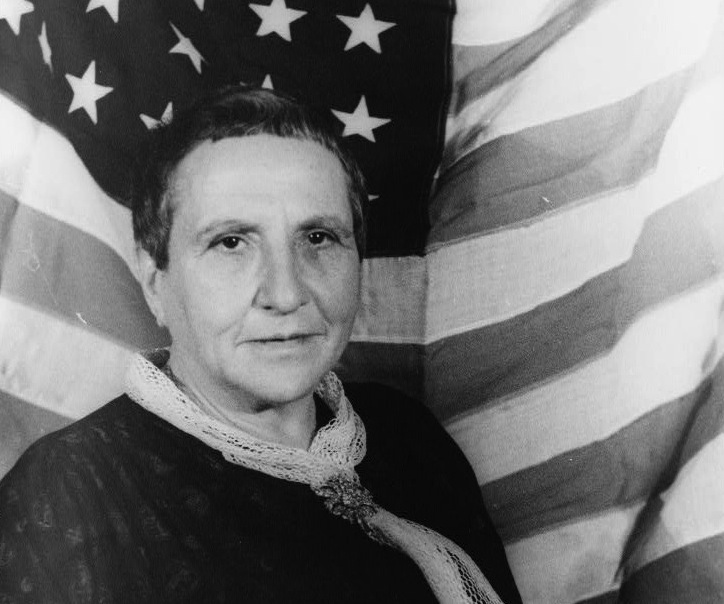
Carl Van Vechten’s iconic 1935 portrait of Gertrude Stein

This year marks the centenary of the publication of Tender Buttons, Gertrude Stein’s collection of experimental still-life word portraits split into the categories of objects, food, and rooms, and which—excluding a vanity publication in 1909, which she paid for herself—was the first of Stein’s work to be published in the United States. Stein had hoped that this enigmatic little book would be her big break, the thing to convince the American people of her genius. That was not to be. Tender Buttons left critics bemused and made barely a dent on the consciousness of the wider reading public. There was no great clamor for more of her writing; Stein would have to wait another twenty years to become a household name. Nevertheless, the publication of Tender Buttons is now widely regarded as a landmark in American literary modernism, the moment when one of the most influential writers of the twentieth century first unfurled her avant-garde sensibilities before the American public.

That moment would never have arrived had it not been for the work of Stein’s most important champion, Carl Van Vechten, the man who arranged for the book’s publication. Little remembered today, Van Vechten was a pioneering arts critic, a popular author of tart, brittle novels about Manhattan’s Jazz-Age excesses, an acclaimed photographer, and a flamboyant socialite whose daring interracial cocktail parties were a defining part of Prohibition-era New York’s social scene. But his greatest legacy is as a promoter of many underappreciated American writers, artists, and performers who went on to gain canonical status. Names as diverse as Langston Hughes, Paul Robeson, and Herman Melville all felt the effects of Van Vechten’s boost. His first great cause was Gertrude Stein. He did more than anyone else to carve her legend into the edifice of the American Century, arranging publishing deals for her, photographing her, and publicizing her work, a task he continued long after her death.

Stein knew how crucial Van Vechten was to her career—not merely in the practical aspects of getting her work into print, read, and discussed, but in helping create and disseminate the mythology that surrounds her name. “I always wanted to be historical, almost from a baby on,” Stein freely admitted toward the end of her life. “Carl was one of the earliest ones that made me be certain that I was going to be.” Van Vechten and Stein were strikingly different, led wildly different lives. Hers was rooted in the domestic stability she enjoyed with her partner Alice B. Toklas; his was an exhausting whirl of binges, parties, and pansexual escapades. But they had two crucial things in common: the conviction that Gertrude Stein was an irrefutable genius and a love of mythmaking, an obsession with re-scripting reality until they became the central actors in the fantastical scenes that unfolded in their heads. When Stein played fast and loose with the facts in her memoirs, The Autobiography of Alice B. Toklas, many were furious over her distortions. But Van Vechten understood that telling the literal truth about her life—or anybody else’s—was never Stein’s concern.

van vechten self portrait 1933

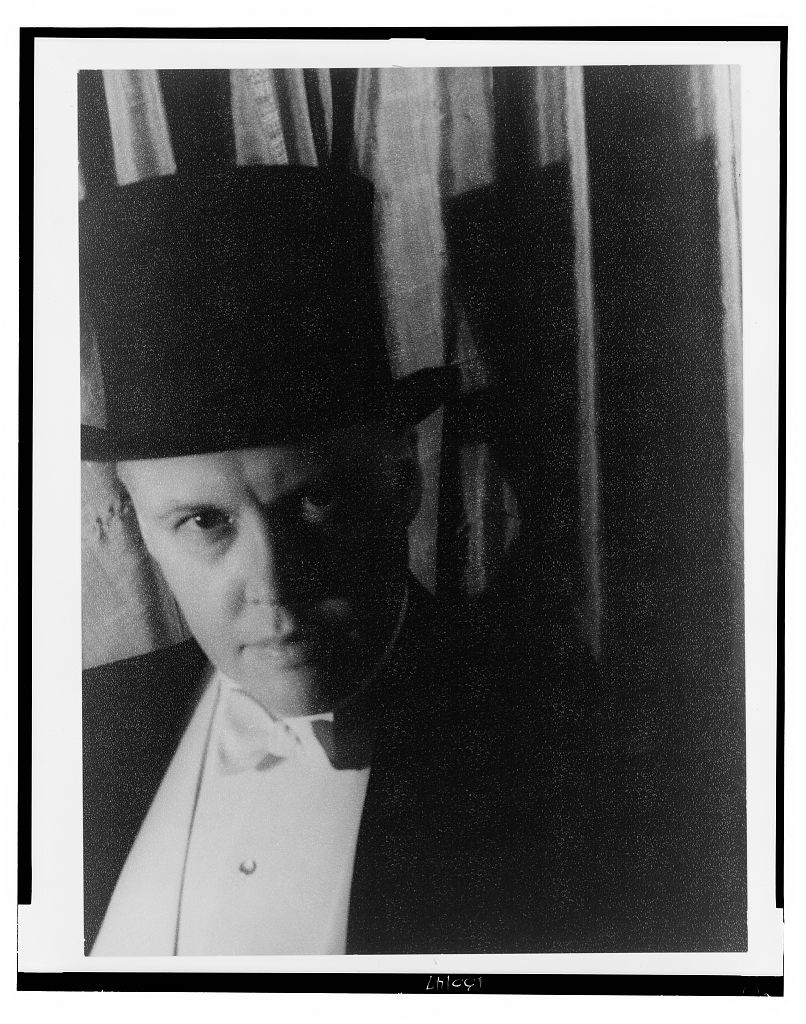
Van Vechten‘s self portrait, 1933

Indeed, one of those fabrications originated from an essay Van Vechten himself had written, about his experience of the remarkable Paris premiere of Le Sacre du Printemps two years earlier. That first performance of Stravinsky’s taboo-busting ballet was a defining moment in the emergence of modernism as an artistic force, and Van Vechten’s ecstatic review of it has been cited over the last century as a key eyewitness account of the event. But he never attended the first night: he had failed to get tickets and had to content himself with the second performance instead. Still, Van Vechten immediately understood the epochal significance of the occasion. He decided he would not allow such a trifling matter as the truth to prevent him from finding a place at the center of events. Gertrude Stein happened to be in the audience with Van Vechten for that second performance, and when he wrote her about his deception, he breezily reassured her that writers such as they “must only be accurate about such details in a work of fiction … I am not a bit muddled about the facts.” Stein could not have agreed more. In fact, she so approved of Van Vechten’s fiction that she embellished the story further in The Autobiography of Alice B. Toklas, suggesting that the first night of Le Sacre du Printemps was also the occasion of their first meeting, and that after the performance she rushed home to write a portrait of her new acquaintance.

Van Vechten and Stein had actually met in that summer of 1913 at the Parisian townhouse Stein shared with Toklas. Over the previous several months, Van Vechten, at this point a critic for the New York Times, had developed a fascination with Stein and her burgeoning legend—his friend, the shamanic Fifth Avenue salon hostess Mabel Dodge, had given him a copy of the prose poem that Stein had recently written about her, Portrait of Mabel Dodge at the Villa Curonia. Van Vechten, always drawn to novelty and exoticism, was immediately captivated by the thoroughgoing oddness of the writing, as well as the tales he had heard about the deeply unconventional woman responsible for it: a middle-aged Jewish lesbian in self-exile in France. On meeting Stein for the first time he was thrilled to discover that she was every bit as strange and marvelous as he had hoped she would be. He wrote his lover back in New York about Stein’s charisma and intelligence, as well as the delicious male nudes by Picasso that hung on her walls, some with “erect Tom-Tom’s much bigger than mine.”

* * *

After that first meeting Van Vechten’s interest in Stein swiftly morphed into an obsession. Back in New York he set himself the task of hauling her from obscurity and into the mainstream. Van Vechten’s encounter with this “cubist of letters,” as she was described in a New York Times article he wrote about her, came at a perfect moment for both of them. In the early months of 1913, many Americans got their first glimpse of artists such as Kandinsky, Matisse, Picasso, and Duchamp when the Armory Show exhibition of modern art hit New York with incendiary force. Stein’s links to these European radicals—“freaks,” as at least one American newspaper labeled them—generated much curiosity about her. Van Vechten, for his part, was at the beginning of his journey as a Manhattan tastemaker, loudly extolling the virtues of African-American theater, ragtime, and modern dancers such as Isadora Duncan. In Stein he found the perfect cause to champion: a unique artist whose mercurial work pulsated with the spirit of the age, but also one whose public image he could shape and bind himself to.

Early in February 1914, Van Vechten urged his friend and New York Times colleague Donald Evans to publish the manuscript of Tender Buttons through his new publishing house, the Claire Marie Press. A thousand copies were printed, but Evans suggested he did not expect them all to sell: “There are in America seven hundred civilized people only” Claire Marie’s brochure claimed, and it was “civilized people only” that the company said it was interested in reaching, which begs the question of whom exactly the remaining three hundred books in Tender Buttons’s print run were intended for. Of Stein’s work, Evans said that “the effect produced on the first reading is something like terror.” It was an unconventional means of promotion—but one that ensured Stein remained the very image of the aloof literary genius.

Van Vechten did a better job of bringing Stein’s writing to public attention with an article, “How to Read Gertrude Stein,” published in the fashionable arts magazine The Trend in August 1914. As the double meaning of the title suggests, it was intended to be an insider’s guide to understanding Stein’s work as well as her personality, framing Van Vechten as the man with an all-access pass to the great enigmatic genius of the age. Always a more assured critic of music than of literature, Van Vechten turned to musical referents for his most effective explanations of Stein’s writing, a tactic that countless others have followed in the intervening century. “She has really turned language into music,” he asserted; “Miss Stein drops repeated words upon your brain with the effect of Chopin’s B Minor Prelude.” The article also helped to develop and solidify Stein’s image as a guru-like figure, the sort of character Jo Davison would capture in his famous sculpture of Stein as Buddha some years later. “As a personality Gertrude Stein is unique,” Van Vechten wrote. “She is massive in physique, a Rabelaisian woman with a splendid thoughtful face; mind dominating her matter.” Stein wrote her charge to let him know that she was “very well pleased with your article about me.”

Considering Van Vechten’s hero-worshipping of Stein, it was more than a little strange for them both that over the next dozen years she remained a cult figure while his fame and importance soared—as a critic and a novelist, but most crucially as a trendsetter and the premier white promoter of the Harlem Renaissance. Success and celebrity never dampened his ardor for Stein, though, and he worked tirelessly on her behalf. In 1922 he came close to convincing Alfred A. Knopf to publish Stein’s Making of Americans, and references to her writing suffused his own literary efforts, which always attempted to frame Stein as the most important author of her generation, the light source from which all modern American writers took their nourishment. He even found opportunity to crowbar Stein into the heart of his infamous 1926 bestselling novel about the lives of African-Americans in Harlem, Nigger Heaven—a mind-blowingly insensitive title that caused every bit as much offence to black people then as it would now. The novel’s heroine is Mary Love, a young black woman with a passion for literature and European history, but who struggles to connect with what Van Vechten characterizes as her innate blackness, her “heritage of rhythm and warmth.” Accordingly, Mary develops an obsession with Gertrude Stein’s depiction of the black experience in “Melanctha,” Stein’s novella about an African-American woman from Baltimore. In fact, Mary has committed great chunks of the book to memory, and Van Vechten dedicates a page-and-a-half to her recitation of a particular passage. It is a preposterous moment in an often bizarre novel, but nothing better reflects Van Vechten’s fealty.

van vechten 1934

Van Vechten’s self portrait, 1934

Publicly and privately, Van Vechten lavished Stein’s work with praise, but in thirty-three years of friendship, Stein never returned the compliment. The mountains of letters the two swapped over the decades clearly show that Stein’s affection for Van Vechten was genuinely deep, but her faint praise for his literary work is hugely conspicuous. “What you have done is very clear and I like it” was her tepid response to Van Vechten’s novel The Blind Bow-Boy, widely thought to be his finest moment as a novelist. It was the most effusive she ever got about his work.

In almost all of his friendships, Van Vechten liked to assert himself as the senior partner, a bossy proprietorial force of nature who dazzled and bulldozed with wit and charisma. Yet with Stein, whose singular genius he never doubted, he was happy to play the supplicant; at her he never lashed out or sulked as he did with so many others when he felt his specialness was being ignored. It was the reason that the two of them were able to maintain such a happy relationship for so many years. Ernest Hemingway once noted that Stein could never remain friends with anybody whom she saw as a threat. Van Vechten, a man she considered a literary lightweight and who was forever vociferously renewing his oath to her, was about as far from a threat as it was possible for her to imagine. Whenever Stein and Toklas executed one of their periodic culls of friends and groupies, Van Vechten, singing Gertrude’s praises thousands of miles away in his Manhattan bubble, avoided the blade.

* * *

By the start of the 1930s, Van Vechten, rich and bloated from what he termed “the splendid drunken twenties,” had given up writing and taken up portrait photography, spending days on end locked away from the unpleasant realities of Depression-era America surrounded by prints of his beautiful and celebrated subjects. He shot an astonishing array of noteworthy people, from George Gershwin to Georgia O’Keeffe. When The Autobiography of Alice B. Toklas became an unexpected bestseller in 1933, Van Vechten became impatient to add her picture to his gallery. The suddenness of Stein’s success surprised Van Vechten as much as anyone. Almost the moment her book hit the shelves she morphed from a cult figure into a bona-fide celebrity. Fulsome reviews by prominent writers appeared everywhere, and a photograph of her taken by one of her new favorite courtiers, George Platt Lynes, graced the cover of Time. Van Vechten was thrilled for her—but bitterly jealous, too. He feared that in the frenzy of acclaim, he would be pushed from the frame at the expense of new, younger disciples.

The chance to link himself definitively to Stein in this phase of her career came in the fall of 1934, when she arrived in the United States for her triumphant homecoming lecture tour. Van Vechten was partly responsible for instigating and arranging the tour, and he provided invaluable assistance in soothing her nerves and cooing praise into her ears, reassuring her that her time had come; the American public really was crazy for her at last. He saw the proof himself as he followed Stein to many of her engagements across the country—striding around the stage with her hands in her pockets, she charmed audiences with a beguiling mixture of esotericism and folksy, homespun wisdom. To some she seemed like an adorably eccentric grandmother; to others, a radically prophetic voice. To just about everyone she was as enchanting as the woman Van Vechten had first met in Paris in 1913.

When he got the chance to photograph Stein during her tour, Van Vechten made sure he did so in a way that took her public image to a new level of grandeur. In Virginia, he shot her in front of neoclassical buildings, including the Rotunda designed by Thomas Jefferson, deliberately placing her within the pantheon of historic American heroes. Once again their shared instinct for myth creation kicked in; they both understood that this was the moment in which Gertrude Stein would achieve her immortality. Touring America, she saw the history of the nation more vividly than ever before, and she sensed her place within it. When she passed through Dayton, Ohio, she noted to Van Vechten that this was where the Wright Brothers had started out; Marion, Ohio, she learned excitedly, was Warren Harding’s hometown. From Illinois she wrote Van Vechten breathlessly, urging him to “make a pictorial history of these United States and I will write one and we will all be so happy.”

vvc 1935

Van Vechten’s self portrait, 1935

By now, Stein’s letters to Van Vechten were routinely addressed to “Papa Woojums,” Woojums being the name of the family unit that Stein, Toklas, and Van Vechten created for themselves around this time, and in which each adopted a distinct role. While Van Vechten and Toklas were the parental figures—Toklas was “Mama Woojums”—Stein was “Baby Woojums,” not because she was helpless or vulnerable but because she was special, a treasured jewel who needed coddling and directing lest her savant genius go to waste. It was a subtle but telling reconfiguration that recognized Van Vechten’s talents and satisfied his self-image as a man of importance—yet still ensured that Stein remained the center of attention.

The night before Stein sailed back to France, Van Vechten had her come over to his apartment for a final photo shoot. In his cramped makeshift studio, he positioned her in front of a crumpled and ragged Stars and Stripes, as if the flag was being blown about in a strong breeze. This was not a Gertrude Stein that had ever been seen before; not a Delphic oracle or a bohemian eccentric, but a pillar of the establishment. With a firm, unsmiling gaze and the haircut of a Roman senator, Stein had been transformed by Van Vechten’s lens into something permanent, weighty, and emphatically American, like a female addition to Mount Rushmore. Van Vechten’s mission to embed himself in Stein’s public profile was complete. The photograph has become perhaps the definitive image of Stein, and when a book of her lectures was published shortly after the tour, it was this photograph that adorned its front cover, chosen by Stein herself.

When Stein died in 1946, it was to Papa Woojums that she left the task of getting her large number of unpublished manuscripts into print, the measure of her respect and affection for him. Despite fearing that “Gertrude had bitten off more than I could easily chew,” Van Vechten faithfully undertook his duty. Within a little more than a decade, Stein’s complete works had been published.

Edward White is the author of The Tastemaker: Carl Van Vechten and the Birth of Modern America. White studied European and American history at Mansfield College, Oxford, and Goldsmiths College, London. Since 2005 he has worked in the British television industry, including two years at the BBC, devising programs in its arts and history departments. He is a contributor to The Times Literary Supplement. He lives in London.

Shared by Arts & Letters Daily feed and expanded by Arts & Letters Daily feed expander pipe by Brandizzi.
18 May 02:08

Starting With Sex

by Andrew Sullivan
Adam Victor Brandizzi

"It’s the place where you want to feel safe and watch Game of Thrones."
Os franceses são um povo estranho, assistir GoT faz eles se sentirem seguros.

And other advice from Maïa Mazaurette, a French sex columnist:

[H]ow would you describe the French attitude toward sex?

I can only compare it to the countries I’ve lived in — Germany, and now Denmark, and I’ve made some trips to the U.S. I’d say the main difference is that in France we’re so straightforward. We don’t have these dating rituals; we just start with sex! And then, if the sex was good enough or we feel connected somehow, then we would try to build a relationship.

So you always have sex on the first date, then?

Absolutely! But it’s not even an issue because there is no date. There is just first sex. You think someone is attractive, you give it a try. I think it really makes sense. (Of course I say that, because I’m French, right?) But if you don’t have sex first, you build up too much pressure. You start thinking, I have seen this guy for four or five restaurants, or however you do it in the U.S., and what if it fails? If you get sex out the way first, then you can only have good surprises.

I never dated an American guy, but even with Danish and German guys, there were so many dates and it was taking so much time. At some point I just felt like, Ahhh! Stop it, are you going to kiss me? Are we going to your place? My place? Do something! I felt like I was investing a lot of time in something that might not be worth it anyway.

It’s interesting to me that France is a predominantly Catholic nation, and yet the culture is so sexually free.

Yes, but we don’t connect sex with ethics or morality or values in general, you know? There have been many studies about how French people don’t care about the sex life of our president, or if a person is unfaithful. It’s absolutely not a problem for me. Now, if my boyfriend and I have an agreement, that’s important. But I actually see a lot of my friends who are a bit older than me, maybe 40 or 45, who are always renegotiating the boundaries of their relationship. And a lot of them are okay with being unfaithful, as long as you don’t say it. It’s actually quite old-fashioned, as if we’re in the Victorian era, and your husband or your wife is the person you share children, a house, and money with, but for passion or a bit of adventure, you go elsewhere. The couple is not the place for adventure. It’s the place where you want to feel safe and watch Game of Thrones.

Update from a reader:

Maybe the French “start with sex,” but they are among the least sexually satisfied people on the planet, as regularly found in the annual Durex global sex survey. So maybe French advice on sex isn’t so good.

17 May 21:18

marypoppinthatpussy: That piñata seems alarmed to say the...


marypoppinthatpussy:

That piñata seems alarmed to say the least

17 May 18:29

thebonegirl: darkdjinn53: Mnemosyne by Sam...


thebonegirl:

darkdjinn53:

Mnemosyne by Sam Guay

http://sguay.deviantart.com/

Oh hey, this is me too.

17 May 18:28

http://odyr.wordpress.com/2014/05/17/1674/

by odyr


17 May 13:29

Uma exposição que trata dos registros privados da abolição

by Míriam Leitão

Enviado por Míriam Leitão - |

PROGRAMA NA GLOBONEWS

Uma exposição que trata dos registros privados da abolição

Na época da escravidão, não havia escravos na casa de Rui Barbosa, onde é hoje a fundação que leva o seu nome. Que está expondo, até o dia 13 de julho, os registros privados da abolição. Foi lá que gravei o programa da Globonews. Quem caminha pela exposição pode ver documentos preciosíssimos daquela época, como um registro em que o comitê dos libertos pede a Rui Barbosa, em 1890, para ajudar no projeto de educar os filhos dos ex-escravos.

Ana Pessoa, diretora do Centro de Memória da Fundação, e Lúcia Velloso, chefe do arquivo da Casa de Rui Barbosa, explicaram alguns desses registros. No segundo bloco, entrevistei Manolo Florentino, presidente da Fundação, especializado em escravidão. Segundo ele, o Brasil recebeu metade dos 11 milhões de escravos trazidos da África para a América, que vieram, principalmente, de Congo e Angola. Setenta por cento deles jovens com até 25 anos de idade.

O objetivo da exposição, segundo Lúcia, é mostrar como a questão da abolição foi vivida no âmbito da vida privada. Rui herdou escravos, mas libertou todos. Há documentos que registram, por exemplo, a alforria de alguns negros e a iniciativa de criar um jornal de defesa do fim da escravidão.

Ana explicou que naquele tempo as articulações se davam por correspondência, que é a grande parte do arquivo privado. E falou de uma polêmica envolvendo Rui Barbosa: quando ele era ministro da Fazenda, mandou queimar faturas para impedir que houvesse um movimento de ressarcimento pelos proprietários, que viam os escravos como mercadoria, e achavam que tinham direito a isso. Há também um registro mostrando que uma família se sentia prejudicada financeiramente por não ter vendido seus escravos antes da abolição.

Muito importante é aquele em que o então ministro da Fazenda responde a um pedido de criação de um banco para ressarcir os ex-donos de escravos. Ele diz assim: "Mais justo seria e melhor se consultaria o sentimento nacional se se pudesse descobrir meio de indenizar os ex-escravos não onerando o Tesouro". Assim, indeferiu o pedido em 11 de novembro de 1890.

Como diz Lúcia, as cartas tratam de um modo de viver e de pensar. Documentos sobre o projeto de Rui Barbosa de emancipação dos sexagenários também estão lá, assim como uma carta que trata da liberdade de 1.176 escravos que pertenciam à Coroa. Por ter seu papel reconhecido no processo da abolição, era pedido a Rui Barbosa que intercedesse nessa questão.

De acordo com Manolo, não há na América uma civilização com raiz tão afro como no nosso país. A identidade brasileira, para ele, é muito africana. Ele falou também sobre as razões pelas quais o país recebeu tantos africanos e por que durou tanto tempo a escravidão por aqui.

Que o Brasil conheça cada vez mais a história da escravidão e a luta pela abolição. Que olhe para esse passado.

A entrevista pode ser vista abaixo na íntegra:

16 May 21:18

Photo


16 May 20:56

Animal magnetism

Adam Victor Brandizzi

Sobre a nobre arte de apreciar animais. Aliás, a Aeon tem, junto com a Nautilus, alguns dos melhores textos de "pop science" que já li!

I like zoos. Really I do. I applaud today’s zoological parks for their increasing emphasis on naturalistic exhibits, their breeding programmes for endangered species, and their efforts to educate the public about wildlife conservation. But the truth is, I mainly like zoos for the same reason that other people do: because I love watching animals.

Animals in captivity might satisfy our desire to cross the existential barrier that separates us from other creatures. Yet the sad reality is that, for the most part, zoo animals have become, as the art critic John Berger put it in 1977, ‘a living monument to their own disappearance’. The greatest pleasure of animal-watching still comes from observing free-living creatures in their natural environment. With enough disposable income, you can go to India, South America or Antarctica on animal-watching trips, ‘bag’ a view of the African ‘Big Five’ (elephant, rhino, lion, leopard, and buffalo), or take a boat to admire great whales exhaling geysers of salty breath.

The wild animals of the world have long inhabited the depths of the human imagination no less than they have occupied the natural habitats of our shared planet. There isn’t a human society on Earth, however primitive or high-tech, that doesn’t concern itself with animal imagery, whether the critters are domesticated or free-living. Indeed, the human fascination with animals is so ancient and so widespread that it seems to be a cross-cultural human universal.

The Chauvet Cave in southern France contains careful, loving depictions – painted an estimated 34,000 years ago – of more than a dozen distinct animal species: predators such as cave bears, cave lions and dire wolves, as well as herbivores such as cattle, horses and mammoths. There is at least one pair of woolly rhinos, evidently fighting.

In our culture, animals loom large in children’s stories, not to mention as toys, clothing, even furnishings. But many adults in urban areas and/or technologically advanced societies lose much of their animal-interest as a concomitant of ‘growing up’.

Most likely, ‘growing up’ in this sense is itself a deformation of our deeper, animal-oriented human nature. It is imposed upon us by a world where transportation is by car, bus, train and airplane, rather than by horse or bullock-cart. We receive meat and milk from a store rather than from our own flocks or hunting efforts; we defend ourselves with electronic protection systems, the police, personal firearms or social convention rather than via warnings uttered by semidomesticated camp followers. For many of us, it’s simply difficult to keep or even perceive other animals in the urban jungle. Yet, even as we are increasingly distanced from real animals, we find ourselves confronted with ever more images of them, cartoonish perhaps, but unavoidable.

The popularity of pets, animal films, TV shows, and books suggests that interaction with animals derives from a deeply rooted human need. Recent findings that companion animals contribute positively to many people’s physical and emotional health do not in themselves explain why animals exert such effects; rather, they suggest that animals (at least, some species) have long been associated with human well-being. The same goes for the simple pleasures so many of us derive from observing and interacting with animals. ‘Pleasure’ is not something that natural selection doles out without a reason – and we would expect that reason to be intimately connected with maximising fitness. When it comes to evolution, pleasure is deployed as bait as much as for immediate reward. The question then is simply this: what do people get from their animal-watching? And can evolution help explain this powerful yearning to observe other creatures?

The science of why so many of us watch animals still remains largely unexplored. One of my earliest research projects as a graduate student in zoology at the University of Wisconsin was titled ‘Who Watches Who at the Zoo?’ I sat in front of a naturalistic exhibit of a family group of lion-tailed macaque monkeys (adult male, adult female, a juvenile and an infant) and pretended to watch them while, in fact, recording the conversations among zoo visitors about the monkeys. The results were quite clear: men focused on the ‘other’ adult macaque male (‘Look at that big guy!’), women paid particular attention to the adult female, as well as the infant (‘Look, honey, there’s the mommy and her baby!’), while children looked especially at their simian counterpart (‘How cute, there’s a tiny little monkey!’). One plausible explanation is that people, at least some of the time, look at animals – non-human primates in particular – as reflections, albeit distorted, of themselves.

This is true across many cultures: animals are widely – perhaps universally – used to signify various human ‘types’, such as the trickster, the wise one, the diligent worker, the brave warrior, etc. Victorian society, especially after Charles Darwin, was typically disconcerted by the obvious similarities between human beings and various non-human primates. ‘Descended from monkeys?’ the wife of the Bishop of Worcester was reported to have exclaimed in 1860. ‘Let us hope that it is not true. But if it is true, let us hope that it doesn’t become widely known!’

Well, it is true, and widely known, at least among those not benighted by religious fundamentalism. So urban (and urbane) an observer as the German philosopher Walter Benjamin noted the potential for mutual recognition between human and animal, with results not altogether different from those of the Bishop’s wife. ‘In an aversion to animals,’ he wrote in 1928, ‘the predominant feeling is fear of being recognised by them through contact. The horror that stirs deep in man is an obscure awareness that in him something lives so akin to the animal that it might be recognised.’ But horror isn’t the typical response to looking at animals. I’m probably somewhere on the abnormally obsessive tail of the normal curve when it comes to enthusiasm for watching animals. But I’m definitely not alone when it comes to deriving delight just from seeing other living creatures, especially free-living ones.

we are living, breathing, perspiring, seeing, hearing, smelling, touching, eating, defecating, urinating, copulating, child-rearing, and ultimately dying animals ourselves

Berger has lamented that ‘the look between animal and man’ – a cross-species connection that might have played a crucial role in the development of human society – has been extinguished by our loss of contact with living animals in industrial society. I’m not so sure. Urban wildlife is actually fairly abundant, although species diversity is regrettably lacking: there are pigeons, rats, cockroaches, and – depending on location – various kinds of gulls. Coyotes and raccoons are surprisingly frequent even in our great cities, but they aren’t typically seen. Even in urban India, there really are sacred cows (usually emaciated and pitiable) and macaque monkeys that are sometimes downright dangerous. Birdwatching is a well-populated hobby that is generally doing better than the birds themselves. And visits to zoos and aquariums are up, as the standards of animal-keeping in such places are also better than ever. What used to be concrete floors and iron bars are increasingly replaced by naturalistic habitats, in which the animals sometimes breed, occasionally lead semi-normal lives, and provide visitors (still disproportionately skewed toward children) an opportunity to watch the animals, perhaps stirrings some universal human neurons dating back to our lengthy sojourn on the African savannah.

A visitor at Dudley Zoo in England, 2013. Photo by Martin Parr/Magnum A visitor at Dudley Zoo in England, 2013. Photo by Martin Parr/Magnum

This suggests some of the evolutionary underpinnings of the human penchant for animal-watching. First, that we are living, breathing, perspiring, seeing, hearing, smelling, touching, eating, defecating, urinating, copulating, child-rearing, and ultimately dying animals ourselves. It is plausible that deep in the human psyche there resides the simple yet profound recognition of a relationship between Us and Them. ‘We be of one blood, ye and I,’ was the incantation taught to Mowgli in Rudyard Kipling’s memorable Jungle Book collections (1894-5). It confirmed the jungle boy’s connection with his non-human caretakers, friends and relatives. Perhaps it is ‘only natural’ that we, animals ourselves, reach out to other creatures. Even if we can’t talk to them à la Doctor Dolittle, or share the most intimate aspects of our lives, like Mowgli, at least we can lose – more likely, find – ourselves in watching them.

What is more, during most of our evolutionary (and recent) past, our well-being — survival, even – depended on relationships to other animals, many of which were predators, with us as their prey. This alone would have generated a potent selective advantage to those of our ancestors who were attuned to the presence as well as the habits of other beasts, especially large and dangerous ones such as sabre-toothed cats, cave bears, dire wolves, hyaenodons and the like – suggesting that behind Benjamin’s ‘horror’ and ‘aversion’ lurks something less highfalutin than the epistemics of ego-deflating mutual recognition: self-preservation.

Thus, it might be no coincidence that people are especially attuned to the doings of predators. As Dorothy said in The Wizard of Oz: ‘Lions and tigers and bears, oh my!’ Sometimes, of course, this attentiveness is more a fear than a fascination; in his book Snakes, Sunrises, and Shakespeare (2014), the ecologist Gordon Orians points out that, cross-culturally, people share an innate fear of snakes and spiders, whereas avoidance of, for example, electric sockets must be learnt.

Conversely, whether as occasional predators or scavengers – or both – our ancestors doubtless preyed upon other animals, and this would have selected for attentiveness to what possible meals might be had at the expense of our fellow creatures, a focus that would have included sensitivity to what was nearby, where they could be found, and how they might best be approached. Careful animal-watching would have thus been doubly rewarded: not only rendering us less liable to end up as prey but also more likely to feed successfully on others.

Given the antiquity of domestication – including, but not limited to, dogs – it is clear that early humans also depended on various ‘kept’ animals as beasts of burden, sources of eggs, milk, meat, and so forth, as well as perhaps employing them as colleagues in hunting, early warning detectors sensitive to the approach of enemies, even providing warmth – not only via their skins and fur, but also their literal bodies, cuddling closely with our Pleistocene ancestors during those long, challenging Ice Age nights.

There are many ways of looking at animals. A veterinarian looks for signs of illness versus health. A city-dweller might well look with fascination at red-tailed hawks or peregrine falcons nesting on a ledge of a high-rise building, but with indifference at their pigeon prey (‘winged rats’), not to mention horror at cockroaches or actual four-legged, long-tailed rats. A cat can, ostensibly, look at a king and presumably vice versa, but we are not supposed to look a gift horse in the mouth. (By the way, as a long-time horse-keeper, I can affirm that there is no such thing as a gift horse, since our equine cousins require hay, vitamins, hoof care, immunisations and regular veterinary attention. Therefore, by all means, look in the mouth of any proffered horse!) A hunter looks at her prey with a mixture of excitement, hard-eyed calculation and determination; the wildlife photographer eyes his subject in a manner not altogether different.

Watch the birdy. Photo by Nigel Roddis/Reuters Watch the birdy. Photo by Nigel Roddis/Reuters

But for sheer pleasure, there is little doubt that watching birds tops the list. Despite their dinosaur origins (which means that our most recent common ancestor was a Carboniferous-era reptile, from roughly 300 million years ago), birds are the most assiduously watched wild animals and for good reason: many of them are fantastically lovely, brightly coloured or gloriously iridescent. Mammals, sad to say, are comparatively drab, not surprising given that birds have colour vision whereas most mammals – with the notable exception of primates such as ourselves – see only shades of grey or brown. In addition (and I say this as not only a fellow mammal but as one whose main empirical research has involved mammals), birds are more vibrant, more alive, and thus more rewarding to watch than are our closer, hair-bearing, milk-making kin, and much more so than amphibians or reptiles, which might well frustrate the watcher by doing absolutely nothing, for minutes – even hours – at a time.

‘Hope,’ observed the poet Emily Dickinson, ‘is the thing with feathers’

Even when they aren’t flying, darting, soaring, walking, dabbling, paddling, or hopping about, birds are rewarding to watch. ‘The invariable mark of wisdom,’ wrote Ralph Waldo Emerson in 1836, ‘is to see the miraculous in the common.’ Consider some of the more ordinary North American birds: the shimmering green head of a mallard drake, the delicate upturned bill of an avocet, the knockout gorgeous motley of the painted bunting. Such precisely defined shape and colour can be almost too much to register dispassionately. When it comes to watching birds – and really seeing them – even the ‘common’ emerges as more than miraculous, or downright shocking. Seeing can be disbelieving.

Seeing the comical red-white-and-black clown-face of a European goldfinch – really seeing it, not just absent-mindedly noting its existence and maybe jotting it down on a checklist – challenges our sense of the mundane. As does the ethereal, ghostly whiteness of a snowy owl, or for that matter, the gleaming coat and bright yellow bill of a starling (a troublesome species, introduced from the UK and which we in North America are supposed to despise because they crowd out native species), or the trim, forked tail of a barn swallow. These perceptions challenge our sense of the mundane. And to see such animals – ‘ordinary’ only to the jaded and obtuse – is to experience a new appreciation for reality itself, since their vitality not only mirrors but magnifies our own. ‘Hope,’ observed the poet Emily Dickinson in 1891, ‘is the thing with feathers.’

This seeing – real seeing – of animals has inspired a dizzying world of artistic creativity, in a line that leads from the Chauvet Cave paintings through to the Lady and the Unicorn tapestries of the Middle Ages, and including John James Audubon’s bird portraits as well as Henri Rousseau’s haunting painting The Dream (1910). The poet too can be a deeply passionate observer, as in Christopher Smart’s 18th-century poem ‘Jubilate Agno’. Written in a religious fervour while he was imprisoned as a madman, it starts with a litany of animals before declaring an exuberant admiration for Smart’s cat, Jeoffry:
For he counteracts the powers of darkness by his electrical skin and glaring eyes.
For he counteracts the Devil, who is death, by brisking about the life.
For in his morning orisons he loves the sun and the sun loves him.
For he is of the tribe of Tiger.
...
For he is a mixture of gravity and waggery.
...
For there is nothing sweeter than his peace when at rest.
For there is nothing brisker than his life when in motion.
...
For the divine spirit comes about his body to sustain it in complete cat.

Perhaps my favourite animal poem is by Rainer Maria Rilke. The story goes that in 1905 Rilke had been hired by the sculptor Auguste Rodin as his amanuensis, but one day confessed that he was suffering from writer’s block. Rodin advised: ‘Go to the zoo [actually, Paris’s Jardin des Plantes], and observe an animal.’ ‘For how long?’ asked the young poet. ‘Watch it until you see it. A few months might be sufficient.’ Rilke followed this advice, and eventually produced what is generally considered his greatest poem: ‘The Panther’.

One thing I love about this story (as well as about the poem itself), is that it speaks to the difference between the scientific discipline in which I was trained as a graduate student (ethology) and a competing, and in my opinion, far lesser scientific enterprise (comparative psychology). Comparative psychology’s approach to studying animals traditionally takes place in a laboratory and involves placing individuals from a limited range of animal species – usually lab rats or pigeons – in a Skinner Box, with the goal of observing some measure of output: frequency of bar-pressing, latency to begin doing so, and so forth. It certainly does not entail watching the animal itself, once its behaviour has been appropriately ‘shaped’, or it has learnt what the experimenter wants it to do. By contrast, ethology – the biological study of animal behaviour – requires that animals be observed whenever possible in their natural environments (if unavoidable, in a simulacrum). Most of all, ethology insists that they are observed rather than being measured while performing an arbitrary, imposed act such as bar-pressing. For this, even a few months are never sufficient.

Ethology is the scientific version of good, old-fashioned animal-watching. Thus, although the immense renown achieved by the primatologist Jane Goodall, one of the giants of ethological research, was largely due to her notable discoveries, the reality is that these findings were only possible because she spent literally thousands of hours observing chimpanzees in their natural environments, carefully watching their every move.

At ethology’s core is Rodin’s and Rilke’s deep, mindful, detailed and patient observation, watching one’s subjects with exquisite care and attention in order to penetrate their world, rather than forcibly adjusting them to ours. The naturalist Henry Beston captured this in 1928, in what I believe to be the finest paragraph ever written about animals, and the best advice I know for watching them:
We need another and a wiser… concept of animals. Remote from universal nature and living by complicated artifice, man in civilisation surveys the creature through the glass of his knowledge and sees thereby a feather magnified and the whole image in distortion. We patronise them for their incompleteness, for their tragic fate for having taken form so far below ourselves. And therein do we err. For the animal shall not be measured by man. In a world older and more complete than ours, they move finished and complete, gifted with the extension of the senses we have lost or never attained, living by voices we shall never hear. They are not brethren, they are not underlings: they are other nations, caught with ourselves in the net of life and time, fellow prisoners of the splendour and travail of the earth.

My advice to all would-be animal-watchers is, in E M Forster’s words ‘only connect… live in fragments no longer’. Simply open your eyes, ideally with benefit of binoculars, to the reality of animal lives separate from your own. Prepare to lose yourself in one of the most positive ‘trips’ available this side of hallucinogenic drugs, drawn through the lenses and deposited into the world of the animal being watched, losing yourself while expanding – however briefly – into another’s life, resonant of your own, while also ineffably different.

‘There is a crack in everything,’ sang Leonard Cohen. ‘That’s how the light gets in.’ Watching animals opens that crack just a little wider, and through it we get a better view – not only of animals, but of ourselves.

13 May 2014

Read more essays on Animals, Evolution and Psychology

Shared by Arts & Letters Daily feed and expanded by Arts & Letters Daily feed expander pipe by Brandizzi.