Shared posts

24 Sep 13:39

The Little Mocker

The following is a conversation around mocking:

What is this?:

interface Authorizer {
  public Boolean authorize(String username, String password);
}

An interface.

So what then, is this?

public class DummyAuthorizer implements Authorizer {
  public Boolean authorize(String username, String password) {
    return null;
  }
}

That's a Dummy.

And what do you do with a Dummy?

You pass it into something when you don't care how it's used.

Such as?

As part of a test, when you must pass an argument, but you know the argument will never be used.

Can you show an example?

Sure.

  public class System {
    public System(Authorizer authorizer) {
        this.authorizer = authorizer;
    }

    public int loginCount() {
        //returns number of logged in users.
    }
  }

  @Test
  public void newlyCreatedSystem_hasNoLoggedInUsers() {
    System system = new System(new DummyAuthorizer());
    assertThat(system.loginCount(), is(0));
  }

I see. In order to construct the System an Authorizer must be passed to the constructor; but the authorize method of that Authorizer will never be called since, in this test, no one will log in.

You got it.

And so the fact that the authorize method of the DummyAuthorizer returns a null is not an error.

Indeed not. In fact, it's the best thing a Dummy can return.

Why is that?

Because if anybody tried to use that Dummy, they'd get a NullPointerException.

Ah, and you don't want the Dummy to be used.

Right! It's a dummy.

But isn't this a mock? I thought these test objects were called mocks.

They are; but that's slang.

Slang?

Yes, the word "mock" is sometimes used in an informal way to refer to the whole family of objects that are used in tests.

Is there a formal name for these test objects?

Yes, they are called "Test Doubles"[1].

You mean like "Stunt Doubles" in the movies?

Exactly.

So then the word "mock" is just colloquial slang?

No, it has a formal meaning too; but when we are speaking informally the word mock is a synonym for Test Double.

Why do we have two words? Why don't we just use Test Double instead of Mock?

History.

History?

Yes, long ago some very smart people wrote a paper that introduced and defined the term Mock Object. Lots of other people read it and started using that term. Other people, who hadn't read the paper, heard the term and started using it with a broader meaning. They even turned the word into a verb. They'd say, "Let's mock that object out.", or "We've got a lot of mocking to do."

That kind of thing happens a lot with words, doesn't it?

Yes it does. Especially when a word has just one syllable, and is easy to say.

Yeah, I guess it's easier to say: "Let's mock that." instead of: "Let's make a test double for that."

Right. Colloquialisms are a fact of life.

OK, but when we need to speak precisely...

You should use the formal language. Yes.

So then what is a Mock?

Before we get to that, we should look at other kinds of Test Doubles.

Like what?

Let's look at Stubs.

What's a stub?

This, is a stub:

public class AcceptingAuthorizerStub implements Authorizer {
  public Boolean authorize(String username, String password) {
    return true;
  }
}

It returns true.

That's right.

Why?

Well, suppose you want to test a part of your system that requires you to be logged in.

I'd just log in.

But you already know that login works, You've tested it a different way. Why test it again?

Because it's easy?

But it takes time. And it requires setup. And if there's a bug in login, your test will break. And, after all, it's an unnecessary coupling.

Hmmm. Well, for the sake of argument, let's say I agree. What then?

You simply inject the AcceptingAuthorizerStub into your system for that test.

And it will authorize the user without question.

Right.

And if I want to test the part of the system that handles unauthorized users, I could use a stub that returns false.

Right again.

OK, so what else is there?

There's this:

public class AcceptingAuthorizerSpy implements Authorizer {
  public boolean authorizeWasCalled = false;

  public Boolean authorize(String username, String password) {
    authorizeWasCalled = true;
    return true;
  }
}

I suppose that's called a Spy.

That's right.

So why would I use it?

You'd use this when you wanted to be sure that the authorize method was called by your system.

Ah, I see. In my test I'd inject it like a stub, but then at the end of my test I'd check the authorizerWasCalled variable to make sure my system actually called authorize.

Absolutely.

So a Spy, spies on the caller. I suppose it could record all kinds of things.

Indeed it could. For example, it could count the number of invocations.

Yeah, or it could keep a list of the arguments passed in each time.

Yes. You can use Spies to see inside the workings of the algorithms you are testing.

That sounds like coupling.

It is! You have to be careful. The more you spy, the tighter you couple your tests to the implementation of your system. And that leads to fragile tests.

What's a fragile test?

A test that breaks for reasons that shouldn't break a test.

Well if you change the code in the system, some tests are going to break.

Yes, but well designed tests minimize that breakage. Spies can work against that.

OK, I get that. What other kinds of test doubles are there?

Two more. Here's the first:

public class AcceptingAuthorizerVerificationMock implements Authorizer {
  public boolean authorizeWasCalled = false;

  public Boolean authorize(String username, String password) {
    authorizeWasCalled = true;
    return true;
  }

  public boolean verify() {
    return authorizedWasCalled;
  }
}

And, of course, this is a mock.

A True Mock. Yes.

True?

Yes, this is a formal mock object according to the original meaning of the word.

I see. And it looks like you moved the assertion from the test, into the verify method of the, uh, true mock.

Right. Mocks know what they are testing.

So that's it? You just put the assertion into the mock?

Not quite. Yes, the assertion goes into the mock. However, what the mock is testing is behavior.

Behavior?

Yes. The mock is not so interested in the return values of functions. It's more interested in what function were called, with what arguments, when, and how often.

So a mock is always a spy?

Yes. A mock spies on the behavior of the module being tested. And the mock knows what behavior to expect.

Hmmm. Moving the expectation into the mock feels like a coupling.

It is.

So why do it?

It makes it a lot easier to write a mocking tool.

A mocking tool?

Yes, like JMock, or EasyMock, or Mockito. These tools let you build mock objects on the fly.

That sounds complicated.

It's not. here is a famous paper by Martin Fowler that expains it well.

And there's a book too, isn't there?

Yes. Growing Object Oriented Software, Guided by Tests is a great book about a popular design philosophy driven by mocks.

OK, so then are we done? You said there was still another kind of test double.

Yes, one more. Fakes.

  public class AcceptingAuthorizerFake implements Authorizer {
      public Boolean authorize(String username, String password) {
        return username.equals("Bob");
      }
  }

OK, that's strange. Everybody named "Bob" will be authorized.

Right. a Fake has business behavior. You can drive a fake to behave in different ways by giving it different data.

It's kind of like a simulator.

Yes, simulators are fakes.

Fakes aren't stubs are they?

No, fakes have real business behavior; stubs do not. Indeed, none of the other test doubles we've talked about have real business behavior.

So fakes are different at a fundamental level.

Indeed they are. We can say that a Mock is a kind of spy, a spy is a kind of stub, and a stub is a kind of dummy. But a fake isn't a kind of any of them. It's a completely different kind of test double.

I imagine Fakes could get complicated.

They can get extremely complicated. So complicated they need unit tests of their own. At the extremes the fake becomes the real system.

Hmmm.

Yes, Hmmm. I don't often write fakes. Indeed, I haven't written one for over thirty years.

Wow! So what do you write? Do you use all these other test doubles?

Mostly I use stubs and spies. And I write my own, I don't often use mocking tools.

Do you use Dummies?

Yes, but rarely.

What about mocks?

Only when I use a mocking tool.

But you said you don't use mocking tools.

That's right, I usually don't.

Why not?

Because stubs and spies are very easy to write. My IDE makes it trivial. I just point at the interface and tell the IDE to implement it. Voila! It gives me a dummy. Then I just make a simple modification and turn it into a stub or a spy. So I seldom need the mocking tool.

So it's just a matter of convenience?

Yes, and the fact that I don't like the strange syntax of mocking tools, and the complications they add to my setups. I find writing my own test doubles to be simpler in most cases.

OK, well, thank you for the conversation.

Any time.


[1] xUnit Test Patterns

27 Aug 12:23

90’s kids, remember when you were in committed, intimate...

by punchthemoon


90’s kids, remember when you were in committed, intimate relationships with obsolete technology? Nostalgia, am  I right?

18 May 12:19

Mujica e a Pasárgada dos Pampas

by Cláudia Trevisan

É impossível resistir a José Mujica, que é a versão política do papa Francisco. A retórica do presidente do Uruguai é de um humanismo radical, pontuada por odes à vida, ao amor e à simplicidade. O retrato que apresenta de seu país é um ideal bucólico de pequenos povoados e cidades de escala humana, nos quais os vizinhos se conhecem, onde se trabalha para viver e não se vive para trabalhar. Nessa Pasárgada dos Pampas, o quotidiano se desenrola no mesmo ritmo do fusca azul 78 que Mujica dirige sem a escolta de seguranças.

Mas atrás do romantismo está um presidente pragmático, que cultiva o capital e vê os investimentos domésticos e estrangeiros como a semente dos empregos do futuro . Sob seu governo, o Uruguai registrou crescimento médio anual de quase 6% e manteve a invejável posição de país latino-americano que possui a menor desigualdade social. Em 2010, a renda per capita uruguaia era de US$ 11,6 mil, ligeiramente superior aos US$ 11,1 mil do Brasil. No ano passado, os valores eram de US$ 16,6 mil e US$ 11,3 mil, respectivamente, o que colocou o Uruguai na liderança do ranking dos países mais ricos da região. A previsão do FMI para 2014 é que a renda per capita do Brasil cairá para US$ 11,1 mil, enquanto a do Uruguai continuará a crescer, para US$ 17,1 mil.

Ex-guerrilheiro, Mujica faz uma surpreendente defesa da globalização e do livre comércio. Lamenta que o processo de derrubada de barreiras promovido pela Organização Mundial do Comércio (OMC) tenha se estancado e critica a divisão do mundo em blocos econômicos. Em vez de discursos contra o imperialismo ianque, ele quer que todos os uruguaios falem inglês e pediu a Barack Obama que envie professores a o seu país.

Desde que ele chegou ao poder, em 2010, o Uruguai assumiu a vanguarda mundial das transformações sociais. O aborto foi legalizado em dezembro de 2012. Quatro meses mais tarde, o Congresso aprovou a lei do “matrimônio igualitário”, que equipara o casamento de homossexuais ao de heterossexuais. No dia 10 de dezembro de 2013, o Uruguai se tornar o primeiro país do mundo a regulamentar a produção, venda e consumo de maconha.

No primeiro ano de vigência da lei sobre o aborto, foram registrados 6.767 interrupções voluntárias da gravidez e nenhuma mulher morreu durante o procedimento. Proporcionalmente, o Uruguai tem uma das menores taxas de aborto do mundo, de 9 casos para cada grupo de 1.000 mulheres em idade fértil. É uma proporção bem inferior à média de 35 por cada grupo de 1.000 registrada na América Latina e à de 40 por 1.000 existente no próprio Uruguai entre 1995 e 2002.

Também é cerca de um terço da taxa registrada no Brasil, onde o aborto é proibido. Não há estatísticas oficiais, mas estudiosos estimam que 300 mulheres morrem no Brasil a cada ano vítima de abortos realizados em condições precárias. O Grupo de Estudos sobre o Aborto estima que são realizados 1 milhão de abortos no Brasil a cada ano e que complicações decorrentes do procedimento levam a 250 mil internações na rede do SUS.

Mujica atribui o protagonismo nessas questões à história de seu país, que foi o primeiro a reconhecer o direito do voto das mulheres, no início do século 20, período no qual a produção e comercialização do álcool foi nacionalizada e regulada pelo Estado. Quanto ao casamento gay, ele diz que o governo apenas reconheceu uma realidade tão antiga quanto à humanidade. “Nós descobrimos que há homens que dormem com homens e mulheres que dormem com mulheres”, ironiza.

16 May 21:18

A luz no dia difícil

by Míriam Leitão

Enviado por Míriam Leitão e Alvaro Gribel - |

COLUNA NO GLOBO

A luz no dia difícil

O país parece tão confuso. Manifestações,greves, bloqueios de ruas, os estrangeiros chegando e nada pronto ainda. De repente, uma luz no noticiário: a Justiça Federal aceitou denúncia contra os envolvidos no atentado do Riocentro. Isso foi há muito tempo. Foi há 33 anos. Por que trazer de volta esse caso? Ele é um dos mais emblemáticos episódios da ditadura militar.

O que tem isso a ver com o desconforto de ficar horas para atravessar um engarrafamento que pode surgir a qualquer momento por causa de uma manifestação? Ou ter que sair andando por falta de transporte? Ter medo de ser apanhado por um rojão de bombas de gás? Toda essa agitação vai passar. Pode-se superar cada greve, cada movimento e protesto — até os mais oportunistas — preservando as leis do país. Existem temores, sim. De que mais algum inocente seja atingido, de que a Polícia se exceda, de que os bandidos se aproveitem. Mas tudo será, mais dia menos dia, resolvido.

Há a preocupação com os retrocessos na economia que as decisões de controle de preço representam. Há represamento de tarifas de energia e combustível, que é escondido através de gasto público ou perda de receita das empresas. Cada solução que inventam tem produzido outro desajuste. No futuro, haverá correções sérias a serem feitas. Seria insensatez manter os atuais desequilíbrios minando a economia brasileira.

A grande certeza da democracia é que, mesmo defeituosa, ela acabará encontrando a sua maneira de amortecer as tensões, resolver os conflitos e eleger vencedores.

E uma ditadura, o que pode fazer? Programar um atentado num show de música para estudantes, num grande centro de convenções, que poderia matar inúmeros jovens. O atentado do Riocentro é emblemático.
Foi planejado já no fim do regime. Era apenas a contagem regressiva até o fim daquele governo infeliz de um general que gostava de cavalo, mas não de povo, e que pediu que o esquecessem.

Ele foi lembrado agora, quando este jornal trouxe à luz uma informação histórica: a de que a cúpula do governo fora informada de tudo. O próprio presidente Figueiredo soubera do atentado. Não era correto definir os autores de atentados assim de “bolsões sinceros porém radicais”, como eles diziam. Havia bolsões sinceramente radicais na defesa do regime e acobertados pelos altos escalões.

Foi impressionante, aquele caso, pela longa impunidade, exibida nos jogos da praia, de Wilson Luiz Chaves Machado. Ele estava ao lado do sargento em cujo colo a bomba explodiu. E teve uma vida tranquila, certo da impunidade. Ele sempre foi blindado pelo Exército contra qualquer pergunta constrangedora. E sempre manteve o seu silêncio providencial. Os outros da lista dos que ontem se tornaram réus, como o general Newton Cruz, mostram que havia a cadeia de comando consciente de tudo o que faziam os bolsões.

A Lei da Anistia era usada como se fosse uma segunda blindagem nesse país tão pouco afeito a enfrentar seu passado. No caso, é tão estranho o uso desse argumento porque a Lei da Anistia é de 1979 e perdoava os crimes até então cometidos. O atentado do Riocentro não havia acontecido ainda, é de 1981. Uma lei pode perdoar um crime ainda não cometido no período de sua entrada em vigor? A Justiça Federal do Rio, em decisão histórica, aceitou denúncia do Ministério Público, tornou réus e abriu processos contra o coronel Wilson Machado e outros cinco acusados. A juíza Ana Paula Vieira de Carvalho considerou que aquele foi um crime contra a humanidade.

A decisão tão esperada chegou num dia de manifestações no Brasil, em que várias insatisfações vieram à tona. A coincidência ajuda a mostrar que, qualquer que seja o dia difícil numa democracia, ele será sempre melhor do que o Estado totalitário, em seu mais alto escalão, armar seus agentes e mandá-los sorrateiramente com bombas para explodir no meio de jovens que apenas assistiam um show musical. A bomba explodiu antes, mas o país teve que esperar 33 anos pela Justiça. E ontem foi apenas o primeiro passo.

16 May 17:33

Cured By A Virus

by Andrew Sullivan

Kent Sepkowitz unpacks the news that scientists at the Mayo Clinic “had treated two adults with the blood cancer, multiple myeloma, by injecting them with mega-doses of genetically modified measles virus”:

Both patients had failed all other available therapies; with the new “oncolytic virus” treatment, each responded and one remains in remission nine months later.

In this study, the patients—neither with existing antibody to measles virus—received enormous doses of live measles virus infused directly into their vein—not given as a shot like a vaccine. Both became feverish and ill with the infusion, as expected, and both recovered. The measles virus was derived from the strain used in routine measles vaccine but had been carefully altered by scientists to enhance its tumor killing effects. It was still, however, a measles virus, capable of giving a person a measles-like illness. The choice of measles for the cancer was quite deliberate—this virus is known to seek out and attack a type of white blood cell that myeloma arises from. The investigators simply harnessed measles virus’ natural born killer tendency.

Adrianna McIntyre has more:

Measles isn’t the only virus used for this kind of therapy; different cancers will be more susceptible to different viruses. Usually when this therapy is attempted, the virus is injected at the tumor site. Myeloma isn’t isolated to tumors, though; the cancer also infects bone marrow itself. In this study, the vaccine was injected into the bloodstream, instead of directly into the tumor.

And this isn’t your garden-variety measles vaccine. The vaccine formulation used in this study contained 100 billion infectious units — 10,000 times the standard dose. And compared to cancer treatments that last months, this measles vaccine therapy only requires a one-time dose. “What we’re really excited about with this particular approach is that we believe it can become a single-shot cure,” said Dr. Stephen J. Russell, lead author on the study.

16 May 17:32

Mother’s Day Without Mom.

16 May 12:58

Mental Health Break

by Andrew Sullivan

Insane yo-yo skills from a six year old:

(Hat tip: Casey Chan)

16 May 12:49

Anã mãe de trigêmeas desabafa: ‘Farei de tudo pelas minhas meninas’

Adam Victor Brandizzi

Quase um outro conto de Guimarães Rosa. Toda força a ela!

RENATA MOURA, DE NATAL

Ao descobrir que estava grávida, em 2013, Maria Ducinea da Silva levou um susto. Com 1,20 metro de altura e 35 anos, ela achava que não poderia ter filhos. Mas não só engravidou como teve três meninas de uma vez.

Após uma gravidez de risco (o útero não tinha como se expandir),  marcada por dores e pela rejeição do pai das crianças, deu à luz em 2 de abril. As filhas, prematuras, estão internadas em Natal (RN), sem previsão de alta.

A mãe mora na cidade há anos, onde chegou após fugir de casa e viver nas ruas de Pernambuco, Estado onde nasceu.

Em Natal, cozinhou para fora e hoje sobrevive somente com um auxílio-doença de R$ 724 mensais.

Única da família que não cresceu, ainda fará exames para saber se tem nanismo. “Dependendo do resultado, talvez façam os exames nas meninas.”

Joaninha, como é conhecida, chora ao contar sua história e promete: “Vou dar às minhas filhas o amor que minha mãe não me deu”.

Anã do Rio Grande do Norte

A seguir, o depoimento dela à Folha.

Sonhar em ser mãe eu não sonhava. Com meu tamanho e minha idade eu achava que não ia acontecer. Descobri a gravidez num dia que passei mal. Achava que era pedra nos rins. O médico viu meu exame de sangue e falou que eu estava grávida. Pensei que fosse mentira.

Eu estava com dois ou três meses de gravidez quando descobri que eram três bebês. Quase enlouqueci. Eu pensava: como poderia carregar um, imagine agora três. Nunca pensei em aborto. Fiz pré-natal, exame de HIV, tudo. Os médicos me mandaram descansar, não andar muito, mas eu não podia.

Estava com quatro meses quando me internei pela primeira vez. Sentia muitas dores no pé da bexiga e falta de ar. Na quarta vez, a médica me internou em definitivo.

Passei uma semana com dor. Eu chorava, pedia para fazer o parto, mas a médica queria esperar porque eu estava com sete meses e uma semana. Eu não aguentava mais comer, respirar. Então, com sete meses e meio, ela resolveu tirar as meninas.

Fiquei mais preocupada depois que elas nasceram. Nasceram com 38 centímetros, foram para a UTI, ficaram doentes. Graças a Deus estão melhores. Meu maior desejo é ir para casa com elas. É uma bênção imaginar que coisinhas tão pequeninas saíram de dentro de mim.

PAI AUSENTE

Quando eu contei ao pai delas que estava grávida ele não disse nada. Simplesmente deu as costas e foi embora. Namoramos 10 ou 11 meses, mas não morávamos juntos. Ele tem 18 anos. A gente se separou por causa da mãe dele e porque ele estava ficando com outra pessoa.

Registrei as meninas só no meu nome: Maria Eduarda, Maria Elena e Maria Eloise. Eduarda é a mais braba. Foi a última a nascer e já saiu da UTI. Eloise é a mais manhosa e Elena é a mais calminha. O amor pelas três é o mesmo. E vou ter que cuidar delas sozinha.

Elas tomam leite por uma sonda. Eu tiro do meu peito, mas não é suficiente, então elas tomam complemento. Também recebi doações. Tudo o que tenho foi o povo que me deu: berço, roupa, carrinho, cômoda. O que tinha muito dei para outras mães que não tinham.

Moro em casa alugada e recebo um auxílio-doença. É só o que eu tenho. Minha casa tem quarto, sala, cozinha e banheiro. Vou ter que arranjar um canto maior.

Hoje, eu durmo e como na maternidade para acompanhar as meninas. Está sendo minha casa e a delas.

ORIGEM

Nasci em Caruaru e me criei numa cidade chamada Lagoa dos Gatos (ambos em PE). Também morei em Curitiba. Tenho irmãos lá e em São Paulo, que não vejo há muitos anos.

Tenho mais lembrança do meu pai, que morreu em 1986, do que da minha mãe. O rosto dela eu lembro mais quando pego um retrato.

Minha mãe maltratava muito a mim e a meus irmãos depois que meu pai morreu. Ela arranjou outro homem, colocou ele dentro de casa e, se ele batesse nela, batia na gente também. Ele me xingava, batia minha cabeça na parede. Para mim, minha mãe me abandonou.

Fugi de casa com 14 anos. Dormia na rua, na rodoviária do Recife. Fui para Natal de carona. Fui acolhida por uma família muito humilde. Agora moro sozinha. Não tenho ninguém da minha família de sangue por perto. Só tenho contato com meu irmão mais velho.

Quero ser a melhor mãe que puder. Uma mãe precisa fazer tudo pelos filhos. Principalmente dar amor, o que eu não tive da minha mãe.

Não vou maltratar minhas filhas. Quero ensinar a elas tudo o que minha mãe não me ensinou. Espero que cresçam com saúde, que possam estudar e ser pessoas do bem.

16 May 12:46

A Terceira Margem do Rio

Adam Victor Brandizzi

Cara... que conto lindo.


A Terceira Margem do Rio

Guimarães Rosa


Nosso pai era homem cumpridor, ordeiro, positivo; e sido assim desde mocinho e menino, pelo que testemunharam as diversas sensatas pessoas, quando indaguei a informação. Do que eu mesmo me alembro, ele não figurava mais estúrdio nem mais triste do que os outros, conhecidos nossos. Só quieto. Nossa mãe era quem regia, e que ralhava no diário com a gente — minha irmã, meu irmão e eu. Mas se deu que, certo dia, nosso pai mandou fazer para si uma canoa.

Era a sério. Encomendou a canoa especial, de pau de vinhático, pequena, mal com a tabuinha da popa, como para caber justo o remador. Mas teve de ser toda fabricada, escolhida forte e arqueada em rijo, própria para dever durar na água por uns vinte ou trinta anos. Nossa mãe jurou muito contra a idéia. Seria que, ele, que nessas artes não vadiava, se ia propor agora para pescarias e caçadas? Nosso pai nada não dizia. Nossa casa, no tempo, ainda era mais próxima do rio, obra de nem quarto de légua: o rio por aí se estendendo grande, fundo, calado que sempre. Largo, de não se poder ver a forma da outra beira. E esquecer não posso, do dia em que a canoa ficou pronta.

Sem alegria nem cuidado, nosso pai encalcou o chapéu e decidiu um adeus para a gente. Nem falou outras palavras, não pegou matula e trouxa, não fez a alguma recomendação. Nossa mãe, a gente achou que ela ia esbravejar, mas persistiu somente alva de pálida, mascou o beiço e bramou: — "Cê vai, ocê fique, você nunca volte!" Nosso pai suspendeu a resposta. Espiou manso para mim, me acenando de vir também, por uns passos. Temi a ira de nossa mãe, mas obedeci, de vez de jeito. O rumo daquilo me animava, chega que um propósito perguntei: — "Pai, o senhor me leva junto, nessa sua canoa?" Ele só retornou o olhar em mim, e me botou a bênção, com gesto me mandando para trás. Fiz que vim, mas ainda virei, na grota do mato, para saber. Nosso pai entrou na canoa e desamarrou, pelo remar. E a canoa saiu se indo — a sombra dela por igual, feito um jacaré, comprida longa.

Nosso pai não voltou. Ele não tinha ido a nenhuma parte. Só executava a invenção de se permanecer naqueles espaços do rio, de meio a meio, sempre dentro da canoa, para dela não saltar, nunca mais. A estranheza dessa verdade deu para. estarrecer de todo a gente. Aquilo que não havia, acontecia. Os parentes, vizinhos e conhecidos nossos, se reuniram, tomaram juntamente conselho.

Nossa mãe, vergonhosa, se portou com muita cordura; por isso, todos pensaram de nosso pai a razão em que não queriam falar: doideira. Só uns achavam o entanto de poder também ser pagamento de promessa; ou que, nosso pai, quem sabe, por escrúpulo de estar com alguma feia doença, que seja, a lepra, se desertava para outra sina de existir, perto e longe de sua família dele. As vozes das notícias se dando pelas certas pessoas — passadores, moradores das beiras, até do afastado da outra banda — descrevendo que nosso pai nunca se surgia a tomar terra, em ponto nem canto, de dia nem de noite, da forma como cursava no rio, solto solitariamente. Então, pois, nossa mãe e os aparentados nossos, assentaram: que o mantimento que tivesse, ocultado na canoa, se gastava; e, ele, ou desembarcava e viajava s'embora, para jamais, o que ao menos se condizia mais correto, ou se arrependia, por uma vez, para casa.

No que num engano. Eu mesmo cumpria de trazer para ele, cada dia, um tanto de comida furtada: a idéia que senti, logo na primeira noite, quando o pessoal nosso experimentou de acender fogueiras em beirada do rio, enquanto que, no alumiado delas, se rezava e se chamava. Depois, no seguinte, apareci, com rapadura, broa de pão, cacho de bananas. Enxerguei nosso pai, no enfim de uma hora, tão custosa para sobrevir: só assim, ele no ao-longe, sentado no fundo da canoa, suspendida no liso do rio. Me viu, não remou para cá, não fez sinal. Mostrei o de comer, depositei num oco de pedra do barranco, a salvo de bicho mexer e a seco de chuva e orvalho. Isso, que fiz, e refiz, sempre, tempos a fora. Surpresa que mais tarde tive: que nossa mãe sabia desse meu encargo, só se encobrindo de não saber; ela mesma deixava, facilitado, sobra de coisas, para o meu conseguir. Nossa mãe muito não se demonstrava.

Mandou vir o tio nosso, irmão dela, para auxiliar na fazenda e nos negócios. Mandou vir o mestre, para nós, os meninos. Incumbiu ao padre que um dia se revestisse, em praia de margem, para esconjurar e clamar a nosso pai o 'dever de desistir da tristonha teima. De outra, por arranjo dela, para medo, vieram os dois soldados. Tudo o que não valeu de nada. Nosso pai passava ao largo, avistado ou diluso, cruzando na canoa, sem deixar ninguém se chegar à pega ou à fala. Mesmo quando foi, não faz muito, dos homens do jornal, que trouxeram a lancha e tencionavam tirar retrato dele, não venceram: nosso pai se desaparecia para a outra banda, aproava a canoa no brejão, de léguas, que há, por entre juncos e mato, e só ele conhecesse, a palmos, a escuridão, daquele.

A gente teve de se acostumar com aquilo. Às penas, que, com aquilo, a gente mesmo nunca se acostumou, em si, na verdade. Tiro por mim, que, no que queria, e no que não queria, só com nosso pai me achava: assunto que jogava para trás meus pensamentos. O severo que era, de não se entender, de maneira nenhuma, como ele agüentava. De dia e de noite, com sol ou aguaceiros, calor, sereno, e nas friagens terríveis de meio-do-ano, sem arrumo, só com o chapéu velho na cabeça, por todas as semanas, e meses, e os anos — sem fazer conta do se-ir do viver. Não pojava em nenhuma das duas beiras, nem nas ilhas e croas do rio, não pisou mais em chão nem capim. Por certo, ao menos, que, para dormir seu tanto, ele fizesse amarração da canoa, em alguma ponta-de-ilha, no esconso. Mas não armava um foguinho em praia, nem dispunha de sua luz feita, nunca mais riscou um fósforo. O que consumia de comer, era só um quase; mesmo do que a gente depositava, no entre as raízes da gameleira, ou na lapinha de pedra do barranco, ele recolhia pouco, nem o bastável. Não adoecia? E a constante força dos braços, para ter tento na canoa, resistido, mesmo na demasia das enchentes, no subimento, aí quando no lanço da correnteza enorme do rio tudo rola o perigoso, aqueles corpos de bichos mortos e paus-de-árvore descendo — de espanto de esbarro. E nunca falou mais palavra, com pessoa alguma. Nós, também, não falávamos mais nele. Só se pensava. Não, de nosso pai não se podia ter esquecimento; e, se, por um pouco, a gente fazia que esquecia, era só para se despertar de novo, de repente, com a memória, no passo de outros sobressaltos.

Minha irmã se casou; nossa mãe não quis festa. A gente imaginava nele, quando se comia uma comida mais gostosa; assim como, no gasalhado da noite, no desamparo dessas noites de muita chuva, fria, forte, nosso pai só com a mão e uma cabaça para ir esvaziando a canoa da água do temporal. Às vezes, algum conhecido nosso achava que eu ia ficando mais parecido com nosso pai. Mas eu sabia que ele agora virara cabeludo, barbudo, de unhas grandes, mal e magro, ficado preto de sol e dos pêlos, com o aspecto de bicho, conforme quase nu, mesmo dispondo das peças de roupas que a gente de tempos em tempos fornecia.

Nem queria saber de nós; não tinha afeto? Mas, por afeto mesmo, de respeito, sempre que às vezes me louvavam, por causa de algum meu bom procedimento, eu falava: — "Foi pai que um dia me ensinou a fazer assim..."; o que não era o certo, exato; mas, que era mentira por verdade. Sendo que, se ele não se lembrava mais, nem queria saber da gente, por que, então, não subia ou descia o rio, para outras paragens, longe, no não-encontrável? Só ele soubesse. Mas minha irmã teve menino, ela mesma entestou que queria mostrar para ele o neto. Viemos, todos, no barranco, foi num dia bonito, minha irmã de vestido branco, que tinha sido o do casamento, ela erguia nos braços a criancinha, o marido dela segurou, para defender os dois, o guarda-sol. A gente chamou, esperou. Nosso pai não apareceu. Minha irmã chorou, nós todos aí choramos, abraçados.

Minha irmã se mudou, com o marido, para longe daqui. Meu irmão resolveu e se foi, para uma cidade. Os tempos mudavam, no devagar depressa dos tempos. Nossa mãe terminou indo também, de uma vez, residir com minha irmã, ela estava envelhecida. Eu fiquei aqui, de resto. Eu nunca podia querer me casar. Eu permaneci, com as bagagens da vida. Nosso pai carecia de mim, eu sei — na vagação, no rio no ermo — sem dar razão de seu feito. Seja que, quando eu quis mesmo saber, e firme indaguei, me diz-que-disseram: que constava que nosso pai, alguma vez, tivesse revelado a explicação, ao homem que para ele aprontara a canoa. Mas, agora, esse homem já tinha morrido, ninguém soubesse, fizesse recordação, de nada mais. Só as falsas conversas, sem senso, como por ocasião, no começo, na vinda das primeiras cheias do rio, com chuvas que não estiavam, todos temeram o fim-do-mundo, diziam: que nosso pai fosse o avisado que nem Noé, que, por tanto, a canoa ele tinha antecipado; pois agora me entrelembro. Meu pai, eu não podia malsinar. E apontavam já em mim uns primeiros cabelos brancos.

Sou homem de tristes palavras. De que era que eu tinha tanta, tanta culpa? Se o meu pai, sempre fazendo ausência: e o rio-rio-rio, o rio — pondo perpétuo. Eu sofria já o começo de velhice — esta vida era só o demoramento. Eu mesmo tinha achaques, ânsias, cá de baixo, cansaços, perrenguice de reumatismo. E ele? Por quê? Devia de padecer demais. De tão idoso, não ia, mais dia menos dia, fraquejar do vigor, deixar que a canoa emborcasse, ou que bubuiasse sem pulso, na levada do rio, para se despenhar horas abaixo, em tororoma e no tombo da cachoeira, brava, com o fervimento e morte. Apertava o coração. Ele estava lá, sem a minha tranqüilidade. Sou o culpado do que nem sei, de dor em aberto, no meu foro. Soubesse — se as coisas fossem outras. E fui tomando idéia.

Sem fazer véspera. Sou doido? Não. Na nossa casa, a palavra doido não se falava, nunca mais se falou, os anos todos, não se condenava ninguém de doido. Ninguém é doido. Ou, então, todos. Só fiz, que fui lá. Com um lenço, para o aceno ser mais. Eu estava muito no meu sentido. Esperei. Ao por fim, ele apareceu, aí e lá, o vulto. Estava ali, sentado à popa. Estava ali, de grito. Chamei, umas quantas vezes. E falei, o que me urgia, jurado e declarado, tive que reforçar a voz: — "Pai, o senhor está velho, já fez o seu tanto... Agora, o senhor vem, não carece mais... O senhor vem, e eu, agora mesmo, quando que seja, a ambas vontades, eu tomo o seu lugar, do senhor, na canoa!..." E, assim dizendo, meu coração bateu no compasso do mais certo.

Ele me escutou. Ficou em pé. Manejou remo n'água, proava para cá, concordado. E eu tremi, profundo, de repente: porque, antes, ele tinha levantado o braço e feito um saudar de gesto — o primeiro, depois de tamanhos anos decorridos! E eu não podia... Por pavor, arrepiados os cabelos, corri, fugi, me tirei de lá, num procedimento desatinado. Porquanto que ele me pareceu vir: da parte de além. E estou pedindo, pedindo, pedindo um perdão.

Sofri o grave frio dos medos, adoeci. Sei que ninguém soube mais dele. Sou homem, depois desse falimento? Sou o que não foi, o que vai ficar calado. Sei que agora é tarde, e temo abreviar com a vida, nos rasos do mundo. Mas, então, ao menos, que, no artigo da morte, peguem em mim, e me depositem também numa canoinha de nada, nessa água que não pára, de longas beiras: e, eu, rio abaixo, rio a fora, rio a dentro — o rio.


Texto extraído do livro "Primeiras Estórias", Editora Nova Fronteira - Rio de Janeiro, 1988, pág. 32, cuja compra e leitura recomendamos.

Tudo sobre o autor e sua obra em "
Biografias".

Bookmarked at brandizzi Delicious' sharing tag and expanded by Delicious sharing tag expander.
16 May 11:56

A Journey, Not An Escape, Ctd

by Andrew Sullivan

IbogaLife, an organization in Costa Rica, seeks to help addicts transition from heroin to sobriety through a powerful psychoactive drug, ibogaine, which is derived from a Central West-African bush called iboga. Abby Haglage describes visiting IbogaLife ceremonies, where she witnessed a young woman named Grace undergo the treatment:

In the first stage of the ibogaine trip, which lasts four to eight hours, users experience fantasies like walking on water, through fire, or flying. In the next stage, which can last anywhere from eight to 48 hours, users contemplate—usually with images from childhood—the meaning of what they saw. It is during this time that many discover the underlying reasons for their addiction, and, ideally, work through them.

So Grace trances, we watch, the Bwiti music plays. She howls afraid, we play instruments to keep her calm. For many minutes, she’s frozen and silent. The faces of the village soft and solemn around her. Then suddenly, without warning, terror invites itself. Her eyebrows furrow with pain, her mouth falls open in shock, her hand reaching out to be saved. For the next few days, this is her reality.

A week after the ceremony, Haglage talked to Grace about her visions, which she described as “more uncomfortable than scary”:

Finding these things, seeing them, wasn’t easy. “My whole body was on fire. I was in so much pain,” she says. But living through them seems to have changed, at least for now, the way she sees the world. “What this did, it gave me a perspective. That was the whole point of my trip I think, perspective,” she says. “Decisions are not good or bad, but what you hold them up against. I have a choice if I want to keep using and that’s fine, but if I do, it’s going to suck. This is the only life I have, as far as I know, and I’d at least like to give it a shot.” …

As for the trip? “I wouldn’t recommend it to somebody who is trying to have fun,” she says dryly. “If you want your body to explode into 1,000 pieces and rebuild itself into something beautiful, then yeah—but don’t expect it to be pleasant.”

Previous Dish on ibogaine here and here.

16 May 11:51

Euro Trip

by Andrew Sullivan

Europa

Bored with exploring Mars, Lee Billings urges scientists to seek life on Jupiter’s moon Europa, which likely holds “double or even triple the amount of water in Earth’s oceans”:

After the revelations of Galileo, a minor cottage industry arose among planetary scientists estimating the volume of Europa’s ocean and the thickness of overlying ice, all in hopes of pinning down what sort of life might exist in that dark watery world – and how accessible it might be to future probes. After more than a decade of debate, the general consensus is that Europa’s abyss is more than 100 kilometers deep. … Whether the ice is thick or thin, the key question facing astrobiologists is really whether sufficient free energy exists within Europa’s sunless depths to support a biosphere – for life, if it is anything, is hungry. If scant useful energy is available beneath Europa’s ice, as many researchers suspect, the ocean could at best be a sparsely populated habitat for alien microbes. But if energy is plentiful, Europa could boast rich ecosystems of complex multicellular organisms – perhaps even something as magnificent and fearsome as Earth’s predatory deep-sea giant squid.

He adds:

Many scientists suspect such sea floor oases were where our planet’s life first emerged from inanimate matter. If the overlying ice crust is thin and mobile enough, useful energy could also trickle down from above, via heat and ejecta from the occasional cometary impact, or from the upwelling mineral salts that oxidize at the surface before slowly filtering down through fractures in the ice. It increasingly seems that, unlike Mars, which, just maybe, might have been able to support a robust biosphere deep in its geological past, Europa probably offers a rich haven for extraterrestrial life right now.

(Photo: Europa, a moon of Jupiter, appears as a thick crescent in this enhanced-color image from NASA’s Galileo spacecraft. By NASA/JPL/University of Arizona)

16 May 08:35

Conheça a professora de SC que já foi ‘mãe’ 35 vezes

Adam Victor Brandizzi

Isso meio que me assusta, dadas as histórias de horror das foster homes, mas parece que aqui funciona bem.

NATÁLIA CANCIAN, DE SÃO PAULO

Na casa de Joenir Lopes, 66, no município catarinense de São Bento do Sul, quase não há mais espaço para fotos. É por meio delas que ela guarda a lembrança dos 35 “filhos” que já teve.

Sim, isso mesmo: Joenir já foi “mãe” 35 vezes. Em uma delas, a convivência durou apenas uma noite. Em outras, até um ano e meio. Dois irmãos estão aos seus cuidados hoje —mas também deverão se despedir dela em breve.

Há 12 anos, a professora aposentada recebe temporariamente em sua casa crianças que foram vítimas de abandono e de violência doméstica.

Lá, ficam aos cuidados de Joenir até que ocorra uma nova decisão da Justiça. A iniciativa, ainda pouco conhecida no Brasil, é chamada de “acolhimento familiar”.

“É como um papel de mãe. Sou responsável pela saúde, educação… tudo”, explica ela, que tem a ajuda do marido para cuidar dos pequenos. Não só do marido: uma equipe técnica, formada por psicólogos, pedagogos e assistentes sociais, também acompanha o processo.

Hoje, 372 municípios brasileiros têm programas de famílias acolhedoras, segundo dados do Ministério de Desenvolvimento Social, que normatiza o serviço. Embora a maioria se concentre no Sul e Sudeste, parte do serviço já se espalha em outras regiões.

Em São Bento do Sul, a iniciativa, considerada uma alternativa aos abrigos, existe desde 2002 —o que faz de Joenir uma das “mães” temporárias mais experientes do município, ainda que não assuma a alcunha: para evitar confundir a criança, que pode voltar à família biológica ou ir para uma família adotiva, prefere ser chamada de “tia”.

Mas diz se sentir realizada da mesma maneira. “Às vezes, fico pensando: não sei ficar sem essas crianças, porque aprendo muito com elas. Hoje, vejo a vida de forma diferente”, conta.

A 'mãe temporária' Edna, 41, de Campinas, que já acolheu dois bebês e espera o terceiro Raquel Cunha/Folhapress

A ‘mãe temporária’ Edna, 41, de Campinas (SP), que já acolheu dois bebês e espera o terceiro
Raquel Cunha/Folhapress

MÃE EXPERIENTE, MÃE RECENTE

Mesma sensação teve Edna*, 41, em outro ponto do país. Foi por uma propaganda ouvida no rádio, enquanto dirigia, que ela soube do Sapeca, programa de acolhimento familiar em Campinas (SP).

Não tinha filhos e sempre quis, de alguma forma, fazer algo para ajudar –ainda que por pouco tempo. Cadastrou-se como “acolhedora” e passou por entrevistas, seleção, cursos e meses de treinamento.

De lá para cá, dois bebês já passaram pelos seus cuidados. O último, Eduardo (nome fictício), acompanhou por quase um ano, até que ele se recuperasse de graves problemas de saúde.

Agora, brinca que está “grávida” do próximo.

“Foi uma surpresa. Vi que sou capaz de amar alguém que não saiu de mim e que sou uma leoa com as crianças. Três horas da manhã, o bebê com febre, você nem pensa: corre para o hospital.”

Essa correria toda, no entanto, assustou os amigos. A maior dúvida: e depois que a criança for embora?

Mãe que é mãe, mesmo temporária, sofre. Mas se recupera. É o que a experiência de Joenir garante: “A gente tem saudades, chora porque a casa fica vazia. Mas fica contente porque encontram uma família.”

*A pedido do Sapeca, o sobrenome não foi divulgado

15 May 18:11

A visão de John Stuart Mill

by Rodrigo Viana


Escrito por Chris Dillow

Artigo escrito em Maio de 2006.

Hoje é o 200º aniversário de John Stuart Mill. É celebrado aqui, aqui e aqui e com uma perspectiva mais crítica aqui. Algumas das suas principais obras encontram-se aqui. Uma coisa que nós devíamos celebrar, e reafirmar, é a visão econômica de Mill. Como Marx, ele antecipou o término do conflito de classes:

“Não se espera que a divisão da raça humana em duas classes hereditárias, empregadores e empregados, possa ser mantida permanentemente. A relação é quase tão insatisfatória para o pagador de salários como a é para o recebedor… A relação de mestres e trabalhadores será gradualmente substituída por uma parceria, em uma das duas formas: em alguns casos, associações de trabalhadores com o capitalista; em outras, e talvez finalmente em toda, a associação de trabalhadores entre si… A forma de associação… em que se a humanidade continua a evoluir, deve ser esperado que no final a predominar, não aquele tipo que possa existir entre um capitalista como chefe e trabalhadores sem uma voz na gestão, mas a associação dos próprios trabalhadores em condições de igualmente, possuindo coletivamente o capital com o qual mantém suas operações e trabalhando sob administradores eleitos e removíveis por eles mesmos (Princípios de Economia Política, livro IV, capítulo 7)”

Tais esquemas, afirmou Mill, aumentariam a produtividade do trabalho, dando aos trabalhadores maiores incentivos; nos capítulos voltados ao Socialismo, Mill luta por “um aumento indefinido na participação dos lucros destinados aos trabalhadores”. Mas esse benefício material, ele afirma:

“É nada comparado com a revolução moral na sociedade que a acompanharia: a cura da disputa permanente entre capital e trabalho; a transformação da vida humana, de um conflito de classes que luta por interesses opostos, a uma rivalidade amigável numa busca de um bem comum para todos; a elevação da dignidade do trabalho; um novo senso de segurança e independência na classe trabalhadora; e a conversão de cada ocupação diária do ser humano em um aprendizado sobre as solidariedades entre as pessoas e a inteligência prática.“

A visão de Mill aqui não é aquela das empresas estatais. A administração governamental, ele diz, é “proverbialmente empreguista, descuidada e ineficiente”. Ao invés disso, diz respeito às cooperativas de trabalhadores. E mais, de cooperativas que competem umas com as outras:

“Embora eu concorde e simpatize com os socialistas na parte prática de seus objetivos, eu discordo profundamente da parte mais visível e veemente de seus ensinamentos, suas declarações contra a competição… Eles esquecem que onde quer que não exista a competição, o monopólio é que existe; e que o monopólio, em todas as suas formas, é a tributação do esforçado para o sustento da indolência, se não pilhagem. Eles esquecem, também, que com exceção da competição entre os trabalhadores, todas as outras competições são para o benefício dos trabalhadores, para o barateamento dos artigos que consomem.”

John Stuart Mill, socialista de mercado.


Traduzido por Matheus Pacini e revisado por Rodrigo Viana.

Chris Dillow é jornalista e mantém o blog Stumbling and Mumbling.

15 May 16:50

Europe’s Anti-Roma Racism, Ctd

by Andrew Sullivan

Perusing the latest Pew survey data from seven European countries, Adam Taylor notices an interesting finding about attitudes toward ethnic and religious minorities:

The most negative views in Europe aren’t directed toward Muslims or Jews. Rather, it’s Roma. This chart is really quite remarkable, showing that RomaSpain is the only nation where more people hold positive views of Roma than negative. In Italy, just 10 percent have positive views about Roma, while 85 percent have negative views.

Unfortunately, it’s not entirely surprising. Roma, often dismissively referred to as “gypsies” in Europe, have suffered discrimination in Europe for centuries, and some estimates suggest that 70 percent of their European population was killed during the Holocaust. Last year, Europe’s tabloid media got into a frenzy over allegations that Roma families in Greece and Ireland had stolen “blond girls.” (In both cases, it was later confirmed that the children were actually Roma).

The Dish looked at attitudes toward the Roma in Europe at the time of the “blond girls” allegations here.

15 May 16:45

Where Does Polarization Come From?

by Andrew Sullivan

Hans Noel tries to answer the question:

Members of Congress are not polarized because voters are now better sorted. And voters are not polarized simply because legislators now are. The missing piece is ideological activists, who now dominate the political parties. In short, policy demanders. These politically engaged activists are the base that legislators are increasingly playing to, because they are the ones who provide campaign resources and who threaten primary challenges. Their polarization also filters to voters, through elected officials but also through the media and informal networks. (And ultimately, these activists themselves may be polarized because elite political thinkers are polarized, but you don’t have to buy that story to believe that activists are important.) Of course, studying legislative and mass polarization is very important, but its far from the center of the story.

Seth Masket adds that almost no one “gets into politics with the goal of driving the parties further apart.” Instead, he argues, individuals “get involved in politics usually because they want the government to do something different from what it’s currently doing”:

Activists have become better at this over time. They’re increasingly organizing over a broader range of issues and they’ve become adept at getting political parties to adopt their stances, making it even harder for politicians to resist them. This isn’t necessarily a bad thing. Indeed, this is how governing ideas are generated and translated into law. But it’s important to remember that the parties aren’t far apart because people hate each other; they’re far apart because people want the government to do things. This is why exhortations for common ground tend to fall on deaf ears. People favor compromise in principle, except on the one thing that drove them into politics in the first place.

Julia Azari partially blames growing polarization on growing distrust of government:

[P]artisanship and declining trust in government have become mutually reinforcing. In my research, I find that mistrust of governing institutions (I focus on the presidency, although I think we can all agree that Congress has not been immune to this) emerged around the same time that the parties began to sort ideologically in response to the collapse of the New Deal coalition and the rise of cultural issues on the agenda. These began – in the late 1960s – as distinct phenomena. But as time went on, they became intertwined. A general lack of reverence and respect for the office of the presidency – not without good reason after Watergate and Vietnam – have merged with party polarization to create an environment in which presidents tend to be divisive, rather than uniting figures. They also tend, as I argue in the book, to rely more on language that appeals to their supporters and their campaign promises, which does little to alleviate the problem. In turn, these developments shape the incentives of individual members of Congress, who have increasingly little reason to collaborate across party lines.

14 May 23:45

Entranced by Reality

by Ian Marcus Corbin
Adam Victor Brandizzi

Mas que artigo lindo! Deu vontade real de encarar Camus.

Albert Camus’s mouth is taut and determined, but his earnest eyes, fixed beyond the photographer’s frame, look more weary than masterful. He cuts the countenance of a man who has seen more than he wanted, but who won’t look away. It’s a face both brave and vulnerable, fitting for one of the twentieth century’s most doggedly humane and honest writers.

This incisive portrait graces the cover of Robert Zaretsky’s smart, galvanizing new book, A Life Worth Living: Albert Camus and the Quest for Meaning. Zaretsky’s slim volume churns between sympathetic biography, basic textual exegesis, and his own Camus-inspired reflections. The book is structured around five untidily overlapping themes, each the focus of a separate chapter: Absurdity, Silence, Measure, Fidelity, and Revolt. Zaretsky’s Camus is a man in full, possessed of remarkable courage, sensitivity and intelligence. If A Life Worth Living is more heartfelt appreciation than rigorous evaluation, it is a welcome reanimation of a deeply compelling writer, and one that ably ties together various strands of Camus’s thought and action.

Albert Camus was a pied-noir, an ethnic Frenchman living in French Algeria. He was born in 1913, and at the age of 25 he moved to France, where he joined the Resistance movement, writing and editing for a dissident paper called Combat. He became a writer of significant repute, and lived mainly in France until his death (by car accident) in 1960.

But as Zaretsky demonstrates, the interwoven beauty and violence of Camus’s Algerian childhood made an indelible mark on the whole of his wide-ranging thought. It is a signal achievement of Zaretsky’s book to show how the different parts of Camus’s thinking cannot be neatly compartmentalized. They all flow from Camus’s singular commitment to concrete reality, forged beneath the hot Algerian sun. The determination to not just think, but also to look, is key to Camus’s greatness.

There is no way for a thinker—or indeed, a user of language—to eschew abstraction entirely, of course, but Camus was deeply attuned to the dangers of excessive abstraction. This may not sound particularly heroic, but it can be, and it certainly was in Camus’s day. Camus’s peers, mid-century French intellectuals, were all too susceptible to the raptures of abstraction. The Left Bank bien pensants were, with few exceptions, stalwart armchair Marxists, obliquely aware that the divine dream of the worker’s paradise was exacting a brutal toll on the actual humans of the Soviet bloc, but blissfully unmoved by this fact. Camus publicly, angrily, charged that their fixation on beautiful ideas made them insensate to the ugly cost such ideas imposed on the much-beloved proletariat. And indeed, it is now difficult—impossible—to think Camus wrong.

Zaretsky quotes the French philosopher Maurice Merleau-Ponty, who writes of the Stalinist horrors with chilling coolness, explaining that only the unfolding of history will “give us the final word as to the legitimacy of a particular form of violence.” Camus righteously fumes in response that “man has been delivered entirely into the hands of history … because we live in a world of abstraction, a world of bureaucracy and machinery, of absolute ideas and of messianism without subtlety.” Camus’s rejection of blood-draining Stalinist abstraction put him far out of favor with his peers, most notably his once-close friend Jean Paul Sartre, who publicly denounced him for his political apostasy.

It was not only the neat certainty of Soviet ideology that Camus resisted. During his lifetime, his native Algeria was torn in a long and bitter struggle between French colonizers, who flagrantly oppressed native Algerians, and Algerian nationalists, who took up arms against civilian pied noirs. On the Left Bank, this was understood to be a clear-cut, one-sided battle between virtuous freedom fighters and vicious colonial oppressors.

Having grown up on actual Algerian soil, Camus simply didn’t recognize the black and white situation described by comfortable French intellectuals. He condemned the violence on both sides, and called for a peaceable coexistence between the pied noirs and the native Algerians. While in Stockholm in 1957, accepting the Nobel Prize for literature, Camus was confronted by a young Algerian nationalist who demanded to know why Camus had not taken an unambiguous pro-Algerian position. Camus famously responded: “People are now planting bombs in the tramways of Algiers. My mother might be on one of those tramways. If that is justice, then I prefer my mother.”

In another famous example: Camus strongly opposed the death penalty, but rather than simply rehearsing arguments about the proper tasks of the state and the social functions of punitive action, he travelled to some executions and wrote about them in excruciating detail in his essay “Reflections on the Guillotine.” He begins with the explanation that “When silence or verbal trickery helps to maintain an abuse that needs to be ended or suffering that needs to be soothed, there is no choice but to speak out and show the obscenity disguised by a cloak of words.” We learn, for instance, that the cheeks of one particular convict—Charlotte Corday—became blushed after her head was severed from her body. Camus’s wager is that “The man who enjoys his coffee while reading that justice has been done would spit it out at the least detail.”

Camus is right about this. A normal, comfortable civilized life is unavoidably supported and protected by violence—police violence, warfare, the slaughter of animals, capital punishment, etc. But most of this violence is invisible to us on a day to day basis. Reasonable people can disagree about the justice of these various species of violence, but shouldn’t we have to look at what we’re doing? Isn’t there something cowardly about passing our violence into the hidden hands of certain designated violence-workers? It is darkly comic to read, in 2013, Camus’s assessment of his own day: “Just as we now love one another by telephone and work not on matter but on machines, we kill and are killed by proxy. What is gained in cleanliness is lost in understanding.” This was long before the rise of ubiquitous internet pornography, sexting, offshore help centers, and drone warfare. If anything, we are sailing higher and higher into the thin air, away from the cluttered floor of embodied reality.

Camus would be increasingly appalled by this ascent. He, for his part, was too much entranced by mere reality to take his leave of it. In an essay titled “The New Mediterranean Culture,” he describes a deep spiritual connection between Mediterranean people and “the courtyards, the cypresses, the strings of pimentos” that mark their land. He concludes that “There are, before our eyes, realities stronger than we ourselves are. Our ideas will bend and become adapted to them.” This “fidelity,” to mere reality, Zaretsky explains, is the source of Camus’s “measure”—his stubborn refusal, or perhaps inability, to trade the finite real for visions of some infinite ideal.

This stubbornness is the key marker of Camus’s perspicacious political vision, and it is buttressed by his deep love for the beauty of his native landscape. He was not just an important political polemicist, but also a beauty-seized rhapsode, susceptible to being carried away by the raw sensuality of his homeland, and then capable of writing prose that takes his readers along with him.

In one of his most lyrical essays, “Nuptuals at Tipasa,” Camus exults in the stark beauty of an Algerian mountain town on the verge of the Mediterranean Sea: “Deep among wild scents and concerts of somnolent insects, I open my eyes and heart to the unbearable grandeur of this heat-soaked sky.” Caught up in the rapture of reality, this professional man of letters, a perceptive commentator on Kierkegaard and Dostoevsky and Kafka, seems almost ready to renounce the life of reflection: “We walk toward an encounter with love and desire. We are not seeking lessons or the bitter philosophy one requires of greatness. Everything seems futile here except the sun, our kisses, and the wild scents of the earth.” One could very sensibly argue that the pleasure and vibrancy of his aesthetic experiences served as a vital counterbalance to one of the most common and dangerous pitfalls of professional thinkers: the temptation to float off into the cool, exhilarating ether of abstraction, leaving messy, mundane realities behind.

It makes sense. The pleasure of intellectual ascent is real, and so moderating it is made easier when one has the ballast of aesthetic pleasure, which is necessarily related to specific, concrete phenomena. Camus was not entranced by trees in general, but by this particular clump of cypresses. A great deal depends on what we choose to pay attention to. Camus attended, with great pleasure, to particular physical things, and his political thought reflects this. As Aristotle explains in the Nicomachean Ethics, we all tend to excel at pursuits that bring us pleasure. A soldier who exults at the thrill of battle will simply tend to be a better soldier. A woman who revels in mathematics will simply tend to be a better mathematician. A man like Camus, who exults in the concrete particulars of a landscape, will be more likely to attend particular realities with care. It is no coincidence that on a panoply of political and ethical questions, Camus’s thinking is precisely marked by such attentiveness.

But of course, Camus was a thinker, even while carried away by the beauty of his beloved Mediterranean. For him, the Algerian landscape was not only an inoculation against excessive abstraction, but a source of wisdom. Along with rocks and sky, flora and fauna, he saw profound, fundamental truths about reality. “There are evenings,” he writes, “at the foot of mountains by the sea, when night falls on the perfect curve of a little bay and an anguished fullness rises from the silent waters … In this golden sadness, tragedy reaches its highest point.”

Nature-rhapsodes—think of the German Romantics or the New England Transcendentalists—often tend to deify nature in one way or another, but Camus was not so inclined. He thought that for humans, the experience of nature was not all rapture. It was also tragedy. In his famous long essay “The Myth of Sisyphus,” Camus explains why this is:

A step lower and strangeness creeps in perceiving that the world is “dense,” sensing to what a degree a stone is foreign and irreducible to us, with what intensity nature or a landscape can negate us. At the heart of all beauty lies something inhuman, and these hills, the softness of the sky, the outline of these trees at this very minute lose the illusory meaning with which we had clothed them, henceforth more remote than a lost paradise. The primitive hostility of the world rises up to face us across millennia.

This realization, that nature even at its most beautiful defies our attempts to understand it, stands irrevocably apart from us, is a deep root of Camus’s famous assertion that the world is “absurd.” Camus’s main idea of absurdity, as Zaretsky unpacks it, is a matter of imbalance between desire and reality—humans long for ultimate meaning and crystalline clarity, but the god-shorn cosmos offers neither of these. It remains coldly, majestically indifferent and inexplicable.

The first part of Camus’s response to this fact is to advocate for clear-eyed acceptance—we should commit to live fully in this absurd world, “without appeal” to God or Progress or any quasi-mystical utopian politics. This is simply all there is, and once again, we should look straight and hard at reality, without veiling it behind the gauzy fabric of some high concept or conceit.

But now Camus the sensitive observer is joined by Camus the actor, the man-in-the-world. The second question for Camus, in fact the most pressing question in all of philosophy, in his estimation, is whether one ought to continue to live under such conditions, or whether suicide is the most rational response. His conclusion is that we should indeed continue to live, and in fact not only live, but fight back, become rebels against the inhumane cosmos. The cosmos may not be on my side, meaningless death may be the last word, but I must refuse to let that fact prevent me from living as deeply and bravely and beautifully as possible. I must remain human.

So, then, for Camus, the absurd man must live with vigor and dignity and compassion, even if the universe is cruel and indifferent to him and his fellow men. If real people, here and now, are suffering injustice, the absurd man will do everything in his power to alleviate their pain; cosmic insignificance—or even ultimate futility—be damned. Speaking through the character of Dr. Rieux in his novel The Plague, Camus writes, “We refuse to despair of mankind. Without having the unreasonable ambition to save men, we still want to serve them.”

“We refuse…” ; “We still want…”. It is simultaneously a modest and outrageous formulation, and it is absolutely central to Camus’s ethics. Most thinkers have argued that their favored moral system should be embraced because it runs parallel to the grain of the universe or history or nature or the Divine will, it accords with reason or human nature, or whatever. Camus makes no such claim. He imagines that he can simply stand athwart reality, and advocate for ethical norms that he wishes to embrace, because he knows they are right.

As a simple matter of fact, Camus’s rakish, stubborn adherence to his intellectually rootless ideals made him right. He was consistently more likely than his contemporaries to oppose injustice of all kinds, and to denounce evil regimes. His relentless demand that we truly look at what we are and what we’re doing should be emblazoned on a banner and displayed in every ethics classroom and voting booth and checkout line.

But if Albert Camus was clearly a wise and admirable man in many ways, what is the lasting value of his thought? More than a half century after his death, he is still praised, debated and invoked in urgent political discussions, but he did not pretend to be a great philosopher, in the mode of Aristotle or Kant or Hegel. Nor was he. His thinking is too personal, too scattershot, too practical for that. There are many academic philosophers who label themselves Kantians, but does it make sense to be a Camusian? Perhaps not. He was a singular thinker, and his thought thins dramatically when abstracted from the particular wiry, dark-haired, deep eyed pied-noir who gave birth to it. His great writerly achievements flow from the fact that he remained entirely that man when he sat down to write. One marvels at the intricate ingenuity of the Kantian system, but one loves Camus the man.

Predictions of future taste are unsteady things, but it is entirely possible that in fifty more years Camus will be little read. His essays are brilliant, dramatic, inspiring reads, but his fiction, which is much more widely known, is just good. But whatever posterity chooses to read or neglect, Camus will continue to be of at least historical importance. It has often been observed that the 20th century was an age of ideologies, when abstract ideas ran roughshod over millions upon millions of real human bodies. In this context, Camus’s fidelity to fleshly reality was remarkable and heroic. If he was not a man for all seasons, he was without question a man for his season.

Ian Marcus Corbin is a doctoral candidate in philosophy at Boston College, and a 2013 Novak Journalism Fellow.

14 May 16:39

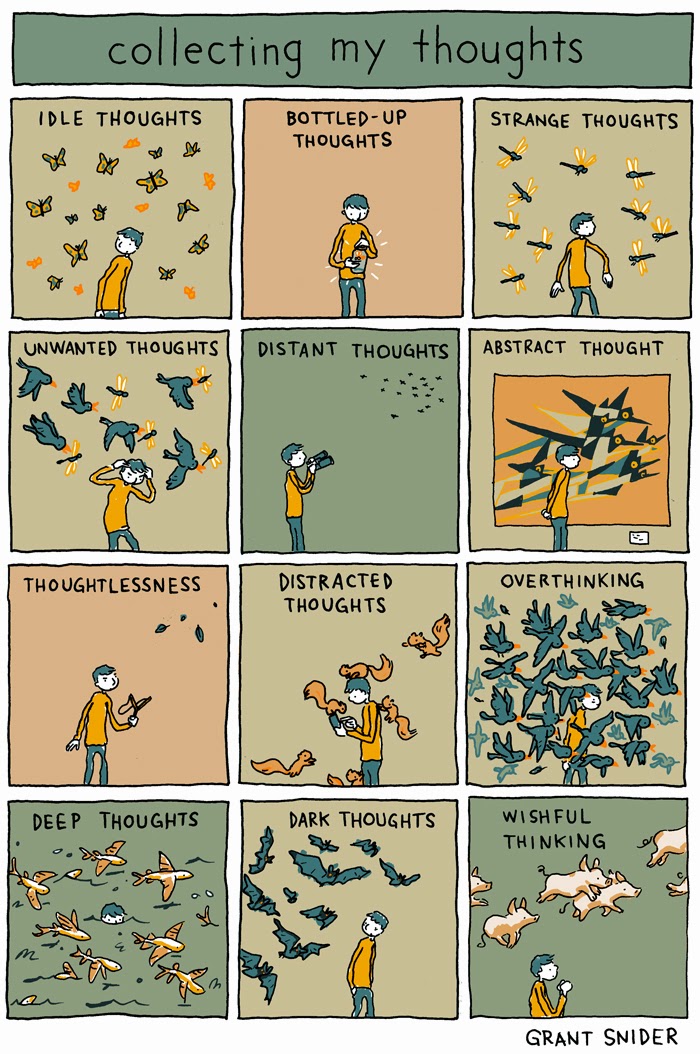
Collecting My Thoughts

by Grant

14 May 16:38

Lógica invertida

Adam Victor Brandizzi

"Alguém com tempo de sobra e que ensine de graça"

mundo357

14 May 13:04

Our Precarious Power

by Andrew Sullivan

Hugh Byrd and Steve Matthewman warn that electrical blackouts are “becoming increasingly common” across the globe and “will only get more frequent and severe”:

Electricity systems are complex, high-tech assemblages in which small failures can interact in unanticipated and often incomprehensible ways. The North American grid, for example, is blackoutarguably the world’s largest machine, but is highly fragmented. It crosses borders and regulatory zones and has no single owner or manager. Over 3,100 utility companies are on it.

Other continent-scale grids have similar weaknesses. The vulnerability of such systems is demonstrated by the Italian blackout of 2003. The event began when a falling tree broke a power line in Switzerland; when a second tree took out another Swiss power line, connectors towards Italy tripped and several Italian power plants failed as a result. Virtually the whole country was left without power. It says something when a nation can be brought to a halt by two trees falling outside its borders. …

Resource depletion is already having an effect on countries that rely on fossil fuels such as coal for electricity generation. Countries with significant renewable resources are not immune, either. Weather is not predictable and is likely to become less so, courtesy of climate change: in the past decade shortages of rain for hydro dams has led to blackouts in Kenya, India, Tanzania and Venezuela. Deregulation and privatization have created further weaknesses in supply as there is no incentive to maintain or improve the grid. Almost three-quarters of US transmission lines and power transformers are more than 25 years old and the average age of power plants there is 30 years.

(Photo: Indian women and children wait inside a darkened train carriage at a railway station in New Delhi on July 31, 2012. A massive power failure hit India for the second day running as three regional power grids collapsed. By Roberto Schmidt/AFP/Getty Images. Dish coverage of the blackouts here.)

14 May 01:45

Petrobras abre mão de profissionais experientes em momento importante

by Míriam Leitão
Adam Victor Brandizzi

Bem, tem o detalhe que são funcionários públicos, e quem já trabalhou com/no governo sabe que sempre tem uns (não todos, claro) que realmente é melhor pagar para que não apareçam...

Enviado por Míriam Leitão - |

NA CBN

Petrobras abre mão de profissionais experientes em momento importante

Alguns pontos merecem atenção na fala da presidente da Petrobras, Graça Foster. Uma notícia boa é que a produção vai aumentar, apesar do atraso nas plataformas. É um dado positivo em meio a tantas notícias ruins sobre decisões de investimento erradas do passado.

Mas Graça justificou o lucro menor da empresa - no primeiro trimestre, o lucro líquido ficou em R$ 5,393 bilhões, dizendo que a Petrobras teve que fazer uma provisão de R$ 2,4 bi para pagar o plano de demissão voluntária. Esse programa, que previa desligamento de trabalhadores com idade igual ou superior a 55 anos, não faz sentido. Como a expectativa de vida está aumentando, o Brasil tinha que fazer um esforço para convencer as pessoas a esperarem mais um pouco para se aposentarem. Um profissional com essa idade está no auge da sua capacidade produtiva e será muito disputado pelo mercado. Deveriam, portanto, ser mantidos.

Os empresários falam que há falta de profissional capacitado, e aí vem a Petrobras e paga para que essas pessoas, que foram qualificadas, saiam da empresa e voltem ao mercado. As companhias da área de petróleo vão gostar disso. Não dá para entender essa parte: um plano de demissão tirando muita gente boa da empresa aos 55 anos. A Petrobras perde com essa visão ultrapassada de que aos 55 anos, 60 anos, o funcionário está "velho".

A companhia está abrindo mão de ativo bom lá fora, como temos visto, e de gente experiente num momento importante em que avança em águas ultraprofundas. Isso não faz sentido. Por que a Petrobras faz isso? É preconceito dizer que a idade média dos funcionários estava alta. Temos que mudar essa mentalidade. Esse é um sinal contraditório daquele que deveria ser dado hoje. O Brasil tem que começar a pensar em aposentadorias mais tarde. Na Alemanha, para se ter uma ideia, aposenta-se aos 67 anos.

Ouçam aqui o comentário feito na CBN

14 May 00:48

Quem paga a conta

by Míriam Leitão

Enviado por Míriam Leitão e Alvaro Gribel - |

COLUNA NO GLOBO

Quem paga a conta

Está terminando da pior forma o caso envolvendo o BNDES e o frigorífico Independência. Aqui, neste espaço, essa operação desastrosa foi criticada desde o início, sem que o banco público a explicasse. Agora se sabe, pela reportagem de Mauro Zanatta, no “Estado de S.Paulo”, que o desfecho será o esperado: enorme prejuízo aos cofres públicos.

O banco perdeu a disputa que fez com o seu sócio, a família Russo, dono do Independência, e terá que ficar com o prejuízo de R$ 250 milhões. Além disso, terá que pagar as custas do processo movido na Câmara de Arbitragem do Mercado da BMF & Bovespa. O processo corre em sigilo. Deve um banco público, que usa dinheiro do contribuinte, usar tanto o subterfúgio do sigilo para não prestar contas à população?

Em dezembro de 2008, o BNDES comprou por R$ 250 milhões uma participação na empresa e se comprometeu a dar mais R$ 200 milhões. Três meses depois, o frigorífico quebrou. O governo agora explica que comprou porque o frigorífico era uma das estrelas do mercado. Ora, quem pode dar esse tipo de explicação é o pequeno investidor, mas não o banco que tem a maior carteira de ações do país. Ele deveria se informar bem antes de entrar na empresa. Quem quebra em fevereiro já estava falido em dezembro, evidentemente.

Em 2009, escrevi que o banco estava virando sócio e dando empréstimos a empresas com conhecidas dificuldades financeiras. Não fui a única. Vários analistas criticaram, em artigos e entrevistas, o projeto ao qual o BNDES se lançou, de campeões nacionais. Na época, ele elegeu três empresas que deveriam liderar o setor de carne. O Independência seria um desses líderes. O outro seria o JBS, no qual o banco despejou bilhões. O terceiro era o Marfrig, que ficou tempos na corda bamba. Frigoríficos menores não conseguiram empréstimos. Para os grandes, o dinheiro jorrava fácil. O Brasil já era, antes daquela política, o maior exportador de carne do mundo.

Quando o Independência quebrou, perguntei ao BNDES que explicação ele tinha para ter realizado o negócio. Ele respondeu que havia encaminhado o assunto para o Departamento Jurídico. A explicação era e continua sendo insuficiente.

Na outra ponta, a pequena empresa enfrenta realidade diferente. Um exemplo vem do empresário José Alfredo Machado, que pediu R$ 1,5 milhão ao BNDES para montar uma fábrica de biocombustível em Aracruz, no Espírito Santo, em 2003. O investimento total da empresa foi de R$ 4,5 milhões; quase 70% bancados pelos sócios.

As exigências foram rigorosas: obrigatoriedade de contratação de seguro, no próprio BNDES, de 7,2% do valor do empréstimo, o que elevou o financiamento em R$ 108 mil. Alienação fiduciária de todas as máquinas e do terreno onde a fábrica foi construída. O banco ficou com os bens em seu nome até que o empréstimo fosse pago. Os três sócios e suas esposas ainda foram obrigados a se tornar fiadores do acordo.

O BNDES exigiu a contratação de outro banco como agente repassador, que acabou sendo o Banco do Brasil. O BB pediu garantias de R$ 1,5 milhão, em aplicações financeiras, que ficariam bloqueadas até que a fábrica entrasse em operação.

— Para tomar R$ 1,5 milhão do BNDES, tivemos que dar R$1,5 milhão de garantia ao Banco do Brasil. O pior é que eles não cumpriram o combinado, de liberar nosso dinheiro assim que a fábrica começasse a funcionar, no início de 2004. À medida em que íamos quitando o empréstimo com o BNDES, o BB ia devolvendo e isso durou até o final de 2008. Na prática, não houve financiamento. Depositamos o dinheiro em uma conta e recebemos em outra. Ficamos sem capital de giro, e o BB, em vez de liberar a garantia integralmente, nos ofereceu outro empréstimo. Nunca mais pretendo pegar nada com eles, e ao mesmo tempo vejo grandes empresas tomando bilhões. Será que eles tiveram que passar pelas mesmas exigências? — questiona o empresário.

Na reportagem do “Estadão” sobre o frigorífico quebrado, fontes do governo só aceitaram falar se seus nomes não aparecessem. A explicação que eles dão para o negócio é que a decisão foi tomada com base em “informações precárias”. Como não pretendem divulgar o processo, fica-se sem saber quem foi o Nelson Cerveró do BNDES no caso do Independência.

14 May 00:45

Is The Meth Epidemic Overblown?

by Andrew Sullivan

After reading Nicholas Parsons’s Meth Mania: A History of Methamphetamine, Sullum believes so:

Although NSDUH data cited by Parsons indicate that monthly meth users never accounted for more than 0.3 percent of the population between 2002 and 2011, the drug in its latest incarnation loomed large in the public imagination. Meth did become the next crack in the sense that it was portrayed as the scariest drug ever, turning its users into hideous, homicidal, zombie-like subhumans who made speed freaks seem attractive and tame by comparison. Popular portrayals of meth’s effects, which Parsons describes in detail with a keen eye for exaggeration and unjustified assumptions, were grossly misleading on two major counts: They presented extreme cases as typical, and they blamed every harm suffered or inflicted by meth addicts, ranging from tooth decay to murderous rampages, on the drug itself.

This sort of pharmacological reductionism is belied by the history of methamphetamine, which shows that the effects attributed to the drug are powerfully shaped by context.

Phillip Smith praises the book for addressing how these myths are made and by whom. He writes that “Parsons is especially interesting in his discussion of law enforcement as a claims maker when it comes to drugs”:

[L]aw enforcement has its own interests to protect. Parsons notes one particularly brazen example of self-interested panic purveying, the “ice” scare of the late 1980s. The DEA jumped all over that — until its annual budget was secured, then not so much.

This leads me to something Parsons didn’t discuss, but which I have long wondered: Why, exactly, are police considered experts on drugs? Because they arrest drug users? Police arrest domestic violence suspects, too, but that doesn’t make them experts on domestic bliss, as their own divorce and domestic assault rates indicate.

13 May 19:24

Granny Orca vs SeaWorld

by Andrew Sullivan

She’s 103 years-old and still making 800 mile trips. And she’s a living indictment of keeping Orcas in captivity.

13 May 02:02

Criando um feed RSS com Delicious, Yahoo! Pipes e Readability

by brandizzi

A retirada das funcionalidades sociais (e posterior desligamento) do Google Reader matou uma das mais notáveis comunidades virtuais, mas trouxe vida a um mercado antes monopolizado. Por exemplo, uns malucos apareceram do nada com um clone chamado The Old Reader (e passaram por maus bocados por isso). Dada sua completude e qualidade (além do quase heroísmo e a notável competência dos criadores), escolhi o Old Reader como meu novo leitor.

The Old Reader fornece praticamente tudo que havia no Google Reader. Uma das poucas exceções é a habilidade de compartilhar links arbitrários: só posso compartilhar o que vier de meus feeds. Tentei usar o Delicious como alternativa. Adicionava meu link em uma tag específica, assinava o feed da tag e depois o compartilhava. O resultado, porém, não foi bom: o feed do Delicious só compartilha o link e o título, sem o conteúdo.

Feed RSS do Delicious, visto no Firefox

Feed RSS do Delicious, visto no Firefox

Aí entram os Yahoo! Pipes. Esta ferramenta maluca permite recuperar conteúdo da Internet (em especial, feeds), processá-los e publicá-los em, entre outros formatos, RSS. Cheguei a brincar com eles um pouco, há muito tempo; assinava um ou outro pipe, geralmente expandindo webcomics, mas nada sério e nada que eu tenha feito. Ainda assim, Pipes pareciam a solução: é fácil recuperar feeds em um pipe, e é fácil recuperar o conteúdo de um link.

Entretanto, eu não poderia simplesmente recuperar o conteúdo de um link e jogá-lo na descrição de um item RSS. Uma página contém muitas coisas: menus, cabeçalhos, propaganda… Para piorar, boa parte da formatação se perderia quando o HTML fosse incluído no feed. Experimentei copiar o conteúdo de interesse e colá-lo no comentário do Delicious, mas o resultado foi lamentável: não era possível adicionar parágrafos, muito menos HTML. Como, então, extrair o conteúdo?

Minha primeira abordagem foi adicionar, no campo Comment do meu bookmark, uma expressão XPath que retornasse o conteúdo de interesse.

Link to share through Delicious and the XPath expression to retrieve the relevant content.

Link to share through Delicious and the XPath expression to retrieve the relevant content.

Daí criei um pipe que percorria o feed com o módulo Loop e, para cada link, baixava o conteúdo. Para isto, usava o módulo XPath Fetch Page, que também retirava o elemento apontado pela expressão XPath do bookmark e o colocava na descrição do feed. Veja o screenshot do pipe:

Expansor dos feeds RSS do Delicious que usa XPath para extrair o conteúdo relevante.

Expansor dos feeds RSS do Delicious que usa XPath para extrair o conteúdo relevante.

O feed resultante era bom mas o processo não era satisfatório. Eu tinha de descobrir qual era o XPath mais adequado para cada página. Frequentemente, não tinha como testar a expressão, de modo que compartilhava links sem conteúdo. Não era possível criar uma expressão para todas as páginas, naturalmente, e Pipes não fornecem uma ferramenta poderosa o suficiente para isso. Como seria bom, pensei, ter algo como um Readability

Feed RSS do Delicious, expandido com XPath, visto no Firefox.

Feed RSS do Delicious, expandido com XPath, visto no Firefox. Agora sim!

E assim a resposta brilhou na minha frente.

Readability é uma aplicação  que torna legíveis artigos em páginas muito sobrecarregadas. Originalmente um mero bookmarklet, hoje é uma aplicação cliente-servidor multiplataforma. Parece mágica: depois de “descobrir” o que é relevante na página, Readability apresenta este conteúdo de maneira padronizada e legível. Eu o uso há muito tempo, tanto para tornar artigos legíveis quanto para enviá-los para meu Kindle.

Huffington Post, al natural e alterado por Readability.

Huffington Post, al natural e alterado por Readability

Para nossa sorte, Readability provê uma API para seu parser! Obtendo um token de autenticação – que é passado como um parâmetro na URL ou via POST – é possível fazer um número considerável de requisições e receber respostas em JSON. Assim,  para cada item no feed, montei uma URL para invocar a API (com o URL Builder) e a pus em um campo; num loop seguinte, invoquei a URL com Fetch Data e atribuí o campo content da resposta à descrição do item.

Este pipe usa a Parser API de Readability para expandir os links.

Este pipe usa a Parser API de Readability para expandir os links.

¡Voilà! Todas as minhas URLs aparecem lindamente expandidas no meu feed.

Depois, vi que o pipe poderia ser ainda mais incrementado: agora, o Delicious sharing tag expander é parametrizável (qualquer um pode usá-lo, passando o nome de usuário no Delicious, a tag escolhida e uma chave de API) e também adiciona a descrição do bookmark como um comentário.

Como extrair o conteúdo de uma página via Readability é uma necessidade comum, isolei esta parte em outro pipeURL Readabilitifier – e a utilizei como um módulo no original. Também a reaproveitei no Feed Readabilitifier, um pipe parametrizado que expande os links de um feed RSS em sua descrição. Uso-o especialmente para expandir feeds truncados (por exemplo, compare este RSS da Folha de São Paulo com a versão expandida) mas também pode ser usado como submódulo, como no meu pipe que expande um dos RSS mais chatos do mundo, o do Arts & Letters Daily.

12 May 21:17

Pesadelos chineses

by Cora

Comprei uns brincos no Marrocos. O vendedor, lá no meio da medina milenar de Fez, os embrulhou num saquinho de pano que tirou de uma pilha enorme de saquinhos de pano. Todos nós os conhecemos: são aqueles saquinhos chineses que se encontram por toda a parte, e que guardam coisinhas miúdas e brilhantes compradas no Egito, na Colômbia, no Nepal, em Manaus ou na Rua da Alfândega.

Que porcaria de mundo globalizado!

E que país tenebroso, a China, que consegue produzir uma coisa de tão pouco valor que sai ainda mais barata, com transporte, imposto e intermediários, do que o que se faria na esquina! O Marrocos tem pano e tem mão de obra sobrando. Quanto custaria a um comerciante um saquinho de pano local? 20 centavos? 30 centavos? Em vez disso, ele compra o produto chinês, que provavelmente sai a dez centavos. A dúzia.

Imagino uma cidade na China onde todo mundo vive de fazer saquinhos de pano. De manhã à noite, chova ou faça sol, lá estão milhares de chineses, coitados, de todas as idades, fazendo a droga dos saquinhos que serão espalhados pelo mundo, tirando o emprego de pessoas que poderiam fazê-los à sua maneira e a alegria de quem curte o sabor do que vai buscar pelo mundo.

Imagino também uma pessoa, que como todas as outras pessoas do mundo só ganhou uma vida, tendo que gastá-la inteira na costura de saquinhos, em condições miseráveis, ao lado de outras pessoas nas mesmas circunstâncias.

E aí agradeço à imensa sorte que eu tive de não ser essa pessoa.

o O o

A China tem, segundo a Wikipedia, mais de um 1,36 bilhão de habitantes. É muita gente, e essa gente precisa viver de alguma coisa — nem que seja de fazer saquinhos de pano para espalhar pelo mundo. Os saquinhos que roubaram a identidade nacional das embalagens miudinhas do planeta inteiro são só uma das muitas pontas soltas de um iceberg de complicações que não tenho qualquer esperança de compreender. Há de tudo no miolo deste iceberg, que pode ser visto pelo angulo que o interlocutor quiser.

A cidade de Guiyu, por exemplo, até pequena pelos padrões chineses — tem apenas 150 mil habitantes — vive quase que exclusivamente de desmantelar aparelhos eletroeletrônicos. As 5.500 empresas da cidade dedicam-se a desmontar lixo eletrônico do mundo inteiro para garimpar o que há de materiais nobres nas placas e conectores. Os níveis de contaminação de níquel, chumbo, cobre e zinco da região são assustadores, centenas de vezes superiores aos que se consideram universalmente “normais”. Mas o mundo continua produzindo lixo eletrônico, e em algum lugar este lixo tem que ser processado; se não importasse essa porcaria toda, Guiyu não teria como manter seus 150 mil habitantes. Para eles, fazer saquinhos de pano a vida inteira deve parecer um trabalho fantástico, um sonho inatingível.

o O o

No ano de 2010, Ai Weiwei, provavelmente o mais famoso artista chinês contemporâneo, inaugurou, no Turbine Hall da Tate Modern Gallery, em Londres, uma instalação chamada “Sementes de girassol”. A instalação consistia em cem milhões de unidades, pesando ao todo uma tonelada e meia, cobrindo a superfície de mil metros quadrados da galeria até uma altura de dez centímetros. Mas aquelas sementes de girassol não eram de verdade; eram réplicas de cerâmica, individualmente moldadas e pintadas.

Jingdezhen, que tem dez vezes mais habitantes do que a desgraçada Guiyu, é famosa pela sua cerâmica desde o Século IV. Atualmente é uma cidade grande, com indústria e empresas de vários tipos, mas, durante séculos, foi, como Guiyu, uma cidade dedicada a uma única atividade. Durante a Dinastia Song (960 a 1279) ficou conhecida por um espetacular tipo de cerâmica delicadamente esverdeado chamado Qingbai; mais tarde, durante a Dinastia Ming (1368–1644), produziu a tradicional porcelana branca e azul que até hoje tira o fôlego de quem a vê.

Foi nessa cidade extraordinária, de onde ao longo dos séculos saíram maravilhas, que Ai Weiwei foi buscar a matéria prima para sua instalação. Durante mais de dois anos, 1.600 ceramistas dedicaram-se, dia e noite, a moldar e a pintar, uma por uma, cem milhões de esculturinhas minúsculas e monótonas, em forma de semente de girassol. Vi um documentário no YouTube em que alguns deles agradeciam pela oportunidade de trabalho.

O que significam cem milhões de sementes de girassol de cerâmica? Segundo Ai Weiwei, elas são uma referência a Mao Tse-Tung, tradicionalmente representado na arte governista cercado de girassóis: o ditador seria o sol, para o qual estaria voltado, feliz, o povo chinês em forma de flor. As sementes falsas, não comestíveis, seriam uma alegoria à propaganda política, na contramão da fome que vitimou milhões de pessoas durante o seu calamitoso governo.

Depois da desmontagem da instalação, Ai Weiwei a transformou numa série de obras “menores”, de apenas cem mil sementes cada. Uma foi leiloada pela Sotheby’s de Londres em fins de 2011, alcançando £ 349.250, ou cerca de £ 3,50 por semente. Talvez tenha sido um bom negócio no atacado, mas no varejo foi um grande prejuízo: hoje, no eBay, é possível encontrar as sementes de girassol falsas a partir de £ 0,43 a unidade. Claro que, sendo o mundo o que é, ninguém garante a sua autenticidade: é perfeitamente possível que as peças, postas à venda por negociantes de Hong-Kong, sejam falsas sementes de girassol falsas.

Não está fácil para ninguém.
(O Globo, Segundo Caderno, 17.4.2014)


12 May 21:17

Conheça a professora de SC que já foi ‘mãe’ 35 vezes

Na casa de Joenir Lopes, 66, no município catarinense de São Bento do Sul, quase não há mais espaço para fotos. É por meio delas que ela guarda a lembrança dos 35 “filhos” que já teve.

Sim, isso mesmo: Joenir já foi “mãe” 35 vezes. Em uma delas, a convivência durou apenas uma noite. Em outras, até um ano e meio. Dois irmãos estão aos seus cuidados hoje —mas também deverão se despedir dela em breve.

Há 12 anos, a professora aposentada recebe temporariamente em sua casa crianças que foram vítimas de abandono e de violência doméstica.

Lá, ficam aos cuidados de Joenir até que ocorra uma nova decisão da Justiça. A iniciativa, ainda pouco conhecida no Brasil, é chamada de “acolhimento familiar”.

“É como um papel de mãe. Sou responsável pela saúde, educação… tudo”, explica ela, que tem a ajuda do marido para cuidar dos pequenos. Não só do marido: uma equipe técnica, formada por psicólogos, pedagogos e assistentes sociais, também acompanha o processo.

Hoje, 372 municípios brasileiros têm programas de famílias acolhedoras, segundo dados do Ministério de Desenvolvimento Social, que normatiza o serviço. Embora a maioria se concentre no Sul e Sudeste, parte do serviço já se espalha em outras regiões.

Em São Bento do Sul, a iniciativa, considerada uma alternativa aos abrigos, existe desde 2002 —o que faz de Joenir uma das “mães” temporárias mais experientes do município, ainda que não assuma a alcunha: para evitar confundir a criança, que pode voltar à família biológica ou ir para uma família adotiva, prefere ser chamada de “tia”.

Mas diz se sentir realizada da mesma maneira. “Às vezes, fico pensando: não sei ficar sem essas crianças, porque aprendo muito com elas. Hoje, vejo a vida de forma diferente”, conta.

A 'mãe temporária' Edna, 41, de Campinas, que já acolheu dois bebês e espera o terceiro Raquel Cunha/Folhapress

A ‘mãe temporária’ Edna, 41, de Campinas (SP), que já acolheu dois bebês e espera o terceiro
Raquel Cunha/Folhapress

MÃE EXPERIENTE, MÃE RECENTE

Mesma sensação teve Edna*, 41, em outro ponto do país. Foi por uma propaganda ouvida no rádio, enquanto dirigia, que ela soube do Sapeca, programa de acolhimento familiar em Campinas (SP).

Não tinha filhos e sempre quis, de alguma forma, fazer algo para ajudar –ainda que por pouco tempo. Cadastrou-se como “acolhedora” e passou por entrevistas, seleção, cursos e meses de treinamento.

De lá para cá, dois bebês já passaram pelos seus cuidados. O último, Eduardo (nome fictício), acompanhou por quase um ano, até que ele se recuperasse de graves problemas de saúde.

Agora, brinca que está “grávida” do próximo.

“Foi uma surpresa. Vi que sou capaz de amar alguém que não saiu de mim e que sou uma leoa com as crianças. Três horas da manhã, o bebê com febre, você nem pensa: corre para o hospital.”

Essa correria toda, no entanto, assustou os amigos. A maior dúvida: e depois que a criança for embora?

Mãe que é mãe, mesmo temporária, sofre. Mas se recupera. É o que a experiência de Joenir garante: “A gente tem saudades, chora porque a casa fica vazia. Mas fica contente porque encontram uma família.”

*A pedido do Sapeca, o sobrenome não foi divulgado

Bookmarked at brandizzi Delicious' sharing tag and expanded by Delicious sharing tag expander.
12 May 17:31

Tweet Of The Day

by Andrew Sullivan

How do I explain Michael Sam to my kids? A man with TWO first names?

— AndyKerman (@LotionDolphin) May 11, 2014

And the beat goes on.

12 May 17:06

On Eleanor Marx

Adam Victor Brandizzi

A história de outra mulher forte (quase) esquecida pela História.

Eleanor Marx©AKG-Images

Eleanor Marx photographed c1875

Eleanor Marx: A Life, by Rachel Holmes, Bloomsbury, RRP£25, 528 pages

Eleanor Marx joked that she had inherited her father’s nose but not his genius and, if she anticipated that it was her fate to be overshadowed by the author of Das Kapital, then she could only be proved correct. Yet contemporaries who knew her work as an activist, writer and translator would have protested nonetheless at the injustice. Now, in Rachel Holmes’ fine biography, we have all the evidence we need to revise this modest self-assessment.

Eleanor was born on January 16 1855 in a two-room garret in Dean Street, London, the sixth child of Karl Marx and Jenny von Westphalen. Only two of her siblings survived into adulthood – her sisters Jenny and Laura, 11 and 10 years older than her, respectively. The eldest son, Edgar, died of tuberculosis 12 weeks after Eleanor’s birth and from that point her father seems to have invested all his hopes and affection in the family’s most recent arrival. He and Eleanor would be soulmates until his death in 1883.

One consequence for Eleanor, known throughout her life as “Tussy”, was that her education was almost entirely conducted at her father’s knee. She barely attended formal school – in part because the family was always so short of money, surviving for periods on money raised by pawning linen and jewellery, or on generous handouts from Karl’s collaborator Friedrich Engels. Instead, she learnt French and German from her French-speaking older sisters and German-speaking mother, while her father encouraged his own love of “book-worming” in her from as soon as she could read.

Karl introduced her to Shakespeare, to the English, French and American novel, to Scott, Balzac and Fielding. He encouraged her writing and love of the theatre. Years later Eleanor recalled: “He would, all unconscious though she was of it, show his little girl where to look for all that was finest and best in the works, teach her – though she never thought she was being taught, to that she would have objected – to try and think, to try and understand for herself.”

And while Karl laboured on Das Kapital he found time to include Eleanor, extracting “examples and narratives that could be turned into enjoyable stories and useful instruction for his little girl”. As Holmes puts it: “To say that Eleanor Marx grew up living and breathing historical materialism and socialism is therefore a literal description and not a metaphor.”

Holmes, a cultural historian known for her biographies of Victorian subjects, here builds a vivid picture not just of Eleanor Marx but also of Karl Marx, Engels (who acted as a second father to Tussy) and the diverse circle of radicals and political refugees who thronged the round reading room at the British Museum in the second half of the 19th century. Domestic and personal lives merge with the ferment of the age.

In her teens Eleanor became her father’s amanuensis, transcribing his notoriously illegible handwriting and generally organising his paperwork. Small wonder that she emerged into adulthood with all her father’s intellectual resources, and with an understanding of economic history and theory few could match. She was, to all intents and purposes, Marx’s creation. As Eleanor wrote, “I remember his once saying a thing that at the time I did not understand and that even sounded rather paradoxical. But I now know what he meant ... My father was talking of my eldest sister and of me and said: ‘Jenny is most like me. But Tussy is me.’ ”

Eleanor was a more agitprop version of the bookish Karl. She led striking dock workers and gas workers, organising their emerging unions’ activities and joining their demonstrations. She ghosted any number of articles and manifestos for male union leaders and political activists. She addressed a crowd of 250,000 at the first May Day rally in London and toured the US, speaking out against the conditions of manual labourers.

Intellectually, what she brought of her own to the political arena was a vision that incorporated the rights of women. As she wrote in 1886 in The Woman Question, “For women, as for the labouring classes, no solution of the difficulties and problems that present themselves is really possible in the present condition of society.”

But Eleanor’s life, as Holmes shows, was tragically flawed around “the woman question”. At the moment she grasped and publicly articulated the connection between socialism and feminism, she became personally involved with a man who would fatally undermine her. Fellow socialist and playwright Edward Aveling was – in Eleanor’s friend George Bernard Shaw’s words – an “agreeable scoundrel ... quite a pleasant fellow who would have gone to the stake for Socialism or Atheism, but with absolutely no conscience in his private life. He seduced every woman he met, and borrowed from every man.”

He and Eleanor were collaborators in their work for socialism, even for feminism. But beyond the endless workers’ rallies and union meetings, their relationship was disastrous from the start. Aveling brought Eleanor down in a way no policeman at a rally or debating adversary on a public stage could ever have done.

Thanks to Holmes’ fresh and vital style – not to mention her endearing partisanship – Eleanor Marx: A Life reads less like a biography than a 19th-century novel. Its close might indeed be modelled on Flaubert’s Madame Bovary, translated into English for the first time by Eleanor Marx in 1886.

Somewhere between March 27 and 31 1898, Eleanor learnt that the feckless, philandering Aveling had secretly married one of his actress amours. For 14 years Eleanor had accepted her own unconventional – and, to many, scandalous – cohabitation with Aveling as necessary, believing him to be already married. In fact, she discovered, his wife had died some years earlier. Eleanor had turned a blind eye to his affairs, his reckless spending, his many loans from her friends never repaid, his long absences and neglect. But this final betrayal was too much.

On March 31, she and Edward argued violently and he left her home in Sydenham, southeast London. Eleanor sent her maid Gerty to the pharmacist with a prescription for chloroform and prussic acid. Sent out on a further errand, Gerty returned to find the 43-year-old Eleanor motionless in bed. “Her long, dark hair was loose, her eyes fixed open,” writes Holmes. “Her face and body had changed colour, to a lurid mottled indigo. Gerty saw that Eleanor was wearing her favourite white muslin summer dress. It was unseasonal. She had washed, ironed and starched it herself, then laid it away in lavender and tissue paper for the winter.”

Thus the life of one of Britain’s most celebrated intellectuals and activists of the late 19th century came abruptly to an end, to be all but forgotten. Thankfully, however, Holmes has given back to us an unforgettable Eleanor Marx.

Lisa Jardine is professor of Renaissance Studies and director of the Centre for Humanities Interdisciplinary Research Projects at University College London

Copyright The Financial Times Limited 2014. You may share using our article tools.
Please don't cut articles from FT.com and redistribute by email or post to the web.

Shared by Arts & Letters Daily feed and expanded by Arts & Letters Daily feed expander pipe by Brandizzi.
12 May 13:21

Email Of The Day

by Andrew Sullivan
Adam Victor Brandizzi

Muito tocante o email. Gosto de textos assim para controlar meu impulso de truther da neurologia :)

A reader illustrates how impactful our reader threads can be:

I have been extremely judgmental of parents who have put their children on ADHD medications in the past. I still believe there is a broad swath of parents who use medication as an easy path around engaged parenting.

However, life has a way of mocking hubris and making you eat your words. My 12-year-old son started collage6th grade this year, and he has been struggling with the new responsibilities that middle school entail. Rather than a group of 20 to 25 kids herding from one class to another as a group, which was what he was used to from elementary school, in middle school each student is assigned an independent locker and schedule and must find his or her own way to class and keep track of homework. When I would get home from work every day, he would have done none of his homework, which was a heavier load than most of his classmates, since he didn’t get anything done during the school day, either. Thus would start a 4-5 hour nightly battle of wills to get his homework done. That is no exaggeration: 4 to 5 hours every single weeknight. It was so bad that I dreaded coming home, and he would burst into tears when he saw me drive up the driveway. He even mentioned several times that he wanted to kill himself. That’s when he started seeing a psychologist.

I started reading the Dish’s discussion on “Hyperactive Prescribing” with a sense of smugness, since I was fighting the good fight and wasn’t letting the fact that my son was struggling push me into being a bad mother reliant on better living through chemistry. But then it struck me that the reader who talked about being diagnosed at 32 years old could be my son in 20 years. His struggles sounded so much like what I observed in my son, and it literally gave me goosebumps. Another excerpt you posted from the man whose life fell into place after his diagnosis and prescription resonated deeply, too.

So the next time we saw my son’s psychologist, I asked her opinion on whether medication could help. She told me that she honestly hadn’t considered medication because she doesn’t have a degree that allows her to prescribe, but now that I mentioned it, he probably would benefit from it. Next stop: pediatrician. She said it seemed clear that our family was suffering, and medication would almost definitely help. Prescription obtained.

dish-readersThe first day he took the medication, he came home with 15 minutes of homework to do, since everything else had been done in class. He finished it while I was cooking dinner. Next night, he had his
homework done before I got home from work. A sample test of 15 extended-response questions (which I don’t believe he had ever finished even ONE question on before) was finished before class was over, with a score of 100%. My husband literally started crying with relief when our son told him about it.

My home no longer has a gray cloud hanging over it. It’s seriously lollipops and unicorns. My son’s teachers have e-mailed me to tell me what an amazing transformation they’ve seen, and everyone in our house is much more relaxed and happy. Last week, out of the blue, as he was about to get out of the car to be dropped off at school, he said, “Thanks for putting me on that medicine, Mom. School’s so much easier now. I’m so happy!” I know that sounds like some sort of e-mail glurge, but that’s what he said, verbatim.

I just thought you – and the readers who shared their experiences – might like to know that they have saved the sanity of a family, and possibly the life of a pre-adolescent. Thank you.

Read more about the Dish community here and here. Photos of readers used with their permission.

12 May 11:45

ADVENTURES IN BEHAVIORAL NEUROLOGY — OR — WHAT NEUROLOGY CAN TELL US ABOUT HUMAN NATURE | Edge.org

Adam Victor Brandizzi

Esse foi um dos melhores surveys da neurologia que já vi. E o cara é engraçado também :P

When you look at the structure of the brain it's made up of neurons. Of course, everybody knows that these days. There are 100 billion of these nerve cells. Each of these cells makes about 1,000 to 10,000 contacts with other neurons. From this information people have calculated that the number of possible brain states, of permutations and combinations of brain activity, exceeds the number of elementary particles in the universe.

The question is how do you go about studying this organ? There are various ways of doing it. These days brain imaging is very popular. You make the person perform some task, engage in conversation or think about love, for that matter, or something like that, or imagine the color red. What part of the brain lights up? That gives you some confidence in saying that that region of the brain is involved in mediating that function. I'm sort of simplifying it, but something along those lines. Then there is recording from single cells where you put an electrode through the brain, eavesdrop on the activity of individual neurons, find out what the neuron is responsive to in the external world. There are dozens of such approaches, and our approach is behavioral neurology combined with brain imaging.

Behavioral neurology has a long history going back about 150 years, a venerable tradition going back to Charcot. Even Freud was a behavioral neurologist. We usually think of him as a psychologist, but he was also a neurologist. In fact, he began his career as a neurologist, comparable in stature with Charcot, Hughling Jackson, Kurt Goldstein. What they did was to look at patients with sustained injury to a very small region of the brain—and this is what we do as well in our lab. What you get is not a blunting of all your mental capacities or across the board reduction of your mental ability. What you get often is a highly selective loss of one specific function, other functions being preserved relatively intact. This gives you some confidence in saying that that region of the brain is specialized in dealing with that function.

It doesn't have to be a lesion; it can be a genetic change. One of the phenomena that we've studied, for example, is synesthesia, the merging of the senses (which I'll talk about in a minute) where's there has been a genetic glitch. It runs in families in whom some gene or genes cause people to hear colors and taste sounds. They've got their senses muddled up. We've been studying this phenomenon.

In general, we look at is curious phenomenon, syndromes that have been known for ages, maybe 100 years, 50 years, that people have brushed under the carpet because they're regarded as anomalies, to use Thomas Kuhn's phrase. What do you make of somebody who says, "I see five as red, six as blue, seven as green, F sharp as indigo." It doesn't make any sense and when you see this in science, the tendency among most scientists, most of my colleagues at any rate, is to brush it under the carpet and pretend it doesn't exist, deny it. What we do is to go and rescue these phenomena from oblivion, studying them intensively in the laboratory. Nine out of ten times it's a wild goose chase, but every now and then you hit the jackpot and you discover something really interesting and important. This is what happened with synesthesia. Another example, which maybe I'll begin with, is one most people have heard of, our work on phantom limbs and mirrors, which I'll touch on in a minute.

One of the peculiar syndromes, which we have studied recently, is called apotemnophilia. It's in fact so uncommon that many neurologists and many psychiatrists have not heard of it. It's in a sense a converse of phantom limbs. In a phantom limb patient an arm is amputated but the patient continues to vividly feel the presence of that arm. We call it a phantom limb. In apotemnophilia you are dealing with a perfectly healthy, normal individual, not mentally disturbed in any way, not psychotic, not emotionally disturbed, often holding a job, and has a family.

We saw a patient recently who was a prominent dean of an engineering school and soon after he retired he came out and said he wants his left arm amputated above the elbow. Here's a perfectly normal guy who has been living a normal life in society interacting with people. He's never told anybody that he harbored this secret desire—intense desire—to have his arm amputated ever since early childhood, and he never came out and told people about it for fear that they might think he was crazy. He came to see us recently and we tried to figure out what was going on in his brain. And by the way, this disorder is not rare. There are websites devoted to it. About one-third of them go on to actually get it amputated. Not in this country because it's not legal, but they go to Mexico or somewhere else and get it amputated.

So here is something staring you in the face, an extraordinary syndrome, utterly mysterious, where a person wants his normal limb removed. Why does this happen? There are all kinds of crazy theories about it including Freudian theories. One theory asserts, for example, that it's an attention seeking behavior. This chap wants attention so he asks you to remove his arm. It doesn't make any sense. Why does he not want his nose removed or ear removed or something less drastic? Why an arm? It seems a little bit too drastic for seeking attention.

The second thing that struck us is the guy would often take a felt pen and draw a very precise irregular line around his arm or leg and say, "I want it removed exactly that way. I don't want you removing too little of it or too much of it. It would feel wrong. I want you to amputate it exactly on that line." And you could test him after a year it is the same wiggly line which he couldn't have memorized, and this suggests already that this is something physiological, and not something psychological that he is making up.

Another theory that is even more absurd (found in some papers, and again, it's also a Freudian theory) is that the guy wants a big stump because it resembles a giant penis. Sort of wish fulfillment. This again is ridiculous, complete nonsense, of course. The question is why does it actually happen? What we were struck by was that there are certain syndromes where the patient has a right hemisphere stroke, in the right parietal cortex. The patient then starts denying that the left arm belongs to him. He says, "Doctor, this arm," he'll often point to it with his right arm and say, "this arm belongs to my mother." Here's a person who is perfectly coherent, intelligent, can discuss politics with you, can discuss mathematics with you, play chess with you, asserting that his left arm doesn't belong to him.

This is different from apotemnophilia. In apotemnophilia the patient says, "This arm is mine, but I don't want it. I want it removed." But there are similarities, there's an overlap, so we suggested that maybe there's something wrong with his body image in the right hemisphere, which alienates the left arm, or the right arm, for that matter, from the rest of the person's body and the sense of alienation leads to the person saying, "I don't want it. Have it removed."

More specifically, messages from the arm and the skin throughout the body, in fact, go to the parietal lobe to a structure, the postcentral gyrus. There's a big furrow or cleft right down the middle of the brain called the central sulcus. Just behind that sulcus there is a vertical, narrow strip of cortex where there's is a complete map of your body's surface. Every point of your body's surface is represented in a specific point on the cortex and there's a complete map called the Penfield Map. That's where touch sensations, and behind it, joint sensations and muscle sensations, are all represented in this somatosensory map.

The first thing we—Paul McGeoch, Dave Brang and I—did was an MEG recording. MEG is a functional brain imaging technique—to map out the body of these people. Normal people have a complete point by point map on the surface of this strip of cortex. We said, well, maybe this guy has a hole in that region corresponding to the arm he wants removed because it feels alien. But what we found is there are no holes. It’s a completely normal map so we were disappointed. Then what we found was there's another region behind it called the superior parietal lobule. This region actually constructs your body image. When I close my eyes I have a vivid sense of my different body parts. Some parts are more vivid than others and this comes mainly from joint and muscle sense, partly from my vestibular sense—saying that I'm standing erect, that my head is not tilted—and partly when I open my eyes I confirm it with vision. So there's a convergence of signals from vision, touch, proprioception, vestibular sense, vision —all of that—helping you construct a vivid internal picture of your own body called the body image. That gets partial input from the map I was telling you about, namely the touch map, the map for joints and muscle sense. It also gets input from hearing. It gets input from vestibular sense. It gets input from vision. All of it is converging to create a body image. That map, we found, does not have the representation of the arm that the patient wants to get rid of (you don’t see this in every patient; in some the malfunction may be in the zones that the body image map subsequently projects to).

So our hypothesis was the signals arrive in S1 (touch) and S2 (joint and muscle sense). All the sensory signals arrive here and they're all normal and they're received in the brain, but when the signal gets sent to the body image center in the superior parietal lobule in the right hemisphere there is no place in the brain to receive that signal and, therefore, this creates a tremendous clash and discrepancy, and the brain abhors discrepancies. The discrepancy signal is then sent to the amygdala, the limbic structures produces an aversion to the arm, and the patient says, "I want the arm removed. It feels intrusive." Words like, "intrusive," over –present” and so I want it removed.

Here's a bizarre psychological syndrome: the person wants his arm removed. Discard the Freudian idea that he wants a big, giant stump or wishful that he wants attention and things like that, and you come up with a precise circuit diagram of what's going on.

We tested this because it is not enough to come up with a theory. How do we test it? It turns out if I poke anybody with needle that pain sensation goes to the sensory pain region in the brain, probably in the thalamus and cortex, and then it goes to the amygdala. The amygdala alerts you to the pain and you say, "Ow." Right? And then it goes down to the anterior cingulate that feels the agony of the pain. There's a cascade of events. There's a sensation of pain and then the agony of pain, and then messages go down the autonomic nervous system and make you start sweating, preparing for action, fleeing, fighting, or whatever the required action is. So if you poke somebody with a needle, this whole cascade of events is set in motion. You can measure the skin resistance, which measures the sweating, you start sweating when poked.

Now, when I poked him with a little pencil above the line where he wanted his arm to be amputated nothing happened. Just a little gentle pencil prick. It's not a painful stimulus. Not much happened. There's no galvanic skin response, there's no arousal. But if you touch him below the line where he wants the amputation, there's a huge, big galvanic skin response. You can actually measure the aversion physiologically, not just rely on the subject to report. There's no way you can fake the galvanic skin response. It's the basis of all lie detector tests.

Then, of course, we went straight to the brain and we said let's map it out. And as I said we found S1 was normal, if you go to S2 that's normal. If you go to the superior parietal lobule where the body image is constructed, to some extent the inferior parietal lobule, right parietal, let's say, where the body image is, there is no arm representation in that center. That's what we found. If you touch the arm there's no activity there. If you touch above the line of amputation or touch the normal arm the activity is completely normal. So that region of the brain is abnormal, but we also speculate that the regions of the brain in the frontal lobes and insula/amygdala to which that SPL/IPL projects, there could be an interruption of signals. In either event there's a physiological reason why this happens. This is giving you insight into how the normal brain constructs a body image.

At this point I should add a note of caution that unlike our work on phantoms and synesthesia which has been confirmed on dozens of subjects—both by us and others—this work on apotemnophilia is very preliminary; we need more subjects. And that’s not a legal disclaimer—it’s the truth. Lets wait and see. Then the question is can you treat the guy? And we're working on that. We don't know how. In case of phantom limb there are ways of treating phantom pain.

We don't deliberately go after these odd phenomena. Somebody phones me and says, "I have this curious phenomenon, Dr. Ramachandran. Can you solve the problem?" Ninety percent of the time we can't, but every now and then we discover something amazing as I said.

So what we do is, we look at the patient and the first question is why does this patient have this syndrome? Why this peculiar behavior? What's going on in the brain? Can you explain it? First of all show that he's not crazy. Show that it's a real, authentic syndrome. There are bogus syndromes and I will talk about that if you like. They're not real. But given that it's a genuine syndrome and you prove that it's authentic, which is often very difficult to do, then having done that you say "what are the precise brain mechanisms that give rise to these curious symptoms?" So the first two questions are: is it real and if so what causes it.The third question is who cares? What does it matter? Each of these three questions needs to be answered if you want to make progress, if you want to draw people's attention to the phenomenon that you're studying.

So lets take synesthesia. First thing we did was to show that these people are not crazy. They're really seeing colors when they see numbers. They're not just making it up. The second thing we did was to ask what are the brain mechanisms, what's going on in the brain? Ed Hubbard, Boynton and I have shown that when they see non-colored numbers the color area in the brain lights up. So what? Why should I care? We've shown this quirky phenomenon has broad implications for understanding creativity and metaphor. Well, we haven't actually shown it, but speculated on that possibility. So in each case what we do is we rescue this phenomenon, this anomaly, from being brushed under the carpet, find out what the mechanism is in the brain, and talk about its deeper implications for all of us, for normal behavior.

Now, we seek odd syndromes to try and explain the symptoms in neural terms and hopefully shed light on aspects of human nature, which have remained ineffable for the longest time. But sometimes you come across a syndrome where you cannot quite know for sure if this is a legit syndrome or not, even though you can find it in the bible of clinical psychologists called DSM, Diagnostic and Statistical Manual, which is the official book for clinicians. If they can label you, give your syndrome a name, they can charge you, charge an insurance company, so there has been a tendency to multiply syndromes.

 There's one called, by the way, Chronic Underachievement Syndrome, which in my day used to be called stupidity. It actually has a name and it's officially recognized. Then there is a syndrome called De Clerambault Syndrome. De Clerambault Syndrome refers to, believe it or not, a young woman developing an obsession with a much older, famous, eminent, rich guy and develops the delusion that that guy is madly in love with her but is in denial about it. This is actually found in a textbook of psychiatry, and I think it's complete nonsense. Ironically, there's no name for the converse of the syndrome where an aging male develops a delusion that this young hottie is madly in love with him, but is in denial about it. Surely, it's much more common and yet it doesn't have a name. Right?

You have to have a nose for anomalies, nose for the right kinds of syndromes to pursue. I'll give you examples and I think two will suffice. Let's return to synesthesia which I have been excited about studying for the last three or four years. It's not really a neurological syndrome, but it is an anomaly of sorts. Francis Galton described it in the Nineteenth Century, the great Victorian polymath who was a first cousin of Charles Darwin. Galton noticed that some people in the population who were otherwise quite normal, except they had one quirk: and that is every time they saw a number, the number would evoke a specific color. So five would be tinged red, six would green, seven would be indigo, eight would be blue, and nine would be orange, or something like that. Also, sometimes in the same subjects or in other people, each tone would evoke a color. So F sharp would be blue, C sharp would be green, so on and so forth.

Galton also noticed that this runs in families and may have a genetic basis and published this, I think it was in Nature, in the Nineteenth Century. Since then there have been dozens and dozens of case reports of people experiencing this, but it was regarded as a curiosity mainly and also is thought to be very rare, estimates ranging from one in a thousand to one in 10,000.

I became very intrigued by this phenomenon and I said, "Why would somebody see five as red?" Now, as I said, it's been known for a long time, for over 100 years, and people ignored it because it didn't fit the big framework of science. What do you make of someone who says F sharp is blue and C sharp is green? It doesn't make any sense. Or five is green or five is red? And I tend to get intrigued by these phenomena. I said, "Well, what's going on in their brain?" The first thing we wanted to show was that this was a legitimate phenomenon, that these people are not making it up.

There are several theories of synesthesia. One theory is that they are crazy. Maybe, but let's set that aside for a minute. One of the things we learn in medicine is when a patient is trying to tell you something when you think he's crazy, it often means that you're not smart enough to figure it out. Sometimes he's crazy, but usually it means you're not smart enough to figure it out, so look carefully, talk to the patient.

In the case of synesthesia, another odd aspect of it is that it's much more common amongst artists, poets, novelists, and other creative people. In fact, seven or eight times more common. This is controversial, but the strong evidence is that this is true. Now why would that be the case? I mean, one of my students has shown this to be the case, Ed Hubbard; why would this happen? There are several little mini-mysteries here about synesthesia. Why would it run in families? Why would they say numbers are colors or tones are colors for that matter? Why would it be more common in artists, poets, and novelists? So on and so forth. So it's a medical mystery worthy of Sherlock Holmes, waiting to be solved.

The first thing we want to show is these people are not crazy. By the way, another common theory is that they are on drugs like LSD –– acid junkies or pot heads. Sure enough it's more common among people who are high on acid, but that makes it even more intriguing. Why would some drugs produce this merging of the senses, this peculiar phenomenon of numbers evoking colors?

Another theory is they're being metaphorical as when you and I say, "It is the east and Juliet is the sun." Or we just say, "This is a loud tie." The tie isn't loud. It doesn't make any sound. Why do you say it's a loud tie? Or cheese. Cheddar cheese is sharp. Now sharp is a tactile adjective, a sharp nail or something. Why do you use a tactile adjective to describe a taste, a gustatory sensation? You say well, it's a metaphor. That's circular. Why do you want to use a tactile metaphor for a taste sensation?

Explaining synesthesia as just a metaphor doesn't explain anything because it's trying to explain one mystery with another mystery and that doesn't work in science. Another example of a metaphor would be, "It is the east and Juliet is the sun." You don't say, "Juliet is the sun." Does that mean she's a glowing ball of fire? No, you don't say that. You say, "She is warm like the sun. She is radiant like the sun." "Is nurturing like the sun" is a celestial body like the sun (a pun rather than a metaphor) "is the center of my solar system" and so on. The brain forms the right links. Synesthesia, by the way, is a completely arbitrary link between five and red. It's not a metaphor in that sense, so I was uncomfortable with the idea, but I thought there might be something to it. But we'll come back to that later as we go along. About a decade ago, by the way, I proposed there may be unconscious synesthetic propensities in all of us, which has now been amply confirmed in many studies including a recent one from Oxford.

Another theory is they're remembering childhood memories. Maybe they played with refrigerator magnets and five was red, and six was blue, and seven was green and for some reason they're stuck with these memories. Well, this again begs the question of why you and I have played with magnets, but we don't have synesthesia presumably. Most of us don't. We found, by the way, the phenomenon of synesthesia is quite common. You see it in one in 50 people. It's not one in a thousand or one in 10,000. People often don't come out and say that they do because they're worried you might think they're crazy

So the childhood memories thing doesn't work because, as I said, why would it run in families? Another reason for not believing it, you would have to say the same magnets were being passed from generation to generation and it doesn't make any sense. Metaphor? Maybe they are being metaphorical in some sense. Maybe it's related to metaphors. They're crazy? That's not a real argument. They're on drugs — no, that doesn't work either.

The first thing we wanted to show is they're not crazy. They aren't making this up. We generated a computerized display made up of fives, lots of scattered fives on the screen, and among those fives were scattered some twos. When you look at a two and a five, a five is a mirror of a two in a sense, in terms of its shape. So you have a bunch of outline drawings of fives. Scattered among them are some twos forming a shape. The twos cluster to form a triangle or a square or a circle like your Ishihara color test in traffic, when you're going through a traffic school eye exam for color vision. It's similar to that.

A normal person looking at it, the non-synesthete looking at this, says, "Oh, fives? You mean there are twos in here embedded? Let me see. Oh, there's a two there. There's a two. Okay. Oh, there's a two there. There's another one there." They take 20 or 30 seconds to find the hidden shape. A synesthete who sees five as red and two as green instantly sees a green circle or a green square or a hidden green shape pop out from the background. He's much faster in detecting the circle or the square than you and I are. If he's crazy how come he's better at it than us? Secondly, if you ask him what he sees he says, "I see a green triangle. I see a green square." Phenomenologically, perceptually, he literally sees the green square or the triangle or the rectangle. What this suggests is that it's a sensory experience not a memory association at least in some synesthetes. Jamie Ward has recently replicated our findings.

It turns out there is a heterogeneity of synesthetes, there are some synesthetes that we will call lower synesthetes, in whom the color is actually perceptually evoked and the numbers seem tinged with color—red, green, blue, yellow, chartreuse or indigo. But there are also more conceptual synesthetes where it does seem to be more like a memory association. We were focusing on the perceptual synesthetes, sensory synesthetes because they are easier to study scientifically.

First, we've shown they're not crazy, it's a real phenomenon. (Remember, I had three steps. First, to show it's real. Second, what are the brain mechanisms? Third, what are the broader implications? Why should I care?) We've solved the first problem which is it's a genuine phenomenon.

The second question is what causes it? Well, Ed Hubbard and I were looking at brain atlases and we were struck by the fact that there's a structure called the fusiform gyrus in the brain buried inside the folds of the temporal lobes. This structure, the fusiform gyrus it turns out, is where the color area of the brain is, V4, which was discovered by Semir Zeki. Right next to it, almost touching it, is the number area of the brain. It represents the visual representations of numbers. The two areas are almost touching each other. We said what's the likelihood that the most common type of synesthesia is the number-color synesthesia, and the number region and color region are adjacent to each other in the brain. This seems unlikely to be a coincidence. Then we said maybe there's an accidental cross-wiring between these two regions of the brain.

How do you prove that? We did brain imaging. You take a normal person and do and FMR, functional magnetic resonance imaging, or MEG, and show them numbers. Only the number area in the fusiform gyrus will light up. Show colored numbers to a normal person, V4, the color area, and the number area will both light up. If you show a synesthete a black and white number, both the number area and color area light up, thereby directly proving that there's a cross-activation going on.

Now, I should add that three out of four groups has shown it to be the case. There's one group who claims they don't see the activation. There's always uncertainty in brain imaging - inherently there is some noise -so it has not entirely been nailed down, but I think it's very likely that we are on the right track. Romke Rowlte in Amsterdam has studied this and she has also shown that there is an actual increase in white matter, actual fibers connecting V4 (color) and the number area within the fusiform gyrus, so that's about as good as it gets.

Now why would this happen? Why do these people have this cross-wiring? That's the next question. A clue first comes from observations made by Francis Galton and has been confirmed since then: it runs in families, it may have a genetic basis. So we said if you take the infant brain, a fetal brain, there's a tremendous redundancy of connections. Everything is connected to everything. It's a crude approximation, but it's almost true. Then what happens is there are pruning genes which prune away the excess connections between adjacent brain regions (or even separated brain regions that were densely connected). This creates a characteristic modularity of the adult brain. Now, if something goes wrong with the pruning gene, if pruning fails to occur in adjacent brain regions, like the color and number area remain connected even in the adult, and if the gene is selectively expressed in the fusiform gyrus through transcription factors, for example, if it's expressed in the fusiform gyrus then you're get a number/color synesthete. Every time your guy sees a number, because of the cross- wiring, the color neurons are going to be activated. Every time he sees a number he sees a color.

In our early papers we noted that such cross-activation could also be based on transmitters that cause disinhibition; probably both things are going on. Voila, you explain number/color synesthesia. You started with a gene. The gene has not been cloned yet, but people are trying. You explain what's going on in the brain, why these people have these quirky visual experiences of seeing colored numbers.

The last question—why should I care? The answer comes from the observation, the claim that synesthesia is seven or eight times more common amongst artists, poets, and novelists. Artists like Kandinsky,for example. Why would this be the case? What do artists, poets, and novelists have in common? They're all very good at metaphor and analogy. Seeing hidden links that most of us lesser mortals have difficulty in seeing. So when Shakespeare said, "It is the east and Juliet is the sun," as I have said before, you don't say, "Juliet is the sun," does that mean she's a glowing ball of fire? You make the right links, you say she's celestial like the sun. You make any number of links. She's the center of my solar system like the sun is the center of the solar system. She's radiant like the sun. She's warm like the sun. She's nurturing like the sun. Shakespeare was very good at picking these metaphors, which have multiple layers of metaphors and resonance.

What has this got to do with synesthesia? What's going on in a metaphor? You're linking seemingly unrelated concepts and ideas, right? If the same synesthesia gene, instead of being expressed selectively in the fusiform gyrus and producing this quirky phenomenon of number/color synesthesia, if it were to be expressed throughout the cortex, throughout the brain, it's going to create a higher propensity, higher opportunity to link seemingly unrelated ideas and concepts in far flung brain regions. If we think of ideas and concepts as also located in specific brain regions, occupying specific brain regions, and if you have these long-range connections then it permits greater opportunity for linking seemingly unrelated concepts. Hence, the basis of creativity and metaphors. Hence, the eight times higher incidence of synesthesia among artists, poets, and novelists.

In other words, what I'm getting at is, an evolutionary biologist could ask the question what use is this gene? It's seen in one in 50 people. It's fairly common, not rare. Why is it conserved in evolution? If there's a gene in evolution that's useless—it's completely useless to see five as red and six as green—it would have been eliminated from the gene pool eons ago, 10,000 years, 20,000 years ago. Clearly, this gene has been around and has been conserved. Now why? Why is this gene still around if it's completely useless?

Well, one possibility is it confers some outliers in the population with the ability to link seemingly unrelated ideas making them artistic, more creative. But when I give these talks people often ask me why, if it's that good that that gene makes you artistic, creative, and metaphorical, why doesn't everybody have it? Well, it's a silly question because evolution takes time and given another 20,000, 100,000, 50,000 years everybody will have this gene and we'll all be creative. But that's not the right answer. It may be a partial answer, but the real answer, I think, is that you don’t want everyone being creative; we need engineers!

You can see what we've done here, as with apotemnophilia, but even more so with synesthesia. It started with this peculiar phenomenon where people see number as color or tones as color. Then from that we said what is it, is it real? We showed that it was a real phenomenon using a number of perceptual psychological tests that can't be faked. From that we went to the brain anatomy doing brain imaging and showed what parts of the brain are involved. Then from that we were able to say there's a genetic basis. So from gene to neuroanatomy to perceptual phenomenology. Finally, all the way to metaphor, Shakespeare, and poetry. All from starting with this peculiar quirk called synesthesia. This is what we do with every one of our syndromes. Sometimes we're partially successful. Sometimes we're fully successful in doing this.

Given our lab is well know for studying these odd quirks of human behavior and explaining what's going on in the brain, and showing there are broader implications for understanding human nature, human consciousness—these things that everybody is curious about—when people have something quirky they come and phone me up. Or if a physician stumbles on a new case which he finds he can't explain, he or she will often phone me. Nine out of ten times I can't do anything about it, but every now and then I find out what's going on in the brain and discover it's something very intriguing and possibly important.

In the case of synesthesia, it was regarded mainly as a curiosity and an anomaly. People were just brushing it under the carpet saying, "What do you make of somebody who says five is red? They're just making it up or they're crazy. That's why it's more common among artists because we all know artists are a bit crazy anyway and they all want to draw attention to themselves." There are all kinds of silly theories floating around. In fact, some synesthetes were diagnosed as psychotic and diagnosed as having schizophrenia. They were told they were hallucinating colors. They were prescribed psychotropic drugs for the schizophrenia. Then they came to realize that they had this perfectly normal phenomenon, not normal, but not pathological either, phenomenon called synesthesia.

I think it's fair to say that we, and Jamie Ward and Julia Simner and a couple of other groups, came and revived interest in this field, brought it into the mainstream. So now there are about 20 or 30 books on synesthesia. Not 20 or 30, maybe a dozen books on synesthesia. On just this is one topic. When I started this nearly ten years ago, nobody was interested in this topic. There was one book by a clinician, a neurologist named Cytowick , but he was a prophet talking in the wilderness. Nobody paid any attention. He didn't really do any definitive perceptual experiments on it. He just said, "Here's a phenomenon worthy of studying." We were the first to actually start doing experiments on the phenomenon—to show that it's authentic, show that it's perceptual, and then pin it down to brain anatomy.

The reason I was attracted to it was because I'm curious about neurological syndromes given my background in clinical neurology, among other things. I began with being intrigued by phantom limbs. Patients would come into the clinic with an arm missing or a leg missing and continue to vividly feel the presence of that missing arm or leg. And again, it has been known for about 100 years and people thought of it as a curiosity, as a case study to be reported during grand rounds: 'Here is a patient with phantom limb.' Nobody knew what to make of it and certainly there was no interest in mainstream neuroscience in phantom limbs.

What we found is quite intriguing: two or three things. One discovery goes back about 15 years. Let's say I'm the guy with the phantom limb, I've lost my left arm and you're the physician. You come and touch the left side of my face. I start feeling the stroking sensation in my phantom thumb! Even though you're stroking my face I feel it in my phantom. If you touch this region, it's my index finger, that's my pinky. There's a complete map of the missing hand on the face. Now, why would this be? Here again is the medical mystery.

I started thinking about and drew inspiration from animal studies that have shown if you cut the nerves going from the arms to the spinal cord what happens is a complete reorganization of the sensory map in the brain. What happens in this patient is when you remove the arm?

You remember earlier when I spoke in the context of apotemnophilia I said there's a complete map of the body surface on the surface of the brain, the post central gyrus. There's a vertical furrow on the side of the brain. Behind that is the map. This map is systematic and point to point for the most part, but it turns out that the face area on the brain is right next to the hand area of the brain. It's a quirk and nobody knows why. The map is continuous and systematic, but oddly enough, the hand area is right next to the face area.

In an adult if you remove the arm, the hand area of the brain is now devoid of sensory input. It's hungry for new sensory input and it's not getting any sensory input. The sensory input from the face skin which normally only goes to the adjacent face area in the brain now invades the vacated territory corresponding to the missing hand and activates the hand cells in the brain. That, of course, misinforms higher centers in the brain that the hand is being stimulated. The patient then experiences the sensations as arising from the missing phantom limb. When you touch the face skin the message not only goes to the face area, but also activates the hand area in the brain. So you're getting cross-wiring between the hand area and the face area of the brain.

We did a ten minute experiment to show this, and it challenged the doctrine in neurology that neural connections of the brain are laid down in the fetus and in early infancy and once they've been laid down by the genome there's nothing you can do to change these connections in the adult brain. That's why if you have a lesion in the adult brain, say following a stroke, there's such little recovery of function and why neurological syndromes are so difficult to treat, notoriously difficult to treat.

It was believed there was no plasticity in the brain connections. We showed in our experiment that, in fact, there's a tremendous scope for rewiring. So much so that over a two centimeter distance in brain tissue in the cortex the face input has now invaded the hand territory of the brain. Then we did brain imaging and showed that this invasion had actually occurred, but we already knew this from the psychological experiment. So I guess my mind is primed to think about cross connections in the brain.

Now that's an example of cross connections caused by amputation depriving sensory input. In synesthesia, just like the face and the hand area, the color and the number area are right next to each other. I started thinking, well, maybe this is cross-wiring again. But in this case the cross- wiring is not due to deafferentation by removing the sensory input, but due to genes, given that it runs in families.

Typically what happens is somebody phones me. It's usually a neurologist or psychiatrist. They say, "Here's a strange case of a patient with apotemnophilia or Capgras Syndrome or some such syndrome. Can you take a look at the patient and tell us what you think?" The patient shows up in the laboratory or in my office and tells me what the problem is. I start thinking about it. You don't tell the patient ahead of time what your theory is because you don't want to cue them. Then you do various experiments on the patient and test your hypothesis about what's going on in the brain in terms of known anatomy and physiology of the brain, not some sort of mumbo jumbo psychological theory. Then you go and test the theory using brain imaging or doing simple psychological experiments.

Sometimes we're able to devise treatment for the patients. For example, in phantom limbs, two-thirds of the patients with phantom limbs experience excruciating pain. There's no known treatment. I should re-state that: There are 20 known treatments, none of them work. So we started investigating it to develop a treatment for it. But sometimes even just explaining to the patient he's not crazy, telling him, "You've got a phantom limb. The reason for this is something is going on in the brain," is a tremendous relief for him. Somebody has apotemnophilia and wants his arm removed. Telling him, "You're not crazy, it's not Freudian, it's a specific anatomical reason why you're experiencing this." Then you go to the next step and say you have this hypothesis about what's going on. You've tested it, you know what's going on in his brain. But can you actually help the patient?

In the case of phantom limbs we've done experiments to show that we can; but let me give you another example. There's a curious disorder that I've not talked about in the past. Candy McCabe in England is studying it, and we are also studying it, and it's called RSD, or reflex sympathetic dystrophy. It's another one of these disorders that is not rare. I'd say one out of 20 stroke patients has it. You also see it in patients who don't have stroke but have a trivial injuries of the finger, like a metacarpal bone fracture that causes an injury with intense, excruciating pain.

It turns out there are two kinds of pain. We think of pain as one thing subjectively, but evolutionarily there are two kinds: there is acute pain and there's chronic pain. Acute pain occurs when you touch a flame or a hot kettle and you say, "Ouch," and you withdraw your hand. Chronic pain is when there's gangrene or a fracture, typically a fracture and there's excruciating pain caused by the fracture and your hand becomes immobilized – you don’t withdraw it. What's the evolution? Even though they feel the same perceptually, evolutionarily they're very, very different.

The function of acute pain is to mobilize the hand and remove it from the source of tissue injury to protect the hand. Chronic pain is the exact opposite. When there's an injury to a metacarpal bone, your hand freezes up and gets "paralyzed" temporarily. It's excruciatingly painful. Any attempt to move it is painful so you don't move the arm. In the case of acute pain you mobilize the arm rapidly. In the case of chronic pain you immobilize it. Why? Because moving it would cause further tissue injury. So it's a protective reflex—immobilization. And then, of course, as the injury heals you start moving your hand again and the pain goes away. That's a normal cause of events.

But in a certain proportion of patients, stroke patients and in a certain proportion of patients with a tiny, little fracture, even a little hairline fracture, or ruptured ligament, the pain persists with a vengeance. Even after the injury is healed, even as the fracture is healed, the pain persists for weeks, months, years, sometimes for life, for decades. Not only does the pain persist, the hand gets swollen and paralyzed, the pain spreads over the entire hand. This from just an injury to one little bone and it involves the entire hand, the entire forearm. There's swelling of the hand, swelling of the arm, warmth, inflammation—all of that takes place on the arm. Again, you're stuck with it and there's no known treatment that works.

We started thinking about this and why should this be? Well, as I said, it's a reflex in mobilization and it's painful. Anytime you attempt to move the hand it causes excruciating pain so the patient gives up and says, "I'm not going to move my hand." Sometimes what happens is you get stuck with this, and this we call "learned pain." Any attempt to move it, the signal that gets sent to the hand to move it, becomes associated with excruciating pain in your brain, so putting it crudely you get a form of learned pain, a learned association between a motor command and the sensation of pain. The brain just gives up and the hand gets paralyzed. Any attempt to move it becomes excruciatingly painful.

How do you break the cycle? We said, "Let's use a mirror." So we put a mirror in the center of the table. This is similar to a mirror treatment for phantom pain and for stroke we discovered over a decade ago. You put a mirror in the center of the table and the patient puts his painful dystrophic, swollen, immobilized, paralyzed arm on the left side of the mirror. The shiny side of the mirror is on the right side and the patient puts his right hand on the right side of the mirror, positions it so it mimics the posture and location of the hidden dystrophic painful left hand. He looks inside the mirror and sees the reflection of the normal hand. Suddenly his hand looks normal, no longer swollen. That's obvious because he's looking at the reflection of the normal hand and it looks like you resurrected his normal hand in the mirror, and it's optically superimposed in the position of dystrophic swollen hand.

Now you ask him to send signals to both hands as if he were moving them, clenching and unclenching or rotating while he's looking in the mirror. Now he's going to get the impression— you don’t initially ask him to actually move the left hand because if he moved it would be painful, he only moves his right hand —and he imagines his left hand moving. What then happens is the patient gets the visual image that his left hand, which is immobilized and paralyzed, is again obeying the brains command, it looks like it's moving and is not painful. This way you unlearn the learned pain and the learned paralysis. The astonishing thing is that the hand actually does start moving for the first time in his life, first time in decades, first time in years. It works better if you do it very soon after the dystrophy sets in, a few weeks or months afterwards. The hand starts moving again and the pain subsides, and in a remarkable example of mind/body interaction, the swelling also subsides, often in a matter of hours.

This chronic pain disorder is considered intractable, incurable. It has been known for decades. I think it was discovered over 100 years ago, for which people have done dorsal rhizotomy, cut the nerves going to the spinal cord, cut the spinal cord to treat it. They do a sympathetic ganglionectomy that does work to some limited extent. You can treat it equally effectively, if not more effectively, with just a two-dollar mirror. The patient looks inside and moves his normal hand. We suggested this therapy some years ago, but it was actually Candy McCabe who first properly described it. We suggested the idea, but she discovered it independently,

There have been clinical trials on this from a group in Germany, I believe, on 50 patients. The discovery was originally made on a handful of patients. Since then their have been double blind, placebo controlled crossover trials, which is the best type of clinical trial you can do, and people have found dramatic recovery from this pain in a matter of a few weeks of mirror treatment. Then the pain stays gone for a period of at least six months and then you may need a refill after that. Imagine the amount of pain and agony and invasive surgery this has saved. Sometimes you come up with an off-the-wall half—plausible hypothesis and there can actually be a clinical use for it. One example is RSD, or reflex sympathetic dystrophy ( now called Complex Regional Pain Syndrome.)

We've talked about synesthesia, we've talked apotemnophilia, and we've talked about reflex sympathetic dystrophy. There are other syndromes like this that we've studied. Another syndrome called Capgras Syndrome where a patient has been in a coma for a week or two and comes out of the coma. He's a little bit slowed down. He has mild dysarthria, problems talking, otherwise mentally, perfectly lucid and normal and can hold a fluent conversation, can play chess with you, can do arithmetic. Everything seems fine except a little bit of slurring of speech. This chap looks at people and can recognize them, no problem. He's not psychotic, not mentally disturbed. The conversation is normal except for the little bit of slurring.

He looks at his mother and says, "Doctor, this woman, you know, she looks just like Mother, but she's not. She's a stranger, some other woman who looks like my mother, but in fact, is not my mother. She's an imposter." Sometimes it develops a paranoid touch. He says, "Why is this woman following me all the time? She's not my mother. She's pretending to be my mother."

Why does this happen? The Freudian explanation again—(By the way, I don't mean to do too much Freud bashing. I know it's fashionable in New York, but I think that he had deep insight into the human condition, especially the role of the unconscious, which we are increasingly realizing is largely true, and Eric Kandel has written about this. But anyway, it's fun to do.) So some Freudians had a theory about Capgras Syndrome that when this chap was a young baby, when he was an infant, he had a strong sexual attraction to his mother, Freud called it the Oedipus Complex. As he grew up the cortex developed and started inhibiting these latent sexual urges towards his mother and therefore, as an adult, he's no longer sexually turned on by his mother. But then a blow to the skull damages the cortex and these flaming sexual urges come to the surface of consciousness and suddenly and inexplicably he finds himself sexually aroused by his mother. He says, "My god, this is my mom. How can I be sexually turned on? This must be some other strange woman."

This is, of course, a very ingenious idea, as indeed a lot of Freudian ideas are. It doesn't work because I've seen patients, at least one patient, who had the same delusion about his pet dog, pet poodle. Saying, "Doctor, this is not Fi-fi. It's some other dog pretending to be Fi-fi." Now if you try to apply the Freudian analysis to this you've got to start talking about the latent bestiality in all humans and some rubbish like that. So it doesn't work. This got me thinking that there's something going on that's probably neurological in the brain.

I'm mainly an experimental scientist and we go with the flow. It's like charting the source of the Nile. You don't know when the next surprising twist and turn is going to be. It's a great adventure. A grand love affair with nature with all these twists and turns and unpredictable events. That's how we do experiments, but all of it is headed towards the goal of understanding human nature, but understanding it piecemeal. For example, you can't ask, "What is consciousness?" Some people do, but it's too nebulous an idea. In fact, philosophers have criticized this approach. But I think it's okay to ask question like Francis Crick did.

Well, what is consciousness? Philosophers like Colin McGinn and others have argued that this is utterly mysterious. The human brain can never comprehend itself and certainly not comprehend mysterious phenomenon like consciousness. Somebody like Crick would vehemently disagree. And I would agree with Crick.

Crick and Koch, for example, have argued that there is a structure called the claustrum that is a thin layer of tissue underlying the insular cortex of the brain. What's exciting about this layer of tissue, what caught Crick's eye and Koch's eye, was that it doesn't have any known function unlike other regions of the brain. There are many regions that we don't know the function of, but the claustrum is especially mysterious. It's not a tiny, little structure. It's a medium sized structure, and it's homogenous in its cell constituents. It also doesn't have the layered structure as with the rest of the cortex.

The astonishing thing that Crick noticed was it's connected to almost every part of the brain including every part of the cortex. It seems reciprocal. It sends connections to the somatic sensory cortex and receives connections back from the somatic sensory cortex. It sends signals to the amygdala, back from the amygdala, to the anterior cigulate, back from the anterior cigulate. In fact, it's very hard to find any region of the brain that is not connected to the claustrum. John Smythies, in our lab, and I have now picked up the gauntlet where he left it.

Crick, for example, has been rewarded in the past for analogies, for big metaphorical leaps. I don't think he actually says this, but if you look at the double helix and the complementarity of the helix, the two sides of the helix, we're struck by the analogy between this and the complementarity between parent and offspring. There's a huge leap of faith there. He says why do dogs give birth to dogs and not to pigs? Any child will ask this question, you and I won't. But Crick asks that question—why do dogs give birth to dogs and not to pigs? There's a complementarity between offspring and parent. Might it be the case that the complementarity of the two strands of the helix actually dictates complementarity of offspring and parents? This was the big leap. Then, of course, he figured out the genetic code and modern biology was born. He's primed to think in terms of linking seemingly unrelated phenomenon, of linking structure and function.

Then he approaches the claustrum and he says, What's the most fundamental thing about consciousness? So axiomatic, in fact, that you take it for granted? That is the fact that you are one person; unity of many attributes of human consciousness. The continuity. The time travel—the ability to go to and from in time—looking into the future, visit nostalgic memories from the past, string them together in approximately the right sequence. Laughter is uniquely human and we can't imagine laughing without being conscious, many attributes of human conscious experience. Self-awareness is another attribute. Putting it crudely consciousness is aware of itself.

Now, the central attribute of human conscious experience, so fundamental, in fact, that we take it for granted, don't pause to think about it, is the sense of unity. You've got a diversity of sensory experiences. You see things, you listen to things. This harks back to what I was saying about synesthesia. You taste things. You have hundreds of memories throughout a lifetime. Yet you think of yourself as a unified person. Yet all of these happen to you. You, John, or me, Rama. It all happened to me and I'm one person. Despite this diversity of sensory experiences, this bewildering sensory cognitive blitz of memories and sensory impressions I experience unity. How does that come about?

Another way to formulate this question is that there are different brain regions actively processing different aspects of information including memories and yet you experience yourself as a unity. Many philosophers will argue this is a pseudo problem, not a true problem. In fact, Crick adopts the opposite view; he and Koch debunk the idea that it's a pseudo problem. He says the most axiomatic thing about consciousness is its unity. And guess what the claustrum is doing? It's getting sensory inputs, even inputs from the motor cortex. It's getting inputs from every region of the brain in one little gathering place and sending messages back. It's ideally suited for performing this unifying role.

There's an analogy here between what the structure of the claustrum is and what the phenomenology of consciousness is. Maybe this is not just a superficial analogy. Maybe it's deep. Maybe the clue to consciousness lies in looking at the structure of the claustrum, a detailed study of its microanatomy and its connections to the rest of the brain.

Questions of that nature, trying to explain functions like consciousness, like self-awareness, like qualia, in terms of brain structures, is something that Crick pursued, and I think its something that I'd like to pursue as well, and we have been trying. We all share his agenda—though obviously not his stature. 

Bookmarked at brandizzi Delicious' sharing tag and expanded by Delicious sharing tag expander.