Shared posts

28 Sep 21:19

FAQ: Supreme Court Justice Nominee Amy Coney Barrett and the People of Praise Movement

by Devorah Blachor

Who is Amy Coney Barrett and what is her connection to the People of Praise Movement?

Amy Coney Barrett is Donald Trump’s Supreme Court Justice nominee to replace Ruth Bader Ginsburg, and she (Amy, not Ruth) has been a member of the People of Praise Movement.

What is the People of Praise Movement?

According to their website, The People of Praise is a “charismatic Christian community renewal movement” which began in the 1960s when Notre Dame students and faculty “began to experience a renewal of Christian enthusiasm and fervor, together with charismatic gifts such as speaking in tongues and physical healing, as described in the New Testament book of Acts.”

Did you just say “speaking in tongues”?

Yes, I did. But I can’t make fun of it, because that’s just the kind of coastal elitism that forced people to vote for a pussy-grabbing-reality-TV-star-con-man from New York City.

OK. Tell me more about this People of Praise Movement.

They believe in women’s submissive role. They used to call women “handmaids.” This led to a hilarious misunderstanding whereby some people thought the People of Praise Movement inspired Margaraet Atwood’s dystopian novel The Handmaid’s Tale about women being forced into sexual slavery by fundamentalist Christians — you know, just like the ones who choose our SCOTUS judges now. But according to Atwood, a different covenant organization called the People of Hope — who also called women “handmaids” — served as the inspiration. Anyway, People of Praise don’t call women handmaids now, possibly because Hulu aired a television series based on the novel which became super popular.

Wait. Should Amy Coney Barrett’s religious beliefs be a consideration in whether or not she should be confirmed as a Supreme Court justice?

No, of course not. Because politics and religion should be kept separate, shouldn’t they? Separation of church and state is something that is actually good about the United States. You might even say that the separation of church and state is something that Makes America Great. Religious beliefs shouldn’t be a consideration when it comes to getting a job, whether it be as an accountant or a Supreme Court Justice or an eccentric owner of an Oklahoma exotic animal zoo. And if a person believes, for example, that abortion is wrong or that LGBTQ people are an abomination, they should absolutely separate those beliefs from their job, ESPECIALLY when it’s a job that gives them power over other people such as a judge, shouldn’t they? But that’s not what people like Amy Coney Barrett and the hundreds of federal judges appointed by Donald Trump do. In fact, the main reason these judges were chosen is because of their inability to separate their religious beliefs from their job. The main reason Republicans have stood by this corrupt criminal is because of these judges, some of whom are genuinely unqualified.

But should…

Wait, I’m not finished. Amy Coney Barrett shouldn’t be rejected as a Supreme Court Justice because of her wackadoodle religious beliefs—because really, who among us don’t believe that Joseph Smith found a stone that told him to have forty wives or that rape victims should be forced to marry their rapists or that wives should be submissive to their husbands? It’s all pretty dubious and curiously all rooted in the desire to control women’s sexuality and persecute gay people, isn’t it? Which is why religion should never dictate modern laws.

Why is this happening?

Because Donald Trump and the Republicans are determined to force fundamentalist religious beliefs onto the rest of the country. They’re committed to banning abortion and rolling back LGBTQ rights because of their religious beliefs — I mean, Donald has no religious beliefs because he’s a soulless vessel of venality but that’s not the point. Imposing religious beliefs on others is called Religious Fundamentalism. If you try to ban abortion and force women to give birth against their will and try to erase legal protections for the LGBTQ community because your religion says that life begins at conception and that gay people are an abomination, that’s called Oppression. If you rant and scream about the Taliban and ISIS and Iran while trying to force your own religious beliefs onto other people, that’s called Hypocrisy. If you’re a Republican trying to ban abortion while telling your mistress to get an abortion, that’s called Moral Rot.

So no, just getting back to your last question, no one should discriminate against Amy Coney Barrett because of her religious beliefs, but all decent people should have resisted Donald Trump’s appointments of hundreds of anti-LGBTQ and anti-choice federal judges and should also resist the confirmation of Amy Coney Barrett, but Republicans didn’t and they won’t. And lots of Trump voters probably know it’s messed up that they voted for this noxious dipturd, so they had to conjure up a fiction of a vast pedophile ring to justify it instead of facing the sad truth of this disgraceful period of American history.

What do we do know?

This.

28 Sep 11:16

Comic for 2020.09.27

New Cyanide and Happiness Comic
28 Sep 11:15

Comic for 2020.09.28

New Cyanide and Happiness Comic
28 Sep 01:41

18 revelations from the investigation into Donald Trump's tax returns

Reporters from the New York Times have obtained decades of tax information Donald Trump has hidden from public view. Here are some of the key findings.
28 Sep 01:33

Trump Dismisses 'New York Times' Report That He Paid Little In Federal Income Taxes

by Benjamin Swasey
President Trump takes a question during a news conference at the White House on Sunday, where he dismissed reporting from The New York Times that he has paid little or no federal income taxes in recent years as "fake news."

President Trump paid $750 in federal income taxes in 2016 and 2017, according to the Times, which also says he's fighting an IRS audit that could cost him over $100 million.

(Image credit: Joshua Roberts/Getty Images)

27 Sep 21:06

Saturday Morning Breakfast Cereal - Condescension

by tech@thehiveworks.com


Click here to go see the bonus panel!

Hovertext:
It's not me insulting you, it's the program I wrote that actively targets people like you.


Today's News:
27 Sep 21:03

Why the Queen herself has twice delivered Canada's speech from the throne

by Janet Davison
 queen elizabeth throne speech 1977

This week saw Gov. Gen. Julie Payette carry out one of her more significant parliamentary duties as the Queen's representative — opening up the new session of Canada's Parliament by delivering the speech from the throne. But there have been two occasions in which the Queen herself has read the throne speech in Ottawa.

27 Sep 20:55

NASA delays its Titan drone mission by another year

by Jon Fingas

You’ll have to be more patient if you’re waiting for NASA to send a drone to Saturn’s moon Titan. The space agency has delayed Dragonfly’s launch by roughly a year, from 2026 to 2027, due to “external” factors. And yes, the COVID-19 pandemic is one of them — its impact on the Planetary Science Division budget made it more practical to wait.

NASA had originally planned to launch Dragonfly in 2025 before the first delay.

It’s an ambitious project. This will represent NASA’s first multi-rotor science vehicle on another celestial body, and the first of any kind to carry its full science payload between multiple areas. The drone will spend nine years flying relatively regular missions to collect samples and study both the habitability of Titan as well as the development of its prebiotic chemistry in a key impact crater.

It may take a long while to learn more about Titan as a result. If all goes well, though, Dragonfly should shed more light on the still-mysterious moon and the viability of life beyond Earth.

27 Sep 04:56

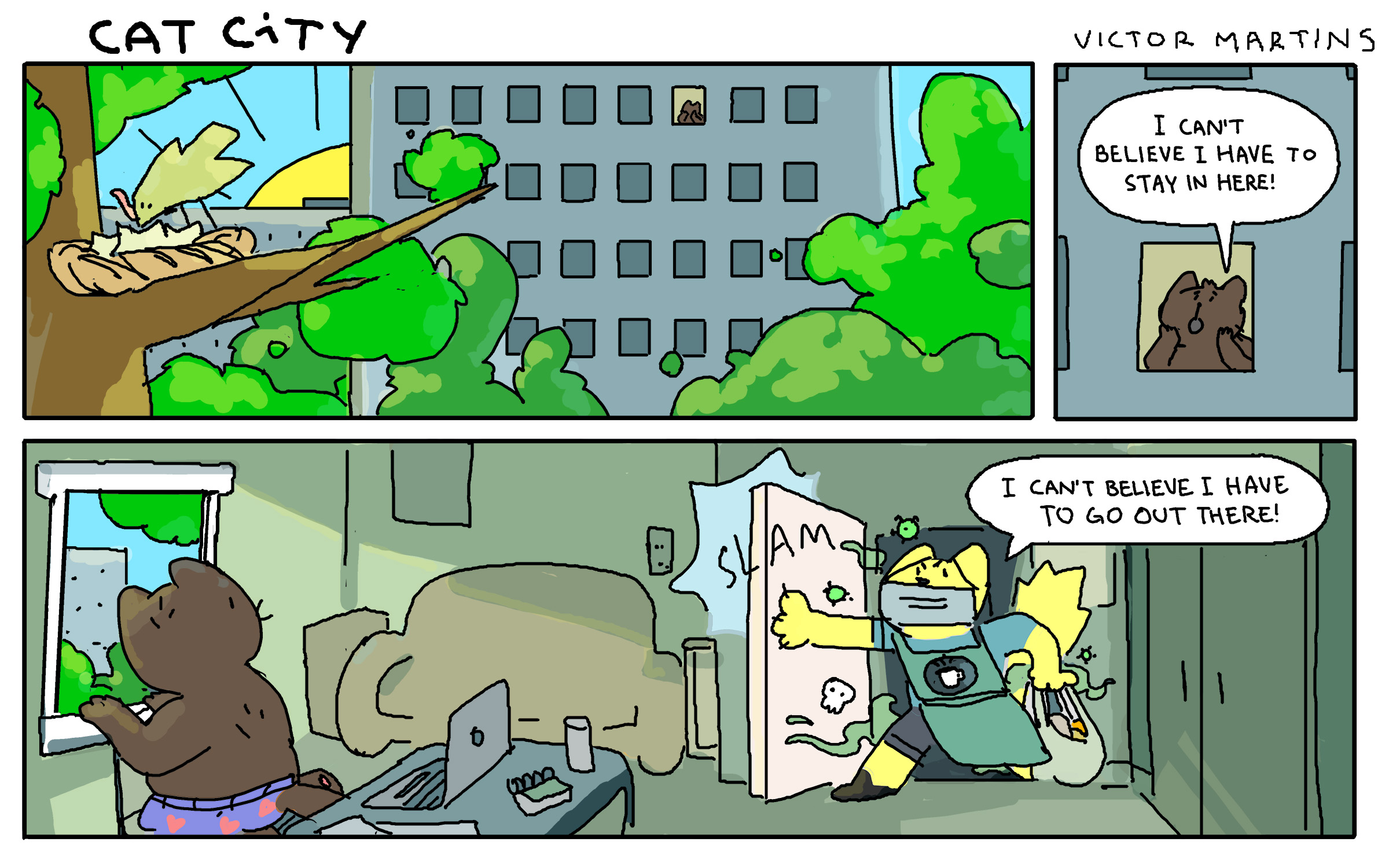
Cat City

by Victor Martins

26 Sep 22:41

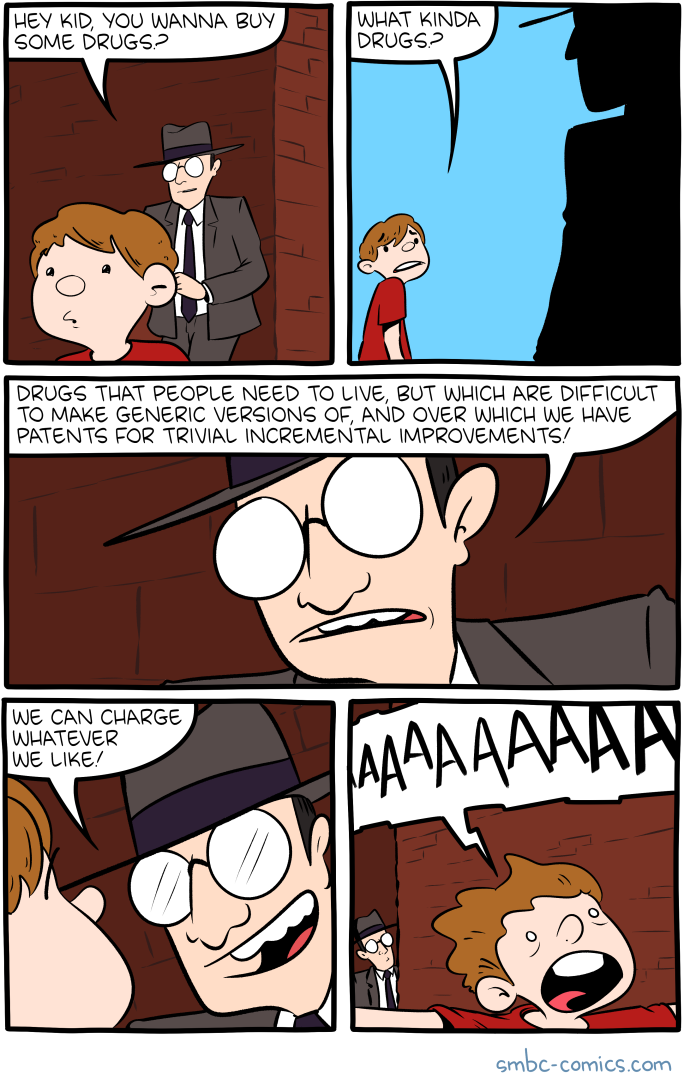
Saturday Morning Breakfast Cereal - Drugs

by tech@thehiveworks.com


Click here to go see the bonus panel!

Hovertext:
One day, we will look on the street dealers of insulin as heroes.


Today's News:
26 Sep 22:40

Having a Friend Who Isn't Forever Online

by Sarah Andersen

26 Sep 21:40

Windows XP source code leak sheds light on Microsoft's OS history

by Jon Fingas

Microsoft is no stranger to Windows source code leaks, but a new incident might just provide insights into its history. Bleeping Computer and ZDNet report that a 4chan user has posted what’s believed to be source code for Windows XP Service Pack 1, Windows 2000, and Windows Server 2003. The files were circulating privately for years, according to the leaker, but are only becoming publicly available now — and they include some early work on Windows XP.

The Verge noted that the code includes multiple unreleased themes from XP’s early development (when it was nicknamed Whistler), including a theme that conspicuously imitates parts of Apple’s Aqua design language from OS X (now macOS). This seems to have been a placeholder for developing the theme engine and clearly never shipped, but it does highlight the fierce rivalry between Apple and Microsoft at a time when the tech industry was still computer-centric.

We’ve asked Microsoft for comment, although it already said it was “investigating the matter.” The Verge claimed the code was legitimate, with Ronin Dey and others also supporting those beliefs (via Windows Central).

One version of the code leak also includes code for MS DOS, Windows CE, Windows Embedded and Windows NT, although those aren’t believed to be new leaks. Experts talking to ZDNet believed the new leaks came from academia, which has long had access to Windows source code to help bolster its security.

This won’t necessarily lead to security issues on par with the WannaCry ransomware attack. While WannaCry exploited Windows XP flaws, the campaign succeeded in part due to poor security policies. No amount of source code will change that, especially if it doesn’t include later XP releases. Microsoft also ended regular support for Windows XP in 2014, limiting any help to organizations with special contracts. Windows XP has been vulnerable for years, and this isn’t likely to make the situation worse.

26 Sep 14:50

Comic for 2020.09.26

New Cyanide and Happiness Comic
26 Sep 12:55

We Are the 56 Tubs of Clorox Wipes You Bought At the Start of the Pandemic

by Kristin Gourlay

We get it. You panicked. You thought: “This virus is coming for my family and me. What do I have to defend us? Soap? Fucking Irish Spring? I don’t think so.”

No, you wanted us, disposable cloths soaked in a disinfectant that can eradicate 99.9% of germs. On March 13, you sped to the store. You knew right where to go: aisle seven, next to the mops, and where the toilet paper used to be. And there we were. Portable. Disposable. Hoardable. Lavender and lemon-scented.

But can we talk?

Do you really need to keep all of us? Do you even know our names? You’ve only used Jennifer, Allan, and eight of the Sharons. Some of us have been having a little FOMO, like there’s more action elsewhere, you know? We’re watching our dreams die as we dry out in this linen closet.

Remember when you picked Jennifer for the first wipe downs? Those heady early days. You attacked the bathroom sink, kitchen sink, doorknobs, TV remotes, iPhones, eyeglasses, dining table, microwave handle, all the fruits and vegetables. Don’t take this the wrong way; she was totally happy to be of service. But you should know that Jennifer had hoped to work with children in some capacity, maybe a placement in a daycare.

We were impressed with your initial strategy: a tub of wipes in every room. Definitely the right move. I mean, we’re sanitizers. Cover every base! You just happened to pick Allan for the bathroom (so ironic! He was a huge Property Brothers fan), and he wanted us to tell you he absolutely loved the remodeling job. I believe his exact words were, “The nickel finish on those fixtures is fire AF.” Oh, and he also wanted us to tell you that you’re the only one who uses us. Your kids have been lying.

And, let’s be real, you’ve been lying to yourself too, haven’t you? Sharon #4 says it’s been six weeks since you last wiped down the front door handle. She would rat out her own mother, so take that with a grain of salt. But has anyone gotten sick because of it? No.

You’re still doing so much. You really are. The masks. The distancing. As members of the disinfectant community, we applaud your commitment. If things get really bad, you can always reinstall the disinfecting shower on the porch for the mail carrier, and haul the hospital-grade ultraviolet light towers up from the basement.

But with the working from home, the supervising of the kids’ remote schooling, the Zooming (Sharon #7 thinks the studio lighting you set up in your office really warms you up on camera), and just keeping up with everything? Ugh. So hard, right? You don’t have time for surfaces the way you used to, and that’s fine. No judgment.

So let us go. You’ll be okay. We’re needed elsewhere now. Hand one of us to your neighbor Wayne, the one who uses a wheelchair and lives alone. Bring a few of us to the fire station up the block. Okay, Bernadette put us up to that one — she loves firefighters. But seriously, maybe distribute some of us to homeless shelters and nursing homes. Heck, you might even stand in front of the grocery store where you found us and give some of us away. Those guys will be so shocked to see us again, amirite?

Look, if you decide you want to do a quick wipe down on some faucets and handles again before we go, we’re here for you. And if you grab the bottle of bleach that’s been sitting over here for so long that it’s stuck to the shelf paper? That’s cool too. Deep down, we’re all the same.

26 Sep 12:48

After Ginsburg’s death, high stakes for Texas’ legal challenge to the Affordable Care Act

by Emma Platoff and Edgar Walters
Francisco Garcia arrives at Kelsey-Seybold clinic in Sugar Land to see his doctor Spencer Berthelsen for annual physical. Sept. 22, 2011.
The Supreme Court will hear a Texas-led challenge to the Affordable Care Act in November. Credit: Michael Stravato for The Texas Tribune

As a Texas-led lawsuit to end the Affordable Care Act made its way through the federal courts in 2018, Gov. Greg Abbott pledged that should his state’s legal team succeed, he and his policymakers would have a plan ready to keep Texans — including the millions with preexisting health conditions — insured.

Now that the unlikely lawsuit has perhaps its best odds yet, with a hearing set for Nov. 10 before a U.S. Supreme Court that no longer includes liberal Justice Ruth Bader Ginsburg, Texas Republicans have yet to show any evidence that such a plan exists.

Texas Attorney General Ken Paxton, a Republican, set out in 2018 to achieve through the courts what his party tried and failed for years to achieve in legislation: the end of President Barack Obama’s landmark health law. Paxton, leading a team of red states, argued that after Congress effectively neutered a key provision of the law — the individual mandate — that provision was unconstitutional and the rest of the law had to fall as well.

The lawsuit won early success in a federal court in Texas and then at the U.S. 5th Circuit Court of Appeals, and now it’s before a Supreme Court that appears likely to tilt more conservative if the U.S. Senate quickly confirms President Donald Trump’s third nominee to the high court.

Experts who have long dismissed the lawsuit as a long shot say the Affordable Care Act faces new uncertainty, though they are betting on its survival.

A legal victory for the state in this case would herald an immediate policy emergency for Texas lawmakers. The state has long boasted the nation’s highest uninsured rate, a gulf that has only widened this year as millions of Americans lost employer health coverage during the coronavirus pandemic. And because the Affordable Care Act touches so many facets of health care policy, from insurance benefits to the federal process for approving certain prescription drugs, the effects of its repeal would be felt by virtually everyone.

If the Supreme Court struck down the law, some 1 million Texans would lose subsidized health insurance plans. It would also end popular consumer protections for patients with preexisting health conditions and for young adults who are allowed to stay on their parents’ health plans until age 26.

In the absence of action from a gridlocked U.S. Congress, Texas policymakers would have to weave a replacement for a relatively popular and immensely complicated piece of legislation — while also managing a perilous budget crisis, electing a new speaker of the Texas House, addressing the coronavirus pandemic for the first time through legislation, and drawing new political maps for the state in a high-stakes once-in-a-decade exercise of political will.

“There’s been absolutely no plan whatsoever put forward by state leaders to try to replace any meaningful part of the Affordable Care Act that ensures either affordable coverage or preexisting condition protections,” said Stacey Pogue, a senior policy analyst at the left-leaning think tank Every Texan.

Moreover, the state has regulatory authority over only a small subset of the insurance market. About 16% of Texans have state-regulated health insurance plans, according to the Texas Department of Insurance. Barring radical change, it’s not clear that state leaders could provide preexisting condition protections to the majority of Texans despite Abbott’s 2018 pledge that Texas leaders would be ready with “replacement health care insurance that includes coverage for preexisting conditions.”

An Abbott spokesperson did not return repeated requests for comment.

In most other states, the Affordable Care Act also pays for low-income adults to receive free health insurance under Medicaid, but Texas has never opted in to that program’s expansion.

If the federal health law were struck down in its entirety, pressure would likely mount on Congress to come up with a replacement, Pogue said. When Republicans took control of Congress and vowed to repeal the law in 2017, an outpouring of popular support for it put pressure on Senate Republicans, who ultimately could not muster the votes for repeal.

“People were angry at the idea that they’d lose coverage, that they’d lose protections, that they’d pay more,” Pogue said. “I assume if those outcomes are on the table, the same outcry will happen that Congress needs to fix the mess.”

“A lot more uncertainty”

Legal experts, including those who oppose the ACA as a policy matter, have dismissed Texas’ lawsuit as unlikely from the start.

But it has gained traction as it’s hurtled through the federal courts, earning support from U.S. District Judge Reed O’Connor, who is popular in conservative circles and a favorite at the Texas attorney general’s office, which files a disproportionate number of its lawsuits in his Wichita Falls jurisdiction.

When the case reached the 5th U.S. Circuit Court of Appeals, the two Republican-appointed judges on the three-judge panel hearing the case affirmed Texas’ argument on a major provision, declaring the individual mandate unconstitutional, but determined that further analysis was needed before they could strike down the rest of the sprawling law.

With Ginsburg’s death, the once-long-shot lawsuit has gotten a boost. It will be heard either by an eight-member court, raising the possibility of a tie, or by a court of nine justices, six of whom will have been appointed by Republican presidents.

Legal experts who have followed the case for years still believe it’s unlikely that the high court will strike down Obamacare in its entirety. But they say Ginsburg’s death may help Texas’ side.

“The likeliest outcome is that the justices vote to get rid of the lawsuit, because it’s so galactically stupid, to be totally candid,” said Nicholas Bagley, a University of Michigan law professor who has followed the case closely. “But I think any confidence you might have had before Justice Ginsburg died that the case would be turned away has surely been shaken. And I think there’s a lot more uncertainty about the future of the ACA.”

The lawsuit hinges on an argument that the law’s original requirement for most Americans to have health insurance is no longer valid — and that because the mandate to purchase insurance is such a core component of the sweeping law, the entire Affordable Care Act falls without it.

“Congress didn’t pass the ACA to require calorie counts be printed on restaurant menus,” said Robert Henneke, general counsel for the conservative think tank Texas Public Policy Foundation, which represents individual plaintiffs on Texas’ side of the case. “Congress passed the ACA to do the individual mandate.”

Texas argues that after Congress in 2017 set the Affordable Care Act’s penalty for not complying with the individual mandate at $0, the provision is no longer constitutional. The mandate was challenged in earlier lawsuits, but the U.S. Supreme Court ruled it constitutional as an exercise of Congress’ taxing power. (Ginsburg and three other Democrat-appointed justices joined Chief Justice John Roberts in that 5-4 ruling.)

Since the penalty is now set at zero, Texas and its allies argue, it can no longer be considered a tax.

Henneke said he has always been confident the court will strike down the law as unconstitutional and that Ginsburg’s death does not change that prediction.

A coalition of states led by California, as well as a slew of legal experts all over the ideological map, dispute almost every facet of Texas’ argument. They say the individual mandate remains constitutional, but also that even if it were not, the rest of the Affordable Care Act would still stand.

The lawsuit turns on that question of “severability,” experts agree.

Most provisions of the Affordable Care Act have survived despite numerous legal challenges, but Ginsburg’s death means the loss of one of the law’s staunchest defenders on the high court. She voted in 2012 to uphold the law in NFIB v. Sebelius, which challenged the individual mandate, and again in 2015 in King v. Burwell, which challenged the federal government’s ability to subsidize health insurance plans.

Many possible outcomes for the ACA

Now, in Texas’ challenge, any number of scenarios are possible.

The court could toss the case on procedural grounds, declaring that Texas’ coalition does not have “standing” to sue in federal court. “It wouldn’t surprise me” if that happened, said Carolyn Shapiro, a law professor at Chicago-Kent College of Law and former Illinois solicitor general.

If Ginsburg’s seat on the court remains vacant when oral arguments are heard in November, the justices could split evenly on the issue, which would send the case back to lower courts and open the door to years’ worth of additional litigation.

Some number of justices, depending on the composition of the court, could join together to strike down just a portion of the law — perhaps the individual mandate and a few related provisions.

The least likely outcome, according to legal scholars of many political persuasions, is the court striking down the Affordable Care Act in its entirety. That would leave millions of Americans without insurance coverage during the coronavirus pandemic, and also destabilize practically every piece of the U.S. health care system, from no-cost benefits for certain “essential” health services to annual limits protecting patients from spending massive amounts on expensive treatments.

“Nothing’s gonna happen this year,” said Josh Blackman, a South Texas College of Law professor who authored a friend-of-the-court brief backing many of Texas’ arguments. “There are not any five votes to kill the entire law.”

Bagley also said the Texas-led coalition has a high bar to clear at every stage.

“It’s safe to say the plaintiffs aren’t likely to succeed,” Bagley said.

The Texas attorney general’s office did not return a request for comment on the lawsuit. But Henneke, the TPPF attorney working with the Texas coalition, said he remains confident that the court will see the case the way he does.

“Our health care system does not work under Obamacare, and there are real problems out there that should not be fixed by the courts, but should be fixed by the people that we’ve elected to office, that need to go back and get to work,” Henneke said. “We need to insist upon the courts doing their role, which is to interpret the law. But we need to demand that Congress and the state get to work to address affordability and access to health care.”

Disclosure: Every Texan and the Texas Public Policy Foundation have been financial supporters of The Texas Tribune, a nonprofit, nonpartisan news organization that is funded in part by donations from members, foundations and corporate sponsors. Financial supporters play no role in the Tribune's journalism. Find a complete list of them here.

26 Sep 12:33

I for one...

by Scandinavia and the World
I for one...

I for one...

View Comic!


26 Sep 04:06

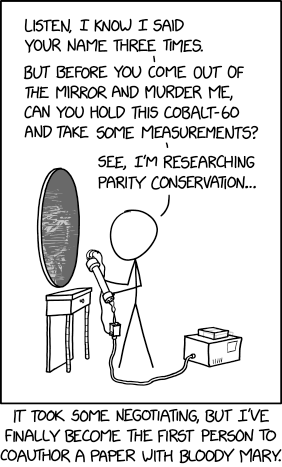
Parity Conservation

Bloody Mary is made of antimatter. It explains so much.
25 Sep 07:45

Hint: It's a Ghost

this is a diesel sweeties comic strip

I'm having a hard time getting into the Halloween "spirit."

25 Sep 07:42

Comic for 2020.09.25

New Cyanide and Happiness Comic
25 Sep 04:13

Feds, In Unusual Statement, Announce They're Investigating Discarded Ballots

by Carrie Johnson
This May 26 photo shows an official Democratic primary mail-in ballot and secrecy envelope for the Pennsylvania primary in Pittsburgh.

Federal authorities working in Pennsylvania say they've been asked to look into the discovery of some mailed ballots described as thrown away, but many aspects of the story remain unclear.

(Image credit: Gene J. Puskar/AP)

24 Sep 19:16

you’re exhausted and burned out because work is terrible

by Ask a Manager

I’m a big fan of the writer Anne Helen Petersen, who wrote the excellent “Scandals of Classic Hollywood” series at the now-defunct Hairpin and a series of fascinating profiles and lately has been writing more and more about work.

Her newest book, out this week, is Can’t Even: How Millennials Became the Burnout Generation. It builds on a piece she wrote early last year exploring why so many people around her were exhausted and burned out — suffering from what she calls “the feeling that you’ve optimized yourself into a work robot.”

Her new book explores the root causes of this generational burnout, positing that it stems from the intense, over-scheduled parenting style many Millennials were raised with. But although she’s writing about her own generation, in many ways the book is a broader exploration of what work is like now, how we ended up this way, and how it hurts everyone. Millennials are her entry point, but the book is a scathing indictment of how careers work now. If you’ve traded money for labor at any time in the last 15 years, you will like this book.

There’s a short excerpt from the book below, one that I thought would particularly resonate with Ask a Manager readers, and Anne has given me a copy to give away to readers here.

To enter to win a free copy: Leave a comment below with your own thoughts on the topic. I’ll pick a winner at random (or rather, random selector software will). All entries must be posted in the comments on this post by Friday, September 25, at 11:59 p.m. ET. To win, you must fill out the email address section of the comment form so I have a way of contacting you if you’re the winner.

And if you don’t win this giveaway, I hope you will buy yourself a copy! It’s fascinating.


Excerpt from Can’t Even: How Millennials Became the Burnout Generation by Anne Helen Petersen, 2020.
Reprinted by permission of the publisher, Houghton Mifflin Harcourt.

One of the pernicious assumptions of “Do what you love” is that everyone who’s made it in America is doing what they love — and conversely, everyone who’s doing what they love has made it. If you haven’t made it, you’re doing it wrong: “Central to this myth of work-as-love is the notion that virtue (moral righteousness of character) and capital (money) are two sides of the same coin,” [Miya] Tokumitsu explains. “Where there is wealth, there is hard work, and industriousness, and the individualistic dash of ingenuity that makes it possible.”

Where there is not wealth, this logic suggests, there is not hard work, or industriousness, or the individualistic dash of ingenuity. And even though this correlation has been disproven countless times, its persistence in cultural conditioning is the reason people work harder, work for less, work under shitty conditions.

When that cool, lovable job doesn’t appear, or appears and is unfeasible to maintain for someone who’s not independently wealthy, it’s easy to see how the shame accumulates. Over the last ten years, Emma, who’s white, has attempted to break in to the information science world — what the rest of us know as librarians. When she graduated with her master’s, she was offered a full-time temp job, with the understanding that it would turn permanent “if she worked hard enough.”

“It was my dream job,” Emma explained. “I thought I was the luckiest person on earth.” But the organization went through a “leadership change” and she was strung along on temp contract after temp contract, pushing herself to her psychological and physical limits. “I worked above and beyond, putting every drop of energy I had into being the most enthusiastic, invested employee,” she said. “But the new leadership did not like me, no matter how hard I tried.”

During her repeated job searches, she experienced depression, low self-worth, intense regret about her investment in education, and a generalized lack of dignity. “I questioned every aspect of my identity,” she says. “Is it the way I talk? My hair? My clothes? My weight?”

Part of the problem was misaligned expectations: when she was getting her master’s, her professors told her that she would graduate and find a full-time position, with a $45,000 minimum salary, benefits, and the ability to immediately enroll in a public service loan forgiveness program. In practice, after numerous job searches, she’s in a job outside her field for which she’s over-educated. She’s making $32,000. Still, she feels lucky, every day, that she’s one of the few in her field who’s found full-time employment.

When Emma looks back on the last ten years, she feels cynical but grateful. “It’s always been implied that if you fail to succeed, you aren’t passionate enough,” she said. “But I no longer invest in work emotionally. It isn’t worth it. I learned that every single person is expendable. None of it is fair or based on passion or merit. I don’t have the bandwidth to play that game.”

When I hear stories like Emma’s, so similar to thousands of other millennials’, I realize all over again just how aggressively, and tirelessly, so many of us worked toward that dream job. Which is why it’s so difficult for millennials to fathom the most enduring criticism of our generation: that we’re spoiled, or lazy, or entitled. Millennials did not germinate the idea that ‘lovable work’ was the ideal, nor did we cultivate it. But we did have to deal with the reality of just how frail that idea became once exposed to the real world.

When someone says millennials are lazy, I want to ask them: Which millennials? When someone says we’re entitled, I do ask them: Who taught us we should be able to do work that we love? We were told that college would be the way to a middle-class job. That wasn’t true. We were told that passion would eventually lead to profit, or at least a sustainable job where we were valued. That also wasn’t true.

Entering into adulthood has always been about modifying expectations: of what it is and what it can provide. The difference with millennials, then, is that we’ve spent between five and twenty years doing the painful work of adjusting our expectations: recalibrating our parents’ and advisors’ very reassuring understanding of what the job market was with the realities of our own experience of it, but also arriving at a wholly utilitarian vision of what a job can and should be. For many of us, it took years in shitty jobs to understand ourselves as laborers, as workers, hungry for solidarity.

For decades, millennials have been told that we’re special — every one of us filled with potential. All we needed to do was work hard enough to transform that potential into a perfect life absent all the economic worries that defined our parents. But as boomers were cultivating and optimizing their children for work, they were also further disassembling the sort of societal, economic, and workplace protections that could have made that life possible. They didn’t spoil us so much as destroy the likelihood of our ever obtaining what they had promised all that hard work was for.

Few millennials had the wisdom to understand that as we hit the job market. Instead, we believed that if opportunities didn’t arise, it was a personal problem. We acknowledged how competitive the market was, how much lower we’d set our standards, but we were also certain that if we just worked hard enough, we’d triumph — or at least find stability, or happiness, or arrive at some other nebulous goal, even if it was increasingly unclear why we were searching for it.

We fought that losing battle for years. For many, including myself, it’s hard not to feel embarrassed about it: I settled for so little because I was certain that with enough hard work, things would be different. But you can only work as an “independent contractor” at a job paying minimum wage with no benefits while shouldering a $400-a-month loan payment — even if it’s in a field you’re “passionate” about — for so many years before realizing that something’s deeply wrong. It took burning out for many of us to arrive at this point. But the new millennial refrain of “Fuck passion, pay me” feels more persuasive and powerful every day.

* I make a commission if you use these links.

you’re exhausted and burned out because work is terrible was originally published by Alison Green on Ask a Manager.

24 Sep 19:07

New vase

by Cassandra Calin

Triggered.

24 Sep 15:48

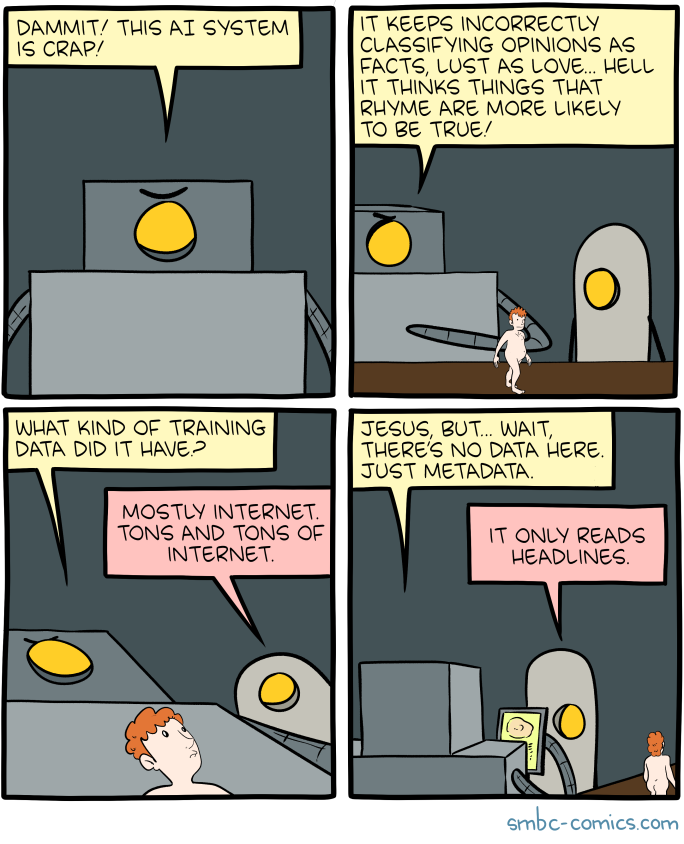
Saturday Morning Breakfast Cereal - AI

by tech@thehiveworks.com


Click here to go see the bonus panel!

Hovertext:
I don't know why, but I find it really funny to draw naked vacuous humans.


Today's News:
24 Sep 15:47

Republican Leaders Reject Trump Hedging On Transfer Of Power Amid War Over Confidence

by Barbara Sprunt
U.S. Rep. Liz Cheney, R-Wyo., seen here at a news conference in July, pushed back against Trump

Senate Majority Leader Mitch McConnell and others rebuked President Trump's equivocation about whether he might transfer power peacefully against a backdrop of uncertainty about the ongoing election.

(Image credit: Samuel Corum/Getty Images)

24 Sep 13:18

Campaign Donations Amongst the Liberal Elite

by Elly Lonon

MICHAEL: Are you writing more postcards to voters?

ALEXANDRA: No, I’m matching our budget to our bank accounts to see if I can find money to spare for the McGrath campaign. That six-month emergency fund of our ours is looking pretty weak here in month seven. But we’re about to save some money on food while we fast for Yom Kippur.

MICHAEL: OK, I’ll play along and pretend like I didn’t spend a fortune on Ben & Jerry’s this week thanks to radical self-care after not celebrating the New Year with Bubbe and in anticipation of self-deprivation this weekend. I’m sure that not eating the leftover takeout sitting in the fridge before it goes bad will “save” us enough to overthrow an empire.

ALEXANDRA: Every dollar helps, Michael. All the pundits say that outside of voting, donating money is the most effective way of helping your candidate.

MICHAEL: You know she can’t win, right?

ALEXANDRA: Allow me to speak for all women and say WE ARE SO FUCKING TIRED OF THAT FUCKING PHRASE. You can bet your Peloton-peddling ass that Ruth never paid mind to those words. If she had, she would never have been the first female tenured professor at Columbia. Nor the first woman member of the Harvard Law Review. First in her class. First in our hearts. GODDAMMIT RUTH. No more firsts for the most badass of Brooklyn broads. Our sweet, diminutive warrior. Gone. I wonder if 45 will write her out of the history curriculum, too.

MICHAEL: She gets one more first… she’ll be the first woman to lie in state at the Capital.

ALEXANDRA: Not in the rotunda, though. In some smaller room. My money says Mitch orchestrated one more snub to feed his bitter, selfish soul. I wouldn’t be surprised if Romney and Collins helped him.

MICHAEL: I know you hate Mitch, but according to the pundits, our money, regardless of what it is or isn’t saying, is better spent on more winnable senate campaigns – Maine, Arizona, South Carolina, Colorado…

ALEXANDRA: BUT MITCH IS WHO I WANT TO HURT RIGHT NOW. I want him to hurt like I hurt. I want him to weep like I wept when the rabbi at Ruth’s memorial yesterday began singing the psalm. I am so tired of hurting. Of watching my loved ones hurt. Of watching humanity hurt. I read this morning that for every person that dies from COVID, an average of 19 people are left mourning that person. With 200,000 dead, that’s almost 4 million people who’ve lost someone they love this year.

MICHAEL: Would it help if I told you the fund I’m thinking of is called Ditch Mitch or Die Trying?

ALEXANDRA: That’s just a meme, Michael. This is me making the “Girl, Same” face in response.

MICHAEL: No, it’s a real thing! It’s part of Vote Save America. They take your donations and funnel them across the 14 senate campaigns that we have a real opportunity to flip. Even if he doesn’t get voted out, he loses his power if he loses the majority.

ALEXANDRA: Is McGrath one of those 14?

MICHAEL: Did you see Regina King’s Emmy Award acceptance speech?

ALEXANDRA: I’ll take that as a “no.” And if one more person holds up that 12 million-dollar settlement as a testament to justice for Breonna while her murderers walk free, my rage will reap more destruction than a gender reveal-themed pyrotechnic device.

MICHAEL: Would a hot flash joke be appropriate right now?

ALEXANDRA: Appropriate is another one of those words that’s meaning seems relative in 2020. Like “presidential” or “unprecedented” or “good.” “How are you, Sally? Well, Joe, my home isn’t on fire, I have my health, food to eat, and no one in my family has been shot by police or charged with sedition this week, so all is good in this anarchist jurisdiction!

MICHAEL: My turn to take that as a “no.”

ALEXANDRA: That was rude, Michael. I’m sorry. I’m just so tired. I’m Dr.-Fauci-finding-out-that-one-of-his-employees-is-a-RedState.com-propagandist-while-Trump-loyalists-rewrite-the-CDC-website level of tired.

MICHAEL: I know. And it’s pretty daunting to think about all the work that lies ahead of us, regardless of how this election turns out. That what we’re fighting for is the opportunity to be even more exhausted and start the REALLY hard work of change.

ALEXANDRA: Can we just watch Umbrella Academy a third time and snuggle? Then we’ll cancel our Netflix subscription and send that money to the Ditch Mitch fund. Then I’ll have the strength to read that Atlantic article that has even Dan “Steady” Rather flustered, I promise. Just give me the rest of this week to rally.

MICHAEL: We’re out of popcorn, but I bought you an extra pint of Tonight Dough.

ALEXANDRA: I’ll take that as a “yes.”

24 Sep 11:41

Microsoft is releasing a non-subscription Office suite in 2021

by Mariella Moon

In a blog post announcing the next version of its Exchange Server, Microsoft has slipped in a single line that’s bound to make those who hate paying subscription fees for Office apps happy. “Microsoft Office will also see a new perpetual release for both Windows and Mac, in the second half of 2021,” the tech giant’s Exchange team wrote (as spotted by Windows Central), confirming that a new version of Office you can purchase with a one-time payment is coming next year.

The company has been pushing Microsoft 365 for years now as the main way to get its Office apps. This subscription-based version of its suite gives you access to Word, Excel, PowerPoint, Outlook and other apps for a monthly payment. While you can use some of those apps for free online with a Microsoft account, you won’t be able to install them on your PC like you’d be able to if you pay for a subscription.

If you’d rather pay just once for Word, Excel and PowerPoint, you can still get Office 2019 for $150. However, it remained unclear for quite some time if it would be the last perpetual release and if Microsoft would transition to a subscription-only model for the Office suite. Thankfully, that won’t be the case — at least for the immediate future. Microsoft didn’t reveal anything else about the upcoming perpetual release other than it’s coming out next year, but it promised to announce more details about its pricing and availability “later.”

24 Sep 11:32

Trump: Major carmakers sue US government over China tax

Tesla is the latest to object to the Trump administration's import duties on Chinese parts.
24 Sep 03:36

Texas begins letting people register to vote online when they’re updating their driver’s licenses

by Dan Rosenzweig-Ziff
A man enters Toney Burger stadium in South Austin where early voting has begun for the July 14 runoff and special election, in Austin on June 29, 2020.
Forty-one states have passed laws allowing online voter registration; Texas is not one of them. Credit: Jordan Vonderhaar for The Texas Tribune

When Jarrod Stringer updated his driver’s license address in 2014, the Texas Department of Public Safety website asked if he wanted to register to vote. He clicked yes and thought he was registered. That fall, when he went to vote in San Antonio, he was denied. According to the system, he had never registered. It was past the registration deadline, so he couldn’t vote.

That kicked off a six-year legal battle that included two lawsuits for the right for Texans to register to vote online while updating their licenses.

“It’s traumatic when you can’t vote,” Stringer said. “It’s implicitly saying, ‘You don’t have a voice. You can’t participate in change.’”

On Wednesday, Stringer won that “mind-boggling” fight with the state of Texas two weeks before the deadline to register to vote in 2020. Acting on a federal judge’s orders, the state updated its online systems to allow people to add their names to the voter rolls when they update their licenses.

While it’s a limited step — the online option is still only available to people updating their licenses — the change marks the first time Texans have been able to register to vote online, which advocates say could significantly increase turnout both this year and for future elections.

Mimi Marziani, the president of the Texas Civil Rights Project, which brought forward the lawsuits, said the change specifically helps marginalized Texans, who most often move.

“This is absolutely a victory for voting rights for all Texans,” Marziani said. “It’s a particular victory for younger Texans, poorer Texans and Texans of color.”

The National Voter Registration Act, known as the motor voter law, requires states to let residents complete their voter registration applications when they apply for or renew their driver’s licenses. Marziani said she took up the case because Stringer had been denied that right.

Previously, Texans like Stringer who tried to register while using the state’s online license portal were directed to a blank registration form they had to fill out, print and send to their county registrar. The state was forced to change that system after U.S. District Judge Orlando Garcia ruled last month that DPS is “legally obligated” to allow voters to simultaneously register to vote with every license renewal or change-of-address application. Garcia had ordered the state to set up a “fully operable” online system by Wednesday.

“The Secretary of State and Texas Department of Public Safety are in compliance with the court’s order,” said Kayleigh Date, a spokesperson for the Office of the Attorney General, in a statement.

According to Marziani, 1.9 million Texans use the Department of Public Safety’s online portal to update their driving information each year, and 96% of eligible Texans have their driver’s licenses. Texas drivers can renew their licenses online if they renewed them in person the previous time, they are older than 18 but younger than 79, and their licenses expire within two years or have been expired for less than two years, among other restrictions. Texas has more than 16.6 million registered voters.

The coronavirus has brought widespread concern about how people can vote safely in Texas this November, especially as the state’s elected leaders have resisted the idea of broadening who is eligible to vote by mail. Campaigns and advocates from both parties have found that registering new voters has been a challenge without online voting. Forty-one states have passed legislation to allow residents to register to vote online; Texas is not one of them.

Marziani said Wednesday’s move shows the state has the infrastructure in place to expand online voting beyond DPS and renewing driver’s licenses.

“The system they use is the exact same system that they would implement for a broader online voter registration,” Marziani said. “This is a flashing green light for the Legislature to finally bring Texas in line with states across the country and pass online voter registration.”

Date did not answer questions about whether this would be possible or whether the state expected to expand online voter registration.

While some state leaders have staunchly opposed any form of online registration, Garcia’s ruling last month said online registration would actually bolster security and election integrity.

“Uncontested expert testimony shows that a compliant DPS system would very likely lead to great efficiency, less human error, a massive saving in costs, and increased voter registration,” Garcia wrote.

For Stringer, who moved again in August and waited to update his license until Wednesday, the action by the state was a relief.

“The representation of the people in the state of Texas is more fair today than it was two weeks ago,” he said. “Part of what it means to be a citizen is to vote without duress. It’s a huge deal.”

24 Sep 03:29

Trump Accuses FDA Of Playing Politics With COVID-19 Vaccine Guidelines

by Alana Wise
President Trump addresses reporters during a Wednesday news conference.

Referring to a report that the FDA plans to tighten requirements for a vaccine, Trump said, "That sounds like a political move."

(Image credit: Joshua Roberts/Getty Images)

24 Sep 03:26

INSTAnt regret

by Cassandra Calin

IG comments in a nutshell.