Cowboy Who?
Shared posts
Canada Battles More Than 180 Wildfires With Hundreds Dead In Heat Wave

About 90% of the village of Lytton was destroyed by fire. It comes while hundreds have died in a massive heat wave that's affecting British Columbia and the western U.S.
(Image credit: James MacDonald/Getty Images)

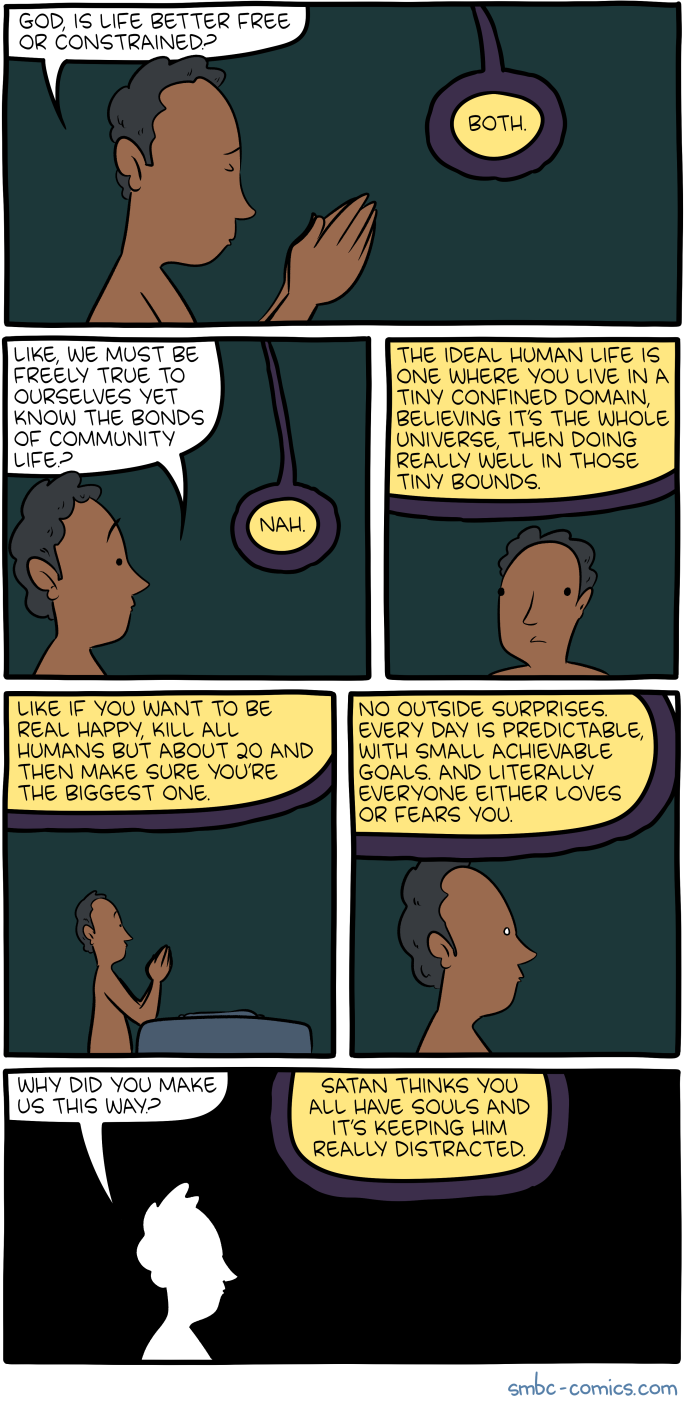
Saturday Morning Breakfast Cereal - Constraint
Click here to go see the bonus panel!
Hovertext:
I have literally never met a grad student without a 'quit and work on a hippie farm' fantasy.
Today's News:
For Independence Day: Six American Flags by Texas Artists
We commemorate the 4th of July holiday by sharing works by Adrian Aguilera and Betelhem Makonnen, Jenn Hassin, Xxavier Edward Carter, Jennifer Ling Datchuk, Jenelle Esparza, and Vincent Valdez, as they reflect on the U.S. flag and its meaning.

Jenelle Esparza, Continent, 2017. 72 × 100 in. Handmade quilt, recycled fabric and clothing, embroidered blocks, batting, cotton blends. San Antonio Museum of Art, gift of Zoe A. Diaz
Jenelle Esparza: “When I approached this work… I immediately thought of the fragments of projects that I didn’t have a place for yet … The objects varied from embroidered textile pieces to bronze casts, but the subject at the core of it all was WOMEN and our experiences through generations. I was casting my grandmother’s clothes pins that hung on the line for decades in bronze. I was taking her unfinished quilt blocks and finishing them myself, which changed the narrative to a contemporary one. Then I decided to… make something that represented ALL women’s experiences in this country. As a citizen, I have always been concerned with women’s issues like the anti-women agenda in my lifetime and the legislation being made to work against us and our bodies.”

Vincent Valdez, from “Drawing Journal” series. 2015. Ink, paper. 8.5”x11”
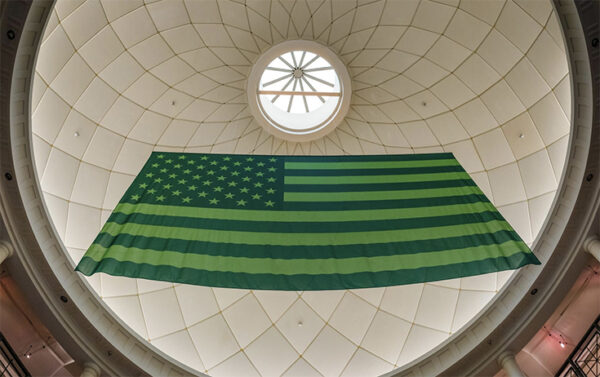
Adrian Aguilera and Betelhem Makonnen, untitled (a flag for John Lewis or a greenscreen placeholder for an America that is yet to be), 2020. Fabric, flag hardware, 3 x 5 x 28 ft. Image of installation FROM THE LIMITATIONS OF NOW, MAR 14, 2021 – SEP 05, 2021, Philbrook Museum, Tulsa OK.
Via Philbrook Museum: “untitled (a flag for John Lewis or a green screen placeholder for an America that is yet to be) honors the late Georgia Congressman John Lewis, an icon of the civil rights movement, and all past and present liberation workers who continually fight for freedom, justice, and equal rights for all Americans.” The flag is currently on view at Philbrook Museum in Tulsa, Oklahoma as part of the exhibition The Limitations of Now, through September 5 of this year.
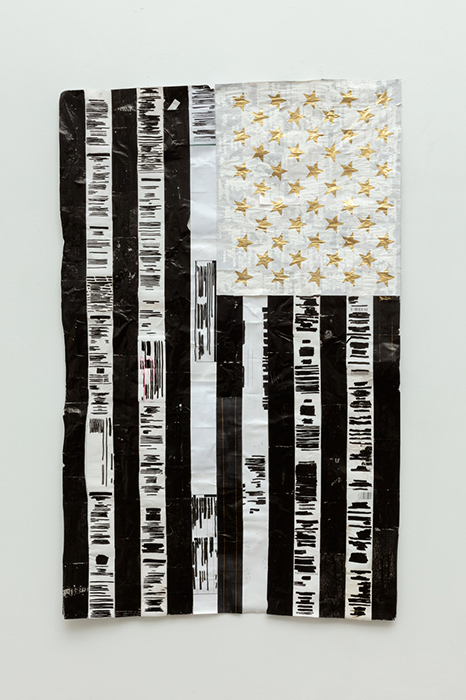
Xxavier Edward Carter, The American Exception (If There Is A Prison In It, It Is A Prison, Not A City), 2021. Acrylic, Sumi Ink, tape, watercolor on paper. Courtesy of the artist and Cluley Projects
Via Cluley Projects, Dallas: “By collaging financial documents, legal paperwork, waste paper, newspaper, and magazines, Carter carefully obscures the traces that give these documents meaning. In doing so what is left are layers of redactions, color fields, and erasures creating a pattern of recognizable but unknowable shapes. After being rendered meaningless, Carter painstakingly draws and paints onto the newly blank canvas a world of possibility.”

‘American Flag,’ performance, Jennifer Ling Datchuck. Photo credit: Clint Datchuk.
Jennifer Ling Datchuk: “My piece is titled American Flag, and is made of synthetic hair, porcelain beads, and a rolling rack. Adorned on the beads are the names of the suffragettes I did not learn about in school, the women of color who continued to fight long after white women received the right the vote… the names of Mabel Lee, Zitkála-Šáand, Ida B. Wells to name a few.”

Jenn Hassin’s Google Doodle, Veterans Day, 2020.
Jenn Hassin: “For the composition, I drew from patriotism and a heavy lean to service. The star and stripes respectfully give gratitude to the many patriots that help celebrate our nation’s veterans. All other colors are military uniform hues that give tribute to those who have worn and are wearing the uniform.”
The post For Independence Day: Six American Flags by Texas Artists appeared first on Glasstire.
Mexico, state-owned oil company slammed after gas leak causes subaquatic fireball in Gulf

Environmentalists criticized Mexico's state-owned oil company Saturday after a gas leak at an underwater pipeline unleashed a subaquatic fireball that appeared to boil the waters of the Gulf of Mexico.
Elvis Costello Doesn't Care That A Pop Star Copied His Riffs; Says Every Musician Does That
Is there any cooler musician than Elvis Costello? Honestly, one of the more annoying things about writing about the ins-and-outs of copyright law and creativity is realizing just how many of my artistic (music, filmmaking, writing, etc.) heroes turns out to have absolutely dreadful opinions about creativity and inspiration, often ignoring how they got to where they got, and instead focusing on pulling up the ladder behind them and squeezing as much cash as possible out of others. So I'm always concerned when I learn about musician I like opining on these issues -- especially over the last few years. You had the Marvin Gaye Estate cash in on a pop song that didn't copy any Gaye song, but just had a similar "feel." And that opened the doors to a whole bunch of similar lawsuits of aging rockers (or their estates) demanding money from newer artists.
But Elvis Costello apparently has decided to take the much more sane, much more creative, and much more supportive route. A few different artists have started whining about a new album by Olivia Rodrigo. It started with Courtney Love complaining about the promo artwork on Rodrigo's new album being somewhat similar to Hole's album "Live Through This."
Olivia Rodrigo’s new promo pics are giving me very much Hole’s Live Through This album cover and I’m here for it!<3 pic.twitter.com/ER33Co9N2A
— Annette❣︎ (@annettelourdess) June 25, 2021
To be fair, Love didn't get that upset, admitting "It happens all the time to me," but she did call it "stealing" and saying that "not asking permission is rude" and "bad form." I don't think it's any of those things. At most it seems like an homage. It might also be kind of an accident. The two sets of images are not really that close. And this is disappointing to see from Love, who twenty years ago famously wrote up one of the greatest screeds mocking record labels and the RIAA for their reaction to the internet.
But, then someone noticed that Rodrigo's music also seemed to have homages in it. Billy Edwards said that her song "Brutal" seemed to be a "direct lift" from Elvis Costello's "Pump it Up." Listening to one after the other, you can definitely hear the similarities in the guitar riff, even though the songs themselves are extremely different.
But... rather than freak out about it, Elvis Costello stepped in on Twitter to make it clear that (1) he's fine with it, and (2) this is how music works. Indeed, he points out that it's how he wrote some of his own songs as well -- "you take the broken pieces of another thrill and make a brand new toy."
This is fine by me, Billy.
It’s how rock and roll works. You take the broken pieces of another thrill and make a brand new toy. That’s what I did. #subterreaneanhomesickblues #toomuchmonkeybusiness— Elvis Costello (@ElvisCostello) June 28, 2021
In fact, with the hashtags on that tweet, Costello notes that Pump It Up is itself a kind of remix of Bob Dylan's famous Subterranean Homesick Blues, which itself was inspired by Chuck Berry's Too Much Monkey Business.
As Costello rightly notes, this is how music works. Artists build on ideas of what's come before. It's homage, and how creativity works. You take ideas and inspiration from those who came before, and then you make your own thing out of it. And, in the long run, everyone does benefit. New fans learn the new songs -- and as they get deeper into it it also helps them rediscover the pieces on which it was built as well. Only foolish people think that creativity springs forth disconnected from all else -- or that every single inspiration must get a piece of whatever successful ideas newer artists come up with.
So, kudos to Elvis Costello for being quite clear in recognizing the nature of creativity, inspiration, and homage.
Saturday Morning Breakfast Cereal - Deadline
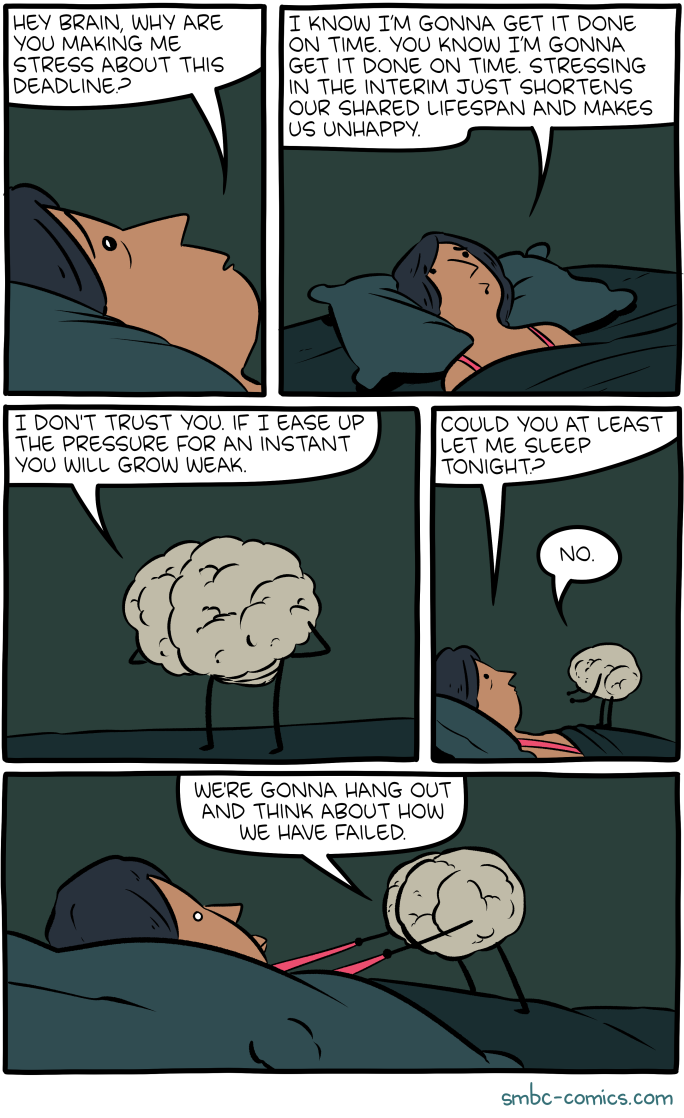
Click here to go see the bonus panel!
Hovertext:
Once we're done with that, we'll switch to how we shall in the future fail.
Today's News:
Stormy Saturday ahead as Tropical Storm Elsa races across the Caribbean
I hope everyone is enjoying the Fourth of July weekend. We’re posting a brief update this morning to call attention to the potential for storms across much of Houston today, and say confidence is finally increasing about the track of Tropical Storm Elsa.
The good news is that, while we expect a fairly wet pattern over the next several days, our concerns about the potential for serious flooding are diminishing. Generally, most of the region should see between 2 and 4 inches between now and Thursday morning, with higher isolated amounts. While this will surely make for a soggy week, it should only produce scattered and sporadic street flooding.
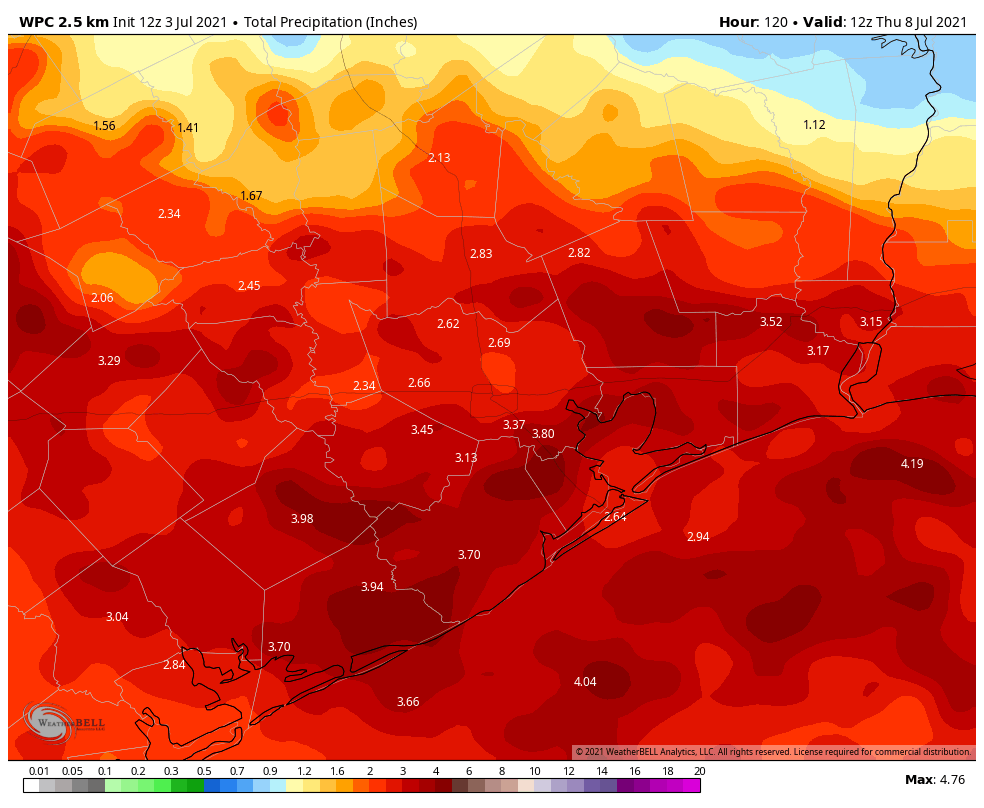
With that said, if you have outdoor plans for the July Fourth holiday weekend you’ll definitely need to keep an eye on the radar, and have a backup. As of 10am CT on Saturday morning, storms are already firing up north of Interstate 10, and these should drop down to the coast later this morning and into the afternoon hours. A good chance of storms will persist through at least the early evening hours. Please do seek shelter during thunderstorms, as we expect to see a fair amount of lightning today. Conditions should be similar on Sunday, although we have some hope that most areas will see rains ending before fireworks shows begin. This rainy, cloudy pattern should persist through about Wednesday.
In the tropics, Elsa has weakened overnight as it has zipped westward across the northern Caribbean Sea. The global models are starting to come into better agreement, and confidence is now fairly high that Elsa will move across Cuba on Sunday, and approach the Florida Keys on Monday. After this time there remains some uncertainty, but generally the storm should track up the western coast of Florida, and may bring heavy rains to the state early next week.
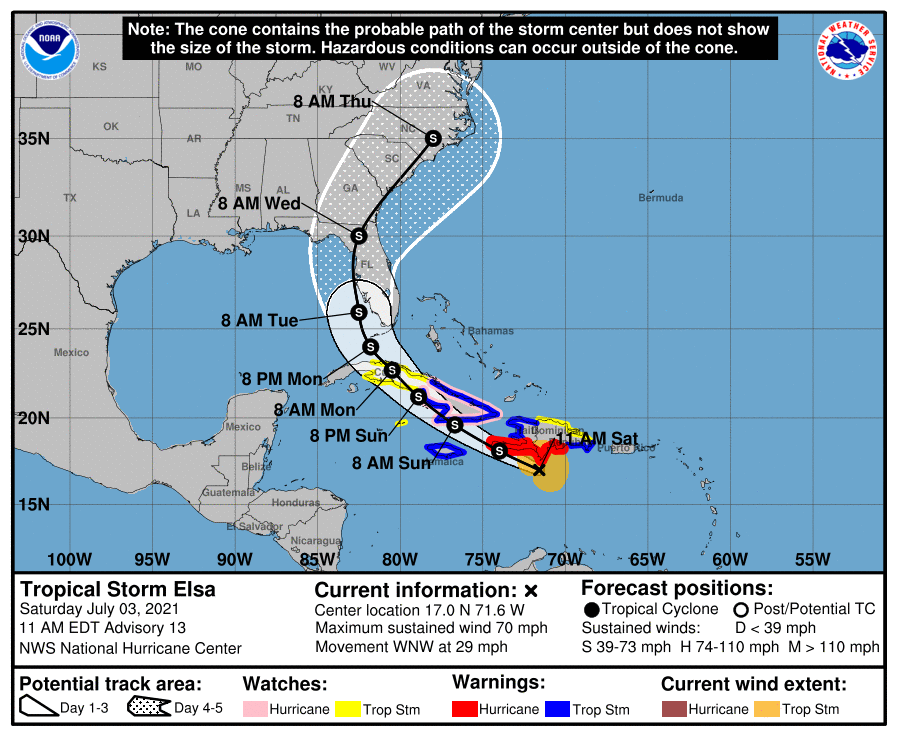
As for intensity, Elsa is now a high-end tropical storm, with maximum sustained winds of 70 mph. Maybe the cold never bothered Elsa anyway, but wind shear has been hampering the storm’s organization overnight, and as it faces additional shear and begins to interact with Cuba, it should weaken further. Elsa’s rapid movement to the west-northwest is not helping either, but the storm should begin to slow down fairly soon. The official forecast has Elsa approaching Florida as a strong tropical storm by around Tuesday of next week, and it would not surprise me if the system is weaker.

Transistor Puzzles

I’ve fallen into a deep hole involving current-limiting circuits and current sources, in an attempt to solve a minor problem with the Yellowstone disk controller. In the big scheme of things, this isn’t a very important problem, but it has me intrigued. I’ve created a simulation of a circuit that may solve the problem, but it exhibits some transistor behavior that I don’t understand. Specifically, the base currents of the transistors don’t seem to follow the rules that I thought I understood.
You can see a working simulation of the circuit here.
The are two SPDT switches at the top of the diagram, representing Yellowstone’s two disk connectors. On pin 9 of this connector, some types of drives will have a 10K resistor connected to the +12V supply. This type of drive needs a -12V supply input on pin 9. It will use about 3 mA at most from -12V. Other types of drives will have a direct connection to +5V on pin 9 (+5V is also provided on pin 11 to all drive types). Yellowstone can either provide an additional +5V supply on pin 9 for this type of drive, or more simply, just leave the pin unconnected.
The basic idea here is to establish a current limiter of about 10-20 mA for pin 9. That’s more than enough for normal operation with the -12V supply, and it prevents dangerously high amounts of current flowing if -12V is directly connected to +5V as in the second type of drive.
Here’s the puzzle: the three NPN transistors have all their bases connected, and all their emitters connected. As shown, they all have the same base-emitter voltage Vbe of 0.668 volts. My mental model is that the base-emitter connection is essentially like a diode. With identical diodes, identical Vbe, and a single shared 470 ohm current-limiting resistor, I would expect the base current Ib to be identical for all three transistors. Yet they’re not. The middle transistor’s Ib is 7.2 mA while the others are only 0.165 mA.
The fact that one transistor is in saturation must be relevant. But the “base-emitter connection is a diode” assumption is failing here, and I can’t explain why. I need to read more transistor theory.
The Last Night at the Media Center
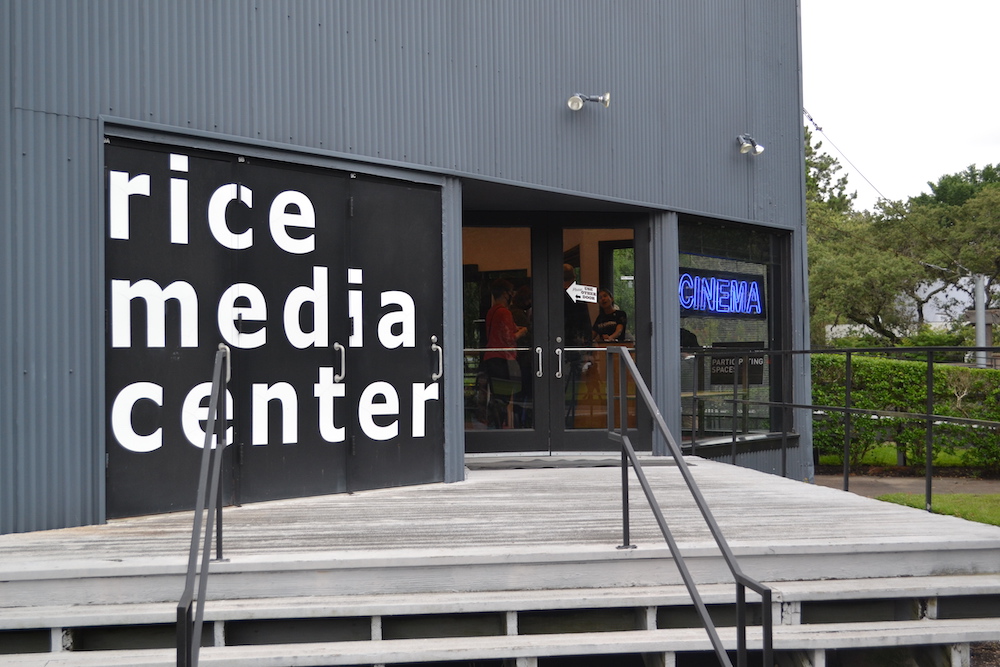
All photos by Robert Boyd
The Media Center at Rice University has shown thousands of movies to generations of undergraduates and the general public. On Friday, June 4, it screened its last movie ever. I was there.
The crowd in the theater was not huge, and tended toward an older demographic. Some, like me, had once been students there. The first thing we were shown was a clip from 1971’s The Last Picture Show, in which Sonny and Duane watch the last movie ever to be shown in the sole movie theater in their small Texas town. In the movie, they watch Red River by Howard Hawks, and we see John Wayne issue his famous line, “Take ’em to Missouri, Matt!” I’m pretty sure I saw that movie for the first time at the Media Center in the ’80s, in Brian Huberman’s Film Form class. In The Last Picture Show, after the movie, the two young men say goodbye to the Miss Mosey, who owns the town’s theater. She says, “Nobody wants to come to shows no more. Baseball in the summer, television all the time. If Sam had lived, I believe we could have kept it going. I just didn’t have the know-how.”
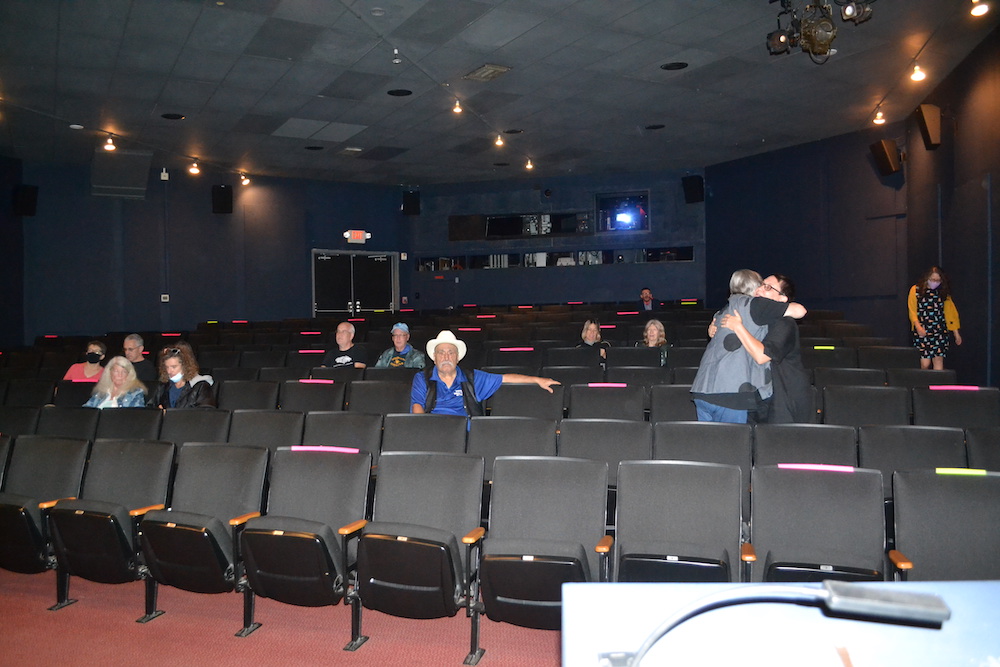
The Last Picture Show, directed by Peter Bogdanovich, was based on the novel of the same name by Larry McMurtry, who was a student at Rice and also taught there. It seemed an appropriate connection. In so many ways, this was the ideal way to start off the last night in this theater.
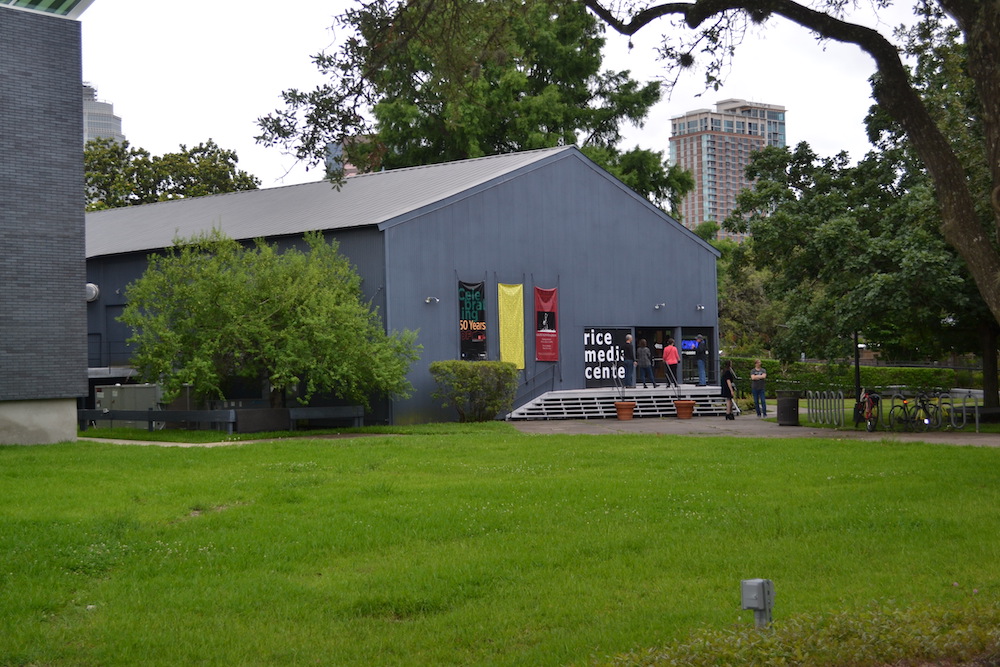
The Media Center was founded 50 years ago. I won’t try to recite its history (which has been done very well by Peter Lucas in a pair of Glasstire articles). But I think it’s important to remind ourselves how weird the Media Center was. When the Menils had their falling out with St. Thomas and moved their educational operations temporarily over to Rice, they bequeathed two architecturally atypical sheds to the university. One was to be a small museum; the other was dedicated to photography and film. The buildings were at the edge of the campus — for a time they were a long way from any other Rice building (except the campus police station). Perhaps it was this distance that made the architectural otherness acceptable to the powers that be at Rice. They had the appearance of industrial buildings, as though filled with light manufacturing, or functioning as distribution centers.
They weren’t built to last, and they haven’t. In this way, it’s not a tragedy that the Media Center is being torn down on its 50th anniversary. It has lived a long and productive existence. (Its sister building, which housed the Rice Museum for many years and was affectionately called “the Art Barn,” was converted to housing the continuing education department in 1987, and finally torn down in 2014.)
On the Media Center’s last public evening, after The Last Picture Show clip was shown, film professor Brian Huberman got up to say a few words. He has been working at Rice almost as long as the Media Center has existed — 46 years. He admitted that the Media Center building was “worn out.” He didn’t seem terribly bothered by its demise. Anyone who knows Huberman knows that he is obsessed with the Alamo. (Not so much the actual Alamo, but The Alamo, the 1960 film that stars John Wayne as Davy Crockett.) Perhaps he was thinking of the Alamo when he said, “Last stands are dangerous because there are rarely any survivors.” No one was making a last stand for the Media Center. People in the audience tended to be on the old side. I assume they were, like me, people who had spent some portion of their youth (and beyond) there.
The movie closing out the Media Center’s long history of film exhibition was Last Night At the Alamo (1983, directed by Eagle Pennell). It was filmed here in Houston, and Huberman was its cinematographer. The subject was a bunch of oil-field workers closing out the last night of a neighborhood bar called the Alamo. A last hurrah, not a last stand. But one of them, Cowboy, drunkenly dreams of holding off the bulldozers with a rifle. Fortunately, his alcohol-soaked fantasy of a heroic last stand fails to excite any of his fellow barflies. Mostly, it’s a bunch of old compadres and a few slumming yuppies spending an evening in a run-down bar, getting drunk there for the last time ever.
The screening was followed by a panel discussion featuring Huberman, Kim Henkel (who wrote the script), Sonny Karl Davis (who played Cowboy), and Tina Brawner (the movie’s associate producer). They told stories about how the movie got made, especially the location shooting. It was a real bar located on Harrisburg, across the street from a coffee roasting plant. It was a functioning bar when they shot Last Night at the Alamo, which meant they had to set up in the mornings, and have the bar ready to open for business by three in the afternoon every day. Appropriately enough, the bar was torn down years ago.
Sonny Karl Davis was the most amusing panelist. He told a story of how he had been in the Willie Nelson vehicle, Red Headed Stranger, in 1986, and heard at the cast party that they were looking for someone to play an Irish cowboy for the upcoming miniseries Lonesome Dove (1989). So he spent the entire party drunkenly speaking in a fake Irish brogue. (In the end, he did get a recurring role in Lonesome Dove, but not as one of the Irish brothers.)
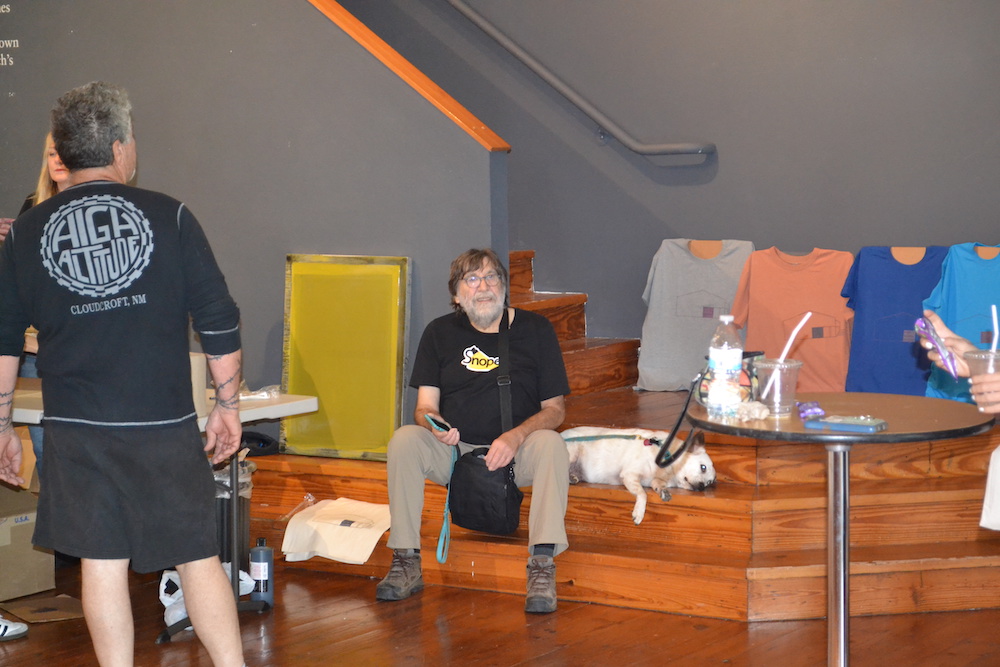
Huberman and his dog
The Media Center final programming extended to the next day with a closing party. As at the screening, there were a lot of us olds in attendance, as well as some faculty, including Huberman and his dog, photography professor Geoff Winningham, photography coordinator Shannon Duncan, and art professor Christopher Sperandio. I mentioned to Sperandio that it was astonishing that Huberman and Winningham, who had both been teachers of mine in the 1980s, were still teaching. He pointed out that they were both already of retirement age when he was hired years ago.

Christopher Sperandio and Shannon Duncan in front of drawings of the future art building
On the wall were plans of the new art building that would take the space that had been the location of the Media Center and the Art Barn. I was astonished that Rice was planning on replacing these two art buildings (as well as the art classrooms in Sewell Hall) with a new, purpose-built building. Rice has always seemed to treat the Department of Visual and Dramatic Arts as the red-headed stepchild of academic disciplines. There were five drawings of the new building; at first glance, it looked fantastic — a giant shed-like building. It felt like a scaled-up version of the Media Center and the Art Barn. It reminded me of hearing James Surls talking about the original Lawndale at U.H., which he described as an indestructible building where the students could do anything.
But on closer examination, I realized that the future art shed is, in fact, two triangle-shaped buildings with a corridor separating them. The shed-like structure would cover the top of the two buildings, and the corridor would be a driveway extending through the whole. This would be a completely unnecessary roadway, with the cutesy name “ArtStreet.” This plan permits Rice to build one of the two buildings while raising money for the second.
The new structure will sit right next to the (still-newish) Moody Center for the Arts, so I wondered if it was necessary. I asked Sperandio, and he pointed out that the art department didn’t control the Moody Center. I asked what department ran it (or if it was interdisciplinary), and he said the Moody Center ran itself. He told me the plan for the new art building includes a black box theater, which will be about 20 yards away from the black box theater inside the Moody Center. In my view, this is the kind of pointless duplication you can engage in when you have a $6.2 billion endowment.

We discussed was what was happening to all the stuff in Media Center. Some of it was being moved to other locations on campus where the art department would temporarily reside. Some was being given away (Sperandio was bummed that some nice, large tables had been claimed before he got a crack at them).
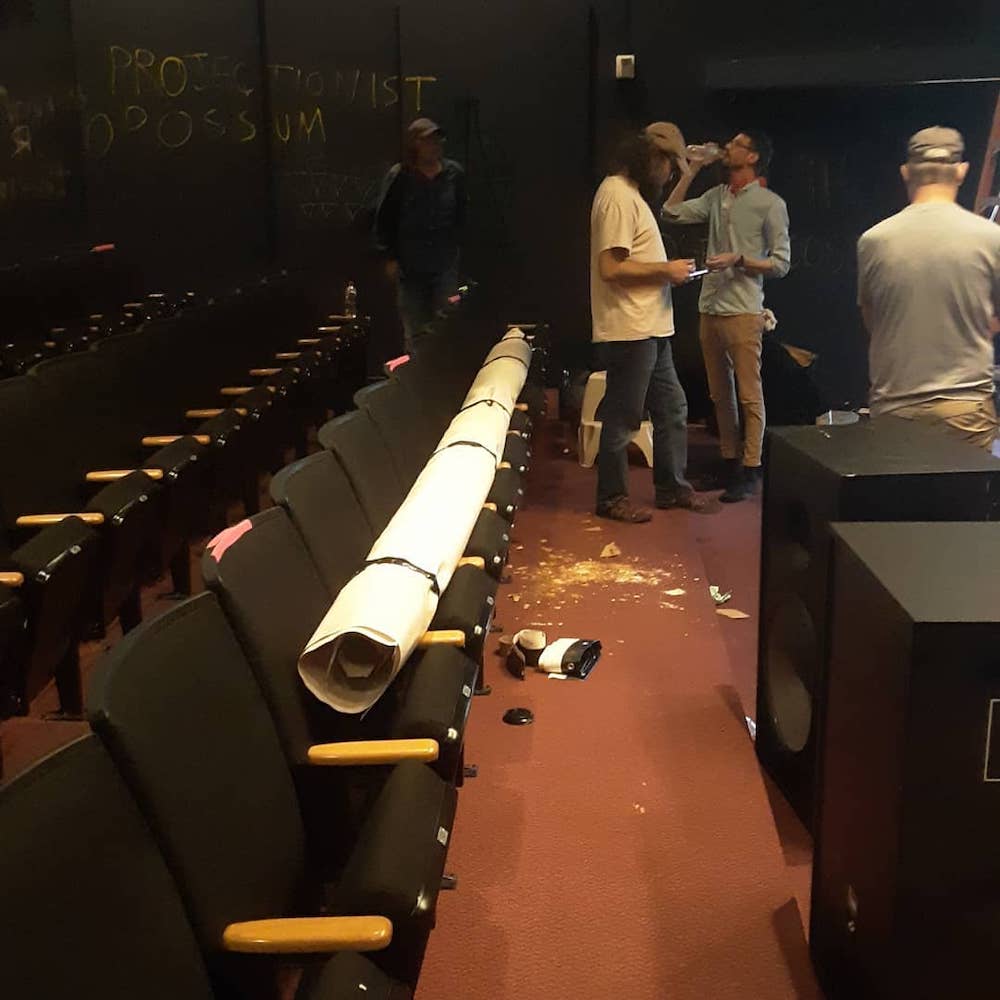
Taking down the Media Center’s screen
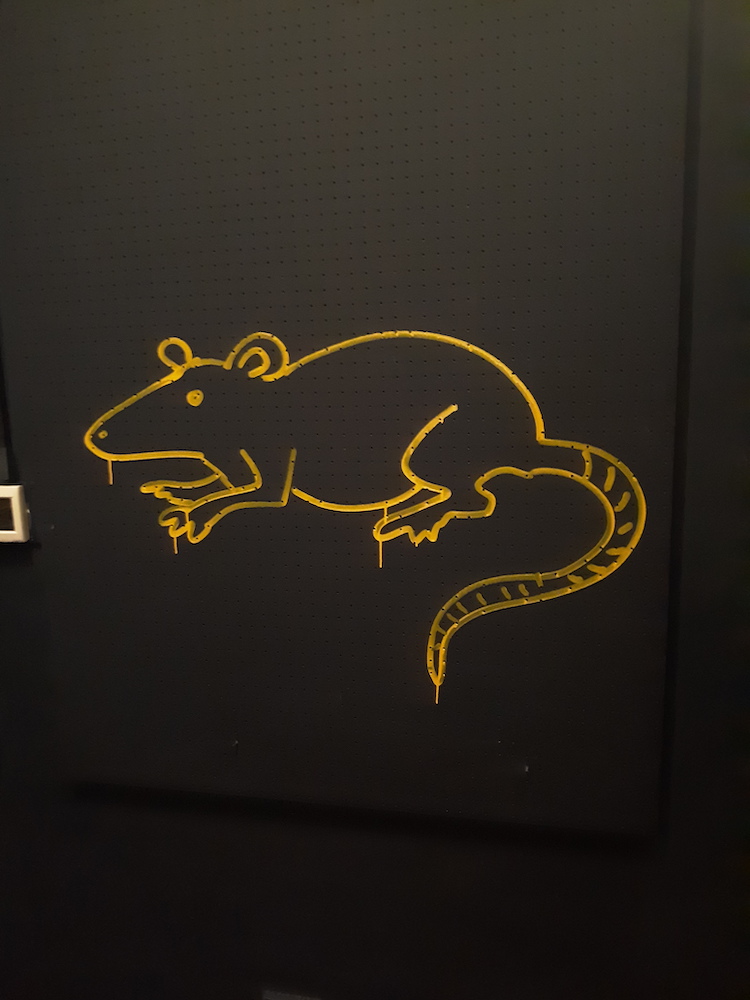
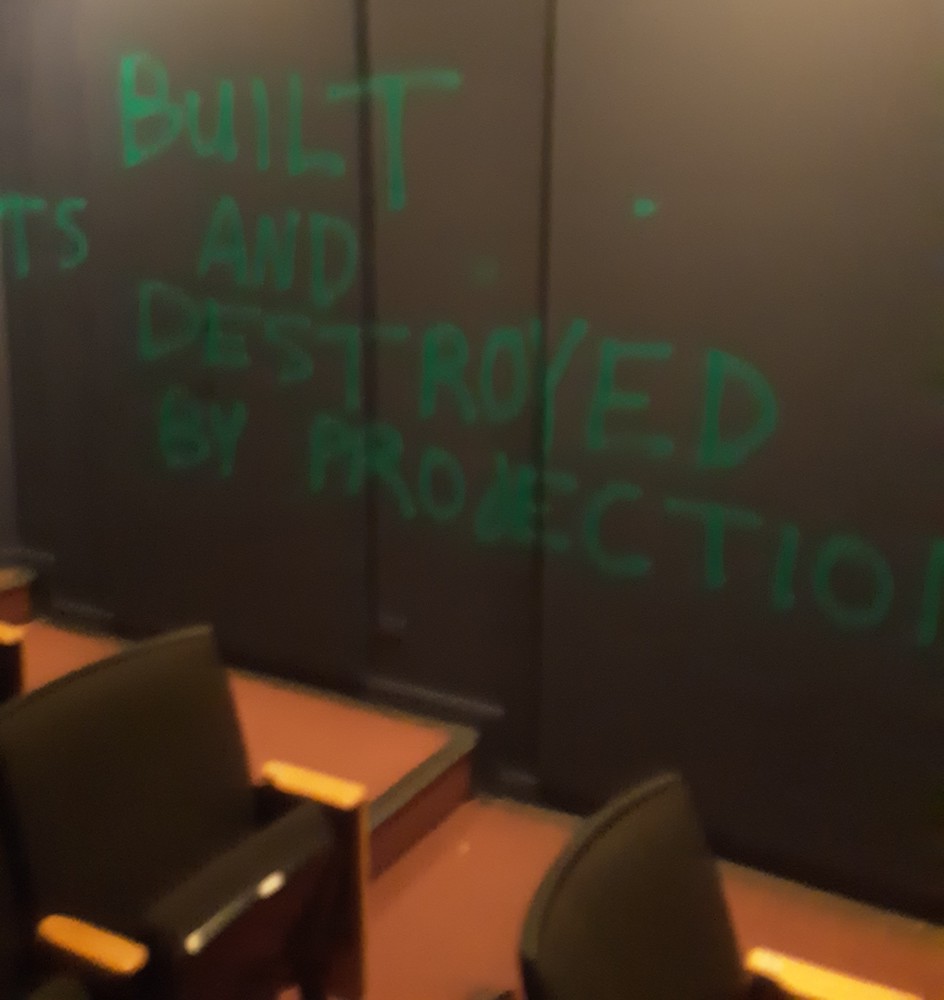
The movie screen was being given to the Orange Show. I came back to the Media Center a week later to help newly appointed Orange Show curator of programs, historian Pete Gershon, take down the old movie screen. The black walls of the movie theater had been tagged by staff and visitors: a portrait of a possum (the Media Center was said to be possum-infested); “SWAMP” (after the Southwest Alternate Media Project, which had a long-time relationship with the Media Center); “’Print the legend’ RIP Rice love Harry J.”; “BUILT AND DESTROYED BY PROJECTIONISTS”; and more. Many old Media Center habitués were present to take the screen down without damaging it — harder than it sounds. This portends exciting things for the Orange Show. For years it has had a tangential relationship with the Houston art community, but I suspect that, with Gershon and its new director, it will become a more central player in the years to come.
As for Rice’s department of Visual and Dramatic Arts? It has never been a major player compared to the University of Houston’s art department. Without the Menils around to finance it, I wonder if it ever will. But it should — university and community college art programs have been the lifeblood of local art scenes in Texas for generations, and there is no reason why Rice University shouldn’t be more prominent.
The post The Last Night at the Media Center appeared first on Glasstire.
Happy Independence Day 2021

Holly and I hope where ever you are, COVID-19 doesn’t interfere with your holiday plans. We thought we would treat you to some truly American favorites from our extensive archive of awfulness.
Click on the book cover to read the original post
Enjoy!
Being an American Can Be Fun!
Leaf
1964

The “Discovery” of North America (quotes are mine/mk)
Byam
1972

Let’s Eat Out!
Jones
1965

The Bicentennial Almanac
200 Years of America
Linton, ed.
1975

The post Happy Independence Day 2021 appeared first on Awful Library Books.
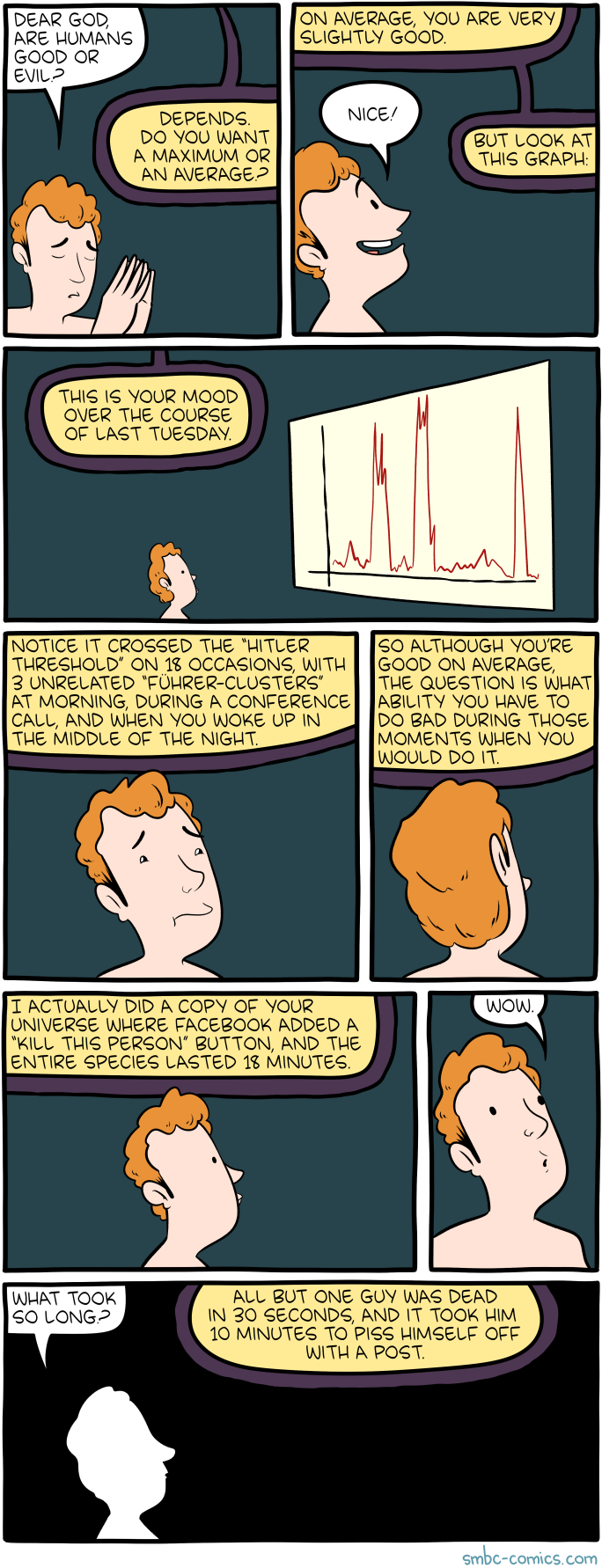
Saturday Morning Breakfast Cereal - Average
A soggy slog of a holiday weekend ahead for Houston
Well, I was hopeful that maybe we could identify a period over the next several days that didn’t look unsettled. While it isn’t going to rain everywhere the entire weekend, the chance of rain is going to be higher than usual everywhere from tonight through Tuesday or Wednesday of next week. We will walk you through things as best we can today, and we’ll conclude our Friday post with an update on Tropical Storm Elsa.
How much rain through next week?
We’ll start off today’s post by addressing the question most people probably have: How much rain are we expecting, and will it flood? Rainfall totals are going to vary widely from location to location, but we’re confident that most places should 2 to 4 inches through Wednesday. That said, given significant amounts of atmospheric moisture (high precipitable water, or PWATs), any storms will be capable of producing 1 to 3 inch per hour rainfall rates. So it’s pretty obvious that some locations will see a good bit more than 4 inches over the coming days. Where exactly those locations are is to be determined.
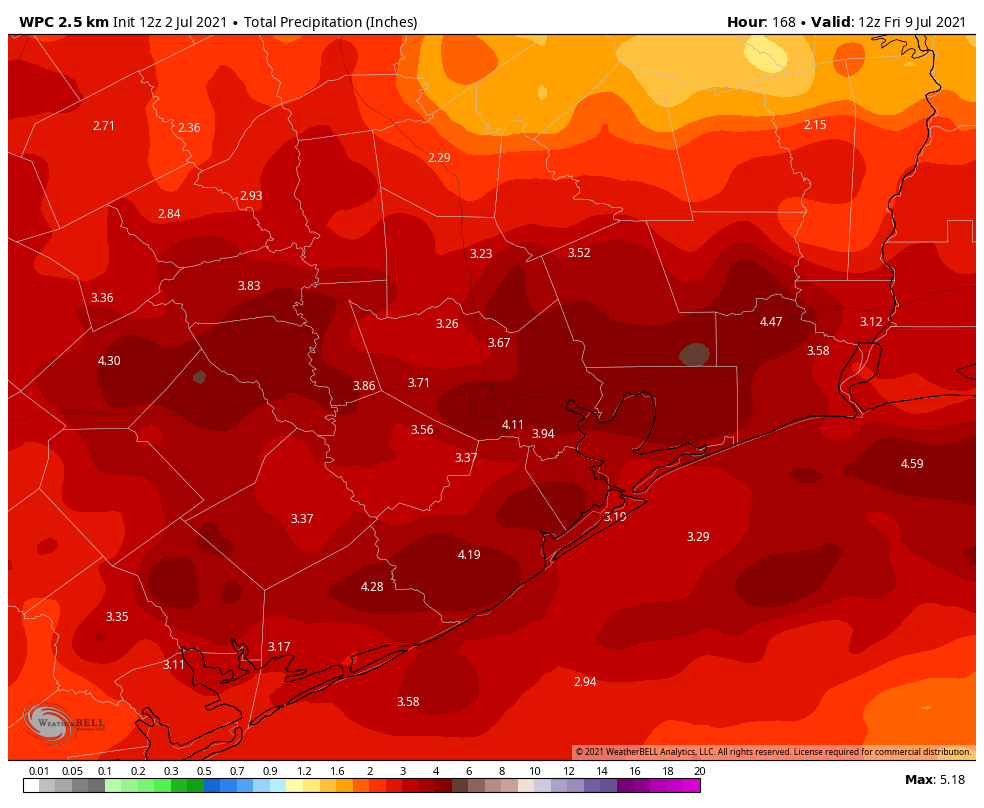
But as you can see from the map above, the current bullseye is just east of Houston. For those curious, the European model has its bullseye over the Sabine River, and the GFS does not really have a bullseye. But most models are in good agreement with this forecast above. You can expect a good bit of rain in the coming days.
Will it flood? This question is somewhat thornier. At this point we don’t expect significant flooding, but the reality is that we can’t rule out things getting a little dicey in spots at times. Even though there will likely be street flooding in spots at times, we are not yet going to trigger the Space City Weather Flood Scale. I do think at some point between now and Wednesday we are going to have to give in with a Stage 1 or 2 type event possible. Things can change, so stay with us through the holiday weekend, and make sure you have downloaded our app!
Today
Friday is going to start off fine. Look for sunshine and a few clouds. Today will probably be pretty hot, with highs in the mid-90s likely. I wouldn’t expect much worse than a couple hit or miss showers through 3 PM at this point. After 3 PM, a cold front begins to sag south into northern parts of the area, and we should see more organized storms break out along or north of Highway 105, dropping into Hempstead, Magnolia, The Woodlands, and Liberty this evening.
Tonight & Saturday
Those storms will continue pressing south after dark, reaching I-10 around or just before midnight, although they could weaken some. A few additional scattered storms will be possible overnight.
On Saturday, we get a surge of moisture (near-record PWATs for the date) that should allow for numerous showers and storms to break out across the region. I would expect a bit of atmospheric “bumper cars” to ensue tomorrow as boundaries collide, popping off new storms across the area in a chain reaction of sorts.
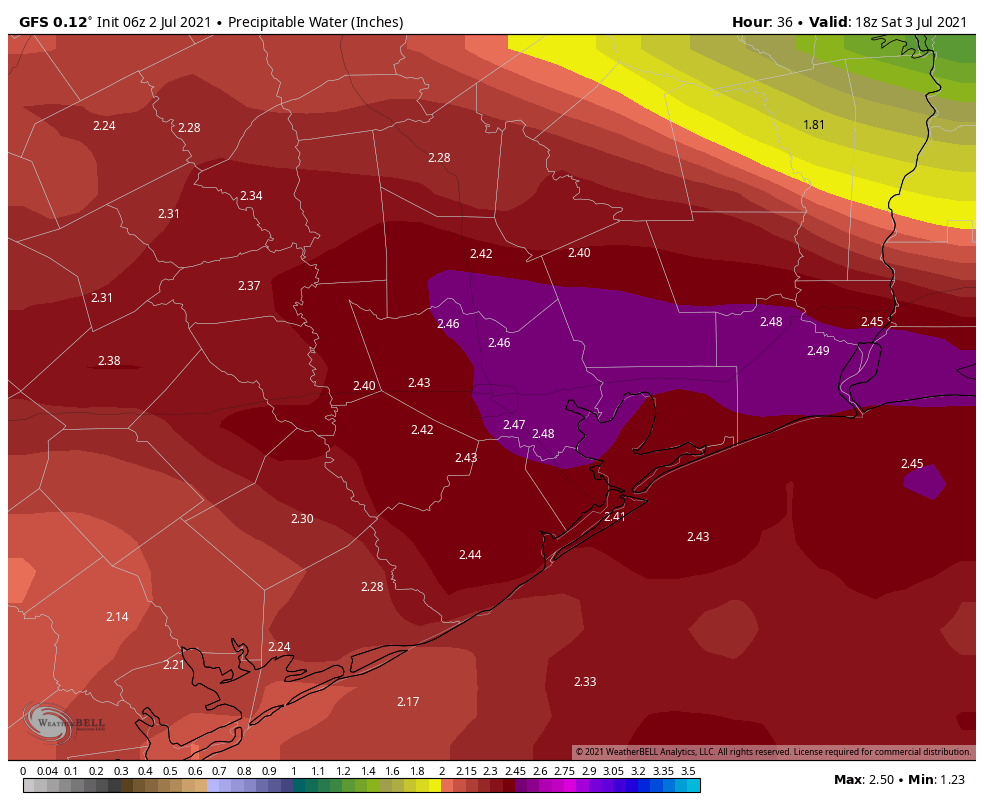
Showers could push or focus south of Houston tomorrow late day or evening.
Temperatures will be held down with clouds and rain. Look for lows in the 70s and highs in the mid-80s.
Sunday
Expect numerous showers and thunderstorms throughout Independence Day, with locally heavy rain possible. Highs will be in the 80s.
What to do about fireworks displays? Well, I wouldn’t be cancelling anything just yet. We are certainly talking up a wet weekend here, and the cancellation option is a very plausible one in some places. That said, there is a good chance that some parts of the area will be just fine for fireworks displays, albeit with some soggy ground to watch from. That decision should be as close to a game time one as possible.
Monday & Tuesday
It’s a bit of a tough call as to which day from Saturday through Wednesday has the best chance for the heaviest rain, but if I were a betting man, I might lay a few chips on Monday or Tuesday. We get a boost in moisture on those days, especially Tuesday and some pretty vigorous upper level support for rain too. Not everyone will see their heaviest rain early next week, but I think some people will, and this is where I would begin to perhaps be more mindful of flash flooding risks.
High temperatures will be held down here. Look for mid-80s at best (probably low-80s or even cooler in spots) for highs and 70s for lows.
Wednesday & Thursday
For the middle of next week, we currently expect to see things begin to wind down a bit. Expect scattered thunderstorms on Wednesday, but we are hopeful that the coverage will be noticeably less than it was on Monday and Tuesday. By Thursday, much will depend on what Tropical Storm Elsa does, but assuming it stays well east of us as forecast, we would probably just see sun, clouds, some isolated to scattered storms (unrelated to Elsa) and slightly warmer temperatures. We’ll see. But it appears that the pattern may begin to change back to a more typical summer one by late next week.
Tropical Storm Elsa
(Editor’s Note: Elsa was upgraded to a hurricane immediately after publication) Elsa did some work overnight getting better organized as it approaches Barbados and the southern Leeward Islands today. Max winds are now 60 mph, and although the National Hurricane Center forecast currently falls just short of Elsa becoming the season’s first hurricane, there is some chance it could attain that intensity.
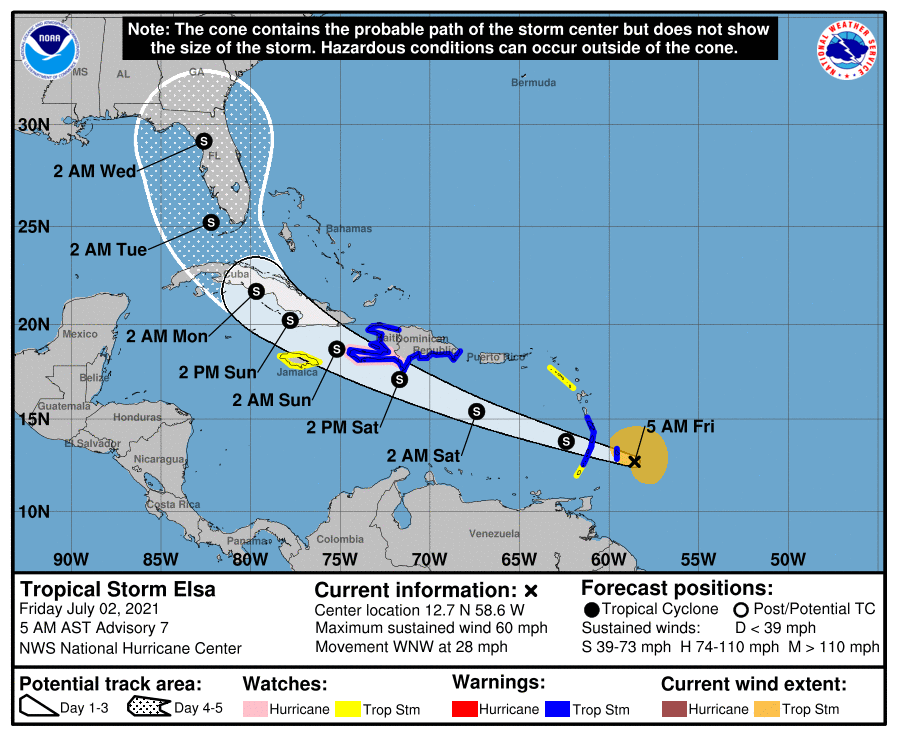
The forecast right now is officially comfortably east of our area, with a focus on Florida by Wednesday or Thursday of next week. There is still a very wide spread of options available to Elsa beyond day 3 or so, meaning that folks from Central Louisiana through the Bahamas, including all of Florida should still be monitoring Elsa’s progress closely. We continue to think this won’t be a direct issue for Texas, but we will monitor its progress and any track forecast changes through the weekend anyway.
Are You a Participant in a Child’s Made-Up Game or Josef K. from Kafka’s The Trial?
1. You have no chance of winning.
2. Despite the odds, you are overly confident about your ability to win.
3. The rules are unnecessarily complicated.
4. At some point you end up talking about Elsa.
5. Your questions receive long, rambling answers that don’t clarify what’s happening.
6. Every move you make is apparently the wrong one.
7. Your complaints about fairness are summarily dismissed.
8. There is no end in sight.
9. Your opponent can be temperamental and unpredictable.
10. Eventually you give up and accept your inevitable defeat.
Participant in a child’s made-up game: 1-10
Josef K.: 1-10
How the gas mantle made lamps 10X brighter
Links 'n Stuff
Video on Limelight:
https://www.youtube.com/watch?v=TZhrRINQ738
Previous lantern video:
https://youtu.be/tURHTuKHBZs
Next lantern video:
https://youtu.be/D_qFWoa_HR4
Technology Connextras (the second channel that stuff goes on sometimes):
https://www.youtube.com/channel/UClRwC5Vc8HrB6vGx6Ti-lhA
Technology Connections on Twitter:
https://twitter.com/TechConnectify
The TC Subreddit
https://www.reddit.com/r/technologyconnections
This channel is supported through viewer contributions on Patreon. Thanks to the generous support of people like you, Technology Connections has remained independent and possible. If you'd like to join the amazing people who've pledged their support, check out the link below. Thank you for your consideration!
https://www.patreon.com/technologyconnections
And thank you to the following patrons!
Yaniv , Francis, BooseGumps, Jay , Dave Anderson, Eric Hansen, Jeremy Kitchen, Audin Malmin, Adam D. Ruppe, Matthew Giraitis, Kevin Landrigan, Carl Yazbek, Nolan Johnson, Hunter Schwisow, Matt Falcon, Paul Williams, Brent LaRowe, Lurker239 , Felix Freiberger, James Ryan, Lukas Komischke, Jason Nevins, Jeffrey , BlancoGrande , Technicalleigh , Adam Coddington, Steven Metcalf, Justin Talbot, Christopher Jett, SovietBear , Techmoan , Kotanu, Christopher Luna, Brian G. Shacklett, Andre Nogueira, Matthew Baron, Mark Critchley, Andres Plaza, Charlie Hankin, Casey Kikendall, Sebi Jecklin, Warmo , The8TrackKid , Michael Snowden, Julian Rapoport, Christopher Bassett, Ryan Cozzubbo, Marcus Schwartz, The Automatic Filmmaker, Matt Taylor, CharlieVictor, Peek , Bastien Louērat, Robert Toth, Marc Ethier, Thijs Dortmann, Brady Brown, Stein Strindhaug, foophoof , Ernie Smith, Christopher Dickey, Andrey Tarantsov, Jeff M, Mitchel J. Mullin II, Matthew Razza, Trix Farrar, Marco Anastasi, Howard Kraut, Matthias Dienelt, Yona , Fredrik Grufman, neko , Grayson Lang, Paul Virdone, Jeffery Grajkowski, Stefan Berndtsson, Michael Sims, Christopher Leidich, Sean Reigle, Mike Friedman, André Waage Sørensen, Chris LeChien, fussel , Luc Ritchie, Eric Romero, Ryan Hardy, Ewen McNeill, Henrik Ripa, Shane Zamora, Alex Ilyin, Yorick Terweijden, Andrew "FastLizard4" Adams, Avi Drissman, Phil Taprogge, Pieter van der Eems, Reto Jost, Vince Terranova, Andrew Montagne, David Scott, Brandon Enright, James Fialho, toasterking , Jason Boyles, Nick Pollard, Manalope , Andy S, Robert , Slartibartfast, Rob Kefford, Benjamin A., Nathaniel , EASY TARGET, Colin Cogle, MrHammond , Aaron Rennow, Countzero , Anders Dahnielson, Eli Krumholz, Guillaume Tremblay-Beaumont, Sha Nasti, Laria , Stephen Hinton, thegeoffreak , Jib Systems, Grazer, Mike Noe, Scott Rowland, Your name, Felix Winkelnkemper, 98abaile , Owen O Byrne, Matt Mullett, Andrew Bade, Max96, Ryan Benson, Johnni Winther, Mark Hesse, Nathan Blubaugh, lululombard , Nelson , William Evans, VilleS , Anton Afanasev, Kilrah , Ray , Liam O'Flynn, Petter Feltenstedt, Gideon Ritter, Oliver Lee, Lennart Sorensen, basram, Viorel , Reaghan Kekeis, lohphat , Vivian Pypher, Brooke Whiting, Robin Johnsen, Phia Westfall, Tom Rolfe, Mark Wayt, Arthur Robillard, Ramon Gamez, Vaughn B., Breunie Ploeg, Benjamin Cirker, Julien Oster, LeoNerd , Trae Palmer, Takuto, Chris Wallace, Matt Shea, Jason Baker, Galimaufry, Michael Holmes, Kevin Hollywood, Trey Harris, Peter Pfundstein, Alan B., Mat Stu, RYAN INGOGLIA, Thomas Kolanus, Daniel Johnson, Potch , Reemt Rühmkorf, Robin Rattay, Bruce Justyn, Justin D, Adam Zawisza, LordJakson , Triancia, Joshua Moncrieff, Microfrost , Juan Olivares, Mike Bird, Michael Shaffer, Brodeur , Jason Spriggs, Gregory Kumpula, Daniel Pf, Yung Kim, John W Campbell, Matthew Jones, The Slapster, BytewiseMarissa, Vince Batchelor, Peter Sarossy
Baseball Hall of Famers

Stories of Champions
Epstein and Epstein
1965
This book is actually about five mini-biographies of some old-school baseball players. Ty Cobb and Babe Ruth were the only ones I recognized. However, my husband, one of those annoying people that has an encyclopedic knowledge of sports stats, knew all of these guys. (He was also kind enough to summarize their stats for me.)
For the most part, these are sanitized versions of the players, and the stories harp on themes of practice, hard work, perseverance, and toughness. Even Ty Cobb, well known for being a difficult person, is portrayed as tough and passionate about winning. Ty Cobb was unpopular with his fellow players and fans alike. He racked up quite a few assault charges during his career.
Babe Ruth, Walter Johnson, and Christy Mathewson are also featured in this book. The stories are meant to be somewhat inspirational and not really fact-based biographies for the kids. Keep it for sentimental reasons, but I don’t think it would be a good choice for a modern youth biography collection. For the truly nerdy baseball fan, one of those encyclopedias of baseball might be more fun.
Mary


The post Baseball Hall of Famers appeared first on Awful Library Books.
Houston Comic Book Shop Sues Hotel For Negligence (In Graphic Novel Form)
how professional-sounding do resume email addresses need to be?
This post, how professional-sounding do resume email addresses need to be? , was originally published by Alison Green on Ask a Manager.
A reader writes:
When using an email for a resume, what makes them professional enough to be used? Some people have told me the email should have my full name in it and be simple to remember. I have seen other emails that are a random arrangement of letters and numbers (such as erwt999@email.com). What about emails made up of pronounceable words that are unrelated to work (such as bluepost12@email.com or my own email, which is something like carodashline@email.com (if my name were Caroline)?
As long as it’s not unprofessional, you’re fine.
You don’t want sex, drug, or drinking references. You don’t want Ihatemyboss@email.com. You probably don’t want politics or religion unless you’re applying for political or religious jobs.
But as long as you’re not doing something that looks like actively bad judgment, you don’t really need to worry.
Names, fine. Letters and numbers, fine. Puns on your name, fine. Words unrelated to work, probably fine as long as it complies with the rule above. (bluepost12@ is fine. dicksgalore@ is not. Nor is weedman@, unless you’re a professional landscaper, and even then I’d proceed with caution.)
If you want to be really safe, the most boringly professional format for your email is jane.toadsmore@ or jtoadsmore@ or jtoadmore12@ or something similar — something clearly built around your name.
But really, other approaches are fine too. No reasonable hiring manager will care about your email address unless there’s something obviously controversial/unprofessional about it, nor will they care one bit that your address is bluepost12@email.com instead of your name.
The one caveat I’d give is to use an email address that isn’t easily misread or mistyped. Most hiring managers won’t be typing in your email from scratch (they’re going to be hitting reply or using an electronic applicant tracking system), but you never know and it’s smart to ensure you’re not using an address with a high chance of being mistyped (like one with six i’s in a row or a 1 that could be mistaken for an L or so forth).
FAQ: Canada
Is Canada socialist?
Canada is a constitutional monarchy with a parliamentary system. While it fully embraces a capitalist economic infrastructure, it has also implemented a number of “safety net” programs that reflect strong social values. These include unemployment insurance, subsidized post-secondary education, and access to universal peanut butter. While it’s true the waiting list can be long for specialized spreads, Canadians can always count on access to peanut butter in a crunch.
What is Canada’s motto?
E Pluribus Denim
Prince Edward Island is a joke, right?
No, you’re thinking of Regina.
Is Canada really just one person?
Not anymore, but once, yes, at least officially. After the British conquered New France in 1760, they quickly determined that nobody actually wanted to live there. For liability reasons, they couldn’t simply leave the place empty. Thus, they appointed one man, James Robert MacDonald, to keep watch over Canada. While we now know that there were countless First Nations communities living here, MacDonald didn’t realize this due to his inability to make eye contact, thus establishing a long-standing Canadian tradition of dismissing Indigenous peoples. Canada underwent a population surge in the 1930s when immigrants arrived to work in the lucrative Leonard Cohen mines. Today, Canada’s population is 27.
What are Canadian values?
Tolerance. Sustainability. Diversity. Rush.
Can something be done about Drake?
Scientists believe Drake was introduced to the west coast of Canada hidden in a crate of Morrocan figs. With little resistance from natural predators, Drake quickly spread, causing extensive damage to British Columbia boreal forests and hip-hop culture. While Drake’s eastward spread was initially hindered by the Rocky Mountains and prairies, Drake managed to reach central Canada by hitching a ride with trucker Jean-Louis Bizou who is maintenant très, très désolé. Drake currently flourishes unchecked in Southern Ontario, where he has ruined peach crops and countless Toronto Raptors games. In terms of treatment, Drake appears to respond well to high doses of The Tragically Hip, although side effects include The Tragically Hip.
Are there dickheads in Canada?
While Canada lacks the sheer density of dickheads of the United States and much of Europe, dickheads have been part of Canada going back to 1904 when Prime Minister Wilfrid Laurier pronounced, “The 20th century belongs to Canada’s dickheads!” While this prediction was a bit off the mark, dickheads have nonetheless thrived in Canada in all walks of life, especially shopping mall security. For many years, the prevailing sentiment was that Canadians could only achieve true dickheadedness by being dickheads south of the border. However, there are still countless opportunities from sea to shining sea for dickheads to be dickheads. Canadian dickheads, though, tend to be quieter, except when they drive their snowmobiles up and down the street at the first fucking sign of snow. You can spot a Canadian dickhead by the smug way he corrects your pronunciation of “Toronto.” He also probably lives in Toronto.
What are the nicknames of Canadian currency?
$1: A Loonie
$2: A Toonie
25: A Beaver Nut
10: A Liz
5: Half a Liz
$5: A Bleu Nuit
$10: A Trebek
$20: A Pictou County Pogey Cheque
$50: A Swanky Pete
$100: Alexander Graham Bill
Who were the Fathers of Confederation?
The Fathers of Confederation were representatives from the Province of Canada and the Atlantic colonies who, between 1864 and 1867, met to discuss forming a union. In French, the Fathers of Confederation are known as Les hommes en culottes mignon (“The Men in Adorable Panties”).
Schitt’s Creek is really just okay, right?
It’s pretty good.
Can I chew gum in Canada?
While open chew laws are commonplace in the United States, Canada has very strict gum laws. Not only must all gums be registered, but certain high-calorie gums are banned outright. These severe measures were legislated federally in 1993 after a rogue case of Hubba Bubba X-Scream Cherry-Tastic Razzle Blast! found its ways inside a Kapuskasing kindergarten and caused extensive hair entanglements and excitability. Luckily there was universal peanut butter.
Is it true that the original name of Westminster, British Columbia was “Cockmeister”?
Yes.
As Expected: Judge Grants Injunction Blocking Florida's Unconstitutional Social Media Law
I'm sorry, but those of you looking forward to riding the Friend Feed Flume at Zuckland or the Search Engine Shuffle at GooglePark are probably out of luck. Florida's new social media law (and its theme park owner exemption) is not going to become law.
We've written a few times about Florida's blatantly corrupt and unconstitutional social media content moderation law -- complete with its special carveout for Disney*. The legal challenge to the bill had a hearing in court on Monday, and as we expected, Florida's arguments in favor of the bill were not well received. I listened to the entire hearing and, to put it mildly, the judge was not impressed by Florida's arguments. At one point, he literally asked the lawyer defending the bill if he had ever come across a more poorly drafted piece of legislation. That's generally not a good sign.
And, now, with just hours to go until the law was supposed to go into effect, the judge has granted the preliminary injunction blocking the bill, and the ruling makes it pretty clear that this bill is not going to survive. Of course, Florida will likely appeal the ruling, and it'll be up to the Appeals Court to go into more depth. During the hearing, the judge, Robert Hinkle, more or less admitted this would be the case, and said that his ruling wouldn't go that deep, because what the Appeals Court says will be more important in the long run. Even so, the ruling is worth exploring, as it smashes the law to bits in a variety of ways.
The State of Florida has adopted legislation that imposes sweeping requirements on some but not all social-media providers. The legislation applies only to large providers, not otherwise-identical but smaller providers, and explicitly exempts providers under common ownership with any large Florida theme park. The legislation compels providers to host speech that violates their standards—speech they otherwise would not host—and forbids providers from speaking as they otherwise would. The Governor’s signing statement and numerous remarks of legislators show rather clearly that the legislation is viewpoint-based. And parts contravene a federal statute. This order preliminarily enjoins enforcement of the parts of the legislation that are preempted or violate the First Amendment.
So, let's start with ye olde 1st Amendment. As we predicted, it's pretty clear that this law violates it. The judge agrees. For all the talk of how the law supposedly "protects" the 1st Amendment, the judge recognized it absolutely does the opposite. I've tried to highlight the key bits if you want to skim:
First, the State has asserted it is on the side of the First Amendment; the plaintiffs are not. It is perhaps a nice sound bite. But the assertion is wholly at odds with accepted constitutional principles. The First Amendment says “Congress” shall make no law abridging the freedom of speech or of the press. The Fourteenth Amendment extended this prohibition to state and local governments. The First Amendment does not restrict the rights of private entities not performing traditional, exclusive public functions. See, e.g., Manhattan Cmty. Access Corp. v. Halleck, 139 S. Ct. 1921, 1930 (2019). So whatever else may be said of the providers’ actions, they do not violate the First Amendment.
Second, the First Amendment applies to speech over the internet, just as it applies to more traditional forms of communication. See, e.g., Reno v. ACLU, 521 U.S. 844, 870 (1997) (stating that prior cases, including those allowing greater regulation of broadcast media, “provide no basis for qualifying the level of First Amendment scrutiny that should be applied” to the internet).
Third, state authority to regulate speech has not increased even if, as Florida argued nearly 50 years ago and is again arguing today, one or a few powerful entities have gained a monopoly in the marketplace of ideas, reducing the means available to candidates or other individuals to communicate on matters of public interest. In Miami Herald Publishing Co. v. Tornillo, 418 U.S. 241 (1974), the Court rejected just such an argument, striking down a Florida statute requiring a newspaper to print a candidate’s reply to the newspaper’s unfavorable assertions. A similar argument about undue concentration of power was commonplace as the social-media restrictions now at issue advanced through the Florida Legislature. But here, as in Tornillo, the argument is wrong on the law; the concentration of market power among large social-media providers does not change the governing First Amendment principles. And the argument is also wrong on the facts. Whatever might be said of the largest providers’ monopolistic conduct, the internet provides a greater opportunity for individuals to publish their views—and for candidates to communicate directly with voters—than existed before the internet arrived. To its credit, the State does not assert that the dominance of large providers renders the First Amendment inapplicable.
The court then explores various precedential cases regarding the ability of the government to compel a private company to host speech and finds that the arguments of Florida are lacking. Since there are speech issues at stake, the law must be subject to strict scrutiny -- and as such it fails the 1st Amendment test. Indeed, public statements made by Florida's governor Ron DeSantis, grandstanding about this bill, are part of what helped to sink it (it would have been sunk anyway, but it's amusing to see his public statements used by the judge here):
The plaintiffs assert, too, with substantial factual support, that the actual motivation for this legislation was hostility to the social media platforms’ perceived liberal viewpoint. Thus, for example, the Governor’s signing statement quoted the bill’s sponsor in the House of Representatives: “Day in and day out, our freedom of speech as conservatives is under attack by the ‘big tech’ oligarchs in Silicon Valley. But in Florida, we said this egregious example of biased silencing will not be tolerated.” Similarly, in another passage quoted by the Governor, the Lieutenant Governor said, “What we’ve been seeing across the U.S. is an effort to silence, intimidate, and wipe out dissenting voices by the leftist media and big corporations. . . . Thankfully in Florida we have a Governor that fights against big tech oligarchs that contrive, manipulate, and censor if you voice views that run contrary to their radical leftist narrative.” This viewpoint-based motivation, without more, subjects the legislation to strict scrutiny, root and branch. See, e.g., Rosenberger v. Rector and Visitors of Univ. of Va., 515 U.S. 819, 829 (1995) (“The government must abstain from regulating speech when the specific motivating ideology or the opinion or perspective of the speaker is the rationale for the restriction.”) (citing Perry Ed. Ass’n v. Perry Local Educators’ Ass’n, 460 U.S. 37, 46 (1983)).
Moreover, these statements are consistent with the statutory definition of “social media platform,” which extends only to, and thus makes the legislation applicable only to, large entities—those with $100 million in revenues or 100 million monthly participants. As the Supreme Court has recognized, discrimination between speakers is often a tell for content discrimination. See, e.g., Citizens United v. Fed. Election Comm’n, 558 U.S. 310, 340 (2010) (“Speech restrictions based on the identity of the speaker are all too often simply a means to control content.”). That is the case here. The state has suggested no other basis for imposing these restrictions only on the largest providers. And even without evidence of an improper motive, the application of these requirements to only a small subset of social-media entities would be sufficient, standing alone, to subject these statutes to strict scrutiny. See, e.g., Minneapolis Star & Tribune Co. v. Minnesota Comm’r of Revenue, 460 U.S. 575, 591 (1983); Arkansas Writers’ Project, Inc. v. Ragland, 481 U.S. 221, 229 (1987).
And, yeah, the Disney carveout is seen as a tell as well:
Finally, the same is true of the exclusion for social-media providers under common ownership with a large Florida theme park. The State asserted in its brief that the provision could survive intermediate scrutiny, but the proper level of scrutiny is strict, and in any event, when asked at oral argument, the State could suggest no theory under which the exclusion could survive even intermediate scrutiny. The State says this means only that the exclusion fails, but that is at least questionable. Despite the obvious constitutional issue posed by the exclusion, the Legislature adopted it, apparently unwilling to subject favored Florida businesses to the statutes’ onerous regulatory burdens. It is a stretch to say the severability clause allows a court to impose these burdens on the statutorily excluded entities when the Legislature has not passed, and the Governor has not signed, a statute subjecting these entities to these requirements.
The judge then goes even further, by noting that even if you applied intermediate scrutiny (a lower standard) the bill still wouldn't live up to 1st Amendment requirements:
The provisions at issue here do not meet the narrow-tailoring requirement. Indeed, some of the disclosure provisions seem designed not to achieve any governmental interest but to impose the maximum available burden on the social media platforms
The judge also follows up on his comments during the hearing about how poorly drafted the law is to note the many problems in the law for being vague and open to wildly different interpretations, but notes that given the other reasons to block the law, he doesn't need to use the vagueness issue for the injunction.
In the end, the court recognizes that this bill was really all about punishing a few companies, and that's not how the law is supposed to work:
The legislation now at issue was an effort to rein in social-media providers deemed too large and too liberal. Balancing the exchange of ideas among private speakers is not a legitimate governmental interest. And even aside from the actual motivation for this legislation, it is plainly content-based and subject to strict scrutiny. It is also subject to strict scrutiny because it discriminates on its face among otherwise-identical speakers: between social-media providers that do or do not meet the legislation’s size requirements and are or are not under common ownership with a theme park. The legislation does not survive strict scrutiny.
There is also, extremely briefly, a recognition that the law is likely pre-empted by Section 230, basically highlighting that the law clearly violates 230's prohibitions on allowing platforms to moderate as they see fit:
Florida Statutes § 106.072 prohibits a social media platform from deplatforming a candidate for office and imposes substantial fines: $250,000 per day for a statewide office and $25,000 per day for any other office. But deplatforming a candidate restricts access to material the platform plainly considers objectionable within the meaning of 47 U.S.C. § 230(c)(2). If this is done in good faith—as can happen—the Florida provision imposing daily fines is preempted by § 230(e)(3). Good faith, for this purpose, is determined by federal law, not state law. Removing a candidate from a platform based on otherwiselegitimate, generally applicable standards—those applicable to individuals who are not candidates—easily meets the good-faith requirement. Indeed, even a mistaken application of standards may occur in good faith.
The federal statute also preempts the parts of Florida Statutes § 501.2041 that purport to impose liability for other decisions to remove or restrict access to content. See Fla. Stat. § 501.2041(6) (creating a private right of action for damages for violations of § 501.2041(2)(b) and (2)(d)1; id. § 501.2041(2)(b) (requiring a social media platform to apply censorship, deplatforming, and shadow banning standards in a consistent manner); id. § 501.2041(2)(d)1 (prohibiting a social media platform from deplatforming a user or censoring or shadow banning a user’s content without notifying the user); § 501.2041(2) (making any violation of that subsection an unfair or deceptive act or practice within the meaning of § 501.204—and thus providing a private right of action for damages under § 501.211).
Claims based on alleged inconsistency of a platform’s removal of some posts but not others are preempted.
That last line needs to be repeated over and over again for every state considering these kinds of laws.
Anyway, Florida is almost certainly going to waste more taxpayer dollars and appeal this ruling, but it's really difficult to see how the law survives. It was a garbage unconstitutional bill from the very beginning -- a point that many, many people made clear to both Governor DeSantis and the legislators who pushed this bill. But, of course, the goal was never to get this bill into actual law. It was all a big theater production -- to let them pretend to be culture warriors against "the libs" who they claim run social media platforms. It's just unfortunate that they get to throw away taxpayer money on their theatrical grandstanding.
* By the way, if you'd like to see a fun moment in the Florida legislature during the debate over the bill, check out this fairly incredible video of the discussion between Rep. Blaise Ingoglia -- who inserted the Disney carveout -- and Rep. Anna Eskamani who wants to get him on record explaining why. Ingoglia flat out admits that it's to protect Disney, though his argument is so hilariously dumb it's hard to believe it's real. He argues that they need to protect Disney+ reviews (Disney+ doesn't currently have reviews) and that it shouldn't apply to other sites, because Disney creates its own content. This ignores, of course, that the entire bill is about the moderation of 3rd party content (such as, uh, reviews, which are not created by Disney). It's almost as if he doesn't understand what all of this means, and is just making sure to do a favor to Disney, just because.
What's A Bubble? (Classic)
Back in the USSR
 Soviet Union
Jackson
1980
The Cold War was turned up to 11 when this book was published, and this text reflects that tension. It is more a middle school textbook than a country book like those common in public library youth nonfiction collections. (See our Spanning the Globe category for some examples.) I’m going to guess that this was probably a rogue donation, because textbooks aren’t a usual item in a public library collection. You will be happy to know that this was still in circulation as of this writing.
Of course there is a “Communism is bad” theme laced throughout the text. In the third picture below, there is a comment that women do the same work as the men in the Soviet Union. I’m trying to decide if the editors thought that was a bad thing or a good thing about Communism.
Mary


The post Back in the USSR appeared first on Awful Library Books.
Historians: Trump Was Only the Fourth-Worst President of All Time
Donald Rumsfeld, The Controversial Architect Of The Iraq War, Has Died

Rumsfeld, a longtime military thinker and Washington powerbroker, served twice as secretary of defense. He was 88.
(Image credit: Mark Wilson/Getty Images)

In Pictures: “ART” at Heidi Vaughn Fine Art, Houston
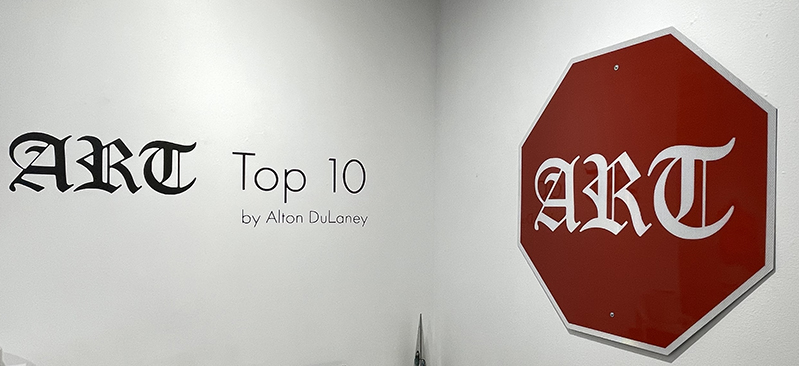 Glasstire visited Heidi Vaughn Fine Art in Houston, where the current exhibition is Alton Dulaney‘s ART: Top 10. The exhibition features neon signs, jewelry, sculpture, and road signs, all created by Dulaney. Vaughn’s website describes Dulaney as “a multi-disciplinary, conceptual artist who researches the ability of ART to transform the perception of objects, images, and actions, as communicated through artistic expression, the relevance of site, the act of mark-making, the marketing and commodification of the ART product, and the identity of the artist.”
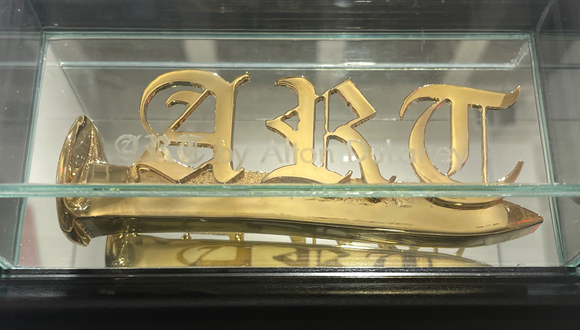
ART Spike, 2021 24k Gold Platted Iron Spike with Steel letters (includes glass vitrine with black lacquer frame).
Dulaney is also Public Art Program Director and Curator at Houston Airports, a system comprised of George Bush Intercontinental Airport, William P. Hobby Airport, and Ellington Airport.
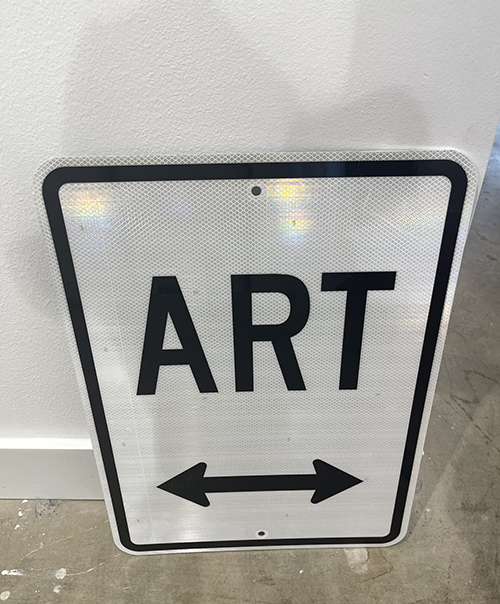
Art Sign.
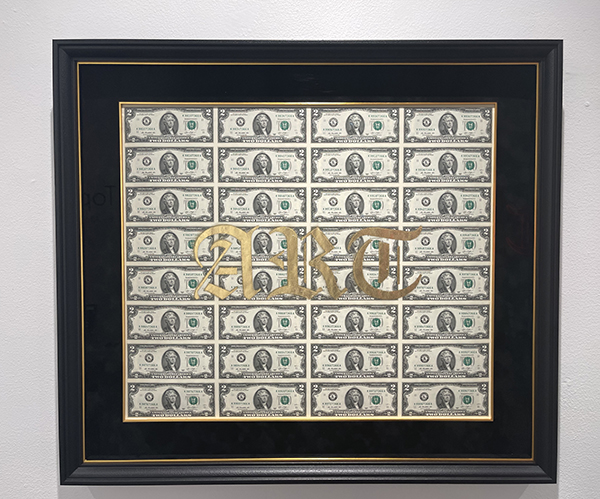
ART Money II, 2021 Rare uncut $2 USD currency, spray paint, gold leaf.
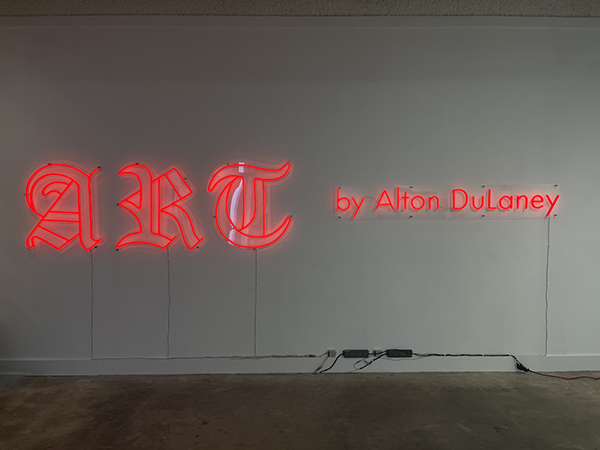
Art by Alton Dulaney.
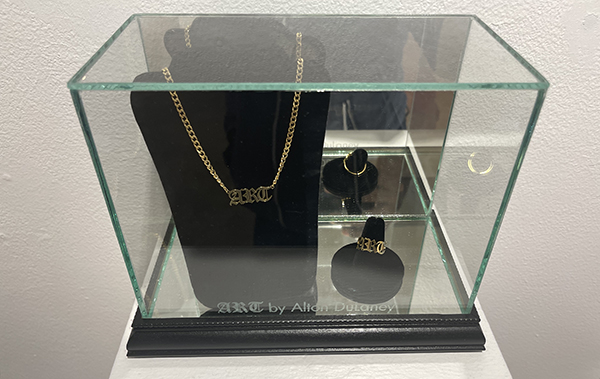
ART Jewelry II, 2021 18k Gold Plated Necklace and Adjustable Ring.

ART Brand Hide II, 2021 Cow hide on stretcher.
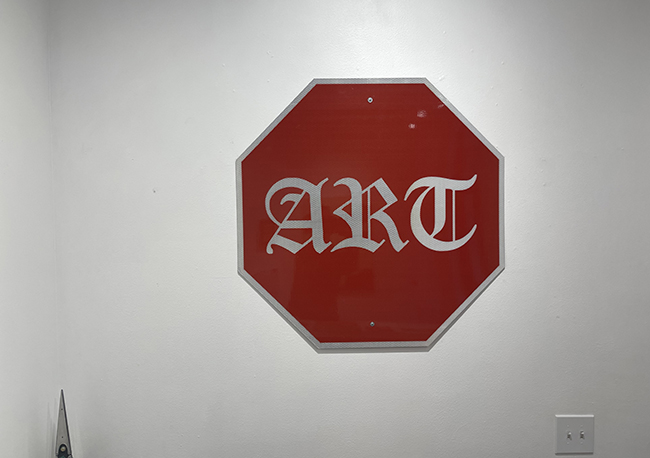
ART Stop Sign II, 2021 Industrial aluminum, diamond grade reflective vinyl.
The post In Pictures: “ART” at Heidi Vaughn Fine Art, Houston appeared first on Glasstire.
Did The Supreme Court Just Take A Sledge Hammer To Copyright's Statutory Damages?
Last week, in a somewhat controversial decision in the TransUnion v. Ramirez case, the Supreme Court ruled, 5 to 4, that plaintiff's in a class action lawsuit did not have standing to sue under the Fair Credit Reporting Act (FRCA). The issue may seem wholly unrelated from copyright, but in reading through the decision, it's possible it could lead to a vastly different world for copyright going forward, because the same issues that the Court finds fault with in the FRCA also apply to copyright law -- and, indeed, it's the part of copyright law that is most widely abused in lawsuits.
I should be clear that I think the holding in the TransUnion case is problematic and seems... well... weird. But if what the majority decided is true, then I don't see how copyright's statutory damages can remain constitutional. Let's dig into the case to explore why. The majority opinion, written by Justice Kavanaugh gives the basic overview right upfront:
To have Article III standing to sue in federal court, plaintiffs must demonstrate, among other things, that they suffered a concrete harm. No concrete harm, no standing. Central to assessing concreteness is whether the asserted harm has a “close relationship” to a harm traditionally recognized as providing a basis for a lawsuit in American courts—such as physical harm, monetary harm, or various intangible harms including (as relevant here) reputational harm.
The issue in this case involved TransUnion's credit reports damaged people by flagging their reports to say that they might be listed on an Office of Federal Assets Control (OFAC) watchlist. Basically, if TransUnion thought that someone's name matched someone on the OFAC list, it would put that in their credit report. For a lot of people who aren't actually on the OFAC list, that can really suck. That resulted in this lawsuit. The court found that for those on that list who could show actual damage, they had standing. But, for others who were flagged by TransUnion, but could not show any actual harm, they did not have standing to sue.
In this case, a class of 8,185 individuals sued TransUnion, a credit reporting agency, in federal court under the Fair Credit Reporting Act. The plaintiffs claimed that TransUnion failed to use reasonable procedures to ensure the accuracy of their credit files, as maintained internally by TransUnion. For 1,853 of the class members, TransUnion provided misleading credit reports to third-party businesses. We conclude that those 1,853 class members have demonstrated concrete reputational harm and thus have Article III standing to sue on the reasonable-procedures claim. The internal credit files of the other 6,332 class members were not provided to third-party businesses during the relevant time period. We conclude that those 6,332 class members have not demonstrated concrete harm and thus lack Article III standing to sue on the reasonable-procedures claim.
The constitutional analysis focuses on the power of the judiciary to deal with actual cases and controversies:
Therefore, we start with the text of the Constitution. Article III confines the federal judicial power to the resolution of “Cases” and “Controversies.” For there to be a case or controversy under Article III, the plaintiff must have a “‘personal stake’” in the case—in other words, standing. Raines, 521 U. S., at 819. To demonstrate their personal stake, plaintiffs must be able to sufficiently answer the question: “‘What’s it to you?’” Scalia, The Doctrine of Standing as an Essential Element of the Separation of Powers, 17 Suffolk U. L. Rev. 881, 882 (1983).
To answer that question in a way sufficient to establish standing, a plaintiff must show (i) that he suffered an injury in fact that is concrete, particularized, and actual or imminent; (ii) that the injury was likely caused by the defendant; and (iii) that the injury would likely be redressed by judicial relief. Lujan v. Defenders of Wildlife, 504 U. S. 555, 560– 561 (1992). If “the plaintiff does not claim to have suffered an injury that the defendant caused and the court can remedy, there is no case or controversy for the federal court to resolve.” Casillas v. Madison Avenue Assocs., Inc., 926 F. 3d 329, 333 (CA7 2019) (Barrett, J.).
So, then the open question is whether or not a law that allows a private right of action over something that is a potential, but not concrete, harm meets the standard. And the majority decides it does not. And then, it goes even further, and notes that even if Congress creates a statutory "prohibition or obligation," courts can't just accept that as evidence of a concrete harm:
Importantly, this Court has rejected the proposition that “a plaintiff automatically satisfies the injury-in-fact requirement whenever a statute grants a person a statutory right and purports to authorize that person to sue to vindicate that right.” Spokeo, 578 U. S., at 341. As the Court emphasized in Spokeo, “Article III standing requires a concrete injury even in the context of a statutory violation.” Ibid.
Congress’s creation of a statutory prohibition or obligation and a cause of action does not relieve courts of their responsibility to independently decide whether a plaintiff has suffered a concrete harm under Article III any more than, for example, Congress’s enactment of a law regulating speech relieves courts of their responsibility to independently decide whether the law violates the First Amendment. Cf. United States v. Eichman, 496 U. S. 310, 317– 318 (1990). As Judge Katsas has rightly stated, “we cannot treat an injury as ‘concrete’ for Article III purposes based only on Congress’s say-so.” Trichell v. Midland Credit Mgmt., Inc., 964 F. 3d 990, 999, n. 2 (CA11 2020) (sitting by designation); see Marbury, 1 Cranch, at 178; see also Raines, 521 U. S., at 820, n. 3; Simon v. Eastern Ky. Welfare Rights Organization, 426 U. S. 26, 41, n. 22 (1976); Muskrat v. United States, 219 U. S. 346, 361–362 (1911).
As the Court then says explicitly, just because someone will have claimed to have violated a statutory cause of action that does not automatically mean there is a concrete harm:
For standing purposes, therefore, an important difference exists between (i) a plaintiff ’s statutory cause of action to sue a defendant over the defendant’s violation of federal law, and (ii) a plaintiff ’s suffering concrete harm because of the defendant’s violation of federal law. Congress may enact legal prohibitions and obligations. And Congress may create causes of action for plaintiffs to sue defendants who violate those legal prohibitions or obligations. But under Article III, an injury in law is not an injury in fact. Only those plaintiffs who have been concretely harmed by a defendant’s statutory violation may sue that private defendant over that violation in federal court.
Indeed, the majority argues that this is, fundamentally, a separation of powers issue:
In sum, the concrete-harm requirement is essential to the Constitution’s separation of powers. To be sure, the concrete-harm requirement can be difficult to apply in some cases. Some advocate that the concrete-harm requirement be ditched altogether, on the theory that it would be more efficient or convenient to simply say that a statutory violation and a cause of action suffice to afford a plaintiff standing. But as the Court has often stated, “the fact that a given law or procedure is efficient, convenient, and useful in facilitating functions of government, standing alone, will not save it if it is contrary to the Constitution.” Chadha, 462 U. S., at 944. So it is here.
The main dissent, written by Justice Thomas (it's an ideologically odd pairing: Justice Thomas with the three Justices most commonly found on the other end of the ideological spectrum: Justices Breyer, Sotomayor, and Kagan) is actually fairly compelling regarding the issue of concrete harm:
The principle that the violation of an individual right gives rise to an actionable harm was widespread at the founding, in early American history, and in many modern cases. See Uzuegbunam, 592 U. S., at ___–___ (slip op., at 5–8) (collecting cases); Havens Realty Corp. v. Coleman, 455 U. S. 363, 373 (1982) (“[T]he actual or threatened injury required by Art. III may exist solely by virtue of statutes creating legal rights, the invasion of which creates standing” (citing cases; brackets and internal quotation marks omitted)). And this understanding accords proper respect for the power of Congress and other legislatures to define legal rights. No one could seriously dispute, for example, that a violation of property rights is actionable, but as a general matter, “[p]roperty rights are created by the State.” Palazzolo v. Rhode Island, 533 U. S. 606, 626 (2001). In light of this history, tradition, and common practice, our test should be clear: So long as a “statute fixes a minimum of recovery . . . , there would seem to be no doubt of the right of one who establishes a technical ground of action to recover this minimum sum without any specific showing of loss.” T. Cooley, Law of Torts *271.3 While the Court today discusses the supposed failure to show “injury in fact,” courts for centuries held that injury in law to a private right was enough to create a case or controversy.
Thomas also goes back to the issue of statutory damages in copyright to prove his point:
The First Congress enacted a law defining copyrights and gave copyright holders the right to sue infringing persons in order to recover statutory damages, even if the holder “could not show monetary loss.” Muransky v. Godiva Chocolatier, Inc., 979 F. 3d 917, 972 (CA11 2020) (Jordan, J., dissenting) (citing Act of May 31, 1790, §2, 1 Stat. 124–125). In the patent context, a defendant challenged an infringement suit brought under a similar law. Along the lines of what TransUnion argues here, the infringer contended that “the making of a machine cannot be an offence, because no action lies, except for actual damage, and there can be no actual damages, or even a rule for damages, for an infringement by making a machine.” Whittemore v. Cutter, 29 F. Cas. 1120, 1121 (No. 17,600) (CC Mass. 1813). Riding circuit, Justice Story rejected that theory, noting that the plaintiff could sue in federal court merely by alleging a violation of a private right: “[W]here the law gives an action for a particular act, the doing of that act imports of itself a damage to the party” because “[e]very violation of a right imports some damage.” Ibid.; cf. Gayler v. Wilder, 10 How. 477, 494 (1851) (patent rights “did not exist at common law”).
But this example in the dissent now seems to serve the opposite point: and effectively argues that under the majority decision, copyright's statutory damages may not be available at all if a plaintiff cannot show "concrete harm."
That's a very big deal in the copyright context. For years, we've pointed out the problematic nature of statutory damages in copyright. Under copyright law, if the work is registered before the infringement, statutory damages are available. And the whole theory behind them is that it's supposedly difficult to show the concrete harm of infringement, and therefore, you don't need to show any actual harm to get statutory damages, and those damages are wholly unrelated to any actual harm. As we noted a decade ago, this makes it "too attractive to sue." Basically, the possible payout from statutory damages, without having show any actual harm or damages at all, is massively distortionary.
And, now, looking at this ruling, it seems that there's an open argument if copyright plaintiffs will now be able to rely on statutory damages if they can't show any harm at all. This wouldn't completely take away statutory damages, but would, at the very least require plaintiffs to show some kind of harm.
Of course, when it comes to copyright law, one of the things we've noted is that courts seem to ignore every other precedent and treat everything related to copyright as if it's different. And, if this issue ever comes back to the court, I'd predict we'd see that same thing again. Judges will bend over backwards to insist that copyright is somehow "different." And it's possible that the majority ruling has an escape valve for that: it mentions repeatedly that part of the way of judging whether or not there's concrete harm is whether or not the issue is "traditionally recognized as providing a basis of a lawsuit in American courts." And, as the Thomas dissent makes clear, that's definitely been the case for copyright law and statutory damages going back basically to the beginning.
However, I do wonder if there's another interesting opening here on that: while in the early 2000s, Larry Lessig pushed a variety of failed cases to try to argue that the massive changes brought about by more recent copyright law changes raised constitutional issues. The Supreme Court rejected those arguments (wrongly in my opinion), but I do wonder if this ruling in TransUnion, at the very least, raises questions about statutory damages under the 1976 Copyright Act, since it covers so much more content, for so much longer, than was "traditional" under copyright law for the first two centuries of the country.
Attention, Wheelchair Users: Our Brewery Has Decided to Accommodate You (Within Reason)
Dear Patrons of Brews For All,
You’re probably aware of the bad press we received this week. We got a call from a would-be customer the other night asking if we were wheelchair accessible, and we let her know that she had the wrong number for the AARP before hanging up on her. She called back and explained that apparently, young people also use wheelchairs? We pride ourselves on being a progressive and inclusive environment, so to avoid a potential lawsuit, we made our brewery the bare minimum of accessible. Here’s what our hot, young wheelchair-using patrons can expect moving forward.
When you show up, challenge yourself by parallel parking in the accessible parking spot along the busy road. If you drove yourself here, you’ll get to open your door into oncoming traffic. If you carpooled with friends (so inspiring that you even have friends), we hope they’re top-notch parallel parkers who can get you close enough to the curb that you don’t have to straddle the abyss between the passenger’s seat and the curbside.
Upon arriving, simply find our phone number online, give us a call, and someone will be out shortly to lead you to our new accessible entrance. You will then be guided around the side of the building and past our dumpster to our plywood, non-ADA compliant ramp. (We spent a lot of money remodeling this gentrified industrial building to look rustic chic, so we can’t just ruin the aesthetic of a converted beef slaughterhouse by putting a ramp in front of the building.)
The door to get inside is quite heavy, but since you’re already being escorted, we’re sure the host will open it for you. Then you will be given a brief tour through our kitchen (watch out for those knives). From there, you’ll get to bob and weave through a crowded room of butts to find your way to the bar where you will be given a tap list. We serve small-batch beers crafted by the most socially conscious brewers in town. In addition, to celebrate #mancrushmonday, #nonbinarybabetuesday, and #womancrushwednesday, we offer half-price drinks to those who identify with the appropriate hashtag.
If you wind up having more than one pint and need to pee, keep in mind that this is a historic building. To update the space, we added a bar, replaced all the floors, and had to bring electrical and plumbing to code. However, we decided to keep the ridiculous split level layout the same as it was in the 1870s — we felt it culturally important to do so. Anyway, the restroom is up two steep, oddly-spaced stairs. There’s only one stall, so you might have to wait a bit, but we’re guessing that will be nothing new for you.
After some brews, how about trying some vegetarian nachos or a wood-fired pizza? You’ll have to order at the bar, but we’ll be sure to keep the music at a level where we will get your order at least half right if you yell as loudly as you can at the staff. Once you place your order, feel free to choose a seat at any of our tables. For a modern look, all tables are bar height. Although your party will only be able to see your eyes across the table, it will be easier for you to shovel our delicious, locally sourced, non-GMO meals into your face. By the way, how clever of you to bring your own chair. You really know how to come prepared.
We sure hope you appreciate these reasonable accommodations that we’ve made so that you too can participate in normal, everyday life.
Cheers!
— Brews For All