Shared posts

17 Mar 12:10

A Reliable 'Assimilation' For Episode 3 Of Star Trek: Picard Season 2

by Witney Seibold

It's astonishing what a departure the second season of "Picard" is from the first. There may still be some lingering trepidation from those who recall the awfulness and the absurdity of "Picard"'s first season, but there may come a point soon where one can cease waiting for the other shoe to drop.

In the first episode of "Star Trek: Picard," Q (John de Lancie) had whisked Picard (as well as the rest of the show's cast, for reasons he didn't explain) into an alternate timeline wherein Earth was a galaxy-wide fascist dictatorship systematically committing multi-species genocide. At the end of the second episode, the cast kidnapped the Borg Queen (Annie Wersching) with the intent of using her massive intellect — as well an ineffable interdimensional sense she possesses — to pull a "Star Trek IV: The Voyage Home," and travel back in time to 2024 Los Angeles to discover the point when Earth split into the dark timeline. 

Note from a Trekkie: I did appreciate the detail that the "slingshot" time travel technique used in "The Voyage Home," repeated here, requires massively complicated calculations to be made on the fly, and only rare minds can handle it. Here, it's a pan-dimensional cyborg semi-deity. In "Voyage Home," it was merely Spock, whom Dr. Jurati (Alison Pill) namechecks. And before you think "Picard" is merely deifying Spock as some sort of untouchable superbeing, the writers seem to be playing fair. There is a common danger writers have committed in nostalgia-inspired remakes and reboots to over-emphasize the importance of characters already beloved by the audience, whether or not it fits logically into the story. Recall the three "Star Wars" prequels wherein Darth Vader was blown up from an evil thug into essentially an anti-Messiah figure. For the retcon of Spock in this episode of "Picard," recall that "Voyage Home" was shortly after Spock had been resurrected from the dead, and was, at that point, more purely intellect than ever before. As such, he was able to make those complex calculations. 

Fish-out-of-water

But to the task at hand: In episode three, "Assimilation," Picard's quest can begin in earnest. With only a clue as to the time and place where a timeline divergence will occur, the cast beams down to 21st-century L.A. to begin sniffing around as to what might have happened. Raffi and Seven (Michelle Hurd and Jeri Ryan) have to sneak into a skyscraper by posing as girlfriends, while Capt. Rios (Santiago Cabrera) immediately sustains an injury and falls in with a local hospital that is constantly being raided by ICE. Dr. Jurati and Picard (Patrick Stewart) remain in orbit with the Borg Queen, hoping to interrogate her and find out more about their mission. I will leave the fate of Elnor (Evan Evagora) for you to discover.

While time-travel-based, fish-out-of-water, lost-on-an-Earth-we-don't-recognize stories are commonly revisited throughout "Star Trek," it is, nonetheless, a reliable trope. How will an enlightened 24th-century character respond to the brutal and uncivilized present? It's a question that is always fun to ask. This was a story used not only in "The Voyage Home," but the episodes "City on the Edge of Forever" (Kirk and Spock during the Depression), "Time's Arrow" (Picard and co. meet Mark Twain), "Past Tense," (Sisko and crew in a dystopian near-future), "Little Green Men" (Quark at Roswell), "Future's End" (Janeway faces off against a Bill Gates-like computer whiz in 1996), "Carbon Creek" (T'pol and Vulcans watch "I Love Lucy"), and other episodes besides. 

I was also — perhaps regrettably — reminded of "Inhumans," a TV show connected to the MCU which seems to have been conveniently forgotten by fans of the Avengers. The conceit of the show was that a group of superpowered Moon-dwellers (one of them played by Anson Mount, who is playing Capt. Pike on the upcoming "Star Trek: Strange New Worlds"), after a coup in their hidden Moon city, are scattered on Earth and are forced to find one another again and return home, undetected. I bring up "Inhumans" not to cast aspersions on the fish-out-of-water story idea — "Inhumans" was poorly received — but to point out how dependable it is. Watching Picard carefully traverse the past is going to be fun, and situations grow organically out of the characters' investigation.

Picard Is No Longer An Android

The episode's title comes from a scene aboard the U.S.S. Stargazer wherein Picard oversees a partial assimilation of Dr. Jurati by the Borg Queen. The Borg Queen, being impish and sinister, refuses to reveal details about Picard's mission without something in exchange, and Jurati figures that she can tap into the Borg Queen's brain directly by becoming a Borg, but then pulling herself out before the assimilation can "take," as it were. Being deliberately assimilated is also a conceit used before, as the crew of the Voyager did it on their show. Given that so many people have been un-assimilated at this point in "Star Trek's" history, it's seeming less and less threatening all the time. Needless to say, Jurati and Picard's plan works. 

Perhaps this Trekkie is dense, but it only occurred to me in episode three that Picard is no longer an android. At the end of "Picard's" first season, in order to save his life, Picard's consciousness was shunted into an android body that was made to look exactly like him, and also age the way a human body would. This was a controversial conceit, and a pretty silly one, even by "Star Trek" standards. As Q had inserted the cast into the alternate versions of themselves, they now have the bodies of their counterparts. Seven of Nine no longer had Borg implants, and it's safe to assume that Picard has gone back to being 100% organic, including his notorious artificial heart.

"Star Trek" in the Paramount+ era has been a constant push-and-pull between introducing new ideas and then retracting them once the writers realized they were bad. In "Discovery," for instance, the title ship can teleport anywhere in the galaxy, effectively making starships — and trekking — obsolete. In order to fit teleportation technology into the story, the writers had to think of a way to erase the U.S.S. Discovery from Trek's own timeline so that other shows (set after "Discovery") would have an organic reason to never discuss the ship's astonishing technology. Picard's android body was a silly idea that was thrown in at the conclusion of season one, almost as an afterthought, and without any sort of meaningful thematic reason. Season two seems to be, like "Discovery" on a constant path of correction. 

"Picard," however, is having an easier time of it. For the first time in a long time, I'm eager to see what happens next on a "Star Trek" show.

Read this next: 13 Shows Like Manifest You Can Binge Watch Right Now

The post A Reliable 'Assimilation' for Episode 3 of Star Trek: Picard Season 2 appeared first on /Film.

17 Mar 11:53

Now That White Musicians Are Getting Sued For Copyright, Lawyers Say Copyright Needs To Change

by Mike Masnick

You may have noticed a whole bunch of stories about copyright lawsuits lately against famous musicians for having songs that sound just kind of like some other songs. I’d been meaning to write up something talking about all of these stories about how Ed Sheeran is supposedly a “magpie” who “borrows” songs, or about how Dua Lipa was sued not once, but twice, claiming her song “Levitating” infringes on the copyrights of others. Or maybe about how it took Katy Perry eight years to finally have an appeals court note that she didn’t actually infringe on someone else’s copyright.

But then I came across this moderately infuriating Guardian article talking about a few of these cases, and saying that “music industry figures” are claiming that all of these lawsuits show how copyright needs to change because “making music is so different to how it was 50 years ago.”

Hayleigh Bosher, associate dean of intellectual property law at Brunel University, who researches the music industry, said “the law needs to move with the times” as “making music is so different to how it was 50 years ago”.

She added: If Sheeran loses, I imagine we will see even more cases. I don’t think copyright is doing its job properly if songwriters are afraid, that’s stifling creativity.”

And, yes, obviously, copyright law needs to change. These lawsuits are crazy, and we’ve been saying that for a long while now.

But there seems to be something worth noting when the industry is only starting to come around on this because of a bunch of lawsuits targeting famous white songwriters. Because for all the talk about how “music is so different” today, we went through another period of time when a whole bunch of brilliant musicians were sued over copyright infringement… and the response from the industry was a lot more muted.

Back in the late 80s and early 90s there was a flood of sampling lawsuits — almost all of which were targeting hip hop artists. And then you had crazy legal rulings like Bridgeport Music v. Dimension Films in which a court announced “get a license or do not sample” and (ridiculously) “we do not see this as stifling creativity in any significant way.”

But did we see the music industry screaming about how we needed to fix copyright laws back then? Nope. If you haven’t seen it, I highly recommend watching Kembrew McLeod’s one hour documentary Copyright Criminals (which, apparently, is now available on YouTube), which does such a great job of showing how copyright basically destroyed a whole genre of hip hop music, but the industry didn’t much care, because hip hop involved mostly artists of color, rather than white pop music.

One great line in that documentary is that after someone says that hip hop artists sampling other musicians is “lazy,” someone notes that it’s not that different than saying a photographer is lazier than a painter because they just snap a picture of what’s already there, rather than painting it from scratch.

The simple fact is that copyright law has gotten in the way of creativity for ages. Creativity has always been based on building on the works of people who came before you. Sometimes it’s homage. Sometimes it’s appropriation. Sometimes it’s just because there are only so many ways certain notes can be played together.

But if people are getting sued over creating new music, and musicians are now afraid of getting sued for making music, then it’s a huge problem. And it was a huge problem in the 80s, 90s, 2000s and today. Perhaps it’s good that more people are realizing how broken the system is and how it’s stifling creativity, but it does seem at least slightly infuriating that it’s only once it’s famous white pop singers are facing the same thing that black hip hop artists faced in the 80s and 90s that its treated as a “real” problem.

17 Mar 00:21

Doctor Who: The Daleks' Timeline Explained

by Lee Adams

Even if you've never seen an episode of "Doctor Who," you'll probably be familiar with the Time Lord's archnemeses, the Daleks. From their humble beginnings in the early '60s, the incredibly cranky hostile aliens have become some of the most iconic baddies in all of sci-fi. Sure, it's easy to poke fun at their creaky early appearances, bumping around the cardboard sets and ubiquitous quarries that served as alien planets in many of the classic episodes. 

They were hellbent on galactic conquest but scuppered by a flight of stairs, as the most common old joke goes. Later incarnations rectified that problem, fitting them with jet boosters so they could fly around, plus improving their arsenal beyond the classic laser/toilet plunger combo. Yet the basic design remained the same and the fact is they are deeply unsettling, with their turret-like head, telescopic eye-scanner thing, and their chilling desire to exterminate anything that isn't a Dalek.

The very first Doctor, William Hartnell, encountered the Daleks in a seven-part 1963 serial known simply as "The Daleks," which gave the creatures their first backstory. They have been regular adversaries for every Doctor since apart from the Eighth, Paul McGann, although other media took care of that for him. As the series developed in the '70s, the show writer Terry Nation indulged in a bit of revisionism and created a second origin story for his most famous creations in the revered 1975 serial "Genesis of the Daleks." As if things weren't confusing enough, trying to keep track of the chronology of a time-traveling Time Lord and his time-traveling archenemies.

The BBC retconned that in 2021 with their official timeline of the Daleks, changing it so the First Doctor's first encounter with them actually happened a century later in the Dalek's timeline. Now the Doctor apparently bumped into a separate faction that stayed behind on their home planet, Skaro, while the others went off through time and space looking for new worlds to conquer. Are we all clear so far?

Me neither, but hang in there. I've only ever been the most casual "Doctor Who" viewer, maybe catching one or two episodes of each regeneration since the show was revamped in 2005. I loved it as a kid, but then I was only really in it for the aliens and paid little attention to all the lore stuff. Let's make no mistake about it, there is an incredible amount of "Doctor Who" lore, from 298 stories over 869 episodes spread across the past six decades. That's before you get into the additional material from books, audio, and other media. Even dedicated Whovians acknowledge that the chronology of events can be a little tricky at the best of times, so what hope would I have? Well, here's what I found out...

So What Is A Dalek, And Where Do They Come From?

The Daleks are hideously mutated blobs shuttling about inside their own personal mini-tanks created by Davros, a mad scientist type from the planet Skaro. Davros was badly injured during a Thousand Year War between his race, the Kaleds, and their mortal enemies, the Thaleds. He was first introduced in that landmark episode "Genesis of the Daleks," where the Fourth Doctor (Tom Baker) is sent back in time to prevent the creation of the Daleks and stop them becoming the dominant species in the universe. 

If you've ever wondered why the Daleks were so fond of exterminating everything, all the clues are here. Terry Nation grew up during World War II (via Warped Factor) and was inspired by the Nazis when it came to inventing the Daleks. He really leans into the comparison in "Genesis;" the Kaleds are really into sinister black military attire, Iron Cross accoutrements, throwing around Heil Hitler-style salutes, and have an obsession with racial purity.

Davros, blind and confined to a fancy wheelchair which carried his life support systems, sold out his own people to speed along his development of genetically enhanced mutants, end the war, and ensure the survival of his race. For an escapist show like "Doctor Who" this story is pretty bleak, envisioning a planet ravaged by nuclear warfare, melding the spectre of Nazism with stark Cold War terror. The Doctor can't bring himself to commit genocide and end the full production of the Daleks before it begins, although an accident does it for him, setting their development back many years. The Daleks eventually turn on their creator, exterminating Davros because he isn't pure enough for them.

The Doctor's involvement with Davros began long before the scientist dreamed up his infamous creations, however. In the two-parter "The Magician's Apprentice/The Witch's Familiar," the Twelfth Doctor (Peter Capaldi) encounters a frightened young boy on a battlefield much earlier in the Thousand Year War, surrounded by deadly "Hand mines." The Doctor initially leaves him to die when he realizes the kid will grow up to become the creator of the Daleks, but returns later to save him and seed the notion of mercy in the boy's mind. This has serious life-saving repercussions for the Doctor's companion, Clara (Jenna Coleman), in many centuries' time when the story concludes.

Out Into The Universe ... And To Earth

Some time after the setback at the end of "Genesis of the Daleks," the evil aliens develop space travel and time travel, setting out into the universe looking for new planets to terrorize and conquer. This gimmick allowed the series' writers to put them in all sorts of fun historical settings, from Ancient Egypt ("The Daleks' Master Plan") and the Mary Celeste ("The Chase"), to supposedly helping out Winston Churchill and the Allies fight off the Luftwaffe during World War II ("Victory of the Daleks"). The latter story gave the "Ironsides" a sweet British army green paint job and gave us Spitfires in space. 

Out of all the billions of worlds in the universe, the Daleks have a particular fixation with Earth, resulting in dozens of invasion plans over the decades. An early attempt came in a more recent episode, "Resolution," where a Reconnaissance Scout landed on our planet in the 9th century, only to be thwarted by warring factions banding together to defeat it and dispatch its dismembered parts to the far-flung reaches of the globe. You can't keep an evil Dalek down, however, and an archaeologist in the 21st century unwittingly unearthed one of the pieces, which revived its missing parts and caused more havoc. Luckily, the Thirteenth Doctor (Jodie Whittaker) was on hand to cast it into a supernova before it could summon the Dalek fleet.

Returning to the early days of the show — that is, the period from the First Doctor's initial encounter with the Daleks and the Fourth Doctor's failure to annihilate them in "Genesis of the Daleks" — showdowns with the irate cyborgs skipped between adventures in the then-present day and the far future. Shortly before the seminal episode "The Daleks," they attempted to conquer Earth in the 21st Century ("Dalek Invasion of Earth"), with several Daleks trundling around London.

Without having to worry about a canonical timeline, the show's original writers gave us several dastardly Dalek masterplans, from trying to eliminate the Doctor while hiring The Master to start a space war ("Frontier in Space"), altering history to make their earlier invasion plan succeed ("The Day of the Daleks"), attempting to implant mankind with the "Dalek Factor" to make us more like them ("The Power of the Daleks"), and holding the galaxy to ransom with a lethal plague ("Death to the Daleks").

Even the Seventh Doctor (Sylvester McCoy) had an adventure set during this time period, returning to 1963 to retrieve the Hand of Omega, a powerful Time Lord weapon that the First Doctor left behind ("Remembrance of the Daleks") before tricking Davros into firing it and destroying Skaro. But wasn't Davros exterminated by the Daleks in "Genesis of the Daleks?" Yeah, about that...

Davros Makes A Comeback...

For all their lethal machinations, the Daleks eventually turned to their old creator Davros for help in the 46th century when they got embroiled in a war with another alien race, the Movellans. It turned out that he wasn't exterminated after all, just held in suspended animation and covered in cobwebs ("Destiny of the Daleks"). Luckily, the Fourth Doctor was able to apprehend Davros and put him in cryogenic freezing to await trial for his heinous crimes.

Now realizing that the Time Lords had been meddling with their timeline, the Daleks teamed up with Davros once again in "Resurrection of the Daleks," breaking him out of a prison ship in the far future to hatch another scheme, this time to clone the Fifth Doctor (Peter Davison) and his companions in an attempt to assassinate the Time Lord high council on Gallifrey, the Doctor's home planet.

Thwarted once again, Davros repaired to the planet Necros with a rather ghoulish plot to create another strain of Daleks using corpses ("Revelation of the Daleks"). Chronologically, this was the last Classic episode featuring the Daleks, with the Sixth Doctor (Colin Baker) in his colorful clown coat taking care of business this time.

Davros made his "Doctor Who" revival return in the two-parter "The Stolen Earth/Journey's End," where Earth was once again under threat from a massive Dalek invasion. The ambitious storyline not only crossed over with characters from two spin-offs, "Torchwood" and "The Sarah Jane Adventures," it also caught fans on the hop with the Tenth Doctor's (David Tennant) premature regeneration. You can get pills for that, mate!

Further Davros adventures followed, including the aforementioned "The Magician's Apprentice/The Witch's Familiar," which served as a prequel to the whole Davros saga. It was a heartfelt renewal of hostilities between Davros and the Twelfth Doctor, with the cunning mastermind preying on the Time Lord's innate compassion to spring another trap on Skaro.

The Time War

The earlier attempt by the Seventh Doctor to destroy Skaro led to the Time War, which came to a spectacular head in "The Day of the Doctor." This epic conflicted between the Time Lords and the Daleks lasted for around 400 years, although was spread over many millennia as they battled across space and time (via Tardis Fandom). There were allusions to the Time War in Classic storylines, but it only became a major plot point for the series from the 2005 revival onwards. "The Day of the Doctor" was a huge event to celebrate the show's 50th anniversary, claiming a Guinness World Record for the largest ever simultaneous screening of a TV show, broadcast to 94 countries worldwide and showing in select cinemas (via The Guardian).

Even I tuned in for that one, although I found the lore a bit bewildering. The BBC certainly pulled out all the stops for the episode, with a marauding Dalek fleet and a massive battle on Gallifrey. The action was a far cry from the endearingly rickety effects of the First Doctor's original adventures, which were the focus of "An Adventure in Time and Space," screened a few days earlier as part of the half-century celebrations.

The story was a major event in both the Time Lords and the Daleks' timelines. It introduced the "War Doctor" (John Hurt), who decided to end the Time War by using an ancient super weapon called the Moment to wipe out both sides. Meeting up with the Tenth and Eleventh Doctors (Matt Smith) to carry out the terrible but necessary deed, the latter's companion, Clara, convinced them there must be a better way. Summoning the help of their previous incarnations, they managed to tuck Gallifrey away in a pocket universe at the last moment, causing the Dalek fleet to destroy itself in the cataclysmic crossfire.

After The Time War And Beyond...

A lone Dalek survivor was discovered on Earth by a raging Ninth Doctor (Christopher Eccleston) in "Dalek," but blew itself up when it couldn't cope with emotions resulting from its DNA being tainted by that of the Doctor's companion, Rose (Billie Piper). Some of the most notable Dalek survivors of the Time War were the Cult of Skaro, who returned to Earth in "Doomsday" with an Ark full of imprisoned Daleks, but got caught up in street warfare with those other classic "Doctor Who" villains, the Cybermen.

The Cult of Skaro were up to the old time-traveling tricks again in the two-parter "Daleks in Manhattan/Evolution of the Daleks," where the Tenth Doctor headed to 1930s New York to rumble their ghastly attempts to create a squid-headed human-Dalek hybrid.

Although the Fourth Doctor (Tom Baker) said in "Genesis of the Daleks" that his enemy had been around for 25,000 years, adventures far beyond that scope appeared in the new "Doctor Who" episodes. In "Bad Wolf/Parting of the Ways," the Ninth Doctor encountered his old foe in the distant future, set in the year 200,100.

In the present day timeline, the Thirteenth Doctor (Whittaker) had a further encounter with the Daleks in "Revolution of the Daleks," when an unscrupulous tycoon used parts of the recon scout from "Resolution" to build his own fleet of defense drones. This allowed the resurrected Dalek to build its own army, only to be wiped out by a Dalek death squad for being impure.

Jodie Whittaker is nearing the end of her tenure as the Time Lord, resulting in fevered rumors about who will take her place as the Fourteenth Doctor. There are some fascinating names in the hat for the next go at the TARDIS controls including Danny Dyer, Phoebe Waller-Bridge, Hugh Grant, and Richard Ayoade. Either one of those might be enough to turn me into a Whovian, but boringly the bookies favor David Tennant having another stint in the role. Whoever eventually gets the part, you can be sure that they will face off against sometime in the future ... or past, as the case may be. 

Read this next: The 10 Best Sci-Fi Movie Villains

The post Doctor Who: The Daleks' Timeline Explained appeared first on /Film.

16 Mar 23:56

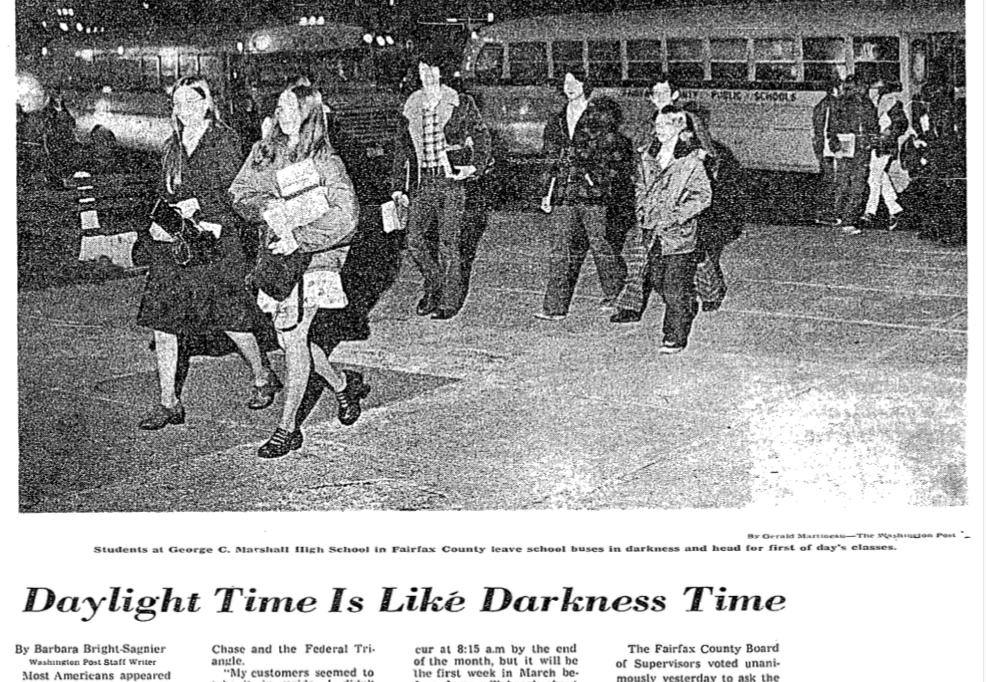
The US Tried Permanent Daylight Saving Time in the ’70s. People Hated It

by Andrew Beaujon
The sun rose at 8:27 AM on January 7, 1974. Children in the Washington area had left for school in the dark that morning, thanks to a new national experiment during a wrenching energy crisis: most of the US went to year-round daylight saving time beginning on January 6. “It was jet black” outside when […]
16 Mar 23:55

NameGrapher to explore past baby name trends

by Nathan Yau

NameGrapher is an interactive chart that lets you explore historical trends for baby names in the United States. Search for a name, and the chart updates as you enter more letters.

The chart is from Martin and Laura Wattenberg, and if it looks familiar to you, it’s because it’s an updated version of the now defunct NameVoyager they made in 2005. The new version, which also uses a stacked area chart to show name totals for boys and girls over time, also provides a few more search options and lets you compare multiple time series at once.

I’m glad it’s back. The NameVoyager was one of the first visualizations I ever saw, and it felt like something special was lost when the site shut down.

Tags: baby names, Laura Wattenberg, Martin Wattenberg

16 Mar 23:55

The Senate just voted to make daylight saving time permanent. Good.

by Brian Resnick
Sunrise in New York City.
If daylight saving time is extended all year long, sunrises and sunset will occur later all year long. | Gary Hershorn/Getty Images

The case against changing clocks is less about extending sunsets later all year and more about staying consistent.

It’s happened: On Tuesday, the US Senate voted unanimously to make daylight saving time permanent beginning in 2023. Perhaps the unambiguous results were influenced by the fact that most of us just turned clocks forward on Sunday, and the disruptiveness of it is still on the lawmakers’ minds.

While in recent years various states have passed pieces of legislation that would extend daylight saving time hours, this vote by the US Senate is the biggest move yet. If the legislation proceeds to the House and then the president, Americans will no longer have to change their clocks twice a year. (It’s not currently clear that the House will take on the legislation at all.)

The benefits of extending daylight saving time all year — or just keeping standard time all year — are more widespread than avoiding the hassle of resetting the clocks (even if many timepieces these days do this automatically).

At most, it could potentially also improve our collective health, and possibly prevent some automobile accidents. It would at least prevent some groaning and hassle as people lose an hour of sleep when daylight saving time starts in the spring. And who wouldn’t want that?

Daylight saving time started to conserve energy. It didn’t work.

Daylight saving time in the US started as an energy conservation trick during World War I and became a national standard in the 1960s. The idea is that in the summer months, we shift the number of daylight hours we get into the evening. So if the sun sets at 8 pm instead of 7 pm, we’d presumably spend less time with the lights on in our homes at night, saving electricity.

It also means that you’re less likely to sleep through daylight hours in the morning since those are shifted an hour later too. Hence “saving” daylight hours for the most productive time of the day.

But this premise never seemed to pan out. The presumed electricity savings of taking advantage of more daylight in the evening turns out to be unclear or nonexistent.

What’s more, not only is daylight saving time ineffective, the name is just confusing.

Daylight saving time — and yes, it’s “saving time” and not “savings time”— begins in the spring, just as the increase in daylight hours starts to be noticeably longer. What’s more, the number of daylight hours that fall upon our vast, beautiful country isn’t affected by the practice. Those are determined by the tilt of Earth’s axis and our planet’s position in its orbit around the sun. And those, we are quite powerless to change.

Extending daylight saving time year-round would mean later sunsets year-round

So if the House and the president actually go through with this, what will change?

Blogger and cartographer Andy Woodruff decided to visualize this with a great series of maps. The goal of these maps is to show how abolishing daylight saving time, extending it all year, or going with the status quo changes the number of days we have “reasonable” sunrise and sunset times.

Reasonable, as defined by Woodruff, is the sun rising at 7 am or earlier or setting after 5 pm (so one could, conceivably, spend some time in the sun before or after work).

This is what the map looks like under the status quo of twice-yearly clock shifts. A lot of people have unreasonable sunrise times (the dark spots) for much of the year:

Daylight saving time as currently observed. Andy Woodruff

Here’s how things would change if daylight saving were abolished (that is, if we just stuck to the time set in the winter all year). It’s better, particularly on the sunrise end:

If daylight saving time were abolished. Andy Woodruff

And here’s what would happen if daylight saving were always in effect. The sunrise situation would actually be worse for most people. But many more people would enjoy after-work light.

If daylight saving time were always in effect. Andy Woodruff

The case for consistency

Individuals might differ on which of the above maps they prefer. But it matters less whether we keep daylight saving time year-round or abolish it completely; the real benefits come from not flip-flopping back and forth twice a year.

It’s more this: Sleep scientists continually advocate that, for optimal health, people should stick to the same sleep schedule every night, going to bed and waking at the same hours each day. When we shift clocks forward one hour in the spring, many of us will lose that hour of sleep. In the days after daylight saving time starts, our biological clocks are a little bit off. It’s like the whole country has been given an hour of jet lag.

One hour of lost sleep sounds like a small change, but we humans are fragile, sensitive animals. Jet lag can mess with our metabolism; extreme versions of it can contribute to diabetes or obesity. But in the short term, jet lag dulls our mental edge.

And when our biological clocks are off, everything about us is out of sync. Our bodies run this tight schedule to try to keep up with our actions. Since we usually eat a meal after waking up, we produce the most insulin in the morning. We’re primed to metabolize breakfast before even taking a bite. It’s more efficient that way.

Being an hour off schedule means our bodies are not prepared for our actions at any time of the day.

One example: driving.

In 1999, researchers at Johns Hopkins and Stanford universities wanted to find out what happens on the road when millions of drivers have their sleep disrupted.

Analyzing 21 years of fatal car crash data from the US National Highway Transportation Safety Administration, they found a very small but significant increase in road deaths on the Monday after the clock shift in the spring: The number of deadly accidents jumped to an average of 83.5 on the “spring forward” Monday compared with an average of 78.2 on a typical Monday.

And it seems it’s not just car accidents. Evidence has also mounted of an increase in incidences of workplace injuries and heart attacks in the days after we spring forward.

Many Americans might not welcome extending daylight saving all year. There was a year in the 1970s when daylight saving time lasted for 16 months, and not everyone was pleased. Polling at the time found that just 30 percent of Americans approved of the change after it began. According to the Washington Post, “parents were suddenly sending their kids to school in the cold and the dark for months on end,” which drove the negative sentiment.

But for those thinking “I don’t want later sunset times all year long!” or “I don’t want to start my day in the winter amid darkness!” know that it’s always been possible for our society to just ... gradually change school or work start times depending on the season.

16 Mar 23:47

New York Times Begins The ‘Wordle’ IP Purge, Gets ‘Wordle Archive’ Taken Down

by Dark Helmet

There are lots of reasons to have fallen in love with Wordle. The simple nature of the game. The ability to post spoiler-friendly brags for how you did on any given puzzle. The clean design. But here at Techdirt, we obviously became smitten with how Wordle’s creator, Josh Wardle, professed no interest in the ongoing monetization combined with zero interest in wrapping any IP around the game. In fact, the couple of times that other folks out there attempted to build Wordle clones or apps that had similar names and monetize them, Josh handled it all as kindly as possible.

But then Josh sold Wordle to the New York Times. When that happened, we wondered aloud:

It will be interesting to see if suddenly “IP issues” start becoming a bigger deal to the NY Times than they were to the original developer…

Which brings us to the present, a few weeks later, with the New York Times getting ‘Wordle Archive,’ a site to go and play past Wordle puzzles, to “voluntarily” shut down.

Wordle Archive was a service dedicated to the preservation of previous Wordle answers, allowing fans to dip into the backlog and play older puzzles, dating all the way back to the first one. However, the service has since been shut down at the request of the New York Times, as announced by an update on the application’s webpage.

The announcement thanks fans for their interest in the Wordle Archive and thanks them for their feedback throughout its life. It goes on to explain the situation and tell fans that its own original game, Word Grid, is still available for those that are interested in playing something similar. However, it is no longer possible to access that version of Wordle Archive, which many fans have used.

And so it has begun. An app created for others to have some simple and innocent fun by a man who very clearly had no interest in bullying others over intellectual property concerns is now in the hands of a media company that has decided to take the exact opposite route. And this will likely be the first move in a larger conflict, so long as the public backlash doesn’t get the Times to reverse course. There are plenty of other related apps and sites harkening back to Wordle. Will the Times be going after those as well? Probably, yes.

The shutdown does raise questions about similar games and services. In the time since Wordle saw its own explosive popularity, other games with similar mechanics have emerged. One clear example of this is Lewdle, which is essentially Wordle using strictly lewd words. Other similar games have also popped up, using similar restrictions or some other sort of twist on the formula.

And so the legacy of Wordle moves from one of pure enjoyment and care-free fun into the realm of intellectual property enforcement and corporatization.

Yay.

16 Mar 23:45

A Compliment

by Reza

16 Mar 23:44

we gave an expensive goodbye gift and the person didn’t leave

by Ask a Manager

This post, we gave an expensive goodbye gift and the person didn’t leave , was originally published by Alison Green on Ask a Manager.

A reader writes:

We have an executive assistant at my company who has been there for five years. She doesn’t make much effort to be social to the rest of us, but the executives she works for have a hard time keeping assistants and seem to get along well with her.

She got a job offer at another company and the salary was too good to turn down. She left on good terms and her main boss, who rarely acknowledged when anyone else in his department left for new pastures, really went all out for a goodbye. A going away party, conference room cake, bar happy hour with the tab picked up, and … a collection taken up for a goodbye gift. Even though she wasn’t that friendly to most of us, we still threw in our $20 each or whatever. The high level executives must have contributed much more than that, because the “department” ended up getting her an extremely nice and extremely expensive designer handbag. (Something they had never done for anyone else.)

As it turned out, she hated the new job and, after one week, called her old boss and asked for her position back. He hadn’t hired a replacement yet and was thrilled to take her back. All good. But … this goodbye present handbag! She returned to her old position and has proceeded to wear the new luxury bag to work every day, and it is making some people crazy.

I’m not sure what she was supposed to do. She had probably already worn the purse to the new job, making it too used to return. But she is walking around work with this VERY expensive handbag as a goodbye present for the job she never left. It has become the office joke now that anytime someone announces they are leaving, it is met with, “Oh sure, just resign, get a purse and oops, just kidding, I’m going to stay after all!”

Most of us don’t really care, but the jokes and comments are flying around the office about it. And some of the employees who contributed were low level, felt pressured to contribute, and are now resentful. I think the executives personally picked up the majority of the cost on this thing (they were excited for her going to a fancy new place and wanted to send her off in style), but they still took up a collection for a goodbye gift when they have never done anything that fancy for anyone else. And then she never really left! What should she have done? Keep the bag? Give the bag back? Wear the bag? Keep the bag but avoid wearing it to work? The rest of us should just accept that it was a gift and hey, things happen?

I think this is less about the assistant keeping a goodbye gift when she ended up coming back and more about the gift practices in your office.

It’s not cool to make people feel pressured into contributing money to gifts — ever, but particularly not when it’s only done for one person. You could argue for an exception when the person leaving occupies a low-level job that most people on staff benefit from, such as a long-time receptionist or cleaner, and where the people chipping in all make comfortable salaries. But that doesn’t sound like the case here; it sounds like the assistant worked for a small group of executives. Those executives could/should have given her a gift themselves if they’d wanted to, but pressuring the whole office to contribute was a misstep. (And $20 would be a lot to chip in for many people!)

Better yet, if the company wants to give goodbye gifts, the company should pay for it (as many companies do).

But it’s not the assistant’s fault that it happened. Ideally she would have recognized that the optics are a little weird (not outrageously weird, but a little weird) and done something to address those. In theory she could have asked if people would like the gift back (an empty offer since, as you point out, the bag couldn’t be returned once used — but it would be a gesture toward “hey, I see the dynamics here”). If she’d written to me, I might have advised her to make a gesture of a different sort, like bringing in baked goods for the office one morning, framed as “thanks for giving me such a nice send-off and then welcoming me back anyway!” She doesn’t have to do anything like that — again, she hasn’t done anything wrong — but it could be smart, especially if she’s picking up on any of the resentment from low-level colleagues who felt pressured to contribute.

But meanwhile, yeah, the rest of you should accept that it was a gift, this stuff happens, it’s not her fault, and there’s no real way to get anyone their money back. You should all let it strengthen your resolve to push back the next time a collection is suggested though — not because this goodbye gift ended up being unneeded, but because it’s a bad practice generally.

16 Mar 23:39

bringing in muffins after a mistake at work, my coworker talked to HR about my mental health, and more

by Ask a Manager

This post, bringing in muffins after a mistake at work, my coworker talked to HR about my mental health, and more , was originally published by Alison Green on Ask a Manager.

It’s five answers to five questions. Here we go…

1. My coworkers had to work late when I messed up — should I bring in muffins?

I’m the newest, youngest, and lowest-ranking employee at my small office. We have a big recurring deadline every three weeks, and it’s very common for most higher-ranking staff to be up fairly late the night before to meet this deadline. I am usually not very involved in the big project due to the nature of my job, but this time, I was given a very large chunk of the workload, which was exciting but proved a bit too much for me to handle so soon into my role. As such, I was late in making my deadline, which made everyone else have to stay somewhat later as a result.

What are my obligations here to make amends for this? Do I bring in muffins or donuts the next day to make up for having “taken away” some sleep from everyone? I have already apologized (politely and not excessively) to everyone as necessary and have planned to talk to my boss about what happened and what I/we can do in the future to prevent this from happening again, but I don’t know what else is normal/expected beyond this. I want to show my boss that I’m both proactive and empathetic. What should I do?

It sounds like you’ve done/are doing everything you should do: you’ve acknowledged and apologized, and you’re talking with your boss about what to do differently in the future. As long as you continue to demonstrate that you take your work seriously and you’re a conscientious and responsible colleague, that’s all you need to do! This stuff happens.

The muffins or donuts are a nice thought, but I wouldn’t do them in this situation. While the message you intend to convey would probably come through, there’s a risk of it feeling like too “fluffy” of a response to a work problem. (Also, in some offices it would read as very gendered in a way that’s not helpful to you.) And keep in mind, you didn’t wrong anyone personally. This was a work problem; you were given work that you weren’t ready for yet. You handled it, and now it’s okay to just move forward.

2. My coworker told HR I’m having mental health issues

I tend to be a pretty depressive person and life is at an extra low point right now, in that it seems hard for me to see any way forward. I am not actively suicidal right now; I am “just existing.” I am in my 20s, working at my third dead-end full-time job out of college, but the first job at which I actually have some connections with people — overall, I like my immediate team. I have been searching for a better job, with no luck, for over a year and a half but have stayed for the income, and I hope to maintain good connections with people.

Yesterday, over Teams chat, a coworker who supervises me on some tasks and who I think would make a great reference engaged me in conversation and I ended up divulging to her that I’m not doing great, although I clearly stated that I’m not suicidal. I also mentioned that medication and therapy have not helped in the past, in response to her encouragement to try them. I don’t hide my mental health; in the past I have even shared with my team that I took (at that time) antidepressants, and I think my low moods tend to be pretty obvious. However, I am also a more private person and don’t waltz around telling everyone that I am depressed and anxious.

Today I came into work to find out that she had told HR that I was having mental health issues (she might have even said I was suicidal). I got a “check in” email from the HR director giving me the suicide hotline number and telling me about our company’s Employee Assistance Program, which offers a 24-hour hotline and therapy sessions. I had to talk to this HR director about another personal issue long ago, and she made condescending remarks to me and never followed up again. I also got a boilerplate email from someone at the EAP saying they thought I might need help. I was particularly angry at the latter because last year, when I actually did try to seek help from the EAP, I kept getting stood up by their professionals and the EAP never responded to me or tried to rectify it. I had also let HR know of this at that time.

I imagine that my colleague who reported me had good intentions, but it is beyond me as to what good she thought could come of it. She did not even tell me she was reporting me. I also suspect she may have shared this with some of our peers too. I feel angry and utterly humiliated. I had hoped to save up a little bit more money before quitting, but I have enough savings to be okay for some time if need be. However, I don’t want to quit hastily and leave with bad relations with anyone, especially because it is important to me to have good references for the future. I am not sure how to tactfully broach this with that colleague. (She works remotely so it would have to be over chat/email. I am pretty sure I would start screaming or crying if I tried to schedule a call with her.) How would you suggest I handle this situation? Ignore it? Confront her? Or should I just quit a job that I hate anyway?

You’re taking this as your coworker wronging you, but it’s much more likely that she was genuinely concerned for you, felt in over her head, and did the right thing by trying to connect you with help. She may have overreacted, but she likely doesn’t know of enough the nuance of the situation to feel she could make that determination herself.

You definitely don’t need to get into detail with HR or the EAP if you don’t want to. It’s okay to say that your coworker misunderstood the situation and you don’t need assistance but appreciate their concern. You don’t need to follow up with your coworker directly if you don’t feel you can do it calmly (and in fact, you definitely shouldn’t if that’s the case), but one option is to email or chat her saying that you think she may have gotten the wrong impression and you don’t need to be connected with resources, but appreciate her concern. (I know you might not appreciate her concern; this is about smoothing things over professionally.)

For what it’s worth, I do think that if you’re open at work about your low feelings, people will be worried about you and some of them will try to get you help. That’s a reflection of people caring about you, not anyone trying to report on you or cause you problems. I’m sorry you’re having a tough time and hope you will try treatment again (here’s a good piece on different ways to get help).

3. How can I get my work done when people interrupt me all day long?

I am an educational operations manager. I am not a traditional operations manager who manages workflow (somewhat) uninterrupted. I have teachers at my door at least 20 times a day — no joke. How am I to get anything done when staff come to visit when they are free at multiple different times a day plus satisfy my own workload but be an accessible leader? I’ve taken productivity trainings, read books, use google keep, and other platforms like Monday.com/Trello/etc. I feel like all I do is at things to my task list or notebook.

You sound like a prime candidate for having office hours (set times every day/week when people know you are free for interruptions) and/or scheduling work blocks on your calendar and making it clear you’re not interruptible during those times. Ideally you’d use the same times every week so people remember it in your schedule, but if you do get interrupted then with something that isn’t urgent, you can say, “I’m in a work block right now and have to focus, so can we talk later?”

But also, if you’re literally being interrupted all day long and it’s preventing you from doing fundamental parts of your job, look at (a) whether your workload is realistic or whether this is a sign that too many things are living in one role, (b) whether there are things that don’t actually need to live with you and which you can delegate, and (c) whether you’ve empowered your staff enough to move forward without checking in with you so often.

4. I resigned and my boss is pressuring me to stay longer

I put in my two-week notice and they are pressuring me to stay longer. They do not have another resource to take on most of my work and they need time to find a contractor or temp to bring in to train. By the time they get someone in, my two weeks will be over. The reason I’m leaving is because of that workload. They recently gave me another analyst’s duties when she left but didn’t take away my existing work so I’ve been doing two full-time jobs for months. I have told my manager repeatedly that this is not sustainable and I provided her with options to help (distribute a portion to another analyst, hire a lower-level person to help out, etc.). I’ve even asked why they did not backfill the other position. The company wanted to save money.

I do like my manager and director (despite them not listening to me) and I hate to leave them in this situation, but at the same time I’ve been sounding the alarm for months. I do not have another job that I’m going to and they know this so they know I have flexibility. I don’t want to leave on bad terms, but what should I do?

Stick to your two weeks! They know you’re not going to another job, but they don’t know what other commitments you might have made for after your ending date. Say this: “I really can’t extend it — I have a bunch of commitments starting right after my ending date. But I’m documenting as much as I can and trying to leave things in good shape for the next person.” And then hold firm — you’re entitled to put any ending date on your labor that you want, two weeks notice is the professional standard for notice periods, and this is a bind of their own making.

If you were willing to stay a little longer for the right price, you could always ask for a retention bonus to do it — framed as, “I’ve made a bunch of commitments for after the 20th that would be hard to move. If you were open to a retention bonus for me moving those and staying an additional two weeks, I’d be open to talking about that. But otherwise I really do need to stick to the 20th.” (If your boss is the type to decide this is extortion rather than a reasonable business proposal, skip it and just stick to the firm refusal in the first paragraph.)

5. Is it OK to suggest my employee apply for another job?

I’m a manager at a company that is undergoing a lot of changes. It’s basically Office Space and people are restless. I can’t promise that layoffs aren’t coming or that long overdue raises are. I respect my staffers and want to support their individual career success even if that means they find it outside our company (in some cases, I think that would be for the best). I have had private conversations saying that I understand feeling like you have to cut and run. But what if I hear of an opening at another company that I know is the kind of role one of them is looking for? Would it ever be appropriate to share a job listing with someone who works for me, or would that just seem like I’m trying to get rid of them or send the message that growth on our team is hopeless and poison the dynamic?

Send it, but include a note giving context so they’re not left to fill in the blanks on their own. For example: “You’re very valuable on our team and I don’t want to lose you, but I couldn’t see this ad and not share it with you because it’s so aligned with your interests. Obviously my hope is that you’ll stay — but I want to support you advancing in your career regardless!”

16 Mar 22:45

Time to freak with your geek!

by Mary Kelly

geek dating cover

The Geek’s Guide to Dating
Smith
2013

I am just going to assume that librarians fall into the definition of “geek”. This little book uses a gaming metaphor for the entire book while dispensing some relationship advice. It is cute and more about the metaphor than any meaningful special advice for those with a geeky outlook on life.

This is also sitting in the 800s rather than 646.77 or any other Dewey. So even though it is dating/relationships, it is really a humor book. It went out a bunch of times when it was new, but has been languishing in the collection for the last couple of years. I also want to point out that as technology has evolved, I would imagine so has the technology based humor. Keep this in mind while weeding. While we know the tech, law, science type topics are subject to a short shelf life, topics related can also age just as fast.

Mary

back cover

inside flap

The post Time to freak with your geek! appeared first on Awful Library Books.

16 Mar 17:00

Amiga 1000 Expansion and PC Sidecar

by The 8-Bit Guy
15 Mar 22:03

the plum liquor, the free lunches, and other times people used their power for good

by Ask a Manager

This post, the plum liquor, the free lunches, and other times people used their power for good , was originally published by Alison Green on Ask a Manager.

Last week I asked about times you’ve seen people misuse their power for good. Here are some of my favorite stories you shared.

1. The over-orderer

In one of my first professional jobs, where I was paid barely over minimum wage, any time my boss ordered in lunch for a client, he would “accidentally” over-order (who knew the client wouldn’t want to eat TWO entrees? or that three people wouldn’t eat 8 pounds of barbeque?) so I could bring home leftovers. Corporate didn’t know exactly how many people were at any of these meetings since we were a satellite office, so he was never caught and I ate much better than I got to eat from some of the best restaurants in the city that I never would have been able to afford on my own.

This boss was also a wine aficionado so any time we went out to lunch in the office he made sure to order us a good wine.

2. The mute button

Last week I learned that I could mute people on web-based calls, at the exact same moment that a chronic mansplainer was talking over the project lead and multiple other people for the fifth time in fifteen minutes (please note, Chronic Mansplainer is not in fact an expert in the space the project is in, he just has strong opinions that he thinks should always be not only heard, but articulated until other people bend to his will). So I muted him. I got to watch his face as he realized he was muted, and they were very angry, but a few minutes later he actually apologized for the interrupting! His excuse was that “he’s just a passionate old [title]” but I’ll still take the apology, and I’m very excited to now have this tool that we (I’ve shared this with a few colleagues who have had similar challenges with others) can use against the small segment of our colleagues that think it is acceptable and appropriate to act this way.

Bonus — I tested it with a friend, and it turns out when someone is muted, they just receive the message “Someone in the meeting muted you,” which means that even though I was prepared for there to potentially be consequences (and I’d already given my manager a heads-up), this does not appear to have hurt me professionally at all.

3. The retreat

My team was ludicrously burnt out (the executive suite literally called one of my devs at 1 am to get data from him). We’d all been working upwards of 10-hour days, occasionally on weekends, and none of us had a good amount of vacation time. Our manager was advocating for us as best he could but it was pretty relentless and he didn’t have much power. Eventually, he said our department was doing a three-day business retreat and couldn’t be disturbed and then told us to go home and rest. It was a pretty dysfunctional workplace but I appreciate my manager doing all he could.

4. The contractor discount

I was at a Sherwin Williams several months ago getting paint for a project. There was a lady in there apparently doing a little bit of research before doing her own project, and she got all huffy about a sign stating that a $.25 supply chain surcharge was going to be added to each item (not sure of the price exactly). She was absolutely berating the poor guy who had been answering all her questions, “Well, Sherwin Williams needs to rethink that because it is absolutely ridiculous.” So I spoke up: “I work in supply chain management [it’s true!] and it is not ridiculous. There are constraints on almost every single part of the supply chain and honestly, you should be happy that it’s only $.25. From what I heard on a call with a supplier before coming here, Sherwin Williams would be completely justified in a higher surcharge.”

She GLARED at me, spun on her heels, and flounced out. When my paint was finished being mixed, the guy behind the counter asked me if I was doing all the painting myself, and I told him no, I had some friends who were going to help. “Ok, I’m going to give you the contractor discount then.” It was 25% off each can of paint I bought! It literally saved me over $100.

5. The bikes

I used to work in a recycling center. Official policy was no salvage allowed – for both customers and staff. Once it was in the bin it was supposed to be gone for good. Partly for safety, partly because recycling centers make money by selling the recyclable materials so salvage reduces revenue. In practice, management turned a blind eye to staff taking things every so often as long as it didn’t get out of hand… but for liability/safety reasons, they were very strict on the policy with customers.

A lot of people toss perfectly good stuff. And a lot of our regular customers were low-income or homeless.

I had a coworker who would set aside every useable bicycle that came in and hand them out to customers who needed them. I helped expand the service by repairing some of the bikes that weren’t rideable when we found them during slow periods (I had the tools/skills from fixing my own bikes). I don’t know how many he gave away over the 15 years he worked there, but it must have been hundreds. Maybe thousands.

6. The vieille prune

This takes place in France 30 years ago. A lot of files were still paper only, and not much was on computers.

A friend of mine, let’s call him Thomas, was interning in a very important bank. Thomas was 23 or so and already very competent, kind of cutthroat. He was given some responsibilities and sent to go and see an elderly farmer, heavy in debt, somewhere in the mountains far from civilization. Thomas was supposed to tell the man that if he kept missing his loan payment, the bank would evict him and sell the farm.

The farmer, who did not have many visits, received him well, got out his older “vieille prune” bottle (plum liquor, it’s very strong) and offered Thomas a drink. They had a great time and spent all night drinking and talking, about the history of the farm, about the farmer’s family, etc.

Thomas’ internship was coming to an end a few days after. When he got back to the bank, he shredded all the paper files about the farmer, erased the only mention of his debt on the computer (no back up at the time of course), and went on his merry way.
Even if the bank did find out, a few years after, that there was something fishy, the time it would take such a huge, slow administrative structure to realize what happened and to recreate the farmer’s file, the man would have been long dead, hopefully in his beloved farm hidden in the mountains…

7. The pet charge

When I was in my early 20s, I lived in an apartment complex which charged a monthly fee for each pet a tenant owned. My then-partner and I adopted a cat from the local animal shelter, notified the apartment management, and began paying the monthly fee. Some months later, we realized that this sociable, good-natured cat would benefit from having another cat in the home. Though we didn’t earn much, we did the math and knew that we’d be able to afford to care for an additional pet–including the monthly pet rent. It’d be a bit of a stretch, but we knew we’d be glad we did it.

After adopting the second cat from the same shelter, I went to the apartment office to let them know. On my way there, I encountered the new manager, and shared the news. When I mentioned that we’d adopted the cats from a shelter, she told me not to worry about the second pet rent.

“The way I see it, you’re saving a life,” she said.

8. The raises

My husband almost doubled the salaries of his mostly female inside sales staff (salaried at around $40k, no commission even though they were pulling in huge contract renewals) after having a request for raises under pay equity turned down. He did it by eliminating their department on paper. This was a huge cost saving measure in Sales Support because of how budget lines were set up. He then hired them for the openings he created in Sales. Salaries in Sales were then way over budget but because he could justify it with the revenue numbers he already had from Support, he was covered.

This was 20 years ago and they all still talk about the career changing after effects.

9. The rug

Big Box Home Improvement Store: A near-daily customer was the first member of his family to immigrate to America. His family was coming for a visit, the first time he’d seen them in about a decade. He was making improvements to his home to impress his parents and siblings.

He had also fallen in love with American football, specifically the Miami Dolphins (were weren’t in Florida and our area’s team had its own rabid fan base). His crowning touch in his home was going to be a wall-to-wall, custom Dolphins rug for his Entertainment Room.

The rug manufacturer messed up and sent the wrong one. It was still the Miami Dolphins but it wasn’t the pattern he wanted. The best we could offer was a refund or re-order. His family was due in a couple days but the order turnaround time was long, like two months. He started to cry. The stress of getting everything “just right” had gotten to him and this was the proverbial straw. He chose to re-order and left the store, upset but not yelling at anyone. Just really, really heartbroken.

I had his phone number from the order and called him later that day. I told him that it had been decided that since we likely wouldn’t be able to sell the rug to anyone else, we’d just give it to him since he was a steady and loyal customer. And that way he’d have at least *something* in his Entertainment Room when his family arrived. He drove over immediately and I helped him load it into his vehicle. He was teary this time, too, but in a good way.

So, yeah, I stole an expensive rug from my store.

10. The lunches

To entice people to return to the office despite the pandemic, management arranged for daily, freshly cooked catered lunches.

When Omicron hit, fewer and fewer coworkers came to the office though and of the ones that did come to the office, well. Let’s just say that for many, a free lunch five times a week is a big enough reason to risk exposure. But with so few people coming into the office, a lot of food went to waste. Management wasn’t happy with the (food and money) waste and there was talk about having to pause the free lunches until more people returned to the office again.

Our office manager said she’d take care of it. We assumed she’d cancel the service. Instead, she bought lunch boxes and send out a company wide email to inform everyone when the caterers would come to pick up their equipment and the leftovers. So anyone who was in the office should load up on leftovers and take them home. The way she phrased it it sounded like this was coming straight from management. We have a lot of part-time employees in low level jobs; students, mothers returning to the work force, single parents, pensioners supplementing their income. A lot of employees are grateful that the company doesn’t just turn a blind eye, but basically insists that people take home bunches of leftovers every day.

Management didn’t know anything about this. But since our office manager had already set everything up and sent the email they also didn’t care enough to put up a stink.

People are now returning the office. Our office manager is obviously increasing the number of lunches ordered as well, because there are still plenty of leftovers that people take home despite the increasing number of people. Management is keeping quiet since employees are happy and returning to the office now anyway. And most employees don’t even know that the only reason the lunches have continued is because our office manager went rogue.

11. The contest

I was the manager at a fitness club that had facilities and a reputation for being friendly for elderly and disabled clients (connected with a physical therapy clinic). We had one elderly client who really enjoyed the heated pool for her arthritis, and the pool classes were one of her few social outlets. When her husband passed away, she let me know the end of the current month would be her last, as she was no longer going to be able to afford it. She was clearly upset, but I didn’t know what I could do.

As the manager, I was allowed to create various promotions and giveaways for the club, within reason. I made flyers for a new drawing where members could win a t-shirt, water bottle, sports drink, or the 1 in 100 chance – a year of membership!

I made a little bowl of tickets that were mostly sports drinks (so my boss wouldn’t kill me LOL) and let members draw a slip when they checked in. I made a second bowl of tickets that were ALL a year of free membership. Guess what, when she came to check in on Contest Day, she got to pick from the rigged bowl. After she “won,” I disposed of the rigged bowl and tickets, and she literally cried tears of joy and hugged me.

Look, everyone got a free sports drink they never would have received if I hadn’t made up this mostly harmless scheme, and I have no guilt!

12. Daylight Savings

I’m a manager of a small team of engineers. I’ve unilaterally decided that our team doesn’t observe the start of Daylight Saving Time on Sunday at 2 am, but rather the prior Friday at 4 pm. So one Friday a year, the clock springs forward, and like magic it’s 5 pm on a Friday and my team ends our workday an hour before the rest of the company.

13. The laptop

After 30 years at my company, I was job eliminated over the phone while on vacation. Part of this call was to inform me that I had bring to my six-year-old laptop to the office by the end of the week. I requested that the company send a shipping box (something that was done routinely) and they insisted I had to show up in person.

I brought the equipment to the head of Desktop IT, a professional and unfailingly honest man. He took my old laptop and asked me to sit down and wait. He took a brand new laptop out of its box and put it in a brand new computer bag. He then took my very old laptop, reformatted the disk and did a software reload while we chatted. When the software reload had completed, he put the old laptop in the box than belonged to the new laptop, and sealed the box. While handing me the new laptop in the new bag, he said, “The guy who fired you insisted that I order him a brand new laptop, so I did. I never said I’d give it to him. Now it’s yours.”

So I left with a brand new computer that had switched identities with a computer that was slated to go to the electronic burial ground. I’m told the new division head who did all of the firings never noticed that he was using a six-year-old laptop.


15 Mar 01:01

Don’t Say Straight

by Devorah Blachor

“Kansas, Tennessee, and Georgia are among those considering legislation like Florida’s House Bill 1557 … banning classroom discussion about gender identity and sexual orientation for specific ages.” — The National Desk

- - -

Don’t say straight! Children are too young to learn about gender identity and gender roles. Why should kids be indoctrinated to believe that women should marry men and be their wives? This aberrant family model didn’t even exist for most of homo sapiens’ existence. It’s just a gross, freakish phenomenon, like pairing cheese curds with beef gravy.

Don’t say straight! It’s time for us to resist the radical heterosexual gender ideology and the corrosive efforts to brainwash our kids into believing that the nuclear family is normal. The whole “wife-husband” thing is unnatural, which is why perfectly reasonable and nonviolent people fantasize about their spouses dying several times a day. That’s something for you to think about the next time your mom stares out the window with a pensive expression. It also explains why married straight people with enough money decide to live in their own house, like Grimes.

Don’t say straight! Humans evolved to live communally, and then some fetishist religious nuts imposed this bizarre isolationist family structure on everyone. Now look at us. Parents don’t have enough support to raise their children. They have to manically scramble to find daycare, summer camps, nannies, and after-school enrichment programs, which are just overpriced babysitters with capoeira drums.

Don’t say straight! Heterosexual relationships are largely unhealthy, imbalanced and many of them end in painful breakups and divorce. It’s like we’re setting our kids up for failure when we tell them about the existence of straight relationships. Brad and Jennifer, Woody and Mia, Kanye and Kim—it always ends in tears, lawsuits, and threats against Pete Davidson. You can tell how messed up straight relationships are by looking at every single AITA thread.

Don’t say straight! When kids are small and impressionable, they believe the world is full of possibilities. One kid might want to grow up and live in a house with their two best friends and make bead loom handicrafts, for example. Another might want to create a universe structured around their favorite manga comic. Still another might want to solve crimes by leading a pack of emergency service specialty puppies. It would be a shame to expose children to heterosexual relationships so early and ruin their chances for happiness and fulfillment.

Look where all this heterosexual madness has gotten us! Society is breaking down. The heterosexual agenda is responsible for what happened when 62 million Americans voted for a man accused by dozens of women of sexual assault, and who bragged about assaulting women to other men. Kids are way too young to learn about that without becoming traumatized. Let’s protect our children from this terrible knowledge so they can feel safe, and while we’re at it, let’s make sure they don’t know about the existence of Brett Kavanaugh either. What kind of twisted mind would want our children to learn about these degenerates?

Don’t say straight! It’s not age-appropriate or developmentally appropriate for students to learn that there are men who feel entitled to women’s bodies, time, and labor, thanks to the conventions of straight relationships. We can’t wait for the Florida GOP to write a bill to address any of that.

Don’t say straight! Kids are too young to learn about gender identity, and about all the horrors associated with heterosexual identity. Who can even keep count of the historical atrocities that come from heterosexual ideology? Forced marriage, child marriage, bride kidnappings, genital mutilation, vaginal testing, honor killings, legalized marital rape, coverture—the heterosexual agenda is the worst thing to happen to humanity ever. Not convinced? The Bachelor is in its twenty-sixth season.

When kids are born, parents and caregivers want to protect them, and the best way to do this is to stop them from learning about heterosexual identity. Will kids sometimes discover that they have classmates who have one mom and one dad who are married to each other? Inevitably, they will. But it should be up to parents to explain why and how this happens. Teachers should be forced to stay silent on these sensitive subjects. They shouldn’t be grooming our children into the destructive heterosexual lifestyle. Responsible parents want to keep children from knowing the truth about heterosexual relationships for as long as possible. We should definitely let them.

15 Mar 00:59

Good Friend

by Reza
15 Mar 00:59

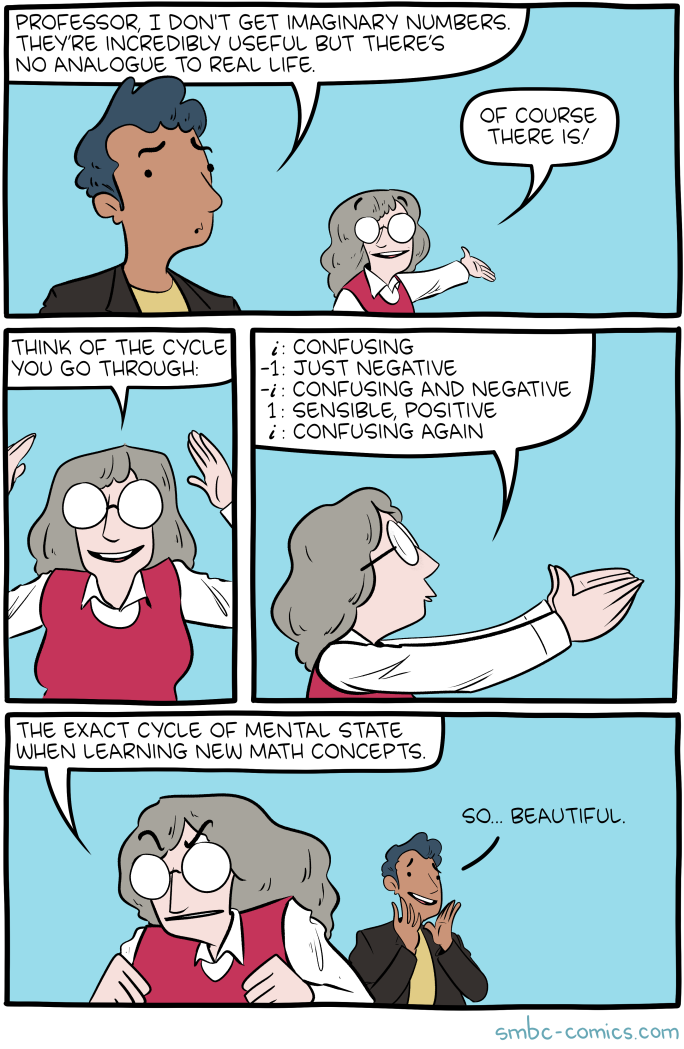
Saturday Morning Breakfast Cereal - i

by tech@thehiveworks.com


Click here to go see the bonus panel!

Hovertext:
I think the only reason students get confused by i is because it's the first glimpse of the idea that math is a field where you can discover truth about reality while making shit up.


Today's News:
15 Mar 00:58

Saturday Morning Breakfast Cereal - Pudding

by tech@thehiveworks.com


Click here to go see the bonus panel!

Hovertext:
This is revenge for the time a guy grilled me in Heathrow for 20 minutes after an all-night flight because I couldn't convince him I was in town for a science comedy show.


Today's News:
15 Mar 00:58

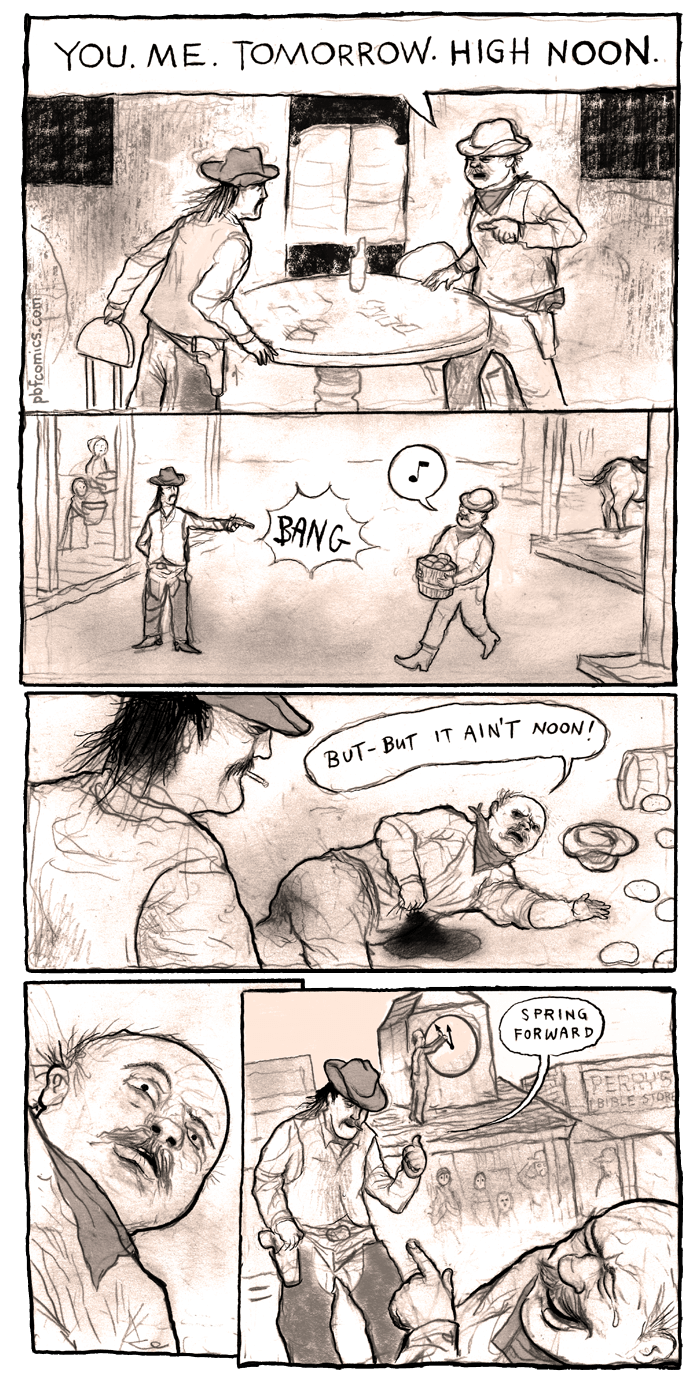
High Noon

by Nicholas Gurewitch

The post High Noon appeared first on The Perry Bible Fellowship.

15 Mar 00:57

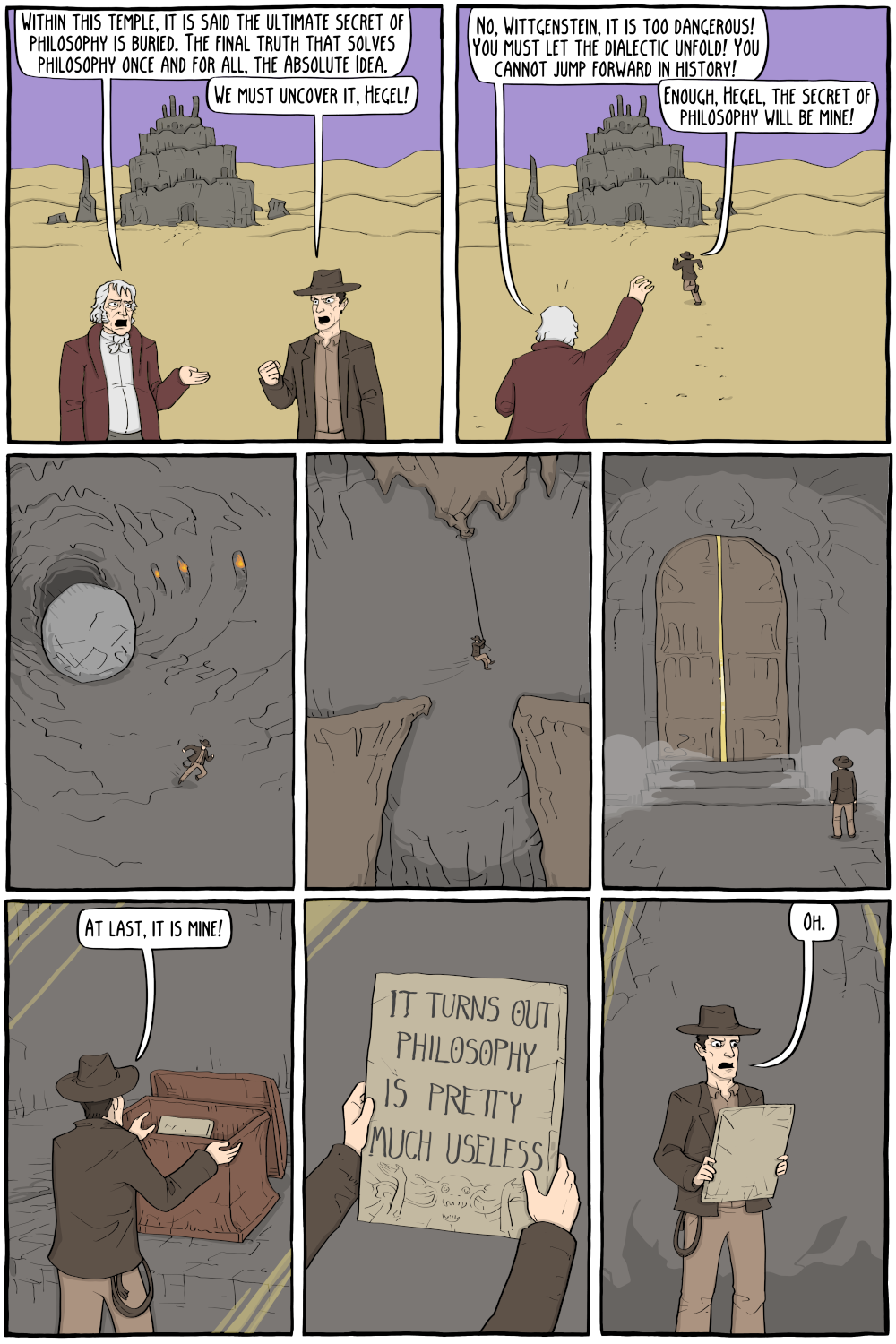
The Ultimate Secret of Philosophy

by Corey Mohler
Hegel: "Within this temple, it is said the ultimate secret of philosophy is buried. The final truth that solves philosophy once and for all, the Absolute Idea."
Wittgenstein (dressed as Indiana Jones): "We must uncover it, Hegel!"

Hegel: "No, Wittgenstein, it is too dangerous! You must let the dialectic unfold! You cannot jump forward in history!"

Wittgenstein: "Enough, Hegel, the secret of philosophy will be mine!"

Description: Wittgenstein makes his way through the temple, dodging boulders and reaching the center of the temple, where he finds a chest with a tablet.

Wittgenstein: "At last, it is mine!"

Description: The tablet reads "it turns out philosophy is pretty much useless".

Wittgenstein: "Oh."
15 Mar 00:56

Psych journal’s turmoil over masturbation and gay sex

by Marc Abrahams

The Retraction Watch web site has the story behind, or beneath, its headline that says “Psych journal in revolt as it publishes paper saying masturbation and gay sex are harmful“.

15 Mar 00:52

An Amiga can’t do Wolfenstein 3D!

by Scali

Like many people who grew up in the 80s and early 90s, gaming was a 2d affair for me. Scrolling, sprites and smooth animation were key elements of most action games. The Commodore 64 was an excellent gaming machine in the early part of the 80s, because of its hardware capabilities coupled with a low pricetag. In the latter part of the 80s, we moved to 16-bit machines, and the Amiga was the new gaming platform of choice, again offering silky smooth scrolling and animations, but because of advances in technology, we now got higher resolutions, more colours, better sound and all that.

But then, the stars aligned, and Wolfenstein 3D was released on PC. The stars of CPUs becoming ever faster, the PC getting more powerful video and audio hardware, and 3D gaming maturing. A first glimpse of what was to come, was Catacomb 3-D by id Software, released in November 1991:

This game made use of the power of the 16-bit 286 processor, which was starting to become mainstream with PC owners, and the EGA video standard. The PC was not very good at action games, because it had no hardware sprites, and scrolling was very limited. But id Software saw that EGA’s quirky bitplane layout and ALU meant that it was relatively good at certain things. We’ve already seen that it is fast at filling large areas with a single colour, for polygon rendering for example. But it is also good at rendering vertical columns of pixels.

And that is the key to having fast texture-mapped 3D walls. By taking a simple 2D-map with walls, and performing raycasting from the player’s position in the viewing direction, you can make a simple perspective projection of the walls. You use raycasting to determine the distance from the player to the nearest visible wall, and then render a texture-mapped version of that wall by rendering scaled vertical columns based on the distance, with perspective projection.

Catacomb 3-D was a good first step, but the game still felt rather primitive, with the limited EGA palette, and the gameplay not quite having the right speed and feel yet.

But only a few months later, in May 1992, id Software released the successor, where everything really came together. The developers figured out that the EGA trick of rendering scaled vertical columns works nearly the same in the newly discovered ‘mode X‘ of VGA. The big advantage was that you could now use the full 256 colours, which made for more vibrant textures and level design. The game itself was also refined, and now had just the right look-and-feel to become a true milestone in gaming. Things have never been the same since.

Here is an excellent overview of how Wolfenstein 3D evolved:

But… that change did not bode well for the Amiga. Suddenly, everything the Amiga was good at, was no longer relevant for these new 3D action games. What’s worse… these games relied on very specific properties of the EGA and VGA hardware. They did not translate well to the Amiga’s hardware at all.

And to add insult to injury, id Software followed up with DOOM the next year, which again took advantage of ever faster and more powerful PC hardware, and refined the 3D first-person shooter even further.

A few brave attempts were made on the Amiga to try and make Wolfenstein 3D-like or DOOM-like games for the platform, but sadly they could not hold a candle to the real thing:

As a result, the consensus was that the Amiga could not do 3D first-person shooters because its bitplane-oriented hardware was outdated, and unsuitable.

But all that depends on how you look at it. As you know, demosceners/retrocoders tend to look at these situations as a challenge. Sure, your hardware may not have the ideal featureset for a given rendering method… but you can still make the best of it. The key is to stop thinking in terms of EGA and VGA hardware, and instead think of ways to scale and render vertical columns as fast as possible on the Amiga hardware.

One very nice approach was shown at Revision 2019 by Dekadence. It runs on a standard Amiga 500, and achieves decent framerates while rendering with a decent amount of colours and detail:

Another interesting project is a port of the original Wolfenstein 3D-game, which is optimized for a stock Amiga 1200. It achieves good framerates by rendering at only half the horizontal resolution:

The Amiga 1200 has a 14 MHz CPU. We can compare it to the closest 286es, which are 12 MHz and 16 MHz, and those are just about adequate to run Wolfenstein 3D as well, albeit at a slightly reduced window size for better performance. So this is not a bad attempt at all, on the Amiga.

Another touch I really like is that it uses the original PC music for AdLib, and uses an OPL2 emulator to render the music to a set of samples.

Another really nice attempt is this DreadStein3D:

It makes use of the engine for the game Dread, which is currently in development. This game is actually aiming more at DOOM than at Wolfenstein 3D, but it has a very efficient renderer, and rendering Wolfenstein 3D-like levels can be done very well on an Amiga 500, as you can see.

Here is a good impression of what the Dread game actually looks like:

As you can see, it’s not *quite* like DOOM, in the sense that there are no textured floors and ceilings. And it does not support height differences in levels either. But it does offer various other features over Wolfenstein 3D, such as the skybox and the lights and shadows. So it is more of a Wolfenstein 3D++ engine (or a DOOM– engine).

And the performance is very good, even on a stock Amiga 500. So… all these years later, we can now finally prove that the Amiga indeed CAN do Wolfenstein 3D. All it took was to stop thinking in terms of the PC renderer, and making poor conversions of the x86/VGA-optimized routines on Amiga hardware, but instead to develop Amiga-optimized routines directly.

If you look closely, you’ll see that they have a ‘distinct’ look because of the way the rendering is performed. Britelite discussed the technical details of what became Cyberwolf in a thread over at the English Amiga Board. It gives you a good idea of how you have to completely re-think the whole renderer and storage of the data, to make it run efficiently on the Amiga. It has always been possible. It’s just that nobody figured out how until recently.

14 Mar 21:19

Google “hijacked millions of customers and orders” from restaurants, lawsuit says

by Tim De Chant
Google “hijacked millions of customers and orders” from restaurants, lawsuit says

Enlarge

Google is being sued by a Florida restaurant group alleging that the tech company has been setting up unauthorized pages to capture food orders rather than directing them to the restaurant’s own site.

Google uses “bait-and-switch” tactics to get customers to place takeout or pickup orders through “new, unauthorized, and deceptively branded webpages,” according to the lawsuit, filed on behalf of Left Field Holdings, a restaurant company that runs Lime Fresh Mexican Grill franchises. On those pages, customers are prompted with large buttons to order with food delivery companies like GrubHub, DoorDash, or Seamless.

“Google never bothered to obtain permission from the restaurants to sell their products online,” the lawsuit says. “Google purposefully designed its websites to appear to the user to be offered, sponsored, and approved by the restaurant, when they are not—a tactic, no doubt, employed by Google to increase orders and clicks.”

Read 10 remaining paragraphs | Comments

14 Mar 21:18

Hyperbolica is OUT NOW!

by CodeParade

Hyperbolica is OUT NOW on Steam! Enjoy this Non-Euclidean adventure while celebrating Pi Day!
Play Hyperbolica: https://store.steampowered.com/app/1256230/Hyperbolica/
Oculus Store: https://www.oculus.com/experiences/quest/4873486596022103/

Official Hyperbolica + CodeParade Merch
https://crowdmade.com/collections/codeparade

Join the discord
https://discord.gg/P9taqBJKJq

Original trailer
https://youtu.be/VYfWfrk5P7w

Press Kit
http://codeparade.net/hyperbolica/

#hyperbolica #indiegame
13 Mar 13:39

A Texas judge blocks the state from investigating parents of transgender youth

by Julián Aguilar, The Texas Newsroom
The judge halted the state from enforcing Gov. Greg Abbott's directive to launch "child abuse" investigations against parents getting gender-affirming care for their transgender children.
13 Mar 13:36

The City of San Antonio Unveils a Large-Scale Sculpture by Pedro Reyes in the River Walk Public Art Garden

by Jessica Fuentes

The City of San Antonio’s Department of Arts & Culture has unveiled a large public artwork by Pedro Reyes, a Mexican artist who often explores social issues in his sculptures and project-based works.

A photograph of artist Pedro Reyes standing on scaffolding next to his large-scale sculpture, titled "Stargazer (Citlali)."

Pedro Reyes working on, “Stargazer (Citlali).” Image © Pedro Reyes, photography: Ramiro Chaves

The sixteen-foot tall sculpture, Stargazer (Citlali), depicts a stylized woman who is seated and holding a small silver star. The City hopes that the sculpture, which is made using over 80 pieces of Mexican volcanic stone, will be an iconic piece at the River Walk Public Art Garden. Part of the work’s title is rooted in the indigenous language of the artist’s hometown of Mexico City — “Citlali” means “star.”

A photograph of Pedro Reyes' "Stargazer (Citlali)." The 16-foot tall sculpture sits on a 5-foot tall base overlooking the River Walk in San Antonio.

Pedro Reyes, “Stargazer (Citlali),” 2022, volcanic rock. Located at the San Antonio River Walk Public Art Garden.

In a press release announcing the acquisition, Mr. Reyes stated his intention behind the piece, saying, “I wanted to offer a work that transcends the relatively recent borders and boundaries we know today to offer an ageless perspective in celebration of San Antonio’s more than three hundred years of distinctive history and culture. The star could be a star like the ones that shine over San Antonio each night — the same ones that have been contemplated by all peoples throughout the region’s human history, the same ones that inspire awe and wonder as they help us glimpse our place in relation to the universe and to time.”

A map of the San Antonio River Walk Public Art Garden. The map identifies locations of sculptures along the River Walk and situated between South Alamo, Bowie, East Commerce, and East Market Streets.

San Antonio’s River Walk Public Art Garden map.

Launched in 2019, the River Walk Public Art Garden, has been a multi-year project and is slated to be completed by the end of this year. Located in the stretch of space confined by Alamo, Bowie Commerce, and Market Streets, the space includes sculptures, wall-mounted installations, and informational displays, and features the following works:
Green Spaces at Market Street by San Antonio Artists Ashley Mireles and Cade Bradshaw
–  Najo Jām (Our Home) by San Antonio Artists Carlos Cortés and Doroteo Garza
Bloom by San Antonio Artist Leticia Huerta
Spheres of Reflection by San Antonio Artist Kaldric Dow
– Sculptures from the exhibit Sebastián in San Antonio: 50+Years 20+ Locations 100+ Works

The post The City of San Antonio Unveils a Large-Scale Sculpture by Pedro Reyes in the River Walk Public Art Garden appeared first on Glasstire.

13 Mar 13:33

Saturday Morning Breakfast Cereal - Ginkgo

by tech@thehiveworks.com


Click here to go see the bonus panel!

Hovertext:
This will never stop weirding me out.


Today's News:
13 Mar 13:32

Lilith

by Sarah Andersen

null

13 Mar 04:40

Fabric Softener Is BS

by Sarah Showfety

We’ve already covered why you should stop using dryer sheets—now it’s time to vanquish the next unnecessary step in your laundry routine: fabric softener. I know, you like how it makes your clothes feel! (And smell.) If you’re a longtime user, you’d be forgiven for thinking in fabric softener’s absence, all your…

Read more...

12 Mar 00:35

A Pregnant Pause

by Mary Kelly

well pregnancy book

Well Pregnancy Book
Samuels and Samuels
1986

Insider gossip from ALB: I am going to be a grandma this summer. I keep thinking that I am not old enough, but my family assures me, I am. Because of this I started looking at pregnancy books. (Side note: as tempting as it was to create a annotated bibliography on pregnancy and childcare, and discuss it with my son and daughter-in-law, I refrained, because I don’t want to be THAT person.)

That said, pregnancy books should be treated like medical information and updated regularly. This example was found in a smallish public library. Also it looked to be in great shape. (After a certain age a book should look used, if it looks too new, it was either added by a library not paying attention or it was crappy in the first place.) Also there is a newer edition from 1996. By the way, the 1996 edition is also weed worthy.

Take a look at the pregnancy books at your library and make sure the books are up to date. We librarian grandmas are watching.

Mary

back cover

birth preparation exercise

birth preparation exercise

birth

The post A Pregnant Pause appeared first on Awful Library Books.

12 Mar 00:33

False Dichotomy

There are two types of dichotomy: False dichotomies, true dichotomies, and surprise trichotomies.