“Night Light,” at Buffalo Bayou East. Image courtesy of Buffalo Bayou Partnerships.
On April 2, 2022, Buffalo Bayou Partnership (BBP) and Aurora Picture Show will present Night Light, a free evening of site-specific, large-scale video art along a 3/4 mile stretch of the Buffalo Bayou East trails.
Map of the locations for “Night Light,” at Buffalo Bayou East trails.
The projections will be featured at Guadalupe Plaza, the Gravel Silos, and the underside of a freeway overpass. These three important locations along the bayou, which were identified in the BBP’s 2019 Master Plan, are a part of a trail that will be revitalized with new green spaces, industrial sites, and gathering spots. Shaped over two years and through conversations with residents, community groups, and other stakeholders, the plan details BBP’s vision for transforming Buffalo Bayou East.
Houston artists Julia Barbosa-Landois, Marcelese Cooper, and Input/Output, have each created experimental video works which respond to the unique locations and touch on themes of water and industry.
In a press release, Karen Farber, BBP’s Vice President of External Affairs said, “We are thrilled to welcome community members to this free celebration on Buffalo Bayou. Night Light is an example of how we plan to activate the waterfront with exciting, unique art for all to experience and enjoy.”
Night Light will be on view from 7:30 to 10:00 pm on Saturday, April 2, 2022. Attendees are invited to travel the paved pathways by bike or on foot and enjoy music, food, and vendor booths stationed between the projection sites. The event is free, but registration is encouraged.
Wikipedia points out that America's two largest-circulation publications are the two magazine sent out to over 38 million members of massive non-profit AARP (originally the American Association of Retired Persons).
It's now starting its own social network to compete with Facebook (which according to a recent survey is being used by over 72 million Americans over the age of 50), Ars Technica reports:
The nonprofit funded the creation of Senior Planet Community, a social media network that encourages users to join pre-existing groups around shared interests, including gardening, travel, fitness, food, and technology. In that way, it feels more like a pared-down version of Reddit or a small collection of forums....
Besides its focus on the 50-plus set, Senior Planet Community stands apart from Facebook in that it's not commercial. The site has no advertising or membership fees. Unless the cost to run the site grows substantially, that probably won't present much of a problem. AARP isn't saying how much it has put into Senior Planet Community, but the organization is famously well-capitalized, with $2.3 billion in net assets and $1.7 billion in revenue in 2020.
At present, the site is bare-bones when compared with Facebook. There's no mobile app yet, though OATS [the affiliate organization that built the social network] says it hopes to develop one. The site is mobile-friendly at least, and all the requisite features are there, including groups, photo sharing, @-mentions, notifications, and direct messaging.
As with all social networks, a looming question is how Senior Planet Community will handle moderation. The site has a relatively extensive list of "house rules" that encourages users to "be courteous" and "cite your sources." Posts about politics aren't forbidden, but the rules say posts can't stray off-topic, and users can't "attack individuals, social, ethnic, or political groups and figures." Users can report posts they think violate the rules. Currently, the user base is relatively small, so policing it should be straightforward.
"The moderating team keeps an eye on all comments, posts, and updates added to the platform from the backend.... " Suzanne Myklebust, OATS's director of communications, told Ars.
While bats have been closely associated with vampires for centuries, there are actually only three species of bats that drink blood. Most of them eat fruits, insects, nectar and small animals, like frogs and fish, instead. Blood is low in calories, while being rich in iron, protein and little else, making it a terrible, terrible food source. Now, a team of scientists has figured out how and why those vampire bat species are the only mammals that can live solely on a diet of blood.
Upon comparing the genome of common vampire bats to 26 other species, the scientists found 13 genes in the blood-sucking mammals that either no longer work or are missing. Three of those losses had been reported in another study published in 2014, with all of them indicating a reduced sense of taste reception in vampire bats. The remaining 10 gene losses are new discoveries, according to the team.
The loss of a gene called REP15 indicates enhanced iron uptake in the animals' gastrointestinal cells, which they also shed and excrete quickly. This prevents iron overload that can have severe detrimental effects. The absence of two other genes allow glucose to remain longer in the bats' bodies and prevent hypoglycemia, since blood contains minimal carbohydrates. Another absent gene might also be the consequence of the "extensive morphological and physiological modifications" in the stomach of common vampire bats. Instead of being a muscular organ, their stomachs are expandable structures used to store large amounts of liquid and serve as a major site of fluid absorption.
The loss of one gene even contributed "to the evolution of vampire bats’ exceptional social behaviors." Since they can't survive too long without feeding, seeing as blood is very low in calories, vampire bats can regurgitate their meals and share with others. They can also keep track of who shared with them in the past and will extend extend help to them in the future if needed. Hannah Kim Frank, a bat researcher at Tulane University, told AP: "It's totally bizarre and amazing that vampire bats can survive on blood — they are really weird, even among bats."
The study revealing the loss of genes that allow them to live off blood doesn't make vampire bats any less weird, or intriguing. You can read the whole study in the Science Advances journal.
At a campaign rally in San Antonio in early February, Beto O’Rourke inveighed against Governor Greg Abbott, directly blaming him for last winter’s deadly grid collapse and his coziness with Texas’ biggest energy players.
“We are all paying the price for this guy’s corruption and his incompetence,” he said.
Abbott and state lawmakers responded with a series of new grid regulations that energy experts say fall far short of what is needed to prevent another disaster. After pronouncing that “everything that needed to be done, was done” to fix the grid, Abbott then raked in millions of dollars in campaign contributions from power and gas companies. That was “pretty close to a bribe,” O’Rourke said.
Kelcy Warren, one of the governor’s biggest donors, apparently did not appreciate the implication. This past June, the founder and executive chairman of pipeline giant Energy Transfer Partners cut Abbott a $1 million check—four times more than any of his prior contributions to the governor—just months after his company made $2.4 billion during the winter blackout. Since then, Warren has featured prominently in O’Rourke’s attacks casting Abbott as a bought-and-paid-for shill for his energy donors.
The day after O’Rourke’s San Antonio event, the Dallas billionaire’s lawyers sent the El Paso Democrat a cease-and-desist letter warning him that his “recently made public statements that Mr. Warren paid a ‘bribe’ to Governor Greg Abbott,” were “absolutely false” and “defamatory,” according to a partial copy of the letter provided by the O’Rourke campaign.
If O’Rourke didn’t “immediately make a public announcement” retracting his statements about Warren and refrain from any such future comments, the lawyers warned, “we will take all necessary and appropriate steps to protect our client’s rights.”
The Democratic candidate ignored Warren’s demands, and soon his own attorneys were served with notice in late February of a defamation lawsuit seeking damages of more than $1 million. The lawsuit calls O’Rourke a “failed politician” and accuses him of waging “a relentless and malicious attack on Warren by accusing him of serious crimes including extortion, bribery, and corrupt influence” due to his donation to Abbott and his role as the former CEO of Energy Transfer.
After the March primary, O’Rourke held a press conference announcing the lawsuit. In the face of Warren’s legal threats, “I chose not to back down,” he said, saying the “frivolous” suit was an attempt by the mogul to “use his billions of dollars to try to shut me down, and shut us up, from telling the story of what happened to the people of Texas.”
Free speech advocates and many legal scholars have long decried these sort frivolous lawsuits—known as SLAPPs, or Strategic Lawsuits Against Public Participation—as a blatant abuse of the country’s legal system by powerful and wealthy people and corporations in an attempt to silence outspoken activists, critical reporters, and rivals alike.
“Kelcy Warren is far from the first billionaire to file a lawsuit against someone who says something they don’t like. … And even though they’re highly unlikely to succeed on the merits, they file them anyway,” Evan Mascagni, policy director for the anti-SLAPP advocacy group Public Participation Project, told the Observer.
“SLAPP-filers don’t go to court to seek justice. Rather, they file these meritless lawsuits to silence, harass, and intimate their critics. Defending against a meritless lawsuit can cost tens or even hundreds of thousands of dollars and clog up the court system for years while at the same time having a chilling effect on the writer or speaker.”
With one of Abbott’s top donors going directly after his political ally’s opponent, Warren’s lawsuit marks an unprecedented incursion into Texas politics—one that is likely to further elevate the mega-donor’s role in the most high-profile election this year. It seems to be an unwelcome move for Abbott, whose campaign promptly issued a statement saying that it had no involvement with the suit. O’Rourke, meanwhile, is spoiling for the fight—and has doubled down in the wake of the lawsuit. Earlier this month, O’Rourke compared Abbott to Russian President Vladimir Putin, calling him an “authoritarian” and a “thug,” and said, “he’s got his own oligarch here in the state of Texas”—an apparent reference to Warren.
The law firm—Kasowitz Benson Torres—that Warren hired to take on O’Rourke is notorious for aggressively litigating these types of suits on behalf of its powerful clients, including Warren’s company, Energy Transfer Partners. The firm’s founder, Marc Kasowitz, was also the longtime attorney for the infamously litigious former President Donald Trump.
Energy Transfer Partners, represented by Kasowitz attorneys, has tried to push the boundaries of the judicial system to punish and stifle activists and environmental groups involved in protests and campaigns that tried to block the company’s construction of the controversial Dakota Access Pipeline.
In 2017, the company filed a lawsuit that accused the environmental activism group Greenpeace of orchestrating a vast conspiracy with other activists and groups to manufacture a “media spectacle”—by spreading misinformation and inciting vandalism—as a ruse to block the pipeline and ultimately raise money for the organization. In doing so, Energy Transfer claimed that Greenpeace violated federal racketeering laws. Known collectively as RICO, these laws were initially created to take down organized crime but have increasingly been invoked by corporations to go after their antagonists. Energy Transfer claimed that Greenpeace had cost the company hundreds of millions of dollars and undercut its ability to secure financing. It sought $900 million in damages.
In an interview with a TV news station in North Dakota, Warren said the lawsuit was meant to “send a message.”
“We’ve created this kind of tolerance where, ‘Oh my gosh, you can’t challenge these people in fear that someone is going to say you’re not a friend of the environment.’ That’s nonsense,” he said. “Could we get some monetary damages out of this thing, and probably will we? Yeah, sure. Is that my primary objective? Absolutely not. It’s to send a message, you can’t do this, this is unlawful and it’s not going to be tolerated in the United States.”
A federal judge called the RICO allegations “dangerously broad” and dismissed the suit in 2019. But Energy Transfer was not deterred.
“It’s not over,” the company’s executive vice president and general counsel Thomas Mason told investors on an earnings call. “We’re not just going to stand by and accept this kind of behavior from bad actors.”
Within weeks, the company filed a defamation lawsuit against Greenpeace in a North Dakota state court. That case has dragged on for three years and is currently set for a jury trial date in 2023, according to state court records.
North Dakota is favorable terrain for these sorts of defamation lawsuits. Unlike many other states that have passed anti-SLAPP laws to discourage frivolous lawsuits, North Dakota has none. Texas, however, has one of the strongest anti-SLAPP laws—the Texas Citizen Participation Act—in the country. The law allows for an expedited dismissal of frivolous lawsuits filed against defendants for speaking out on a “matter of public concern.”
Warren’s lawsuit cites several statements O’Rourke has made—both on social media and in campaign speeches—blaming Abbott and his energy industry donors for the deadly grid collapse, which his lawyers argue amount to specific and defamatory claims that Warren broke the law.
“Defendant’s statements that Warren has committed felonies in a purported effort to profit off the suffering of his fellow Texans are completely out of bounds for any speech, let alone as talking points for a candidate for the Governor of the State of Texas,” the lawsuit states. “The accusations go well beyond the sorts of vague and generalized accusations of political and corporate corruption that are often thrown around; rather, they focus on a particular person, a particular campaign contribution, at a specific point in time, and a particular purported favor done in exchange for the contribution.”
The suit points to Warren’s long history as a political donor to Abbott and others and says that he made his unusually large $1 million contribution to Abbott in June because the governor was heading into what was expected to be an expensive primary race against Don Huffines—a wealthy former state senator who was self-funding his campaign—along with several other potential challengers. The Dallas billionaire filed the suit in San Saba County, where he owns property. Warren argues he is a private citizen who “has not spoken publicly nor sought publicity concerning the matters” that are the subject of O’Rourke’s accusations.
While it’s not clear if O’Rourke will ultimately file a motion to get the suit tossed, experts say the state’s anti-SLAPP law was created for cases like these.
“My general impression of the lawsuit is that it’s very much subject to dismissal under the TCPA,” Lane Haygood, an Odessa-based lawyer who has worked on free speech cases in the state, told the Observer.
“The statements that could survive [an anti-SLAPP dismissal] are the ones that get closest to accusing Mr. Warren of committing a specific crime,” Haygood added. “There are a couple of times that O’Rourke uses words like extortion or bribery, which are defined crimes under the Texas Penal Code. But they are also rhetorical shorthand and hyperbolic, and so in context, Texas courts are generally likely to hold that such language is not specific enough to be actionable defamation. It is the difference between saying ‘John Smith assaulted me on September 4, 2021,’ and ‘John Smith is a bully who beat me up.’ ”
O’Rourke has dismissed Warren’s claims as blatantly frivolous, saying that everything he’s said is based on publicly available facts and media reports. So far, he’s indicated that he wants to let the case play out—paying for any legal costs with campaign funds. This week, his attorneys filed motions to change the venue of the lawsuit to a court in his home of El Paso County and called for a trial by jury.
Under the state’s anti-SLAPP law, O’Rourke has 60 days from the date he was served—February 28—to file a motion to dismiss. It’s not uncommon for attorneys to wait until the deadline to do so in case the defendant files an amended petition, Haygood said.
Or O’Rourke may see the public spectacle of this lawsuit as a political gift that’s well worth going to court over—especially since his ample campaign funds should easily cover the legal costs of a drawn-out legal battle.
Haygood says he’d advise his clients to use any means available to try to kill a lawsuit as early as possible.
“But then again, most of my defamation defendant clients aren’t independently wealthy candidates for high public office with an enviable fundraising game, so the calculus will be different,” he said.
This book has the info you need to grow into a successful woman. Naturally, that means deep introspection and analysis of make-up, hair, fashion, and diets. It’s “frank and fun!”
I think today’s teens and preteens would find this book ridiculous. Miss washing your face completely last night before bed? Hello acne and awful skin. What does the author think these preteen girls are doing? Out clubbing with heavy makeup and smoking? One missed day washing your face is hardly a cause for alarm. That’s the beauty of youth. You can mess up and still have decent skin.
The rest is pretty much a re-hash of every teen magazine article on diet, exercise, and makeup. I flocked to these kinds of books when I was a teen. Even back in the olden days of the late 1960s and early 1970s, I would have cringed at the title. Maybe we just need better books for tween and teen girls that won’t have them questioning every little detail about their appearance.
Okay, first to answer the “How to do it” part of the question: To un-ignore an email thread, find a message that is part of the ignored thread and select it. The Ignore button in the ribbon will go into the pressed state to indicate that this thread is being ignored. Click the Ignore button to uncheck it, thereby un-ignoring the thread.
Note that un-ignoring a thread will not un-delete the messages that were ignored when the rule was in effect. But future messages will not be ignored.
Okay, so how does this work internally? If you open your Rules, you won’t find any rules for deleting the ignored thread. Where are the ignored-thread rules kept?
The rules for ignored threads are kept in a hidden folder in your mailbox named Conversation Action Settings, in the Associated Contents table. You can use the MFCMAPI tool to view them.
This trick is handy not just for snooping around under the hood: It’s also useful if you want to un-ignore a thread for which you don’t have a copy in your Deleted Items folder. You can go into the Associated Contents table and delete the rule for the ignored thread. (Note: I’ve never done this myself, but it’s nice to know I could do this if I had to.)
Bonus chatter: Rules for ignored threads expire after 14 days of inactivity, which is nice to know. It means that your Conversation Action Settings folder is self-cleaning to some degree.
For some reason, I’ve pondered this hypothetical on and off for years: Suppose you were magically granted the ability to perform one piece of music beautifully, but in exchange, you are rendered incapable of playing any other piece at a level higher than beginner.
What instrument and piece should you pick so you can have the longest musical career before you’re found out?
For example, the Tchaikovsky Piano Concerto is popular and impressive-sounding, and being one of the best interpreters in the world will get you regular work on the classical music circuit. But people are going to get suspicious if that’s the only thing you ever play. And when you get called back on stage by an adoring audience for an encore, people are going to be disappointed that you never oblige.
If you pick a solo piece, will people book you for a recital that consists of a single piece?
If you choose Freebird, knowing that it is still frequently played and requested, would people start wondering why you come on stage to play that one song and nothing else?
I eventually concluded that the best answer is the Turangalîla-Symphonie on the ondes Martenot. (Turangalîla-Symphoniepreviously.)
You will never get found out because there are no other pieces of any consequence for the ondes Martenot!
When I posed this question to some friends, one of them replied that he would choose Beethoven’s Waldstein Sonata. “The orchestra would sit and listen, which means I would get exactly one booking. But, if I was able to play that beautifully just once, I wouldn’t need to play anything else.” I like this answer despite the fact that it rejects the question. (The question isn’t to name the piece that would be most personally satisfying. It’s the one that lets you go the longest without being found out!)
Bonus chatter: Businessman Gilbert Kaplan became enamored with the works of Gustav Mahler, particularly the Second Symphony, named Resurrection. (Mahler’s Second Symphony previously.) Kaplan conducted over 100 performances of the Second Symphony, and no other work.
Now that society is collapsing, Everything Is Terrible! is reborn with their new and fantastical expedition into found footage... but this time the adults can stay home! EIT! has unearthed thousands of forgotten DVD & VHS tapes aimed at yesterday’s youth to bring you their most mind-melting movie to date. Watch in awe as all colors of the rainbow join forces to destroy the tyranny of adult civilization once and for all! All of your oldest friends will be there; skateboarding web-surfers, rapping math equations, gigantic baby ducks, and maybe even a wizard or two! And what EIT! show would be complete without a live experience that makes the Ice Capades look like a stupid piece of trash! Finally, an all-encompassing extravaganza created for kidz... by kidz!
Google likes to make experimental web apps from time to time, but the company introduced something a bit different on Thursday. Google is collaborating with the Japanese Ministry of Economy, Trade and Industry and 12 cultural institutions across Japan on a new virtual art exhibit called Manga Out Of The Box, and part of the project is a web app for generating manga-like artwork.
The company wrote in a blog post, “With Giga Manga, you’ll be able to create your own manga-style ink drawings with the help of machine learning. In this unique experiment, all you need to do is sketch a few simple lines and add some splashes of color – then let machine learning fill in the rest.”
Giga Manga demo (Source: Google)
The web app is accessible on the web, and generally seem to work well. However, “a few simple lines” is overselling the tool a bit — you’ll need to sketch much of the image by yourself. The web app mostly just helps with shading and color filling. Giga Manga also seems to have a difficult time if an object has the same color for both the outline and fill. When you’re done, the tool shows artwork generated by other people that looks similar to what you made.
Manga Out Of The Box includes other hybrid digital pieces, including a visual history and timeline of manga art and insights from artists like Takashi Murakami (who is well known for his “superflat” art style and its influence on other artists’ work). You can check out the full collection at the blog post linked below.
The new web app is a bit similar to the Art Transfer feature in the Google Arts & Culture app, which allowed people to edit their own photos in the style of well-known paintings. Some of the available options included artwork from Frida Kahlo, Edvard Munch, and Leonardo da Vinci.
This is one of those “where are they now” discussions. Or we can call it a #throwbackthursday type of post.
Back in 2009 when we started this little dog and pony show, we just put up covers and didn’t really look to deep into some of the titles. I started looking at a few of these early titles and was a bit curious if they were still hanging out in libraries. It’s still around, but it looks like it is mostly in university libraries.
For the most part, this book is about clothing construction with a few modifications that make it easier for the user to dress themselves. When we originally posted this book, we didn’t have any interior pages. Looking at it now, I am almost shocked this was a 1981 publication. The pictures make it look much older.
I had few chuckles of the use of “attractive and fashionable clothing” from the back cover blurb. Most amusing to me was the corset discussion. I don’t think I have heard the word corset in a modern context since my great-grandmother was alive. Since this is a UK publication, maybe that was the word most commonly used. (UK people, please weigh in!)
The topic is still important, but certainly the cover art and the interior pictures make this weed-worthy for a public library.
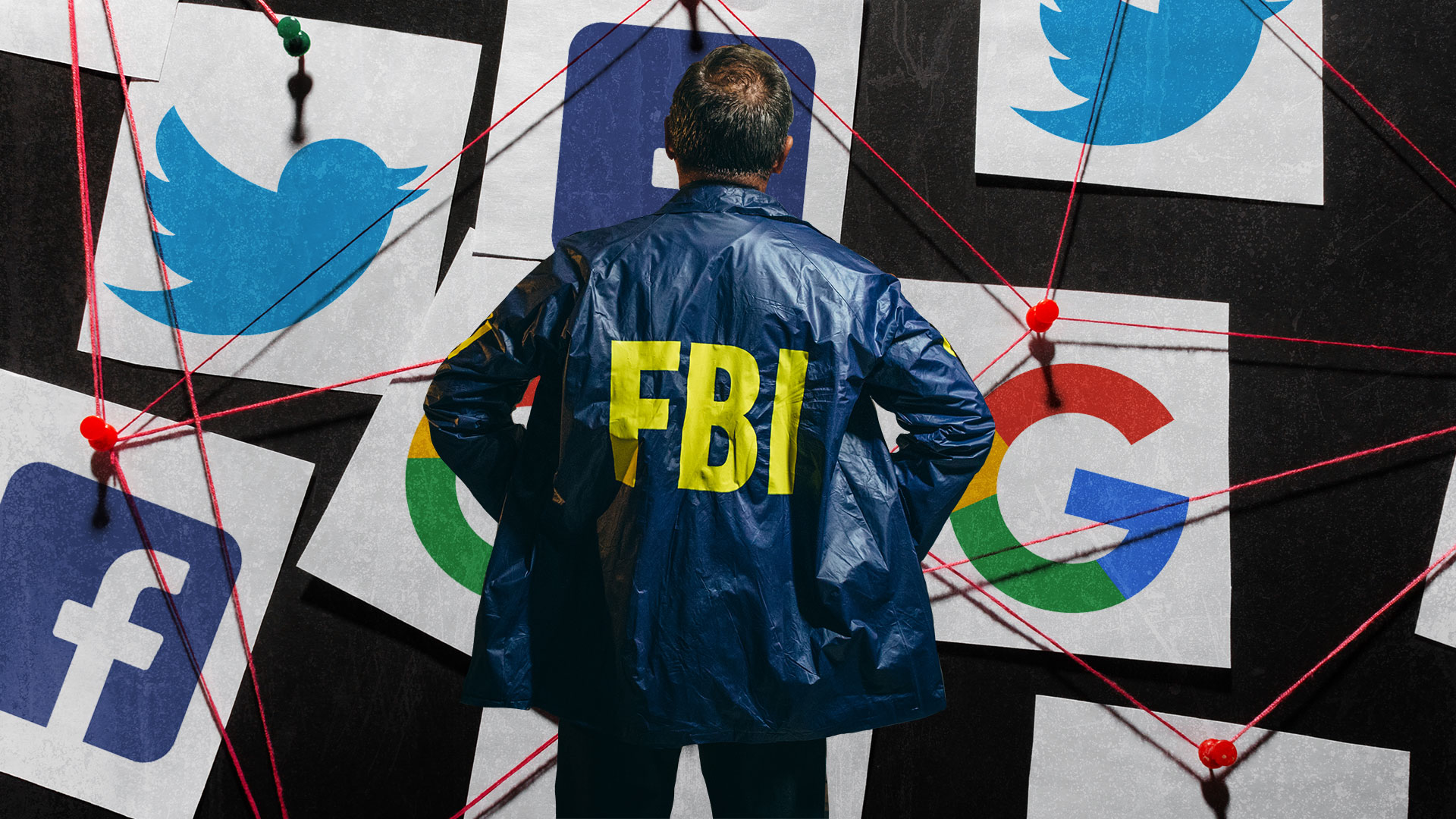
The FBI’s latest counterintelligence operation against Russia is hardly secretive—you just have to be standing in the right place.
In the wake of Russian President Vladimir Putin’s unprovoked invasion of Ukraine, the FBI stepped up its recruiting efforts in the US, hoping to attract Russians who are dissatisfied or disillusioned with the war. People standing in close proximity to the Russian embassy in Washington, DC, can see the ads, which appear in Russian, on Facebook, Twitter, and Google.
One ad appeared in a Washington Post reporter’s Facebook feed when he was standing on the sidewalk next to the embassy’s walls on Wisconsin Avenue NW, but none appeared in his feed when he crossed the street.
The Infowars host had been scheduled to appear Wednesday and Thursday. Jones' lawyer said his client was following his doctor's guidance not to attend court proceedings.
If you want a new car right now, it’s going to cost you. | DigitalVision via Getty Images
Car dealers are charging way over sticker price — and consumers are paying.
It’s a wild time out there in the car market. Wild in a good way if you’re a car dealer trying to sell a car. Wild in a less good way if you’re a consumer looking to buy, which is the spot Richie Iglar recently found himself in.
In the fall, he and his wife were in the market for an SUV and made an appointment at a Mercedes dealer in New Jersey. The salesman was “super nice” throughout most of the process, Iglar explained … until it came to the price. The dealership wanted to charge them $20,000 over the manufacturer’s suggested retail price (or MSRP).
“We were both shocked and politely declined, saying while we would like to have the car, we can’t justify over-spending for it,” he said. Iglar emailed another dealer trying to get a sense of what their markups were, and a week later they responded they were adding on $15,000. He decided to put a pause on buying. “I can’t justify spending that much over sticker.”
Iglar is hardly alone. Tens of thousands of dollars over the sticker is something of an outlier, but across the country, people on the hunt for a new vehicle are being met with significant dealer markups, thanks to supply shortages and high consumer demand. New car dealers have the upper hand at the moment, and some of them are willing to use it.
“At the end of the day, it’s saying, ‘Look, if you don’t buy this, the guy right behind you or the gal three people behind you is going to, and they’re going to pay me $1,000, $2,000 more than you’re willing to, so I have to go with them.’ It’s one of the first times in history where the dealer has so much demand that they can actually do that,” said Ivan Drury, senior manager of insights at Edmunds, a consumer research company. “If there are five people raising their hand to buy the exact same product, you just go with whoever is bidding the highest.”
According to Kelley Blue Book, the average new car price in the United States was $46,085 in February, $5,000 more than it was a year ago. Going by the Consumer Price Index, which measures what consumers pay for goods and services, new vehicle prices are up 12.4 percent over the past year. (Used car prices are up a ton, too, but for this story, we’re focusing on new ones.)
How much are dealer markups contributing to this average price increase? The answer is certainly not all of it, or maybe even most of it. But they’re not helping, either. “It comes down to if someone’s willing to pay it, and they can sell it and keep selling it, I think they’re going to ride that train as long as they can,” Iglar said.
Amid the current inflationary environment, there’s a broader debate going on about what’s causing prices to rise. Some Democrats and economists argue that corporate greed is playing a role, basically saying that companies are taking advantage of the moment to boost their profits even when it’s not necessary, and contributing to higher inflation overall. Other economists have dismissed this, saying it’s a flimsy excuse, and that other factors, among them supply chain problems, increased demand, and commodity prices, have much more of an impact. After all, corporate greed wasn’t invented in the pandemic.
I am not going to litigate whether profiteering — which is generally legal in the US — is driving up inflation. But it’s hard not to recognize that in some corners, businesses and CEOs and salespeople are likely looking at the current economic landscape and thinking, “Eh, why not bump that price tag up a little more?” And who can blame them? That’s capitalism.
“Are they taking advantage of the situation? Yeah,” Drury said with regard to dealers. “I think they’re doing exactly what anyone else would if they were selling something too.”
This is capitalism. Welcome.
In an environment where goods are scarce, intermediaries can push up the prices to pocket the money. We are in an environment where goods are scarce, and where, because of inflation, people sort of expect prices to go up anyway, and so in some corners, there’s a little bit of padding going on.
Even in a moment like this, with inflation on the rise, the point of companies is to make money. Many executives have been pretty open that they’re able to pass on price increases to consumers and keep their margins up, or do a little bit better. Procter & Gamble, for example, has hiked prices on a variety of items over the past year, including diapers, razors, and feminine care products. It has helped them deal with rising costs but also has helped them increase revenue.
Are these price increases along the margins creating broad-based inflation across the economy? Many economists say probably not. But in the system we live in, when businesses big and small are in a position of power, they use it, and that’s certainly not helping.
“We need to be honest that price changes are complex, and I don’t think it’s fair to boil it down to a single cause. Saying that profiteering is playing a role and profiteering is driving inflation are two different arguments,” said Mark Paul, an assistant professor of economics and environmental studies at New College of Florida. “The degree of price increases we’ve seen today are absolutely in line with a story where car companies are charging consumers above and beyond what should be considered a reasonable markup due to these market disruptions.”
Eventually — and hopefully — the current supply/demand mismatch the automotive industry is seeing will sort itself out. The semiconductor shortage will subside, other production and supply chain bottlenecks will settle, there will be more new cars available, which should also help the used car market settle down. And that, again eventually and hopefully, will help cool inflation down. (New and used cars are a pretty significant factor in current inflation numbers.)
In the meantime, consumers like Iglar can bide their time and wait for things to settle back down. Or they can bite the bullet and pay much more than they’d like to for a new car.
If you want a new car right now, you have to really ($$$) want it
Previously, it’s been pretty rare for shoppers to pay above sticker price for new cars. Now, it’s pretty common.
According to Edmunds, 82 percent of customers paid above sticker price for a new car in January of this year. For some perspective, that figure was 2.8 percent in January 2021 and 0.3 percent in 2020. On average, transaction prices for a new car in January were $728 above the sticker price. In the same month in 2021 and 2020, they were more than $2,000 below it. For some higher-end vehicles, like the one Iglar was in the market for, dealers are charging tens of thousands of dollars above what manufacturers suggest.
In more normal times, it’s car dealers that are often trying to undercut one another on prices to attract customers and compete. Now, with inventories so low, it’s customers who are competing with each other for vehicles.
Bill Brunner, vice president and general manager at Paramus Chevrolet in New Jersey, told me that right now he has about 80 cars on his lot compared to what used to be 300, 400, or even 600 vehicles available. The scenario has created what he describes as a “balancing act” on pricing. “Our prices have definitely adjusted based on availability,” he said. “Having said that, we still need to be conscious of our customer base.” He knows some people have a budget. He also wants customers to come back next time their lease is up or they want to buy a new car.
Brunner said he’s starting to see some vehicles come through with more volume now, which will allow his dealership to be more competitive with the pricing. But it all really just depends on what they have. “There were some vehicles that we made better gross profits on than we would have if we had 100 of them in stock. It’s just supply and demand. If we had two of a particular model instead of 100, our pricing structure is different. It’s just the way it is,” he said. Brunner also noted the pandemic has been tough on dealerships, as it has been on a lot of businesses.
Still, some auto manufacturers aren’t loving the situation and have told dealers to knock it off on some egregious price hikes out of concern it will hurt their brands. (A lot of people don’t realize it’s the dealer that ultimately sets the price, not, say, GM or Ford.) Traditional auto manufacturers are also dealing with competition from companies such as Tesla, which sell direct to consumers. Plus, a number of car companies are launching electric vehicle products that they hope will expand their customer base, and many of those vehicles already come with long wait times.
“You figure somebody’s trying out your brand for the first time and it’s an EV product, you don’t want to ruin that relationship by saying, one, you’re going to wait, and two, you might pay more than you expected,” Drury said.
In a February earnings call, Ford CEO Jim Farley said that the automaker believes 10 percent of its dealers over the last year had charged above-MSRP prices and warned that “future allocation” of their models would be impacted by those policies, meaning the dealers in question might not be getting their most popular cars. The Wall Street Journal reported that GM also told dealers in a letter it might take action against a “small minority of bad actors” selling and leasing far above sticker price.
The Wall Street Journal has also reported that Toyota and Honda have talked to individual dealers about charging above MSRP, too. Jack Hollis, Toyota Motor North America’s senior vice president of auto operations, told the publication he thinks dealers thinking only about the short term are making a mistake. “If that customer experience is great during this time, they’ll be with you,” he said. The Journal noted that many dealers aren’t happy with the practice, either, because they worry it could damage the entire sector’s reputation.
To be sure, dealer markups are not the only thing contributing to price increases. “A whole slew of things” are making cars more expensive, said Stephanie Brinley, principal automotive analyst at IHS Markit. The pandemic has tossed the car industry into chaos over the past couple of years. Semiconductor shortages and supply chain woes have caused major setbacks in production, and the costs of making and moving the cars have gone up as well. Brinley pointed out that many consumers also want more, costlier features, which drives prices, too. “It’s a combination of trying to maintain margin and keep profitability up, but it can’t be done if consumers don’t want it,” she said.
Many of the vehicles with the highest markups are ones that are already pricey to begin with. “If you have $50,000 to spend on a car, how bad can someone feel for you when they can’t afford a $15,000 used car?” Drury said. “I don’t feel bad for certain people when they can bid up the price.”
Brinley pointed out it’s pretty easy to figure out what manufacturers suggest the price should be on a new car — the information is readily available on the internet. If you’re in the market for one, she suggests looking it up and then going from there. “Figure out what you’re willing to pay, and if you’ve got a dealership that is charging more than you might be willing to pay, you might not get a car in the next two hours, it might be a bit more complicated, but move on,” she said.
In the current landscape, you might have to be in “move on” mode for a while.
We live in a world that’s constantly trying to sucker us and trick us, where we’re always surrounded by scams big and small. It can feel impossible to navigate. Every two weeks, join Emily Stewart to look at all the little ways our economic systems control and manipulate the average person. Welcome to The Big Squeeze.
“Once I asked him to explain to me, so that I could understand it, why spin-1/2 particles obey Fermi-Dirac statistics. Gauging his audience perfectly, he said, “I’ll prepare a freshman lecture on it.” But a few days later he came to me and said: “You know, I couldn’t do it. I couldn’t reduce it to the freshman level. That means we really don’t understand it.”
Y'all do know that I am excited about The Northman right? As was inevitable after whatever Robert Eggers did post-The-Lighthouse, aka my favorite movie of 2019, I've only been posting about it non-stop since the second it was announced, and then once the photos of Alexander Skarsgard ripped to the hills started appearing... I mean, forget about it. The movie's out in less than a month now, I have gotten press emails about screening announcements being forthcoming, and I remain giddy as a gadfly. (I don't know what that means but it rolls off the tongue good so let's make it a thing.) So all of that fervor underlined and circled, can I make one complaint here with the appearance of the new poster?
The marketing for this movie has been [whispering] a lil' shitty right? Cheap, is the word I am looking for -- cheap. And generic. And cheap. A Robert Eggers is probably not gonna look like a lackluster episode of Vikings, and yet all of the marketing is making me think it might. So I will not say I am worried. But I wish they'd cut a trailer that was all about the no-doubt kick-ass visuals we'll be getting (some of which were glanced in the first trailer) and less about the pedestrian stuff. Give me a reason to see this on a gigantic screen, people! I know there is a naked fight on the side of a volcano -- why is there only a one second shot of that in the trailer? They need to wow us a little better, is all I am saying. Anyway I'll be there at the first screening I can get to, y'all have no doubt about that -- until then below is a variation on the new poster (I think it does work better as a quad, but it's still awfully "video box art" like) and if you hit the jump there's a new image from the movie too...
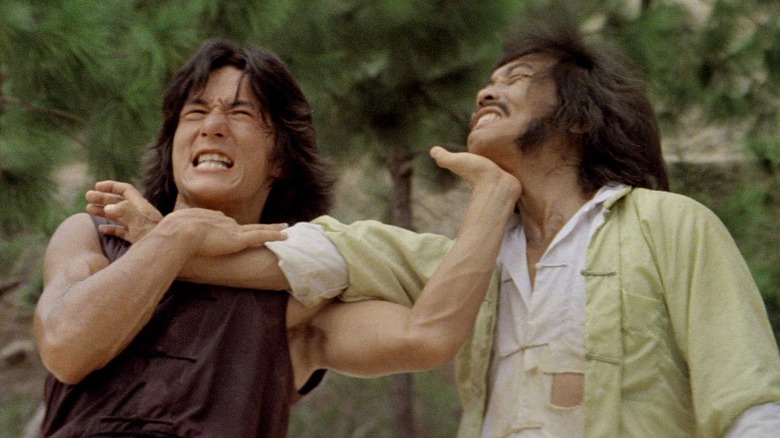
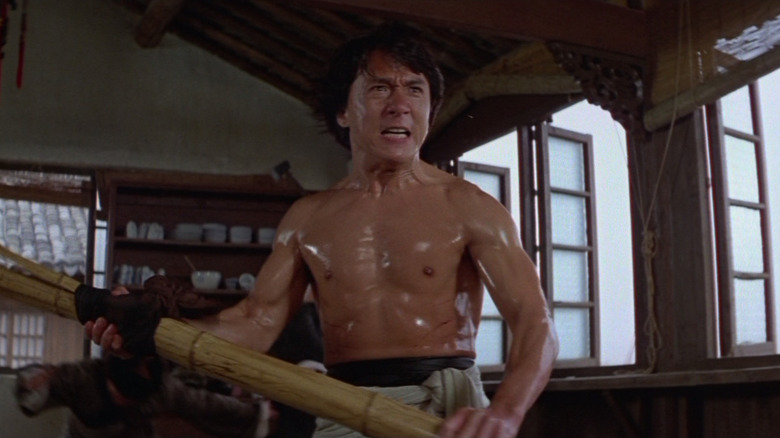
If you love martial arts films, then the 1978 film "Drunken Master" should be on your watchlist. The film is all-time martial arts classic, starring Jackie Chan as Chinese folk hero Wong Fei-Hung. It put Jackie Chan on the map in Asia, the first step towards him becoming the superstar he is today.
"Drunken Master" was the second collaboration between Chan and director Yuen Woo-ping, following "Snake in the Eagle's Shadow," which released earlier that year. It's credited with not only popularizing the Drunken Boxing style of Chinese martial arts, it's also one of the earliest showcases of Chan's specific flavor of action comedy. The popularity of "Drunken Master" and his subsequent films saw Chan taking on the role of creative lead for "Drunken Master II," where he was able to fix some of the issues he had with the original's overall presentation.
Woo-ping would follow this success with many other classics, including "Iron Monkey" and "Tai Chi Master," before finding international success as the action choreographer of "The Matrix" and "Crouching Tiger, Hidden Dragon." "Drunken Master" not only blew up the careers of two veterans in action filmmaking, it also inspired countless other movies, games, and television shows.
Keeping The Kids In Mind
Yuen Woo-Ping would not return to direct the sequel, however. "Drunken Master II," also known as "The Legend of Drunken Master," was released many years later in 1994. By that point, Chan was a bonafide star, having written, directed, and starred in "The Fearless Hyena," "Police Story," and "Police Story II." When the time came for a sequel to "Drunken Master," it only made sense for Chan to have a greater hand in the direction of the film. While "Drunken Master II" was directed by Lau Kar-leung, Chan was able to steer the story in a direction that he felt better suited his vision.
1978's "Drunken Master" featured Chan as a younger, impetuous Wong Fei-Hung who learns martial arts as a way to grow emotionally. It's a deft mix of comedy and martial arts action, with every fight showcasing Chan's comical expressions, amazing moves, and wildly over-the-top pratfalls. The sequel came far later and features an older Fei-Hung struggling with a temper and a style of kung fu that requires the consumption of copious amounts of alcohol. Chan wanted to use the later film to present a better message for younger viewers.
"When I saw 'Drunken Master' after I became popular -- it is a great movie, but I was a little disappointed," Chan explained in an interview for the 35th anniversary of the first film posted at Films Extras. "Because I taught kids about drinking liquor and I hit people through the movie. So when I directed the last half of 'Drunken Master 2,' I adjusted the wrong parts of the story right away. Too much drinking and fighting are wrong."
There's No True Drunken Master III
While Fei-Hung has to drink to unlock the peak of his style of kung fu in "Drunken Master II," his demeanor and general drunkenness are treated as a flaw in the film. Picking fights is the impetus for the film's plot, with Wong's family items being switched with those being smuggled out of China by antagonistic British officials during a duel that didn't need to happen. Likewise, Fei-Hung's drunkenness gets him into more fights and almost causes his father to lose his land.
What hasn't changed is the general craft of the film and Chan's martial arts prowess. With the weight of experience, the older Chan is faster and more precise in the sequel. He's also more adept at playing up the physical comedy of a situation, like an early fight scene where Fei-Hung is desperately looking for more things to drink and becoming more unorthodox in his style as he succeeds. The final fight between a more driven Fei-Hung, who is pushed to drink by necessity, and a taekwondo-wielding henchman played by Ken Lo is a brutal ballet of wild kicks and ethyl alcohol. It's also one of the best fights ever put to film. As a kid who grew up on these films, I have to say I missed all of the messaging about not drinking amidst the excellent fight scenes. Sorry, Mr. Chan.
Later in the interview, Chan notes that the changes made to "Drunken Master II" were indicative of his overall feelings about filmmaking. While the martial arts and comedy remain at the forefront, his later films present more wholesome themes of friendship, family, and loyalty. Kicking people is cool, but you don't have to be a bad guy to do it.
Last Friday the crew at Asahi Linux led by Hector Martin released the first alpha release for running Linux on Apple Silicon hardware. I eagerly loaded up Asahi Linux on an M1-powered Apple Mac Mini knowing the various early limitations of the Linux kernel support that is still settling. Overall the Apple M1 Linux performance ended up exceeding my expectations for the performance in its early alpha state. Here are some benchmarks.
Now that society is collapsing, Everything Is Terrible! is reborn with their new and fantastical expedition into found footage... but this time the adults can stay home! EIT! has unearthed thousands of forgotten DVD & VHS tapes aimed at yesterday’s youth to bring you their most mind-melting movie to date. Watch in awe as all colors of the rainbow join forces to destroy the tyranny of adult civilization once and for all! All of your oldest friends will be there; skateboarding web-surfers, rapping math equations, gigantic baby ducks, and maybe even a wizard or two! And what EIT! show would be complete without a live experience that makes the Ice Capades look like a stupid piece of trash! Finally, an all-encompassing extravaganza created for kidz... by kidz!