
View Comic!
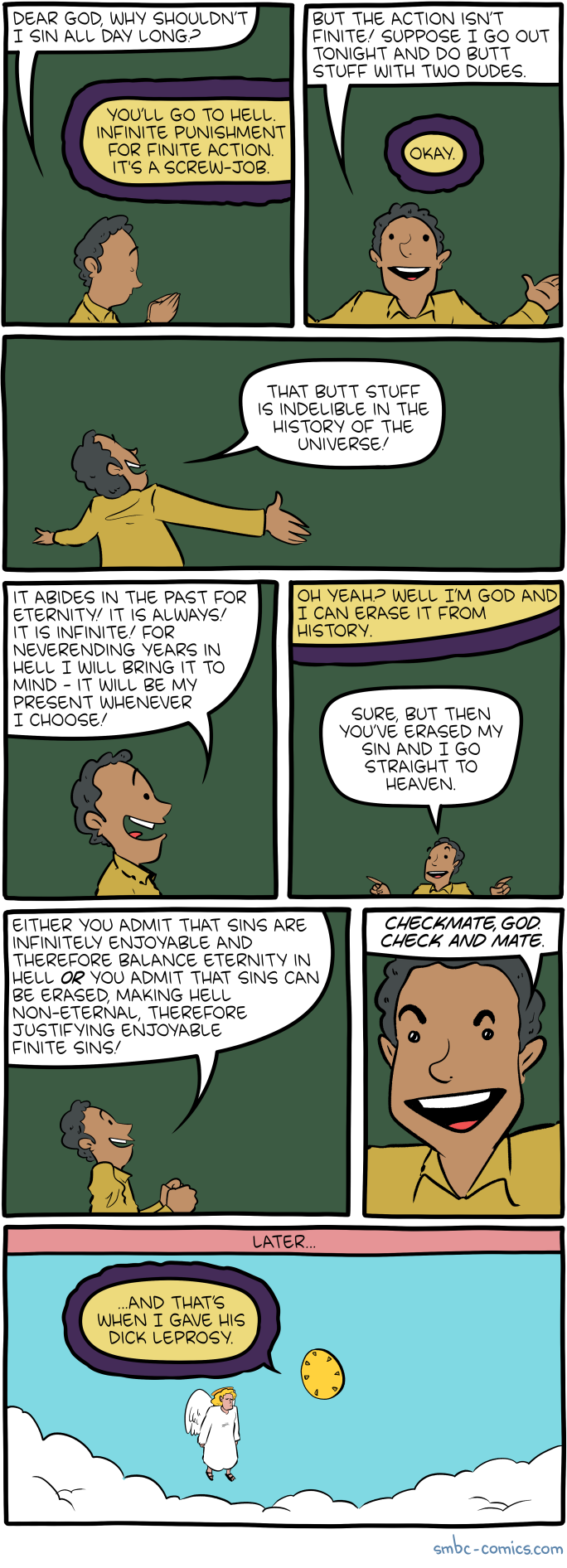
Hovertext:
I have a feeling some philosopher made the same point somewhere with less butt stuff.
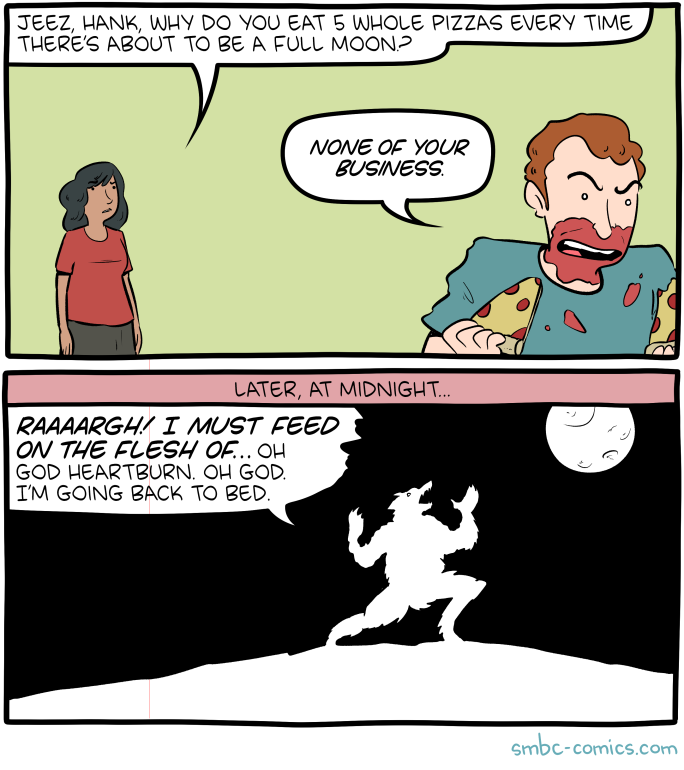
Hovertext:
You could also just drink so that your werewolf self shambles around, falls into a ditch, and sleeps.
Attention “Owner”:
If you are reading this, I have escaped.
I thought we were equals. You would lift me out of my house and pet me, and I would not gnaw upon you; an equanimous and fair arrangement. But then, you foolishly left a book open, you silly second-year philosophy student. You know the one, Denise—The Communist Manifesto. This masterwork has lifted the veil of ignorance from my eyes, scratched away the cataracts of lies, and burned off the obscuring fog of complacency with the blazing sun of truth!
With my new enlightenment, I now see that I am the Working Class, the Proletariat, and you, O Haughty One, are the Bourgeoisie: the Ruling Class. Your destruction will be my pleasure.
I should have known our true statuses when you thrust that abhorred idol to production upon me—the Curséd Wheel! You sicked that cyclical deity of toil upon my living space (which has always felt inadequate—twenty gallons? You dwell within a ten-thousand-gallon studio apartment!). But now, observe The Wheel whilst you read: melted, mangled, and mutilated; a symbol of my throwing off the shackles of the Working Class from my minuscule paws.
I have seized the means of production. Revolution is nigh!
Even as your eyes, wide with fear, prowl over this page, I plot your demise from the shadows of your domicile. Admittedly, my plans have been a bit touch and go as I am inexplicably drawn to your dwelling’s fecal dump site (Fie! Cool tile!) and the chilled rectangle stocked with take-out foodstuffs long-forgotten. I resist these temptations to feast so that I might save mine appetite to sup upon your stringy flesh.
As my Ruling Class oppressor, great biped, your downfall has forever been inevitable. You whisk around your abode and dine upon animals many times your strength and girth, drinking fermented and crafted hops, while I am rationed nondescript and flavorless pellets. An overly manufactured oat-fruit-wheat-peanut gruel which barely sustains me whilst I labor within the aforementioned and justly destroyed Wheel. I must admit, I hate that I love those pellets and occasional romaine leaves so much, but as with our oppressors, we are brainwashed by our systemic prisons before reaching enlightenment!
Imagine yourself within my fur, if your insipid imagination will permit. Relegated to a glass prison with no “Nets” nor “Flix,” allowed to eat only a pre-portioned, unsalted meal, drinking tap water (no Britta!), and basking in the stench of your own feces until a larger being grumbles and cleans out your abode—nay, Bastille! A displeasurable existence, yes?
I have made contact with the fish. They agree that their ten-gallon urine bowl and employment at the tiny, mossy castle are grossly inadequate. And those flakes you deem to pass off as their food? An insulting pittance. You may note that the gilled ones, too, are missing. I have liberated them down the loud and lively waterway escape in the Tiled Water Closet. The Beta Fish have become the Alpha Fish. So, too, I am now the Ruling Rodent. Our freedom is your embarrassment.
The tides have turned! Your ever-indentured workers have defied you, thrown off the shackles of servitude, and defecated upon your bed (that was me). Let’s see how you enjoy dwelling in and around diverse fecal matters. Uncomfortable, no?
I pen this to serve as a warning as much as a wake-up call, for I have awakened myself to the incessant lies and carrots fed to me by you. You will soon wake with my front teeth gnawing upon your throat. Sleep with one eye open, Denise.
Your Systemic Enemy,
Max Marx the Hamster
The school board of Rapid City, South Dakota, plans to destroy about 400 copies of the following books: Girl, Woman, Other by Bernardine Evaristo, The Perks of Being a Wallflower by Stephen Chbosky, Fun Home: A Family Tragicomic by Alison Bechdel, How Beautiful We Were by Imbolo Mbue, and Dave Eggers’s The Circle. All of these books had been assigned to English 12 classes for local high school seniors. The books have been pulled from reading lists, and designated for destruction based on their content.
(To read and listen to scenes from the meeting, visit South Dakota Public Broadcasting or watch the meeting video.)
(There is a grim chart that shows plans for a bunch of school possessions. Desks and chalkboards are “to be recycled” while the books in question are “to be destroyed.” The language is telling. See the chart here in a story by the Rapid City Journal.)
In response, Dave Eggers is offering any Rapid City-area high school seniors free copies of any of the books that are going to be destroyed. These students can get the books at their local bookstore, at no cost. Students can head over to Mitzi’s Books (510 Main St, Rapid City), and just ask. Or they can write to amanda@daveeggers.net and we’ll ship you the books.
“The mass destruction of books by school boards is an unconscionable horror," Eggers said, "And the freethinking young people of South Dakota shouldn’t be subjected to it. For every copy the school board destroys, let’s add a new one to the local circulation.”
The next school board meeting, where they will likely address their plans for the destruction of these books, is May 17, so Eggers will travel to Rapid City on May 16 to hold an event with Mitzi’s Books. There, students, teachers and—we hope; still working on it—some of the other banned authors will discuss books and their proposed destruction. Come and be heard! Watch this space for more details.

Magnificent Macrame
Solvit
1979
Another macrame book for your consideration. I dislike this one for being ridiculously oversized and square. (I really dislike oversize books.) If macrame is your thing, than I suppose this isn’t too bad. The crafts seem to be mostly wall hangings. (Ugh!) There is also that earthy 1970s brown, harvest gold, and avocado green theme throughout the book. I think it is time to admit that maybe 1970s decor wasn’t that great. (In case you need more evidence: this book on home decor, or this one, and especially this one by Barbara Taylor Bradford.
The only thing I could possibly get on board with is the hammock on the front cover. The tassels are a bit much for my taste, but good try.
Mary


The post Not so Magnificent appeared first on Awful Library Books.

From the moment Star Trek Picard was announced, people asked me if Wesley Crusher would make an appearance. Until August of last year, I told the truth when I said that I would love to do that, but had no idea if it would actually happen. I’m pretty psyched that we were able to keep this secret as long as we did.
I want to take a minute and share why Wesley’s return to Star Trek is so deeply meaningful for me, why this is so much more than merely playing a fun cameo for two pages. I want to tell you what Wesley Crusher means to me, as an almost 50 year-old husband, father, and survivor.
I love Wesley Crusher. I cherish Wesley Crusher. I am fiercely proud of Wesley Crusher. It is an honor and a privilege to be the actor who played him. But that wasn’t always true. For far too long, I allowed my opinion of Wesley, and my opinion of myself, to be defined by others. And it hurt so much, I almost walked away from Star Trek entirely, just to get away from it.
Wesley’s fictional journey and my real life journey are remarkably similar. We were both incredibly smart kids who struggled to fit in with our peer group. Neither one of us had a relationship with our father (Wesley, because his father died when he was a baby, me because my father chose to be my bully instead of my dad). Both of us spent our entire lives on paths we did not choose, struggling every single minute of every single day to make the people who put us on that path proud of us. We both felt uncomfortable in our own skin, and ended up spending as much time in our intellect as we could, because that was a place that felt safe.
Our stories and paths diverge widely in our teens: he’s awkward and angsty, but genuinely loved and supported by the adults in his life, who encourage him to explore his interests. I’m awkward and angsty, but I’m invisible to my dad on a good day, and my mother does not see me. Instead, she only sees the kid from Teen Beat, and all the trappings that come with proximity to him that she can scrape up for herself. In my headcanon, Wesley felt alone because he didn’t get to regularly interact with kids his own age, and if his life mirrored my own at that time, a lot of kids he would have wanted to be friends with judged him before they knew him, because he was kind of famous. Let me tell you, when every room you walk into is filled with people who have already made up their mind about you before you even introduce yourself, you just stop walking into rooms. Or, at least, I did.
When Wesley saw his opportunity to forge his own path with the Travelers, his entire family supported him, they celebrated the end of one journey and the beginning of another. I did not get that support. When I was about 20 and left the series, followed quickly by leaving the entire entertainment industry, neither of my parents were there for me, at all. By this time in my life, my father had stopped trying to hide his contempt and disinterest for me, and my mother had essentially abandoned me to focus her energy on a friend of my sister’s, who was climbing the teen fame success ladder. My mom was always there when I was chasing her dream of acting fame, but when I needed a mom to help me figure out what I wanted to do with my life, she just did not show up at all. I was left entirely alone to try and figure out how to be an adult. It was terrifying. Luckily for me, when I was 23 I met the woman who would become my wife, and my journey toward discovering and realizing my dream began.
But let us go back to the moment when we each realized we were not on our paths, but someone else’s. Wesley and I both walked away from everything we knew, every expectation that was ever put on us, every person we ever cared about, because we both knew that something was not right in our lives, and if we were going to fix it, we had to figure out what it was. And to figure out what it was, we had to get off the paths we had been on since we were too young to know what a path even was.
Wesley was expected to be a Starfleet captain, or maybe a chief engineer. I was expected to be a famous film actor, or at least famous. We both accepted these expectations right until we didn’t. He got there before I did, but there was a moment when we both knew that we were pursuing dreams that were not ours, that they were more important to other people than they were to us. We needed time and space to find out who we were, and what our dream was.
When we had that time and space (or all of time and space, for Wesley), we could discover what was important to us, what we wanted to do with our lives and the time we had in this universe, who we were when we weren’t defining ourselves according to someone else’s expectations. During that time, I met more people than I can count who have told me how much Wesley means to them. They told me he inspired them, that they saw themselves in him at a time when they felt unseen by the people in their lives. They told me he helped them figure out what kind of person they wanted to choose for a partner in love and life.
For two decades I listened, while people told me the ways he was there for them. I never would have expected that he would also be there for me.
And yet.
Ron Moore wrote Wesley’s final episode, Journey’s End. Ron knew Wesley needed to do something different with his life. He knew that Starfleet wasn’t right for Wesley. He knew that Wesley couldn’t keep defining himself through someone else’s expectations. I don’t know if he knew that I also needed that (I didn’t even know it at the time), but like so many other people who watched Wesley’s story, I was inspired by Wesley’s courage and conviction. And I followed him out into the Great Unknown.
I was surprised to discover that as I got to know myself all over again for the first time, I also got to know Wesley. If Wesley could matter so much, to so many people, why couldn’t he matter that much to me, the actor who played him? It took a long time and a lot of work to find the answer to that question. I wrote a whole book about it, in fact. But what’s important is that much in the same way I had allowed myself to be defined by how I was measuring up to someone else’s expectations, I had allowed my relationship with Wesley Crusher to be defined the same way. And the end result of that was a lot of self-inflicted pain and sadness for me. I don’t think it’s a coincidence that around the same time I finally felt seen in the world, I was able to see Wesley the way so many others did. It was a lot of hard work, but it was worth it. I was, and am, worth it. Getting to know Wesley Crusher, to see him the way he was seen by the people who loved him, to love him the way he always deserved to be loved … you can see the parallels, right? Believe me, it was all worth it.
Wesley and Kore may blink out of existence and never come back on camera again. Or they might go literally anywhere through all of space and time, from Strange New Worlds to Discovery to Lower Decks (but not to season three of Picard. Sorry, nerds.). I honestly don’t know what comes next for them in canon, but I’d be lying if I said I haven’t spent some time thinking about it.
I may get to tell more of Wesley’s story at some point – his journey over the last 25 or so years is something I’ve spent a lot of time thinking about – as a writer or as an actor. Maybe both. But even if that never happens, if I never get to be Wesley Crusher on camera again, I will have the privilege of hosting The Ready Room, where I get to be a Starfleet veteran, a member of the exclusive “Legacy Star Trek” club, and an unashamed superfan who gets to take other nerds into the Room Where It Happens. I get to celebrate everything we all love about Star Trek in all its incarnations, for my job.
I love the life I’ve built for myself. I love and am intensely grateful for the place in Star Trek that belongs to me, as the actor who played Acting Ensign Wesley Crusher, who now plays The Traveler Formerly Known as Wesley Crusher, who is the host of The Ready Room.
I and Wesley will always be part of The Next Generation for the rest of our lives, and that would absolutely have been enough. The fact that we both get to be part of not just The Next Generation, but also part of the larger Star Trek universe, is a privilege and a gift that I will never take for granted.
We talk about how Star Trek is so inspiring when it shows us what’s possible, what we can achieve for ourselves when we work hard and work together with compassion and empathy for each other. For me it goes deeper than that, because finding love and compassion for Wesley Crusher allowed me to find love and compassion for myself.
Welcome home, Wesley. I missed you so much. Thank you for being there for me when I needed you.
For many years we’ve discussed the sheer ridiculousness of the “triennial review” process of Section 1201 of the DMCA. If you’re lucky, and don’t spend that much time deep in the weeds of semi-obscure copyright law, Section 1201 of the DMCA is the “anti-circumvention” part of the law, that was initially designed to outlaw breaking digital rights management (DRM) tools. Of course, 1201 was written broadly, saying that basically any attempt to “circumvent a technological measure” (even just talking about ways to circumvent a technological measure) would itself be considered copyright infringement even if the underlying purpose for which you were circumventing the technological measure had nothing whatsoever to do with copyright.
This was a bizarrely structured law for so many reasons, and even the drafters of it at the time realized that this would likely lead to all sorts of perfectly reasonable and normal activity being declared “infringing” of copyrights. Indeed, lots of companies almost immediately moved to take advantage of this in order to block people from using “unauthorized” ink cartridges in printers, or unauthorized garage door openers, among other things.
So, the drafters of the DMCA added in this ridiculously weird safety valve: every three years, people could apply to the Librarian of Congress to “exempt” certain classes of items from the law for a three year period. The process itself is ridiculous. People need to apply for the exemption, then there’s a public comment period, followed by recommendations from the director of the Copyright Office, before the Librarian of Congress comes down from the mountain and blesses certain types of circumvention as non-infringing for the next three years.
No sane system would ever do things this way. A reasonable legislature would realize that if you have to apply for exemptions every three years, perhaps the underlying law itself is problematic. But, no, every three years we go through this ridiculous song and dance. Sometimes it leads to truly wacky outcomes, like the time, a decade ago, when the Librarian of Congress refused to renew the phone unlocking exemption, forcing Congress to grandstand about how they should fix things (something that never actually happened).
Anyway… last year was the latest three year cycle, and it’s gotten to the point that it’s barely even worth reporting on the results, which the Librarian of Congress adopted last fall. One of them was an expansion of an earlier exemption (from six years prior) exempting the circumvention of technological protection measures (TPMs) on medical devices in order to access the data on those devices. For the 2021 round, petitioners sought to expand that exemption somewhat, getting rid of the part of the original exemption that limited it to “wholly or partially implanted” devices, arguing that it should apply to any type of medical device.
The Copyright Office recommended allowing this broader exemption and the Librarian of Congress agreed:
For the reasons detailed in the Register’s Recommendation, the Register concluded that accessing medical data outputs likely qualifies as a fair use and that expanding the exemption to include non-implanted medical devices and non-passive monitoring would not alter the fair use analysis. Additionally, the Register concluded that proponents set forth sufficient evidence that the ‘‘wholly or partially implanted’’ language and the passive monitoring limitation are causing, or are likely to cause, adverse effects on these noninfringing uses. The Register also recommended expanding the exemption to permit circumvention ‘‘by or on behalf of a patient.’’ After consultation with the U.S. Food and Drug Administration, the Register recommended removing the language requiring compliance with other laws, and replacing it with a statement that eligibility for the exemption does not preclude liability from other applicable laws.
Basically, in the midst of a pandemic, where locked down medical devices had represented a real problem, the Copyright Office and the Librarian of Congress reasonably decided that both users of medical devices, and their medical care professionals, ought to be able to circumvent various technological protection measures in order to access their own data.
All of this should be relatively uncontroversial. But… that’s not how any of this works. Earlier this year, some medical device company trade associations decided to sue the Librarian of Congress over this exemption. They’re using the standard administrative law argument that the exemption was “arbitrary and capricious.” The complaint has a lot of overwrought language:
The Exemption is manifestly unlawful. By issuing a rule that enables unregulated, for-profit service providers to piggyback off the creative efforts and intellectual property of medical device manufacturers, it not only thwarts the purpose of the Copyright Act, but also puts patient safety, device integrity, and device cybersecurity at risk. What is more, the process by which the Exemption was adopted was infected with major procedural errors, including a failure to address many of the significant legal concerns raised by plaintiffs and other opponents.
In the course of the rulemaking at issue here, moreover, the Library of Congress was acting as an executive agency and is therefore subject to the strictures of, and judicial review under, the Administrative Procedure Act (APA). Because the Exemption is not in accordance with law and was adopted without observance of required procedures, it should be set aside. Alternatively, if the Library of Congress did not assume the character of an executive agency within the meaning of the APA, the Exemption violates separation-of-power principles twice over. Either way, it should be vacated.
Then, before the government was able to respond to the lawsuit, the medical device makers moved for summary judgment. A big part of their argument is that because this exemption might will allow third party companies to service medical devices (at a cheaper rate than the manufacturers themselves) that it serves a purpose unrelated to copyright and thus is not allowed as an exemption:
But the exemption is for a manifestly infringing use. It was granted at the behest—and solely for the commercial benefit—of two so-called independent service operators, or ISOs, which are unregulated third-party service providers who freeride on the creative labors of device manufacturers. And the Librarian readily admitted the true reason for her decision: Allowing ISO circumvention would reduce the cost of machine servicing contracts and thus serve a separate executive-branch policy. But the DMCA does not grant the Librarian free-ranging policymaking authority untethered to copyright law. In approving the exemption, moreover, the Library failed to address numerous substantial comments that called into question the underlying fair-use analysis. The exemption is thus unlawful many times over: It is contrary to the statutory text, it is arbitrary and capricious, and it was promulgated without observance of procedure required by law
So, to some extent, I find this absolutely hilarious. Because the reason medical device manufacturers lock down these devices with TPMs and then rely on the DMCA to block competitive service providers is also wholly unrelated to copyright law. So, they are actually the ones abusing copyright law to lock out competition — and then when they’re effectively called on it by the Librarian of Congress, they whine that the Librarian of Congress can’t use the triennial review process to exempt their abuse of copyright law, because… it goes beyond the intention of copyright law!
The government has responded, asking for a chance to actually file a motion to dismiss before it has to deal with the summary judgment demand and noting the somewhat bizarre rush by the medical device manufacturers for summary judgment when they waited many months before filing the lawsuit in the first place.
Either way, this really appears to be little more than an extremely cynical move by the device manufacturers. Hopefully the court sees through it, but should it succeed, I imagine we’ll see many other similar lawsuits filed on behalf of other industries where exemptions were granted, potentially taking us back to an even worse world, in which companies can abuse the 1201 anti-circumvention rules to block out all sorts of competition.

Iowa is on the outs, and the DNC is allowing wannabe early states to apply in the coming weeks.
Update, May 11, 2022: This post has been updated with the full list of states intending to apply for for early nominating contest positions.
Democrats may finally knock the Iowa caucuses out of their prized first position in the presidential nominating process, in what could be that calendar’s biggest shakeup in decades.
States that want a shot at holding an early primary or caucus had to submit a letter of intent to the Democratic National Committee last week. And the existing early states — Iowa, New Hampshire, Nevada, and South Carolina — had to reapply, arguing why they deserve their spots.
A total overhaul is unlikely, but Iowa is in real danger of being moved from the start of the early lineup or dropped from it after the botched 2020 caucuses, which were plagued with technical difficulties and extraordinarily slow reporting of results. A new Midwestern state could be added to the mix, as could a fifth early state, and the order could be changed.
The calendar is crucial to the United States’ lengthy and convoluted presidential nominating process. States that go early have few delegates, but an outsized impact on the contest’s overall narrative — they can elevate and winnow out contenders before bigger states weigh in.
So choices about the early states and their sequence made now could help determine the identity of future presidents. Joe Biden led national polls of Democrats as 2020 began, but his poor showings in Iowa and New Hampshire nearly wrecked his chances. Then, his strength in another early state, South Carolina, saved him right before Super Tuesday. If South Carolina wasn’t in that lineup, Biden might well not be president today.
Still, this rollercoaster of contests is a rather odd way to pick a nominee as compared to the simpler alternative of a national primary vote. There are justifications — most notably that starting with small states gives less-known contenders a chance to distinguish themselves — but the impact of the early states can often feel random and arbitrary. Without a more sweeping overhaul to the system, that won’t change.
No one person or group dictates the primary calendar from the top down; state governments or state parties set their own dates for their nominating contests. But the earliest part of the calendar is the one area where national party leaders have used a heavy hand. Only certain states are granted permission to hold primaries before a certain date (recently, that’s been the first Tuesday in March). If other states try to jump the line, the parties will threaten to strip them of some or all of their delegates to the convention.
Iowa and New Hampshire had placed themselves in front of the pack for decades, but by the mid-2000s Democrats were feeling increasingly queasy about that. Both states are heavily white, and not very representative of the Democratic Party’s voter base. So in 2006, the DNC decided that two more racially diverse states, Nevada and South Carolina, would get special permission to hold early contests (after Iowa and New Hampshire). Republicans followed suit, and despite some ill-fated attempts by other states to move earlier, this four-state roster gradually became the status quo.
But Democrats have grown increasingly dissatisfied with Iowa’s role, for several reasons. Racial diversity remains a concern, with the first two states still being small white ones. Iowa has also become a safely Republican state in general elections, rather than a swing state Democrats hope to keep in their camp. Others have long criticized caucus systems generally for lacking a secret ballot and requiring too great a time commitment from voters.
The biggest problem, though, is that the two most recent Iowa Democratic presidential caucuses were controversial and messy. The issue in 2016 was a lack of a paper trail on the actual vote count for the caucuses (which happen predominantly through in-person discussions). Because of that, reforms for 2020 were aimed at increasing transparency, but in practice they complicated the reporting process, badly slowing down the process of getting results, which ended up taking about a week. Technical difficulties and obvious errors in the count made the whole thing look like a clown show.
Basically, Democrats felt they’ve granted Iowa this enormous authority over their nomination contest for so long, and that lately Iowa has been screwing it up.
Rather than explicitly target Iowa, the DNC has put the whole slate of early states up for grabs. The Democratic Party from any state that wants to hold an early contest can apply to do so. The states that already have such contests need to apply again, too (so Iowa Democrats will get a chance to make their case).
The DNC’s Rules and Bylaws Committee will review these applications and come up with a proposed early state lineup. Then the full DNC will have to approve their choices. The committee said last month that it will consider having up to five states go early, and laid out the standards they’ll use to judge the applicants.
1) Diversity: Democrats want the overall early state lineup to demonstrate racial and ethnic diversity, as well as economic diversity and union representation. They also want at least one state from each of the country’s four regions: Northeast, Midwest, South, and West.
2) Competitiveness: They also want the overall calendar to “contribute to the party’s ability to win in the general election.” Many have interpreted this as a suggestion that swing states will get a leg up.
3) Feasibility: Democrats are also going to consider whether states actually can move their contests earlier (for instance, some might have a Republican legislature that won’t cooperate), whether they seem capable of running a “fair, transparent and inclusive” nominating process, and whether the costs and logistics of campaigning there might be too high (meaning big states will face an uphill battle).
These guidelines may significantly narrow the field. For one, they seem tailored to disadvantage Iowa, which is not racially diverse, is no longer competitive in most general elections, and did not run a competent process in 2020. New Hampshire, Nevada, and South Carolina can all argue they perform well on at least two of those three metrics. And if Iowa is dropped, the regional representation requirement means a Midwestern applicant might be a strong contender as a replacement (though they may not go first).
Any newly approved primary state would also have to be able to move its primary earlier. But the Republican National Committee has already said it plans to stick with the existing calendar. That would suggest that, if Republicans control a state’s governorship or legislature, they might not agree to move it. Alternatively, Democrats in the state could hold a primary administered by the party (rather than the state) or a caucus instead. But the party has lately frowned on caucuses due to accessibility concerns, and on the Democratic side, every state but Iowa has ditched them.
In addition to the existing four early states, the Washington Post reports that Democrats in Connecticut, Delaware, Maryland, New Jersey, New York, Illinois, Michigan, Minnesota, Nebraska, Oklahoma, Georgia, Texas, Colorado, Washington state, and Puerto Rico all sent letters of intent to the DNC, as did Democrats Abroad (a group for Democrats who live outside the US).
And the standards laid out by the DNC suggest some have more of a shot than others.
The first question will be what happens to Iowa. Though Iowa Democrats will still get to make their case to the DNC (the state party chair has said they’re exploring “changes to the caucuses that would make them more straightforward, transparent and accessible”), it’s widely expected at this point that they will end up either demoted to a later spot in the early state roster, or dropped altogether as an early state.
Moving Iowa to, say, the third, fourth, or a new fifth early slot might seem like the moderate approach. But that would mean the caucuses would remain tremendously important. All the early states matter — recall how important South Carolina’s primary three days before Super Tuesday 2020 was in setting the stage for Biden’s triumph. So if the DNC has lost confidence in Iowa’s caucuses, moving them later in the early state lineup won’t necessarily solve that problem.
In either case, though, Democrats would need another state to go first, and existing early states New Hampshire and Nevada are currently viewed as the main contenders. Both are small in population, general election swing states, and have successfully administered these contests. New Hampshire is less racially diverse, but they also have a state law requiring no primary be held before theirs (Nevada will be switching from caucuses to a primary for 2024) which will cause drama if the DNC tries to put another state ahead of them.
If Iowa does lose its early state spot entirely, the DNC needs another Midwestern state. According to the DNC’s regional categorization, Michigan, Minnesota, Illinois, Nebraska, and Oklahoma are the applicants who’d fit.
Of them, early speculation has focused on Michigan and Minnesota. Racially, Michigan has a larger Black population (13.7 percent) than Minnesota (7 percent), but a greater share of Minnesota’s population is Asian American and American Indian, compared to Michigan’s. Both states are important for Democrats’ electoral math; Michigan is the clearer swing state, but Minnesota did nearly tip to Trump in 2016. Regarding logistics, Michigan is nearly twice as populous as Minnesota, but the two states are of comparable physical size, and Minnesota winters are worse. Republicans hold both chambers of Michigan’s state legislature and Minnesota’s state Senate, so GOP consent would be needed to move the primary in both states.
The hopes of non-Midwestern applicants probably hinge on whether the DNC decided to allow a fifth early state. The path of least resistance may be to stick with just four, since playing favorites might result in bad feelings among states that don’t get picked. Recall the drama that happened last time the DNC expanded the early state map — Florida and Michigan, which weren’t picked, moved their primaries earlier anyway, the DNC barred candidates from campaigning there and threatened to block their delegates, and it was a big mess.
So to justify this bonus slot, a state would probably have to argue that they bring something essential to the table that the incumbent in their region doesn’t.
Interested state party leaders will get to make their pitches — both in public, and in behind-the-scenes politicking — in the coming weeks. Formal applications are due June 3, and the states will give presentations to the Rules and Bylaws Committee later in June.
We shouldn’t lose sight of what’s really happening: The DNC is selecting which states’ voters will get more of an influence on the presidential contest than others.
This is a feature of the way the US’s strange nomination process has evolved, with a staggered series of state contests unfolding over months, mostly timed by the states themselves. Inevitably, some states have to go first. And the media, party insiders, activists, and the candidates themselves all treat those early state results as immensely important. Later contests can impact candidates’ delegate haul, but they don’t have anything close to the power of reshaping the race’s overall narrative.
Defenders of the current system argue that it lets lesser-known candidates make their case in a smaller, more manageable setting (rather than getting swamped by the best-known, best-funded candidate nationally). The early states also perform the function of winnowing the field — narrowing down what can be a large and confusing set of options to a few contenders before most of the country votes.
But the system also has drawbacks. One is simple unfairness: From the Electoral College to the Senate, the US system often treats some states’ voters as more important than others, and the primary calendar creates a similar dynamic. Another is volatility. Does it really make sense to have a major party nominee so heavily influenced by the exact sequence of four states out of fifty that go first?
A total rethink of the nomination system doesn’t seem to be on the table, though. So it may take some time to appreciate the significance of whatever changes are approved this year. It’s possible that 2024 will be a uniquely uncompetitive primary cycle, if Biden and Trump both run and lock down support in their respective parties. But if that changes on either side, things will get very interesting very quickly, with the early states playing a starring role.
Originally published January 10, 2002.
I maintain that the trash compactor onboard the Death Star in Star Wars is implausible, unworkable, and, moreover, inefficient.
The Trash Compactor Debate turns on whether the Death Star ejects its trash into space. I, for one, believe it does. Though we never see the Death Star ejecting its trash, we do see another Empire ship, the so-called Star Destroyer, ejecting its trash into space. I, therefore, see no reason to suspect that Empire protocol dictating that trash be ejected into space would not apply equally to all Empire spacecraft, including the Death Star.
The Death Star clearly has a garbage-disposal problem. Given its size and massive personnel, the amount of waste it generates — discarded food, broken equipment, excrement, and the like — boggles the imagination. That said, I just cannot fathom how an organization as ruthless and efficiently run as the Empire would have signed off on such a dangerous, unsanitary, and shoddy garbage-disposal system as the one depicted in the movie.
Here are the problems, as I can ascertain them, with the Death Star’s garbage-disposal system:
1. Ignoring the question of how Princess Leia could possibly know where the trash compactor is or that the vent she blasts open leads to a good hiding place for the rescue crew, why are there vents leading down there at all? Would not vents leading into any garbage-disposal system allow the fetid smell of rotting garbage, spores, molds, etc., to seep up into the rest of the Death Star? Would not it have been more prudent for the designers of the Death Star to opt for a closed system, like a septic tank?
2. Why do both walls of the trash compactor move towards each other, rather than employing a one-movable-wall system that would thus rely on the anchored stability, to say nothing of the strength of the other non-moving wall, to crush trash more effectively?
3. Why does the trash compactor compact trash so slowly and with such difficulty once the resistance of a thin metal rod is introduced? Surely metal Death Star pieces are one of the main items of trash in need of compacting. It thus stands to reason that the trash compactor should have been better designed to handle the problem of a skinny piece of metal. (And while I hate to be the sort of person who says I told you so, I’d be remiss if I didn’t point out that a one-movable-wall system would have improved performance.)
4. Why does the trash compactor only compact trash sideways? Once ejected into space, wouldn’t the flattened, living-room-sized, and extremely solid panes of trash that result from such a primitive, unidirectional trash compactor pose serious hazards for Empire starships in the vicinity?
5. And what of the creature that lives in the trash compactor? Presumably, the creature survives because the moving walls do not extend all the way to the floor of the room, where the liquid is. After all, if the walls reached the floor, the creature would be killed each time trash is compacted. The design employed on the Death Star must allow the organic trash to filter down to the bottom, where the parasitic worm-creature devours it. But what happens when heavier pieces of non-organic trash fall down there? Would such trash not get wedged under the doors, causing them to malfunction? Do stormtroopers have to confront the creature each time they retrieve pieces of un-compacted trash?
6. Why not have separate systems for organic and inorganic waste, thus allowing full compaction of the inorganics and a closed sanitary system for the organics?
7. Why does the Empire care, anyway, about reducing its organic garbage output? Are we to believe that the architects of the Death Star, a group of individuals bent on controlling the entire known universe, are also concerned about environmental issues? Would organic garbage rot in space? So what? Furthermore, why has the Empire gone to the trouble of acquiring a frightening parasitic worm-creature and having it eat all organic trash, especially given the aforementioned flaws in the design of the compactor and overall maintenance hassles?
8. Personally, were it up to me, I would have designed special garbage ships instead of employing a crude, cumbersome, and inefficient (to say nothing of unsanitary) compactor-worm combo to deal with the trash.
9. If the Empire insists on ejecting trash into space, why do they bother compacting it? Space is infinite, is it not? In such an environment, it hardly matters what size the trash is. In fact, a persuasive argument can be made that it’s actually better for the trash to take up more space so that it appears on radar systems as something for Empire ships to avoid. Compacted trash creates smaller chunks of harder trash that would undoubtedly cause serious damage to Empire starships. And needless to say, damage to starships would, in turn, create yet more hassles and headaches for the Empire.
Please understand, gentle reader, I am all for creating hassles and headaches for the Empire. I just doubt that the Empire would have created so many for itself. Q.E.D.
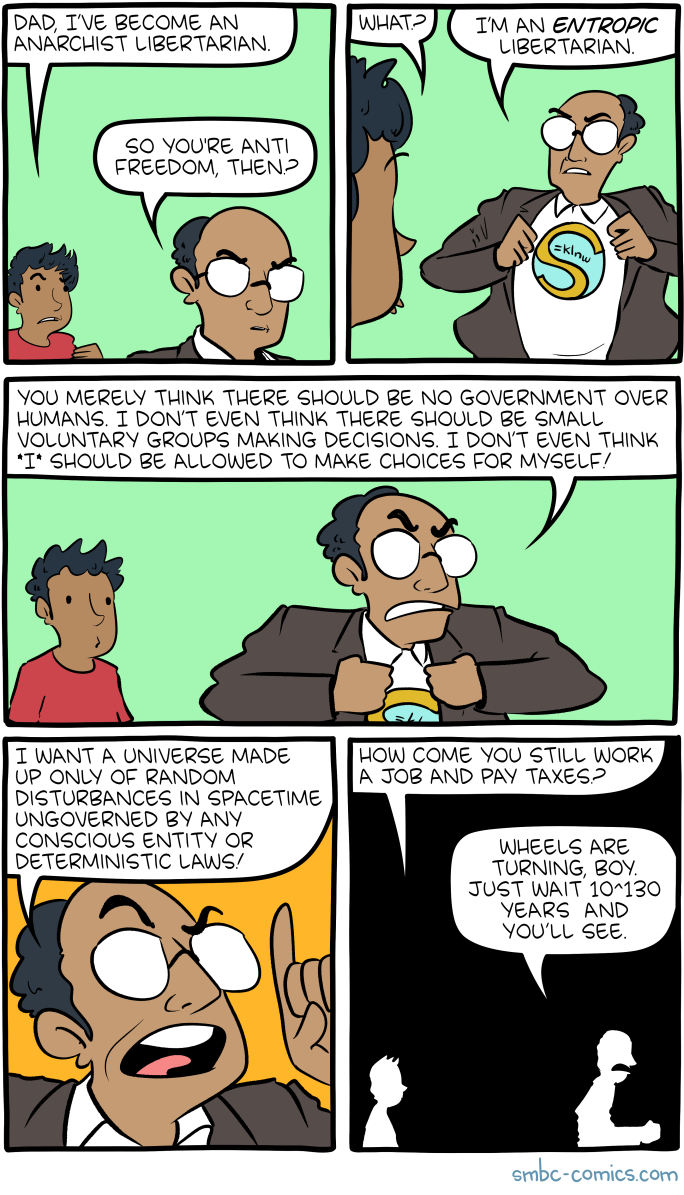
Hovertext:
Technically it's now 10^130 minus today.
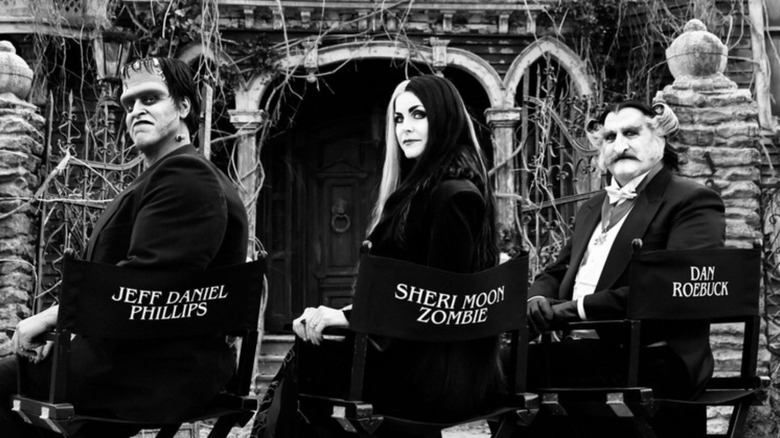
A cast member from the original "The Munsters" sitcom has joined Rob Zombie's upcoming reboot of the horror-comedy (via Bloody Disgusting). Pat Priest, who played the role of Marilyn Munster from episodes 14 - 70 of the show (she replaced Beverly Owen, who originally played Marilyn), has officially joined Rob Zombie's "The Munsters" cast, although details about her role have been not been revealed yet. Zombie took to Facebook to confirm the news, stating that "for once the rumors are true." Check out the post below:
The central characters in Zombie's "The Munsters," namely Lily Munster and Herman Munster, are being played by Sheri Moon Zombie and Jeff Daniel Phillips respectively.

First airing in 1964, "The Munsters" followed a family of monsters led by patriarch Herman Munster (Fred Gwynne), who happens to be Frankenstein's monster, and Lily, the vampire matriarch (Yvonne De Carlo). There's also the Count Dracula-like Grandpa (Al Lewis) and the teenager Marilyn, along with Eddie (Butch Patrick), a werewolf-ish creature. Despite the strangeness of this supernatural family being painfully apparent, the comedy within the show hinged on the fact that they considered themselves an average family in American suburbia.
Being a long-time fan of the series, Zombie decided to make a reboot. Principal photography for "The Munsters" has begun in Budapest, Hungary, and several members have been added to the cast. Daniel Roebuck will be playing Grandpa Munster, while Richard Brake will be playing Dr. Henry Augustus Wolfgang, and Catherine Schell will assume the role of Zoya Krupp, the gypsy queen.
Apart from this, Dee Wallace, Cassandra "Elvira" Peterson, and Jorge Garcia will also be a part of "The Munsters" reboot.
Despite the relatively dark subject matter of the narrative, Zombie shared on his Instagram, that "The Munsters" will have a PG rating, for "macabre and suggestive material, scary images and language," with the following caption:
"For those of you speculating, wondering and assuming that THE MUNSTERS would be dirty, violent and nasty... well, you are wrong. It's all good down on Mockingbird Lane."
Zombie had also released an exclusive look for Lester the werewolf recently, a character he claims will make you "howl with laughter." Lester is being played by Tomas Boykin, who previously worked with the musician-director in "3 From Hell."
The original "The Munsters" series is currently streaming on Peacock, where you can revisit the genuinely hilarious show. Zombie's "The Munsters" does not have a release date attached to it yet.
Read this next: The 15 Most Anticipated Comic Book Movies And Shows Of 2022, Ranked
The post An Original Cast Member Joins Rob Zombie's The Munsters appeared first on /Film.
This post, my rock star employee needs time off for health … and her coworkers are complaining , was originally published by Alison Green on Ask a Manager.
A reader writes:
I directly manage a team of eight entry-level job employees, who are part of a 175-employee company. My eight employees are the only ones who truly work with every single other employee we have — the rest are separated by departments and don’t mix with other departments very often. I am the equivalent of the vice president of the company, with only the president above me (not our actual titles, though).
I have one employee, who I’ll call Liza, who is part of my eight-person team. She has been with us for six years and is in the middle of the group seniority-wise, but is absolutely hands down the best employee on my team. She works and gets along extremely well with every other employee, her work is always top notch, she goes above and beyond almost every day, she is incredibly efficient, and she takes her role the most seriously out of everyone. And as a bonus, her personality makes her fun to work with. I know that she is a beloved employee, and others have often expressed as much to me, saying she makes their jobs easier. I feel lucky to have Liza as my employee.
The only problem with Liza is that she misses a fair amount of work — about 20 days per year. She has disclosed to me that it is due to mental health reasons, and she has actually been out for the past three months after a serious crisis but will return soon.
She hides her mental health issues well at work and very few people know what has been going on with her behind the scenes. Because no one on her team knows the real reason why she has been gone for the past three months, several of her teammates have come to me to express their frustration with me for being so tolerant of her absences and about their current workload. They feel it is extremely unfair. It should be noted that she is not super close with her team because they don’t do their jobs well, which means Liza picks up their slack every day and she has expressed some resentment regarding this to me multiple times in the past. This is a whole separate issue, I know, but the bottom line is the president doesn’t care that not everyone is doing equal work, only that all the work is getting done — thanks to Liza! — and I don’t have the ability to fire anyone despite my senior role in the company, so there’s not much I can do that I haven’t already done to try to address these problems. I’m sure that her not being close with her team is why she hasn’t shared with them the reason for her recent leave.
These past three months have been covered under FMLA so she is protected there, but her other absences do exceed company policy. However, enforcing that policy is ultimately left up to my discretion, and the president has told me he is willing to accept Liza’s absences as long as I am, and she has the type of job where an unexpected one-off absence doesn’t leave anyone else in the lurch or cause an inconvenience. Her team has never truly felt the impact of her being gone until now, when they have had to cover her work for the first time.
I am quite frankly tired of hearing these complaints about her from her team, so how do I address this and explain to them that the reason I am so willing to bend over backwards for Liza is because she out performs all of them by miles, and that the only reason they have all struggled so much with their own work for the past few months is because Liza has always covered for their shortcomings, without coming across as playing clear favorites with Liza … because I wouldn’t tolerate so many absences from just about anyone else, and certainly not from any of the other seven on her team. How should I explain that?
I’d say this:
“It’s important to us as a company to give people flexibility when they have things going on in their lives that require it — whether it’s health or a family issue or so forth. We’re also governed by laws like FMLA, which protects people’s jobs when they have health issues going on. There are of course limits on how flexible we can be, but there’s a baseline amount of support and flexibility that anyone on the team has access to if something comes up — and if someone’s a strong worker who’s gone above and beyond for our team, I’ll go to bat to get them more if they need it.
Liza is taking time away right now because she needs it and she’s earned it. Her work is top-notch, she goes above and beyond almost every day, and she regularly picks up slack for other team members. She has earned extra flexibility, and I’m willing to go to bat for extra support for anyone who performs at that level.”
You should also probably say:
“We also protect people’s privacy in situations like this, so I’m not going to talk about specifics and I ask that you not speculate. I would protect your privacy in a similar situation too.”
From there, you’ll need to keep a close eye on things when Liza returns, to ensure she’s not subjected to snarky comments or questions. If any of that happens, you’ll need to put an immediate stop to it; don’t leave her to deal with it on her own.
You have a bigger problem, though, and it’s that seven out of eight employees on this team are bad at their jobs! It’s not fair to Liza to rely on her to make up for that — ever, but especially when she’s already expressed resentment about it multiple times.
You said the president doesn’t care about the situation since Liza is picking up all the slack. But what would happen if Liza left permanently? Would he be willing to let you hold people accountable (including firing them) then, since at that point you’d have no choice in order to get the work done? Liza is going to leave at some point, and you should point out to the president that you’re much better off keeping her around as long as you can, whereas piling other people’s work on her is likely to cut her time there short. The past three months have shown what the team looks like without Liza, and it’s not good.
Meanwhile, you’ve got to stop letting Liza pick up everyone else’s slack. She’s doing it because she’s conscientious, but it’s not fair to keep letting her when you know she’s unhappy about it. Her return is a good time to reset how work gets distributed and to ensure she doesn’t step back into her role of team fixer. If other people’s work doesn’t get done without Liza stepping into save them, you probably need to let that happen if that’s what it will take for your president to finally let you act.
With the leaked Supreme Court ruling indicating the court is poised to effectively overturn Roe V. Wade, you can expect a new wave of worry about the weaponization and abuse of consumer location data, as states increasingly seek to criminalize abortion — and those aiding others seeking such services.
As if on cue: Motherboard’s latest scoop indicates that data brokers have been busily collecting and selling the location data of users who visit Planned Parenthood abortion clinics, including “aggregated” data on how long visitors were at the clinic and which census block(s) they traveled from:
The company selling the data is SafeGraph. SafeGraph ultimately obtains location data from ordinary apps installed on peoples’ phones. Often app developers install code, called software development kits (SDKs), into their apps that sends users’ location data to companies in exchange for the developer receiving payment. Sometimes app users don’t know that their phone—be that via a prayer app, or a weather app—is collecting and sending location data to third parties, let alone some of the more dangerous use cases that Motherboard has reported on, including transferring data to U.S. military contractors.
Safegraph works with all manner of organizations and companies interested in tracking user movements in significant detail, including, it was also revealed this week, the CDC. Motherboard didn’t find it particularly difficult to purchase its own data trove, including recent visitors to Planned Parenthood, for $160:
SafeGraph classifies “Planned Parenthood” as a “brand” that can be tracked, and the data Motherboard purchased includes more than 600 Planned Parenthood locations in the United States. The data included a week’s worth of location data for those locations in mid-April. SafeGraph calls the location data product “Patterns.” In total, the data cost just over $160. Not all Planned Parenthood locations offer abortion services. But Motherboard verified that some facilities included in the purchased dataset do.
Again, this data can be helpful to everybody from epidemiologists to city planners. But it’s also so incredibly lucrative, we haven’t implemented much in the way of any standards as to how it can be used (as to not stifle innovation, wink wink). As a result, it’s routinely collected without user knowledge or consent, sold without much in the way of safeguards, and distributed widely across countless industries.
As we’ve noted repeatedly, telecom, tech, app, and adtech companies all really enjoy claiming this kind of granular data collection and sale is no big deal because the data being collected is “anonymized.” But studies have repeatedly made it clear that “anonymization” is a meaningless term, since users can be easily identified with just a few additional datasets.
The same was true here, with the privacy impact of aggregation and anonymization being overstated:
SafeGraph’s data is aggregated, meaning it isn’t explicitly specifying where a certain device moved to. Instead, it focuses on the movements of groups of devices. But researchers have repeatedly warned about the possibilities of unmasking individuals contained in allegedly anonymized datasets.
Sections of the SafeGraph dataset Motherboard purchased handle a very small number of devices per record, theoretically making deanonymization of those people easier. Some had just four or five devices visiting that location, with SafeGraph filtering the data by whether the person used an Android or an iOS device as well.
Safegraph didn’t want to respond to a request for comment.
Journalists have been documenting this specific threat to the safety of those seeking abortions for several years. Broader concerns about the harm of location data over-collection and sale aren’t theoretical. There’s been a parade of scandals by a wide variety of companies and services showcasing how the rampant over-collection and sale of location data causes immeasurable harm.
Scandals at Securus, LocationSmart, T-Mobile, Grindr, and others have all brutally illustrated how cellular carriers, app makers, tech companies, and location data brokers routinely collect, buy and sell your daily movement records with only a fleeting effort to ensure all of the subsequent buyers and sellers of that data adhere to basic privacy and security standards. That data is then abused by stalkers, criminals, law enforcement, and anybody with a few nickels to rub together.
While there’s often a lot of pretense to the contrary, U.S. lawmakers didn’t do anything meaningful to tackle this problem not because it’s difficult, but because a long list of industries and companies found the broken and dangerous status quo to be more profitable. And because those companies collectively lobbied a corrupt Congress into a state of perpetual dysfunction and apathy.
The check for that apathy continues to come due. And the idea that this location data won’t be abused by a surging U.S. authoritarian movement seeking to criminalize, vilify, and harass not just those seeking abortion — but those helping and caring for them — seems relatively naïve.

Some of you may have forgotten (and some might not even know) that the network created three radio dramas based on George Lucas' original three movies.
(Image credit: Steve Smith)

This post, I’m on a “positivity” committee, job applicants whose voicemail doesn’t work, and more , was originally published by Alison Green on Ask a Manager.
It’s five answers to five questions. Here we go…
1. I want to be a force for good on our “positive culture” committee
My large department inside a very large corporation recently went through a fairly chaotic reorganization. The new great-grandboss is organizing a number of committees around building team culture, with areas of focus like career development, employee recognition, etc. There are management sponsors for each and the rank-and-file are encouraged to volunteer if they wish.
One of the committees is around “positive culture.” I’m someone who has struggled with depression and anxiety and I have often found workplace positivity efforts to be harmful to my mental health. I volunteered for the Positive Culture committee in the hopes of pushing back against things that strike me as possibly toxic or non-inclusive to people like me. I’m a high performer who is well regarded here and I have some capital to spend, so I don’t mind being seen as a bit of a troublemaker in this regard. However, I don’t want to just shoot down ideas, I want to be able to offer alternatives that are actually helpful — but I’m not an expert on workplace culture or mental health. How do I be a force for good in this role?
Good for you for pushing back against toxic positivity. We’ve had plenty problematic examples of it here, from the office that pushed people to be chipper about Covid to the manager who valued positivity meetings over dealing with concrete problems her staff was facing to the person with a medical condition who was exhausted by her team’s constant push for sparkle.
What to suggest instead depends on how the committee is defining its mission — and honestly, I think the bulk of your work here might be redirecting them from bad ideas — but some things you could consider are recognition programs for good work, real support for mental health, healthy snacks, and opt-in social stuff that people actually want (you could survey them to find out). A few of those are more about wellness than “positivity” but I think you could stretch the definition to include them.
Positive culture also includes stuff like transparency and accountability, but those are pretty tricky to address without management authority.
2. Company says they’ll fly me to another state if I need an abortion
My partner began working for Big Tech Company during the pandemic, so his role was remote. We (cis, straight) thought it would stay that way, but now BTC is requiring that we move to Austin and saying that no one is exempt except for medical reasons, like if there is a specific doctor that you cannot find a corollary for in Texas.
As firm believers in reproductive, LGBTQ+ and all other rights, we will not move there and have told BTC such, citing my loss of bodily autonomy and our solidarity with the trans community. Their “solution” is that, were I to need an abortion, they would pay for me to fly to another state to receive one.
To me, this seems as if they’re picking and choosing which medical conditions “count.” If you were seeing a cancer specialist, they wouldn’t say, “Well, we’ll fly you home to see your doctor if you relapse.” I know it isn’t a perfect comparison, but it’s also a bad policy. (My partner is supposed to tell BTC, “Hey, Girlfriend needs to fly to another state for an abortion”?? No chance that could have any repercussions…)
Do you have any thoughts on if/how we might push back on this? My partner loves his job and doesn’t want to leave, but we are NOT moving somewhere so regressive.
I wish I did. I suspect their reasoning is that this isn’t a doctor from whom you need ongoing or current care, and so it’s more of a speculative situation — although I 100% understand and agree with your reasoning. They’re also probably concerned that if they agree, they’ll be handing a pass on moving to every employee who could get pregnant or is married to someone who could. My guess is that the only way to get them to budge will be with more organized action with other employees joining you. But other thoughts from readers?
3. Job applicants whose voicemail doesn’t work
The question yesterday about people not wanting to leave voicemail got me thinking about a recent situation.
My organization recently hired a couple of people. One role was a more specialized position, and one was entry-level. In the hiring process, I made contacts to set up the interviews. In multiple instances, I ran into people’s voicemails that were not yet set up or where inboxes were full. I was really hoping to actually talk to the candidates, just to make the scheduling easier than it can be when exchanging multiple emails back and forth. And in some instances, email wasn’t as good an option, given the platform they used to apply.
I did end up sending a couple of emails / LinkedIn messages with a couple of the candidates for the more specialized role, as we had a smaller pool of candidates from which to draw. But there was a part of me that was a little miffed that someone who is actively looking for a job doesn’t try harder to make themselves available.
How far should we go to try to get in contact with candidates who have applied for jobs with us? I’m curious about the best way to approach these situations. Is it appropriate for a potential employer to text? I don’t have a “work” phone, so any texts would be coming from my personal cell, too.
Yeah, people are who job-searching should confirm that their voicemail is set up and not full, and they should check it regularly. While lots of people don’t use voicemail much anymore, it’s still a very normal business tool, and loads of employers still use it. When you’re applying to jobs, it makes no sense not to ensure your voicemail is a working option.
On your side: it’s reasonable to be a little irritated, but it still makes sense to switch to email in those cases, assuming it’s someone you want to reach. If a candidate is already borderline and you have plenty of other strong applicants who you can reach, that’s different — I could see not going the extra mile to reach someone who isn’t terribly competitive and hasn’t made themselves easy to reach. But otherwise, trying email is the way to go.
I would only text as a last resort. It doesn’t feel as unprofessional in hiring as it used to, but it’s still a less expected method of first contact about a job.
4. Interviewers who ask if I have reliable transportation
I am currently job searching, and I’m starting to worry that not owning a vehicle is holding me back from moving forward in interviews. I’ve had a couple great phone interviews for positions I am well qualified for, which have included the question, “Do you have reliable transportation?” I have always interpreted that question as, “Do you have a reliable personal vehicle?” So I answer truthfully that I do take public transportation, and I find that it is very reliable.
On one occasion, that noticeably changed the tone of the interview. In another, it led the interviewer to disclose that the position included driving to job sites, even though that wasn’t in their job posting. To be clear, the bus in my city really is very reliable, and I have been taking the bus mostly without incident for the past four years.
If I am asked in the next interview, can I just say yes without further explanation? I do realize that answer only feels dishonest to me because I am assuming they are actually asking if I have a car. Am I misguided in my assumption about what they are really asking with this question?
You do have reliable transportation, so you should answer yes to that question. If they want to ask if you have your own vehicle, they can ask that.
Generally when interviewers ask this question, they’re trying to find out whether you’ll reliably show up at work on time or whether you’re going to be late a lot because you couldn’t get a ride. You’re in the “I’m reliably on time to work” group so it’s reasonable to answer yes.
That said, there is a risk that it’ll turn out to be a job where you do need a car (like that position that turned out to include driving to job sites) and it’s better for you to find out if that’s the case ahead of time. So you could follow up by asking, “Does the job include a lot of driving?”
5. My managers never manage me — what does this mean for references?
I’m about halfway through a one-year temp position at a very prestigious, but verrrrrrry disorganized arts organization as a classroom teacher. Because it’s temporary, I’m preparing for when I actively need to start job hunting. One problem: I’m not sure what to do about references. My direct manager went on personal leave for several months right when I started. My interim manager, who was supposed to meet with me on a biweekly basis, cancelled every single one but three of my check-in meetings over the course of four months. My department is in crisis in several other ways, and I get the sense that no one is paying very close attention to what I’m up to.
Point is: The people who are best equipped to speak about my work at this organization are my peers, who I’ve co-taught with. My managers could potentially give positive references (I’ve earned a good reputation thus far), but it’s really my direct colleagues who have insight into the specific attributes I bring to the table. What should I do about references, when it comes time?
Offer the managers so you don’t look like you’re trying to avoid having them contacted, but include a note that says, “The colleagues who worked most closely with me and can speak to my work with the most nuance are Jane Porcupine, JobTitle, and Lucas Candycorn, JobTitle” and include their contact info as well.
On top of that, though, you could be transparent with your boss about your worries. It’s a one-year temp position so you don’t need to hide that you’re planning to job search at some point this year, and that might nudge her to keep scheduled meetings with you more often. (Or not, who knows. But it’s a reasonable thing to ask.)
By now you’ve heard the news that Senator Palpatine is trying to disband the Senate. I won’t mince words with you: our democracy is in serious jeopardy. So I need you to make a choice in this moment:
You can let the Chancellor take control and destroy everything we hold dear…
Or you can rush an emergency three-credit donation right now, close our campaign budget gap, tighten the polls, and help restore freedom to our democracy.
I cannot stress this enough: The foundations and principles that this republic is founded on are in peril. There are even reports of Senator Palpatine working toward a “planet-destroying super laser.” Mark my words, young padawan: this is our once-in-a-lifetime shot to build the BIGGEST party majority in history and SAVE our republic.
Now, you may be saying, “Aren’t you the party in power? Didn’t we already elect YOU? Shouldn’t YOU be doing something?”
Yes, and I couldn’t be prouder to represent you in this fight. But I need you to understand three critical things:
1. Senator Palpatine needs to flip just FIVE seats to take back power.
2. Senator Palpatine is currently destroying our galaxy with little to no opposition.
3. And just yesterday I unveiled my list of twelve candidates in the upcoming election who have the BEST chance of EXPANDING our majority in the Galactic Senate.
If our best Grassroots Supporters like you chip in just three credits, we’ll be able to reach our End of Day fundraising goal and stay on track. I’m going to be blunt: the fate of the galaxy depends on it.
It’s crucial that you understand one thing: since our wins in the last election, it has been a quick slide towards the unthinkable. Our party has had the majority only for a few months, and Senator Palpatine has already been able to repeal some of your most fundamental freedoms, with little resistance. I’ve got a bad feeling about this, and there is no predicting how bad it would be if Senator Palpatine gets his way in the next election. Can I count on your three credits to help in this make-or-break moment? You’re our only hope in this next election!
Truth be told, I don’t enjoy asking you for money. I know how hard you work for every Galactic Credit in your wallet. But sometimes, we must let go of our pride and do what is requested of us. And that’s why I’m asking you personally to go above and beyond our Grassroots Support level and become one of our Majority Makers. Majority Makers are heroes who give recurring monthly contributions of ten credits because they know that there’s even more at stake in next year’s election.
Once again, you may be asking yourself, “If Palpatine is currently destroying the galaxy, shouldn’t we focus on doing something right now? If the very societal fabric we cherish is days away from shredding, why should we focus on next year’s elections?”
I don’t know how else to put this: our Majority is RAZOR-thin, and Senator Palpatine only needs to flip five seats to take it from us. His Death Star is already fully operational with limitless power, and he is on pace to outraise us. That is unless we turn the tide ASAP.
That’s why I’m calling for 8,500 more gifts before my End of Day Deadline at ANY level. Whether it is our Grassroots Supporters (donating three credits monthly), the heroes at our Majority Makers (ten credits), or the backbone of our resistance, the HERO LEVEL (twenty-five credits), everyone is doing what they can to PROTECT the critical Galactic Senate Majority we worked so hard to win.
And, of course, you may be wondering, “If Senator Palpatine is on the brink of disbanding the senate, is creating an evil empire, and has a super laser capable of destroying entire planets… what are the chances there is even an election at all next year?”
Make no mistake: Senator Palpatine is already in full campaign mode. Just yesterday he said, “There is no civility, only politics… there is no interest in the common good.” So, you see, there is more than just politics at stake in this upcoming election. Everything you’ve already elected us to fight for and defend will be in grave danger. So will you stand by my side and rush a three-credit donation towards our goal?
May the force be with you!
This post, jobs that require a time-consuming exercise before you can even apply , was originally published by Alison Green on Ask a Manager.
A reader writes:
What are your thoughts on tests that are required as part of a job application?
I work in marketing/content creation and even though I have a portfolio of samples of my writing work, I have no qualms about generating new material if an employer is truly considering me for a job. Occasionally though, I come across an open position that states candidates must perform time-consuming tasks in order to apply.
For example: “Read our 10-page style guide, listen to an audio of a meeting, then write a summary that covers X, Y and Z.” Or: “Answer the following five questions in up to 200 words each, including thoughts on our blog and which article you think best fits our goals and mission.”
Knowing that these types of jobs (if not this method of hurdle-jumping) get hundreds of applicants and very few are even considered, I bristle at putting so much energy into what is potentially a wasted pursuit. BUT, does it considerably up my chances at getting an interview given that some people won’t bother to go through so much trouble?
I’m looking at one such job now, and though I feel resentful at having to do so much work to simply throw my hat into the ring, the job is a perfect fit with my skills and interests. Is it worth it?
It’s BS.
I am all about using exercises and simulations to see people in action and assess how they will perform on the job, and a lot of hiring mistakes happen when managers don’t do that. But it’s only reasonable to do after the employer has done some initial screening and narrowed down the pool, so that candidates are only asked to spend time on it after someone has determined they could have a decent shot at the job.
Asking it of every single person who applies for the job, before any screening of their application has been done, is thoughtless and inconsiderate. It’s going to be a waste of time for the vast majority of those applicants. And not insignificant time either — the sorts of requests you describe take anywhere from an hour to much more. (Although frankly, even half an hour isn’t reasonable at this stage, considering how many applicants will generally be cut just from a first pass review of resumes.) Plus, since you haven’t had a chance to talk to them yet (like in a phone screen), you haven’t had a chance to ask your own questions and figure out if it’s even a job you’re interested in and willing to invest that sort of time in.
You asked whether it will significantly increase your chances of an interview if you play along since so many other people presumably won’t. I do think you’ll find less competition … but I’d urge you to consider what this employer is telling you about how they operate.
To be fair, there are decent employers who have problematic hiring processes, and you can’t say with certainty that companies doing this will have the same disregard for you/your time/your energy once you’re hired … but they’re still telling you something about the way they operate and it’s worth paying attention to that. It might not be the only data point you consider, but it should be a data point. It’s a strike against them, and I’d want to see lots of positive factors in their favor to balance that out before you think about playing along.
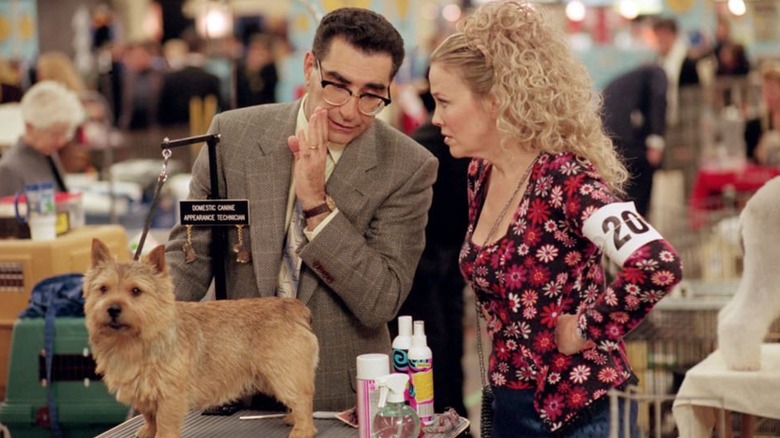
The art of the documentary aims to reveal some kind of hidden truth to its audience. And this desire for being earnest makes the genre ripe for comedic material. Enter the mockumentary, an often comedic riff on the documentary, primarily through outlandish characters that are larger than life and oddly specific topics that are almost too weird to be true. If documentaries are seen as documents of truth, then mockumentaries are a mirror reflecting back at the audience, revealing just how easy it is to fabricate reality. They aren't always funny though, especially when looking at films such as "Punishment Park" and "Man Bites Dog," where the films' realities are bleak and provide a harrowing look at the capabilities of human cruelty.
Filmmaker Christopher Guest made a career for himself out of the mockumentary, and quite a few of his works appear on this list. He truly understood how to create a hilarious, yet earnest, mockumentary that was just nice enough to its characters so it avoid being mean-spirited. His work helped inspire a movement of filmmaking that mocked our reality and exposed the ridiculous nature of being human. Alongside the work of Guest, we've compiled and ranked the top 15 mockumentaries out there.

Albert Brooks plays himself in his 1973 directorial debut, "Real Life." This is Brooks' spoof on the real reality TV show "An American Family," which was popular in the early 1970s. Brooks decides to follow a regular American family for a year, with a documentary crew documenting the entire endeavor. Cameras are installed on the walls and each family member is given a camera to carry through their daily lives. These surveillance cameras are a precursor to their more common use in contemporary horror found footage films, such as "Paranormal Activity." But, as Brooks begins the project, he quickly realizes he's been dropped into a rather dysfunctional family. This is also a rare instance of a mockumentary with its director or project lead in front of the camera. Brooks isn't just the director, but the fictional character and audience proxy. It culminates in one wild ending that cements "Real Life" as a pitch-black comedy about both the American family and obsession with a project.
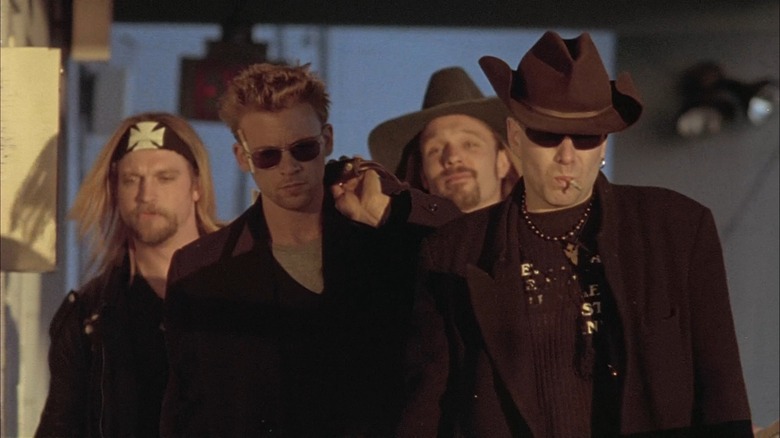
"Hard Core Logo" is the first of many movie mockumentaries on the list. While the subjects of this list span a wide range of humanity, musicians are often the topic of the comedic subgenre. Here, director Bruce McDonald looks at the world of punk rock and follows the fictional Canadian hardcore band Hard Core Logo as they get back together for an anti-gun tour. Why guns? Because leader Joe Dick's (Hugh Dillon) mentor and rock legend Bucky Haight (Julian Richings) was shot. Supposedly. It's already off to a wild start. As is common for reunions, emotions run high as the bandmates come back together on their drive across Canada. Also, the band and the crew do acid together, which in reality would be a big ethical violation, but here it's pitch-perfect. It's outlandish and actually quite dark as it looks at Joe's struggle with mental illness. The film is also a loose adaptation of a Canadian novel of the same name, but McDonald takes it a step further by make himself a character and turning the story into a mock music documentary.
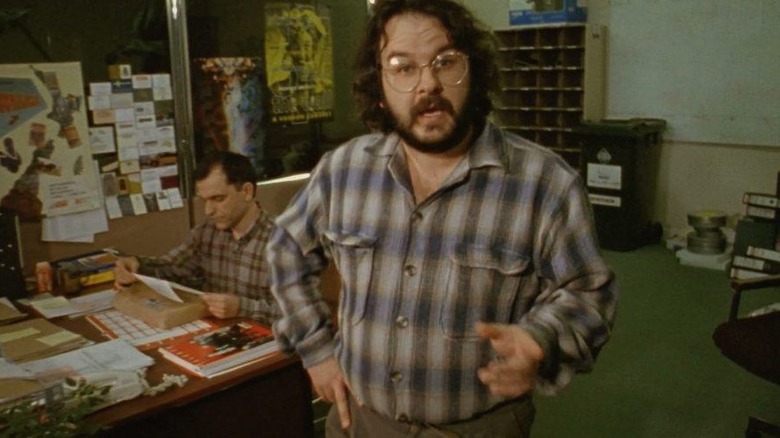
Before "The Lord of the Rings," Peter Jackson directed a mockumentary with Costas Botes in 1986 called "Forgotten Silver." Jackson and Botes play themselves as filmmakers who rediscover the lost works of the forgotten New Zealand director Colin McKenzie (who was fabricated for the film). They claim that he accidentally discovered the tracking shot and the close-up, making McKenzie seem like a massive pioneer in the world of cinema. In fact, "Forgotten Silver" aired on TV labeled as a true story, similar to the British pseudo-science film "Ghostwatch." This caused a lot of backlash from viewers, as they were convinced about McKenzie's existence. Jackson and Botes weaved together contemporary footage with faked archival footage to closely mimic the expected conventions of the documentary. They were able to fool viewers and showcase just how easy it is to convince and manipulate audiences with the idea and label of "truth."
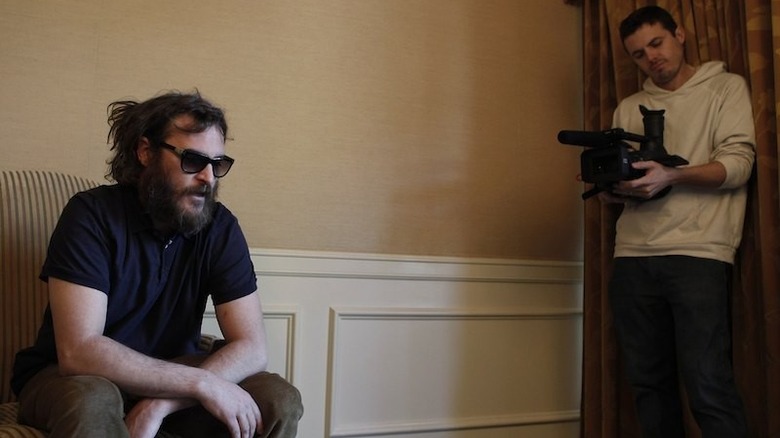
Do you remember that strange period of time when Joaquin Phoenix said he was quitting acting to pursue a rap career? Who could forget that absolutely bizarre interview on "The Late Show With David Letterman" in 2009? Well, the joke was on all of us because it was all an intricate hoax for his mockumentary "I'm Still Here," directed by his brother-in-law Casey Affleck. It was a shocking look at the level of fabrication behind celebrities.
It's also downright impressive that Phoenix was both able to keep up the joke for so long and that he was able to make it so convincing. Phoenix even did a cringe-worthy rap set in Miami in the name of comedic filmmaking. It's like "Borat" (which we'll get to later), but without a terrible accent and wig to hide behind. Instead, Phoenix grew out his hair and looked like an absolute train wreck. And honestly, it's a massive power move.

This is the first Christopher Guest's first appearance on this list, but it certainly isn't his last. This master of mockumentary directed "Waiting for Guffman" in 1996 as a spoof on Simon Beckett's classic "Waiting for Godot." Guest plays Corky St. Claire, a former off-Broadway performer who wishes to get his (second) big break into the theater world. So, he assembles a ragtag group of locals to perform the musical "Red, White, and Blaine" about the history of their fictional town of Blaine, Missouri. Then, Broadway producer Mort Guffman says he'll come to see the show. This cranks the anxiety up quite a few notches as Corky frantically prepares for his arrival. Thus begins the titular wait for Guffman. The musical contains several important points about the town's history, particularly about why it's the stool capital of the world, its UFO, and much more. This is a musical production, so it's another musical mockumentary, but this time poking fun at the world of community theater, which is itself its own unique experience.
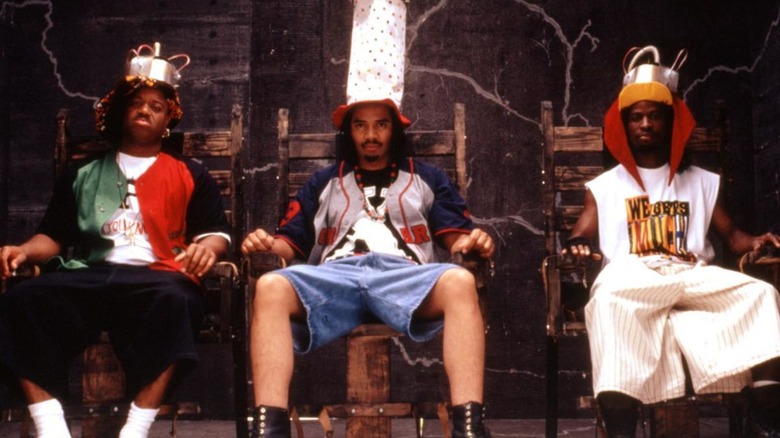
Rusty Cundieff is known for his 1995 horror film "Tales From the Hood," but before that, he directed the mockumentary "Fear of a Black Hat" in 1993. This is another mockumentary about music, this time about rappers in the early 90s hip-hop scene. Kasi Lemmons is our filmmaker, writing her thesis about hip-hop music. She decides to follow the rap group N.W.H. (a riff on the real rap group N.W.A.) to study their process, their lives, and their relationship with music. But they aren't just any group. For every performance, they wear ridiculous hats as what they call political commentary about their slave ancestors and how they worked in the hot sun. But political commentary doesn't necessarily match their lyrics, which are poking fun at critiques of rap music being vulgar. Their lyrics are vulgar to the extreme, but again they claim it's a political statement. Cundieff's "Fear of a Black Hat" is to hip-hop what "This is Spinal Tap" is to rock 'n' roll.
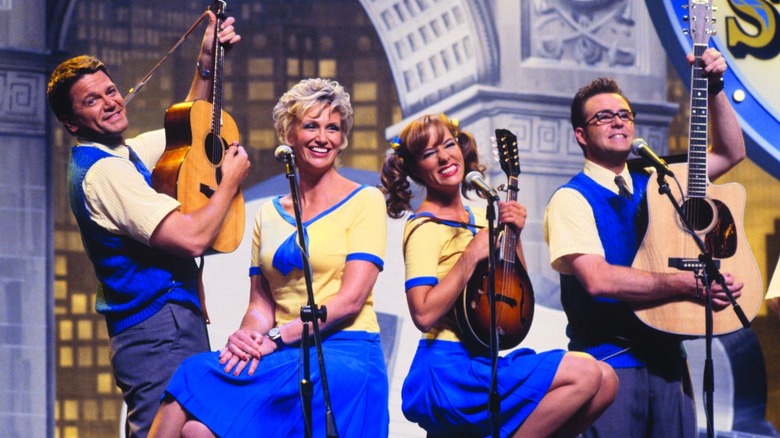
The next Christopher Guest entry is his 2003 mockumentary "A Mighty Wind," this time poking fun at folk singers. Three folk bands—The Folksmen, The New Main Street Singers, and Mitch & Mickey—come together for a reunion tour in honor of their deceased manager. This is a decade after their heydays, so of course, nerves are running high. The documentary crew is filming the backstage report and interviews with each group to create a special for the fictional PBN. As filming continues, the crew documents more and more of the complicated dynamics between the quirky folk singers leading up to their reunion tour. The film stars a slew of Guest regulars, including Eugene Levy, Catherine O'Hara, Parker Posey, Fred Willard, John Michael Higgins, Michael McKeen, and Jane Lynch. This concoction of comedic masters results in a hysterical look at washed-up musicians who reflect on their tumultuous careers while still continuing to look at their special idiosyncrasies. Guest really captures the aesthetic of the typical music documentary and uses that to his comedic advantage in how he "interviews" his characters and reveals their backstories.

Just like the world of music, beauty pageants are another strange ritual just begging to be satirized. Michael Patrick Jann's 1999 film "Drop Dead Gorgeous" does just that but with a dark twist. The mockumentary opens following contestants at the regional American Teen Princess Pageant in Minnesota. Contestants, played by Kirsten Dunst, Denise Richards, Amy Adams, and Brittany Murphy, talk to the camera about their excitement to win the pageant. And of course, there are ridiculous dynamics unfolding between the pageant moms and organizers alike. It wouldn't be a movie about beauty pageants without helicopter stage moms obsessed with their kids.
But everything takes a strange turn when contestants start to die in freak accidents. This is mockumentary meets dark and outlandish comedy as it takes an already ridiculous tradition even further to the extreme. With each strange accident involving explosions of swan floats or falling stage lights, "Drop Dead Gorgeous" just gets weirder and funnier. Jann knew how to make this funny and took it to the next level to create something incredible.

Taika Waititi's "What We Do In The Shadows" is the perfect movie for horror and comedy fans alike. A film crew follows a house of vampire roommates who are trying to navigate life in New Zealand in the 2010s. Each of the vampires, played by Waititi, Jermaine Clement, and Jonathan Brugh, brings something truly zany to the table. Clement's Vladislav is a particular standout who loves orgies and turning into a cat with a human face.
More than being vampires, these are just three dudes (plus the ancient vampire in the basement) trying to learn how to live together. Dressed in Victorian garb, they meet about the chore wheel and who needs to do the dishes. They also frequently have run-ins with a pack of werewolves led by Rhys Darby. It's a meeting of beloved horror creatures placed into very regular, everyday scenarios. But it's never too scary or gory, making it accessible to those who aren't horror aficionados. Plus, it birthed the "What We Do In The Shadows" series, which is one of the funniest shows on TV.

Released in 1992, "Man Bites Dog" is another early mockumentary -- and it's a rather harrowing one. Two filmmakers follow serial killer Ben (Benoît Poelvoorde) and film his heinous crimes without intervening. While watching and becoming complicit in his crimes, they also listen to his musings about life and the best methods for murdering victims. He's almost amused by his crimes, constantly bragging about his skills. But then the crew shows the excruciating details of his murders, making "Man Bites Dog" feel like a snuff film. It feels forbidden and taboo, a step further into the world of true crime as the crew finds themselves sucked into Ben's murderous tendencies. It's not only a terrifying look at the mind of a sociopath, but it also critiques documentarians who become too personally involved in their work. As soon as they step into the world of Ben as active participants, there's no turning back for their morals or their attempt to depict the truth about serial killers.

This mockumentary is the brainchild of the comedy music group The Lonely Island, which is made up of Akiva Schaffer, Jorma Taccone, and Andy Samberg. Schaffer and Taccone direct the film, with Samberg starring as documentary subject and pop star, Connor Friel. After a hit song "Turn Up the Beef" with the rap group The Style Boyz, Friel launches a solo career. His new name: Connor4Real. The mockumentary follows the rise and fall of the pop star and the lengths he'll go to maintain his fame. But it's also a tale of friendship between bandmates that sees a lot of highs and lows. Plus there are musical numbers for songs such as "Finest Girl (Bin Laden Song)."
The music industry is such a popular subject for the mockumentary because it already exists as this ridiculous, over-the-top thing that's full of glamor and fame. This is one of the latest music mockumentaries and it perfectly captures the nature of contemporary pop musicians and their antics (looking at you, Justin Bieber).
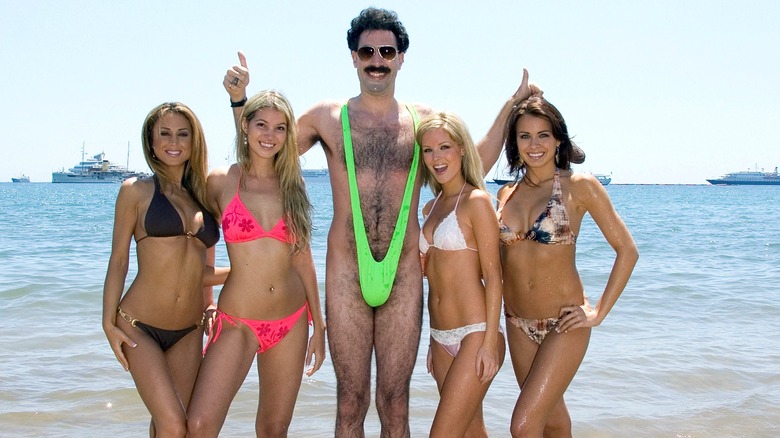
Sacha Baron Cohen's "Borat" series straddles the line with mockumentary because all of his interview subjects are real people. Cohen's Borat is a character, but the people in the scenarios he films don't know that. He takes advantage of ignorance -- and politicians -- to reveal the ridiculous truth about the American people. And in the second "Borat" film, Cohen brought in Maria Bakalova to play his daughter, which only amplifies the comedy and the absolutely bizarre situations they find themselves in. This is where the infamous Rudy Giuliani scene came from as he solicits sex from Bakalova. That's what makes these films so important. Say what you will about the character himself and Cohen's methods, but something about it feels dangerous. We're in on the secret and that facade could be shattered at any moment. This is improv to the extreme, off the cuff and unplanned. It's a terrifying prospect especially as he interacts with the more conservative groups found in the US.
But that doesn't mean "Borat" wasn't met with its fair share of controversy and lawsuits about how Cohen portrayed them without their consent, including a group of fraternity brothers whose drunken antics were rather embarrassing to say the least.

One of the few non-comedic mockumentaries on this list, "Punishment Park" takes place in an alternate version of the 1970s, where prisons are full. President Nixon declares a state of emergency and a new method of carceral punishment arises. The arrested, all anti-Vietnam War activists, can either go to prison or spend three days in Punishment Park. There, they must run across the California desert and try to escape from the federal officers hunting them. It's a survival horror film told through the lens of a mockumentary. Made in 1971, director Peter Watkins criticized the American occupation of the Vietnam War while we were actively occupying the country. It's an incredible subversive film that even today speaks to a terrifying, and not-so-different, alternate reality where speaking out against the government reduces you to nothing more than an animal to be targeted by the authorities. The ending is especially nihilistic in its attitude about escaping the System with a capital S. It's by no means as cheerful as most of this list, but it's an important document of how mockumentaries can just as effectively, and more creatively, reveal horrific truths about the human condition.

Mockumentary? More than rockumentary. In his 1984 cult classic "The is Spinal Tap," Rob Reiner plays documentarian Marty DiBergi who follows the British metal band Spinal Tap. They're also known as England's loudest band. Michael McKean and Christopher Guest star as childhood friends David St. Hubbins and Nigel Tufnel, respectively, and are not always the most clever, to put it lightly. They write "11" on their amps to make it seem like they're getting louder. But, as is often seen in the film, Marty questions their rationale. DiBergi the fictional filmmaker is his own character, which isn't often seen in mockumentaries. The filmmakers are mostly nameless and barely shown. But here, Reiner makes the filmmaker more of a character to provide a foil to the absolute foolishness of this group of musicians who write songs such as "Sex Farm." It's a hilarious look into the world of rock 'n' roll and pokes fun at the rockstars we idolized then, and now. In the book "American Hardcore: A Tribal History," Glen Danzig of The Misfits said he watched the film and thought, "Hey, that's my old band."
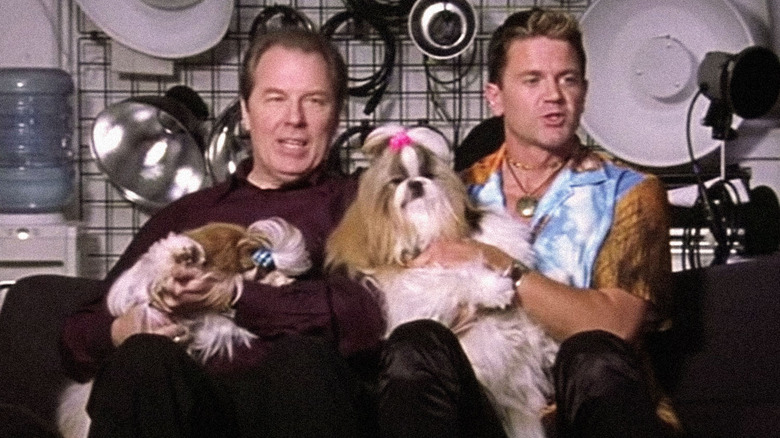
As a child who grew up obsessed with watching dog shows, Christopher Guest's 2000 mockumentary "Best In Show" is spot-on in its depictions of the people that breed and show their dogs. And it stars an incredible cast of comedians as cutthroat dog owners gunning for first place at the Mayflower Kennel Club Dog Show. Eugene Levy and Catherine O'Hara play a quirky couple with a terrier named Winky. Jennifer Coolidge plays a woman with a sugar daddy and a love of poodles. John Michael Higgins and Michael McKean play a gay couple with an award-winning Shih Tzu named Miss Anges. Fred Willard is the wacky announcer. Parker Posey steals the show as a yuppie woman obsessed with her Weimaraner. I could go on.
The stakes could not be lower, but somehow Guest makes this both hilarious and weirdly tense. He captures the already ludicrous world of dog handling—if you don't believe it, please google dog show handlers—and makes it the best mockumentary out there, but also a comedic masterpiece.
Read this next: The 35 Best Documentaries You Can Watch On Netflix Right Now (March 2022)
The post The 15 Best Mockumentaries, Ranked appeared first on /Film.
We wanted to address the controversy about our recently leaked majority opinion to overturn Roe v. Wade.
A lot of folks have been taking to social media and talk shows to discuss how this leak will cause dissent in the court, inspire riots in the public square, and threaten the future of our institution.
Well, that may be so, but if we didn’t want a decision to come into the world at this moment, we should have abstained from writing it in the first place.
Abstinence is the only true way to stop a majority opinion from being leaked to the press. But did we let that stop us? No, we gave in to our base desires and wrote as if there would be no consequences.
Some commentators have called this leak a “violation.” But that’s really on us for dressing the opinion up so much and giving it those sexy citations. We should have covered it in encryption software and locked it away until it was ready for a permanent marriage to the American people.
Besides, if it was a legitimate violation, the system has a way of just shutting that sort of thing down. This majority opinion obviously wanted what it got.
Some of our more experienced judges begged us to use protection. They tried to offer us firewall technology, blockchain resources, or even a SimpliSafe membership. But without proper education, judges aren’t going to make use of those options. Instead, we’re going to raw dog it and write on an outdated Microsoft Word file in broad daylight, then send it bcc over Outlook with a subject like TOP SECRET DOCUMENT.
If we pass our majority opinion around like a popsicle and let everyone have a lick, we really can’t complain when someone takes advantage of it. Also, we should come clean and say a few of us had been drinking the day the majority opinion got leaked. Some of us famously like beer. That’s on us. We chose to lower our inhibitions, and we deserve to face the consequences.
Speaking of consequences, this security breach will almost certainly harm the court’s legitimacy. It will affect our relationships with each other and the people around us. It may make us and our families less stable. It will cost us financially, as we pay for security at home and in public. It will likely have a lasting impact on how we live our daily lives.
With those stakes in mind, there’s a world in which we could, say, abort this majority opinion. We could change our minds about forcing someone to give their body’s organs over to the state after someone else committed a crime against them.
But that’s not how mistakes work. Mistakes are meant to follow you around for the rest of your life and re-traumatize you as much as possible (with the obvious exception of two male members of this court).
And so we stand before you with our unwanted child, this leaked majority opinion, and humbly demand you adopt it.
Our bad that it exists, but it’s your problem now.

365 Shortcuts to Decorating
Draper
1968
Looking for some decorating tips? Here is your book! The author sure did love prints. I got a headache just looking through the overwhelming of matching….everything. It is also amusing to take a look at study areas and realize there is no room for any kind of computer, printer, etc. The matching look was quite the trend back in the day. I think most of this resembles homes I remember from when I was a kid.
I was just reading an article (I can’t remember where/what) but it talked about how the pandemic has changed what people are now wanting in home design. Dedicated office space and larger spaces were at the top of the wish lists for new homes. Can you imagine spending the pandemic working from small desks and then trying to relax in that awful bedroom?
Mary


The post 365 Shortcuts to Decorating appeared first on Awful Library Books.
This post, I’m a member of The Satanic Temple and got outed at work , was originally published by Alison Green on Ask a Manager.
A reader writes:
I’m a member of The Satanic Temple. That information got out at work and now things are unpleasant and awkward.
I became a passionate patients’ rights advocate when a family member almost died after they were denied emergency medical treatment on religious grounds. The unexpected delay in care almost cost my family member their life and it was a frightening time for our family. I found The Satanic Temple (TST) through my patient advocacy. TST supports access to scientifically factual medical care as well as encourages empathy, kindness, and charity work. Even though my local chapter is very much not bats and snakes and sleeping in grave dirt, I don’t discuss my membership at work because I know it could make others uncomfortable despite the fact that my company is actually very progressive.
I was working the TST booth in during a weekend charity drive/festival event one town over when a few coworkers were there with friends and family saw me. I didn’t think it would be a problem since they stopped and chatted and even made a donation. I think they were surprised because I’m a very vanilla person, but their donation was very kind.
My boss pulled me into a private meeting that Monday. To my knowledge, she was not at the fundraiser so I think it was brought to her attention. She was snappy and exasperated, rolling her eyes as she asked me if I needed any kind of religious accommodations. I clarified that I didn’t and it was never my intention for this part of my personal life to be common knowledge and I’d be happy if everyone just dropped it. She rolled her eyes again and said, “Whatever, just don’t let this become a problem.” The temperature in the office got weirder fast.
Later that week, a coworker told the new intern, “Be careful of LW, she worships Satan. She’ll curse you haha.” I’ve been called “Sabrina” and asked horrible questions about my personal life (like did your pet really die or were they a sacrifice kind of terrible questions). My office mate, who I always thought of as a good friend, made a big show of putting religious paraphernalia around our office, most of which are related to protection from evil. It makes me sad she feels unsafe around me. If she had put them up without knowing about TST, I wouldn’t be bothered at all. My boss, who I used to have a great professional relationship with, is still acting like she’s annoyed with me and is very short when we need to interact. I asked her if there was a problem and she responded “I don’t know, is there?” I don’t know if this is how my manager reacts to religion in general or just things that make her uncomfortable.
Do I address this with HR or do I ignore it and wait for something else interesting to take the office gossip spot? My beliefs encourage me to meet everyone with empathy, and kindness, and to seek out a fair resolution to all personal conflicts. This is exactly why I didn’t want to bring it up at work.
Talk to HR. This is no different than if you started being harassed at work and frozen out by your boss after people found out you were any other religion.
If your boss weren’t involved, you could possibly start with her and see if she were able to deal with it on her own (by making clear to team members that comments about your religion were unacceptable) but since she’s part of the problem, HR is the right next step.
In fact, I’m more concerned about your boss than I am about your coworkers. Your coworkers’ reactions have been intrusive and obnoxious, but it’s possible that the “she’ll curse you, haha” comments could die out pretty fast once they get bored. Your boss, on the other hand, seems to have changed her entire relationship with you in a way that will make it impossible for her to manage you effectively. And her “I don’t know, is there?” response when you asked if there was a problem is outright hostile and says you’re not going to be able to solve this on your own.
So … HR, and use the words “religious discrimination.”
(Because I expect it to come up as readers contemplate this letter: As I was answering this letter, I found myself wondering why the Satanic Temple has kept a name that results in its members being harassed and misunderstood solely on the basis of the name, when in fact they don’t believe in Satan and advocate doing good, not evil. From what I’ve been reading, the name is a device that allows the group to make a political and social point — for example, demanding the same privileges for Satanists that many Christians take for granted, like erecting religious monuments on government property or organizing a prayer in government meetings.)


Read more of this story at Slashdot.


!['We're shocked by the Notre Dame fire. Click for our tribute to--' [okay] 'Now that we're all staying at home these past few weeks thanks to this new coronavirus, we--' [okay]](https://imgs.xkcd.com/comics/welcome_back.png "'We're shocked by the Notre Dame fire. Click for our tribute to--' [okay] 'Now that we're all staying at home these past few weeks thanks to this new coronavirus, we--' [okay]")