Click here to go see the bonus panel!
Hovertext:
Be careful not to join the SMBC patreon, because it's got inappropriate-
Today's News:
Hovertext:
Be careful not to join the SMBC patreon, because it's got inappropriate-
If you’re a publicly traded company, it’s not enough to make a decent profit selling products people like. You have to deliver endless quarter over quarter improvements to please investors. So countless companies engage in an act of self-cannibalization, where they begin to cut back on things like customer service (see: U.S. telecom), or annoy their customers with obnoxious cash grabs.
Case in point: companies like BMW just really can’t give up their dream of turning everyday, basic features, into subscription services. Service fees they can, consistently and mysteriously, nudge ever skyward. In several countries, that has taken the form of charging customers upwards of $18 per month just to enjoy heated seats they technically already own:
As cynical as that might sound, Korean owners aren’t forced to pay monthly for heated seats, or any of BMW’s other available options, but monthly payments can be made to try those out. Heated seats, for instance, cost ₩24,000 (roughly $18) per month. But you can also pay for a year subscription ($176), a three-year subscription ($283), or you can buy the heated seats permanently ($406).
The heated seat subscription option is part of the company’s “Connected Drive” program, and is already reality in Korea, the UK, New Zealand, Germany, and South Africa. It hasn’t come to the U.S. yet, but it’s fairly obvious that it’s likely to, eventually.
In this case, the technological capacity for heated seats already exists in the car. The manufacturer has already factored these costs into the base price. And they’re effectively charging you a premium simply to turn on technology that already exists and, frankly, you’ve probably already paid for:
A seat heater blocked by software is broken, and the car owner should have the right to repair their seats. https://t.co/RPoSJJhY3f pic.twitter.com/0KFqD3zuYU
— Kurt Opsahl (@kurtopsahl) July 12, 2022
That opens the door to an arms race with hackers and modders, with the right to repair (something you already own) debate waiting in the periphery. And the FTC watching you like a hawk, waiting to see if companies make enabling something you already own a warranty violation.
As cars get smarter and more complicated, the potential for nickel-and-diming your customers for services that should come as part of standard packages will only increase. If done reasonably, the company would really only be shifting the costs from one premium package to a subscription service.
But the need for quarter over quarter returns means they’re incentivized to never stop pushing their luck. So what you wind up getting is dumber and more annoying price gouging until either regulators or consumers say they’ve had enough. And even then, Wall Street still usually gets what Wall Street wants.

23-year old Phillip Carroll of Maryland survived falling into the crater at Mt. Vesuvius after dropping his cellphone during the daring act. Apparently, in true American Tourist fashion, Carroll and his family had hiked to the crater along a closed trail through a forbidden area. — Read the rest
 The new woman’s guide to getting married
McCord Leo
1982
Submitter: A reference question brought me into the wedding books collection and I came across this book. I was surprised it was still circulating with a checkout just last year. Toned and dated, I thought I was going to find a real humdinger – but the info in the book was not that bad. It’s still worth weeding and replacing with something more modern that includes up-to-date financials and includes non-heterosexual couples.
Holly: The photos! Absolutely stunning. Oh, wait…there aren’t any.


The post The New Woman Gets Hitched appeared first on Awful Library Books.

Brandy Bottone of Plano, Texas is 34 weeks pregnant. According to Texas officials, the fetus she's carrying is a human being. Bottone says she should be allowed to drive her car in an HOV lane because the fetus is a human passenger. — Read the rest
“This and That” is an occasional series of paired observations. See past “This and That” posts here. – Ed.
Today: Black and green right triangles

Unidentified artist, “Untitled (Triangles),” 1930s, cotton sateen, Smithsonian American Art Museum, Gift of Corrine Riley and museum purchase through the Barbara Coffey Quilt Endowment and the Luisita L. and Franz H. Denghausen Endowment, 2016.5.54

Clarissa Bonet, “Glimpse,” 2019, inkjet print. Collection of the artist, courtesy of Catherine Edelman Gallery, Chicago.
Clarissa Bonet’s “Glimpse,” is on view in the Outwin 2022: American Portraiture Today exhibition at the National Portrait Gallery in Washington, D.C. through February 26, 2023.
*************
No matter how original, innovative or crazy your idea, someone else is also working on that idea. Furthermore, they are using notation very similar to yours. – Bruce J. MacLennan
The post This and That: Clarissa Bonet and an Unknown Artist appeared first on Glasstire.
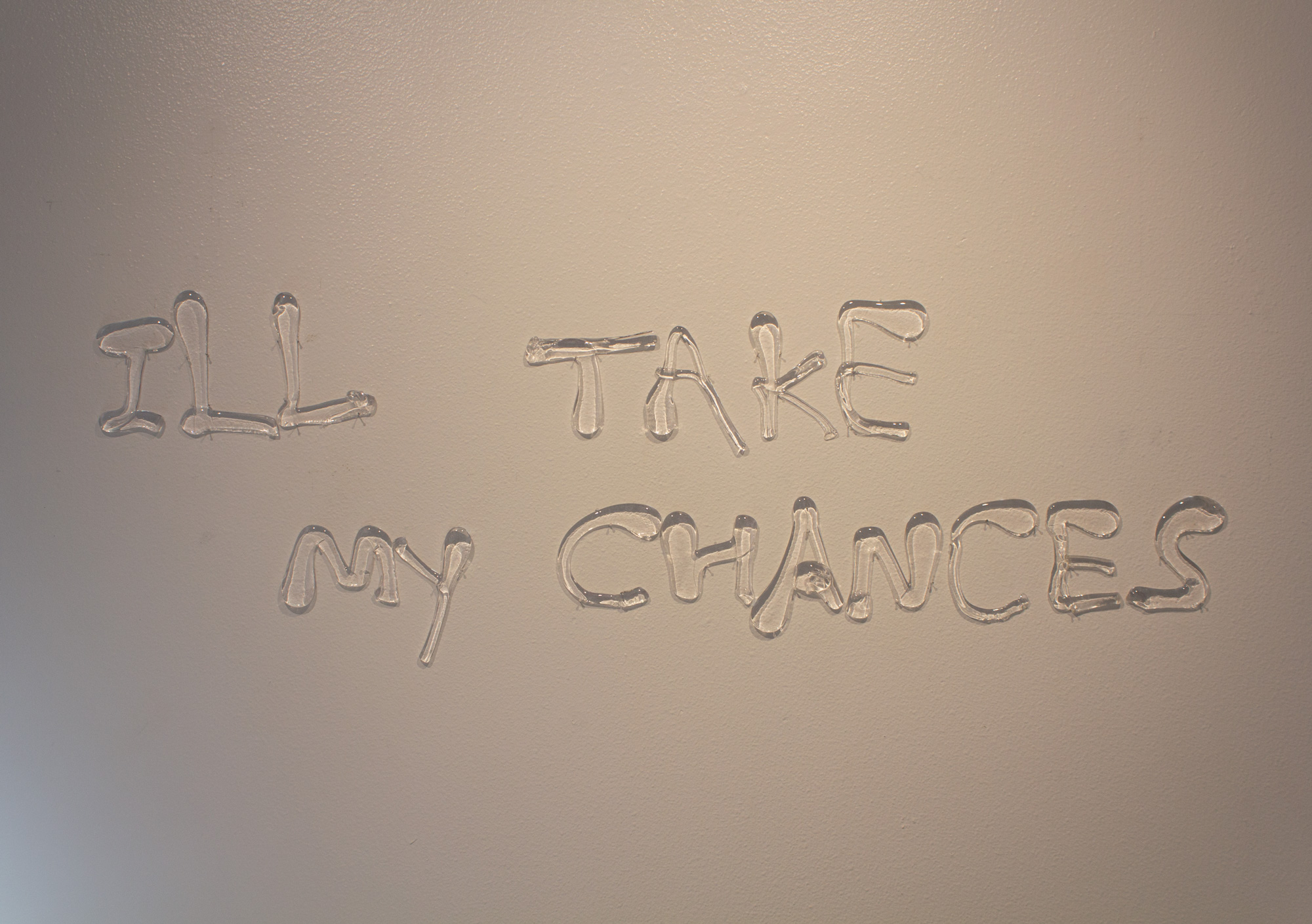
Kay Seedig, “I’ll Take My Chances,” hand ladled glass, on view at the Latino Cultural Center
Someone, like me at the Latino Cultural Center, June 18–August 13, 2022
This exhibition, curated by Angela Faz, seeks to present contemporary art that examines “queerness beyond rainbow capitalism.” In this show, the masculinity that dominates much of queer culture is left out to make room for presentations of femme narratives, or rather, the queer spectrum more broadly. Kay Seedig’s work I’ll Take My Chances consists of the title written in hand-ladled glass, which has cooled into hardened individual letters that are pinned to the wall. Glass is heavy, and writing even a short statement, one letter at a time, by drawing with molten glass is an undertaking that requires stamina. The work, much like the rest of the show, is an action of taking up space, being heard, and going against the grain.
****

Sarah Ann Weber, ‘Their perfume lost,’ 2022, Acrylic, watercolor and colored pencil on paper, mounted on linen over wood panel, 72 (H) x 96 (W) in
Sarah Ann Weber: The first green light of the sun at 12.26, June 4–July 30, 2022
Sarah Ann Weber’s show almost reads as an extended version of Sir John Everett Millais’s Ophelia, albeit with more psychedelia. In one work, I would give you some violets (2022), a blue skeleton lays on its back amid a menagerie of foliage. The painting’s hues range in grand washes of watercolor, and flowers seem to be planted in the sky. There is less of an emphasis placed on botanical accuracy, and more of a general sense that the painted and drawn gardens grow in a mythical eden. The scenes have no discernible living figures; most of the content of this show is plant life, which consumes all visible space. The vegetation is a welcome respite from the hot parking lot that sits right outside the gallery.
****
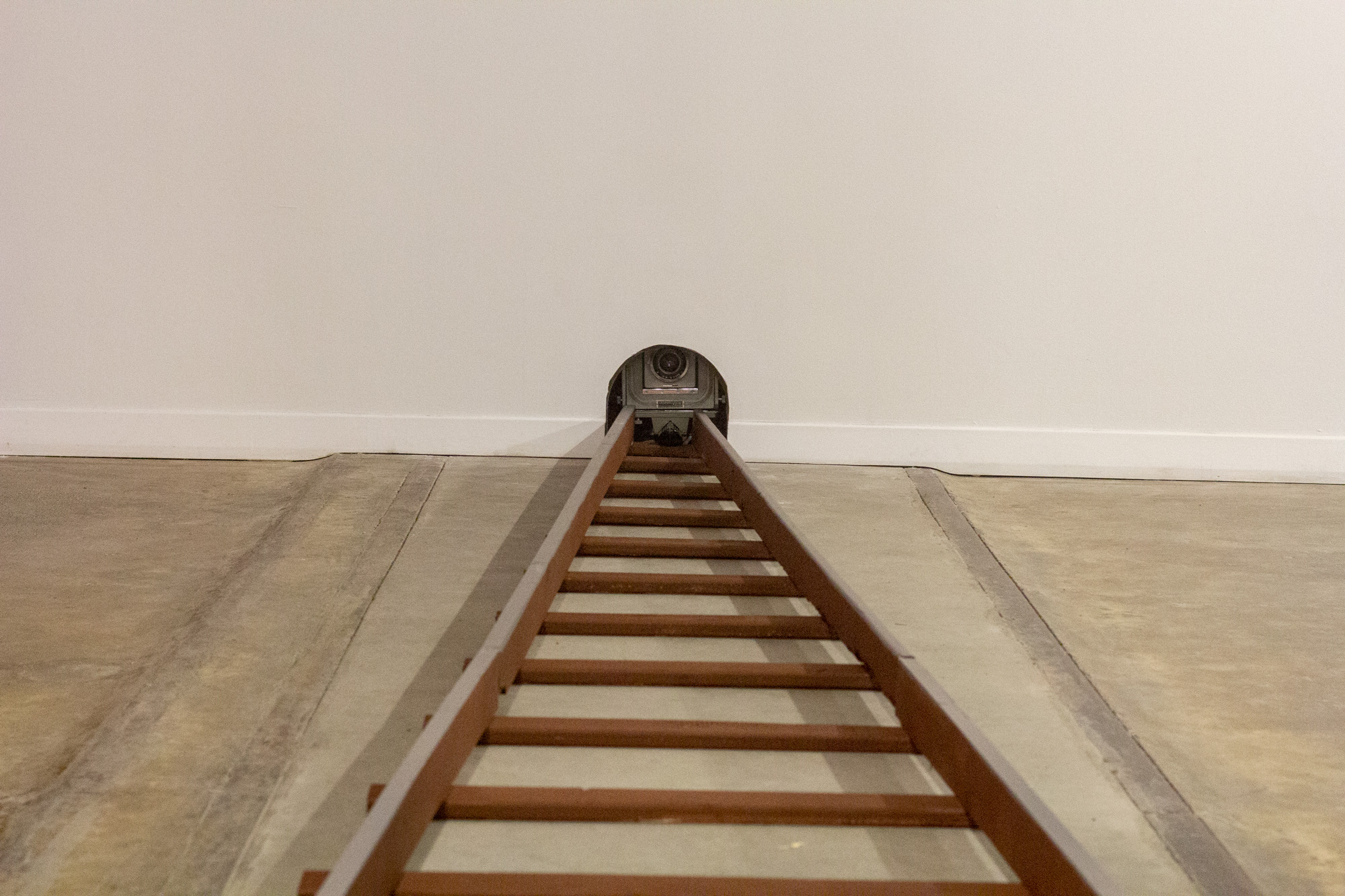
Hadi Fallahpisheh, installation view of “Young and Clueless,” on view at the Power Station
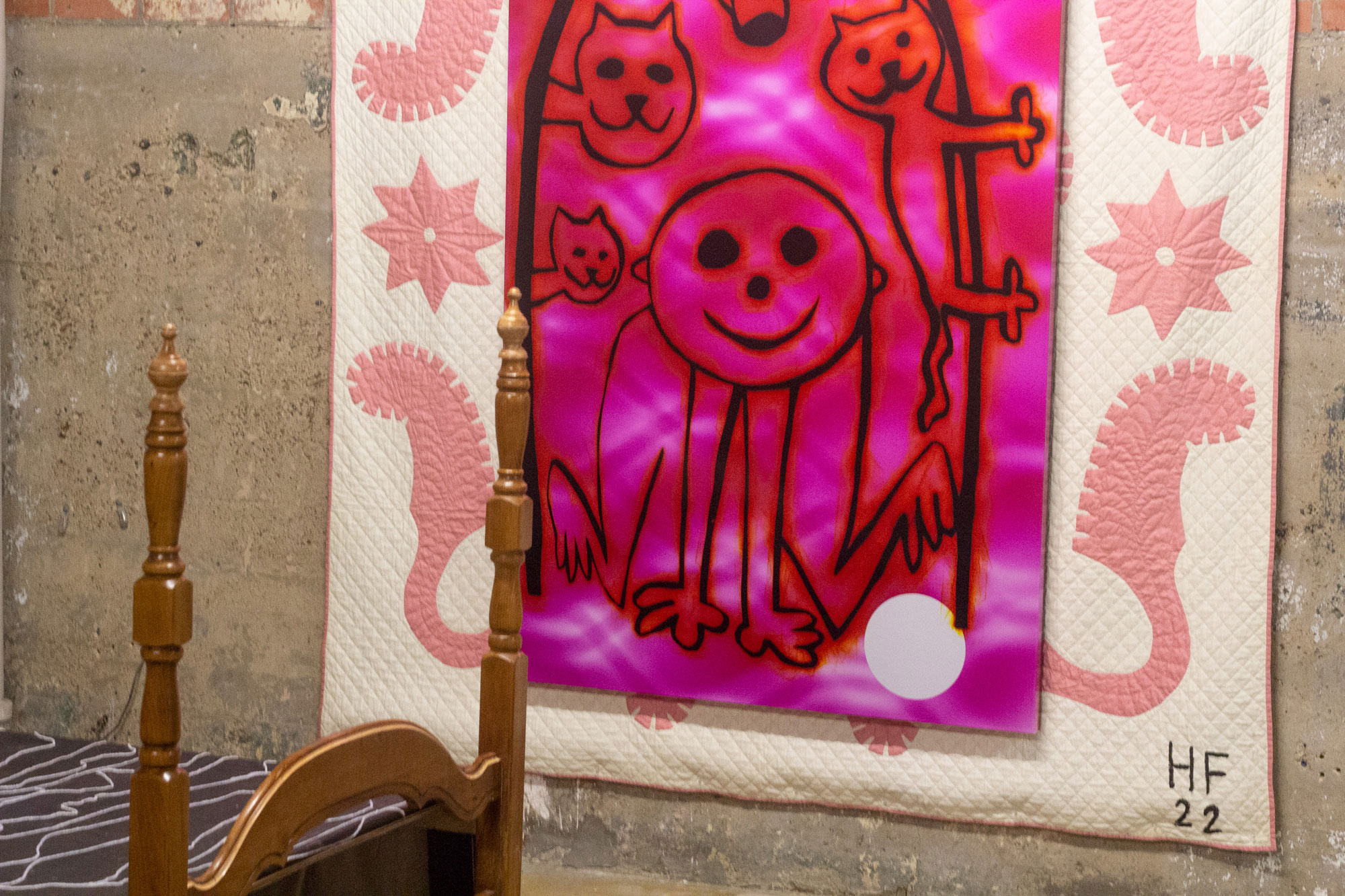
Hadi Fallahpisheh, installation view of “Young and Clueless,” on view at the Power Station1
Hadi Fallahpisheh: Young and Clueless at the Power Station, Currently on view, opened April 20, 2022
Hadi Fallahpisheh’s show at the Power Station is a recollection of childhood paranoia. Stuffed teddy bears flounder around their respective sculptural works, and light paintings (made by exposing photosensitive paper with lights and color gels in a darkroom) are blinding. The shadowy silhouettes of a cat and mouse greet the viewer from a barred up gallery window.
The Power Station is not usually a place where paintings are hung and left to speak for themselves; as such, this show has many modes from which to articulate the sense of a compromised home. The upstairs balcony gallery features a light painting with a mouse kneeling before a windmill, which is a shocking cyan hue. A miniature railroad installed on the floor gives off the forced perspective of the rail descending into the distance. The space’s windows have been prepared with plastic sheeting, which echoes the color gels used in Fallahpisheh’s paintings. Be sure to look everywhere in order to piece the fable together.
****

Tobe Kan Kiu Sin, “Shift 3,” 2020, oil pastel on canvas, approx 23.4 x 27.6 in (59.5 x 70 cm)

Tobe Kan Kiu Sin, “Asleep 21,” 2019, oil pastel on cardboard, approx. 9.8 x 7.8 in (20 x 25 cm)

Simon Roberts, “Brexshit Times,” short run publication, on view at Peter Augustus
Tobe Kan Kiu Sin: of war, of love, of time at Peter Augustus, May 21–June 25, 2022
Tone Kan Kiu Sin’s oil pastel paintings are executed on black-clad canvas and board, which acts as a much more dramatic ground than traditional white canvas. Also in the space are various plants seated upon square plots of dirt, left to carry out their life cycles as best they can in the artificial environment of the gallery. The artist’s paintings feel something like plein air depictions of tropical plants, but they are cold in hue. Despite Sin’s use of oil pastels, these works resemble a dry-brush technique, as the color is lightly applied and reveals an inconsistent surface to the works. Kan Kiu hails from Hong Kong, and their paintings feature those plants native to the region. The greenery on the floor of the gallery, by contrast, is sourced locally, and will not live as long as their painted counterparts. While I think it is cliché to say that an artwork is about death simply because it does not cheer brightly for the future, I don’t think it is too much for us consider a question of location: where is this square, this plot, this land?
Additionally on view at the gallery during my visit was Brexshit Times, a short-run publication by Simon Roberts that features instances of the word “Brexit” used by the press, combined with other words; as in Brexiled or Brexhausted. The publication, color-coded in such a way to emulate the Financial Times, touches on the news cycle’s colorful approach to labeling political shifts, and the English-speaking world’s difficulty grasping change.
All photos by William Sarradet unless otherwise stated. William Sarradet is the Assistant Editor for Glasstire.
The post Someone Like Me: Shows to See Right Now in Dallas appeared first on Glasstire.
What’s the history?
Several years ago, Boris Johnson, a man many believe to be a long-running satire of the upper classes, was made prime minister after promising to be tremendously rude to everyone else in Europe.
What happened?
Crikey. Where to begin. Lies, corruption, incompetence, drunkenness, sexual deviance, wallpaper abuse. That sort of thing. We’ve had quite a time of it.
And?
He was forced to resign as prime minister.
What! Forced? So, you had a coup?
Not really. Several men who speak like they live in Downton Abbey went to see the prime minister and shook their heads at him whilst quietly tutting. Utterly humiliated, Johnson resigned.
Okay, so you have an election now, right?
Don’t be vulgar.
What?
We don’t have an election to choose a new prime minister; we have an election when we’ve got a prime minister who thinks they can win an election.
How do you choose a prime minister then?
We don’t. The party in power does. In this case, it’s the Tory Party.
What’s the Tory Party?
The British version of Republicans but less obsessed with wombs. Think fox-hunting is the God-given right of all men. Don’t really trust anyone who didn’t go to one of four incredibly expensive public schools. Despise Europe.
But you’re European.
Shh. We don’t talk about that. The Tory Party is the Government of the day. They choose a new leader, and that leader becomes the prime minister.
What about the Queen?
Leave her out of it. The women’s 96. She’s been through enough.
How does this Tory Party choose its leader then?
To begin with, several Tory MPs nominate themselves to be leader and then protest that they didn’t really want to be leader, but after pressure from their colleagues to stand, they have reluctantly put themselves forward.
They then spend a week or so being incredibly passive-aggressive to the other candidates and leaking the most appalling and scurrilous lies about them to the press.
Like what?
Could be anything. You know what the British press is like. So-and-so is a people trafficker, that chap got caught performing oral sex on himself, she married her horse, his success was only secured through an unholy rite of sacrifice to Satan.
Wow. Is any of that true?
No. But it’s early days. That’s the sort of thing we can expect over the next week or so.
Who are the candidates to watch out for?
What is it with you guys and Europe?
Goodness knows. It’s the Tories. They’ve always had a bee in their bonnet about the rest of the continent. Unclear why. Maybe they had a traumatic experience with a croissant in early life. Perhaps someone’s spouse ran off with a bullfighter. Frankly, it’s best not to ask. Otherwise, you might get caught with an hours-long diatribe about Belgians being appalling.
What happens next?
Daily votes from other Tory MPs. The person with the lowest number of votes each day is eliminated. Like American Idol but with less Whitney Houston covers.
And when there’s one candidate left, they become prime minister, right?
No, of course not. The daily votes continue until there are two remaining candidates. The membership of the Tory Party then decides which of these two is to become leader.
Wait. Who are the members of the Tory Party?
Several hundred elderly racists who live in beautiful English villages and hate everything. The final two candidates spend the summer attempting to convince these people that they’re going to abolish income tax, bring back hanging, and invade France. The candidate who is the most persuasive is voted leader of the Tory Party and consequently prime minister of the country.
So, you’re telling me that the next prime minister of Britain is chosen by a handful of old people?
Mother of democracy, my friend. Wish us luck.
The very worst of the heat is over, at least for now. The very thick ridge of high pressure influencing our weather continues to retreat westward, and this should help nudge high temperatures downward a bit, toward the mid-90s eventually. Additionally, our rain chances will improve moderately over the next several days. However, it appears as though the potential for heavy rainfall from a tropical system will remain to our east, over Louisiana.
The high temperature on Monday at Bush Intercontinental and Hobby airports reached 103 degrees, and today should be a couple of degrees cooler to go along with mostly sunny skies. The century mark will still be reachable for much of the region away from the coast, however, so please continue to take heat precautions. Winds will be very light, perhaps blowing at 5 mph out of the southwest or west. Rain chances are about 20 to 30 percent near the coast today, and perhaps 10 to 20 percent inland. If there were a way to buy multiple rainfall raffle tickets, I’d definitely be in “Take my money!” mode.

Another day a lot like Tuesday.
These days may be a bit cloudier, and cooler, with highs perhaps topping out in the mid-90s. I’m hopeful that daily rain chances will be in the range of 40 percent, and there should be a few lucky areas picking up 1 inch or so. The rest of us? Probably not so lucky.
The weekend looks similar, with highs probably slotting somewhere in the mid-90s, and rain chances perhaps in the 30 percent neighborhood. Skies should be mostly sunny.
The forecast for early next week is still somewhat uncertain. It does seem possible that high pressure will start to build back in over the region, pushing temperatures up. However, there are also some scenarios in which conditions stay in the mid-90s, with pretty healthy daily rain chances. I realize that’s not very helpful, but it’s the best I can do right now.

The National Hurricane Center is continuing to predict that a tropical blob near the Louisiana coast has a 30 percent chance of becoming a tropical depression or storm during the next five days. This is likely to make for very wet weekend in Southern Louisiana, with 5 to 10 inches possible in and around New Orleans. Unfortunately, Houston is likely to fall just outside the heavy rainfall boundary as the system moves into Louisiana.

| Piled Higher & Deeper by Jorge Cham |
www.phdcomics.com
|
|
 |
||
|
title:
"James Webb Telescope" - originally published
7/12/2021
For the latest news in PHD Comics, CLICK HERE! |
||


Read more of this story at Slashdot.
In 1921, a young woman named Eunice left her northeast Texas hometown of Bonham for Dallas. She didn’t get to stay long. Police found her and brought her back. A grand jury was investigating whether the 19-year-old’s recent miscarriage was actually an abortion.
The grand jury indicted Eunice as an accomplice of the doctor who allegedly performed an illegal abortion on her. She was jailed for two weeks and not allowed to see her family. Then, officials took her from jail to a public courtroom in Fannin County to testify against the local doctor who had performed the procedure that led to her miscarriage. Abortion had been a felony crime in Texas since 1856, and this was the way it was traditionally prosecuted: Put the woman on the stand and make her give evidence against others involved.
From the stand, Eunice was pressed repeatedly to divulge invasive and intimate details about her life and her desperate efforts to end her pregnancy, according to case records from the Texas Court of Criminal Appeals that are held by the Texas State Library and Archives Commission.
Prosecutors asked for the precise words she used when she asked the doctor for the procedure. They pushed further for details about the instruments used—one was silver, she said, another copper-like. She was asked whether she knew where the womb was and where the vagina was. They asked where the instruments were inserted.
“These instruments were placed in my womb, I guess is what you would call it, by [the doctor], and this water passed right after that,” Eunice said.
Her trial provides a harrowing glimpse of a time when abortion was a crime in Texas and hints at what may be in store once again, a century later, for women in the state.
Fifty years after Eunice’s indictment, a federal court in Dallas struck down the state’s expansive abortion ban, prompting the U.S. Supreme Court to affirm the ruling and establish a constitutional right to abortion in Roe v. Wade, based in the right to privacy. Now, the court appears to be on the verge of reversing that 1973 landmark decision.
In preparation, Texas Republicans have passed a “trigger law” that, if Roe is struck down, will automatically restore the state’s old criminal abortion law. What may follow is an enforcement regime that is far more aggressive, punitive, and weaponized than the one in place in 1921.
“None of the trigger laws that are waiting in the wings impose criminal penalties directly on the individual,” said Farah Diaz-Tello, senior counsel and legal director at the reproductive justice group If/When/How. “They are all explicitly aimed at people who perform abortions.”
Still, she expects that prosecutors in Texas and other anti-abortion states will take it upon themselves to prosecute people who end their pregnancies—even though that is prohibited by law.
Through the 19th century and most of the 20th, until the Roe decision was issued, Texas women who were believed to have had abortions were often called to testify in criminal trials. Although seldom prosecuted themselves, they were pressured to testify against doctors and others who’d been involved in arranging the procedure, baring their shame in public. They were typically the only available witnesses who could provide the necessary testimony to convict abortion providers and were often threatened with punishment if they didn’t cooperate.
Women at the time were typically framed as the “second victim” of abortions, and prosecutors portrayed abortion bans, in part, as protecting pregnant women from being exploited.
Eunice’s case was extreme—the women themselves were rarely jailed and almost never criminally indicted for abortion crimes. Prosecution almost always targeted the person who performed or induced the abortion or helped in some way. Women at the time were typically framed as the “second victim” of abortions, and prosecutors portrayed abortion bans, in part, as protecting pregnant women from being exploited and/or pressured into dangerous, sometimes fatal procedures.
Courts in many states, including Texas, had determined by the late 1800s that their criminal abortion statutes could not be used to prosecute women for inducing their own abortions or as accomplices in the procedures. In Eunice’s case, the doctor’s attorneys argued that the state could not rely on Eunice as the sole witness to a criminal abortion in which she was also indicted as an accomplice. The doctor was convicted and sentenced to five years in prison, but the conviction was overturned on appeal. His lawyers contended that Eunice’s testimony was unduly influenced by being jailed and that she was “testifying for her freedom.”
The Texas Court of Criminal Appeals agreed. “A woman who voluntarily submits to an abortion, or advises, encourages or procures it to be done is not an accomplice” under the state’s criminal law, the court wrote.
There is no indication in the records whether Eunice herself was ever prosecuted—or when she was released from jail. But in the meantime, her life was interrogated and torn apart in public. She was asked about her relationship with her boss at the local cotton mill where she worked. He had impregnated her, supplied her with medicine to try to self-induce, promised to pay her back for the abortion, and then fled the state when she was sick in bed. A former co-worker was summoned to further testify to their relationship. Her doctor and nurse gave details about the miscarriage.
Eunice’s case was one of just two known instances where women were charged and jailed for an illegal abortion before Roe, and thus has been frequently cited by the anti-abortion movement in an attempt to downplay the legal threats to women of the pre-Roe era and to suggest that pregnant people need not fear legal repercussions if abortion is again criminalized. But just because women weren’t typically prosecuted for illegal abortion didn’t mean they weren’t routinely arrested, detained, examined, interrogated, and threatened with public exposure and ruin.
“The road to prosecutors deciding that, ‘Oops we can’t actually prosecute someone’ could be pretty rough,” said Mary Ziegler, a Florida State University law professor who studies the legal and criminal history of abortion and reproductive rights. An ominous warning for what could come after Roe came out of South Texas earlier this year. A 26-year-old woman named Lizelle Herrera was arrested and charged with murder in Starr County for an alleged self-induced abortion that had apparently been reported to police by the local hospital. The case drew national attention and she was eventually released and the district attorney dropped the charges.
While Texas criminal statutes clearly do not allow people to be charged for the outcomes of their own pregnancies, reproductive rights advocates warn that this has not always been the case, both before and after Roe was decided, and in the future after it falls.
According to scholars, the medical industry—including doctors and hospitals—were among those who pushed to criminalize abortion, despite the fact that doctors were also the targets of prosecution in abortion cases. As Leslie J. Reagan, a University of Illinois professor, documents in her seminal book on the history of illegal abortion prosecution, When Abortion Was a Crime, law enforcement relied on physicians and hospitals to report suspected abortions.
“Although some physicians voluntarily worked to enforce the criminal abortion laws, others would have preferred to have nothing to do with it,” Reagan wrote. “In illegal abortion cases, doctors found themselves caught in the middle between their responsibilities to their patients and the demands of government officials.”
Reagan, whose research focuses on Chicago from the late 1800s through the early 1900s, found that while successful convictions were rare, grand jury investigations of suspects and coroners’ inquests became more and more common. Between 1901 and 1919, the Cook County coroner investigated an average of 60 suspected abortion deaths per year, though many were found to be accidental, self-induced, or otherwise not criminalized. The women subjected to abortion investigations—often interrogated by police on their deathbeds—were most often working-class immigrants and women of color.
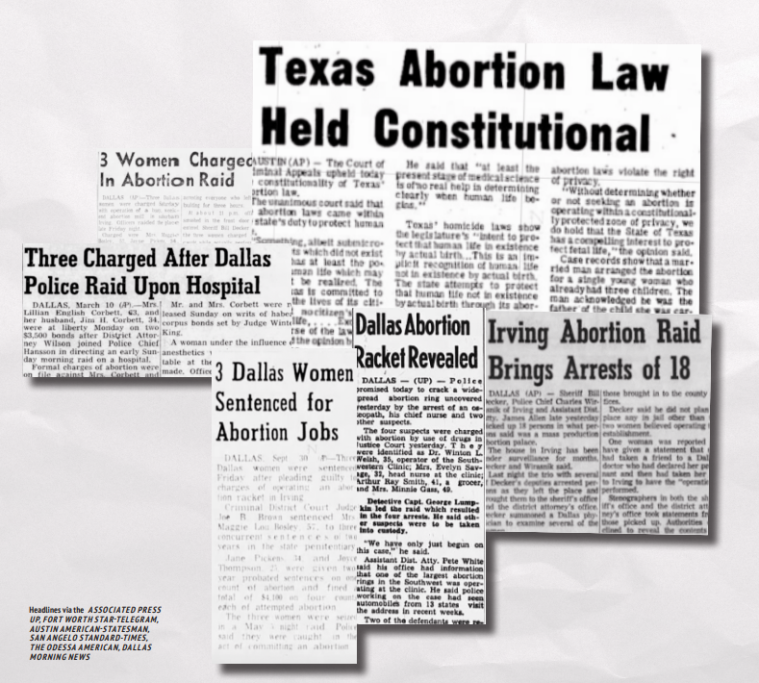
In the decades immediately preceding Roe, law enforcement tactics on abortion crimes grew increasingly aggressive. By the 1940s and ’50s, police raids on suspected abortion providers’ offices and underground clinics were a key part of abortion crime enforcement, Reagan writes, akin to crackdowns on criminal rackets involving gambling, prostitution, and bootleg liquor.
While she focused on Chicago, policing of abortion was similar throughout much of the country. In Texas cities like Dallas, police department vice squads investigated illegal abortions. The women who were caught and arrested in these raids were then pressured to flip on the providers.
In the 1970s, Henry Wade became perhaps the most famous abortion prosecutor in U.S. history in the eponymous Supreme Court case that legalized abortion.
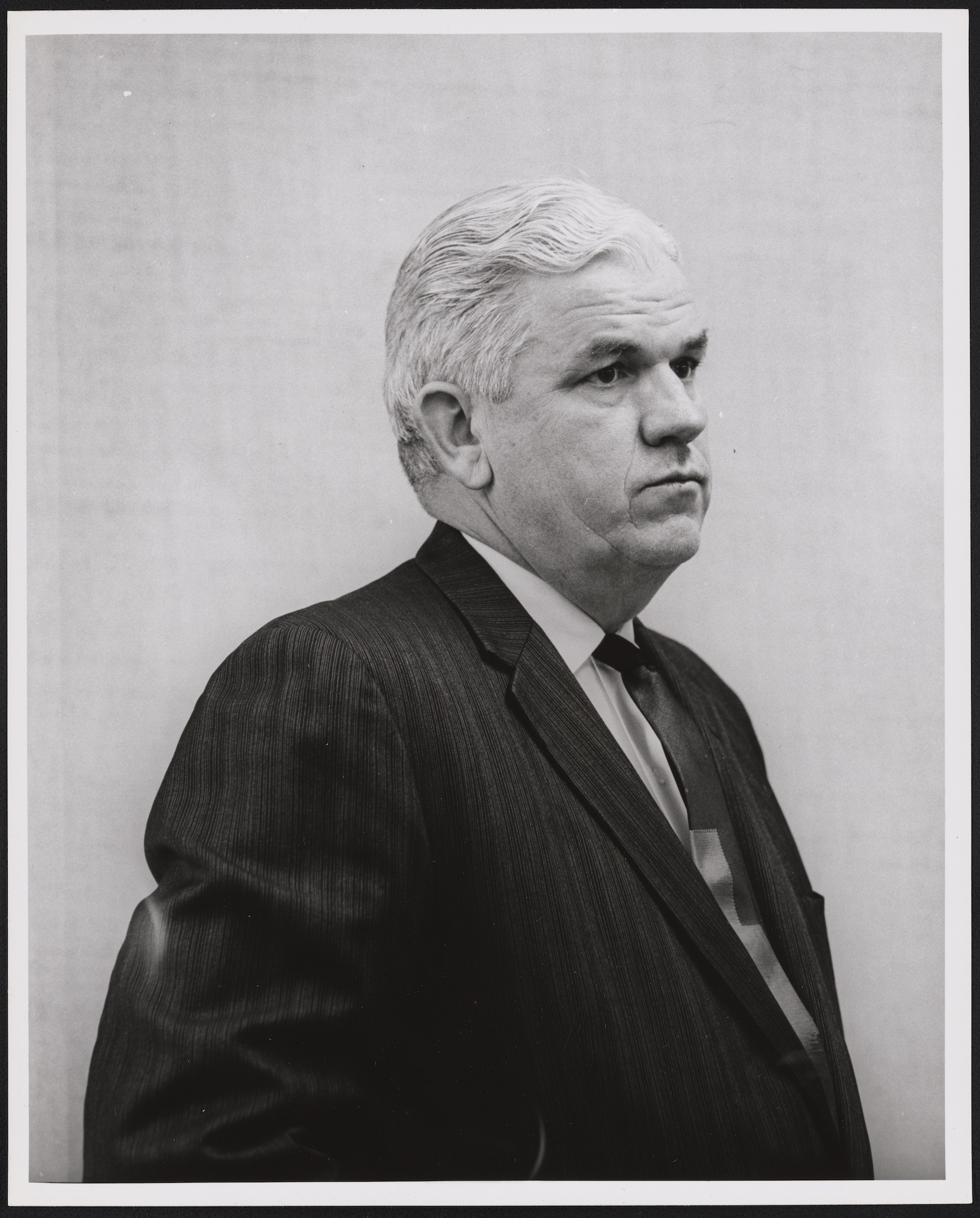
Wade lost his first bid for Dallas County district attorney in 1946 to Will Wilson—a young, ambitious lawyer who set the tone for the office that Wade would later inherit. Wilson would go on to be a state Supreme Court justice, attorney general, and top appointee in Richard Nixon’s Department of Justice. But first, as the Dallas DA, he garnered a reputation as a hard-charging crusader with a penchant for staging high-profile raids. He led a tough-on-crime crackdown in the city that included aggressive prosecution of criminal abortions.
Texas newspapers largely ignored the debates around abortion policy but provided ample coverage of illegal abortions as part of the crime beat. Front pages in Dallas and across the state would occasionally blare with sensational headlines about police raids and nefarious abortionists.
Soon after taking office, Wilson led one such raid. In March 1947, he and a seven-man team from the Dallas police vice squad staged a raid at a suspected “abortion hospital” in Oak Cliff, breaking in while a young woman was on an operating table in the middle of a procedure. According to the Dallas Morning News, about 20 women were in the waiting room at the time of the raid; many of them were temporarily detained by police and made material witnesses. Two women who allegedly operated the clinic were arrested and charged with 10 counts of illegal abortion. One woman died before going to trial, but the other was convicted and sentenced to five years in prison.
The case was said to have been the first abortion prosecution in Dallas County in 20 years and the first successful conviction in 30 years. The Dallas District Attorney’s Office continued to prosecute abortion crimes, including under Wilson’s successor, Wade, who took over in 1951.
The next year, a news headline announced: “Dallas Abortion Racket Revealed.” The dispatch told of police breaking up a “widespread abortion ring” and arresting an osteopath, nurse, and two other suspects on charges of “abortion by use of drugs.” The assistant DA claimed his office had information suggesting that this was one of the largest illegal abortion operations in the Southwest. Police who watched the place for weeks before the raid reported seeing cars with plates from up to 13 states. The osteopath was convicted on a single charge of illegal abortion and sent to prison for two years.
In 1961, the DA’s office and police staged another raid of a tidy suburban home in Irving that they sensationally referred to as a “mass production abortion palace.” After months of surveillance, police surrounded the house and apprehended several women who came out. The women were taken to the sheriff’s office, where a doctor examined them.
At 10 p.m., police broke down the door and entered the house. In the back room, they found a woman receiving an abortion. Her mother and child were in the front room, according to newspaper accounts. Another woman who’d brought a young woman to the house was pregnant herself, and after being arrested she went into labor. Three Dallas women were charged with operating the illegal “abortion racket” and all were convicted.
However, Wade’s son Kim maintains that his tough-on-crime dad was ambivalent about prosecuting abortion cases. The Southern Baptist from Rockwall County may have even been sympathetic to the cause of abortion reform. In Joshua Prager’s new book, The Family Roe: An American Story, Kim claimed that his father “disagreed with the abortion statutes it had been his charge to defend.”
That’s not entirely unexpected. In that era, abortion was not a driving political issue, nor were voters calling out for aggressive enforcement of abortion crimes. In fact, the public was coming around to the idea that outright abortion bans should be softened.
Through the 1960s, the rising feminist movement was pushing to liberalize abortion regulations in states across the country. By the early ‘70s, several states had legalized abortion and many more reformed their laws. In the remaining states, prosecuting abortion crimes had become more difficult. In 1971, the U.S. Supreme Court raised the bar for prosecutors to prove that an abortion had not been done to protect the woman’s life. A survey by the Texas Medical Association found that between 1965 and 1969, more than 200 abortions were not clearly illegal under the state anti-abortion law, which included an exemption if the woman’s life was at risk. Some Texas politicians were considering loosening the law on abortion. Still, there was plenty of resistance. Asked what he thought should be done with an abortion reform bill in the Legislature, a state representative from Lufkin responded, “Shoot the sponsor.”
Then came Sarah Weddington and Linda Coffee, who decided to challenge the constitutionality of abortion bans head-on. But first they had to find a client and a case to represent their argument. That turned out to be Norma McCorvey.
McCorvey, who went under the alias “Jane Roe” in the lawsuit, lived in Dallas, where Coffee had recently begun her career. Before the suit, Coffee actually had hoped to be hired by Wade, who had earned a reputation as an extremely effective prosecutor. His office was reportedly shocked when they were served with the lawsuit papers, wrote author Marian Faux in her landmark book about the case, Roe v. Wade. Still, prosecutors took the challenge to the law seriously.
Attorneys from Wade’s office and the Texas Attorney General’s office argued the case for the state. After the trial court ruled in favor of Roe, the judge neglected to put an injunction in place to keep Wade’s office from enforcing the law while the case continued. Wade announced that his office would continue to prosecute abortion cases while appeals went through. But even at the U.S. Supreme Court, Wade himself did not personally argue the case. After the decision was handed down, he didn’t speak publicly about the verdict, which enshrined him in history as the personification of the anti-abortion system. The Washington Post reported years after Wade’s death that he never even read the decision.
Texas was already well on its way to a new era of criminalized abortion before Supreme Court Justice Samuel Alito’s draft opinion leaked in May. A post-Roe Texas could make the pre-Roe days look quaint.
During the last session of the Texas Legislature, Republican lawmakers passed Senate Bill 8, a draconian law that effectively banned abortion through a private civil enforcement apparatus. Any private citizen can slap a civil lawsuit on anyone who is believed to have aided or abetted an abortion in the state. If the plaintiff wins, they get a $10,000 bounty and can recoup their legal fees. If they lose, the plaintiff has no obligation to cover the defendant’s attorney bills.
The law, which the Supreme Court declined to strike down, marked an ominous threat to civil liberties. It’s also a radical expansion of civil liability by a Republican Party that has drastically reduced the ability of everyday Texans to seek the recourse of civil courts against big business.
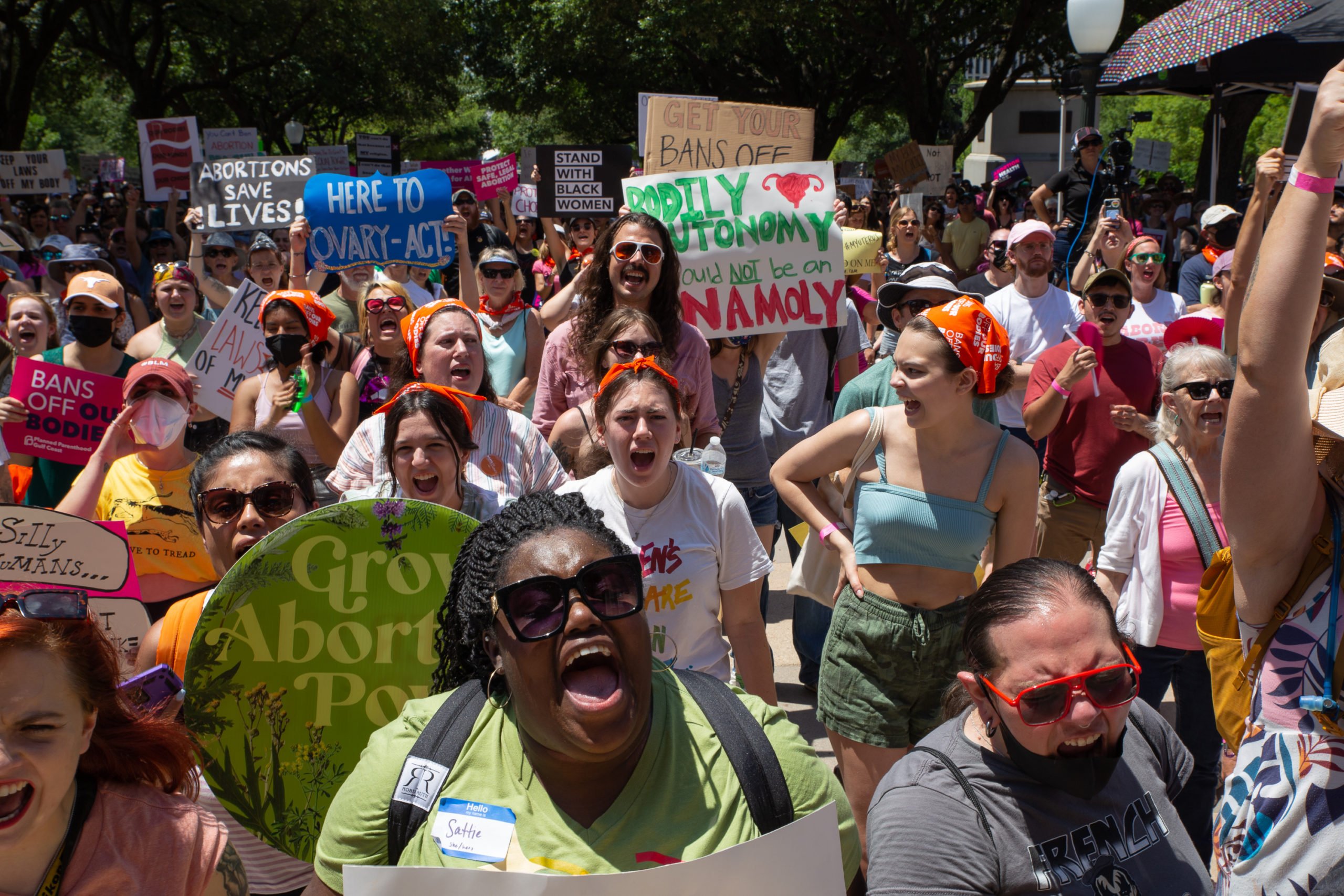
SB 8 gives standing to any private citizen to bring a suit, and could potentially be applied not only against the person who performs the procedure, but someone who gives their friend a ride to the clinic; an employer or insurer that covers the cost of reproductive healthcare; and organizations that help Texans pay for the costs of accessing abortion out of state. Some Republican lawmakers have already taken to social media to publicly threaten criminal prosecution of people who’ve made public their financial support for abortion options.
The law’s civil enforcement mechanism was a legal innovation aimed at avoiding federal injunctions that have stymied the GOP’s past attempts at strict abortion laws and ultimately served as a temporary solution until the newly installed conservative majority on the high Court got the chance to do away with the constitutional right to abortion.
Like many other Republican-dominated states, Texas passed a “trigger” law that would automatically criminalize abortions within 30 days of a Supreme Court ruling that returned abortion regulation to the realm of states’ rights. Under the law, it would be a felony to “knowingly perform, induce, or attempt an abortion.” An unsuccessful attempt could mean at least two years in jail; a successful abortion would be a first-degree felony, subject to a mandatory minimum of 5 years in prison.
Diaz-Tello, the legal director for If/When/How, said that abortion providers and those who help provide access to abortion will be the main targets.
“Those are the people that [abortion prosecutors] are really looking to terrorize, to chill them from getting people the care they need,” she said. “In the hopes that, because the state doesn’t actually have jurisdiction over the individual body to keep them from having an abortion, that they can cut them off from any source of care or support that they need to be able to get an abortion.”
Under the state’s trigger law, as was true before Roe, the only exception would be if a licensed physician deems a woman’s pregnancy to be life threatening or threatening “a serious risk of substantial impairment of a major bodily function.” That exemption wouldn’t apply to a woman who, for instance, threatened to take her own life or to make a dangerous attempt to self-induce an abortion. Further, any doctor suspected of performing an illegal abortion would become a target of Ken Paxton’s Attorney General’s Office, which is empowered to seek civil penalties of “not less than” $100,000 for each violation. The Legislature also restricted access to abortion-inducing medications and made it a crime to prescribe abortion by medicines through mail or telehealth services, cutting off other avenues for women.
Under the law, it would be a felony to “knowingly perform, induce, or attempt an abortion.”
While current Texas law explicitly prohibits the prosecution of women for their pregnancies, that hasn’t kept zealous prosecutors from going after them anyway. And reproductive rights lawyers are concerned that this will accelerate under draconian abortion ban laws in states like Texas. Since Roe, people have been increasingly policed and prosecuted for ending their pregnancies. From 1973 to 2005, there were 413 cases in which a pregnancy led to attempted prosecution and incarceration, according to a 2013 report by the National Advocates for Pregnant Women.
In 2003, Texas passed a feticide law. Three weeks later, the district attorney in Potter County issued a letter to all practicing physicians in the Panhandle county warning that the law requires them to report all women who are using or have used narcotics during pregnancy. As a result, more than 50 women were reported, charged with crimes, and in many cases, incarcerated. The Court of Criminal Appeals ruled in 2006 that the law did not allow for the prosecution of pregnant women. By that point, some women had been locked up for years as their cases worked through legal appeals.
Over the past several years, the dominant Republican Party in Texas has ceded more and more ground to the demands of the far right, especially on abortion. Right-wing lawmakers and activists are now calling for laws that would make receiving an abortion a capital crime. State Representative Briscoe Cain, a Deer Park Republican, has already promised to introduce legislation in the 2023 regular session that would empower district attorneys and the state attorney general to investigate and prosecute alleged abortion crimes in any Texas jurisdiction.
The aim would be to undercut the power of the growing number of liberal district attorneys in some of the state’s most populous counties, including Travis, Bexar, Dallas, and Harris. Several of those district attorneys have, in response to Alito’s leaked draft opinion, pledged not to enforce the state’s criminal abortion laws if Roe is overturned.
Cain and 13 other GOP legislators have issued a warning to companies like Tesla and Lyft that they will push legislation to kick them out of the state if they follow through on promises to cover employees’ costs to access abortion care outside of Texas.
Today, the tools available to zealous prosecutors are also far more powerful than they were in the early 21st century as law enforcement is able to weaponize troves of internet data in criminal investigations. “In the decades since Roe, smartphone and other surveillance technology has been introduced and is available to individuals, anti-abortion advocates, employers, and the government, making pregnant people vulnerable to surveillance of their whereabouts, their physical health, and their decision-making process regarding their bodies in multiple new ways,” Cynthia Conti-Cook, a civil rights lawyer and technologist, wrote in a 2021 report.
For years, a driving force of the conservative movement and the Republican Party has been to overturn Roe v. Wade. Now that they are on the edge of success, the question becomes: What now?
The post Before ‘Roe’—and After appeared first on The Texas Observer.
There’s a little thrift store in North Austin that has a blue sun-faded Ann Richards yard sign in the window. If you were to inquire, as I did, if the sign was for sale, you’d be politely told “no”—it’s as much a part of the store as the pride flag hanging in the window above clusters of ceramic knickknacks. The store owner did, however, show me another piece of Texas history, a black-and-white photograph under the checkout counter’s plate glass of Ann Richards, Barbara Jordan, and George H. W. Bush.
As we gazed down at the photo, I was struck by Richards’ magnetic hold on people. Perhaps her heaps of charisma, a quality generally lacking in Texas politicians today, is what captures the eye. Or perhaps it’s that she represents a more hopeful time when Democrats stood a fighting chance. Whatever the key to her allure, Ann Richards’ spirit lives on. And what better time to appreciate her legacy than now with the release of The One Ann Only: Wit and Wisdom from Texas Governor Ann Richards.
Compiled by The Ann Richards Legacy Project, The One Ann Only contains more than eighty photographs, some alongside her sharpest quotes. With a vibrant laminated cover, a white ribbon, and high-quality Forest Stewardship Council paper that makes the images pop, the book feels coffee table-worthy. It includes a foreword by Sarah Bird, a timeline of Richards’ life, and an afterword by Mary Beth Rogers. Overall, The One Ann Only is light on text—readers looking for a substantive biography or critical policy overview will have to look elsewhere. Instead, the book’s strength lies in its stellar photography.
When I spoke with Margaret Justus, founder of The Ann Richards Legacy Project, who served as Richards’ deputy press secretary, she said she envisioned a book that would reach fans as well as teachers, students, people in recovery, and anyone who might not be familiar with Texas’ 45th governor. Justus expressed concern that newer generations don’t know who Ann Richards is—a fate all too common for women in politics whose legacies get slowly, meticulously erased.

The One Ann Only is a visual love letter to Richards fans, and an open-door welcome for fans-to-be. Readers will likely feel an impulse to start calling her “Ann.” Regardless of the photographer, be it Pam Francis, Ave Bonar, or Annie Leibowitz, there’s something engrossing about each photograph in the book, perhaps because it doesn’t seem possible to take a bad picture of Richards—she’s that photogenic. Her laughter, her facial expressions, and her commanding presence at a podium all lend a sense of familiarity to her air of mystery. Here’s a woman, impeccably coiffed, and there’s no anticipating what she’ll say.
Flip to page 43, and there’s an image of Richards, standing tall in what looks to be a tense conversation with Jim Mattox, her Democratic primary opponent in 1990. The accompanying quote reads, “I’ve been tested by fire and the fire lost.” Flip to page 75, and there she is at a table with Barbara Jordan, saying something that makes Jordan crack up. Whatever it is, readers will sense it’s both piercingly funny and cuttingly true.
Richards’ humor was key to her political success. Her best quips point out the obvious but overlooked, for example: “Ginger Rogers did everything Fred Astaire did. She just did it backwards and in high heels.” It won’t be lost on readers that Richards, too, performed under the watchful eyes of many who wanted to see her fall.
As Sarah Bird’s heartfelt foreword points out, “Ann was both our last female governor and for three long decades the last Democrat elected to [the] office.” Not since 1976, when Jimmy Carter won over Texans, has a Democratic presidential candidate prevailed here. Bird adds: “[A]s I write this, the ink is still drying on the voter suppression bill that the current occupant of the statehouse signed just minutes ago.”
The book makes clear that Richards’ success didn’t arise from thin air. Her upbringing paved the way for the captivating speaker she became. By age 16, she attended Girls State, the annual mock legislative assembly, and was chosen to represent Texas delegates in Washington, D.C. Speaking of her father’s influence, Richards said, “I have always had the feeling I could do anything, and my dad told me I could. I was in college before I found out he might be wrong.” Deeply invested in empowering future generations, she helped create the Ann Richards School for Young Women Leaders in 2006—the same year she died of esophageal cancer.
I found that sitting with The One Ann Only in my lap, absorbed by the pictures and quotes, that what the book offers—through Ann’s wide smile—is an aura of hope. Perhaps current and future Democratic candidates will take a few notes from her playbook, cultivating a genuineness, approachability, and candor that cuts through rote stump speeches and offer voters something singular, honest, and real.
The post Ann Richards’ Legacy Is a Light for Dark Times appeared first on The Texas Observer.
On Sunday evening, as temperatures topped out at a withering 104 degrees, some 500 demonstrators gathered in southwest Uvalde at Robb Elementary School—the site, 47 days prior, of the deadliest school shooting in Texas history, which left 19 elementary-age children and two teachers dead. Out front sprawled a memorial to the lives stolen: a collage of weathered stuffed animals, crosses, letters, and flowers.
Vicente Salazar, who lost his 4th-grade granddaughter Layla Salazar—who loved music and the Dallas Cowboys—addressed a throng of reporters. “We have to have change in our Texas government … change the policies, change our representatives and everything,” he said, demanding that the age of purchase for AR-15-style rifles, like that used by the 18-year-old Uvalde killer, be raised from 18 to 21.
Salazar then turned to the law enforcement response to the shooting. “It’s a joke; I could’ve did a better job myself if I’d been able to get through their lines,” he said, explaining that he was among the many incensed Uvaldeans who were forbidden to cross a police perimeter line while cops took 77 minutes to kill the shooter. The delayed response has enraged the local community and drawn condemnation from law enforcement experts, while state and local officials have worsened the matter by spreading conflicting and false information and denying access to records. “If you’re taking a badge to protect the people, and protect the babies, why didn’t they do it? We still can’t get answers,” Salazar said.
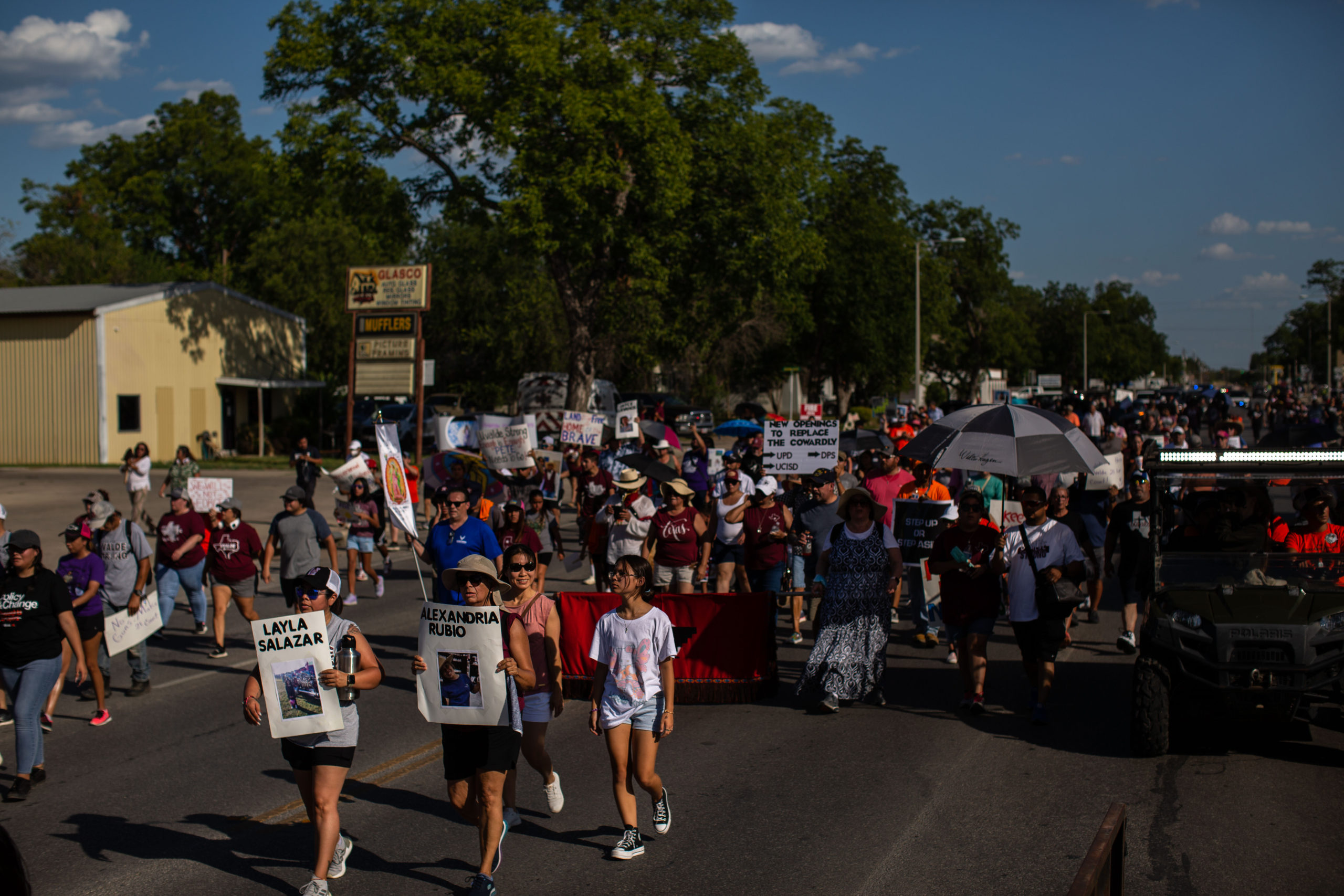
At a quarter to six, the demonstrators assembled on Geraldine Street by the school, flanked in front and back by state troopers on motorcycles and bicycles. A crew of Brown Berets, from multiple Texas cities, organized the crowd and handed out waterbottles. Sweat poured as the march began. Families of the slain wore matching custom-made t-shirts to commemorate the unthinkable. The protesters carried signs reading: “Bullets are not school supplies,” “You don’t need a gun to be powerful,” and “Hear their screams.” They chanted: “Not one more child” and “Qué queremos? Justicia! Cuándo? Ahora!” (What do we want? Justice! When do we want it? Now!) as the sun beat down.
“Thoughts and prayers are appreciated, but we need change; we need to stop this from happening to any other kids and any other schools in America,” said Micaela Alvarez, a child victims advocate who’d traveled from San Marcos to participate, as she walked. “I also don’t think there’s really any reason someone needs an assault rifle.”
“What I want no one can give me: I want my daughter back, and if I can’t have her, then those who failed her will never know peace.”
After a mile, the assembly halted at Uvalde’s town square, where live oaks provided merciful shade. One by one, representatives from each of the 21 families took to the podium to speak, a procession of still-roiling rage and grief that lasted about two hours.
“What I want no one can give me: I want my daughter back, and if I can’t have her, then those who failed her will never know peace,” said Kimberly Rubio, mother of Alexandria Rubio, through tears. “We want answers, we seek justice, and we demand change—and we will never rest.”
Blame centered most frequently on Governor Greg Abbott for signing lax gun laws in Texas and on Pete Arredondo, chief of the Uvalde school district police, for failing to stop the shooter sooner. Some called for all cops who were present that day to resign. One father, Javier Cazares, said he was helping launch a new chapter of the League of United Latin American Citizens in Uvalde. A handful stressed the importance of voting in November. State Representative Tracy King and gubernatorial candidate Beto O’Rourke attended.
“It’s unbelievable that in this country guns have more protections than children and women,” said Destiny Esquivel, 16-year-old cousin of Maite Yuleana Rodriguez.
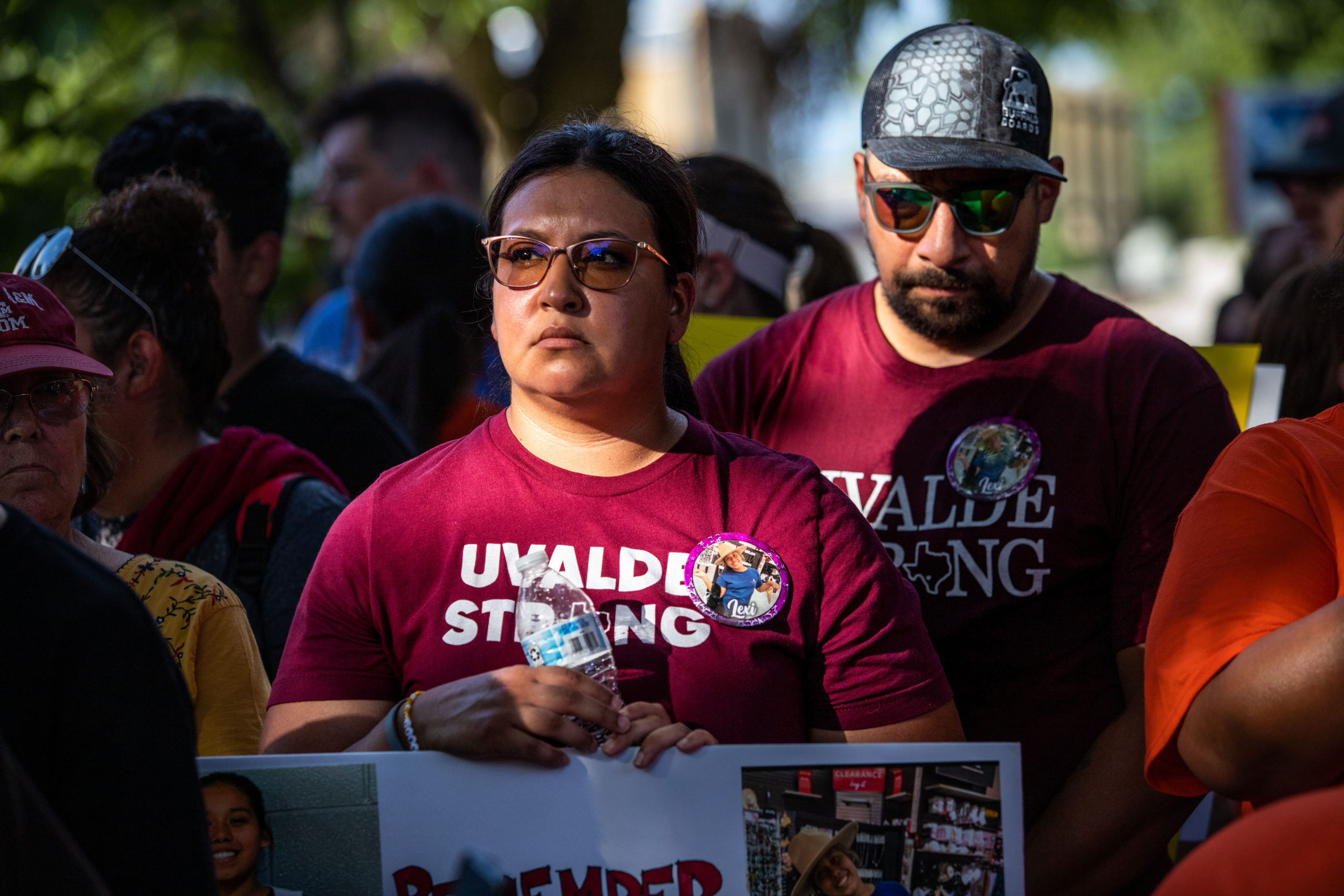
Speaking of the police response, the aunt of Xavier Lopez added, “There is no excuse they could ever say that would justify them being cowards,” while A.J. Martinez, one of the kids who survived the attack, shared, “Right now I don’t feel safe anywhere. … I don’t want nobody to have to go through what my family and friends, or the community, went through.”
Some family members focused on sharing heartrending details about the lost children, who loved softball and dancing, telling jokes and anime. One sister wept almost from her first word to her last. Not a few looked to the afterlife for solace.
Not long after a generous rain cloud finally blocked the sun, Alysandra Garcia took to the podium. Her mother, Irma, was one of the teachers killed in the attack, and her father, Joe, suffered a fatal heart attack two days later.
“My sweet mother, who would never hurt a soul, stared at her murderer in the eyes in her last moments. … She was the backbone to our family, and we will never be the same,” Garcia told the crowd. “So, my gracious and perfect parents, when we meet again in Heaven, we can finally have our first dance, since y’all won’t be there for my quinceañera.”
The post Uvalde Marches for Transparency and Gun Reform appeared first on The Texas Observer.
TO: All Staff
RE: Recent passage of the ‘Arm the Teachers’ bill
Hi everyone,
I trust you know I don’t begrudge anybody their success—ultimately, it’s about the students—but I think it’s absolutely unfair that the quality of weapons we get is tied to standardized test scores. I understand that the Science Department’s Regents numbers are through the roof, but do you think it’s right that I’m stuck with a pistol because my kids don’t care about Shakespeare?
To be frank, I’m just not sure why the Math Department should be getting laser scopes for their M16s. Not to be petty, but they just got those new graphing calculators. I’ve been teaching the same worn copies of The Sun Also Rises for eight years. Can I at least get a silencer or some night-vision goggles?
This is undoubtedly a difficult situation, and that means we should be coming together, not breaking apart. The freaking senate managed to collaborate on bipartisan gun legislation. What are we doing here, people? We all got into teaching for the same reasons: to inspire the next generation and show up to work every day armed to the fucking teeth. Let’s try to remember that.
You all know me—you know I’m not a busy body; however, I have noticed that some teachers are not routinely cleaning and oiling their service weapons (see Chancellor’s Regulation 11-b). Will this be enforced, or are we as a staff just okay with dirty guns now?
As stated in my last email, I am in favor of the latest guidance re: mandatory Rambo-style bandoliers. Still, I believe that the warpaint and cigars send a negative message to the kids.
Let’s face it—some lines need to be drawn. Which brings me to my next question: What role can/should our guns play in classroom management? What’s permissible here? Brandishing? Racking an empty shotgun? Where do we stand on shooting at the floor and yelling, “DANCE!”?
Also, and I know I’m not the only one who has been wondering about this, but will the teacher’s lounge be doubling as an armory? Because I don’t want anyone taking my bullets. If it’s anything like the Naked Juice saga, no amount of sticky notes will stop people from taking my shit. Looking at you, Larry. Those things are like five bucks a bottle.
On the topic of money, I’m still waiting on an answer from the DOE about whether or not they will be providing holsters. When our Business Manager Ron returns from Command and Control training at Fort Drum, I hope he can shed some light.
The city is really nickel-and-diming us on this stuff. That’s why I was so pumped to hear about the initiative to supplement our municipally funded arsenal with homemade ghost guns 3-D printed by our wonderful science team. Shout-out to Meg for securing the blueprints off the Dark Web!
Per our recent professional development cycle on racial justice, the lack of BIPOC representation on staff here remains troubling. How can we distinguish ourselves from other primarily white, heavily armed groups? This is quickly starting to feel like an offshoot of the Oath Keepers. What are we thinking? Festive T-shirts? More progressive hiring practices? Let’s circle back on this when we return in the fall.
Lastly, we still need a few volunteers for the high-capacity magazine drive. Looking at you, Larry.
Sincerely,
Concerned in the English Department
This post, my employee didn’t want the post-baby flexibility I arranged for her , was originally published by Alison Green on Ask a Manager.
A reader writes:
One of the people on my team announced she was pregnant. I was thrilled for her and wanted to be a supportive manager. Our company is too small to qualify for FMLA but we do have our own program that allows for 12 weeks of paid medical leave. I went beyond that and allowed her eight extra weeks of paid leave on top of that, plus as much vacation time as she wanted to use. We’re too small for this to be required by law, but I was able to convert one of our old spaces into a pumping room with a locking door, chair, sink, and outlet and we told her we would pay her for her pumping breaks. I also set up a flexible schedule for when she returned to work. I looked into our insurance plan and found out she could get a pump covered and I sent her info on that.
I was surprised that she chose to come back to work at eight weeks and not take the full medical leave or the extra time I arranged for her. She didn’t use the pumping room because she didn’t breastfeed at all, and she wouldn’t use the flexible schedule I got her. She worked her normal hours. I’m disappointed that I set all this up for her, only for her not to use any of it.
I reminded her several times about the flexible schedule and let her know breastfeeding and pumping was still possible. She says her husband works for himself and the plan was always for her to go back soon while he had the baby part-time and the baby was in daycare part-time. She said she never planned to breastfeed and formula was fine, and she told me she doesn’t feel bad for choosing to work when she could afford to stay home and not breastfeeding even though she could have.
I don’t understand why she wouldn’t want the perks I worked so hard to set up. I am disappointed in her and having a hard time getting over it. I had to quit my job when I was pregnant because there was no support for working moms. I’m having a hard time understanding why she wouldn’t want the perks I would have killed for back then. She went right back to work like she never even left. I admit I’m at a loss.
I answer this question over at Inc. today, where I’m revisiting letters that have been buried in the archives here from years ago (and sometimes updating/expanding my answers to them). You can read it here.
This post, my bosses want our remote team to work out together 3 times a week , was originally published by Alison Green on Ask a Manager.
A reader writes:
I work for a very large multi-national publicly traded company. The job itself is great — clear expectations, strong management, excellent IT services, market appropriate pay, and a very generous benefits package. I am on a team of about 20, although I really only interact with three people on a regular basis.
A few weeks ago, our leadership team began doing a “let’s get physical Friday,” basically a 20-minute workout once a week. I have chosen not to participate in this as my level of physical activity is none of my employer’s business, not to mention that my current workload means that taking 20 minutes out in the middle of the morning for something unnecessary really interrupts my workflow.
It was suggested this week that we start holding these sessions three times a week as a way of taking a few moments away and bonding as a team. This was presented during a meeting where we were determining our KPIs for the upcoming month.
Here’s the really weird part: my office is 100% remote. We have a virtual office and are never face to camera. I don’t even have any idea what my coworkers look like. So the suggestion that we should all exercise together seems … odd. I don’t have enough room in my office to even lay out a yoga mat. No one has asked whether anyone is interested in this program. Attendance has been very low.
The way I understand what they’re doing from another coworker who has attended is that everyone just has their headset/audio on and they all follow along to the same YouTube workout video.
I gently mentioned today in the meeting that it is important for us to remember that we don’t know the physical abilities or able-bodiedness of our coworkers, and that using forced exercise as a way of bonding a team could be excluding some folks who are unable to participate. The responses were wild. One of the leads suggested that yes, injuries happen and that was understandable, completely glossing over people who may be physically unwell or disabled. Another lead, mine in fact, had the audacity to suggest that those who were unable to participate due to an illness or injury should disclose that so that they could be given an alternate way to participate.
And they’re calling it “optional,” but one of the leaders has been very pushy about it. In fact, it was held this morning and one of my coworkers, whom I know privately to have a physical disability, messaged me, “I was going to go and try, but I couldn’t do the workout they were trying without passing out.” When this coworker messaged the lead in the group chat to say, “I tried but I don’t really have space around my desk haha,” the lead’s response was, “Well, maybe next time you can move your laptop where you have more room.”
We’re feeling pressured to participate and while I know my rights under the ADA, not everyone does and it seems they aren’t as willing to stand up and say something as I might be. I’m concerned that people are going to feel pressured into disclosing their disabilities in order to appease this leader.
Is it just me, or is this a major violation and HR issue? Forcing people to exercise together or otherwise be forced to disclose a disability that may have nothing to do with their ability to do their jobs? Am I overreacting? Are mandatory group exercise classes a normal part of a work environment?
Nooooo, this is not normal.
Some companies do offer on-site work-outs as a perk … but it’s not generally your whole team all exercising together to “bond.”
You were 100% right to point out the issues with organizing a regularly-occurring bonding activity around something that requires a specific level of physical ability. In theory your team lead is right to note that they’d offer accommodations to people who need them … but you’re right that no one should be forced to disclose a disability for something like this (and what kind of “alternate way to participate” do they have in mind, specifically?).
It’s one thing to offer something like this occasionally as a novelty for people who want to participate, particularly if it’s mixed with other sorts of activities people can choose from. But making it a regular thing — first weekly and now three times a week? — really isn’t okay, and pressuring people to take part is even less so.
A weekly (or thrice weekly) activity for “bonding” that excludes people (whether due to physical ability, not having the space at home, or simply not caring to exercise in a group during the workday) isn’t about bonding at all. People who can’t or won’t participate in group exercise shouldn’t have to worry they’re missing out on team-building benefits or that they’ll be seen as less a part of the team.
I am curious about the “mandatory” nature. It does sound like they’re inappropriately pressuring people to show up, but you also mentioned that participation has been very low … so it seems like people are successfully opting out. It’s still not okay, for all the reasons above, but if you’re seeing that people can just not show up without any repercussions, I’d strongly recommend that you spread the word to your coworkers about that so people know they can easily skip it.
Beyond that, you have a couple of choices if you want to push the issue. You can band together with coworkers who share your lack of interest in group work-outs and ask that they not be made a central focus on the team because it’s excluding some of you and perhaps suggest offering them quarterly for people who want them (or some other low frequency). Or you can point out your concerns to HR, who in a large company will probably be pretty interested to hear what’s going on.
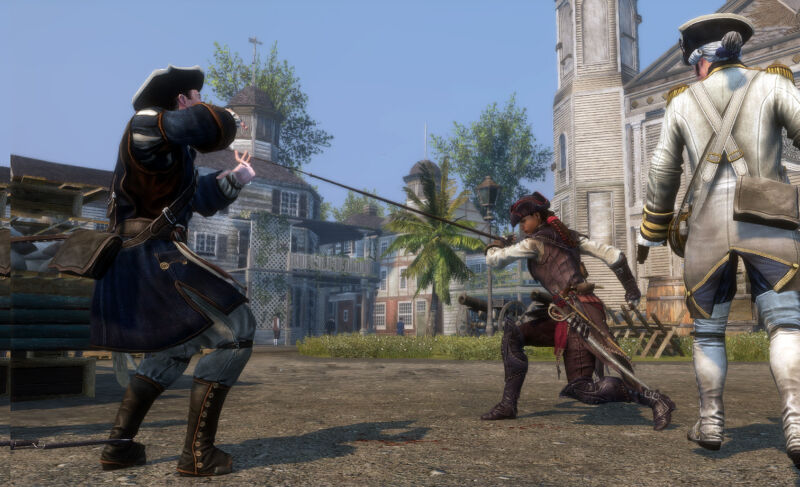
Enlarge / If you purchased Assassin's Creed Liberation HD during last week's Steam Summer Sale, you now have less than two months to play it before it stops working.
Ubisoft has announced it will be decommissioning the online servers for a number of its older titles. But in addition to the expected loss of the online multiplayer portions of these games, the shutdown also means that single-player DLC for the PC versions of those titles will no longer be accessible, even for those who have already purchased and downloaded it before the coming shutdown.
According to Ubisoft's announcement, "the installation and access to downloadable content (DLC) will be unavailable" on the PC versions of the following games as of September 1, 2022:
Assassin's Creed 3
Assassin's Creed: Brotherhood
Driver San Francisco
Far Cry 3
Prince of Persia: The Forgotten Sands
Silent Hunter 5
Read 8 remaining paragraphs | Comments
Sunday’s heat was extreme for the greater Houston area. College Station, for example, set a daily record for July 10 by reaching 111 degrees. This was also its second hottest day on record, in any month, ever. In Houston, four of the first 10 days of July have now recorded 100-degree days. Sunday’s mark of 105 degrees tied the record for the hottest degree for any day in July. Anyway, here are the maximum temperature records set or tied on Sunday:
City of Houston: 105 degrees (101, set in 1998)
Houston Hobby: 104 degrees (100, set in 1964)
Galveston: 96 degrees (96, set in 1931)
College Station: 111 degrees (109, set in 1917)
It is worth noting that all of these locations also set or tied minimum temperature records on Sunday. For example, the low temperature in Houston never fell below 82 degrees. So overall you just experienced the warmest July day in nearly 150 years of records along the upper Texas coast.
Congratulations, or something.
I realize that some readers get twitchy when we write about about climate change. This is a weather site, not a climate site, and that’s our focus. But here’s the reality. Houston experienced an extremely hot and dry summer in 2011, just 11 years ago. At the time, it seemed historic. Also, as someone who lived through it, I can attest that it was miserable. But now 2022 may be on course to match or exceed it, at least in terms of heat. This is not normal. People can have reasonable debates about the precise causes of this excess heat, and what to do about it. But Sunday’s weather was atrocious, and not a future I particularly want to leave to my children.
The heat continues, albeit with slightly less burn, today. The National Weather Service has kept an “excessive heat warning” in place for the region’s far western counties, including the College Station and Brenham areas, where highs are likely to reach at least 105 degrees again today. Houston should also see highs of around 100 degrees, or perhaps a touch higher. Like on Sunday, some relief may come from scattered thunderstorms that will start out north of the region and then move through during the afternoon. While the rain is most assuredly welcome, these storms could bring some briefly strong winds. Otherwise winds will be light, out of the southwest at 5 to 10 mph.
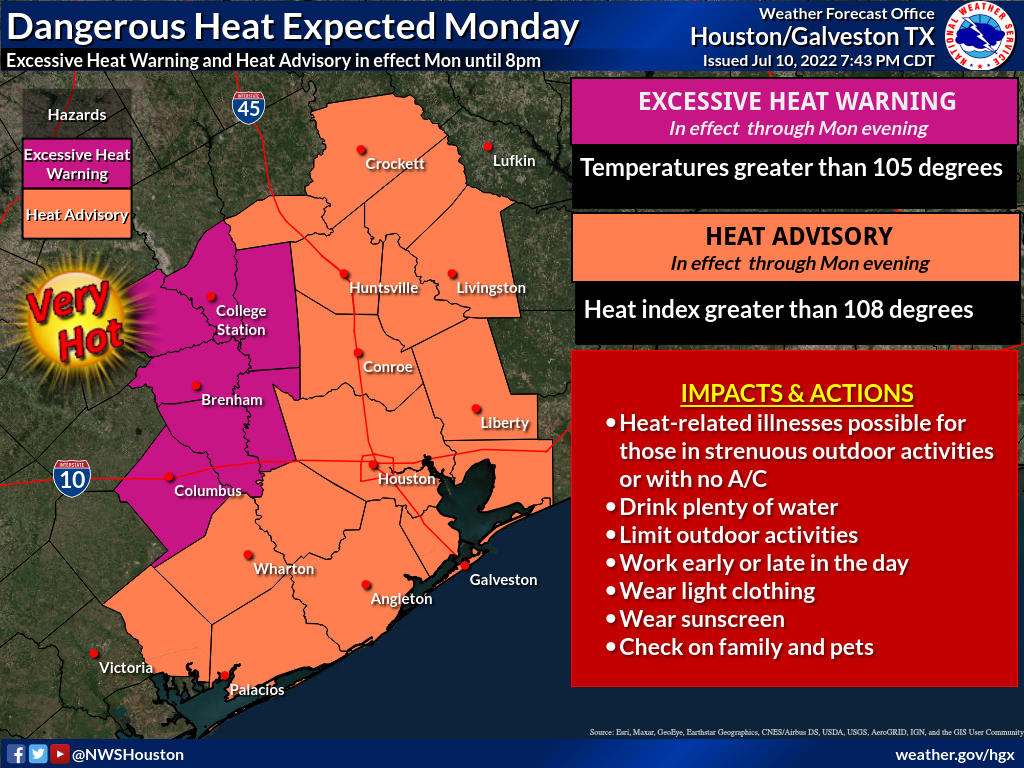
The intense high pressure system that baked our region over the weekend will finally begin to back off to the west, and that will start to provide some slight relief, likely keeping highs in the Houston metro area just below 100 degrees. Rain chances will likely be around 20 percent.
These will, finally, feel more like typical mid-July days in Houston. We can probably expect highs roughly in the mid-90s, but there will also be some clouds to go along with 30 to 40 percent rain chances each day. Hopefully our parched trees and lawns see some welcome rain during this period.
Careful observers of the National Hurricane Center will note that they are now predicting a 30 percent chance of a tropical system forming in the northern Gulf of Mexico during the next five days. Essentially, a cool front is moving down into the northeastern Gulf from Georgia and the Florida Panhandle. This, this system will then drift westward across the northern Gulf of Mexico and may impact our weather this weekend.
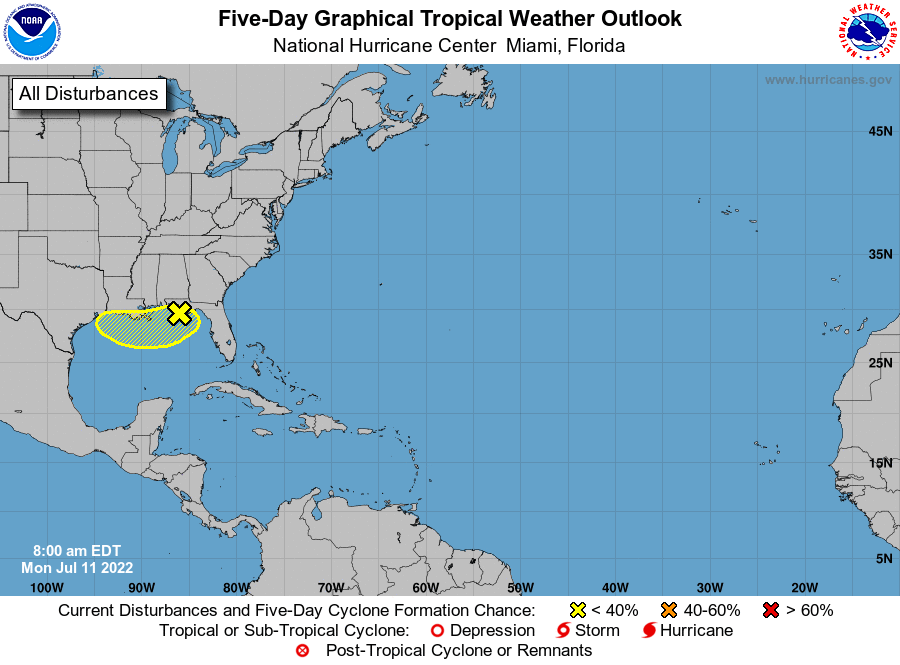
There are a lot of unknowns here, including whether the system will significantly intensify (probably not) and how far west it will come. If it moves all the way to Texas it could bring us some significant rainfall this weekend, but if it moves into Louisiana we’re going to remain hot and dry. For now I’d guess the weekend will continue to see hot and mostly sunny weather, but the forecast comes with an asterisk at this point.
We’re including some tips we shared from Reliant over the weekend that can help manage energy usage, regardless of your electricity provider:
Cowboy Who?#spoilers!
VECNA: Would you like to join them, Max?
(Music plays as an image of Max’s friends appears in the distance as if at the top of a hill.)
VECNA: They can’t help you now, Max. There’s a reason… sorry, is that “Turn It On Again” they’re playing?
MAX: Lucas remembered!
VECNA: Huh. I figured there must be some kind of nostalgic memory attached to it like it was playing during your first kiss, but I can see your mind and… no? That’s really your favorite song?
MAX: Why? You don’t like Genesis?
VECNA: Ehhh, I mean… they’re fine. Not really my thing.
MAX: Then what’s your problem?
VECNA: If a middling band’s third-best single on what—if I’m being generous—is their fourth-best album is your favorite song of all time, I don’t think I’m the one with a problem.
MAX: You know, for a “middling band” that’s “not really your thing,” you seem to have put a lot of thought into ranking every album and every single on those albums.
VECNA: I thought some of their early stuff was pretty interesting—
MAX: “Their old stuff was better”? What a fresh take on rock music!
VECNA: Look, I cut them some slack when Gabriel left, but now that Hackett’s gone and they’re down to a trio, it’s like they’ve completely abandoned their prog-rock roots. If I wanted cute pop music I’d put on some Bangles.
MAX: Excuse me? Cute pop music? Have you even listened to the lyrics? “Turn It On Again” is about a guy so lonely and alienated in his life that his only meaningful emotional connections are with the people on the TV shows he watches.
VECNA: (sighs) Okay, fine. Music is subjective. If that’s your favorite song…
MAX: I mean, under the circumstances, I’m kind of regretting that it’s not “Supper’s Ready,” so I’d have a little more time to escape.
VECNA: Heh. With twenty-six minutes, you could saunter up that hill!
MAX: Ha!
(Max strikes Vecna, who recoils and drops her. She runs toward her friends.)
VECNA: Don’t worry, Max. I will end your torment… before they release “Invisible Touch.”