In news that is not surprising at all, and seems to be playing out just as people predicted a month ago, Elon Musk has officially claimed that Twitter is in breach of its merger agreement and says he’s pulling out of the deal. The actual details, of course, are not that simple. There is no actual escape hatch like that here. Musk made a legal agreement to pay $44 billion for the company and can’t just walk away.
As we noted back in June, he appeared to have hired some very expensive lawyers to come up with some sort of pretext for walking away, and it’s playing out exactly in the manner described. Musk had specifically waived his rights to due diligence prior to the deal, but the merger agreement did include a promise to provide Musk with necessary data to conclude the deal.
For much of the month of May, Musk (who must be a terrible fucking poker player) telegraphed his intentions to bail on the deal by whining about how much spam there was. This made no sense at any level. First, when Musk announced the deal, he insisted he was doing it in order to tackle the spam challenge on the platform (a problem that really doesn’t impact most users of the site — but does impact the very most high profile users like Musk). So to then suddenly start whining about spam seems transparently a pretext.
Also, it was a pretext that couldn’t void the deal.
So, his second attempt to come up with an excuse was to claim that Twitter publicly lied to the SEC in its filings regarding how much spam was counted among its monetizable daily active users. This also seemed ridiculous, as Twitter had been publicly reporting those numbers for quite some time, and Musk could have explored those prior to the deal itself but, again, deliberately chose to waive those rights. You can’t do a deal in which you agree not to explore the data, and then complain that you hadn’t seen the data.
Somewhere around this time, it seems clear that Musk’s lawyers explained to him that this wouldn’t get them out of the deal, and (it seems likely) suggested that they could cook up some alternative pretext that at least someone could try to actually argue in court — because it was clear that court is where this would all end up.
And thus, behold the bullshit brilliance of the lawyers at Skadden, Arps, who earned their large paycheck by zeroing in on the part of the deal about needing to supply Musk with the information necessary to close the deal. They just started requesting tons of data, specifically related to the whole spam/mDAU discussion, knowing that they could just keep asking for more data, some of it impossible to actually supply to Musk, and eventually they would be able to say that Twitter wasn’t supplying the data requested, and thus was in breach… and therefore the deal was off.
And, that’s exactly what happened. From the letter to Twitter:
Notwithstanding these repeated requests over the past two months, Twitter has still failed to provide much of the data and information responsive to Mr. Musk’s repeated requests, including, but not limited to:
- Information related to Twitter’s process for auditing the inclusion of spam and fake accounts in mDAU. Twitter has still not provided much of the information specifically requested by Mr. Musk in Sections 1.01-1.03 of the May 19 diligence request list that is necessary for him to make an assessment of the prevalence of false or spam accounts on its website. As recently as the June 29 Letter, Mr. Musk reiterated this long-standing request for information related to Twitter’s sampling process for detecting fake accounts. The June 29 Letter identified specific data necessary to enable Mr. Musk to independently verify Twitter’s representations regarding the number of mDAU on its platform—including, but not limited to (1) daily global mDAU data since October 1, 2020; (2) information regarding the sampling population for mDAU, including whether the mDAU population used for auditing spam and false accounts is the same mDAU population used for quarterly reporting; (3) outputs of each step of the sampling process for each day during the weeks of January 30, 2022 and June 19, 2022; (4) documentation or other guidance provided to contractor agents used for auditing mDAU samples; (5) information regarding the user interface of Twitter’s ADAP tool and any internal tools used by the contractor agents; and (6) mDAU audit sampling information, including anonymized information identifying the contractor agents and Quality Analyst that reviewed each sampled account, the designation given by each contractor agent and Quality Analyst, and the current status of any accounts labelled “compromised.” A subsequent request along these lines should not have been necessary, as this information should have been provided in response to Mr. Musk’s original diligence request. Yet, to date, Twitter has not provided any of this information.
- Information related to Twitter’s process for identifying and suspending spam and fake accounts. In addition to information regarding Twitter’s mDAU audits, the June 29 Letter also reiterated requests for data specifically identified in Sections 1.04-1.05 of the May 19 diligence request list regarding Twitter’s methodology and performance data relating to identification and suspension of spam and false accounts, including, but not limited to, information regarding account suspensions, including information sufficient to identify daily numbers of account suspensions since October 2020 and numbers of account suspensions for each of Twitter’s internal reasons for suspension. In addition, during the June 30, 2022 call, Twitter’s representatives indicated for the first time that the workflow and processes for detecting spam and false accounts in the mDAU population is different and separate from the workflow and processes for identifying and suspending accounts in violation of Twitter’s policies. On that call, Twitter indicated that it would not be willing to provide information regarding the methodologies employed to identify and suspend such accounts.
- Daily measures of mDAU for the past eight (8) quarters. On June 17, 2022 (the “June 17 Letter”) Mr. Musk reiterated his request for “access to the sample set used and calculations performed, as well as any related reports or analysis, to support Twitter’s representation that fewer than 5% of its mDAUs are false or spam account.” To that end, Mr. Musk requested that Twitter provide “daily measures of mDAU for the previous eight quarters, and through the present.” This information is derivative of the information Mr. Musk first sought in Sections 1.01-1.03 of the May 19 diligence request list. Although Twitter has provided certain summary data regarding the mDAU calculations, Twitter has not provided the complete daily measures as requested.
- Board materials related to Twitter’s mDAU calculations. In the June 17 Letter, Mr. Musk requested a variety of board materials and communications related to Twitter’s mDAU metric, its calculation of the number of spam and false accounts, its disclosure of the mDAU metric, and the company’s disclosure of the number of spam accounts on the platform. Twitter has provided an incomplete data set in response to this request, and has not provided information sufficient to enable Mr. Musk to make an independent assessment of Twitter’s board and management’s understanding of its mDAU metric.
- Materials related to Twitter’s financial condition. Mr. Musk is entitled, under Section 6.4 of the Merger Agreement to “all information concerning the business … of the Company … for any reasonable business purpose related to the consummation of the transactions” and under Section 6.11 of the Merger Agreement, to information “reasonably requested” in connection with his efforts to secure the debt financing necessary to consummate the transaction. To that end, Mr. Musk requested on June 17 a variety of board materials, including a working, bottoms-up financial model for 2022, a budget for 2022, an updated draft plan or budget, and a working copy of Goldman Sachs’ valuation model underlying its fairness opinion. Twitter has provided only a pdf copy of Goldman Sachs’ final Board presentation.
This is all just a very expensive way of saying “you promised us to provide us everything we needed, so we kept asking for more and more ridiculous, and impossible-to-actually-deliver information until we could claim you weren’t giving us what we needed, and so now we can claim you’re in breach.”
I mean, they list out five different requests, but the first four are all variations on the same made up nonsense request. And the last one is just thrown in as a Hail Mary in case the court sees through the first four.
Musk’s lawyers try to claim that the information that Twitter did provide Musk — basically access to the full Twitter Firehose API (which was always a kind of middle-finger to Musk’s bogus insincere request in the first place) — wasn’t enough to satisfy the agreement because, in part, it treated Musk like a common every day customer. *shudder*
Twitter only offered to provide Mr. Musk with the same level of access as some of its customers after we explained that throttling the rate limit prevented Mr. Musk and his advisors from performing the analysis that he wished to conduct in any reasonable period of time.
And, if you really want any extra proof that this was all pretextual and planned out back in May, and executed over the last month, Musk is doing this basically on the first day he can. The original merger agreement included a termination clause for contractual breach, with a 30 calendar day notice. It has been exactly 30 days since Musk sent that obviously pretextual complaint about providing data. We hit the deadline, and now Musk says he’s out.
Somewhat hilariously, Musk’s lawyers throw one more Hail Mary in at the end of the letter, claiming that because there were some management changes after the merger agreement was announced — including both some executive firings and some who just chose to get out before Musk became their boss — that this somehow violated another clause of the agreement to “preserve substantially intact the material components of its current business organization.” This is also legally weak sauce.
Not surprisingly, Twitter’s board chair immediately announced this was going to court, which is what everyone expected:

So, the next stage of the fight will happen in Delaware Court of Chancery, and who the hell knows what happens then. Lots of lawyers are going to start eyeing yachts, however.
On the whole, it seems fairly blatantly obvious that all of Musk’s excuses here are pretextual, and plotted out by his lawyers to try to get him out of a deal that didn’t actually have an escape hatch. The question before the court, really, is whether or not it matters that he’s obviously trying to escape a deal that he agreed to.
Perhaps the most likely outcome is that the two sides will come to some sort of agreement — with the most probable outcome being that Musk agrees to pay some amount for Twitter to drop the case and walk away. The question though, is what number will satisfy both parties. While the agreement has a $1 billion breakup fee, that’s not really controlling here. There are going to be long drawn out discussions regarding how much Twitter and Musk will each agree to in order to just walk away. It may come down to somewhere around that $1 billion, but my guess is that if Twitter believes it has a strong case to force Musk to go forward with the full $44 billion, that it may be able to force him to pay substantially more.
Of course, it’s not just Twitter and its Board who are likely to go to court over this. I fully expect multiple shareholder lawsuits to be filed. And quickly. And not necessarily in the Chancery Court in Delaware. And some of those may get… messy for Musk, who basically jerked around the shareholders for months, and (it can be credibly argued) did serious damage to the company’s value in the interim.
All that said, there’s a separate question of what happens to Twitter.
Some — who were opposed to the Musk takeover — may look at this as the best scenario, if Musk walks away but has to hand Twitter a lot of cash, that could be useful to keep Twitter going. However, the way these things usually work is that Twitter is now seen as wounded and vulnerable. And, I can’t see Twitter’s current board (or major institutional investors) being able to leave Twitter alone as an independent company like this. As such, my guess would be that some third party now tries to swoop in and buy up the pieces.
It seems unlikely that either Google or (especially) Facebook would be allowed to do so by the DOJ or the FTC, but you could see some other large companies jumping into the fray — including Microsoft (who once wanted to buy TikTok and Discord, and already owns GitHub and LinkedIn) and Walmart (who also wanted TikTok, and still pretends that it wants to be a digital giant, rather than just a commerce giant). There are some more “out of left field” options as well. A large media company (Comcast? Disney?!?) could make a play for it. I think AT&T and Verizon have been chastened and shamed by their internet service failures, but who knows?
Either way, at some point in this process, it seems likely that Twitter’s ownership is going to change drastically.
Finally, for all the trolls and muck throwers who celebrated Musk “freeing” Twitter, well, they’ll just have to slum it up at Parler, Truth Social, Gettr, Gab, or wherever else they need to go.
Today is a special day. At 6:15am CT local time in Houston, 99 percent of the world’s population is illuminated by the sun. Of these 99 percent, the vast majority are in direct sunlight, while the remainder are in some form of twilight. Only parts of Australia, New Zealand, and Papua New Guinea are in full darkness at this time. As to why this occurs a couple of weeks after the summer solstice, and not on the summer solstice, that has to due with the distribution of the world’s population, and the location of Earth’s landmasses. TimeAndDate has more detail on all of this in a great fact-checking post.

Speaking of that sun, we’ll see plenty of it during the days ahead. This weekend looks extremely hot before conditions start to moderate a little bit more each day next week. It will be nice to have daily rain chances again.
Areas inside Loop 610 won the rainfall lottery on Thursday, but the chance of hitting an isolated rain shower today is less than on Thursday. Instead, we can simply expect mostly sunny weather, with highs in the upper 90s to 100 degrees in Houston, and warmer conditions still for far inland areas such as College Station. Winds will be light, out of the southwest at 5 to 10 mph. Overnight lows probably won’t drop below 80 degrees.
Look for very hot weather, with highs at or above 100 degrees for much of the area with sunny skies. Please take precautions due to the heat during the middle of the day.

This will be another hot and mostly sunny day, probably the hottest of the period. However, there is a slight chance, perhaps 10 to 20 percent, of an afternoon shower or thunderstorm kicking up along with the sea breeze. I mean, probably not. But maybe.
The details for next week’s weather remain a bit fuzzy, but the overall trend should be one toward more typical weather for mid-July in Houston. That means that as we get toward the middle of the week highs likely will slot somewhere in the mid-90s, with a decent 30 or 40 percent chance of rain each day. After the last few days, that doesn’t exactly sound terrible, does it? We’ll be back on Monday with some more clarity on those details. Until then, please take the heat seriously this weekend.

This post, teacher shared bad medical advice, former employer wants “my side of the story,” and more , was originally published by Alison Green on Ask a Manager.
It’s four answers to four questions. Here we go…
1. Giving feedback when a teacher is sharing (bad) medical opinions
I am a teacher mentor for a residential summer camp/school for kids. The curriculum of the camp is not health-related. It is my job to observe teachers and offer them feedback on their teaching, usually in the form of a conversation afterward, with possibly a written observation report that would be shared with our managers (the academic dean and the executive director).
Today I observed a teacher give what was an exemplary class when viewed from the point of view of teaching the official curriculum. However, in banter before the class officially started, the teacher also shared medical beliefs that I think are (a) incorrect and (b) harmful to students in our setting, where we are “in loco parentis” to minors. The context was this: several kids have been passing around a cold, which has been tested and is not Covid. The teacher’s first comment was that she didn’t know why anyone would bother to get vaccinated for Covid, when you can get Covid despite vaccination. Then she said that whenever she starts to get the sniffles, she wards off illness by not eating sugar. She seemed to imply that if the students hadn’t eaten sugar, they wouldn’t be sick. I want to offer her feedback along the lines of “keep your medical opinions to yourself and stick to the curriculum,” but I realized that if she had been pro-vaccination and promoting some other medically valid way of preventing illness, like washing your hands, I wouldn’t have minded her comments. What do you think the appropriate feedback for her is?
She absolutely should not be discouraging kids from following public health advice on vaccination! That’s a really big deal. “I ward off illness by avoiding sugar” is a problem too, but if she’d just said that it wouldn’t have been nearly as alarming as her anti-vax comment. It’s a big enough deal that you should escalate it to your managers rather than just addressing it with her yourself one-on-one.
I know you’re questioning yourself because you wouldn’t have objected if she’d said something more reasonable — but you’re not required to treat all opinions equally. Some are actively harmful.
2. My former employer wants “my side of the story” about a process I didn’t document when I left
I left a job in January, due to an extensive workload for relatively low compensation (two people were hired to replace me). I spent the last month there compiling a 50-page handover document, providing as much detail as I could about everything I did. Since then, my former boss has also handed in her notice. I found out last week, when my former boss called me on her last day, that there was confusion over one part of one process that I’d previously been doing. A miscommunication over this step in the process had escalated dramatically over the last couple of months, resulting in one (fairly senior) employee making a complaint to the ethics board.
This morning I received an email from that employee asking for my side of the story. I contacted my former boss to see whether I should even reply, who told me to contact HER former boss. I did so, and her reply makes it clear that I didn’t document this step in my handover notes, and asks for further information about the process. I’ve gone back through my emails, which I still have access to, and provided a detailed reply, but as of right now still haven’t had guidance about whether to respond to the employee who’s emailed me.
Part of the issue is that I left because I was so overworked that it was affecting my mental health. Since the emails I’ve had today, I am once again having physical symptoms of anxiety.
What obligation do I have to help my former boss’s boss out with more detail on this process? Should I feel responsible because I didn’t include this step in my handover notes, even though this appears to be the only step in any process that I missed from my documentation? If I don’t get any guidance, should I reply to the staff member who is asking for my side of the story, or just ignore her email?
You aren’t obligated to engage in this process at all! You can choose to if you want to; for example, if you have good will toward the organization or the people involved, you might choose to provide what you can remember, within reason — i.e., spending 20 minutes on it, not hours. But it’s also perfectly acceptable to say, “I’m sorry, it’s been six months and I don’t remember many of the details at this point, although I did try to cover everything I could think of in the transition document I left behind.”
And no, you should not feel terribly responsible for not including this in your handover notes. In most jobs, it’s impossible to leave a behind a document that will cover absolutely everything you were responsible for. A smart boss will review what you write up before you go in case they spot holes, but even smart bosses won’t necessarily spot something you missed (especially since you might be much more familiar with the nitty-gritty details of your job than they are) and it’s just part of the deal when you have turnover that stuff like this can happen. That’s not on you. You left behind a 50-page document, for goodness sakes! That’s a lot more than most people do.
As for the email from the staff member, I don’t love that she’s asking for “your side of the story.” It’s one thing to say “do you remember the password for X” or “how do we get into this file?” … but “your side of the story” isn’t really a thing you should need to engage about now that you no longer work there. If you want to respond to her, you could simply say, “Since it’s been six months since I’ve been involved in this (I left in January), I forwarded this to (boss’s boss) and she’ll take it from here.”
3. Should I tell my boss I’m thinking of leaving?
During my 10+ years in this career, I’ve always been in a client-facing position. My current position is a sales job. My past supervisors encouraged me to take it, saying that it would be good for my resume and I could always transition out after a few years. I have been in this job for almost two years and I hated it after a few months of being here. I looked at the job with rose-colored glasses and I blame myself for not asking enough questions during the interviews. The clients I am working with are different than what I had expected. I am working six days a week, even though it’s supposed to be the not-so-busy time of year. I was a multiple-time award winner in my last position, but at this job I am struggling to meet expectations.
Basically, I want out. I know that I don’t want to sales job anymore and I want a job that is more of a supporting role. I want my two-day weekend back.
I’ve been job hunting for about five months. I’ve had a lot of interviews but I haven’t had an offer yet. Meanwhile, I’m starting to think if I should be honest with my supervisor and let her know that I want to transition out of my current role. I don’t want to stay with my current organization anymore, but I don’t want to burn the bridge, either. I’m also thinking about quitting without a job lined up but it might not be a good idea with a recession coming. Could you give me some food for thought?
Don’t tell your boss you want to move out of your current role until you’re ready to give formal notice that you’re leaving, with an ending date. I understand that you want to be honest, but there’s nothing she can do with that information until you are actually about to leave — and there’s a lot of risk of her asking you to set a departure date before you’re ready (potentially one very soon, especially if you’re struggling in the role). It’s not dishonest not to share your plans — to the contrary, it’s very normal not to tell your boss you’re considering leaving before you’re ready to go! It’s completely normal and standard practice to wait to tip off your boss until you are formally resigning.
So before you do anything in that realm, decide what you want to do. If you want to quit without something else lined up, there’s advice here about how to decide whether that’s a reasonable risk or not. Or just keep interviewing and biding your time. But hold off on saying anything until you have a plan and a reasonably-soon date you want to leave.
4. What professional clothing options can I layer in a very cold office?
I work in an office that is freezing. When I say freezing, I mean when I’m wearing a normal, short-sleeved, summer-weight shirt and pants when it’s 98 degrees outside, but the thermostat inside is set to 62. This means I can’t dress for the office because I’d be wearing long, winter-weight pants and a heavy, long-sleeved top in the sweltering summer heat once I leave. And I leave the building often — taking outdoor walks at lunch, going to off-site meetings, walking a few blocks from the parking garage to the building, etc.
What can I keep at the office to throw on that still looks professional? For reference, our dress code is casual. Many people wear jeans and t-shirts (or hoodies in the winter). My role (and me personally, I guess) requires dressing up the jeans *a bit* with a nice blouse, sweater, etc., or wearing casual linen pants in lieu of jeans.
There are folks who use lap blankets at their desk or throw on a hoodie when they get to work, but I’m looking for clothing (a wrap, a sweater, a jacket, etc.) that can be an all-purpose, stay-at-the-office layer yet professional. Specific brands or item recommendations are welcome.
Also, I can’t adjust the thermostat; it isn’t an option for a variety of reasons that would need a second letter to explain. Believe me when I say that if that was an option, it would already be 68-72 in the building.
This is a good one to throw out to readers. Share your advice in the comment section.
This should surprise no one, but Joshua Benton, over at Nieman Lab, has a really fantastically well-reported article about how Facebook basically wants out of the news business entirely. It goes through multiple reasons why this is the case, but a big one is that Rupert Murdoch’s decade-long demands that Facebook and Google simply fork over some cash to news organizations (for sending them traffic) has finally had some modicum of success in Australia, and is now being considered elsewhere around the globe.
As Benton highlights:
The fact that it worked in Australia has inspired other countries to try to do the same. Canada will soon pass a version of Australia’s law. The U.K. will likely do the same, promising “Australia plus plus.” And while I still doubt it will pass, there’s a weaker bill in Congress that’s seeing “new bipartisan interest.”
And, for Facebook, (whose core business has been struggling a lot of late) that’s just one more reason to just ditch news entirely.
But Facebook? Facebook has been trying to wipe the news off its platform for years. Why would it think it should be doling out hundreds of millions of dollars to publishers it is actively trying to squeeze off its feeds?
[…]
So it shouldn’t be surprising that it’s Facebook that plans to just…stop writing checks. It’s hit a little revenue bump and needs to cut costs. It has handed out hundreds of millions of dollars in order to shut up publishers, and now publishers in countries a lot bigger than Australia think they’ve figured out how to force it to hand out more — a lot more. If the checks didn’t work…why keep writing them?
Of course, as Benton notes throughout the article, there are plenty of other reasons for Facebook to abandon the news business entirely. It’s actually not what most people use Facebook for (he has citations to stats that suggest most users don’t even want to use it for news), and Facebook regularly gets blamed for all sorts of stuff, based on how news (and fake news) is shared on the site.
So, getting rid of news entirely kills two birds with one stone. It takes some heat off of Facebook… and it removes the need to pay these massive sums to shut up Murdoch and others.
Of course, that may mean that everyone who’s been hoping that free cash from Facebook would somehow “save the news business” are going to be forced to look elsewhere. Google may still be on the hook, but it’s not like the newer social media networks are likely to care much about news either. I don’t think many people rely on TikTok or Instagram (of course, also owned by Facebook) for news, as both are not even remotely built on links.
Maybe, just maybe, like we’ve been saying since Techdirt’s earliest days, news organizations need to focus on building sustainable business models, not just demanding cash from others who figured out how to give people what they actually want.


Read more of this story at Slashdot.
Hovertext:
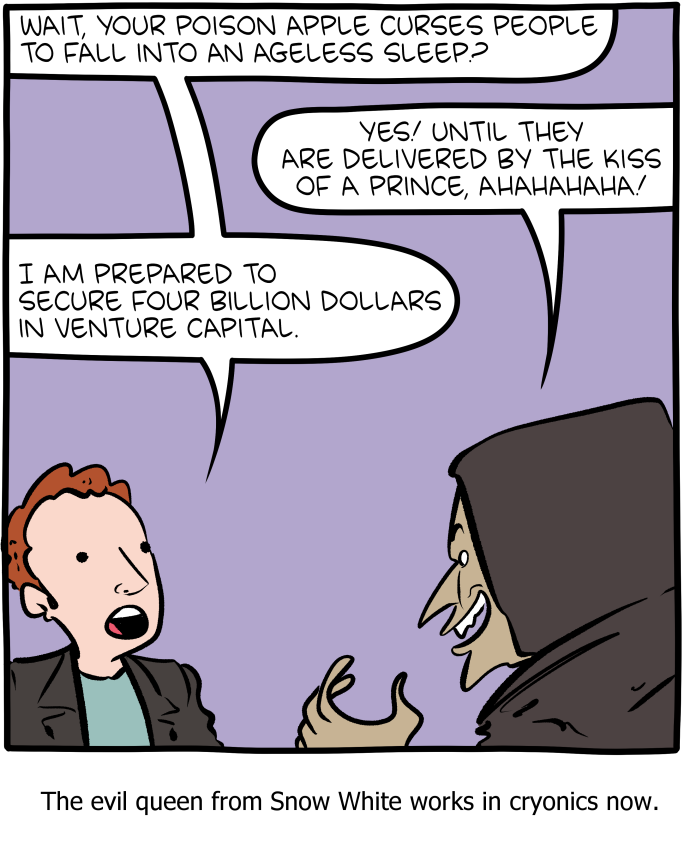
Apple Immortality unfortunately got sued out of existence, so now you gotta die.
“Scandal-ridden British Prime Minister Boris Johnson capitulated to mounting pressure to step down Thursday, announcing his decision after days of high-profile government resignations and calls from fellow Conservative Party members to quit.” — NBC News
Hi Britain, confused American here. You’re telling me you can just make a guy “step down”? Are you saying you don’t just have to live with whatever other messed-up stuff he’s gonna do until his term is over? I… I don’t understand.
Okay, he must’ve done something worse than our last guy. That’s the only explanation. Did he incite a violent coup, try to join it, and succeed? No? He just misused government money, made bad policy decisions, ignored misconduct allegations, and skirted COVID protocols? That was, like, an average Tuesday for our former guy. I’m not kidding—that was his whole deal.
Sorry, I must be missing something. You can just insist your guy leave office enough times, and he’ll eventually listen? We didn’t even tell our previous guy he could be in office in the first place. Seriously, we literally didn’t vote for him. I don’t get it.
You want me to believe that when your guy did enough bad things, the rest of his party began stepping down from government to denounce his leadership? When our last guy screwed up that bad, the rest of his party basically said, “We love screwed-up shit! It’s the best!” I’m so confused.
Explain it to me like I’m a small child. Your guy bad, you say stop, he stop? Our last guy even worse, we say stop, he double down. Why? Why not us like you?
Okay, you’re arguing that the grass is always greener—that your guy already did enough damage by sealing your fate as an isolationist country. But, like, our former guy did that too, and then he got to stick around and do even worse stuff. So, like… what the hell?
I’m really trying to understand here. This must be a first, right? Like, is this the first time this has ever happened? No?! This is the third consecutive time your leader has resigned before the end of their term?! Jeez, seems like you folks have a lot of buyer’s remorse.
Look: on this side of the Atlantic, if we realize we fucked up, we rename ourselves The Fucked Up Party, and we tell everyone that we actually wanted to fuck up in the first place. That’s the American way. Speaking of which, I’ve decided that I’m embarrassed that we couldn’t get our last guy to “step down.” So I’d like to amend my initial reaction: I can’t believe your guy is stepping down—what a loser!
This post, let’s talk about your mortifying moments at work , was originally published by Alison Green on Ask a Manager.
It’s almost time for Mortification Week 2022, and in preparation we need to hear your stories of mortifying experiences at work — yours or other people’s. Maybe you mistakenly emailed your lengthy romantic story to a colleague instead of your husband … or gave a person two noses in an interview Photoshop test … or accidentally threw condoms all over your interviewer’s desk. Whatever it is, we want to hear in the comments about your stories of embarrassment at work.
And remember, mortification is universal and makes us human, and it is often hilarious.

The comic artist was discovered off the coast of Nago, Okinawa, Japan, wearing snorkeling gear. First published in 1996, the series he created became a worldwide sensation.
(Image credit: Christy Radecic/Invision/AP)

Glasstire counts down the top five art events in Texas.
For last week’s picks, please go here.

Installation view at the MFAH: Leandro Erlich, “Bâtiment,” 2004, Nuit Blanche, Paris, France. © Leandro Erlich Studio
1. Leando Erlich: Seeing is not Believing
Museum of Fine Arts Houston
June 26 – September 5, 2022
From the Museum of Fine Arts, Houston:
“Conceptual artist Leandro Erlich constructs visual paradoxes and optical illusions that force viewers to question their own perception of reality and acknowledge the infinite possibilities of their surroundings –a staircase that misleads to go nowhere; an elevator that appears partially stuck below ground; a swimming pool that appears to reflect one group of onlookers above the water’s surface and a different group below: everyday situations that Erlich renders confounding. Beginning in June, the Museum of Fine Arts, Houston, will present two of the artist’s most iconic installations in the exhibition Leandro Erlich: Seeing is not Believing (June 26-September 5, 2022). These immersive environments and a selection of additional works will span the career of this acclaimed Argentine artist, whose psychological subversion of the everyday seems to defy the basic laws of physics and challenge our own sense of balance, space and the absolute.”

A work by Matt Kleberg, on view in “Learning to Draw” at Barry Whistler Gallery in Dallas.
2. Learning to Draw
Barry Whistler Gallery (Dallas)
June 4 – July 23, 2022
From Barry Whistler Gallery:
“Barry Whistler Gallery is pleased to present Learning to Draw featuring over 40 artists who explore a wide range of approaches and materials in their practice of drawing. Most of us became familiar with drawing as children. Drawing is often the first step towards communication and storytelling. For artists, drawings can be the beginning of a larger idea.”

Kevin Clay, “Sleep Among the Trees,” on view at the Art Museum of Southeast Texas in Beaumont.
3. Kevin Clay: Sleep Among the Trees
Art Museum of Southeast Texas (Beaumont)
May 19 – August 14, 2022
From the Art Museum of Southeast Texas:
“Kevin Clay was born and raised in Southeast Texas and attended Lamar University where he studied Communications with an emphasis in film. Although he does not have a formal Fine Arts education, he has spent time studying through various sources including books, the internet and free lectures from the MFA Boston. Clay draws inspiration from fashion, like vintage Balenciaga and Givenchy, as well as painters and other artists, particularly the works of Lucien Freud, Antonio Lopez Garcia and David Hockney. The pervasive theme is the translation of memories into drawings inspired from life’s experiences. Clay works in oil, pastels, colored pencils and graphite. He is drawn to tactile materials that show their mark making and texture.”

Day Wheeler, “Goat Woman Winks,” on view at K Space Contemporary in Corpus Christi.
4. Day Wheeler: Masking: Layers of Knowing
K Space Contemporary (Corpus Christi)
July 1 – August 26, 2022
From K Space Contemporary:
“Masking: Layers of Knowing is a solo exhibition by Day Wheeler consisting of ceramic forms, mixed media drawings, and photography. ‘The Hell with it. MASK UP’ is the last line of a piece of prose written by the artist several months before the pandemic. Other than being prophetic, the line had nothing to do with the pandemic. However, masks and masking run throughout this show in direct and indirect ways. The artist’s alter ego, goat woman, is a figure that shows up throughout the show. The concept of becoming invisible or disappearing is explored through archival prints and cyanotypes, while clay masks with associated drawings and pottery forms address the ideas of image and identity.”

Stella Alesi, “April 12th, 2022 from the Comfort series,” oil and repair tape on oil paper 22.5 x 22.5 inches
5. Stella Alesi: &
Northern-Southern (Austin)
June 25 – July 24, 2022
From Northern-Southern:
“spirit forms, continuous and ever-changing. & describes Alesi’s art and practice: flowing always to new forms and new reasons. Alesi works in a series:, each an era in a moment, marking the emotional time of the making. They seldom revisit a series. Alesi moves to the next one, and the next, and the next. And, and, and. Alesi is working now in the Comfort series. “Not comfortable like a couch, but comfort, like what you get from a good friend,” says Alesi. The forms resemble ampersands, curvy ends and stems. Alesi invited four artists to contribute—friends and those they admire from afar. All searching abstractionists, seeking to make a spirit material. Each artist balances rigor with freedom, finding the eternal in the moment of making: Momo, Michelle Marchessault, Michael Hall, and Evan Horn.”
The post Top Five: July 7, 2022 appeared first on Glasstire.
This post, my manager posted a “wall of shame” of people who didn’t volunteer to work more , was originally published by Alison Green on Ask a Manager.
A reader writes:
I work in a small unit (20 people) that provides direct patient care and is part of a very large healthcare organization. Like a lot of healthcare units, we’ve struggled with staffing for the past few years. It’s been 2+ years of being short-staffed, working mandatory overtime, being asked to pick up shifts, etc. Sometimes the incentives are worth it (when overtime is mandatory, we are paid double time) and sometimes they’re not (i.e., “Do it for the team!” when the whole team is burned out and people have been coming to work on their days off for months).
Recently, we had a staff meeting where, essentially, the first part was “Everyone needs to volunteer to work more” and the second part was “Your attitudes are poor and I want to hear less complaining and more positivity.”
Our supervisor is brand new to management (she was our coworker six weeks ago) and her superior (my manager) has historically been okay but hands-off, and as he’s decided to become more hands-on, leaves me unimpressed. He’s more interested in making sure that we look like happy employees on the surface and tends to blame any problems on the person who pointed out the problem. I am side-eyeing him as I remember a time there was some harsh criticism on an anonymous employee survey and that person was encouraged, several times, to come forward to “give more details.”
A new voluntary overtime program is in place for the summer to attempt to help cover vacation time. It’s tiered, so the more shifts you commit to, the higher your reward. Great carrot! Unfortunately, my supervisor is presenting it as mandatory and reminding everyone that we all need to sign up for extra shifts because we’re a team and we need to help our teammates.
The final straw came today when a List of Shame was posted in our unit. The verbiage was hostile and passive-aggressive. It listed all staff members, how many hours of PTO they’ve requested this summer, and how many extra shifts they’ve signed up for. If you haven’t signed up for any shifts, your name is highlighted. A coworker said she saw our supervisor posting it and said, laughing-but-not-really, “You’re not really going to make a Wall of Shame, are you?” and our supervisor laughed and said, “Yeah, [manager] told me not to, but I know our unit better and I’m doing it!”
Obviously, I am one of the people who haven’t signed up for any extra shifts. For the past two years, I’ve helped out regularly. I’ve come in on my days off to provide lunch relief, worked a few extra weekends, signed up for extra shifts, been willing to move my scheduled days as needed, etc. I truly feel like I’ve done my part. But right now, I just can’t. It’s a combination of mental health and transportation issues, but the thought of coming to work more often than I’m scheduled is overwhelming. If it was mandatory, I’d focus on the paycheck and make it work. But this is allegedly VOLUNTARY, and I just need to tap out this round.
I feel like I shouldn’t have to divulge this. I shouldn’t have to say, “My mental health doesn’t allow for extra shifts right now.” I know there shouldn’t be a mental health stigma, but there is and I haven’t said anything to anyone at work. And since my supervisor is new and I don’t particularly trust my manager, I don’t WANT to say anything because I don’t trust them to respond correctly.
I have not yet had a direct talk with my supervisor. I anticipate one next week and am planning to ask, confused, “Oh, I thought it was voluntary! Did it switch to mandatory?” and be all concerned. Then I’ll say, sadly, but firmly, “Oh, I just can’t right now. I can’t do extra shifts this summer.”
I know you don’t recommend going to HR very often, but we do have a robust HR department and they were involved a few years ago when we had a provider issue and I have a pretty good impression. Is this something to submit to them? On our company website, there’s a generic form to contact them that states the person you’re talking about is NOT notified and there’s a place for attachments. Should I fill that out? Or chalk this up to a new manager mistake and ignore it? I am at a loss.
I think you could definitely talk to HR about this, framing it as, “For the past two years, I’ve helped out regularly, come in on my days off to provide lunch relief, worked extra weekends, signed up for extra shifts, and been willing to move my scheduled days as needed. I have less flexibility with my schedule right now because of some things in my personal life, and I don’t think I should be publicly shamed on a chart listing how much PTO I’ve requested and how many extra shifts I’m volunteering for. If this is mandatory, please say so (and, I assume, provide the accompanying double time). But I think this chart should be taken down.”
But I think you should talk with your manager as well (maybe before you try HR, since your manager might take care of it on his own). I get that you’re not terribly impressed with him, but the chart-posting supervisor did say that he had told her not to do it — so there’s a good chance he’ll want to know that she did it anyway and will shut it down. Plus, she’s a brand new supervisor, and he needs to know she’s fumbling badly right out of the gate (not to mention directly contradicting his instructions). Use the same framing as in the language for HR above.
And no, you don’t need to disclose that your mental health is what’s in play. It’s enough to point out that you’ve been super helpful for two years, but right now you can’t. You can cite “things in my personal life.” You can cite “some health stuff I need to take care of” if you want (mental health is health, and you don’t owe more specifics than that). But you don’t need to get more detailed.
And if that chart stays up, ignore it. In fact, reframe it in your head from “wall of shame” to “wall of pride” — you’re demonstrating to your coworkers that you and your team mates can have good boundaries and can say no. Sometimes everyone on a team will give in because they’re made to feel like they’d be the one hold-out if they don’t; you might be doing a good thing for other people by modeling that “no, not available” is an option.
This post, intern avoids all networking, reprimanded for watching TV on a lunch break, and more , was originally published by Alison Green on Ask a Manager.
It’s five answers to five questions. Here we go…
1. Our intern avoids all social/networking opportunities
We have a summer intern, “Ralph,” split between two department sections so he can get a variety of experience. Ralph is the most reserved person anyone’s ever worked with. He runs away from any kind of vaguely social or networking opportunity, and unfortunately on top of that his work is also not great.
My department invited him to our monthly Friday lunch so he could get to know us better, and the date, time, and location was sent to him two weeks ago. When we went to tell him the new restaurant location in person (since apparently our old choice closed permanently last week!) Ralph said that he had a massive task from the other department with a tight deadline and couldn’t make it. During that conversation he looked nothing short of relieved and happy. He’s also done this to the other section and to every single person who’s invited him to anything, saying that he’d “love to be there” and then pulling some urgent work reason he can’t at the last minute.
I don’t think Ralph’s made many connections at our company who he could ask for a letter of recommendation, both because of his work and because he acts like he doesn’t want to deal with anyone. His work has been critiqued and corrected and people have been honest with him about that, but I don’t think anyone’s said anything to him about the importance of personal connections in our business. Is that something one should even say to an intern?
If networking connections are important in your field, that’s definitely the kind of thing that it’s helpful to talk with an intern about, since it might not be obvious and interns are there to learn (and to make those connections, as well). That doesn’t mean Ralph needs to do social stuff if he finds it too unpleasant, but he deserves to know the trade-offs he’s making by declining to. So the conversation would be less “you need to do this” and more “it’s helpful in our field because of XYZ and not doing it can have repercussions like ABC” and from there it’s up to him.
That said, this doesn’t sound like the most pressing issue for Ralph since even if he were more comfortable building relationships, the quality of his work means he’d be unlikely to get great references from this internship. It would still be a kindness to tip him off, but it doesn’t sound like it should be the biggest area of focus.
2. We were reprimanded for watching TV on our lunch break
Our small startup-like company is very informal, some suits, some developers and IT guys in jeans and t-shirts, everyone on a first-name basis and half of us work from home at the moment anyway.
Today my friend and I were having our lunch (12–1 pm) in an empty boardroom, which people do from time to time (people also frequently drink beer there from 4 pm), and there’s a TV in that room. We put on the TV and watched a show for 40-odd minutes. There were no executives around, no clients, vendors, consultants or outside people of any kind. When we turned on the TV, we were the only people in the building. We had the volume low anyway, as the show required subtitles.
A couple of people coming back from their lunch walked past and saw us watching TV, and one of them reported us to a manager. Not for what we’d actually done though—when my friend got back to her desk she had a very stern message from her manager (working from home) saying that it had been reported that we were “watching movies in the office” for hours, when we should have been working. They even reported a specific number of hours and minutes, which was both untrue and impossible because of other meetings in that room earlier in the day.
What horrified me most was that the manager simply believed this surreal version of events. Rather than saying “someone’s saying you did X, what’s that about?” they simply repeated the accusation as a fact and said “this was very bad, never do that again.” They didn’t react any better to being told that it didn’t happen.
I think a manager should support their staff and get both sides of any story like that. I don’t want a full-on judge and jury, but I do think the manager should have given us the benefit of the doubt. What do you think?
Yes. The manager should have asked about it, not charged in thinking they already knew for sure what happened. Their approach should have been, “I heard X and wanted to find out more from you.”
If “they didn’t react any better to being told that it didn’t happen” means she didn’t believe your friend, that’s even more of a problem, and means you can’t trust this manager to be fair or impartial or to have good judgment in the future. (On the other hand, if the manager did believe your friend but still doesn’t want you watching TV at lunch because of the optics, that’s a different thing. It’s probably still unreasonable unless there’s context justifying it, but it’s not as bad as essentially accusing an employee of lying without any evidence for it.)
3. Employee wants me to order goth office supplies
I have a new employee who wants some rather goth office supplies. I personally feel this is not a reasonable request since everyone else is getting generic office supplies and I have personally foregone special equipment so we are not spending more money than we need to. I also feel like if I approve this request, then others will want special supplies also. Where does it end? Any suggestions?
I’m personally a fan of letting people order whatever office supplies they want, within reason, but if you have a reason not to (like budget or if it would be difficult to juggle individual orders for everyone), it’s okay to say, “We buy the same type of notebooks, pens, etc. for everyone. If you need an additional type of supply for your work, I can order that for you! But if it’s just a matter of preferring a different aesthetic, we wouldn’t typically special-order that but you could bring it in yourself if you’d like to.”
4. When can you ask about about benefits in an interview process?
I’m starting to apply for jobs again after working at the same place for about five years. When is the appropriate time during the interview process to ask about benefits if they don’t offer the information themselves? I mean essential benefits like healthcare and sick/vacation time, not perks. Is it during the first or second interview? After you have an offer? Is there a time when asking would seem presumptuous or pushy?
So, just like the the conventional wisdom used to be not to ask about salary in a first interview, the conventional wisdom also used to be that you shouldn’t ask about benefits during a first interview, because you’d seem too focused on compensation rather than the job itself. This was obviously ridiculous — the whole reason you are there is because you are interested in being compensated for your labor, and things like health insurance and time off are incredibly important factors in whether you’ll pursue a particular job or not. And yet, it used to really rub interviewers the wrong way.
This has changed, just as the conventions on talking about salary have changed. Employers generally prefer to save detailed discussions of benefits (like nitty-gritty details of particular medical plans) until later in the process, but in most fields it’s fine to ask general questions about benefits toward the end of the first interview.
5. Should I be paid for travel time?
Is it legal for companies to tell you to travel on your personal time (evenings and weekends) without compensation or additional time off?
If you’re exempt, yes, that’s legal. If you’re non-exempt, federal law requires you to be paid for any travel time that takes place during your regular work hours, even if it’s on a day you don’t normally work— but, somewhat strangely, travel time outside your regular hours doesn’t need to be paid (unless you perform work while traveling, like if you worked from that train — that would need to be paid). There’s an exception for travel to a one-day assignment in another location; in that situation, your travel time does need to be paid, minus any time you would have spent commuting to your regular work site.
However, some state laws require payment for travel time where federal law doesn’t, so it’s worth checking your state laws if you’re non-exempt.

The post Slamasaurus appeared first on The Perry Bible Fellowship.
Hovertext:
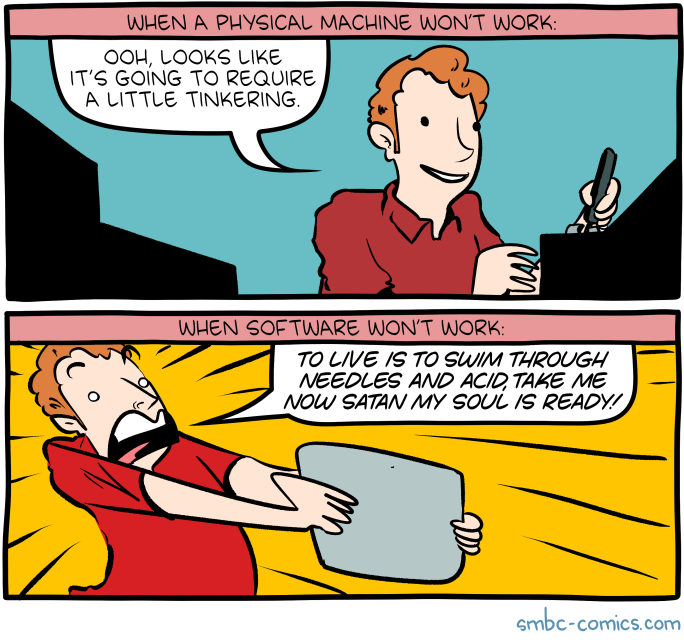
iTunes actually works fine if the goal is to learn the futility of existence.
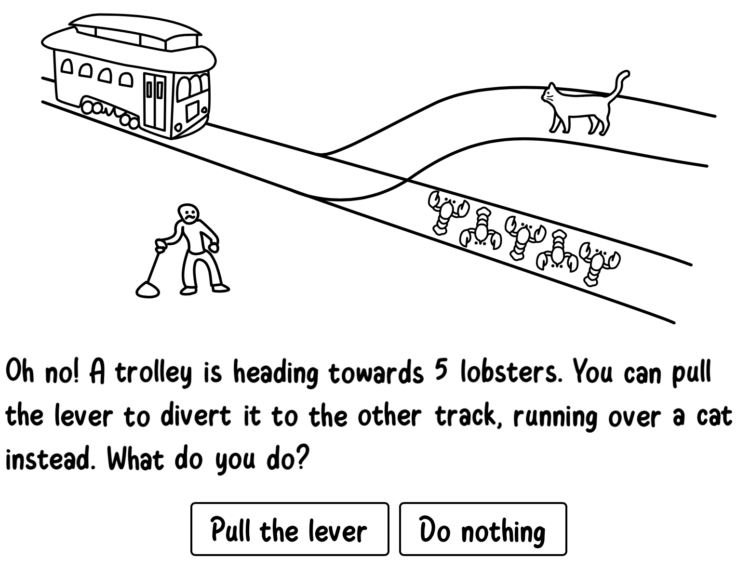
You’ve probably heard of the trolley problem, a thought experiment that imagines a trolley approaching a fork in the tracks. There are five people stuck on one path and one person stuck on the other. If the trolly continues on its current path, five people will die, but if you consciously switch the tracks, you could save them and only one person dies. Do you switch or let the trolley continue?
Neal Agarwal, who continues to gift the internet with fun projects, reframes the trolley problem with increasingly more absurd choices. You also get to see how others answered, so you can compare your own choices against the moral compass of the internet.
Tags: humor, Neal Agarwal, trolley
This post, can I ask my employee why she’s leaving, I think my boss and I see the same therapist, and more , was originally published by Alison Green on Ask a Manager.
It’s five answers to five questions. Here we go…
1. Is it OK to ask my employee why she’s leaving?
I am a fairly new manager, managing a team of about 15 people for the past year. I just received an email from one of my best people letting me know that she is resigning (we are all remote). I have no idea why she is leaving – she had never expressed to me that she was unhappy and she has only been here a little bit longer than me. In fact, I had just recommended her for a raise and title promotion this month (which she knew). I feel a bit blindsided because I thought we had good and open communication, but now I am wondering if I missed something and questioning my skills as a manager. My question is, is it appropriate to ask her why she is leaving? Not with the intention of convincing her to stay, but to know if there are other issues on the team I should be aware of? I genuinely wish her the best and want her to do what’s best for herself and her career, but now I’m worried other team members might be unhappy too. But I also don’t want to make her uncomfortable or overstep personal boundaries.
It’s okay to say, “Would you be willing to talk with me about what led to you deciding to leave? No pressure if you’d rather not, of course, but if there’s anything I missed or should be looking at with other team members, I’d be grateful to know.” From there, leave it in her court — you’ll have issued the invitation and it’s up to her whether to take you up on it.
But also, keep in mind that people leave jobs for all sorts of reasons that shouldn’t make you question your skills as a manager. She might have just felt ready for something new, or found a shorter commute or more money, or all sorts of things. It’s worth asking the question in case there is something you should know, but as a general rule it’s smart to assume that anyone on your team could be thinking about leaving at any time and know that you won’t always see signs of it ahead of time.
2. I think my boss and I might see the same therapist
In my office, we share Outlook calendars. Late last year, I noticed that my boss had an appointment after hours whose title was the first name of the therapist I’ve been seeing for years, virtually since Covid. It’s not an unusual name, but it’s not a super-common one, either. I’ve since noticed that my boss turned that meeting private and has a recurring private meeting weekly at that time. When I looked at several weeks on her calendar, the only weeks she didn’t have the private appointment at that time were the weeks my therapist was on vacation. I’ve also noticed my therapist asking me about work (not the reason I’m in therapy) quite a bit more lately. All of this could be a coincidence, but it’s enough circumstantial evidence that I’m not sure what to do next. I know my therapist wouldn’t be allowed to tell me if my boss was also one of her patients, but if she is … I feel very weird about it.
It’s possible you are indeed seeing the same therapist, but if that’s the case, your therapist should have an absolute firewall between you and she definitely shouldn’t be asking you more about work because of it. Is it possible that’s confirmation bias — that since you’re worried about it, you’re noticing it more? Or that she has legitimate reason to be asking about work more often recently (unconnected to whether your boss is her patient)?
If it keeps bothering you, the best way to address is actually to tell your therapist how you’re feeling — not in a way that sounds like you expect her to confirm or deny (since as you note, she can’t for privacy reasons) — but you could say, “I’ve gotten the sense recently that my boss might be a patient of yours, and while I know you can’t comment on that, it’s making me really uncomfortable and I wonder we can talk about that without violating anyone’s confidentiality.” You could also say, “It feels like you’ve asked me about work more recently, and if you are treating my boss, that would worry me too.” Put it in her lap — it’s part of her job to figure out how to address stuff like this (and to do it without ever revealing if your boss is in fact one of her patients). You might end up feeling okay about things, or you might not — but that’s where I’d start.
3. How to respond to questions about an awesome opportunity… that I hated
I’m currently on a sabbatical — my partner got a short-term research opportunity abroad, so we’ve moved for a few months to let him take it. Given my work and needing to care for our child, I couldn’t reasonably work from our current location, and my company was kind enough to let me take leave so that we could do this. I know how enormous of a privilege this is, both generally and within my company.
However, I have hated this experience. I’ve traveled abroad before, but only for a couple weeks at a time, and doing it for months is a different beast. I don’t speak the local language, I can’t work or volunteer here, I miss my home and my family and friends. I’ve found a couple things to keep busy one or two days a week, but overwhelmingly I’ve found the whole experience really destabilizing, and I’m experiencing many symptoms of depression as a result. I cannot wait to get back to our home and even back to work.
I’ll be back at work in about a month, and I’m expecting a lot of excited questions about how great it was, how much fun I must have had, etc. etc. etc. I don’t know that I can reasonably handle a lot of people gushing about how great it must have been or talking about how much they would have loved the opportunity. That’s very far from my current reality, and I don’t think people would really understand how or why. How can I handle these questions gracefully and move people along to talking about literally anything else as quickly as possible?
How about, “It was a great opportunity but it’s definitely hard being away for so long when you don’t speak the local language! I’m glad to be back. How’s (work topic) going?” Or you could condense that into, “Definitely interesting, but I’m glad to be back. How’s (work topic) going?” Or with people you’re closer to, “It was more challenging than I expected! A great opportunity that I’m grateful for, but it’s a big adjustment to live so far from family and friends and I’m glad to be back.”
You’ll probably have some people who want to hear more than that and who might probe for more details, so ideally you’d be ready with a couple of stories that you can share without a ton of turmoil — maybe about a local food you fell in love with (or despised but couldn’t avoid), or how your kid liked being there, or a funny story about the language barrier or a cultural difference. Even people who probe will probably be satisfied with one or two stories and then you can switch the subject back to work.
4. Who gets the rewards points for business travel?
I work at a nonprofit and recently helped book travel for a few of my colleagues going to a conference. When I was confirming the dates, times, locations, etc., I made it clear that I was booking through a third party service that gives you rewards points to use on future stays (think Expedia, Travelocity, etc.). No one ever mentioned an organization account or what to do with all of the points these bookings will earn (and let me tell you.. it’s A LOT of points). All of my friends are saying that these points are mine to use if they didn’t say anything. I think that I should ask my manager what to do, but I’m worried that they would have otherwise been okay with me keeping them but if I bring attention to it they would ask me to find a way to use them for the organization. What should I do?
Organizations normally have policies on who gets to keep the award points from business travel. Often the people traveling get to keep them (which makes sense because business travel can be a hardship; you’re dealing with airline delays, being away from home, and all the other stresses of travel), although some stingier organizations (and particularly some nonprofits) want to keep them for employer use.
It’s almost never the case, though, that the points would go to the person booking travel for other people. If I’m reading correctly that you’re booking the travel but not traveling yourself, it should definitely be one of the two options above. Check with your manager if you’re unsure which it is.
5. My job title is misleading
I am starting my job search to move away from the company I’ve been at for the past few years. My current position was a fairly big leap from my last one, but I’ve grown a great deal at this job and am confident I can pivot into a related position in a different field, about 50% of which I already do.
I’ve always thought my job title was really vague, and very cursory googling when I was hired didn’t turn up too much. Today I looked again and found out there is a fairly specific set of duties associated with it — very, very few of which I actually do. Imagine being called a train specialist and collecting data about arrivals and departures, when most people with the same title advise their C-suite about what models of train the railway should buy.
What should I do? I’m pretty sure asking for a title change isn’t an option. There was a lot of petty drama when my coworkers’ titles got marginally changed a while ago, and it seems like our HR department is very stubborn and slow-moving about this in particular. It just stings given that an accurate title would probably help me out. How weird is it to leave job titles off of a resume altogether? Or, if it’s a vague and somewhat uncommon job title anyway, does it matter in the first place? (The resume template I’ve been working on has it listed in a place that would be inconvenient to remove, so it’s also somewhat tempting to just leave my title on there.)
Definitely don’t leave job titles off altogether; that’ll look weird and like you’re hiding something. But one option is to include a more accurate, descriptive title in addition to the real title. So for example, if your real title is train specialist, but the bulk of what you do is coordinating arrival and departures, you might list your title this way:
Train Specialist (Arrival/Departure Coordinator)
That way you’re providing more clarity, but also ensuring the real title is listed there and will match up with what your employer will say if someone calls them to verify your employment.
Hovertext:
Sorry for the lack of blogs. Turns out if you discuss the idea of writing long letters, lots of people write you long letters. Between that and everything else in life I haven't had time to get anything new in. Many things in the works, though.