CALGARY – Producers of HBO’s post apocalyptic series The Last Of Us recently revealed how shooting in Calgary forced them to use VFX to hide the city’s bleaker wasteland aspects. The series, which takes place 20 years after the world’s population has been decimated by a deadly fungal plague, was chosen to shoot in Alberta […]
How to profit from the coming rapture
Getting ahead when you are left behind
Levy
2008
I was searching for something and came across this book. My first thought was this was a serious effort by some religious nuts. When I started reading and laughing, it was clear it was a spoof.
It was actually fun for about a half an hour. Then it was done, at least for me. Sometimes books like these tend to be too long. The joke just went on too long. What concerned me is the owning library had it classified in the 200s. I would have stuck this in the 800s with other humor books.
I work for a small towing and salvage company as the manager and dispatcher in a very rural area. My duties range from high-stress emergency tow dispatching to legal notice writing and basic administrative duties, as well as selling auto parts and salvage, inventory, writing store policies and negotiating contracts with motor clubs, payroll, and many other things. I am currently the only person handling these duties while the owner is in a semi retirement. I feel I do a great job and I get a lot of praise from the owner and customers.
I should mention that I love my work and for the most part am extremely happy with my job. I like everyone I work with. The job is fast-paced, fun, and different every day. I make very good money.
The issue I am having is that the owner, Ben, has a very toxic family that interferes with my work and the work of my colleagues. He and two of his adult children live on the property, and both of his kids have ongoing substance abuse and alcohol problems. Because of these problems, Ben does not want them involved in the business at all and has taken them out of his will.
They have been going to the work areas and picking irrational fights with my crew, spreading rumors about them, and being all around abusive and cruel. They have gone so far as to call social services on my crew, falsely accusing them of child abuse, screaming at them when they drive by, and attempting physical fights with the lead mechanic. This is all due to what I believe is jealousy and bitterness that they will not inherit the multimillion dollar company. The local police and even the school district know that they constantly make false claims and all of their accusations were proven to be false.
Ben is close to 80 years old and has been in the business over 50 years. He is a veteran and all around decent man who treats us all well outside of this issue. He is the type of man who wants to “die in his boots” and seems to be of sound mind, making solid business decisions, and is in relatively good health.
While I have talked with him about this on numerous occasions, he seems incapable of stopping the problem. I am instructed not to engage with the arguments, ignore them, and continue working because they are “just crazy” and “there’s nothing he can do” because he can’t throw his kids out on the streets. All of us (employees) care about and are loyal to Ben and none want to just quit, we want a solution. We have all worked for him for 10 or more years.
After the most recent attempt from the “kids” berating the crew, I instructed the full crew (six men) to come up to the office and stop all work until we talk to Ben, basically going on strike until he stopped the situation. I didn’t know what else to do.
Ben said he had threatened his kids with legal action, eviction, and criminal charges if they did not stop the harassment, and everyone accepted his apologies and promises and went back to work. I tried to advocate for the crew after they left the office and told Ben that he would lose his whole crew if he didn’t get this under control and that none of us deserved to work in that environment. He agreed and promised to find a way to fix it.
Everything calmed for a few weeks, and then I discovered that Ben’s daughter had been telling people that Ben and I had been having an affair for years and MY daughters had even heard about this at school.
Although he is my friend, and I am loyal to him as my boss, the thought of that turns my stomach! I am half his age! Not to mention the horrible effect it could have on my professional reputation in this small town and the fact I am happily married with children. I already deal with sexism in this traditionally male driven industry every day, and this degrades all of my hard work and abilities.
I know that I need to leave this situation, but I feel extremely sad for Ben and the rest of the people I work with. I am sad to leave a job I am good at and love, and also worry because there isn’t a lot of work in this field available in my area. I worry about my income, and I worry if I quit I won’t be able to file for unemployment. What should I do? Is there anything I can do that won’t hurt the owner but will also protect me while I am searching for something else?
It would take months to train someone to replace me, and at this point Ben does not know how to operate any of the programs or software that we use to dispatch and communicate with the state. He doesn’t know any of what’s in any of our contracts with the police or motorclubs. I feel like if I leave with the standard two weeks of notice, it would be a very low blow. Do I tell him I plan on leaving and put up with this a few more months while I train someone to replace me? Would it even be fair to expose someone new to this situation? And the petty side of me tells me not to quit as that means that his ungrateful and cruel children win and the rest of us lose.
I wrote back and asked, “Aside from the affair rumor, has the berating and harassing stopped since your last conversation with your boss about it?
For now it has, but I expect it will start again as soon they are bored. It has happened repeatedly over the years and they calm down for a while and then go from colleague to colleague trying to make their lives miserable. The rumors get worse each time.
I’m so sorry you, your coworkers, and Ben are all dealing with this. It sounds awful for everyone.
Would it be worth having one final conversation with Ben where you say that you are about to leave over this and so if he was serious about pursuing legal action against his kids, now is the time to do it if he wants you to be able to stay?
Or is it clear he’s not really going to follow through with that? Or, even if he does follow through with it, are you done with the situation and ready to leave regardless? (That would be more than reasonable! And even if Ben does pursue legal action against his kids, it’s not clear that it would stop them from harassing you and your coworkers. It might even make it worse.)
In theory you could talk with a lawyer yourself — some of what Ben’s kids are doing should be fightable on defamation grounds. But defamation lawsuits can be long and expensive, and by the time you’re suing your boss’s family for defamation, it’s probably time to go anyway. It’s possible that a lawyer might be able to stop some of this with some frightening cease-and-desists so you wouldn’t need to go all the way to a lawsuit … but this is all such a mess that I think your instinct to just get out is the better one. Still, though, a conversation with a lawyer about options could be worth having.
In any case, back to quitting. One option is to see if Ben would be open to laying you off. If he does that, you’d be eligible for unemployment. Or, is there an amount of money that would make it worth it to you to stay a few months longer to train someone to replace you? If so, you could propose that.
You’re right that the business will need to be up-front about the situation with whoever is hired … and Ben probably needs to be prepared to pay a premium to get someone willing to put up with that. (Also, any chance one of the employees already on staff, who knows what the kids are like, would want your job and be able to do it? That might be the easiest path if anyone’s qualified and willing to do it.)
However … you don’t need to solve these issues before you go. You can just quit with the standard two weeks notice if you just want to be done. I know you’re worried about the position that will put Ben in, but he has had plenty of warnings that you and others are deeply upset about his kids’ behavior and its impact on your lives, and he’s chosen not to take action to fix that. To be fair, I’m sure he’s in a very difficult situation because he loves his kids! But he’s got to be aware that their behavior means his employees may flee. And two weeks notice truly is standard, even in situations where it will leave the business in a bind.
But if you’re not at the “need to quit today” point, your best next step may be a conversation with Ben where you lay out where you’re at and some of the options you’re considering. See what he might be able to offer once he understands you’re ready to leave. And by that I don’t mean “let him convince you to stay” — but rather that because you’re open to a few different ways of proceeding, talking with him frankly might help you decide exactly what to do next.
Huge news for the failure-inclined: For the next month, Failure to Launch: a Tour of Ill-Fated Futures is crowdfunding on Backerkit! This is the latest Iron Circus comic anthology, featuring non-fiction stories about inventions and ideas that did not work out as their creators intended.
It's a beautiful book with work from a bunch of super-talented cartoonists, and I am also in it! If you would like to learn more about such topics as floating utopias and hippo domestication, you have simply no choice but to back this project while you can.
ATLANTA—The professional football world was reportedly rocked Monday when the Super Company issued a press release announcing that it would not renew its sponsorship contract with the NFL’s championship bowl game. “Following some underperformance in terms of our financial goals over the past several years, our company…
In response to new rules issued by the administration of Gov. Ron DeSantis, teachers are being ordered to remove all books from libraries and classrooms until they can be approved by a state-trained “certified media specialist.” The following books are currently banned from schools in Florida.
Under the current system, in order for patients and doctors to get access to medical records, the clinic has to fax paperwork between other medical facilities, which often delays treatment.
Ursula Schulz-Dornburg, image from “Huts, Temples, Castles” (MACK, 2022). Courtesy of the artist and MACK.
This is my favorite book of photographs published in 2022, and the fact that Ursula Schulz-Dornburg made the pictures between 1969 and ‘70 gives me only the slightest anxious flutter about my rapport with more contemporary photography. It is easy to worry that, under this reviewer’s costume that I’ve recently slipped into, there is a narcissistic goblin searching mostly for the conceits of his own artwork on other folks’ pages. Not finding it, the goblin eschews the present. That would be bad! But I know I self-catastrophize as much as I over-share, the latter of which I am doing right now in the name of reckless transparency and/or to fulfill some arbitrary, self-imposed word count. A digression; I like a lot of things just fine!
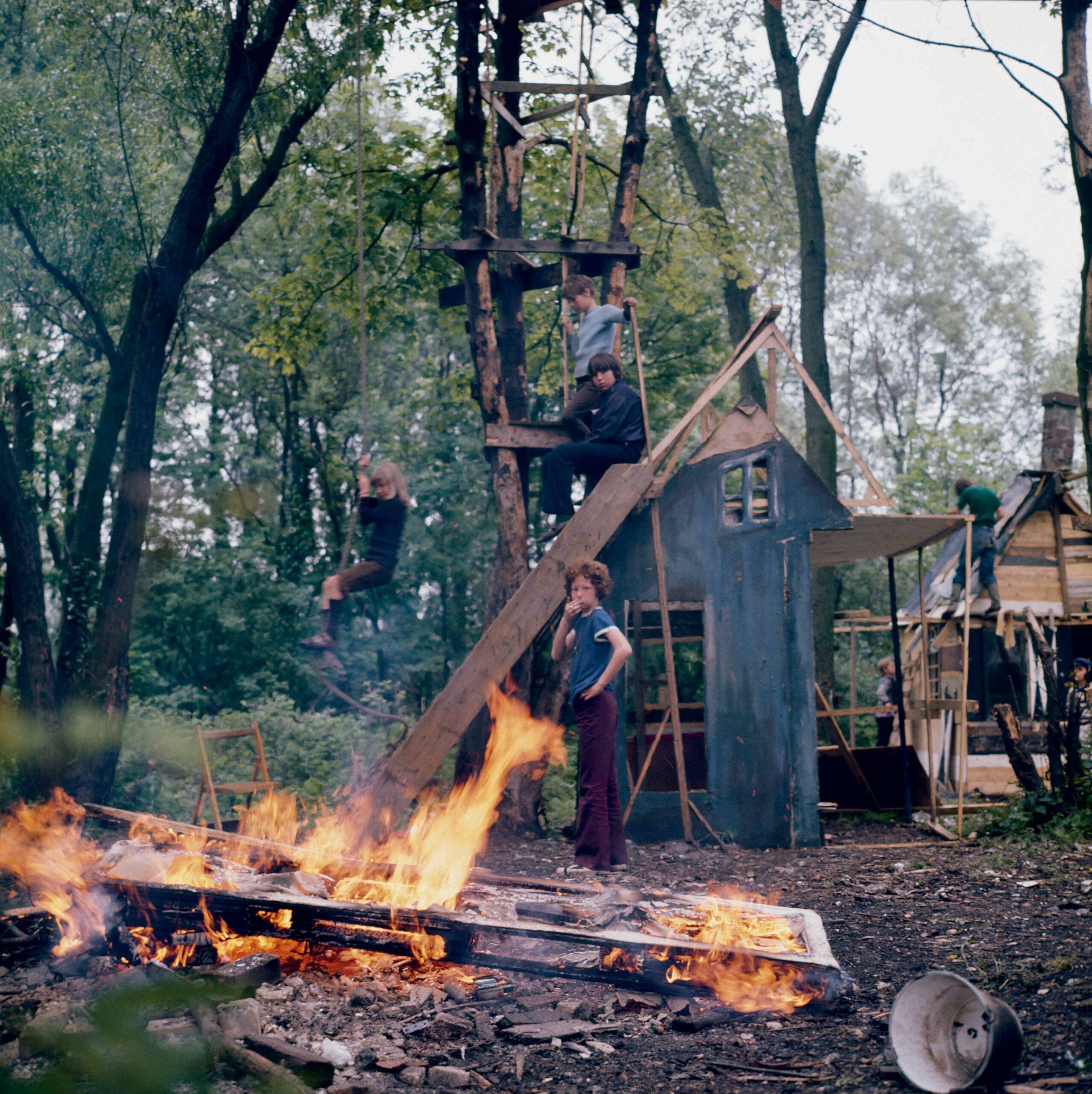
Truth is, I am drawn to Huts, Temples, Castles precisely because the work is, despite its historical nature, wildly relevant today. After spending some time with its pictures, the sleek loneliness of the present feels extra acute. Not that the good old days were actually any better, but the past can be mined for instructive anecdotes. I now beg my child-having friends: send your offspring into the woods to have fun with hammers.
Ursula Schulz-Dornburg, image from “Huts, Temples, Castles” (MACK, 2022). Courtesy of the artist and MACK.
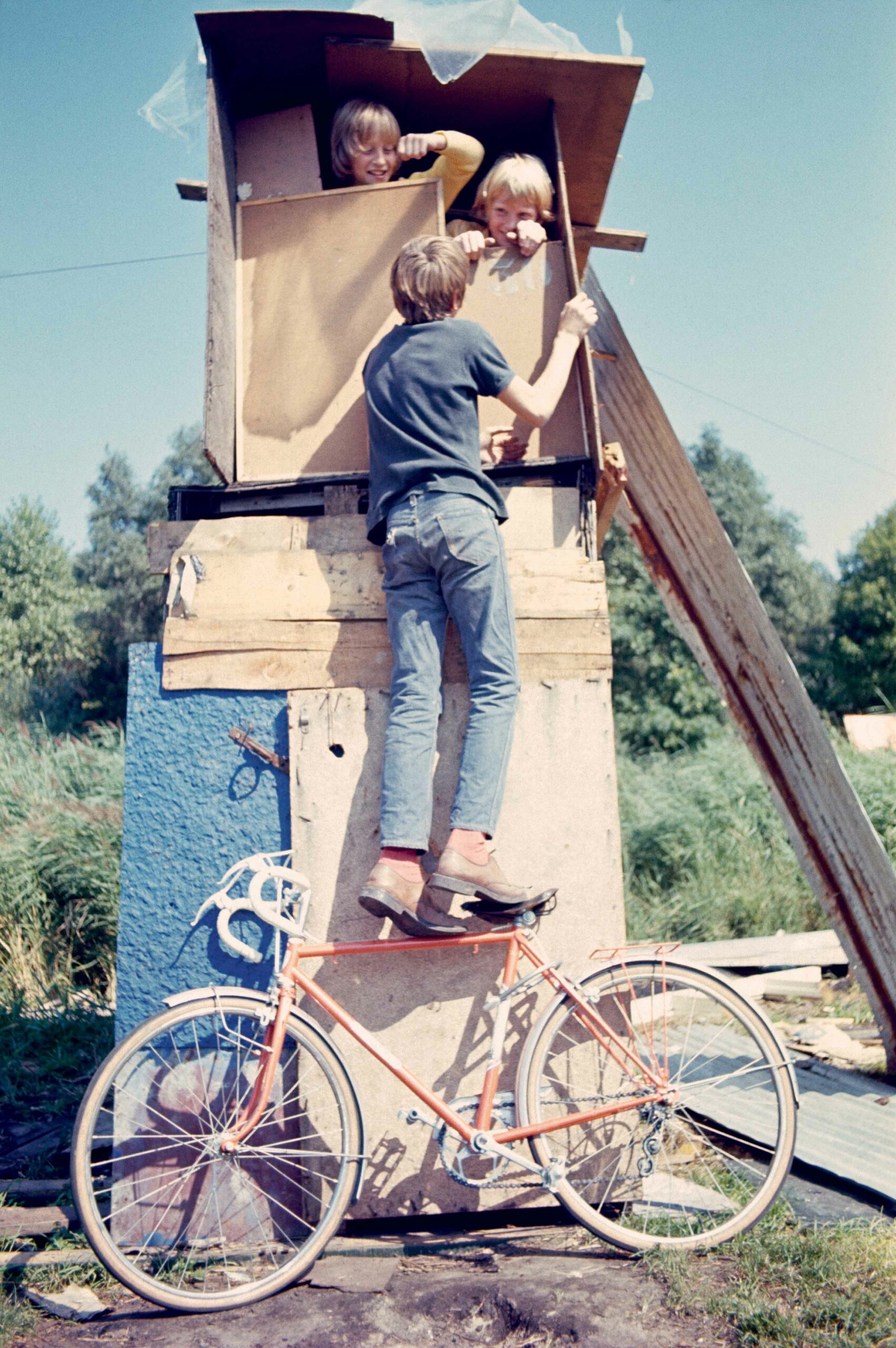
As explained by Tom Wilkinson in a valuable complementary essay in the back of the book, Schulz-Dornburg went to photograph an isolated part of Amsterdam known as Jongensland, or Boysland. There she found a community of youths — ostensibly all boys, though the occasional girl shows up in her pictures — set to work constructing a diminutive utopia of junk. The depictions are relatively straightforward, and it is a wonder that this seemingly highly-organized, equally feral (though well-dressed) community of youths felt at ease with an adult photographer in their midst. This perceived level of ratty comfort speaks positively of both Schulz-Dornburg’s craft as (lacking a less objectionable word) documentarian, and the solid confidence that the Jongeslanders had in their efforts.
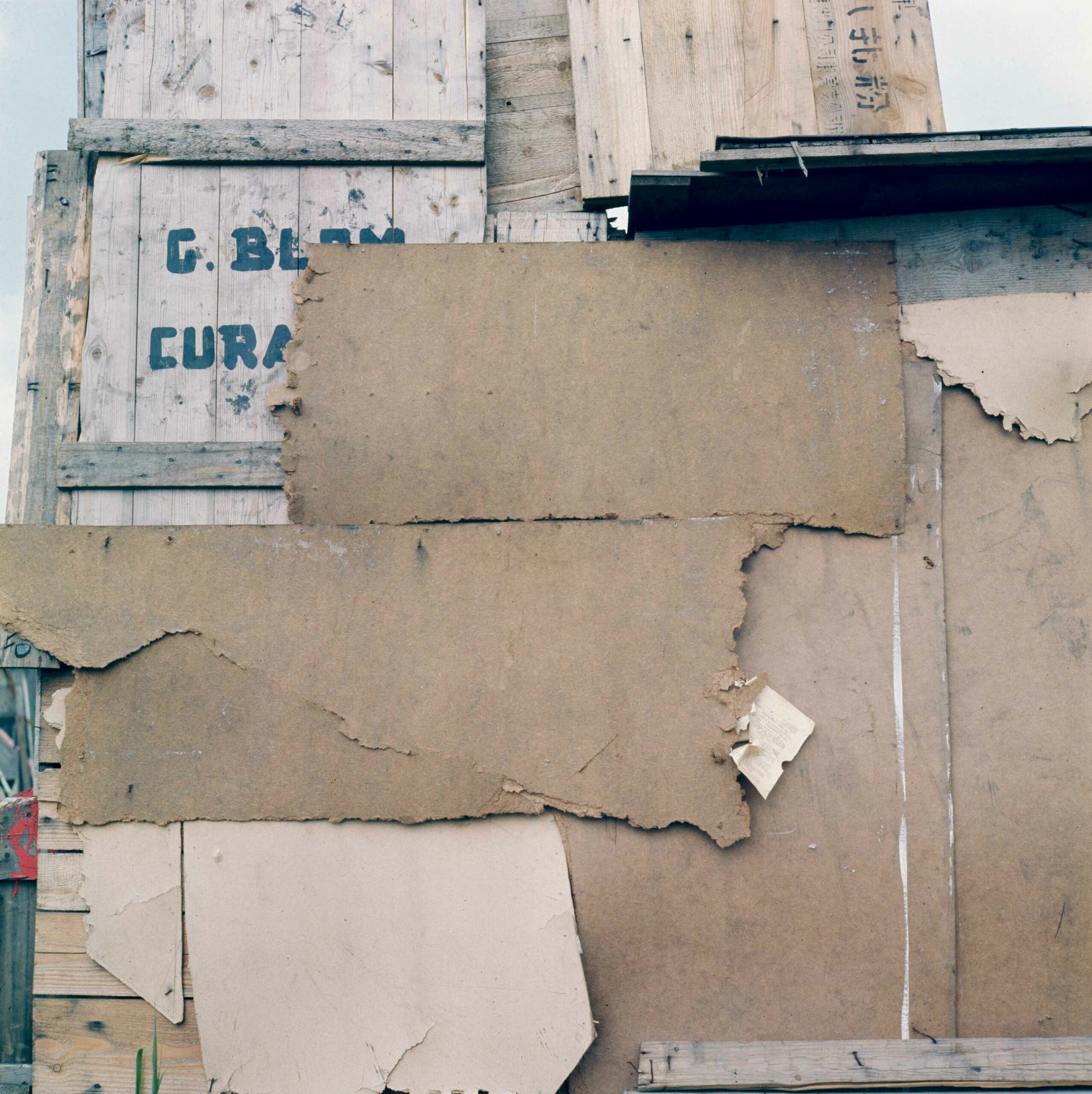
The place was built from scrap wood, paper, and discarded windows. It appeared to be under constant construction, with a bicycle just as likely to be used for transportation as for a stepladder. The entire project was rife with a sort of causal, adolescent danger that feels somehow cathartic to observe, inspiring rather than worrisome. Small fires, lit from the same materials used to build, appear frequently and must have represented some critical though indeterminate part of the culture. Also, they had goats.
Ursula Schulz-Dornburg, image from “Huts, Temples, Castles” (MACK, 2022). Courtesy of the artist and MACK.
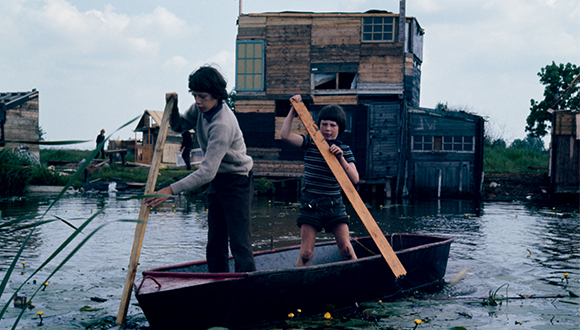
The residents even developed a system for navigating the waterways that surrounded their town; one tremendous picture shows a child and a smaller child using dimensional lumber to paddle a boat through murky water. In the background a multi-story Frankenstein of a building exceeds, in terms of interest, most high-end waterfront design. It is to Schulz-Dornburg’s credit that she steps back and allows the architecture (if you can call it that; MACK, the publisher, did list this as an architecture book in their catalog) of Jongensland to exist without much embellishment or photographic elevation.
On the other hand, the pictures exclude the rest of Amsterdam. Schulz-Dornburg isolates Jorgensland so completely that it is easy to imagine this ramshackle nation of children stretching on forever, some apocalyptic/idyllic planet left to the kids. Framing is a subtle trick of pictures that adds a quiet, almost subterranean level of tonal nuance to this book.
Ursula Schulz-Dornburg, image from “Huts, Temples, Castles” (MACK, 2022). Courtesy of the artist and MACK.
Ursula Schulz-Dornburg, image from “Huts, Temples, Castles” (MACK, 2022). Courtesy of the artist and MACK.
I’m liable to figure that when some contemporary photographers invent their own little worlds in which to dwell—and tons of celebrated projects have debuted in the last decade that hinge on ideas of fictional towns, maps without territories, and other more medium-specific jaunts (like the wide-ranging fantasies of the brilliant Onorato and Krebs) — they are striving for the same types of freedoms that the denizens depicted in Huts, Temples, Castles once found in the real world, in garbage. Photography will always excel at slicing lived experience out of time and into malleable, manageable scraps. It’s what it does.
Maybe I’m being pessimistic when I wonder if so many recent projects twist those scraps toward fantasy out of longing, a search for life-affirming play that’s been sapped from an imperiled world wasted online. And probably I’m viewing Jongensland’s heyday through a rose-tinted lens (Schulz-Dornburg’s or my own, I can’t tell). But to be presented with such an affectionate depiction of what a gang of kids could do with some heaps of trash, that builds positive momentum.
Ursula Schulz-Dornburg’s Huts, Temples, Castles is available through MACK.
Carlie Trosclair, “Floodplain|uᴉɐldpoolℲ,” on view at Project Row Houses as part of “Round 54: Southern Survey Biennial.”
In her intimate, haunting contribution to Project Row House’s Round 54: Southern Survey Biennial, New Orleans artist Carlie Trosclair reimagines a home’s genealogy. Her multiple installations, collectively entitled Floodplain|uᴉɐldpoolℲ, consist of ethereal yet insistently material latex casts that evoke the aftermath of a natural disaster all too familiar to southern viewers: a flood.
Trosclair’s work occupies 2517 Holman Street, one of the white, single story houses converted to exhibition spaces by Project Row Houses in Houston’s historic Third Ward. Depending on where a visitor begins, Trosclair’s Floodplain|uᴉɐldpoolℲ serves as either introduction or punctuation mark to the Southern Survey Biennial.
Carlie Trosclair, “Floodplain|uᴉɐldpoolℲ,” on view at Project Row Houses as part of “Round 54: Southern Survey Biennial.”
In each space, southern artists explore themes of community, loss, and remaking. Kandy G. Lopez (Texas) fills a home with larger-than-life-sized portraits — crafted from yarn — of bold, confident people of color. Julien Hyvrard (Florida) recreates a transitional housing facility, inviting visitors to sit or lay in the space as they listen to the stories of those reintegrating into society. Victoria Ravelo (Florida) and Naomi Lemus (Texas) transform used clothing and accessories borrowed from working class communities of color in Houston into an intimate web. Likewise, Sedrick Huckaby (Texas) and Rehab El Sadek (Texas) each use discarded objects as materials for new, imaginative constructions. And Rashayla Marie Brown (Texas) pays tribute to those seeking justice for their ancestors.
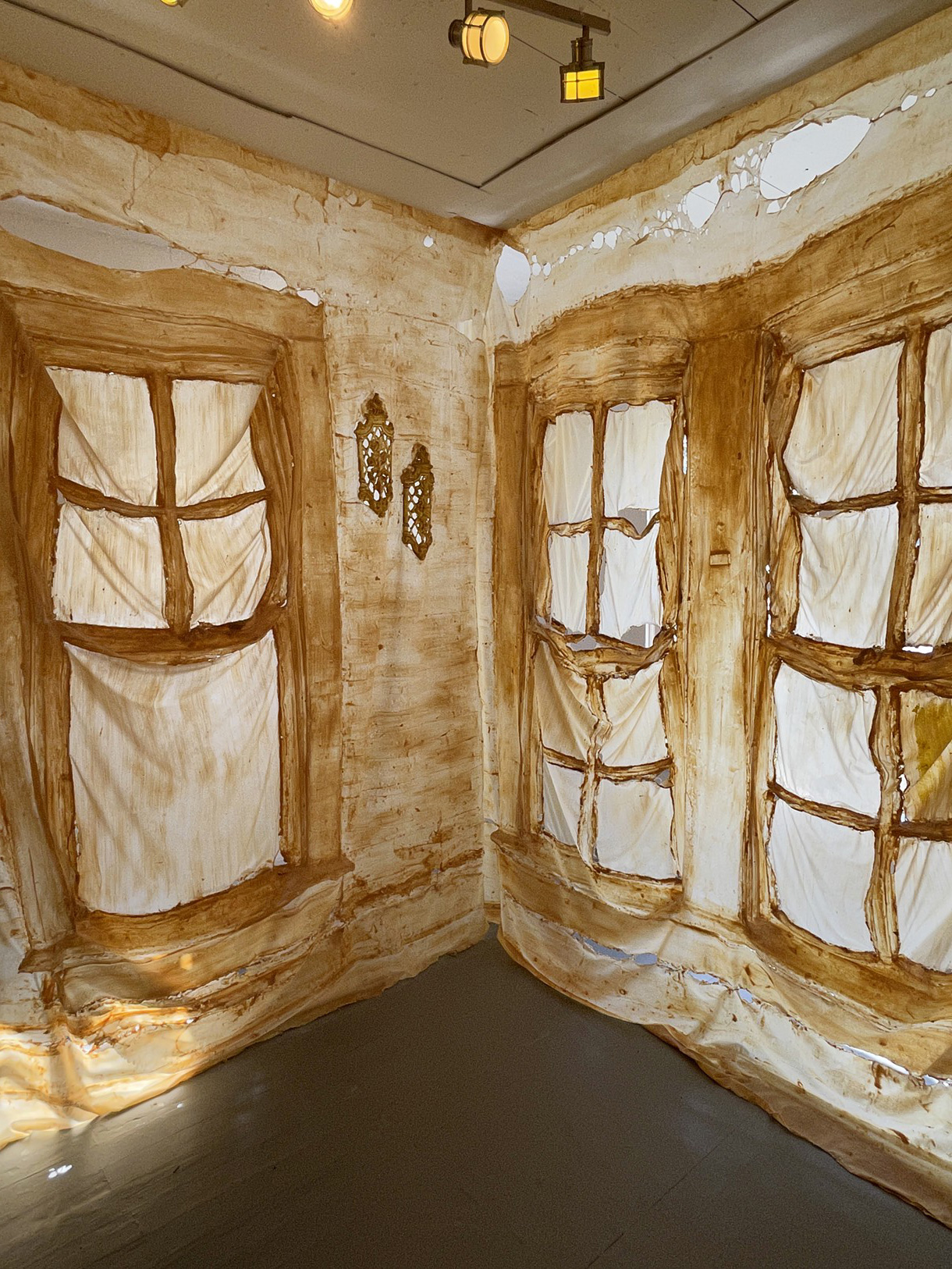
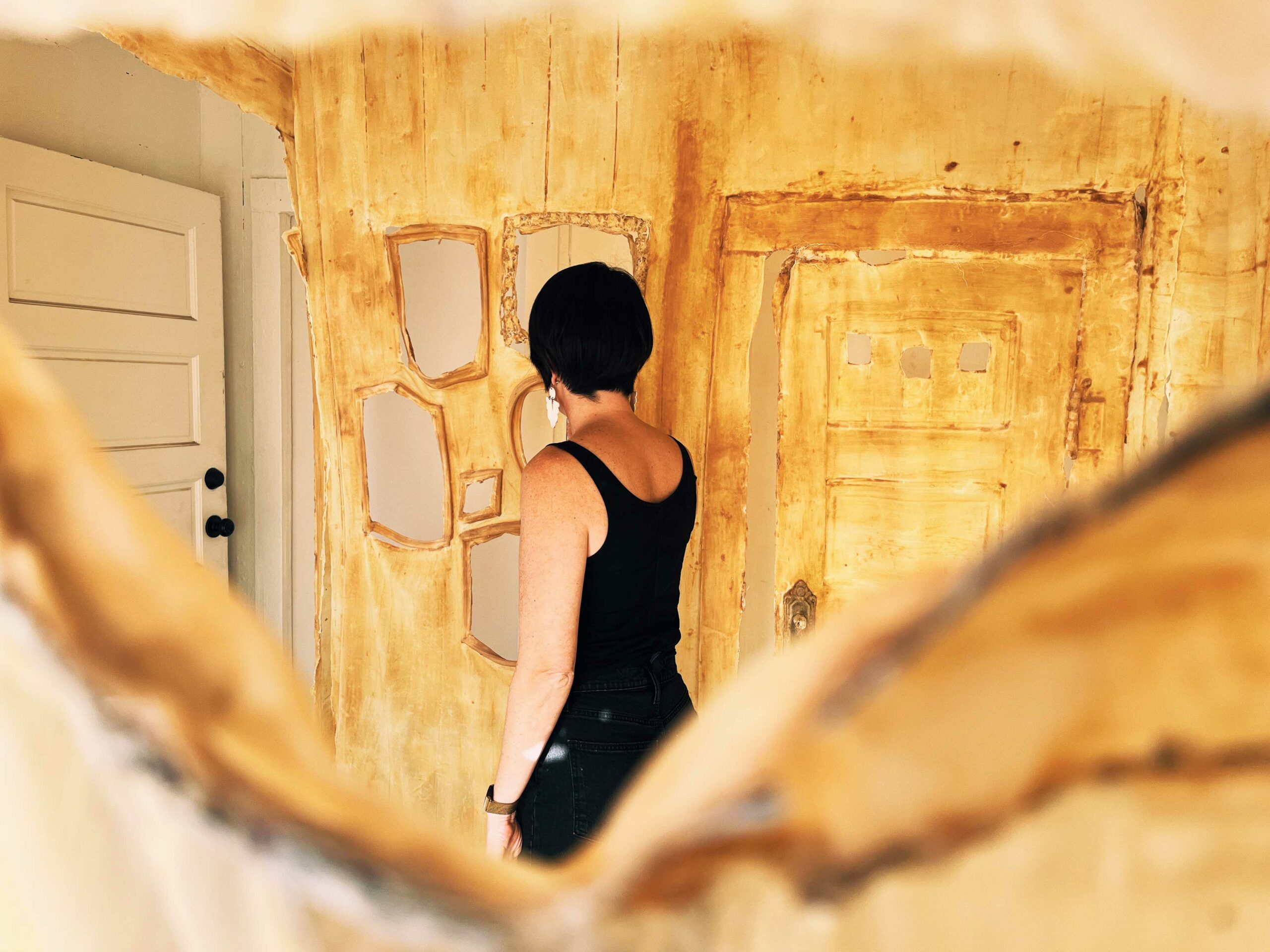
At the end of the row, Trosclair’s installations conjure a space for holding — or perhaps releasing — all these bodies, stories, and objects. When we enter the front room of the row house, we are paradoxically invited to enter into it once again. Within|between is a suspended room-within-a-room, constructed from paper-thin, ochre-hued latex casts of the home’s own walls. As the title suggests, we can enter into the hanging room and stand within the skin-like walls, or we can walk in the gap between the cast and its original.
Carlie Trosclair, “Floodplain|uᴉɐldpoolℲ,” on view at Project Row Houses as part of “Round 54: Southern Survey Biennial.”
The doubled space is contingent and even porous. Empty picture frames, the lattice work of decorative sconces, and tears in fragile window panes perforate the ghostly walls, offering glimpses of the solid, permanent structure beyond. At the same time, wooden splinters and flakes of paint cling to the latex skin. The seemingly secure space of the home becomes permeable and vulnerable.
Carlie Trosclair, “Floodplain|uᴉɐldpoolℲ,” on view at Project Row Houses as part of “Round 54: Southern Survey Biennial.”
This sentiment takes on a particular urgency in the context of Houston’s Third Ward, the historically African American neighborhood where Project Row Houses is located. By the late nineteenth century, the Third Ward was a dynamic center of Black businesses, churches, and schools, and it nurtured civil rights activism in the 1960s. However, burgeoning gentrification has left many residents wondering if they will be forced to leave their lifelong homes. Further, the confluence of climate change, aging infrastructure, and inequitable funding has left the Third Ward particularly at risk to catastrophic damage from natural disasters like Hurricane Harvey in 2017 and the deep winter freeze in 2021. Trosclair’s within|between evokes the hovering anxiety of past or potential displacement and the loss of one’s beloved space.
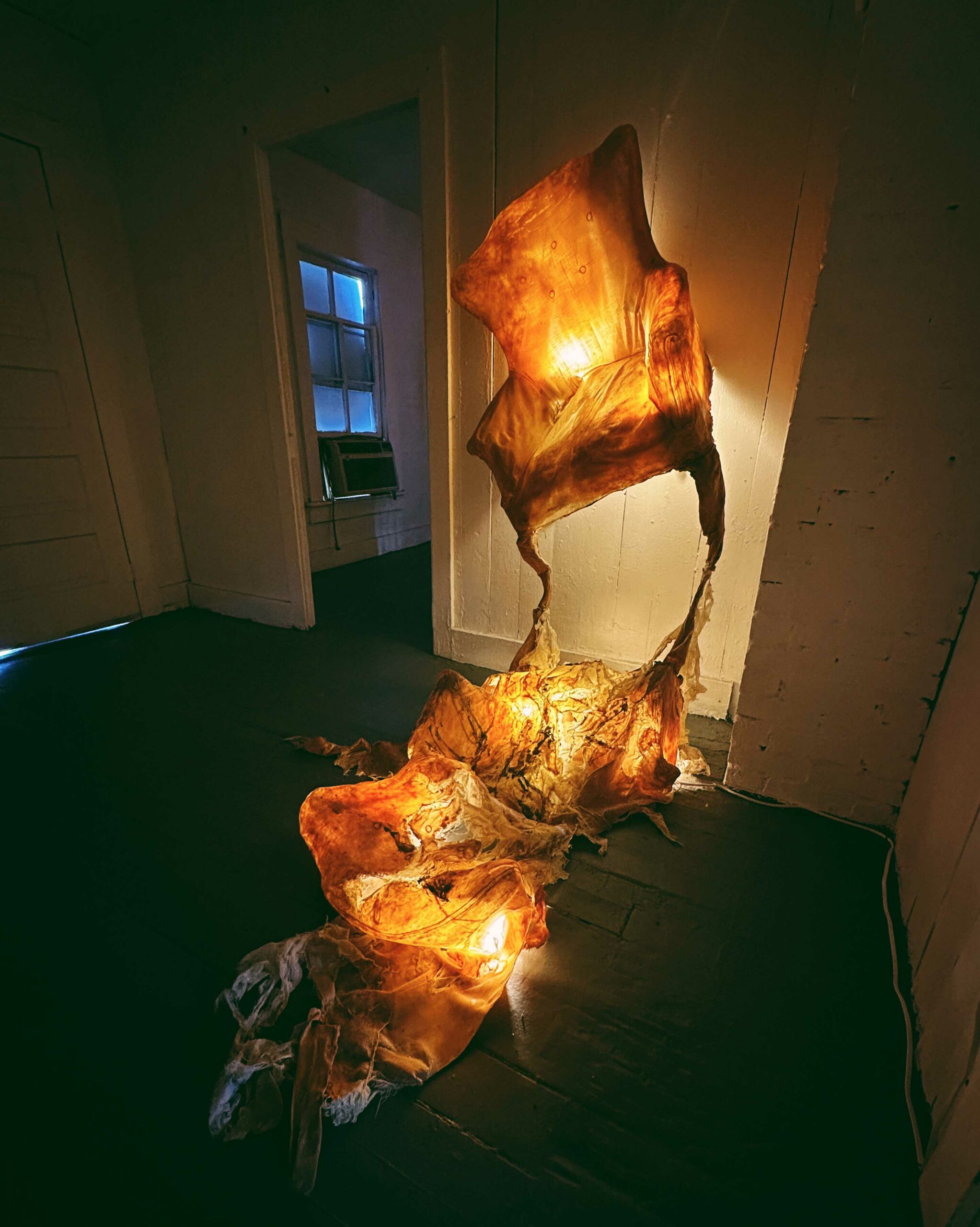
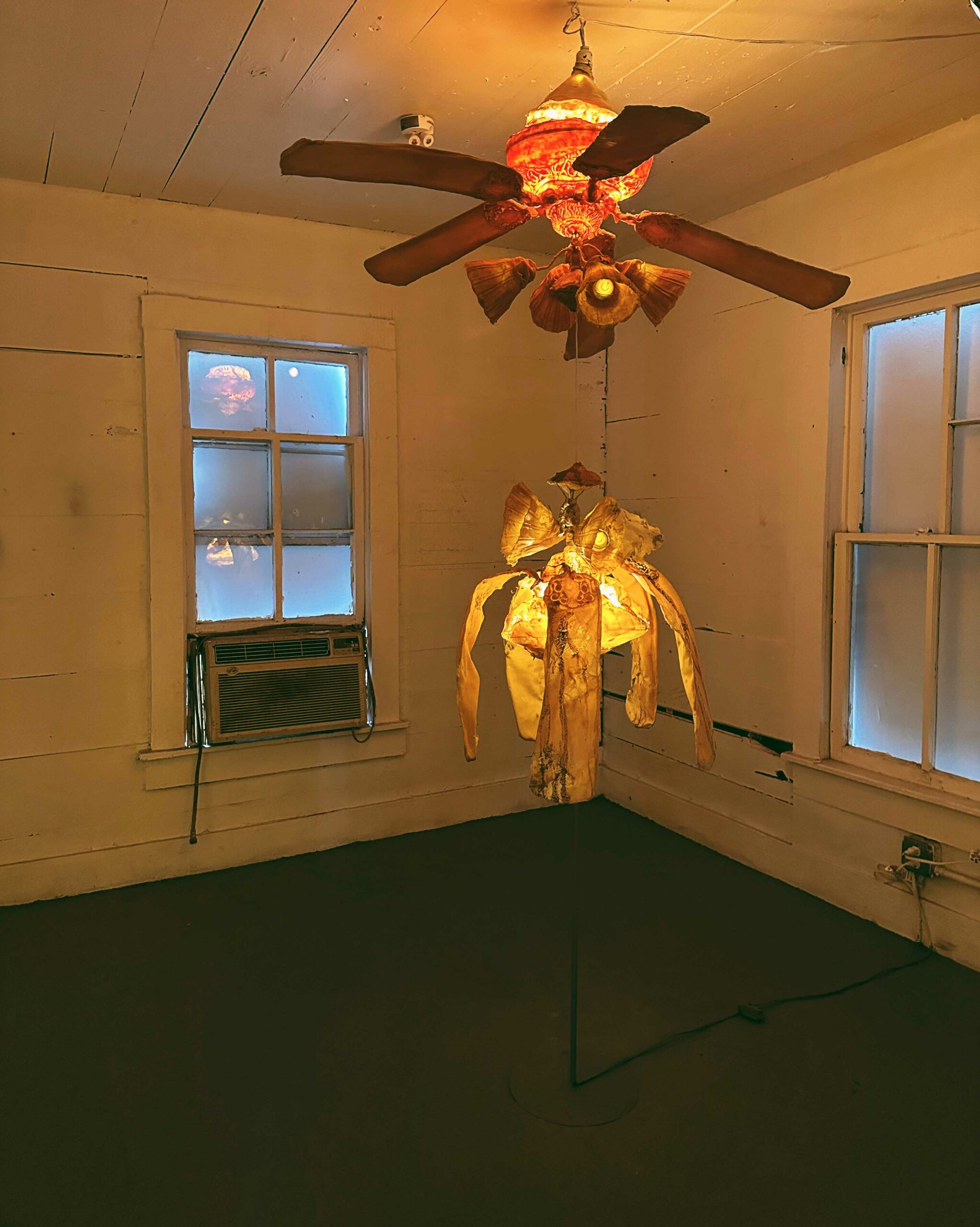
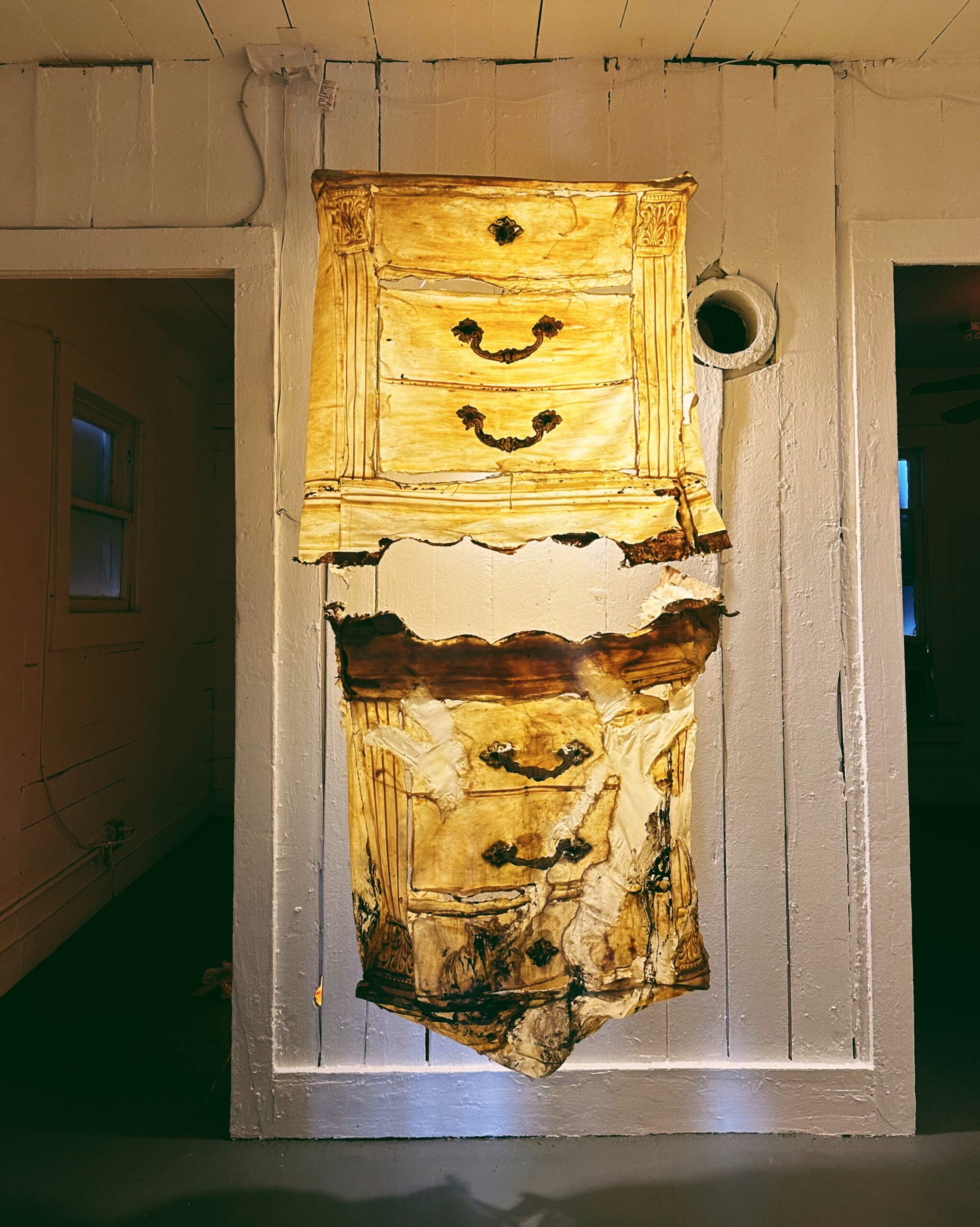
The other small rooms of the row house are dotted with a collection of sculptural casts: Floodplain|uᴉɐldpoolℲ. Cast in latex and lit from within, a nightstand, fireplace mantle, chair, and ceiling fan seem to float at an invisible waterline. Each object is doubled, with the copy hanging upside-down like a watery reflection. The pooling, tattered doppelgangers are caked in mud from the Mississippi River.
Here, Trosclair draws from her own experiences of Hurricane Katrina’s devastation in New Orleans to explore the relationship of presence, absence, and memory. In each installation, the object itself is absent. There is the shell of the nightstand, but no actual piece of furniture. But the memory of the object as it was, and the memory of the object after the flood are literally and inextricably tethered. Often, the flooded remnants transform into something else entirely. The inverted chair suggests an ominous carcass, while the drooping reflection of the ceiling fan evokes a faded, collapsed flower.
Carlie Trosclair, “Floodplain|uᴉɐldpoolℲ,” on view at Project Row Houses as part of “Round 54: Southern Survey Biennial.”
But Trosclair is not simply referencing literal floods. After all, the Third Ward has a lower risk of flooding than other areas in Houston. But ironically, the slight elevation that protects it from floods also makes it more attractive to developers looking to erect new, larger, and higher-priced homes that reshape the built environment and displace longtime residents and their social memory.
It is this evacuation of the past that Trosclair wants us to pay attention to. Following the late poet and author Toni Morrison, she locates a haunting resonance between flooding and memory. In her essay “The Site of Memory,” Morrison describes floods as water’s remembrance of where it used to be. “All water has a perfect memory,” she writes, “and is forever trying to get back to where it was.” A flood is water’s reclamation.
Trosclair’s artistic practice is like water. It finds the gullies in our sense of self and place and rushes in, reminding us of what once was and what might still be.
Floodplain|uᴉɐldpoolℲis on view through February 12, 2023 at Project Row Houses as part of Round 54: Southern Survey Biennial in Houston, Texas.
Dr. Elissa Yukiko Weichbrodt is Associate Professor of Art and Art History at Covenant College in Lookout Mountain, Georgia.
1. I can’t afford to buy breakfast for my team every month
At my job, we have weekly meetings where my whole team gets together in the morning. At these meetings, one to three people present what they’ve been working on for the past month. We are an academic research lab in a university, and 15 members of the team attend these meetings. At these meetings, my boss requires that one person presenting bring breakfast of some kind for the whole team. This means most people bring breakfast about once every one to two months.
This has been irking me for a few reasons. I am the lowest paid member of our team (think sub-poverty level for our area) because I am still a student and I am expected to pay for breakfast for all the higher members of our team once a month (my boss makes, literally, 10 times what I make). Additionally, not everyone on our team performs a research role (i.e., support staff/admin staff) so some people are never required to bring breakfast (since they never present), despite also eating it every week. And finally, I rarely eat because I’m still Covid-conscious in small rooms and prefer to keep my mask on, so it’s not like I’m saving money on getting myself breakfast during these meetings (oftentimes I don’t even end up getting to eat any of what I brought).
I know it’s something my boss is really married to, and he has done this for many years if not decades. Financially, I can make it happen since it’s not terribly often, but with rising food prices and inflation, my budget gets tighter and tighter every month. Should I just grit and bear it to keep the peace? I know many people in our group look forward to eating during this meeting every week.
No, you should speak up. And really, they should have been exempting you all along. While I don’t love this kind of system for anyone, you’re a student! You should never have been asked to buy breakfast, not even once.
Say this: “As a student, I’m not in a position to buy breakfast for the team — I really can’t afford it. So I need to exempt myself from the rotation. If that means I should opt out of eating, I will.”
Don’t get into how some people are never required to bring breakfast; that’s not really the point. The point is that you can’t afford to do it, so you won’t be. Period. And notice that with this language, you’re not asking for the favor of being let off the hook; you are telling them you cannot afford it and thus cannot do it.
You could say this privately to your boss, although on some teams, it would be more effective if said in front of the whole team (you could raise it as a sort of housekeeping measure at the end of one of these meetings). Which will work better depends on your boss and your team.
But whenever you say it, say it forthrightly! Don’t be shy about it, or embarrassed. You’re a student, for F’s sake. They’ve all been there and they should all get it.
2. Should you always ask about a gap on someone’s resume?
Should you always ask about a gap on someone’s resume?
Not all gaps, no. People have gaps on their resumes for all sorts of unremarkable reasons — took some time out of the workforce after having a baby, dealing with a health issue, taking a few months off in between jobs, travel, and on and on. The existence of a gap on someone’s resume shouldn’t be a big deal in and of itself.
Ask about a gap if you’re genuinely trying to figure out someone’s career trajectory and there’s a glaring hole that’s genuinely getting in the way of that. Generally that should mean that gaps of only a few months won’t be relevant and gaps from years ago shouldn’t matter at all. (And gaps from during the pandemic shouldn’t surprise anyone.) Personally, I only ask if the gap is a current one (“what have you been doing since leaving X?” — and that’s not a gotcha, it’s genuine interest in knowing because there could be info that’s relevant professionally — like a job they left off not realizing it would be relevant or, for some positions, whether they’d done anything to keep their skills up-to-date during that time if the gap is a long one) or if there’s a pattern of multiple gaps (and then I want to understand what keeps driving them to leave jobs with nothing else lined up — not because that’s an inherently bad thing, but because it can be a bad thing depending on the reasons — like if they’re constantly getting fired, always walking off in a fit of rage, etc.).
3. Invitations to a retirement party that’s much bigger than anyone else’s
Our CEO’s admin assistant asked me to design retirement party invitations for one beloved coworker, who is liked by many any our organization and has been a big part of being involved in many company activities, as well as philanthropic work in her 30 years at the company.
Our company normally only hosts cake/punch in a large conference room, no matter how many years a person has worked here. However, this particular employee is having a big dinner party planned by the company at an off-site event venue with drink tickets, etc.
The admin asked me to somehow word the invitation so that it doesn’t insult others who don’t get this kind of retirement send off. How would you word an invitation in this circumstance?
That’s an impossible task, because of course others are going to notice the difference and be hurt or demoralized. It’s likely to be a major messaging issue, and asking you to come up with the messaging yourself without any direction is ridiculous.
You could try going back to the assistant and saying, “I’m struggling with how to word this in a way that doesn’t raise questions about why Jane’s event is so much more elaborate than other retirement parties have been. Can you explain to me what the messaging is supposed to be so I have something to work with?” My guess is the assistant may not know either and it probably wasn’t her call, but since she’s the one asking you to do it, you’ve got to point out that you can’t do it without more information.
4. My coworker refuses to reply-all when she needs to
I have a coworker who works at an off-site location who I need to email frequently with questions. I often include her team lead and our manager in the emails so they are in the loop and can also see her replies with information I’m trying to find out.
The problem is, she is terrible at the reply-all function and always ends up only replying to me. At times this is fine, but many times there are instances where she is having problems or issues I can’t help her with, and instead of replying-all so her team lead also reads it, the message only ends up with me.
I know the usual problem is more commonly with too many people hitting reply-all when it’s not necessary, but this is a reoccurring instance where I really need her to reply-all. I’ve even pointed it out to her for the more serious issues, letting her know that she should be looping in her managers to draw attention to specific problems. Is there another way to deal with this? I find it constantly frustrating and not sure if there’s anything I can do.
Ask her one time very clearly and explain why (“can you please reply-all when I’ve cc’d Jane and/or Cecil since they need to see the answer too?”). If she continues not to, you can try one more reminder … but after that, you probably need to accept that for whatever reason she’s not doing it and you can’t make her. In that case, you can just forward her replies to Jane and Cecil with “FYI” or “You were left off the cc, but looks like Ophelia needs help with this” or so forth.
Some people will just never manage their email the way you want them to. It’s reasonable to ask once or twice, but after that you’ve just got to work around it. (There are exceptions to this, of course, like if you happen to be their boss or if they’re causing havoc with customers by not doing it.)
5. Do I have to reveal my arrest on job applications if my record was expunged?
I was arrested years ago. Later the case was dismissed and all records of it were expunged.
When applying for jobs, sometimes they ask if you’ve ever been arrested. I answer yes because I have. However, I’ve been told that since my record was expunged and if you look it up there’s no evidence of it, I should say no. But I feel like that’s lying. I don’t mind telling anyone the story because they would be able to see that I didn’t do anything wrong. But I worry about people just seeing “arrested” and having a negative opinion about me. What are your thoughts?
You can answer “no” to that question. That’s what expungement is — legally speaking, it never happened and you’re permitted to say no. You might feel better about it if you reword the question in your head to, “Do you have any legal record of arrests?”
Caveat 1: Certain government jobs or jobs working with vulnerable populations (like children) may still require you to disclose expunged records for relevant charges, so make sure to closely read what you’re answering. (You could also check with the lawyer who handled your expungement to be sure.)
Caveat 2: Order a copy of your own criminal history to make sure your record was actually expunged correctly. I recently had an old arrest from a political protest sealed (it was a bad arrest; I was there to bail out other activists but they arrested all of us, and having it on my record annoyed me on principle) and when I double checked my report months later to be sure, it was still there, despite the judge’s order to seal it. It’s fixed now, but if I hadn’t checked I wouldn’t have known they’d messed it up. My lawyer told me the same thing happened to another one of his clients, who didn’t find out until a prospective employer ran his background check — and his offer was pulled over it. So definitely check.
🌎 Get our exclusive NordVPN deal here ➡️ https://NordVPN.com/sabine It's risk-free with Nord's 30-day money-back guarantee!
Correction to what I say at 7 mins 13: The major reason air pressure decreases is that the gravitational pressure from the air above it decreases. The gravitational force itself also decreases but that's a rather minor contribution. Sorry about that, a rather stupid brain-fart.
How does the greenhouse effect work? Greenhouse gases, such as carbon dioxide and methane, prevent infrared radiation from escaping to outer space. This warms the surface of earth. More greenhouse gas means more warming. Simple enough! Alas, if you look at the numbers, it turns out that most infrared radiation is absorbed almost immediately above the ground already at pre-industrial greenhouse gas levels. So how does it really work? In this video, I try to sort it out.
00:00 Intro 00:40 The Greenhouse Effect: Middle School Version 03:17 The Greenhouse Effect: High School Version 10:33 The Greenhouse Effect: PhD Version 14:30 Stratospheric Cooling 16:24 Summary 18:14 Protect Your Privacy With NordVPN
Few things are harder to start than a narrative of the thing you “do” and what all the ramifications of it are. For people who don’t make it the center of their lives, your thing is already hopelessly complicated and gaining enough of a foothold to feign interest is olympic-level effort. For people who do make it the center, your description fills them with a never-abating dread that you’re going to get the explanation “wrong”, or that you’re going to give the Outsiders a bad impression.
So let’s begin at the beginning, again.
My parents’ divorce, taking place in the realm of the beginning of the 1980s, was not in any way friendly and in fact rather contentious. I wasn’t yet a teenager, and I was the oldest, and most notable for the purposes of this story, my mother gathered up her children and scooted off to first a hotel and then a location with family, without telling my father where she had taken us. In modern parlance, the term is “child abduction”, although I’m sure my mother didn’t think that’s what she was doing. Ultimately, connections were made, a nasty divorce proceeding happened, nobody was shot, stabbed, restrained, or attacked.
But in many presentations I’ve given, I mark the moment of being scuttled out of the family home into the great unknown of Outside The Neighborhood as being when my focus and awareness of the world fundamentally changed, because as she put things into the station wagon and tearfully told her kids to get ready to go, she also asked us to take what we needed. Which is a difficult question for someone in the realm of ten years old.
I needed a blanket and my dog.
Woven into the simple declaration take what you need are a host of world and perspective-changing understandings of what you and need are. Let’s not overplay the trauma aspect of it all, and focus on the concepts being dropped on me and my siblings, which first and foremost is a crumbling of rock-solid foundations. Foundations of family, to be sure, but also possession, consistency and location. Home was no longer an immutable realm, but split into multiple locations, one inevitably a favorite, with the other a shadow of the concept of home. Possessions stopped becoming things you could walk out of sight from and be a hundred percent sure (maybe 90-95 percent sure) they’d be there when you came back. And most effective on me was the idea that lack of effort to maintain the talismans and protocols of representation would result in a void. Put more simply: You’re the keeper of yourself and of what matters. There is no consistency that will protect you.
Like a lot of knowledge, this came at some level of heavy price, although I again stress the price is one many others pay at much greater cost. The fact remains that both my parents bent over backwards to provide opportunities, to ensure comfort and food and connection as best they could, and while I can sit back in my fifties and leave notes as to my parents’ actions in their thirties, my own thirties were spent in hacker conventions, shooting films and stumbling through my own home life, so I’m quite the unqualified judge.
This is all to say that when Chris Boufford showed me an acoustic modem in his grandparents’ spare room and how, by calling another number in Mount Kisco and putting the receiver of the phone into a cradle you’d suddenly get words on the screen, I had lived a life up to that point where two thoughts came almost simultaneously:
This is amazing.
I need to save this before it inevitably disappears.
I couldn’t have known that in the years afterwards, I would in fact collect so many artifacts from this thing, this concept of the Bulletin Board System, that I’d meet many of the people responsible for it existing, that this pile of artifacts would get a name and a branding, and that I’d collect it all so hard that I’d end up being associated with the concept of it for a lifetime. But I definitely understood, taught as I was during that painful childhood lesson, that inaction would be tantamount to approving its destruction and disappearance.
Calling as I did to many BBSes in my teen years, I’d focus on the textfiles, the message bases, the downloadable files, because they felt, I think, like special missives from beyond my little life and easily kept on floppy disks. When disks were the main way to store computer data for home users, you would encounter two kinds of people: folks who kept a small, special set of floppies representing what they needed, and others who had vast, terrifyingly large collections representing not what they needed but what they thought should be held in trust. I’ve gone through a lot of these collections over the years, and have seen rooms full of these things, hundreds and sometimes thousands, representing homemade bunkers of data. I had my own bunker, and while it was only a few dozen, the relative smallness of textfiles meant that each disk could hold many, many examples of these artifacts I thought deserved whatever long life I could provide.
At what point does a hoarder of data, driven by a sense of loss and of fear of same, turn from a mere accumulation of piles and end up with something resembling an archive?
I can point to various choices I was making in my teenage years with textfiles as the whole endeavor being more than just a private copy of things I liked: creating capsule descriptions of the textfiles for my own BBS, giving them unique extensions (HUM, PHK, HAC, PRO) to classify them in general genre headers, and attempting to keep the authorship and context of the files in the form of “buffers”, just saving all the output of a BBS to keep a record of where the files came from. I can find in my stacks actual essays I’d written about what these files were, and throwing my own writings in amongst everyone else’s so my own works wouldn’t be lost.
My college years were where all of it could easily have come to naught. New city, new goals, explorations and discovering my new set of interests could have led to my younger days and their collections being scattered to the wind. In a series of lucky maneuvers and chances across that period, I did not lose my textfiles and floppies and printouts, and they persisted for about 8 years in my hands and in the hands of a friend, David Weinstock, who kept things I was “done with” and critically asked me if I wanted them back. And by the time he asked, I did want them back. My own collection and archive, itself, came at the same risk of entropy and disappearance but the spinning wheel fell on “save” and I had them all again.
In my twenties is when I start creating The Warrens.
I don’t have a lot of handy photos of all the Warrens, and maybe that’s a compilation I need to add back here as I find them again. But over and over again, I turn wherever I’m living, or a single room within it, into a cramped, filled-to-the-brim, often deeply concerning space of materials. These will be favorite books, personal collections of memories, computer hardware and software, and an ever-growing set of amusements and pieces into my own functioning workspace. “Work”, in many cases, being the day-to-day activities of a geek browsing online things or playing with some sort of toy or tool, but surrounded by all the possibilities and options at arm’s length should my shifting focus switch to a new attraction.
I create Warrens a lot. Casting my net backwards, I count six of them, and each one a tiring memory to me, as I consider how much effort it took to build them up, and then inevitably pull them apart.
While it’s fundamentally silly to think each Warren was going to be the absolute last, there was definitely an approach and plan with each one to improve what came before. Bins instead of piles, thematic groupings instead of simple shelves of one kind of medium, and so on. Ultimately, though, they all have had flaws and they’ve all had a lifespan. My life changes and the Warrens soon collapse like a circus tent and travel to the next stop.
The site called TEXTFILES.COM caused me to regard not only my collection but the contributions of others, and the resulting documentary that I shot about bulletin board systems put me in a lot of homes with a lot of similar Warrens, and somewhere along that continuum, I found myself constructing an awareness of the types of items being collected by me and others, and giving them classifications. In more and more cases, I started to take on others’ collections as well, which forced me to think about it even harder.
Here’s what a few decades of this cobbled together in my mind:
When we end up with our physical and digital piles of material, there’s a couple grand classifications that help parse what we’ve got, and for some folks, they need this to process the next steps to take, especially if they’re overwhelmed. And those classifications are things that are you, things held in trust, and things held in indifference.
Things that are you tends to be stuff that you’ve created, be it writings, photos or saved data that represents projects or memories, and which is relevant as your trail of effect through your lived life. E-mails you’ve written, images you’ve made, and the inevitable works we consciously or unconsciously create as people. These items are not necessarily precious, but they are often rare – you have the only copy or item, only you maintain it. And in fact, only you may see any value in it or understand what it is.
Things held in trust are items that may or may not have deep meaning or relevance to you, but which you acquired from without – the downloaded programs, or bought books, or a six-foot statue you won an auction for years ago. You didn’t make these things, and there may be many copies of them, or you again might have the only one: but if they’re not part of your functioning life, then I consider them “held in trust”, as a caretaker keeps maintaining a garden or structure, towards some future.
Things held in indifference are all those pieces of life that acquire around a certain personality – ranging from discarded envelopes from packages you got, to motherboards and loose screws from machines long gone and pamphlets from trips and travel that you shoved into a suitcase and then forgot about. Some personality types (say, someone who remembers that time long ago he had to give up everything to take what he needed) might impulsively acquire things and then forget about them almost immediately. These collections can overlap with the items held in trust or the things that are the person’s own creations, as well.
When I give advice to people on what to do when they wake up one day and realize they have 2,000 CD-ROMs or piles of magazines they’ll never read, or stacks of VHS tapes of shows they bought 20 years ago and now will never watch, is help them reach the “end of the story”. People want a story, and they want the story to have a happy ending. I advise them on how to frame that story:
..but then, after asking a number of message boards and confidantes about what to do about this multi-gigabyte zip of Wojacks, the collector uploaded them to a website, finally resting knowing this long-gathered precious trust of meme juice would survive another generation. The End.
..but in a shocking twist, it turned out there was a weirdo working for an Archive of the Internet who wanted these stacks of CD-ROMs and floppies, and they offered a home which immediately cleared up that part of the garage, allowing the lawnmower to finally be stored inside, The End.
…having discovered that there are plenty of National Geographic issues to go around and there was no need to keep them around, our hero contacted a local old folks’ home and donated them to the residents’ library, where they were happily passed around and enjoyed for years to come.The End.
What is now past a decade working for the Internet Archive has meant that I’m working in both physical and digital concerns, and each one has challenges and its own peculiar qualities. Millions of items are being shipped to large warehouses controlled by Internet Archive, and millions of files and “items” are being added to the online presence. In some cases, they live in both places, existing in boxes in pallets in shipping containers in rooms in a building, and also inside a .zip file inside an identifier inside a search result on a website.
I’ve concocted ideas, then, on Archiving.
It’s probably as good a time as now to say that I am not universally beloved as a figure or authority. I am not a professionally trained archivist, but I’ve spent my entire life somewhere in the discipline, and it is not hard, if you seek them out, to find people who consider my very existence in the field to be a cavalcade of gaps in judgement by the world and by, perhaps, destiny itself. Why, in a world overflowing with top-notch expertise by individuals educated by some of the finest academic programs and concerns, would this street-wise dandy be considered the one to listen to?
Well, for one thing, I’m fuckin’ hilarious. But I also think it’s because I come to a lot of my conclusions and efforts from the point of view of ad-hoc need and not because I read somewhere that it’s where I should be putting my resources towards. I made a documentary about bulletin boards because I was concerned many of these people would die and there’d be no record of them and their perspective; and I was right. Doing this work put me in touch with lives and people who had collections that lacked a specific interest by established institutions, and so I was the one who helped keep them around, or even take them personally. And when the time came for me to join forces with Internet Archive, I was already strongly my own thing and it was a partnership, not a subsumption.
And so from this situation comes a pile of general credos and rules of thumb I’ve picked up in my travels:
Where possible, save the original. Where possible, digitize the original or maintain a digital copy. Ephemera and transient content is just as important to maintain as products and projects.Digitize at the highest resolution and fidelity possible, but realize you’re never going to get it perfect and keep the originals around, if you can. Make digital copies as widely available as possible, all the time, so it finds its value to people seeking it.
It seems pretty basic stuff, but some of it is hotly contested and virtual ink spilled by the gallon about process, style and considerations along the way. It’s what works for me, and on the whole, it’s been a succcess.
In this world-view, one of the critical parts of the whole aspect of “archiving” is making that digital copy of something physical or analog, using tools and equipment to do so. Naturally, “Born Digital” items merely need to be kept around and maintained, but items that are sitting in another medium or container need to make the leap over the Air Gap into virtual/digital reality and that’s where it gets complicated.
I’ve been asked, in all manner of ways, what the most difficult part of the process is – is it tracking down items to work on, or finding the right order, or devising which video container codec is best for a ripping of a VHS tape, the DPI of a paper scan, or which equipment stack is best for the job?
No, none of that.
It’s the crushing loneliness.
It’s the functional experience of facing down a pile of things that are in one format, and doing whatever steps are taken, over and over, to convert them into another form: the loading of the papers into the feed reader, the stacking of CD-ROMs into a ripping device, the constant movements of putting tapes into tape players and turning the capturing software on and off, typing in the filenames with metadata information as it’s done. Doing it endlessly, facing down hundreds and sometimes thousands of components in a single “collection” with lots of potential for mistakes, do-overs, unexpected failures, and all the bumps in the road for what seems like a very straightforward task.
It’s slowly grinding through a backlog of promises and easily-said agreements to turn This into That, and then finding hours, days, and weeks of your life drained out of you, resulting in barely enough data to fill a percentage of a modern hard drive.
The secret-not-so-secret is a lot of this work falls under “it should be paid for”, because it requires just enough mental capacity as to not be automation-ready, but the minute-to-minute joy of it is absolutely minimal, repetitive, and only enjoyable in the rear view mirror looking back at all the stuff you did. The occasional bright gem of something truly interesting and weird won’t make up for the hundreds of times you’ll be getting a necessary but basic item hoisted into digital, and after enough time, you just wear out.
When I started digitizing VHS tapes en masse, I did a bunch of research and asking a number of people how they approached the task, and an interesting theme of conclusions came out: Most were working with a specific set of items, and most of them burnt out after 20 to 50 tapes. Almost nobody went past that amount, even when they had many more to do.
My solution, then, was to Stream.
For the years I’ve been doing the fundamentally boring VHS and U-Matic tape ripping as part of my projects, I’ve almost always had a stream going on Twitch. It’s at https://twitch.tv/textfiles and it has ranged from a non-camera showing of what was being digitized to a full-on just-short-of-a-televised-show experience, while I move through piles of cassettes stacked to the ceiling from donated sets.
In this way, I’ve digitized (at this juncture) over two thousand videotapes, with many more to come.
The initial work was being done out of my actual apartment, which made sense until it really, really didn’t.
The nature of this sort of project is spare parts, awaiting cardboard boxes, and a mildew smell that starts to hit you when you walk in. At some phase of life, this is tolerable, but just like separating things that are you from things held in trust, it’s better to have a dedicated workshop away from a living space.
So, I started renting an office.
It’s in one of those facilities where they have dozens of rental rooms and has a set of group amenities like a kitchen, copy room, and even meeting rooms. Obviously, it cost more than just stuffing everything into my home, but the separation has turned out to be particularly healthy, both in terms of knowing what lying around is my own stuff, and what is destined for long-term storage after being digitized.
After consulting with my friend Kyle, I re-imagined the entire “streaming” approach to be focused on the image, and having it both look good, and look informative. The result is striking:
People have asked what the huge monitor is, behind me. I’ll answer that one straight off – it’s a cheap LCD TV, purchased for my apartment and long-since superseded by others but still working enough to look fine on a camera. The lighting is from two $25 LED lights designed for the purpose, along with a webcam aimed down the maw of the U-Matic tape device, since I have to keep the top off anyway (constant cleaning). The camera recording me is a mirrorless DSLR (a few hundred dollars) in constant monitor mode, and sending it all to a HDMI-to-USB Camlink.
Some time in the future, let me go into further detail of The Setup and the Toolchain, which a certain segment of audience can’t get enough of, and another can’t stand a smidgen of.
Instead, let me say that what’s obvious, looking in the context of my full life with this endeavor, is that I’ve built yet another Warren.
Cameras and framing are very deceiving. The room is tiny, barely 70 square feet. The day I toured the facility and was sent the stack of paper I needed to sign up for a year of long-term residence, they included a “typical” picture, which is either my office or the one next to it, and the difference is striking:
Because of the equipment, it runs very hot in there. Because I’ve got all the projects going on from so many sources, it’s also a bit noisy. Filters on my studio microphone prevent my audience from hearing the never-ending humming.
Composing the dull, generic room that I was given into the cyber-scape of fluorescent dreams that now appears on the Twitch stream has been a multi-year project. Tapes and other products move in, get processed, boxed up, shipped out. Streams have been a few minutes or many hours, depending on what I’m focused on and what time permits. And because I have a dedicated space, I can be very loud, very intense, and be able to speak freely on subjects without worrying I’m ruining anyone’s living conditions or sleep. It has worked spectacularly.
But again, the real purpose of this Warren is to share – to share with people online (thousands of them, over the years) with what I’m up to, to have conversations or debates through chat and phones, and to be able to conduct myself in a way that doesn’t feel like a prison sentence, even if the space I’m functioning in resembles a jail cell a little too much.
I know this set of decisions and designs is not for everyone. Not everyone wants to yammer constantly while doing their job to a shifting, weird audience of onlookers. Not everyone feels they need multi-colored lights and a massive background video to conduct themselves, but not everyone is processing thousands of videotapes all their waking hours, with a dreary consistency that would have long-ago wrenched all joy and delight from the occasional discoveries. Even with my motivations to archive and share being life-long, and my individual cramped spaces being laboratories that I use to experiment and improve my processes, it turns out that isolation didn’t give me focus – audiences do.
Here, in the contemporary time of my archiving life, really an archiving lifetime, is me now trying to turn the promise of endless stacks of media and materials into digital form, to make them reachable to the world, before something, and there’s more than a few somethings up to the task, takes me out of the game. It’s a life born of a tragedy, but that tragedy caused perspective, and that perspective has given me an awareness of how much has been done and how much is left to do.
From my cramped Warren launches hundreds of recorded moments, and maybe, with the help of a kind set of eyes, I’ll get a lot more of the work ahead done.
Enlarge / What might have been. (credit: Lee Hutchinson / NASA / NOAA)
February 1, 2023: One of the most tragic events in the history of space exploration is the loss of the space shuttle Columbia and all seven of her crew on February 1, 2003—a tragedy made worse because it didn’t have to happen. But just as it is human nature to look to the future and wonder what might be, so too is it in our nature to look at the past and wonder, “what if?” Today, on the twentieth anniversary of the event, Ars is re-publishing our detailed 2014 examination of the biggest Columbia "what if" of all: what if NASA had recognized the damage to the orbiter while the mission was still in progress? Could anything have been done to save the crew?
If we die, we want people to accept it. We are in a risky business, and we hope that if anything happens to us, it will not delay the program. The conquest of space is worth the risk of life.
—Astronaut Gus Grissom, 1965
It is important to note at the outset that Columbia broke up during a phase of flight that, given the current design of the Orbiter, offered no possibility of crew survival.
—Columbia Accident Investigation Board Report
At 10:39 Eastern Standard Time on January 16, 2003, space shuttle Columbia lifted off from pad 39A at the Kennedy Space Center in Florida. Just under a half-minute later, at 81.7 seconds after launch, a chunk of insulating foam tore free from the orange external tank and smashed into the leading edge of the orbiter's left wing at a relative velocity of at least 400 miles per hour (640 km/h). Columbia continued to climb toward orbit.
The foam strike was not observed live. Only after the shuttle was orbiting Earth did NASA's launch imagery review reveal that the wing had been hit. Foam strikes during launch were not uncommon events, and shuttle program managers elected not to take on-orbit images of Columbia to visually assess any potential damage. Instead, NASA's Debris Assessment Team mathematically modeled the foam strike but could not reach any definitive conclusions about the state of the shuttle's wing. The mission continued.
Concerns about whether stoves are safe are nearly as old as gas stoves themselves. | Chaloner Woods/Getty Images
We’ve been fighting over gas stoves for decades.
Forty years ago, the federal government seemed to be on the brink of regulating the gas stove. Everything was on the table, from an outright ban to a modification of the Clean Air Act to address indoor air pollution. Congress held indoor air quality hearings in 1983, and the Consumer Product Safety Commission (CPSC) and the Environmental Protection Agency (EPA) were both investigating the effects of gas appliances.
Backed into a corner, the industry that profits from selling consumers natural gas for their heating and cooking sprang into action. Itfiled comments to agencies disputing the science. It funded its own studies and hired consultants to assess the threats it would face from further regulation.
To prove that voluntary action was effective and regulation unnecessary, utilities produced their own literature for consumers, like Northern States Power Company’s warning that “Homes Need Fresh Air During the Heating Season.” And it nervously eyed media reports, like Consumer Reports’ conclusion in 1984 that “the evidence so far suggests that emissions from a gas range do pose a risk” and “may make you choose an electric one.”
The research on gas stoves’ health effects was “provocative, not conclusive,” concluded a 1984 Energy Bar Association report drawn up by gas industry consultants.
Ultimately, the US did not pass new regulations. Instead, natural gas became even more embedded in American homes and lives, in 2020 supplying fuel to 70 million homes. All the while, scientists continued to warn that gas can produce a range of emissions and pollutants: nitrogen dioxide, carbon monoxide, carbon dioxide, formaldehyde, hydrogen cyanide, and particulate matter, among others. The methane from gas is a growing contributor to climate change.
Now, the US runs the risk of repeating history, and natural gas utilities find themselves in a similar position to the one they were in four decades ago. We have dozens of studies and better quantification of exposures and risks than ever, but the industry, dependent on selling fuel to tens of millions of homes, is reprising an age-old playbook used by any industry that finds itself on the defense over public health.
The gas industry takes a page from tobacco to dispute gas stove science
Even in the early 1900s, the natural gas industry knew it had a problem with the gas stove. At the time, people who didn’t have gas stoves largely used coal or wood, but new competition was on the horizon from electric stoves. Both coal and wood were known to cause health issues, but while gas companies would later position themselves as a clean alternative to these fuels, the industry was already aware it was far from clean.
At the second annual meeting of the Natural Gas Association of America in 1907, gas representatives debated how to approach the issue of ventilation around the stove. “I believe the association will go on record on that point: no gas of any kind should go into a heating stove without a flue connection,” which vents into the air outdoors, according to published minutes from the meeting.
One attendee noted, “This method of burning gas should be condemned merely from the fact that we get the gas direct and there is danger to life in getting any gas direct in your room, to say nothing of all of the by-products.” The most obvious danger of the time was carbon dioxide and carbon monoxide poisoning.
Gas grew regardless of these problems. Over the next few decades, electric and gas stoves went to war with marketing campaigns — a pre-presidential Ronald Reagan appeared in a marketing campaign for General Electric’s all-electric household in 1958, while in 1964 the Pennsylvania People’s Natural Gas Company recruited film star Marlene Dietrich. She professed in her ad, “Every recipe I give is closely related to cooking with gas. If forced, I can cook on an electric stove but it is not a happy union.”
By the 1970s and ’80s, the science had become far more nuanced. One of the seminal reports from the EPA’s appointed Committee on Indoor Pollutants published in 1981 showed, “an association between gas cooking and the impairment of lung function in children.” While many questions were unanswered, the NAS was convinced by the evidence it did have that gas appliances posed a “sufficient threat to the general public health to justify remedial action.”
The gas industry has latched onto these small uncertainties to undermine the larger body of research. The American Gas Association still heralds the federal agencies’ lack of action since the 1980s and 1990s as an argument in the stoves’ favor.
In 1986, though, the EPA sent a report back to the CPSC. The executive summary said gas from cooking or heating “is not a risk factor of great magnitude in comparison with a factor such as cigarette smoke,” but still noted the amount of research needed to understand more: “Unfortunately the majority of epidemiological studies include no information on N02, and among those that do have actual measurements, the number of homes and characterization of concentrations are very limited,” the report continued. “This suggests that better quantification of exposure is a major need in future studies.”
The EPA also kicked the issue of nitrogen dioxides to the CPSC to determine the level of emissions coming from these appliances, asking for “further efforts ... to assess the health risks associated with indoor use of kerosene space heaters and other sources of nitrogen dioxide emissions.”
None of this appeared to happen.
The EPA did issue emissions standards for wood stoves and fireplaces in 1985, but never took up gas. The prospect of any more EPA action faded from the public debate. Agencies apparently backed away from the issue. Tobacco was becoming a bigger priority, and the EPA and Housing and Urban Development started voluntary initiatives for healthier homes.
There were marginal improvements in stove and oven technology in the intervening years. The biggest change was phasing out pilot lights, a flame that would always burn gas but also is dangerous when it goes out. These helped some severe safety issues with gas appliances, like lowering the chance of an explosion, but didn’t address air quality issues when the stove was on or off. Building codes throughout the country also began to mandate lifesaving carbon monoxide detectors.
One key gas industry technology that could have improved the safety of the stove was developed around the same period, in the 1980s. It was an infrared burner device that uses less gas and lowers nitrogen dioxide emissions, one of the most concerning pollutants that comes from gas and causes asthma. According to NPR’s reporting, the idea was shelved in part because there was no demand for it; it would even do away with the iconic blue flame that made the stove so popular.
The déjà vu of the gas stove debate
As these debates have resurfaced, the gas trade groups have echoed similar lines to the ones they used in the 1980s. This time, in addition to drawing attention to the uncertainties that remain, the industry has directly disputed the scientific consensus.
Some of the defenders of the gas stove are the same consultants who have defended tobacco and chemicals industries in litigation over health problems.
A hearing in November in the Portland-area Multnomah County in Oregon on gas stoves as pollution hazards offered a glimpse of that strategy. Doctors and public advocates testified against gas appliances because of the NO2 they emit. The gas appliance had its defenders as well, including Julie Goodman, an epidemiologist employed by the consulting firm Gradient who argued that “longer-term average NO2 concentrations in homes with gas cooking are not of a potential health concern. Importantly, it is well-established that ventilation mitigates cooking emissions, regardless of the source of the energy used.”
Goodman’s firm had been hired by the American Gas Association to dispute the research on gas stoves, according to a letter to the American Medical Association temporarily published on the association’s website. The letter noted, as of September, that AGA had hired Gradient for consulting. In a recent interview in the New York Times, Goodman added, “when considering the entire body of literature, the available epidemiology evidence is not adequate to support causation with respect to gas stoves and adverse health effects.”
A similar pattern has emerged in the gas industry’s pushback on gas stoves. AGA’s replies have emphasized that there is no conclusive evidence that gas cooking poses harm, and no clear causation between asthma and pollution from the stove. After all, it’s not the only source of nitrogen dioxide or other pollutants that we’re exposed to.
But for all the talk about uncertainty around risks from gas appliances and the gas stoves in 70 million American homes, there are plenty epidemiologists, pediatricians, and other scientists feel confident about. Gas produces pollutants, and without any ventilation it can be dangerous to one’s health. Even when gas is ventilated, the emissions don’t go away; it just contributes to outdoor smog instead of poor indoor air quality.
Republicans have claimed the recent gas stove news is a front or a distraction spun by a Biden administration intent on taking people’s freedoms away (to repeat, neither Biden nor the CPSC is banning the stove). Rep. Jim Jordan (R-OH) tweeted on Friday, “Maybe if the Biden Administration wasn’t so worried about banning your gas stoves, they would have seen this Chinese spy balloon coming.” In a recent letter to the CPSC, Sen. J.D. Vance (R-OH) called the gas stove a “newfound ‘hidden hazard’ that rests on limited research.” And right-wing forums are full of conspiracies, including the theory, “The Gas Stove Ban was to keep Biden’s Mishandling Classified Docs out of the news.”
None of it is true. The pollution concerns are practically as old as the gas stoves themselves. There’s less debate over the gas stove than the natural gas industry and its allies have implied.
So I started a Rugby Enthusiast Scholarship at University of Houston-Downtown. It’s a scholarship for rugby player and fans.
Some of you may say: “But Billy, UHD doesn’t have a rugby team!” This is true, but maybe there are some older guys and gals that play club rugby, or used to play, or maybe are just fans of rugby who want to go back and finish a bachelor’s degree or go for a masters. This is for them.
If no one donates anything, it will be fully funded by yours truly in about 7 years time. But you can help get this thing going sooner by contributing to the cause https://fundraise.givesmart.com/vf/UHDRugby
TALLAHASSEE, FL—Saying the continent’s existence raised numerous questions of bias and accountability in the classroom, the Florida Board of Education reportedly responded to heated statewide controversy Friday by removing Africa from all world maps. “Many parents expressed concern that we were teaching their …
WASHINGTON—Bowing down before the floating intruder mere hours after it entered American airspace, the entire U.S. nation reportedly surrendered Friday to the Chinese balloon spotted hovering over Montana. “Today, I speak to the Great Balloon to say unequivocally: the country is yours,” said President Joe Biden in a…
The last time Bush Airport reported anything other than overcast or broken overcast skies was back on the morning of January 27th. That week-long streak will end at some point today. Most of the area will see at least some sun, if not full sun before the end of the day, and everyone sees sunshine tomorrow. In addition, we’ve gone over 100 straight hours below 50 degrees, not a particularly big deal, but it has certainly been cold and quite damp. That should end today also. All in all, if you have weekend plans, you can confidently go forth with them.
Today
Most of the area remains under low clouds this morning. You have to get east of about Wallisville and Anahuac or west of Flatonia on I-10 to get into clearing.
Satellite as of 7 AM shows that clouds still dominate, but they will lose ground as the day goes on, allowing the sun to take hold. (College of DuPage)
The clouds will erode through the day today, allowing the sun to emerge. I think they’ll probably dissipate from east to west through the morning and afternoon. Areas most likely to stay cloudy most of today are probably west of Houston. Once the clouds diminish, look for temperatures to rebound into the 50s over most of the area. Places that stay under clouds may only get close to 50 degrees. Winds will be light in most spots but perhaps a bit gusty over the open water.
Weekend
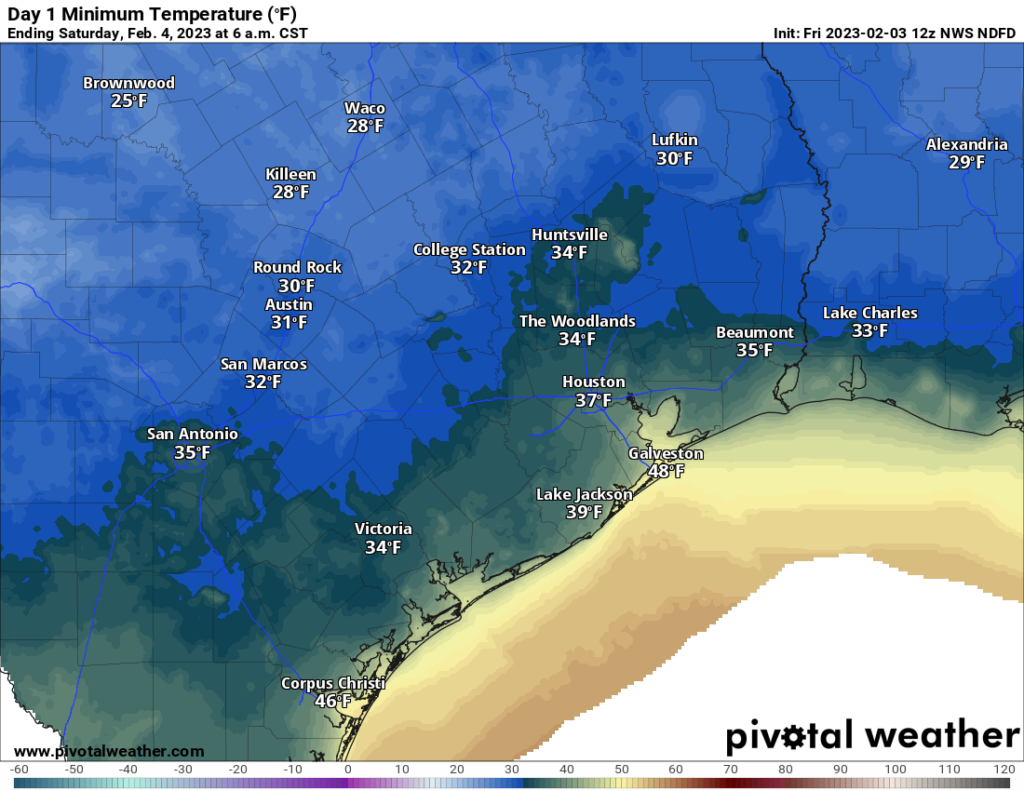
Both Saturday and Sunday should feature more sun than clouds. Winds will flip back onshore on Sunday, which may allow for a few extra clouds. So Saturday will start chilly, with 30s in most of the area, but we should warm to near 60 or so. But Sunday will start in the 40s and warm to near 70 degrees.
Saturday morning low temperatures should bottom out in the 30s in most places away from the immediate coast. (Pivotal Weather)
Just a quick note: Models do predict some fog may develop tonight north and west of about Cypress. Anyone in places like Navasota into Bryan or College Station and north toward Huntsville, just be advised that there could be temperatures at or below freezing with fog. That could make travel a bit slick late tonight and early Saturday morning. Once the sun comes up, it will improve quickly. This should not affect the Houston area.
Early next week
Monday should be partly to mostly sunny and warm. You’ll notice a little more humidity creeping back through the day, and there may even be some patchy fog development on the coast. Most places will top off in the 70s. Tuesday should be even warmer despite more clouds, with AM lows in the 60s and daytime highs around 75 or a few better in spots. Again, some fog is possible along the coast.
Next front
Consistent with Eric’s post yesterday, it looks like we can pencil in the next front for Tuesday night or Wednesday. The timing and details still need to be sorted out, but at this point we are looking for showers and storms in some window between Tuesday night and Wednesday afternoon, followed by cooler, drier air to close out next week. Or at least that’s the line of thinking we’re going to sell to you today. Some models bring back rain chances as soon as Friday, so we’ll see. More on Monday!
Rest of Texas
Interior Texas can continue to thaw out today and begin to assess and repair the damage left behind from this week’s ice storm. There are still nearly 250,000 customers without power across the state. If you plan to travel toward Dallas or Austin or San Antonio or El Paso, road conditions should be clear today through the weekend. As always, check with drivetexas.org for the latest information.
Bobbi Wilson went on a mission to save New Jersey's trees, capturing spotted lanternflies. That frightened her neighbor, who called the cops. Now, her bug collection is part of a Yale museum.
Submitter: We found this gem in our Children’s department of our public library, on a recent much needed weed. The children on the cover seem to enjoy waterboarding Grandpa. The actual photos inside are very disturbing. They dare you to wrestle a bear, and how about the crying little girl watching her beloved turkey get it’s head chopped off. I don’t understand why we had this one on the shelves for so long!
Holly: None of these are pleasures or appropriate pastimes for children! Pretty sure Grandpa is bobbing for apples. He doesn’t seem to be very good at it, though.
NEW YORK—In a move designed to make the curriculum more palatable to conservatives, the College Board announced Thursday that its revised AP African American Studies course would focus mostly on Herman Cain’s rise to CEO of a pizza restaurant chain. “As of today, the newest iteration of the AP African American Studies…