Shared posts

09 Feb 21:31

Pawns in the Voucher Scheme

by Josephine Lee

Like many other typical teenagers, James’ favorite periods in school are P.E. and lunch. During our phone call, he turned the tables on me, politely asking about my children and work. A 15-year-old student who was born with a tumor and has autism, James actively seeks engagement with others, especially his peers. But for two years, he learned at home in isolation. Arizona’s voucher educational savings account program, called the Empowerment Scholarship Account (ESA), granted him $40,000 of public funds to pay private school tuition. But even with that money, private school after private school denied him admission. 

“They first demanded all his files, his IEPs [Individualized Education Plan for students with special needs], but before they would grant an interview, they would give some excuse why his needs could not be met there,” James’ mom Pamela Lang said. “Some gave interviews and tours, and James would get excited. But then they would decline admittance saying they could not accommodate him.”

After every single Phoenix, Arizona Catholic school and a slew of secular private schools rejected James, Lang was finally able to find a school to address his needs. But now, she fears there won’t be enough state funds in the future to afford its costly tuition. 

What started in Arizona in 2011 as a $2.5 million state voucher program for students with special needs has now ballooned to a universal voucher program for all of the state’s students, public or private. 
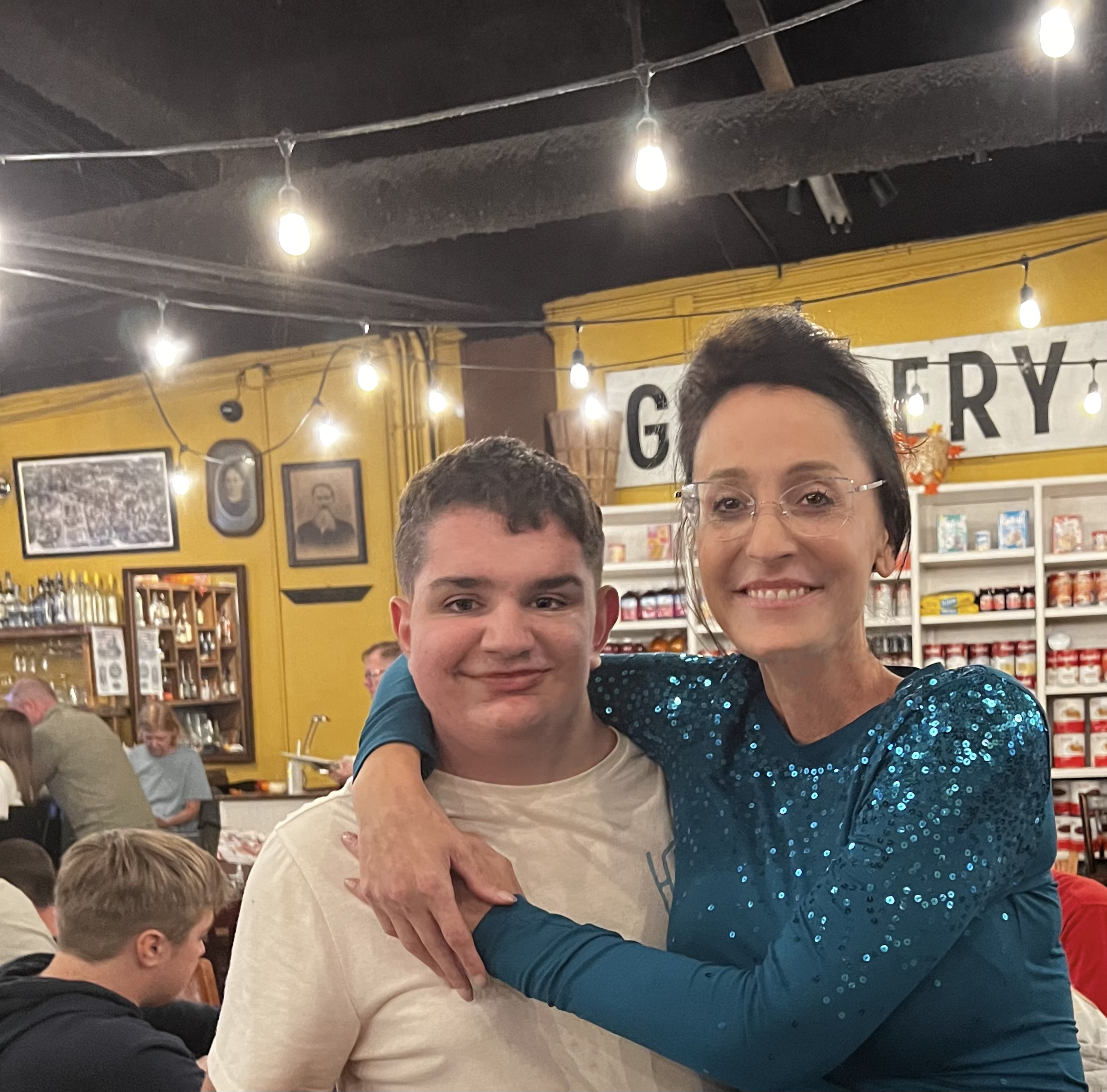
Pamela Lang poses with her arms around the neck of her son James. She's in a blue top with sequins while he's wearing a simple off-white tee. They are standing in an old-timey looking grocery store. Like many disabled students, James depends on the programs in the Arizona voucher program.
As Arizona increasingly diverts funds from public schools into its voucher program, Pamela Lang (right) worries that she there won’t be funds left for her son James (left).

“The state said the voucher was for kids with disabilities but it was just a way in to open the door,” Lang said. “Every single year since the state got the ESA, they just kept expanding it to more and more people, and now, it’s for everybody. We’re just hoping kids with disabilities aren’t going to have nothing left for them.”

In the first quarter of this school year, Arizona already blew through $300 million, awarding 80 percent of the funds predominantly to wealthy students already enrolled in private schools. This will leave a projected $4 million debt in the state’s education budget at the end of the 2022-2023 school year, a debt that public school advocates fear will deplete public school funds further. 

Critics say Arizona used vouchers for special needs students as a trojan horse for school privateers to divest, divert, and dismantle the state’s public education system, which now ranks in the bottom three among all U.S. states for per-pupil spending, teacher retention, and teacher pay. 

Texas lawmakers are now poised to follow Arizona’s lead. But parents in Arizona are warning Texans to take heed. Their stories are a cautionary tale for our state, which plans during this legislative session to use special needs students to usher in multiple voucher programs. 

Arizona’s voucher programs—and the Texas proposals—include both a universal education savings account and a tax-credit scholarship program, both of which would divert public education money from state coffers to enrich private schools, corporations, and wealthy families.

Divest 

The country’s first public school education savings account started in Arizona in 2011. The ESA directly appropriates public education money and deposits it into an individual savings account or debit card for parents to use for private school tuition, tutoring, homeschooling, or therapy. 

In its first year, $2.5 million of Arizona’s ESA money was directed toward students with special needs. But in subsequent years, expenditures and eligibility for the ESA program expanded to include children attending public schools that received a D or F rating, children in military families, in foster care, and on Native American reservations. Then in 2017, legislators attempted to pass universal vouchers for all students. The proposal was beaten back twice by public school advocates but passed in 2022.  
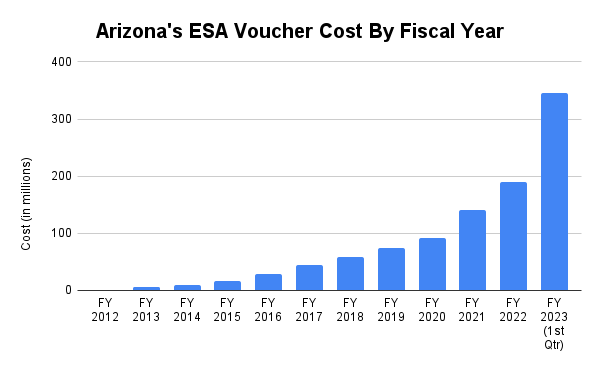
A chart showing the ever-increasing cost of the Arizona voucher program per year, with the cost ballooning to almost 350 million in first quarter of 2023.
Source: Arizona Department of Education

Since its inception, Arizona’s ESA program has stripped more than $963 million from public school funds.

Texas House Bill 557, filed by Representative Cody Vasut, is a universal voucher program from the get-go. It would enable an unlimited number of students to receive reimbursements for up to $10,000 in private school tuition, the full per-pupil allotment in Texas. If all 309,000 private school students in Texas decided to apply for a voucher under this bill, public schools could lose $3 billion in state funding after one year alone. The impact could bankrupt a system in Texas which already ranks in the bottom 10 states in per-pupil funding. 

Beth Lewis, director of Save our Schools Arizona, warns Texans that such a voucher program never gives back as much as it robs from public education. 

“They sell it under the guise that the money’s following the child,” Lewis said. “But if you were already in a private school or a homeschool situation, that money’s not following you. It’s never been allocated to you. So in reality, it’s a subtraction from a student in the public school. Then, you’re never going to have an equitable system where every kid can access quality education.” 

Besides the education savings account program, Arizona has a second type of voucher program that directly funnels public money to private schools—the tax credit scholarship program. 

“In reality, it’s a subtraction from a student in the public school. You’re never going to have an equitable system where every kid can access quality education.”

In 2006, Arizona expanded the tax credit scholarship program to target its most vulnerable populations—students with disabilities, students from low-income families, and students in foster care. Under this program, corporations claim a dollar-to-dollar tax credit against their corporate income tax or their insurance premium tax when they donate to third-party nonprofit administrative entities, known in Arizona as a “school tuition organization,” or STO. 

Then the STOs take 10 percent for overhead and disburse the remaining 90 percent to private schools for students’ tuition. 

Instead of going through the state treasury and potentially to public schools, the tax credit program directly infuses private entities with state tax money. Since its inception in 1998, Arizona’s tax credit voucher programs have grown by 4,000 percent and have siphoned more than $2 billion from the state’s general revenue. The system is rife with abuse. 

Arizona Christian School Tuition Organization (ACSTO) is Arizona’s largest STO. Since 1998, ACSTO has accumulated a total of $300 million in donations. According to a New York Times investigation, its executive director Steve Yarbrough collected a six-figure salary from the nonprofit organization while serving as the president of the state Senate. ACSTO paid outsourcing fees to another company and rent for property both owned by Yarbrough. He is also a co-founder of Valley Christian School, which has collected $23 million in scholarship money since 1998. 

“There’s no financial accountability, there’s no academic accountability … most of it is just profiteering and grifting,” said Lewis, the Arizona public school advocate. 
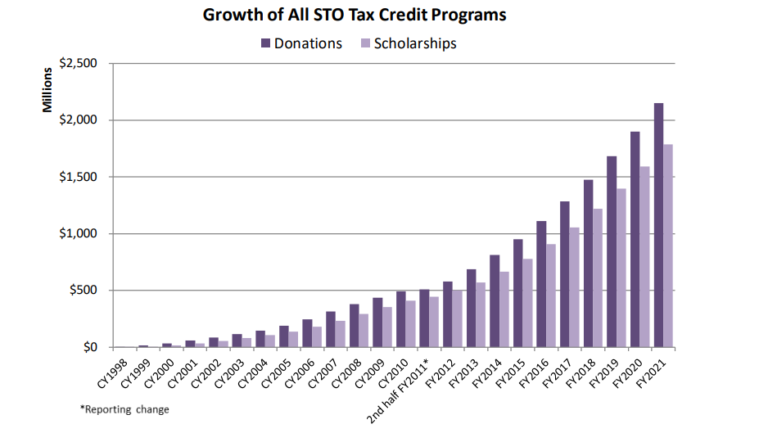
A chart showing the steady growth of STO (School Tuition Organization) Tax Credit Programs, or voucher programs, from 1998 (almost nothing) to 2021 (over $2 billion).
Source: Arizona Department of Revenue, Office of Economic Research and Analysis, March 2022

Texas House Bill 619, filed by Representative Matt Shaheen, and Senate Bill 176, filed by Senator Mayes Middleton, resemble Arizona’s corporate tax credit scholarship program. Like Arizona’s program, corporations can claim a dollar-to-dollar tax credit against their insurance premium tax. Under SB 176, corporate donors can also opt for a tax credit of up to “100 percent of the entity’s state premium tax liability.” 

Patty Quinzi, legislative director of the Texas American Federation of Teachers, said SB 176 would enable corporate donors to game the system to extract more than they actually donated. 

“The bill has a built-in tax giveaway to the business sector at our schools’ expense,” Quinzi said. “This hurts teachers, who spend hundreds of dollars of their own money to buy basic school supplies, and it hurts students, who lose valuable funding for support services and extracurricular programs.”

Like Arizona’s initial program, both bills prioritize Texas’ students with special needs. HB 619 also includes students in foster care, in a military family, and in families with incomes up to $100,000 for a family of four. And both, like Arizona’s law, permit higher tax credits in subsequent years. SB 176 proposes a $200 million cap in its first year to increase by 25 percent of the previous year’s amount each year. This means, if SB 176 passes, the Texas treasury could lose more than $2 billion in revenue over five years alone. 

“This hurts teachers, who spend hundreds of dollars of their own money to buy basic school supplies, and it hurts students, who lose valuable funding for support services and extracurricular programs.”

Last winter, the Texas Commission on Special Education Funding held multiple hearings to address a critical shortfall in special education funding. In 2018, the U.S. Department of Education found that Texas violated federal laws requiring schools to identify and serve all students with disabilities. Up until then, the Texas Education Agency had put an 8.5 percent cap on the number of students eligible to qualify for special education services. The agency has since removed the illegal cap, and the evaluation of special education students has grown by 44.5 percent since 2012. But along with that, so has the need for more resources. 

During the hearings, voucher proponents—including religious schools, the Catholic Diocese of Dallas, the Texas Private Schools Association, and Koch-connected organizations like ExcelinEd, EdChoice, and the Texas Public Policy Foundation—made the case that Texas’ special education funding needs would be better solved by a voucher educational savings account. 

Public school district superintendents and disability advocates, like Disability Rights Texas’ senior policy specialist Steve Aleman, disagreed. Aleman argued that vouchers would roll back any progress Texas has made toward serving special needs students and pull funding away from a system already in dire need of more money. 

“This is really about servicing private schools. It’s not about public special education programs,” Aleman said. 

Disempower

Arizona parents of children with disabilities warn that their experiences with vouchers have often been negative. Unlike public schools, which are required by federal law to admit and teach all children regardless of their disabilities, charter schools and private schools are not. 

After Lang pulled her son James out of public school, she attempted to use her ESA money to get James admitted into the special education programs in Phoenix’s Catholic schools. She had seen advertisements about a special education program in the Catholic Diocese of Phoenix called the Matthew 19:14 Project. Its website quotes Pope Francis, stating, “An inclusive education finds a place for all and does not select in an elitist way the beneficiaries of its efforts.” James was rejected from every school in the diocese.

Lang then tried other secular private schools, which were advertising special education programs. Both the New Way Academy and On Track Academy rebuffed James. Afterward, On Track Academy clarified their definition of disability as limited to dyslexia and anxiety. Desert Garden Montessori didn’t offer any aides for special needs children. 

“I wrote every pathetic letter, basically selling my kid and begging them to take him, and they would still be like, ‘No, he’s got this and that.’ Or they’d just say that they can’t serve his needs there,” Lang said. “It’s just a constant slog.” 

Parent Raquel Mamani put her twins back in a Phoenix public school after a local private school admitted one of her children and denied the other who’s been diagnosed with multiple learning disabilities. The school gave both children a 30-minute test on the computer to determine their admission qualifications. 

“The money is being poured into these private schools, but we see many special education students end up right back at the public school,” Mamani said. “They always talk about how it’s the parent’s choice, ‘power to the parents.’ But it’s not the parent’s choice. It’s the private school’s choice.”


Parents waive most federal legal protections for children with disabilities when they pull them out of the public schools and enroll them in a private voucher program that does not receive federal funds. The federal laws that protect students with disabilities are:

  • The Individuals with Disabilities Education Act (IDEA) requires public schools to identify and evaluate students with disabilities, craft individual educational plans (IEPs), ensure an inclusive environment, and provide parents with timely communication and access to student records. 
  • Section 504 of the Rehabilitation Act prohibits public schools that receive federal IDEA grants from discriminating against or preventing students with disabilities from participating in academic programs or extracurricular activities. It also ensures that students with disabilities can access school facilities.  
  • The Americans with Disabilities Act (ADA) prohibits discrimination against any person with a disability by requiring auxiliary aids and services and ensuring legal recourse if one is retaliated against for reporting violations. While secular private schools are subject to the ADA, religious private schools are not.

Based on data from Arizona’s Department of Revenue, at least 70 percent of all private schools receiving scholarships from the tax credit programs are religious schools, exempt from federal or state civil rights laws. 

Parent Sabine Triplett has always felt like she had to fight the Houston Independent School District to get services for her son Nils, who is dyslexic. But she was able to use the law to ensure his needs were met. When Triplett realized Nils was not receiving the reading support he needed under both Section 504 and IDEA, she was able to call for an Admission, Review, and Dismissal meeting with a team of teachers and specialists who oversaw Nils’ IEP. Through this process, Nils received dyslexia reading intervention, oral test administration, and extra study guides. If the ARD meeting had not been successful, Triplett knew she could file a complaint. 

“I dedicated my time to advocating for Nils, researching and learning all this stuff. We decided he was better off in public school, where if the services were available, I could figure out how to get it for him,” Triplett said. 

“They always talk about how it’s the parent’s choice, ‘power to the parents.’ But it’s not the parent’s choice. It’s the private school’s choice.”

Besides waiving legal protections, parents of students with special needs may be left in the dark about how their child is faring in a private school. Public data on how the voucher system is serving any student, not only students with disabilities, is scarce because private schools are not required to report data. While public school districts must report state standardized test scores as well as disciplinary actions, incidents of harassment, bullying, and discrimination to the U.S. Department of Education, private schools are not required to do so. Aleman said that under a voucher system, “parents are just their own advocate, without any legal standing beyond what is in that [private school] contract, and that is systemically not fair to students with disabilities.”

Notably, on the same day Texas Representative Vasut filed a proposal for an educational savings account, he also filed HJR 37, a resolution to amend the state constitution to forbid state and local government regulations of private schools and homeschools. This means that private schools and homeschools taking state voucher funds may never have to require state standardized tests or report their students’ academic performance. 

After searching for two years, Lang finally enrolled James in the Pathways School, dedicated to teaching students with disabilities. But after finding out that the school separated James from other students and sat him in front of a computer in the lobby all day, Lang withdrew him a few years later. Desperate, Lang later put James in a homeschool agency named Prenda. Prenda’s teacher held classes for eight students in her living room and often canceled at the last minute. Lang withdrew James from the school when the teacher asked her to hire a personal aide for James, saying that “she couldn’t handle him in the house.” (In 2021, Prenda was investigated by the Arizona attorney general for its use of such in-home educators.)

“They’re just scams. They’re not there for the kids. They’re just there to collect easy ESA money. They’re not really investing in teachers. They’re not investing in programs or in the infrastructure of the building. They’re just collecting,” Lang said. 

Divert

Arizona’s voucher program was sold as a way to serve special needs students in the public school system. But these students make up only 27 percent of current ESA recipients. Students from low-performing schools make up only 1.5 percent. 

According to a study conducted by the Grand Canyon Institute, a nonpartisan public policy research group, 45 percent of universal ESA applicants in 2022-2023 came from the wealthiest quarter of students in the state. Eighty percent of universal ESA applicants were already attending private schools or homeschools. Because Arizona’s $7,000 per-pupil allotment only covers a fraction of the tuition for private schools, most low-income students remain in public schools. 

“Who’s going to be able to pay the difference if I only have $7,000 and I’m a single mom who works every day. I don’t have the money to pay the difference. My child’s going to end up in public school anyway. Or we see private schools that are about $6,999 crop up to take these voucher dollars. But they’re not quality schools,” said Mamani, one of the Arizona mothers. 

As in Arizona, national conservative organizations have long set up shop to push vouchers in Texas. This includes Betsy Devos’ Texas Federation for Children, Koch-connected EdChoice Texas, the Heritage Foundation, funded by the Koch brothers, Betsy DeVos, and Texas oil billionaire Tim Dunn, the Texas Public Policy Foundation, which is a member of Koch’s State Policy Network, Heritage Foundation-supported Mom’s for Liberty, and Defend Texas Liberty and American Family Association, both funded by Texas oil billionaires Farris Wilks and Tim Dunn. 

Wilks and Dunn’s goal is to “tear up, tear down public education to nothing” and replace it with private Christian schools. DeVos has stated that these organizations are working “to build God’s Kingdom.” 

“There are different groups that are in this for different reasons, but they’re very deep-pocketed special interests that are working to prop up vouchers,” Lewis said. “You’ve got other folks that are just in it for profits … and then you have religious lobbies or extremist MAGA folks. It’s been absolutely devastating to our public education system. We’re gonna start to really feel it over the next few years. And at that point, it might be too late.”

A roadside billboard showing an Asian mom and daughter working on homework, with the text, "Families need more education options. Thank you, Gov. Abbott."
Heritage Foundation flooded Texas highways with billboards promoting voucher programs. Heritage Foundation website

Dismantle

While the privateers continue to enrich themselves, it’s public school students and our most vulnerable populations that ultimately pay the cost. The majority of Arizona’s special needs students, 95 percent, still attend public schools. But vouchers continue to drain public schools of resources, and in turn, drive out teachers in droves. 

As of the beginning of this school year, 22 percent of teacher positions across Arizona were still unfilled, as were 19 percent of special education positions. To compensate, last summer former Arizona Governor Doug Ducey signed a new law that would no longer require teachers to have a college degree when they start out. 

Vouchers have created a downward spiral for Arizona’s education system—a vicious cycle of budget cuts and deteriorating educational standards that leave some parents to believe that private education is the only option. 

Parent Amy Pedotto decided to withdraw her daughter Zoe from public school after fourth grade and enroll her in the state’s ESA voucher program, fearing class sizes would grow too large for her daughter, who has autism, ADHD, and difficulty processing auditory information. 

“Her first four years at that school, she [Zoe] had veteran teachers who had been teaching for years and they knew how to work with her,” Pedotto said. “But our teachers are leaving. It’s a mass exodus.” At some point, she added, public education “becomes no longer viable.”

“Our teachers are leaving. It’s a mass exodus.”

Money lost through vouchers and charter schemes has already forced Arizona to slash its public school budget by $4.56 billion since 2009, according to research by the Arizona School Boards Association. This includes a $256 million cut for major school repairs and new buildings and a $2 billion cut to capital funding that pays for textbooks, desks, and other basic needs. To make ends meet, some districts have eliminated bus routes and classes. 

The state will see another $4 million shortfall after this year. 

Even though Pedotto’s daughter uses an ESA, she admits that vouchers create a lose-lose situation—for parents who choose vouchers and for those who remain in public schools with reduced resources.

“Those [special needs students] who use vouchers attend private schools because they offer smaller class sizes, not because they are focused on serving students with disabilities,” Pedotto said. “Now, those same kids will have to compete for enrollment with students who don’t have disabilities and are less expensive to educate. So special education students who remain in the public education system, and by far the majority do, will continue to experience the impact of the legislature’s failure to fund education.” 

Lang says her son James has a “more generous view of humanity” than she does. After years of struggling to secure an education with vouchers, Lang is skeptical that his current private school education can continue if the universal voucher program continues to grow. 

“Kids with disabilities were used. It was never about them.” 

The post Pawns in the Voucher Scheme appeared first on The Texas Observer.

09 Feb 15:36

Loyal Dog Spends Hours Each Day Humping Owner’s Grave

GARY, IN—Impressing onlookers with the display of faithfulness for his former master, a loyal dog named Milo reportedly drew attention Wednesday for spending hours each day humping his owners grave. “You can really tell how much this little guy loved his owner that he darts right toward his tombstone early in the…

Read more...

09 Feb 15:34

Mom Sick Of Reminding Lazy Teenager To Reload Family Gun After Shooting Sprees

DICKINSON, ND—Groaning as she once again picked up several of his used shell casings off the ground, local mother Mandy Watkins told reporters Thursday she was sick of reminding her lazy teenager to reload the family gun after shooting sprees. “I don’t know how many times I have to tell him—if you use the family rifle…

Read more...

09 Feb 12:33

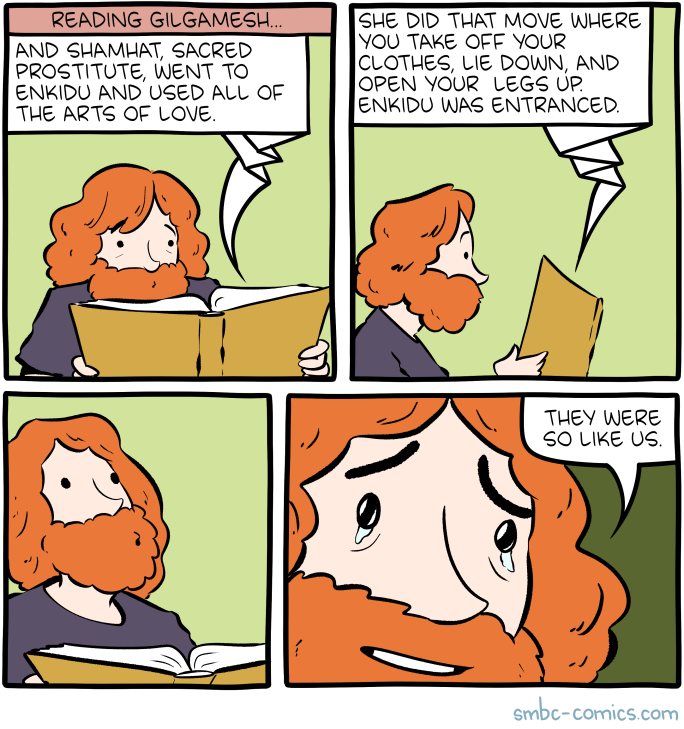
Saturday Morning Breakfast Cereal - Gilgamesh

by tech@thehiveworks.com


Click here to go see the bonus panel!

Hovertext:
No really, read it. This is her number one move.


Today's News:
09 Feb 12:30

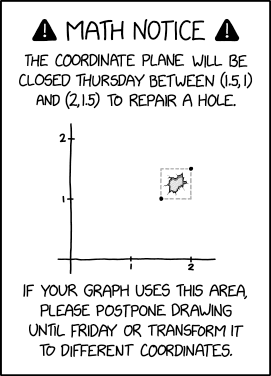
Coordinate Plane Closure

3D graphs that don't contact the plane in the closure area may proceed as scheduled, but be alert for possible collisions with 2D graph lines that reach the hole and unexpectedly enter 3D space.
09 Feb 12:29

Surface

by Sarah Andersen

null

09 Feb 12:28

Cannabis for construction workers, Romance research noir-noir-noir

by Marc Abrahams

This week’s Feedback column (that I write) in New Scientist magazine has four segments. Here are bits of each of them:

  • Cannabis for construction workers — A Nigerian study from 2015 hints at a cannabis boost to efficiency. Manasseh Iroegbu at the University of Uyo, Nigeria, is lead author of “Exploring the performance of mason workers in the construction industry: New evidence from the use of cannabis at work site in a field experiment”….
  • Bear-face on Mars — A smiley-faced bear, discernible in a NASA satellite’s image of the surface of Mars (above), is inspiring smiles on the faces of humans on the surface of Earth. Similar discoveries have garnered two Ig Nobel prizes….
  • Romance research, triple-darkly — Romance can be challenging, especially when one of the romancers seems “dangerous” or “gross”, or has a personality bursting with “Narcissism, Machiavellianism, and psychopathy”, three qualities known as the dark triad. The conjunction of seamy personalities and romance is much studied by psychologists, perhaps none more diligent than Peter Jonason, who has published about 200 studies on the dark triad…. 
  • A little bit missing — While astrophysicists try to identify the “missing mass” that constitutes most of the universe, authorities in Western Australia had to search for a specific, tiny chunk of mass that went missing….
09 Feb 12:27

“Tribbles, my wife loves em, can’t get enough o...

“Tribbles, my wife loves em, can’t get enough of them, but one thing I noticed is that they just can’t stand Klingons. Those tribbles didn’t take a liking to you at all, did they?”

(sequel to Columbo in Space part 1)

09 Feb 12:26

CNET Insiders Say Tech Outlet Softened Coverage To Please Advertisers

by Karl Bode

It hasn’t been a great few weeks for CNET.

If you hadn’t seen, the company was busted using AI to generate dozens of stories without informing readers or the public. Despite newfound hype, the AI wasn’t particularly good at its job, creating content that had persistent issues with both accuracy and plagiarism. Of the 77 articles published, more than half had significant errors (Futurism’s Jon Christian’s coverage of the mess is essential reading).

It wasn’t particularly surprising if you’ve watched the outlet’s coverage over the last decade become increasingly inundated with affiliate blogspam and often toothless, corporate friendly stenography of company press releases. And who could forget that time former CNET owner CBS blocked the company from doling out a CES award to Dish Network as part of a petty legal dispute over cable box ad skipping.

A major reason for CNET’s more recent problems are thanks to its owner, private equity firm Red Ventures, which acquired CNET from CBS in 2020. Recently leaked internal communications and employee accounts from inside CNET indicate that Red Ventures was so excited by AI’s ability to generate content at scale cheaply, it didn’t really care if the resulting content was rife with inaccuracies:

“They were well aware of the fact that the AI plagiarized and hallucinated,” a person who attended the meeting recalls. (Artificial intelligence tools have a tendency to insert false information into responses, which are sometimes called “hallucinations.”) “One of the things they were focused on when they developed the program was reducing plagiarism. I suppose that didn’t work out so well.”

Amusingly, the whole point of doing this, lower costs, never materialized because editing the resulting AI content was more time consuming that editing human work:

The AI system was always faster than human writers at generating stories, the company found, but editing its work took much longer than editing a real staffer’s copy. The tool also had a tendency to write sentences that sounded plausible but were incorrect, and it was known to plagiarize language from the sources it was trained on. 

But AI aside, insiders say the environment created by Red Ventures is one in which affiliate blogspam style coverage takes precedent, and the company is all too happy to obliterate editorial firewalls and soften coverage if it makes advertisers happy:

Multiple former employees told The Verge of instances where CNET staff felt pressured to change stories and reviews due to Red Ventures’ business dealings with advertisers. The forceful pivot toward Red Ventures’ affiliate marketing-driven business model — which generates revenue when readers click links to sign up for credit cards or buy products — began clearly influencing editorial strategy, with former employees saying that revenue objectives have begun creeping into editorial conversations. 

Reporters, including on-camera video hosts, have been asked to create sponsored content, making staff uncomfortable with the increasingly blurry lines between editorial and sales. One person told The Verge that they were made aware of Red Ventures’ business relationship with a company whose product they were covering and that they felt pressured to change a review to be more favorable.

U.S. journalism is, if you hadn’t noticed, already in crisis. There’s a decided lack of creative new financing ideas. There are also endless layoffs, and homogenized, feckless content that’s increasingly afraid of challenging sources, advertisers, or event sponsors. Twice a year the entire United States tech press turns their front pages into glorified blogspam affiliates for Amazon, and nobody, in any position of editorial authority, ever seems to think that’s in any way gross, unethical, or problematic.

AI will likely help human beings in multitude of ways we can’t even begin to understand. But it’s also going to supercharge existing problems (like propaganda) in similarly complicated and unforeseen ways, whether that’s making it easier for corporations to run sleazy astroturf lobbying campaigns, or inexpensively slather the Internet with feckless clickbait and blogspam at unprecedented scale.

08 Feb 23:30

HR won’t do anything about a coworker who’s angry about my weight loss

by Ask a Manager

This post, HR won’t do anything about a coworker who’s angry about my weight loss , was written by Alison Green and published on Ask a Manager.

A reader writes:

I just came back to work after a month-long emergency medical leave. The tl:dr is that after a decade of medical gaslighting, a new doctor ordered an emergency MRI during a routine visit and discovered a mass in my abdomen. I was rushed into surgery within 24 hours. I ended up having an 18-pound benign tumor pressing on my vital organs and I was about a week away from multiple organ failure. I’m lucky to be alive and time will tell if I have any lasting organ damage but right now everything is fine.

Mentally I’m struggling with a few things but the only outwardly noticeable impact is that I’ve gone from a size 20 to a size 8. Nobody on my medical team anticipated a change this drastic but I’m healthy and lucky. I was expecting to get a lot of questions from my coworkers because curiosity exists. I had a basic “emergency surgery but I’m fine now” answer that almost everyone accepted but one coworker who I hardly speak to, Aubrey.

On my first day back to work, Aubrey came up to me and said, “I wish you had come to me to lose the weight instead of resorting to such drastic measures. You’re going to gain it all back, you know. I’ll be waiting.”

I was aware of Aubrey’s reputation, but since we never work together I didn’t think it would be an issue. She’s one of those people who think they’re a fitness expert and calls herself a “health coach” (nothing to do with the company we work for). She has a reputation for giving out unsolicited and incorrect “health advice” and is always commenting on people’s food choices. I was speechless when she asked why I “opted to get butchered instead of putting in the hard work to lose the weight.” There’s nothing wrong with someone choosing surgical weight loss options, but that’s not what happened to me and I really resented her aggressive attitude/spreading rumors.

During my second week back, she came by my office at the end of the day in athletic gear offering to go with me if I was “too afraid to go to the gym alone.” At the time I wasn’t even cleared to lift my kid, do laundry, or climb a flight of stairs, let alone go to the gym with this crackpot. I don’t remember what I said to her, but she left saying I’d gain the weight back because I’m lazy.

The next day Aubrey ranted angrily about me in a meeting I wasn’t in (missed it for a follow-up, ironically). I don’t know everything that was said, but the gist was that if I can’t dedicate myself to weight loss, I obviously can’t see my work obligations through. HR called for a red flag mediation. At our company, mediation can go against your bonus opportunities for the year. I have no idea why I’m in mediation when she’s the one being an asshat.

At the mediation, Aubrey stated that she was triggered by my “new body” and I should have “thought of other people’s feelings and warned” her before my surgery. I hardly had time to warn my husband and get my kid out of daycare. I don’t owe Aubrey anything. I have empathy that she’s obviously struggling, but that does not excuse her behavior.

HR said that while they can’t ask me to explain my medical history, it might clear the air if I told her what kind of surgery I had and why. I said I wasn’t obligated to share my medical information with anyone and that Aubrey having bad coping skills doesn’t entitle her to a coworker’s personal health information. Their response was kind of “well, then we can’t stop her from bullying you.”

After Thanksgiving, my doctor helped me put in ADA accommodation paperwork so I could work from home. I was having some mild complications from surgery but also to avoid Aubrey. This company hates remote work so they’re REALLY not happy. Aubrey still emails me workout videos and diet plans and when I forward them to HR their response is, “Noted. Do you know when you’re coming back to the office?”

I’ve been thinking about escalating this to corporate with an employment lawyer. Is that overkill? I’m still in a sensitive place after my surgery and I have no energy for this, especially since Aubrey is fixated on weight loss which was the primary way doctors gaslit me for years. I’ve been with this company for five years and I’m just exhausted and disappointed in how they’re handling this and I want it over yesterday.

What on earth. Aubrey is obviously batshit bananapants and wildly offensive and out of line — but having one bananapants coworker is less surprising than how much your company’s HR team is dropping the ball.

Aubrey is welcome to have her own private feelings about weight loss, but she needs to keep those feelings to herself at work (and preferably everywhere else too). She is not entitled to harass a coworker about their body, their weight loss, how she thinks they achieved it, or what she thinks they should do next. She is definitely not entitled to refer to someone’s surgery as “butchering” themselves (!) or claim their body triggers her (!) or proclaim that their weight has anything to do with their follow-through on work obligations. (And the whole “you’re going to gain it all back, and I’ll be waiting” thing?! As if after this you’d obviously go to her if you did gain weight? What?)

But, as I said, she’s clearly bananapants. HR’s response in some ways is weirder, because you’d assume they don’t have whatever problems Aubrey is dealing with.

HR should be fully aware that they can’t legally allow an employee to harass another employee about a medical condition — a real one or one that exists in Aubrey’s mind. (The ADA specifically calls this out; you can’t discriminate against or harass an employee because of their protected health condition, or because of a condition they are perceived as having.)

Telling you that they can’t help you unless you share your private medical information with Aubrey … no. They might not be wrong that it would shut her up, but (a) Aubrey isn’t entitled to that, nor should they support the idea that she needs a “good enough” reason to stop, and (b) they’re obligated to shut her down regardless. And making you do mediation with her? No.

And now they’re being weird about your ADA accommodation — and in that context, are blowing you off when you report Aubrey’s latest harassment? That’s a huge problem. The entirety of the picture — the mediation, the vibe you’re getting about your remote work accommodation, and how they’re raising it when you attempt to discuss Aubrey — is concerning enough that talking with a lawyer about your options is a reasonable next step. Not necessarily because you’re going to sue (hopefully it doesn’t get to that point) but because lawyers can be enormously helpful in negotiating with your company on your behalf or advising you from behind the scenes on how to protect yourself.

08 Feb 23:23

I gave two weeks notice but got told to leave immediately

by Ask a Manager

This post, I gave two weeks notice but got told to leave immediately , was written by Alison Green and published on Ask a Manager.

A reader writes:

I quit my first job out of college yesterday. I really liked that job, I was great at it, and I was on good terms with my coworkers and boss. So when I got a job offer I wanted to take, I thought it would be the professional thing to give a standard two weeks, finish off my existing projects, and write a thorough set of transfer documents.

Well. I told my boss I was accepting another job, and he immediately told me that would be my last day, to pack up my things and make a list of projects I was working on, and that someone would reach out to me about benefits. So 10 minutes later, I left, and I’m still pretty stunned and sad.

This happened at the end of the workday, so few people were around. I feel so guilty — I hate that all of my work is getting dumped on other people without warning or explanation from me. Part of me wants to reach out to my coworkers and tell them what happened and how sorry I am, and another part of me wants to not look back.

Emotions are running high for me because I’m going through a lot of personal stuff in addition to this, so I don’t trust my gut to assess this from a purely professional perspective. What’s the right move?

I’m sorry this happened! Your boss is most likely a jerk.

There are some fields where resigning employees are asked to leave immediately (while still being paid for their notice period) as a security measure or if you’re going to a competitor, but you usually know if you’re in one of them so I’m guessing you’re not. (It’s always struck me as kind of a weird policy since if you were going to steal trade secrets, you could just do that before you resigned. But if they pay out your notice period — and that part is a crucial item on the “not a jerk” checklist — then so be it.)

But you have absolutely nothing to feel guilty about. You did the professional thing and gave two weeks notice. If your work is dumped on other people without warning, that’s on your boss, not on you. Your boss had the opportunity to have a smoother transition and decided not to. There’s nothing for you to apologize for!

I do think it’s worth contacting your coworkers to say goodbye, at least the ones you were closest to. First, you’re entitled to say goodbye to people you worked with and give them your contact info so you can stay in touch in the future. Second, there’s a chance your boss is misrepresenting what happened — saying you left without notice or even implying he fired you — and you have the chance to say what really happened.

Don’t make it a gossipy or dramatic thing in your email, but make sure you clearly say you tried to give notice. For example, you could write something like: “I wanted to let you know that Tuesday was my last day at (company). I’ve accepted another job, and when I resigned to Cecil and offered two weeks notice, he told me I should leave immediately. So I didn’t have a chance to say goodbye or tell you how much I’ve enjoyed working with you. (You could insert some personal details here about why you liked working with them if you want.) I hope we can stay in touch and my contact info is below.”

In other words, straightforward, factual, and relatively unemotional.

This is also worth doing because people should know that their manager operates this way. They need to be able to take it into account when the time comes from them to resign — it’s useful for them to know they might be walked out that same day, so they can factor that into their own timing.

08 Feb 17:37

Comic for 2023.02.08 - Yeah

New Cyanide and Happiness Comic
08 Feb 16:58

A federal judge mocks the Supreme Court on abortion

by Ian Millhiser
Police stand guard between a group of anti-abortion protesters and a group of pro-choice protesters outside a clinic in Little Rock, Arkansas. | Greg Smith/CORBIS/Corbis via Getty Images

A Democratic federal judge suggests that banning abortion violates the 13th Amendment’s prohibition on “involuntary servitude.”

Last June, the Supreme Court said in Dobbs v. Jackson Women’s Health Organization (2022) that “the Constitution does not confer a right to abortion.” Given that Dobbs tossed out a half-century of precedent, upended reproductive freedom in about half of the country, and effectively eliminated an entire constitutional right, you probably heard about this decision.

Nevertheless, on Monday, a federal judge in Washington, DC handed down a brief order suggesting that the Supreme Court may not have meant what it said in Dobbs. “The ‘issue’ before the Court in Dobbs was not whether any provision of the Constitution provided a right to abortion,” Judge Colleen Kollar-Kotelly, a Clinton appointee, wrote. “Rather, the question before the Court in Dobbs was whether the Fourteenth Amendment to the Constitution provided such a right.”

And that leaves open the possibility that the Thirteenth Amendment, which prohibits “slavery” and “involuntary servitude,” does forbid laws banning abortion. Judge Kollar-Kotelly’s order requires the parties to a criminal prosecution touching on abortion rights to brief whether the Thirteenth Amendment or “any other provision of the Constitution could confer a right to abortion.”

Unless the membership of the Supreme Court changes drastically, the Court is exceedingly unlikely to rule that any provision of the Constitution protects the right to an abortion. The Court’s GOP-appointed majority stridently opposes abortion rights. They didn’t just overrule Roe v. Wade. They established, in Whole Woman’s Health v. Jackson (2021), that states can effectively immunize anti-abortion laws from judicial review by using bounty hunters to enforce those laws.

Simply put, these deeply committed opponents of abortion rights are not going to reverse course because a judge appointed by a Democratic president writes a clever opinion arguing that forcing someone to carry a pregnancy to term is a form of involuntary servitude.

That said, the argument that the Thirteenth Amendment protects a right to an abortion is serious — or, at least, no less serious than much of the legal reasoning that comes out of this Supreme Court. As Harvard law professor Laurence Tribe has written, “a woman forced by law to submit to the pain and anxiety of carrying, delivering, and nurturing a child she does not wish to have is entitled to believe that more than a play on words links her forced labor with the concept of involuntary servitude.”

Moreover, while Judge Kollar-Kotelly’s order is, at most, a very thoughtful effort to troll the Supreme Court, trolling is now common practice by lower court judges throughout the federal judiciary. The United States Court of Appeals for the Fifth Circuit is dominated by right-wing trolls, who routinely hand down outlandishly reasoned decisions declaring entire federal agencies unconstitutional, ordering the Biden administration to change America’s foreign policy, or even permitting military personnel to defy orders that political conservatives do not like.

It would certainly be best if federal judges all engaged in good faith efforts to follow the law, including well-established legal precedents. But since we don’t live in that world, Kollar-Kotelly’s order raises an arresting question: Why should left-leaning judges unilaterally disarm? If Republican judges can play this game, why can’t judges who support abortion rights do the same?

The Thirteenth Amendment case against abortion bans, briefly explained

Judge Kollar-Kotelly’s order arises out of a case called United States v. Handy, a criminal prosecution of several individuals who allegedly worked together to block access to a reproductive health clinic in 2020, when Roe was still good law.

Among other things, these defendants are charged with violating a federal law that makes it a crime to conspire to “injure, oppress, threaten, or intimidate any person . . . in the free exercise or enjoyment of any right or privilege secured to him by the Constitution or laws of the United States.”

Before Dobbs, this would have been a fairly straightforward case (assuming, of course, that the government can prove its factual allegations against these defendants beyond a reasonable doubt). Prior to Dobbs, cases like Roe established that there is a constitutional right to an abortion. So blocking an abortion clinic injured the right of that clinic’s patients to exercise a constitutional right.

After Dobbs, however, the case becomes more complicated. The government still has a strong argument that blocking an abortion clinic violates a federal statute that specifically prohibits using certain tactics to block access to an abortion clinic — and the government also charged these defendants with violating this statute. Nevertheless, the prosecution’s argument that these defendants violated the broader ban on injuring constitutional rights would be stronger if it could also argue that these defendants violated a constitutional right to an abortion.

Enter the Thirteenth Amendment. Kollar-Kotelly’s order cites two sources — a scholarly article by law professor Andrew Koppelman, which argues that this amendment “is violated by laws that prohibit abortion;” and a Tenth Circuit opinion that discusses a similar argument — to support the proposition that an abortion ban might qualify as “involuntary servitude.”

The argument that the Thirteenth Amendment protects a right to abortion is fairly straightforward. In Bailey v. Alabama (1911), the Supreme Court held that this amendment sought to abolish “that control by which the personal service of one [person] is disposed of or coerced for another’s benefit, which is the essence of involuntary servitude.”

As Koppelman writes, “forced pregnancy and childbirth” by its very nature, operates “by compelling the woman to serve the fetus.”

But wait, what about Dobbs’ statement that “the Constitution does not confer a right to abortion?”

Of course, one major problem with this Thirteenth Amendment argument is that Dobbs spoke in categorical terms about the right to an abortion — or, rather, the nonexistence of that right. Dobbs states outright that “the Constitution does not confer a right to abortion.”

To get around this problem, Kollar-Kotelly rests on a notoriously hard-to-pin-down distinction between a court decision’s “holding” and something known as “dicta.”

Briefly, the portions of an opinion that respond to the specific legal question before a court are considered the court’s “holding,” and are binding on lower courts that consider similar cases. By contrast, when a judge launches into a non-sequitur or otherwise opines on issues that are not relevant to the actual legal issue in the case, those portions of the judge’s opinion are considered “dicta” and are not binding.

As Kollar-Kotelly writes, quoting from the eminent federal Judge Henry Friendly, “a judge’s power to bind is limited to the issue that is before him; he cannot transmute dictum into decision by waving a wand and uttering the word ‘hold.’”

The specific issue that was before the Court in Dobbs, Kollar-Kotelly notes, was whether the Fourteenth Amendment protects a right to an abortion, not whether any other provision does so. “That is why neither the majority nor the dissent in Dobbs analyzed anything but the Fourteenth Amendment,” she writes. Thus, the Court’s broad pronouncement that the Constitution as a whole “does not confer a right to abortion” can plausibly be dismissed as dicta.

Realistically, this argument is unlikely to persuade anyone on the Supreme Court who joined the majority opinion in Dobbs. The distinction between holding and dicta is notoriously slippery. And even if five justices were convinced that Dobbs’s broad announcement about the entire constitution is dicta, those justices would still have the formal authority to simply reject the Thirteenth Amendment argument for abortion rights on the merits.

The Supreme Court can only blame itself for Kollar-Kotelly’s order

Again, unless two Republican appointees on the Supreme Court unexpectedly leave the Court and are replaced by Democrats, the justices are about as likely to rule that the Constitution protects a right to an abortion as they are to move the Supreme Court’s building to Mordor, Asgard, or the Unseelie Court.

And, again, in a better world, judges would behave as servants of the law — rather than trying to stretch that law to serve their particular agenda.

But here in the actual world, lower courts do not always operate as loyal followers of the Supreme Court’s precedent. They often act as think tanks for new legal ideas that haven’t gained support on the Supreme Court, but that could at some point in the future. The Fifth Circuit more or less operates as a generator and legitimizer of right-wing ideas that are often, but not always, rejected by this Supreme Court. So do several federal trial judges that have become favorites among right-wing advocates seeking to move the law hard to the right.

If this Supreme Court didn’t want lower court judges to act like partisan trolls, it could communicate that to those judges by hewing more closely to legal texts and to existing precedents. But, if anything, this Court has actively encouraged judges on the rightward extremes of the federal judiciary to play games with the law.

Kollar-Kotelly’s order cannot really be defended as a serious attempt to convince this Supreme Court to change the law. But, at worst, it is simply the center-left equivalent of the kind of judicial entrepreneurship that routinely goes on at the Fifth Circuit. The Supreme Court should not be surprised that, if it refuses to rein in egregious overreach by courts like the Fifth Circuit, Democratic judges will also start behaving like they have a free hand.

08 Feb 14:14

Andrew Plotkin’s treasury of Zork maps

by Andy Baio
the one by cart00nlion is just beautiful #
08 Feb 12:46

The Jedi Academy Will No Longer Teach Anakin Skywalker’s Massacre of the Younglings

by Max Davison

“The new Republican governor of Arkansas, Sarah Sanders, said the move to ban critical race theory in public schools in her state was a preventative measure… ‘Our teachers absolutely need to teach our history,’ Sanders said, ‘but they shouldn’t teach our kids and our students ideas to hate this country and to give a false premise about who we are and what we’re about. And that is something that we have to make sure we protect our students from.’” – The Guardian

- - -

I sense a great disturbance in the Force. Cynical academics are attempting to corrupt our society with their inaccurate revisionist history. In order to protect our Padawans from being indoctrinated in the Dark Side’s ideology, the Council has decided to excise certain ugly chapters from the ancient Jedi texts.

The revised curriculum will not cover Order 66, the minor instance in which the Jedi Council misinterpreted a prophecy, chose the wrong chosen one, and allowed the Sith to infiltrate our ranks, which all culminated in Anakin Skywalker murdering the younglings in cold blood and then proceeding to enslave the entire galaxy. This isolated incident does not reflect who we are as a modern society and does not need to be taught to our youth.

We don’t deny that these events took place. Is Anakin Skywalker part of our shared history? Of course he is. Is he the defining element of our saga that continues to inform all of our subsequent actions? Hardly. “Skywalker” is not the only last name in our lore. Teaching Anakin’s failings would only cause the Padawans to question their leaders’ authority and worry that they, too, could be either corrupted or murdered. Which they won’t.

Despite what some have alleged, this is not an attempt at whitewashing our history. Instead, we are striking back against the propagandistic anti-Jedi agenda that permeates academia. These so-called “historians” are fixated on the one moment in history when we could not identify great evil, even when it was in front of our faces, leading to the mass slaughter of our ranks. But what exactly are modern Jedi supposed to learn from this? The days of intergalactic tyranny are long past. The Empire won’t rise again. The Death Star won’t be rebuilt. We’ve learned our lesson already. This critical theory only makes young Jedi feel shame for something they never did.

And this is precisely where the new Empire begins: in our classrooms. Our school systems are building the next generation of mindless Stormtroopers by exposing them to politicized counternarratives, causing them to question accepted history and rethink the infallibility of our great heroes. We need to fight against this totalitarian thought control by imposing our own limits on what ideas and concepts our students are allowed to believe.

Fear leads to anger. Anger leads to hate. Hate leads to suffering. So let’s prevent our Jedi younglings from encountering any negative portrayals of our history. The Jedi should not be seen as the group that allowed the Empire to rise but as the Rebels who rose to prevent the Empire from ever returning. For a period of time. Instead of highlighting his time as Darth Vader, we will only teach Anakin’s profound redemption, sacrificing himself to defeat Palpatine and prevent the Emperor from ever rising to power again. For a period of time, that is.

Instead of harping on about how the Jedi Knights are “an outdated patriarchal order of white men,” we spend an entire week teaching about Mace Windu, a proud Jedi person of color who proved that the Force does not discriminate. His purple lightsaber blazed a trail for other JPOC, who are always welcome in our world.

The Jedi Code instructs us to avoid attachment. And thanks to this, we are very good at ignoring the undesirable parts of our history. Supreme Leader Snoke. The Holdo Maneuver. Jar Jar Binks? Never existed. Luke becoming a hermit who turned his back on the fight after failing as a teacher? That’s an ugly mischaracterization of a great man. Everything involving Kylo Ren and Rey? Best forgotten. We don’t need these unfortunate outliers in our canon, poisoning our memories of the Golden Age with their moral relativism and realistic depictions of our founding heroes.

The goal of our academy is to forge great leaders, not to create activist, political progressives who tear down the Jedi Order from within. We should be training more students like Grogu. Grogu is quiet, is inoffensive, and doesn’t push us into dark introspective caves that cause us to rethink any of our preconceived notions. We need more Grogus in this world!

This revamped syllabus offers a new hope for the next generation of Jedi. It will inspire our students, protect our legacy, and reaffirm our childhood notions of good and evil. Together, we will write bold new chapters while also clinging to comforting old standards that are too precious to abandon, and we will lash out whenever any outsider attempts to alter our sacred dogma by even the slightest degree.

This is the way.

08 Feb 12:44

Transport Tycoon fan remake OpenTTD gets largest update in years

by Graham Smith

OpenTTD 13.0 been released, which is "one of the largest releases we've done in several years" according to the developers. If you don't know OpenTTD, it's an open source and free fan remake of Transport Tycoon which greatly expands, polishes and modernises the beloved business sim. This latest update improves the interface further, tweaks the world generation, and more.

Read more

08 Feb 05:12

Wedding Dress Codes Certain to Impress and Befuddle Your Guests

by Mary Sasson

Business Vulnerable

Beach Tragedy

Garden Party Murder Mystery

Fish Tank Chic

Mocktail Attire

Whimsical Police Auction

Semicolon Formal

Traffic Court Casual

Last Dinner as a Family Before You Announce Divorce at Dessert

Destination (Final)

Disney Adult

Eighth Grade Semi-Formal

Rae Dunn

White Tie-less

Woodstock ’99

Frenemy

Boho Christmas

New Coke

Come as You Are (As I Want You to Be) / (Nirvana)

08 Feb 05:10

Saturday Morning Breakfast Cereal - Trust

by tech@thehiveworks.com


Click here to go see the bonus panel!

Hovertext:
I don't even trust MYSELF to catch my wife, even if I'm intending to.


Today's News:
08 Feb 00:57

10 Classic Sci-Fi Novels That Need To Be Adapted Into Movies

by Chris Heasman

Science fiction movies have shared a close relationship with their literary counterparts for as long as they've existed. The first sci-fi film ever made, Georges Méliès' 1902 short "A Trip to the Moon," was inspired by two Jules Verne novels, "From the Earth to the Moon" and "Around the Moon," as well as H.G. Wells' serialized novel "The First Men in the Moon." From there, countless movies — including some of the greatest of all time — have been based on sci-fi novels, novellas, and short stories.

Let's put it this way: Without the vast cosmos of sci-fi literature to draw from, we would never have experienced "Metropolis," "Frankenstein," "Invasion of the Body Snatchers," "2001: A Space Odyssey," "A Clockwork Orange," "Solaris," "Planet of the Apes," "Blade Runner," "Total Recall," "Starship Troopers," "The Thing," "Jurassic Park," "Minority Report," "Children of Men," "Arrival," "Annihilation," "Edge of Tomorrow," and a hell of a lot more.

Clearly, books have made an invaluable contribution to the world of cinema over the last 120 years, but there are still many worlds left to explore. Here are some classic sci-fi novels that, despite being ripe for adaptation, have yet to receive their moment on the silver screen.

The Left Hand Of Darkness — Ursula K. Le Guin

"The Left Hand of Darkness" is arguably the most famous of the 19 stories that make up Ursula K. Le Guin's Hainish Cycle. Published in 1969, the novel is set in a future in which much of the known universe has banded together to form the Ekumen, a loose federation of worlds that provides trade, knowledge, and protection to its members. Genly Ai, a Terran envoy for the Ekumen, is sent to the planet Gethen — known to his people as "Winter" — to convince the native population to take their first steps into the wider universe.

Le Guin's book is particularly well-suited for film because it so deftly strikes so many different chords at once. In one sense, it's a political thriller, as Genly struggles to navigate Gethen's different factions and convince their leaders to join his cause. In another, it is a study of gender; the inhabitants of Gethen are ambisexual, only adopting "male" or "female" traits once a month, and Le Guin uses this quality to shine a light on our own attitudes towards masculinity and femininity. "The Left Hand of Darkness" also features a love story for the ages, as Genly and Estraven, an exiled politician, fall deep into a discordant and passionate romance. And then, seemingly out of nowhere, the back end of the novel explodes into a gripping adventure story, forcing the two lovers to race against time across Winter's northern ice sheets.

A mission for peace; a strange alien civilization; a doomed romance; a stirring third-act escapade — and it's all combined with some of the finest world-building this side of J.R.R. Tolkien. It's a marvel that "The Left Hand of Darkness" hasn't been adapted a dozen times already.

The Blazing World - Margaret Cavendish

Mary Shelley is often (and rightly) considered to be the mother of science fiction, but the genre's foundations were laid long before "Frankenstein." In 1666, English writer Margaret Cavendish, Duchess of Newcastle, published "The Description of a New World, Called the Blazing-World." The story follows an unnamed "Lady" who, after journeying through a passageway near the North Pole, finds herself lost in a utopian world populated by anthropomorphic beasts. Crowned Empress of the Blazing World, the Lady launches a military invasion to rescue her homeland from an existential threat. Cavendish's groundbreaking novel was actually the very loose inspiration behind "The Blazing World," a 2021 thriller about the traumatic homecoming of an American college student. Still, that movie is sorely lacking in talking animals, arctic exploration, and naval warfare, so it's hard to argue that it's a real adaptation of the original story.

It's a real shame that we've never had a proper "Blazing World" film, too. While the book isn't exactly an easy read — it's very obvious that it was written in the mid-17th century — it is a staggeringly imaginative work, one that feels bold and fantastical even by today's standards. It's also surprisingly exciting: The middle of the novel gets a little bogged down in philosophical navel-gazing and meta commentary, but the second section, in which the Empress clothes herself in bejeweled robes and leads her golden submarines to the shores of Europe, is a genuine thrill. Give it to Guillermo Del Toro and watch the awards pile up.

The Sirens Of Titan — Kurt Vonnegut

Kurt Vonnegut's sophomore novel is considered by many (and by "many," I mean "me") to be the finest work of sci-fi comedy ever made. Released in 1959, "The Sirens of Titan" revolves around Malachi Constant, an ultra-wealthy and incredibly fortuitous businessman who is given a bizarre prophecy by an omniscient space explorer. During his fruitless attempt to flee his fate, Constant is caught up in a Martian invasion of Earth, the establishment of a global religion, and a final, devastating journey to Titan itself.

"The Sirens of Titan" tackles a number of heavy themes across its 300-or-so page count, from the nature of free will to the meaning of life itself, but what really strikes you is just how much fun it all is. Vonnegut's ability to balance the hilarious with the heartbreaking is beyond compare, and his uncanny knack for clever dialogue and absurdist humor could, in the hands of a capable screenwriter and director, make for a truly wonderful sci-fi movie.

It does bear mentioning that we've come tantalizingly close to a "Sirens of Titan" adaptation before. Back in 2017, Variety reported that "Community" and "Rick & Morty" creator Dan Harmon had been hired to develop a TV series based on Vonnegut's book. He was still writing scripts for the show during a GQ interview in 2018, but nothing has been said about it since then. For now, it seems, the adventures of Malachi Constant will remain confined to the page. What a shame.

We — Yevgeny Zamyatin

A number of dystopian sci-fi movies have come from books. The most famous, of course, is "Nineteen Eighty-Four," Michael Radford's adaptation of the George Orwell classic, but countless others exist too, including "The Road," "Children of Men," and the "Hunger Games" franchise. "We," the 1921 novel by Yevgeny Zamyatin, might not be as recognizable as some of those names, but the novel's influence on the genre is undeniable: Orwell himself believed that it inspired Aldous Huxley's "Brave New World," and he lifted more than a few of its beats for his own story.

"We" is about D-503, a spacecraft engineer who lives in the One State, an authoritarian dystopia defined by mass surveillance, total subservience, and the worship of logic above all. When D-503 meets I-330, a charming rebel who claims to be part of an underground movement to overthrow the One State's dictator, he finds himself torn between his duty and his growing desire for freedom. If this all seems a little derivative, know that it's only because Zamyatin did it before anyone else — Kurt Vonnegut once said that, in writing his own dystopian novel, "Player Piano," that he "cheerfully ripped off the plot of 'Brave New World,' whose plot had been cheerfully ripped off from Yevgeny Zamyatin's 'We.'"

While we've seen many adaptations of the stories that "We" influenced, Hollywood has yet to breathe new life into the original. (A Russian version was supposed to release in 2021, but seemingly has yet to see the light of day.) As events in the real world become ever more, uh, interesting, works such as "Nineteen Eighty-Four" and "Brave New World" are being brought closer to the fore of the cultural zeitgeist. Why not go back to where it all began?

Kindred — Octavia E. Butler

Thanks to the efforts of creators like Jordan Peele, Nia DaCosta, and Misha Green, Black-led horror movies and shows have experienced something of a boom in recent years. Aside from a few noteworthy projects, however — "Black Panther," maybe, or "Sorry to Bother You" — Black science fiction has yet to find much mainstream success at the movies. This is a particular shame, since Black authors have been producing fantastic sci-fi literature since the advent of the genre.

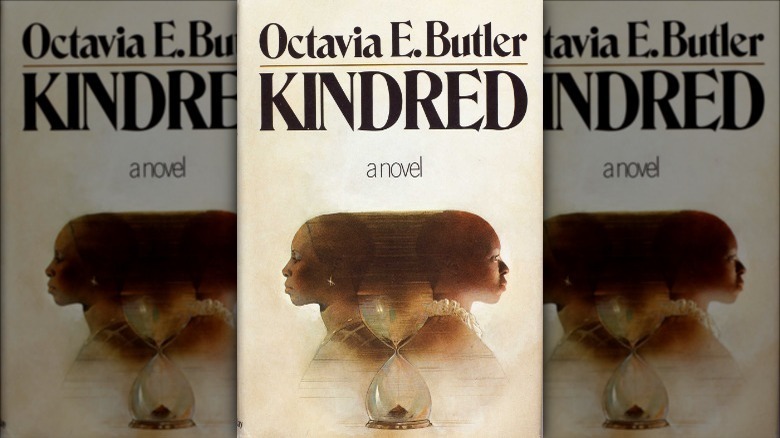
Take "Kindred," for example. Written by legendary sci-fi author Octavia E. Butler, "Kindred" is rooted firmly in the history of Black America. The story follows Dana, a young writer who begins to inexplicably flit between modern day Los Angeles and a Maryland plantation in the 1800s. Over time, Dana's trips to the past become longer, forcing her to reckon with the brutality of slavery and its impact on her ancestors.

By depicting slavery through the eyes of a contemporary protagonist, "Kindred" offers a unique take on a story that has rarely been done justice on the silver screen, and Butler's complex portrayal of slave communities is remarkable even today. It's fair to say that faithfully adapting Butler's novel into a feature would be difficult (Hulu made a disappointing attempt at a TV series in 2022), but, if someone succeeded, it would almost certainly be a stunning success — and could kick-start the golden age that Black sci-fi cinema deserves.

The Restaurant At The End Of The Universe — Douglas Adams

In 2005, Garth Jennings directed an adaptation of Douglas Adams' iconic sci-fi novel, "The Hitchhiker's Guide to the Galaxy." Although many critics would disagree, I'm actually a big fan of the "Hitchhiker's Guide" movie — despite making a few key changes to the plot of the book, it's absolutely stuffed with heart and feels Adamsian to its core (probably because he co-wrote the screenplay prior to his death). Sadly, despite ending on a sequel hook, a second installment never materialized; in 2007, Martin Freeman told MTV that the first simply didn't do well enough to warrant another.

It's too bad, too, because "The Restaurant at the End of the Universe" is just as funny and irreverent as "The Hitchhiker's Guide to the Galaxy." In the second installment in the five-book series, Zaphod Beeblebrox and Marvin the Paranoid Android set out to meet the Ruler of the Universe, Arthur Dent and Ford Prefect journey to prehistoric Earth, and the whole gang visits the eponymous restaurant, where diners are able to witness the destruction of the universe itself. It's all deeply weird — weirder even than "Hitchhiker's Guide," though not nearly as absurd as the subsequent books in the franchise.

Honestly, I'm not sure how well "The Restaurant at the End of the Universe" would translate to the screen. Certain aspects were adapted into the superb "Hitchhiker's Guide" TV show from the early '80s and the radio series that preceded it, but in those cases the story acted more as a middle chapter in a larger narrative. Could anyone actually pull off a straight, standalone adaptation? Maybe, maybe not. All I know is that the original 2005 movie absolutely deserves a sequel.

Downbelow Station — C.J. Cherryh

"Downbelow Station" is part of C.J. Cherryh's epic Alliance-Union universe, a series of 27 novels and seven short story anthologies that detail the conflict between a private corporation called the Earth Company, the trade confederacy known as the Alliance, and the Union, a rebel government based on the distant world of Cyteen. Published in 1981, the first novel in the saga depicts the final days of the war as experienced by the denizens of a space station orbiting Pell's World, which the residents call "Downbelow."

To say that Cherryh's universe is complex would be an understatement. Beneath the dense world-building and politicking that drives "Downbelow Station," however, you'll find a sprawling human drama played out by a compelling cast of characters. That's the novel's brilliance, really: The reality of this cosmic war always feels intimate, and the people affected by it — whether they're soldiers, refugees, or otherwise — are fully-realized and believable. Nevertheless, it all leads towards a spectacular climax filled with betrayal and destruction, one that justifies the slower first half and then some.

It's easy to imagine "Downbelow Station" as a kind of "Game of Thrones"-style streaming series, but it's arguably just as suited to the movies. A film adaptation could easily stand as a tense and claustrophobic one-off about the social trauma wrought by war, or it could play into the space opera angle, kick up the action, and spark a whole franchise. Either way, the best aspects of Cherry's novel would work marvelously in cinema.

The Drowned World — J.G. Ballard

Back in 2016, Ben Wheatley brought J.G. Ballard's most famous sci-fi book, "High Rise," to the big screen. Despite that movie being genuinely pretty great, I would argue that he chose the wrong story. The author's second novel, 1962's "The Drowned World," is a striking and strangely beautiful portrayal of an environmental post-apocalypse, one that might have as much of an impact on a 21st century audience as it would a 20th century reader.

Set in London in the 22nd century, "The Drowned World" takes place long after an array of solar storms have played havoc with the Earth's ionosphere, leading to rapid global warming and flooding most of the planet. Dr. Robert Kerans, a scientist tasked with studying the prehistoric creatures and plants that have emerged in the sunken city, begins to dream of ancient lagoons, giant beasts, and an ever-thrumming sun — and soon finds that his companions are experiencing the same visions. Kerans' regression into his biological roots only becomes more complicated by the arrival of Strangman, the terrifying leader of a band of pirates and, if you ask me, one of the genre's most underrated villains.

In "The Drowned World," Ballard weaves a vision of the future that feels so utterly oppressive that it's almost hypnotic, rife with abandoned skyscrapers and giant lizards; visually, it could give any sci-fi classic a run for its money. That's to say nothing of the story's focus on climate, too, which would no doubt resonate in a world that is, if not quite drowned, certainly getting there. Few literary adaptations would feel more timely.

The Moon Is A Harsh Mistress - Robert A. Heinlein

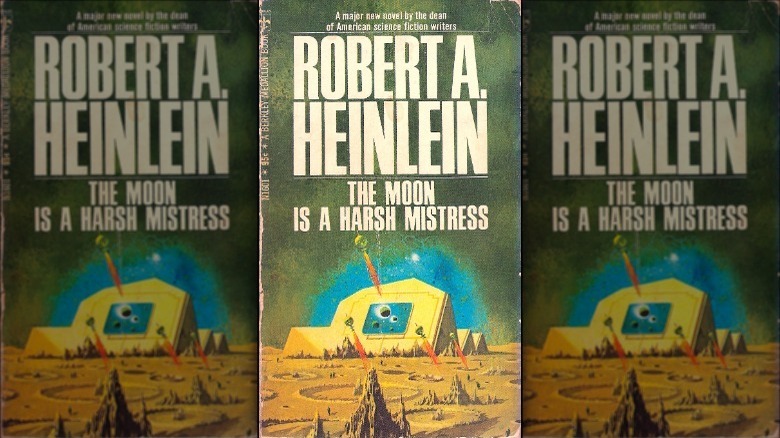
Published in 1966, Robert A. Heinlein's "The Moon Is a Harsh Mistress" tells the tale of a revolutionary war waged against Earth by a lunar colony. Guided by a sentient supercomputer named Mike, the so-called "Loonies" declare independence from their masters after realizing that the wheat tributes they send to Earth will eventually lead to the collapse of their burgeoning civilization. The leaders of the uprising, Mannie, Wyoh, and Prof, subsequently find themselves in a world of intrigue and oppression.

Above all, "The Moon Is a Harsh Mistress" is a careful examination of the politics of rebellion. Heinlein tackles many subjects in the novel, from gender relations to economics, and spends a good deal of time opining on each. This is not why it would make for such a good film, though — in fact, I would say any movie adaptation would do well to cut most of that out. No, "The Moon Is a Harsh Mistress" earns its place on this list because the basic premise — moon-people build society, Earth oppresses them, war breaks out — holds so much potential. As such, it really doesn't need to be faithful to the original story; simply hire a bunch of A-listers, throw half the budget into pyrotechnics, and let the good times roll.

That said, this is also another book we can chalk up as a near-miss in Hollywood. Back in 2015, The Hollywood Reporter revealed that Bryan Singer had been signed on to direct a movie adaptation of Heinlein's novel, titled "Uprising." Considering Singer's well-deserved fall from grace in recent years, though, this is probably another project that won't be arriving in theaters any time soon.

The Long Tomorrow — Leigh Brackett

Leigh Brackett was no stranger to Hollywood. Once described by Gizmodo as the "Queen of the Space Opera," Brackett's name is best known to cinephiles as an early contributor to the screenplay of "The Empire Strikes Back." She was an author first and foremost, however, and her 1955 novel "The Long Tomorrow" is one of her definitive sci-fi works.

"The Long Tomorrow" takes place in a world ravaged by nuclear war. In the aftermath, the few survivors have developed an innate hatred of technology, and the gap left by the absence of modernity has been filled by religious fundamentalism. The story follows two rebellious teenagers, Len and Esau, who set out to find Bartorstown, a distant community that is said to wield the power of old technology. Aside from the obvious science-versus-religion motif, there's a kind of post-apocalyptic Mark Twain vibe to "The Long Tomorrow," albeit with a healthy dash of "The Road" mixed in for good measure.

It's unlikely that a cinematic adaptation of Brackett's novel would become a smash-hit blockbuster, but the world of "The Long Tomorrow" is so captivating — and the themes so familiar even today — that the opportunity is simply too good to pass up.

Read this next: Sci-Fi Box Office Bombs That Deserve A Second Chance

The post 10 classic sci-fi novels that need to be adapted into movies appeared first on /Film.

08 Feb 00:45

Scale of the Chinese balloon

by Nathan Yau

I wasn’t paying much attention to the Chinese balloon that the U.S. shot down — until this graphic by JoElla Carman for NBC News floated by. The balloon was 200 feet tall, which makes the Thanksgiving parade Snoopy balloon look tiny and about equivalent to the wingspan of a Boeing 747.

Tags: balloon, NBC News, scale

07 Feb 19:12

Comic for 2023.02.07 - Blood Group

New Cyanide and Happiness Comic
07 Feb 19:11

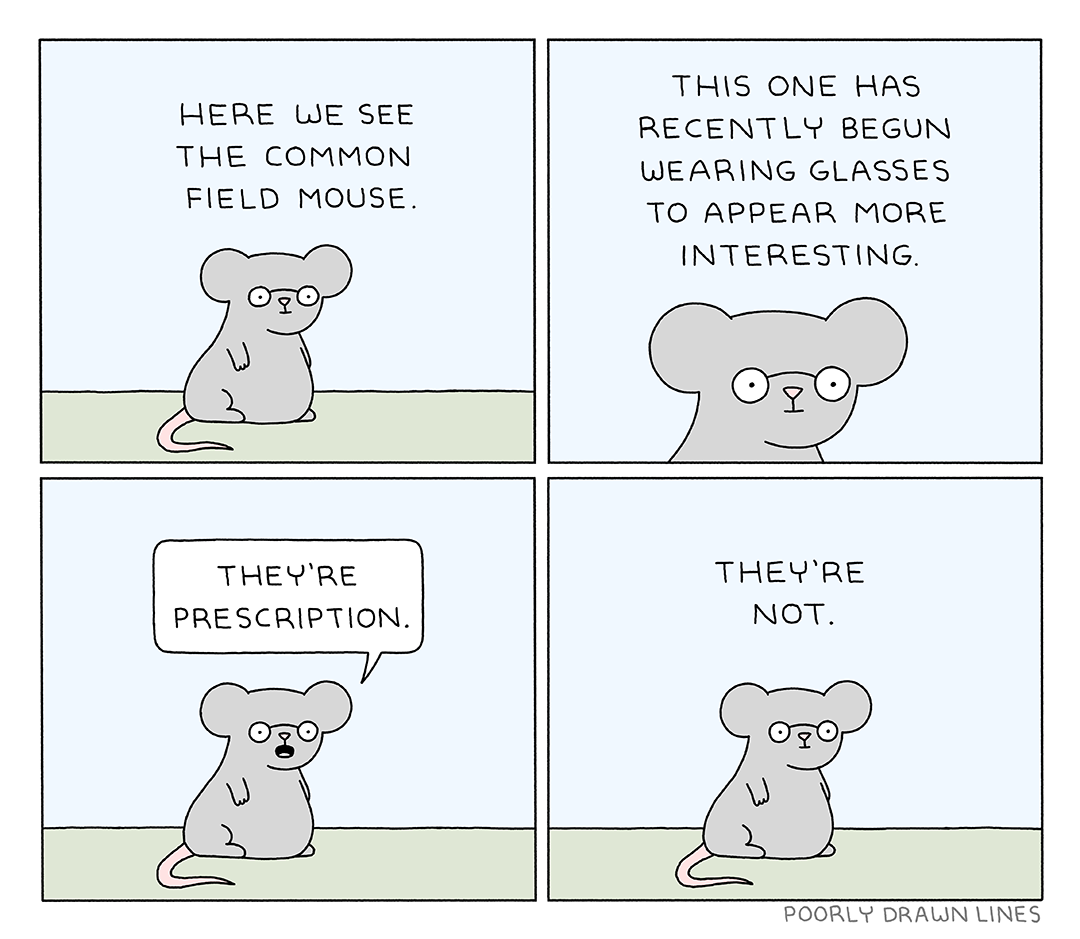
Common Mouse

by Reza
07 Feb 19:11

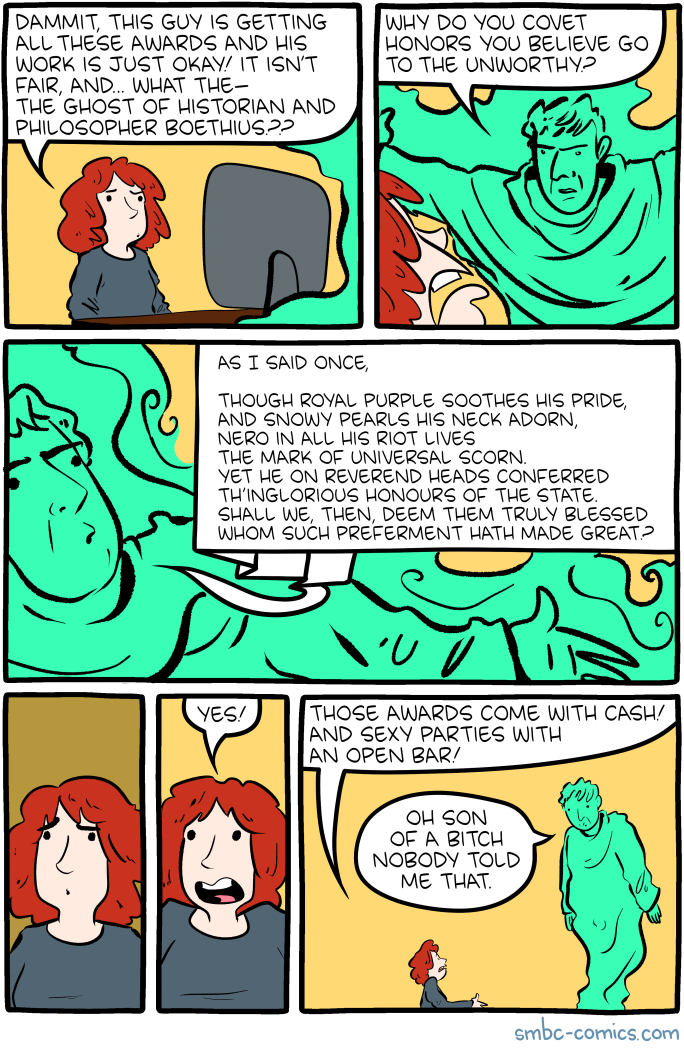
Saturday Morning Breakfast Cereal - Boethius

by tech@thehiveworks.com


Click here to go see the bonus panel!

Hovertext:
Fact: Boethius wrote in modern English, with rhymes,


Today's News:
07 Feb 17:29

Sponsored: 18 More Days Until You’re Struck And Killed By Kia Sorento

CHICAGO—In a hit-and-run expected to leave your loved ones devastated, a new report released this week found that there were only 18 days left until you would be struck and killed by the all-new 2023 Kia Sorento. “The countdown to oblivion has begun, starting at only 2.9% APR,” read the report, which noted that the…

Read more...

07 Feb 17:29

Police Stop Black Civilian For Fitting Description Of Giant Fire-Breathing Reptile Terrorizing Tokyo

LOS ANGELES—In an incident widely criticized as racial profiling, sources reported Thursday that L.A. police officers had stopped a local Black man who they claimed fit the description of a giant, fire-breathing reptile that was currently terrorizing Tokyo. “Right after we heard reports of a 400-foot kaiju knocking…

Read more...

07 Feb 13:03

how do I reply to my coworker’s apology without saying her constant mistakes are OK, coworker calls me “mama,” and more

by Ask a Manager

This post, how do I reply to my coworker’s apology without saying her constant mistakes are OK, coworker calls me “mama,” and more , was written by Alison Green and published on Ask a Manager.

It’s five answers to five questions. Here we go…

1. My coworker keeps causing more work for me, then apologizing — and I don’t want to tell her it’s OK

I’m in a weird situation right now. My coworker, who I’ll call Jane, made a big mistake over the weekend. Big enough that I was called and my boss had to cover for the mistake. In this instance, she didn’t do something I had specifically asked her to do during her working hours on a Friday. The Monday after this happened, it became a Big Deal, and we were both questioned separately on what happened.

This isn’t the first time Jane has made an error and other errors she has made have resulted in incorrect pay that I need to go and clean up after. I am getting tired of having to constantly clean up her mistakes. She apologizes and I’ve always said it’s fine, but at this point, it’s no longer fine. She’s been in the job for almost six months and keeps making the same mistakes.

How can I kindly accept her apology without blanketing over the fact that she continues to make these errors?

You don’t have to say it’s fine if it’s not fine. You shouldn’t be mean about it, of course, but when she apologizes, you could say, “I appreciate that, but is there something we can change to avoid it happening again?” or “I want to make sure we’re putting systems in place that will head this kind of thing off before it happens — is that something you could talk to (manager) about?”

It also sounds like things are at the point where you should talk to your boss about it, if you haven’t already, to point out the impact it’s having on your own work (as well as your weekend, in this case).

2. Coworker calls me “mama”

In a former position, a coworker used to call me “mama.” I am not a mom and she was older than me, but it was seen as a cultural thing, so no one else seemed to care. As I move forward in my career, I would like to nip such things in the bud without coming across as insensitive or aggressive. What’s will be the best approach to being firm enough to prevent this reoccurrence without being seen as too harsh?

“Oh, please just call me Jane — thanks!”

And then if it continues, be more direct: “I don’t like being called ‘mama.’ Just Jane, please!” Or, depending on your style, “I’m no one’s mama — just Jane, please” or “”Mama’ throws me way off — just Jane, please.”

There are indeed cultures where “mama” is a term of respect, but it’s okay to say you want to be called by your name.

3. Can I negotiate more time before I start my new job so I can help my old job replace me?

I’ve essentially been offered a job as long as my references check out (and I can’t imagine they won’t). I’d like to have a longer than standard two-weeks notice period so that my current employer can have enough time to find someone and have me somewhat train them. They’ve, unfortunately, put themselves in the position of having me do everything, and I’m not sure what they’ll do once I leave.

Is there a way to negotiate a longer notice period with the new employer? I’m not sure what to say to them to have this happen.

Please don’t do this! It would be one thing if you wanted to ask for an extra week to see through one crucial project, but you’re talking about asking for multiple extra weeks, even months. Giving your employer time to advertise the job, interview people, hire a replacement, and wait for that person start and then for you to spend time training them — you’re talking about at least a month, and in many jobs two months or more. That’s a major request of your new employer, and it’s something that people just don’t really do in this situation.

It would be different if you needed the time for other reasons — like if you had a vacation or surgery scheduled or just wanted a week or two off in between jobs. But you’d be proposing a major inconvenience to your new employer just to benefit your old employer.

The situation you and your current job are in is a really common one: Very often when someone resigns, it leaves a major gap for the old employer and the person leaving worries about what will happen. And yet … the business handles it. They figure it out and life goes on. It’s not your problem to solve for them, and definitely not at the expense of your new job. (Also, when people are in your situation, they tend to feel like their situation is an exception — that they’re unusually indispensable, that their leaving will cause an unusual amount of chaos and disaster, that their employer is particularly helpless — and it’s almost never the case. So many people feel that way, and rarely does the business collapse after they’re gone.)

Leave your projects thoroughly documented and that’s all you’re obligated to do. If you’re really feeling generous, you could offer to be available for a training call or two with the new person once they’re hired (for pay), but frankly I wouldn’t recommend that in most situations; it’s better to make a clean break and focus on your new job.

4. How much admin work should you do before your first day of a new job?

I just accepted a job offer from a new organization for the first time in seven years and am trying to figure out how much things have changed. While I’m very excited about the job and it’s not a deal breaker for me, they’ve sent a lot of stuff to completed that I’ve always done on my first day at my previous companies. I had to create an account through ADP, fill out all my tax forms, emergency contact info, and paycheck info, read and acknowledge the employee handbook, submit photos of my IDs, and they still want a high resolution photo for my security badge, all due on the last business day before I start.

Everywhere else I’ve worked had me do all that on the first day on their own systems, but it’s also a lot easier to complete this from a mobile app these days (though I’m not thrilled about uploading my passport photo, etc). Do I just need to go with the flow, or am I right to be kinda annoyed they’re requesting all this before I’m on the clock?

This does seem to be happening more often these days; employers seem not to see it as work that should wait for your first day, but more akin to something like signing an offer letter, even though it takes a lot more time.

The path of least resistance is to just go with it if it’s not a major hassle for you. But if it is, you could say, “My schedule before I start is really packed, so I don’t think I’ll be able to get to most of this until my first day. Can you tell me which tasks are essential for me do before then?” That gives them an opportunity to tell you, for example, that you should at least do the ID photos so you’re not prevented from navigating the building on your first day, or whatever the case might be.

5. How do I tell my new job I have a brain tumor?

I recently left a terrible job and started a new one that has been fantastic to me and very good in general. However, I’ve spent the last year having MRI’s and neurologist visits and found out a week after starting that I have a brain tumor.

I’m worried that sharing this with my new employers will cause me difficulty at work, but at the moment, it’s not having any effects on my work and I do want to be honest with them about it. I’m just a little reluctant to do so, because at my previous not great job, any mention of anything that required me to take time off (I had Covid and a bad mental health time) was not received well, and nor were the medical issues of the other staff. I’m sure the job I have now won’t be like that, but as a new employee, how do I bring up the topic that I have a brain tumor?

I’m so sorry you’re dealing with this. You don’t need to — and probably shouldn’t — bring it up since it doesn’t sound like you want to request any accommodations right now.

As a general rule, it’s safest to only disclose a health condition at work when you need to ask for a specific accommodation connected with it, and that’s especially true at a new job. (That doesn’t mean you need to go out of your way to keep it a secret, but it sounds like you’re feeling that you need to share this with them and you don’t.) If there comes a time when there’s something specific you need to ask for, you can tackle that then — and even then, you don’t necessarily need to disclose specifics if you don’t want to — but for now you’re not under any obligation to share your health situation. (This post talks about this in the context of mental health issues, but a lot of the same principles apply.)

07 Feb 13:00

Electron Color

There's quark color, but that's not really color--it's just an admission by 20th century physicists that numbers are boring.
07 Feb 12:59

Modern Stoic Philosophy

by Corey Mohler
PERSON: " "

PERSON: "Amazing! I always knew Stoic Virtue is the way to live."

PERSON: "I'll show you how everyone is embracing your ideas 2000 years later!"

PERSON: "Great!"

PERSON: "Use the techniques of Stoicism to DOMINATE your business rivals!"

PERSON: "The advantage of Stoicism means you can ride the waves of the crytpo market without fear!"

PERSON: "It's a good thing i'm a master of stoicism, or this would be quite upsetting."
07 Feb 04:46

Lawmakers Propose Letting Prisoners Donate Organs For Reduced Sentences

Massachusetts Democrats have proposed a bill that would allow prisoners to donate their organs for reduced sentences, giving people up to a year off their prison sentence “on the condition that the incarcerated individual has donated bone marrow or organ(s).” What do you think?

Read more...

07 Feb 04:45

a very good update: how to tell a former employee he can’t visit us weekly

by Ask a Manager

This post, a very good update: how to tell a former employee he can’t visit us weekly , was written by Alison Green and published on Ask a Manager.

Remember the letter-writer asking how to tell a former employee he couldn’t visit their office weekly (#3 at the link)? The update is one of my favorites ever (and I probably should have saved it for Valentine’s Day but you are getting it now because I love it too much to wait):

I have an update to a question you posted a few months ago about our retired worker, Frank, who kept dropping by weekly for hours long chats. A very big THANK YOU to the commenters who suggested volunteer work. I don’t know why that hadn’t occurred to me since my aunt founded and ran a nonprofit near and dear to me (shout out to diaper banks, which are a huge unmet need in many communities where diapers aren’t covered by food assistance programs or food banks).

The next week when Frank came in, I saw two people run in the other direction and decided to address it. I invited Frank to lunch and unprompted he shared that he was really at loose ends and didn’t know how to spend his time. I brought up volunteering and he said he didn’t know how to find a place to volunteer, how do you even apply, and who would want his help (EVERYONE! everyone wants people who have unlimited daytime ability). I gave him my aunt’s number then and there and sent her a text to expect his call.

He called the next day and by the following week was a full-time fixture there. At Thanksgiving, I asked my aunt how Frank was doing and she gushed about his hard work pitching in wherever, his positivity, the ideas he was bringing to the table. She loved Frank.

New Year’s rolls around and we have another family get-together and who walks in but Frank! He and my aunt are in a relationship! They are looking at moving in together!!! They are both ehhh on marriage but “we’ll see”! The office has a break from Frank but now I might be getting more of him. I don’t know if AAM has been responsible for a love match before, but I’m crediting this one to you and the commenters for this kismet!

❤️    ❤️    ❤️