Democracy is a word on a lot of lips lately, but I’m not sure what it means: The right to vote?
Freedom of speech? All of it together forms this numinous enterprise of democracy that we can’t see or touch. But we can see and know workers, who are the fabric of democracy.
Over the decades, I’ve done studio and commercial photography, photojournalism, landscape pictures, and art photography. My dad and I used to do crime scene photos for the Fort Worth Police Department. Here and there, I’ve also worked for the excessively affluent million and billionaires who seemed to know little about us mid-level workers. Their cultural currency was built on watching people’s behavior in the presence of great wealth.
But for the most part, us Byrds—I’m the fourth generation of photographers by that name in my family—don’t watch the rich. We document the great, squirming mass of humanity that has worked for a living since our Neander neighbors shared the planet with us. Our trade is the folks who trade their living moments for food and shelter.
These days, I am obsessed with the anthropology of it all—the part my images play in capturing the lives of those around me who build, invent, educate, preach, cook, and strip.
The peasants and hunter-gatherers who walked the road before us had few means of documenting their lives. Yet proof of those lives is available to us: tools discovered in East Africa’s Olduvai Gorge, primitive business emails etched in stone by Sumerian laborers.
Current-day image tools offer ever-increasing verisimilitude. Black-and-white photographs introduce us to mid-19th-century presidents. Color photographs describe mid-20th-century family life. Documentaries tell us about societies already gone.
Despite all the truthiness of our modern images, however, there is a problem: their lack of permanence compared with the archival longevity of, say, a painting, whether on a canvas or a cave wall. You walk into a display of 3,000-year-old Egyptian images of Nefertari or Khufu, and there they are. You can see how they dressed and what they labored at, try to understand their beliefs. Digital images, inkjet prints, and color photographs can’t compare.
That’s why, these days, I make precious metal-based photographs. Scientists estimate that a black-and-white photograph printed with gold, silver, platinum, or palladium may last 500 to 2,000 years, maybe more if stored properly. I’m working to keep my window to posterity open as long as possible.
Photographs are the artifacts of now. With them, we can solidify the “present” to make the numinous appear—in this case, the workers of one time period speaking to the future.
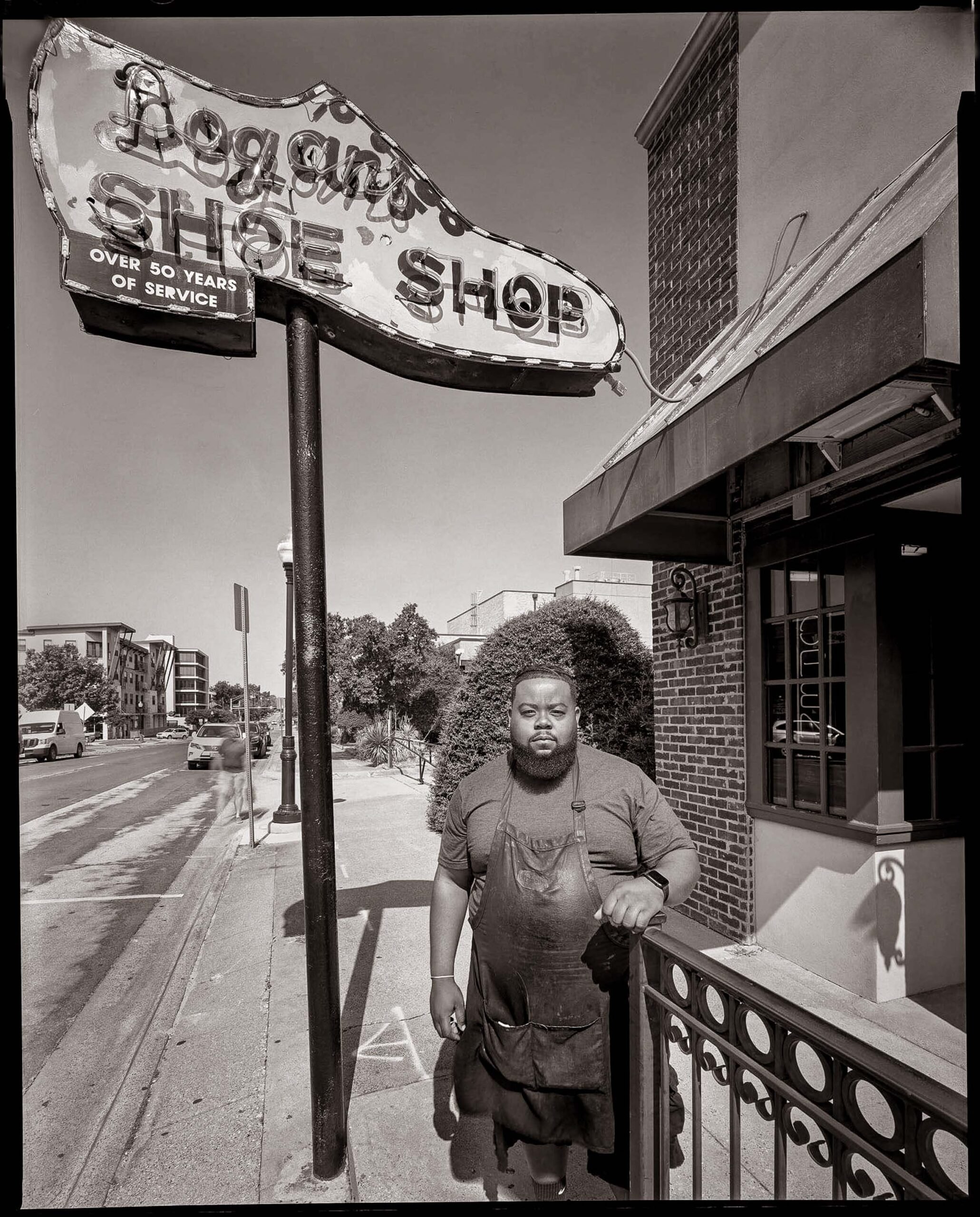
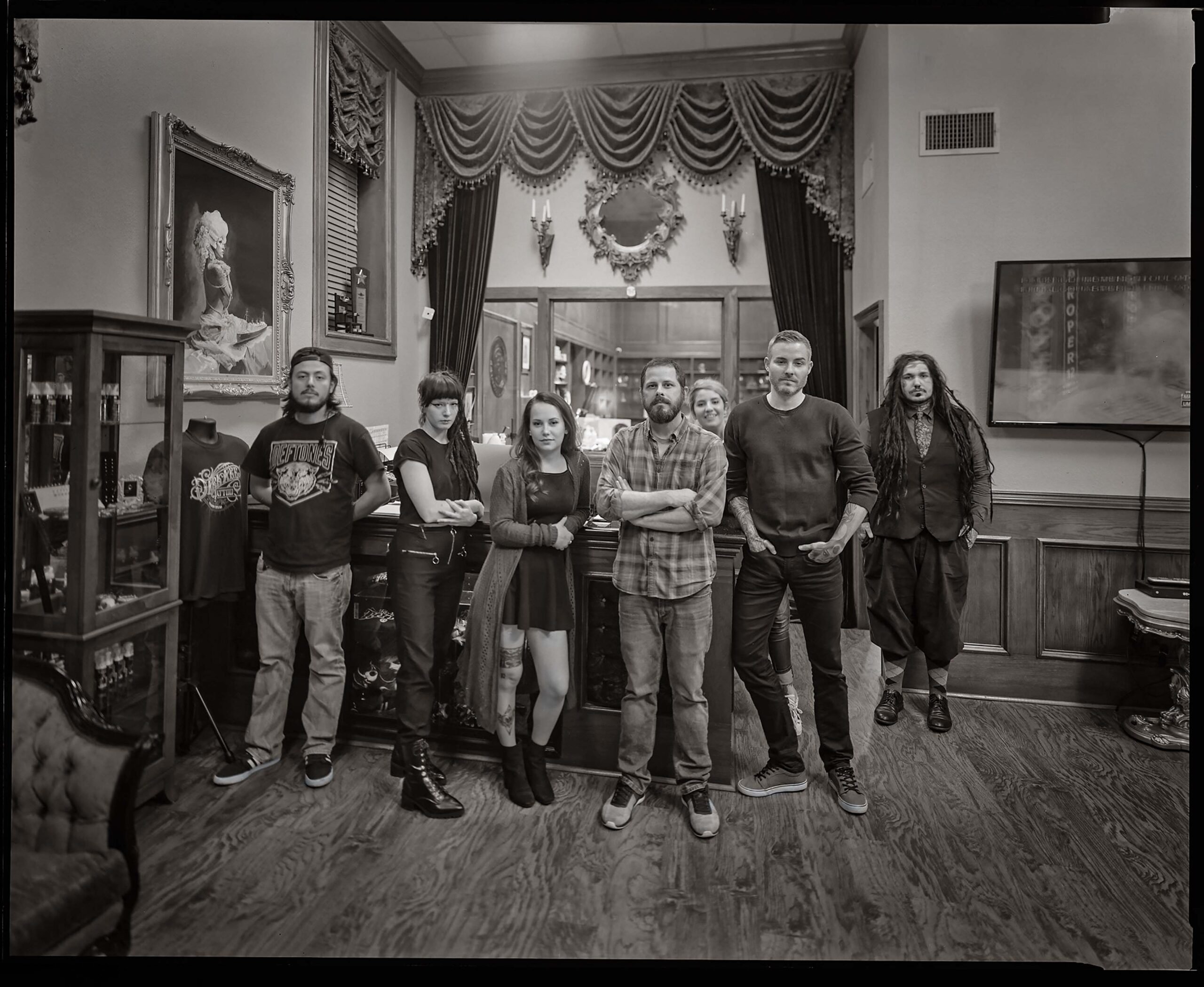
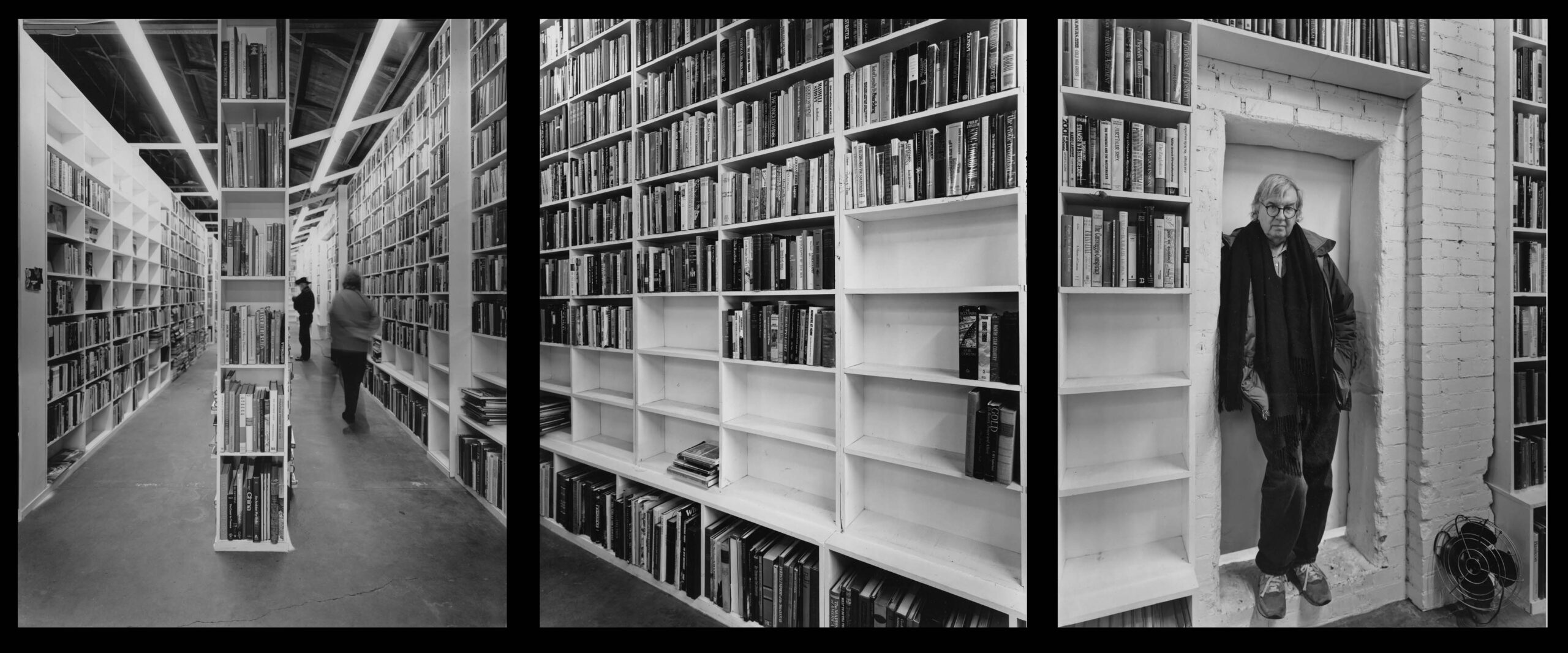
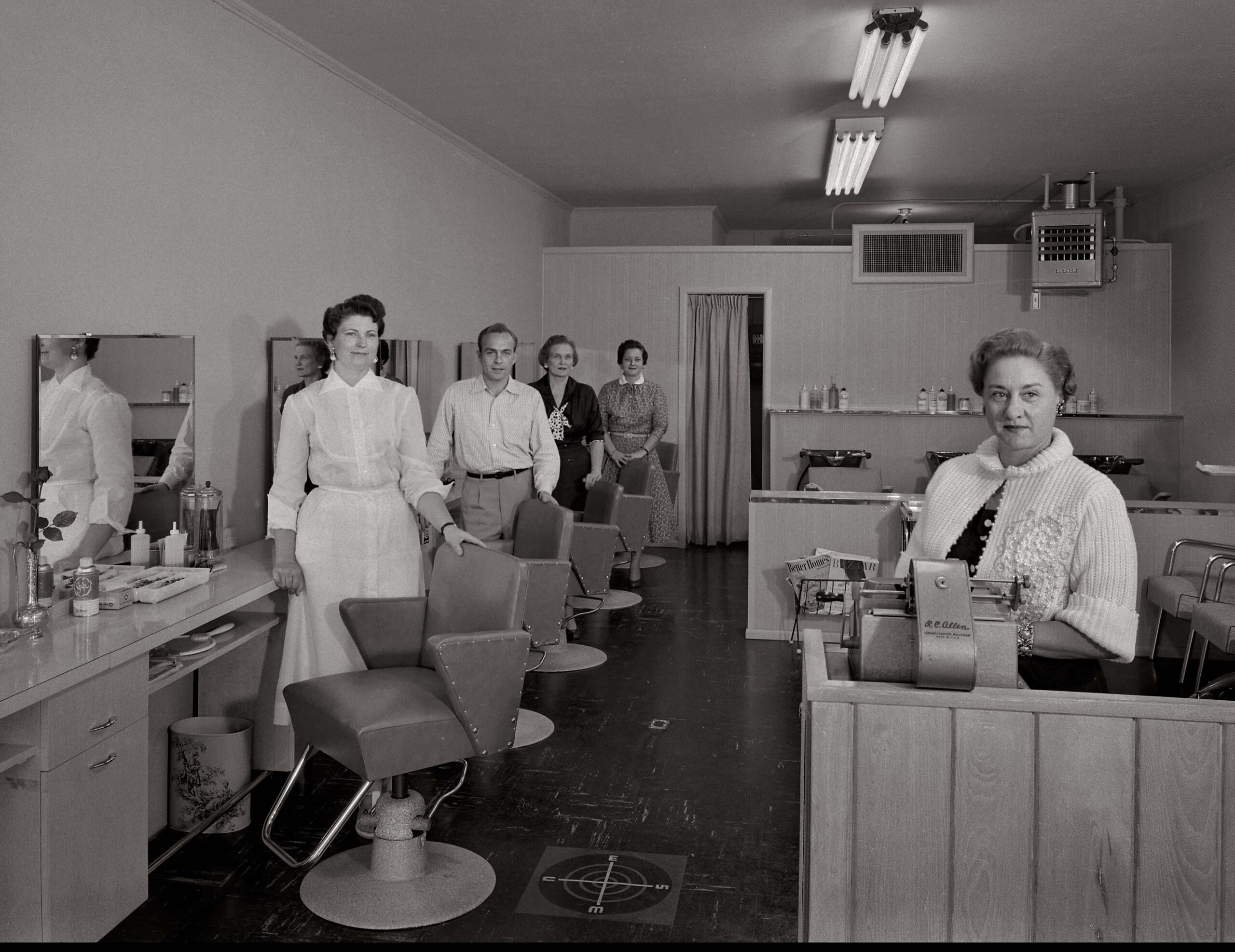
Christopher Jones works in the shoe repair shop owned by his grandmother, Dessie Jones, in Denton in 2019. Byrd Williams IVByrd Williams Jr. captured the serious visages of a group of city planners in El Paso around 1912. Byrd Williams Jr.The crew at Denton’s Dark Age Tattoo Studio pauses in their work for this shot in 2019. Byrd Williams IVIn 1998, author Larry McMurtry had just bought most of the inventory of Barber’s Books in Fort Worth and moved them to his bookstore in Archer City. Byrd Williams IVMatt Soness and daughters Brie Soness and Sage Horton start serving coffee at 6 a.m. at downtown Dallas’ Flying Horse Café. Byrd Williams IVAt the Westcliff Hair Salon in south Fort Worth in 1952, hairdressers lined up at their workstations while a co-worker stood ready to check out customers. Byrd Williams III
When I bought a house last year, it came with many new responsibilities. Suddenly, I was the one who had to change the furnace filters, call the exterminator, and repeatedly suggest to my neighbor that her big tree might be dead. But the biggest change of all was “escrow,” a word that I definitely understand and did not just hear for the first time when my officemate Patty said it in passing.
Escrow definitely has something to do with houses and money, so you start by getting a mortgage. To get a mortgage, well, you probably know all about that, but a very important person is the notary. The notary is sort of like an attorney, but with the letters in “attorney” mixed up and some deleted. Notaries are identity experts—they can tell exactly who you are by looking at you and then at your driver’s license. Notaries have a special stamp they bought from Zazzle. You have to pay them in cash. That’s what I know about notaries, and with that knowledge, you can advance past that part of the home-buying process, and you’re one step closer to having escrow.
Once you’re done with the notary, time to figure out your routing number. Your routing number comes from the bank and has to do with those big tubes that suck up the money capsules at the drive-through. I get the feeling that if I write down my routing number incorrectly, it might bankrupt me. That’s why knowing and understanding it is crucial during a significant financial transaction, like buying a house and setting up escrow.
The last thing you have to stay on top of is property taxes. Property taxes are money you pay to the government based on the value of your house. The government comes by once a year to value your property, unless you have a “homestead exemption.” A “homestead exemption” means you can shoot anyone who comes on your property without permission, which makes the government stay away. It’s important to ensure you have homestead if you’re eligible. It’s a key deterrent to burglars and it lowers your taxes.
With all that done, you can set up your escrow to be automatic. Mine is automatic—I’m definitely saying that because it is, not just because Ron from HR told Patty it was way better to make escrow automatic. I am definitely not saying my escrow is automatic as a form of denial because I am paralyzed by fear that I will lose my home due to a snafu with escrow, which I understand entirely.
So: mortgage, approved by the notary—check. Routing number copied precisely correct to avoid financial ruin—check. Homestead filed—check. Automatic escrow—I almost certainly did that during the busy home-buying process and just don’t remember it right this second—check.
Yep, I love owning my home, but navigating the purchase process required a lot of financial savvy. Aside from what we’ve discussed here, I also have a complete understanding of things like what my title attorney did, when I am supposed to call 411, and the easement thing that my real estate agent said was not a big deal. And that’s without even mentioning escrow, which I definitely have and totally understand.
It’s not quite Microspeak, but it is a sort of Microjoke: Referring to a document as “light reading”.
In common parlance, “light reading” is something that is easy to read without requiring significant mental effort: A magazine that covers celebrity comings and goings, a romantic comedy novel, a travel story. If you choose to read them, they are typically enjoyable content that doesn’t require close reading and which you can put down at a moment’s notice. If you encounter a section that you find boring, you can just skip over it without serious repercussions.
At Microsoft, the term “light reading” is almost never used to mean that. Rather, it is used ironically to refer to a document that is one or more of the following: Lengthy, complex, mandatory.
All of the documents that were covered at the directors review are available on this site. Enjoy the light reading!
Some light reading for the Tuesday meeting: (lengthy email message follows)
Here’s a citation from outside Microsoft:
Just in case you wanted a little light reading, you can access the Apple TV’s software license agreement through the Settings menu.
A Supreme Court decision 50 years ago may have been shaped by the claim that poor children of color can’t learn. The case’s impact has reverberated for generations.
Almost exactly 50 years ago, Alex Rodriguez got his 15 minutes of fame when he was in sixth grade.
Now 61, Rodriguez recalls when news media swarmed his family’s small home in west San Antonio in 1973. “There was everybody and their grandma as far as reporters all over the place,” he said. “At the school, at the house, at the neighborhood. They were just going crazy.” The TV crews had cameras, he recalls, that “were bigger than a bazooka.”
In a way, the reporters were there because of him. In 1968, his father, Demetrio, had sued the state of Texas for underfunding his son’s school district, which was predominantly made up of low-income and Mexican American families. Alex recalls the third floor of his elementary school being condemned; when it rained, water would pour down the stairs. Three or four students shared one textbook.
The lawsuit, filed by Rodriguez and a number of other parents, remarkably, had reached the Supreme Court. Civil rights groups were hoping — and some reporters expecting — it to be the “Brown vs. Board of Education of the 1970s,” as a front-page story in the Wall Street Journal put it.
But as the case wound its way through federal court, a nascent counter-idea was blossoming: Maybe, an influential cadre of social scientists claimed, it didn’t matter how much money schools spent. In fact, maybe schools weren’t actually a key factor in what students learned.
Maybe — most insidiously — poor children of color weren’t likely to succeed in school no matter how well-funded their schools. This idea was spreading, appearing in academic journals and publications like the Atlantic and the Washington Post. A New York Times news article from 1970 included this startling line: “In the case of a slum child,” it read, citing supposedly cutting-edge research, “his chances of learning to read were quite limited, even though large amounts of money might be devoted to his education.”
Fifty years ago this year, the Supreme Court cited some of that same research to rule against the Rodriguez family. The racist notion that children in poverty could not benefit from additional or even equal resources may well have influenced the court’s decision.
“The poor people have lost again, not only in Texas but in the United States, because we definitely need changes in the educational system,” Demetrio Rodriguez told one of the reporters that Alex recalls descending on their home. The media soon left, and Alex went back to the same underfunded school. “It was famous for a day or two — then that was it,” he says now.
Admittedly, the legal and practical merits of the Court’s 1973 decision in San Antonio Independent School District v. Rodriguez are complex and up for legitimate debate. In the long run, the ruling was not the devastating blow to funding equality efforts that many advocates feared. Funding gaps due to property taxes have narrowed or fully closed, in part because state courts stepped in after the Supreme Court stepped aside.
But that often took decades, and the decision had a lasting impact. It left multiple generations of low-income children, like Alex Rodriguez, in schools with lesser funding. This is particularly troubling because more recent evidence has found a meaningful link between spending and student success.
Still today, thanks to the Rodriguez case, the Constitution does not protect the right to an education. A recent effort by students in Detroit to garner some federal right to quality, adequately funded schools failed. For half a century, the decision has effectively closed federal courts to students and families seeking a better education.
On a Thursday morning in May 1968, hundreds of students walked out of Edgewood High School on the west side of San Antonio. They held signs: “‘Every student in America deserves a great education. Where is ours?” “We want a gym not a barn.” “Better library, better teachers, better schools.” They marched to the superintendent’s office with a list of demands. It was a sign of the civil rights-infused times — “the era of rising expectations among minority groups like the Mexican American youngsters” of the city, as the local San Antonio Express put it.
A number of parents had joined in the protest, and soon organized the Edgewood Concerned Parents Association. “When I heard kids saying they didn’t think they could make it in college because of their high school education, then that’s when I decided it was time to do something,” one parent said.
Demetrio Rodriguez — a sheet metal worker, military veteran, and then a father of three young boys — was among those frustrated parents. The group initially targeted their ire at district officials, concerned that they were self-dealing or hoarding money. But then they met with a local lawyer, Arthur Gochman, who pointed out that the district got dramatically less funding than others in the area. Maybe the schools’ problems stemmed not from mismanagement of money, but a lack of it.
Since the advent of public education in America, property taxes had been schools’ biggest source of funding. And because property values varied dramatically from place to place, school funding did too. (Today, state funding has eclipsed local dollars for schools, reducing or even eliminating gaps in dollars due to property taxes. But disparities still exist in some places and funding often isn’t targeted to the highest-needs students. )
Nationally, the correlation between property wealth and poverty was not perfect — in some places, especially big cities, expensive property sat next to deep poverty. But the link was strong enough to create large funding gaps between school districts. In 1972, the country’s most affluent districts were spending 40 percent more per student than the highest-poverty districts.
The San Antonio area was a perfect example. Alamo Heights — an affluent northern part of the city, which had kept Black and Hispanic residents out through racially restrictive covenants — had nearly 10 times the taxable property value as the Edgewood school district, which served mostly low-income, Mexican American children.
The consequences, then, were preordained, and state and federal funds couldn’t make up the gap either. When all the funding was added up, in 1968 Edgewood schools received $356 per student compared to $594 in Alamo Heights, just a few miles across town.
That translated into big differences in what the schools could offer. Teachers in Edgewood were paid much less than those in Alamo Heights. Probably because of that, half of them had only substandard credentials, compared to 11 percent in Alamo Heights, which also had more staff per student. Class sizes in Edgewood were an average of 28 kids. Alamo Heights had a counselor for every 650 students; Edgewood had one for every 3,100. Despite being in southern Texas, just one in three Edgewood classrooms had air conditioning.
On July 10, 1968, with the support of Gochman, who took the case pro bono, Demetrio Rodriguez and several other San Antonio families filed suit against Texas’s school funding system, which they claimed violated the equal protection clause of the Constitution by discriminating against low-income, Mexican American families across the state. “I thought, I ain’t got nothing to lose,” Rodriguez said later. “Maybe we could do some good.”
But far from San Antonio, a small group of social scientists had begun to question the importance of money in public education. Instead, some researchers implied — or even stated outright — that blame for low student performance lay mostly with low-income families of color themselves.
The 1964 Civil Rights Act had included a provision requiring the federal Office of Education to produce a study on inequality in education. Many assumed it would show the need for more investment in segregated Black schools. Two years later, the federal government released the results — which stunned many educators and policymakers. The massive analysis of close to 600,000 students showed large gaps in test scores between Black and white students, but didn’t find much evidence that better schools or more funding led to higher test scores. Lagging student achievement, lead researcher James Coleman concluded, was mostly due to “the home” and “the cultural influences immediately surrounding the home,” rather than schools or money.
The study “produced the astounding proposition that the quality of the schools has only a trifling relation to achievement,” wrote politician and Harvard professor Daniel Patrick Moynihan, who evangelized the Coleman report, as it came to be known, in speeches and articles.
Coleman’s data set was unprecedented, but his methods for teasing out the impacts of funding on student outcomes were crude. He couldn’t follow individual students’ progress over time or isolate the effect of an infusion of funding. “Coleman’s analysis was not only wrong but generated misunderstandings that remain sadly pervasive today,” wrote Stanford professor Caroline Hoxby in a 2016 retrospective.
Nevertheless, the report soon picked up widespread attention: discussed at congressional hearings, written about in newspapers and magazines, and pored over by academics. It also drew notice because it came soon after the 1965 passage of Title I, the first major federal education funding stream and a key piece of Lyndon Johnson’s “war on poverty.”
Coleman’s conclusion that families mattered more than schools seemed to bolster another high-profile report of the era: “The Negro Family: The Case for National Action,” written by Moynihan and published in 1965. This controversial analysis claimed that a rise in single parenthood was at the heart of a “tangle of pathology” among Black families. Moynihan said the point of the report was to spur government action to support low-income Black households. But some civil rights leaders condemned the report as shifting the blame for racial inequality onto Black people.
In 1969, this implication became explicit in an academic article published by University of California Berkeley psychologist Arthur Jensen. He claimed that IQ is nearly fixed at birth and that, therefore, extra funding for poor and Black children was doomed to fail because of what he viewed as their genetically low intelligence. This flagrantly racist argument was a sensation, garnering widespread press coverage. “Can Negroes learn the way Whites do?” was the headline in US News. “Born Dumb?” followed Newsweek. “Intelligence: Is there a racial difference?” asked Time magazine. The New York Times Magazine sympathetically profiled Jensen, describing his “severely trying moments” of being accused of racism.
This was a sign of the times, too: The heady optimism that the federal government could quickly end poverty and educational inequality had waned. The liberal coalition that had supported civil rights and Johnson’s war on poverty had splintered, amid white backlash and the Vietnam War. Riots rippled across American cities. White intelligentsia cast about for explanations for the persistent challenges of poverty, urban unrest, and racial inequality. Some landed on a convenient, age-old answer: the deficiencies of poor people of color.
That’s how in 1970, the Times could declare a “slum child” uneducable. Similarly, a 1970 Wall Street Journal news piece said that Title I funding to help students in poverty had produced “negligible” results. Lower test scores among children of color could be explained by either “genetic or cultural” factors, the article claimed.
In the introduction to a 1971 cover story on IQ, the editors of the Atlantic claimed that Moynihan, Coleman, and Jensen’s reports — “three landmark social documents” — had collectively called into question policy efforts to address racial inequity in education and elsewhere. Getting rid of racist laws had not eliminated economic and educational inequalities — “presumably,” they wrote, “because of internal barriers.”
A 1973 front-page Washington Post story opened with this analogy: “The doctors, you might say, keep telling the parents that their child’s case is hopeless, that no amount of money or variety of remedies will add up to a cure.” The piece was accompanied by a picture of a Black student in a remedial reading class.
There were other, legitimate reasons to question the efficacy of school spending, including a 1969 report from the NAACP concluding that Title I dollars were often being misused. The Coleman report, although methodologically flawed, was among the few empirical examinations of whether more money led to better schools. The problem was that some pundits and researchers had leaped from these early results to write off the impact of schools and funding altogether.
A number of Black academics and writers tried to combat this fatalist brand of social science. “Such studies are a throwback to the nineteenth century theorists who adopted Social Darwinism — the survival of the fittest — as a means of bolstering the privileged classes of society,” wrote Vernon Jordan in the Chicago Defender, a Black newspaper. “Now this old and ugly tradition is being revived.”
But this critique got much less attention from journalists and policymakers than the new educational fatalism, which had already migrated up to the White House.
Later serving as an adviser for President Richard Nixon, Moynihan sent the president an excerpt of Jensen’s paper on race and IQ, as well as two later memos that referenced Jensen’s claims. In a 1971 memo prompted by the Atlantic article on IQ, Moynihan claimed that psychologists believed that there was a “ranking of the major races” by intelligence: Asians, Caucasians, and then “Africans.” Moynihan expressed some anguish over this and described the conclusion as “not settled.” He also recommended Nixon not give up on social programs altogether.
Others were more fatalistic. White House adviser Patrick Buchanan, who later mounted bids for president, wrote a memo about the same article, saying it cast doubt on extra education spending. “Every study we have shows blacks 15 IQ points below whites on the average,” he wrote.
During a phone call with Moynihan, Nixon endorsed the idea of a racial hierarchy of intelligence. “What was said earlier by Jensen is probably very close to the truth,” said Nixon — who appointed four of the justices who, in just a few years, would decide Demetrio Rodriguez’s case.
But in 1971, three years after filing the lawsuit, Rodriguez still had good reason to be optimistic. In December, he and the other San Antonio parents won a major victory in federal court. ”The current system of financing public education in Texas discriminates on the basis of wealth,” a three-judge panel concluded unanimously. The question of whether more money could improve schools did not even come up in the decision.
Texas decided to appeal the ruling to the Supreme Court. The stakes were high not just in Texas, but beyond: Numerous other lawsuits had been filed against property tax–driven funding schemes across the country. But they were on a collision course with the new social science about the limits of school funding.
In a column for the New York Times, Moynihan wrote that while he sympathized with the Rodriguez plaintiffs, equal funding would not help schools. “The least promising thing we could do in education would be to spend more money on it,” he declared. The article was cited in the Texas brief before the Supreme Court.
It was possible to argue against the lawsuits based on legitimate questions about funding and outcomes, local control, or the constitutional issues at play. But at least in some cases, arguments lapsed into fatalism.
“In the view of many,” a 1971 Times story about the case claimed, “the true sources of educational deficiencies are rooted in the more basic inequalities among people and no amount of reshuffling of tax dollars, however just, is going to change that.”
“Do we as legislators have the responsibility to compensate for inadequate home life?” wondered an Oklahoma state legislator, as quoted by the Times.
It was easy to miss, but phrases like “inequalities among people,” and “inadequate home life” were suggesting that children of color or children in poverty could not be expected to achieve high levels of academic performance, and so it would be fruitless to make funding more equal.
One civil rights group was so concerned about the schools-don’t-matter narrative that it held a press conference in 1972 to beseech courts not to rely on this research. Such studies amounted to a “sophisticated type of backlash” to efforts to address inequality, said Kenneth Clark, a prominent Black psychologist whose research was cited in Brown v. Board of Education.
No matter. Attorneys defending Texas’s school funding scheme had seized on this research. “Beyond some minimum there is reason to believe that there is no relation between expenditures and quality of education,” lawyers for the state wrote in their brief before the court.
Justice Lewis Powell, whom Nixon had appointed to the Supreme Court in 1971 and who had previously served on the Richmond and Virginia school boards, wrote the majority opinion in San Antonio v. Rodriguez. It was a 5-4 ruling, with the four recent Nixon appointees forming the crucial majority bloc. If it had reached the court a bit earlier, it could have easily gone the other way.
Powell concluded it simply wasn’t the court’s role to meddle with complex funding formulas. Legally, Powell said that poor children and families do not warrant heightened constitutional protection from discrimination and that education is not a fundamental right.
Powell also raised questions about whether money matters — citing Coleman and Moynihan. “One of the major sources of controversy concerns the extent to which there is a demonstrable correlation between educational expenditures and the quality of education,” wrote Powell. The Los Angeles Times later reported that the issue of whether money mattered weighed significantly in the justices’ thinking. Powell did not himself claim that poor children of color could not learn or that schools did not matter, but the growing skepticism about education funding was deeply linked to that very idea.
The shadow of Brown v. Board of Education seemed to loom large in the case, but not in the way many expected. Enforcing desegregation had prompted a furious backlash and a host of practical difficulties that engulfed the court in litigation for decades to come. Deciding for the plaintiffs in the Rodriguez case, Powell wrote, would have led to an “unprecedented upheaval in public education.” Of course, Brown had led to such an upheaval. But Powell seemed to conclude that it simply wasn’t worth it this time.
“Powell felt that it would lead the Supreme Court into morass, like Brown v. the Board,” recalls Mark Yudof, a lawyer who worked on the case for the San Antonio parents. “It was a fear of being dragged into this unknown terrain that probably was the strongest factor.”
To Justice Thurgood Marshall, who had spearheaded the Brown litigation as a lawyer for the NAACP Legal Defense and Education Fund, the majority opinion was a betrayal of Brown. “The majority’s holding can only be seen as a retreat from our historic commitment to equality of educational opportunity,” he wrote in dissent.
But the case was over. There would be no federal right to an education then or now. Dozens of lawsuits in lower courts were suddenly dead.
“I cannot avoid at this moment feeling deep and bitter resentment against the supreme jurists and the persons who nominated them to that high position,” Demetrio Rodriguez told the New York Times after the decision.
The legal fights over school funding were just beginning.
After the loss in 1973, lawyers and advocates shifted their focus to state courts. They sued under state constitutions — which, unlike the federal constitution, typically guarantee some form of education explicitly — and won a string of victories in a number of states. That included Texas, where Demetrio Rodriguez and other parents won a decision in 1989, which eventually resulted in some property taxes from wealthy areas being redistributed to poorer communities, a scheme dubbed by Texas politicians as “Robin Hood.”
“I cried this morning because this is something that has been in my heart,” said Rodriguez at the time. “My children will not benefit from it ... but there is nothing I can do about it now.”
Meanwhile, the debate about money and schools had also shifted. In the decades that followed Rodriguez, many politicians and researchers continued to question whether more dollars bought more learning. But this contention became much less linked to racist and classist assumptions about which children could learn. Instead it focused on whether public schools were functional enough to use money effectively.
More recently, the debate has shifted once again. In a seminal 2016 paper, three economists found that children benefited when their schools got extra money due to a state court order. Other research, examining different funding changes, has generally reached a similar conclusion: Students, particularly low-income students, typically do better when schools get more funding. “The results are very, very consistent,” said Kirabo Jackson, a Northwestern University economist and leading researcher on school funding. “The vast majority of these studies find positive effects on student outcomes.”
Research in the wake of the Coleman report has also shown that while out-of-school factors, like poverty, do affect student learning, schools and teachers matter too. Of course.
The above history might give us pause before too quickly accepting the confident claims of social science. But at the least, the new research has erased any scientific veneer behind the claim that money or schools don’t matter. Still, the Court has not seriously reconsidered the Rodriguez decision; instead, in 2009, it reiterated in even stronger terms that money is unlikely to improve schools.
Admittedly, what the school funding system would have looked like today had the Supreme Court ruled differently in Rodriguez is unknowable.
Jeffrey Sutton, a federal judge and former clerk to Lewis Powell, has argued that state courts proved better equipped to deal with local funding complexities and ended up successfully addressing the funding disparities in Texas and elsewhere. These court decisions really did help chip away at school funding disparities — although it took time. By 1992, the funding gap between poor and non-poor districts was down to 20 percent, as states began making up for property tax differences. Presently the gap, contrary to conventional wisdom, is basically zero on a national level. Edgewood, for instance, receives similar funding as Alamo Heights all these years later.
But other legal scholars take the view that federal courts abdicated their responsibility and could be doing more. They point out that funding gaps still do exist in certain places and that there is a consensus that children in poverty need not simply equal funding for their education, but more.
In 2016, a handful of students in Detroit filed a lawsuit in federal court seeking a “right to read.” After a fleeting victory before an appeals court, the full circuit court vacated the decision. In the end, the plaintiffs managed a meager settlement with the state of Michigan in 2020. Gov. Gretchen Whitmer promised to seek $94 million in extra funding for the city’s schools, but to date, it has not been funded.
It was nearly 50 years after Rodriguez but the decision loomed large. It also has loomed in the background of Alex Rodriguez’s life.
After the decision, his schools, not surprisingly, didn’t change much. In the years that followed, the funding gap between Edgewood and Alamo Heights actually grew larger. Rodriguez graduated from high school in 1979 with little idea of what to do next. No one at the school had suggested he go to college. He doesn’t even recall thinking that was an option. Rodriguez worked for a while at an auto parts store, and then got a job driving a city bus. He did that for 36 years, logging over 2 million miles. He retired just over a year ago.
He lives a busy, fulfilling life now — running errands for his family, working on his truck, spending time with grandkids. He lives in the same house his parents did, the one on which cameras and reporters and lawyers descended 50 years ago. He has what he needs and doesn’t want more than that. He doesn’t live with any regrets. But Alex Rodriguez also understands that he was shortchanged. “I was one of the ones that suffered through the lack of education,” he says.
Matt Barnum is a Spencer fellow in education journalism at Columbia University and a reporter at Chalkbeat, where he’s written about education policy and politics since 2017.
I have a question about a weird interviewing situation for a sales role.
I had gone through a few interviews with a company as I was evaluating a new sales role, and the entire interview process felt standard and professional (phone screen, in-person interview, tour of the branch, and next step would be to shadow a cold call).
After the in-person interview and tour of the branch, I got a call a few days later from a VP I had met (not the recruiter) telling me that they decided I wasn’t a good fit and wouldn’t be moving forward in the process. I did the standard “thank you for the opportunity, I appreciate your time, wish you the best,” after which the VP said, “Just kidding, I got you! I wanted to see if you’d fight for the job.”
I kind of awkwardly laughed, he told me they’d want me to do the cold call, and I told him I would get back to them about scheduling next steps. I eventually emailed and said that I didn’t think it would be the right fit (partially because of the weird joke, but I also decided to stay in my current role).
I guess my question is … what? Is that a legitimate tactic? In my experience, getting a “no” from a recruiter is not the same as getting a “no” in a sales transaction. Should I be fighting back whenever I get rejected for jobs?
Noooo.
What on earth!
It’s true the norms in sales can be different, but what? Wanting a candidate to fight back against a rejection? Wanting a candidate to refuse to hear “we’re going with someone else” and instead push to be reconsidered? That’s pretty much universally considered obnoxious candidate behavior that no employer wants to deal with and which will often get you blacklisted.
I realize there are some sales strategies that encourage salespeople to try to push past a no, but (a) many people consider that approach a huge turn-off in a sales context too and will never buy from someone who does that, and (b) even if we set that aside, generally people understand that tactics for one type of situation aren’t always appropriate in others.
I suppose if they are screening for candidates who will run roughshod over people’s boundaries and ignore clear “not interested” statements, this is a way to do it. But I’m guessing that’s not a place where you want to work … and by withdrawing, you rightly screened that behavior out.
(For the sake of thoroughness, I will also note that it’s not 100% clear that it was a screening tactic from them, as opposed to just a bad joke, given the VP’s weird “just kidding, I got you!” and interest in moving you forward anyway. Rejecting you as a joke would be a whole different problem, though.)
Caro isn't solely interested in telling the stories of famous men. Instead, he says, "I wanted to use their lives to show how political power worked." Originally broadcast in 2013 and 2019.
Cambodia's government said the pieces of jewelry that arrived back in their homeland included items "... precious metal pieces from the Pre-Angkorian and Angkorian period."
Mathematician Jim Propp connects the counting numbers — the concept of them, not particular, specific numbers — to the seemingly unconnected Lake Woebegon Effect. Propp’s essay appears in his Mathematical Enchantments blog:
… The twentieth century weekly radio show “A Prairie Home Companion” had a recurring feature called “The news from Lake Woebegone”, in which host Garrison Keillor would describe fictional happenings during the past week in his iconic, nonexistent home town of Lake Woebegone, Minnesota. Each week he’d end the news segment with the same tag-line: “And that’s the news from Lake Woebegone, where all the women are strong, all the men are good-looking, and all the children are above average.” That last line gave humorous expression to the fact that most parents think their children are objectively special, and it even gave rise to a new bit of psychological jargon. But curiously, a version of the Lake Woebegone fallacy applies to the counting numbers, not as a fallacy but as a fact – specifically, the fact that every counting number is smaller than average….
Propp then goes on to explain, clearly, why every counting number is smaller than average.
It’s now been two years since Winter Storm Uri sank Texas into a deep freeze and brought the state’s electric grid to the brink of total collapse. Upon signing into law a series of legislative changes at the end of the 2021 session, GOP Governor Greg Abbott infamously declared mission accomplished on Texas’ response to the energy disaster. “Bottom line is that everything that needed to be done was done to fix the power grid in Texas,” he said. That line hung over his head like a political anvil as the state’s grid operator ERCOT has faced repeated close calls in the face of subsequent extreme weather, struggling to meet record-level electricity demands.
Meanwhile, the newly revamped Public Utility Commission (PUC) was—at the Lege’s behest—crafting a drastic overhaul of the state’s electricity market to ensure that the grid could reliably meet the increasing demands of a rapidly growing population. The focus of this redesign has largely been centered on the supply side of the equation—how to incentivize generators to build new natural gas power plants—while sidelining questions about how to lower consumer demand. This months-long process—led by Abbott-appointed PUC Chairman Peter Lake—came to a close in January when the Commission unanimously approved a contentious, convoluted, complicated thingamajig called the “Performance Credit Mechanism.” Only slightly less jargon-y in acronym form, the PCM would effectively deliver lucrative credits to power generators—such as energy giants Vistra and NRG—that are able to provide energy during certain high-demand periods. Electricity retailers—the utilities you pay your bills to—would pay for those credits and, naturally, pass the cost on to everyday consumers.
That policy proposal, which has never been used in the United States, received staunch resistance from the start. The PUC’s own energy consultant recommended against the policy because it “entails significant risk because of its novelty,” as did ERCOT’s independent monitor. All members of the Texas Senate business and commerce committee that oversees grid issues sent a letter to the PUC telling it to put its policymaking process on pause. Big business groups like Texas Manufacturers and the Oil & Gas Association came out against it on the grounds that it would increase their energy bill, as did consumer advocacy groups. The policy is estimated to cost at least $400 million a year to electricity customers while many experts question whether it will actually do anything to prompt new power plants.
The policy is estimated to cost at least $400 million a year to electricity customers while many experts question whether it will actually do anything to prompt new power plants.
Texas energy expert Doug Lewin has said the provision merely hands a “blank check” to existing power generators, leaving customers to once again foot the bill. Beyond that, this redesign will likely exacerbate already growing market dominance by a handful of energy giants (again, think Vistra and NRG) while further gutting consumer choice—the supposed crown jewel of Texas’ unusually deregulated market.
Apart from Abbott and the Commission, the key booster of the PCM is Texas Competitive Power Advocates, a lobby group composed of the largest power plant operators in the state. The group helped revive the political life of the PUC’s redesign when its leader pledged in testimony before the Legislature that, if the PCM were implemented, 4,500 megawatts of new power generation would come online. The governor himself cited that industry pledge when he put his full weight behind the PUC’s model. But the Utility Commission’s vote is only the beginning of a long fight over grid policy, since the agency has now referred the matter to the famously erudite minds of the Texas Legislature.
Within hours of the PUC’s decision, GOP state Senator Charles Schwertner—who authored key grid legislation in 2021 and chairs the business and commerce committee—blasted the move. He said the PUC “chose to ignore the clear direction of the Legislature [by] voting to replace the state’s competitive energy market with a costly and complex proposal that is unlikely to deliver the dispatchable generation resources that Texas needs.”
Schwertner and his committee will likely serve as the tip of the spear in Republican Lieutenant Governor Dan Patrick’s ongoing policy fights over grid reform—which first began in 2021 with a spat between Abbott appointees and the state House over repricing schemes. Patrick has made increasingly loud noises about wanting more significant policies guaranteeing new natural gas power plants beyond what the PUC has come up with. And Schwertner has effectively said such measures are in the works, saying his committee “will hold hearings and consider whatever legislation is necessary to correct this error and fulfill our obligation to the people of Texas.” (The senator spent the committee’s first hearing in Travis County jail after he was arrested for drunk driving overnight.)
One overlying factor in this policy battle is energy market ideology. Winter Storm Uri in 2021 exposed the deep flaws of the once-vaunted Texas model of a deregulated “energy-only” grid that pays generators solely for power produced, which means operating on a razor’s edge without reserves. With its new proposal, the PUC would effectively create a version of a “capacity market,” where consumers pay a certain amount to keep energy generators on reserve in case of emergency. This adds cost but helps ensure reliability. Rather than simply mimic California—quelle horreur—the PUC aims to build an untested and uncertain road to a similar end, but it’ll have to pause long enough for our fearless leaders to come swinging their own political sledgehammers. Viva the Lege.
“This and That” is an occasional series of paired observations. See past “This and That” posts here. – Ed.
Today: Weaponized childhood objects
Angel Cabrales, “Juegos Fronteras: Swingset Penitentiary,” 2013, installation. On view at Centro de Artes, San Antonio, 2023.
David Avalos, “The Bullet-Proof Piñata,” 1995, wood, sheet lead, escutcheon pins, hardware, and chain. On view at Ruby City, San Antonio, 2023.
*************
No matter how original, innovative or crazy your idea, someone else is also working on that idea. Furthermore, they are using notation very similar to yours. – Bruce J. MacLennan
Jules Verne described the sea as the “embodiment of a supernatural and wonderful existence,” a life force of exemplary love and emotion. In concept, the sheer vastness of the ocean has fascinated humankind for centuries and inspired artists with its otherworldly inhabitants. Midnight Zone(s), Adela Andea’s sixth solo exhibition at Anya Tish Gallery in Houston, is an otherworldly adventure for those looking to explore an oceanscape depicted with unconventional materials. This exhibit includes a stunning new LED installation that allows viewers to experience Andea’s brilliant use of light, form, and space.
As the title suggests, Midnight Zone(s) refers to the high-pressure, lightless layer of the ocean and the creatures that adapt to survive in those conditions. This exhibit layers themes of survival, exploration, and imagination, and confronts viewers with the impact of ocean debris. Inspired by the fiction of Jules Verne, Adela Andea’s work creates an experience that encourages audiences to journey through each zone of the exhibit to explore the fantastical pieces, which juxtapose ocean life with technology.
Midnight Zone, the centerpiece of the exhibit and Andea’s newest installation, illuminates the room from the back wall of the gallery. A white behemoth composed of multiple glowing pieces in organic shapes invites viewers with its brilliant light. Large bulbous forms, some the size of an adult, suspend from the ceiling and wall and are positioned to allow viewers to walk under and around the installation. Covered in small white circles, the center of each is filled with a colored insert, some red, some blue, and some green. The white circles were sliced from pool noodles, leaving a hollow center that Adela filled with repurposed cutouts from European pool noodles, which were used for her installation at the Center for International Light in Unna, Germany. This reuse of materials becomes a personal metaphor for Adela, as she was born and raised in Romania but has lived the past twenty-four years of her life in the United States. Walking through Midnight Zone truly invokes the same awe that Jules Verne described in Twenty Thousand Leagues Under the Sea; it’s a nearly supernatural experience of genuine love and emotion.
Midnight Zone draws in viewers with its whimsy and imaginativeness, but also calls for reflection on the effects of technology and plastic on ocean life. Additionally, as the title references the lightless layer of the ocean, it allows audiences to revere nature’s — and by proxy humans’ — ability to adapt to stressful environments. It’s impossible not to read into the metaphor of how the ocean’s inhabitants evolve to survive in its high-pressure zones. As viewers walk through Andea’s installation, the experience encourages one to imagine an exciting journey through the sea, but also consider how nature adapts to survive while considering humankind’s impact on the ocean itself.
Installation view of “Midnight Zone(s)” by Adela Andea at Anya Tish Gallery. Photo: Alin Andea
Scattered artfully on a wall is a collection of candy-colored pieces made of various plastics and LEDs. This wall collection includes Bioluminescence 1 through Bioluminescence 4 and Yellow Lantern, which together demonstrate Andea’s ability to reinterpret nature in a meaningful way. These pieces harmonize together in their collective use of color, texture, and composition. Bioluminescence 3 stands out as the largest of the pieces; shaped like a chunk of coral reef, small circles, thin strings of plastic, and bits of perforated plastic panels make up the shape and texture of the artwork. “Forms such as these,” says the artist, “are first envisioned without the materials, then constructed one unit at a time until the piece comes together in an organic way that reimagines nature.” Together, the collection of pieces simulates an underwater ecosystem, referencing coral reefs, seaweed, and rocks.
Installation of pieces by Andela Andea, including: “Bioluminescence 3,” 2022, 3D printed parts, various plastics, LED lights, battery source, 16 x 12 x 8.50 in.; “Yellow Lantern,” 2022, 3D printed parts, various plastics, LED lights, battery powered 9 x 5.50 x 6 in.; “Bioluminescence 2,” 2022, 3D printed parts, various plastics, LED lights, battery powered 16 x 15 x 10 in.; “Bioluminescence 4,” 2022, 3D printed parts, various plastics, LED lights, battery powered 11 x 9 x 8.50 in.; “Bioluminescence 1,” 2022, 3D printed parts, various plastics, LED lights, battery powered 9 x 14 x 6 in. Photo: Alin Andea
The components that make up these pieces also seem a bit familiar. Small plastic circles and thin strings of plastic may remind viewers of counting chips and Koosh balls from the 1990s and 2000s. A soft glow of light emitting from each object ties in with the exhibit’s overarching theme of nature reimagined with technology. Between the primary pieces are scattered small cuffs of hard material in yellows and blues. They’re perforated in a manner meant to evoke the image of discarded plastic 6-ring can holders, a not-so-subtle reminder of overconsumption and waste. These collective pieces may depict a thriving ecosystem, but they also warn of our impact on its life. Plastic may survive in the sunless midnight zone of the ocean, and ocean life may be able to adapt to survive, but it’s humankind’s overuse of plastic that will suffocate the underwater communities of the sunless midnight zone.
Hydrophis is positioned near the entry of Midnight Zone, as if it truly is a sea snake prowling the entry of an ocean cavern. Built of CCFL, Plexiglas, various cords, and a power source, Hydrophis brings all these parts together to form a diagonal line on a wall while soft rays of colorful light create an aura around the piece. Andea’s use of colorful fluorescent lights call to mind the work of Dan Flavin, who’s incandescent and fluorescent light installations were groundbreaking artworks of the Minimalist movement. At the center of the work, a power source, with a colorful fan spinning in action to cool the piece’s computer, powers various lights planted throughout the piece. Plastic rings hang from wires, and bright neon lights in spiral shapes give one the idea of snake coils, as the title suggests.
The circle and spiral shapes incorporated within this piece tie in with the circles used in Midnight Zone, but set up a dramatic contrast between the two works. Hydrophis reminds those who are familiar with Andea’s work that she generally creates more colorful installations, while Midnight Zone marks a departure from that practice. By using the power source, CCFL, and Plexiglas, Andea conveys an underlying narrative of technology, power, and manmade materials. While the inhabitants of the ocean’s midnight zone may adapt to live with no light, people allow technology to change them as they evolve to a more complex society. Hydrophis, like us humans, represents the creatures of the Midnight Zone(s) that have adapted to survive in, oftentimes, strenuous circumstances.
Adela Andea, “Hydrophis,” 2023, CCFL, Plexiglas, power source, 42 x 44 x 11 inches. Photo: Alin Andea.
Andea’s contributions to other exhibits over the past year have been impactful, but seeing a recent solo exhibition of her exploration of new forms and themes demonstrates her imagination to push boundaries. This colorful and brilliant new exhibition is as thought-provoking as it is whimsical. Her work pushes audiences to think differently about the world and take on new perspectives by examining her dynamic installations. A journey through Adela Andea’s Midnight Zone(s) is an emotional experience inspired by the beauty and wonder of the sea that Jules Verne so eloquently described.
Midnight Zone(s) is on view through February 25 at Anya Tish Gallery in Houston. There will be an artist talk featuring Adela Andea in conversation with collector Lester Marks on February 25 at 2 PM.
Tell us about your research & how you use the Internet Archive to further it! We are gathering testimonials about how our library & collections are used in different research projects & settings.
From using our books to check citations to doing large-scale data analysis using our web archives, we want to hear from you!
There is a lot of energy right under our feet, a relic from Earth's hot past as a ball of plasma. But how much can geothermal energy realistically do for us? What technologies are currently being pursued, what are the risks, and is it even carbon neutral? In this video we have collected all the relevant facts and numbers for you.
00:00 Intro 00:53 How Much Geothermal Energy is There? 06:37 What are the Challenges? 13:08 What Can New Technology Do? 16:07 What Are the Risks? 19:51 Summary 20:21 Into The Impossible With Brian Keating
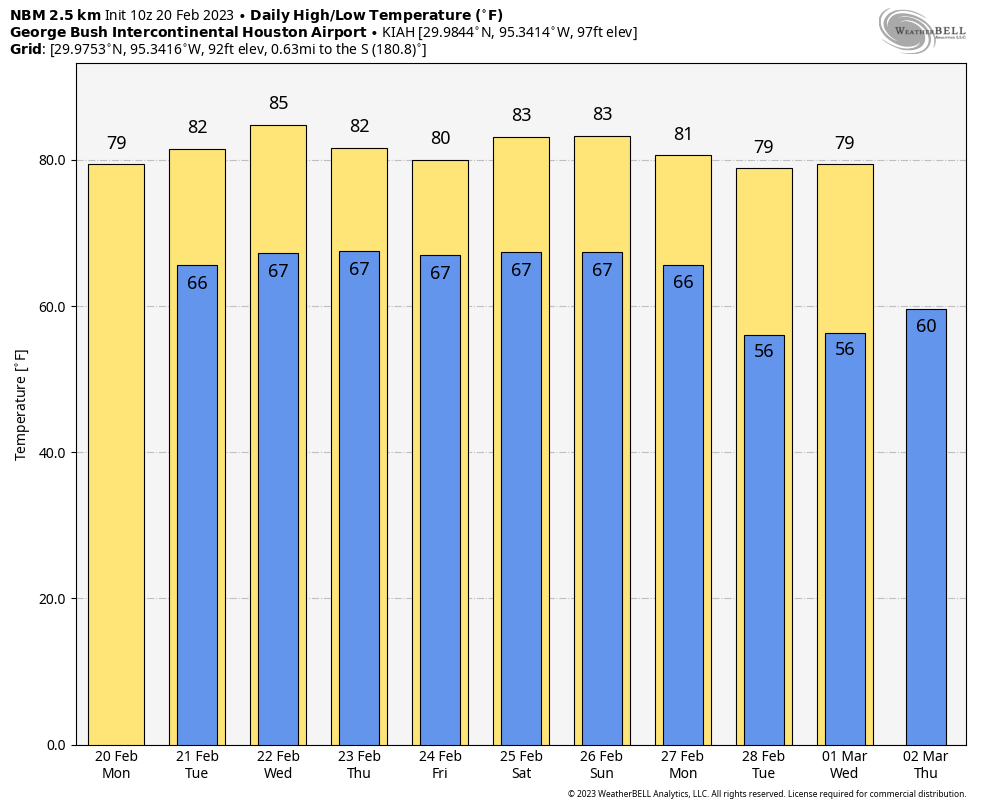
Houston, and much of the southern United States, now face a prolonged warm spell that will likely last for nearly all of the rest of February. We are going to see highs of around 80 degrees for the next week, with fairly sticky dewpoints in the 60s. The other notable thing is that, after a fairly wet winter so far, rain chances will be near zero for the same period.
This pattern may finally start to break by early next week. I’m not ready to say winter is over, but I would say it’s more likely than not that we’re done with nights in the 30s for this winter. We’ll still have a few cold nights in the next couple of months, certainly, but this week will bring us into springtime in Houston.
Well, at least the weather will be consistent. (Weather Bell)
Presidents Day
As much warmer air moves over cooler waters, we’re seeing the formation of sea fog this morning for areas closer to the coast. After the fog dissipates today we’ll be left with partly to mostly cloudy skies and high temperatures of around 80 degrees. A very few, scattered showers will be possible south of Interstate 10 this afternoon, where atmospheric moisture levels are highest. But any precipitation that makes it to the ground will be light. Lows tonight will only drop into the mid-60s in Houston, with the development of sea fog likely once again.
Tuesday
Expect another day like Monday, with highs in the low 80s. The only real difference will come in the form of stronger winds from the southwest, perhaps gusting to around 20 mph, and a bit higher overnight. Lows will only drop to around 70 degrees. Needless to say this is rather warm for late February.
Wednesday
In response to an upper-level system, winds on Wednesday will be stronger still out of the south, perhaps gusting to 35 or even 40 mph. These warm winds, southerly flow, and partially clearing skies will amp up temperatures, pushing highs into the mid- to possibly upper-80s in the metro area. I would not entirely rule out a few inland areas pushing 90 degrees, but I don’t think most of the metro area will reach that mark.
NAM model for maximum wind gusts on Wednesday morning. (Weather Bell)
Thursday and Friday
A weak front will move into the Houston area and stall toward the end of the week, but at this point I don’t think it will have too much effect on our sensible weather. Put another way, we can probably expect mostly cloudy skies, highs in the low 80s, and warm nights. Rain chances remain low, about 10 percent.
Saturday and Sunday
Expect more of the same this weekend, with warm and humid air, highs of around 80 degrees, and cloudy skies. The potential for fog will continue to be present in the forecast. Rain chances will be on the order of 10 percent each day.
Next week
As always the details start to get hazy as we approach the early part of next week, but it does look as though some sort of front will trundle into Houston by around next Monday. I’m not seeing much of a signal for rainfall with this front, but it’s certainly possible. This should bring us a few days of sunnier weather, with highs in the 70s and lows, perhaps, in the 50s. By then most of us should be ready for some drier air.
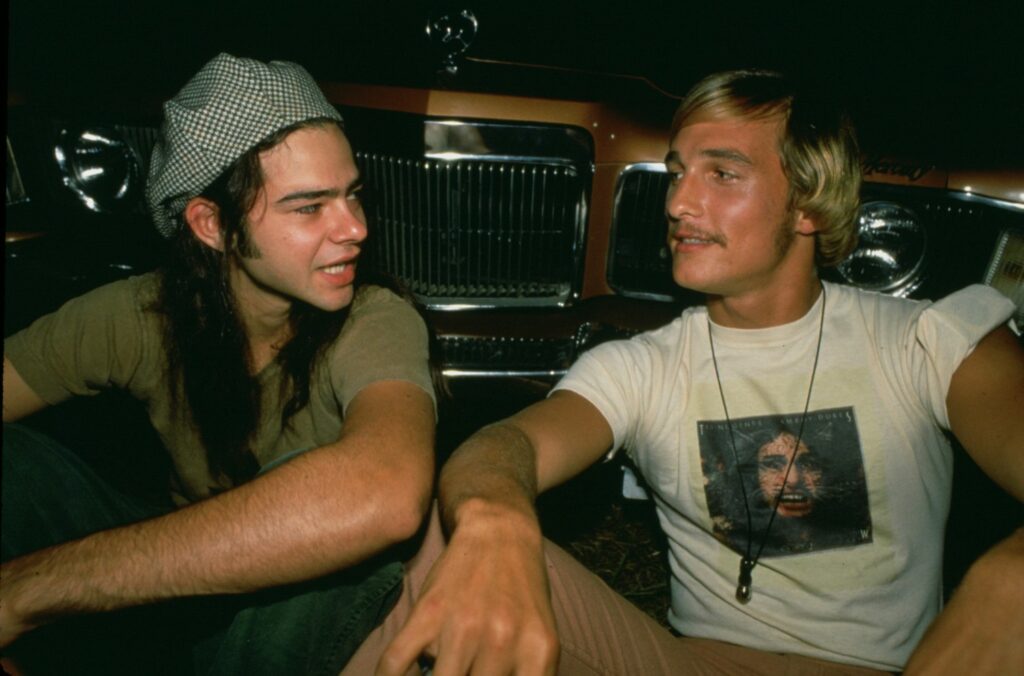
See it with a bud. (Dazed and Confused movie)
Dazed and Confused
If you’re looking for something fun to do on Saturday evening, come join me at the Museum of Fine Arts to watch Dazed and Confused. I’ll speak for a few minutes before the film, and then we’ll sit down to watch the glorious movie in its original 35mm film format, and take in that spectacular 70s soundtrack in a theater. I can’t wait!
NEW YORK—Emerging from decades of self-imposed retirement to insert himself into your most intimate fantasies, actor and comedian Rick Moranis announced Monday that he had plans to pop into your head for no discernible reason right before you orgasm. “After years away from your thoughts, I’m thrilled to have this…
WASHINGTON—Fighting back tears as he mustered the courage to do what needed to be done, Secretary of Transportation Pete Buttigieg reportedly cut a train’s brake lines Monday so it could run free. “Go, just get out of here! You’ve been trapped for too long, and you deserve to roam,” a visibly distressed Buttigieg…
Thieves stole the catalytic converter from the iconic Oscar Mayer Wienermobile while it was parked overnight during a promotional visit for the Super Bowl in Las Vegas last week. What do you think?
HOUSTON—Expressing overwhelming gratitude for his partner, local man Tyler Dorfman told reporters Monday that marrying his wife Kelsey Dorfman, a woman who doesn’t eat her pizza crusts, was the best decision he ever made. “It’s basically double the crusts, or kind of infinity crusts when you think about how much more…
Since it’s a holiday, here’s an older post from the archives. This was originally published in 2016.
A reader writes:
I have recently graduated from college. I currently have no job prospects, but I am applying to jobs on a daily basis. I feel that if I can write a really good cover letter it will give me that extra boost, as I did not work very much during college due to having scholarships. I have been trying to spin my college years as actually working a full-time job in my cover letter.
What I mean is comparing attending college full-time to having a full-time job. For example, showing up to classes on time is just like showing up to work on time. Also, what you learn in the classroom is giving you experience in what you might encounter in your chosen field of work. For me, it was working with all the laws (i.e. FMLA, Title 7, COBRA, etc.) and how they might apply to situations. My courses also taught me indirectly the tricks of Microsoft Word, PowerPoint, and Excel.
I view my college years as my main job for the last four years. Here is what I have so far for my cover letter concerning my college years: “Attending college has been my full-time job for the last four years. Attending a full schedule of classes is very comparable to being employed full-time. I had to meet the expectations of solid attendance, completion of projects within expected parameters and prioritizing various assignments all while maintaining a good relationship with an ever-changing set of diverse classmates. My assignments were viewed as miniature performance reviews with the grade being the equivalent to a performance rating.” Is this a plausible way to go for my cover letter?
Yeah, no, don’t do that. Attending college full-time is actually not like having a full-time job, and you will come across as naive if you write that.
There are lots of differences between school and work that employers find significant. For example:
* If you mess up or neglect your work in college, it will only impact you. In a job, other people are counting on your work. (And yes, college has team projects, but the stakes aren’t the same.)
* In school, the emphasis is on exploring your subject and learning how to think. At work, the emphasis is about getting things done, often as quickly as possible. Learning is good, but it’s not the point.
* At school, you have someone guiding your learning. At work, you’re often expected to figure most things out on your own.
* In school, you have a whole cadre of people who are there to help you succeed — professors, advisors, counselors, etc. At work, whether or not you succeed is basically on you and you alone, and if you’re not succeeding, you’re probably not going to keep that job.
* At school, you can get away with a certain amount of slacking — skip a class you don’t feel like attending, throw a paper together at the last minute. You might not do as well as you otherwise would, but you can get away with it to a point. But if you try that at work, slacking will often affect other people, and it can get you fired.
* At school, effort often matters a lot. At work, effort doesn’t matter; results do. You’ll be judged by the quality of what you produce, not by how hard you worked to produce it.
So no, don’t compare attending school to working a full-time job. Also, don’t include that list of what you needed to do to succeed in school; employers know what school entails. Moreover, most or all of the candidates you’re competing with have probably had that same experience, so it’s not setting you apart from them.
Instead, talk about what makes you particularly qualified. Look at it from an employer’s perspective — when faced with a sea of candidates who all recently graduated, and some of whom worked jobs during that time too, what is it that should make them interested in hiring you? That’s what you need to talk about in your cover letter and resume. (There’s advice here on how to do that when you don’t have much experience.)
This is going to be more challenging because not working much during school is going to put you at a disadvantage when you’re competing against people who did (and it’s why I strongly encourage people to work and intern while they’re in school, although I realize that advice is totally unhelpful to you now). So the challenge for you now is to figure out what you have to offer employers and present that in a compelling way. Hopefully “didn’t work very much” does mean “did work a bit” — and you can mine those experiences for cover letter and resume fodder.
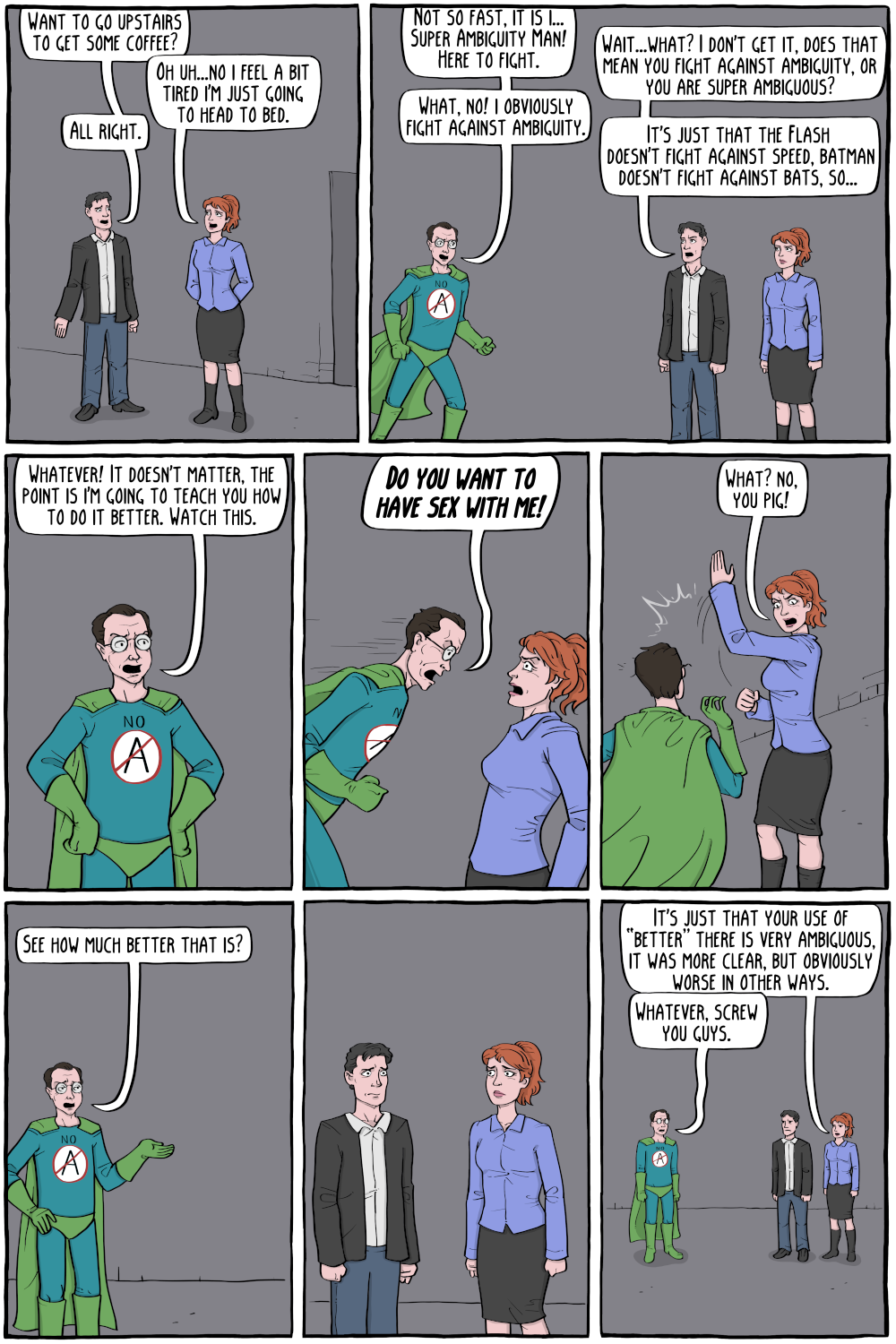
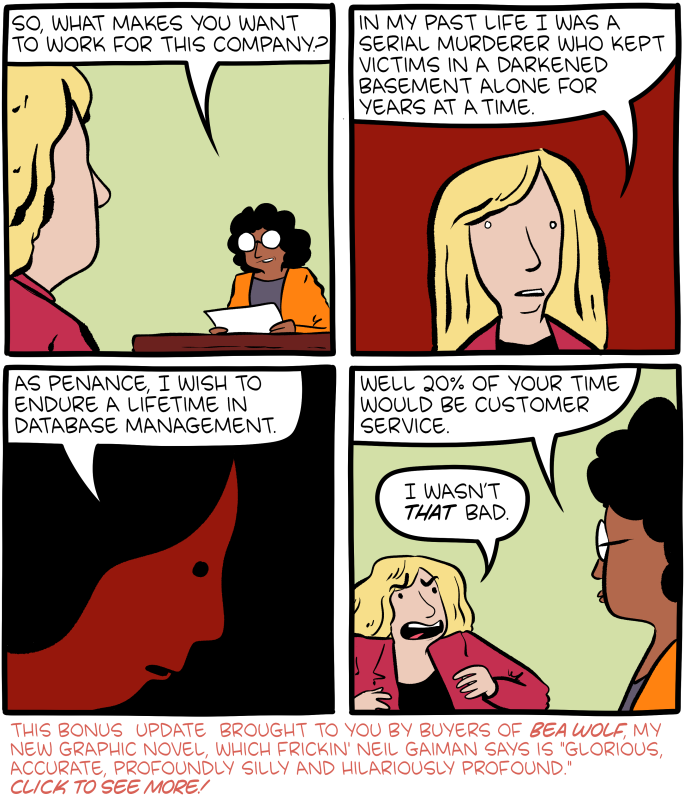
Hovertext: This is just a big thank you to Bea Wolf buyers. We're already in our 3rd printing and it doesn't come out for a month. If you want a hardcover, lock it in soon - they're gorgeous :D
Today's News:
Thanks y'all, I mean it. Here's one more heartmelting review:
"An instant classic. Like nothing I have ever seen. The unforgettable characters within Treeheart and their death-defying (and extremely funny) heroics now have a permanent place in my brain. This combination of impossibly charming art and boundlessly thrilling and hilarious text is a required addition to your family's library. I love this so much."
The Supreme Court could soon redefine the rules of the internet as we know it. This week, the court will hear two cases, Gonzalez v. Google and Twitter v. Taamneh, that give it an opportunity to drastically change the rules of speech online.
Both cases deal with how online platforms have handled terrorist content. And both have sparked deep concerns about the future of content moderation, algorithms and censorship.
Section 230 and Gonzalez v. Google
If you’ve spent any time following the various culture wars associated with free speech online over the last several years, you’ve probably heard of Section 230. Sometimes referred to as the “the twenty-six words that invented the internet,” Section 230 is a clause of the Communications Decency Act that shields online platforms from liability for their users' actions. It also protects companies’ ability to moderate what appears on their platforms.
Without these protections, Section 230 defenders argue, the internet as we know couldn’t exist. But the law has also come under scrutiny the last several years amid a larger reckoning with Big Tech’s impact on society. Broadly, those on the right favor repealing Section 230 because they claim it enables censorship, while some on the left have said it allows tech giants to avoid responsibility for the societal harms caused by their platforms. But even among those seeking to amend or dismantle Section 230, there’s been little agreement about specific reforms.
Section 230 also lies at the heart of Gonzalez v. Google, which the Supreme Court will hear on February 21st. The case, brought by family members of a victim of the 2015 Paris terrorist attack, argues that Google violated US anti-terrorism laws when ISIS videos appeared in YouTube’s recommendations. Section 230 protections, according to the suit, should not apply because YouTube’s algorithms suggested the videos.
“It basically boils down to saying platforms are not liable for content posted by ISIS, but they are liable for recommendation algorithms that promoted that content,” said Daphne Keller, who directs the Program on Platform Regulation at Stanford's Cyber Policy Center, during a recent panel discussing the case.
That may seem like a relatively narrow distinction, but algorithms underpin almost every aspect of the modern internet. So the Supreme Court’s ruling could have an enormous impact not just on Google, but on nearly every company operating online. If the court sides against Google, then “it could mean that online platforms would have to change the way they operate to avoid being held liable for the content that is promoted on their sites,” the Bipartisan Policy Center, a Washington-based think tank, explains. Some have speculated that platforms could be forced to do away with any kind of ranking at all, or would have to engage in content moderation so aggressive it would eliminate all but the most banal, least controversial content.
“I think it is correct that this opinion will be the most important Supreme Court opinion about the internet, possibly ever,” University of Minnesota law professor Alan Rozenshtein said during the same panel, hosted by the Brookings Institution.
That’s why dozens of other platforms, civil society groups and even the original authors of Section 230 have weighed in, via “friend of the court” briefs, in support of Google. In its brief, Reddit argued that eroding 230 protections for recommendation algorithms could threaten the existence of any platform that, like Reddit, relies on user-generated content.
“Section 230 protects Reddit, as well as Reddit’s volunteer moderators and users, when they promote and recommend, or remove, digital content created by others,” Reddit states in its filing. “Without robust Section 230 protection, Internet users — not just companies — would face many more lawsuits from plaintiffs claiming to be aggrieved by everyday content moderation decisions.”
Yelp, which has spent much of the last several years advocating for antitrust action against Google, shared similar concerns. “If Yelp could not analyze and recommend reviews without facing liability, those costs of submitting fraudulent reviews would disappear,” the company argues. “If Yelp had to display every submitted review, without the editorial freedom Section 230 provides to algorithmically recommend some over others for consumers, business owners could submit hundreds of positive reviews for their own business with little effort or risk of a penalty.”
Meta, on the other hand, argues that a ruling finding 230 doesn’t apply to recommendation algorithms would lead to platforms suppressing more “unpopular” speech. Interestingly, this argument would seem to play into the right’s anxieties about censorship. “If online services risk substantial liability for disseminating third-party content … but not for removing third-party content, they will inevitably err on the side of removing content that comes anywhere close to the potential liability line,” the company writes. “Those incentives will take a particularly heavy toll on content that challenges the consensus or expresses an unpopular viewpoint.”
Twitter v. Taamneh
The day after the Supreme Court hears arguments in Gonzalez v. Google, it will hear yet another case with potentially huge consequences for the way online speech is moderated: Twitter v. Taamneh. And while the case doesn’t directly deal with Section 230, the case is similar to Gonzalez v. Google in a few important ways.
Like Gonzalez, the case was brought by the family of a victim of a terrorist attack. And, like Gonzalez, family members of the victim are using US anti-terrorism laws to hold Twitter, Google and Facebook accountable, arguing that the platforms aided terrorist organizations by failing to remove ISIS content from their services. As with the earlier case, the worry from tech platforms and advocacy groups is that a ruling against Twitter would have profound consequences for social media platforms and publishers.
“There are implications on content moderation and whether companies could be liable for violence, criminal, or defamatory activity promoted on their websites,” the Bipartisan Policy Center says of the case. If the Supreme Court were to agree that the platforms were liable, then “greater content moderation policies and restrictions on content publishing would need to be implemented, or this will incentivize platforms to apply no content moderation to avoid awareness.”
And, as the Electronic Frontier Foundation noted in its filing in support of Twitter, platforms “will be compelled to take extreme and speech-chilling steps to insulate themselves from potential liability.”
There could even be potential ramifications for companies whose services are primarily operated offline.“If a company can be held liable for a terrorist organization’s actions simply because it allowed that organization’s members to use its products on the same terms as any other consumer, then the implications could be astonishing,” Vox writes.
What’s next
It’s going to be several more months before we know the outcome of either of these cases, though analysts will be closely watching the proceedings to get a hint of where the justices may be leaning. It’s also worth noting that these aren’t the only pivotal cases concerning social media and online speech.
There are two other cases, related to restrictive social media laws out of Florida and Texas, that might end up at the Supreme Court as well. Both of those could also have significant consequences for online content moderation.
In the meantime, many advocates argue that Section 230 reform is best left to Congress, not the courts. As Jeff Kosseff, a law professor at the US Naval Academy who literally wrote the book about Section 230, recently wrote, cases like Gonzalez “challenge us to have a national conversation about tough questions involving free speech, content moderation, and online harms.” But, he argues, the decision should be up to the branch of government where the law originated.
“Perhaps Congress will determine that too many harms have proliferated under Section 230, and amend the statute to increase liability for algorithmically promoted content. Such a proposal would face its own set of costs and benefits, but it is a decision for Congress, not the courts.”