In 2005, Franklin Leonard was a junior executive at Leonardo DiCaprio's production company. A big part of his job was to find great scripts. The only thing — most of the 50,000-some scripts registered with the Writers Guild of America every year aren't that great. Franklin was drowning in bad scripts ... So to help find the handful that will become the movies that change our lives, he needed a better way forward.
Today on the show — how a math-loving movie nerd used a spreadsheet and an anonymous Hotmail address to solve one of Hollywood's most fundamental problems: picking winners from a sea of garbage. And, along the way, he may just have reinvented Hollywood's power structure.
This episode was produced by James Sneed and Darian Woods, and edited by Bryant Urstadt, Karen Duffin and Robert Smith.
Environmental investigations units with the Houston Police Department and Texas Commission on Environmental Quality are looking into alleged criminal activity at the Kingwood Central Wastewater Treatment Plant, where operators are accused of concealing the release of pollutants into a public waterway. But the City of Houston says its drinking water has been unaffected and is safe for consumption.
The Tribune analyzed more than two dozen anti-drag protests. Opponents frequently characterized the drag events as catering to children, even when businesses advertised them as adults-only or provided warnings about the potential for explicit material.
I currently have a full-time job as a manager in an industry that is a very small world. I’ve worked here for three years, and I love it. My question concerns a boss I had at the previous company where I worked, Bob. He wants to stay in touch. I don’t.
When I worked for Bob, I got promoted multiple times and eventually became his second-in-command. But he wouldn’t relinquish any power to me, instead always asking for my advice and never taking it. I found the position extremely frustrating. It felt like a waste of time, plus I wasn’t learning anything.
The company had multiple under-performers, but Bob wouldn’t fire anyone. He always wanted to be liked. Even when serious behavior issues arose, including racist and sexist comments at work, he would let it fester rather than disciplining or firing the offender. (Example: One employee made inappropriate jokes about child sexual abuse material at work. Bob told me, “His wife just had a baby! I can’t fire him!”) Several talented female employees and employees of color quit the company over Bob’s behavior. This company did have an HR department, but Bob would always pressure people not to make official reports to HR, claiming he would handle disputes himself – which he never did.
After getting a much better job, I’ve realized just how much Bob failed me and my colleagues. But because I ignore his texts, he has started talking to other people I know – including my current coworkers and boss – about how I’m “ignoring him” and he’s sad. Again, because my industry is small, I will most likely run into him at conferences someday, which I’ve avoided due to pandemic cancellations but soon won’t be able to avoid anymore.
I think I have a few options:
• Continue to ignore him. When coworkers/peers tell me he’s asking about me, keep shrugging it off and saying we simply lost touch. I’m not sure how to keep this up if I run into him at a conference and he asks me outright if I’m upset with him, though.
• Send him an email apologizing for ignoring his texts, explaining that I needed some space to mentally regroup/adjust to my new job. This would also require me to respond to any future contact and to generally pretend I still like him.
• Send him an email explaining that I feel like he failed me as a boss and that I wish he would make some changes to how he manages other people, especially since he is currently still a manager. I know that this would upset him greatly, due to his need to be liked by everyone, but he is already upset that I am ignoring him. Sending him a message like this might end our relationship (what little is left of it), but it also might lead to further problems, such as him continuing to complain to my current boss/colleagues/peers about my decision to cut ties.
I’m worried my coworkers think it’s weird that I don’t talk to him. I have explained the full situation to my boss and he seems understanding, if a bit confused by how firm my decision has been to cut off a former boss in a small industry like ours (I have a good reputation with my boss thanks to my past three years of good work at this job, which probably helps). With my other coworkers, I have not really elaborated on any of this, although naturally they are curious.
I don’t think sending Bob a message about his failures as a boss will result in much meaningful change to how he functions as a manager. If it were that easy to get managers to change, there would be far fewer bad ones. People aren’t usually bad managers because no one has ever told them things like “you shouldn’t let behavior problems fester” or “you can’t allow racist and sexist comments at work.” They’re bad managers for much more complicated reasons — in a case like Bob’s, probably some combination of a deep-rooted fear of upsetting people or being disliked (the terribly irony of which is that it nearly always leads to the manager being disliked by their best employees), bad priorities, incompetence, and insufficient oversight from above him. You can’t fix any of that with an email to Bob.
I do think you can just continue to ignore him if you want. If you run into him at a conference and he asks outright if you’re upset with him, you can say, “I’ve just been incredibly busy and terrible about keeping in touch— sorry about that!” That may or may not be credible, but it’s a thing you’re allowed to say and he can’t really insist that it’s not true. (Or rather, he could but that would be extremely weird and you could stick to your story and then quickly excuse yourself.)
The easier option, though, especially since he’s complaining about your lack of response to others, is probably to respond to one of his recent messages. Don’t respond immediately; let it sit for a bit and then respond by saying, “Sorry for the long delay in responding! I’ve been incredibly busy and terrible at keeping in touch. My schedule won’t calm down for the foreseeable future but I hope all is well with you!”
Frankly, if you wanted to, you could even say, “I’ve been hearing from colleagues that you’re worried that I’m ‘ignoring’ you. I’m just really busy and I hope you will stop saying that to people since it’s making it sound there’s drama when there isn’t. Hope all is well and I’ll see you at (conference)!”
You could also choose to just have the bare minimum amount of contact with Bob to stay on good terms, given the small industry — meaning you respond to the occasional message (but not all) with something cheerful, vague, and brief. Sometimes it makes sense to do that for political reasons, although I can’t tell whether or not it’s the case for you (and if you can’t stomach it, then so be it).
But also, you can just keep ignoring him if you want, and shrugging it off (“eh, we lost touch”) if anyone asks you about it. It doesn’t need to be a big deal to you just because Bob has turned it into a big deal for himself.
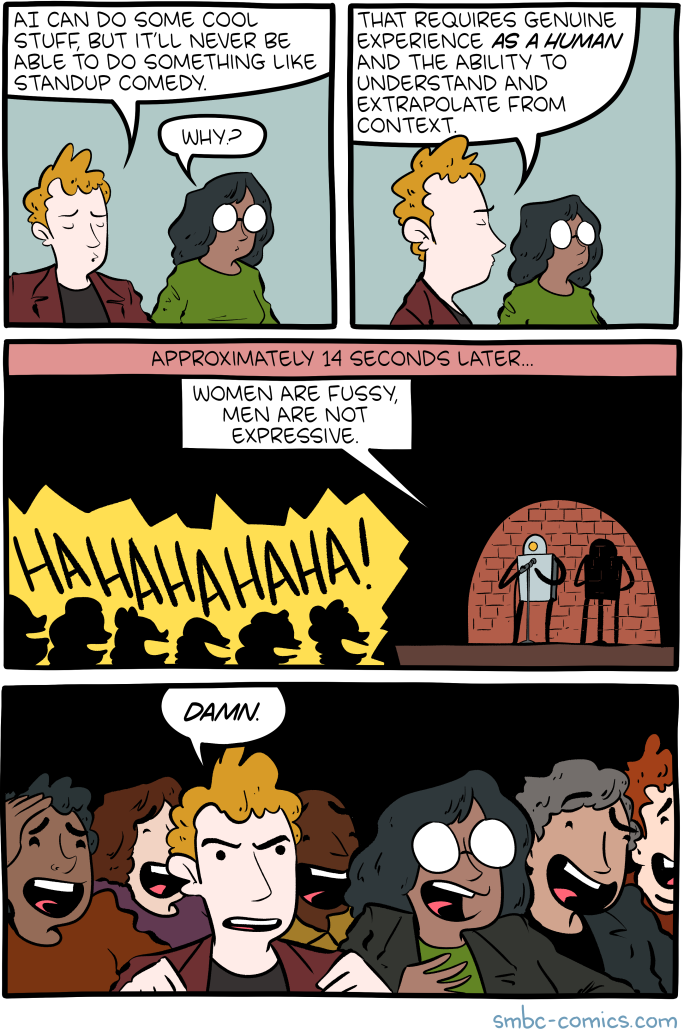
Hovertext: Have you noticed this thing where people say AI will never be as good as Shakespeare, but then nobody mentions that none of us are as good as Shakespeare?
This is a low-stakes question and one that’s more philosophical than imminent, but I’ve been curious about your take on it for a couple weeks now and decided to write in.
A women-focused satire site has been advertising me a pullover sweatshirt that says CHILDLESS in big letters across the front. Could this get me in trouble at work, or appear discriminatory against colleagues with children if I ran into a coworker in town in my off hours?
My personal context that has me thinking about it —
Two years ago ago I was promoted to my first management, surpassing a few colleagues with 5+ more years of tenure. While I believe my promotion was based solely on work quality, and in the past two years I think I’ve proven my worth as the right person to lead our team, I’m also someone who generally falls into the “preferred” side of societal biases — e.g. youth, physical appearance, health status, family status (not having to flex time for child care). To be clear, I don’t think this makes me a better person and I’m continually working to diminish my own acceptance of these biases, but I am aware of my privileges and the potential appearance of colleagues being passed over for discriminatory reasons.
I would feel pretty awkward if I ran into any of my colleagues with kids while wearing a sweatshirt championing childlessness (and already feel pretty awkward in meetings when they’re talking about kids/pets and I have to repeatedly say that no, I have none and won’t be getting any). But is that awkwardness a me problem or a potential work issue? How far does a management role extend into someone’s off-work personal expression?
For what it’s worth, I do ask my colleagues with kids about them, pass on notices about local family-friendly events, and always make accommodations for them to take off work or flex hours as needed to care for their families (which is the most important bit, I think).
I’m not seriously considering buying the sweatshirt. I just can’t get it out of my targeted ads and I think about this every time I see it!
Ooooh, this is an interesting question (and I will be answering it as someone who is also childless by choice).
I think you’ve got two competing principles here. On one hand, what you wear on your own time should be your own business (within some reasonable limits — if you’re wearing racist slogans, don’t be surprised if your employer takes an interest, especially if you manage people). And this sweatshirt doesn’t say that people with kids suck — it’s a statement about you, not anyone else. Is it that different than if you wore a shirt that said ITALIAN? Or for that matter, MOM? So from that perspective, this is no one’s business.
However … you’re a manager and that can change things. You don’t want anyone who reports to you to wonder if you think it’s somehow better not to have kids, or if you look down on people who do. You don’t want them to wonder whether you favor people who never need time off for a sick kid, or how you really felt about their maternity leave, or whether you’ve got biases that affect who gets what projects or promotion opportunities.
And to be clear, maybe a sweatshirt shouldn’t make them wonder any of those things. But given how very weird we are in this country about parenthood, and about motherhood in particular (it’s the highest calling a woman can aspire to! the most important job you’ll ever do! so selfish not to! oh, but don’t expect any support from society as a parent! you’re completely on your own! if it’s hard or messes up your career, well, you chose this so how dare you expect help) and the reality that many women do get penalized professionally for having children and that society is outright hostile to working moms in many ways … well, I sure could see an employee running into their manager wearing that sweatshirt and not feeling great about it.
So while you could wear it around town, I think it would be kinder and wiser not to, as long as you’re managing people, and I think that’s what your awkward feelings about it are telling you. But by all means, buy it and wear it around the house if you want to.
(As a side note, it’s interesting that you categorized being childless on the ““preferred” side of societal biases! It definitely can be at work, as detailed above … but holy wow, there’s some weirdness out there toward people who don’t have kids. Which is what gives the shirt its subversiveness. Society cannot be satisfied! If you are a woman, you’re going to be told you’re messing it up one way or another.)
1. To help women, we assign them extra work and penalize them if they don’t do it
I work for a large organization that tries to be proactive about diversity and inclusion. One if their iniatives seems wrong to me. To provide women with better resume building and networking opportunities, the company has a list of projects that they nominate women to complete. The nomination is more you being told by your manager that you have to do this. The extra work is in addition to your day job and if you fall behind because of it, you will likely be penalized. The company tries to make the work high-visibility by showcasing it at the annual town hall. However, I wonder … why do women have to do this extra work when their male counterparts do not? How does this seem fair?
Wow, no, that is not how this is supposed to work. And legally, it can’t work like that.
It is fine to design a program to try to redress systemic disadvantages by making networking and resume-building opportunities available to women in your company who want them. It is not okay — and crucially, it is not legal — to assign women extra work because they are women. And then to claim that it’s to help them! Agggh. (It’s also not legal to assign work by gender, period.)
The women employees in your organization should be up in arms about this.
2. Did I mess up how I called out when I was in the ER?
A few years ago, I worked in a large division of a large company. Although all my job functions had previously been supervised by one person — Maarva, with whom I got along well — a reshuffle meant that I took on a second supervisor, Kino, for one facet of my job.
About three weeks after Kino’s arrival, I woke up in the middle of the night with horrible abdominal pain. At 6 am, I went to the emergency room and was admitted for what turned out to be a terrible gallbladder attack. Around 8 am (an hour before we were expected to be at work), I called Maarva’s voicemail, told her what was going on, and asked her to please inform Kino that I would be out that day. I did not call Kino as well because (a) I was nervous about my cell phone battery running down, (b) I felt horrible and could barely focus, and (c) I figured that Maarva passing along this information would constitute adequate notice. For what it’s worth, I had no particularly pressing deadlines or projects for that day, for either Maarva or Kino.
Once my attack had subsided and future surgery was tentatively scheduled, I was sent home that night and returned to work — tired but functional — the following day and discovered that Kino was furious with me. He told me that I was never to call out without informing him again and he had written me up over it. Later in the day, the managers had a meeting, and Kino griped about my “lack of respect.” Only then did Maarva realize she’d forgotten to mention my call to Kino, who hadn’t even known I was in the hospital — he just thought I took an average day off and failed to inform him. To Kino’s credit, he apologized to me and attempted to take back the write-up, but our horrible division head refused, because the incident “taught me a lesson” (about gallstones? who knows?).
This incident left a really bad taste in my mouth. I still feel that Kino could have at least spoken to me about the incident and gotten his facts straight before writing me up. The division head’s behavior was about what I would expect from him, but it still seems to me that if a write-up turns out to be based on a faulty premise, it ought to be rescinded. But maybe I’m giving myself too much of a break here? Yeah, I was in agonizing pain in an ER, but Kino didn’t know that. If Kino had written in to you, what course of action would you have suggested for him on the day I was gone? The day after? How much did I mess up?
(Maarva apologized profusely to both Kino and to me, sent flowers while I was in the hospital for my surgery, and served as my reference for my next job. She was a great supervisor aside from her occasional absent-mindedness!)
Of course it left a bad taste in your mouth! You were in the ER dealing with excruciating pain, called in as required, and assumed Maarva would handle it from there — and then got attacked by Kino the moment you returned to work. Even if you had neglected to call in, Kino’s reaction was way over the top! When he couldn’t find you the day you were out, why didn’t he ask Maarva — your primary manager — if she’d heard from you? Or start by asking you what happened once you returned, rather than assuming and launching into a furious tirade and write-up? If it turned out you had in fact just blown off work for no reason and without alerting anyone, he could have dealt with that — but you don’t start by jumping to the worst conclusions about someone and raging at them … and as a manager he should be aware that sometimes when someone is out unexpectedly, it’s because something really bad happened, the sort of thing that would make his reaction incredibly misplaced.
You didn’t mess up at all. You alerted your office you’d be out and asked them to notify others who needed to know. You were fine. Kino sucked.
3. Am I supposed to address all MDs as “Doctor so-and-so”?
I work for an organization where I frequently interact with medical doctors in a professional capacity, for specific projects made up of medical doctors and others. Many of my non-MD colleagues exclusively address these individuals as “Dr. so-and-so” forever and always. For me, as soon as they say they say their first name only (“Hi, I’m Jane”) or sign their first name only in an email — which they usually do immediately — I take that as a sign they are happy to be on a first name basis and use that. They are not my doctor. And, we are working together as equals. Also, these are regular work meetings often in groups so it would be weird to ask them in front of everyone “May I call you Jane?” Last, no one ever calls me “Mrs so-and-so.”
For comparison, at my kids’ schools, everyone addresses me as “Mrs” and I use their titles as is appropriate. In that case, it’s mutual and reciprocal.
Am I wrong here?
Nope, that is in fact the long-time etiquette rule: If someone introduces themselves with only their first name or signs off using it, that’s a signal that you should address them by their first name. That’s what it means!
4. New colleague keeps blaming a coworker for missed deadlines
I work for a large company. My team collaborates with several different teams on various projects. One of these teams has a new structure with a new point of contact. Since the new contact came on board six months ago, we have noticed that the team is often late on deadlines, even those they suggested. The contact person consistently and proactively blames their tardiness on one specific member of their team, calling them out by name and noting what a burden their time out of office has caused, is causing, or will cause. That named team member, whom we have worked with for years and have found to be excellent, has taken a total of about three weeks of PTO, scheduled well in advance, during this time frame. They are not in the meetings where their absence is discussed. (For what it’s worth, we have not seen evidence that this “named” team member is assigned to any of the late work, but rather the suggestion is that her absence causes stress on the rest of the team which in turn affects their work.)
Our team has grown increasingly uncomfortable with how often this person’s PTO is used as an excuse, not just because our timelines are not met but because it seems to unfairly target one person for the productivity of a full team. Is there anything we can or should be doing to address this situation?
Ideally your team’s manager would speak to the manager of the new point of contact about what’s happening — explaining that she keeps blaming a colleague for late deadlines, it doesn’t seem to be true, and it’s making your whole team uncomfortable.
If for some reason that doesn’t happen or doesn’t solve it, the rest of you should feel free to speak up when this contact person blames the other team member. For example: “That doesn’t sound right. Jane has always been on top of deadlines and hasn’t taken an unusual amount of PTO.” Or, “It’s not sitting right with us that you blame Jane when this happens. She has always been on top of deadlines and hasn’t taken an unusual amount of PTO.” And consider adding, “Maybe you can sit down with us, Jane, and (this person’s manager) and hash this out.”
5. Interview travel expenses
What expenses is it appropriate for a company to cover when you travel to their location for an interview? In my field, people often interview with organizations that are located in different cites than their own. Typically, the schedule is to fly in the night before, interview the entire day, have dinner that night with the interview committee, and then fly out the next day.
However, I was recently offered an interview where they wanted me to fly back right after I interviewed — they were not willing to cover a hotel for that night. That would have meant interviewing from 9-5 (there was no dinner, I guess, another bad sign), then an hour or longer ride to the airport in rush hour traffic, and flying another 1.5 to 2 hours to get home. That sounded like an exhausting day, so I declined to continue on with the interview process.
They did mention that things would have been different if I lived on the opposite coast from the organization’s location, but since I was located on the same coast they would only pay for a hotel the night before. Is that standard for interviews? I was kind of offended and it honestly felt a bit ableist, like they were looking for the candidate with the most stamina vs. the one who would be the best fit for the role.
There’s no real standard across fields; some organizations won’t pay to fly candidates out at all, some try to keep their expenses as low as possible, and some pay more to prioritize candidate comfort and will happily pay for that second night. But more often than not, with an organization that’s already flying someone out, it’s reasonable to expect they’d cover a second night, given the schedule you described — or would at least agree to it if you asked, even if it wasn’t their first proposal. (A lot of people would prefer to fly home that night since the flight was short, and they might have assumed that was your preference … but there should have been room for you to explain it wasn’t.)
I doubt they were looking for the candidate with the most stamina; more likely they were trying to save money (although the effect could be the same).
Experts say that a nearly 2,000-year-old wooden, penis-shaped object that was recently discovered in England could have served as a sexual tool by ancient Romans in Britain. What do you think?
A factory-sealed, first-generation iPhone sold at auction for $63,356.40, more than 100 times its original price, after a woman was gifted the phone in 2007, but never opened it because she didn’t want to get rid of her other phone. What do you think?
This week in DistroWatch Weekly: Review: helloSystem 0.8.0News: Solus team works to repair website, Arch and its children recommend manually updating a package, Canonical offers real-time version of Ubuntu, SUSE tests Micro editionQuestions and answers: Underrated distributionsReleased last week: KaOS 2023.02, Parrot 5.2, Clonezilla Live 3.0.3-22Torrent corner: Manjaro,....
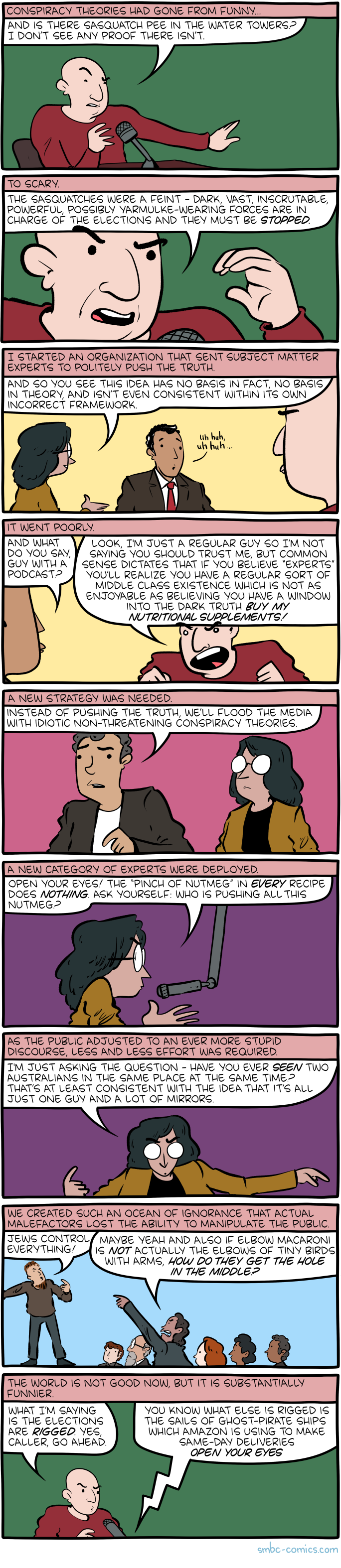
Hovertext: Panel 4 is the greatest prose I'm capable of.
Today's News:
Hey geeks, after years of holding out, I'm finally getting engaged with social media. I post a lot of favorite old comics plus news about NEW BOOKS. You can follow me on facebook, instagram, twitter, mastodon, and tumblr. Please consume comics however you like - what helps us most is if you buy books when they come out. <3
NABLUS, WEST BANK—In a journalistic dispatch produced moments after the military operation, the headline ‘10 Palestinians Dead After Israeli Raid’ was published Wednesday as part of a news story that reportedly could have run any week for the past 75 years. “At least 10 Palestinians were confirmed killed, with…
Democracy is a word on a lot of lips lately, but I’m not sure what it means: The right to vote?
Freedom of speech? All of it together forms this numinous enterprise of democracy that we can’t see or touch. But we can see and know workers, who are the fabric of democracy.
Over the decades, I’ve done studio and commercial photography, photojournalism, landscape pictures, and art photography. My dad and I used to do crime scene photos for the Fort Worth Police Department. Here and there, I’ve also worked for the excessively affluent million and billionaires who seemed to know little about us mid-level workers. Their cultural currency was built on watching people’s behavior in the presence of great wealth.
But for the most part, us Byrds—I’m the fourth generation of photographers by that name in my family—don’t watch the rich. We document the great, squirming mass of humanity that has worked for a living since our Neander neighbors shared the planet with us. Our trade is the folks who trade their living moments for food and shelter.
These days, I am obsessed with the anthropology of it all—the part my images play in capturing the lives of those around me who build, invent, educate, preach, cook, and strip.
The peasants and hunter-gatherers who walked the road before us had few means of documenting their lives. Yet proof of those lives is available to us: tools discovered in East Africa’s Olduvai Gorge, primitive business emails etched in stone by Sumerian laborers.
Current-day image tools offer ever-increasing verisimilitude. Black-and-white photographs introduce us to mid-19th-century presidents. Color photographs describe mid-20th-century family life. Documentaries tell us about societies already gone.
Despite all the truthiness of our modern images, however, there is a problem: their lack of permanence compared with the archival longevity of, say, a painting, whether on a canvas or a cave wall. You walk into a display of 3,000-year-old Egyptian images of Nefertari or Khufu, and there they are. You can see how they dressed and what they labored at, try to understand their beliefs. Digital images, inkjet prints, and color photographs can’t compare.
That’s why, these days, I make precious metal-based photographs. Scientists estimate that a black-and-white photograph printed with gold, silver, platinum, or palladium may last 500 to 2,000 years, maybe more if stored properly. I’m working to keep my window to posterity open as long as possible.
Photographs are the artifacts of now. With them, we can solidify the “present” to make the numinous appear—in this case, the workers of one time period speaking to the future.
Christopher Jones works in the shoe repair shop owned by his grandmother, Dessie Jones, in Denton in 2019. Byrd Williams IVByrd Williams Jr. captured the serious visages of a group of city planners in El Paso around 1912. Byrd Williams Jr.The crew at Denton’s Dark Age Tattoo Studio pauses in their work for this shot in 2019. Byrd Williams IVIn 1998, author Larry McMurtry had just bought most of the inventory of Barber’s Books in Fort Worth and moved them to his bookstore in Archer City. Byrd Williams IVMatt Soness and daughters Brie Soness and Sage Horton start serving coffee at 6 a.m. at downtown Dallas’ Flying Horse Café. Byrd Williams IVAt the Westcliff Hair Salon in south Fort Worth in 1952, hairdressers lined up at their workstations while a co-worker stood ready to check out customers. Byrd Williams III
When I bought a house last year, it came with many new responsibilities. Suddenly, I was the one who had to change the furnace filters, call the exterminator, and repeatedly suggest to my neighbor that her big tree might be dead. But the biggest change of all was “escrow,” a word that I definitely understand and did not just hear for the first time when my officemate Patty said it in passing.
Escrow definitely has something to do with houses and money, so you start by getting a mortgage. To get a mortgage, well, you probably know all about that, but a very important person is the notary. The notary is sort of like an attorney, but with the letters in “attorney” mixed up and some deleted. Notaries are identity experts—they can tell exactly who you are by looking at you and then at your driver’s license. Notaries have a special stamp they bought from Zazzle. You have to pay them in cash. That’s what I know about notaries, and with that knowledge, you can advance past that part of the home-buying process, and you’re one step closer to having escrow.
Once you’re done with the notary, time to figure out your routing number. Your routing number comes from the bank and has to do with those big tubes that suck up the money capsules at the drive-through. I get the feeling that if I write down my routing number incorrectly, it might bankrupt me. That’s why knowing and understanding it is crucial during a significant financial transaction, like buying a house and setting up escrow.
The last thing you have to stay on top of is property taxes. Property taxes are money you pay to the government based on the value of your house. The government comes by once a year to value your property, unless you have a “homestead exemption.” A “homestead exemption” means you can shoot anyone who comes on your property without permission, which makes the government stay away. It’s important to ensure you have homestead if you’re eligible. It’s a key deterrent to burglars and it lowers your taxes.
With all that done, you can set up your escrow to be automatic. Mine is automatic—I’m definitely saying that because it is, not just because Ron from HR told Patty it was way better to make escrow automatic. I am definitely not saying my escrow is automatic as a form of denial because I am paralyzed by fear that I will lose my home due to a snafu with escrow, which I understand entirely.
So: mortgage, approved by the notary—check. Routing number copied precisely correct to avoid financial ruin—check. Homestead filed—check. Automatic escrow—I almost certainly did that during the busy home-buying process and just don’t remember it right this second—check.
Yep, I love owning my home, but navigating the purchase process required a lot of financial savvy. Aside from what we’ve discussed here, I also have a complete understanding of things like what my title attorney did, when I am supposed to call 411, and the easement thing that my real estate agent said was not a big deal. And that’s without even mentioning escrow, which I definitely have and totally understand.
It’s not quite Microspeak, but it is a sort of Microjoke: Referring to a document as “light reading”.
In common parlance, “light reading” is something that is easy to read without requiring significant mental effort: A magazine that covers celebrity comings and goings, a romantic comedy novel, a travel story. If you choose to read them, they are typically enjoyable content that doesn’t require close reading and which you can put down at a moment’s notice. If you encounter a section that you find boring, you can just skip over it without serious repercussions.
At Microsoft, the term “light reading” is almost never used to mean that. Rather, it is used ironically to refer to a document that is one or more of the following: Lengthy, complex, mandatory.
All of the documents that were covered at the directors review are available on this site. Enjoy the light reading!
Some light reading for the Tuesday meeting: (lengthy email message follows)
Here’s a citation from outside Microsoft:
Just in case you wanted a little light reading, you can access the Apple TV’s software license agreement through the Settings menu.
I’m about to graduate from college and I’ve been looking at internships targeting recent grads, as well as entry-level jobs, Some of these, including one I’m very interested in, ask interns to share a house and do group activities beyond work-related training (cook meals together, go swimming). Which sounds unprofessional, I know, but is sort of reasonable since these internships are often linked to an undergraduate summer program (or even a high school program!) and are marketed as halfway between a job and a gap year.
For a lot of people, I’m sure this kind of thing is super fun and rewarding (I have a friend in one of these programs and it’s great for her). However, sharing a kitchen is an absolute no-go for me — I have celiac disease, which is an incredibly sensitive gluten allergy. Even using kitchen utensils that have been used with gluten risks making me sick for weeks, I can’t eat many items labeled “gluten free,” etc. I’m willing to live on my own or with roommates I personally vet and who know that they’re opting in to a strictly gluten-free kitchen, but I am not going to spend months of my life negotiating kitchen space with random teenagers who might forget that soy sauce has wheat in it, or absolutely need to bake a cake or they’ll go crazy, or think I’m making the whole thing up for attention.
Do you know if internships that expect this are legally required to let me find alternate accommodations? I’m worried that since this isn’t a traditional job, they’ll argue that living in a community with other interns is in some way a core part of the program. And how should I handle asking about it? My current plan is to ask in stages:
– by email before I apply, disclose that I have a disability that would affect housing arrangements but not any other aspect of the job, and ask if the housing component is considered a requirement, a perk, or part of compensation
– in an interview, disclose fully, and ask how they’ve handled disability accommodations for interns in the past
– during salary negotiations, ask how much they’ll subsidize alternate housing or raise my pay, since the posted offer plus rent-free housing is obviously a much higher rate of compensation than simply the money on its own.
It’s very, very likely that you’ll be allowed to find your own alternate accommodations; programs like this typically see the provided housing as a perk but not a strict requirement … and especially not a requirement so strict that it would trump a participant’s health needs. I can’t say with certainty whether they’re legally required to let you opt out of it, but I’d be surprised if they aren’t. Regardless, from a practical standpoint, they almost certainly will allow exceptions.
The most likely complication is that they might not be willing to pay for alternate housing for you, since that won’t be budgeted into the program’s finances. So go into it knowing that might not be on the table.
I wouldn’t send the pre-application email asking if they consider housing a requirement, a perk, or part of compensation — the person answering those emails might not know how it will impact compensation and it’s getting more into the weeds than you need to at that point. Instead, apply and include a note in your cover letter explaining you have a health issue that would mean you couldn’t live in their group housing. In the interview, explain what you’d need and ask how they’d handle that. And then if they offer you the internship, see if you can negotiate a stipend for housing, which may or may not be doable but isn’t unreasonable to ask about. (Or, if the housing stipend would be a deal-breaker for you, you could ask about it at the interview stage or even before accepting an interview.)
Also, you mentioned salary negotiations so be aware that a lot of these programs don’t do any salary negotiation; participants are all paid the same. But even if that’s the case, you can still ask about housing assistance.
2. Would I be a jerk for turning down lunch with my successor?
I just found out that the person who became my successor for a previous role is now my successor again for a job I left a few years ago. What are the chances? She got in touch with me to ask to take me to lunch to learn more about her new role.
I am normally very happy to talk to those taking over previous roles. However in her first time succeeding me, she ended up being let go by the board of directors after a disastrous few years were she burnt through half the surplus I had worked hard to build, alienated the staff, and fired (and then hastily rehired when the board found out) a key senior manager who was on sick leave.
Now she wants to meet with me and I have such trepidation about her being unleashed on another beautiful nonprofit that I adored leading. It would be out of character for me to turn down this meeting, but I’m also livid. We work so hard to build organizations but it always shocks me how quickly they can be dismantled.
Weirdly, our offices are in the same building so I will likely bump into her. And who knows, maybe she’s different now? Although I note she has not held a full-time position since that role. So, WIBTA for saying no to a lunch? If I said yes is there a kind way to be honest? Or is it worth saying anything at all?
You can turn down down the lunch without being a jerk; being a good person does not require spending your time in ways that you object to on principle or that feel unlikely to pay off in the way the person requesting your time wants. And really, since it’s been a few years since you left that job, you might not even be able to provide terribly useful insights at this point anyway (and you won’t know what has changed since you left).
Don’t get into the real reason though; there’s no constructive way to say, essentially, “You were a disaster at the first job and I’m concerned you’ll be a disaster at this one too.” Just cite busyness — “My schedule is packed and I’m trying to be disciplined about not putting anything else on my calendar, so the timing won’t work, but best of luck with the role!” And if you run into her in the building and she tries to waylay you with questions, you can always cite the passage of time (“It’s been so long that I don’t remember much that would be helpful, and things have changed since I was there”), which is probably true.
Also! If you can, try to move away from being livid. Her work was presumably a disaster because of incompetence, not intentional malfeasance. And if she’s a disaster in the second job, the organization that hired her for what sounds like a senior role bears some responsibility for that, particularly since she has a track record that could be examined.
3. I don’t want to tell coworkers my time off is for plastic surgery
I’m booked to have cosmetic surgery later this year and I don’t want my colleagues to know about it. I’m lucky enough to have a manager that doesn’t ask for details about time booked off, but any leave of a week or longer will always result in my colleagues asking about where I’m off to, holidays, etc., and I don’t know what to reply when this inevitably happens before my surgery.
I’ve been told that I’ll need two weeks off from work to recover, so I can’t just brush it off with “oh, just chilling at home and catching up with chores” and any mention of surgery will prompt a whole load of chatter about the state of the NHS (I’m in the UK), and if I mention that I’m paying for private medical care, then this just opens up a huge can of worms. So what’s the best way for me do deal with this? A blunt “I’m having two weeks off for private reasons” will NOT satisfy my colleagues and will likely just fuel gossip.
Is it an option to just say vaguely, “Just some medical stuff I have to take care of”? And if you’re asked for details, “Nothing I want to get into, but nothing to worry about”?
If not, then you are having a staycation, or your sister/cousin/college roommate is visiting, or you’re visiting family … whatever you’re most comfortable saying. You don’t owe people total honesty about things that are none of their business, and any of these answers qualifies as an allowable white lie when you’re dealing with nosy people who would otherwise push you for information they’re not entitled to.
4. I’m suspended without pay — but still getting work calls
I made a horrible decision and got a DUI after celebrating a recent promotion. I am full of remorse and recognize what a terrible decision this was. I was traveling for work and, while off duty, I was in a rental car paid for by the company. I called my supervisor the next morning, told him what happened and expressed my remorse. He shared that while disappointed, he did not believe this would result in termination and thanked me for notifying him. I have an extremely strong record with my company and am well respected within the organization and by our customers.
I’ve since been notified by HR that they are revoking my promotion and suspending me for 30 days without pay. However, I am continuing to receive calls — there are several big projects slated for when I return, of which I would typically be planning for now. Can they ask me to plan and work for these while being suspended without pay? I don’t want to be difficult and am fully accepting the consequences of my actions. I am taking every step necessary to ensure this never happens again. But is working for free a legal consequence? I am a salaried, exempt employee.
Nope, they can’t legally have you work while they’re not paying you. Is it possible the people calling you don’t realize you’re suspended? Either way, message your boss (and cc HR) and explain people are still calling you with work and say, “I assume that legally I can’t do work while I’m suspended so I’m going to explain to people that I’m on leave and redirect them to you, but I wanted to let you know it’s happening in case you want me to handle it differently.”
5. Why are so many executives condescending to workers?
Why are so many company executives so condescending to employees? I just sat through a town hall meeting where the CEO revealed that they changed the rules for this coming year to make it much harder to get a bonus than it was supposed to have been. He actually told us that it was better for us this way, like we’re stupid and don’t understand that they just want to pay us less. The whole time, he used a voice like he was a parent talking to a small child. Then the HR director stood up and did the same thing. Do they really think we’re that stupid? Why would they employ us if they think we’re idiots?
Power makes many people weird and out-of-touch and gives them an inflated sense of their own importance relative to others.
Responsible, thoughtful people with power will actively work to counteract those effects, but not everyone falls in that category (and even when they do, it seems to be tough to completely insulate themselves from power’s effects — it can be very Frodo and the Ring).
A Supreme Court decision 50 years ago may have been shaped by the claim that poor children of color can’t learn. The case’s impact has reverberated for generations.
Almost exactly 50 years ago, Alex Rodriguez got his 15 minutes of fame when he was in sixth grade.
Now 61, Rodriguez recalls when news media swarmed his family’s small home in west San Antonio in 1973. “There was everybody and their grandma as far as reporters all over the place,” he said. “At the school, at the house, at the neighborhood. They were just going crazy.” The TV crews had cameras, he recalls, that “were bigger than a bazooka.”
In a way, the reporters were there because of him. In 1968, his father, Demetrio, had sued the state of Texas for underfunding his son’s school district, which was predominantly made up of low-income and Mexican American families. Alex recalls the third floor of his elementary school being condemned; when it rained, water would pour down the stairs. Three or four students shared one textbook.
The lawsuit, filed by Rodriguez and a number of other parents, remarkably, had reached the Supreme Court. Civil rights groups were hoping — and some reporters expecting — it to be the “Brown vs. Board of Education of the 1970s,” as a front-page story in the Wall Street Journal put it.
But as the case wound its way through federal court, a nascent counter-idea was blossoming: Maybe, an influential cadre of social scientists claimed, it didn’t matter how much money schools spent. In fact, maybe schools weren’t actually a key factor in what students learned.
Maybe — most insidiously — poor children of color weren’t likely to succeed in school no matter how well-funded their schools. This idea was spreading, appearing in academic journals and publications like the Atlantic and the Washington Post. A New York Times news article from 1970 included this startling line: “In the case of a slum child,” it read, citing supposedly cutting-edge research, “his chances of learning to read were quite limited, even though large amounts of money might be devoted to his education.”
Fifty years ago this year, the Supreme Court cited some of that same research to rule against the Rodriguez family. The racist notion that children in poverty could not benefit from additional or even equal resources may well have influenced the court’s decision.
“The poor people have lost again, not only in Texas but in the United States, because we definitely need changes in the educational system,” Demetrio Rodriguez told one of the reporters that Alex recalls descending on their home. The media soon left, and Alex went back to the same underfunded school. “It was famous for a day or two — then that was it,” he says now.
Admittedly, the legal and practical merits of the Court’s 1973 decision in San Antonio Independent School District v. Rodriguez are complex and up for legitimate debate. In the long run, the ruling was not the devastating blow to funding equality efforts that many advocates feared. Funding gaps due to property taxes have narrowed or fully closed, in part because state courts stepped in after the Supreme Court stepped aside.
But that often took decades, and the decision had a lasting impact. It left multiple generations of low-income children, like Alex Rodriguez, in schools with lesser funding. This is particularly troubling because more recent evidence has found a meaningful link between spending and student success.
Still today, thanks to the Rodriguez case, the Constitution does not protect the right to an education. A recent effort by students in Detroit to garner some federal right to quality, adequately funded schools failed. For half a century, the decision has effectively closed federal courts to students and families seeking a better education.
On a Thursday morning in May 1968, hundreds of students walked out of Edgewood High School on the west side of San Antonio. They held signs: “‘Every student in America deserves a great education. Where is ours?” “We want a gym not a barn.” “Better library, better teachers, better schools.” They marched to the superintendent’s office with a list of demands. It was a sign of the civil rights-infused times — “the era of rising expectations among minority groups like the Mexican American youngsters” of the city, as the local San Antonio Express put it.
A number of parents had joined in the protest, and soon organized the Edgewood Concerned Parents Association. “When I heard kids saying they didn’t think they could make it in college because of their high school education, then that’s when I decided it was time to do something,” one parent said.
Demetrio Rodriguez — a sheet metal worker, military veteran, and then a father of three young boys — was among those frustrated parents. The group initially targeted their ire at district officials, concerned that they were self-dealing or hoarding money. But then they met with a local lawyer, Arthur Gochman, who pointed out that the district got dramatically less funding than others in the area. Maybe the schools’ problems stemmed not from mismanagement of money, but a lack of it.
Since the advent of public education in America, property taxes had been schools’ biggest source of funding. And because property values varied dramatically from place to place, school funding did too. (Today, state funding has eclipsed local dollars for schools, reducing or even eliminating gaps in dollars due to property taxes. But disparities still exist in some places and funding often isn’t targeted to the highest-needs students. )
Nationally, the correlation between property wealth and poverty was not perfect — in some places, especially big cities, expensive property sat next to deep poverty. But the link was strong enough to create large funding gaps between school districts. In 1972, the country’s most affluent districts were spending 40 percent more per student than the highest-poverty districts.
The San Antonio area was a perfect example. Alamo Heights — an affluent northern part of the city, which had kept Black and Hispanic residents out through racially restrictive covenants — had nearly 10 times the taxable property value as the Edgewood school district, which served mostly low-income, Mexican American children.
The consequences, then, were preordained, and state and federal funds couldn’t make up the gap either. When all the funding was added up, in 1968 Edgewood schools received $356 per student compared to $594 in Alamo Heights, just a few miles across town.
That translated into big differences in what the schools could offer. Teachers in Edgewood were paid much less than those in Alamo Heights. Probably because of that, half of them had only substandard credentials, compared to 11 percent in Alamo Heights, which also had more staff per student. Class sizes in Edgewood were an average of 28 kids. Alamo Heights had a counselor for every 650 students; Edgewood had one for every 3,100. Despite being in southern Texas, just one in three Edgewood classrooms had air conditioning.
On July 10, 1968, with the support of Gochman, who took the case pro bono, Demetrio Rodriguez and several other San Antonio families filed suit against Texas’s school funding system, which they claimed violated the equal protection clause of the Constitution by discriminating against low-income, Mexican American families across the state. “I thought, I ain’t got nothing to lose,” Rodriguez said later. “Maybe we could do some good.”
But far from San Antonio, a small group of social scientists had begun to question the importance of money in public education. Instead, some researchers implied — or even stated outright — that blame for low student performance lay mostly with low-income families of color themselves.
The 1964 Civil Rights Act had included a provision requiring the federal Office of Education to produce a study on inequality in education. Many assumed it would show the need for more investment in segregated Black schools. Two years later, the federal government released the results — which stunned many educators and policymakers. The massive analysis of close to 600,000 students showed large gaps in test scores between Black and white students, but didn’t find much evidence that better schools or more funding led to higher test scores. Lagging student achievement, lead researcher James Coleman concluded, was mostly due to “the home” and “the cultural influences immediately surrounding the home,” rather than schools or money.
The study “produced the astounding proposition that the quality of the schools has only a trifling relation to achievement,” wrote politician and Harvard professor Daniel Patrick Moynihan, who evangelized the Coleman report, as it came to be known, in speeches and articles.
Coleman’s data set was unprecedented, but his methods for teasing out the impacts of funding on student outcomes were crude. He couldn’t follow individual students’ progress over time or isolate the effect of an infusion of funding. “Coleman’s analysis was not only wrong but generated misunderstandings that remain sadly pervasive today,” wrote Stanford professor Caroline Hoxby in a 2016 retrospective.
Nevertheless, the report soon picked up widespread attention: discussed at congressional hearings, written about in newspapers and magazines, and pored over by academics. It also drew notice because it came soon after the 1965 passage of Title I, the first major federal education funding stream and a key piece of Lyndon Johnson’s “war on poverty.”
Coleman’s conclusion that families mattered more than schools seemed to bolster another high-profile report of the era: “The Negro Family: The Case for National Action,” written by Moynihan and published in 1965. This controversial analysis claimed that a rise in single parenthood was at the heart of a “tangle of pathology” among Black families. Moynihan said the point of the report was to spur government action to support low-income Black households. But some civil rights leaders condemned the report as shifting the blame for racial inequality onto Black people.
In 1969, this implication became explicit in an academic article published by University of California Berkeley psychologist Arthur Jensen. He claimed that IQ is nearly fixed at birth and that, therefore, extra funding for poor and Black children was doomed to fail because of what he viewed as their genetically low intelligence. This flagrantly racist argument was a sensation, garnering widespread press coverage. “Can Negroes learn the way Whites do?” was the headline in US News. “Born Dumb?” followed Newsweek. “Intelligence: Is there a racial difference?” asked Time magazine. The New York Times Magazine sympathetically profiled Jensen, describing his “severely trying moments” of being accused of racism.
This was a sign of the times, too: The heady optimism that the federal government could quickly end poverty and educational inequality had waned. The liberal coalition that had supported civil rights and Johnson’s war on poverty had splintered, amid white backlash and the Vietnam War. Riots rippled across American cities. White intelligentsia cast about for explanations for the persistent challenges of poverty, urban unrest, and racial inequality. Some landed on a convenient, age-old answer: the deficiencies of poor people of color.
That’s how in 1970, the Times could declare a “slum child” uneducable. Similarly, a 1970 Wall Street Journal news piece said that Title I funding to help students in poverty had produced “negligible” results. Lower test scores among children of color could be explained by either “genetic or cultural” factors, the article claimed.
In the introduction to a 1971 cover story on IQ, the editors of the Atlantic claimed that Moynihan, Coleman, and Jensen’s reports — “three landmark social documents” — had collectively called into question policy efforts to address racial inequity in education and elsewhere. Getting rid of racist laws had not eliminated economic and educational inequalities — “presumably,” they wrote, “because of internal barriers.”
A 1973 front-page Washington Post story opened with this analogy: “The doctors, you might say, keep telling the parents that their child’s case is hopeless, that no amount of money or variety of remedies will add up to a cure.” The piece was accompanied by a picture of a Black student in a remedial reading class.
There were other, legitimate reasons to question the efficacy of school spending, including a 1969 report from the NAACP concluding that Title I dollars were often being misused. The Coleman report, although methodologically flawed, was among the few empirical examinations of whether more money led to better schools. The problem was that some pundits and researchers had leaped from these early results to write off the impact of schools and funding altogether.
A number of Black academics and writers tried to combat this fatalist brand of social science. “Such studies are a throwback to the nineteenth century theorists who adopted Social Darwinism — the survival of the fittest — as a means of bolstering the privileged classes of society,” wrote Vernon Jordan in the Chicago Defender, a Black newspaper. “Now this old and ugly tradition is being revived.”
But this critique got much less attention from journalists and policymakers than the new educational fatalism, which had already migrated up to the White House.
Later serving as an adviser for President Richard Nixon, Moynihan sent the president an excerpt of Jensen’s paper on race and IQ, as well as two later memos that referenced Jensen’s claims. In a 1971 memo prompted by the Atlantic article on IQ, Moynihan claimed that psychologists believed that there was a “ranking of the major races” by intelligence: Asians, Caucasians, and then “Africans.” Moynihan expressed some anguish over this and described the conclusion as “not settled.” He also recommended Nixon not give up on social programs altogether.
Others were more fatalistic. White House adviser Patrick Buchanan, who later mounted bids for president, wrote a memo about the same article, saying it cast doubt on extra education spending. “Every study we have shows blacks 15 IQ points below whites on the average,” he wrote.
During a phone call with Moynihan, Nixon endorsed the idea of a racial hierarchy of intelligence. “What was said earlier by Jensen is probably very close to the truth,” said Nixon — who appointed four of the justices who, in just a few years, would decide Demetrio Rodriguez’s case.
But in 1971, three years after filing the lawsuit, Rodriguez still had good reason to be optimistic. In December, he and the other San Antonio parents won a major victory in federal court. ”The current system of financing public education in Texas discriminates on the basis of wealth,” a three-judge panel concluded unanimously. The question of whether more money could improve schools did not even come up in the decision.
Texas decided to appeal the ruling to the Supreme Court. The stakes were high not just in Texas, but beyond: Numerous other lawsuits had been filed against property tax–driven funding schemes across the country. But they were on a collision course with the new social science about the limits of school funding.
In a column for the New York Times, Moynihan wrote that while he sympathized with the Rodriguez plaintiffs, equal funding would not help schools. “The least promising thing we could do in education would be to spend more money on it,” he declared. The article was cited in the Texas brief before the Supreme Court.
It was possible to argue against the lawsuits based on legitimate questions about funding and outcomes, local control, or the constitutional issues at play. But at least in some cases, arguments lapsed into fatalism.
“In the view of many,” a 1971 Times story about the case claimed, “the true sources of educational deficiencies are rooted in the more basic inequalities among people and no amount of reshuffling of tax dollars, however just, is going to change that.”
“Do we as legislators have the responsibility to compensate for inadequate home life?” wondered an Oklahoma state legislator, as quoted by the Times.
It was easy to miss, but phrases like “inequalities among people,” and “inadequate home life” were suggesting that children of color or children in poverty could not be expected to achieve high levels of academic performance, and so it would be fruitless to make funding more equal.
One civil rights group was so concerned about the schools-don’t-matter narrative that it held a press conference in 1972 to beseech courts not to rely on this research. Such studies amounted to a “sophisticated type of backlash” to efforts to address inequality, said Kenneth Clark, a prominent Black psychologist whose research was cited in Brown v. Board of Education.
No matter. Attorneys defending Texas’s school funding scheme had seized on this research. “Beyond some minimum there is reason to believe that there is no relation between expenditures and quality of education,” lawyers for the state wrote in their brief before the court.
Justice Lewis Powell, whom Nixon had appointed to the Supreme Court in 1971 and who had previously served on the Richmond and Virginia school boards, wrote the majority opinion in San Antonio v. Rodriguez. It was a 5-4 ruling, with the four recent Nixon appointees forming the crucial majority bloc. If it had reached the court a bit earlier, it could have easily gone the other way.
Powell concluded it simply wasn’t the court’s role to meddle with complex funding formulas. Legally, Powell said that poor children and families do not warrant heightened constitutional protection from discrimination and that education is not a fundamental right.
Powell also raised questions about whether money matters — citing Coleman and Moynihan. “One of the major sources of controversy concerns the extent to which there is a demonstrable correlation between educational expenditures and the quality of education,” wrote Powell. The Los Angeles Times later reported that the issue of whether money mattered weighed significantly in the justices’ thinking. Powell did not himself claim that poor children of color could not learn or that schools did not matter, but the growing skepticism about education funding was deeply linked to that very idea.
The shadow of Brown v. Board of Education seemed to loom large in the case, but not in the way many expected. Enforcing desegregation had prompted a furious backlash and a host of practical difficulties that engulfed the court in litigation for decades to come. Deciding for the plaintiffs in the Rodriguez case, Powell wrote, would have led to an “unprecedented upheaval in public education.” Of course, Brown had led to such an upheaval. But Powell seemed to conclude that it simply wasn’t worth it this time.
“Powell felt that it would lead the Supreme Court into morass, like Brown v. the Board,” recalls Mark Yudof, a lawyer who worked on the case for the San Antonio parents. “It was a fear of being dragged into this unknown terrain that probably was the strongest factor.”
To Justice Thurgood Marshall, who had spearheaded the Brown litigation as a lawyer for the NAACP Legal Defense and Education Fund, the majority opinion was a betrayal of Brown. “The majority’s holding can only be seen as a retreat from our historic commitment to equality of educational opportunity,” he wrote in dissent.
But the case was over. There would be no federal right to an education then or now. Dozens of lawsuits in lower courts were suddenly dead.
“I cannot avoid at this moment feeling deep and bitter resentment against the supreme jurists and the persons who nominated them to that high position,” Demetrio Rodriguez told the New York Times after the decision.
The legal fights over school funding were just beginning.
After the loss in 1973, lawyers and advocates shifted their focus to state courts. They sued under state constitutions — which, unlike the federal constitution, typically guarantee some form of education explicitly — and won a string of victories in a number of states. That included Texas, where Demetrio Rodriguez and other parents won a decision in 1989, which eventually resulted in some property taxes from wealthy areas being redistributed to poorer communities, a scheme dubbed by Texas politicians as “Robin Hood.”
“I cried this morning because this is something that has been in my heart,” said Rodriguez at the time. “My children will not benefit from it ... but there is nothing I can do about it now.”
Meanwhile, the debate about money and schools had also shifted. In the decades that followed Rodriguez, many politicians and researchers continued to question whether more dollars bought more learning. But this contention became much less linked to racist and classist assumptions about which children could learn. Instead it focused on whether public schools were functional enough to use money effectively.
More recently, the debate has shifted once again. In a seminal 2016 paper, three economists found that children benefited when their schools got extra money due to a state court order. Other research, examining different funding changes, has generally reached a similar conclusion: Students, particularly low-income students, typically do better when schools get more funding. “The results are very, very consistent,” said Kirabo Jackson, a Northwestern University economist and leading researcher on school funding. “The vast majority of these studies find positive effects on student outcomes.”
Research in the wake of the Coleman report has also shown that while out-of-school factors, like poverty, do affect student learning, schools and teachers matter too. Of course.
The above history might give us pause before too quickly accepting the confident claims of social science. But at the least, the new research has erased any scientific veneer behind the claim that money or schools don’t matter. Still, the Court has not seriously reconsidered the Rodriguez decision; instead, in 2009, it reiterated in even stronger terms that money is unlikely to improve schools.
Admittedly, what the school funding system would have looked like today had the Supreme Court ruled differently in Rodriguez is unknowable.
Jeffrey Sutton, a federal judge and former clerk to Lewis Powell, has argued that state courts proved better equipped to deal with local funding complexities and ended up successfully addressing the funding disparities in Texas and elsewhere. These court decisions really did help chip away at school funding disparities — although it took time. By 1992, the funding gap between poor and non-poor districts was down to 20 percent, as states began making up for property tax differences. Presently the gap, contrary to conventional wisdom, is basically zero on a national level. Edgewood, for instance, receives similar funding as Alamo Heights all these years later.
But other legal scholars take the view that federal courts abdicated their responsibility and could be doing more. They point out that funding gaps still do exist in certain places and that there is a consensus that children in poverty need not simply equal funding for their education, but more.
In 2016, a handful of students in Detroit filed a lawsuit in federal court seeking a “right to read.” After a fleeting victory before an appeals court, the full circuit court vacated the decision. In the end, the plaintiffs managed a meager settlement with the state of Michigan in 2020. Gov. Gretchen Whitmer promised to seek $94 million in extra funding for the city’s schools, but to date, it has not been funded.
It was nearly 50 years after Rodriguez but the decision loomed large. It also has loomed in the background of Alex Rodriguez’s life.
After the decision, his schools, not surprisingly, didn’t change much. In the years that followed, the funding gap between Edgewood and Alamo Heights actually grew larger. Rodriguez graduated from high school in 1979 with little idea of what to do next. No one at the school had suggested he go to college. He doesn’t even recall thinking that was an option. Rodriguez worked for a while at an auto parts store, and then got a job driving a city bus. He did that for 36 years, logging over 2 million miles. He retired just over a year ago.
He lives a busy, fulfilling life now — running errands for his family, working on his truck, spending time with grandkids. He lives in the same house his parents did, the one on which cameras and reporters and lawyers descended 50 years ago. He has what he needs and doesn’t want more than that. He doesn’t live with any regrets. But Alex Rodriguez also understands that he was shortchanged. “I was one of the ones that suffered through the lack of education,” he says.
Matt Barnum is a Spencer fellow in education journalism at Columbia University and a reporter at Chalkbeat, where he’s written about education policy and politics since 2017.
I have a question about a weird interviewing situation for a sales role.
I had gone through a few interviews with a company as I was evaluating a new sales role, and the entire interview process felt standard and professional (phone screen, in-person interview, tour of the branch, and next step would be to shadow a cold call).
After the in-person interview and tour of the branch, I got a call a few days later from a VP I had met (not the recruiter) telling me that they decided I wasn’t a good fit and wouldn’t be moving forward in the process. I did the standard “thank you for the opportunity, I appreciate your time, wish you the best,” after which the VP said, “Just kidding, I got you! I wanted to see if you’d fight for the job.”
I kind of awkwardly laughed, he told me they’d want me to do the cold call, and I told him I would get back to them about scheduling next steps. I eventually emailed and said that I didn’t think it would be the right fit (partially because of the weird joke, but I also decided to stay in my current role).
I guess my question is … what? Is that a legitimate tactic? In my experience, getting a “no” from a recruiter is not the same as getting a “no” in a sales transaction. Should I be fighting back whenever I get rejected for jobs?
Noooo.
What on earth!
It’s true the norms in sales can be different, but what? Wanting a candidate to fight back against a rejection? Wanting a candidate to refuse to hear “we’re going with someone else” and instead push to be reconsidered? That’s pretty much universally considered obnoxious candidate behavior that no employer wants to deal with and which will often get you blacklisted.
I realize there are some sales strategies that encourage salespeople to try to push past a no, but (a) many people consider that approach a huge turn-off in a sales context too and will never buy from someone who does that, and (b) even if we set that aside, generally people understand that tactics for one type of situation aren’t always appropriate in others.
I suppose if they are screening for candidates who will run roughshod over people’s boundaries and ignore clear “not interested” statements, this is a way to do it. But I’m guessing that’s not a place where you want to work … and by withdrawing, you rightly screened that behavior out.
(For the sake of thoroughness, I will also note that it’s not 100% clear that it was a screening tactic from them, as opposed to just a bad joke, given the VP’s weird “just kidding, I got you!” and interest in moving you forward anyway. Rejecting you as a joke would be a whole different problem, though.)
Caro isn't solely interested in telling the stories of famous men. Instead, he says, "I wanted to use their lives to show how political power worked." Originally broadcast in 2013 and 2019.
Cambodia's government said the pieces of jewelry that arrived back in their homeland included items "... precious metal pieces from the Pre-Angkorian and Angkorian period."
Mathematician Jim Propp connects the counting numbers — the concept of them, not particular, specific numbers — to the seemingly unconnected Lake Woebegon Effect. Propp’s essay appears in his Mathematical Enchantments blog:
… The twentieth century weekly radio show “A Prairie Home Companion” had a recurring feature called “The news from Lake Woebegone”, in which host Garrison Keillor would describe fictional happenings during the past week in his iconic, nonexistent home town of Lake Woebegone, Minnesota. Each week he’d end the news segment with the same tag-line: “And that’s the news from Lake Woebegone, where all the women are strong, all the men are good-looking, and all the children are above average.” That last line gave humorous expression to the fact that most parents think their children are objectively special, and it even gave rise to a new bit of psychological jargon. But curiously, a version of the Lake Woebegone fallacy applies to the counting numbers, not as a fallacy but as a fact – specifically, the fact that every counting number is smaller than average….
Propp then goes on to explain, clearly, why every counting number is smaller than average.
It’s now been two years since Winter Storm Uri sank Texas into a deep freeze and brought the state’s electric grid to the brink of total collapse. Upon signing into law a series of legislative changes at the end of the 2021 session, GOP Governor Greg Abbott infamously declared mission accomplished on Texas’ response to the energy disaster. “Bottom line is that everything that needed to be done was done to fix the power grid in Texas,” he said. That line hung over his head like a political anvil as the state’s grid operator ERCOT has faced repeated close calls in the face of subsequent extreme weather, struggling to meet record-level electricity demands.
Meanwhile, the newly revamped Public Utility Commission (PUC) was—at the Lege’s behest—crafting a drastic overhaul of the state’s electricity market to ensure that the grid could reliably meet the increasing demands of a rapidly growing population. The focus of this redesign has largely been centered on the supply side of the equation—how to incentivize generators to build new natural gas power plants—while sidelining questions about how to lower consumer demand. This months-long process—led by Abbott-appointed PUC Chairman Peter Lake—came to a close in January when the Commission unanimously approved a contentious, convoluted, complicated thingamajig called the “Performance Credit Mechanism.” Only slightly less jargon-y in acronym form, the PCM would effectively deliver lucrative credits to power generators—such as energy giants Vistra and NRG—that are able to provide energy during certain high-demand periods. Electricity retailers—the utilities you pay your bills to—would pay for those credits and, naturally, pass the cost on to everyday consumers.
That policy proposal, which has never been used in the United States, received staunch resistance from the start. The PUC’s own energy consultant recommended against the policy because it “entails significant risk because of its novelty,” as did ERCOT’s independent monitor. All members of the Texas Senate business and commerce committee that oversees grid issues sent a letter to the PUC telling it to put its policymaking process on pause. Big business groups like Texas Manufacturers and the Oil & Gas Association came out against it on the grounds that it would increase their energy bill, as did consumer advocacy groups. The policy is estimated to cost at least $400 million a year to electricity customers while many experts question whether it will actually do anything to prompt new power plants.
The policy is estimated to cost at least $400 million a year to electricity customers while many experts question whether it will actually do anything to prompt new power plants.
Texas energy expert Doug Lewin has said the provision merely hands a “blank check” to existing power generators, leaving customers to once again foot the bill. Beyond that, this redesign will likely exacerbate already growing market dominance by a handful of energy giants (again, think Vistra and NRG) while further gutting consumer choice—the supposed crown jewel of Texas’ unusually deregulated market.
Apart from Abbott and the Commission, the key booster of the PCM is Texas Competitive Power Advocates, a lobby group composed of the largest power plant operators in the state. The group helped revive the political life of the PUC’s redesign when its leader pledged in testimony before the Legislature that, if the PCM were implemented, 4,500 megawatts of new power generation would come online. The governor himself cited that industry pledge when he put his full weight behind the PUC’s model. But the Utility Commission’s vote is only the beginning of a long fight over grid policy, since the agency has now referred the matter to the famously erudite minds of the Texas Legislature.
Within hours of the PUC’s decision, GOP state Senator Charles Schwertner—who authored key grid legislation in 2021 and chairs the business and commerce committee—blasted the move. He said the PUC “chose to ignore the clear direction of the Legislature [by] voting to replace the state’s competitive energy market with a costly and complex proposal that is unlikely to deliver the dispatchable generation resources that Texas needs.”
Schwertner and his committee will likely serve as the tip of the spear in Republican Lieutenant Governor Dan Patrick’s ongoing policy fights over grid reform—which first began in 2021 with a spat between Abbott appointees and the state House over repricing schemes. Patrick has made increasingly loud noises about wanting more significant policies guaranteeing new natural gas power plants beyond what the PUC has come up with. And Schwertner has effectively said such measures are in the works, saying his committee “will hold hearings and consider whatever legislation is necessary to correct this error and fulfill our obligation to the people of Texas.” (The senator spent the committee’s first hearing in Travis County jail after he was arrested for drunk driving overnight.)
One overlying factor in this policy battle is energy market ideology. Winter Storm Uri in 2021 exposed the deep flaws of the once-vaunted Texas model of a deregulated “energy-only” grid that pays generators solely for power produced, which means operating on a razor’s edge without reserves. With its new proposal, the PUC would effectively create a version of a “capacity market,” where consumers pay a certain amount to keep energy generators on reserve in case of emergency. This adds cost but helps ensure reliability. Rather than simply mimic California—quelle horreur—the PUC aims to build an untested and uncertain road to a similar end, but it’ll have to pause long enough for our fearless leaders to come swinging their own political sledgehammers. Viva the Lege.
Jules Verne described the sea as the “embodiment of a supernatural and wonderful existence,” a life force of exemplary love and emotion. In concept, the sheer vastness of the ocean has fascinated humankind for centuries and inspired artists with its otherworldly inhabitants. Midnight Zone(s), Adela Andea’s sixth solo exhibition at Anya Tish Gallery in Houston, is an otherworldly adventure for those looking to explore an oceanscape depicted with unconventional materials. This exhibit includes a stunning new LED installation that allows viewers to experience Andea’s brilliant use of light, form, and space.
As the title suggests, Midnight Zone(s) refers to the high-pressure, lightless layer of the ocean and the creatures that adapt to survive in those conditions. This exhibit layers themes of survival, exploration, and imagination, and confronts viewers with the impact of ocean debris. Inspired by the fiction of Jules Verne, Adela Andea’s work creates an experience that encourages audiences to journey through each zone of the exhibit to explore the fantastical pieces, which juxtapose ocean life with technology.
Midnight Zone, the centerpiece of the exhibit and Andea’s newest installation, illuminates the room from the back wall of the gallery. A white behemoth composed of multiple glowing pieces in organic shapes invites viewers with its brilliant light. Large bulbous forms, some the size of an adult, suspend from the ceiling and wall and are positioned to allow viewers to walk under and around the installation. Covered in small white circles, the center of each is filled with a colored insert, some red, some blue, and some green. The white circles were sliced from pool noodles, leaving a hollow center that Adela filled with repurposed cutouts from European pool noodles, which were used for her installation at the Center for International Light in Unna, Germany. This reuse of materials becomes a personal metaphor for Adela, as she was born and raised in Romania but has lived the past twenty-four years of her life in the United States. Walking through Midnight Zone truly invokes the same awe that Jules Verne described in Twenty Thousand Leagues Under the Sea; it’s a nearly supernatural experience of genuine love and emotion.
Midnight Zone draws in viewers with its whimsy and imaginativeness, but also calls for reflection on the effects of technology and plastic on ocean life. Additionally, as the title references the lightless layer of the ocean, it allows audiences to revere nature’s — and by proxy humans’ — ability to adapt to stressful environments. It’s impossible not to read into the metaphor of how the ocean’s inhabitants evolve to survive in its high-pressure zones. As viewers walk through Andea’s installation, the experience encourages one to imagine an exciting journey through the sea, but also consider how nature adapts to survive while considering humankind’s impact on the ocean itself.
Installation view of “Midnight Zone(s)” by Adela Andea at Anya Tish Gallery. Photo: Alin Andea
Scattered artfully on a wall is a collection of candy-colored pieces made of various plastics and LEDs. This wall collection includes Bioluminescence 1 through Bioluminescence 4 and Yellow Lantern, which together demonstrate Andea’s ability to reinterpret nature in a meaningful way. These pieces harmonize together in their collective use of color, texture, and composition. Bioluminescence 3 stands out as the largest of the pieces; shaped like a chunk of coral reef, small circles, thin strings of plastic, and bits of perforated plastic panels make up the shape and texture of the artwork. “Forms such as these,” says the artist, “are first envisioned without the materials, then constructed one unit at a time until the piece comes together in an organic way that reimagines nature.” Together, the collection of pieces simulates an underwater ecosystem, referencing coral reefs, seaweed, and rocks.
Installation of pieces by Andela Andea, including: “Bioluminescence 3,” 2022, 3D printed parts, various plastics, LED lights, battery source, 16 x 12 x 8.50 in.; “Yellow Lantern,” 2022, 3D printed parts, various plastics, LED lights, battery powered 9 x 5.50 x 6 in.; “Bioluminescence 2,” 2022, 3D printed parts, various plastics, LED lights, battery powered 16 x 15 x 10 in.; “Bioluminescence 4,” 2022, 3D printed parts, various plastics, LED lights, battery powered 11 x 9 x 8.50 in.; “Bioluminescence 1,” 2022, 3D printed parts, various plastics, LED lights, battery powered 9 x 14 x 6 in. Photo: Alin Andea
The components that make up these pieces also seem a bit familiar. Small plastic circles and thin strings of plastic may remind viewers of counting chips and Koosh balls from the 1990s and 2000s. A soft glow of light emitting from each object ties in with the exhibit’s overarching theme of nature reimagined with technology. Between the primary pieces are scattered small cuffs of hard material in yellows and blues. They’re perforated in a manner meant to evoke the image of discarded plastic 6-ring can holders, a not-so-subtle reminder of overconsumption and waste. These collective pieces may depict a thriving ecosystem, but they also warn of our impact on its life. Plastic may survive in the sunless midnight zone of the ocean, and ocean life may be able to adapt to survive, but it’s humankind’s overuse of plastic that will suffocate the underwater communities of the sunless midnight zone.
Hydrophis is positioned near the entry of Midnight Zone, as if it truly is a sea snake prowling the entry of an ocean cavern. Built of CCFL, Plexiglas, various cords, and a power source, Hydrophis brings all these parts together to form a diagonal line on a wall while soft rays of colorful light create an aura around the piece. Andea’s use of colorful fluorescent lights call to mind the work of Dan Flavin, who’s incandescent and fluorescent light installations were groundbreaking artworks of the Minimalist movement. At the center of the work, a power source, with a colorful fan spinning in action to cool the piece’s computer, powers various lights planted throughout the piece. Plastic rings hang from wires, and bright neon lights in spiral shapes give one the idea of snake coils, as the title suggests.
The circle and spiral shapes incorporated within this piece tie in with the circles used in Midnight Zone, but set up a dramatic contrast between the two works. Hydrophis reminds those who are familiar with Andea’s work that she generally creates more colorful installations, while Midnight Zone marks a departure from that practice. By using the power source, CCFL, and Plexiglas, Andea conveys an underlying narrative of technology, power, and manmade materials. While the inhabitants of the ocean’s midnight zone may adapt to live with no light, people allow technology to change them as they evolve to a more complex society. Hydrophis, like us humans, represents the creatures of the Midnight Zone(s) that have adapted to survive in, oftentimes, strenuous circumstances.
Adela Andea, “Hydrophis,” 2023, CCFL, Plexiglas, power source, 42 x 44 x 11 inches. Photo: Alin Andea.
Andea’s contributions to other exhibits over the past year have been impactful, but seeing a recent solo exhibition of her exploration of new forms and themes demonstrates her imagination to push boundaries. This colorful and brilliant new exhibition is as thought-provoking as it is whimsical. Her work pushes audiences to think differently about the world and take on new perspectives by examining her dynamic installations. A journey through Adela Andea’s Midnight Zone(s) is an emotional experience inspired by the beauty and wonder of the sea that Jules Verne so eloquently described.
Midnight Zone(s) is on view through February 25 at Anya Tish Gallery in Houston. There will be an artist talk featuring Adela Andea in conversation with collector Lester Marks on February 25 at 2 PM.

/https://static.texastribune.org/media/files/faeb0adb7e5a9bd10536e7ad0db64baf/0114%20Kid%20Friendly%20Drag%20LS%2006.jpg)