PALM BEACH, FL—Though new charges are expected soon from both special counsel Jack Smith and a Georgia investigation of the former president, the Trump campaign was said to be privately worried Monday that there still might not be enough indictments to meet all their fundraising targets. “Frankly, we’ve got some…
WASHINGTON—At a press event Monday held to address the student debt crisis, President Joe Biden made a speech during which he appeared to forget the nation’s name. “Instead of saying ‘the United States,’ President Biden began using words like ‘bud’ or ‘amigo’ to project familiarity, but it was obvious he couldn’t…
A recent Taylor Swift concert in downtown Seattle shook the ground so hard, it registered signals on a nearby seismometer roughly equivalent to a 2.3-magnitude earthquake. What do you think?
Pee-wee's creator, Paul Reubens, died Sunday of cancer. He was 70. Pee-wee was a petulant man-child and a trickster spirit, a burst of joyous id that snuck his brand of anarchy into the mainstream.
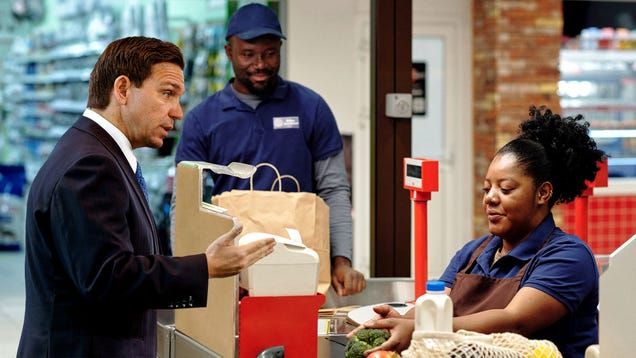
ORLANDO, FL—After spending several long, painful minutes pacing up and down the aisles and attempting to decide on what he wanted, Gov. Ron DeSantis (R-FL) flubbed a grocery store visit Monday by attempting to buy the cashier. “Good afternoon, I’ll take this candy bar, a bottle of water, and also, I’d like to purchase…
White was preparing to compete in next week's Cyclocross World Championships in Scotland when a driver struck him while he was cycling on the shoulder of a highway in Boulder, Colo.
This post was written by Alison Green and published on Ask a Manager.
A reader writes:
I’ve just had a mid-year profit share conversation with my boss (who majority owns the company, and note that we do not bring out the best in each other so perhaps this is just interpersonal friction) where he told me what my payment would be. This is an established, formal profit share program that you are entitled to as an employee of the business and is related to business profits, not to individual performance.
I said something like “okay, cool” and he asked what my response was. The number was in line with what I’d been led to expect, and I have pretty neutral reactions to compensation as in my role there isn’t any room for negotiation once the figures have been set. I did clarify whether he was looking for a comment on that and he said I could show at least some gratitude as he’d never heard me express my thanks after a figure was revealed (I disagree, but let’s assume he’s right).
I work in a small business of less than 20 employees so to remove a point of friction I have made a mental note to always express thanks, though I’m not sure if this is particular to my boss or is a best practice. Is this common in other firms?
From a strictly logical viewpoint, in a world where emotions are removed and everything functions according to pure logic, you wouldn’t thank your boss for making a contractually obligated profit-sharing payment.
In this world of humans with human emotions … you don’t owe a thank-you for a contractually obligated payment but it can be considered polite in a context like this one (even though the amount is pegged to business profits and not any sort of recognition of your performance). It doesn’t make logical sense for the reasons you point out — just like you don’t owe your boss gratitude for delivering your paycheck on time — but it’s a social convention, a nicety that tends to be useful for relationships and minimizes friction.
That said, your boss’s attitude about it is wrong and stems from a ridiculous paternalism on the part of some managers, as if they are dispensing your pay out of personal beneficence … when in fact they’re basically paying a bill for services rendered. It’s deeply messed up, but it’s also true that greasing the wheels of the interaction with a polite “thank you” will often pay off in good will and a smooth relationship — again, not that it should, but it does. Not with all bosses, but clearly with your current one.
If it helps, you could think of it not as “thank you for delivering this payment that you were contractually obligated to give me” and more as “I appreciate this working relationship that has borne monetary fruit for us both.”
On November 3, 2020, as America watched the first results of a fateful presidential contest roll in, voters in a North Texas suburb struck a blow for workers’ rights. Euless residents approved a proposition limiting some large companies’ ability to force employees to work overtime if they didn’t want to.
The “fair workweek” initiative, comparable to measures passed recently in a handful of other cities, was led in Euless by employees of LSG Sky Chefs, an airline catering giant and meal-supplier for American Airlines. These workers, unionized with Unite Here, said they were being overwhelmed with mandatory overtime hours, often announced at the last minute, as American Airlines, headquartered near the sprawling Dallas-Fort Worth airport, sought to dramatically increase flight volume.
“You can have a wife and children, and yet every day you are forced to stay at work, and you have no time to even go back and sit and relax and play and take care of children,” said Samuel Tandankwa, a Sky Chefs driver and Unite Here member, recalling the conditions in 2019 and leading up to the COVID pandemic.
Despite getting voters’ approval, the initiative faced legal troubles from the first. Some city officials doubted it could be enforced. Sky Chefs told the Texas Observer it didn’t apply to them since they maintain a national contract with Unite Here. And Texas Attorney General Ken Paxton had already written a letter stating the policy would violate a state law that bans cities from setting minimum wages. Nevertheless, Tandankwa told the Observer in July that since the campaign, the company actually has turned away from using mandatory overtime, freeing up workers to meet family obligations, and neither he nor local worker advocates want to lose the ordinance.
But Euless’ overtime measure is among the local ordinances that will be vaporized by Texas’ House Bill 2127, dubbed the “Death Star” bill by critics, which was signed by GOP Governor Greg Abbott last month and takes effect in September. It’s causing uproar around the state, as city officials, workers, and others try to figure out what parts of municipal law and regulation the bill will nullify.
The legislation’s real intent is both narrower and potentially more profound than just upending city ordinance-making powers.
The bill’s sweeping, alleged purpose is stated in its opening sections: “returning sovereign regulatory powers to the state where those powers belong.” However, closer examination suggests that the legislation’s real intent is both narrower and potentially more profound than just upending city ordinance-making powers. First, it is a laser beam aimed at a small group of progressive ordinances improving worker and tenant protections—local victories won through hard-fought campaigns over the course of more than a decade. Second, and more importantly, it’s a bid to permanently hamstring municipal democracy in Texas, especially in its big blue cities. Cities are where most Texans live; they are increasingly liberal, their populations often majority nonwhite, and they are the level of government most responsive to ordinary citizens. In essence, the Legislature decided there was too much Democracy afoot in Texas, so it did something about it.
“To me, that’s the will of the people being taken away,” said Tevita Uhatafe, a Euless resident who works for American Airlines and is also a vice president of the Texas AFL-CIO. “We voted for it … and here we are, we’re going to get it taken away because people who claim to hate big government are acting just like [it].”
“There is no precedent for what they did this time,” said Rick Levy, president of the Texas AFL-CIO. “It was not a measured response to a given policy that corporate interests didn’t like; it was a wholesale transfer of power from cities to politicians in Austin.”
HB 2127 is mostly broad in its language—and thus unclear in what all it actually will do. It lists vast categories of law—agriculture, business and commerce, finance, insurance, labor, natural resources, occupations, and property—in which cities may not regulate an issue that the state already regulates, unless explicitly authorized to do so somewhere in state law.
Some cities and legal experts argue that would return populous cities to the very limited level of power they had in Texas until the early 1900s. Growing cities were burdening the Legislature with so many local concerns that the Lege put an issue on the ballot that, in essence, allowed cities with more than 5,000 people to self-govern—a capacity known as “home rule.” Voters passed the amendment in 1912. Cities could now legislate broadly, as long as their ordinances didn’t contradict state law. The City of Houston has already filed suit to block the Death Star bill, charging that undoing home rule would require another voter-approved constitutional amendment.
The full extent of what local policies the bill will undo is unclear, say city attorneys. “People ask me often … ‘Are we combing through our ordinances?’ And the answer to that is ‘No,’” San Antonio City Attorney Andy Segovia told the Observer. Because of the bill’s vague wording, he said, “It would be almost an impossible task to identify those [ordinances] that we would have a high degree of confidence would be affected.”
However, the Legislature was specific in attacking local labor and tenant protections along with a couple other grab-bag issues. The bill forbids local ordinances on overtime and other work scheduling matters, policies mandating rest breaks for construction workers like those maintained in Dallas and Austin, and also “fair chance hiring” policies like those on the books in Austin and DeSoto, which help the formerly incarcerated get jobs. It forbids eviction protections like those in Austin and Dallas, too. Another provision appears to target Austin’s ban on cat declawing, while convoluted carve-outs grandfather in existing local regulations of payday lenders and so-called puppy mills while preempting future measures.
Bills to wipe out local regulation of employment practices were pushed by the state’s powerful business lobby in the 2019 and 2021 legislative sessions but didn’t pass. The core language of those bills was inserted into the Death Star bill.
Congressman Greg Casar (seen here, in 2022, with Congressman Lloyd Doggett) helped push the boundaries of local policymaking as a member of the Austin City Council. Gus Bova
City attorneys told the Observer they could not provide a list of affected ordinances and would ultimately need clarity from the courts. Taking a page from the state’s bounty hunter-style abortion ban, HB 2127 expressly authorizes individuals and trade associations to sue cities or counties for violations. A judge may order a city to abandon its policy but can only award the plaintiff costs and fees, so some cities may simply wait for these suits to arrive before making decisions.
HB 2127 is just the latest entry in a saga of state “preemption,” the term referring to a higher level of government big-footing a lower level. Over the last decade, the Legislature has undone local efforts to regulate fracking and ridesharing companies, to reduce police budgets and decriminalize homelessness, to prohibit discrimination against Section 8 tenants and reduce deportations from jails, while also capping local tax revenues. Between 2018 and 2019, Austin, San Antonio, and Dallas also passed policies requiring employers to provide paid sick leave. These ordinances were thoroughly stymied by the courts, but the business lobby—exemplified by the National Federation of Independent Business and the Texas Public Policy Foundation—went on the warpath against local labor protections anyway.
U.S. Representative Greg Casar, a Democrat representing a swath of Texas from Austin to San Antonio, led the charge as an Austin City Council member from 2015 to 2022 when the capital city pushed the bounds of local progressive policymaking further than any other city in the state and likely across the South. He sees a continuous thread in the state’s pushback from then to now.
“Big corporate lobbies do not want our democracy to work for working people,” Casar told the Observer. “And they don’t want any examples that can show that democracy can work for working people.”
GOP state Representative Dustin Burrows, author of the Death Star bill, minces no words in describing his feelings about local government. “We hate cities and counties,” he said in 2019, a comment caught on a surreptitious recording. However, his explanation of HB 2127’s provisions was much less clear.
It’s needed, he said at one point, because small businesses just can’t navigate a “patchwork of local regulations”—although business-related local policies have often exempted companies below a certain threshold. He said the bill would actually help local officials by giving them an excuse not to vote on “countless issues that activists have been harassing them to pass.” In committee, he said the bill would encourage the Legislature to “do a better job of regulating … industry”—a claim that would surely elicit a bitter chuckle from any seasoned watcher of Texas politics. Throughout, Burrows stated that cities would retain control over core functions like zoning and public safety. On the other hand, he also specifically promised that cities could still regulate billboards—and the billboard industry is already scheming openly to the contrary.
Perhaps his most accurate explanation about the bill—and his vision of democracy—came when he complained at a hearing that “Some of the same advocates that come to the Legislature with their agenda that are not able to get it through here at the state Capitol have now gone to some of our cities” and gotten them to adopt measures “to implement their vision of Texas in a way that we have already rejected.”
The bill’s Senate sponsor, Republican Brandon Creighton, at one point defended HB 2127 with the inspiring phrase: “We write statute that’s ambiguous on purpose and vague.” And then he slipped into it a provision banning local governments from passing measures to give renters some protection from eviction, while utterly misdescribing what he was doing.
Levy, the state AFL-CIO president, worries that the Death Star law’s strange structure will allow lobbyists to slip seemingly innocuous provisions into bills simply to create state “regulation” in a policy area for the purpose of later undoing local policies in court.
“It sets up the state Legislature as the place where lobbyists can go to play to get anything they don’t like on the local level invalidated,” Levy said. Such lobbyists, of course, represent the very same organizations that are empowered to sue cities or counties for violations of the new law—a process whereby, as the City of Houston has put it, cities and taxpayers will end up funding “lawsuits filed by trade associations seeking to deregulate their industries at the local level.”
In its lawsuit seeking to block HB 2127, Houston argues that the bill will “effectively repeal” the state’s century-old home rule regime—which cannot legally be done through an ordinary bill but would require a constitutional amendment approved by the people. “The State of Texas is not its state legislature alone,” the suit says. “Instead, Texas’ sovereign powers are vested in Texans themselves and, in their Constitution, Texans delegated [home rule] powers to cities.”
As of July 24, the state has yet to file an answer to the lawsuit, though Burrows made sure to note on Twitter that the Bayou City had enlisted the help of an attorney based in California. San Antonio has joined the suit against the state as well.
Declaring war on home rule is a recent phenomenon concentrated in states like Texas, Florida, and Arizona that have both right-wing legislatures and large urban areas. “The general movement from the late 19th century to the late 20th or early 21st century [was] in the opposite direction: to increase respect for local self-government,” said Richard Briffault, a scholar of preemption at Columbia Law School. “But what you have been seeing in the last, I’d say, 15 years is a big pushback on that, and a lot of it correlates with [the urban-rural divide]—a lot of it correlates with party, and a lot of it correlates with race.”
Downtown Houston (Matt Patterson via AP)
That timeline corresponds with the Republican takeover of many state legislatures, while many cities (such as Houston) grew ever-bluer. The Death Star bill specifically forms part of a more recent trend of so-called super preemption, meaning measures that target city powers broadly, but experts say Texas’ law is novel in its scope. “In the breadth of it, in how open-ended it is, in the ways in which it really does seem to try to completely reorder the relationship between cities and the state, I do think it’s something new,” said Nestor Davidson, another scholar of state-city conflict at Fordham University.
“If you look at the role that cities play today in terms of being the level of government closest to the people,” Davidson said, “if they don’t have the authority they need to be able to respond … I do think ultimately that that’s a democracy issue.”
Darwin Hamilton recalls clearly the late night at Austin City Hall in 2016 when his city became the first in the South to pass a fair-chance hiring policy, which forbids private employers from initially asking about applicants’ criminal backgrounds. An advocate on criminal justice issues who was formerly incarcerated himself, he still remembers how the crowd erupted. “It was just a monumental and historic night,” Hamilton told the Observer. “Given who our opposition was … attorneys, well-funded, from [the Texas Public Policy Foundation] and staffing companies, Chamber of Commerce—and then here are these formerly incarcerated people who basically won the debate that night.”
He and his allies spent the next few years fighting state legislation to undo the victory—successfully, until the Death Star arrived.
A statewide but much more limited version of the fair chance hiring policy, applying to public employers only, died at the Capitol this year, along with measures mandating rest breaks and various other versions of pro-worker and pro-tenant policies over the years. Assuming Houston’s lawsuit does not succeed, progressive activists will have to recalibrate their strategies post-HB 2127.
“[HB 2127] doesn’t necessarily mean that there still can’t be a lot of really innovative and amazing things that happen at the local level,” said Kara Sheehan of the nonprofit Local Progress. She pointed to San Antonio, which rather than giving up entirely on a proposed policy mandating rest breaks for construction workers is now scaling it back to apply only to employers contracted or funded by the city. A measure along those lines should survive the Death Star.
“I think that it’s going to be just more fuel for this kind of current wave of unionization.”
More ambitiously, private-sector union drives can lead to collective bargaining agreements containing requirements comparable to those that cities can no longer impose. Levy suggested HB 2127 is “telling workers … ‘You’re on your own, you better organize,’ and I think that it’s going to be just more fuel for this kind of current wave of unionization” that’s playing out in workplaces from hospitals to newspapers to coffee shops.
Last, there’s always the level of government to which even Texas must defer. As a historically hot summer bakes the Southwest, Casar, the councilman-turned-congressman, is pushing the federal Occupational Safety and Health Administration to accelerate its ongoing process of promulgating a heat safety standard, which could mandate rest breaks for construction workers and other laborers nationwide for the first time.
“Mourn, and then organize,” Casar advised. “I and lots of other organizers and elected officials put our lives into [measures undone by the Legislature], but this is what the right wing in power in the state does. … What they were able to do is pass a law to try to snuff out policies—but I don’t think they can snuff out that local democracy. I think that only happens if we let them.”
CLEVELAND—In response to concerns about whether his off-field behavior would risk further derailing his career, Cleveland Browns quarterback Deshaun Watson told reporters Monday, “I’ve learned from my mistake of using my own name at massage parlors.” “To the Browns community, my coaches, and teammates, I take full…
Thank you for your input. The situation did have an interesting resolution: someone got fired over this but (maybe surprisingly) it wasn’t me.
My boss was the only other member of my team to show up the day after my angry message, having told the other team members to let her know what they wanted to have me do. Most of the tasks she asks me to do for her when I go to the office maybe take 10 – 15 minutes; hers are the most reasonable and I totally get why she doesn’t want to make a special trip to them. She discovered that she was incorrectly assuming that the tasks my teammates were requesting were the same. The fastest request from my teammates took about 45 minutes, making it click with her that I wasn’t exaggerating when I said that I was spending half the day doing other people’s work.
Like you, my boss didn’t like how I phrased the message, but she agreed that things had to change. She was also under the impression that I like going to the office. It was kind of nice during the first year of the pandemic when gas was cheap and the drive took under 20 minutes no matter what time of the day it was. However, now that I have to deal with normal traffic patterns, my preference would be to get in, do my office tasks, and leave before rush hour to finish the day at home.
My boss informed the team that we were expected to come into the office when it was needed to do any tasks that cannot be done from home. She suggested everyone model what I do, which let tasks without an urgent deadline “stack up” and/or go in when we do a particular presentation (which is made to people who work in the field without the ability to work from home, so I do it in the office to keep credibility and not look like I am rubbing in the privilege of being able to work from home).
This led to the discovery that one of my teammates moved about to a home that is about two hours away from the office. Naturally, he did not want to four hours of commuting every couple of weeks. This actually violates our Hybrid Work Arrangement which requires approval if someone relocates more than 60 miles from the office (while it doesn’t apply to my team, about 50% of the company does functions that require at least one person be on duty 24/7/365, so they decided to apply the rule to everyone to always assure that critical needs are met) and/or to another state (for tax compliance). Since there was no issue with working from a different state, my boss would have probably approved this had he asked before understanding how much was being requested out of teammates (or truly me). Unfortunately for my teammate, layoffs were happening and he found himself being the sacrificial lamb to the budgeting gods from my team.
A pair of tropical systems have a chance to develop in the Atlantic, but both will scoot out to sea and not be a direct impact land.
Happening now: Invests 96L and 97L
As expected, the tropical wave in the middle of the Atlantic Ocean is on its way to potentially developing later today or tomorrow. This wave is now tagged Invest 96L. Meanwhile, off the North Carolina coast, we have Invest 97L, which is a vigorous area of thunderstorms with a lesser chance of developing in the next day or so.
Two areas to watch; neither is a threat to land. (NOAA/NHC)
Regardless of development, both systems will move out to sea, and neither is a threat to land. Even Bermuda should see only fringe effects at worst.
Why are we confident that both systems will turn out to sea? A quick look at the upper levels of the atmosphere shows that both systems have a pretty easy exit path away from land.
With high pressure west of the Azores, the clockwise flow around it should pull 96L north, then northeast and out to sea. 97L is already embedded in pretty fast flow off to the ENE, so it will rocket out to sea.
Invest 96L
The area we’ve been watching since last week out over the open Atlantic took on the Invest 96L tag over the weekend, meaning it became an area to investigate and we got some additional model data on it to look at. This really just confirmed what we already had confidence in, that this system was likely heading out to sea.
Puerto Rico and the Lesser Antilles are at the bottom left of this satellite image, while Invest 96L is on the right side. It’s heading out to sea, while some scattered clusters of thunderstorms impact the islands. (Weathernerds.org)
On satellite this morning, 96L doesn’t exactly look exciting, though I’ve seen worse looking storms upgraded, so we’ll see what the NHC finds in the next day or two. The 80% probability from the NHC seems perfectly fine here, because there’s a good chance it will develop, but it’s definitely not a guarantee. The ceiling on this system looks like lower-end tropical storm so not a huge deal. It will struggle due to wind shear and sinking air. It has about 3 or 4 days before it’s outta here.
Invest 97L
Admittedly, it’s 97L that looks most interesting this morning.
Invest 97L is hauling out to sea, with no risk to land. (Weathernerds.org)
There’s a hint of spin to it as it moves northeast, but this is more like a nor’easter than a tropical system in terms of how it’s developing (the formation process is being driven more by fronts and atmospheric dynamics than warm waters and heat). While that’s primarily a technicality, it’s all moot as this is heading out to sea. This could graze Bermuda with some thunderstorms as its trailing cool front approaches and stalls near the island. Aside from that? Not much to this.
The medium range (days 6 to 10): Pressing reset
A period of calm is expected to take control of most of the Atlantic basin this weekend and early next week, and we do not expect any storm activity as the atmosphere sort of presses the “reset” button. For the most part, this calm is expected to last into…
Fantasyland (beyond day 10): Still calm? Perhaps.
We don’t see anything of note right now on any modeling that indicates things will pick up at the end of the 10 to 14 day period. Last week, we were hinting at a potential ramp in activity for mid-August. Some of the support for a more conducive background state seems to have faded some, as the Pacific side heats up. There would be two primary ways to generate activity should that be the case, since an active Pacific generally means a quieter Atlantic. First, you’d have to watch close in for something, say, in the Gulf or just off the coast. Second, with a good bit of storminess ongoing in Africa, that could potentially get something to flare up in the far eastern Atlantic in time. But we have plenty of time to watch.
Early August and everything after
Which brings me to what I wanted to touch on more today. Where do storms usually form in the first third of August?
Historical storm origin points in early August. (NOAA/NHC)
The Gulf is a hotspot in early August, with numerous storms historically forming there. We also tend to see flare ups near the Lesser Antilles, as well as a peppering of storm origins across the Atlantic. So where do you look in early August? The Gulf, the Leeward & Windward Islands, and across the Atlantic.
We are entering the ramp up of hurricane season. Accumulated cyclone energy (ACE) for the season to date is quite high, thanks mostly to Hurricane Don. We’re over 16 units of ACE right now for 2023, which is almost twice as much as normal for the end of July. Remember, ACE is a stat that factors in the wind speed of tropical systems and for how long they maintain that intensity, and we sum it over the season (hence: accumulated). Far from perfect, but it gives you a sense of where the season compares to prior seasons in terms of activity.
Accumulated cyclone energy through the end of July will be right around 16 units, which is a good bit above our normal of 9.6 on this date. (Colorado State University)
But, it’s important to note that we still have about 92 percent of hurricane season from an ACE standpoint still in front of us. It remains early. That said, by the end of August, we jump from today’s 8 percent of the season climatologically complete to 30 percent. We ramp things up in a big way after the first third of August. So, the fact that it’s looking fairly calm to start August is great news, but we’ve got a long way to go. Fingers crossed!
Unfortunately, that light is the Sun. And it’s going to be blazing hot and bright for the foreseeable future.
Sadly, if you are coming to this morning’s post looking for hope about Houston’s forecast, I can only offer a few crumbs. First of all, after this week, I think conditions may return to slightly more normal-ish weather for August. If that sounds hopeful, well, just remember that August in Houston is already pretty miserable. On the rain front we’re still looking at 5 to 10 percent daily chances this week, but by next week our daily rain chances may well jump up to about 30 percent a day, again a pattern more typical of high summer in Houston. Finally, our days are getting shorter. We have lost about 30 minutes of daylight since the summer solstice in late June, and that trend will accelerate in August. Houston is probably about six weeks away from having any expectation of the season’s first front. So some relief is coming—eventually.
Not great, Bob. (Weather Bell)
Monday and Tuesday
The story of our weather this week, however, is going to sound very similar. We’re under a potent ridge of high pressure that will consistently push high temperatures for areas inland of Interstate 10 to 100 degrees or higher this week. Monday and Tuesday look to bring the hottest weather, with afternoon temperatures and humidity combining to push heat conditions into the “extreme” level based on wet bulb globe temperatures, which factor in raw temperatures, dewpoints, wind, and other factors to provide a sense of heating. Those winds, by the way, will be light, at just 5 to 10 mph from the southwest.
Wednesday, Thursday, and Friday
Big-time heat continues this week, with highs of around 100 degrees, and lows around 80 degrees, and plenty of humidity. Rain chances, as mentioned in the post’s introduction, will be on the order of 5 to 10 percent.
Saturday and Sunday
Toward the end of this week the high pressure system will slowly start to retreat westward, and that will have some subtle effects on our weather this weekend. First of all, temperatures may come down a degree or two. Still very hot, but not excessively so. And perhaps we will see some more clouds, with rain chances rising to about 20 percent each day. Let’s not kid ourselves, though. For the most part these look to be very hot and sunny days.
As high pressure eases westward (over northern Mexico and southern California) next week, Houston’s forecast looks slightly better. (Weather Bell)
Next week
I’m going to ballpark highs next week in the upper 90s, with a daily 30 percent chance of rain, give or take. So again, the takeaway this morning is that this week looks extremely hot; next week a bit less so, and I would urge you to hang in there. This can’t last forever. And it won’t. Even if it seems like it will.
This post was written by Alison Green and published on Ask a Manager.
A reader writes:
I know you’ve answered a couple of questions from managers of polyamorous employees who want to bring more than one partner to events, but as a relatively junior employee … what would be the best way to go about asking if it’s okay to bring two people?
My institution (higher ed) throws large-scale events occasionally that don’t require exact head counts, and I’m not worried about that, but for something like: my manager recently hosted an event for just his academic group and their significant others at his house. It ended up being on a day during which one partner was working, so it was a moot point this time, but if that sort of situation occurs again (either here or at future jobs), do you have any suggestions about the most diplomatic way to see if it’s okay to bring a plus-two without coming across as taking advantage of his generosity? Am I overthinking this?
I am not explicitly out as poly at work (mostly because I don’t socialize much with my colleagues and I’ve only been here for 10 months) but I’m willing to be — it’s a liberal institution in a liberal city, although I think my manager is fairly old-fashioned.
I have been with one partner for 11 years and the other for six, so they’re both serious relationships that I would like to acknowledge socially. I would be much less interested in drawing attention to myself if it wasn’t two people I foresee having around for the rest of my career.
I don’t think you’re overthinking — it’s genuinely tricky.
First and foremost, I’d want to know more about your willingness to be out at work, particularly to your manager. Especially with a manager you describe as old-fashioned, there’s a real risk of professional consequences. At a liberal institution, that might not mean open discrimination — but it could mean, for example, that your manager is suddenly less comfortable with you, is less inclined to recommend you for high-profile projects or promotions, and/or doesn’t mentor you or champion your work in the same way.
Or not! It might not lead to any of those things. But make sure you’re considering what you know about your boss and how willing you are to take those risks.
It sucks that that’s the case! Your personal choices shouldn’t be anyone else’s business. But here we are.
Assuming you’re willing to accept that risk, though, what are the logistics of asking to bring two people instead of one? Well … I sat on this question for a while because I couldn’t settle on an answer that felt right and finally realized I needed to bring in someone with more expertise in poly issues than I have.
But first, full disclosure, my initial thinking about this question was overly focused on, “Is it a burden on the host if multiple people want to bring multiple partners and suddenly the gathering is bigger then initially envisioned … and therefore can you alternate which partner you bring for smaller events?” Dr. Powell’s response to that convinced me that’s not the right way to look at it.
Here’s what they said:
I agree with you that my primary concern is the reaction of the more conservative manager. Being polyamorous isn’t a protected category, so it’s really easy for people to make your life miserable if they want to. Before coming out and asking to bring both of your partners, I would consider:
1) What are the potential consequences (positive and negative) of coming out to your manager?
2) What’s the worst-case scenario? (Losing your job, having your work curtailed or micromanaged, what else?)
3) What are your relationships like with the people at the same level as and above your manager?
4) If your manager decides to be a jerk, would the people who can overrule them be likely to have your back?
5) How much risk are you willing to assume? What are you unwilling to risk or unable to deal with losing?
As for the slippery slope part, I strongly disagree with you there. If someone was throwing an event that included an invite for their colleagues’ children, they wouldn’t cap how many kids someone can bring. Mononormativity / amatonormativity tells us that each of us gets to have one significant person and that person is/will be our romantic/sexual partner. However, that’s just not true! If someone in the department had five kids and someone had none, we wouldn’t say that the person with five kids should be forced to choose which two or three of their children they’ll bring to an event. The letter writer has been in each of these partnerships for years and saying that they should accept only ever having one recognized partner is unkind to everyone involved. How should the letter writer choose which one is their public partner and which one isn’t? How would that be kind or caring to the partner who’s now essentially a secret?
In terms of the etiquette around this in the polyam community, having one socially recognized partner and one who doesn’t get to be socially recognized is generally frowned upon these days. While it’s still sometimes necessary, there’s been a lot of writing and discussion about the ways in which an unrecognized partner is harmed by being hidden and denied. It’s similar in some ways to a closeted queer person denying that their partner is anything more than a friend — yes, you may need to do that to keep yourself safe, but you’re hurting the person who doesn’t get a choice in whether their relationship is ever seen by others.
The harm to the (potentially) secret partner is core to why my overall recommendation to this letter writer would be to think over the questions in my first paragraph alone and then sit down with both partners and collectively come up with options that all three of them could be happy with. Maybe the letter writer alternates which partner they bring to events and then if anyone asks they can choose how to talk about it. Maybe one partner doesn’t actually want to go to work events, but just wants to be sure that the lw acknowledges that they exist (by putting up pictures with them, talking about them with colleagues, etc.). Perhaps what feels best to all of them would be for neither partner to go to events if the letter-writer can’t risk coming out as polyam. Would it make sense to talk to someone at the school about whether they have any policies in place to protect against discrimination related to relationship structure? Maybe the three of them will come up with all kinds of ideas that I can’t even imagine! By making this a problem that all three of them get a say in addressing, the letter-writer can be sure that no one feels like they’re being treated as disposable or like a less “real” partner and the lw can get help thinking about possibilities.
On the positive side, this kind of conversation with the manager, if it went well, could help them re-evaluate their guest policy on the whole. What if someone is single but wants to bring their bestie or a close relative? Is the cap about cost or space or is it just going by the standard mononormative script? What’s the goal of these events and who would they want to feel welcome there? For instance, are partners invited because they’re assumed to be central to the employee’s life, because otherwise people go to fewer events, or because the manager wants to invite their partner, or because that’s how it’s always been? Clarifying these kinds of goals for the manager can make it easier to determine who to say “yes” to including along with the employees and prevent slippery slope issues from happening (though I don’t realistically think everyone bringing two people is likely). If the issue is cost, maybe the employee and their partner chip in a bit? If it’s space, is one extra person really a problem? Or would that make the alternating partners at events solution a better one?
NEW YORK—Closing his eyes and slapping himself across the face ahead of a television appearance Monday, Rudy Giuliani was overheard telling himself, “Come on, Rudy, give ’em that old 9/11 razzle-dazzle,” according to sources. “You’re going to go out there, and you’re going to hit them with the ol’ one-two Twin Towers…
Chicka Chicka Boom Boom Some people are wising up and removing this bawdy board book from impressionable kindergarten classrooms. The title alone is filthy. It encourages kids to join orgies, which is obviously how all those letters got injured up there in the so-called “coconut tree.”
The Very Hungry Caterpillar Normalizes binge eating and obesity. All this does is teach little kids—even girls!—that it’s okay to consume food when you’re hungry. To make matters worse, the caterpillar doesn’t go on a diet, doesn’t hate itself, and doesn’t even get properly shunned by society for its gross and destructive dietary choices. Instead, it turns into a literal butterfly. Not only is this the opposite message we should be sending children, but it’s completely unrealistic.
The Giving Tree A story of handouts. Flat-out socialism. Not to mention the climate-thumper extremism of giving the tree feelings. “Oh no, a tree is sad. It turns into a pathetic little stump. Whatever will we do?” Ridiculous.
The Book with No Pictures Without pictures, how do we know what’s going on? I didn’t get it at all. And the black-and-white cover—does it always have to be about race?
The Day the Crayons Quit Does NO ONE want to work anymore?
Caps for Sale Should be titled: How to Fail in Business. The “peddler” is a complete buffoon. He doesn’t sell a single cap, can’t even afford lunch, and then instead of revamping his approach, decides to take a nap without protecting his merchandise.
Where the Wild Things Are Don’t be fooled by shiny medals. This is a horrifying story of lawlessness and open borders. It teaches that it’s okay to cause chaos and become the kingpin of some antifa group of thugs and then get off scot-free with a warm dinner waiting. Not in this lifetime, Max.
Dragons Love Tacos How anti-American can you be? True patriot dragons love cheeseburgers, apple pie, and ketchup packets.
The Rainbow Fish Blatant propaganda from the LGBToomanyletters community. Not to mention, the fish makes friends by giving away its silver scales, making it an ordinary ugly fish with no accumulated wealth. A bunch of communist crap.
Goodnight Moon Now we’re worried about being polite to objects? We have to say goodnight to our dirty socks and crusted-over bowl of mush and even the fricking air? We always say goodnight to the flag and Jesus, but I draw the line at a creepy old lady whispering, “Hush.”
This post was written by Alison Green and published on Ask a Manager.
It’s five answers to five questions. Here we go…
1. My coworker keeps complaining he didn’t get promoted — but it’s his own fault
I’m a project manager for a small engineering firm (12 employees). Due to our size, I’m involved with all aspects of the business, including staffing.
The engineer with the most seniority, Roman, has just been passed up for a promotion to become the lead engineer and the firm’s owner has hired from outside the company to fill the role.
A year or so ago, he had approached the owner and asked to be made the lead engineer, and the owner gave him a list of things to work on to be considered for the role. Roman was not successful in fulfilling the requirements; he is technically proficient but lacked the proper soft skills. Roman is now very upset that he has lost out on the promotion and he keeps coming to me and asking me questions (“What did I do wrong?”) and frequently talking to me about it (“I know I’m not perfect, though I guess I didn’t think my lack of perfection would result in a bit of a demotion, even though I acknowledge I wasn’t technically considered a lead at any time”). It’s making me uncomfortable.
He is now saying that it’s unfair that the owner never told the whole team that Roman was looking to move into the role of a lead, so therefore the team never respected him as a leader.
I feel stuck between giving him honest feedback and just hearing him whine and complain. I want to keep the peace so I keep letting him just talk at me, but I’m growing impatient because his ideas on team leadership (total control over how the entire engineering team works) and his general lack of soft skills are making me want to be brutally honest. Should I just let him keep complaining at me and hope it blows over soon?
If part of your job is to manage Roman or give him feedback, then you really need to be direct with him about why he wasn’t selected for the job and the specific things he’d need to change to be considered in the future. But I’m guessing that if that were part of your job, you would have already done that. So assuming it’s more of a peer situation … it’s really up to you. Some people wouldn’t want to get involved at all, figuring it’s Roman’s boss’s job to talk about this stuff with him and you’re not obligated to say something that risks drawing his resentment over to you. If that’s the case, you can still try to shut down his complaints by saying something like, “I know you’re upset but I’m not the right audience for this. If you want to talk about it, you should talk to (boss).” And if he keeps complaining to you after that: “You should talk to (boss), not me.”
But if you’re willing to give him some honest feedback, it could be a kindness to say, at a minimum, “Look, (boss) gave you a list of things you’d need to work on to be considered for the role. If you want to know why you didn’t the job, it’s those things.” And if you’re really willing to get into it: “The team hasn’t looked to you as a leader because of the issues (boss) talked to you about and and things like (insert soft skill specifics); it wasn’t because they didn’t know you wanted the job.”
2. My boss is doing 27 events next month … the average is 4
I work in a public-facing job where a part of our job is setting up events for the public (but that’s not all we do.) I have a new boss (to the location, not position) who has major issues with work life balance. She’s constantly staying late to do extra events that one person asked for that she can’t say no to. She brings her work home, a practice discouraged by everyone at our location, and once told me that she likes to stay busy so she won’t be “left alone with her thoughts.” It has slowly built until I realized that next month she has a whopping 27 events! She regularly has 2-3 events in a day. She has other aspects of the job that are starting to get overlooked, including being the manager to our department, which is me and two new people still being trained.
I’ve been told that telling her to do less is 1) above my pay grade or 2) not my problem as it’s her work-life balance at stake. I considered that, but I work on the marketing for these events and it adds to my plate greatly with this number of events. Also, the two new people are already struggling with finding their own place outside just assisting her with her projects. Finally, it’s hard to rely on her as a manager when I look for her and she’s always in an event.
I’ve broached the issue lightly to test the waters, asking to put a cap on a maximum number of events per month, and she asked if I felt like I had too much on my plate. I said we just need to get through the month and would like a further conversation after the busy week ahead of us. How do I start this conversation and what points do you think will help her cut back? I also worry this will set a bar for the public that will make it hard to lower if they’re expecting multiple events a day.
Yeah, you don’t really have standing to tell her to do less or to address her work-life balance (although it does sound messed up). But you definitely have standing to talk about the impact it’s having on your own workload and stress level — and it sounds like she has explicitly invited that.
For example, you could say: “Traditionally we’ve done four events per month, and that’s been a good number because it’s left room for other prioritizes like XYZ. But we’re doing seven times that many next month, which means I don’t have the time I need for XYZ.” Ideally you’d talk in specifics here — you’ve had to push back X, Y has been delayed for weeks, the only way you met the deadline for Z was by working over the weekend, etc.
That said, be prepared for the possibility that she might prioritize events in a way her predecessor didn’t, and that could be her call to make. But if that’s the case and the increase interferes with you being to do other parts of your job, then you need to have a workload conversation — since if she wants you to do X additional events every month, then presumably it means other work needs to be pushed back or cut entirely.
Unless you’re in a fairly senior role where you have some responsibility for training/managing the two new hires, I wouldn’t get into your observations about the impact on them, at least not until you have a better sense of her response to the first set of concerns. Start with the pieces affecting you and see how that goes.
3. Meeting a nanny on her first day
My husband, infant, and I (she/her) are all living at my parents’ house while my husband and I try to sell our condo. Every adult works full-time, but my husband is a teacher and hasn’t been working over the summer, so he’s been the full-time childcare. We have a nanny that’s starting soon and is working 8 am – 4 pm from my parents’ house (and eventually our new place when we sell). We are very lucky to have our current arrangement — my Mom watches the baby Mondays and Tuesdays, and the nanny is Wednesday through Friday.
Over the summer, I pick up a very part-time second job in our religious community. My husband starts school on a Wednesday, the nanny’s first day. On that day, I have a non-negotiable commitment at this second job that will mean I’m out of the house from 6 to 9:30 am … so I won’t be there when the nanny is supposed to be there! My mom can stick around the house until the nanny gets there, but my Mom is understandably uncomfortable since she hasn’t had any contact with the nanny herself. On the other hand, the nanny is going to be in my mom’s house, so they’re going to see each other eventually.
My mom suggested having the nanny come in the day before (Tuesday) so she can see the house, but the commute is not insignificant for the nanny, and she won’t normally be working Tuesdays anyways. How do we handle the nanny’s first day in a way everybody is comfortable with?
I’m not totally clear on how your mom is comfortable having the nanny in her house all day, but not comfortable greeting her when she first arrives … but can you solve this by just having your mom and the nanny meet on a video call before her first day? If for some reason that’s not a solution, would the nanny be up for coming by the week before she starts if you pay her to do it? (I agree it’s not reasonable ask her to make a long commute otherwise, but if you pay her to do it, she might be up for it — although it’ll of course depend her availability that week.) The other option would be having her start late on her first day, so that she doesn’t arrive until you’re back from your morning appointment … but hopefully a video call could solve all of this.
4. Is it worth it to submit a resume to a “general talent pool” without a specific opening?
I’m applying to jobs, and I’ve noticed that about half the company job pages I see either have a posting for “general interest” or a flag saying something like, “Don’t see a job that matches your qualifications? Click here to submit an application to our talent pool.”
Is it worthwhile to do this? Does anyone ever get considered or hired out of these kinds of applications? If yes, how would you recommend tailoring the resume and cover letter — particularly if you have a broad skill set and/or are willing to consider multiple types of positions?
It happens occasionally, but less often than those instructions make it sound.
If you have an unusual or hard-to-find skill set, submitting a “general interest” resume is more likely to pay off the next time they’re looking for someone with those skills; in that case they’re more likely to go back to past applications to see if anyone already in their database of candidates might be a good fit. If your skill set is less specialized or easy to find, they’re more likely to just advertise the job the standard way and might never even look at past applications.
In any case, there’s no harm in doing it if you can do it quickly, but I wouldn’t invest significant time in crafting an application specifically for that type of listing.
5. Asking about training in an interview
I am job searching. One of the Very Bad Things that’s happened to me in the past when changing jobs is not getting adequate training for the new job after being hired. This makes me wonder if it would be appropriate to ask about the company’s training during an interview.
Absolutely! You could say, “Can you tell me what the training will look like for this position?” or “What has training typically looked like for this position?” You can also ask how long it usually takes before someone is up to speed, and where new hires typically run into challenges.
ALEXANDRIA, VA—Expressing fear that his partner of the past two years might be harboring unspoken desires, local man Tyler Hiller told reporters Monday that he was paranoid that his girlfriend, Kayla Nguyen, fantasized about sleeping with other people as often as he did. “It worries me sick that she could be having…
Water temperature at a buoy in southern Florida reached a shocking 101.1 degrees Fahrenheit this week, which meteorologists say is among the hottest ocean temperatures ever recorded on Earth. What do you think?
MELROSE, MA—Shedding new light on how the popular medication repairs a chemical brain imbalance, psychiatrists at Melrose Wakefield Hospital released a study Monday touting the effectiveness of SSRIs to cause enough other problems that it completely takes a patient’s mind off their depression. “In a double-blind study…