Shared posts

30 Aug 03:20

As Springs Dry Up, a Warning of Future Water Shortages

by Dylan Baddour

This article originally appeared on Inside Climate News, a nonprofit, independent news organization that covers climate, energy and the environment. It is republished with permission. Sign up for their newsletter here

Almost every other day, Charlie Flatten gets a call about another local water well gone dry. 

Last week, he tried to help one woman find a water truck to fill her home cistern. But all the hauling companies had suspended service amid a deepening shortage in Central Texas.

“She’s got to go find somewhere else to live,” said Flatten, general manager of the Hays Trinity Groundwater Conservation District in Dripping Springs. “This is extremely serious.” 

Here in the booming Hill Country southwest of Austin, Flatten said, the Trinity Aquifer is at its lowest level on record. Across the region, iconic natural springs are dwindling or drying up, victims of extreme heat, persistent drought and ever-growing demand for water.

This May, Flatten’s district issued a moratorium on groundwater pumping for the first time in its history. Meanwhile, he said, a private company called Aqua Texas continues pumping millions more gallons than it is authorized to take. And there isn’t much he can do about it. 

Their business model does not benefit from conservation.

“Their business model does not benefit from conservation,” Flatten said of Aqua Texas, a subsidiary of Essential Utilities, an investor-owned utility with a $10.4 billion market capitalization. “Their business model benefits from selling water and their shareholders expect them to turn a profit every quarter.”

Flatten sent Aqua Texas a $450,000 fine for pumping almost twice as much as its permit allowed last year, but the company hasn’t paid. Settlement negotiations continue, along with excessive pumping, Flatten said.  

“We have contested the over pumping fee with the groundwater district and are currently working closely with them to get that resolved,” said Aqua Texas spokesperson Jennifer Olohan.

“The fee was for over pumping the drought curtailment numbers and not for over pumping the totality of our permit.”

After a year of requests from local leaders, Aqua on Friday banned all outdoor water use by its customers.  

This situation highlights a critical weakness of aquifer management in Texas, according to Vanessa Puig-Williams, Texas water program director for the Environmental Defense Fund. 

Because groundwater is private property in Texas, most of the conservation districts that manage it have insufficient tools available to enforce conservation, she said. 

“We are asking our local groundwater conservation districts to do the impossible,” she said. “I think we’ve set ourselves up for a disaster and I think we’re starting to see it in Central Texas.”

Dry springs of Central Texas 
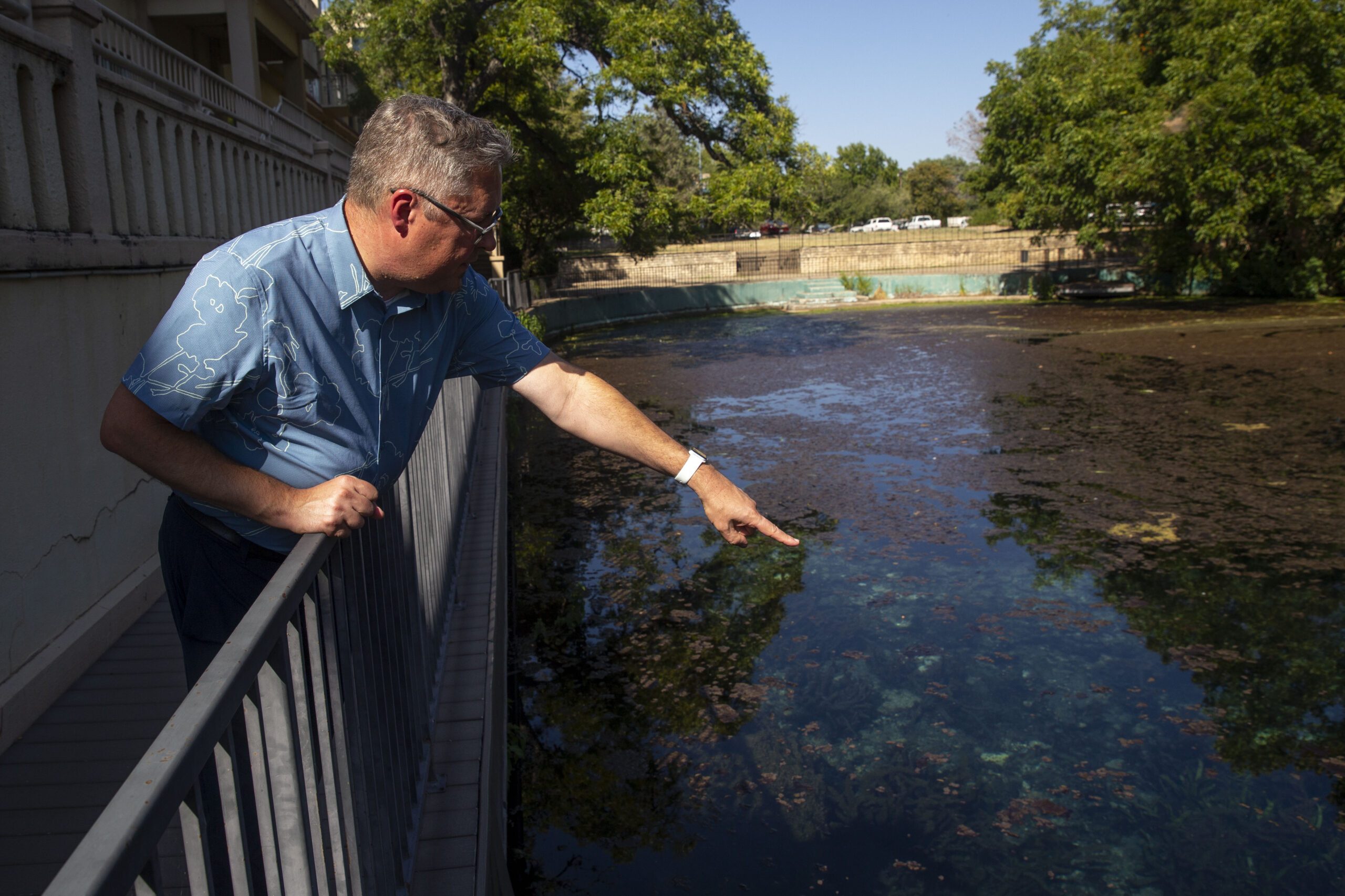
Robert Mace, a white man in a subdued blue and white Hawaiian-print shirt, leans over a railing as he points into a mucky, drought-struck aquifer.
Robert Mace, executive director of the Meadows Center for Water and the Environment at Texas State University, points out features in San Marcos Springs on Thursday, August 10, 2023. Dylan Baddour/Inside Climate News

The cavernous, limestone aquifers of Central Texas produce a notable collection of springs that have nurtured human habitation for millenia here. 

Ancient footpaths once followed this line of water features along where the Hill Country meets the coastal plains. Later, the Spanish road through Texas took the route. Today it’s the Interstate Highway 35 corridor—one of the fastest growing regions in the country—and the powerful springs mark the spots that would become Austin, San Marcos, New Braunfels and San Antonio.

Central Texas’ largest springs, which come from the Edward’s Aquifer, are approaching their lowest flow levels on record, according to Robert Mace, executive director of the Meadows Center for Water and the Environment at Texas State University in San Marcos. 

Standing beside a spring-fed pool, he pointed to a dry, rocky hole at the water’s edge. 

“It’s usually just gushing out of here,” Mace said as afternoon temperatures approached 105 degrees. “I’ve never seen it like this. This is the worst it’s been.”

San Marcos Springs, historically the second-largest in Texas, is flowing at just 50 percent of its historical average for this time of year.

The largest spring complex in Texas, Comal Springs in nearby New Braunfels, is flowing at 30 percent of its historical average for August. Its primary spring has gone completely dry. 

Las Moras Springs in Brackettville, west of San Antonio, have also stopped flowing. 

A young, small deer with immature horns navigates the dry creek bed at Comal Springs.
The primary spring at Comal Springs, the largest spring complex in Texas, has gone completely dry. Dylan Baddour/Inside Climate News

Barton Springs in Austin is flowing at about 14 cubic feet per second. Its average flow over the last 45 years is 67 cubic feet per second, according to Tim Loftus, manager of the Barton Springs Edwards Aquifer Conservation District. 

“We’re starting to enter rare territory,” he said. 

The lowest flow recorded at Barton Springs was 10 cubic feet per second during the drought of the 1950s—a decade-long dryspell that still stands as the worst in Texas history and the lowest point for the Edwards Aquifer springs. 

There is one big difference between the 1950s and now. Back then, there were less than eight million people in Texas. Today there are 30 million. Texas has gained more residents than any other U.S. state since the turn of this century, and none of them brought their own water.

August doesn’t look good.

Current heat and rainfall conditions rival the intensity of the 1950s drought, said Roland Ruiz, manager of the Edwards Aquifer Authority in San Antonio. Back then, however, these conditions lingered for almost 10 years. 

“This drought is not nearly as long in duration, at least not yet,” he said. “In terms of temperature, it’s more intense.” 

Levels in the Edwards Aquifer, which supplies drinking water for nearly two million people, are about 50 feet below average for this time of year, according to Paul Bertetti, senior director for aquifer science research and modeling with the Edwards Aquifer Authority.

Last week, he told a board meeting of the aquifer authority that only a “deluge event” would begin to return normal conditions. But dry heat still dominated the forecast for weeks to come. 

“August doesn’t look good,” Bertetti said. “Above-normal rainfall is not expected until winter months.” 

‘Invested in this carpet grass’

When it comes to water conservation, there’s one high-volume use that planners agree must be first to go: the lawn. 

Summertime outdoor water use accounts for 50 to 80 percent of residential consumption, according to the Texas Water Development Board. Most of it goes onto turf grass.  
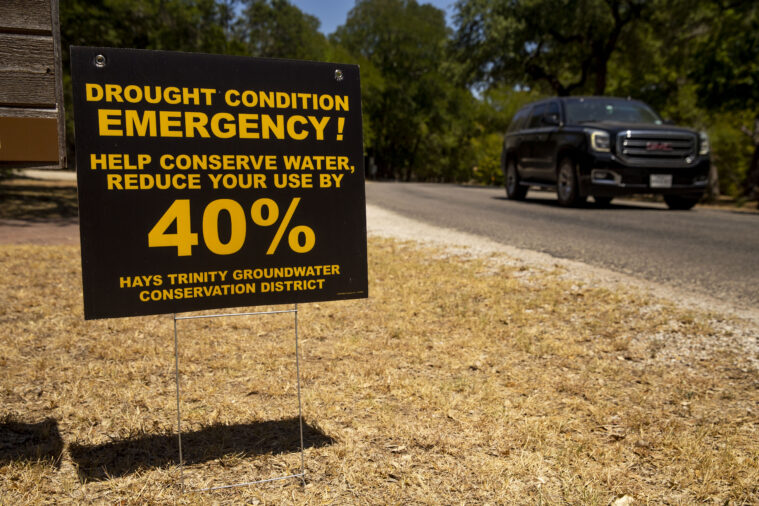
A SUV drives by a yellowing lawn with a sign warning water consumers to reduce usage by 40 percent during the drought emergency.
The Hays Trinity Groundwater Conservation District has ordered a 40% reduction in water use, but not all permitted pumpers are complying. Dylan Baddour/Inside Climate News

“We’ve asked our customers to basically let their lawns die, and that is not acceptable to a lot of people,” said Eric Ingram, general manager of the water supply company in the Hill Country town of Comfort. “They tell us, ‘We’ve got thousands of dollars invested in this carpet grass.’ Well, we live in a desert now.”

The city of Manor banned sprinkler use for the first time in its history. Residents may only water by hand. City manager Scott Moore said the number of residential water accounts in Manor grew by 144 percent since 2013. Since 2016, the city has registered 2,376 residential and 135 commercial irrigation systems, he said.

The city of Georgetown, the fastest-growing U.S. city, also banned sprinkler use in some of its territory for the first time since 2011, citing the inability of a neighboring city, Leander, to supply water. 
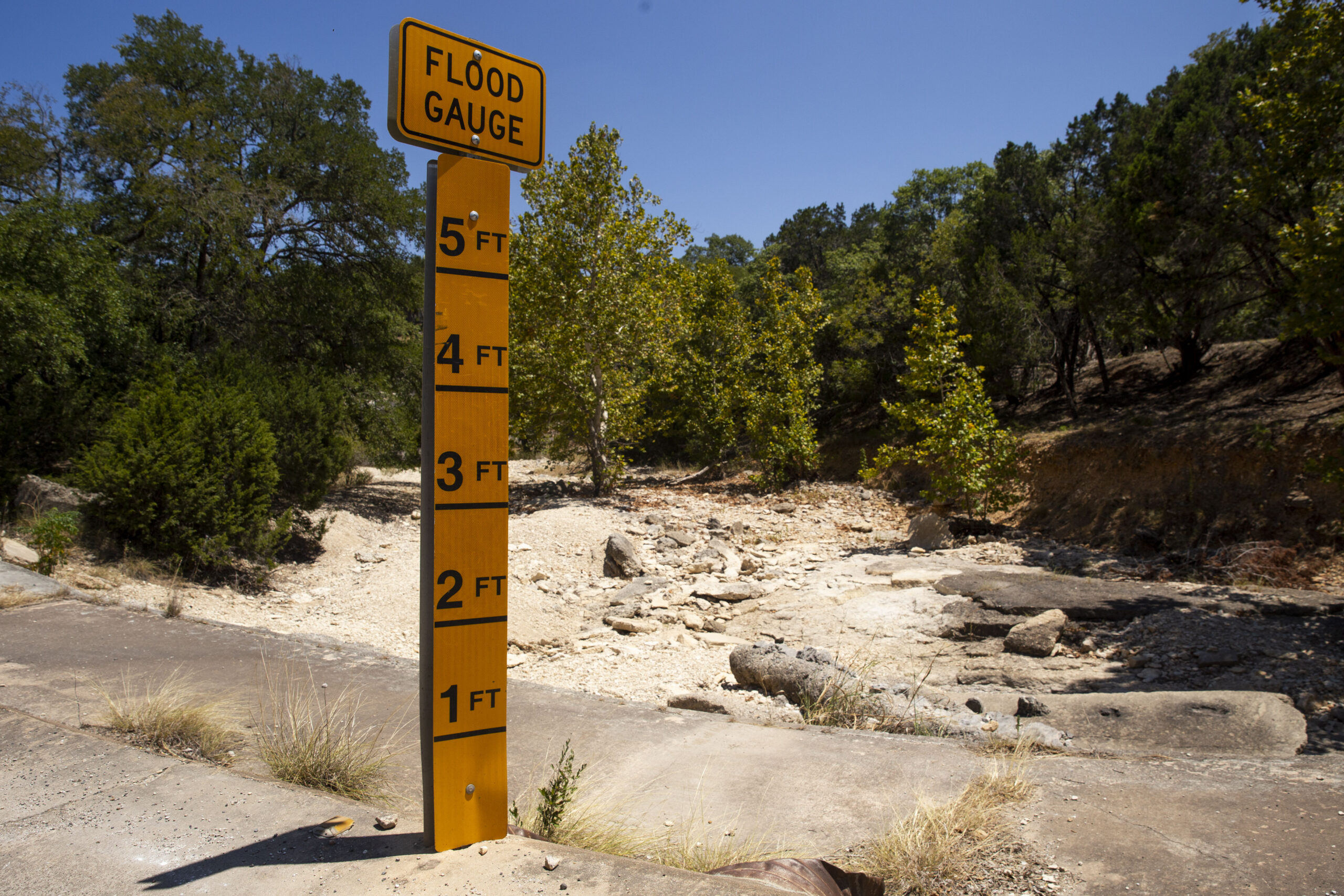
A flood gauge stands next to an entirely dry creek bed, bordered by a forest.
A flood gauge now reflects the severity of the drought at a dry creek bed in the Woodcreek neighborhood outside Wimberley. Dylan Baddour/Inside Climate News

“Not being allowed to water our lawns is far from ideal. However, having safe drinking water for our customers must take priority over pristine, green lawns,” said Georgetown Mayor Josh Schroeder in a public announcement

In several cases, widespread irrigation of grass caused water system problems as supply grew short. For example: some residents of Bee Cave woke up to low or no water pressure in late June. 

“The storage tanks were drained overnight by Over-irrigation of lawns,” Bee Cave mayor Kara King wrote on Facebook.

The same thing happened in Dripping Springs, where some residents received a boil water notification on July 20. Rick Broun, general manager for the local water supply company, told the Dripping Springs Century News that the loss in system pressure resulted from “an enormous amount of irrigation use last night.”

Water conservation strategies

Residents and developers must reform their water use habits as the population of Central Texas continues to grow, according to Cathy Ramsey, a Dripping Springs resident and Western Hays County project coordinator for the Save Our Springs Alliance.

“Not many people are aware that the groundwater is extremely stressed right now,” she said. “The land looks dismal, wells are going dry and new developments keep on coming in, so it’s a little alarming.”

She has no well on her 10-acre semi-rural lot. Instead, pipes channel rainwater that falls on her house into a 20,000 gallon cistern that sits half-buried near her house. She uses non-toxic detergents so her sinks and showers can drain into gardens outside. 

We’re destroying our springs to have lawns. How sad.

Ramsey doesn’t grow a lawn. She lets the native grasses grow tall. Some of their roots can reach more than 15 feet below ground, she said, giving them excellent drought tolerance. 

“We’re destroying our springs to have lawns,” she said. “How sad.”

Native grasses alone won’t save Texas from water scarcity. Sustainable growth will require a combination of tactics on multiple fronts, according to Perry Fowler, executive director of the Texas Water Infrastructure Network. 

He said priorities should include repairs to widespread leakage in aging water systems, adoption of reuse technologies, construction of new reservoirs and, ultimately, development of desalination plants. 

“Based on the population growth projections that we’re seeing right now, we don’t have adequate water,” Fowler said. “The weather just exacerbates the problem.”

Water infrastructure in Texas has typically relied on federal money from the Clean Water State Revolving Fund, he said, but increasing earmarks in national legislation are decreasing the amount available to Texas. 
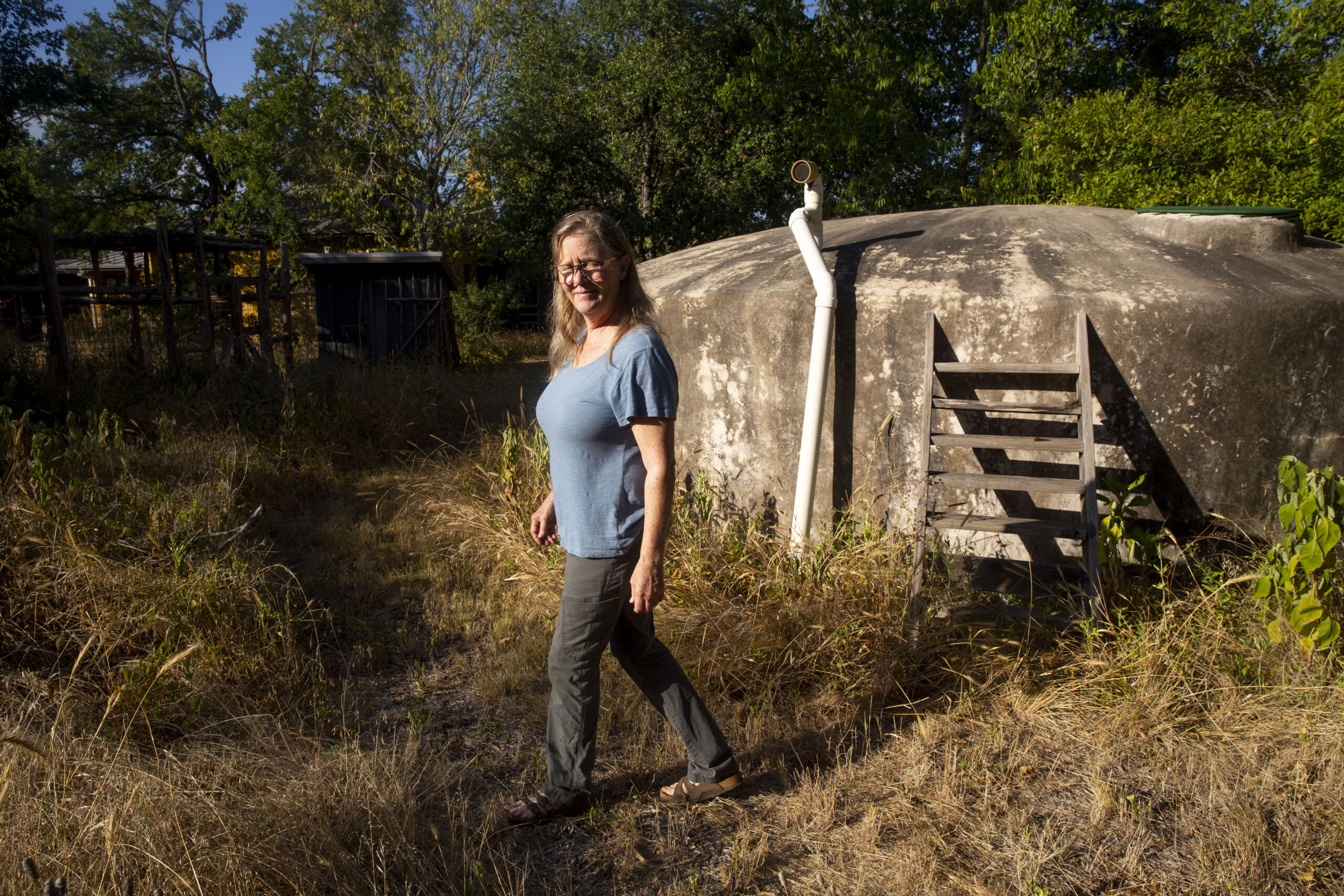
Water conservation tools, like this 20,000 gallon rainwater cistern, could help mitigate the upcoming water crisis, according to Cathy Ramsey, Western Hays County project coordinator for the Save Our Springs Alliance. Dylan Baddour/Inside Climate News

In November, Texas will vote on a proposed amendment to the state constitution—known as Proposition 6—that will establish a state water fund. 

“I think a lightbulb went off this last lege session showing that people are viewing water as more of a priority,” Fowler said. “We’re going to be struggling just to maintain the level of funding that we rely on here.”

Marisa Bruno, water program manager for the Hill Country Alliance, said cities should adopt a system known as “One Water,” in which a single authority runs an integrated system for water supply, wastewater and stormwater drainage, full of built-in opportunities for reuse.  

“We’re going to just have to make some changes,” she said. “I don’t think business as usual is going to cut it.”

The case of Aqua Texas

On a sweltering summer afternoon, 53-year-old Horacio Aguirre crossed his arms as he stared into a green, mucky puddle. He’d driven three hours from Houston to show his granddaughter Jacob’s Well, an iconic Hill Country swimming hole, only to find it dried up.  

“I can’t believe it,” said Aguirre, an industrial mechanic. “This is sad.”

Standing nearby in the shade, David Baker nodded in agreement. The founder and director of the Wimberley Watershed Association, he’s dedicated the last 30 years to protecting Jacob’s Well. In that time, he’s seen it stop flowing six times. But he’s never seen the water as low as it is now.
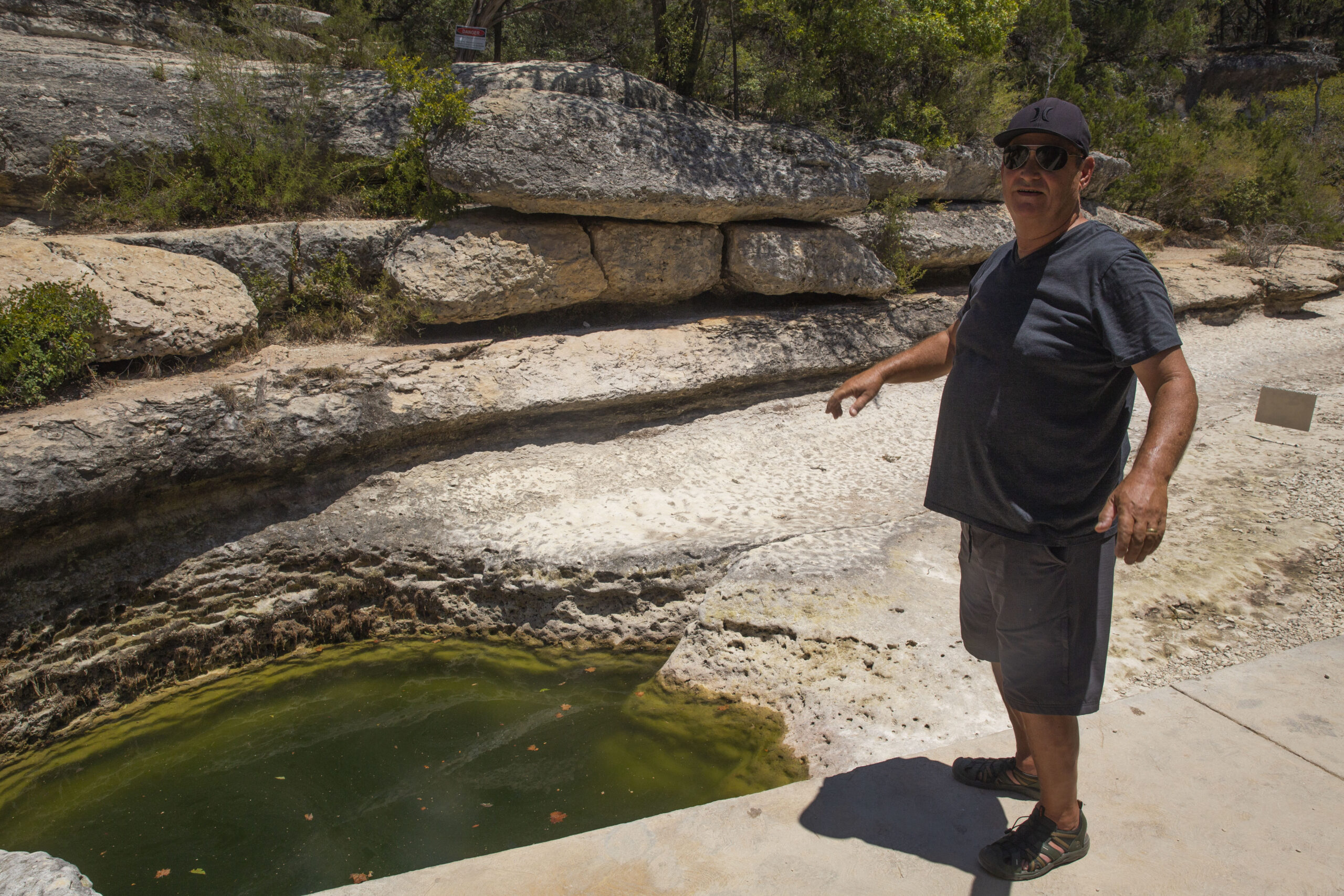
David Baker, a white man in blue shorts, t-shirt and ballcap points at the mucky green puddle where the famous spring known as Jacob's Well once flowed.
David Baker, founder and director of the Wimberley Watershed Association, said he’s never seen the water level so low in Jacob’s Well. Dylan Baddour/Inside Climate News

“Jacob’s Well is the canary in the coal mine for the aquifer. The canary is gasping for breath right now,” Baker said. 

It’s not just the drought, he said. Massive volumes of groundwater pumping are equally to blame. Specifically, Baker said, Aqua Texas, the investor owned water utility that’s been flaunting its permits.

When Baker started the Watershed Association in 1996, he said, there were 50 houses in the Woodcreek neighborhood. Now there are 1,500, with more than 2,000 lots still yet to be developed, all serviced by Aqua Texas.

Hays County, which includes Jacobs Well, ranked as the fourth fastest-growing U.S. county last year, tied with its neighbor, Comal County. 

Every gallon now sprayed onto lawns or flushed down toilets in these neighborhoods used to flow out of Jacob’s Well, Baker said. 

“Across the region we’re losing two-to-three feet of groundwater levels every year,” he said. “Let’s be conscious that this is a finite resource.”

Aqua Texas, which supplies water to 280,000 customers in Texas, said in a statement it is taking steps to reduce the impacts of its pumping. The company said it has purchased additional land outside the Jacob’s Well area in order to explore the possibility of using a different aquifer, and that it is building a new treatment plant to reuse wastewater for lawn irrigation. Aqua Texas also plans to spend $3 million this year replacing underground pipes. 
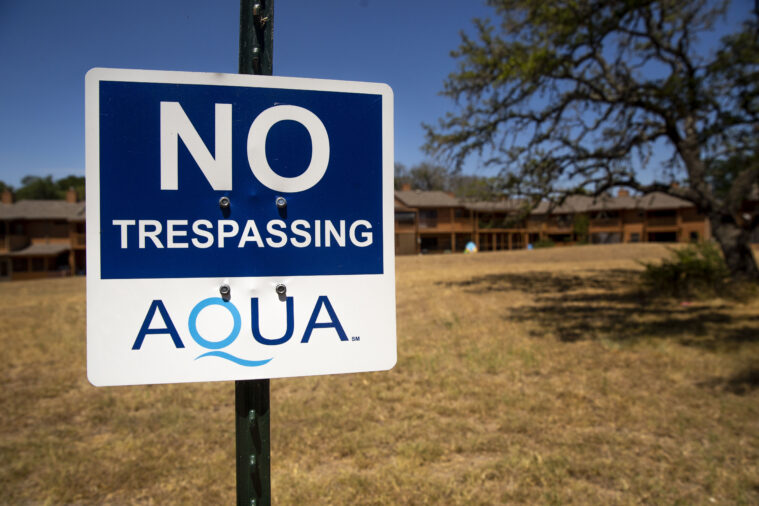
A sign in front of a dry field reads "No Trespassing" with an Aqua logo.
Aqua Texas, an investor-owned water utility, pumped almost twice as much groundwater as its permit allowed in 2022, according to officials with the Hays Trinity Groundwater Conservation District. Dylan Baddour/Inside Climate News

“We live here and understand the importance of finding a solution to the water issues. We can’t fix it overnight,” said Aqua Texas president Craig Blanchette in a statement. 

But Flatten, the manager of the Hays Trinity Groundwater Conservation District, said time is running out and there isn’t much he can do to enforce less pumping. 

Each of the 98 groundwater conservation districts in Texas has different rules and powers. Most of them don’t have authority to deny permits to pump groundwater, which is considered a landowner’s private property. (The districts may enact a temporary moratorium on new permits, like Hays Trinity has done.) 

“I can’t go out and turn their taps off,” Flatten said. “We’re running out of time.”

The population of Dripping Springs has tripled in ten years. Flatten estimated that if 100 residents were asked the location of the city’s namesake springs, none of them would know. So they wouldn’t know, either, that those springs are also totally dry.  

“The springs are a window to the aquifer,” he said. “If you see a dried up spring, that means every nearby water well is at risk.”
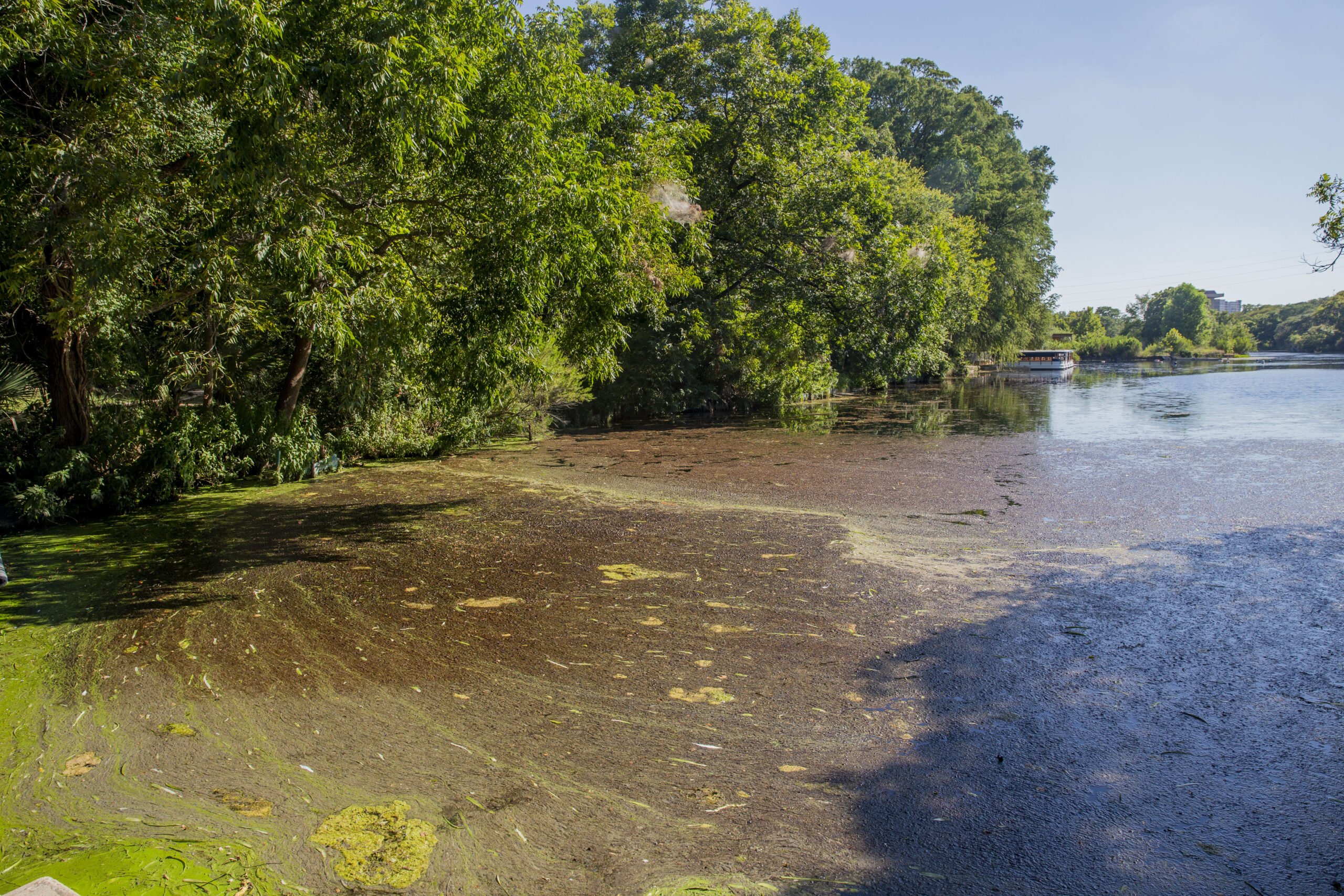
A layer of greenish yellow scum floats atop the murky, tree-lined waters of San Marcos Springs.
Extreme heat and low flow has led a layer of scum to develop atop the water at San Marcos Springs. Dylan Baddour/Inside Climate News

The post As Springs Dry Up, a Warning of Future Water Shortages appeared first on The Texas Observer.
29 Aug 17:06

Why British cities make no sense

by Jay Foreman

📕 Buy the MAP MEN BOOK 'This Way Up - When Maps Go Wrong' https://lnk.to/mapmen

Why is Reading, a massive settlement of 170,000 people, NOT a city, while the tiny Welsh village of St Davids IS a city? Is it something to do with cathedrals? Or universities? Or is it a surprisingly simple answer which only raises more questions about how city status works in the UK, and merits a ten minute video? (No, no, and yes.)

SEE NEW EPISODES EARLY, AND BEHIND-THE-SCENES EXTRAS...
http://www.patreon.com/jayforeman

Written and presented by
JAY FOREMAN https://www.twitter.com/jayforeman
MARK COOPER-JONES https://www.twitter.com/markcooperjones

Director/DOP
JADE NAGI https://www.twitter.com/jade_nagi

Edited by
JAY FOREMAN

Runner
ABBY TIMMS

Voice of University Challenge
ROGER TILLING @rogertilling

VFX
CHRIS WALKER https://www.artstation.com/zangrethordigital

Satellite map animations
PEADAR DONNELLY

Queen awards ceremony animations
DARREN DUTTON @Darren_Dutton

City Bid Pamphlets
STEWART FRASER @golfsaleriots

UK urban sprawl map
HELEN MCKENZIE @helenmakesmaps

Additional research
JONN ELLEDGE @jonnelledge

Cathedral counting research
CHRIS JOHNSON @chrislesjohnson

Additional graphics help
DAVID FLETCHER @artfletch
MATT GIRLING @iamcanalboy

Rochester sign image
@RochesterCitySt
Check out their Twitter for more info on Rochester’s city status.

See also, Tom Scott’s video about Rochester
https://www.youtube.com/watch?v=kBaLb1C4WAg

Piano version of Peaky Blinders
TIM TRAVELLER @TheTimTraveller

Music help
PRESTON PARRIS @prestonoutatime
29 Aug 16:58

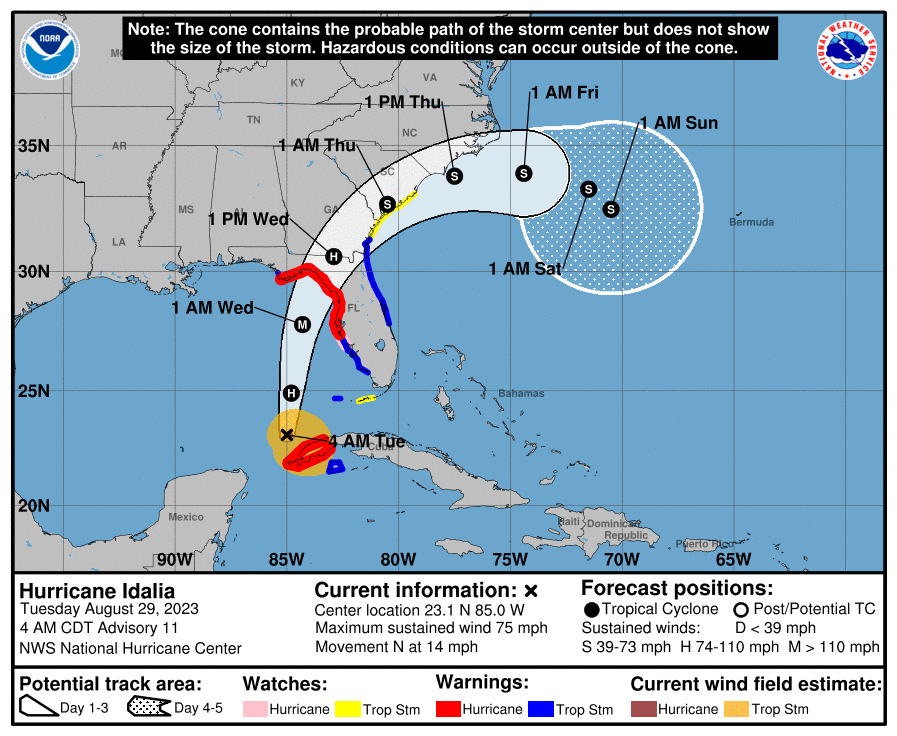
Idalia is now a hurricane and still on track to impact the Big Bend region of Florida as a major hurricane Wednesday morning

by Matt Lanza

One-sentence summary

Hurricane Idalia is expected to rapidly intensify today and tonight and come ashore somewhere in the Big Bend area of Florida as a major hurricane tomorrow, producing extremely dangerous storm surge, in addition to strong winds and heavy rain well away from the center.

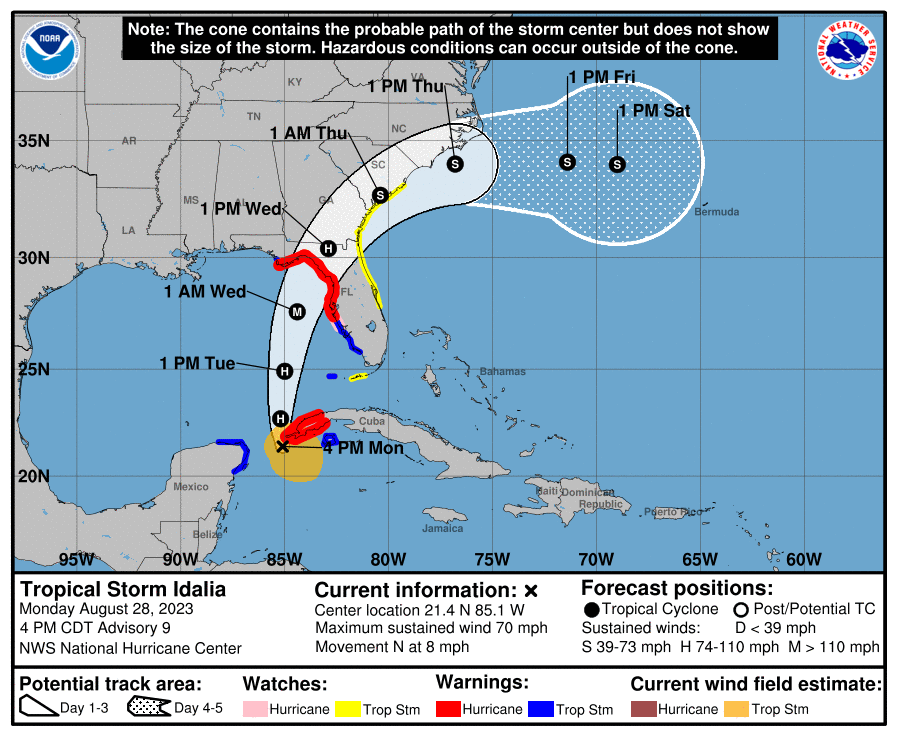
Hurricane Idalia is expected to come ashore on Wednesday morning near the Big Bend of Florida as a major hurricane. (NOAA NHC)

Hurricane Idalia

The bottom line on Idalia is that it is expected to come ashore near the Florida Big Bend as a major hurricane, without much modern precedent in this area. This will lead to severe wind and potentially catastrophic storm surge in many communities in this region. Preparations need to finished quickly today, and advice of local officials should be heeded.

What’s changed overnight?

The only notable change overnight (besides becoming a hurricane) may be that model forecasts have nudged the landfall point a little to the west. This further increases the odds of a historic surge event and hurricane impact in the Big Bend. There were no serious changes to watches or warnings, and you can see that Hurricane Warnings are posted from Manatee County north through coastal Franklin County in the Panhandle, as well as inland along and west of I-75. Tropical Storm Warnings are posted for the East Coast from Brevard County north past Jacksonville and into coastal Georgia just past St. Simons Island, extending inland across much of southeast Georgia.

The watch and warning situation as of 7 AM ET Tuesday. (Pivotal Weather)

Idalia’s track to Florida

Hurricane Idalia is expected to track steadily north/north-northeast today and tonight. The exact landfall point remains a bit fuzzy, but the overnight shift west is somewhat notable. There is a bit more risk in parts of Apalachee Bay than there perhaps seemed yesterday. But generally speaking, the Big Bend into Apalachee Bay seems most likely for landfall.

Idalia is getting its act together as it moves over exceptionally warm water southwest of Florida, and it will likely begin to look more like a classic hurricane through the day today. (weathernerds.org)

Idalia’s storm surge

With the track where it is, there have only been minor adjustments to the storm surge forecast from the National Hurricane Center.

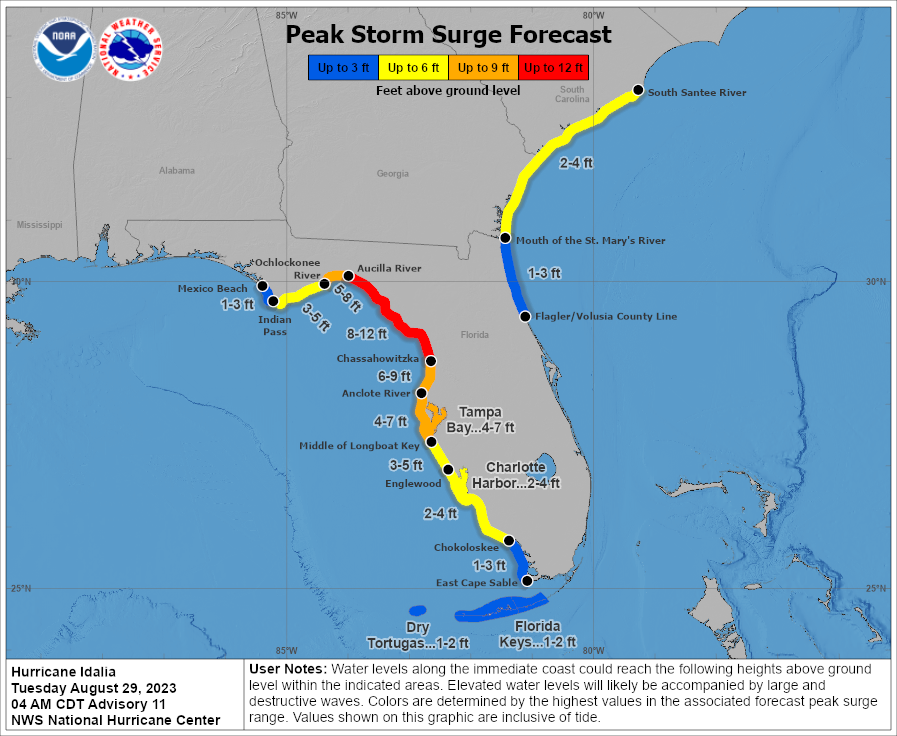
Storm surge is still expected to be life-threatening and potential catastrophic for the Big Bend area in Florida. (NOAA NHC)

At this point, from Tampa south, most of the surge forecast is now baked in. North of Tampa, the bullseye of surge may shift a bit with landfall, closer to Aucilla River and in Apalachee Bay with a shift west in track, or just a bit down coast toward Homosassa with a little eastward shift. But in general, this morning is the time to finalize preparations for as much as 8 to 12 feet of water in the Big Bend and east side of Apalachee Bay.

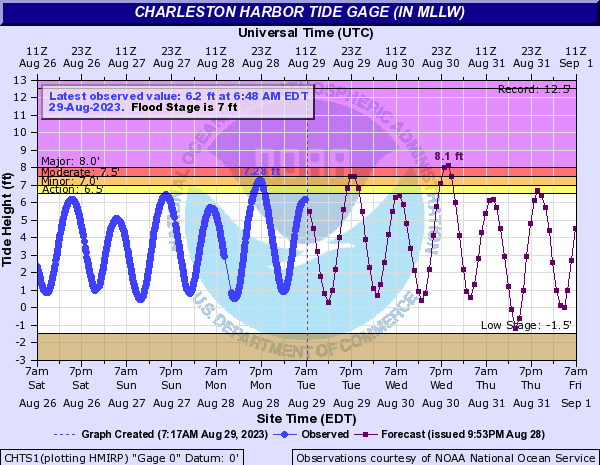
The tidal forecast for Charleston, SC shows “major” flood levels being reached on Wednesday evening. (NOAA)

On the East Coast, we continue to see forecasts of about 2 to 4 feet of surge for Georgia and South Carolina south of the Santee River. For Charleston, there could be “major” flooding levels hit with this during Wednesday evening’s tide cycle.

Idalia’s wind

The wind forecast for Idalia brings it ashore as at least a 120 mph category 3 hurricane. There is some chance it could be stronger than that. Major hurricane force winds will be confined to a small area near the center as it comes ashore. Hurricane-force and tropical storm-force winds will extend out rather far from the center, especially to the east.

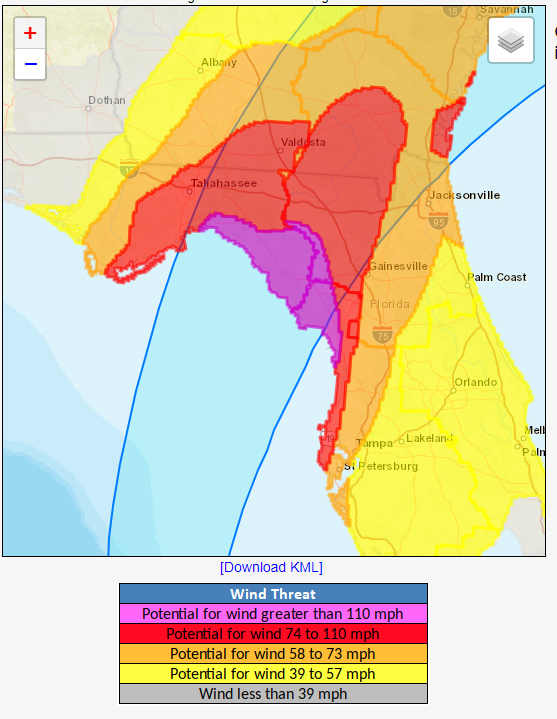
The current hurricane wind threat is highest in the Big Bend, with hurricane-force winds possible near Gainesville and as far inland as Valdosta, GA. Tallahassee should see at least hurricane-force gusts. (NOAA)

The primary wind damage risk will be in the purple shaded region above in the Big Bend. Tallahassee, Valdosta, and Gainesville into the extreme coastal northern fringes of the Tampa metro may see hurricane-force winds as well. Those winds may also occur on the immediate Georgia coast as well. Tropical storm-force winds will include much of Tampa and Jacksonville up toward Savannah and farther up coast into South Carolina. Power outages are likely for a chunk of north Florida, south Georgia, and coastal South Carolina.

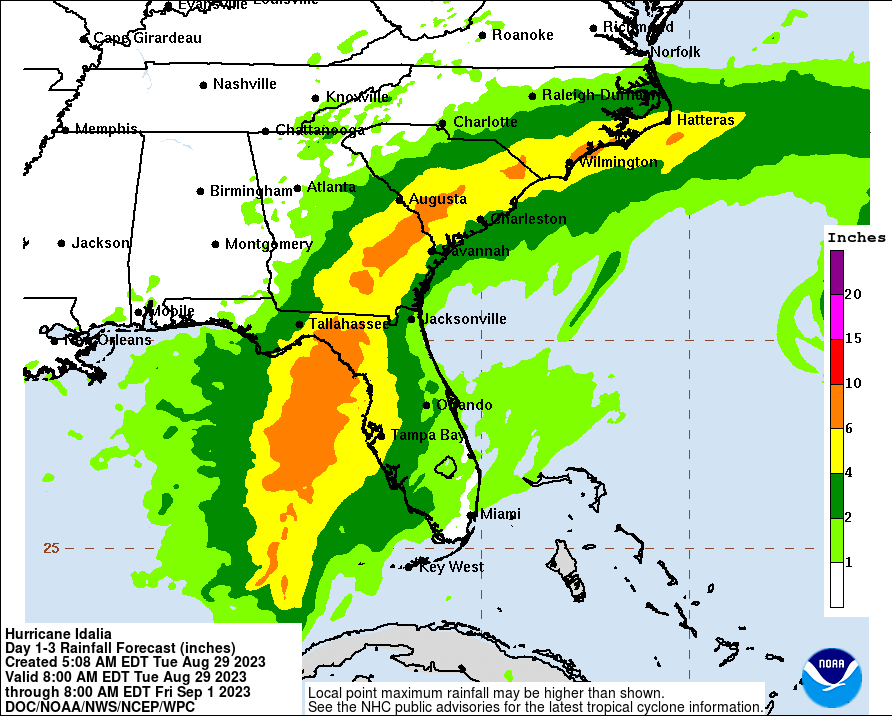
Anywhere from 6 to 10 inches of rain will be possible in the hardest hit areas along Idalia’s track, leading to potential flash flooding. (NOAA NHC)

Idalia’s Rain

We continue to view rain as more of a secondary hazard from Idalia, as its forward speed *should* allow for some mitigation of outcomes there. Still, you could see as much as 6 to 10 inches of rain in spots, and in addition to causing localized flash flooding, this could exacerbate tidal flooding along the immediate coast or bays. Flood Watches are posted in many spots and may expand north through the day today. We’ll hone in some more on this later.

Idalia’s exit and distant future

What happens after Idalia exits the U.S. coast? That’s a great question that we just don’t have a great answer to right now.

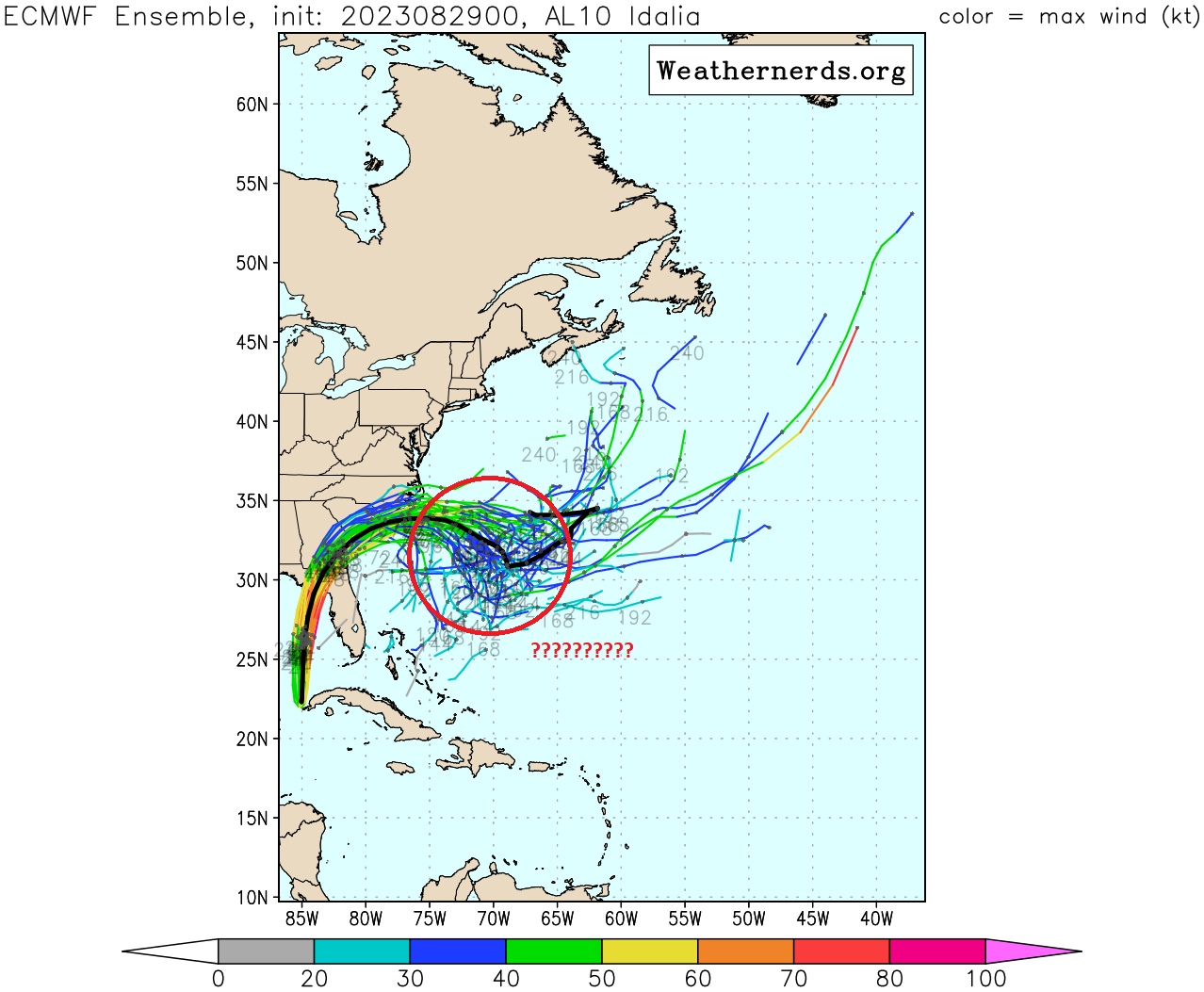
Truly, we aren’t really sure what will happen to Idalia after it moves back offshore of the Southeast this weekend. We need some time to sort this out, but no one needs to worry at this time. (Weathernerds.org)

The pattern that will steer Idalia becomes more convoluted this weekend once it moves offshore of the Southeast. From there, models are, for lack of a better term, confused about where it will go or if it will even maintain identity at that point. The bottom line here is that no one needs to currently worry about a second act from Idalia, but we’ll keep tabs on this in the coming days to see what, if anything happens.

Hurricane Franklin

Franklin became a textbook category 4 hurricane yesterday, and it’s producing rough surf and dangerous rip currents in Bermuda and along the Eastern U.S.

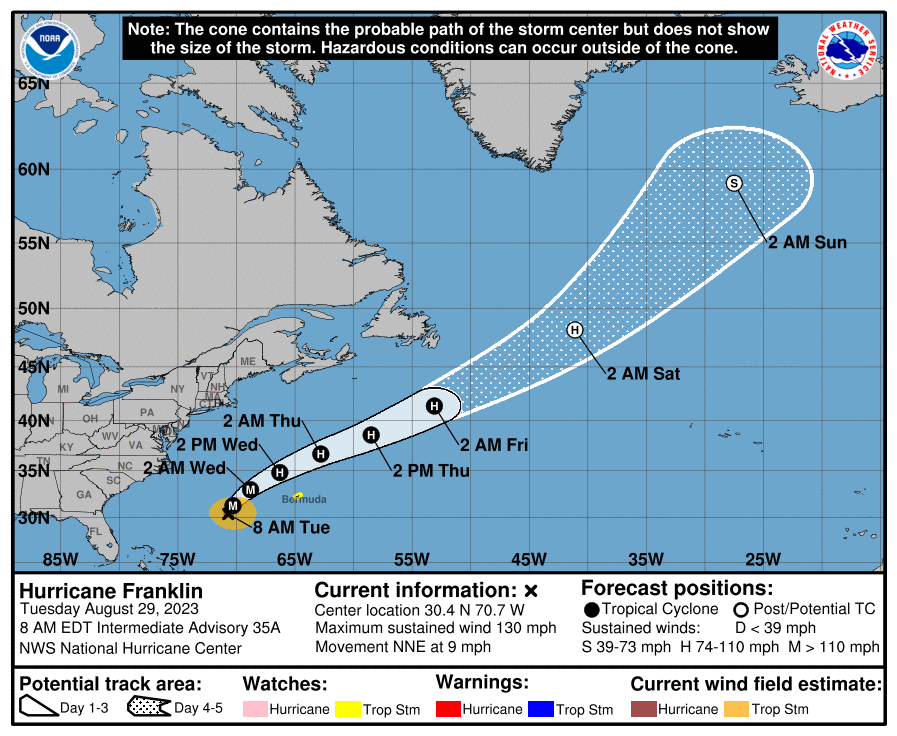
Hurricane Franklin is expected to zip out to sea over the next 5 to 6 days, and it will probably eventually be absorbed into a storm over Greenland. (NOAA NHC)

Franklin is going to steadily head out to sea over the next 5 days, and it should eventually get drawn back north and west, absorbed into a high latitude storm over Greenland.

Elsewhere

Old Invest 92L has a shot at developing into a weak system east of Franklin’s track. A new wave emerging off Africa has about a 70 percent chance of development over the next week as it heads out to sea. No threats to land are seen beyond Idalia over the next 7 to 10 days.

29 Aug 16:13

New Murals Come to San Antonio

by Jessica Fuentes

Recently, the city of San Antonio has seen an influx of new murals installed through various programs and initiatives, including the Centro Public Improvement District Management Corporation San Antonio’s (Centro’s) Art Everywhere Project, the University of Texas at San Antonio, and McDonald’s national Ritmo y Color initiative.

A photograph of a mural by Rudy Herrera.

“Shared Magic” by Rudy Herrera

Centro, a nonprofit organization that manages the City’s downtown Public Improvement District, was established in 1982. In addition to organizing volunteers to welcome people to downtown and to clean and maintain the area, the organization also hosts events, programs, and initiatives such as the Art Everywhere Project.

Launched in 2020, Art Everywhere has supported local artists in the installation of 140 public art pieces, including murals and prints of artists’ works. The initiative identifies underutilized spaces in downtown San Antonio and fills those spaces with art. Through the program, artists are paid a small honorarium and nearby businesses and their patrons learn about local artists. 

Andrea Rodriguez, Centro San Antonio’s Vice President of Cultural Placemaking, told Glasstire, “Many downtowns around the world possess a vibrancy because of the art that exists in the public realm; we lacked that here, so we initiated the project a little over three years ago in May of 2020, hoping that a little art might spark some joy. We began with one mural — and the response was so positively overwhelming we decided we must do it again.”

While the program does post open calls, Centro is also approached by individual artists and arts organizations with proposals. Ms. Rodriguez works to match artists with businesses and other stakeholders in the downtown area to bring these ideas to fruition.

A photograph of a storefront window filled with art.

“8 x 8: Eight Curators – Eight City Blocks” at RiverCenter

Most recently, the Art Everywhere Project launched its 8 x 8: Eight Curators – Eight City Blocks program. Because San Antonio’s downtown is within a historic district, there are limits on which walls can be utilized for murals. For this project, Ms. Rodriguez worked with eigh local gallerists and art leaders from organizations such as The Contemporary at Blue Star, Space C7 Gallery, Masa Boys Collective, Eye of The Beholder Gallery, Henry Ford Academy of Art and Design, and The Carver, to curate storefront windows on eight city blocks.

View a map of each of the Art Everywhere Projects via the Centro San Antonio website.

A photograph of a tiled mural on the exterior of a brick building.

Mark Hogensen, “Discovery Enterprise,” 2023.

Earlier this month, Mark Hogensen, an artist and alumni of the University of Texas at San Antonio (UTSA), installed a tiled mural at the university’s San Pedro 1 campus, which opened in January 2023 just east of the UTSA Downtown campus.

The mural, Discovery Enterprise, is on the northwest corner of the building and measures 58 feet long by 10 feet tall. The futuristic style of the design uses perspective to create illusions of space and references architecture and landscape. 

UTSA partnered with the City of San Antonio’s Department of Arts & Culture on the project, which included hosting early community conversations to outline the scope and theme of the work. 

A photograph of muralists Manola and Maria Ramirez standing outside of a McDonald's where they have installed a mural.

Manola and Maria Ramirez

In June, Manola and Maria Ramirez, sisters who are both University of Texas at Austin graduates with BFAs in Studio Art, installed a mural as part of McDonald’s National Ritmo y Color initiative. The program celebrates Latin music and art by inviting artists in Latino communities to reimagine a McDonald’s restaurant in their community. 

In a press release, Anna Oquin, a local McDonald’s owner/operator, “As a Hispanic business owner here in San Antonio, it’s an honor to showcase Manola and Maria’s Hilos de Orientación (Threads of Guidance) mural at my McDonald’s. I can’t wait to shine a light on this community’s talent, and I hope it inspires the next generation of local artists here in South and Central Texas.”

A photograph of muralists Manola and Maria Ramirez standing inside of a McDonald's where they have installed a mural.

Manola and Maria Ramirez

The Ramirez sisters’ mural is rooted in aspects of their Mexican culture, traditions, and ancestors. The design incorporates shapes inspired by the traditional folkloric dress from Jalisco and patterns reminiscent of Talavera pottery, which is native to Guanajuato, where the artists’ family originates. Additionally, the flowers in the work are a tribute to their grandparents, who inspired their love for nature. 

Manola and Maria Ramirez said, “The opportunity to work with McDonald’s through Ritmo y Color has been a lot of fun. We are very grateful to have the platform to share our culture through our art.”

The post New Murals Come to San Antonio appeared first on Glasstire.

29 Aug 16:09

Parents Don’t Understand How Son Could Spend So Much Money To Live In Place That Brings Him Joy

DAYTON, OH—Saying that it made absolutely zero sense for him to squander his paycheck on rent that high, local parents Janet and Greg Tillson told reporters Tuesday that they didn’t understand how their son could spend so much money to live in a place that brought him joy. “Frankly, I don’t understand it at all—why…

Read more...

29 Aug 16:09

Knife-Wielding Doctors Roam Country Searching For Teens To Force To Be Trans

WASHINGTON—Warning citizens of a rising threat to the nation’s youth, U.S. officials cautioned Tuesday that knife-wielding doctors were roaming the country in search of adolescent children they could force to be trans. “Across America, parents are watching helplessly as trained surgeons compel their sons to become…

Read more...

29 Aug 16:08

Urge To Kill Children Lingers On Much Too Long To Be Postpartum Depression

TACOMA, WA—Saying the disturbing emotions continued to plague her well after the point at which they should have subsided, local mother Leah Andronico told reporters Tuesday that the urge to kill her children had lingered on far too long to be a symptom of postpartum depression. “At first I thought my desire to choke…

Read more...

29 Aug 16:07

If You See This Worm, Kill It!

by Nick Pasion

Hammerhead worms have been spotted slithering around our area, and experts suggest that if you see one, you should kill it. The invasive species can erode local ecosystems by feasting on earthworms, slugs, and snails. Climate change is expanding their domain, so they could become a lot more common around here. You’re most likely to […]

The post If You See This Worm, Kill It! first appeared on Washingtonian.

29 Aug 16:06

Apple’s global suppliers

by Nathan Yau

Most of Apple’s suppliers and manufacturing happen outside the United States and in China. But because of tensions between the U.S. and China, Apple has tried to shift to other countries. Bloomberg provides the breakdowns over time, showing the biggest increases in India and Vietnam.

Tags: Apple, Bloomberg, China, suppy

29 Aug 11:45

Idalia on the verge of becoming a hurricane with its sights set on Florida’s Big Bend region

by Matt Lanza

One-sentence summary

Final preparations in advance of expected major hurricane Idalia should be made by tomorrow morning on the Florida coast, as the storm’s impacts will begin spreading that way by Tuesday afternoon or evening.

Idalia is on the cusp of becoming a hurricane this evening as it begins to lift into the Gulf of Mexico. (NOAA NHC)

Idalia right now

Idalia has been battling some shear today that has held it back a bit in terms of significanr intensification and organization. To be clear, this was expected, and even in the face of this Idalia has held its own and added some lower pressure and stronger wind. As shear moves around a bit tonight and tomorrow and Idalia begins to advance northward, it should begin the process of rapid intensification, just in time for its arrival in Florida. The general rule of thumb in recent years has been that if anything can go wrong in the Gulf of Mexico, it will, and Idalia may add to that list. Let’s focus on impacts today.

Idalia has not moved a whole heck of a lot today, sitting generally just southwest of the western tip of Cuba.

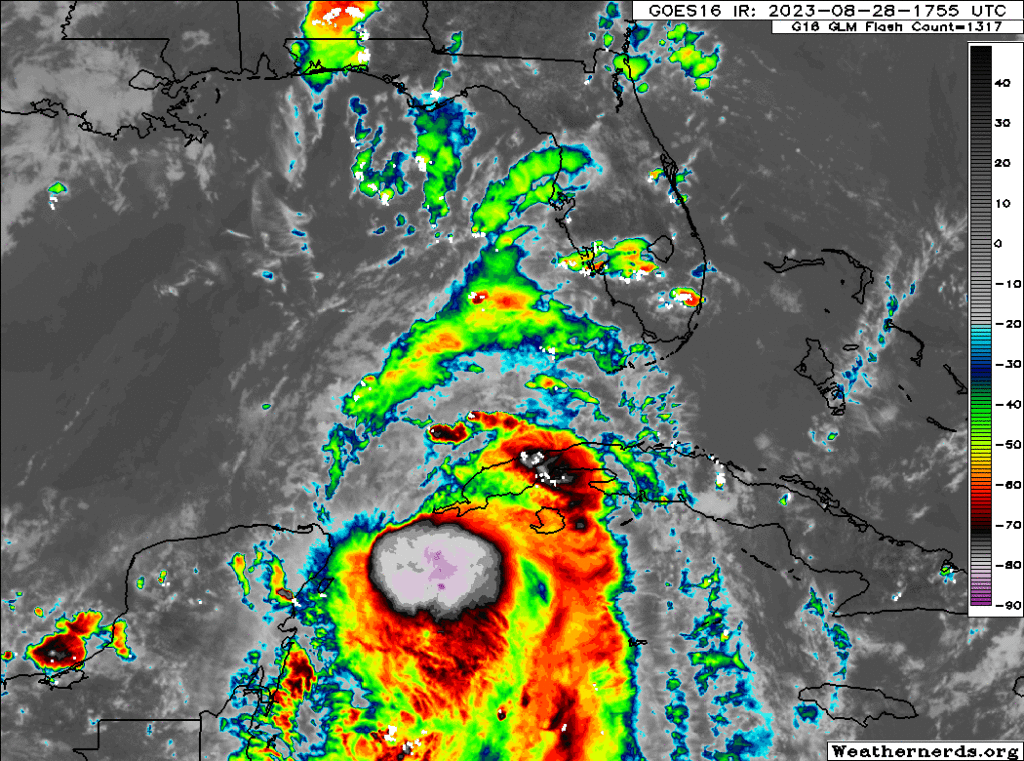
A satellite loop shows some significant thunderstorms near and just south of the center of Idalia in the pink and purple hues. Idalia is expected to become a hurricane tonight. Florida is at the top-center of this loop. (Weathernerds.org)

Max winds are currently 70 mph, and Idalia should become a hurricane tonight. Hurricane warnings are in effect for western Cuba. As noted above, wind shear has inhibited Idalia a bit to this point, but we expect that to loosen up some tonight and tomorrow.

Forecast track & uncertainties

Idalia will broadly come north-northeast toward the Big Bend of Florida. There’s still a good deal of uncertainty on the exact landfall point. Because of the angle of approach from Idalia and the unique geography of Florida, a slight shift in track could yield a decent shift in surge impacts. As we’ll note below, the impacts beyond surge should be relatively baked in now for most spots, with a few exceptions.

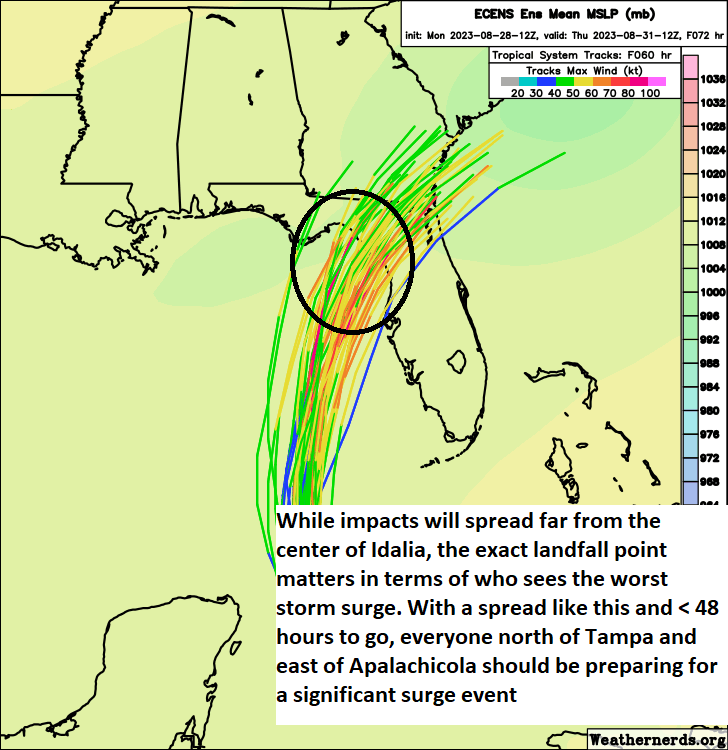
You can see the ensemble spread here from the European model is still considerable, with a handful of ensemble members close to Tampa and many more spread across the Big Bend, as well as a couple as far west as Apalachicola. Recall, the Euro ensemble consists of 51 model runs “tweaked” at initialization slightly to produce some goal posts for outcomes. We need this in tropical situations.

In terms of wind and rain, the forecast will be fairly straightforward regardless of track. The exceptions to this will be the core maximum winds that extend out 10 to 20 miles from the center. We still need to fine tune that. But a broad swath of tropical storm or even hurricane force winds will be possible along much of the west coast of Florida and a bit inland from there.

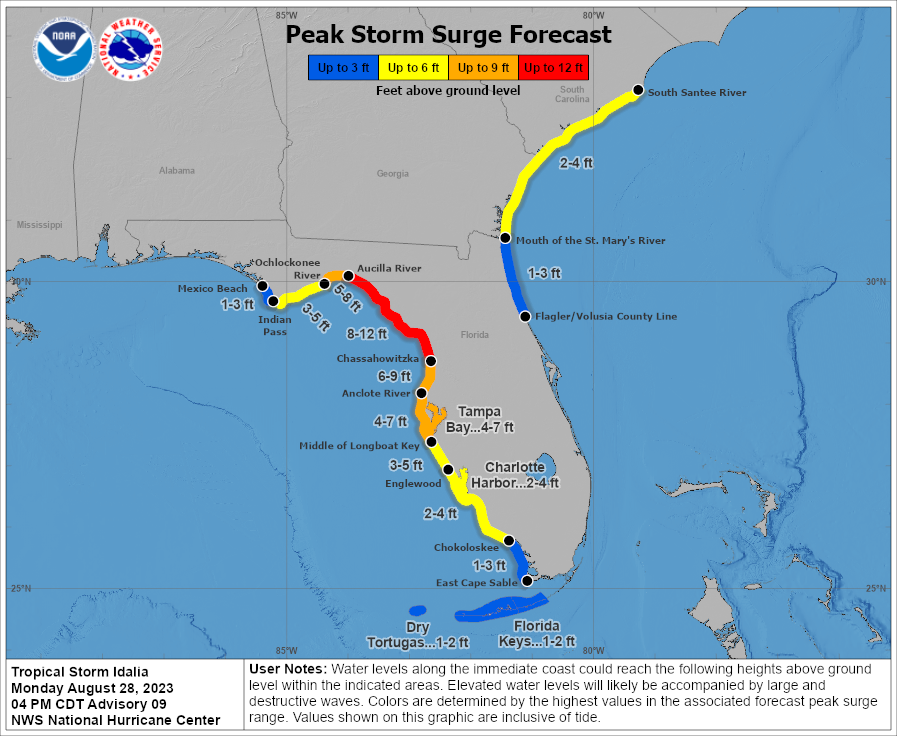
The storm surge forecast for maximum potential water above ground level shows as much as 8 to 12 feet of surge possible from Chassahowitzka around the Big Bend to the Aucilla River. This is contingent on the exact track of Idalia, with these values shifting some based on the precise landfall point. (NOAA NHC)

In terms of storm surge, things get a lot trickier. As we saw with Ian last year, the track south of Tampa led to catastrophic surge in Fort Myers and an empty Tampa Bay. Initial forecasts were calling for significant surge flooding in Tampa. We will have to watch the exact track of Idalia closely to determine exactly where the worst surge occurs and where the inflection point between onshore and offshore winds occurs. But in general, significant, damaging, dangerous storm surge is likely in the Big Bend and along the Nature Coast south to near Tampa Bay. Surge impacts in Tampa should be considerable but not quite as serious as farther north. And surge impacts south of Tampa will be modest but notable. Moderate surge is possible on the South Carolina and Georgia coasts as well into Wednesday.

It cannot be overstated that everyone from Apalachee Bay to Sarasota needs to prepare for the reasonable worst case scenario surge, understanding that if the track shifts, conditions could get worse or better depending on that exact track. There will be some element of overpreparation in some communities, which is an outcome you need to accept. Wind is a concern with this storm, rainfall a secondary concern. Surge? The biggest concern I have with this thing. Please take it very, very seriously. There is no modern analog to this storm in the Big Bend, and the surge impacts are likely to be dire.

Intensity

The current National Hurricane Center forecast brings Idalia ashore as a major, category 3 hurricane with maximum winds of 120 mph. We could see a slightly stronger storm (or even a weaker storm!) depending on the track and how efficiently Idalia can undergo its expected rapid intensification.

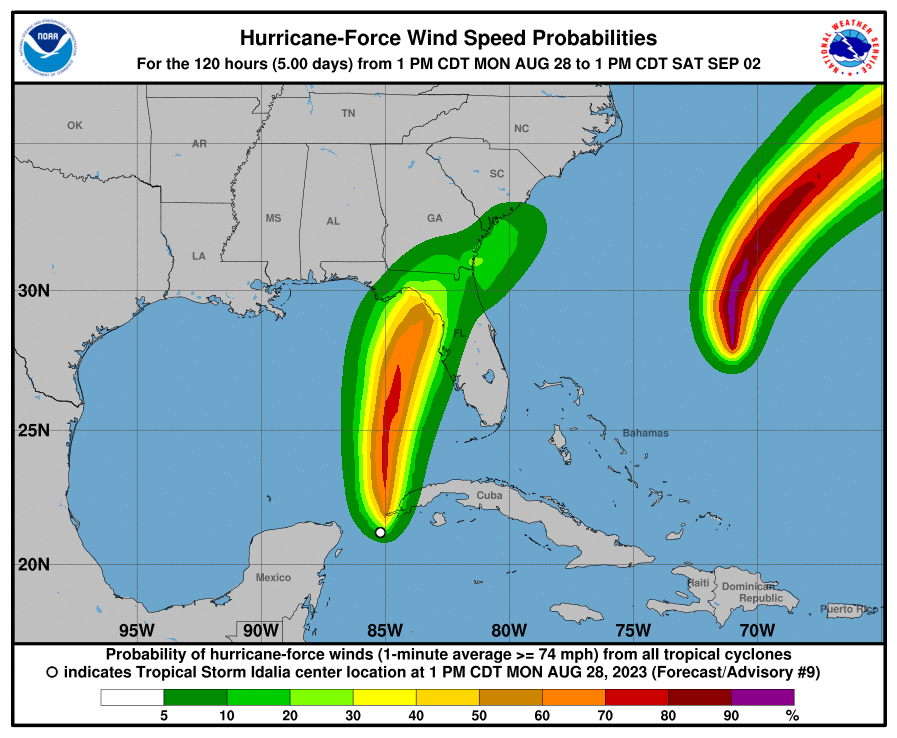
The probability of hurricane-force winds along the path of Idalia show potential as far inland as Orlando and Ocala and as far west as Tallahassee still. Tropical storm winds are likely in these areas and capable of causing damage and knocking out power. (NOAA NHC)

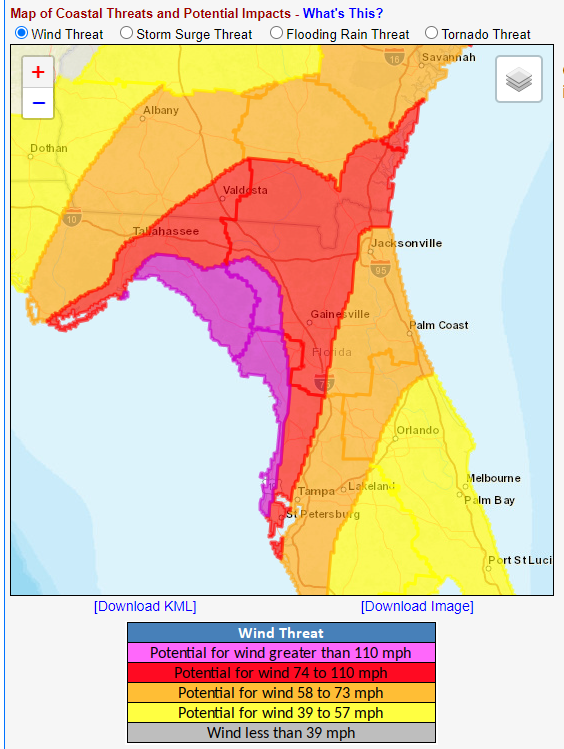
For folks along the coast from Sarasota north, expect hurricane force gusts possible and sustained tropical storm force winds. Inland, including the west side of Orlando will see tropical storm force wind gusts. The core hurricane conditions will follow near and east of Idalia’s center, likely impacting the Big Bend, Nature Coast counties north of Tampa and perhaps grazing Ocala. Inland hurricane conditions are likely for Gainesville, Lake City, and perhaps the western side of Jacksonville, as well as in extreme southeast Georgia. As long as the storm stays on its current forecast track, Tallahassee should be spared significant impacts.

Click to enlarge the image of wind risk in Florida, with Orlando possibly seeing tropical storm force winds, Tampa seeing tropical storm to hurricane-force winds, and the strongest winds in purple west of Ocala and Gainesville (NOAA)

For the east coast, tropical storm watches are in effect from Sebastian Inlet, FL north past Savannah and Charleston to the South Santee River in South Carolina. Storm surge watches cover the area north of the Florida/Georgia line to the South Santee River.

Rainfall

In terms of rain, anywhere from 4 to 8 inches will be possible along the track of Idalia across North Florida, into southeast Georgia and South Carolina as well as southeast North Carolina. Flooding is possible in any of these locations, but the increasing forward speed of Idalia will hopefully help mitigate severe freshwater flooding concerns.

Places like Jacksonville, Savannah, and Charleston will want to prepare for a combination of surge flooding, worsened by rainfall, which will prevent water from draining as quickly as usual. In those areas, flooding could be a little more noteworthy. We’ll touch on that some more tomorrow.

As is always the case with landfalling tropical systems, isolated tornadoes are possible across Florida and into southeast Georgia and the southeast Carolinas.

So, to summarize:

  • Idalia is likely to lead to dire storm surge impacts in the Big Bend of Florida with no real good modern analog.
  • Surge is highly likely south and east of where Idalia comes ashore, far from the center, but the landfall point matters significantly in determining who sees the worst surge. All of Gulf Coast Florida between Apalachicola and Sarasota should prepare for surge impacts.
  • Idalia’s strongest winds will impact the Big Bend and just inland, but gusts to hurricane-force are possible for Tampa and Ocala, and sustained hurricane-force winds may impact Gainesville and the western side of Jacksonville. Idalia’s wind field will extend well east of where it comes ashore.
  • Rainfall is a secondary impact in most spots in this particular storm, but still 4 to 8 inches of rainfall could cause flooding in Florida, southeast Georgia, coastal SC and southeast NC.
  • Places on the East Coast like Charleston, Savannah, and JAX could be dealing with some moderate surge flooding exacerbated by rainfall that limits drainage.

Our next full update will be on Tuesday morning. Look for a video update this evening on our social channels and follow our Twitter feed and Instagram stories for some other notes this evening.

Facebook
Instagram
TikTok
Twitter
Threads
Bluesky
Mastodon

29 Aug 11:39

a coworker threatened to kill me, extending a work trip to make it a vacation, and more

by Ask a Manager

This post was written by Alison Green and published on Ask a Manager.

It’s five answers to five questions. Here we go…

1. A coworker threatened to kill me

A coworker, Sam, messaged me to say they were going to do something against company policy and if I reported them, they would kill me. Sam is a known bully who will intimidate people and retaliate against them until they are fired or quit. I have seen, firsthand, how people are fired after baseless accusations from Sam. Sam is beloved by 99% of our company, including our CEO, because everyone Sam does not get along with is fired or quits. Sam reports to the CEO.

I reported Sam through our internal ethics hotline and provided screenshots of the threat. I was told an investigation could not be conducted unless I was willing to have myself identified in the process. Sam has access to my phone number and physical address, and I am scared of them, so identifying myself is not an option I am comfortable with. Is requiring a person to identify themselves, to an accuser, for an internal employee investigation normal? The company has evidence of the threat in screenshots but is unwilling to proceed. Sam has already started their campaign to discredit my work, but it does not seem like I have any recourse. Any thoughts or suggestions would be appreciated.

Your company has screenshots of one employee threatening to kill another employee but won’t do anything about it unless you’re willing for Sam to know you reported it?! What?! Even if they don’t care on all the obvious grounds — like concern for your safety and not wanting to run a workplace where people threaten to kill each other — they should at least care on legal liability grounds. Because holy legal liability if something did happen.

To be clear, it’s not uncommon for investigations to need to identify the accuser to the accused; sometimes that’s the only way for an investigation to be possible. But they have your screenshots, and they can presumably verify the messages if they were sent on company systems. Is there any chance what they meant was “we want to make sure you know that when we speak to Sam about it, Sam will probably know you reported it”? Because that’s likely true — but it’s not a reason for them not to proceed (there are also ways around that if they bothered to think about it — like the message having been seen by someone else in a routine IT check or so forth).

In any case, it’s illegal to threaten to kill someone, not just a violation of workplace etiquette. Please consider talking to the police, or at least to a lawyer who can guide you from here.

2. Can you ask to extend your work trip to make it a vacation?

My job recently asked me to go to an industry conference outside the country. They’re willing to pay for flights, hotel, per diems — everything is great on that end!

Here’s the thing: Not only is this city and this country a place I’ve dreamed of going for years, but my favorite nerdy hobby is hosting their international conference in the same city the weekend before the event my job asked me to go to. Normally, flying here is a bit out of my reach, financially. But if work paid for my flights and I paid my hotel in the interim and took some PTO between my hobby conference and work conference … I could turn this into the trip of a lifetime.

I don’t know if this is something companies do or allow, but if so, I want to at least try asking! But I have no idea where to start. Would I sound too young/inexperienced for even asking because this isn’t normal? What’s the cut-off for what the company pays vs what I pay? Like when I’ve traveled for work in the past, they’ve paid for an extra day of hotels when I couldn’t find convenient/cheap flights out the day of an event. I know they wouldn’t pay the whole time, but if I’m in the same hotel, how do I split that up? How do I convince them to let me hang out in another country on PTO before the conference? It sounds like I just want to take a vacation on the company’s dime, and that’s not completely false!

This is a completely normal thing that people do. Companies generally don’t care at all as long as it’s doesn’t incur additional expenses for them. So they’d still pay for your flights because they’re paying for those anyway (unless you’re choosing dramatically more expensive flights to accommodate the vacation dates) and your hotel for the nights you’d be there for work anyway. You’d pay for the extra hotel nights and any other expenses during the days you’re adding on for vacation (like food, etc.), and you’d use PTO for the vacation portion. Basically, anything they’d be paying for if you weren’t tacking on a vacation, assume they’ll still pay for — and anything extra, you cover. That’s it!

It doesn’t look young or inexperienced to ask; it’s very, very common to do this.

3. How to ask, “Why do I always need to ask twice to get a task done?”

How can I diplomatically ask someone why I always have to ask twice to get a simple task completed?

Using llama grooming as an example for anonymity, imagine that in our llama grooming business, I get the health certificate from the owner but need to provide this to the llama records department before the grooming appointment can be booked. The llama records department needs to go into the llama’s record in the database and indicate that the health certificate has been received. (Note that I am unable to complete this task myself.)

Almost every time I email the certificate and ask that the record be updated, I have to email again (typically 3-4 days later) to remind them of the task. Usually when I email the second time, the task is completed within a few hours.

How can I nicely ask why I have to email twice to get this simple task completed?

“I’m finding that I usually need to come back and ask a second time for the record to be updated. Is there something I can do differently on my side so it gets done with just the first request? A different way you want me to send these, or something else?”

In other words, allow for the possibility that there really could be something you’re doing on your end that’s making it less convenient for them — or at least frame it that way even if you’re sure it’s not the case, since that allows you to point out the issue in a pretty low-key way.

4. My coworker wants my job after I’m promoted, but she’s not qualified

Our general manager has received a promotion and is moving to a new location. I want her position, and she is pushing for me to have her position. Most of my coworkers want this to happen, and in all reality, it probably will. However, one of my coworkers (I’m technically probably a half step above her, but we work in tandem over different departments) has expressed to me that if I move up, she will be applying to my position. She is not qualified for it, nor do I personally think she could learn the ropes quickly enough to not avoid just losing her job altogether. Perhaps under a more seasoned GM, she’d flourish, but I know how much slack for her shortcomings I picked up in that role; I will not be able to pick up her slack in my new role, while also training her replacement.

How do I gently let her down and not sour the relationship? I think in a year or two, with a serious action plan, she could do it. But not in the next 30 days we’d want someone in role by.

Are the qualification she lacks pretty clear/obvious ones? If so, you could say, “We’ll need to look for XYZ qualifications.”

But otherwise, you should probably wait until things are further along with your own hiring, so that you have some standing to opine on the hiring process to replace you (and you’ve either already become her boss or are clearly about to be). At that point you’d have standing to say something like, “For this role we’ll need someone with qualifications XYZ. If it’s a position you’re interested in working toward, we could put together a plan for you to get those qualifications over the next year. But for this round of hiring, we’ll need someone who comes in with those.”

Alternately, you could let her throw her hat in the ring and give her the chance to make the case for her candidacy, while making it clear you’re conducting a full search and she’ll be competing against other candidates. And then assuming she’s not hired at the end of that, you could explain where other candidates were stronger and offer to put together a development plan to strengthen her in those areas for next time.

5. Can I ask for dividers in our open office to protect me from the AC?

I work in a small open-space office. I really like the job. However, the AC (or some other ventilation) creates a constant draft blowing right into my face. It is not strong, but after 8+ hours it accumulates and now I have constant pain in this side of my face. It is also super distracting — I literally count minutes until I can leave my desk. Our office gets pretty hot so we do need AC, and all other tables are taken so can’t switch. My colleagues accommodate my requests, but it doesn’t change much and I don’t want them to dislike me for making them hot. I tried a lot — brought a hoodie with a big hood to protect my face, a small fan hoping to divert the airstream, even sealed the vent above me — nothing worked.

Now I want to ask the maintenance to install tall plexiglass partitions on the two sides of my table which should hopefully protect me, but I am concerned about the reaction of my officemates/other colleagues. Is it a reasonable request? Maybe you have any other suggestions? It feels ridiculous to struggle over such a detail, but it bothers me a lot.

It’s a very specific request to start with if you haven’t talked to your boss about it yet! Start there — explain the issue to your boss and what you’ve tried and ask if it’s possible to move. The fact that other desks are all taken doesn’t mean they can’t switch things around if someone else won’t be bothered by it (and it sounds like most other people aren’t, unless there’s something about your specific location that’s more impacted than the other desk areas).

If that doesn’t resolve it, then that’s the time to ask if you can speak with maintenance about solutions. And who knows, maintenance might be able to adjust something about the ventilation that solves the problem, or your plexiglass barriers might be the only solution, or they might suggest something else entirely. But talk to your boss first, and then present the problem (not just a single pre-determined solution) to maintenance if your boss can’t solve it.

29 Aug 11:31

Simone Biles Makes History As First Gymnast To Successfully Perform Somersault

SAN JOSE, CA—Winning her eighth U.S. Championship in 10 years, Simone Biles made history Sunday as the first gymnast to successfully perform a somersault. “We have never seen a gymnast, male or female, able to stick the landing on the somersault,” said Maureen Shevrin, one of the eight judges who awarded the gymnast a…

Read more...

29 Aug 11:31

New Poll Finds Most Americans See Biden As Too Old To Effectively Lead Conga Line

WASHINGTON—In a troubling sign for the incumbent president, a new poll released Monday by the Pew Research Center found that most Americans see President Joe Biden, 80, as too old to effectively lead a conga line. “Our data indicated that among both registered and unregistered voters, Americans overwhelmingly believe…

Read more...

29 Aug 11:31

Nerd Who Spent Summer Getting Into Shape Quickly Discovers Bully Worked Out Twice As Hard

BELLINGHAM, WA—Admitting that his physical transformation didn’t even come close to cutting it, local nerd Hayden Gardner told reporters Monday he had spent all summer getting into shape only to discover his bully had worked out twice as hard. “Wow, I thought that I’d spent the last three months getting totally swole,…

Read more...

29 Aug 11:30

Democrats Respond To Jacksonville Shooting With Proposal To Remove Black People From Circulation

WASHINGTON—Following a Jacksonville, FL mass shooting in which a white assailant killed three African Americans, Democrats in the U.S. Senate introduced a bill Monday they said would address the continuing crisis of racially motivated attacks by removing all Black people from circulation. “The only way to prevent…

Read more...

29 Aug 11:30

Spanish Soccer President Refuses To Resign After Forcibly Kissing Player At World Cup

Spanish soccer boss Luis Rubiales, who forcibly kissed a player after the country’s Women’s World Cup victory, has refused to resign, fueling anger among the team and government ministers, who decried his actions as unacceptable macho behavior. What do you think?

Read more...

29 Aug 11:29

China Bans Seafood From Japan As Treated Radioactive Fukushima Water Release Begins

Japan has begun releasing treated radioactive water from the wrecked Fukushima nuclear power plant into the Pacific Ocean, a process expected to take 30 years to complete, prompting China to immediately ban all seafood from the country. What do you think?

Read more...

29 Aug 11:28

Richard Sackler Pays $1.5 Billion To Rename All Picasso’s Works After Himself

BOCA RATON, FL—In an effort to re-enshrine his family’s legacy in the art world following the removal of its name from a wing of the Metropolitan Museum of Art, billionaire former president of Purdue Pharma Richard Sackler revealed Monday that he was paying $1.5 billion to rename all of Pablo Picasso’s works after…

Read more...

29 Aug 11:27

Christians Explain Why They Push Christianity In Public Schools

Many public schools across the United States violate religious freedom laws by leading children in prayer and hanging the Ten Commandments in classrooms. The Onion asked Christians why they push Christianity in public schools, and this is what they said.

Read more...

29 Aug 11:24

Queen’s ‘Fat Bottomed Girls’ Cut From ‘Greatest Hits’ Album For Younger Audiences

Queen’s 1978 hit “Fat Bottomed Girls” has been removed from the band’s Greatest Hits album on Yoto, an audio platform for children, after the company decided it was not appropriate for its audience. What do you think?

Read more...

29 Aug 11:23

World’s climate scientists recommend having only as many children as you plan to eat

by TJ Dawe

GENEVA — The Intergovernmental Panel on Climate Change put out a statement today advising potential parents to only create and rear as many children as they believe they’ll feasibly be able to consume. “We need climate strategies that are practical and that anyone can do,” said IPCC chair Jim Skea at a press conference. “This […]

The post World’s climate scientists recommend having only as many children as you plan to eat appeared first on The Beaverton.

29 Aug 11:20

Comic for 2023.08.28 - Agoraphobia

New Cyanide and Happiness Comic
29 Aug 11:18

Path Minimization

Of course you get an ice cream cone for the swimmer too! You're not a monster.
29 Aug 11:17

Philosophy Cop

by Corey Mohler
PERSON: " "

PERSON: "Philosophy cops, you are under arrest!"

PERSON: "That's not the same! He is coercing us with a gun."

PERSON: "Well..."

PERSON: "He offered you a free choice too: the money or your life. Choose then! "

PERSON: "Save it! You are going away for a long time."

PERSON: "So, are you guys going to arrest me, or...?"

PERSON: "Why would we arrest you?"

PERSON: "Yeah, your philosophical outlook is perfectly clear. You want money and are taking it."

PERSON: "You can't do this!"
28 Aug 18:40

He helped write MLK's 'I Have a Dream' speech. Now he reflects on change in the U.S.

by Scott Detrow
Martin Luther King Jr. waves to the crowd during the "March on Washington" in 1963.

60 years after Martin Luther King Jr. gave his famous "I Have a Dream" speech, we hear from one of the men who helped him write it, his friend and attorney Clarence B. Jones.

(Image credit: AFP via Getty Images)

28 Aug 18:39

update: my employee refuses to do her job and leads me in circles about why she won’t

by Ask a Manager

This post was written by Alison Green and published on Ask a Manager.

Remember the letter-writer whose employee refused to do her job and would lead her in (bizarre) circles about why she wouldn’t? Here’s the update.

Thank you for publishing my letter last year. Prompted by a recent question, I thought an update on my Bartleby might be of interest. Though timing meant that I couldn’t take the advice you provided directly, it coincided reasonably well with the course of action I had already started, and I held it with me while events played out. Shockingly, she mostly turned things around and the situation improved!

I included my concerns about the issues I outlined in my first letter in my annual performance evaluation of her (which I drafted shortly before you published your response). I didn’t mince words; I included direct statements that there were issues with how much of her time she was charging to customers’ projects (instead of to our overhead; it’s expected that folks will charge some time to each, but her ratio was the worst in my group by a good margin) and with how she had refused chargeable work when offered. My supervisor and I discussed her overall rating, and left it at the middle level rather than ticking it down to a category that would mandate an immediate PIP; while neither of us felt great about it, our conversations with HR folks indicated that they wanted us to give her one more shot before implementing a PIP so as to make it clear that all good faith efforts were made beforehand.

I knew that Bartleby would be displeased and likely difficult about it, so when we had the performance conversation that is part of our normal annual review process (usually an uneventful 1-1 meeting), I took the HR rep up on their offer to join the meeting to observe and mediate.

The meeting was … not uneventful. I outlined the issues that I had raised in my written review, let her know that they were real and serious, and that she would be placed on a PIP if things didn’t improve in the very near future. She responded that I was being unreasonable and that including my “incorrect” comments about her in the performance evaluation of record was unprecedented and unfair. When I (politely) pushed back, she escalated to almost (but not quite) calling me a liar who held her to a standard that didn’t apply to the rest of the group. I kept calm and stayed on message, while the veteran HR person (whose eyes were growing wider and wider) backed me up and tried (with little success) to bring things back on track. In the end, Bartleby agreed to write a response to the review to include in the file; the result was the sort of long, rambling series of diversionary tactics and indirect accusations that made up many of our previous conversations. In the aftermath, the HR person (still a bit stunned by the meeting), my manager, and I agreed on a modified strategy for communication with her, in which I would make any requests in writing and immediately exit any in-person conversation that showed signs of spiraling. We also agreed that we would put her on a PIP if things didn’t get better right away.

After that, Bartleby mostly avoided me in person for a few months and we communicated primarily by email, which was fine by me. She was brought in to a project that let her charge a reasonable fraction of her time, which remedied the most readily quantifiable problem with her performance. She also agreed to several smaller projects that I sent her way with only appropriate levels of commentary and no pushback.

After a while, we started having polite, short conversations in person about smaller matters from time to time, and her new pattern of avoiding drama and gracefully accepting projects has continued to this day; we even had a conversation the other day where we initially disagreed about a matter but found common ground fairly quickly. I no longer spend an inordinate amount of time managing her and her charging rate has remained entirely adequate. While she is still not a star performer, she now definitely a net asset to the group rather than a detriment to it.

I am not entirely convinced that this new state of affairs will last indefinitely, and I will remain vigilant for any sign of her old ways returning, but I expect that this year’s review cycle will be far less fraught than last year’s.

28 Aug 17:07

Cupboard Gnome

by tom cardy

Tag a Cupboard Gnome, lest their awful gaze pierce your soul and render you body a lifeless husk
28 Aug 17:02

Judge sets March 4, 2024, as Trump trial date in election interference case

by Carrie Johnson
Former President Donald Trump speaks at his Mar-a-Lago estate on April 4, in Palm Beach, Fla.

The judge overseeing a criminal case against former President Donald Trump for interfering with the 2020 presidential election has set a trial date of March 4, 2024.

(Image credit: Evan Vucci/AP)

28 Aug 17:01

'You're not welcome here!' DeSantis booed at vigil for Jacksonville shooting victims

by Juliana Kim
Florida Gov. Ron DeSantis, left, speaks at a prayer vigil on Sunday for the victims of a mass shooting that took place Saturday in Jacksonville, Fla.

Florida Gov. Ron DeSantis visited Jacksonville on Sunday to mourn the three victims killed in a racially motivated shooting at a local Dollar General.

(Image credit: John Raoux/AP)

28 Aug 16:49

why won’t my company fire my notoriously terrible manager?

by Ask a Manager

This post was written by Alison Green and published on Ask a Manager.

A reader writes:

I was part of a mass exodus from my former employer, and most of us left because we didn’t want to continue working with our director, “Ken.” I can spare you the details, but Ken is completely awful. I saw wonderful coworkers who were otherwise completely pleasant and professional be reduced to crying, swearing at Ken, raising their voices to him, and rage-quitting meetings with him. It might not be an exaggeration to say that working with Ken was seriously traumatic, as many former employees, including me, have had nightmares about him since leaving. I gave direct feedback to Ken, as well as Ken’s boss and HR (and I know other people did as well), but we never saw any significant changes in his behavior. There have been a slew of Glassdoor reviews from both current and former employees referencing Ken being terrible to work for/with.

A lot of us are wondering why Ken hasn’t been terminated. So much good talent has left or is leaving because of him, and it’s baffling why the company continues to let this happen. I’ve heard all of the possible reasons being speculated:

1. The higher-ups somehow, despite the direct feedback and it being all over Glassdoor, don’t know how terrible he is.

2. Ken has dirt on his boss and has blackmailed them into keeping him on.

3. Ken’s part of a protected class and the company is afraid to fire him because they think it would be a liability (I hate to bring this one up, but this is how much people are grasping at straws).

4. The higher-ups think that you have to do the terrible things Ken is doing to get results out of people.

5. The higher-ups are using Ken to get people to quit so they can avoid laying people off.

Of all of these, I think 4 and 5 are the most likely. However, I don’t think the data would support 4. Ken was on parental leave last year, and I’m pretty sure the numbers would show that people were more productive when he wasn’t there (I’m kicking myself for not doing the math when I had the chance). They were certainly happiest when he was gone. That leaves 5 as the most likely candidate in my opinion, although it sounds far-fetched. On the other hand, our industry has been plagued by layoffs recently and the company’s business outlook isn’t great, so a Ken-induced mass exodus could be a way to get a lot of people to resign while not doing an official layoff. Almost none of the positions left empty by folks resigned have been backfilled due to budget constraints, which is partly why I think it’s 5.

I’m curious for your thoughts about this situation, and in general why terrible people aren’t fired.

In the vast majority of situations like this that I’ve seen, it’s none of those explanations! It’s much more common for it to be reasons #6 or #7:

6. Wimpy management above the terrible employee — management that’s too weak and/or conflict-averse to take the sort of action that results in real change (whether that’s getting the terrible employee to behave differently or firing them). This is so, so common.

or

7. Management above the bad manager values his non-management contributions more than anything else. If Ken is fantastic at something they really prioritize — especially something that brings in a ton of money — some companies will care about that more than the fact that’s he’s a bad manager who’s driving people away. This is usually short-sighted because there’s a point where the cost of constant churn is higher than whatever benefits the problem person brings … and in addition to that, there are opportunity costs to having someone like this on your staff: who’s to say what creative and revenue-generating initiatives people might come up with if they weren’t living in fear of Ken and trying to work around him, or what strong hires they’re missing out on because Ken has a reputation and people don’t want to work for him, or how many junior people could have blossomed into high contributors but aren’t because Ken stifles them or drives them out of the field entirely? But it’s very, very, very common for people to get away with bad management because they’re really good at something else.

Now, in your situation, it’s possible that it’s actually your explanation #5 (wanting people to quit so the company can avoid layoffs) but I’m skeptical … because generally when you need to shrink your staff, you want to pick the people who leave and the roles you’re cutting, and not just cut positions indiscriminately. When people flee a Ken, you’re most likely to lose your best people first — the ones you least want to want to lose — because they have the most options. If achieving lower staff numbers is their goal, this would be an incredibly messy and ineffective way to get there.

Also, a legal note: everyone is part of a protected class, because protected classes are things like race (not just race X), gender (not just gender X), and so forth. So it takes more than membership in a protected class for a discrimination suit, although some groups are more likely to need the protection of anti-discrimination laws than others.