Shared posts

24 Oct 18:39

There are Lots of Pictures: Three Books of Photographs

by Bucky Miller
Photo of a page from a photo book of an abstract black and white image

“Recorder” by Miranda Lichtenstein

Across the 1970s, the filmmaker Hollis Frampton wrote a series of black-hole-dense essays on photography for Artforum. These pieces led him on quite the journey of the mind, a path that traversed ideas from Eadweard Muybridge’s dalliance into homicide as potential inspiration for his photographic studies to a 1000-foot metal sphere that was dredged up from the ocean and breached by a team made of a photographer, a psychiatrist, a mountaineer, and a “small contingent of heavily armed Commandos.” Depending on who you ask, it’s either some of the best stuff ever written about the medium, or a lot of hot air. Most likely whoever you ask will simply respond, “wait who?” For me, it simply rocks; I wouldn’t be here without it. If you’ve known me long, you know I’ve already gone on about Frampton for way too long. But:

One image that keeps popping into Frampton’s consciousness throughout the essays is a semi-hypothetical, near-infinite archive of photographs. The aforementioned expeditionary force, which appears in Digressions on the Photographic Agony (1972), emerges from the oceanic sphere “[d]azed, grimy, their faces frozen in the hornswoggled look of men lost in a perfect ecstasy of boredom, they explain that they have found… nothing. Or, rather, less than nothing: they have found only photographs” (emphasis original). Turns out, they’ve happened into a version of the Lost City of Atlantis that was built exclusively to be photographed. Once the pictures were taken, the Atlantians dismantled the city and left behind only the photos and “a critical tradition to accompany the images: a puzzling collection of writings that is gathered into the so-called Atlantic Codex.” In the story, an entire field of academia is developed to decode this text.

Photo of a man in religious robes in a photo book

“Desire Lines” by Lara Shipley

Two years after Digressions, at the beginning of his most useful essay, Incisions In History/Segments of Eternity (1974), Frampton puts the idea of the pile into the mind of a “tall young woman at an imaginary party.” Midway into their conversation, Frampton presses her — a historian and figment of the author’s imagination — to expand upon her answer to his ridiculous question, something like “what is history?” Because she is actually Frampton, she goes on and on, at one point “confiding”:

Now I hope you won’t think me vulgar… but it seems to me that nowadays both the ash-heap and the file of photographs are constantly expanding. I suspect, even, that there is some secret principle of occult balance, of internal agreement, between the two masses of stuff. The photographs are all splendidly organized according to date, location, author and subject; the ash-heap is perfectly degenerate. Both are mute, and refuse to illuminate one another. Rather, pictures and rubbish seem to conspire toward mutual maintenance; they even increase, in spite of every human effort. Just between you and me, it won’t be long before they gobble up everything else.
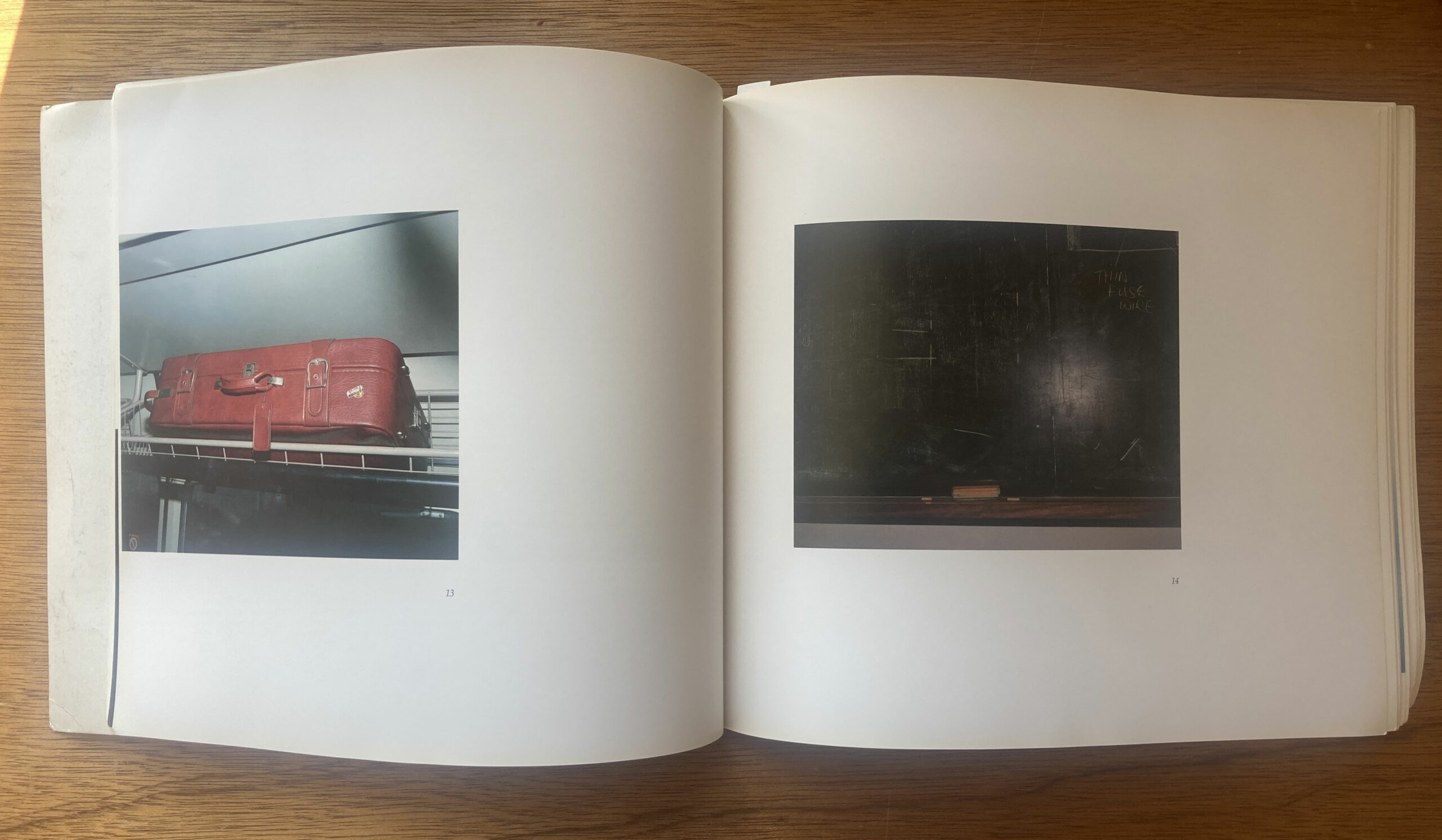
Image from a photo book of a suitcase in a luggage rack

Jonathan Williams’ copy of “Two Blue Buckets” by Peter Fraser

Whenever Frampton’s mountain of pictures surfaces, it presents some sort of obstacle; a physical and intellectual entity that photographers, academics, and even time itself are forced to contend with. And yes, it’s always been a tricky medium. From Digressions: “The instantaneous mnemonic process works with perfect precision, no matter who presses the button. In every early discussion of photography as an art, it is that single fact that seems to cause the most trouble.” Hollis Frampton died young, sadly, from cancer, in 1984. How much has the file of photographs expanded since then? What about the ash-heap? What now?

Cover of a black and white photo book

“Recorder” by Miranda Lichtenstein

Recorder by Miranda Lichtenstein

Miranda Lichtenstein’s photographs are not, at first glance, the type of pictures one might expect to be published in book form. Actually, at first glance they aren’t even photographs. But Recorder is the photography book that once again got me thinking about Frampton and his ash-heap. Quoted in a Prudence Peiffer essay at the back of the book, Lichtenstein asks an ominous question: “Why take another picture?” At one point or another, a similar sentiment of existential dread has permeated the thoughts of most photographers I know. They ever increase, in spite of every human effort. Liechtenstein, however, took it to heart. Motivated by her own disillusionment with taking pictures — “I was no longer interested in what I could do or say with the medium out in the street” — she set about “cannibalizing” her personal archive. Old photos become source material for this collection of wildly muddled, non-representational pictures.

Image from the page of a black and white photo book

“Recorder” by Miranda Lichtenstein

Except they aren’t entirely non-representational. While the original content of each photograph has been fervently banished to the ash-heap, what’s left still very much depicts the medium. The standout series of works in the book, all titled Ground, are made from the torn scraps of countless photographic prints. The printed areas have been excised (in some ways an inverse of Frampton’s description of photographs as “incisions in history”), and the borders remain as jagged, island-like frames around big, vacant, solidly white expanses. They are in equal parts anxious and haunted. In the book these pieces were printed on much lighter weight paper than the other plates, and on single-sided pages. The ghost image of each Ground, white void fading even further toward total white, shows up on the verso.

Image from a page of a black and white photo book

“Recorder” by Miranda Lichtenstein

The presence of white in photographs does not indicate nothing. That honor belongs to black. If no light touches a piece of film, that negative developed and printed will yield an entirely black print. The same thing happens if you leave your lens cap on your mirrorless Sony. A completely white photograph is the result of the opposite: too much light has passed through the lens. It’s fundamental. So the old scraps of photographs, the frames around the what-used-to-be-theres that were obliterated in order to make these Grounds, now surround everything.

Cover of a photo book by Lara Shipley

“Desire Lines” by Lara Shipley

Desire Lines by Lara Shipley

To avoid burying the lede, let me first say that the novel-shaped Desire Lines provides the most human, nuanced, and accurately complex depiction of life in the U.S.-Mexico border region of the Sonoran Desert that I’ve ever encountered in a group of pictures. Somehow, the photographs also manage to acknowledge the overwhelming beauty of this harsh terrain. This writer, who was born in that desert, is happy about it.

But now a disclosure: There’s a jpeg in some long-dormant Facebook file of photographs that depicts younger versions of Lara Shipley and myself sitting next to our mutual professor, Bill Jenkins, as he prepares to discuss Hollis Frampton with us and the rest of our class. It was around that time, as a graduate student at Arizona State University, that she started making the work that would end up in Desire Lines. 
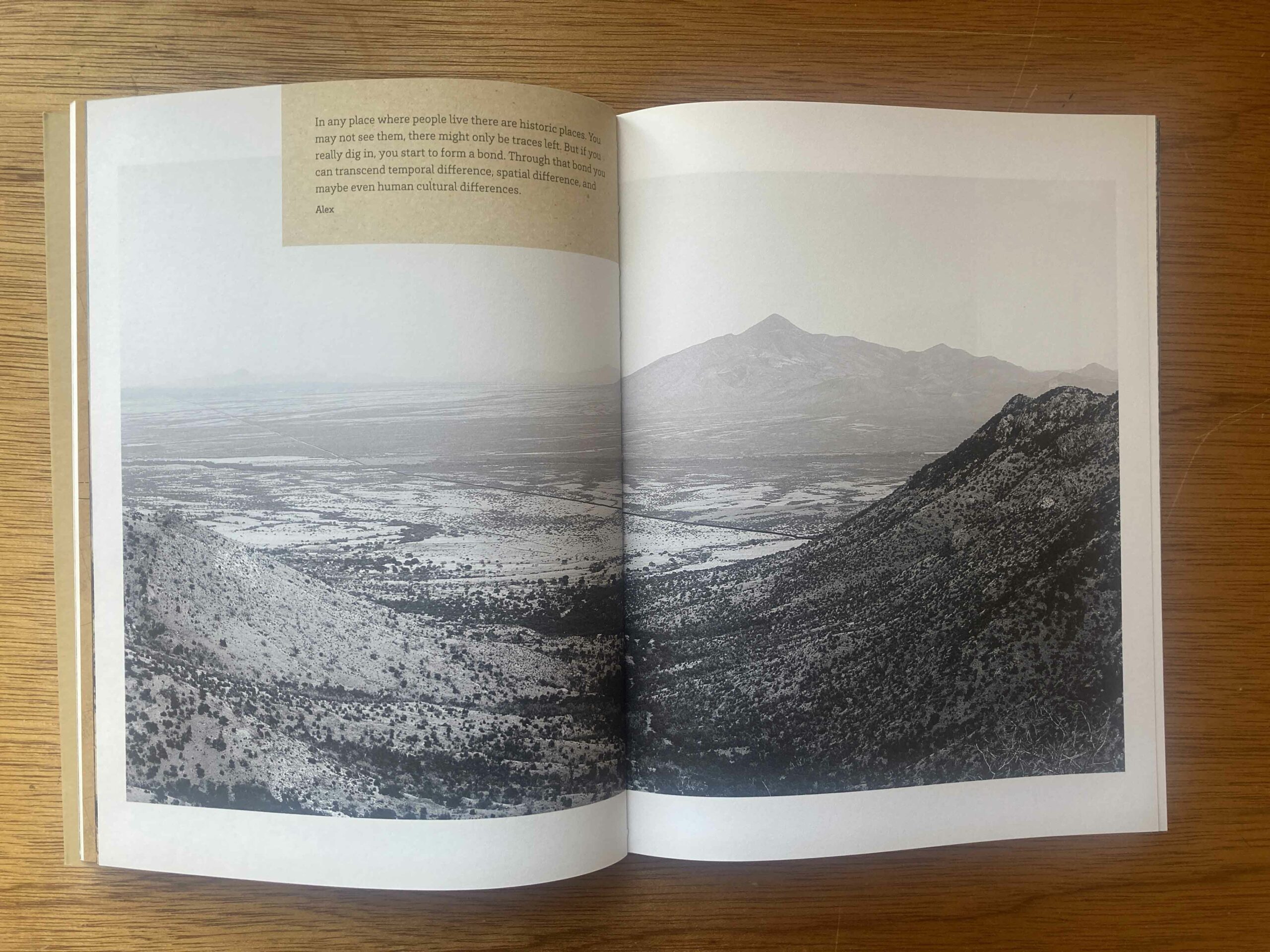
Photo of a mountainous landscape in a photo book

“Desire Lines” by Lara Shipley

Shipley and I haven’t been in touch much since those days, because of life, but I’ve continued to follow her work. When she contacted me to say she had a new book out, I was already thinking about Lichtenstein’s Recorder in terms of Frampton’s writings. I did not expect to be able to fold Desire Lines in alongside it, but it wound up being a perfect foil: Shipley’s own relationship to the infinite-photo-producing-machine is clearly felt within the pages of her most recent publication.

Interspersed with her own photographs are a collection of historical images. These are mostly of “Wild West”-type stuff: hard white men with wide hats and big guns; indigenous people digging a ditch. There is also a full-bleed reproduction of a postcard image I saw regularly as a kid in Arizona: a dweeb, a white male photographer in 1950s garb, stands in the archway created by a mighty, many-limbed saguaro cactus that has grown too large so that some of its appendages drape back down to the earth. The eager little tourist, unconcerned with the otherworldly majesty of the whole plant, is right up in there snapping an up-close picture, and maybe has a dozen cactus spines visible through his rangefinder. Taking pictures about taking pictures has been a thing for a while. It’s a charming, enduring image of the region. Over the bottom right corner, Shipley has superimposed a horrific photograph of a desiccated human corpse that looks like it had been abandoned somewhere out in the desert. The source of this second photograph is unclear. 

Shipley makes the archive an asset. She brings frontier mythology into the present through sequencing; suddenly the cowboy fantasies are full of brutality and are no longer only myth. As she writes in an insightful essay near the back of the book, “things haven’t changed that much.” But the juxtaposition wouldn’t work if it wasn’t for the variety and coherence of her own photographs, which far outnumber the archival documents in the book.

page of a photo book with black and white photos arranged on a map

“Desire Lines” by Lara Shipley

Everything out there is defined by the desert sun. We zoom out from portraits of folks shielding their eyes — made with a real collaborative quality that can be achingly rare in photo world documentation of American small-towners — and are all of a sudden looking across an endless expanse of creosote as an unseen vehicle kicks up clouds of dust from a dirt road. A man stands in the shadows of the border fence, which dwarf him as he seems to contemplate it. Caches of bottled water, left by some humanitarian for passing migrants, cluster around the bases of scrubby trees. It’s easy to miss the swooping chopper concealed behind the tips of an ocotillo.

Even pictures made at night seem informed by the sun; activity increases after it sets. In some pictures, Border Patrol aircraft, via long exposure, become light shows in the evening sky. Elsewhere, their spotlit checkpoints are the only things that escape the all-consuming black. There are double exposures, fragments, and pictures set inside others. Shipley, no tourist, leaves nothing on the table in her investigation of lives in the endless Sonoran. Anything less than that would have come up short.

Photo of a photo book of two buckets

Jonathan Williams’ copy of “Two Blue Buckets” by Peter Fraser

Jonathan Williams’ copy of Two Blue Buckets by Peter Fraser

I’m headed somewhere else now. 

In September in Sylva, a small mountain town in western North Carolina, I happened upon a bookstore that confoundingly shares its name with San Francisco’s famed City Lights Books. Tracking the origins of that parallelism would be its own investigation, and I doubt I’ll be back in the region too soon, so I will leave it aside as a curiosity. What matters now is that, as a bookstore, the southern City Lights holds its own.

One shelf in the back of the shop contained a well-labeled but picked-over selection of used books from the estate of Appalachian poet-publisher-photographer-polymath Jonathan Williams (1929-2008). The Black Mountain College-affiliated Williams was the founder of The Jargon Society, which published works by the likes of Buckminster Fuller, Mina Loy, and Kenneth Patchen. That imprint was also the first to reveal The Family Album of Lucybelle Crater, photographer Ralph Eugene Meatyard’s singularly weird portfolio of hideously masked kin, to the general public. Williams was also a contributing editor for Aperture. 
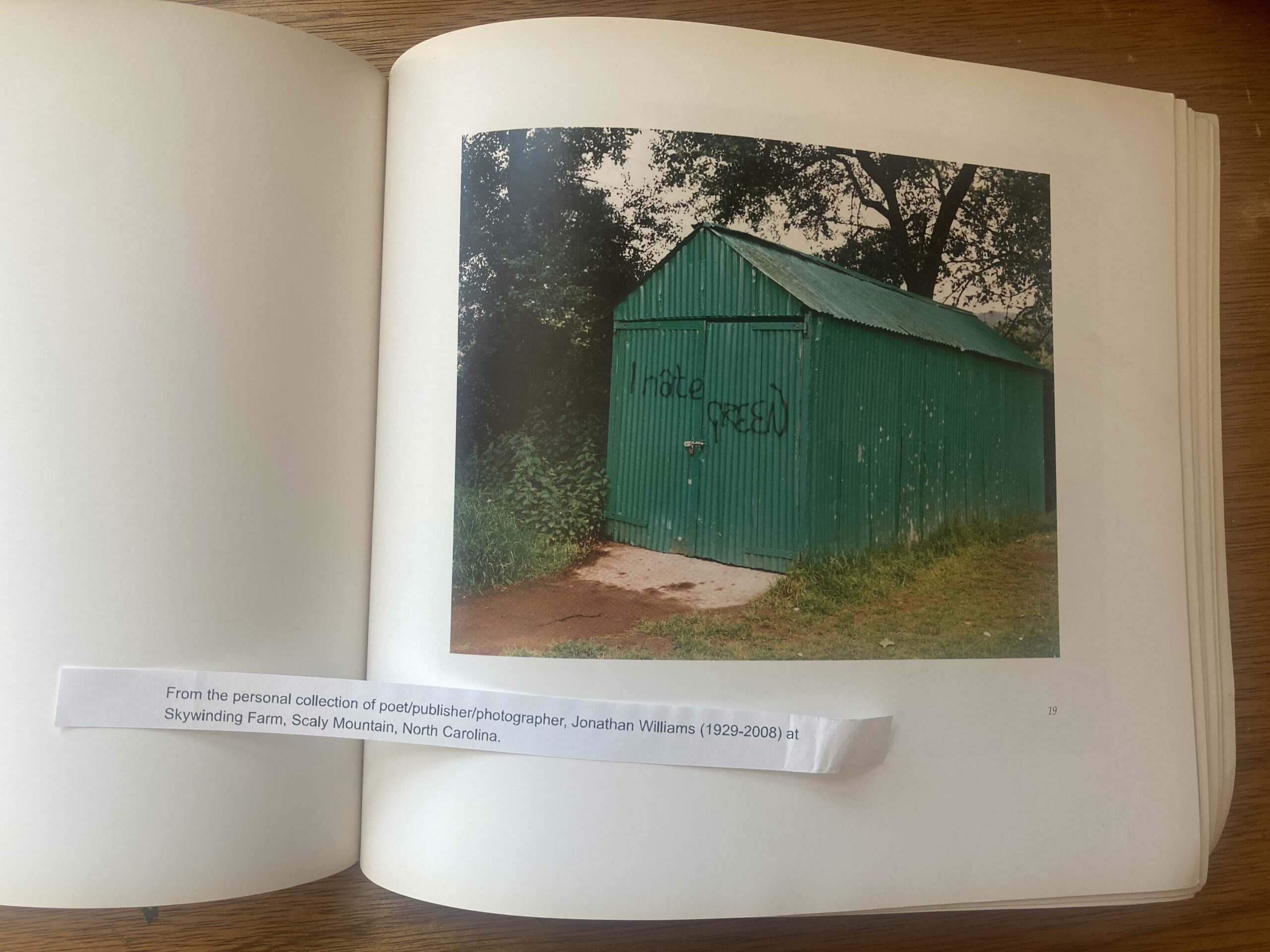
Photo of a shed in a photo book

Jonathan Williams’ copy of “Two Blue Buckets” by Peter Fraser

A lot of what was left on his shelf at Sylva’s City Lights was either too obscure for me or a book about cheese, although I do have evidence that Mr. Williams read David Ignatow’s New and Collected Poems while eating ketchup. Tucked in one corner I was delighted to find Two Blue Buckets, the Welsh Peter Fraser’s 1988 photo monograph, a book I’ve wanted for years. It cost me $25, more than it would have online and more than I wanted to spend, but the novelty of its former owner pulled me in. It’s got a smell.

Peter Fraser’s (b. 1953) color compositions are intensely direct to the point where it’s nearly confusing. His work is not as encompassing as his predecessor and one-time co-conspirator William Eggleston’s, nor as ironic as that of his Gen-X analogues, like Jason Fulford. Two Blue Buckets is named for a photograph of two blue buckets, which appears in triplicate on the book’s cover and once inside the pages. The buckets sit side by side and… that’s pretty much it, aside from some out of focus tables and chairs that are suggested around the edges of the frame. Somehow, though, these are the most captivating two blue buckets anyone has ever seen fit to show anyone. 

The same thing happens over and over throughout the book. A red briefcase on a luggage rack, a folded-up wheelchair, a board spanning the six-foot gap between two more (white, upturned) buckets. Fraser’s deadpan turns all these objects into sculptures. I have another one of his books, a self-titled thing from 2004, and I’ve long struggled to find the words for why any of his pictures work as well as they do. Here’s a recent diagram that I showed in a lecture while trying to figure it out:

Diagram of Peter Fraser related to Barthes

With my critical thinking skills failing as if Fraser’s pictures spring up from the page and smack me right in the face whenever I look at them, let me instead say something about this copy of the book. The only proof I have that it once belonged to Jonathan Williams is a small slip of paper that City Lights stuck into all his books that reads, “From the personal collection of poet/publisher/photographer, Jonathan Williams (1929-2008) at Skywinding Farm, Scaly Mountain, North Carolina.” So they could have faked it. But Williams is a relatively niche figure, and everyone at the shop was friendly. I think I’m safe there. Still, there is no real record of provenance; no signature, no bookplate. I gain nothing tangible from owning this copy over the $19 one on AbeBooks.
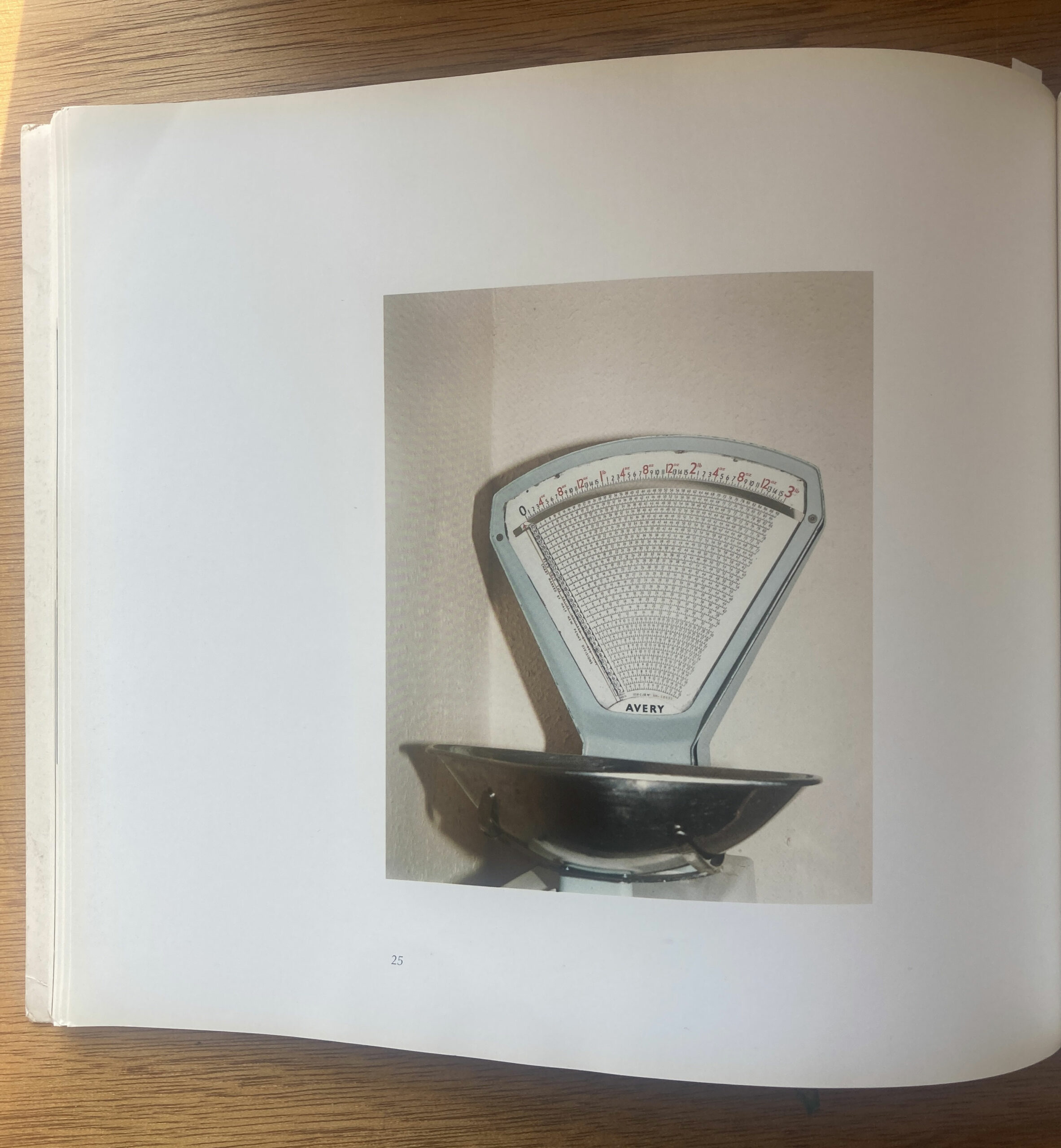
Photo of a photo of a scale in a photo book

Jonathan Williams’ copy of “Two Blue Buckets” by Peter Fraser

What I do receive for my $6 surcharge is a flimsy, but palpable, conduit to the past. A book has a history. It is fun to imagine the guy who wrote this poem flipping through Fraser’s book and meditating on his picture of an Avery scale. The scale seems to contain and weigh what describes it: a blast of light from Fraser’s flash. I can visualize the poet silently chuckling, a smirk of recognition for a man who once saw how dahlias can set fire to the sun.

Poems and photographs are buddies. They swirl around each other in mesmerizing ways, passing ideas back and forth, the limitations of their forms keeping them from touching. For a measly twenty five bucks I have plugged myself like a thumb drive into the dangling end of this particular continuum of thought. A book is a tool. Now that this one is with me, how will I use it? We’ll see. Of course, I can’t talk to Williams to find out how he actually felt. From my distance I have to do a lot of guesswork.

Bill Jenkins always liked to point out how in Incisions, Hollis Frampton suggests that photography lives between the complimentary vanishing points of memory and conjecture. Frampton says, “the confused plane of the Absolute Present, where we live, or have just seemed to live, brings to irreconcilable focus these two divergent images of our experience of time.” Yeah, there are lots of pictures; they twist in different ways in different hands. The important thing is that time persists, so it stands to reason the pictures’ll never stop twisting.

The post There are Lots of Pictures: Three Books of Photographs appeared first on Glasstire.

24 Oct 18:38

This and That: Ron Gorchov and John Wesley

by Brandon Zech

“This and That” is an occasional series of paired observations. See past “This and That” posts here. – Ed.

Today: Choirs

An abstract painting featuring many bright colors, done on a curved canvas.

Ron Gorchov, “Choir,” 1983, oil on linen, 77 x 108 x 15 inches


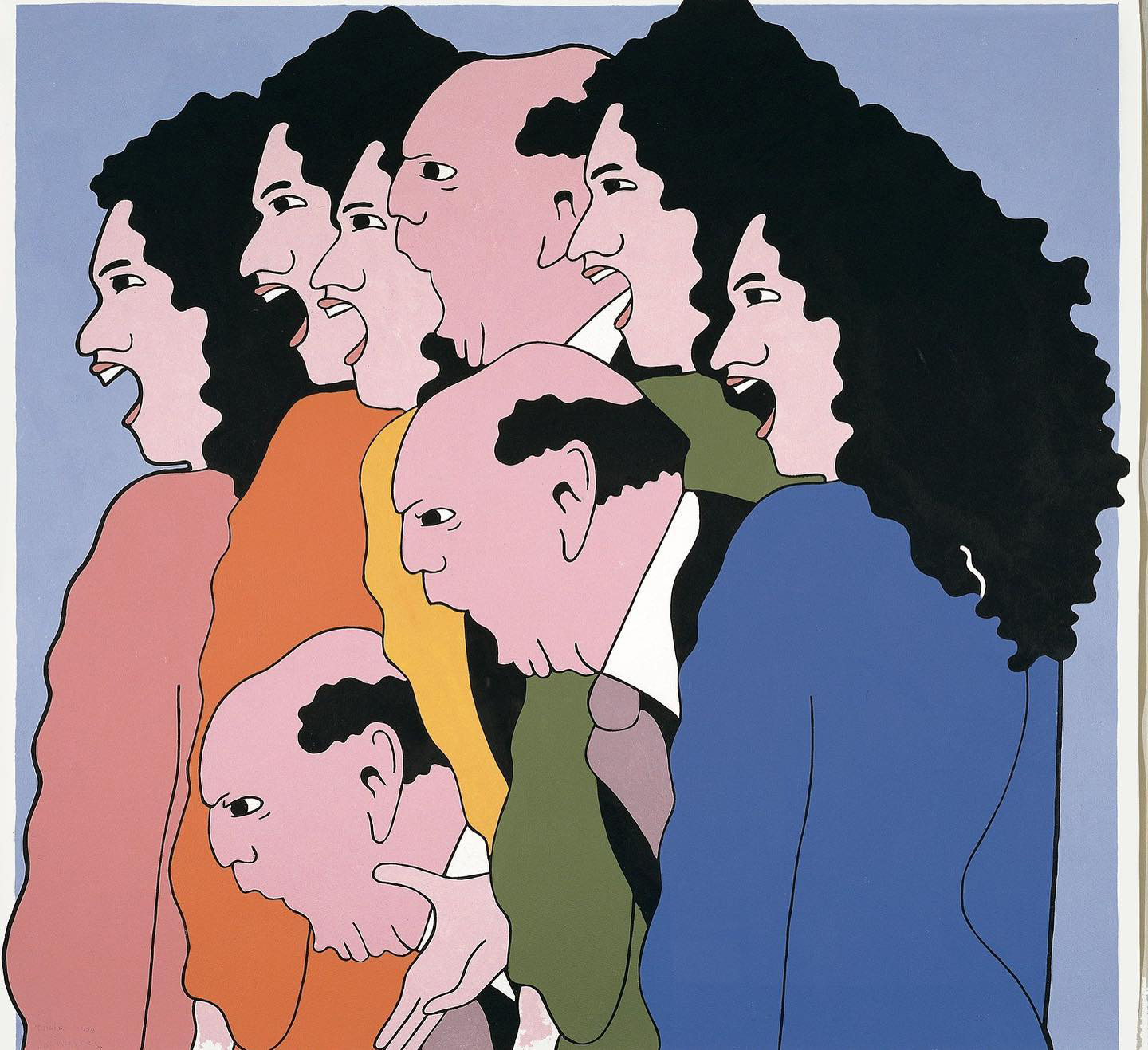
An acrylic painting of a group of people all singing with their mouths agape.

John Wesley, “Choir,” 1988, acrylic on paper


*************

No matter how original, innovative or crazy your idea, someone else is also working on that idea. Furthermore, they are using notation very similar to yours. – Bruce J. MacLennan

The post This and That: Ron Gorchov and John Wesley appeared first on Glasstire.

24 Oct 18:38

[Sponsored] Collecting, Editing, Re-presenting: Amy Banner Updegrove at Davis Gallery, Austin

by Glasstire

Art is often inspired, at least in part, by an artist’s life. Andy Warhol used his design and illustration sensibilities to create flat, brand-driven commentaries on society; Lenka Clayton draws on her experience as a mother to make funny, absurd, and honest artworks about daily life; and Georgia O’Keeffe found new ways to interpret her surroundings in unique, unexpected, and unrecognizable ways. While there are varying degrees of consciousness in these artists’ choices, one thing is clear: our background and who we are as people is inextricably linked to how we look at and navigate the world. 

This sentiment rings true when considering the work of Austin-based artist Amy Banner Updegrove, whose first-ever solo exhibition, Echo, opens at Davis Gallery in Austin next week. Updegrove creates mixed media three-dimensional collages — or as she calls them, builds — that consider color, space, texture, materials, and framing as their structural components. From there, she employs a mix of aesthetics, intuition, and materials testing (in more of a design than laboratory sense) to see what works well together.

An artwork featuring a collage of paint swatches, all nailed to a canvas.

Amy Banner Updegrove, “Obstinate,” 2023, painted paper and zinc nailed to fabric ground, 24 x 24 x 1.75 inches

There’s a visual throughline that permeates Updegrove’s art: slightly imperfect grids of varying sizes; cooling shades of blue and white, which are sometimes punctuated by earthy browns and rich golds; and materials that present well but are not traditional. In works like Obstinate (2023), Updegrove uses paint swatches she collected from a local business to create subtle cube-like forms, complete with drop shadows. They are, in fact, completely flat. The piece still has body, however — the forms are held firmly in place by zinc nails, which stick a few millimeters out of the canvas’ surface. On the artwork’s corners, metal L-brackets are held in place with carpentry tacks, a final and more overt hint that this artwork has sprung forth from a hardware store.

An artwork featuring a collage of paint swatches, all nailed to a canvas.

Amy Banner Updegrove, “Obstinate” (detail) 2023, painted paper and zinc nailed to fabric ground, 24 x 24 x 1.75 inches

Updegrove has always been a purposeful collector of materials. She lived for a stint in New York City, while working as a retail marketing director for Polo Ralph Lauren, and remembers her time in the city through the specialty stores that only New York can sustain: a shop selling hundreds (if not thousands) of kinds of ribbon; Pearl River Mart, which specializes in Asian home goods, art, and outerwear; and fabric stores with everything and anything you could possibly need for upholstery, curtains, clothing, and beyond.

An artwork featuring a golden ground made of joss paper. Wire crisscrosses above the paper in a geometric pattern.

Amy Banner Updegrove, “Rave,” 2023, joss paper, copper carpentry tack, copper and brass wire, 24 x 24 x 2 inches

Though she hasn’t wrapped ribbon around her pieces or used fabric swatches within them, this New York collecting has come though in certain works that employ, as their ground, the golden centers of joss paper. The paper has a rich history in Chinese culture: it is used in ancestral worship and is also burned at funerals and during worship in Chinese folk religion. Updegrove comes to the paper with an appreciation and respect of its cultural significance, its symbolism, and its singular appearance. She feels that it reflects a richness of life and a vibrancy she hasn’t found anywhere else.

Pieces like Rave utilize the paper as a ground. In this case, there is no layering of the paper — the gold stands on its own, the patchwork-like quality subtly representing the ways our lives are stitched together. Over the paper, copper and brass wires crisscross the surface of the panel in a grid pattern, creating various rectangles and squares. Shapes are created within shapes, with the culminating work almost recalling Robert Rauschenberg’s gold leaf shadow box pieces.

An artwork featuring panels painted in various shades and tints of blue.

Amy Banner Updegrove, “Current,” 2023, painted panels acrylic over birch framed in oiled vintage leather and secured in natural steel grid with brass welded corner, 49 x 49 x 2 inches

Though Updegrove’s art has a strong sense of movement (with some of the paint swatch works being similar in appearance to Latin American Op Art), its goal is instead stillness. Her work, she says, is a direct response to the nonstop freneticism of life, which, if left unchecked, could easily overtake us. When Updegrove started making artwork, she gravitated towards forms, colors, and patterns that calmed her. Inspiration comes from elements she notices on walks in her Austin neighborhood: the singular but unique way plant buds emerge and bloom, the formulaic but imperfect look of a tree’s rings. It also comes from other observations, gleaned during travel and from her collections: the stonework of a bridge in Central Park, the strong weave going through a monochromatic swatch of fabric.

Even though each of her artworks is laid out with clear and specific intent, and in an exceedingly meticulous way, Updegrove manages to avoid any feeling of obsessiveness. This likely comes from the calm and collected way Updegrove approaches her art; it similarly doesn’t hurt that the works’ square forms and cool colors denote a sense of balanced stability.

Through her careers in design and publishing, Updegrove has had to perfect the way she manages (seemingly) effortless elegance. She talks of hallway-long mood boards in the Ralph Lauren office, from which employees could approach and glean inspiration. This cluttered but purposeful visual vocabulary is what Updegrove has managed to pump back into her art. There’s a sense of it being unconscious — at one point the artist wondered aloud if a person falls into a career because of who they are, or if a person becomes who they are because of their career.

An artwork featuring a grid of white paper over other colored elements.

Amy Banner Updegrove, “Passion,” 2023, Madagascar raffia, cotton paper and theatre gels layered with Amate paper and zinc tack over canvas captured in handmade black walnut frame, 48 x 68 x 4 inches

The answer, it would seem, is yes to both. You can’t separate a person from what drives them, and, if they’re lucky, they’re able to lean further into who they are by making their passion their life’s work. Updegrove did this for decades in her various corporate jobs, and it is now, in the interleaving years where she has been able to take a step back and collect herself, that she is doing this with her own artwork.

Updegrove isn’t a new artist — she made things when she was growing up, studied modes of art making in college, and regularly flexed her creative muscles on various design projects — but she is fairly new at considering herself an Artist with a capital A. Echo is a beginning, an introduction to a newly minted artist with a rich background, which means she likely has many more ideas, processes, and modes of working still to come.


Amy Banner Updegrove: Echo will be on view at Davis Gallery in Austin from November 4 to November 22, 2023. Learn more by visiting Davis Gallery’s website.

The post [Sponsored] Collecting, Editing, Re-presenting: Amy Banner Updegrove at Davis Gallery, Austin appeared first on Glasstire.

24 Oct 13:56

the adult bibs, the talking shrimp, and other unusual office traditions

by Ask a Manager

This post was written by Alison Green and published on Ask a Manager.

One of the most interesting things about offices is how they develop their own subcultures, rituals, and traditions. I recently asked about unusual office traditions you’ve seen or experienced, and here are some of my favorites you shared.

 My office has a “talking shrimp” that we use instead of a “talking stick” in brainstorming meetings where we otherwise run the risk of all talking over each other. It’s a foam replica of a cooked jumbo shrimp — headless and legless but we’ve added googly eyes. The tradition has evolved to the point that now in virtual meetings people will sometimes put a shrimp emoji in the chat when they want to talk and the meeting leader will recognize them saying “you have the shrimp.”

 All of our baby showers are veggie themed. It started several years ago when the pregnant person and the office clown were talking about gift baskets. Clown said, “Wouldn’t an onion basket make a nice gift!” It went from there. I started a week before the shower, which did in fact feature a basket full of every kind of onion known to man. Showers since then have included sprouts, potatoes, and turnips; the most recent one was asparagus.

 My first day at one of my first jobs out of college I was given a $30 gift certificate to a local yarn store and was given instructions to go find yarn that “felt right to me,” buy $30 worth of it, and bring it in the next Monday. There were a couple of suggested weights and the firm instruction that I not purchase acrylic, and while it was extremely weird to me, I did as I was directed and showed up for work with a couple of skeins.

Turns out we had a woman who’d worked there longer than God and who crocheted in all her meetings to help her focus. She’d make granny squares out of every new hire’s yarn and they’d be added to the office afghan blanket – by the time I started working there she’d been at it for years and there were multiple blankets floating around the office. Anyone could check out a blanket, but only for a day at a time because they were extremely in demand. The director had started the whole thing years and years ago when he’d noticed her crocheting, was fascinated, and asked if she’d mind taking on a special project. She said okay, but she wasn’t providing the yarn, he said that’s fine, and had it written into the budget.

She retired when I’d been there for five years, but by that point she’d trained a successor and the tradition was still alive when I left a couple of years after her.

 In my department, we celebrate a wide variety of made up holidays. For example, a policy such as Policy 9.13 Nepotism would be celebrated on September 13 with your relatives’ favorite treats. There are also a variety of other holidays, such as Toast Day and Fa-La-La-Latte Day.

 We have a “Wall of Same.” If two or more coworkers happen to come into the office dressed very similarly, they’ll ask someone to take a picture and add it to the board. It’s fun to notice with someone “Hey we’re wearing almost the same thing! Let’s take a picture.” One day, a few years ago, there were about 6 of us who happened to wear something burgundy on the same day — a sweater, blazer, pants, or skirt. I’ve moved on from that office but I still have that picture!

 At a software development firm, we had the Build Breaker Trophy. It was a spectacularly ugly statue of a merman riding a seahorse, which somebody had fished out of the office dumpster. If you broke the build (translation: messed up the shared project code so that it blocked everybody else’s work) then you got presented with the Build Breaker Trophy, and had to display it on your desk until you could pass it on to somebody else.

 We have a periodic International Snack Battle, where people bring food in a given theme from a place they have lived or a culture they like (including here). It’s done during an extra long tea break. Themes have included milk, dessert, (non-alcoholic) drinks, pineapple, lemon… Everyone gets the chance to try new things and learn about new recipes / local bakeries / unique products, as entries need not be homemade. Each person present can vote for top three on presentation and on taste. Spreadsheet tabulation ensues. Winner chooses next theme. (People usually include allergen info on a label without being prompted, and they sometimes bring something that stretches or doesn’t fit the theme, if that’s what they’re feeling.)

 My floor has all of the lights off. We don’t like fluorescent lights. New people get a handful of poop emoji erasers to use as weapons to toss when you need someone’s attention but they have headphones on.

 At a place I used to work we had a tradition called Bad Decision Friday. It was a small, very casual nonprofit. We’d either go somewhere together and have greasy, regrettable food, or–if it was busy — we’d order greasy, regrettable food delivered. The camaraderie! The indigestion! I miss that place.

 I worked in a TV newsroom many years ago that had a gargoyle statue on the corner of the assignment desk. He was the “Breaking News God” and every time someone touched him, some major incident would inevitably happen that would require reporters and photogs to rush out the door and producers to completely re-tool their rundowns. It was a workplace full of skeptical journalists, but everyone was wary of the BNG.

 We had The Team Plant. It was a nice ordinary office houseplant in a basket, and it didn’t belong to anyone in particular. Most of the time it lived on a credenza in the middle of our open space. But sometimes the team would just decide that you deserved or needed to have The Team Plant on your desk for a while.

You might find it on your desk if you got a promotion or had a new grandchild, or if your car was damaged in a fender-bender or someone on your account team left the company, or if you had a cold and were dragging. It appeared on my desk the week my father died and stayed there for a while, and then one of my co-workers completed a difficult project and I passed it on to him.

 My former office has the New Hire Frog. Every new hire, regardless of experience, is bequeathed this gaudy frog statue from the former new person, along with a list of Rules of the Frog. Rules include “rub frog’s belly for luck but no more than once a day” or “don’t place frog on your cubicle’s wall because he is afraid of heights” or “bring the frog with you to workload meetings so Head Boss remembers you don’t know all the ins and outs.” Silly, simple, occasionally practical stuff.

Supposedly the frog was liberated from a tequila bar in Mexico by a former employee, but no one ever got a straight answer from him so no one really knows where it came from. But faithfully does the frog stand upon each new hire’s desk.

 We had a huge oil painting donated by a board member long ago, it was an amateurish coastal harbor scene in odd colors, with a pink lighthouse with beams shining out from it that looked a bit … well, phallic, in a way that once you noticed it you could not un-see it. If you were out on travel or vacation and had enough wall space in your office, you might come back and find it hanging there. Then you had to keep an eye out for an opportunity to pass it on to the next lucky staffer. Nobody ever discussed this directly, it was just a thing that happened as if by magic. When we moved to a much smaller office space it was discreetly (and well) hung in the building’s common area.

 A few decades back when I was working as a computer technician the place I worked had a fun tradition. On the last Friday of the month, the boss would buy a case of beer, and around 4:30 we would gather in the loading dock and drink some beers while we took turns using a The Official Company Bat (TM) to beat any malfunctioning equipment into small pieces of scrap.

 I used to work with a museum with a lot of outdoor space for the public to enjoy free of charge. One summer day I decided it was far too hot to eat lunch in my office without any climate control, so I took my sandwich to the gazebo. This woman with about 10 macaw parrots climbing all over her, sauntered up the path. She then entered the museum, and began placing the birds on people.

I love birds. I even have my own parrots! Never would I think of bringing my girls to a public space and just put them on people. And yet, everyone acted like this was a perfectly normal thing. And everyone stopped what they were doing, even giving tours, to play with the birds they had been handed. The birds were delightful!

When she left, I kept asking people if it really had happened, and their response was, “Oh, that’s just the parrots for peace lady. She comes here sometimes to give the birds some shade.”

 At one workplace we had Salad Days in the summer. A coworker had a large garden (maybe actually a small farm?) and several times during the growing and harvesting season he’d announce a Salad Day and then bring in a HUGE amount of greens and veggies and other people would bring in things like dressing or cheese or croutons or fruit or bread or whatever might go on or with a salad and we’d all just eat giant salads for lunch.

 We have a company-wide White Elephant gift exchange every Christmas. It’s absolute madness, and a lot of fun. One year, an intern submitted several beautifully framed photos of himself. The recipient proudly displayed them at his desk until the following White Elephant, when he wrapped them up and put them back in gift pile. And the same thing happened the year after that, and the year after that… It’s now been more than 15 years, and the photos of Intern Nathan have showed up in the White Elephant every year since.

 My workplace has a cat. He was not originally ours, he moved in at some point. We are a very secure site, with badging in everywhere, secured perimeter, 24/7 security guards etc., and a cat who is just allowed to wander around. He has a Facebook page which has more likes than that of the institution’s leader, he features in the Newcomers’ Guide and if we have visitors, we sure check whether he is at his usual spot, to show him off. He has an official entry on our website. Search for Micky the Space Cat!

 I worked in a very casual workplace (shorts, jeans, basically anything goes as long as it’s not too revealing), and we would occasionally have a “Formal Friday” (like casual Friday, but the opposite, get it?). Some people would just dress office snazzy, some would wear something you’d wear to a cocktail party, and some people used the opportunity to bust out their 80s/90s apparel with shoulder pads and chunky gold jewelry. Good fun. (And, of course, totally optional.)

 I have just joined a team where people have huge adult terry cloth bibs to wear at lunch time. (The kind that can be bought in bulk for nursing homes.) Mine was bestowed on me this week and I am surprisingly happy about it.

24 Oct 13:41

Instagram Apologizes For Adding ‘Terrorist’ To Palestinian User Profiles

Meta has apologized after inserting the word “terrorist” into the profile bios of some Palestinian Instagram users, in what the company says was a bug in auto-translation. What do you think?

Read more...

24 Oct 13:28

Pluralistic: In defense of bureaucratic competence (23 Oct 2023)

by Cory Doctorow


Today's links


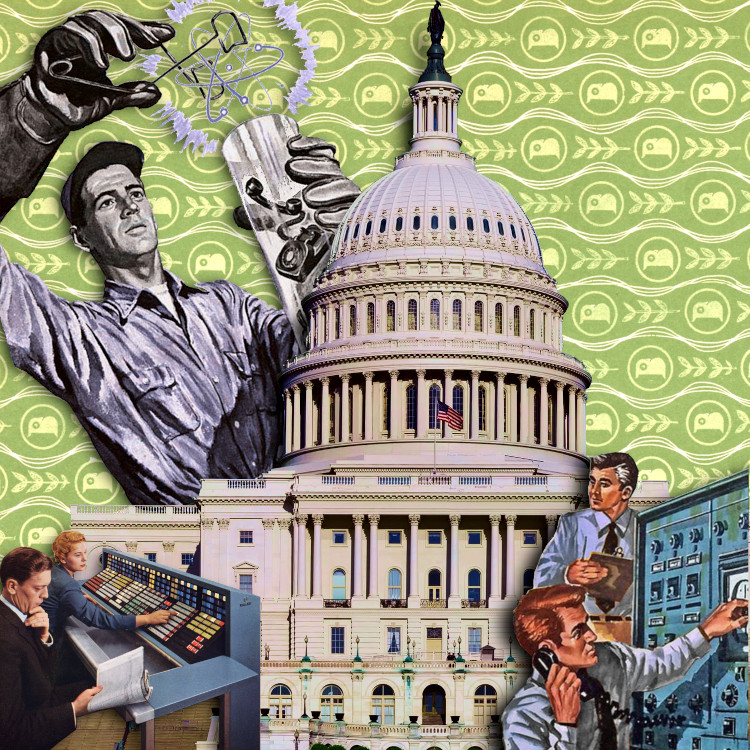
The US Capitol building. In the bottom left corner are a man and a woman sitting at a computer control panel, adjusting switches and reading a manual. In the bottom right corner are two men at another control panel. One man is looking over his shoulder at the capitol, the other is talking on a phone. Behind the Capitol looms a man in overalls, holding a giant test-tube in one hand and a set of tongs with a stylized atom. Inside the tube is a telephone.

In defense of bureaucratic competence (permalink)

Sure, sometimes it really does make sense to do your own research. There's times when you really do need to take personal responsibility for the way things are going. But there's limits. We live in a highly technical world, in which hundreds of esoteric, potentially lethal factors impinge on our lives every day.

You can't "do your own research" to figure out whether all that stuff is safe and sound. Sure, you might be able to figure out whether a contractor's assurances about a new steel joist for your ceiling are credible, but after you do that, are you also going to independently audit the software in your car's antilock brakes?

How about the nutritional claims on your food and the sanitary conditions in the industrial kitchen it came out of? If those turn out to be inadequate, are you going to be able to validate the medical advice you get in the ER when you show up at 3AM with cholera? While you're trying to figure out the HIPAA waiver they stuck in your hand on the way in?

40 years ago, Ronald Reagan declared war on "the administrative state," and "government bureaucrats" have been the favored bogeyman of the American right ever since. Even if Steve Bannon hasn't managed to get you to froth about the "Deep State," there's a good chance that you've griped about red tape from time to time.

Not without reason, mind you. The fact that the government can make good rules doesn't mean it will. When we redid our kitchen this year, the city inspector added a bunch of arbitrary electrical outlets to the contractor's plans in places where neither we, nor any future owner, will ever need them.

But the answer to bad regulation isn't no regulation. During the same kitchen reno, our contractor discovered that at some earlier time, someone had installed our kitchen windows without the accompanying vapor-barriers. In the decades since, the entire structure of our kitchen walls had rotted out. Not only was the entire front of our house one good earthquake away from collapsing – there were two half rotted verticals supporting the whole thing – but replacing the rotted walls added more than $10k to the project.

In other words, the problem isn't too much regulation, it's the wrong regulation. I want our city inspectors to make sure that contractors install vapor barriers, but to not demand superfluous electrical outlets.

Which raises the question: where do regulations come from? How do we get them right?

Regulation is, first and foremost, a truth-seeking exercise. There will never be one obvious answer to any sufficiently technical question. "Should this window have a vapor barrier?" is actually a complex question, needing to account for different window designs, different kinds of barriers, etc.

To make a regulation, regulators ask experts to weigh in. At the federal level, expert agencies like the DoT or the FCC or HHS will hold a "Notice of Inquiry," which is a way to say, "Hey, should we do something about this? If so, what should we do?"

Anyone can weigh in on these: independent technical experts, academics, large companies, lobbyists, industry associations, members of the public, hobbyist groups, and swivel-eyed loons. This produces a record from which the regulator crafts a draft regulation, which is published in something called a "Notice of Proposed Rulemaking."

The NPRM process looks a lot like the NOI process: the regulator publishes the rule, the public weighs in for a couple of rounds of comments, and the regulator then makes the rule (this is the federal process; state regulation and local ordinances vary, but they follow a similar template of collecting info, making a proposal, collecting feedback and finalizing the proposal).

These truth-seeking exercises need good input. Even very competent regulators won't know everything, and even the strongest theoretical foundation needs some evidence from the field. It's one thing to say, "Here's how your antilock braking software should work," but you also need to hear from mechanics who service cars, manufacturers, infosec specialists and drivers.

These people will disagree with each other, for good reasons and for bad ones. Some will be sincere but wrong. Some will want to make sure that their products or services are required – or that their competitors' products and services are prohibited.

It's the regulator's job to sort through these claims. But they don't have to go it alone: in an ideal world, the wrong people will be corrected by other parties in the docket, who will back up their claims with evidence.

So when the FCC proposes a Net Neutrality rule, the monopoly telcos and cable operators will pile in and insist that this is technically impossible, that there is no way to operate a functional ISP if the network management can't discriminate against traffic that is less profitable to the carrier. Now, this unity of perspective might reflect a bedrock truth ("Net Neutrality can't work") or a monopolists' convenient lie ("Net Neutrality is less profitable for us").

In a competitive market, there'd be lots of counterclaims with evidence from rivals: "Of course Net Neutrality is feasible, and here are our server logs to prove it!" But in a monopolized markets, those counterclaims come from micro-scale ISPs, or academics, or activists, or subscribers. These counterclaims are easy to dismiss ("what do you know about supporting 100 million users?"). That's doubly true when the regulator is motivated to give the monopolists what they want – either because they are hoping for a job in the industry after they quit government service, or because they came out of industry and plan to go back to it.

To make things worse, when an industry is heavily concentrated, it's easy for members of the ruling cartel – and their backers in government – to claim that the only people who truly understand the industry are its top insiders. Seen in that light, putting an industry veteran in charge of the industry's regulator isn't corrupt – it's sensible.

All of this leads to regulatory capture – when a regulator starts defending an industry from the public interest, instead of defending the public from the industry. The term "regulatory capture" has a checkered history. It comes out of a bizarre, far-right Chicago School ideology called "Public Choice Theory," whose goal is to eliminate regulation, not fix it.

In Public Choice Theory, the biggest companies in an industry have the strongest interest in capturing the regulator, and they will work harder – and have more resources – than anyone else, be they members of the public, workers, or smaller rivals. This inevitably leads to capture, where the state becomes an arm of the dominant companies, wielded by them to prevent competition:

https://pluralistic.net/2022/06/05/regulatory-capture/

This is regulatory nihilism. It supposes that the only reason you weren't killed by your dinner, or your antilock brakes, or your collapsing roof, is that you just got lucky – and not because we have actual, good, sound regulations that use evidence to protect us from the endless lethal risks we face. These nihilists suppose that making good regulation is either a myth – like ancient Egyptian sorcery – or a lost art – like the secret to embalming Pharaohs.

But it's clearly possible to make good regulations – especially if you don't allow companies to form monopolies or cartels. What's more, failing to make public regulations isn't the same as getting rid of regulation. In the absence of public regulation, we get private regulation, run by companies themselves.

Think of Amazon. For decades, the DoJ and FTC sat idly by while Amazon assembled and fortified its monopoly. Today, Amazon is the de facto e-commerce regulator. The company charges its independent sellers 45-51% in junk fees to sell on the platform, including $31b/year in "advertising" to determine who gets top billing in your searches. Vendors raise their Amazon prices in order to stay profitable in the face of these massive fees, and if they don't raise their prices at every other store and site, Amazon downranks them to oblivion, putting them out of business.

This is the crux of the FTC's case against Amazon: that they are picking winners and setting prices across the entire economy, including at every other retailer:

https://pluralistic.net/2023/04/25/greedflation/#commissar-bezos

The same is true for Google/Facebook, who decide which news and views you encounter; for Apple/Google, who decide which apps you can use, and so on. The choice is never "government regulation" or "no regulation" – it's always "government regulation" or "corporate regulation." You either live by rules made in public by democratically accountable bureaucrats, or rules made in private by shareholder-accountable executives.

You just can't solve this by "voting with your wallet." Think about the problem of robocalls. Nobody likes these spam calls, and worse, they're a vector for all kinds of fraud. Robocalls are mostly a problem with federation. The phone system is a network-of-networks, and your carrier is interconnected with carriers all over the world, sometimes through intermediaries that make it hard to know which network a call originates on.

Some of these carriers are spam-friendly. They make money by selling access to spammers and scammers. Others don't like spam, but they have lax or inadequate security measures to prevent robocalls. Others will simply be targets of opportunity: so large and well-resourced that they are irresistible to bad actors, who continuously probe their defenses and exploit overlooked flaws, which are quickly patched.

To stem the robocall tide, your phone company will have to block calls from bad actors, put sloppy or lazy carriers on notice to shape up or face blocks, and also tell the difference between good companies and bad ones.

There's no way you can figure this out on your own. How can you know whether your carrier is doing a good job at this? And even if your carrier wants to do this, only the largest, most powerful companies can manage it. Rogue carriers won't give a damn if some tiny micro-phone-company threatens them with a block if they don't shape up.

This is something that a large, powerful government agency is best suited to addressing. And thankfully, we have such an agency. Two years ago, the FCC demanded that phone companies submit plans for "robocall mitigation." Now, it's taking action:

https://arstechnica.com/tech-policy/2023/10/telcos-filed-blank-robocall-plans-with-fcc-and-got-away-with-it-for-2-years/

Specifically, the FCC has identified carriers – in the US and abroad – with deficient plans. Some of these plans are very deficient. National Cloud Communications of Texas sent the FCC a Windows Printer Test Page. Evernex (Pakistan) sent the FCC its "taxpayer profile inquiry" from a Pakistani state website. Viettel (Vietnam) sent in a slide presentation entitled "Making Smart Cities Vision a Reality." Canada's Humbolt VoIP sent an "indiscernible object." DomainerSuite submitted a blank sheet of paper scrawled with the word "NOTHING."

The FCC has now notified these carriers – and others with less egregious but still deficient submissions – that they have 14 days to fix this or they'll be cut off from the US telephone network.

This is a problem you don't fix with your wallet, but with your ballot. Effective, public-interest-motivated FCC regulators are a political choice. Trump appointed the cartoonishly evil Ajit Pai to run the FCC, and he oversaw a program of neglect and malice. Pai – a former Verizon lawyer – dismantled Net Neutrality after receiving millions of obviously fraudulent comments from stolen identities, lying about it, and then obstructing the NY Attorney General's investigation into the matter:

https://pluralistic.net/2021/08/31/and-drown-it/#starve-the-beast

The Biden administration has a much better FCC – though not as good as it could be, thanks to Biden hanging Gigi Sohn out to dry in the face of a homophobic smear campaign that ultimately led one of the best qualified nominees for FCC commissioner to walk away from the process:

https://pluralistic.net/2022/12/15/useful-idiotsuseful-idiots/#unrequited-love

Notwithstanding the tragic loss of Sohn's leadership in this vital agency, Biden's FCC – and its action on robocalls – illustrates the value of elections won with ballots, not wallets.

Self-regulation without state regulation inevitably devolves into farce. We're a quarter of a century into the commercial internet and the US still doesn't have a modern federal privacy law. The closest we've come is a disclosure rule, where companies can make up any policy they want, provided they describe it to you.

It doesn't take a genius to figure out how to cheat on this regulation. It's so simple, even a Meta lawyer can figure it out – which is why the Meta Quest VR headset has a privacy policy isn't merely awful, but long.

It will take you five hours to read the whole document and discover how badly you're being screwed. Go ahead, "do your own research":

https://foundation.mozilla.org/en/privacynotincluded/articles/annual-creep-o-meter/

The answer to bad regulation is good regulation, and the answer to incompetent regulators is competent ones. As Michael Lewis's Fifth Risk (published after Trump filled the administrative agencies with bootlickers, sociopaths and crooks) documented, these jobs demand competence:

https://memex.craphound.com/2018/11/27/the-fifth-risk-michael-lewis-explains-how-the-deep-state-is-just-nerds-versus-grifters/

For example, Lewis describes how a Washington State nuclear waste facility created as part of the Manhattan Project endangers the Columbia River, the source of 8 million Americans' drinking water. The nuclear waste cleanup is projected to take 100 years and cost 100 billion dollars. With stakes that high, we need competent bureaucrats overseeing the job.

The hacky conservative jokes comparing every government agency to the DMV are not descriptive so much as prescriptive. By slashing funding, imposing miserable working conditions, and demonizing the people who show up for work anyway, neoliberals have chased away many good people, and hamstrung those who stayed.

One of the most inspiring parts of the Biden administration is the large number of extremely competent, extremely principled agency personnel he appointed, and the speed and competence they've brought to their roles, to the great benefit of the American public:

https://pluralistic.net/2022/10/18/administrative-competence/#i-know-stuff

But leaders can only do so much – they also need staff. 40 years of attacks on US state capacity has left the administrative state in tatters, stretched paper-thin. In an excellent article, Noah Smith describes how a starveling American bureaucracy costs the American public a fortune:

https://www.noahpinion.blog/p/america-needs-a-bigger-better-bureaucracy

Even stripped of people and expertise, the US government still needs to get stuff done, so it outsources to nonprofits and consultancies. These are the source of much of the expense and delay in public projects. Take NYC's Second Avenue subway, a notoriously overbudget and late subway extension – "the most expensive mile of subway ever built." Consultants amounted to 20% of its costs, double what France or Italy would have spent. The MTA used to employ 1,600 project managers. Now it has 124 of them, overseeing $20b worth of projects. They hand that money to consultants, and even if they have the expertise to oversee the consultants' spending, they are stretched too thin to do a good job of it:

https://slate.com/business/2023/02/subway-costs-us-europe-public-transit-funds.html

When a public agency lacks competence, it ends up costing the public more. States with highly expert Departments of Transport order better projects, which need fewer changes, which adds up to massive costs savings and superior roads:

https://papers.ssrn.com/sol3/papers.cfm?abstract_id=4522676

Other gaps in US regulation are plugged by nonprofits and citizen groups. Environmental rules like NEPA rely on the public to identify and object to environmental risks in public projects, from solar plants to new apartment complexes. NEPA and its state equivalents empower private actors to sue developers to block projects, even if they satisfy all environmental regulations, leading to years of expensive delay.

The answer to this isn't to dismantle environmental regulations – it's to create a robust expert bureaucracy that can enforce them instead of relying on NIMBYs. This is called "ministerial approval" – when skilled government workers oversee environmental compliance. Predictably, NIMBYs hate ministerial approval.

Which is not to say that there aren't problems with trusting public enforcers to ensure that big companies are following the law. Regulatory capture is real, and the more concentrated an industry is, the greater the risk of capture. We are living in a moment of shocking market concentration, thanks to 40 years of under-regulation:

https://www.openmarketsinstitute.org/learn/monopoly-by-the-numbers

Remember that five-hour privacy policy for a Meta VR headset? One answer to these eye-glazing garbage novellas presented as "privacy policies" is to simply ban certain privacy-invading activities. That way, you can skip the policy, knowing that clicking "I agree" won't expose you to undue risk.

This is the approach that Bennett Cyphers and I argue for in our EFF white-paper, "Privacy Without Monopoly":

https://www.eff.org/wp/interoperability-and-privacy

After all, even the companies that claim to be good for privacy aren't actually very good for privacy. Apple blocked Facebook from spying on iPhone owners, then sneakily turned on their own mass surveillance system, and lied about it:

https://pluralistic.net/2022/11/14/luxury-surveillance/#liar-liar

But as the European experiment with the GDPR has shown, public administrators can't be trusted to have the final word on privacy, because of regulatory capture. Big Tech companies like Google, Apple and Facebook pretend to be headquartered in corporate crime havens like Ireland and Luxembourg, where the regulators decline to enforce the law:

https://pluralistic.net/2023/05/15/finnegans-snooze/#dirty-old-town

It's only because of the GPDR has a private right of action – the right of individuals to sue to enforce their rights – that we're finally seeing the beginning of the end of commercial surveillance in Europe:

https://www.eff.org/deeplinks/2022/07/americans-deserve-more-current-american-data-privacy-protection-act

It's true that NIMBYs can abuse private rights of action, bringing bad faith cases to slow or halt good projects. But just as the answer to bad regulations is good ones, so too, the answer to bad private rights of action is good ones. SLAPP laws have shown us how to balance vexatious litigation with the public interest:

https://www.rcfp.org/resources/anti-slapp-laws/

We must get over our reflexive cynicism towards public administration. In my book The Internet Con, I lay out a set of public policy proposals for dismantling Big Tech and putting users back in charge of their digital lives:

https://www.versobooks.com/products/3035-the-internet-con

The most common objection I've heard since publishing the book is, "Sure, Big Tech has enshittified everything great about the internet, but how can we trust the government to fix it?"

We've been conditioned to think that lawmakers are too old, too calcified and too corrupt, to grasp the technical nuances required to regulate the internet. But just because Congress isn't made up of computer scientists, it doesn't mean that they can't pass good laws relating to computers. Congress isn't full of microbiologists, but we still manage to have safe drinking water (most of the time).

You can't just "do the research" or "vote with your wallet" to fix the internet. Bad laws – like the DMCA, which bans most kinds of reverse engineering – can land you in prison just for reconfiguring your own devices to serve you, rather than the shareholders of the companies that made them. You can't fix that yourself – you need a responsive, good, expert, capable government to fix it.

We can have that kind of government. It'll take some doing, because these questions are intrinsically hard to get right even without monopolies trying to capture their regulators. Even a president as flawed as Biden can be pushed into nominating good administrative personnel and taking decisive, progressive action:

https://doctorow.medium.com/joe-biden-is-headed-to-a-uaw-picket-line-in-detroit-f80bd0b372ab?sk=f3abdfd3f26d2f615ad9d2f1839bcc07

Biden may not be doing enough to suit your taste. I'm certainly furious with aspects of his presidency. The point isn't to lionize Biden – it's to point out that even very flawed leaders can be pushed into producing benefit for the American people. Think of how much more we can get if we don't give up on politics but instead demand even better leaders.

My next novel is The Lost Cause, coming out on November 14. It's about a generation of people who've grown up under good government – a historically unprecedented presidency that has passed the laws and made the policies we'll need to save our species and planet from the climate emergency:

https://us.macmillan.com/books/9781250865939/the-lost-cause

The action opens after the pendulum has swung back, with a new far-right presidency and an insurgency led by white nationalist militias and their offshore backers – seagoing anarcho-capitalist billionaires.

In the book, these forces figure out how to turn good regulations against the people they were meant to help. They file hundreds of simultaneous environmental challenges to refugee housing projects across the country, blocking the infill building that is providing homes for the people whose homes have been burned up in wildfires, washed away in floods, or rendered uninhabitable by drought.

I don't want to spoil the book here, but it shows how the protagonists pursue a multipronged defense, mixing direct action, civil disobedience, mass protest, court challenges and political pressure to fight back. What they don't do is give up on state capacity. When the state is corrupted by wreckers, they claw back control, rather than giving up on the idea of a competent and benevolent public system.


Hey look at this (permalink)


A Wayback Machine banner.

This day in history (permalink)

#20yrsago Aussie senators shout at Bush during Parliamentary visit https://web.archive.org/web/20031202151028/https://abcnews.go.com/wire/World/ap20031023_523.html

#20yrsago Woodworking tools coming with bullshit EULAs now https://memex.craphound.com/2003/10/23/woodworking-tools-coming-with-bullshit-eulas-now/

#20yrsago Life Hacks: Tech Secrets of Overprolific Alpha Geeks https://www.oblomovka.com/wp/2003/10/22/

#15yrsago New US RFID passports manufactured offshore at a huge profit, transported by unsecured couriers https://www.washingtontimes.com/news/2008/mar/26/outsourced-passports-netting-govt-profit-56284974/

#15yrsago HOWTO read the secret forensic dots in your laser-printer output https://www.instructables.com/Yellow-Dots-of-Mystery-Is-Your-Printer-Spying-on-/

#10yrsago Fox News’s astroturfers who defend the network online with armies of fake identities https://www.mediamatters.org/fake-news/fox-news-reportedly-used-fake-commenter-accounts-rebut-critical-blog-posts

#10yrsago DEA instructions for testing bills for cocaine https://www.muckrock.com/news/archives/2013/oct/21/there-bump-your-bill-heres-how-dea-tested-money-co/

#10yrsago Huawei: unlike western companies, we’ve never been told to weaken our security https://www.theguardian.com/technology/2013/oct/21/huawei-denies-spy-customers-chinese

#10yrsago UK rightsholders use secret censorship orders to block legit sites https://web.archive.org/web/20130816160817/http://www.pcpro.co.uk/news/broadband/383614/rights-holders-taking-down-legitimate-sites-in-piracy-crackdown

#10yrsago McDonald’s advises hungry, sick employees to get welfare benefits https://consumerist.com/2013/10/23/mcdonalds-mcresources-help-line-tells-worker-how-to-get-welfare-benefits/

#10yrsago Rookie Yearbook Two: Gevinson and pals’ wonderful anthology of humane, vigorous, unapologetic feminism https://memex.craphound.com/2013/10/23/rookie-yearbook-two-gevinson-and-pals-wonderful-anthology-of-humane-vigorous-unapologetic-feminism/

#10yrsago Even Amazon can’t keep up the “you only license ebooks” shuck https://memex.craphound.com/2013/10/23/even-amazon-cant-keep-up-the-you-only-license-ebooks-shuck/

#5yrsago Amazon is actively pitching face-recognition to ICE https://www.thedailybeast.com/amazon-pushes-ice-to-buy-its-face-recognition-surveillance-tech

#5yrsago Every minute for three months, GM secretly gathered data on 90,000 drivers’ radio-listening habits and locations https://www.freep.com/story/money/cars/general-motors/2018/10/01/gm-radio-listening-habits-advertising/1424294002/

#5yrsago Apps are using “silent notifications” to track you after you uninstall them https://www.bloomberg.com/news/articles/2018-10-22/now-apps-can-track-you-even-after-you-uninstall-them

#5yrsago America has an epidemic of workplace miscarriages, caused by pregnancy discrimination https://www.nytimes.com/interactive/2018/10/21/business/pregnancy-discrimination-miscarriages.html

#5yrsago A database of instructions for making different paper airplanes https://www.foldnfly.com/#/1-1-1-1-1-1-1-1-2

#5yrsago The American right loves forms, paperwork and other bureaucracy https://www.currentaffairs.org/2018/10/the-cult-of-the-form

#5yrsago EFF just sent this letter to every official negotiating the EU’s Copyright Directive https://memex.craphound.com/2018/10/23/eff-just-sent-this-letter-to-every-official-negotiating-the-eus-copyright-directive/

#5yrsago San Francisco spends $3.1m/year on homeless toilets and $65m/year cleaning up poop https://missionlocal.org/2018/10/san-francisco-needs-a-marshall-plan-for-toilets/

#5yrsago Youtube CEO: EU Copyright Directive means that only large corporations will be able to upload videos https://blog.youtube/inside-youtube/a-final-update-on-our-priorities-for/

#5yrsago Britain’s “nasty party” condemns its MPs’ nastiness https://www.bbc.com/news/uk-politics-45938754

#1yrago The Persuaders (how minds really change) https://pluralistic.net/2022/10/23/narrative-warfare/#giridharadas


Colophon (permalink)

Today's top sources: Slashdot (https://slashdot.org), Naked Capitalism (https://www.nakedcapitalism.com/).

Currently writing:

  • A Little Brother short story about DIY insulin PLANNING
  • Picks and Shovels, a Martin Hench noir thriller about the heroic era of the PC. FORTHCOMING TOR BOOKS JAN 2025

  • The Bezzle, a Martin Hench noir thriller novel about the prison-tech industry. FORTHCOMING TOR BOOKS FEB 2024

  • Vigilant, Little Brother short story about remote invigilation. FORTHCOMING ON TOR.COM

  • Moral Hazard, a short story for MIT Tech Review's 12 Tomorrows. FIRST DRAFT COMPLETE, ACCEPTED FOR PUBLICATION

  • Spill, a Little Brother short story about pipeline protests. FORTHCOMING ON TOR.COM

Latest podcast: The Lost Cause (excerpt) https://craphound.com/news/2023/10/12/the-lost-cause-excerpt/
Upcoming appearances:

Recent appearances:

Latest books:

Upcoming books:

  • The Lost Cause: a post-Green New Deal eco-topian novel about truth and reconciliation with white nationalist militias, Tor Books, November 2023
  • The Bezzle: a sequel to "Red Team Blues," about prison-tech and other grifts, Tor Books, February 2024

  • Picks and Shovels: a sequel to "Red Team Blues," about the heroic era of the PC, Tor Books, February 2025

  • Unauthorized Bread: a graphic novel adapted from my novella about refugees, toasters and DRM, FirstSecond, 2025


This work – excluding any serialized fiction – is licensed under a Creative Commons Attribution 4.0 license. That means you can use it any way you like, including commercially, provided that you attribute it to me, Cory Doctorow, and include a link to pluralistic.net.

https://creativecommons.org/licenses/by/4.0/

Quotations and images are not included in this license; they are included either under a limitation or exception to copyright, or on the basis of a separate license. Please exercise caution.


How to get Pluralistic:

Blog (no ads, tracking, or data-collection):

Pluralistic.net

Newsletter (no ads, tracking, or data-collection):

https://pluralistic.net/plura-list

Mastodon (no ads, tracking, or data-collection):

https://mamot.fr/@pluralistic

Medium (no ads, paywalled):

https://doctorow.medium.com/

(Final Medium column: "The internet’s original sin" https://doctorow.medium.com/the-internets-original-sin-c16a8d0256a8?sk=e4c58c0a5739f0bc79860390ae874232)

Twitter (mass-scale, unrestricted, third-party surveillance and advertising):

https://twitter.com/doctorow

Tumblr (mass-scale, unrestricted, third-party surveillance and advertising):

https://mostlysignssomeportents.tumblr.com/tagged/pluralistic

"When life gives you SARS, you make sarsaparilla" -Joey "Accordion Guy" DeVilla

23 Oct 19:55

A surprise result in Argentina's presidential election sets up a showdown

A man in a dark suit holds a microphone while he speaks during a political rally.

Economy Minister Sergio Massa produced a big surprise by finishing first in the opening round of Argentina's presidential election, reflecting voters' wariness about handing the presidency to his chief rival, a right-wing populist.

23 Oct 17:31

‘Go Away TEA,’ Say Houston ISD Parents and Teachers

by Josephine Lee

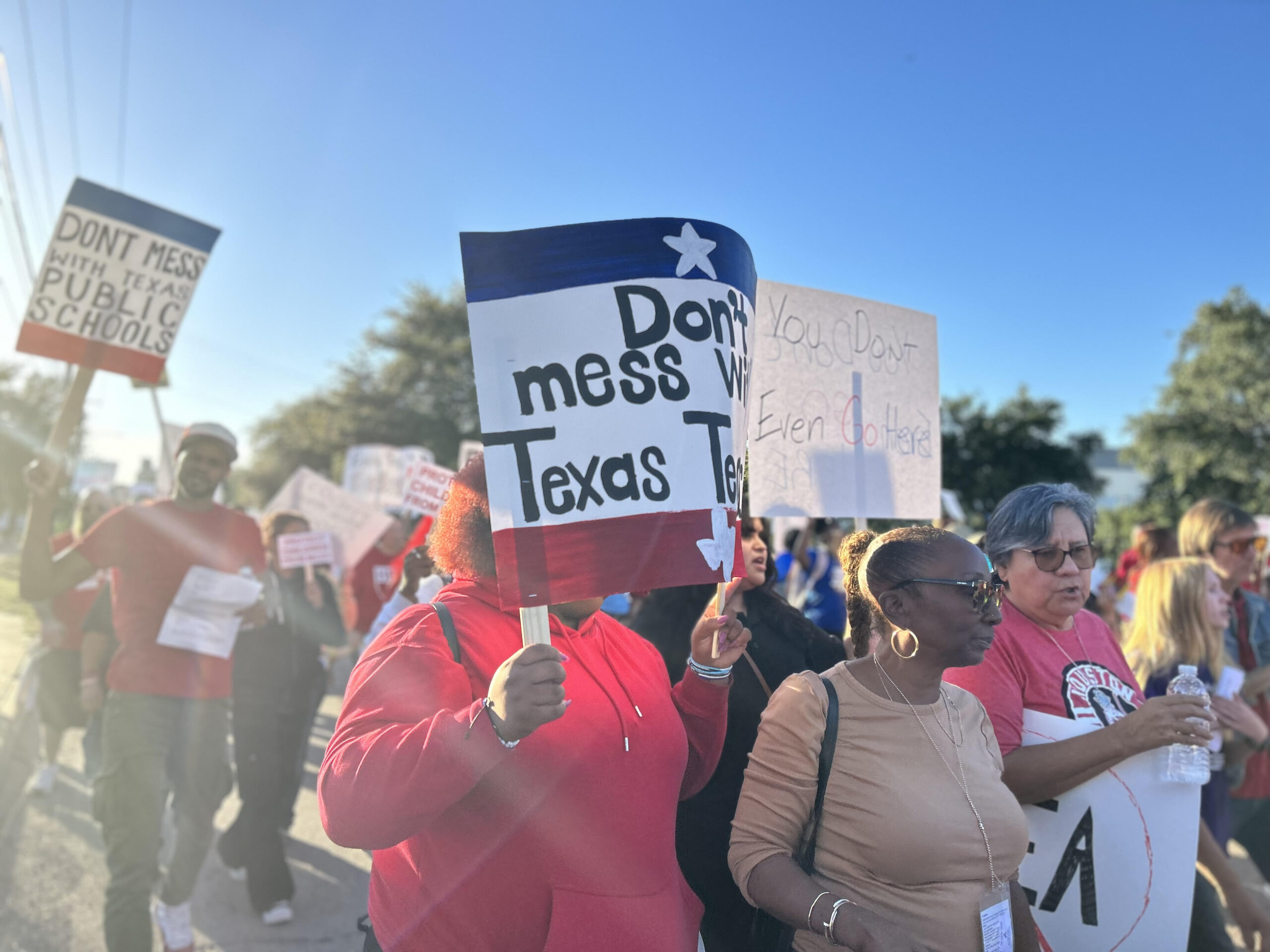
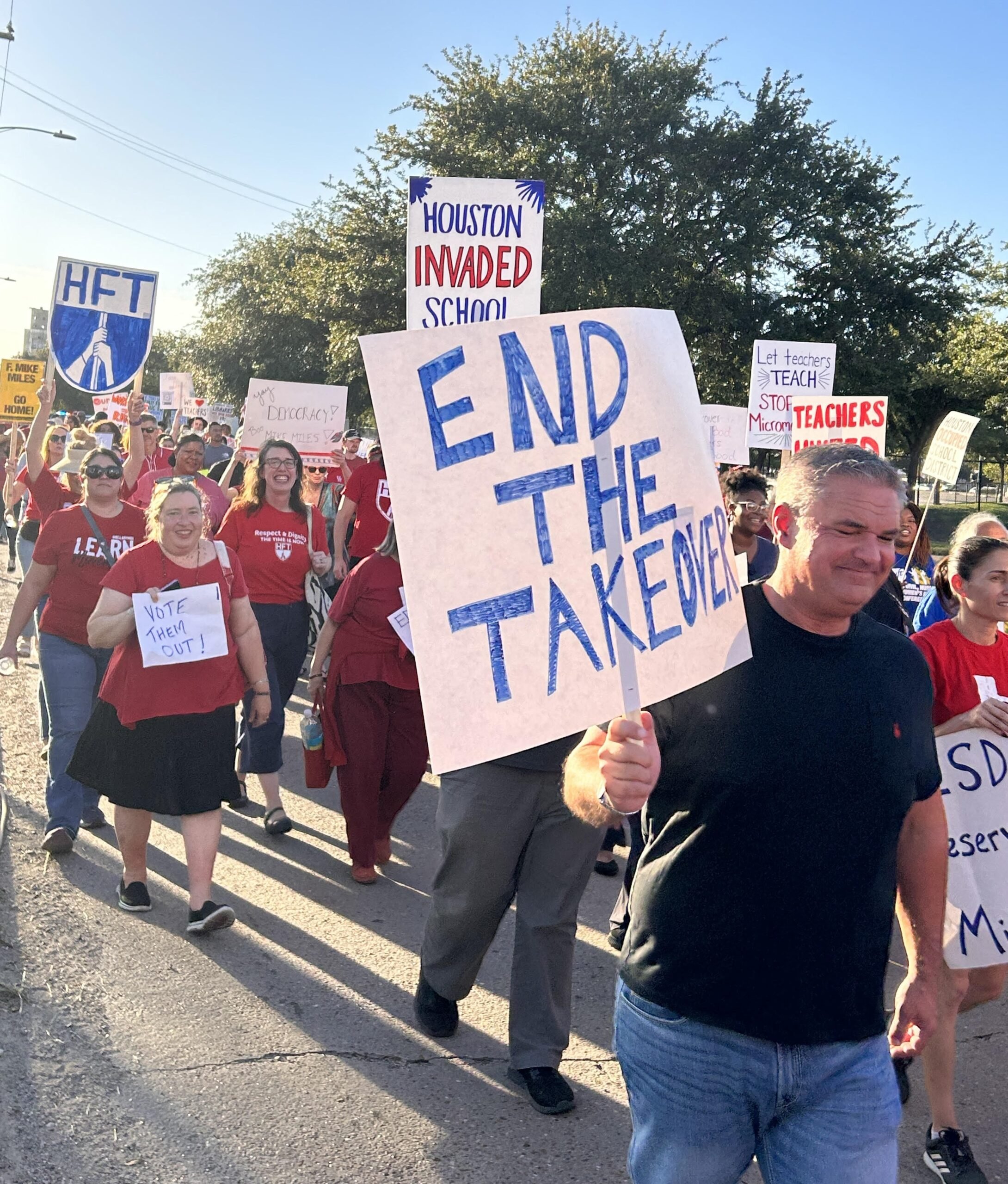
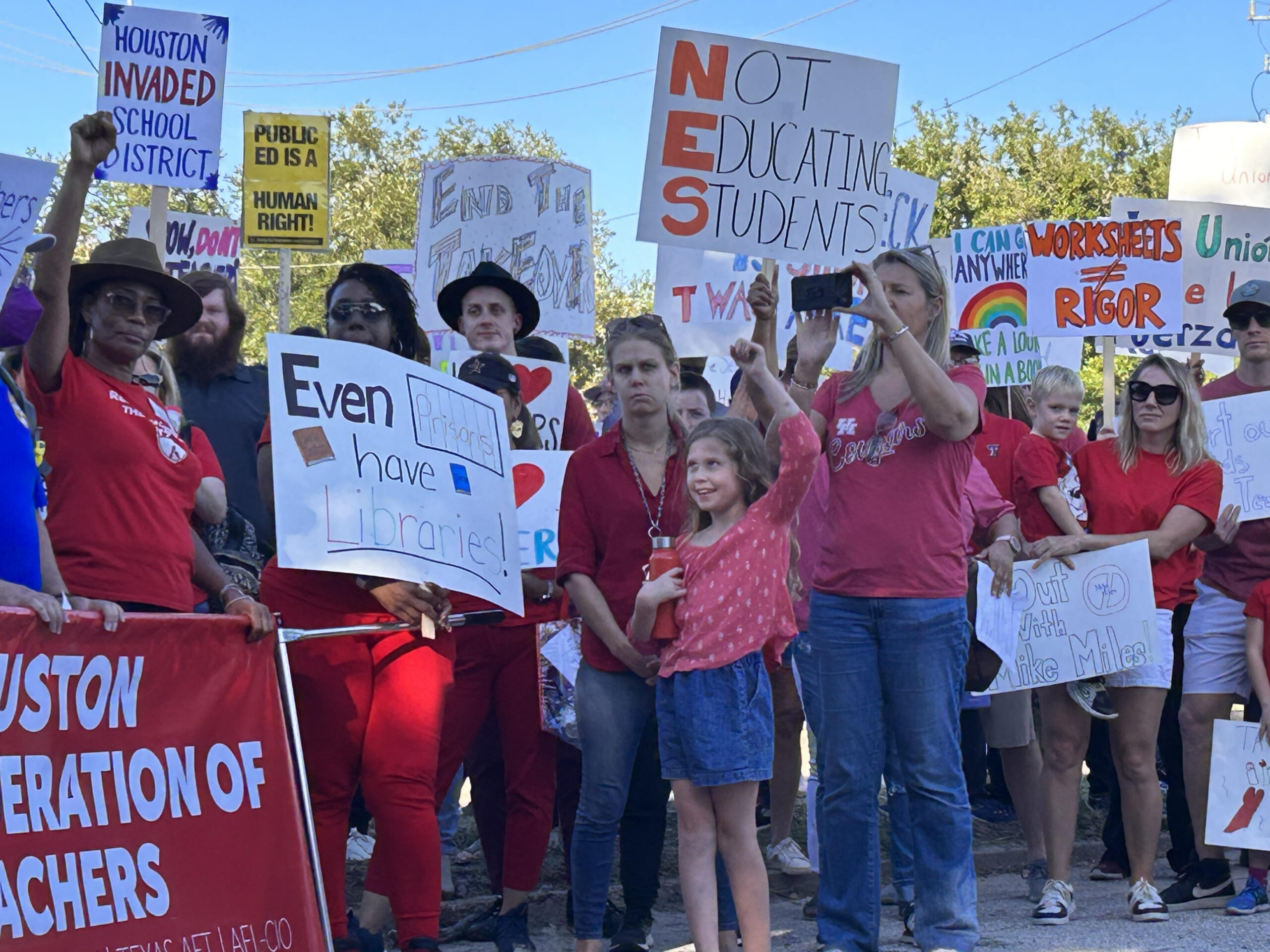
Extending a mile, a procession of protestors in red marched in front of the Houston Independent School District (HISD) administrative building last Friday to demand an end to the state takeover of Houston schools. Hoisting signs that read “HISD: Houston Invaded School District,” “Mike Miles—Killing Education One Apple at a Time,” and “Even Prisons Have Libraries,” 600 parents, teachers, and students gathered at the protest organized by the Houston Federation of Teachers to challenge the administration and policies of state-appointed district Superintendent Mike Miles. 

After the Texas Education Agency seized control of the district, Miles started the school year promising more pay and support for teachers and a more rigorous, standardized curriculum for students, particularly at the 85 campuses that are part of the New Education System (NES) program, curricular reforms Miles transplanted from his Third Futures charter school network 

But teachers and parents describe experiencing chaos since the start of the school year. Teachers have complained that the district’s curriculum does not follow the state standards and is riddled with errors and inappropriate content. Critics also note that special education services have been cut or legally required services have not been implemented under Miles’ rigid standardized curriculum. And when teachers and administrators ask questions, they face retaliation. The district has removed at least nine principals and more teachers from their campuses, reassigning them to other campuses, putting them on administrative leave, or recommending them for termination. Many more teachers and other employees have left the district in frustration. Students at HISD’s Debakey High School for Health Professions were left teaching themselves AP Physics for seven weeks in the absence of a teacher. 

“We do not want our children subjected to substandard learning. We are professional educators. We demand to be respected,” Houston Federation of Teachers President Jackie Anderson said at the protest. “Miles has made a lot of promises and those promises have been broken. He has created a broken education system. We want him out of here. Now.” 

A diverse crowd marches against the takeover of Houston ISD. In front are two Black women, one holding a Don't Mess With Texas Teachers sign.
Josephine Lee/Texas Observer

It was only three weeks into Teresa Carr’s second year at Project Chrysalis Middle School when she was put on administrative leave and received a recommendation for termination in mid-September. 

The district’s division superintendent, Luz Martinez, had been berating the teachers during a meeting at the school for letting their students use the restroom at the beginning of class. Carr asked when students were expected to use the restroom since they only had three minutes to get from one class to the next. When Carr pointed out that there had already been many schedule changes within the few weeks since school started, Martinez called Carr “unprofessional” and screamed at her to leave the room. 

“There is no keeping our head down because we do all this for our students.”

“She was yelling at me over and over to leave. And then the next day I got an email with a letter in it telling me that I was being recommended for termination for insubordination and unprofessionalism,” Carr said. After a co-worker questioned Carr’s removal, she, too, was put on administrative leave and recommended for termination. 

Since then, parents have been picketing in front of the school once a week to demand the teachers be reinstated. Martinez told Houston Public Media that the teachers were not implementing the NES program with fidelity. “No matter what you do, you’re always gonna have people who go with it and people who don’t,” she said, calling them “disbelievers” and “naysayers.” 

But when asked if teachers should just comply, Carr said, “There is no keeping our head down because we do all this for our students. They can’t stand up and fight like we can. It’s terrifying. But we have to be that voice and that strength for them.”

A dense crowd, most wearing red t-shirts, march with signs protesting the state take over of Houston ISD.
Josephine Lee

Veteran teacher Raye, who asked the Texas Observer to use a nickname for fear of further retaliation by district administrators, was removed and reassigned to another campus after she asked for corrections of the district’s curricular materials. 

Instructional slides were filled with grammatical errors. An answer key to a quiz on writing stated that an essay began with the body paragraph, followed by the conclusion, and ended with the introduction. But Raye had to get an administrator’s permission to change or delete slides. 

“When I tried to change the slides, they said that I was ruining the integrity of the NES program,” said Raye. 

Miles had promised NES teachers a teacher apprentice to help make copies, to grade student work, and to conduct small group instruction so that classroom teachers could solely focus on instruction. Raye said that had never happened. 

When she returned to her classroom to retrieve her things, students started calling out to their teacher to return. Thereafter, Raye was admonished by administrators again, this time for “disrupting the flow of instruction” for the uncertified teacher apprentice left to take over her class. 

“We’re teachers for the children. And when you stifle us, and we have no autonomy, we can’t really do our jobs. I feel like I have handcuffs on just trying to do my job,” Raye said. 

Men in red t-shirts march at the head of a crowd with their fists upraised. They are holding a Houston teachers union banner.
Josephine Lee/Texas Observer

Teachers said that under the NES program, everything is timed. They have 45 minutes to read from the scripted slides. Then students have 10 minutes to take a quiz on the material they just learned. Often, the lessons cover skills that do not follow the state curriculum standards known as the Texas Essential Knowledge and Skills and are above students’ grade levels. Teachers are not allowed to take time to review foundational skills to make sure students understand the lesson. If students pass the quiz, they are then given a packet of worksheets with more advanced material and shuffled off to a “learning center” where an uncertified “learning coach” is expected to guide dozens of students at different grade levels and subjects. 

Both teachers and parents say Miles’ NES program is setting students up to fail, especially emergent English language learners and students with disabilities. They say they are not getting extra support, services, or accommodations for these students as required under federal and state laws. 

“Our teachers are being held hostage by a curriculum that is failing our students,” said parent Jessica Campos at the protest. “This curriculum doesn’t allow my child with dyslexia to learn. It doesn’t allow her teacher to give her extra time,” Campos’ daughter used to get As and Bs at Pugh Elementary School, but this year, she has been failing tests, saying she is not given enough time to learn the material. 

Based on a survey conducted by the Houston Federation of Teacher and completed by 1,115 teachers, 84 percent responded that they opposed teaching from a scripted lesson plan and more indicated that experienced teachers need more autonomy to adapt a curriculum to the students’ needs. Most respondents, 86 percent, disagreed with Miles’ evaluation system, which ties their pay to student test scores. 

A diverse crowd poses during a protest press conference, many in red t-shirts or holding signs opposing the state takeover of Houston ISD by Mike Miles.
Josephine Lee/Texas Observer

Despite the efforts of the district to silence teachers, teachers at the protest called the action a “practice picket” and say it’s only the beginning of other actions to come. Teachers have been wearing “Red for Ed” every Wednesday at school to demonstrate their solidarity with other teachers. 

“Teachers are the real guardians of education. Our loyalty is to students and not the district. We have a moral obligation to students to do what is best for them, even if it means reassignment or termination. We will not wait to sound the alarm. The stakes are too high,” middle school teacher Traci Laston said. 

The post ‘Go Away TEA,’ Say Houston ISD Parents and Teachers appeared first on The Texas Observer.

23 Oct 17:26

Chevron buys Hess for $53 billion, marking second major buyout this month as oil prices surge

by Associated Press
The Chevron-Hess deal comes less than two weeks after Exxon Mobil said that it would acquire Pioneer Natural Resources for about $60 billion. Crude prices are up 9% this year.
23 Oct 17:26

Houston’s weather to remain warm for awhile, but some seriously fall-like weather is on the horizon

by Eric Berger

Good morning! I want to thank the hundreds of people who came out to celebrate Fall Day on Sunday afternoon—it was lovely to meet so many of you, and see some old friends. Shout out to the family who drove all the way down from College Station. I also want to thank Reliant for supporting such a great event. And finally, today is the eighth anniversary of Space City Weather. I can’t believe it’s been that long, because it only feels like Matt and I are getting started.

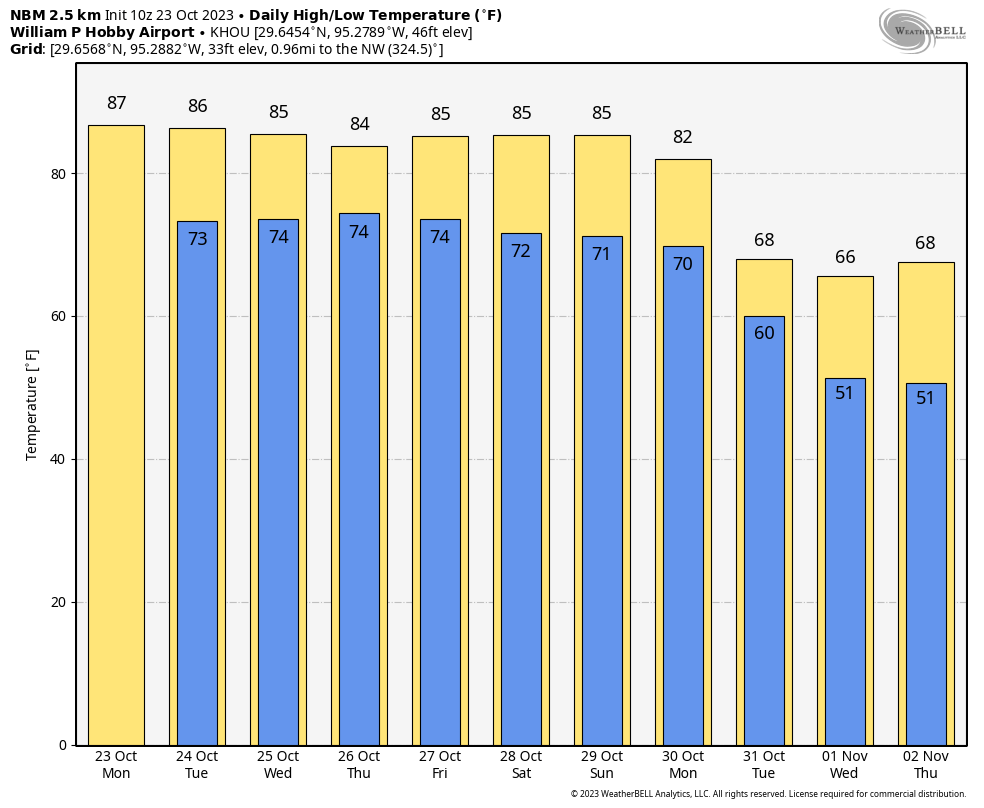
As for our weather, there won’t be much change for the next week or so. We’re going to be in a warm-ish pattern for fall, with highs mostly in the mid-80s and lows in the low- to mid-70s. We’ll also see some decent rain chances later this week. This pattern will hold through the weekend before a fairly strong front is likely to arrive by or before Halloween, which could drop daytime highs into the 60s. Still a long ways to go, but I wanted you to know there will be an end to this warmer and muggier weather, eventually.

We won’t see much change this week in weather conditions, but next week? Yes. (Weather Bell)

Monday

At Fall Day several people asked me what the weather would be like for next week, and I simply pointed to the sky. What we saw on Sunday is more or less likely what we should see today, and for the rest of the week. We’re going to see partly sunny skies, and highs in the mid- to upper-80s on Monday. Winds will be out of the south, as they will for much of this week, gusting to about 20 mph. A few areas near and along the Gulf Freeway saw rainfall this morning as some atmospheric moisture surged into the area, but I think that’s mostly it for rain chances until Wednesday. Lows tonight will drop into the low 70s in Houston, with cooler conditions for outlying areas.

Tuesday

This is the one day this week that I’m confident will see mostly sunny skies. So if your plans require sunshine, Tuesday’s the day. Look for highs in the upper 80s, with southerly winds. Overnight lows drop into the low 70s.

Wednesday, Thursday, and Friday

A slug of tropical moisture will move into the region during the second half of the work week. Since much of this moisture is coming from the Pacific, the best rain chances will be west of Interstate 35, in Central and West Texas. The Houston region should be on the periphery of the main action, with most of the area picking up perhaps 0.25 to 1 inch of rain through Friday. Look for partly to mostly cloudy skies otherwise, with highs in the mid-80s, and lows in the low- to mid-70s.

Rain chances will increase later this week, especially for West Texas. (Weather Bell)

Saturday and Sunday

For now there appears to be little chance of the front making it through by the weekend, so we can probably expect partly to mostly sunny skies, with highs in the mid-80s, and continued muggy air. Rain chances are not zero, but at this point they don’t look particularly high, either.

Next week

At this point I would pencil in the aforementioned front for next Monday, which hopefully will be the case as it may bring an additional round of showers. It would be nice to have this weather out of the way for next Tuesday, Halloween, but for now there’s just no way to be sure. In any case, after the front we probably will have a few days with highs in the 60s or 70s, and lows in the 40s or 50s. November, in other words, should feel like November.

23 Oct 17:25

I worked remotely from a friend’s house — and my boss says I have to count it as vacation days

by Ask a Manager

This post was written by Alison Green and published on Ask a Manager.

A reader writes:

I work as a development director for a nonprofit for a specific region. I have been in my job for four years and have been very successful in my role.

I have worked primarily from home because I write a lot of grants and reports, and my office doesn’t have private spaces or designated work spaces. I do go into our small office one half day each week for team meetings, but the rest of the time I have always worked from home or am out visiting clients, attending conferences, etc. The only other office worker on our local team (most of our staff does field work) does the same as me — goes in for half a day and the rest of the week is working from home.

We have a policy that if you are not working in the office, you must have a workspace with a door, etc. I always follow this guideline.

My CEO is very concerned when people work in different locations if they have connectivity issues. I was working remotely one day at a friend’s vacation home and the internet did not allow me to join a team zoom meeting. After not being able to join that meeting, I was told I had to take a vacation day for that entire day. I did because I just didn’t want to argue about this.

This week, I worked at another friend’s home in another city but this time the internet connectivity worked fine and I joined all the zoom meetings, etc. If I had not told people I was at a friend’s house in another state, they would not have known.

Well, today, the third day that I have been working from my friend’s home, I got an email from my manager that I was supposed to have had this request to work from a different location approved before I did so. And that they would tell HR to make all of my days this week be designated as vacation days on my timecard and I would lose three vacation days from my accrued vacation.

Is this acceptable? I simply want to quit, but I can’t because I need the money and would prefer to line up a new job before quitting. I feel like my employer does not trust or value me when I have been a high-performing employee for four years. My location had zero effect on my work.

Do I have the right to refuse to accept that decision and insist that I not be required to use vacation days for the three days I already worked this week?

Your employer does have the right to tell you that you can only work remotely from your home and that you can’t work from other locations. We can debate whether or not that’s reasonable, but they do have the right to make that their policy. (Some things that would make it reasonable: if there’s a higher incidence of connectivity issues when people are other places, and if your work has strict confidentiality requirements.)

But the way for them to handle that is for them to tell you that, proactively. If they’ve never said this was prohibited, then they’re wrong to say they won’t count those days as work days and will deduct them from your vacation balance. Your manager should have contacted you and said, “This is the policy. We’ll make an exception this time since it sounds like it wasn’t clear, but going forward you cannot work remotely from anywhere other than your home (or your local area, or whatever they want their policy to be) without prior permission.”

And you should approach it that way from your side now. Go back to your manager and say this: “I hadn’t been informed of any policy prohibiting us from working from other locations. I’ve only been told that remote work spaces must be private and have a door, and I’ve followed that vigilantly. If this won’t be allowed going forward, I will of course comply with that but I don’t think I should be held to a policy I wasn’t informed of, especially if it means losing valuable vacation days when I did X hours of work during the days in question.”

If they dig in their heels, you might point out that you’ve always gone above and beyond and been lauded for excellent work, and this is highly demotivating. If you’ve ever done even a small amount of work while you’re on vacation (checking emails or returning a call), this is a good time to mention that, and note that they’re removing any incentive to be flexible that way in the future.

If they still won’t budge, legally you probably don’t have any recourse. The legal requirement is that you get paid for the days you worked — but the requirement is only that they pay you, not that it can’t come from your PTO. (Caveat: if you happen to be in California, that would change things. In California, if you work during a vacation, your employer must count that as time worked and can’t dock your PTO for it. It’s possible a small number of other states might have similar laws; I haven’t found anything, but it’s worth you checking for your state.)

But that’s just about what’s legal, not about what’s reasonable. A reasonable employer won’t hold you to policy you’ve never been informed of, and it’s worth talking to HR if you don’t get anywhere with your boss.

23 Oct 17:22

update: my boss keeps commenting on my acne

by Ask a Manager

This post was written by Alison Green and published on Ask a Manager.

Remember the letter-writer whose boss kept commenting on their acne? Here’s the update.

It’s been almost an entire year since I wrote to you about my boss commenting on my acne! First, let me say thank you to the AAM community for being so kind and wonderful to me. I was incredibly emotional and embarrassed when I wrote in, and all of the commenters brought me to tears with their empathy and support. I had never before experienced so much kindness from internet strangers, but please know that you all made me feel so much better, and I am grateful. And I have a very happy update to report!

While Alison was quick to post my story and share her advice, I actually wound up having my one-on-one with my boss first. However, the advice I received was basically how I handled the situation. I told my boss, “Hey, yesterday you made a comment about my skin, and I need you not to do that anymore. It is a medical condition, and I am working with doctors to solve it, but I don’t need to discuss it, especially in front of others.” I had planned a lengthier monologue about how I don’t want to come to work only to have people comment on my appearance and how it affects me emotionally, but my boss cut me off and said, “I’m sorry, I won’t do that anymore. I just was concerned and wondered if I could help. I should probably apologize to (other coworker) too, since I probably made him uncomfortable.” For the record, I do not buy that she was concerned because it was a harsh comment, not delivered with any warmth or concern, and she wasn’t picking up social cues to drop it. And her larger concern for the other coworker who was present was a huge red flag. But in the long run, I don’t think I get to decide what lesson my boss learned out of this, as much as I wanted her to understand the damage she had done.

However, a lot of good things came from this. Firstly, my former boss never commented on my skin again. And I say former boss, because I started a new position about seven months ago! Between this incident and a few other work-related happenings, I decided that it was time to move on. When I started my job hunt, I found an absolutely perfect role for me with a wonderful company, who went on to hire me a short time later. I received about a 66% pay increase, have had a really positive transition period into the role, and am overall doing really well. My acne is still acne-ing, but it has improved, and nobody in my new job has said a word.

I did want to address a few comments — some of you are so funny, and your comeback suggestions are stored in my back pocket in the unfortunate event that I have to use them. I do feel more confident about making people feel uncomfortable about making me feel uncomfortable, so thank you! A few of you thought my former boss might be involved in an MLM and getting ready to sell me skin care. That one is totally plausible, but in truth, my former boss comes from affluence and only works because she likes it. And for those of you sharing my struggle, I appreciate your solidarity and wish you nothing but the best.

Thanks again, Alison and the AAM community!

23 Oct 17:15

Childless Millennial couple announces plans to get really into Halloween this year

by Jen MacIntyre

BARRIE, ON – Tyler and Sarah Kergin, a happily childless local couple, has always enjoyed Halloween. But yesterday they told reporters that they plan to “pull out like ALL the stops” this October. “Spooky season is my favourite time of year!” a beaming Sarah stated. “The leisurely morning walk to get a spiced latte, the […]

The post Childless Millennial couple announces plans to get really into Halloween this year appeared first on The Beaverton.

23 Oct 17:14

Saturday Morning Breakfast Cereal - Costume

by Zach Weinersmith


Click here to go see the bonus panel!

Hovertext:
Patreon users felt this one was too sad, but look at the cute kid in the dino suit!


Today's News:
23 Oct 14:35

See the Lineup for the 15th Annual Houston Cinema Arts Festival

by Jessica Fuentes

The Houston Cinema Arts Society (HCAS) has released the schedule for its 15th annual Houston Cinema Arts Festival (HCAF), which will take place from Thursday, November 9 through Sunday, November 19.

HCAS was established in 2007 and received its nonprofit status in 2008. In November 2009, the organization launched the annual film festival, which includes film screenings, installations, live performances, panel discussions, and workshops. 

The theme for HCAF23 is Bring it on Home. A statement from HCAS notes, “Home is where you feel safe, secure and most importantly, it’s where you can grow. As HCAF moves forward, know that our organization is taking care of ‘home’; yours and ours. This festival is our home just as much as it is for filmmakers, for patrons, and all others working to make this happen — let’s grow together.”

This year’s festival marks the return of CineSpace, a short film competition in partnership with NASA, which features films that are inspired by and use NASA imagery. This is also the fourth year for the regional short film competition Borders | No Borders, which features narrative and documentary films by filmmakers in Texas, Arkansas, Oklahoma, Louisiana, New Mexico, and Mexico.

See a listing of some of the films that will be a part of the festival below. Visit the HCAF website to view a full schedule of programs and to purchase tickets.

A still image from the movie "Lost Soulz."

Lost Soulz, directed by Katherine Propper

Lost Soulz
Directed by Katherine Propper
95 minutes | United States | 2023
The DeLUXE Theater
Thursday, November 9, 2023 | 7 p.m. & 10 p.m.

When aspiring rapper Sol is discovered by a group of gen-Z musicians at a party, he joins their tour through the heart of Texas and embarks on a once-in-a-lifetime adventure. As Sol and the musicians head out west, thy bond over their shared pains and longings from their lives left behind. Vibrant and bold, yet sensitive and vulnerable, these musicians pour their souls into the music they create together. The novelty of Sol’s newfound family fades as the demons Sol left behind come back to haunt him, including his guilt over abandoning his ailing friend. His sense of self is put to the ultimate test as he seeks refuge from the rootlessness and loss that has defined his existence.

The 7 p.m. screening will be followed by a Q&A with the Austin-based filmmaker, Katherine Propper. 

A promotional image for the movie "Rushmore."

Rushmore, directed by Wes Anderson

Rushmore
Directed by Wes Anderson
93 minutes | United States | 1998
St. John’s School – Lowe Theatre
Friday, November 17, 2023 | 7:30 p.m.

When a beautiful first-grade teacher arrives at a prep school, she soon attracts the attention of an ambitious teenager named Max, who quickly falls in love with her. Max turns to the father of two of his schoolmates for advice on how to woo the teacher. However, the situation soon gets complicated when Max’s new friend becomes involved with her, setting the two pals against one another in a war for her attention.

A still image from the movie The Herricanes.

The Herricanes, directed by Olivia Kuan

The Herricanes
Directed by Olivia Kuan
87 minutes | United States | 2023
Museum of Fine Arts, Houston Brown Auditorium
Sunday, November 12, 2023 | 7:30 p.m.

The Houston Herricanes were a part of the first women’s full tackle football league in the 1970s. Their unknown story is one of commitment, courage, and strength. Despite adversity and hardship, they fielded a team purely for the love of the game. What they started was a movement that is still in motion today.

This screening will be followed by a Q&A with director Olivia Kaun.

The post See the Lineup for the 15th Annual Houston Cinema Arts Festival appeared first on Glasstire.

23 Oct 14:34

Extinction Mechanisms

The Late Heavy Bombardment was followed a few billion years later by the Comparatively Light but Oddly Specific Bombardment.
23 Oct 14:33

Airbnb Host Jacks Up Price In Case Upcoming Annual Spooktacular Event At Local Library Brings In Tourists

JASONVILLE, IN—Not wanting to miss out on the huge moneymaking opportunity, local Airbnb host Keith Lowery told reporters Monday he had jacked up the price on his listing in case the upcoming annual Spooktacular event at his town’s library brought in tourists. “There’s bobbing for apples and a design-your-own paper…

Read more...

23 Oct 14:33

Gazan Refreshed After Taking Weekend To Unplug From News

KHAN YUNIS, GAZA—Having enjoyed a much-needed break from the constant coverage of the Israeli-Palestinian conflict, local Gazan Amir Najjar told reporters Monday he felt refreshed after taking the weekend to unplug from the news. “Seeing all these videos of bombs killing innocent people can be stressful, so to clear…

Read more...

23 Oct 14:32

Kamala Harris Stands At Border Punching Empty Palm With Fist

23 Oct 11:15

Comic for 2023.10.22 - Scary Visitor

New Cyanide and Happiness Comic
23 Oct 11:15

Comic for 2023.10.23 - Dead Parents

New Cyanide and Happiness Comic
23 Oct 02:49

Saturday Morning Breakfast Cereal - AI Humor

by Zach Weinersmith


Click here to go see the bonus panel!

Hovertext:
OpenAI, hear me out: instead of nerfing the AI just make it shame the user.


Today's News:
22 Oct 15:40

How unions are stopped before they start

Union membership in the U.S. has been declining for decades. But, in 2022, support for unions among Americans was the highest it's been in decades. This dissonance is due, in part, to the difficulties of one important phase in the life cycle of a union: setting up a union in the first place. One place where that has been particularly clear is at the Volkswagen plant in Chattanooga, Tennessee.

Back in 2008, Volkswagen announced that they would be setting up production in the United States after a 20-year absence. They planned to build a new auto manufacturing plant in Chattanooga.

Volkswagen has plants all over the world, all of which have some kind of worker representation, and the company said that it wanted that for Chattanooga too. So, the United Auto Workers, the union that traditionally represents auto workers, thought they would be able to successfully unionize this plant.

They were wrong.

In this episode, we tell the story of the UAW's 10-year fight to unionize the Chattanooga plant. And, what other unions can learn from how badly that fight went for labor.

This episode was hosted by Amanda Aronczyk and Nick Fountain. It was produced by Willa Rubin. It was engineered by Josephine Nyounai, fact-checked by Sierra Juarez, and edited by Keith Romer. Alex Goldmark is our executive producer.

Help support Planet Money and get bonus episodes by subscribing to Planet Money+
in Apple Podcasts or at plus.npr.org/planetmoney.

Learn more about sponsor message choices: podcastchoices.com/adchoices

NPR Privacy Policy
22 Oct 15:37

Saturday Morning Breakfast Cereal - Illusion

by Zach Weinersmith


Click here to go see the bonus panel!

Hovertext:
I got this idea from a story I can't remember, only that it had the line 'I will show you the power of illusion' and was, possibly, from the Hindu tradition. Anyone know it?


Today's News:
22 Oct 15:36

Saturday Morning Breakfast Cereal - Sleep

by Zach Weinersmith


Click here to go see the bonus panel!

Hovertext:
Thanks to many readers for telling me the story I was thinking for yesterday's comic, which was a myth about Narada and Krishna. Still can't remember where I heard it first, but thanks!


Today's News:
21 Oct 08:17

Fall Day will feature numerous giveaways—come enjoy mild temperatures and some fall fare

by Eric Berger

Good afternoon. As we get closer to Fall Day on Sunday, I wanted to share a final update on what you can expect if—excuse me, I mean when—you show up. Matt and I will be on hand, along with our webmaster Lee Hutchinson and web guru Dwight Silverman. Reliant has put a lot of work into making this a fun event for all, and they’re offering some great giveaways:

  • 4 Houston Rockets tickets
  • 4 Houston Texans Tickets
  • a Lance McCullers autographed baseball
  • a Michael Brantley autographed jersey

In addition, the first 20 people who show up can get a free, personalized paperback copy of my book on the origins of SpaceX, Liftoff. All you have to do is ask (and show up at 4 pm or shortly after).

We’re also going to have several activities for children, including face painting, and an assortment of fall-inspired fare that can be purchased separately:

  • Chaider (chai & apple cider)
  • Dirty Pumpkin Chai
  • Lemonade
  • Hot cocoa
  • Flavored Syrups (pumpkin, hazelnut, vanilla, caramel, sf vanilla)
  • Chocolate croissant
  • Pumpkin Muffin

As for the weather, it still looks warm-ish, but based on the latest data I anticipate temperatures in the low- to mid-80s in the Hermann Park area, with partly to mostly cloudy skies. Finally, there will be reserved parking available near the McGovern Centennial Gardens, so please be sure and look for the signs.

See you Sunday!

21 Oct 08:13

About Ghosts

by Reza
20 Oct 23:38

Jonas Brothers Reveal They Sometimes Try To Secretly Trade Places Like Identical Twins Except Everyone Notices

LOS ANGELES—Explaining that their close bond as siblings had led them to occasionally experiment and play pranks, the Jonas brothers revealed to reporters Friday that they sometimes try to secretly trade places like identical twins, except everyone notices. “Sometimes I’ll show up to a gathering with friends and…

Read more...

20 Oct 18:46

Black Holes vs Regular Holes

Created by the collapse of: [massive stars] [Florida limestone bedrock]
20 Oct 18:44