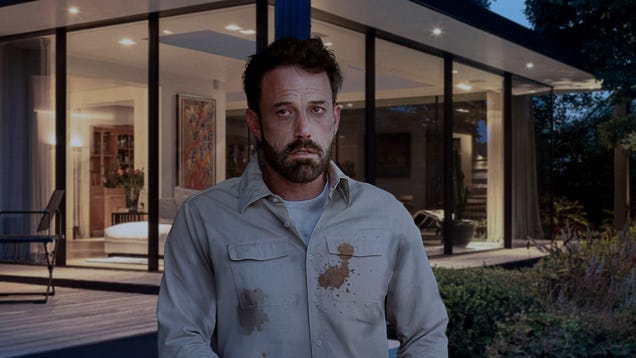
BEVERLY HILLS, CA—Slowly pushing down the bedroom door handle in an attempt to enter without waking his wife, Jennifer Lopez, a disheveled-looking Ben Affleck reportedly sneaked in at dawn Wednesday reeking of coffee after he spent all night at a 24-hour Dunkin’ location. “And just where the hell have you been—oh, let…
THE HEAVENS—In an effort to determine the efficacy of a divine law that may one day join those in His current Decalogue, God, Our Lord and Heavenly Father, told reporters Wednesday that He was testing out a potential new commandment on mice. “The phase 1 trial of this latest 11th-commandment candidate will be carried…
Alert: This is Verizon letting you know that an unrecognized device, the only device you’ve ever used to sign in to our website, has logged into your account. Was that you? Was it??
We are freaking out over here. We have no idea if this device—your only device—was you logging in. For all we know, it could be anyone. It could be an enemy that you have. Is there an enemy you have who might’ve used a device we don’t know to log into your account? Or was it you?
It was you, right???
It might not be. That’s why we asked, Is “AUDREY FARNSWORTH MACBOOK AIR” you, Audrey Farnsworth? We don’t recognize this device, even though you have literally never used any other device to log into our website.
But that doesn’t mean it’s NOT possible that it wasn’t you. There is actually no way of us knowing that. We weren’t there, physically, to see the logging in. That’s why we’re asking. So, was it?
We hope you can let us know soon because we’re really not doing well about this. When this mysterious device of the Literal Exact Same Laptop You’ve Used for Many Years logged into your account, an alarm went off at our headquarters, and every single employee stood up and screamed, “WHO IS THAT?” at the same time.
It WAS you, wasn’t it? WASN’T IT?
God, what if it wasn’t you? What will you do? Will you get mad at us? It’s not our fault that an unrecognized device has stormed into your account with the silent finesse of a Trojan horse, ready to view your personal information. In OUR opinion, YOU should be the only person to view your personal information. So, was it you? Are YOU viewing your personal information, or is it an enemy?
Is an enemy viewing your account right now???
PLEASE click “ALLOW” if this was you. If this wasn’t you, click DO NOT ALLOW. For the LOVE of CHRIST, do NOT click ALLOW if THIS WASN’T YOU, AND WE MUST MENTION AGAIN THAT WE ARE NOT SURE THAT IT WAS.
WAS IT YOU?
ARE YOU SURE? ARE YOU DEFINITELY SURE? HOW CAN YOU BE SURE? WAS IT YOU? DID YOU DO IT WITH YOUR HANDS? AND IF YOU DID IT WITH YOUR HANDS (YOUR OWN HANDS?), DID YOU KNOW YOU WERE DOING IT WHEN YOU WERE DOING IT? DID YOU?
by By Alejandra Martinez and Carlos Nogueras Ramos
The dunes sagebrush lizard lives in the same West Texas land that supports the state’s biggest oil and gas fields, and industry leaders say the new designation will hurt drilling and production.
In brief: A dying front brings a chance of storms well to the north of Houston tonight, but for most of us the story remains one of heat. Temperatures will peak over the weekend, with Memorial Day looking especially hot.
Wednesday
Expect another warm day in Houston, with highs of around 90 degrees due to mostly cloudy skies. It will be a little windier than Tuesday, with southeasterly gusts up to about 20 mph. With the humidity, it will feel plenty hot outside during the daytime hours before lows drop to about 80 degrees tonight.
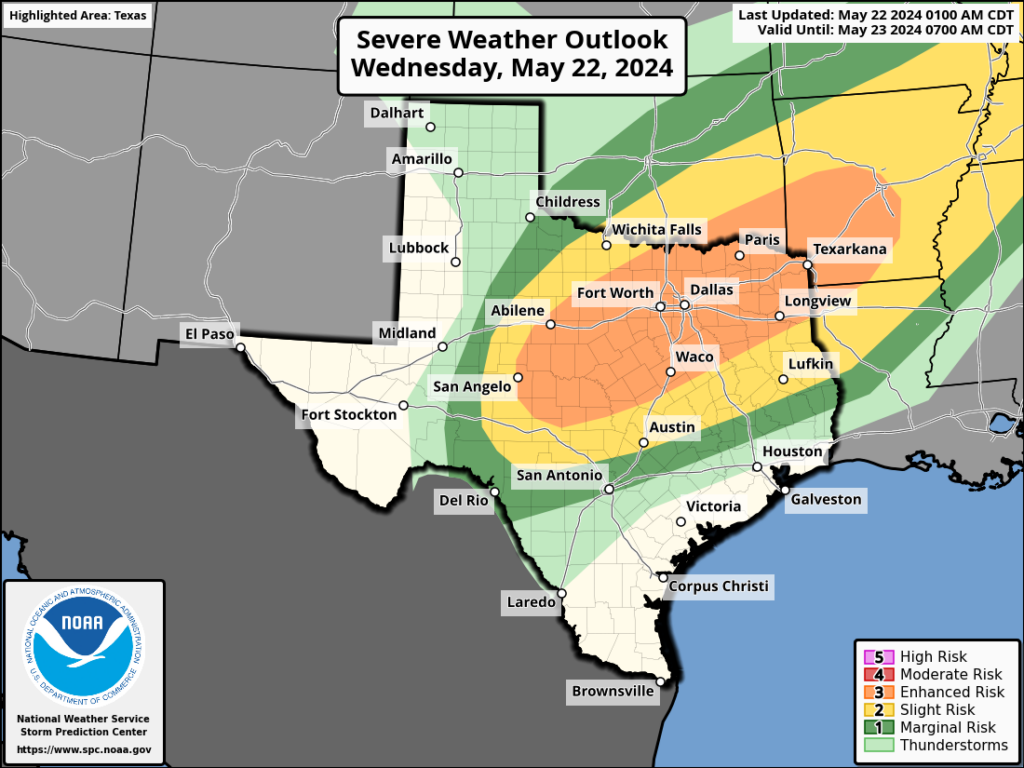
There is a healthy chance of storms well to the north of Houston later today and tonight. (NOAA)
For areas north of Houston, and by this we are probably talking about locations north of Highway 105 in Montgomery County, there is a chance of storms later this evening and during the overnight hours as a dying frontal boundary pushes a line of storms through northern Texas. There is some question as to how far south these storms will get. It is possible that locations such as College Station and Huntsville could see some thunderstorms tonight. There is even a slight chance that locations further south, including The Woodlands, could see some of this action. However, I think a capping inversion will probably prevent such activity for most of the Houston metro area, including at least the southern half of Montgomery County.
Other than this, we should be rain-free through the weekend.
Thursday
Expect partly sunny skies and a high of about 90 degrees with plenty of humidity. Another warm night.
Friday
As skies turn mostly sunny, expect highs to nudge up into the low 90s with plenty of humidity.
Saturday, Sunday, and Monday
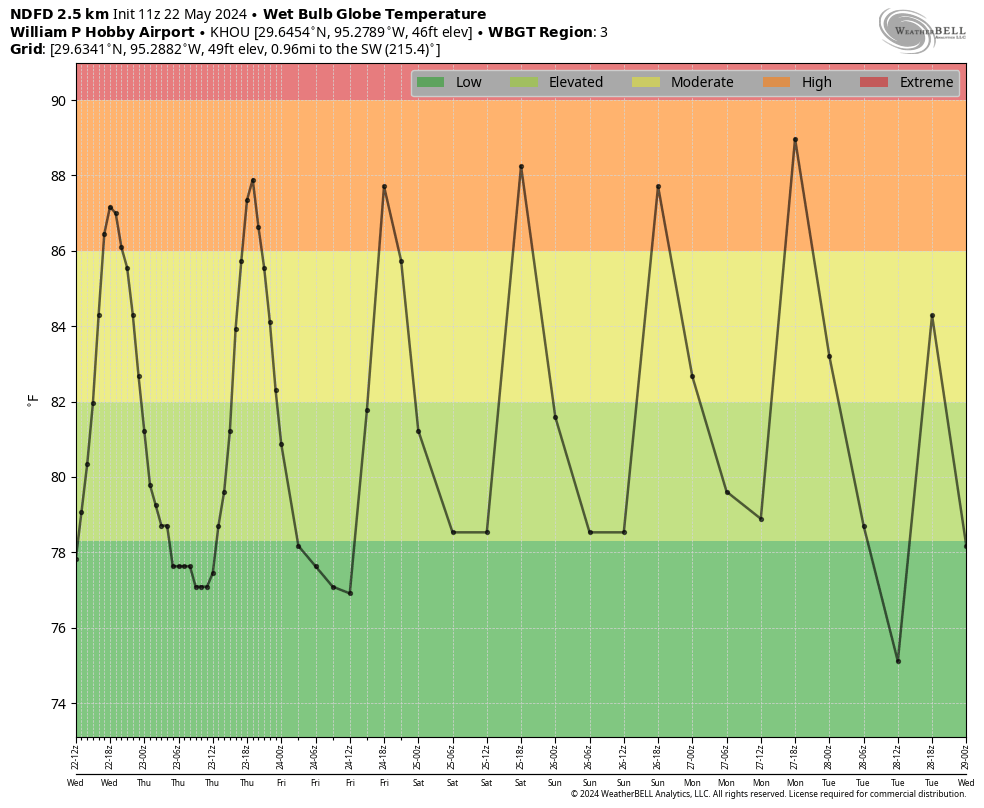
The holiday weekend looks hot and sultry. Highs will rise from the low 90s on Saturday to the mid- to upper-90s by Memorial Day with mostly sunny skies. Folks, it’s going to be Houston hot this weekend, so take all appropriate heat precautions. That includes sunscreen during the daytime with the Sun reaching an angle of 80 degrees during the early afternoon hours.
Wet Bulb Globe Temperature forecasts give a sense of the heat to expect this weekend. (Weather Bell)
Next week
So what happens after Memorial Day? It still looks like some sort of weak front arrives on Monday night or Tuesday. It’s late May, so your expectations should be for slightly cooler weather, and slightly drier air, and not much more. Still, beggars cannot be choosers at this time of year. Rain chances look a little bit improved later next week, but we’ll have to see about that. I don’t have much confidence in such a prediction.
Last week’s storms
Check back later this morning as Matt has a post on last week’s storms, and where they share some commonality with Houston’s history of similar events. It’s a great article with a lot of historical context.
This post was written by Alison Green and published on Ask a Manager.
It’s five answers to five questions. Here we go…
1. Was I wrong in this email squabble?
I have a question about a little email tussel I recently ended up in. I am a contractor for a professional services agency and was working on a project for a client. Part of my work includes using a third party to upload documents to a publishing site. This was my first time working with the third party in any capacity. Last week, I sent the required documents to the contact at the service (“Pat”) and asked for an update when the content was uploaded. They did acknowledge the email and said they would send an update once it was completed.
To make a long story short, Pat helped with uploading documents from a different (but related) project, and when I asked about the original request, I was met with pushback about never receiving documents related to the project (despite the email chain being named after the project). It was so blatantly wrong and strange that I began questioning myself, but a coworker also on the email chain acknowledged that Pat seemed disorganized, so I surmised that it must not be me. I sent the documents again to Pat two more times before the weekend, and each time was either ignored or they said that they did not receive anything from me when I asked for an update.
Eventually, on Monday morning, the client mentioned that they still did not see the documents uploaded. I reached out to Pat for an update, to which they said again that they never received anything from me and to send a new email with the attachments. I did as requested and included screenshots of all the emails I had sent to Pat the previous week with a note “in case they wanted to investigate.” It felt a little petty as I was sending it, but I was annoyed.
Pat replied back, “Obviously I am getting your emails but I never got one related to (Project name). Make sure you’re sending to the right recipient.”
Once they had confirmed completion of the upload, I sent them a screenshot of my original email including the “to” line showing that it did indeed go to them and said I appreciated their help. Pat’s tune changed significantly after that, and while they didn’t apologize, they said they would look into it more and they were glad we were able to complete the project.
If it matters, I am a woman in my late 20s and from what I can tell, Pat is a man in probably his 50s. While I felt petty sending screenshots of everything, this seemed like a very strange situation (could he not go back to the original email?) and I didn’t feel like being pushed around or apologizing for something I didn’t do. My director and coworker were also cc’d on all of the communications. Would love your insight on if I handled this appropriately!
Pat’s the problem, not you.
It’s one thing to miss an email, but before chastising someone to “make sure you’re sending to the right recipient,” you’d think he’d first go back and confirm that he really didn’t get the email.
I do think it was overkill on your side to send screenshots of all the emails you’d sent Pat the previous week, rather than just the one in question. Sending just the one in question probably would have solved the whole thing and not dragged out the interaction quite as much.
But again, you weren’t the problem.
2. I’m about to hire my first employee and I’m freaking out
I set up a nonprofit organization last year which has grown beyond the point where I can keep delivering everything on my own. There are two other directors on the board but they are both employed elsewhere, so other than quarterly board meetings I do the vast majority of the work. Thanks to grant funding and trading income, the organization can afford to employ someone part-time to take over some of the core delivery so that some of my time is freed up to work on developing and growing the business, and making it sustainable for the long term.
I’ve been through the recruitment process, I’ve got a preferred candidate and a second choice, interviews are done, references contacted, offer letter and contract (we’re in the UK) are all drafted with guidance from a HR consultant … and I am absolutely terrified of actually calling the candidate and making the offer.
I think I’m paralyzed by the weight of responsibility that being someone’s manager and employer involves. I have literally never been anyone’s supervisor or manager before. I’ve had a lot of managers, good and bad, and have a fairly good idea of what kind of manager I want to be, but the terror is getting in the way.
If I don’t hire this person, or at least A person, I will not be able to sustain the company. There’s so much potential and so much demand for what we offer, and the only way to realise that is to employ someone who is not me to do some of it. So why am I so scared? And what can I do? I told the applicants I’d make a decision last week. I’ve already updated them that there’s a delay, but I really do need to finalize the hiring decision this week, not least because I need them in role asap so that I can shift my focus to a large and important project starting in mid-July (which will involve hiring more staff).
This is hard to answer without knowing exactly what you’re afraid of, but if it’s really just the weight of being someone’s boss … well, honestly, you’re going to mess it up at some point, probably multiple points, because that’s what we all do. You’re not going to be perfect. You’re going to learn on the job, and it’s sometimes going to be messy. (This pep talk sucks, sorry!) But this is how you learn to do it. As long as you commit to a few basic principles at the outset — clear communication, getting aligned on expected outcomes, a coaching mentality, a bias toward transparency, and a view of the other person as a partner rather than a peon — you’re going to be fine. The other person is going to be fine. You’ll both figure it out. Commit to talking about it if that’s not happening.
But also, consider some training on how to manage people effectively — the nitty-gritty, “what does this look like day-to-day” of management. (I have conveniently written a book about exactly that and it’s even targeted toward nonprofit managers, so here you go.)
Also! Make sure you have a clear role description and list of outcomes the person will be responsible for achieving, and a training plan (at least an organized outline) for what you’ll need to cover with them to get them acclimated and equipped to contribute. You’ll feel better if you have those things. But from there … all you can really do is jump in.
3. Interviewer asked, “What would your detractors say about you?”
I’ve interviewed twice for the same agency over the span of several years. Both interviews included the same question: What would your detractors say about you?
The question has actually turned me off a bit from working for that agency. How do you advise answering a question like that?
It’s really just the old “what are your greatest weaknesses?” in disguise — or at least you can answer it that way. If you’ve had 360 feedback and you’re comfortable talking about something from that, you can do that and cite it as the source. But either way, the framing should be the same as for the “weaknesses” question — something you’re not as strong in combined with what you’ve done/are doing to work on it.
4. Should I say my coworker is the reason I’m leaving?
I am planning to jump ship from my current position due to my hostile coworker. She belittles me and tokenizes my identity on a daily basis and reacts poorly to both constructive feedback on her poor judgement for managing relationships with outside community partners and simple requests such as turning off her phone volume in a shared office space or using Teams for work-related discussion instead of text. She is also a terrible writer (a key job requirement), so I end up having to rewrite much of her work.
I am 100% leaving this position due to her conduct and I feel it’s important to tell leadership. I already discussed my coworker’s behavior with my manager and there has been little change. Leadership’s main concern is finishing the project we were hired to implement. My coworker’s and my positions are temporary, project-based positions, so it is highly unlikely this coworker would stay on. Would I look like the petty, aggrieved employee for sharing my true reasons for leaving or should I keep it neutral and say, “I found a position that’s a better fit for my career goals”?
There’s no point in getting into a lengthy dissection of your coworker’s behavior, but if your manager is the one asking, there’s no reason you can’t say, “It’s no secret that I’ve found Jane very difficult to work with.” If the person asking is higher up, you can share, “I’ve encountered a lot of difficulties working with Jane, which I’ve shared with Manager. I don’t want to rehash it at this point, but it ended up seeming like the right choice to simply move on.” I wouldn’t get into it beyond that — you’re leaving, and that gives them enough bread crumbs to follow if they care to.
One exception: If I’m understanding correctly that Jane subjected you to harassment or discrimination based on your race, religion, sexual orientation, or other protected class, you should spell that out, along with the fact that your boss didn’t act on it when you reported it (that part is crucial). They need to hear that, even if they don’t care about the rest of it.
5. How to raise your rates as a freelancer
Is there a good way to raise your freelancer rates with your existing clients? I haven’t raised my rates in a long time because of The Fear of never getting any work ever again. I am now pretty sure that I am undercharging. My instincts are all saying “only raise by a really small amount!” “Give them three months notice before the rate rises kick in!” But those are the same instincts that led me to not raise my rates for years so I am not sure I should trust them!
Also, do I need to give a reason for raising my rates? Or do I just state that they are going up? I was planning to say, “Due to rising costs, I will need to raise my rates from 1 September to xxx/hour or xxx/day.” As I am a freelancer writer, they may ask what costs. But, honestly, the price of coffee, my most important business expense, has shot up so I am telling the truth!
In general, you shouldn’t raise your rates only by a small amount out of fear; you want to raise them to a level that’s in line with the market and which means you won’t be undercharging. At the same time, freelancers also have to be realistic about clients’ budgets and what price point they’ll accept, and how willing you are to potentially lose some clients over a price hike. (Ideally, you’d be willing to lose some, since it will open up space for clients who can pay what your work is worth — but obviously that gets into what you can and can’t afford, how much risk tolerance you have, and how large of an increase we’re talking about.) It’s more art than science.
You don’t need to give a reason and I wouldn’t say it’s “due to rising costs.” You can just let people know they’re increasing and to what. Giving two to three months notice is good practice. You can also note that you haven’t raised your rates in the X years you’ve worked together.
Your wife said you were crazy, but who’s laughing now that you’re the only one in the family left and can live the rest of your life underground eating cans of expired beans?
Microsoft revealed an updated version of their AI assistant Copilot, which will use generative technology to remember everything users do on their PCs and suggest things you might like to do next. What do you think?
Some time ago, I told the story of the confidential coffee maker, one of the ways that Microsoft employees temporarily stationed in IBM’s Boca Raton office rebelled against IBM’s strict corporate culture. Since then, some of my colleagues shared additional stories from the IBM office commonly nicknamed Boca.
When the Microsoft engineers first arrived in Boca, they were assigned a computer lab equipped with a handful of very outdated computers. The next morning, Steve Ballmer, head of the operating systems division, bought twenty brand new Compaq 386/20 computers and network equipment for the Microsoft engineers to use. They were the envy of the IBM developers as they walked in the door with their top-notch equipment.
Part of the IBM/Microsoft joint venture agreement was that both the managers and engineers would alternate between Microsoft employees going to Boca and IBM employees coming to Redmond. And by some strange quirk of fate, the schedule ended up that during the winter, the Microsoft managers packed their bags for sunny Florida, and during the summer, the IBM managers left behind the oppressive heat of Florida for the pleasant summers of the Pacific Northwest. Meanwhile, the engineers were on the opposite schedule, going to Redmond in the winter and Boca in the summer. Huh. How strange that it worked out that way. Must just be dumb luck.
One of the security measures at Boca was that everybody had to sign in and out of the hardware lab. One of the employees was convinced that this was a complete waste of time since nobody ever checked the signature against the ID badge, and he began signing in and out under more and more absurd false names. Eventually, the lab manager came to the Microsoft office with the sign-in logs and asked the employee to sign in again because “Benito Mussolini? Somebody’s gonna notice that.”
The meeting came and went, so I thought I’d update you. Our team is hybrid with some people fully remote, so the meeting was fortunately not in-person. There are fewer than 20 of us on the team.
The person leading the five appreciation languages was the head of another team in our division, so most of us knew her but hadn’t worked with her before. She began by talking about how much she loves the framework and it’s her favorite, and that the relationship one is also amazing, and then moved into explaining the five languages. For each one, she asked us to comment in the chat if we thought it as one of our languages. People were very active for the first four.
Then she got to “Touch” and she quickly said that she knew some people might be intimidated to say it was one of their appreciation languages, so she would pipe up first about it being an important one to her in order to break the ice. There was continued silence. Hoping to draw out fellow “Touch” people, she started telling us that at her last workplace people were very into hugging and back pats, but here it seems like more of a handshake/fist bump place, and that made her kinda sad. Still silence from all of us. She decided to interpret that as people not feeling comfortable to admit to Touch being their language, but then mercifully moved on to some exercises around the other four languages.
The training was somewhat useful–I learned some valuable insights into how various coworkers like to get words of appreciation (some in public, others not, some with lots of detail, others with just a simple “thank you”). And I also now feel confident that even if one of my coworkers really was hiding their preference for touch (which I doubt), no one in my office thinks touching is an appropriate way to show appreciation in the workplace.
FREDONIA, AZ—In an effort to provide easier ungulate access throughout the grounds of the popular natural attraction, Grand Canyon National Park announced Friday the installation of new mule vending machines. “These five-story-tall vending machines are fully automated, providing parkgoers with year-round, 24-hour…
WASHINGTON, DC - FEBRUARY 23: U.S. Supreme Court Associate Justice Samuel Alito speaks during the Georgetown University Law Center's third annual Dean's Lecture to the Graduating Class in the Hart Auditorium in McDonough Hall February 23, 2016 in Washington, DC. Moderated by Georgetown Law Dean William M. Treanor, Alito began the conversation talking about his father. (Photo by Chip Somodevilla/Getty Images)
On May 16, the New York Times reported that, during the tense period between the January 6 insurrection and Biden’s inauguration, Justice Samuel Alito’s family displayed an upside-down American flag outside their home. An upside-down flag is a distress signal — a way that soldiers or ships at sea show that they are in extraordinary danger.
Taken in isolation, it’s hard to draw sweeping conclusions from this flag. The Times reports that many supporters of the “Stop the Steal” campaign — former President Donald Trump’s failed effort to overthrow the 2020 presidential election — embraced an inverted American flag to signal their belief that the United States was in grave danger. Alito claims that the flag was raised by his wife “in response to a neighbor’s use of objectionable and personally insulting language on yard signs.”
But this flag is hardly an isolated incident. On the bench, Alito is the Supreme Court’s most unrelenting Republican partisan — a reliable vote for whatever outcome is preferred by the GOP’s right wing, regardless of whether there is any legal support for that position. Alito isn’t simply a bad judge; he is the negation of law, frequently embracing claims that even intellectual leaders within the conservative movement find risible.
The morning before the Times published its flag scoop, for example, Alito published a dissenting opinion claiming that the Consumer Financial Protection Bureau, the brainchild of Democratic Sen. Elizabeth Warren, was unconstitutional. The opinion was so poorly reasoned that Justice Clarence Thomas, ordinarily an ally of far-right causes, mocked Alito’s opinion for “winding its way through English, Colonial, and early American history” without ever connecting that history to anything that’s actually in the Constitution.
Off the bench, meanwhile, Alito has a long history of making partisan statements that are just ambiguous enough that he can deny he was bemoaning a Republican defeat in a recent election. A little more than a week after Democratic President Barack Obama won his 2012 reelection race, Alito spoke to the conservative Federalist Society, where, quoting from one of his least favorite law professors, he warned that America is caught in a “moment of utmost sterility, darkest night, most extreme peril.”
Alito has long been the justice most skeptical of free speech arguments — he was the sole dissenter in two Obama-era decisions establishing that even extraordinarily offensive speech is protected by the First Amendment — but this skepticism evaporates the minute a Republican claims that they are being censored. Among other things, Alito voted to let Texas’s Republican legislature seize control over content moderation at sites like Twitter and YouTube, then tried to prohibit the Biden administration from asking those same sites to voluntarily remove content from anti-vaxxers and election deniers.
Alito frequently mocks his colleagues, even fellow Republicans, when they attribute government policies to anti-Black racism. After Justice Neil Gorsuch wrote in a 2020 opinion that the states of Louisiana and Oregon allowed non-unanimous juries to convict felony defendants more than a century ago to dilute the influence of Black jurors, Alito was livid, ranting in dissent: “To add insult to injury, the Court tars Louisiana and Oregon with the charge of racism.”
Yet while Alito denies that racism might have motivated Louisiana’s Jim Crow lawmakers in the late 19th century, he brims with empathy for white plaintiffs who claim to be victims of racism. When a white firefighter alleged that he was denied a promotion because of his race, Alito was quick to tie this decision to the local mayor’s fear that he “would incur the wrath of … influential leaders of New Haven’s African-American community” if the city didn’t promote more non-white firefighters.
Though Alito, who turned 74 last month, is probably in the twilight of his career, his unapologetically partisan approach to judging could very well be the judiciary’s future, at least if Trump secures another term in the White House.
Today’s headlines are peppered with names like Aileen Cannon, the judge overseeing Trump’s stolen documents trial who has also behaved like a member of Trump’s defense team, or Matthew Kacsmaryk, the former Christian right litigator who’s been willing to rubber stamp virtually any request for a court order filed by a Republican. The United States Court of Appeals for the Fifth Circuit, the powerful federal court that oversees appeals out of Louisiana, Mississippi, and Texas, is now a bastion of Alito-like partisans who treat laws and precedents that undermine the GOP’s policy goals as mere inconveniences to be struck down or ignored.
Alito — a judge with no theory of the Constitution, and no insight into how judges should read ambiguous laws, beyond his driving belief that his team should always win — is the perfect fit, in other words, for what the Republican Party has become in the age of Trump.
Samuel Alito, by the numbers
It’s probably possible to go through any long-serving judge’s record and find opinions that aren’t especially persuasive. So, rather than rely on anecdotal evidence of Alito’s partisanship, let’s start with two empirical analyses of his behavior on the Supreme Court.
Political scientist Lee Epstein examined how often each current justice votes for a defendant’s position in criminal cases. Her data, which was first reported by NBC News, shows a fairly clear partisan divide. All three of the Court’s Democrats voted with criminal defendants in over half of the cases they heard, with former public defender Ketanji Brown Jackson favoring defendants in nearly 4 out of 5 cases. All six of the Court’s Republicans, meanwhile, vote with criminal defendants less than half the time.
But there is also a great deal of variation among the Republicans. Justice Neil Gorsuch, the most libertarian of the Court’s Republican appointees, voted with criminal defendants in 45 percent of cases. Alito, who once served as the top federal prosecutor in the state of New Jersey, is the most pro-prosecution justice, voting with criminal defendants only 20 percent of the time.
Yet Alito’s distrust for criminal defense lawyers seemed to evaporate the minute the leader of his political party became a criminal defendant. At oral arguments in Trump v. United States, the case asking whether Trump is immune from prosecution for his attempt to steal the 2020 election, Alito offered a dizzying argument for why his Court should give presidents broad immunity from criminal consequences.
If an incumbent president who “loses a very close, hotly contested election” knows that they could face prosecution, Alito claimed, “will that not lead us into a cycle that destabilizes the functioning of our country as a democracy?” Alito’s supposed concern was that a losing candidate will not “leave office peacefully” if they could be prosecuted by the incoming administration.
The problem with this argument, of course, is that Trump is a case about a president who refused to leave office peacefully. Trump even incited an insurrection at the US Capitol after he lost his reelection bid.
Similarly, in Fischer v. United States, a case asking whether January 6 insurrectionists can be charged under a statute making it a crime to obstruct an official proceeding, Alito peppered Solicitor General Elizabeth Prelogar with concerns that, if the January 6 defendants can be convicted under this law, that could someday lead to overly aggressive prosecutions of political protesters. At one point, Alito even took the side of a hypothetical heckler who starts screaming in the middle of a Supreme Court argument and is later charged with obstructing the proceeding.
Alito can also set aside his pro-prosecution instincts in cases involving right-wing causes such as gun rights. At oral arguments in United States v. Rahimi, for example, Alito was one of the only justices who appeared open to a lower court’s ruling that people subject to domestic violence restraining orders have a Second Amendment right to own a gun. Indeed, many of Alito’s questions echoed so-called men’s rights advocates, who complain that judges unthinkingly issue these restraining orders without investigating the facts of a particular case.
Consider, as well, a case analysis by Adam Unikowsky, a Supreme Court litigator who previously clerked for conservative Justice Antonin Scalia.
In order to bring a federal lawsuit, a plaintiff must show that they were injured in some way by the defendant they wish to sue — a requirement known as “standing.” Unikowsky looked at 10 years’ worth of Supreme Court standing cases, first classifying each case as one where a “conservative” litigant brought a lawsuit, or as one where a “progressive” litigant filed suit. He then looked at how every current justice voted.
Nearly every justice sometimes voted against their political views — Thomas, for example, voted four times that a conservative litigant lacked standing and twice voted in favor of a progressive litigant. Alito, however, was the exception. In all six cases brought by a conservative, Alito voted for the suit to move forward. Meanwhile, in all 10 cases brought by a progressive, Alito voted to deny standing.
(Unikowsky also found that Justice Jackson, the Court’s newest member, has not yet crossed over in a standing case, but the data includes only one case, where she joined a 6–3 decision by Justice Brett Kavanaugh, a Trump appointee.)
Some of Alito’s standing opinions are genuinely embarrassing. The worst is his dissent in California v. Texas (2021), one of the four cases where Thomas voted to deny standing to a conservative litigant.
Texas was the third of three Supreme Court cases attempting to destroy the Affordable Care Act, President Obama’s signature legislative accomplishment. But even many high-profile Republicans found this lawsuit humiliating. The Wall Street Journal’s editorial board labeled this case the “Texas Obamacare Blunder.” Conservative policy wonk Yuval Levin wrote in the National Review that Texas “doesn’t even merit being called silly. It’s ridiculous.”
As originally drafted, Obamacare required most Americans to pay higher taxes if they did not obtain health insurance. In 2017, however, Congress eliminated this tax by zeroing it out. The Texas plaintiffs claimed that this zero-dollar tax was unconstitutional, and that the proper remedy was that the Affordable Care Act must be repealed in its entirety.
No one is allowed to bring a federal lawsuit unless they can show that they’ve been injured in some way. A zero-dollar tax obviously injures no one, because it doesn’t require anyone to pay anything. And so seven justices concluded that the Texas lawsuit must be tossed out.
Alito dissented. While it is difficult to summarize his convoluted reasoning concisely, he essentially argued that, even if the zero-dollar tax did not injure these plaintiffs, they were injured by various other provisions of Obamacare and thus had standing.
This is simply not how standing works — a litigant cannot manufacture standing to challenge one provision of federal law by claiming they are injured by another, completely different provision of federal law. As Jonathan Adler, one of the architects of a different Supreme Court suit attacking Obamacare, wrote of Alito’s opinion, “standing simply cannot work the way that Justice Alito wants it to” because, if it did, “it would become child’s play to challenge every provision of every major federal law so long as some constitutional infirmity could be located somewhere within the statute’s text.”
Alito’s Texas opinion, in other words, would allow virtually anyone to challenge any major federal law, eviscerating the requirement that someone must actually be injured by a law before they can file a federal lawsuit against it. Needless to say, Alito does not take such a blasé attitude toward standing when left-leaning litigants appear in his Court. But, when handed a lawsuit that could sabotage Obama’s legacy, Alito was willing to waive one of the most well-established checks on judicial power so that he could invalidate the keystone of that legacy.
Alito’s jurisprudence of white racial innocence
In a 2005 speech explaining why he opposed Chief Justice John Roberts’s confirmation to the Supreme Court, then-Sen. Obama explained how he thinks judges actually decide difficult cases. While “95 percent” of cases can be resolved solely by looking at neutral legal principles, Obama said, “adherence to precedent and rules of construction and interpretation will only get you through the 25th mile of the marathon” in the especially challenging cases that come before the Supreme Court.
In those hardest cases, Obama argued, “that last mile can only be determined on the basis of one’s deepest values, one’s core concerns, one’s broader perspectives on how the world works, and the depth and breadth of one’s empathy.”
One might think that empathy, which means the capacity to understand the thoughts, feelings, and experiences of another person, would be an essential quality in anyone tasked with judging other people. But Republicans later latched onto Obama’s statement as evidence that his judicial appointees would decide cases based on feelings and vibes, instead of law. As Sen. Chuck Grassley (R-IA) said in 2016, “the President’s idea of what’s appropriate for justices to consider is totally at odds with our constitutional system. We are a government of laws and not a government of judges.”
Alito’s jurisprudence, however, displays neither the universal empathy touted by Obama nor the kind of mechanical application of legal principles imagined by Grassley. Instead, Alito engages in selective empathy, often mocking the concerns of left-leaning litigants while simultaneously being extraordinarily protective of conservatives. And this selective empathy is most obvious in Alito’s decisions involving race.
Alito lashes out at his colleagues when they accuse white lawmakers — even, in one case, white lawmakers in the Jim Crow South — of racism. Yet he showed tremendous empathy for the firefighter who claimed to be a victim of anti-white discrimination.
Indeed, one of the unifying themes in Alito’s race cases is his desire to write a presumption of white racial innocence into the law — and especially into American voting rights law.
Consider, for example, Alito’s majority opinion in Abbott v. Perez (2018), where the Court’s Republican majority rejected a claim that Texas’s GOP-friendly congressional maps were an illegal racial gerrymander.
In 2011, the Texas legislature drew maps that never took effect, and that were eventually declared an illegal gerrymander by a federal court. Because of the legal challenges to these maps, the state legislature drew alternative maps in 2012 that were supposed to be used only in that year’s election. Though much of these interim 2012 maps closely resembled the illegal 2011 maps, a court allowed Texas to use them in the 2012 election because otherwise the state would not have been able to conduct the election at all.
Then, in 2013, the Texas legislature passed a new law converting the 2012 stopgap maps into permanent maps, meaning that they would be used until the next census in 2020. The state legislature did so, moreover, despite the fact that many of the districts in these new maps were still being challenged as unlawful racial gerrymanders.
Alito’s opinion in Perez, however, cut most of these challenges off. He reasoned that “the 2013 Legislature’s intent was legitimate” because the decision to convert the interim maps into permanent maps was not driven by racism. Rather, it was driven by a desire to “bring the litigation about the State’s districting plans to an end as expeditiously as possible.”
Alito’s argument, in other words, was that the 2013 maps were permissible because they were enacted to shut down a lawsuit challenging a racial gerrymander. It’s as if the school districts that were declared unlawfully segregated in Brown v. Board of Education (1954) had simply passed a new law re-creating the same racially segregated schools that existed before Brown was decided, and then argued that the new law should be upheld because it was enacted to end a lawsuit challenging segregation.
Consider, as well, Alito’s majority opinion in Brnovich v. DNC (2021), a case asking whether two Arizona election laws that allegedly had a disproportionate negative impact on nonwhite voters violated a 1982 amendment to the Voting Rights Act.
In rejecting this claim, Alito simply made up a bunch of new limits on the Voting Rights Act that appear nowhere in the law’s text. He declared, for example, that state laws which purport to fight voter fraud are presumptively legal. He also applied a strong presumption that any voting restriction that was commonplace in 1982 does not violate the 1982 amendment to the Voting Rights Act.
This later presumption is completely ridiculous. The only reason why Congress enacts any law is because it wants to change the status quo. If Congress enacted a new voting rights law in 1982, that means that Congress was unsatisfied with the state of voting rights in 1982 and wanted to change it — not to preserve restrictions that were commonplace at the time.
As Justice Elena Kagan wrote in her Brnovich dissent, Alito’s opinion “mostly inhabits a law-free zone.”
Alito’s selective concern about the First Amendment
Earlier this month, Alito delivered the commencement address at Franciscan University, a Catholic school in Ohio. Much of his speech echoed the sort of anti-“cancel culture” rhetoric that can be heard on any given episode of Sean Hannity’s Fox News show.
“Troubled waters are slamming against some of our most fundamental principles,” Alito told the graduates, echoing similar rhetoric that he used to describe the reelection of President Obama in 2012. “Support for freedom of speech,” Alito claimed, “is declining dangerously, especially where it should find broadest and widest acceptance.”
Alito’s concern about free speech is a little jarring, because he’s long been the justice least likely to back free speech claims by civil rights plaintiffs. In 2010 and 2011, for example, Alito was the sole dissenter in two importantfree speech cases reiterating the Court’s well-established view that speech is protected by the First Amendment even if it is likely to offend most people.
The justice’s more recent free speech decisions, meanwhile, largely turn on whether the party that wishes to shape public discourse is a Democrat or a Republican.
In 2021, for example, Texas’s Republican legislature enacted a law that effectively seizes control over all content moderation at major social media platforms like YouTube, Twitter, or Facebook. The law was an explicit effort to force these platforms to host right-wing content that they would prefer not to publish. “It is now law that conservative viewpoints in Texas cannot be banned on social media,” Texas Gov. Greg Abbott (R) said when he signed the law.
The law is also comically unconstitutional. The Court held inRumsfeld v. Forum for Academic and Institutional Rights (2006), that “freedom of speech prohibits the government from telling people what they must say.” And it held inMiami Herald v. Tornillo(1974), a publication’s choice to publish or not publish certain content is subject only to the outlet’s “editorial control and judgment,” and “it has yet to be demonstrated how governmental regulation of this crucial process can be exercised consistent with First Amendment guarantees of a free press.”
Yet, when a majority of his colleagues voted to temporarily block this Texas law, Alito dissented, suggesting that Texas’s Republican lawmakers should have more leeway to address “the power of dominant social media corporations to shape public discussion of the important issues of the day.”
Not long after Alito wrote this dissent, however, the Court heard another case, known as Murthy v. Missouri, which involved an unusual order handed down by the far-right United States Court of Appeals for the Fifth Circuit. That order effectively forbade the Biden administration from asking social media companies to voluntarily remove harmful content, such as videos seeking to recruit terrorists or tweets that promote false and potentially dangerous medical advice.
Once again, a majority of Alito’s colleagues voted to block this lower court order. Once again, Alito dissented.
It should be obvious that the First Amendment cannot simultaneously empower a Republican government to force media outlets to change their editorial policies, while also forbidding a Democratic government from asking a media outlet to change what it publishes — unless, of course, you believe that there is one First Amendment for Democrats and a different one for Republicans.
Later in his address to Francisan’s graduating class, Alito had a revealing line about why he believes that freedom of religion is threatened in the United States. “Religious liberty is also threatened,” Alito claimed. Then he warned the graduates that “when you venture out into the world, you may well find yourself in a job, or community or a social setting when you will be pressured to endorse ideas you don’t believe, or to abandon core beliefs.”
This warning blurs an important line between the kind of pressure that can plausibly violate “religious liberty,” and the kind of pressure that is just an ordinary part of living in a pluralistic society.
Alito is correct that, under some circumstances, a worker who is pressured because of their religious beliefs at work may have a viable religious liberty claim. That’s because federal law requires employers to accommodate their employee’s religious beliefs unless doing so would impose an “undue hardship on the conduct of the employer’s business.” So, for example, if a worker’s boss pressured a conservative Catholic employee to sign a statement endorsing the right to an abortion, such pressure would likely violate this worker’s civil rights.
But there is no right to be free from pressure, or even social ostracization, because people in your community or social circles find your religious beliefs abhorrent. If freedom of religion means anything, it must include both the right of a conservative evangelical to believe that gay people are sinful, and the right of everyone else to turn up their nose in disgust at anyone who expresses such a viewpoint.
Yet Alito hasn’t simply argued that conservative Christians have a right not to be shunned for their views, he’s argued that the rights of gay Americans must be diminished in order to protect the feelings of people who oppose those rights. Hence Alito’s argument that Obergefell v. Hodges (2015), the Court’s landmark marriage equality decision, was wrongly decided because “it will be used to vilify Americans who are unwilling to assent to the new orthodoxy.”
Thus, in Samuel Alito’s America, Republicans have the power to control media, while Democrats can’t even ask media outlets to change what they publish. Meanwhile, the rights of historically marginalized groups must be diminished to prevent anyone from speaking ill of those who would marginalize them.
Can Alito be defended?
A 2023 essay by attorney Adam White tries to find a larger intellectual project behind Alito’s jurisprudence, beyond an overarching command that the Republican Party should always win. Alito, White claims, is a “Burkean conservative,” a reference to the 18th-century English conservative Edmund Burke, who is wary of the “dangers of concentrating too much power [in] the hands of elites or elite institutions.”
White argues that Alito seeks to preserve traditional ways of organizing society, and to diminish the power of institutions that can cause the United States to depart from such traditions. As White writes, “when government action — especially the swift and sweeping work of agencies, executives, and courts, rather than legislatures — threatens longstanding traditions or the institutions and communities that keep and transmit them, Justice Alito’s instinct has been to begin with a presumption in favor of defending tradition.”
Alito, for what it’s worth, appears to think of himself very much as White describes him. In his Franciscan speech, for example, Alito argued that the Constitution “guards against improvident change,” both because the document itself is almost impossible to amend, and because it makes it very difficult for the federal government to make law. The framers of the Constitution, Alito claims, “knew that times would inevitably come when people would be tempted to make hurried and unwise changes,” and they believed that the “country’s well-being depended on the ability to resist these temptations.”
But if Alito imagines a country that is slow to change its laws, and one where Congress — and not swifter-moving institutions like the courts or executive branch agencies — are the drivers of policy, this vision appears to wax and wane depending on who is in the White House, and whether a new policy benefits liberals or conservatives.
Consider two cases, both of which involve court decisions that sought to shape US policy.
When a Republican administration sought to end a program created by Democrats, Alito behaved exactly as White describes him — warning about concentrating too much power in the judiciary. Shortly after Trump officials tried to end DACA, Alito wrote in dissent, “one of the nearly 700 federal district court judges blocked this rescission, and since then, this issue has been mired in litigation.” He complained that “the federal judiciary” had effectively prevented Trump from implementing one of his policy goals “during an entire presidential term.”
Three years later, however, one of the nearly 700 federal district court judges blocked a different federal policy. Kacsmaryk, the crusader for the religious right that Trump put on the bench, attempted to ban the abortion drug mifepristone nearly a quarter century after the FDA authorized doctors to prescribe it in the United States. Even on Alito’s very conservative, anti-abortion Court, he was one of only two justices who went along with this attempt to remove a widely available medication from the market by judicial decree.
Or consider Alito’s vote in Trump v. Hawaii (2018), the challenge to Trump’s decision to ban citizens of several Muslim-majority nations from entering the United States. Trump did so, moreover, after bragging on the campaign trail about his plan to enact an unconstitutional ban on Muslims entering the United States if elected president.
Before Trump took office, Alito was often the Court’s most outspoken proponent of an expansive concept of religious freedom, especially in cases involving conservative Christians. But Alito abandoned this concern for religious liberty, as well as any concerns about the executive branch setting policy, in the Hawaii case. Instead, Alito joined an opinion claiming that federal law “exudes deference” to President Trump.
Under President Biden, by contrast, Alito’s been one of the Court’s strongest proponents of the so-called major questions doctrine, a judicially created doctrine that’s been used almost exclusively to strike down policies created by Democratic administrations, and that has no basis in either the Constitution’s text or in any statute. Indeed, Alito’s even wielded this doctrine to strike down Biden administration policies that were unambiguously authorized by federal law.
So let’s dispel this fiction that Alito takes a principled, Burkean approach to the law and the Constitution. Alito does often use the sort of rhetoric that is associated with traditionalist forms of conservatism, but that rhetoric only drives his actual decisions when it leads to the outcome he prefers.
Samuel Alito is one of the worst judges of his generation. He rejects the very basic idea that courts must decide cases based on the law, and not based on their partisan views. He routinely embarrasses himself in oral arguments, and in his published opinions, with legal reasoning that no sensible lawyer can take seriously. And he even tries to distort public debate and silence critics.
But most of all, Alito is one of the most uninteresting thinkers in the country. Here he is, in one of the most powerful and intellectually rigorous jobs on the planet — a philosopher king, presiding over the mightiest nation that has ever existed — and his only big idea is “Republicans should win.”
The very least the auto industry can do is make these transactions clear to car owners, but most of the time they can’t even do that.
Now it looks like the FTC might be considering legal action against the auto industry for lax privacy standards. An FTC blog post indicates that the “connected car” industry has been on the agency’s “radar for years,” and hinted at potential future actions:
“Car manufacturers—and all businesses—should take note that the FTC will take action to protect consumers against the illegal collection, use, and disclosure of their personal data.”
The FTC is being prodded into action by the concerns of Senator Ron Wyden, whose office launched an investigation finding that automakers routinely collect not only driver behavior data but data from connected phones, sell access to a myriad of often dodgy third parties and data brokers, and routinely fail to make any of those transactions meaningfully clear to car owners.
Usually customer acceptance for such monetization of data isn’t buried in your car paperwork; it’s buried in the user agreement connected to automakers’ car apps or road-side assistant apps. This is, it should be noted, the same industry that’s fighting tooth and nail against “right to repair” reforms under the pretense that it just cares a whole lot about consumer privacy and security.
Of course the FTC lacks the resources, staff, and authority (quite by lobbying design) to meaningfully police U.S. tech privacy violations at the scale they’re happening. And even should the FTC take action, any fines would likely comprise a tiny fraction of the money made from non-transparently and haphazardly monetizing drivers’ every fart for the better part of the last two decades.
And whatever fines that do get levied are often reduced further (or eliminated entirely) thanks to multi-year legal fights within an increasingly corrupt court system.
Still, it’s important to try to have standards. It’s what separates us from potatoes.
As Wyden’s office has made clear, the stakes for our corrupt failure to pass baseline privacy laws or regulate data brokers continue to rise. Demonstrated pretty clearly by his office’s recent discovery that a data broker had been selling abortion clinic location data to right wing activists, who then took to targeting vulnerable women with health care disinformation.
But between regulators that have been steadily boxed in by thirty-years of lobbying and corrupt court rulings, and a Congress that’s too corrupt to function, it seems like we’ll be waiting a long time to see meaningful reform on this front. And that reform is only likely to come courtesy of a privacy scandal whose scope and impact we probably can’t imagine.
It should come as no shock to anyone when I say that DC Comics and Marvel both behave in a very aggressive manner when it comes to all things intellectual property. These two companies have engaged in all kinds of draconian behavior when it comes to everything from copyright to trademark. But one thing that somehow escaped my attention all the years I’ve been writing for Techdirt is that those two companies also jointly hold a trademark, granted by the USPTO, for the term “Super Hero,” as well as several variants. You can visit that Wikipedia link to get some of the backstory as to how this all came to be, but, suffice it to say, that the term “super hero,” at this point in history, is obviously generic. Hell, it refers to an entire genre of movies, if nothing else.
Scott Richold’s Superbabies Ltd told a USPTO tribunal, opens new tab that “Super Hero” is a generic term that is not entitled to trademark protection, according to a copy of the petition provided by Superbabies’ law firm Reichman Jorgensen Lehman & Feldberg.
Representatives for DC and Marvel did not immediately respond to requests for comment.
“By challenging these trademarks, we seek to ensure that superheroes remain a source of inspiration for all, rather than a trademarked commodity controlled by two corporate giants,” Superbabies’ attorney Adam Adler said in a statement.
Now, this is all coming about because DC Comics accused Superbabies Ltd. of trademark infringement when it caught whiff of the company’s own attempt to trademark its comic book name. But the idea that the term “Superbabies” or “Super Hero” could be monopolized for any market at all via trademark law is, at this point, absurd. And yet both DC and Marvel have wielded their trademarks many times in the past.
“DC and Marvel claim that no one can use the term Super Hero (or superhero, super-hero, or any other version of the term) without their permission,” the petition said. “DC and Marvel are wrong. Trademark law does not permit companies to claim ownership over an entire genre.”
I would argue that the term wasn’t particularly unique as an identifier back when it was first granted over 100 years ago and certainly isn’t now. When you hear the term, you might think of certain super heroes from either Marvel or DC. Or you might think about the many, many super hero characters out there that are not owned by those companies. The point is that the term is ubiquitous at this point.
Will the USPTO give serious consideration to canceling DC and Marvel’s joint trademark? I’m not sure, but it certainly should.
I spend a lot of time talking about how to expand public transit in North America so that we might someday have transit and passenger railways that can approach the same magnitude of extensiveness of those in Europe and Asia. However, it is worth reflecting on the fact that we are less far behind in sheer scope than people often realize.
North America is naturally going to have less intercity rail than Europe or Asia owing to the low population densities we see. Sure, there’s no reason the Northeast Corridor, or California, or Quebec City-Windsor should not have dramatically better rail (I would note, dramatically better rail is some way shape or form is happening in all of these places), but frequent or high-speed rail would not exist from Vancouver to Calgary, or from Salt Lake City to San Francisco if they were in Europe or Asia! There would probably be a daily, or maybe twice daily train. The reality of this continent is that while we do have big cities and city clusters — they are often legitimately very far apart.
Now yes, it is possible that this train would be electric, and yes, neither of the city pairs I just mentioned are close to living up to the standard of rail service you might see in other parts of the world, but the gap is smaller than people appreciate.
If you enjoy my content, consider subscribing to my blog:
Your support will help me bring you more content faster!
I think too often in North America we think that are problem is not having enough transit, and to be clear — that is part of the problem without a doubt. But cities like Toronto, Seattle, and New York have plenty of transit and still don’t stand up that well to those overseas, and that’s because we have a quality issue that is almost as big as our quantity issue. Even transit agencies like the TTC that are objectively good at running and maintaining transit service by North American standards seem to be totally unaware of things like global wayfinding best practices or even modern business best practices. Transit agencies across the continent build projects for far more than international (and domestic) comparators and seem to spend little time reflecting on this.
The Eglinton Crosstown in testing.
There str a lot of places where we can and should spend energy on expanding our transit systems, but it makes me very sad when I see crisis going from city to city — Chicago, Toronto, Washington DC, and Boston have all seen major regressions in service levels and quality on their existing metro systems: systems that are actually pretty large! The entire culture of the continent’s transit industry needs to shift to put greater focus on actually showing up and providing frequent, reliable, everyday service. While we do need to level up and expand at the same time — adding new lines, re-signalling, and improving safety (screen doors or gates) and accessibility (elevators and escalators) on old lines — we also clearly need to put more energy on not regressing.
The current slow zones for construction & maintenance on the TTC subway. (Credit: TTC)
And to be clear, it’s not all regression. I love when I see a transit system in North America implement nice digital wayfinding, as an example. But if we want great transit, we shouldn’t settle for something less than what would be best-in-class in Europe. One of the only advantages in being so slow to technical innovations and transit system improvements should be that we can just copy the best, and because we are too unfamiliar of what the best is and what it looks like we don’t. That needs to change.
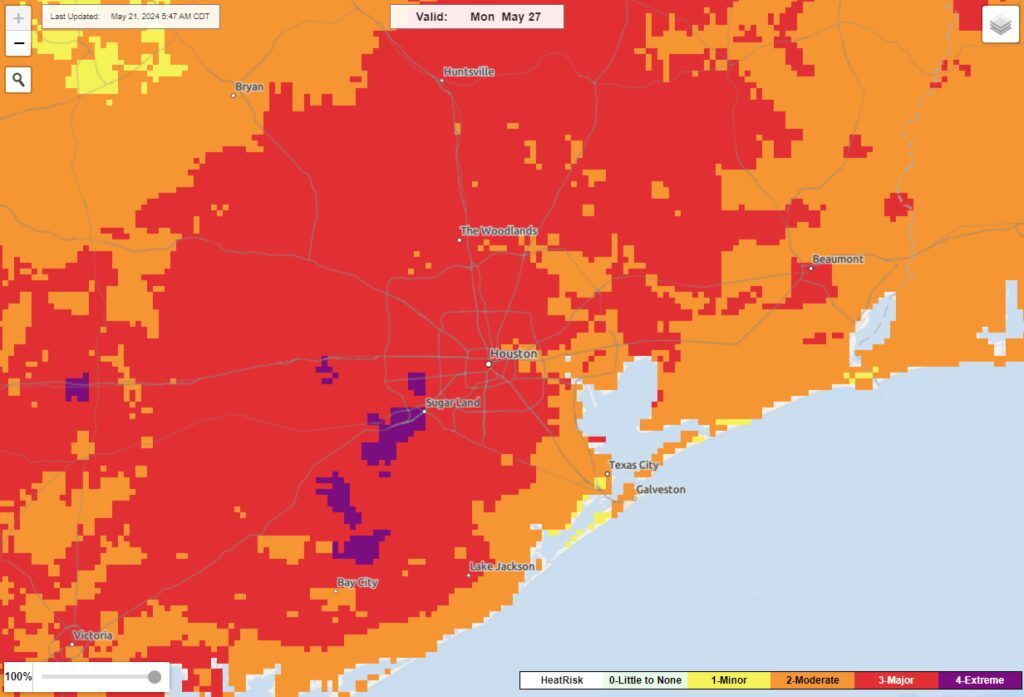
In brief: Today’s post talks about the arrival of summer-like weather in Houston, and breaks down the four phases of summer. We also discuss a new offering from the National Weather Service called “HeatRisk.” Finally, we look ahead to a hot and sunny Memorial Day Weekend.
We’re starting to see 90-degree days on the regular which, in my mind, signals the start of summer in Houston. Long-time readers will know that I like to break summer down into four phases. Why? Because “summer” season lasts so long, nearly five months. This is contrast to meteorological summer, which runs from June through August, and “solstice” summer, which runs from June 20 through September 22 this year. For me, Houston’s summer typically runs from about mid-May through mid-October. Here are the four phases:
Early summer: When we first start to see 90-degree temperatures with regularity, but some nights in the 60s are still possible, and there’s still the thinnest hope of a weak front
Mid summer: When highs run from 90 to 95 degrees, and nights are sultry, but you know it could still get worse
High summer: Somewhere between late July and early September there’s a period where temperatures reach the upper 90s to mid-100s and you realize, “Ok, this really is the worst.”
Late summer: This is the period in September and early October when days grow shorter and we usually see the first front or two of the season. But most of the time it’s still hot.
Early summer began this week in Houston, and we have a chance to bump into Mid summer early next week before we drop back into early summer. You may think it’s crazy to have gradations of heat during summer, as Houston is invariably hot and humid during the summer months. But as we found out last year, there is heat and there is heat. Last summer we used the “wet bulb globe temperature”to measure how hot it really felt outside, and we’ll continue to use this tool. However there’s now another way to assess the heat.
HeatRisk map for Monday, Memorial Day. (National Weather Service)
This year the National Weather Service is introducing a “HeatRisk” color-based scale that takes into account the following factors to provide guidance for outdoor activities:
How unusual the heat is for the time of the year
The duration of the heat, including both daytime and nighttime temperatures
If those temperatures pose an elevated risk of heat-related impacts
The scale ranges from green (little or no risk) to magenta (extreme). If we look at the risk for Memorial Day we can already see a few areas of Houston reaching an ‘extreme’ level of risk. This is due to temperatures likely in the mid- to upper-90s and the time of year, late May, as we’ve not re-accustomed ourselves to the heat yet.
We’ll see a few more clouds today than we saw on Monday, and this should help hold temperatures to about 90 degrees. Winds will be from the south, at 10 mph or so, with gusts up to 20 mph. Aside from that it’s going to be another humid day, with a warm night in the mid- to upper-70s.
Wednesday
Skies should be partly to mostly cloudy on Wednesday, and this should allow some parts of Houston to stay in the upper 80s. However, if we get a bit of sunshine during the afternoon hours, highs in the low 90s are possible. Still warm. Still humid.
Thursday and Friday
These days will probably bring mostly sunny skies, so temperatures from 90 to the low 90s are likely. Nights remain warm.
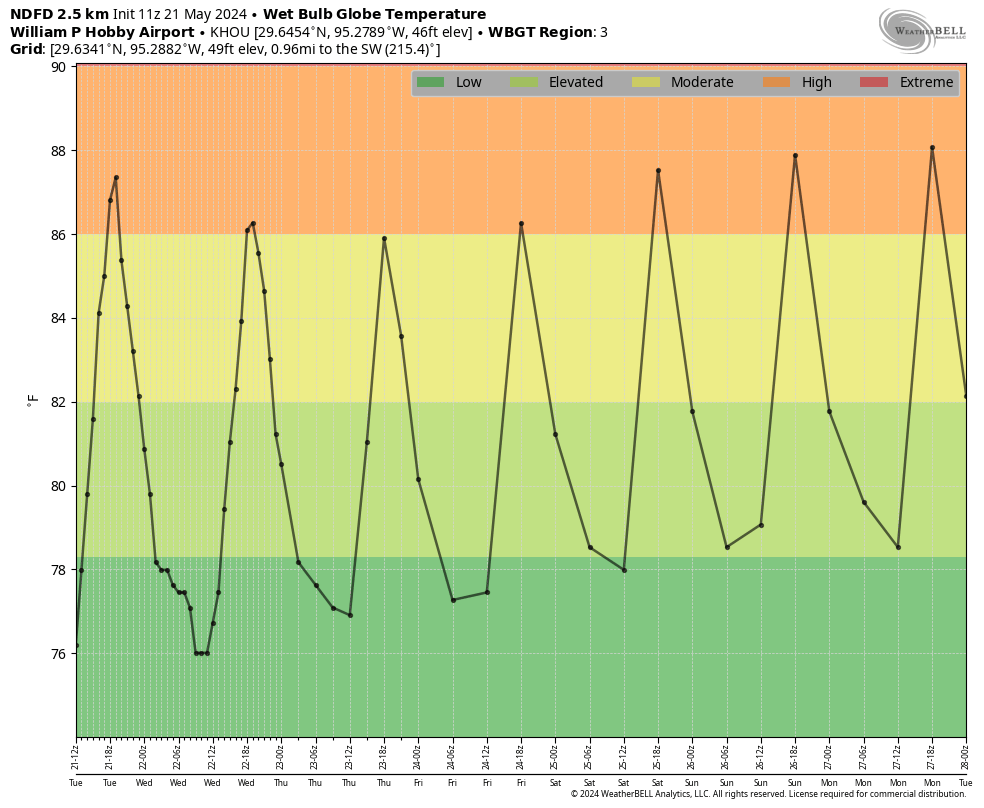
Wet Bulb Globe Temperatures will be high this week, but not extreme. (Weather Bell)
Saturday, Sunday, and Monday
Hot and mostly sunny. Highs this weekend are likely to reach the mid-90s, with upper-90s possible on Memorial Day. By Monday it looks like a weak front will approach the area, bringing a chance of rain with it. However I don’t believe this front will arrive in time to modify conditions during the daytime on Monday.
Next week
The front should arrive on Monday night or Tuesday, and at this point it does appear as though the boundary will indeed push all the way to the coast. Don’t expect miracles in late May, but we might see some slightly drier air and highs in the upper 80s, with modestly cooler nights. It isn’t much, but it’s the best we can reasonably hope for at least the next three months, and probably longer.
LOS ANGELES—Emphasizing that you would be “doing him a real solid,” local man Josh Gurney, your friend on the opposite side of town, told you Tuesday that he needed you to move his car three times a day for the next six weeks. “Hey, if it’s not too much trouble, would you be available to move my car once every…
NEW YORK—Seeing the two men’s gazes lock for a split second before one quickly lowered his head, sources confirmed Tuesday that Donald Trump quietly avoided eye contact with Rudy Giuliani on the steps of the courthouse where his disgraced former personal attorney and campaign lawyer was begging for change. “Spare a…
INDIANAPOLIS—Whipping his head around in a double take, local man Dean Wilson was reportedly starstruck Tuesday after spotting Caitlin Clark with her Indiana Fever teammates at the Greyhound bus station. “Wow, it’s a good thing I snapped a photo of her at the vending machine, or else no one would have believed me,”…




/https://static.texastribune.org/media/files/aaff4d69284c6b4c22ef4037503a3aab/Dunes%20Sagebrush-Lizard%20Ryan%20Hagerty%20USFWSFPWC.jpg)