The Austin Asian American Film Festival (AAAFF) has announced the schedule for its upcoming festival, featuring films by international, Asian Diasporic, Asian American, and local Texas filmmakers.
Austin Asian American Film Festival
In a press release Hanna Huang, AAAFF Executive Director, said, “Through 12 features and 19 short films, our audience will get to delve into intimate stories of relationships. Our protagonists will encounter the personal growth (or not) that comes from finding inner strength and reconciling with their identities.”
The event will take place from June 26 through 30 at the AFS Cinema (located at 6259 Middle Fiskville Rd, Austin, TX 78752). Opening night will include welcome remarks at 6:40 p.m. and a lobby party from 9:15 p.m. to 11 p.m. AAAFF’s annual Red Carpet Event will take place on Friday, June 28 at 6:30 p.m. Throughout the week, live Q&A sessions will feature directors, including Jean Shim, Kenji Tsukamoto, Thien An Pham, Erica Tanamachi, and Andy Nguyễn.
Mr. Nguyễn, Director of Fanti, remarked, “I have been following AAAFF’s programming for many years and have always wished to have an opportunity to be a part of it once I made a film one day. I am absolutely honored to be in the company of the Asian Americans who have played here.”
Festival badges and single-screening tickets can be purchased at the AAAFF website. See the opening night schedule below and a full schedule here.
Wednesday, June 26: OPENING NIGHT
6:40 – 7:00 p.m. – Welcome Remarks & Intro
7:00 – 7:13 p.m. – MSG: Mysterious Savory Grains by Kyle Finnegan Country of Origin: United States; Language: English
7:13 – 8:40 p.m. – New Wave by Elizabeth Ai Country of Origin: United States; Language: English and Vietnamese with English subtitles. Accessibility: Closed Captioning in English avail for CC Reader Devices Q&A to follow with director Elizabeth Ai
A lot of the readers put their fingers on what I was reluctant to address in my letter — that my physical appearance was part of what was likely prompting the complaints. I do look different than most of my coworkers. While we are all roughly the same age, I have always taken care of my health, my skin, and my hair, and have been a regular gym-goer since my college athlete days. I modeled briefly as well. So I’m kind of used to people reacting to my appearance and certain people automatically disliking me simply based on what I look like. I can’t do anything about that and I try hard to be warm, friendly, and kind to everyone regardless.
After the letter was published, I did go back to my boss for a deeper conversation about the feedback and asked her if she thought there was more to the problem than just my clothing choices. She confided that the person who’d complained was a member of an adjacent team, an older woman who was notorious for unfounded complaints about coworkers, and who for whatever reason had taken issue with me. (I should note that we never had a single direct interaction!) The complaint had been made to our VP, who instructed my boss to let me know, but the VP herself was apparently neutral about whether my clothing was really a problem. After we talked, my manager went back the VP and HR on her own, with detailed examples of common dress code “violations” and asked that management release an update with more specific guidelines.
The dress code update was much stricter than the prior version and continues to be widely ignored. Around this time, the complainer was fired for poor performance and attitude issues, and my boss moved to another state for her spouse’s job. I now report directly to the VP. Due to some changes with my role, I am now leading a lot of training sessions (including videos that will stay in our formal onboarding courses for years) so I now find myself dressing much more formally than most of my peers as a natural result of this responsibility.
To be completely honest, being taken seriously has been something I have sometimes struggled with in a male-dominated industry over the years. As much as I would like the world to be different, the reality is that appearance is a big part of how anyone is perceived, and we all have to deal with that in whatever way it affects us. This was a valuable lesson for me. I appreciate all of the feedback, it definitely helped me overcome my denial that what I look like affects my relationships at work. If upgrading to a more formal style is all it takes to be seen as competent and shut down this kind of petty competitiveness, I’m okay with it. Luckily my area has a lot of great thrift and re-sale shops and I have been able to upgrade without spending too much money.
I appreciate everyone’s advice, this community is a fantastic resource. Thank you all very much!
I read some of the comments, but don’t think people really understood my point of view. I’m very methodical and analytic, which is why I said I don’t make mistakes. It’s just not normal to me for people to think making mistakes is okay.
I did follow your advice to not mail the grandboss on LinkedIn, until I discovered she seems to have gotten me blackballed in our field. Despite numerous resume submissions and excellent phone screens, I have been unable to secure employment. I know my resume and cover letter are great (I’ve followed your advice) and during the phone screens, the interviewer always really likes me, so it’s obvious she’s told all her friends about me and I’m being blackballed.
I did email her on LinkedIn after I realized what she’d done, and while she was polite in her response, she refused to admit she’s told everyone my name. She suggested that it’s just a “tough job market” and there are a lot of really qualified developers looking for jobs (she mentioned that layoffs at places like Twitter and Facebook), but it just seems too much of a coincidence that as soon as she refused to hire me, no one else wanted to hire me either.
I also messaged the hiring manager on LinkedIn to ask her to tell her boss to stop talking about me, but I didn’t receive a response.
I’m considering mailing some of her connections on LinkedIn to find out what she’s saying about me, but I don’t know if it would do any good.
I’m very frustrated by this whole thing — I understand that she didn’t like me, but I don’t think it’s fair to get me blackballed everywhere.
I’ve been talking to my wife about going back to school for my masters instead of working, but she’s worried it will be a waste of money and won’t make me any more employable. I’ve explained that having a masters is desirable in technology and will make me a more attractive candidate, but she’s not convinced. If you have any advice on how to explain to her why it’s a good idea, I would be grateful.
I can’t advise on that — it really depends on the career path you want — but I can tell you that under no circumstances should you contact the interviewer’s connections on LinkedIn to ask what she’s saying about you.
First and foremost, it would reflect terribly on you. You’d come across as someone with no boundaries and who can’t take no for an answer — to the point that you’d seem scary, as in a potential safety concern for the interviewer. It would almost certainly get you immediately eliminated from any hiring process those connections are involved with in the future. People do not interview people who respond to rejection this way; to the contrary, they do everything they can to avoid contact with them.
Second, you’ve latched onto this theory that the interviewer has gotten you blacklisted because you’re not getting job offers. But were you getting offers before that interview? Perhaps you were and didn’t mention it, but otherwise this is just a continuation of what was happening, not a change. And even if it is a change, the interviewer’s response to you makes plenty of sense on its own; it is a tough job market and there are a lot of really qualified developers looking for jobs.
Additionally, even if the interviewer did tell some of her connections about her experience with you, she’s allowed to do that. Trying to go after her for it won’t make the situation any better; it will make it worse.
Ironically, the thing you’re accusing the interviewer of doing to you (blackballing you in your field) is something you’d be doing to yourself if you pursue this.
Last, you do indeed make mistakes. I know that because literally every human on the planet makes mistakes (do you truly believe you are the one human ever to have lived who doesn’t make mistakes?), but also because you’ve made so many of them in this situation and can’t see them — so there are undoubtedly others you can’t see too. It’s worth spending some time thinking about that rather than reflexively denying that it could be true.
This post was written by Alison Green and published on Ask a Manager.
A reader writes:
I’ve been in my industry for eight years now. From the outside, it’s a very cool area to work in (and mostly it is…) and it’s definitely more on the map as a career path than it was when I started.
Lots of grads are very interested in a job like mine, but entry-level roles are rare. I get lots of out-of-the-blue LinkedIn messages and emails asking for advice, and am always willing to grab a coffee with people to offer what I know about breaking in because it’s hard, particularly if you don’t already have connections. Over email most are polite, but in-person some are just awful: entitled, rude, uninterested, no answers to why they like the industry or what they’re after…
I’m particularly struggling with what to do with one person. A friend connected us, I fit her in for a coffee, and she was rude and dismissive — like talking to a grumpy younger sister who didn’t want to be there. I left thinking, did I accidentally email her asking to chat instead of the other way round? She then sent an email following up four weeks later, which was just a request to further connect her with people wrapped in a pretty weak thank-you.
I’m not expecting bouquets of flowers or a poem about how awesome I am, and I don’t want to be a jerk because first jobs are tricky. It’s tough and I know there’s some etiquette to it that she just doesn’t get, but I also don’t want to waste my limited brownie points with friends in the industry by connecting them to surly grads I don’t rate. How do I reply saying “You were rude and I don’t want to help” without saying that? Do I offer feedback that might help in future or is that likely to cause drama?
I answer this question over at Inc. today, where I’m revisiting letters that have been buried in the archives here from years ago (and sometimes updating/expanding my answers to them). You can read it here.
According to a study published in Nature Ecology & Evolution that used machine learning of audio data to predict the intention of African elephant calls, elephants address one another by and respond to individual names, using unique rumbling sounds to call out across distances. What do you think?
by By Natalia Contreras, Votebeat and The Texas Tribune
More than 80% of the state’s registered voters can cast their ballot anywhere in the county on election day. Scrapping that option could lead to disenfranchisement, experts say.
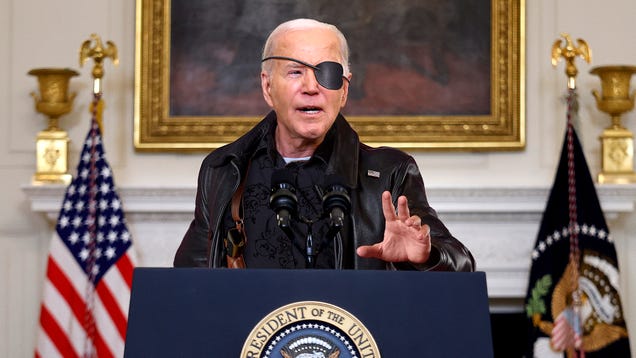
WASHINGTON—Drawing stunned gasps from onlookers as he donned his signature eye patch and leather jacket, the man once known as President Joe Biden revealed Wednesday that he is, in fact, Delta Force operative Captain Robert Scott, on a mission since 1973 to investigate a major government cover-up. “Ladies and…
This post was written by Alison Green and published on Ask a Manager.
It’s five answers to five questions. Here we go…
1. My employee never eats at work
I added a new (and wonderful) person to the team I lead about six months ago. We share an open work space. Most folks eat lunch communally, but sometimes people pop out to buy something or go for a walk. I have noticed that this new employee does not seem to eat the whole time she is at work (about 9-5). She declines snacks/fruit/pastries that we have during team meetings, will sit with folks at lunch and chat but does not eat, etc.
I can’t decide whether I should say something or not. On the one hand, I feel like whether she eats or not is for her and her circle of loved ones/clinical providers. On the other hand, I’m worried that maybe something about the way food is structured in our office (communally) might be a stressor? I work in a high-stress nonprofit job and I don’t want my staff going all day without eating — that doesn’t help anyone’s stress. If there’s something I can change about her environment to make this easier, I want to know and I want to do it. But as her manager, I’m worried asking about this is prying into her life in a way that would make her uncomfortable.
Leave it alone. She’s an adult and can manage her own food intake. There could be all kinds of reasons for what she’s doing — intermittent fasting, preferring to eat later in the day, not liking to eat around others, who knows.
If the facts in your letter were different — like if most people ate hurriedly at their desks and there was pressure not to take much time for lunch— I might advise making sure she felt she could take enough time away to eat. But that doesn’t sound like an issue here, so you can safely leave it alone!
2. My office is angry I didn’t pay for a plane ticket for a business trip after I resigned
This happened about a year ago, but I am not sure if I was in the wrong. After nearly nine years at the same organization at a job I really enjoyed, an opportunity fell into my lap for a new job with more responsibilities and a pay jump. However, at the time, I had pre-booked travel for a conference I attended annually, including paying for the flight. The trip was about a month after I would start my new job. When I resigned, my boss told me I had to pay for the flight, since it was nonrefundable. It was around $650.
My husband and I both thought that was ridiculous and he consulted with a friend who does employment law who said I was under no obligation to repay this. I told my job I wasn’t paying for the flight, I didn’t plan to use the ticket, they could have it, etc.
The way I was treated for my last two weeks was terrible. My boss, who I had formerly been on fantastic terms with (think buying birthday and holiday gifts for my kid), stopped speaking to me. My department (five others) took me to a goodbye lunch. When I said at the lunch that I enjoyed working with everyone, it was dead silence until someone said, “Well, glad we got to leave the office for a free lunch!” This was an organization of less than 50 people, and the CEO didn’t even say goodbye to me. The HR person reminded me repeatedly to return my key before I left. I recently ran into several old coworkers at an event and some of them were still salty about the whole thing. Think not saying hello even though I worked with them for nearly a decade! So … What do you think?
I think that entire office was bonkers. It’s ridiculous to think you should pay for a business trip just because you leave before it happens; if that were the norm, no one could ever safely book business travel since they couldn’t guarantee they’d be there when the trip rolled around. That’s part of the cost of doing business for your company. But far more bonkers than their stance on that is the level of vitriol they directed toward you afterwards — particularly your non-management coworkers, who shouldn’t give one tiny fig about an issue like this. (Not saying hello to you an event?!)
3. Returning to an office where an estranged friend works
In 2022, I had been close friends with two coworkers, Ashley and Stephanie, for about five years. We were all on the same team working remotely but we would get together once or twice per week for TV nights, dinners out, road trips, exchanging gifts, etc. That spring, I found out I would be working in our office overseas for two years. We were all super excited and we discussed visits to my location and trips back home.
That summer, about two months before I was to leave, Ashley and I had a falling-out that was completely my fault. She, rightly and understandably, cut off all contact with me. Ashley and Stephanie remained friends and, while my friendship with Stephanie was strained, we also remained friends.
Now my assignment overseas is coming to an end. They have both returned to in-office work, although on different teams. I will be returning to the office as well and have been assigned to the team Ashley is on. Through Stephanie, I know that Ashley is aware of this.
I have not had any contact with Ashley since I left. At this point, I know we will not be friends and just don’t want to make any problems for her. I don’t know how to approach this. Do I reach out to Ashley? Wait to see if she reaches out? Do I ask about switching to another team?
I would do … nothing! Don’t reach out to Ashley, and definitely don’t ask to switch to another team. Just show up and be pleasant and professional and show through your actions that you respect whatever boundaries she has in regard to you. Treat her the way you’d treat someone you don’t know well but have respect and good will towards.
Depending on the nature of the falling-out, it’s possible she’ll be ready to move past it, or perhaps she won’t. Follow her cues and don’t force any big conversations about it.
Alternately, if you really wanted to, I suppose you could send a note in advance saying something like, “I don’t want you to feel awkward about me returning to the office, so I want you to know that I take full responsibility for our falling-out two years ago, understand your decision to cut ties, and will of course respect the boundaries you’ve put up since then.” But I don’t know, it’s almost reopening the drama. I think you’re better off just showing up and being pleasant and professional, but not familiar.
4. Using a custom email domain when job searching
A nice, low-stakes question about email addresses — as you can see, I’m using a basic firstinital.lastname@gmail.com address, which I’ve had since some time during grad school when I took my husband’s name for the sake of the alliterative initials. (Kidding. Mostly.) But I’ve been considering using firstname@lastname.com instead for job searches. I feel like it’s more impressive somehow, I guess? On the other hand, the reason that we own lastname.com in the first place is the fact that my spouse is an independent contractor and hosts his portfolio and query form there.
Is anyone likely to check out the URL and be confused by that? His business isn’t controversial or anything, but also wildly unrelated to my line of work (think carpentry vs. banking). Does it matter? Am I overthinking this?
Stick with the gmail. The custom domain for your last name won’t strengthen your candidacy in any way; most people won’t even notice it, and those that do are unlikely to think anything of it. But if anyone does bother to go to lastname.com, it could be mildly odd to see your husband’s stuff there. Not a big deal, by any means — but not a plus either. So there are really no advantages to using the custom domain, and one potential small weirdness. Stick with the gmail address; it’s absolutely fine.
5. Should I put being on my condo board of trustees on my resume?
Does being a member of the board of trustees of a largeish condominium belong on your resume if you can point to specific accomplishments? Not in the employment section, of course, but elsewhere?
I wouldn’t unless the specific accomplishments are relevant to the position you’re applying for — like if you’re applying for bookkeeping jobs and you can mention the bookkeeping mess you cleaned up as the condo association treasurer or similar. If it’s specific and relevant, include it.
That said, you can define “relevant” pretty broadly! For example, I’d also include that bookkeeping example if you were applying for an admin job where you wouldn’t be working with finances but want to show organization and resourcefulness as strengths.
This was the first of two cases against Hunter Biden brought by a Justice Department special counsel. Biden also faces tax charges in a separate prosecution scheduled to go to trial in September.
The Consumer Financial Protection Bureau released proposed federal regulations that would prevent unpaid medical bills from being counted on consumers’ credit reports.
(Image credit: Smith Collection/Gado/Getty Images)
Firstly, thank you so much for your response to my letter, and to all the commenters. It was incredibly reassuring and did give me the strength to raise the issue with the interim CEO. One of the commenters, also autistic, said that they felt autistics could be especially vulnerable to emotional manipulation and the feeling that we are always in the wrong — I think that’s partly why I was so twisted up about it and unsure what to do.
I think a lot of people wanted some serious consequences for Jane, which didn’t happen as I didn’t really want that. I could see that she was doing good in some other ways (I’ll explain further down!). I spoke to the interim CEO, who suggested a mediated conversation with an autistic counselor. They were able to express the issues in a much better way than I could have, and Jane apologized. I think she also got a warning from the CEO. She’s since been on a training course with an autistic charity, and we’ve had some really good conversations about autism and how it affects me.
As I said in the letter, the company had a lot of issues relating to discrimination against neurodivergent and black employees especially, and a lot of it stemmed from two members of senior management. Even while the above was going on, Jane was starting to work on that. Those two individuals have now both left the company — one was fired, and one saw the writing on the wall and resigned. It was a stressful period (the one who was fired raised several retaliatory grievances, including against Jane and the interim CEO) but now thankfully is over.
With them gone, we’ve started a DEI audit which will hopefully lead to new policies and training for all staff. I have started to be a little more open about being autistic, but haven’t yet made any company-wide announcements!
Part of Jane’s frustration came from hearing real distress from some of our employees, and feeling that I was part of the senior management and not doing anything about it. I know she was definitely in the wrong to let this lead her to tell someone I was autistic and then telling me that I had a responsibility to share this (and she now agrees and has apologized!) but I do also want to try and be stronger in future in challenging discrimination if I’m in a similar position again (hopefully not).
Thank you so much again for your reply. I was feeling really low but speaking to the interim CEO and Jane, while stressful at the time, ended up with everything in a much better place – and I’m not sure I would have done that without you and all the comments!
A bull named Party Bus escaped the ring during a rodeo in Oregon, hopping the fence and charging into the crowd where it injured three people. What do you think?
In brief: Monday’s showers were hit or miss, with a few areas picking up 2 inches of rain and much of the rest of the area seeing dark clouds but little precipitation. This stormy pattern will continue for two more days before we turn sunny and hot for the second half of the week. Rain chances look to increase again early next week with the influx of tropical moisture. In today’s post, we also share a weather oddity observed on Monday.
Clouds over Houston’s freeways
On Monday a reader, Chris Yetsko, noticed an interesting feature when he was looking at satellite images of the Houston area shortly after sunrise. If you look closely near downtown you can see lines of cumulus clouds briefly firing up to the north. These align with Interstate 45, Highway 59, and Highway 290, just at rush hour. Frankly, neither Matt nor I have ever seen anything like this.
So what’s happening? I can’t say for sure. Cumulus clouds like these form when warm, humid air rises rapidly. When this air encounters colder temperatures aloft, water vapor in the air condenses. We did see some slightly cooler air north of Houston on Monday, so this may be why we see this phenomenon on freeways north of downtown, rather than south of the city where the atmosphere was a little warmer. Freeways, of course, are warmer than surrounding areas due to automobile exhaust. In any case, a fun little meteorological mystery we wanted to share.
Tuesday
The overall setup today is similar to Monday, with plenty of moisture in the atmosphere and a series of disturbances propagating through the area. Therefore, I expect we’ll see the development of fairly widespread showers and thunderstorms later today, predominantly during the afternoon and early evening hours with daytime heating. Accumulations should again vary widely, with some areas perhaps picking up 2 inches or more, and many areas seeing little measurable rainfall. Brief street flooding is possible under the strongest storms. Otherwise, expect partly sunny conditions today with high temperatures in the low 90s.
Wednesday
This should be a similar day to Tuesday, albeit with perhaps less shower and storm coverage during the afternoon and evening hours. Expect highs in the low 90s.
Thursday and Friday
Rain chances don’t entirely go away on Thursday, but they’re probably going to drop into the vicinity of 10 percent. By Friday they should be gone entirely. Thus, I expect these to be mostly sunny days with highs in the mid-90s. The humidity will be slightly lower, so enjoy those mornings and evenings.
Saturday should be the hottest day of the week in Houston. (Weather Bell)
Saturday and Sunday
The first half of the weekend should bring more hot and sunny weather, with most of the area in the mid-90s. However, we can’t rule out a few areas popping into the upper 90s. By Sunday the high pressure ridge that will bring sunny conditions during the second half of this week should be easing off, and it will open us back up to some rain chances. I’ll ballpark them at 30 percent or so, but we’ll need to fine-tune that as we get closer.
Next week
We’re still looking at the possibility of an influx of moisture from a tropical system in the Gulf of Mexico starting on Monday. The forecast is pretty messy, meaning there are a lot of variables in play and the models are struggling to hone in on a solution. My sense is to not be too worried about this. I’m just not seeing much of a signal for a really organized tropical storm to develop in the Southern Gulf of Mexico next week. The primary threat is heavy rainfall, but again all we can really say at this point is that we may see some elevated rain chances next week. We’ll keep watching for you.
Thank you for answering my letter. You were right, it was a really big deal. I was viewing the Jacob-as-my-manager problem from his perspective — until I told him otherwise, it was just a simple one night stand over a decade ago — and it didn’t seem like a huge problem. I hated and appreciated the reality check. I regret reading the comments, but thank you also for moderating them as quickly as you did.
A lot happened in a short space of time (thankfully I already had a therapist!). First, I spoke to my union rep who said, “Say NOTHING but call us if HR tries to set up a meeting with you.” Staying silent and having Jacob independently declare the prior relationship when he arrived would have been problematic because I’d still end up in the same position and I would have lied by omission. Our HR team can be gossipy and they know the age of my half-Chinese daughter, so I needed to have as much control as possible over the disclosure. I spoke to an employment lawyer who reviewed our policies and, at his suggestion, I wrote an email to HR declaring a prior relationship with Jacob.
And then I was immediately pushed out. Even if you have all the legal support in the world, you can’t prevent someone from doing something illegal, you just have recourse afterwards. In a meeting with my lawyer, the union rep, HR, and a member of the senior management team, I was asked to resign. When I said no, they insisted on a statutory declaration about the relationship with Jacob stating what happened, when it happened, how many times it happened (??) and who initiated it (??). I also said no to that. We ended the meeting with each side agreeing to think about possible solutions.
The company’s solution was to start messing with my pay, my benefits, my swipe card access to my office, my computer log in, and my email/calendar account. They spread rumors about me and I heard coworkers whispering that I’d had an affair with a manager. They sent me for a “random” drug test at a time when I was scheduled for an important meeting with clients. They cancelled accommodation that had been booked for upcoming travel, which I only found out about because I was getting paranoid and called the hotel.
I can’t describe how awful it feels to know that someone with this kind of power over your job is devoting their time and energy to thinking of ways to screw with you. Every day I was going into work wondering what was waiting for me and it was wearing me down fast. The advice from the union rep was to go back in time and follow their first piece of advice, or just keep documenting everything as we prepared to take legal action. The lawyer estimated that it would take at least a year to get any kind of resolution, and I didn’t even want the job anymore. By this point, I wasn’t sleeping much and I had cried a few times at work. I was beginning to crack and we were only just getting started.
So, I resigned. I wish I’d held up better under the pressure but it was all just too much with the looming deadline of Jacob’s start date at our office, and whatever way HR was going to drag him into this. I’m lucky that I can take my time looking for a new job, so I’ve had some space to process everything.
Outside of the work stuff, I spoke with a family lawyer who outlined all the possible ways this situation could go, and what the most likely outcomes were. Basically, my daughter is old enough that what she wants would get heavily weighted by a court if it came to that. I have spoken to my daughter many times about her father. I told her what I knew about him and that I had tried to contact him. I’ve offered for her to see a therapist if she ever wanted to talk about it with someone who wasn’t me, and she has always said “thanks, but no thanks.”
The family lawyer helped me write a letter which I left for Jacob. I told him about his daughter, said I wasn’t trying to get anything from him, and gave him the contact details of my lawyer. After a few weeks (of me freaking out that HR had somehow intercepted the letter), he emailed my lawyer. He was the easy-going and practical Jacob I remembered. He was still processing it but said he wasn’t going to take any legal steps, he offered us his family medical history, he apologized if I resigned because of him, and he said he would like to meet our daughter if she’s interested. She also has some siblings. I told her all this, she said she’s happy that she has her father’s contact info but she doesn’t want to meet him right now. She’s of the view that having him in our lives would cause unwanted disruption. And she doesn’t even know about the work clusterfudge.
Highlights from my most recent livestream where I explain how Philosophy Tube is made - also, for Pride Month, queer fiction recommendations! : "Manhunt," "Wrath Goddess Sing," and "Brainwyrms. See Dracula's Ex-Girlfriend ---- https://go.nebula.tv/dex Support me on Patreon ---- https://www.patreon.com/PhilosophyTube
This post was written by Alison Green and published on Ask a Manager.
It’s five answers to five questions. Here we go…
1. An angry ex emailed my boss saying I’m a drug addict
I had a great job as a systems analyst working remotely, but this job coincided with some drama in my personal life. I was dealing with a messy breakup with my ex-partner — I ran a background check on him and learned that he had lied about much of his past, and pretty much everything else. I asked him to move out, and he eventually did, but not without a fight. In a moment of stupidity, I decided to send a group text to about 10 mutual friends of ours and let them know that he was a fraud and a liar, essentially everything I had discovered from the background check.
As a form of retaliation, I suppose, he then emailed my boss and the HR director at the company I worked at and told them I was a drug addict who was goofing off on the clock. He also said that when I was in the hospital, I actually wasn’t, which was a lie. But the whole thing changed my boss’ tune about me entirely, and they began to ask questions.
The reason my ex had their email addresses is because I was in the emergency room a few months prior and I gave him their contact information. I thought it would show that I really was incapacitated, because I was, and my partner could help communicate updates to my boss. Big mistake there.
When my boss started asking for documentation on the hospital visit, I provided it, but then they noticed that my hospital visit was only for three days, but I was out for five days. I needed a few days to recover, so I don’t see what the problem was, but they became very suspicious and in a moment of stress and pressure, I “quit” for health reasons.
How should I have handled that differently? I asked for my job back a few weeks later, explaining that my ex was trying to ruin my reputation, but they didn’t seem interested in taking me on again.
Your boss and HR suck. People generally need additional time to recover after whatever caused a three-day hospital stay; it’s very common to need to be at home for at least a few days after being discharged from a multi-night hospitalization! Even if that wasn’t immediately obvious to them, it should have been once you pointed it out.
I’m curious how things had been going in that job before your ex’s email, and what your relationship with your boss was like. Typically when an employee is in good standing, an email from a stranger with an obvious agenda won’t carry a lot of weight (assuming reasonably competent management — a key caveat), so I’m curious if there had already been any issues that were putting a strain on things at work. I say that not to blame you — you were the victim of a vindictive ex-partner — but simply because I’m trying to make sense of how your boss and HR ended up where they did. Either way, though, their response was horrible. Did they express any concern for you or just move into accusatory mode?
As for what you could have done differently … ideally you wouldn’t have quit, and instead just calmly held firm on the truth: “I was hospitalized for three days and then had two days of recovery at home. I’d be happy to get you documentation from my doctor if it’s needed.” But I wouldn’t second-guess yourself; it sounds like a deeply stressful situation where you had been betrayed on multiple levels by a partner, and then your job started in on you too. Don’t beat yourself up for not making optimal decisions during something like that.
2. My boss lets my employee insult me in meeting after meeting
I am a middle manager in a small nonprofit, having taken over an underperforming team two years ago. I am under a great deal of pressure to perform at a high level while turning them around.
They are not turning. I put the lowest performer on a PIP six months ago and have weekly meetings with the employee and my boss, the organization’s director. We are a small org and she acts as HR.
The HR/PIP meetings are unbearable. My employee spends them insulting me and my boss tells me repeatedly that I cannot respond defensively because that will “affect the process.” One on one, my boss tells me that this process isn’t about me, and my employee has to say her piece. But I can’t imagine repeatedly insulting my boss to her boss and remaining employed. It doesn’t sit right with me. That, and the fact that this has dragged on for six months, has made me question my boss’s actions in this whole matter. Am I correct to question this and should I be looking to get out?
You should be looking to get out. A six-month PIP with no signs of ending? A boss who tells you to sit through meeting after meeting to be insulted so the employee can “say her piece”? She’s said her piece. Repeatedly. PIPs are not couples counseling where everyone gets out all their feelings; they’re intended to be action-oriented — here’s what needs to change, here’s the timeline for when the change must happen by, and here are the consequences if it doesn’t. A couple of months maximum (often ideally less) and with a focus on action, not endless discussions. And on top of that, you’ve been charged with turning around an underperforming team and this is what happens when you try to meet that mandate? And on top of that, the head of the org isn’t willing to act when action is needed (and I’d bet that shows up in a ton of places, not just in managing low performers) — and she wants you to operate in the same way.
Tell your boss (who doesn’t know what she’s doing) that it’s time for the PIP to come to an end and a decision made about this person’s employment. But meanwhile, this isn’t a job — or an organization — structured in a way where you can succeed. Get out and go work somewhere that doesn’t expect managers to manage without giving them the tools to do it.
3. Pressured to sign safety releases against my judgment
The summer I turned 18, I was a junior camp counselor at a sleepaway camp. The campers in my bunk were only four years younger and often out of control (to the point of escaping the bunk repeatedly after curfew). The camp had arranged for their whole age group (multiple bunks of rising high school freshmen) to go on an overnight camping trip, complete with rafting and rock-climbing, organized by our nature counselor but run by a separate outdoor adventure company.
That company required legal waivers for every camper. And so, before we left camp, all of us counselors were given the waivers for the campers in our bunk and told to sign them. The other counselors basically did as they were told, but I didn’t want to sign anything without reading and understanding it. (Recall, I’d just turned 18. This was probably the first legal document I would have been signing in my entire life.) So, I read it, and it asked me to affirm that the camper named could do the activity safely and responsibly and that I knew of no reason they shouldn’t participate, and that I would be responsible for anything that happened. And, frankly, I didn’t trust that some of these kids would act appropriately and not put themselves or others in danger.
I was already getting hassled by more senior camp staff for reading the document (they just wanted quick signatures to get the task done, and the senior counselor in my bunk was out that day). I said I wasn’t comfortable signing and explained why. They tried to pressure me into it, multiple ways. They tried to claim it wasn’t any different than what I’d already agreed to by taking the counselor job. (I think the phrase “in loco parentis” was used.) Somehow I held my ground, at least somewhat — I may have signed a form or two, but not for any campers I didn’t trust … and I think ultimately I put up enough of a fuss that they got some other sucker to sign, or did it themselves. I don’t think anyone ever took my concern about the campers’ participation seriously, though … and it was probably luck more than anything else that nothing majorly bad ended up happening on the trip.
What could I have done here? What should I have done? What should they have done? This is bonkers, right?
You were absolutely right to refuse to sign those forms, and good for you for holding firm in the face of pressure — something that a lot of people find hard to do at 18 (hell, something a lot of people find hard to do at 45). People sometimes like to act as if signing a legal document is no big deal — but believe me, if that were the case, then they wouldn’t need you to sign it at all. The fact that they want you to is what tells you it matters, and you should take it seriously.
I also question if you even had the legal authority to sign on behalf of those campers. Those sound like forms that should have been signed by their parents or guardians; I doubt you even had the legal standing to attest to what the forms said, even if you wanted to. The camp should have coordinated to get the forms signed by parents before camp even started.
You did the right thing. You can always say, “I’m not comfortable signing this.” You were right to refuse — and whoever signed instead of you was probably in the wrong.
4. Navigating small social/networking circles as a manager
I’m a mid-level manager in a professional field that requires a significant training period that’s historically relatively conservative and male-dominated; my particular niche still is heavily weighed to men, especially in leadership roles.
I found my current job when Petunia, a woman I did my training and was friendly with, reached out when a staff opening happened. I was then promoted during the pandemic, so I became Petunia’s boss.
Another woman, Iris, also trained with me and Petunia and works in the same field but a different company. She started inviting a group of women in our field to meet at local restaurants monthly to discuss life over dinner. We talk about work stresses and it is helpful to hear shared perspectives; it has been going on for maybe a year and a half at this point. It’s really nice because there aren’t many women to meet and not any women managers nearby.
Iris knows Petunia, my direct report, is now going through a divorce with small kids at home and wants to invite her too. I feel conflicted. Iris and I are good friends. My answer to Iris was that she can definitely invite Petunia but I should probably bow out of the group as I don’t want to give the appearance of favoritism since I’m the boss. Truthfully, I’ve always been careful about what I’ve said in this venue anyway but would feel totally unable to talk about things, as I’m very private at work and furthermore, even if I wasn’t her supervisor, I wouldn’t want to hang with Petunia.
Iris opted to not invite Petunia so I could come. Now I feel guilty. Did I mess up?
No! You’ve been a part of the group for a year and a half. You explained that you couldn’t continue to participate if they invited Petunia — for very sound reasons — and they opted to ensure that you, an existing member, could remain in the group you’re already in. That’s reasonable. You also didn’t demand they not invite Petunia; you explained what it would mean for you, and they made a decision from there. That’s also reasonable.
That said, if this is practical, maybe you could encourage Petunia and other junior women you work with to form their own group. You could explain the value you’ve gotten from the one you’re part of and suggest they might do something similar.
5. When should I disclose MS?
I have recently been diagnosed with MS. I have a lot of social credit saved at my current workplace so it is not begrudged if I need to take time for a flare. I don’t have many symptoms and rarely need to take time off, but that could change at some point in the future.
If I decide to move jobs, when should I disclose my condition and is it dishonest to “hide” it until it becomes a problem?
You don’t need to disclose it at all until/unless there are specific accommodations you want to ask for. And even then, you generally wouldn’t need to disclose the condition itself, just that you have a need for medical accommodations. (Some people prefer to name the condition, figuring it helps people to have context and understand what’s going on, but that’s completely up to you and your sense of what will be easiest in your particular workplace.)
That’s not dishonest; your personal medical information isn’t your employer’s business.
This post was written by Alison Green and published on Ask a Manager.
It’s a special “where are you now?” season at Ask a Manager and I’m running updates from people who had their letters here answered in the past. Here are four updates from past letter-writers.
There will be more posts than usual this week, so keep checking back throughout the day — there’s more to come today.
It certainly has been a learning experience and implementing some of your suggestions has worked in a lot of ways. I greatly appreciate your help. I think I needed permission to not be as nice as I was and it was helpful that other folks had similar experiences in the comments.
Shortly after receiving your initial advice, this person and I disagreed on a work policy and they blew up at me. They also were having similar interactions with other coworkers on different floors and in different departments. I decided then and there to put your steps into action and also take it a bit further to protect myself and my sanity! I realized I needed to follow my gut and give myself the green light to limit friendships in the office, starting with this one.
What’s worked:
I stopped answering calls and texts from them on my personal devices. If they talk to me about work, it has to be via traditional company channels so I can keep a paper trail. I muted their messages in my cell phone so I am not alerted to their attempts to contact me outside of work hours. If they ask, I just say that I didn’t get it or I was busy and saw it too late. I am busy outside of work so it passes muster.
I have ended my open door policy completely. I used to keep my door to my office open all the time. I do not anymore. If I know that the person in question is on site, I will close my door, lock it and mark that I am in a meeting or busy. It sucks because it restricts my own movement in our building but, it helps discourage them from coming to my space. I have asked if anyone needs me, to message me and ask if I have the time. This gives me the option to say no.
I also stopped speaking to them about any issues or information I have about work or people at work. This means no gossip or information is shared unless about a specific joint project. If they try to come vent to me I say, “I have only a few minutes before my next meeting” to cut the interaction short. If they ask my opinion, I don’t have one. I also do not ask follow-up questions.
As a result, we do not hang out in or out of the office anymore. We do not spend much time speaking other than to go over project details or if they have a question. It is still hard. There is a definitive shift in the energy when we interact. We are still polite, but they are hot and cold with me. Because of the incident mentioned earlier, I am sometimes on edge but the restricted engagement has helped me manage.
I spoke to our human resources person, and she told me that she and the director had already reached out to the local police about coming to the event, and Sam was notified that he is barred from attending it.
They’re still waiting to hear back from the police, so I will be checking in regularly until I hear that they’ve actually agreed to come, and if they don’t, I’ll look into hiring private security or canceling the event.
On the urging of the commenters, I also contacted local law enforcement about Sam, because a) I don’t know exactly what upper management told them and b) I realized that my concerns about Sam won’t end even if this event goes smoothly.
Thanks for running this Ask the Readers question last year! I had a busy day when it ran and didn’t participate in the comments at all. It sure was interesting to look back and see all the assumptions people were making! As I expected, the most useful feedback we received was from people who actually do share successfully home offices. Thank you to all those who shared their experience!
What we took away was the most important thing is to be sure we’re not on calls at the same time to avoid audio interference. So we set up an alternative call space in our bedroom (aka I cleaned off my vanity), and then every morning we compare schedules and decide who’s going to take calls where. We set up the shared office the month before I went on maternity leave, and we’ve been loving it ever since! We both always use headsets and virtual/blurred backgrounds for calls so this works perfectly for us. We also have a clearly defined workspace space away from the baby (who is taken care of by someone else in the house during the day), which was important to us.
So with some good communication we have a super easy solution … no need for my husband to do an hour long commute everyday, share our bedroom with a baby for a year (he moved into his own bedroom at four months and everyone slept 100% better), or my favorite ridiculous suggestion: build a freestanding wired office shed in our tiny backyard. Maybe if we have another kid!
The commenters helped me realize I could ask my 20-something direct report, who was the one I was most worried about, especially since the power differential would have made it harder for her to speak up. She delightedly said that she loves cursive, but that her same-aged family members who grew up in this area generally can’t read it. Like I said in the comments, it doesn’t come up a lot, but it seems reasonable for me to take a second to think about whether cursive is likely to be comprehensible before using it in work-related things.
On February 23, 2001, professor Thomas Guderjan accompanied other Texas Christian University (TCU) researchers and a librarian to the locked door of storage room L10C in the basement of the Mary Couts Burnett Library. The group intended to locate pre-Columbian Peruvian textiles donated to the university between 1995 and 1997, along with pottery and ritual artifacts, in order to move some items to the university’s design department. As an anthropology professor, Guderjan felt excited: He’d heard of the collection’s existence when he joined the faculty the year before, but had never seen it.
But when they entered the room, Guderjan and the others found only a series of plain cardboard boxes of various sizes stacked on wooden pallets. As the group proceeded to search for textiles, they realized they had stumbled onto a crime scene.
Box after box revealed only bubble wrap, while others held only bits of broken pottery. Very few cartons still contained intact objects. The group shared their discovery with Head Librarian Bob Seal, who contacted the TCU Police Department. Detective Kelly Ham, dispatched to investigate the theft, noticed more shards of broken pottery in a hallway close to an external exit. Further investigation later revealed that the thief had, over weeks or months, absconded with the antiquities a few at a time, restacking the empty boxes upside down to show the unbroken tape on the undersides.
Presuming the suspect might return, police and university officials returned the boxes to their original locations, initiated video surveillance, and attempted to prevent the story from leaking.
But after staking out the storage room for a little over a month, police recommended that the university break its silence. In an interview, Guderjan, who now works at the University of Texas at Tyler, recalled that TCU authorities hoped spreading the news might lead potential buyers or associates of the culprit to call in tips for law enforcement. On March 26, TCU’s student newspaper the Daily Skiff broke the news, and two days later the Fort Worth Star-Telegram followed up.
Within days, those stories yielded results.
The thief “extracted three large leaf trash bags full of the pottery.”
On March 29, a private investigator named Janie Brownlee contacted Detective Ham, stating that a confidential informant knew someone who had somehow acquired some of the stolen antiquities. Later that evening, Brownlee asked to meet with Ham at midnight near the intersection of Loop 820 and Granbury Road in Fort Worth, where Brownlee handed over “five black trash bags containing seventy of the stolen artifacts. Eleven … were broken or damaged,” the detective noted in his report.
Houston Police Department officials contacted Ham to say that a 50-year-old man named Ralph Prude had turned over 10 more artifacts. Ham drove more than 250 miles to Houston on March 31 to retrieve the objects and meet with Prude, who named a potential suspect: David Earl Word, a former employee of TCU. Prude also promised to pass along Ham’s number to Word.
On April 1, Ham arranged to meet Word at King Cole Liquor on Richmond Avenue in Houston, where he had relocated after the thefts. During their encounter, Word told Ham that he had entered the TCU library to warm up on a cold night and wandered into the basement where he found boxes labeled “pottery.” Intoxicated, he decided to stuff two or three pieces in his backpack. He continued the pattern over the next few days. One night around 3 a.m., Word and an unnamed acquaintance drove to the university in a van. Word entered the TCU building and extracted “three large leaf trash bags full of the pottery,” according to the TCU police report.
At the end of the meeting, Ham did not arrest Word, who promised to surrender the following day. But Word never showed. Finally, on April 4, Word contacted Ham and again agreed to surrender, and Ham brought him back to Fort Worth.
TCU police later determined that Word stole 105 antiquities valued at $266,200. Most were recovered, though more than a dozen pieces were damaged. But Word never did any prison time. He pled guilty to second-degree felony theft and was given 10 years’ probation and ordered to pay TCU $17,800.
TCU used those payments to pay its insurance deductible. More than 20 years later, the university still displays some of the same antiquities police recovered, though the thefts drew attention to its lack of security.
The incident also raised lingering questions about the university’s original acquisition of the antiquities—and about whether Texas universities and museums in general do enough to vet such donations.
When Donald F. Moorehead, Jr. gave the collection of Peruvian antiquities to TCU in the 1990s, he provided no information about how they came into his possession, according to university records. Moorehead was a corporate waste management mogul, not an art collector or antiquities dealer. Moorehead did provide appraisal reports detailing the approximate era and cultural origin of each item, according to a deed of gift retained by TCU officials. According to that document, peoples from the ancient Andean cultures of modern-day Peru—including the Chavín, Nazca, Mochica, Chimú, Paracas, and Recuay—created the objects.
The collection contained painted pottery and textiles intended for everyday use or ceremonial purposes. It also included anthropomorphic figures, erotic pottery, and portrait stirrup vessels used for chicha, an alcoholic beverage made from fermented purple maize and consumed during religious rituals to pay tribute to the dead.
Archeologists have identified many objects similar to those donated by the Mooreheads, often buried in large quantities in the graves of royals and other elites to assist them in their afterlife. Such grave goods have long been targeted both byart dealers and thieves.
A depiction of the thefts antiquities stored in a library basement, based on university records
Modern-day Peru, home to some of the Americas’ wealthiest pre-Columbian cultures, has a well-documented trail of thefts of its cultural patrimony. The country’s most infamous looting occurred in an active archaeological site centered around the royal tombs of Sipán in Limbayeque. The archaeological community considered Sipán to house “the richest ancient tombs in the New World” when excavations began in the late 1980s, as Peruvian archeologist Walter Alva wrote. He and others found that the wealth of grave goods, such as golden masks and ornate headdresses, interested academics and thieves alike, with the latter raiding the tombs as early as 1987. Stolen objects from Sipán spread on the global black market, finding their way into public and private collections primarily in the United States and Europe.
In 1929, Peru passed a law declaring national ownership of its cultural patrimony and prohibiting the removal of any discovered antiquities. Yet Peru’s law proved ineffectual to prevent ongoing thefts, antiquities trafficking experts say, partly because countries like the United States with active antiquities markets refused to prevent the importation or trade of the items.
The United States has entered into a total of 20 bilateral agreements to protect foreign antiquities since the 1990s. But it balked at adopting a more restrictive proposal crafted by an intergovernmental organization called the International Institute for the Unification of Private Law in 1995 that called for a crackdown on collectors that use dubious acquisition practices.
Many U.S. museums and universities collect antiquities because the ability to catalog and display valuable artifacts elevates their status, reputation, and research capabilities. Prestigious institutions like the Smithsonian and Harvard University regularly invite anthropologists and historians worldwide to study and write about their collections.
An illustration of one of the stolen items, according to police and university records
But according to archaeologist Donna Yates, an expert on the illicit trade, “Most of the antiquities that have been acquired by collectors and museums in the past and that are on the market now are at least illicit in some way, and many are held illegally.” As Yates wrote in the Journal of Financial Crime, in one of several articles on antiquities trafficking, many museums and universities are reluctant to return or refuse donations of questionable provenance “because of desire to compete with other museums or because of a sincere belief that a museum is the best place for the object.”
At times, the value of donated art or antiquities collections might be inflated by fraudsters in order to overstate the value of a charitable gift as a tax write-off. The appraisal process of art and antiquities is highly subjective, and the opinions of ostensible experts are difficult to challenge, Yates said, creating the potential for abuse.
Antiquities-related tax deduction schemes first garnered attention in the 1970s and 1980s when undercover IRS agents exposed criminal networks connected to prominent institutions such as the Getty, the Smithsonian, and the Los Angeles County Museum of Art. Museum officials colluded with art dealers by accepting donations of foreign antiquities that lacked detailed provenance and had been highly inflated. The donors typically “never saw, much less owned, the objects they gave, but lent their names to the transactions in return for generous tax write-offs,” one participant told the Los Angeles Times in 2008.
The Los Angeles Times investigation found that art donors “reap nearly $1 billion in tax write-offs” every year. Few are audited, but “half of the donations checked over the last 20 years had been appraised at nearly double their actual value.”
Such cases have prompted proposals to tighten federal regulation of the appraisal industry and to reduce the limits of deductions. But given that the vast majority of acquisitions are donated, museum officials have warned that lowering the incentive to donate could have serious consequences for the future of public art.
In 1998, Donald Moorehead, the TCU antiquities donor, was inducted into the Environmental Industry Hall of Fame for “outstanding contributions to the waste industry.” Later that same year, Moorehead played a major role in creating the one of the world’s largest trash-hauling businesses. He was “a legend” in the garbage business, according to a eulogy delivered by his niece when he died in Allen in 2022.
During the TCU theft investigation, an expert opined that the value of the items he’d donated to TCU as the Moorehead collection had been inflated in 1996, according to TCU police reports and related documents.
TCU records show that Sue Bergh, then-associate curator at the Cleveland Museum of Art, wrote to TCU’s associate vice chancellor, Larry Adams, via email on March 29, 2001, saying that she believed he should seek another expert opinion and that the initial appraisal of nearly $400,000 for the Moorehead collection was likely high. “If my memory of the value of the ceramics serves, they were overvalued at the time of the gift,” she wrote. (Bergh, retired, could not be reached for further comment.)
According to Guderjan, Moorehead had previously attempted to donate the collection to other institutions before approaching TCU. Guderjan said he suspects the collection was rejected by others because it lacked clear provenance and because, in his opinion, the value was “highly inflated and incorrect.”
Kenneth Linsner, an independent appraiser used to assess the value of the Moorehead collection during the time of the TCU donations, according to a TCU police report, declined to address questions Berge raised in her letter. In an email response to the Texas Observer, Linsner said he had “no recollection or comment” about the specifics. He emphasized that he follows The Uniform Standards of Professional Appraisal Practice, which require the “keeping of records” for “a few scant years and not decades.” (Linsner also said via email that he worked “under contract” with the federal Internal Revenue Service [IRS] from 1983 to 2000.)
The IRS never publicly accused the Mooreheads of overreporting the value of their gifts to TCU, according to the university and court records reviewed for this story. Those donations were made in the names of Donald Moorehead and of his ex-wife Shelley Moorehead. Moorehead died in 2022; Shelley Moorehead did not respond to questions about the donation that were emailed to the Mooreheads’ eldest son.
At the time of their donation to TCU, Donald and Shelley Moorehead lived in Houston’s River Oaks. But, according to TCU records, the objects were shipped from a warehouse in New York City owned by a company called Abbey Art Consultants, Inc. When the shipments arrived at TCU in 1996 and 1997, Nancy Wilson, director of gift planning, expressed concern in a memorandum that the artifacts were “not well packed” and that some objects were either missing or damaged. (Wilson died in 2019.)
In the 1990s, Abbey Art Consultants participated in helping individuals sell or donate antiquities, sometimes reaping tax benefits for their clients. In a deal brokered in 1996, Abbey Art sold lawyer and Mobil Oil employee Joseph B. Williams III a large collection of foreign antiquities. In a contract Williams signed in 1996, Abbey Art guaranteed that the “purchase price shall not exceed 24% of the cumulative appraised fair market value of the art,” court records show. Williams later donated the items to Drexel University in exchange for tax deductions, according to federal court records. Abbey selected the appraisers, recommended the donees, handled the paperwork, packaging, and shipping, and even “agreed to share the risk of inflated appraised values by promising a pro-rata refund of the discounted purchase price.”
The donor was a “legend” in the garbage business.
In the 1997 deal, Abbey Art used three appraisers to evaluate different portions of the collection of articles Williams donated to Drexel University, according to court records.
Kenneth Linsner, the appraiser hired to assess the Mooreheads’ donation, according to TCU records, was also one of the three used to appraise part of Williams’ 1997 donation to Drexel, according to court records. (He was not involved in appraising two other antiquities collections Williams later acquired from Abbey and donated, according to tax court records.) Linsner did not respond to specific questions related to his involvement with Abbey Art. In an email response, he said he “was not an employee of Abbey Art, nor a member of the firm, nor under contract to the firm nor anything but an independent appraiser.”
Available records do not show whether the IRS ever questioned the Mooreheads or Abbey Art about the TCU donation.Federal court records show that more than a decade after donating the Peruvian objects to TCU, the Mooreheads were audited by the IRS. But the audit makes no mention of the antiquities donation, according to a lawsuit the Mooreheads filed to challenge it.
But Williams, Abbey Art’s other client, was audited by the IRS and his dealings with Abbey Art came under scrutiny. In 2007, the IRS issued Williams a notice of deficiency for the tax years 1993 through 2000 involving unreported overseas income and charitable donations of appreciated art, according to civil and tax court documents. The IRS determined that Williams violated tax law by donating art at values far above his purchase price before officially owning it for the required holding period of one year. The agency did not challenge the valuations, but the U.S. Tax Court opined that both the “deeply discounted” prices Abbey’s offered its customers based on bulk purchases of art “in third-world countries” and the appraisals of the objects were “suspect.”
The IRS limited Williams’ charitable deductions to the amounts he paid for the art and charged him penalties for excessive deductions, records show. In 2003, he pleaded guilty to tax evasion and conspiracy to defraud the IRS in the U.S. District Court for the Southern District of New York and was sentenced to 46 months, according to court records. He was released in 2006. (Williams’ attorney declined comment via email; Abbey Art Consultants is no longer in operation.)
In the 1990s, TCU was ill-prepared to properly care for and handle the Mooreheads’ large donation of objects. Left in boxes inside a locked but otherwise unsecured basement, the antiquities were vulnerable to damage and theft.
Thefts from a museum or university collection create an embarrassing situation that can harm an institution’s reputation as a repository of antiquities. Records show that TCU police and administrators carefully curated the narrative released to the Daily Skiff after the theft of the Moorehead collection. On March 28, 2001, Tracy Syler-Doctson, the assistant director of communications, circulated an internal memo providing Guderjan and university librarian Robert Seal talking points to use “when dealing with the media.” Syler-Doctson advised them “not to go into specifics about the security system” but to assure reporters that the university was “reviewing security measures.” The memo mentioned that an inventory taken in February 2000 had verified that all items were secure and that “only authorized individuals had access to the secured archival area.”
But Ham, the TCU police investigator, discovered that over 400 individuals had access to the room that housed the objects, including student workers, faculty, maintenance staff, and instructional services personnel. Dozens of people had unauthorized access to the storage room for at least several months, possibly over a year.
The thief promised to provide “all sorts of juicy information concerning the utter lack of security at TCU.”
The list included Word, the thief, who confessed to Ham that even as a low-level painting contractor he easily copied his key, giving himself long-term access. While incarcerated in the Tarrant County Jail, Word wrote to Ham claiming he planned to give the Fort Worth Star-Telegram“all sorts of juicy information concerning the utter lack of security at TCU.” But there’s no indication that Word gave any such interviews.
Since the 2001 heist, TCU officials say they have taken significant measures to improve security. Once authorities recovered the stolen items, the university placed Miguel Leatham, an anthropologist with an interest in folklore and religious movements, in charge of its care. Leatham ensured that the textiles in the collection received proper preservation in a more secure environment. Only two unnamed TCU officials hold keys to display cases containing pottery, and those cases are monitored by security cameras.
Far from Fort Worth, world-renowned institutions such as the Bibliothèque Nationale de France in Paris have also suffered at the hands of thieves. In 1982, a Mexican lawyer named José Luis Castañeda del Valle posed as a student researching a well-known Nahuatl divinatory manuscript known as the Aubin Tonalamatl in the library. Once granted access, del Valle slipped the codex into his jacket, extracted it from the library, and fled to Mexico. Though Interpol apprehended him, the culprit gained notoriety, claiming he only took the manuscript to return it to its proper home. Mexican and French authorities later negotiated a permanent loan for the record to remain in Mexico’s National Institute of Anthropology and History.
Leaders of the art world in the Global North have long used the lack of security in the Global South as an argument against repatriating antiquities. But antiquities thefts persist in the Global North too. In the summer of 2023, the British Museum fired an employee for stealing jewels from a storeroom that lacked proper security. The thief, like Word, may have been stealing from the museum for an extended period without detection.
Some have argued that cooperation with museums in Latin America poses serious challenges, but any astute visitor to the Lives of the Gods: Divinity in Maya Art exhibit in Fort Worth’s Kimbell Museum of Art last year would have noted that 40 percent of the antiquities on display were loaned by Mexican and Guatemalan institutions. The thefts in Paris, London, and at TCU demonstrate that the Global North can claim no moral high ground regarding antiquities thefts: Objects are vulnerable abroad as they are in their countries of origin.
TCU officials initially viewed the Moorehead donations as an opportunity to enhance the university’s prestige while building a collection that could encourage the study of Latin American cultures. An exhibit brochure from 1997 reveals the donation was met with excitement but little understanding of the material. A brochure described techniques for making Peruvian pottery without providing any cultural context for the artifacts or their use. Only after the theft, when the collection was placed under the care of the Sociology and Anthropology Department, did a clearer picture of the objects begin to emerge.
An artist’s depiction of the handover of some of the stolen items
In the decades following the donation of the Moorehead collection, TCU anthropologists and other researchers have worked to identify the objects’ origin with greater precision. In some cases, they have confirmed the object’s specific culture of origin and narrowed the timeframe to ranges of two or three centuries. However, the objects’ provenance—the specific places of origin and discovery—remains lost to history.
Modern archaeologists routinely record an object’s exact location in any specific excavation site, building, or even room. The lack of such information associated with the Moorehead collection adds another layer of mystery to a troubling history of collecting and displaying pre-Columbian antiquities in the Global North.
Prior to the 20th century, the United States and other imperial powers in Western Europe such as Great Britain and France collected, studied, and displayed antiquities as trophies of their empires. Entrepreneurs and representatives of these nations’ institutions legally collected but also made illicit purchases and in many cases turned to theft. Many early collectors also did not prioritize recording details of their acquisitions, leaving many objects taken from Latin America during the 19th century without identifying information beyond the country of origin.
More recently, David Hidalgo, co-founder of OjoPúblico, a Lima-based online magazine of investigative journalism, helped compile a searchable database documenting details of stolen cultural property from Peru and other countries in Latin America as part of a years-long project called Memoria Robada, “Stolen Memory.” The OjoPúblico investigation has helped expose various smuggling networks that take advantage of loopholes in international laws.
The troubled history of collecting and displaying foreign antiquities in the Global North in general and the Moorehead collection in particular, has forced us, a collection of student authors and a professor at this same university, to reckon with our own difficult questions. Why do collections such as the Moorehead lack provenance information? Have thefts had any impact on how Texas universities and museums accept donations from collectors who have often prioritized wealth, secrecy, and the accumulation of goods over respect for Indigenous cultures? What can Texas institutions do to address the cultural damage done?
In an interview, Yates, the expert on black market antiquities dealing, observed that in the current collecting climate, curators have a greater responsibility both to vet their collections and to shield their institutions from potential litigation.
Some Texas universities, museums, and scholars have already opened lines of communication with Latin American governments—and even found ways to repatriate antiquities. In August, Homeland Security Investigations held a ceremony at Sul Ross State University in Alpine, during which several stolen pre-Columbian antiquities were returned to the Mexican government.
In an interview, Guderjan said that he and others at TCU opened dialogue in the years following the heist with a contact in the anthropological community in Peru about a possible repatriation of the Moorehead items, but the collection ultimately remained at TCU.
Two decades after the theft, the Moorehead collection remains a quiet reminder of the dark legacy of the global antiquities trade—and of the forced disconnect between Latin American communities and their cultural patrimony.
In response to questions, a university official stated the school continues to follow basically the same procedures for vetting or assessing the value of a major donation of art or antiquities, emphasizing that they rely on donors, who are generally required to use what IRS calls “qualified appraisers” on gifts over $5,000 if they plan to seek a tax deduction. “Typically, the donor or an agent for the donor ([often] an appraiser) provides the valuation for gifts,” said TCU Assistant Vice Chancellor Adam Bartell Baggs in an email. “In terms of tax deductions, that’s really between the IRS and the donor and their [certified public accountant]. We do not get involved in those situations.”



/https://static.texastribune.org/media/files/f2a761e6dd3b5f1c38974080deea76db/0528%20Abortion%20Update%20MR%2010.jpg)

/https://static.texastribune.org/media/files/f1c92b0f866ed7b4ef52693a089f48c5/1108%20Lubbock%20Election%20Day%20MR%20TT%2008.jpg)









/https://static.texastribune.org/media/files/a776b5ca7959b23d8dbff34d2c7f440e/image.png)