Click here to go see the bonus panel!
Hovertext:
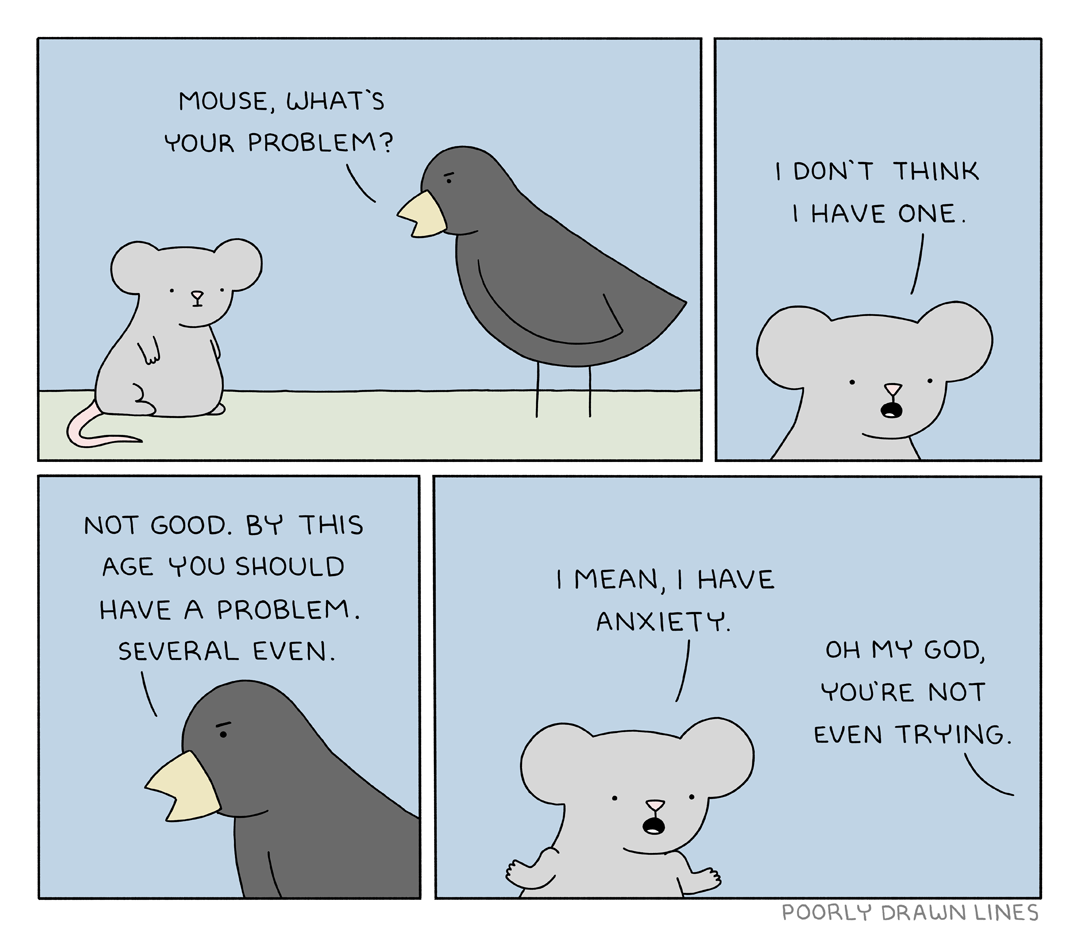
I wonder when someone will invent half-generations to get access to more specific marketing categories.
Today's News:
Hovertext:
I wonder when someone will invent half-generations to get access to more specific marketing categories.
In brief: This post, also published on The Eyewall, reviews the 2024 Atlantic hurricane season which officially ended on Nov. 30. The season will likely be remembered for the Appalachian flood disaster due to Hurricane Helene, and the relatively quick follow through in Florida from Hurricane Milton. Locally, Hurricane Beryl caused significant disruptions due to its wind gusts.
Hurricane season ends today officially, although it’s been quiet for the last 10 days or so. We could still get a surprise, as offseason storms have occurred. The last wintertime tropical system was an unnamed storm in January of 2023 off the coast of New England. Hurricane Alex occurred back in January 2016 out in the middle of the Atlantic. An unnamed storm formed near the Azores in December of 2013. The 2007 Atlantic season continued into December with Tropical Storm Olga, which racked up $45 million in damage in the Caribbean.
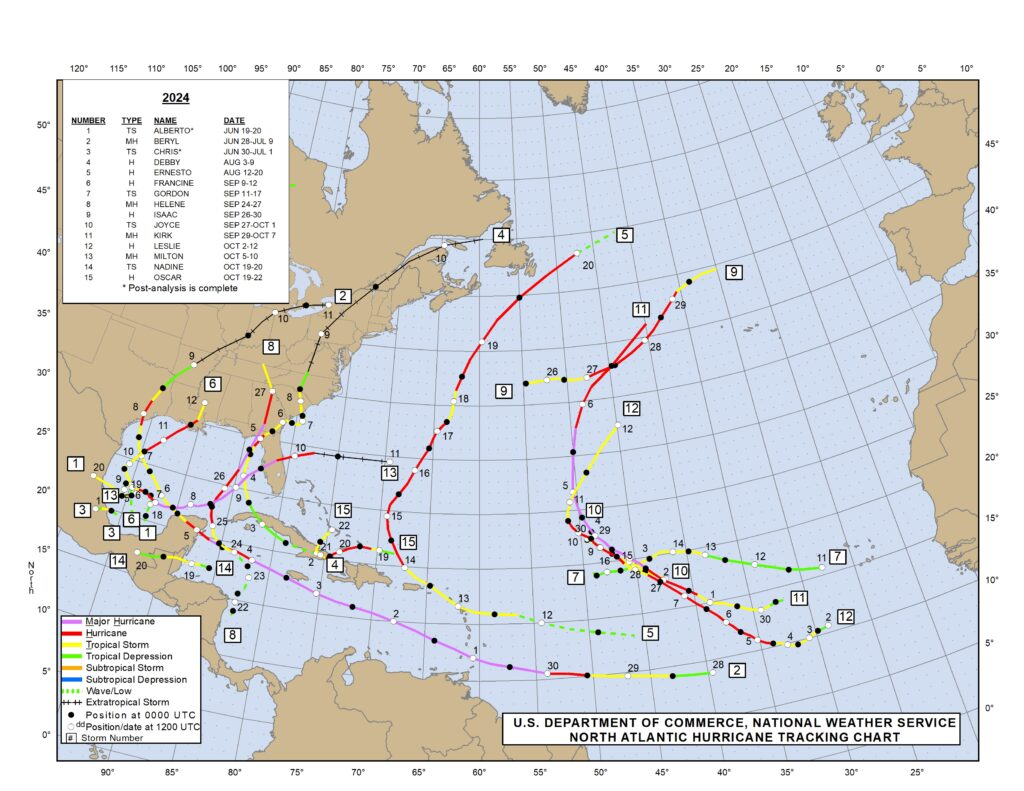
The 2024 Atlantic season will likely be remembered for the Appalachian flood disaster due to Hurricane Helene, as well as the relatively quick follow through in Florida from Hurricane Milton. Helene will almost certainly be retired in the post-season, the first “H” storm to get that treatment since 2017’s Hurricane Harvey. I suspect Milton will also be retired, which would make it the first “M” storm since Hurricane Michael in 2019 to be retired from the list.
The “B” storms are particularly tough to retire, given that they’re usually weaker and earlier in the season. The last “B” storm to be retired was 33 years ago, Hurricane Bob (which this author remembers from being sideswiped in New Jersey as a kid). Beryl will also almost certainly be retired, less so for what happened in Houston and more for what it did to some of the Caribbean islands as a category 5 storm.
The “A” storms are a bit easier to retire, with notable intense storms like Alicia, Allen, Andrew, Anita, and Audrey on the list. Flood events like Allison and Agnes have also been retired.
Storm names are generally retired because they were especially memorable or catastrophic in terms of property damage or loss of life. It’s part of why naming works for hurricanes; if it was an especially bad storm, that name will never be heard again except in relation to that specific storm.
The total damage from this season is likely to top $100 to 150 billion in damage based on various reliable estimates. There’s a much deeper story to be told here. Between various disasters and inflation in recent years, the cost of insurance has risen dramatically. This year likely did not help those problems. Folks like Steve Bowen below, as well as Kelly Hereid and Susan Crawford’s “Moving Day” are very good resources to follow this ongoing story.
Most people tend to focus on the hazard portion of weather / climate risk. Which is important.The next step is connecting the dots so everyone understands that this is a real and growing economic / pocketbook risk.It could lead to a future financial crisis.www.redfin.com/news/florida…
— Steve Bowen (@stevebowen.bsky.social) 2024-11-20T20:40:04.086Z
Back in May, I described the upcoming hurricane season as likely to be an “arduous slog.” It ended up that way in the end, sort of, but a bizarrely silent August threw a massive wrench in forecast expectations this year. NOAA’s official hurricane outlook called for the following:
So overall this was a mixed bag of a seasonal forecast. There were some good calls and some overdone calls. In general, NOAA has actually had a bit of an under-forecast bias, with 4 of the last 5 years verifying above their forecast range.
So, they met the target this year, though the ACE forecast was overdone. Much of this season’s absurdly high forecasts were driven by excessively warm water temperatures in the entire Atlantic basin, as well as the projected development of La Niña in the Pacific Ocean. The warm water temperatures held on all season.

Notably for 2025, we remain near record levels across the Atlantic, except in the Gulf which has mercifully fallen back to just “above normal” levels. So the water temperature forecasts were accurate.
So what about La Niña?

Well, this one is a bit more complicated, but the answer is that it partially verified, yes. The ensemble spread shown by the multiple members in red lines above did a nice job capturing the realistic spread in possible options. And through August, the La Niña seems to have struggled to develop. We seem to be getting there now, sort of, though we are not officially there yet and we may not officially get there. We’re basically ENSO neutral, leaning negative. So while the forecast technically verified within the plume, it did not get to La Niña, which probably had some impact on reducing potential storms.
So what hurt August and why did this season “feel” like it really underachieved? Well, if we look at the variable of “velocity potential” as a proxy for “rising air,” where negative values (blue and purple) indicate more rising air than usual, we can see an interesting comparison to an active stretch like August 15 through September 15, 2020, which produced some hefty storms. Use the slider to see the differences.


Both seasons featured generally significant rising air over Africa and/or the Indian Ocean, much like you would want to see in an active stretch. In 2020, however there was significant rising air over the Atlantic as well, whereas in 2024 we saw significant sinking air present in the Gulf, Caribbean, and parts of the western Atlantic. Interestingly, if you look at the rate of precipitation this year, you see a major difference in *where* in Africa the above normal rainfall occurred.

There was a good deal of talk this year about how the Sahara and Sahel were experiencing significant rainfall, and indeed there was a massive greening in the Sahel this year. Does this entirely explain why the 2024 Atlantic hurricane season was a bit less frenetic than expected? No, but it does offer a possible partial explanation and avenues for research that can help with future hurricane season outlooks.
Overall, there is a lot to unpack about this season. From a damage standpoint it met expectations. From a statistical standpoint, it met some expectations and fell short in others.
You want to know what hasn’t ended? Our annual fundraiser at Space City Weather. However, it does tomorrow. So if you want to support our work here, please follow this link to donate or buy merchandise.

EL SEGUNDO, CA—Revealing that split ends have grown 50% stronger in just the past decade, a new study published Friday by researchers at the L’Oréal Academy warned that overuse of hair detangler was giving rise to new product-resistant supertangles. “When hair detangler was first developed, we arrogantly assumed we would be living in a world without snagging, but now we face an even bigger threat to smooth, silky hair,” said study author Vicki Zhou, explaining that decades of reliance on hair-detangling technology has led to the evolution of supertangles, which can survive the standard chemicals used to improve follicle manageability. “We could be entering a time when even the most powerful oils and silicones are powerless to contain frizz. These supertangles were localized problems at first, but salon overprescription has led to a vicious cycle in which people are dependent on using stronger and stronger hair detanglers to prevent complete knotting, and scientists can no longer keep up. Right now, top L’Oréal researchers are working around the clock to develop new conditioners that can hydrate, strengthen, and detangle all in one, but if that doesn’t work, we could be looking at a world where all hair is matted and clumped.” Zhou also warned against the development of lab-engineered ultra-snags to test out stronger detangling products, citing the dangers of these supertangles escaping their containment facilities.
The post Study: Overuse Of Hair Detangler Giving Rise To Product-Resistant Supertangles appeared first on The Onion.
The post Parents Completely Jacked 3 Months Into Retirement appeared first on The Onion.
Hovertext:
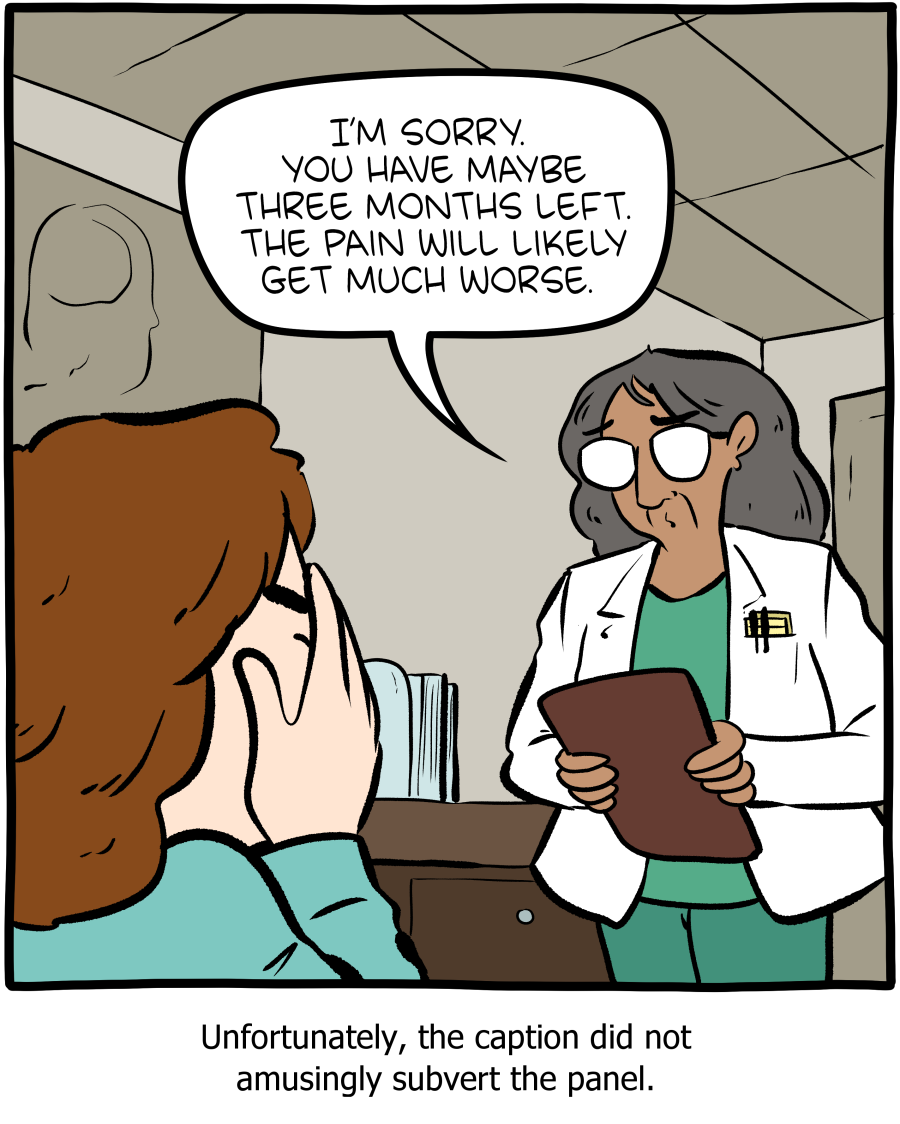
This is like a time machine to SMBC circa 2005.
James Joyce: “Maaaaaam, oh, maaaaaaaaa…”
Albert Camus (to a concerned Big Lots manager): “Lost maman in home goods today. Or maybe it was yesterday.”
George Orwell: “Mom, The Party is holding me at checkout for thoughtcrime (throwing hangers at store security cameras).”
Herman Melville (to Costco employee): “When we find her, please don’t tell mom I said she’s my white whale.”
Emily Dickinson (scribbled on an old receipt and hidden under a dressing room bench):
Mom—ma—
Mother, come—quick, or I’ll be found—
by no one.
Ernest Hemingway: “I’m scared. That’s all.”
Malcolm Gladwell (to a shopper with lots of time to kill in Marshalls): “On the surface, I’m lost. Separated from my mother, plain and simple. But what if I told you this fateful event began way earlier than twenty minutes ago when I got sidetracked by a runaway bouncy ball. No, it begins before me or, likely, you. This story started one hundred years ago with an obscure Slovenian retail design consultant from Ljubljana and the disdain he held for his overbearing mother.”
Elizabeth Bishop (convincing herself she’s fine with losing her mom): “The art of losing isn’t hard to master.”
Ian Fleming (on Nordstrom Rack intercom): “M, this isn’t a secure line. If you’re looking for your phone, I slipped it in a display of men’s dress shoes out of spite for forcing me to come here. You won’t find it without me.”
J. D. Salinger (to Kohls employee): “If you want to hear about the last place I saw my mom, you’ll probably wanna know where I was born, about my lousy childhood, and how many of your dressing rooms have ‘fuck you’ etched into the walls.”
Joan Didion (to sketchy teens behind a strip mall, predicting the fall of brick-and-mortar shopping centers): “The center cannot hold.”
Sophocles (to Burlington cashier): “No, I couldn’t find my mother, but I did see the person I want to marry someday.”
Samuel Beckett (to himself after waiting ten minutes outside the dressing room while his mom tries on jeans): “I’ll wait. But I’ve waited long enough. For what? Her call. Then I’ll wait for her call.”
James Joyce (cont.): “…aaaaaaaaaaaaaaaaaam.”
Glasstire counts down the top five art events in Texas.
For last week’s picks, please go here.

Still image of digital rendering of Notre-Dame Cathedral, Ars Electronica
1. Notre-Dame Cathedral Immersive Experience
Museum of Fine Arts, Houston
November 23, 2024 – January 5, 2025
From the MFAH:
“Following the devastating fire on April 15, 2019 that destroyed the roof, spire, and much of the interior of Notre-Dame de Paris, the iconic Gothic cathedral will reopen to the public on Saturday, December 7, 2024. To commemorate this historic moment, The Museum of Fine Arts, Houston will present an unprecedented immersive experience that brings visitors into a virtual, three-dimensional model of Notre-Dame.
The monumental virtual installation recreates the experience of being in the medieval cathedral’s majestic space, while revealing the extraordinary achievement of those engaged in Notre Dame’s five-year restoration: a team of nearly 2,000, both on site and in workshops across France, including conservators, carpenters, glassmakers, locksmiths, engineers, and scaffolding experts. The presentation showcases the legendary architectural features of the cathedral, including its famed stained-glass windows, as well as the role of new technologies in preserving and communicating humanity’s cultural heritage.”

Citlali Delgado, “Ni Una Mas,” 2024, oil, acrylic and spray paint on canvas, 5 x 7 feet
2. Ecos del Sol: Portraits of Mexican American Heritage and Culture
Museum of the Big Bend (Alpine)
November 15, 2024 – February 15, 2025
From the Museum of the Big Bend:
“The artist in this exhibition celebrate the heritage and culture of Mexican Americans, and more specifically, peoples who identify themselves as Chicano, Bordeña and Fronterizo. The portraits not only document their proud heritage and that of their ancestors, but also address the challenges these generations are faced with today in maintaining and celebrating their culture, ancestry, and traditions.”

Herbert Dunton, “My Children,” 1920.
3. Storytellers: Narrative Art and the West
Briscoe Western Art Museum (San Antonio)
October 4, 2024 – January 19, 2025
From Briscoe Western Art Museum:
“Opening a window into the rich history, culture, and landscapes of the Southwest, the Briscoe Western Art Museum is proud to host Storytellers: Narrative Art and the West, an exhibition that reveals the breadth of narrative art produced in the Southwest from the early twentieth century to today. The exhibition features more than 70 remarkable works curated from the prestigious collections of the New Mexico Museum of Art, the Museum of Indian Arts & Culture, the Briscoe, and private lenders.
A narrative work of art is one that tells a story of a particular moment, or moments, in time. Narratives are often used to illustrate historical events, legends, traditions, myths, fables and religious ceremonies. The exhibition explores the many ways artists have told stories about the Southwest in their art including religious, migratory, historical and rural subjects.”

Chivas Clem, “Cole with Dead Hawk,” 2021.
4. Chivas Clem: Shirttail Kin
Dallas Contemporary
October 17, 2024 – January 12, 2025
From Dallas Contemporary:
“Curated by Alison M. Gingeras, Shirttail Kin presents an archive of 61 photographs spanning over a decade. In a shift from the artist’s usual appropriation-based explorations of pop culture, Shirttail Kin documents a local community of transient men whom Clem frequented upon his return to his hometown after an illustrious career in New York. Turning his attention to his native landscape, Clem captures some of the region’s most pressing issues. His intimate images disclose complex and surprising constructions of masculinity while also capturing an empathetic picture of a misunderstood and largely forgotten population.
After almost two decades in New York… Chivas Clem returned to his hometown of Paris, Texas… The move prompted Clem to encounter a community of transient men, ‘drifters, addicts, and former felons,’ whom he hired to help in the studio. Growing close, the men became Clem’s ‘shirttail kin,’ a colloquial term used in the South to mean one’s chosen family. After establishing a cautious familiarity spanning many years, Clem was able to fully immerse himself among this itinerant subculture, taking pictures but also deepening his personal engagement with his subjects while living alongside them. The 1,600 ensuing photographs are a jarring coupling of vulnerability and feral charisma: models nude, sleeping, having a bath, but also wielding guns or taking drugs. The result is a fraught diary that reflects upon masculinity, class, visibility, desire, trauma, and beauty.”

Jon Langford, “The Cuckoo Is A Pretty Bird.”
5. Jon Langford: The Cuckoo Is A Pretty Bird: New Paintings & prints
Yard Dog (Austin)
November 14, 2024 – December 31, 2024
From Yard Dog:
“Welsh rabble-rouser, painter extraordinaire, punk rock pioneer: Jon Langford (born October 11, 1957) is a prolific and well-respected visual artist whose punk rock instincts and unparalleled draftsmanship come together in a painting style that is distinctive, engaging, and challenging. In addition to his paintings and prints, his artwork appears on CD’s (his own and other’s), book covers, and Dogfish Head Brewery beer bottle labels. His multimedia music/spoken-word/video performance, The Executioner’s Last Songs, premiered at Alverno College in 2005, and has been performed in several other cities, including Austin. He illustrated the comic strip Great Pop Things under the pseudonym Chuck Death. Since 2005 he has co-hosted a weekly radio program, The Eclectic Company, broadcast on WXRT 93.1 FM in Chicago. He has contributed to This American Life.”
The post Top Five: November 28, 2024 appeared first on Glasstire.

Hovertext:
Oddly enough, the hard part was picking jargon NOT to use.
This post was written by Alison Green and published on Ask a Manager.
This comment section is open for any discussion you’d like to have with other readers (work or non-work or possibly even entirely dessert-focused if that’s your bag).
Happy Thanksgiving!





LONDON, ON – A local woman has shocked friends and family by revealing that her favourite comfort show contains neither fantastical creatures, nor grisly true crime homicides. Vanessa Parker, 34, revealed the disquieting news in a shared Instagram story asking users to reveal their comfort show of choice. When Parker revealed hers was the classic […]
The post Weird! Woman’s comfort show doesn’t have any monsters or murder appeared first on The Beaverton.
Americans all across the nation are gathering today to celebrate the Thanksgiving holiday. What are you thankful for?

“That Moldova doesn’t have an extradition treaty with the U.S.”
Bruce Sipiora, Ceramic Patcher

“I’m grateful to be living in the age of the blender.”
Michael Littlefield, Systems Analyst

“Taylor Lautner’s performance in The Adventures of Sharkboy and Lavagirl in 3-D.”
Renata Hanson, Rag Oiler
The post Americans Celebrate Thanksgiving appeared first on The Onion.
The post Macy’s Thanksgiving Day Balloon Floats Away After Handlers Let Go To Check Their Phones appeared first on The Onion.
Families will be at each other’s throats this Thanksgiving. The political divide feels wider than ever, and both sides are digging their heels in. It’s a foregone conclusion that there will be heated arguments. But there’s no need for your bird to get drenched in spittle just because your dad starts claiming ectopic pregnancy is “no big whoop.”
You need a Turkey Poncho.
We know, you’ve heard it before: “A polyester cloak that you slide over your Thanksgiving turkey so it doesn’t get spat on during screaming matches? Not interested.”
Sounds like someone is headed for drool-covered poultry.
Admit it, you’re already worried about seating arrangements. Your uncle just got laid off from the Chrysler factory, and all his hats have American flags on them. Your younger sister recently learned the word “nonbinary” and uses it in every sentence. Your grandpa is openly hostile to women who wear pants. This will not go well.
Don’t let the food suffer. Your turkey’s going to need some protection when your vaccine-hating cousin starts foaming at the mouth, and this poncho’s patented synthetic blend is the best on the market at repelling the conspiracy mist from that mouth.
It doesn’t matter what preparation you’ve put into your Thanksgiving feast, because before the mashed potatoes do a full lap around the table, everyone’s going to be spit-shouting over whether it’s good or bad that America is a nation of immigrants.
For the record, pro-migrant loogies taste just as gross.
Election years are notoriously difficult for shared food. If you want a halfway-edible bird, you need this poncho. It’s even wind-resistant, which will come in handy when your aunt starts hyperventilating because no one else thinks the world is flat. You saw her Facebook post, “If the world is round, why do basketballs stop rolling?” This is the person you’re supposed to have a non-spitty conversation with?
Trust us, Thanksgiving hangs in the balance. Placed on the table between backward-hat nephews who quote Andrew Tate and pale nieces fired up about Roe, your bird is squarely in the Rage Zone, which will result in a sheen of slobber that makes it unappealing to consume. We’re not exaggerating. The average unclothed Thanksgiving turkey typically absorbs up to six tablespoons of MAGA saliva. Eight if the Lions lose.
With each Turkey Poncho order, we’ll throw in a set of fork silencers to be placed on the tines, which blunts the sounds of silverware scraping on plates during seething silences. It’s a chilling noise that inevitably comes before someone says, “The Great Replacement Theory gets a bad rap.”
Then there’s the kids’ table. Typically placed behind an unpleasant plus-one with thoughts on which races should stop procreating, the children are in constant danger of getting hit with stray biscuits. But this can be easily defended by investing in Carbohydrate Riot Shields, which will absorb the buttery blows of all but the most crustily baked bread items.
This all may sound unnecessary to you. After all, what’s to keep us from starting a constructive national dialogue where we approach our differences respectfully, with an aim toward healing our fractured families and making life better for all?
Fuck you, that’s what. They’re coming for our guns.
This post was written by Alison Green and published on Ask a Manager.
I asked last week about unusual office traditions you’ve seen or experienced, and here are 15 of my favorites you shared.
1. The PB&J party
We once had a coworker who was a young, single guy right out of college and living on his own for the first time. He always forgot to buy groceries, so he would bring really random things for lunch every day (one day he brought a jar of spaghetti sauce.) One of my coworkers brought him a loaf of bread and jars of peanut butter and jelly for Christmas so that he could make himself sandwiches.
Thus, the PB&J party was born. That was almost 10 years ago, but now right before Christmas, we all get together, reserve a room and everyone brings something. We have had fancy peanut butters, homemade jams and breads, and various other spreads and different foods-and we all sit around and eat PB&J.
2. The goat shrine
We had a goat shrine. It was just this little alcove with a few pictures of goats and in the center was a little toy goat statue that would scream when you pushed down on it. Whenever someone accomplished something or completed a difficult task they would hit the goat and we would all cheer for them. New hires would hit the goat when they got out of training and got their first real work assignments.
3. The plant cuttings
One of our big departments has a tradition where when an employee retires, they gift her (it’s mostly women) a plant pot with cuttings from all of the office plants in that department.
4. The puffed treat
My team received 2 bags of a highly coveted puffed treat one year. We got through about 1.5 bags before either interest was lost or politeness took over and the last bit was never finished. Nobody could bear to throw it away though so one day one of the team hid it at someone’s desk. This began a multi-year tradition of passing the puffcorn. We competed to have the best, sneakiest, funniest ways to hide it or pass it.
Memorable moments included:
Someone slipping it into a team member’s coat sleeve at a team lunch
Having it mailed to my house during covid
Sneaking into the office when I was supposed to be off to tape it under my co-worker’s desk
It lived for years, survived covid and only died when my team split for other ventures.
5. The 8 Weeks of Doom
At my old job in public education, my office mate invented the concept of the 8 Weeks of Doom. This was defined as the period between New Year’s and Spring Break where it was dark and gray, there were few holidays, and everyone’s seasonal depression hit an all-time high.
To combat the 8 Weeks of Doom, she started a tradition of making me a Doom Calendar, which is an advent calendar but for fighting the Doom. She’d include small fidgets, snacks, stickers, and fun tea, which I’d open whenever the Doom felt very high on a particular day. Eventually this turned into a standing tradition of us making each other Doom Calendars, and the concept spread to our whole department. We would eventually just start our department meetings checking in about how everyone was managing the Doom, and did anyone want to open a Doom Calendar door for a quick pick me up?
Even though we’re not longer office mates, I still exchange a Doom Calendar with this friend every year anyway. It really does help with the Doom!
6. The welcome back
At my internship, on any employee’s first day back from parental leave, they’d be greeted with a full spread of pastries and other treats lovingly prepared by the staff at the on-site cafe for the entire office to share. Anyone who could get away from their desks, even for just a few minutes, would pop by to wish the new parent well.
7. The hiking coupons
When I worked for a national park as a interpreter (tour guide), if we did a particularly good job that day (helped out in a tricky situation, really rocked a program or something), our boss would give us what she called a “Take a Hike” coupon, which was good for one hour of hiking time on work time. (We’d give it back to “redeem” the coupon when we scheduled a time with our boss to go hiking.) We were the perfect audience for that and the boss usually found a reason to give each of us two or three a season.
8. Wacky Fruit Wednesdays
At the start of this year, I realized that I dreaded Wednesdays specifically (I’m in office Monday/Wednesday/Thursday), so I started bringing in fruit I had never tried before from the grocery store to share with my team. This morphed into Wacky Fruit Wednesdays, where my team and people seated near us talk about anything other than work for 30 minutes and try new food.
We’ve tried over 100 fruits at this point, and people have brought in different things like hot sauce and pickles. We pivoted to a paper airplane contest for Ramadan, and it was a blast. This week we tried the miracleberries that convert sour into sweet and ate plain limes. It’s become the highlight of our workweek.
9. The treat log
Back when we had an office, there was a treat table where folks would bring in baked goods to share. We’d write what was brought, since it was often homemade. Folks would usually just tape a sheet on the table with the description scrawled on it. Once, someone left the sheet behind so the next time treats came, the previous line on the paper was scratched out, and a new description got added to the same sheet.
When we ran out of space on that page, a second sheet was taped to the bottom of the first one. Eventually, the taped sheets hit the floor.
The next time treats showed up, someone had folded up the three pages of treat descriptions, written ‘treats.tar.gz’ on it, and taped to the table next to a new sheet. We faithfully kept rotating treats.log from then on!
10. The unicorns
My previous company took computer security very seriously and it was a big deal to lock your computer when you were away from it. If you didn’t, you would send out an email to your team that says “I love unicorns!” and everyone would know your shame. If it was happening to you repeatedly your manager might talk with you about it because you’re making a habit of leaving your computer unlocked.
Then I switched to a security team and things got much sillier. Because we take security so seriously, if you get unicorned twice within a short time your email would say that you’re bringing baked goods next week. Then we switched to our team ALWAYS owing a snack to the team if you get unicorned. We had a unicorn goblet that lived on your desk until you brought in carbs for the team.
We had to make rules about what counts — if you were still in the area of your desk (open plan), between your desk and the door, it didn’t count unless somebody could go to the area next door, get the unicorn mask, put it on, sit at your desk and send an email without you noticing. This was to prove you wouldn’t notice a stranger coming in and using your computer. This exercise was done successfully a couple times!
I was notorious for “badge unicorning” — you’re not allowed to leave your badge sitting around either, and your badge could be used to scan documents and email them ‘from’ you. So I had a unicorn picture I would scan and send to the team if you left your badge at your desk.
11. The fancy garlic
We have some sort of relationship (I’m fuzzy on the details) with some sort of co-op or charity that grows and sells garlic. There used to be an annual sale for the staff, but I guess our leadership team decided it was better to just buy it in bulk, so periodically we each get hand-delivered fancy bags of garlic by management.
12. The rubber ducks
When I was an EA, I used to discretely put one of two little rubber ducks on top of my monitor to indicate the CEO’s mood that day.
I had a low-wall cube in the middle of the open area surrounded by exec offices. The librarian duck (reading a book) meant, “Shhh … maybe not today” and the jazzercize duck (wearing an 80s track jacket) meant, “We’re up and running and getting things done! Feel free to approach.” The other members of the C-suite loved it.
13. The breakfast burritos
For years, I worked in a very strange office with a lot of very strange traditions, but one of the oddest was the inexplicable fervor over Breakfast Burrito Day.
So my office was located in the basement of the building, and the lobby area had this little shoppette. Essentially a gas station convenience store without the accompanying gas station. Every Thursday, the owner of the shoppette used to bring in homemade breakfast burritos to sell. The EXCITEMENT over these breakfast burritos cannot be overstated. People went crazy for these breakfast burritos. Chatter about their arrival would begin days in advance. By Wednesday afternoon, many harried work discussions would invariably lead to someone reassuring whomever they were talking to that “at least tomorrow is Breakfast Burrito Day!” Come Thursday morning, the desire for burritos would reach a fever pitch. People would send envoys up to the shoppette in 15-minute intervals to scope out whether the burritos had arrived yet. Once word was received that the burritos were there, people would gather around the front desk and quite literally swarm upstairs to procure burritos. One time, a group of roughly 20 people started a breakfast burrito conga line that cha-cha’d its way all the way up to the shoppette. After buying the burritos, people would return to the basement like Olympians returning with gold medals.
I partook in Breakfast Burrito Day once with one of my friends. The conga line was what sold us; we just had to try these seemingly life-changing burritos! And reader, I need to make it clear to you how absolutely terrible these breakfast burritos were. They were really, really bad! They were soggy and slimy and bland! We both actually threw most of our burritos away. Not worth any of the hype, let alone a dedicated conga line!
And YET. Breakfast Burrito Day was and remained a weekly beacon of light for many of the basement dwellers (much to my bewilderment).
14. The pranks
In Engineering they started playing pranks on people who were out for any length of time — when one of the managers took a few weeks off to refinish his basement, they built him a basement in his office (basically a loft) but the fire marshal made them take it down. They set up a beauty salon for another manager when he was out for surgery. When the director of QA was overseas getting a new acquisition integrated in, they built him a deck outside his office which had an internal window looking out at the rest of the QA department. There was a mural on the wall, and plants, and a water feature.
15. The emotional support chickens
We have emotional support rubber chickens! If one calls out for help, another responds.
This started with one in each department that mysteriously showed up one morning. My office is locked for compliance when I’m not in it, so my chicken was tucked into my inbox, but most people found their chicken tucked onto their desk amongst their belongings like it settled in on its own.
One long-time beloved coworker ended up moving out of state (but he continued to work very part time for about a month after the move, so he remained in Slack) and one time, he posted a video of someone using rubber chickens to recreate Total Eclipse of the Heart. This prompted someone to send a clip of their chicken honking. Someone took a photo of their chicken in front of their screen with the clip visible in Slack in the background. And then someone else took a photo of their chicken with that chicken in the background. This progressed with dozens of chicken photos.
By the end of that week, every single person with a desk had a chicken.
We do monthly employee appreciation catered lunches and during one, someone brought in a huge, elaborate bird cage with multiple levels and put two rubber chickens in it.
When we’re having A Day, we will honk our chicken and any chicken that can hear will honk back (emotional support chickens, remember?) and sometimes this leads to a chorus of chickens just shrieking their frustration.
Recently, I saw a tiny rubber chicken keychain that squeaks when you squeeze it, so needless to say, myself and my partner (who is endlessly amused by the office chickens) now have tiny chickens that we honk at each other.
WASHINGTON—Revealing that retirees have a lot to look forward to after exiting the workforce, the Federal Reserve Survey of Consumer Finances, published Wednesday, found that the majority of Americans had enough saved for an absolutely incredible single day of retirement. “By the time most people leave the workforce, they’ll have accrued the necessary funds to live it up like an absolute god for 24 hours, enjoying caviar, skydiving lessons, and all the Glenlivet 15 they can handle,” the survey read in part, adding that recent economic gains meant that retirees could probably even buy an original prop from Star Trek: First Contact. “Whether they choose to spend that day renting an RV to explore one or two different states or swimming with a dolphin at an aquarium, Americans generally have enough of a nest egg squirreled away from decades of saving to enjoy retirement from dawn into the wee hours of the morning before the money finally runs out.” An addendum to the report noted that most Americans under 40 only had enough saved for a so-so half hour of retirement.
The post Report: Most Americans Have Enough Saved For Absolutely Incredible Single Day Of Retirement appeared first on The Onion.
The post Manifest Dunce-ity appeared first on The Onion.
WASHINGTON—In a memo that stated they couldn’t even smell the stuff without gagging, officials at the Food and Drug Administration announced Wednesday a plan to ban Captain Morgan rum, citing the fact that they’d had way too much of that shit in college. “Captain Morgan Rum is not suitable for…ugh, we just need to get rid of that disgusting garbage,” FDA commissioner Robert M. Califf said between pauses to suppress his body’s reflexive urge to vomit, adding that Bacardi Raspberry would also be made illegal for human consumption as he finally retched into a mop bucket. “Our data indicates Captain Morgan rum is nasty as fuck. In one study, even the hardest drinkers in our friend group were throwing up by, like, 9:30 p.m. and were passed out in the bathtub a half hour later. In addition, the test subjects were completely hungover for the entire hellish weekend.” Califf, after admitting that maybe he could stomach Captain Morgan rum again now that so much time had passed, reportedly tried taking one sip and instantly puked into his briefcase.
The post FDA Bans Captain Morgan Rum After Having Way Too Much Of That Shit In College appeared first on The Onion.
by Lizzie Presser and Kavitha Surana
ProPublica is a nonprofit newsroom that investigates abuses of power. Sign up to receive our biggest stories as soon as they’re published.
Wrapping his wife in a blanket as she mourned the loss of her pregnancy at 11 weeks, Hope Ngumezi wondered why no obstetrician was coming to see her.
Over the course of six hours on June 11, 2023, Porsha Ngumezi had bled so much in the emergency department at Houston Methodist Sugar Land that she’d needed two transfusions. She was anxious to get home to her young sons, but, according to a nurse’s notes, she was still “passing large clots the size of grapefruit.”
Hope dialed his mother, a former physician, who was unequivocal. “You need a D&C,” she told them, referring to dilation and curettage, a common procedure for first-trimester miscarriages and abortions. If a doctor could remove the remaining tissue from her uterus, the bleeding would end.
But when Dr. Andrew Ryan Davis, the obstetrician on duty, finally arrived, he said it was the hospital’s “routine” to give a drug called misoprostol to help the body pass the tissue, Hope recalled. Hope trusted the doctor. Porsha took the pills, according to records, and the bleeding continued.
Three hours later, her heart stopped.
The 35-year-old’s death was preventable, according to more than a dozen doctors who reviewed a detailed summary of her case for ProPublica. Some said it raises serious questions about how abortion bans are pressuring doctors to diverge from the standard of care and reach for less-effective options that could expose their patients to more risks. Doctors and patients described similar decisions they’ve witnessed across the state.
It was clear Porsha needed an emergency D&C, the medical experts said. She was hemorrhaging and the doctors knew she had a blood-clotting disorder, which put her at greater danger of excessive and prolonged bleeding. “Misoprostol at 11 weeks is not going to work fast enough,” said Dr. Amber Truehart, an OB-GYN at the University of New Mexico Center for Reproductive Health. “The patient will continue to bleed and have a higher risk of going into hemorrhagic shock.” The medical examiner found the cause of death to be hemorrhage.
D&Cs — a staple of maternal health care — can be lifesaving. Doctors insert a straw-like tube into the uterus and gently suction out any remaining pregnancy tissue. Once the uterus is emptied, it can close, usually stopping the bleeding.
But because D&Cs are also used to end pregnancies, the procedure has become tangled up in state legislation that restricts abortions. In Texas, any doctor who violates the strict law risks up to 99 years in prison. Porsha’s is the fifth case ProPublica has reported in which women died after they did not receive a D&C or its second-trimester equivalent, a dilation and evacuation; three of those deaths were in Texas.
ProPublica condensed 200 pages of medical records into a summary of the case in consultation with two maternal-fetal medicine specialists and then reviewed it with more than a dozen experts around the country, including researchers at prestigious universities, OB-GYNs who regularly handle miscarriages, and experts in maternal health.
Texas doctors told ProPublica the law has changed the way their colleagues see the procedure; some no longer consider it a first-line treatment, fearing legal repercussions or dissuaded by the extra legwork required to document the miscarriage and get hospital approval to carry out a D&C. This has occurred, ProPublica found, even in cases like Porsha’s where there isn’t a fetal heartbeat or the circumstances should fall under an exception in the law. Some doctors are transferring those patients to other hospitals, which delays their care, or they’re defaulting to treatments that aren’t the medical standard.
Misoprostol, the medicine given to Porsha, is an effective method to complete low-risk miscarriages but is not recommended when a patient is unstable. The drug is also part of a two-pill regimen for abortions, yet administering it may draw less scrutiny than a D&C because it requires a smaller medical team and because the drug is commonly used to induce labor and treat postpartum hemorrhage. Since 2022, some Texas women who were bleeding heavily while miscarrying have gone public about only receiving medication when they asked for D&Cs. One later passed out in a pool of her own blood.
“Stigma and fear are there for D&Cs in a way that they are not for misoprostol,” said Dr. Alison Goulding, an OB-GYN in Houston. “Doctors assume that a D&C is not standard in Texas anymore, even in cases where it should be recommended. People are afraid: They see D&C as abortion and abortion as illegal.”
Hope visits his wife’s gravesite in Pearland, Texas. (Danielle Villasana for ProPublica)Doctors and nurses involved in Porsha’s care did not respond to multiple requests for comment.
Several physicians who reviewed the summary of her case pointed out that Davis’ post-mortem notes did not reflect nurses’ documented concerns about Porsha’s “heavy bleeding.” After Porsha died, Davis wrote instead that the nurses and other providers described the bleeding as “minimal,” though no nurses wrote this in the records. ProPublica tried to ask Davis about this discrepancy. He did not respond to emails, texts or calls.
Houston Methodist officials declined to answer a detailed list of questions about Porsha’s treatment. They did not comment when asked whether Davis’ approach was the hospital’s “routine.” A spokesperson said that “each patient’s care is unique to that individual.”
“All Houston Methodist hospitals follow all state laws,” the spokesperson added, “including the abortion law in place in Texas.”
“We Need to See the Doctor” Hope and his two sons outside their home in Houston (Danielle Villasana for ProPublica)Hope marveled at the energy Porsha had for their two sons, ages 5 and 3. Whenever she wasn’t working, she was chasing them through the house or dancing with them in the living room. As a finance manager at a charter school system, she was in charge of the household budget. As an engineer for an airline, Hope took them on flights around the world — to Chile, Bali, Guam, Singapore, Argentina.
The two had met at Lamar University in Beaumont, Texas. “When Porsha and I began dating,” Hope said, “I already knew I was going to love her.” She was magnetic and driven, going on to earn an MBA, but she was also gentle with him, always protecting his feelings. Both were raised in big families and they wanted to build one of their own.
When he learned Porsha was pregnant again in the spring of 2023, Hope wished for a girl. Porsha found a new OB-GYN who said she could see her after 11 weeks. Ten weeks in, though, Porsha noticed she was spotting. Over the phone, the obstetrician told her to go to the emergency room if it got worse.
To celebrate the end of the school year, Porsha and Hope took their boys to a water park in Austin, and as they headed back, on June 11, Porsha told Hope that the bleeding was heavier. They decided Hope would stay with the boys at home until a relative could take over; Porsha would drive to the emergency room at Houston Methodist Sugar Land, one of seven community hospitals that are part of the Houston Methodist system.
At 6:30 p.m, three hours after Porsha arrived at the hospital, she saw huge clots in the toilet. “Significant bleeding,” the emergency physician wrote. “I’m starting to feel a lot of pain,” Porsha texted Hope. Around 7:30 p.m., she wrote: “She said I might need surgery if I don’t stop bleeding,” referring to the nurse. At 7:50 p.m., after a nurse changed her second diaper in an hour: “Come now.”
Still, the doctor didn’t mention a D&C at this point, records show. Medical experts told ProPublica that this wait-and-see approach has become more common under abortion bans. Unless there is “overt information indicating that the patient is at significant risk,” hospital administrators have told physicians to simply monitor them, said Dr. Robert Carpenter, a maternal-fetal medicine specialist who works in several hospital systems in Houston. Methodist declined to share its miscarriage protocols with ProPublica or explain how it is guiding doctors under the abortion ban.
As Porsha waited for Hope, a radiologist completed an ultrasound and noted that she had “a pregnancy of unknown location.” The scan detected a “sac-like structure” but no fetus or cardiac activity. This report, combined with her symptoms, indicated she was miscarrying.
But the ultrasound record alone was less definitive from a legal perspective, several doctors explained to ProPublica. Since Porsha had not had a prenatal visit, there was no documentation to prove she was 11 weeks along. On paper, this “pregnancy of unknown location” diagnosis could also suggest that she was only a few weeks into a normally developing pregnancy, when cardiac activity wouldn’t be detected. Texas outlaws abortion from the moment of fertilization; a record showing there is no cardiac activity isn’t enough to give physicians cover to intervene, experts said.
Dr. Gabrielle Taper, who recently worked as an OB-GYN resident in Austin, said that she regularly witnessed delays after ultrasound reports like these. “If it’s a pregnancy of unknown location, if we do something to manage it, is that considered an abortion or not?” she said, adding that this was one of the key problems she encountered. After the abortion ban went into effect, she said, “there was much more hesitation about: When can we intervene, do we have enough evidence to say this is a miscarriage, how long are we going to wait, what will we use to feel definitive?”
At Methodist, the emergency room doctor reached Davis, the on-call OB-GYN, to discuss the ultrasound, according to records. They agreed on a plan of “observation in the hospital to monitor bleeding.”
A sonogram of Porsha’s firstborn on the fridge in the family home. She was excited to have a third child. (Danielle Villasana for ProPublica)Around 8:30 p.m., just after Hope arrived, Porsha passed out. Terrified, he took her head in his hands and tried to bring her back to consciousness. “Babe, look at me,” he told her. “Focus.” Her blood pressure was dipping dangerously low. She had held off on accepting a blood transfusion until he got there. Now, as she came to, she agreed to receive one and then another.
By this point, it was clear that she needed a D&C, more than a dozen OB-GYNs who reviewed her case told ProPublica. She was hemorrhaging, and the standard of care is to vacuum out the residual tissue so the uterus can clamp down, physicians told ProPublica.
“Complete the miscarriage and the bleeding will stop,” said Dr. Lauren Thaxton, an OB-GYN who recently left Texas.
“At every point, it’s kind of shocking,” said Dr. Daniel Grossman, a professor of obstetrics and gynecology at the University of California, San Francisco who reviewed Porsha’s case. “She is having significant blood loss and the physician didn’t move toward aspiration.”
All Porsha talked about was her devastation of losing the pregnancy. She was cold, crying and in extreme pain. She wanted to be at home with her boys. Unsure what to say, Hope leaned his chest over the cot, passing his body heat to her.
At 9:45 p.m., Esmeralda Acosta, a nurse, wrote that Porsha was “continuing to pass large clots the size of grapefruit.” Fifteen minutes later, when the nurse learned Davis planned to send Porsha to a floor with fewer nurses, she “voiced concern” that he wanted to take her out of the emergency room, given her condition, according to medical records.
At 10:20 p.m., seven hours after Porsha arrived, Davis came to see her. Hope remembered what his mother had told him on the phone earlier that night: “She needs a D&C.” The doctor seemed confident about a different approach: misoprostol. If that didn’t work, Hope remembers him saying, they would move on to the procedure.
A pill sounded good to Porsha because the idea of surgery scared her. Davis did not explain that a D&C involved no incisions, just suction, according to Hope, or tell them that it would stop the bleeding faster. The Ngumezis followed his recommendation without question. “I’m thinking, ‘He’s the OB, he’s probably seen this a thousand times, he probably knows what’s right,’” Hope said.
But more than a dozen doctors who reviewed Porsha’s case were concerned by this recommendation. Many said it was dangerous to give misoprostol to a woman who’s bleeding heavily, especially one with a blood clotting disorder. “That’s not what you do,” said Dr. Elliott Main, the former medical director for the California Maternal Quality Care Collaborative and an expert in hemorrhage, after reviewing the case. “She needed to go to the operating room.” Main and others said doctors are obliged to counsel patients on the risks and benefits of all their options, including a D&C.
Performing a D&C, though, attracts more attention from colleagues, creating a higher barrier in a state where abortion is illegal, explained Goulding, the OB-GYN in Houston. Staff are familiar with misoprostol because it’s used for labor, and it only requires a doctor and a nurse to administer it. To do a procedure, on the other hand, a doctor would need to find an operating room, an anesthesiologist and a nursing team. “You have to convince everyone that it is legal and won’t put them at risk,” said Goulding. “Many people may be afraid and misinformed and refuse to participate — even if it’s for a miscarriage.”
Davis moved Porsha to a less-intensive unit, according to records. Hope wondered why they were leaving the emergency room if the nurse seemed so worried. But instead of pushing back, he rubbed Porsha’s arms, trying to comfort her. The hospital was reputable. “Since we were at Methodist, I felt I could trust the doctors.”
On their way to the other ward, Porsha complained of chest pain. She kept remarking on it when they got to the new room. From this point forward, there are no nurse’s notes recording how much she continued to bleed. “My wife says she doesn’t feel right, and last time she said that, she passed out,” Hope told a nurse. Furious, he tried to hold it together so as not to alarm Porsha. “We need to see the doctor,” he insisted.
Her vital signs looked fine. But many physicians told ProPublica that when healthy pregnant patients are hemorrhaging, their bodies can compensate for a long time, until they crash. Any sign of distress, such as chest pain, could be a red flag; the symptom warranted investigation with tests, like an electrocardiogram or X-ray, experts said. To them, Porsha’s case underscored how important it is that doctors be able to intervene before there are signs of a life-threatening emergency.
But Davis didn’t order any tests, according to records.
Around 1:30 a.m., Hope was sitting by Porsha’s bed, his hands on her chest, telling her, “We are going to figure this out.” They were talking about what she might like for breakfast when she began gasping for air.
“Help, I need help!” he shouted to the nurses through the intercom. “She can’t breathe.”
“All She Needed” Hope with his son (Danielle Villasana for ProPublica)Hours later, Hope returned home in a daze. “Is mommy still at the hospital?” one of his sons asked. Hope nodded; he couldn’t find the words to tell the boys they’d lost their mother. He dressed them and drove them to school, like the previous day had been a bad dream. He reached for his phone to call Porsha, as he did every morning that he dropped the kids off. But then he remembered that he couldn’t.
Friends kept reaching out. Most of his family’s network worked in medicine, and after they said how sorry they were, one after another repeated the same message. All she needed was a D&C, said one. They shouldn’t have given her that medication, said another. It’s a simple procedure, the callers continued. We do this all the time in Nigeria.
Since Porsha died, several families in Texas have spoken publicly about similar circumstances. This May, when Ryan Hamilton’s wife was bleeding while miscarrying at 13 weeks, the first doctor they saw at Surepoint Emergency Center Stephenville noted no fetal cardiac activity and ordered misoprostol, according to medical records. When they returned because the bleeding got worse, an emergency doctor on call, Kyle Demler, said he couldn’t do anything considering “the current stance” in Texas, according to Hamilton, who recorded his recollection of the conversation shortly after speaking with Demler. (Neither Surepoint Emergency Center Stephenville nor Demler responded to several requests for comment.)
They drove an hour to another hospital asking for a D&C to stop the bleeding, but there, too, the physician would only prescribe misoprostol, medical records indicate. Back home, Hamilton’s wife continued bleeding until he found her passed out on the bathroom floor. “You don’t think it can really happen like that,” said Hamilton. “It feels like you’re living in some sort of movie, it’s so unbelievable.”
Across Texas, physicians say they blame the law for interfering with medical care. After ProPublica reported last month on two women who died after delays in miscarriage care, 111 OB-GYNs sent a letter to Texas policymakers, saying that “the law does not allow Texas women to get the lifesaving care they need.”
Dr. Austin Dennard, an OB-GYN in Dallas, told ProPublica that if one person on a medical team doubts the doctor’s choice to proceed with a D&C, the physician might back down. “You constantly feel like you have someone looking over your shoulder in a punitive, vigilante type of way.”
The criminal penalties are so chilling that even women with diagnoses included in the law’s exceptions are facing delays and denials. Last year, for example, legislators added an update to the ban for patients diagnosed with previable premature rupture of membranes, in which a patient’s water breaks before a fetus can survive. Doctors can still face prosecution for providing abortions in those cases, but they are offered the chance to justify themselves with what’s called an “affirmative defense,” not unlike a murder suspect arguing self defense. This modest change has not stopped some doctors from transferring those patients instead of treating them; Dr. Allison Gilbert, an OB-GYN in Dallas, said doctors send them to her from other hospitals. “They didn’t feel like other staff members would be comfortable proceeding with the abortion,” she said. “It’s frustrating that places still feel like they can’t act on some of these cases that are clearly emergencies.” Women denied treatment for ectopic pregnancies, another exception in the law, have filed federal complaints.
In response to ProPublica’s questions about Houston Methodist’s guidance on miscarriage management, a spokesperson, Gale Smith, said that the hospital has an ethics committee, which can usually respond within hours to help physicians and patients make “appropriate decisions” in compliance with state laws.
After Porsha died, Davis described in the medical record a patient who looked stable: He was tracking her vital signs, her bleeding was “mild” and she was “said not to be in distress.” He ordered bloodwork “to ensure patient wasn’t having concerning bleeding.” Medical experts who reviewed Porsha’s case couldn’t understand why Davis noted that a nurse and other providers reported “decreasing bleeding” in the emergency department when the record indicated otherwise. “He doesn’t document the heavy bleeding that the nurse clearly documented, including the significant bleeding that prompted the blood transfusion, which is surprising,” Grossman, the UCSF professor, said.
Patients who are miscarrying still don’t know what to expect from Houston Methodist.
This past May, Marlena Stell, a patient with symptoms nearly identical to Porsha’s, arrived at another hospital in the system, Houston Methodist The Woodlands. According to medical records, she, too, was 11 weeks along and bleeding heavily. An ultrasound confirmed there was no fetal heartbeat and indicated the miscarriage wasn’t complete. “I assumed they would do whatever to get the bleeding to stop,” Stell said.
Instead, she bled for hours at the hospital. She wanted a D&C to clear out the rest of the tissue, but the doctor gave her methergine, a medication that’s typically used after childbirth to stop bleeding but that isn’t standard care in the middle of a miscarriage, doctors told ProPublica. "She had heavy bleeding, and she had an ultrasound that's consistent with retained products of conception." said Dr. Jodi Abbott, an associate professor of obstetrics and gynecology at Boston University School of Medicine, who reviewed the records. "The standard of care would be a D&C."
Stell says that instead, she was sent home and told to “let the miscarriage take its course.” She completed her miscarriage later that night, but doctors who reviewed her case, so similar to Porsha’s, said it showed how much of a gamble physicians take when they don’t follow the standard of care. “She got lucky — she could have died,” Abbott said. (Houston Methodist did not respond to a request for comment on Stell’s care.)
It hadn’t occurred to Hope that the laws governing abortion could have any effect on his wife’s miscarriage. Now it’s the only explanation that makes sense to him. “We all know pregnancies can come out beautifully or horribly,” Hope told ProPublica. “Instead of putting laws in place to make pregnancies safer, we created laws that put them back in danger.”
For months, Hope’s youngest son didn’t understand that his mom was gone. Porsha’s long hair had been braided, and anytime the toddler saw a woman with braids from afar, he would take off after her, shouting, “That’s mommy!”
A couple weeks ago, Hope flew to Amsterdam to quiet his mind. It was his first trip without Porsha, but as he walked the city, he didn’t know how to experience it without her. He kept thinking about how she would love the Christmas lights and want to try all the pastries. How she would have teased him when he fell asleep on a boat tour of the canals. “I thought getting away would help,” he wrote in his journal. “But all I’ve done is imagine her beside me.”
First image: Hope now wears his and Porsha’s wedding rings around his neck. Second image: Porsha’s son plays with cards capturing memories of his mother. (Danielle Villasana for ProPublica)Mariam Elba and Lexi Churchill contributed research.
by Melissa Sanchez and Mica Rosenberg
ProPublica is a nonprofit newsroom that investigates abuses of power. Sign up to receive our biggest stories as soon as they’re published.
At first, she didn’t think much about the Nicaraguan asylum-seekers who began moving into town a few years ago. Rosa was an immigrant too, one of the many undocumented Mexican immigrants who’d settled nearly 30 years ago in Whitewater, a small university town in southeast Wisconsin.
Some of the Nicaraguans had found housing in Rosa’s neighborhood, a trailer park at the edge of town. They sent their children to the same public schools. And they got jobs in the same factories and food-processing facilities that employed many of Rosa’s friends and relatives.
Then Rosa realized that many of the newcomers with ongoing asylum cases could apply for work permits and driver’s licenses — state and federal privileges that are unavailable to undocumented immigrants. Rosa’s feelings of indifference turned to frustration and resentment.
“It’s not fair,” said Rosa, who works as a janitor. “Those of us who have been here for years get nothing.”
Her anger is largely directed at President Joe Biden and the Democratic Party for failing to produce meaningful reforms to the immigration system that could benefit people like her. In our reporting on the new effects of immigration, ProPublica interviewed dozens of long-established Latino immigrants and their U.S.-born relatives in cities like Denver and Chicago and in small towns along the Texas border. Over and over, they spoke of feeling resentment as they watched the government ease the transition of large numbers of asylum-seekers into the U.S. by giving them access to work permits and IDs, and in some cities spending millions of dollars to provide them with food and shelter.
It’s one of the reasons so many Latino voters chose Donald Trump this election, giving him what appears to be Republicans’ biggest win in a presidential race since exit polls began tracking this data. Latinos’ increased support for Trump — who says he could use the military to execute his plans for mass deportations — defied conventional wisdom, disrupting long-held assumptions about loyalties to the Democratic Party. The shift could give Republicans reason to cater to Latinos to keep them in the party’s fold.
On the campaign trail, Trump singled out Whitewater after the police chief wrote a letter to Biden asking for help responding to the needs of the new Nicaraguan arrivals. While some residents were put off by Trump’s rhetoric about the city being destroyed by immigrants, it resonated with many of the longtime Mexican-immigrant residents we interviewed. They said they think the newcomers have unfairly received benefits that they never got when they arrived illegally decades ago — and that many still don’t have today.
Among those residents is one of Rosa’s friends and neighbors who asked to be identified by one of her surnames, Valadez, because she is undocumented and fears deportation. A single mother who cleans houses and buildings for a living, Valadez makes extra money on the side by driving immigrants who don’t have cars to and from work and to run errands. It’s a risky side hustle, though, because she’s frequently been pulled over and ticketed by police for driving without a license, costing her thousands of dollars in fines.
One day two summers ago, one of her sons found a small purse at a carnival in town. Inside they found a Wisconsin driver’s license, a work permit issued to a Nicaraguan woman and $300 in cash. Seeing the contents filled Valadez with bitterness. She asked her son to turn in the purse to the police but kept the $300. “I have been here for 21 years,” she said. “I have five children who are U.S. citizens. And I can’t get a work permit or a driver’s license.”
When she told that story to Rosa one afternoon this spring, her friend nodded emphatically in approval. Rosa, like Valadez, couldn’t vote. But two of Rosa’s U.S.-born children could, and they cast ballots for Trump. One of Rosa’s sons even drives a car with a bumper sticker that says “Let’s Go Brandon” — a popular anti-Biden slogan.
Rosa said she is glad her children voted for Trump. She’s not too worried about deportation, although she asked to be identified solely by her first name to reduce the risk. She believes Trump wants to deport criminals, not people like her who crossed the border undetected in the 1990s but haven’t gotten in trouble with the law. “They know who has been behaving well and who hasn’t been,” she said.
Immigrants seeking asylum arrive in Philadelphia in December 2022. They had been bused in from Texas, which has sent thousands of immigrants to cities around the country this way during the Biden administration. (Photo by Ryan Collerd/AFP via Getty Images)In the months leading up to the presidential election, numerous polls picked up on the kinds of frustrations felt by Rosa and her family. Those polls indicated that many voters considered immigration one of the most pressing challenges facing the country and that they were disappointed in the Biden administration’s record.
Biden had come into office in 2021 promising a more humane approach to immigration after four years of more restrictive policies during the first Trump administration. But record numbers of immigrants who were apprehended at the U.S.-Mexico border began to overwhelm the system. While the Biden administration avoided talking about the border situation like a crisis, the way Trump and the GOP had, outspoken critics like Republican Texas Gov. Greg Abbott amplified the message that things at the border were out of control while he arranged to bus thousands of immigrants to Democrat-controlled big cities around the country. In Whitewater, hundreds of Nicaraguans arrived on their own to fill jobs in local factories, and many of them drove to work without licenses, putting a strain on the small local police department with only one Spanish-speaking officer.
While the Biden administration kept a Trump expulsion policy in place for three years, it also created temporary parole programs and an app to allow asylum-seekers to make appointments to cross the border. The result was that hundreds of thousands more immigrants were allowed to come into the country and apply for work permits, but the efforts didn’t assuage the administration’s critics on the right or left. Meanwhile, moves to benefit undocumented workers who were already in the country were less publicized, said Kathleen Bush-Joseph, a policy analyst at the nonpartisan Migration Policy Institute.
The White House did not respond to requests for comment.
Conchita Cruz, a co-founder and co-executive director of the Asylum Seeker Advocacy Project, which serves a network of around 1 million asylum-seekers across the country, said that because of either court challenges or processing backlogs, Biden wasn’t able to deliver on many of his promises to make it easier for immigrants who’ve lived in this country for years to regularize their status.
“Policies meant to help immigrants have not always materialized,” she said.
Cruz said that while the administration extended the duration of work permits for some employment categories, backlogs have hampered the quick processing of those extensions. As of September, there were about 1.2 million pending work permit applications, according to U.S. Citizenship and Immigration Services data, with many pending for six months or more. USCIS said the agency has taken steps to reduce backlogs while processing a record number of applications.
Biden’s attempts to push for broad immigration reform in Congress, including a proposal his administration sent on his first day in office, went nowhere. Earlier this year, in an effort to prevent a political win for Biden before the election, Trump pressured Republicans to kill bipartisan legislation that would have increased border security.
Camila Chávez, the executive director of the Dolores Huerta Foundation in Bakersfield, California, said Democrats failed to combat misinformation and turn out Latino voters. She recalled meeting one young Latina Trump supporter while she knocked on voters’ doors with the foundation’s sister political action organization. The woman told her she was concerned that the new immigrant arrivals were bringing crime and cartel activity — and potentially were a threat to her own family’s safety.
“That’s our charge as organizations, to make sure that we are in the community and educating folks on how government works and to not vote against our own self-interests. Which is what’s happening now,” said Chávez, who is the daughter of famed farmworker advocate Dolores Huerta and a niece of Cesar Chávez.
Trump has made clear he intends to deliver on his deportation promises, though the details of how he’ll do it and who will be most affected remain unclear. The last time Trump was elected, he moved quickly to issue an executive order that said no “classes or categories” of people who were in the country illegally could be exempt from enforcement. Tom Homan, who Trump has picked to serve as his “border czar,” said during a recent interview with Fox & Friends that immigrants who were deemed to be a threat to public safety or national security would be a priority under a new administration. But he said immigrants with outstanding deportation orders will also be possible targets and that there will be raids at workplaces with large numbers of undocumented workers.
The Trump campaign did not respond to a request for comment.
Mike Madrid, a Republican strategist, said it’s wishful thinking to believe Trump will give any special treatment to undocumented immigrants who have been living and working in the U.S. for a long time. But he’s heard that sentiment among Latino voters in focus groups.
“They believe that they are playing by the rules and that they will be rewarded for it,” Madrid said. “Republicans have never been serious about legal migration, let alone illegal migration. They’re allowing themselves to believe that for no good reason.”
Sergio Garza Castillo, who owns a gas station and convenience store in Del Rio, Texas, had long voted for Democrats. But his frustration with border policy led him to vote for Trump this year. (Gerardo del Valle/ProPublica)The Republican Party’s growing appeal to Latino voters was especially noticeable in places like Del Rio, a Texas border town. As ProPublica previously reported, Trump flipped the county where Del Rio sits from blue to red in 2020 and won it this year with 63% of the vote.
Sergio Garza Castillo, a Mexican immigrant who owns a gas station and convenience store in Del Rio, illustrates that political shift. Garza Castillo said he came to the U.S. legally as a teenager in the 1980s after his father, a U.S. citizen, petitioned and waited for more than a decade to bring his family across the border.
Ever since Garza Castillo became a U.S. citizen in 2000, he has tended to vote for Democrats, believing in their promise of immigration reform that could lead to more pathways to citizenship for long-established undocumented immigrants, including many of his friends and acquaintances.
But the Democrats “promised and they never delivered,” Garza Castillo said. “They didn’t normalize the status of the people who were already here, but instead they let in many migrants who didn’t come in the correct way.” He believes asylum-seekers should have to wait outside the country like he did.
He said he began to turn away from the Democrats in September 2021, when nearly 20,000 mostly Haitian immigrants seeking asylum waded across the Rio Grande from Mexico and camped out under the city’s international bridge near Garza Castillo’s gas station. Federal authorities had instructed the immigrants to wait there to be processed; some remained there for weeks, sleeping under tarps and blankets with little access to water and food. Garza Castillo said he and other business owners lost money when the federal government shut down the international bridge, an economic engine for Del Rio.
Some of the Haitian migrants were eventually deported; others were allowed into the U.S. to pursue asylum claims and given notices to appear in court in a backlogged immigration system that can take years to resolve a case. “That to me is offensive for those who have been living here for more than 10 years and haven’t been able to adjust their status,” Garza Castillo said.
He hopes Trump seizes on the opportunity to expand support from Latino voters by creating a path to citizenship for undocumented immigrants who’ve been here for years. “If he does that,” he said, “I think the Republican Party will be strong here for a long time.”
Anjeanette Damon, Nicole Foy, Perla Trevizo and Gerardo del Valle contributed reporting.

Don’t bite the hand that feeds you McDonald’s.
You can lead a horse to water, but you can’t make him use an all-gender bathroom.
It takes a village to run the Department of Government Efficiency.
Two wrongs do make a right-wing conspiracy theorist.
Wow, that costs an arm and an egg!
The early bird gets the brain worm.
When the going gets tough, the tough google “how move country?”
Childless cat lady got your tongue?
Fool us once, shame on us. Fool us twice, shame on us.
It’s not whether you win or lose; it’s how soon you find a coping mechanism.
Keep your friends close and your friends with disaster shelters closer.
The road to hell is paved with the President’s Collectible Trading Cards.
Honesty is the worst policy.
People who live in White Houses shouldn’t throw tantrums.
They’re barking up the wrong coconut tree.
It’s like taking candy from a baby you were forced to have.
The ball’s in your Supreme Court.
You made your bed; now you have to tell lies in it.
He’s throwing caution to the windmills.
If at first you don’t succeed, try to blame the elimination of the Department of Education.
We’re hanging on by the skin of our non-fluoridated teeth.
Money talks; wealth whispers, “Thanks for the huge tax cut.”
It’s always darkest before the post-election family dinner.
It’s like a Fox host guarding the henhouse.
Better never than late.
Birds of a feather get sick together because they’re unvaccinated.
You can teach an old dog new crimes.
Where there’s a will, there’s a way Will has an opinion about what women should do with their bodies.
RFK Jr.’s curiosity killed the cat. And the bear. And the dolphin.
Bad things come to those who are Gaetz.
If only an apple a day kept Dr. Oz away.
Where there’s smoke, there’s a former reality star saying, “Yuh fired!”
Lie down with dogs, wake up with Elon as your best friend.
Crypto doesn’t buy happiness.
Reach for the moon—even if you miss, you’ll land among the Border Czars.
Hope for the best, but prepare for the worst things you’ve ever heard a president say.
Don’t put all your eggs in one basket, because the future of IVF is uncertain.
There were plenty of fish in the sea.
Beauty is in the eye of the beholder of five children by three different women.
Home is where the heart has irregular palpitations (thanks to yet another breaking news story).
Absence makes the heart miss Biden.
One man’s junk is the reason a cabinet member is in trouble again.
Special Counsel Jack Smith requested that all federal charges be dropped against President-elect Trump over his alleged efforts to overturn the 2020 election, saying that he “stands fully behind” the allegations in the indictment but that Justice Department guidelines made clear he could not prosecute a sitting president. What do you think?

“Still, a good resume builder.”
Corbin Webster, Denim Embroiderer

“Yeah, I always check out of my job around this time of year too.”
Melanie Sabo, Unemployed
“Looks like somebody’s gunning for a cabinet position.”
David Khalil, Plug Tester
The post Jack Smith Drops Election Interference Case Against Trump appeared first on The Onion.
If you’ve spent any time at your local state park, your local body of water, or your local abandoned granite quarry turned rock climbing haven, then I’m sure you’ve seen me. I was probably leading a hiking group, a kayaking expedition, or belaying for a group of middle schoolers on a YMCA-sponsored after-school trip. If so, then you saw me in my element, for I am a guy in a Patagonia UV hoodie, and I have never been indoors.
I was born in the fresh fall air to a mushroom-foraging father and a reiki-healing mother. My parents opted for an outdoor water birth, and I entered into this world in a stock tank on an organic farm where my parents spent the year WWOOF-ing.
Shortly after my birth, my parents embarked on a three-year RV excursion along the entire Pan-American highway from Prudhoe Bay, Alaska, to Tierra del Fuego. At fourteen months, I took my first steps at the top of Machu Picchu and climbed my first mountain in Patagonia (the region, not the store) a year later.
Growing up, my days were spent camping with my family, camping with my scout troop, or camping at summer camp. The Montessori school my parents sent me to was in a treehouse built by my classmates and me. That was our kindergarten class project. By ninth grade, we knew how to fell a ponderosa pine and quarter saw it for lumber with nothing but hand tools.
After high school, I studied environmental science at one of those colleges in California where the classes are held outside and all the professors have dreadlocks. The only “building” was the dean’s office. And it was less of a building and more of a canvas yurt.
Since then, I’ve had several different occupations. I was a park ranger at Zion, a whitewater rafting instructor on the Snake River, and a lumberjack in West Virginia. Each time, I lived in a tent right next to my place of work. I refuse to do any job that requires a commute of more than twenty paces.
The closest I’ve ever come to living indoors was the six months I spent on a sailboat while teaching scuba diving in the Keys. But that doesn’t count. Because on a boat, a door is called a “hatch.”
I have been with many women, but my only long-term relationship is my torrid, lifelong affair with Mother Nature. I make love at the tops of fire towers, behind waterfalls, and nowhere else. “Beds” are for gardens and rivers.
My hobbies include rappelling, lead climbing, soloing, and spelunking. If there’s a rock and some rope, I’m there.
I hiked the AT in hard mode: August in Georgia, December in Maine. You haven’t lived until you’ve done the Knife Edge Trail at the top of Katahdin when it’s forty below.
I don’t go to the doctor, because you don’t need health care when you walk sixty thousand steps a day.
I always know which way is north, what local plants are edible, and where to find the nearest rock shelter in case of a squall. Yes, I know what a “squall” is. Doesn’t everyone?
I grow my own weed. I make my own soap. I know the difference between the call of a Carolina wren and the call of a northern mockingbird imitating a Carolina wren.
I have never used a toilet that flushes.
The sound of the forest is my white-noise machine. The only blanket I need is a blanket of stars. The only pillow I need is moss.
I have never been indoors. Unless you count my annual trip to Patagonia (the store, not the region) to buy UV hoodies.
Do you really think I’m the kind of guy that wears sunscreen?
This post was written by Alison Green and published on Ask a Manager.
Over the years, readers have submitted a tremendous number of amusing stories about holidays at work. Here are some of my favorites.
1. The thief and the hero
At a temp secretarial job back in the day, the owner had a buffet set up for the employees as an appreciation lunch for completing a particular project (which was why I was there to temp since it was an all-hands/emergency situation).
One of the very well-paid senior employees took an entire tray of meatballs and an entire tray of pasta off of the buffet line, after the managers/seniors went, but before any of the other employees, who had to take a slightly later lunch that day. When called on it, he said that he needed it to feed his kids for the week – and the owner said if the only way he could feed his children was by stealing from his job and taking food from lower-paid employees, he was welcome to it. But the owner would be accompanying him to the food stamp office to apply or reporting him to CPS if he refused, because feeding his children should be his first priority and if his children could only be fed by stealing, that wasn’t something that could be ignored. It turned into a public argument about how the owner was shaming him for liking expensive things and needing a little help sometimes. Ended up as the employee’s last day. (2022)
2. The divinity candy
Around the holidays, it’s not unusual for our office break room to contain an assortment of treats gifted to us from vendors or customers. Several years ago during this most festive time of year, I noticed a tray of what looked like divinity candy sitting out on the break room table. Divinity is not my favorite holiday candy, but it was early in the season, and the pickings were slim, so I decided to have a piece. Just as I took a bite, a coworker walked in and said, “Oh! You’re trying out my candy – let me know what you think of it!”
By this time the bite had well and truly settled on my palate, and let me tell you, I had opinions. Being a polite sort of person in real life, I was hesitant to tell her what I thought (which would have been difficult without swallowing, which was not an option at this point), but I can tell you – it tasted like a dog turd rolled in powdered sugar. Or what I assume a dog turd would taste like, having never sampled a dog turd myself. I stepped around my coworker to grab a paper towel to ostensibly wipe my mouth (and discreetly spit out the offending “candy’), then turned back around to address my coworker. “I don’t think I’ve ever had anything like it,” says I, in what I hope was a pleasant voice. “What’s it called?” Coworker replies, “I haven’t really thought of a name for it – it’s just something I experimented with.” Then she tells me how she made it.
Y’all. It was mashed potatoes. And not even real potatoes, but the boxed potato flakes. Prepared in the normal way with butter, milk and salt, then mixed with peanut butter, Karo syrup, and powdered sugar, then rolled in another healthy dose of powdered sugar. Dear coworker had made too many mashed potatoes for dinner the night before, and in an effort not to waste food, had decided to try her hand as a confectioner. I’m having flashbacks of the nauseating flavor and texture just typing this out. So gross. So, so gross. I mumbled something polite that probably came out as more of an “Oh! Hrrmm, interesting” or similar, then bolted from the room to warn the rest of my coworkers NOT to try the “divinity” in the break room. (2023)
3. The baby boom
My former company had a fancy dinner at a hotel party with an open bar. It was a great event. Many people got hotel rooms but my spouse and I went home. I must have missed something because HR sent out an email saying that in the future there would be a two drink limit, beer and wine only, no shots or hard liquor.
And as a side note, almost exactly 9 months later there was a minor baby boom in the company. (2022)
4. The bacon monitor
In one of my last jobs, our party planning committee, used to do company-wide catering for most major holidays. I swear, every single time we did a breakfast one and included bacon, we always had to have a member of the committee stand watch as the ‘bacon monitor’ and count how many pieces of bacon each person had. Apparently, a few years before I started, some people would pile a plate full of nothing but bacon, and no one else would get any. (2017)
5. The homemade gifts
I worked in the children’s department of a public library for many years. Being quirky, creative people, we decided that our department of 7-9 (depending on year) would hand-make ornaments for one another each year, and unwrap them together at a mini party the day before the holiday when the department was always dead. We would bring homemade snacks too, so it was all good fun. Typically these ornaments consisted of a funny saying or item we encountered over our year in the department (hilarity happens surprisingly often as a public servant).
One year, my coworker painted the silhouette of our boss (who we had caught sleeping in their office chair once), which was received with cacophonous laughter. Another year, a woman had blatantly sworn up and down to one coworker that a part of one of the toy food kits her kids took home had never existed … “I remember there was no potato!” About a week later, she silently snuck into our department one afternoon, dropped the offending plastic potato on our desk without a word, and slunk out. So my other coworker (who had already deleted the plastic potato from our kit) poked a hole in it, strung it up, and wrote “There was No Potato!” on it for her gift recipient that year. Hilarious. So figure simple, silly things like that were always the basis for the ornaments.
But the one that takes the cake, for all the years before and after, was the “Snowman” cookie cutter. We loaned out cookie cutter kits to the general public. This was always met with a certain level of squick, since who knew if they were ever washed before or after, but they were one of our highest circulating items. One day, a woman came up to the counter to check out a package of Christmas themed cutters. She was ahem’ing quite loudly so me and my coworker went to check it out. Immediately we noticed the problem. Someone, possibly months or years prior, had taken the snowman out of the bag and re-bent it for a bachelorette or something similar. We knew this because upon closer inspection, the snowman was now a penis.
Both of us laughed so hard we almost peed our pants. We deleted the “Snowman” from the kit and let the woman check out the rest of the items. Why she still wanted to bake cookies with her kids using THAT set, knowing what it was previously used for, was beyond us. All was well for many months until our gift exchange … when we discovered someone on staff had not only rescued the penis cookie cutter from our trash, but had tied a glittery ribbon on it, and wrapped it up as their gift that year! Several of us burst into hysterics and one super conservative person was very much not amused.
More stringent guidelines about what constituted a handmade gift followed in years after. (2023)
6. The revenge
A coworker at a place I used to work at got fired shortly before Christmas. On the day of the holiday party, while all the remaining employees were at the restaurant, she snuck into the office and glued all the mugs in the break room to the floor. (2023)
7. The salsa
My coworker used to bring her ‘famous salsa’ to every potluck. It was just three different brands of store-bought salsa mixed together. She even made a (completely serious) production of preparing it in the kitchen, like she was Julia Child. Pro tip: The trick was to ‘fold’ the salsa to get the best flavor. (2022)
8. The remark
I work for a small family-owned company. Each Christmas, the owners, would host a fantastic Christmas party at their home with A LOT of wine. Years ago, a coworker’s wife got really drunk. As she and coworker were leaving, my boss said in a joking tone, “Are you sure you don’t want one more glass of wine?” To which she replied, “Why don’t you eat my ass?”
We haven’t had alcohol at a holiday party since. (2017)
9. The cookies
When I was fresh out of college, I worked in a government office that was cuckoo for Christmas: a secret Santa ornament exchange, a big holiday party, a ladies-only holiday party (???), and cookie day. Legend day has it that in past years, the office had several women who loved to bake and got a real kick out of making one million (metaphorically, but close enough) cookies, then spending a lunch break piling them into huge gift platters and distributing them to all the other departments. Although these women had all since retired, the tradition had continued and I received an email requesting I bring in TEN BATCHES of cookies for cookie day. This email only went out to the women in the office, and this industry at the time skewed heavily towards men so that was maybe 20% of the office.
I actually love to bake, but gritted my teeth a little over the sexism of only asking the women. Even more concerning was the cost – I’d only been working full time for 3 months and December was coming in expensive, 10 batches was going to be a stretch. But the email reminders were increasingly filled with pressure to participate, reminders to ‘clear your weekend!’ to bake cookies. It was a brand spanking new job, my first full time one ever, so I decided I could afford to make six batches and if anybody had the nerve to hassle me about it further they could take it up with payroll.
Cookie day rolled around and it turned out I wasn’t the only one resentful of being strong-armed to “bake all weekend” for strangers in other departments. My coworker walked in late while everybody (every woman, anyways) was already plating, didn’t say a word and dropped one lone box of Oreos on the table. And I mean DROPPED, from a foot or more above the table so it landed with a thud that got everybody’s attention. Then she turned on her heel and left. It’s been 15 years and I have never seen another action as perfectly, beautifully passive aggressive. It still makes me laugh 15 years later. (2023)
10. The cursed walk
A friend’s company always does their year end party in January for less stress and more bang for their buck. The first year I went, it was roaring 20’s themed in a rented out basement night club. I did multiple shots of tequila, including while linking arms with their CEO. We rallied friend’s department to the 24-hour diner three blocks away, and during that walk: three people got lost and called multiple times because they couldn’t figure out how to pull up google maps, the team lead started accusing us of kidnapping him, then puked on my shoes, then accused me of stealing his phone while trying to call his cab, resulting in an awkward conversation with a passing cop. The next year, it was a daytime event with drink tickets and a very specific “NO SHOTS, not even if you pay out of pocket” rule, complete with signs on the bar. (2023)
PALM BEACH, FL—Sighing as he pulled on the head of a gargoyle while searching for a secret entrance to his old closet, Barron Trump reportedly returned home from college Tuesday to find his mother, Melania Trump, had converted his room into an unending labyrinth of darkness. “I know she always wanted a cold, inescapable void in the house, but I’ve only been gone a few months, and now I have nowhere to put my stuff,” said the youngest Trump child, who expressed frustration that a sudden breeze blew out every torch he tried to light in the ceaseless network of stone corridors. “I realize that I don’t live here anymore, but it’s super annoying to bypass the Minotaur every time I need to grab my shoes. I don’t even mind that she changed it—I just wished the creeping vines weren’t constantly rearranging the maze behind me. It took me four hours to find my bed, and I couldn’t even sleep because of all the whispering ethereal voices. Now I can’t find my way back, and every time I look in a mirror I realize I’ve returned to the beginning. Maybe I just need to tie a rope to myself or something like that.” At press time, sources confirmed Barron was running headlong into the void after hearing a low growl as something gnawed through his rope.
The post Barron Trump Returns Home To Find Melania Converted Room To Unending Labyrinth Of Darkness appeared first on The Onion.




/https://static.texastribune.org/media/files/7976438f34d462fa7cfbc3c592c99708/20241118-Villasana-Abortion-Deaths-42_preview_maxWidth_3000_maxHeight_3000_ppi_72_embedColorProfile_true_quality_95.jpg)