City leaders, who will be elected in May, will have just a short window to decide what services to provide, like police or fire, and how to tax residents.
Secretary of State Marco Rubio has announced plans to make sweeping cuts to the State Department, which he called “bloated” and “bureaucratic.” What do you think?
“Nobody has ever been able to explain to me what the rest of the world does anyway.”
Shane Demke, Laundry Appraiser
“We could easily cut 75% of the world’s countries and be fine.”
Lyle Bosen, Cord Wrapper
“High-level statecraft is best left to contractors.”
MONTREAL – A new study into your workplace’s efficiency habits has found that all the meetings you zone out in at work could easily have been replaced with an email that you would’ve pretended to skim over. “Research shows that workers who sit in a meeting and start daydreaming will only retain 3% of the […]
I was asked to see if I could find the brand new student worker who was supposed to be staffing a front line desk, as everyone who walked past noticed no one was sitting there. I happened to go around the desk — and discovered her sitting underneath the desk, absorbed with her phone. (She’d taken off her shoes, for an added touch.) I politely asked her to sit in the chair. She climbed out from under the desk, said something about not feeling “people-y” today, and sat in the chair, eyes never leaving her phone.
• • • •
Working as Corp Trainer at a call center. CEO comes storming down to our offices asking who owns a car with a car wrap on the hood that says “Cocaine Queen.” We find out whose car it is and tell them they can’t park the car in the office parking lot because it isn’t appropriate. She gets indignant and tells us that it is her “stage name” she worked nights as an exotic dancer. When we tell her that is fine, but it can’t be parked in the parking lot, she tells us that she picks her kids up from school and no one has ever said it wasn’t appropriate.
• • • •
This wasn’t their fault at all but I’ve never forgotten it. I happened to look out the window as one of the new hires was walking towards the building. He noticed that there were geese in the fountain and detoured to go look at them. They had nested and if you know anything about Canadian geese, they can be vicious! The geese started chasing him, he freaked out, ran around to get away from them, slipped on the geese poop, landed on his back in the grass, and had 4 geese honking at him. Poor guy came in covered in poop and wet grass. I told him to go home and we would try again tomorrow.
• • • •
We had a guy apply for a staff job. His very first day he was helping clean up brush along the edge of a mountain biking course. One of the other staff said “when you’re done with that axe, I need it,” and the new guy proceeded to say “OK” and THROW THE AXE AT HIM. It went within a yard of his torso. New guy’s first day was his last day. He protested that he didn’t mean to hurt anyone, he just didn’t think about the risk, and was told “Look, we know you didn’t mean it, but you’re so stupid you’re dangerous.”
• • • •
Let’s talk about the most surprising first impressions you’ve seen made by new coworkers. Please share your stories in the comments.
I read Ask a Manager every day and have a suggestion for the site. I’m always delighted when I click on a post and it turns out to have a bunch of updates — those are the most fun to read! I think readers would enjoy a category on the Topics page that’s specifically for posts with more than one update. Maybe you could call it “Sagas” or something like that? Sometimes I want a solid distraction and the multiple updates always deliver, but as far as I’m aware there’s no way to specifically pull up a list of posts that have them. Just something to think about if you ever add new categories. Thanks!
MARYVILLE, TN—Relying on a precise measurement as though a slight miscalculation could be lethal, local woman Anna Gardner, who is said to be on a diet, reportedly weighed out peanut butter Thursday like it was hard drugs. Several reports indicated that Garner precisely laid a dollop of the Jif peanut butter onto a kitchen scale and removed the excess with a knife to make sure it was the right amount as if she were portioning out a Schedule I substance that she planned to sling to junkies on the streets. According to sources, upon licking a bit of the peanut spread off the knife’s blade, Gardner let out a sigh of pleasure and said “That’s the stuff” in the manner of a notorious drug lord who, after testing out the purity of her product, runs the knife across her own cheek and mutters “I’m loco.” At press time, reports confirmed a blissful Garner was passed out on the couch with an empty glass of peanut butter and banana smoothie by her side like a woman strung out on black tar heroin.
SILVER SPRING, MD—Emphasizing that these guidelines had already been issued to the public plenty of times, the U.S. Food and Drug Administration released a passive-aggressive safety alert Thursday reminding Americans that the serving tongs were there for a reason. “We just thought we’d let everybody know that serving tongs are not there for decoration, they are there to be used,” read the statement, the impetus for which was said to be the fact that the American public had “apparently forgotten how to use them” and needed its memory refreshed. “We’re not sure why we have to keep reminding you, since you seem to love buffets—this is your third plate, right? And before you all bother asking: No, it doesn’t matter if you managed to take one cookie and not touch the others. No, you won’t get sick from touching the tongs that everyone else touched. No, we don’t believe you when you say you’ve thoroughly washed your hands before approaching the food. Seems like you should have picked up on this by now, but we’re sure you have a really good reason to think you don’t have to follow the rules like everybody else.” At press time, the FDA had reportedly followed up with a condescending step-by-step video demonstrating how to use serving tongs.
VATICAN CITY—In a stunning discovery that revealed the full extent of the pontiff’s addiction, Vatican coroner Fernando Ruini released a report Thursday confirming Pope Francis died of a eucharistic overdose. “Our autopsy found the Holy Father had a substantial amount of Eucharist in his system— roughly four times the legal limit—at the time of death,” said Ruini, who added that measurements of the pope’s blood of Christ (BOC) were consistent with those from someone who had communed with Jesus for decades. “It’s a wonder he lived as long as he did given his clear dependency on letting God into his heart. By the end, he was probably getting the Blessed Sacrament once or twice every day just to function. There are also some signs he was mixing in other sacraments—penance, the anointing of the sick, or whatever he needed to hit that spiritual high he got off his first communion wafer.” The coroner added that he wouldn’t let anyone he loved get behind the wheel of the popemobile with the late pontiff’s level of blessedness.
Compiled while sitting through a three-hour public hearing and rethinking life choices.
- - -
Are you a citizen trying to understand urban planning? A newly minted planner who keeps accidentally saying “zoning entitlement” in casual conversation? A mayor who treats public hearings as open-eyed nap practice?
You’ve come to the right glossary. Only planners can magically turn a small park into a placemaking activation node. This glossary features definitions that tell the real story. Look for the one not-real-term-but-should-be.
- - -
Active Transportation – Walking, biking, scooting, and other low-carbon ways to arrive at a meeting to discuss why it’s too hard to walk or bike anywhere.
Affordable Housing – Technically, housing that costs no more than 30 percent of your income. Practically, a rhetorical device used in PowerPoints to mean everything and nothing. (NOTE: See “Sustainability”).
Area Plan – A document designed to organize land uses, dreams, and disappointment within a five-block radius.
Community Engagement – A process by which planners and public officials hear from the public and then email each other privately about how they have already made a decision.
Complete Streets – A street for everyone: pedestrians, drivers, cyclists, people with strollers, delivery robots, Cybertrucks, and that one guy who always walks in the bike lane while texting.
Cul-de-Sac – Latin for “your kids can skateboard here, but good luck getting a bus.”
Density – A word that makes planners swoon and neighbors write angry letters to the editor.
Developer – A person with money and vision. Sometimes, too much of the first and not enough of the second.
Environmental Review – A sacred ritual to determine whether a proposed project will harm the planet, the squirrels, or—realistically—someone’s ability to watch said squirrels.
Fluff Corridor – A line of bike lanes, planters, and public art created solely for press photos.
Heat Island Effect – The confluence of concrete and paving that makes you feel as if you’re wearing an all-black all-wool suit on a sweltering summer day.
Missing Middle Housing – Housing that exists only in diagrams, wistful blog posts, and the books and reports buried in your planner friend’s tote bag.
Mixed-Use – A building that contains both coffee and sadness.
NIMBY – Stands for “Not in My Backyard.” From the Old English nimm bæc yarde, meaning “no change shall occur within sightline of my bird feeder.”
Placemaking – Hanging string lights, taking photos, and calling it a success.
Public Realm – A liminal zone between private interests and pizza slices. Includes sidewalks, benches, and that one fountain nobody wants to fix.
Sustainability – Technically, meeting present needs without compromising future generations. Practically, a rhetorical device used in PowerPoints to mean everything and nothing. (NOTE: See “Affordable Housing.”)
TOD (Transit-Oriented Development) – Housing located near high-quality transit service, which is rumored to exist in several North American cities.
Traffic Calming – A strategy to convince cars that they are not the main character in their own biopic.
Urbanist – Someone who considers sidewalk width to be a moral issue, and they may or may not have written a thesis paper about it.
View Corridor – A magical pathway through buildings, designed to ensure your Instagram sunsets stay uninterrupted by pesky housing units.
Zoning – A highly rational system for separating land uses, emotions, and lawsuits.
- - -
This glossary is incomplete, evolving, and entirely dependent on public comment. Please leave your suggestions in the form of a Post-it note on a foam board in the community center lobby between 2:15 and 3 p.m. on a Tuesday.
The 2023 report cards are finally out for Texas public schools, and as expected, grades took a tumble virtually across the board.
Texas public districts and schools saw a sharp drop in their academic accountability ratings under a revamped rubric that made it harder for them to score top ratings in 2023, according to results released Thursday by the Texas Education Agency.
Nearly two-thirds of the A-through-F district ratings fell by at least one letter grade, while one-third of district ratings didn’t change. Those trends played out in the Greater Houston area, where 14 of the largest 20 districts dropped at least one letter grade and the remaining six held on to their rating.
To see results for each school and district, click here for the TEA’s ratings website.
The TEA planned to publish the scores in the fall of 2023, but the release was delayed due to a lawsuit filed by school districts that argued state officials violated the law in crafting the tougher standards. Scores from 2024 haven’t been released, either, due to a separate lawsuit filed by districts.
Accountability ratings are largely based on various measures tied to standardized test scores, including overall performance, rates of growth and comparisons to other districts and schools. Graduation rates and measures of readiness for life after high school also factor into ratings for districts and high schools.
Here are some of the biggest takeaways from the 2023 scores for Houston-area districts, including Houston, Katy, Aldine and Pasadena ISDs.
HISD trended down before takeover
Under Texas’ accountability system, each district and school grades a 0-to-100 rating, which is then converted into a letter grade that follows the traditional A-through-F scale. All of the Houston region’s 20 largest districts saw their numerical rating fall in 2023 compared to 2022.
But HISD carded the sharpest decline of the group, falling from 88 to 72. The fall largely resulted from a large drop in reading and math growth relative to the rest of the region.
The 2023 scores, which are primarily based on spring test results, marked the last accountability rating before Texas Education Commissioner Mike Morath replaced HISD’s school board and appointed Superintendent Mike Miles to run the district. HISD’s accountability rating from 2023 did not contribute to the ouster of district leaders.
HISD posted significant gains in test scores and accountability ratings in Miles’ first year, district administrators said, though official ratings for 2024 haven’t been released.
Higher-income districts held steadiest
Critics of Texas’ accountability system often point to the fact that districts in wealthier neighborhoods rarely get low ratings, while it’s difficult for districts in lower-income parts of Texas to excel.
The updated grading system will do little to dispel that complaint.
In the Houston area, the five larger districts serving the fewest lower-income students — Conroe, Clear Creek, Katy, Pearland and Tomball ISDs — saw small drops in their ratings relative to the rest of the region.
Tomball scored the third-highest rating out of the state’s 100 largest districts, earning a rare A grade. Katy and Pearland lost their A grades from 2022, though they still scored 88 and 89 overall, respectively.
Aldine fell to the bottom
Among the 100 largest districts in Texas, none scored worse than Aldine ISD in 2023. The district carded a 63 rating, down from 77 the prior year.
Districts that serve high percentages of lower-income, emergent bilingual and at-risk students are much more likely to score lower ratings under Texas’ accountability system. But as the Houston Landing documented last year, Aldine has fallen behind districts serving similar types of students since the arrival of Superintendent LaTonya Goffney in 2018.
Aldine board members and many community members remain supportive of Goffney, a popular leader across the state and nation. The district made moderate progress on its standardized test scores in 2024, though it’s not yet clear whether the growth is enough for the district to shed its D grade.
Galena Park, Pasadena shined
The two eastern Harris County districts serving large numbers of lower-income Hispanic and emergent bilingual students topped many similar districts by earning B grades.
Galena Park ISD, home to roughly 21,000 students, lost its A grade but saw its overall score modestly slip from 91 to 85.
Pasadena ISD, which serves nearly 50,000 students, narrowly kept its B grade as its score fell from 86 to 81.
KIPP, IL Texas took a dive
For decades, many charter school advocates have pointed to above-average test scores as evidence that charters outperform traditional public schools.
But two of the Houston area’s largest charter operators — KIPP Texas Public School and International Leadership of Texas — posted sharp drops in accountability ratings that resulted in D grades. The two networks received scores of 69 and 68, respectively, in 2023 after both notching 86 ratings the prior year.
The tumble followed some of the state’s worst rates of growth on math and reading test scores, historically an area of strength for KIPP Texas in particular.
KIPP Texas runs 32 schools in the Houston area and 22 other campuses spread across the state. Greater Houston is home to 11 of International Leadership of Texas’ 26 schools.
Three of the state’s largest charter networks with a Houston footprint — YES Prep Public Schools, IDEA Public Schools and Texas College Preparatory Academies — each scored B ratings.
On Monday, the State Bar of California revealed that it used AI to develop a portion of multiple-choice questions on its February 2025 bar exam, causing outrage among law school faculty and test takers. The admission comes after weeks of complaints about technical problems and irregularities during the exam administration, reports the Los Angeles Times.
The State Bar disclosed that its psychometrician (a person or organization skilled in administrating psychological tests), ACS Ventures, created 23 of the 171 scored multiple-choice questions with AI assistance. Another 48 questions came from a first-year law student exam, while Kaplan Exam Services developed the remaining 100 questions.
The State Bar defended its practices, telling the LA Times that all questions underwent review by content validation panels and subject matter experts before the exam. "The ACS questions were developed with the assistance of AI and subsequently reviewed by content validation panels and a subject matter expert in advance of the exam," wrote State Bar Executive Director Leah Wilson in a press release.
Joe R. Villarreal, 2024. Image courtesy of City of San Antonio Department of Arts & Culture
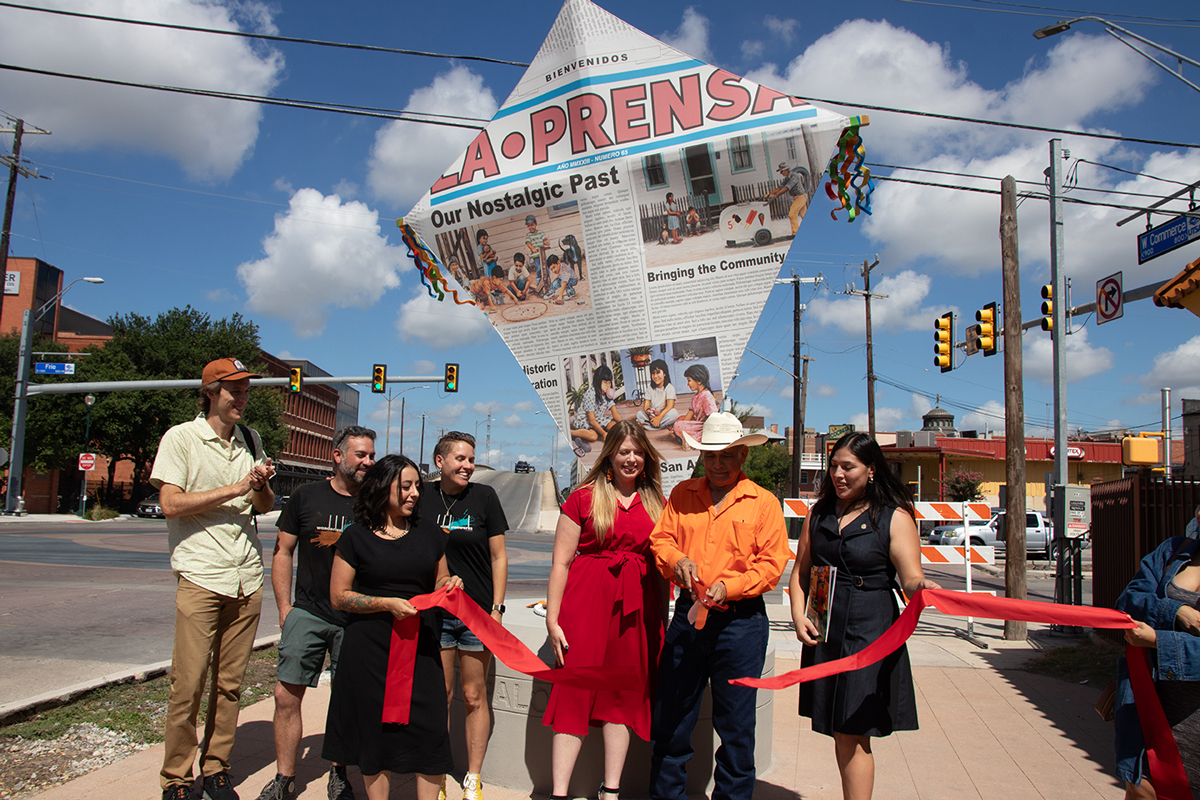
In June 2024, Mr. Villarreal achieved a longstanding dream by completing two permanent public art commissions for the City of San Antonio. The pair of painted steel sculptures, titled El Papalote and El Trompo, are positioned at the intersection of North Frio and West Commerce Streets as an informal gateway to the West Side, referred to locally as “El Mero Weso,” the heart of the city’s Mexican American population.
Krystal Jones, Director of the City of San Antonio Department of Arts and Culture, said in an email to Glasstire, “Joe R. Villarreal’s work has always been a cherished part of our community, but with El Papalote and El Trompo, we’ve been able to bring his legacy into the public eye in a way that truly honors his impact. These vibrant sculptures, accessible to everyone, serve as a lasting tribute to his talent and passion. Their unveiling last June was a momentous occasion, and now, even more so, [they symbolize] the enduring joy and connection Joe’s art continues to inspire in San Antonio.”
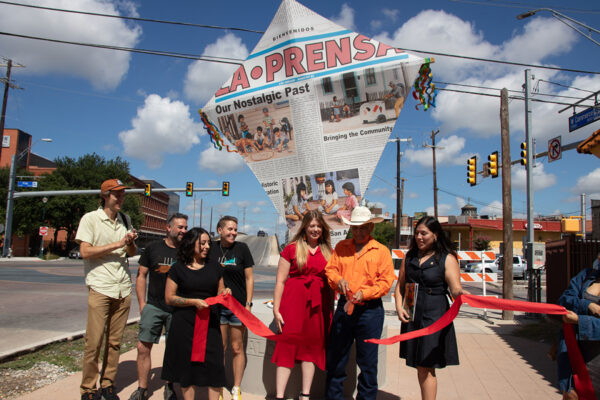
Joe R. Villarreal at the ribbon cutting for his public art sculptures, 2024. Image courtesy of City of San Antonio Department of Arts & Culture
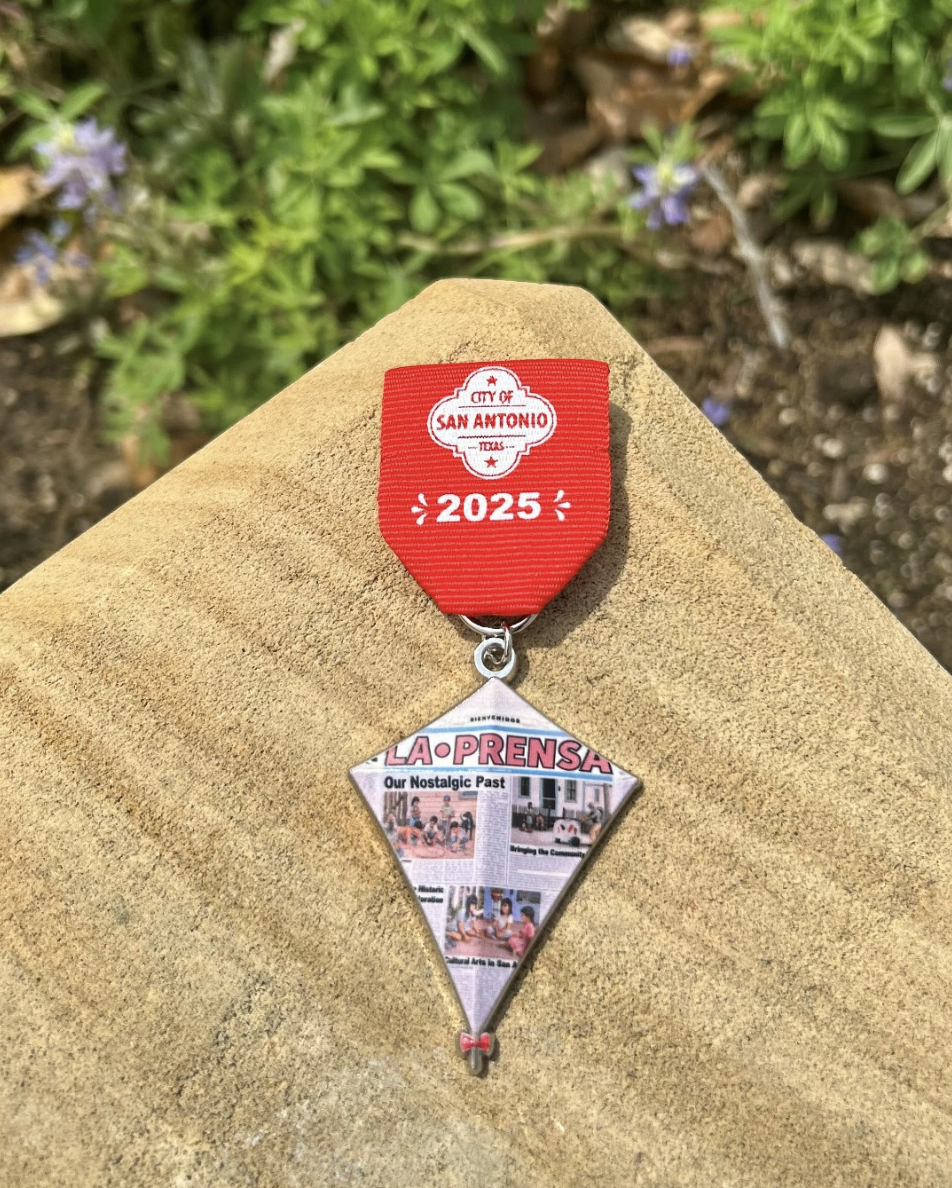
El Trompo is a 12-foot-high depiction of a child’s rainbow-colored spinning top, and El Papalote is a similarly large-scale representation of a kite made from a folded La Prensa newspaper, the San Antonio-based bilingual news outlet that first published in 1913. Family members and friends converged on the sculptures with flower bouquets and remembrances to commemorate the artist after hearing of his death.
Mr. Villarreal studied commercial art at Fox Tech High School, where he graduated in 1971, then learned from artist Warren Hunter at the Hunter School of Art in San Antonio. He worked as an illustrator, graphic designer and display designer at Southwest Research Institute for 22 years, continuing to illustrate by hand even as other illustrators were replaced by digital processes. Upon retiring at age 70, he dedicated himself full-time to artmaking, culminating in the two public sculptures.
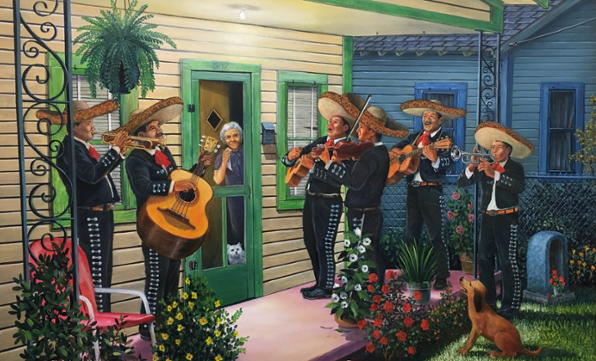
Joe R. Villarreal, “Las Mañanitas de Mi Madre,” 2002, oil on canvas
Mr. Villarreal’s paintings of Mexican American working-class life, including mariachi serenades, children playing marbles in the yard, and an abuelas’ tamale-making party among other nostalgic subjects, were frequently made into popular prints that hang throughout the city’s West Side in private homes and such stalwart restaurants as Ray’s Drive Inn.
Tommy’s Restaurant posted on Facebook, “No one captured the soul of what growing up in San Antonio was like better than him.”
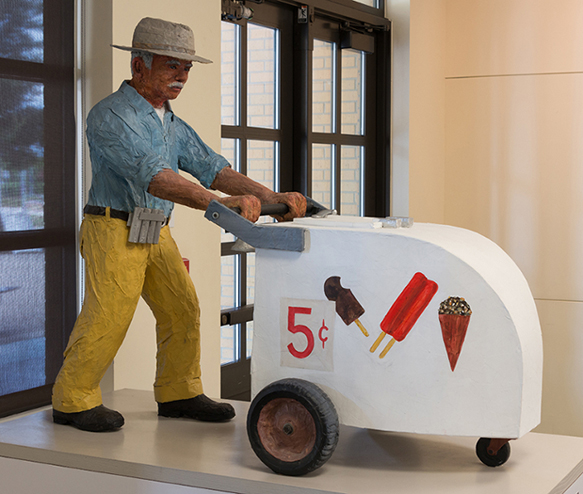
Joe R. Villarreal, “El Icecrinero,” papier maché, 56.125 x 28 x 41.5 inches
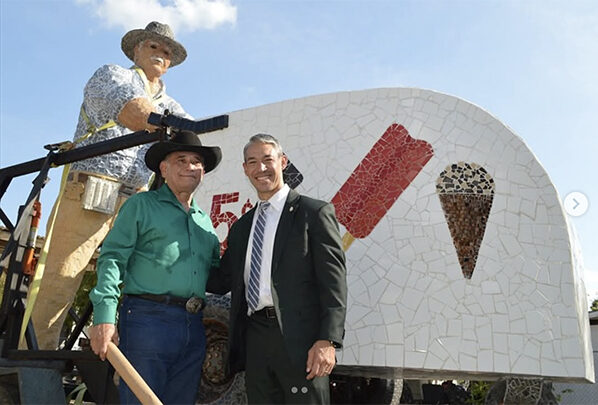
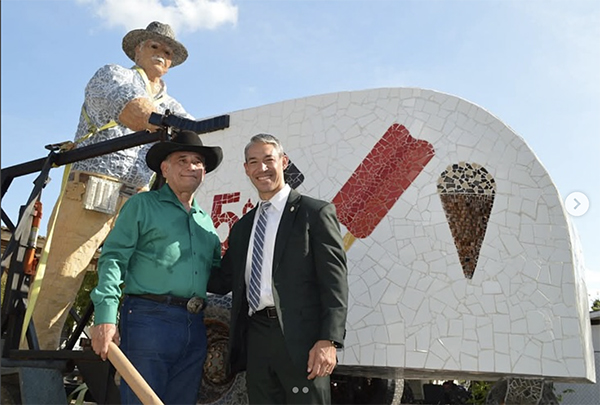
Over the years, Texas A&M University San Antonio has collected several of Mr. Villarreal artworks, including paintings and a papier maché sculpture, El Icecrinero, depicting a paleta man — a common sight on neighborhood streets. In 2019, after several health setbacks including a heart attack and a first bout with cancer, Mr. Villarreal finished a 13-foot-tall, 1-ton version of the sculpture in concrete and ceramic tile, intended as public art. When the City unveiled El Papalote and El Trompo in 2024, the artist expressed hope that one day El Icecrinero would find a public home beyond his backyard, where it remains perched on a trailer.
Joe R. Villarreal with San Antonio Mayor Ron Nirenberg
In June 2024, in an interview with the San Antonio Report, Mr. Villarreal explained his work was about his personal experiences and memories. He said, “As we age, some of these memories are gone, but not forgotten — at least not by me.”
A Facebook comment by friend Patricia Mota expresses admiration for Mr. Villarreal’s “ability to capture time and revive childhood memories. Forever to remind us of the life of strong family unity and neighbors who shared raising each other’s children.”
Mr. Villarreal’s art was recognized beyond San Antonio. According to La Prensa, his paintings were part of a 2000 PBS documentary, The Mexican Americans, and MySA reported in 2019 that a painting of his was to be used in an episode of the Selena drama series on Netflix. A painting by Mr. Villarreal of Dallas Cowboys players on horseback was converted into a cartoon image used on a King of the Hill episode titled Rodeo Days, also in 2000.
Mr. Villarreal was scheduled to be an honorary grand marshal for the City’s annual Fiesta Flambeau parade on Saturday, May 3, but realized in recent weeks that he wouldn’t be able to make it due to declining health. Among hundreds of condolences and appreciations flowing onto social media posts announcing Mr. Villarreal’s death, 11-year-old parade Grand Marshal Mateo Lopez, a local mariachi star, wrote, “I had the privilege to know you! You will live forever thru your art! Que en Paz decades maestro.”
Fiesta Flambeau Association President James Fenimore spoke to Glasstire about Mr. Villarreal. He said, “[Joe] was a very real figure on the West Side.” He added the artist’s name came up naturally in discussing potential grand marshals, as so many members of the Association have prints of his on their walls.
Mr. Villarreal’s son Jerry Villarreal said his father was “my hero,” “a kid at heart” and “your typical All-American Dad” who collected Dungeons and Dragons fantasy comics as a kid. Jerry described his father as modest, reserved, and generous in personality, having donated artwork and made T-shirts for his sons’ elementary school, and played guitar and sang for his class. Jerry said his dad was “a sculptor, an innovator, a fabricator, Illustrator, a mechanic, and he did body work on cars,” having painted lowriders including his own favorite ’55 Chevy Nomad and his grandma’s El Camino for a lowrider show.
“He did everything,” Jerry Villarreal said. Many of those skills came together in creating the El Icecrinero sculpture, having fabricated its welded steel armature as well as its multi-colored, multi-layered surfaces.
Mr. Villarreal’s wife Sylvia and sons Joe J. and Jerry were by his side when he died. “My brother said to hold his hand because he’s not responding, and see if he responds to you,” Jerry recalled. “He really hated when I cried,” Jerry said, recounting how his father gestured to Jerry’s favorite recent painting nearby to assuage his sadness. “He squeezed my hand and he kind of moved his arm, and he looked to his right, and on the right was that painting of La Virgencita … that’s when he stopped breathing.”
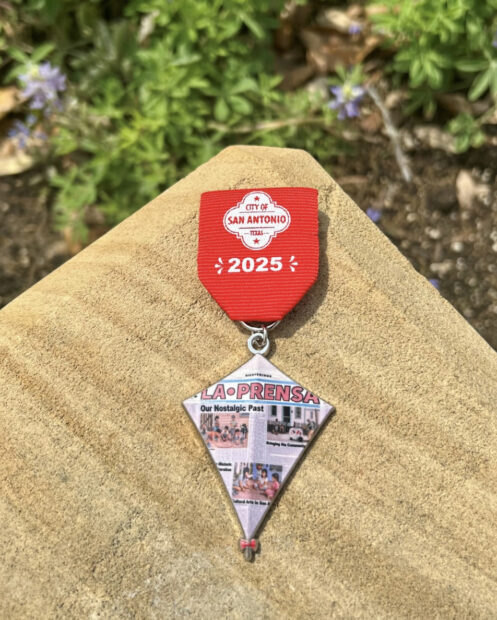
2025 City of San Antonio Fiesta Medal
In the immediate, Mr. Villarreal’s memory will live on in the Fiesta medal commissioned by the Department of Arts and Culture for this year’s annual citywide festival, a miniature version of the El Papalote kite, and his work, which is on view through April at Lee-Bunch Studio Gallery in Del Rio.
Last June, Mr. Villarreal expressed gratitude that El Papalote and El Trompo would continue representing his beloved West Side long after he was gone. He said he’d received many thanks from residents, who had told him, “Finally, something that we can see and recognize, something for us. … I was doing it all for them. You know, honestly, it’s for them, because, hey, I’m gonna be gone. I want them to enjoy it.”
I work in tax accounting. Tax season just ended and the overtime nearly killed me. I love my job but I’m tired of it. I’m also in my mid twenties and more or less feel like I settled down too soon.
I work at a small firm and the owners are the best bosses I’ve ever had. I really enjoy the people I work with and I enjoy what I do. I’m well paid and have good benefits including 100% employer paid health insurance. But I’m starting to get tired of it.
Lately I’ve been fantasizing about opening a bookstore. I’ve planned out the kinds of loans I would need, how I would acquire inventory, etc. It all feels so doable, but I would lose the stability afforded to me by my current job. I’m sure I would make less money, and I fear the bookstore wouldn’t make any money at all. I could switch to part-time hours at my current job, but I would lose my benefits and not make as much money. All that said, the bookstore is still calling my name.
I’m dreaming of a store open in afternoons and evenings for people to shop at after work or school. I’d like to have seating and make it sort of a local “third place.” I’m inclined to think that my community would enjoy it, but I’m not sure how profitable it would be. What should I do?
Write up a formal business plan, including market analysis, sales strategy, start-up costs, and financial projections (including what monthly sales you’d need to cover expenses). You’ll need that anyway, and that process will give you a lot more insight into whether it’s something you want to move forward with.
But also, you should talk to some bookstore owners! Owning a bookstore is a very common dream, and often what people envision doesn’t line up with the realities of the work — which tend to involve long hours, small profit margins, and often more focus on business than books. That doesn’t mean you couldn’t do it successfully and happily, but you’d want to make sure that you understand exactly what’s involved and what your day-to-day life will be like. In fact, the best possible thing you could do might be to work part-time in a bookstore for a while and see it up close.
2. My company disciplined a coworker for sharing info everyone already knew
I work in a niche field in a town with a handful of businesses in that field. Many of us know each other and have worked at the different businesses over time. In my workplace, there’s a high awareness of confidentiality about who’s applying for jobs, as there should be, but we had a situation come up that I’ve been curious about.
Sally had worked with me at Company A, then went to work for Company B. Some of our part-time staff at A also worked part-time at B. My coworker Lyle and I supervised these part-timers. When we had an opening at A for a different job, Lyle was on the hiring committee. I had previously worked at B, and several people I knew there mentioned that Sally was applying for this new opening at A.
One day, one of the mutual part-timers told us that Sally was applying, and had talked to them about it at B. Sally had been very open about it, and it was no secret, so many of us found out. Later, a different part-time staff person was chatting with Lyle about the position, mentioned Sally, and Lyle confirmed through conversation that Sally was applying. This was overheard and heads rolled! Lyle was disciplined, with the threat that he could have been fired for breaking confidentiality in the hiring process. Normally this would be appropriate, and Lyle probably shouldn’t have been talking about the hiring at all. But it did feel odd, since most of us at A already knew Sally was applying because she’d told multiple people, including people who worked here.
Sally ended up leaving for a third business and is currently applying for a job at the fourth, which I know about through this network even though A isn’t involved at all! Sally habitually broadcasts this kind of information. Of people I know in our field, this actually isn’t uncommon. Anyway, I was reminded of me of this incident, and I’m curious what you think of it.
It’s great that your company takes applicant confidentiality seriously, but threatening to fire Lyle in this particular set of circumstances was a bit extreme. Or at least it was if they actually threatened to fire him. But did they? Or was the conversation more like, “We take applicant confidentiality really seriously and while we know that in this case the candidate was sharing the news widely herself, you still need to be careful because it’s not up to you to decide who hears about it, and there’s too much room for error if you assume you know who already knows. While we understand what happened here, we take the rule seriously enough that breaking it could be fireable, and it’s important that you don’t do it again.”
An explanation that the policy still applies despite the circumstances and and why, along with a warning that it’s a job requirement to handle confidential information with discretion and a reminder of the potential consequences, would be reasonable.
3. I‘m getting too many requests for practice exchange
I work in professional services in higher education (in the EU). Two years ago I started to be active on LinkedIn. The goal was to advertise our great services and attract researchers to our university, but I now have a very large presence there.
Recently, I have been overwhelmed with international colleagues wanting to do a study visit to our unit. They want to learn how to build or improve services at their own universities or sometimes even countries. This is a normal thing to do in my sector, but now we get monthly/weekly requests. We are a team of seven, mostly part-time, and my colleagues (who I manage) aren’t keen to host all these people who basically are fans of mine from the internet. Also, I get invited to give talks about our unit as well, so lots of info is already available in recordings anyway.
Nevertheless, I’m having trouble just rejecting everyone. I also went on helpful study trips to the elite UK universities when we built the unit. How many should I accept? What can I offer instead? And how do I tell the people „you’re the fourth person this month to ask me this?”
How many you should accept depends on how much time and energy they take up and how much of both those things you’re willing to invest, so I can’t answer that — but it’s very reasonable to put limits on it. You’re seeing that more people are interested than you can accommodate, so you already know you’ll need to say no to some of them; the question is just how many you can reasonably say yes to. Since your colleagues are involved, too, sit down as a group and decide what’s practical. (And you’re not locking yourself into whatever you decide; if it turns out to still be too many, or if it’s not as onerous as you’d thought, you can adjust that number up or down next year.)
But the fact that you already have lots of info available in recordings is great because you can point people to those.
It’s completely fine to say, “We’ve fully booked the slots we have available for study visits this year (or this quarter, or whatever time period makes sense), but we’ve compiled some information that might be useful” and then link them to it.
4. Is bad eyesight a disability for the purpose of job applications?
I’ve run into this question on employment questionnaires and job applications: Do you have a visible/non-visible disability?
I have pathetic eyesight and wear glasses/contact lenses as a correction. I wouldn’t be able to function properly without these corrections.
I generally don’t think of my condition as a disability, because wearing glasses is so common. But what do I say to answer this question? Technically, I do have a disability, because I can’t function without my lenses. But I feel like I’m faking a label to call it a disability. I don’t know how to answer this question.
Currently, I have been saying that yes, I have an invisible disability (because I wear contact lenses, so nobody knows how bad my vision really is). Am I lying? I am wondering if “invisible disability” is usually referring to a condition that doesn’t have any kind of mechanical aid (for sight, hearing, locomotion).
You can answer this however you want and it will have absolutely no ramifications for you, whichever you choose.
Assuming you’re in the U.S., they’re only asking because companies with more than 100 employees and companies with government contracts over a certain dollar amount have to report the demographic makeup of their applicants and employees to the Equal Employment Opportunity Commission (in aggregate, not individually). They’re not allowed to consider your answers when they consider your candidacy; in fact, they’re legally required to store the information separately from the rest of your application. (The exception to this is veteran status; in some cases employers are permitted to give preference to veterans.) They’re also not legally allowed to penalize you for not answering, and they won’t check back on your answers to ensure they match up with info they get about you later on. (So if you said you had a disability when you don’t appear to, they’re not going to ask you about it or even notice or care. Same thing if you said you didn’t have one when you do. This is just about collecting info in the aggregate for reporting.)
If you consider your vision issues to be significant enough to be a disability, answer yes. If you don’t, answer no. It will not matter either way!
5. Addressing a federal layoff in my resume and when networking
I’m one of the thousands of government employees who were recently RIFed. I’m searching for jobs (using your resources!) and am unsure whether and how to put this layoff on my resume and cover letter. Technically, I’m still on admin leave, so do I put the date on my resume as July 2014-present or July 2014-June 2025? Do I address this in my cover letter? I can’t decide if people will take pity on me or if it will come off as desperate.
I also struggle with how to address this in networking situations: do I still work there or am I a former employee? It can get exhausting having people tell me how sorry they are when all I really want is to have someone say “let’s get you a job.”
You can do either! “To present” would be accurate because technically you’re still employed, just on leave. “To June 2025″ would also be fine if June is the date when your employment will end. It really won’t matter much either way.
You don’t need to address it in your cover letter at all.
In networking situations, you can say, “I work as a taco handler for the Department of Dinner, but my job is one of the ones being cut.”
Money, CA – After a few weeks breaking no records at the box office, Disney’s Snow White has finally been dethroned at the box office by a poorly shot video of a man ranking Skittles flavours. “It’s just a better hook for audiences,” explains Stephanie Zacharek, a renowned film critic for Time magazine. “Man ranking […]
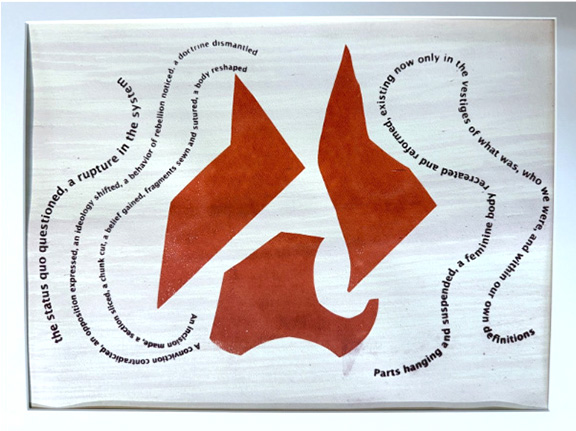
“It sort of resembles a woman’s pelvis,” I remark to San Antonio-based artist Olivia Ortiz. “Anatomical landscapes!” she exclaims. We’re looking at the exhibition poster for her solo show, Vestiges of Our Femininity, on view at Mercury Project in San Antonio and curated by Leslie Moody Castro. The poster features faint, light-pink striae covering the background, made by Ortiz hand-brushing cochineal onto paper. Then Ortiz screen-printed three nondescript red shapes, not quite touching one another but hovering in their central organization on the paper. To the right and left of the formation, Moody Castro’s screen-printed text orbits their irregular edges. Together, their cadence oscillates from the space between the shapes’ jagged edges and the text’s curvilinearity. The poster is illustrative of the collaboration between Ortiz and Moody Castro and offers a conceptual articulation of the featured works, all of which hinge on one key element: cochineal.
Olivia Ortiz in collaboration with Leslie Moody Castro, “Vestiges of Our Femininity” exhibition print, screen print with hand-painted cochineal on paper, 12 x 18 inches, 2025. Photo courtesy of the artist
In the 16th century, cochineal was known to many, but today, few are familiar with it (confession: I wasn’t). So, let me give you a quick rundown now that I’ve emerged from the cochineal rabbit hole. Cochineal is a small insect that dwells on cactus pads, typically that of prickly pear nopals. Female cochineals are flightless, living off the cactus’ juices and laying their eggs there. Cochineal produces carminic acid, a vibrant red pigment, so for thousands of years, the Aztecs and other indigenous peoples harvested the insect and its eggs for dying textiles, ceremonial use, and trade with other nearby native communities. When the Spanish invaded Mexico, they exploited cochineal as a natural resource because it produced a red hue that was more saturated than any found in Europe at the time. It became a globally traded commodity that was once more valuable than gold and silver, and ultimately became a symbol of power and high status. It was worn by royalty, military forces, and the clergy, and used to make paint used in European masterpieces. By the 19th century, synthetic dyes largely replaced its production, and today, only three cochineal farms remain in Mexico (“and they are all women-run!” Ortiz tells me). In Vestiges of Our Femininity, Ortiz employs cochineal as a personification of the feminine to chisel a new space that uncovers past exploitations and reveals forthcoming reclamation, free from the bounds of patriarchal constructs. The exhibition poster articulates this endeavor 4-fold, so I’ve italicized and bolded each section of the text to serve as section headers.
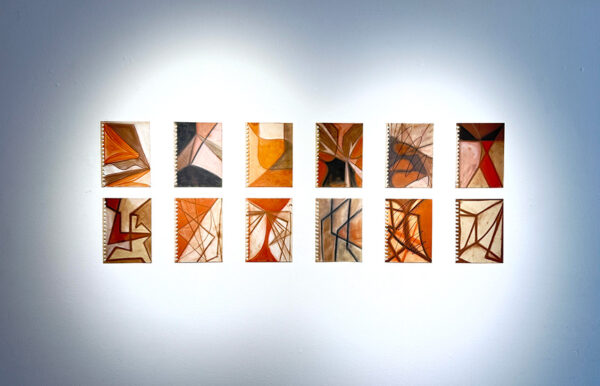
Olivia Ortiz, “All Day Everyday,” 2022-present, Conte on paper, 8.5 x 5.5 inches. Photo courtesy of the artist
The status quo questioned, a rupture in the system
In Ortiz’s self-described anatomical landscapes, materialized in drawing, painting, and installation, she continues the long tradition of depicting the female body in art. A fleshy palette proliferates through the exhibition space. Curving color fields hug into each other, tracing their contours. However, Ortiz’s subjects are not the odalisques and Venuses that populate the Western art historical canon. They’re abstracted as if one held a microscopic lens up to their body. Within the tradition of depicting nude women and their flesh, Ortiz offers a magnification that’s more intimate in context and perspective – a close-up of a body, a routine, or a life – but visually subverts that lineage because the work is not sexualizing the female form. In their obscurity, they disrupt the historical exploitative representation of women, shifting the flow of power back into their own hands.
Olivia Ortiz, “Stand Tall,” 2025, 60 x 72 inches, oil on canvas. Photo courtesy of the artist
A conviction contradicted, an opposition expressed, an ideology shifted, a behavior of rebellion noticed, a doctrine dismantled
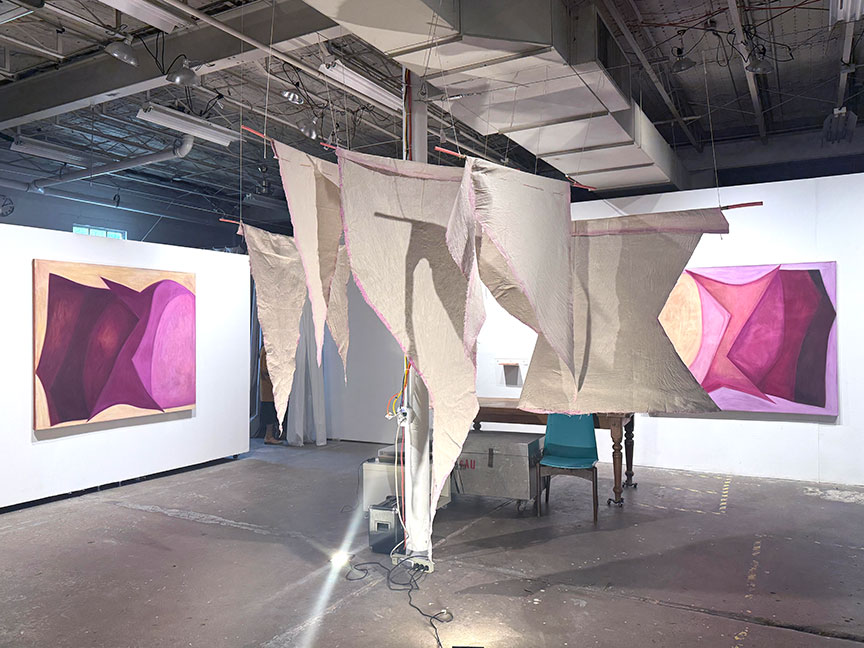
Layering recurs in Ortiz’s work. In Stand Tall, six color fields of oil paint extend across the 72-inch canvas, each unfolding from the next, varying in form and color. The furthest-right field is a deep oxblood color, which Ortiz tells me is the same color as pure cochineal pigment. The following color fields moving leftward represent the value scale of cochineal; the hue lightens as additives, such as acid, are added to the pigment. The resulting tonal gradient implies a kind of episodic trajectory, like age in a lifespan, phases in a menstrual cycle, or eons on a larger geological timescale, which makes me think of another applicable phrase complementary to Ortiz’s anatomical landscapes: sedimentary femininity. The flat perspective, allowing all layers to be viewed at once, translates as a moment suspended and removed from its trajectory, enabling a conceptual third-party reflection on how layers of past constructs of femininity have lifted us to the surface of today’s gender discourse. From this vantage point, women possess the agency to usher in what remains useful and shed what’s become obsolete as they craft their identity. Ortiz’s reference to cochineal in the gradient exemplifies the power shift in this trajectory by usurping its colonial exploitations to instead shroud in power those marginalized by its patriarchal principles, notably, indigenous people and women.
Oliva Ortiz, “And Never Back Down,” 2025, 60 x 72 inches, oil on canvas. Photo courtesy of the artist
An incision made, a section sliced, a chunk cut, a belief gained, fragments sewn and sutured, a body reshaped
Stand Tall’s composition is actually the inverse of And Never Back Down, which is drawn as a corset. With this in mind, their form comes to the fore. Horizontally oriented, the tonalites curve and zigzag into and around the next layer to form the shape of a woman’s chest and torso, with a bulge to outline the breast and indentations to accentuate the waist. In Ortiz’s work, the visual connotation of the corset functions in various ways. On one hand, it represents the ways that women’s bodies have been physically bound – to fulfill beauty standards and for medical recoveries – as well as the ways that women have been socially bound, and whose rights are still fluctuating to this day. As Stand Tall and And Never Back Down visually communicate inversely, Ortiz employs the corset inversely. Eschewing its historically inhibiting qualities and instead implementing the corset as a buttress, Ortiz reminds women not to bend to patriarchal pressures, especially in America’s present-day political environment.
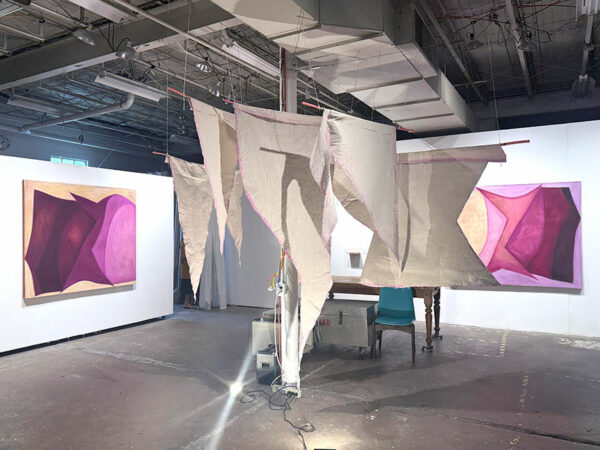
From left: Olivia Ortiz, “And Never Back Down,” 2025, 60 x 72 inches, oil on canvas; Olivia Ortiz, “Just An Appendage,” 2025, sculpture mixed media, dimensions vary; Olivia Ortiz, “Stand Tall,” 2025, 60 x 72 inches, oil on canvas. Photo courtesy of the artist
Parts hanging and suspended, a feminine body recreated and reformed, existing now only in the vestiges of what was, who we were, and within our own definitions
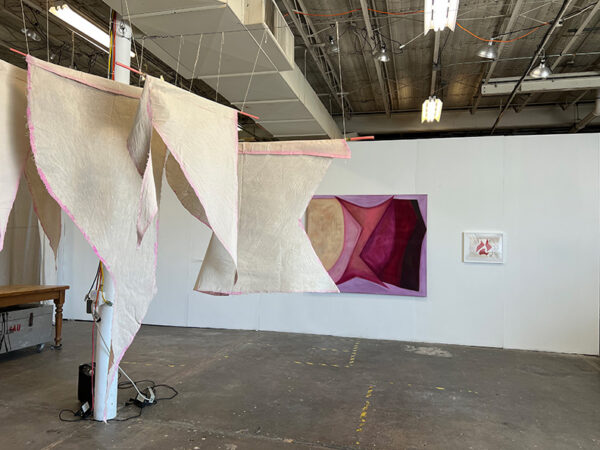
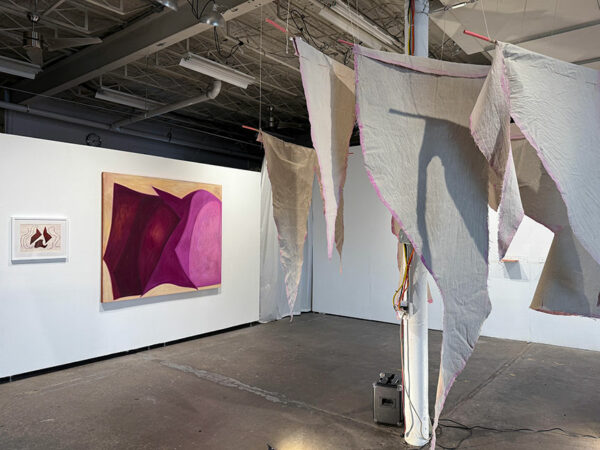
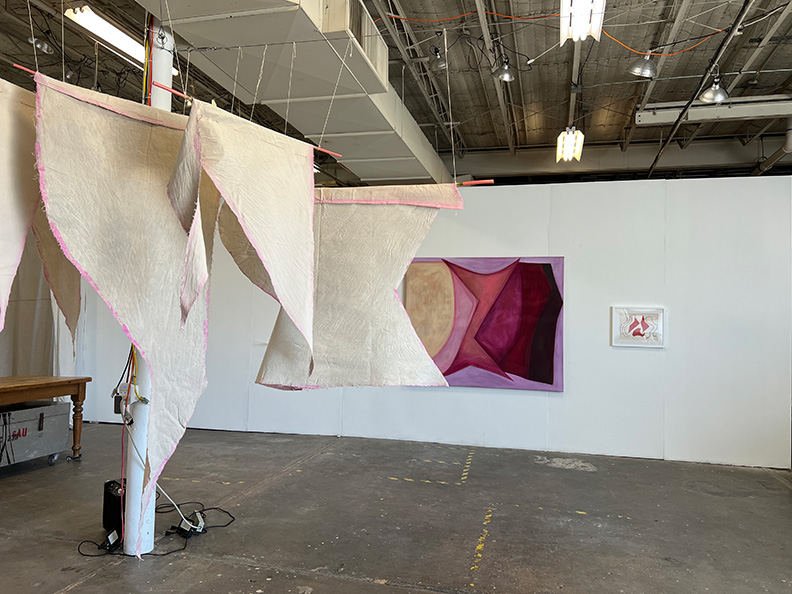
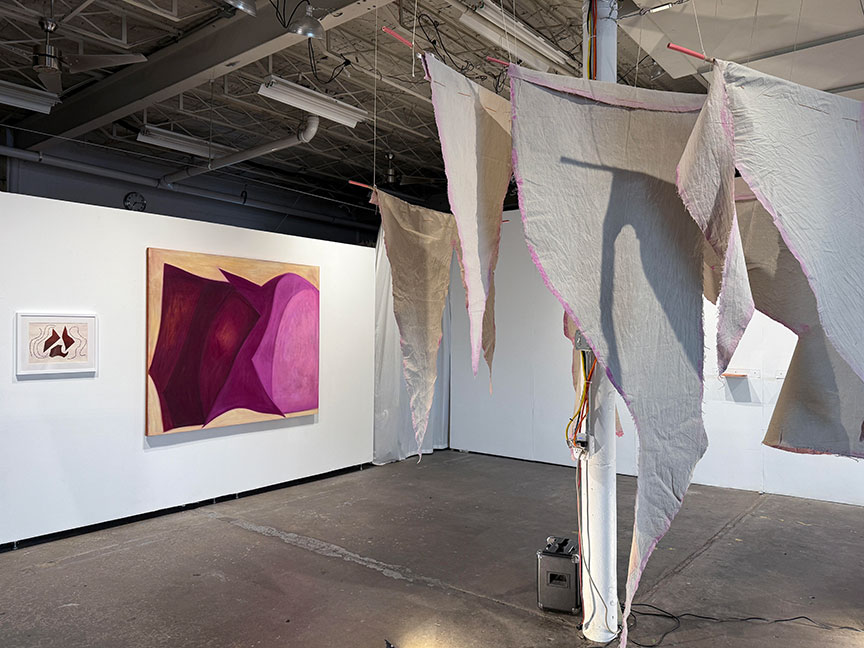
Central to the exhibition space is Just An Appendage, an installation that is a newfound passion in Ortiz’s practice. Six swaths of canvas hang on bamboo rods suspended from the ceiling by string. Each canvas cut-out represents a body part or corresponding garment, such as a set of legs, a pair of panties, a lower back, side boob, and, again, a corset. After cutting the canvas by hand, Ortiz lined all of the edges in cochineal and then dunked them in a tub of clay slip to hold the form. The canvas hangs organically, with deep wrinkles in the fabric. Just An Appendage orbits the pole in the center of the room like a mobile, the six canvas pieces paralleling the six layers that compose the corset ribbing in the paintings Stand Tall and And Never Back Down. However, in the installation, those six elements are severed, like a deconstruction of the Frankensteinian construct of a Woman. The cochineal lining seemingly represents a kind of salve to this severance, alluding at once to both the historical exploitation and commodification of femininity and the healing work women must do to mend the inherited genetic trauma thereof, physically and emotionally. Now that those constructs have been deconstructed, Ortiz again brings us to that liminal space between what’s been determined for the female body up to this point, physically and collectively, and how women will define femininity for themselves moving forward.
From left: Olivia Ortiz, “Just An Appendage,” 2025, sculpture mixed media, dimensions vary; Olivia Ortiz, “Stand Tall,” 2025, 60 x 72 inches, oil on canvas; Olivia Ortiz in collaboration with Leslie Moody Castro, “Vestiges of Our Femininity” 2025, exhibition poster, screenprint and hand-painted cochineal on paper. Photo: Caroline Frost
From left: Olivia Ortiz in collaboration with Leslie Moody Castro, screenprint and hand-painted cochineal on paper, 2025; Olivia Ortiz, “And Never Back Down,” 2025, 60 x 72 inches, oil on canvas; Olivia Ortiz, “Just An Appendage,” 2025, sculpture mixed media, dimensions vary
Under a presidential administration that is pursuing a singularity in citizenship, religion, and gender conformity, plurality is crucial. Vestiges of Our Femininity demonstrates that as women pursue reclamation by inverting the systems historically used to homogenize us, we create a more heterogeneous social landscape by shedding layers that no longer serve its formation. Ortiz tells me that her daughters helped her sew the canvas onto the bamboo for Just An Appendage. “They were like, ‘Mom, I stabbed myself four times!’” she says. “Just like many women before them,” I add. Here’s to pricking fingers whilst crafting the way for the next generation of women!
Vestiges of Our Femininity is on view at Mercury Project in San Antonio through April 26th.
“This and That” is an occasional series of paired observations. See past “This and That” posts here. – Ed.
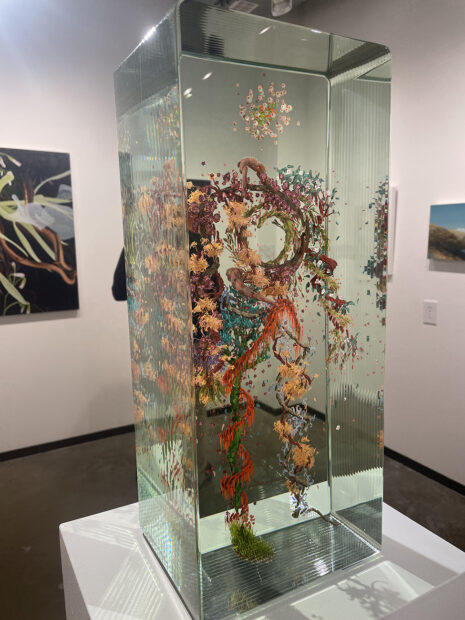
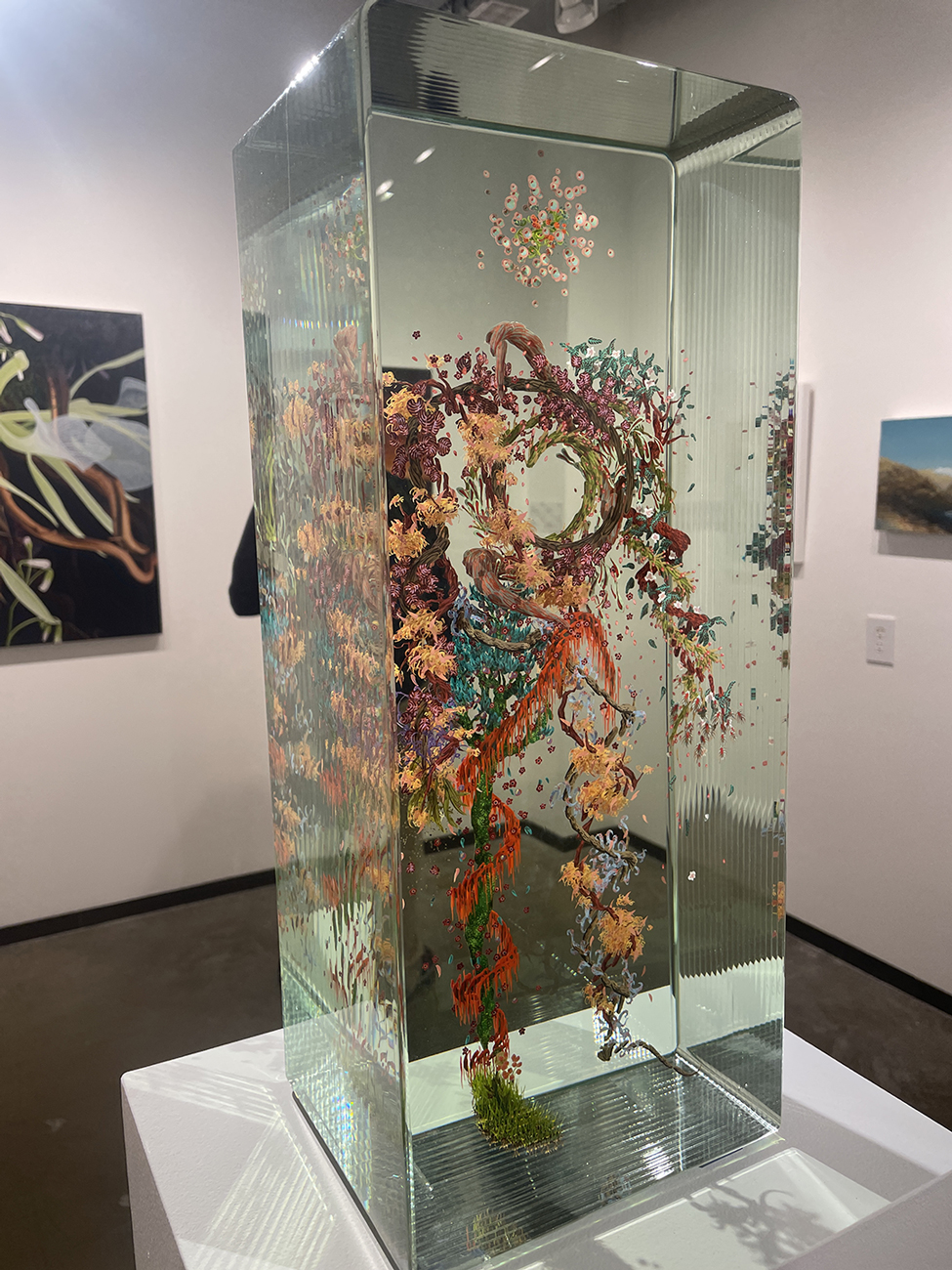
Today: Painting on clear, layered panels
Dustin Yellin, “Understory III (Study for Psychology),” 2024, glass, epoxy, and acrylic paint, 8 x 19 x 6 inches. On view at Andrew Reed Gallery at the Dallas Art Fair
Camila Echavarría, acrylic paintings on glass with a cider wood base. On view at Beatriz Esguerra Art at the Dallas Art Fair
*************
No matter how original, innovative or crazy your idea, someone else is also working on that idea. Furthermore, they are using notation very similar to yours. – Bruce J. MacLennan
There is no me without you. Would I remember your phone number if my contacts were suddenly deleted, with no backups? If I’m being completely honest, not even the area code.
- - -
I have known you for the entirety of my time on this mortal plane. Should we FaceTime with the kids? Okay. No, yeah. [Takes a shot.] I think I could do that.
- - -
I want to know EVERYTHING that is going on with you. By scrolling through your social media posts.
- - -
Sometimes I miss you so much that your absence feels like someone close to me has passed away. Ah, you want to get a phone call on the calendar? Oh. No, that sounds amazing. [Panics in millennial.] Two weeks from Wednesday, perfect. I definitely won’t completely forget until the phone rings.
- - -
Every aspect of my personality was informed or shaped by you. Please enjoy this GIF of Beyoncé dancing for your birthday.
- - -
Every time we catch up, it’s like manna for my spirit. Also, have you heard of Marco Polo? No, it’s amazing, it’s a messaging app where you send each other recorded videos of things you would have said on the phone, and then the other person watches the video you sent and records their own to send back to you. For you to watch alone in your apartment with your cats. Isn’t that so much better than communicating synchronously to each other’s faces?
- - -
You would not believe what just happened, and you are the ONLY person who can give me perspective on this. So insane. Hang on, let me explain it to you excruciatingly slowly in a series of seventeen texts. Feel free to reply incredulously to every third text or so before I’ve even remotely finished the story. No, I know, it seemed like I was done, but that was just the setup.
- - -
My darlingest friends: I love you all so deeply that I want to form a commune with you and grow old together for the rest of our lives, Golden Girls style. Please, tell me we can make this a reality. Oh noooo. Our long-scheduled group Zoom fell through at the last minute, and no one can make it anymore? Aw, maaaaan. I am sooooo disappointed and definitely not relieved to the core of my being. Next time!
- - -
Who would have thought that one day we’re twenty and drinking jungle juice out of a tub in the basement of a frat house, and now you’re a mom. It’s been so amazing to watch you mature into this role—no no no no no, please do not hand the phone to your three-year-old, I still have vertigo from last time.
- - -
Omg, just saw your Instagram post, I need to know all the details. Oh… you sent a voice text. That’s… haha… so cool. It’ll be so much like talking on the phone that I… Wow, yeah, no, I will definitely just hit that little play button and listen away. I just… just need to do this other thing real quick. But I will definitely not NOT listen to this, because it is NOT the same as talking on the phone and fills me with no existential dread whatsoever. Heh. So cool. Technology…
- - -
I’m trying to call more, I honestly am. But do you have personal business hours or anything? When would be the best time to call, where there would be the least amount of screaming in the background?
- - -
This is ridiculous; I used to share a bedroom with you! I’m going to call you more, if it’s the last thing I do. (NARRATOR: It was, in fact, the very last thing she ever did.)
- - -
Now that I’m a parent, I have a much deeper appreciation for how hard it must have been for you and Dad as parents, a decade younger than I am now, with way more kids, way less money, and way less information about how to be a parent. You did the best you could, and I realize that now. Oh, you’re gonna pass the phone to Dad so I can talk to him too? Huh. I mean, I don’t really see why, I just told you everything I wanted to say, but okay…
- - -
You know, the pandemic was obviously so traumatizing in so many ways, but on the plus side, it finally taught us that talking on the phone is neither hard nor terrifying. Thank god. Everything is going to be different from now on.
- - -
FIVE YEARS LATER
Happy birthday! Please enjoy this GIF of Beyoncé dancing… on the beach.
I recently received what I believe to be a scam job offer. It seemed too good to be true, and I should have realized it was a scam, especially since I don’t remember applying for the position at the company that supposedly offered it to me. The most obvious red flag was that it seemed too good to be true, and the text in the email was clearly copied and pasted from a template. Still, in the excitement of the moment, I almost fell for it.
Here’s how it went down:
First email: A seemingly legitimate email from someone within the organization asked me to reply “yes” if I was interested in being considered for the position. I replied “yes,” as I have been applying for jobs almost daily for the past three weeks. It’s possible that I applied for this position and simply forgot. Given the large number of applicants applying for jobs through LinkedIn, I can understand the need for email verification. The name of the emailer and the email address appeared to be real enough, but the emailer did not list a phone number or job title, just an address (which was listed below his name and is a real address for a corporation in Wisconsin). I googled the company, and they are a legitimate organization involved in energy infrastructure. However, the emailer’s name and email address returned no search results. I then googled the emailer’s name by itself and found real people on LinkedIn with similar names, but none of them were employed by the company the emailer claimed to be working for. I reached out to these people on LinkedIn to ask if they had ever worked for the company, and those who replied said no.
Second email: I received a job screening questionnaire that was way too generic to be legitimate. There was also a deadline to return the questionnaire by a certain time on the day of receipt. It took me a while to answer the questions, but I made the deadline. I also noticed that the emails sent by the emailer were usually during evening/early morning hours in the United States — certainly, non-standard workday hours for a recruiter, unless they work a third shift. I should have noticed this sooner, but I was still overly thrilled to have been offered a seemingly legitimate job, so I didn’t pay attention to the timing.
Third email: After sending in the questionnaire before the deadline, I received an email during those non-working hours telling me that I had “got the job.” However, rather than offering me a salaried position, they said it would be hourly pay with weekly disbursements. This was the first red flag I noticed, as the questionnaire had listed the position as salaried, and now it was hourly. The next step was for me to forward my phone number, physical address, and full name to an HR email address, which would supposedly begin the hiring process, and I would start training immediately. The second red flag was that the email’s text was clearly a copy-paste job — too many spaces between phrases, inconsistent font, capitalization of certain words, and still no job title or phone number for the mysterious emailer. The language also seemed unprofessional for someone working at a company involved in energy infrastructure. The third red flag came when the emailer mentioned that the company would be sending me a check for work expenses and equipment. Having worked in higher education for almost 20 years, I know that reimbursement and expense processes are never that simple, especially when done over email!
I was about to reply with the details requested, but I couldn’t shake the “it’s all too good to be true” feeling, especially since I had never communicated with the emailer in person, over the phone, or via Zoom. I still didn’t know their position at the company or how to contact them other than by email. I’ve never been offered a job this quickly or this easily. It just couldn’t be real.
So, I replied to the third email with the following:
Just a few questions before I confirm or deny the position offered:
What is your official position at the company?
There is no phone number listed with your email — could you please provide one so I can call you?
Please provide the phone number for a human resources representative so I can verify the details you’ve provided.
No response as of yet.
I even called the corporate headquarters of the company they said they were from and spoke with the head of human resources, and they had no clue who the person was and no record of anybody by that name working there or at any office, and asked me to forward the emails to them so they can investigate for fraud.
I now understand how this happened: I have a website that hosts my professional portfolio, resume, and projects. I also list this email address as a contact, so it wouldn’t be hard for someone to craft a scam email based on the information available on my website. I was almost fooled, but it was the small inconsistencies in the text that eventually led me to question the legitimacy of this “job offer.”
The most embarrassing part of it all is that I almost fell for it. It was the small things that really added up that made me really question if it was legitimate.
Me again. A couple more red flags to note, as well:
If that initial email literally just asked you to reply with “yes” … that’s weird and not typical for hiring. Something like “please let us know if you’re still interested,” sure. But “send back the word ‘yes'” is pretty spammy.
Offering you the job without a single interview or giving either side a chance to actually talk to each other: huge red flag. It can happen in some pretty narrow circumstances, but it’s incredibly rare for professional jobs.
I recently interviewed for and accepted a job as a nurse at the very small hospital in my very small midwestern town. My lovely manager was very transparent about how they are big supporters of work-life balance, and gave tangible examples of how they support families, because they have “small town values.” She is clearly very proud of this fact and puts a lot of stock in being a “good” manager. I know some of the employees on that floor, and everything she says seems to be true and not just lip service.
Well, I am pregnant (around 15-16 weeks when I interviewed) but, naturally, did not disclose this fact until I had a verbal offer from HR, at which point I asked about some unpaid leave since I won’t be eligible for FMLA. The HR rep asked if I had disclosed my pregnancy during the interview. I answered no, and she said something along the lines of, “Of course not, I didn’t think so, I’ll let your manager know.”
Well, my manager said to me on my first day, “Congratulations on your pregnancy! I hope you know that I’m very supportive of families and you could’ve told me during your interview.” She seemed, and seems, very miffed. I responded with the usual stuff about how you never know until you know who you’re interviewing with, that the common advice is to wait, blah blah blah. Since then, I’ve committed to being aggressively normal and am planning to let her work out her angst on her own.
My question is, if you are relatively certain that the place that you’re interviewing is family-friendly, and you suspect that your manager will be … sensitive to not being disclosed to, or to being perceived as untrustworthy, does it make sense to disclose? I am confident (and was confident during the interview) that they would have hired me either way. I feel like I lost some political capital with her.
You can’t know if it’s safe to disclose or not, so you should default to not disclosing. Lots of companies say they’re family-friendly but aren’t. And lots of companies are pretty good at supporting pregnant employees who worked there for a while but might still balk at hiring someone who would be out on leave for months soon after starting. And some would hire a pregnant candidate for some jobs but not for others. And sure, maybe there’s a company out there that’s great about it across the board and would always happily hire pregnant candidates … but you have no way of knowing from the outside which category this company is in, which is why it’s always safer not to disclose until you’ve been hired.
In some hypothetical situation where you’d seen the company hire a slew of obviously pregnant candidates, maybe the calculation would be different. Even then, though, you’d be taking the risk that they’d balk at it this time — maybe even because they’d accommodated so many maternity leaves recently, or maybe because this particular job made it harder to accommodate for some reason.
A manager who takes that personally and gets upset that you didn’t “trust” her enough to disclose your pregnancy ahead of time is a manager who really isn’t that family-friendly at all. It’s not family-friendly for her to make it about herself and her feelings, rather than understanding that of course people need to worry about discrimination, and of course you don’t know her well enough to feel confident, and there’s a reason the law makes it clear you don’t have to disclose a pregnancy when you’re interviewing for a job.
Your manager being “miffed” that you didn’t trust her, a stranger, not to unconsciously or consciously factor your pregnancy into her hiring decision (which is illegal but happens all the time) is a really odd reaction. You didn’t know her! You had nothing to judge on. And frankly, even if you did know her and still decided to use the legal protection afforded to you and not disclose, she’d still have no right to be miffed because discrimination is really common, and your right not to be illegally discriminated against trumps her desire to feel like a trusted ally. (Ironically, her response is proving that she isn’t really a trusted ally anyway.)
And to add to all that, at 15-16 weeks you might not have been sharing the news with anyone.
Ultimately, it’s just not info she was entitled to.
As for what to do from here, being aggressively normal and letting her work out her angst on her own is exactly the right approach.
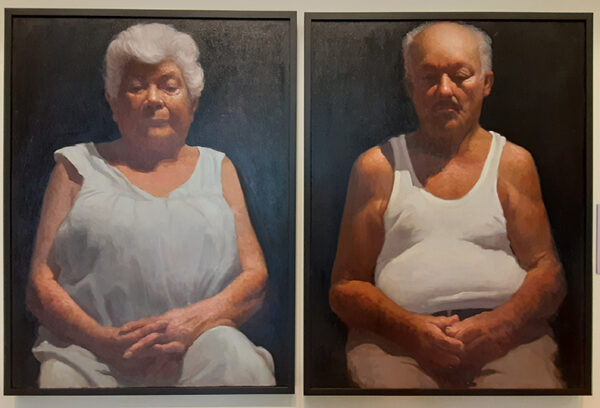
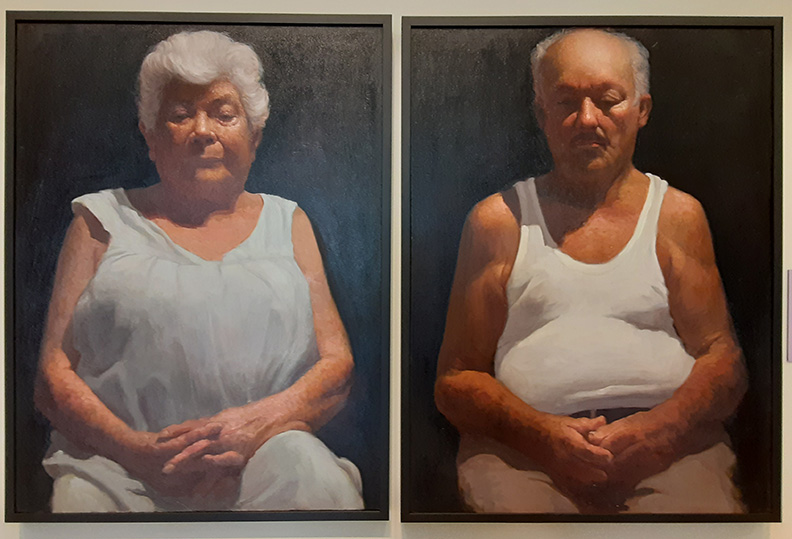
Raymond Bonilla’s Escuchas (2009) is a diptych about the psychological confines of family values and tradition. The two paintings depict a gray-haired woman and a man, painted in the chiaroscuro of Spanish baroque. They are dressed casually, with white sleeveless shirts that engender a sense of intimacy. The figures are seated in a frontal view while looking downward, with their torso and arms to show their clasped hands — because when they were being addressed by their Puerto Rican parents while they were young, they could not look them in the eye, and had to place their hands together in a sign of respect. Bonilla depicts the two older adults in this way to performatively place how they were raised. This work sets the tone for the exhibition, about the invisible forces that compel or repel us toward home.
Terry Evans, “MCAT, Trinity River, July 4, 2013,” 2014, inkjet print
The current exhibition at the Art Museum of South Texas is the third exhibition from the partnership of the Amon Carter Museum of American Art Cohort in the Art Bridges Foundation Cohort Program, after Native Impressions and Photography is Art. After this show closes at Corpus Christi, the exhibition will travel to the Amarillo Museum of Art and the Ellen Noël Art Museum in Odessa, the two other cohort members. The show brings together a selection of artworks from each of the five institutions’ collections. It is divided into four themes: Home, Family, Honor, and Loss. The theme’s relationship to the title appears incongruous, particularly as the exhibition was divided into three galleries, with the themes Honor and Loss sharing one gallery — it seems Family and Honor as representing the title’s theme of love could have been paired together instead. Nevertheless, the exhibition succeeds in bringing together shared notions of home, between family and communities, into a wide-ranging reflection.
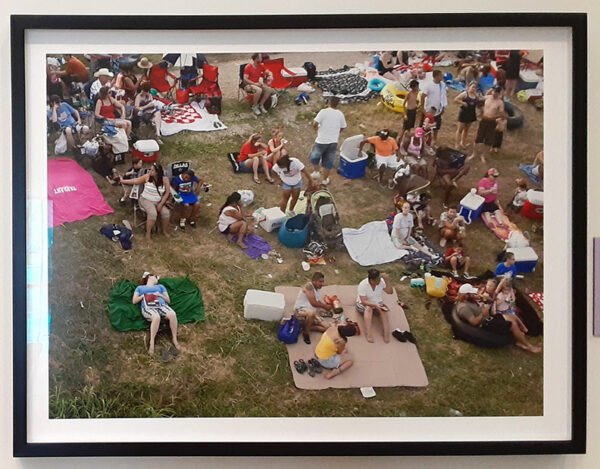
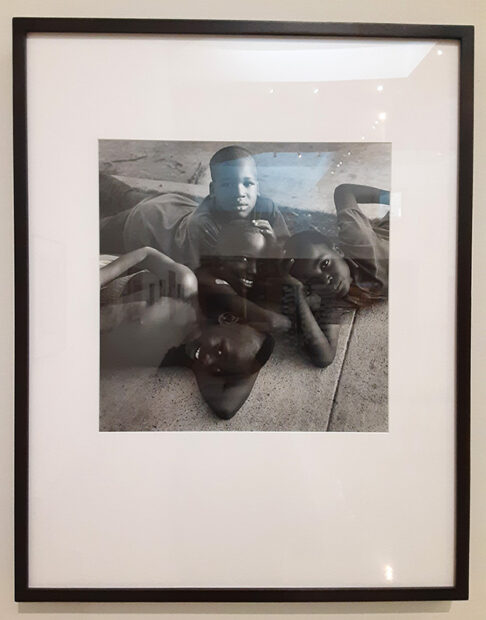
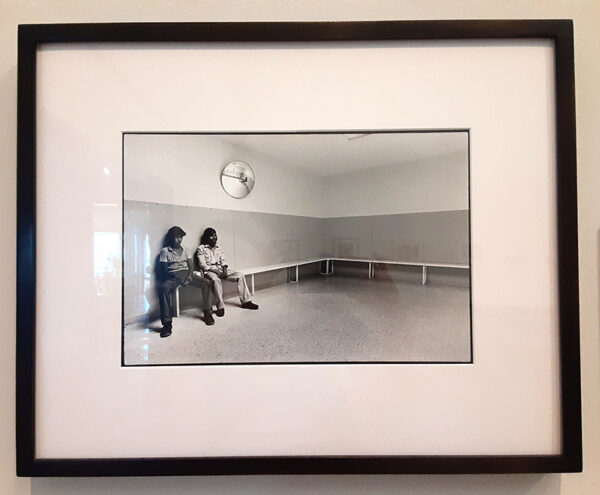
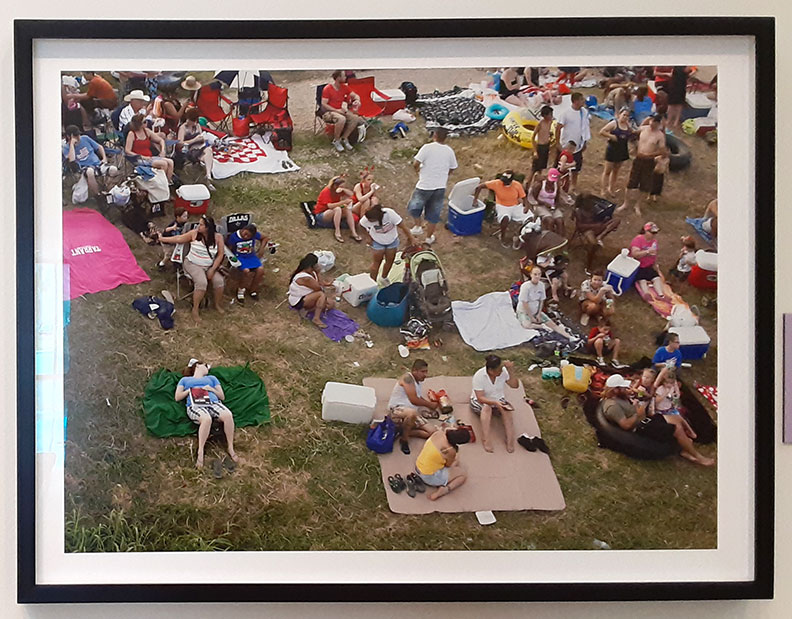
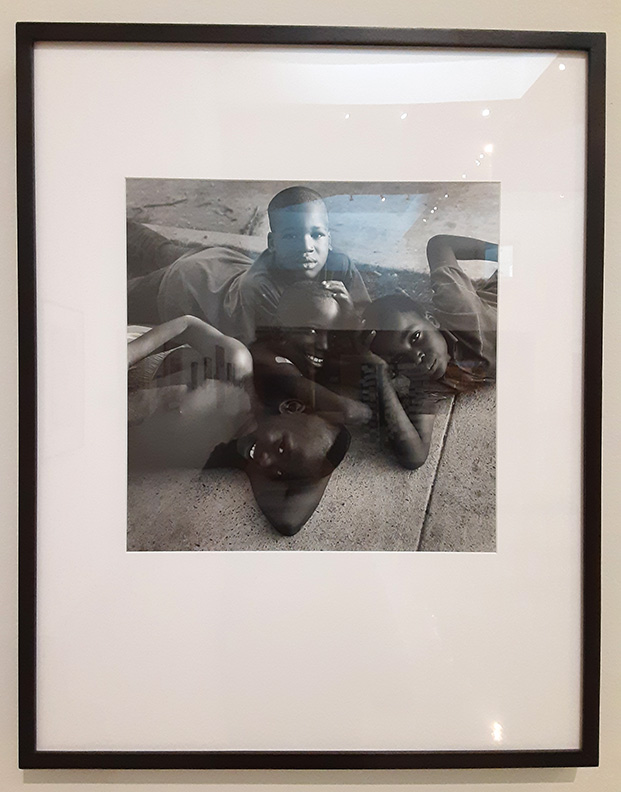
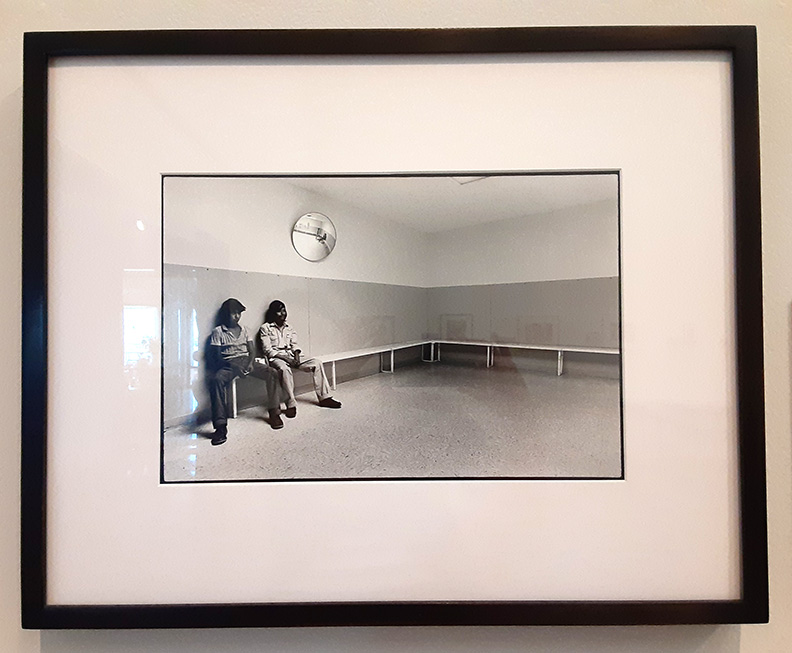
The section for the theme of family is the largest within the exhibition, and there is a strong representation of photographs as a medium. Terry Evans’s MCAT, Trinity River, July 4, 2013 (2014) is a birds-eye-view photo of various North Texas families that have gathered together for Independence Day, showing working- and middle-class urbanites lounging on river banks, snacking on chips, tostadas, sodas, and beer. There’s a cold anthropological perspective applied here, as though the groupings of families are displayed as objects of study. From an opposite end of the spectrum, Earlie Hudnall, Jr.’s Wheels (1993) depicts the warmth between the photographer and the subjects. Four young Black boys pause playing on the ground as they smile and each prop their faces up toward the camera, describing a sense of family as shared between friends within a close-knit community. The show reverts to a dystopian theme with Ave Bonar’s In Custody of Border Patrol, Brownsville (1984), which shows two men seated on a metal bench, with a wide-angled mirror above them showing two more people across the room as a sign of surveillance. The ruthless waiting and the vacant cold of the institutional setting is a stark reminder of the border bureaucracy that deprives people of their connection to their families, and therefore their humanity.
Francisco Delgado, “Catharsis I,” 2004, serigraph
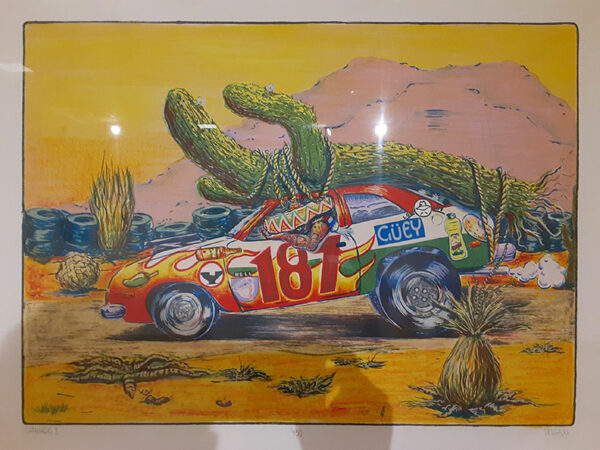
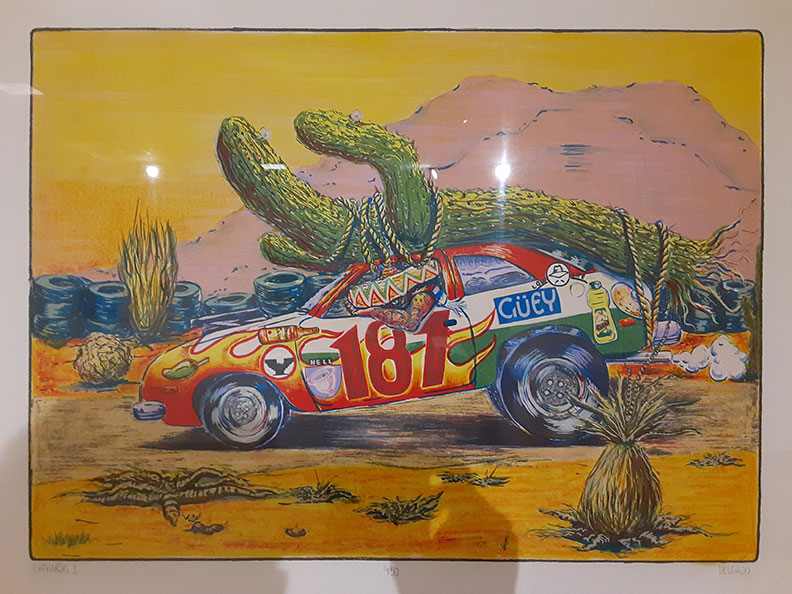
The theme of home is represented in works such as Francisco Delgado’s Catharsis I (2004), where a man wearing a sombrero is driving a modified car with a large cactus tied to the top, navigating along a wall of tires and West Texas hills in the background. Printed on the car are various rasquache signs such as “Taco Hell” and “Mr. Clean,” as well as a United Farm Workers logo and the number 187, short for California Proposition 187, which barred undocumented immigrants from accessing public services, becoming a symbol for one of the national flashpoints of Latinx voting-rights activism during the 1990s. Here, home is represented in solidarity as bringing together Chicano/a ideology in the US-Mexico borderlands.
Mark Bradford, “In which he shall be,” 2022, mixed media on canvas
Jimmy Peña, “Gravity,” 2003, serigraph
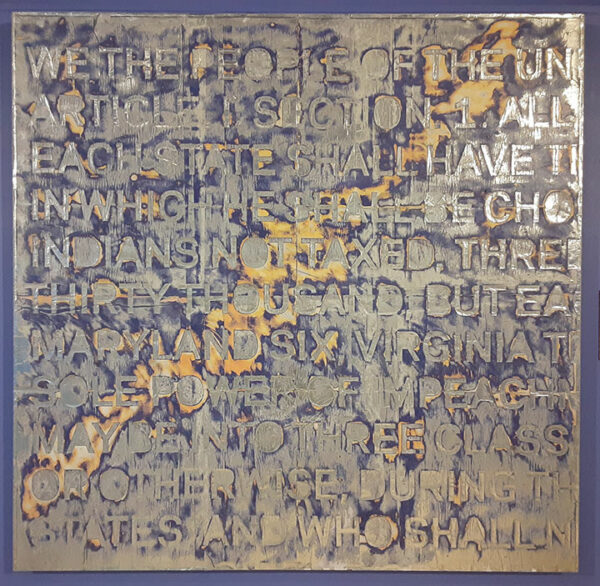
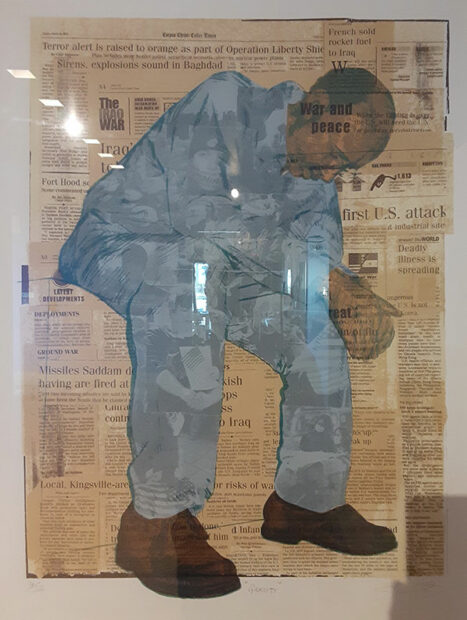
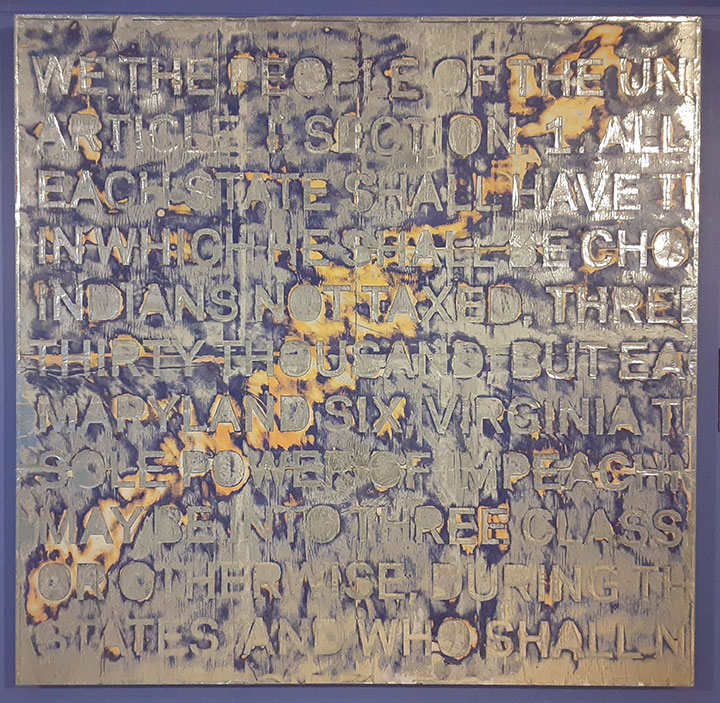
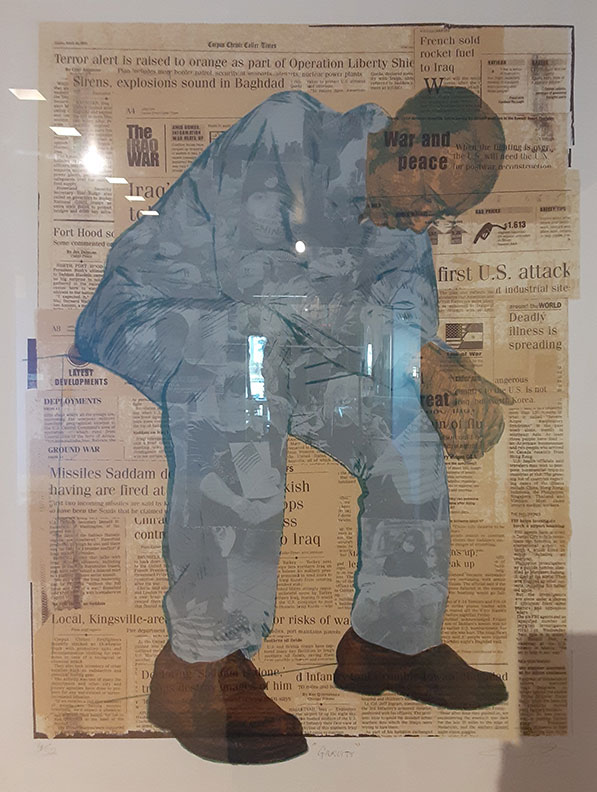
As the show segues from the themes of family and home to honor and loss, there is an interstitial space in between the galleries that bridge the two areas, showcasing solely two works. The first work is Mark Bradford’s In which he shall be (2022), which crops together passages from the US Constitution. Powerful words such as “We the People,” “Each State Shall Have,” “Indians Not Taxed,” and “Sole Power of Impeachment” are written on the canvas in mixed media. There is an appearance of a rip, or a burn mark, across a diagonal divide, as though the document is in the midst of destruction, implicating the scale of our current Constitutional crisis. Next to this work is Jimmy Peña’s Gravity (2003), a serigraph made to commemorate the lives lost during 9/11, with a collage of clippings from the Corpus Christi Caller Times reporting on the Iraq War, a direct result of the terrorist event. At the center, a figure in blue sits with his head lowered in immense grief.
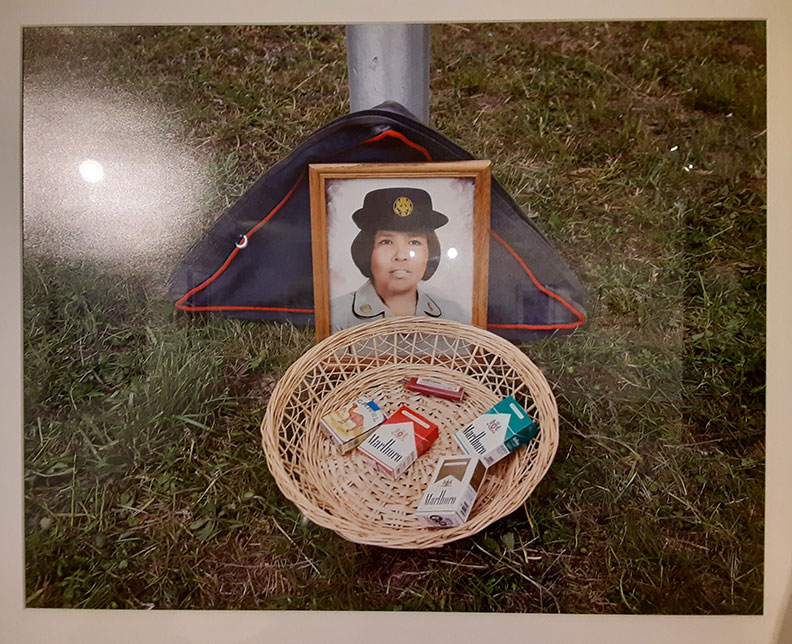
Tom Jones, ChakShepSkaKah (White Eagle), “Arlene Greengrass-Rodriguez,” 2017, inkjet print
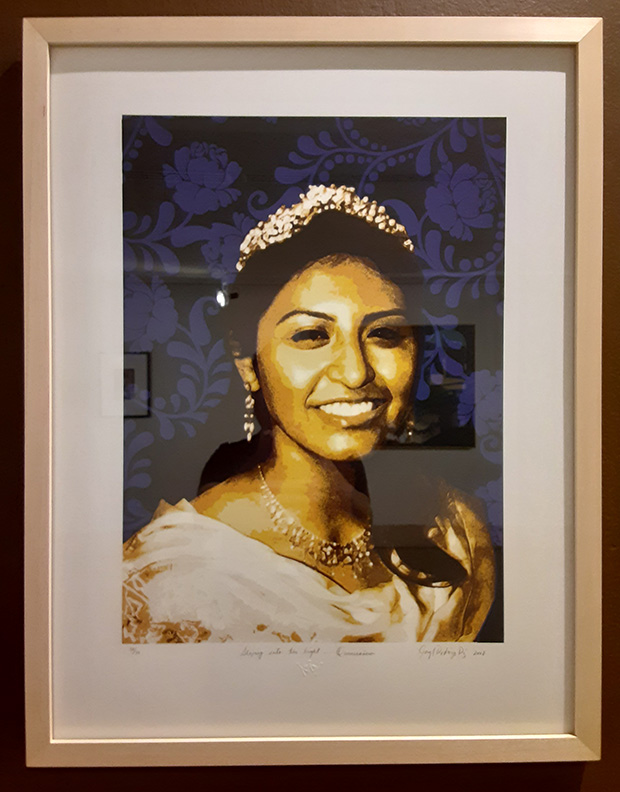
Ángel Rodríguez-Diaz, “Stepping into the Light…Quinceañera,” 2008, serigraph
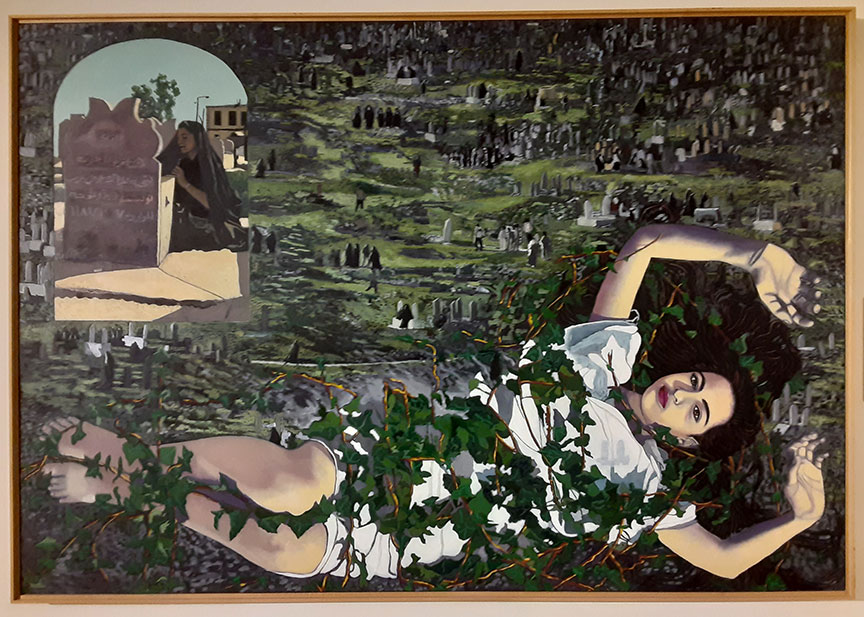
Lahib Jaddo, “Regeneration,” 1994, oil on canvas
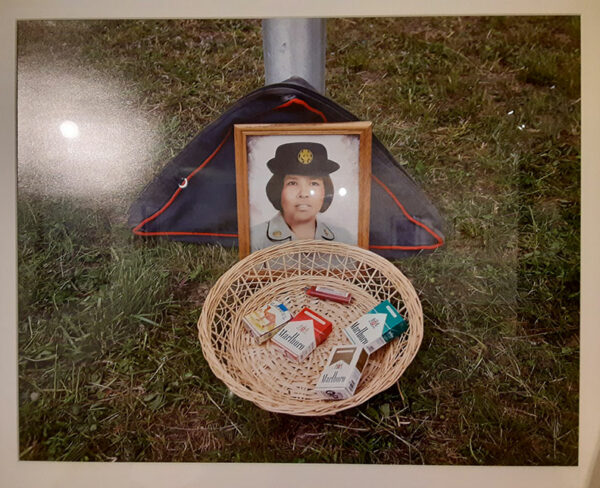
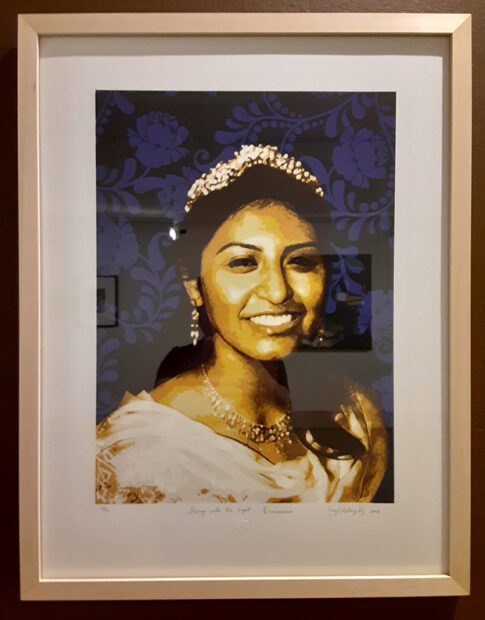
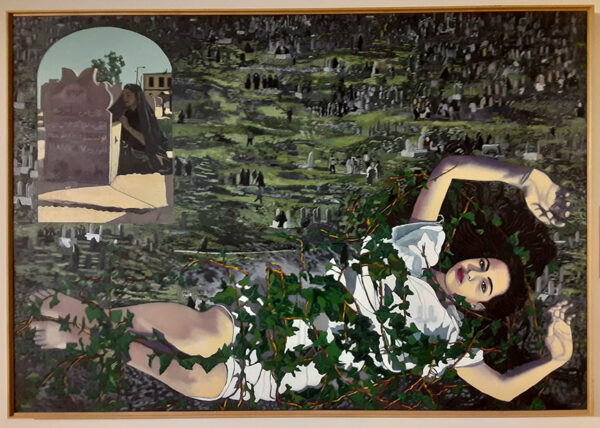
The themes of loss and honor are shown through Tom Jones’s photograph of Arlene Greengrass-Rodriguez, a Ho-Chunk veteran who is memorialized through a display of a flag pole dedicated to her, with her portrait, a flag cover, and a basket strewn with tobacco products at the base of the pole. The tobacco would be lit during a Memorial Day Powwow, with its smoke relaying prayers to the Creator. Ángel Rodríguez-Diaz’s Stepping into the Light…Quinceañera (2008) is a photorealistic serigraph of the Ashley Garcia, a daughter of a family friend to the artist. She is surrounded by swirling patterns of roses, glowing amidst the celebrations of her fifteenth birthday, a time-honored tradition within South Texas Latino/a families. In Lahib Jaddo’s Regeneration (1994), a young woman, the artist’s daughter, lies across the bottom of the composition surrounded by vines, while above, the history weighs heavily against her with a panoramic view of a cemetery in Bagdad, Iraq. An insert of a scene at the top left depicts the family’s matriarch visiting a grave, providing a closer-up view of the many figures within the wide burial grounds. This work, as representing the exhibition as a whole, brings together the view of generations and the enduring traditions shared within the bonds that exist in our physical and metaphorical homes.
Home, Love, and Loss is on view at the Art Museum of South Texas through April 27.











![[img]:textum](https://analognowhere.com/_/textum/textum.png)
