Cowboy Who?
Shared posts

Pluralistic: Sarah Wynn-Williams's 'Careless People' (23 Apr 2025)

Today's links
- Sarah Wynn-Williams's 'Careless People': "Too big to care."
- Hey look at this: Delights to delectate.
- Object permanence: 2005, 2010, 2015, 2020, 2024
- Upcoming appearances: Where to find me.
- Recent appearances: Where I've been.
- Latest books: You keep readin' em, I'll keep writin' 'em.
- Upcoming books: Like I said, I'll keep writin' 'em.
- Colophon: All the rest.

Sarah Wynn-Williams's 'Careless People' (permalink)
I never would have read Careless People, Sarah Wynn-Williams's tell-all memoir about her years running global policy for Facebook, but then Meta's lawyer tried to get the book suppressed and secured an injunction to prevent her from promoting it:
So I've got something to thank Meta's lawyers for, because it's a great book! Not only is Wynn-Williams a skilled and lively writer who spills some of Facebook's most shameful secrets, but she's also a kick-ass narrator (I listened to the audiobook, which she voices):
https://libro.fm/audiobooks/9781250403155-careless-people
I went into Careless People with strong expectations about the kind of disgusting behavior it would chronicle. I have several friends who took senior jobs at Facebook, thinking they could make a difference (three of them actually appear in Wynn-Williams's memoir), and I've got a good sense of what a nightmare it is as a company.
But Wynn-Williams was a lot closer to three of the key personalities in Facebook's upper echelon than anyone in my orbit: Mark Zuckerberg, Sheryl Sandberg, and Joel Kaplan, who was elevated to VP of Global Policy after the Trump II election. I already harbor an atavistic loathing of these three based on their public statements and conduct, but the events Wynn-Williams reveals from their private lives make them out to be beyond despicable. There's Zuck, whose underlings let him win at board-games like Settlers of Catan because he's a manbaby who can't lose (and who accuses Wynn-Williams of cheating when she fails to throw a game of Ticket to Ride while they're flying in his private jet). There's Sandberg, who demands the right to buy a kidney for her child from someone in Mexico, should that child ever need a kidney.
Then there's Kaplan, who is such an extraordinarily stupid and awful oaf that it's hard to pick out just one example, but I'll try. At one point, Wynn-Williams gets Zuck a chance to address the UN General Assembly. As is his wont, Zuck refuses to be briefed before he takes the dais (he's repeatedly described as unwilling to consider any briefing note longer than a single text message). When he gets to the mic, he spontaneously promises that Facebook will provide internet access to refugees all over the world. Various teams at Facebook then race around, trying to figure out whether this is something the company is actually doing, and once they realize Zuck was just bullshitting, set about trying to figure out how to do it. They get some way down this path when Kaplan intervenes to insist that giving away free internet to refugees is a bad idea, and that instead, they should sell internet access to refugees. Facebookers dutifully throw themselves into this absurd project, which dies when Kaplan fires off an email stating that he's just realized that refugees don't have any money. The project dies.
The path that brought Wynn-Williams into the company of these careless people is a weird – and rather charming – one. As a young woman, Wynn-Williams was a minor functionary in the New Zealand diplomatic corps, and during her foreign service, she grew obsessed with the global political and social potential of Facebook. She threw herself into the project of getting hired to work on Facebook's global team, working on strategy for liaising with governments around the world. The biggest impediment to landing this job is that it doesn't exist: sure, FB was lobbying the US government, but it was monumentally disinterested in the rest of the world in general, and the governments of the world in particular.
But Wynn-Williams persists, pestering potentially relevant execs with requests, working friends-of-friends (Facebook itself is extraordinarily useful for this), and refusing to give up. Then comes the Christchurch earthquake. Wynn-Williams is in the US, about to board a flight, when her sister, a news presenter, calls her while trapped inside a collapsed building (the sister hadn't been able to get a call through to anyone in NZ). Wynn-Williams spends the flight wondering if her sister is dead or alive, and only learns that her sister is OK through a post on Facebook.
The role Facebook played in the Christchurch quake transforms Wynn-Williams's passion for Facebook into something like religious zealotry. She throws herself into the project of landing the job, and she does, and after some funny culture-clashes arising from her Kiwi heritage and her public service background, she settles in at Facebook.
Her early years there are sometimes comical, sometimes scary, and are characteristic of a company that is growing quickly and unevenly. She's dispatched to Myanmar amidst a nationwide block of Facebook ordered by the ruling military junta and at one point, it seems like she's about to get kidnapped and imprisoned by goons from the communications ministry. She arranges for a state visit by NZ Prime Minister John Key, who wants a photo-op with Zuckerberg, who – oblivious to the prime minister standing right there in front of him – berates Wynn-Williams for demanding that he meet with some jackass politician (they do the photo-op anyway).
One thing is clear: Facebook doesn't really care about countries other than America. Though Wynn-Williams chalks this up to plain old provincial chauvinism (which FB's top eschelon possess in copious quantities), there's something else at work. The USA is the only country in the world that a) is rich, b) is populous, and c) has no meaningful privacy protections. If you make money selling access to dossiers on rich people to advertisers, America is the most important market in the world.
But then Facebook conquers America. Not only does FB saturate the US market, it uses its free cash-flow and high share price to acquire potential rivals, like Whatsapp and Instagram, ensuring that American users who leave Facebook (the service) remain trapped by Facebook (the company).
At this point, Facebook – Zuckerberg – turns towards the rest of the world. Suddenly, acquiring non-US users becomes a matter of urgency, and overnight Wynn-Williams is transformed from the sole weirdo talking about global markets to the key asset in pursuit off the company's top priority.
Wynn-Williams's explanation for this shift lies in Zuckerberg's personality, his need to constantly dominate (which is also why his subordinates have learned to let him win at board games). This is doubtless true: not only has this aspect of Zuckerberg's personality been on display in public for decades, Wynn-Williams was able to observe it first-hand, behind closed doors.
But I think that in addition to this personality defect, there's a material pressure for Facebook to grow that Wynn-Williams doesn't mention. Companies that grow get extremely high price-to-earnings (P:E) ratios, meaning that investors are willing to spend many dollars on shares for every dollar the company takes in. Two similar companies with similar earnings can have vastly different valuations (the value of all the stock the company has ever issued), depending on whether one of them is still growing.
High P:E ratios reflect a bet on the part of investors that the company will continue to grow, and those bets only become more extravagant the more the company grows. This is a huge advantage to companies with "growth stocks." If your shares constantly increase in value, they are highly liquid – that is, you can always find someone who's willing to buy your shares from you for cash, which means that you can treat shares like cash. But growth stocks are better than cash, because money grows slowly, if at all (especially in periods of extremely low interest rates, like the past 15+ years). Growth stocks, on the other hand, grow.
Best of all, companies with growth stocks have no trouble finding more stock when they need it. They just type zeroes into a spreadsheet and more shares appear. Contrast this with money. Facebook may take in a lot of money, but the money only arrives when someone else spends it. Facebook's access to money is limited by exogenous factors – your willingness to send your money to Facebook. Facebook's access to shares is only limited by endogenous factors – the company's own willingness to issue new stock.
That means that when Facebook needs to buy something, there's a very good chance that the seller will accept Facebook's stock in lieu of US dollars. Whether Facebook is hiring a new employee or buying a company, it can outbid rivals who only have dollars to spend, because that bidder has to ask someone else for more dollars, whereas Facebook can make its own stock on demand. This is a massive competitive advantage.
But it is also a massive business risk. As Stein's Law has it, "anything that can't go on forever eventually stops." Facebook can't grow forever by signing up new users. Eventually, everyone who might conceivably have a Facebook account will get one. When that happens, Facebook will need to find some other way to make money. They could enshittify – that is, shift value from the company's users and customers to itself. They could invent something new (like metaverse, or AI). But if they can't make those things work, then the company's growth will have ended, and it will instantaneously become grossly overvalued. Its P:E ratio will have to shift from the high value enjoyed by growth stocks to the low value endured by "mature" companies.
When that happens, anyone who is slow to sell will lose a ton of money. So investors in growth stocks tend to keep one fist poised over the "sell" button and sleep with one eye open, watching for any hint that growth is slowing. It's not just that growth gives FB the power to outcompete rivals – it's also the case that growth makes the company vulnerable to massive, sudden devaluations. What's more, if these devaluations are persistent and/or frequent enough, the key FB employees who accepted stock in lieu of cash for some or all of their compensation will either demand lots more cash, or jump ship for a growing rival. These are the very same people that Facebook needs to pull itself out of its nosedives. For a growth stock, even small reductions in growth metrics (or worse, declines) can trigger cascades of compounding, mutually reinforcing collapse.
This is what happened in early 2022, when Meta posted slightly lower-than-anticipated US growth numbers, and the market all pounded on the "sell" button at once, lopping $250,000,000,000 of the company's valuation in 24 hours. At the time, it was the worst-ever single day losses for any company in human history:
Facebook's conquest of the US market triggered an emphasis on foreign customers, but not just because Zuck is obsessed with conquest. For Facebook, a decline in US growth posed an existential risk, the possibility of mass stock selloffs and with them, the end of the years in which Facebook could acquire key corporate rivals and executives with "money" it could print on the premises, on demand.
So Facebook cast its eye upon the world, and Wynn-Williams's long insistence that the company should be paying attention to the political situation abroad suddenly starts landing with her bosses. But those bosses – Zuck, Sandberg, Kaplan and others – are "careless." Zuck screws up opportunity after opportunity because he refuses to be briefed, forgets what little information he's been given, and blows key meetings because he refuses to get out of bed before noon. Sandberg's visits to Davos are undermined by her relentless need to promote herself, her "Lean In" brand, and her petty gamesmanship. Kaplan is the living embodiment of Green Day's "American Idiot" and can barely fathom that foreigners exist.
Wynn-Williams's adventures during this period are very well told, and are, by turns, harrowing and hilarious. Time and again, Facebook's top brass snatch defeat from the jaws of victory, squandering incredible opportunities that Wynn-Williams secures for them because of their pettiness, short-sightedness, and arrogance (that is, their carelessness).
But Wynn-Williams's disillusionment with Facebook isn't rooted in these frustrations. Rather, she is both personally and professionally aghast at the company's disgusting, callous and cruel behavior. She describes how her boss, Joel Kaplan, relentlessly sexually harasses her, and everyone in a position to make this stop tells her to shut up and take it. When Wynn-Williams give birth to her second child, she hemorrhages, almost dies, and ends up in a coma. Afterwards, Kaplan gives her a negative performance review because she was "unresponsive" to his emails and texts while she was dying in an ICU. This is a significant escalation of the earlier behavior she describes, like pestering her with personal questions about breastfeeding, video-calling her from bed, and so on (Kaplan is Sandberg's ex-boyfriend, and Wynn-Williams describes another creepy event where Sandberg pressures her to sleep next to her in the bedroom on one of Facebook's jets, something Wynn-Williams says she routinely does with the young women who report to her).
Meanwhile, Zuck is relentlessly pursuing Facebook's largest conceivable growth market: China. The only problem: China doesn't want Facebook. Zuck repeatedly tries to engineer meetings with Xi Jinping so he can plead his case in person. Xi is monumentally hostile to this idea. Zuck learns Mandarin. He studies Xi's book, conspicuously displays a copy of it on his desk. Eventually, he manages to sit next to Xi at a dinner where he begs Xi to name his next child. Xi turns him down.
After years of persistent nagging, lobbying, and groveling, Facebook's China execs start to make progress with a state apparatchik who dangles the possibility of Facebook entering China. Facebook promises this factotum the world – all the surveillance and censorship the Chinese state wants and more. Then, Facebook's contact in China is jailed for corruption, and they have to start over.
At this point, Kaplan has punished Wynn-Williams – she blames it on her attempts to get others to force him to stop his sexual harassment – and cut her responsibilities in half. He tries to maneuver her into taking over the China operation, something he knows she absolutely disapproves of and has refused to work on – but she refuses. Instead, she is put in charge of hiring the new chief of China operations, giving her access to a voluminous paper-trail detailing the company's dealings with the Chinese government.
According to Wynn-Williams, Facebook actually built an extensive censorship and surveillance system for the Chinese state – spies, cops and military – to use against Chinese Facebook users, and FB users globally. They promise to set up caches of global FB content in China that the Chinese state can use to monitor all Facebook activity, everywhere, with the implication that they'll be able to spy on private communications, and censor content for non-Chinese users.
Despite all of this, Facebook is never given access to China. However, the Chinese state is able to use the tools Facebook built for it to attack independence movements, the free press and dissident uprisings in Hong Kong and Taiwan.
Meanwhile, in Myanmar, a genocide is brewing. NGOs and human rights activists keep reaching out to Facebook to get them to pay attention to the widespread use of the platform to whip up hatred against the country's Muslim minority group, the Rohinga. Despite having expended tremendous amounts of energy to roll out "Free Basics" in Myanmar (a program whereby Facebook bribes carriers to exclude its own services from data caps), with the result that in Myanmar, "the internet" is synonymous with "Facebook," the company has not expended any effort to manage its Burmese presence. The entire moderation staff consists of one (later two) Burmese speakers who are based in Dublin and do not work local hours (later, these two are revealed as likely stooges for the Myanmar military junta, who are behind the genocide plans).
The company has also failed to invest in Burmese language support for its systems – posts written in Burmese script are not stored as Unicode, meaning that none of the company's automated moderation systems can parse it. The company is so hostile to pleas to upgrade these systems that Wynn-Williams and some colleagues create secret, private Facebook groups where they can track the failures of the company and the rising tide of lethal violence in the country (this isn't the only secret dissident Facebook group that Wynn-Williams joins – she's also part of a group of women who have been sexually harassed by colleagues and bosses).
The genocide that follows is horrific beyond measure. And, as with the Trump election, the company's initial posture is that they couldn't possibly have played a significant role in a real-world event that shocked and horrified its rank-and-file employees.
The company, in other words, is "careless." Warned of imminent harms to its users, to democracy, to its own employees, the top executives simply do not care. They ignore the warnings and the consequences, or pay lip service to them. They don't care.
Take Kaplan: after figuring out that the company can't curry favor with the world's governments by selling drone-delivered wifi to refugees (the drones don't fly and the refugees are broke), he hits on another strategy. He remakes "government relations" as a sales office, selling political ads to politicians who are seeking to win over voters, or, in the case of autocracies, disenfranchised hostage-citizens. This is hugely successful, both as a system for securing government cooperation and as a way to transform Facebook's global policy shop from a cost-center to a profit-center.
But of course, it has a price. Kaplan's best customers are dictators and would-be dictators, formenters of hatred and genocide, authoritarians seeking opportunities to purge their opponents, through exile and/or murder.
Wynn-Williams makes a very good case that Facebook is run by awful people who are also very careless – in the sense of being reckless, incurious, indifferent.
But there's another meaning to "careless" that lurks just below the surface of this excellent memoir: "careless" in the sense of "arrogant" – in the sense of not caring about the consequences of their actions.
To me, this was the most important – but least-developed – lesson of Careless People. When Wynn-Williams lands at Facebook, she finds herself surrounded by oafs and sociopaths, cartoonishly selfish and shitty people, who, nevertheless, have built a service that she loves and values, along with hundreds of millions of other people.
She's not wrong to be excited about Facebook, or its potential. The company may be run by careless people, but they are still prudent, behaving as though the consequences of screwing up matter. They are "careless" in the sense of "being reckless," but they care, in the sense of having a healthy fear (and thus respect) for what might happen if they fully yield to their reckless impulses.
Wynn-Williams's firsthand account of the next decade is not a story of these people becoming more reckless, rather, it's a story in which the possibility of consequences for that recklessness recedes, and with it, so does their care over those consequences.
Facebook buys its competitors, freeing it from market consequences for its bad acts. By buying the places where disaffected Facebook users are seeking refuge – Instagram and Whatsapp – Facebook is able to insulate itself from the discipline of competition – the fear that doing things that are adverse to its users will cause them to flee.
Facebook captures its regulators, freeing it from regulatory consequences for its bad acts. By playing a central role in the electoral campaigns of Obama and then other politicians around the world, Facebook transforms its watchdogs into supplicants who are more apt to beg it for favors than hold it to account.
Facebook tames its employees, freeing it from labor consequences for its bad acts. As engineering supply catches up with demand, Facebook's leadership come to realize that they don't have to worry about workforce uprisings, whether incited by impunity for sexually abusive bosses, or by the company's complicity in genocide and autocratic oppression.
First, Facebook becomes too big to fail.
Then, Facebook becomes too big to jail.
Finally, Facebook becomes too big to care.
This is the "carelessness" that ultimately changes Facebook for the worse, that turns it into the hellscape that Wynn-Williams is eventually fired from after she speaks out once too often. Facebook bosses aren't just "careless" because they refuse to read a briefing note that's longer than a tweet. They're "careless" in the sense that they arrive at a juncture where they don't have to care who they harm, whom they enrage, who they ruin.
There's a telling anaecdote near the end of Careless People. Back in 2017, leaks revealed that Facebook's sales-reps were promising advertisers the ability to market to teens who felt depressed and "worthless":
Wynn-Williams is – rightly – aghast about this, and even more aghast when she sees the company's official response, in which they disclaim any knowledge that this capability was being developed and fire a random, low-level scapegoat. Wynn-Williams knows they're lying. She knows that this is a routine offering, one that the company routinely boasts about to advertisers.
But she doesn't mention the other lies that Facebook tells in this moment: for one thing, the company offers advertisers the power to target more teens than actually exist. The company proclaims the efficacy of its "sentiment analysis" tool that knows how to tell if teens are feeling depressed or "worthless," even though these tools are notoriously inaccurate, hardly better than a coin-toss, a kind of digital phrenology.
Facebook, in other words, isn't just lying to the public about what it offers to advertisers – it's lying to advertisers, too. Contra those who say, "if you're not paying for the product, you're the product," Facebook treats anyone it can get away with abusing as "the product" (just like every other tech monopolist):
https://pluralistic.net/2022/11/14/luxury-surveillance/#liar-liar
Wynn-Williams documents so many instances in which Facebook's top executives lie – to the courts, to Congress, to the UN, to the press. Facebook lies when it is beneficial to do so – but only when they can get away with it. By the time Facebook was lying to advertisers about its depressed teen targeting tools, it was already colluding with Google to rig the ad market with an illegal tool called "Jedi Blue":
https://en.wikipedia.org/wiki/Jedi_Blue
Facebook's story is the story of a company that set out to become too big to care, and achieved that goal. The company's abuses track precisely with its market dominance. It enshittified things for users once it had the users locked in. It screwed advertisers once it captured their market. It did the media-industry-destroying "pivot to video" fraud once it captured the media:
https://en.wikipedia.org/wiki/Pivot_to_video
The important thing about Facebook's carelessness is that it wasn't the result of the many grave personality defects in Facebook's top executives – it was the result of policy choices. Government decisions not to enforce antitrust law, to allow privacy law to wither on the vine, to expand IP law to give Facebook a weapon to shut down interoperable rivals – these all created the enshittogenic environment that allowed the careless people who run Facebook to stop caring.
The corollary: if we change the policy environment, we can make these careless people – and their successors, who run other businesses we rely upon – care. They may never care about us, but we can make them care about what we might do to them if they give in to their carelessness.
Meta is in global regulatory crosshairs, facing antitrust action in the USA:
And muscular enforcement pledges in the EU:
As Martin Luther King, Jr put it:
The law cannot make a man love me, but it can stop him from lynching me, and I think that is pretty important.
Hey look at this (permalink)

- Corporate Lawlessness Comes Next https://www.hamiltonnolan.com/p/corporate-lawlessness-comes-next
-
Deconstructing Housing https://democracyjournal.org/magazine/76/deconstructing-housing/
-
What Happens When Private Equity Owns Your Kid’s Day Care https://jacobin.com/2025/04/private-equity-day-care-childcare/

Object permanence (permalink)
#20yrsago Free Culture Movement turns one https://web.archive.org/web/20050426022041/http://www.lessig.org/blog/archives/002838.shtml
#15yrsago India’s copyright bill gets it right https://web.archive.org/web/20100425031519/https://www.michaelgeist.ca/content/view/4974/196/
#15yrsago Hitler’s pissed off about fair use https://www.youtube.com/watch?v=kBO5dh9qrIQ
#10yrsago Fascinating, wide-ranging discussion with William Gibson https://www.youtube.com/watch?v=bmh29gwEy7Y
#10yrsago Tory chairman accused of smearing party rivals’ Wikipedia entries https://www.theguardian.com/politics/2015/apr/21/grant-shapps-accused-of-editing-wikipedia-pages-of-tory-rivals
#10yrsago John Oliver on patent trolls https://www.youtube.com/watch?v=3bxcc3SM_KA
#5yrsago Disney heiress slams top execs' compensation https://pluralistic.net/2020/04/22/filternet/#castmembers
#5yrsago Covid burns through Charter Cable employees https://pluralistic.net/2020/04/22/filternet/#thomas-rutledge-murderer
#5yrsago Unmasking the registrants of the "reopen" websites https://pluralistic.net/2020/04/22/filternet/#krebs
#5yrsago Apartment buildings didn't cause the pandemic https://pluralistic.net/2020/04/22/filternet/#kate-wagner
#5yrsago Web-wide copyright filters would be a disaster https://pluralistic.net/2020/04/22/filternet/#filternet
#1yrago Paying for it doesn't make it a market https://pluralistic.net/2024/04/22/kargo-kult-kaptialism/#dont-buy-it
Upcoming appearances (permalink)

- Auckland: Unity Books, May 2, 6PM
https://www.eventbrite.co.nz/e/an-evening-with-cory-doctorow-tickets-1320740102199 -
Wellingon: Unity Books, May 3, 3PM
https://www.unitybooks.co.nz/news-and-events/author-talk-picks-and-shovels-by-cory-doctorow -
Pittsburgh: Picks and Shovels at White Whale Books, May 15
https://whitewhalebookstore.com/events/20250515 -
Pittsburgh: PyCon, May 16
https://us.pycon.org/2025/schedule/ -
Virtual: Writing to Resist (California Writers Club Berkeley):
https://cwc-berkeley.org/writing-to-resist-5-18-25/ -
PDX: Teardown 2025, Jun 20-22
https://www.crowdsupply.com/teardown/portland-2025 -
PDX: Picks and Shovels with bunnie Huang at Barnes and Noble, Jun 20
https://stores.barnesandnoble.com/event/9780062183697-0 -
London: How To Academy with Riley Quinn, Jul 1
https://howtoacademy.com/events/cory-doctorow-the-fight-against-the-big-tech-oligarchy/ -
Manchester: Picks and Shovels at Blackwell's Bookshop, Jul 2
https://www.eventbrite.co.uk/e/an-evening-with-cory-doctorow-tickets-1308451968059 -
Manchester: Co-operatives UK Co-op Congress keynote, Jul 3
https://www.uk.coop/events-and-training/events-calendar/co-op-congress-2025-book-your-place -
New Orleans: DeepSouthCon63, Oct 10-12, 2025
http://www.contraflowscifi.org/

Recent appearances (permalink)
- Can we use the Internet for Democracy?
https://www.youtube.com/watch?v=Zh_HON6iql8 -
Fightback Against Trump's Tariff Attack (Avi Lewis)
https://www.youtube.com/watch?v=P9sgIAc6z_o -
The Voice of Canadian Humanism
https://open.spotify.com/episode/7uuwdZTIbWzKhBQ3mmMiRv

Latest books (permalink)
-
- Picks and Shovels: a sequel to "Red Team Blues," about the heroic era of the PC, Tor Books (US), Head of Zeus (UK), February 2025 (https://us.macmillan.com/books/9781250865908/picksandshovels).
- The Bezzle: a sequel to "Red Team Blues," about prison-tech and other grifts, Tor Books (US), Head of Zeus (UK), February 2024 (the-bezzle.org). Signed, personalized copies at Dark Delicacies (https://www.darkdel.com/store/p3062/Available_Feb_20th%3A_The_Bezzle_HB.html#/).
-
"The Lost Cause:" a solarpunk novel of hope in the climate emergency, Tor Books (US), Head of Zeus (UK), November 2023 (http://lost-cause.org). Signed, personalized copies at Dark Delicacies (https://www.darkdel.com/store/p3007/Pre-Order_Signed_Copies%3A_The_Lost_Cause_HB.html#/)
-
"The Internet Con": A nonfiction book about interoperability and Big Tech (Verso) September 2023 (http://seizethemeansofcomputation.org). Signed copies at Book Soup (https://www.booksoup.com/book/9781804291245).
-
"Red Team Blues": "A grabby, compulsive thriller that will leave you knowing more about how the world works than you did before." Tor Books http://redteamblues.com. Signed copies at Dark Delicacies (US): and Forbidden Planet (UK): https://forbiddenplanet.com/385004-red-team-blues-signed-edition-hardcover/.
-
"Chokepoint Capitalism: How to Beat Big Tech, Tame Big Content, and Get Artists Paid, with Rebecca Giblin", on how to unrig the markets for creative labor, Beacon Press/Scribe 2022 https://chokepointcapitalism.com
-
"Attack Surface": The third Little Brother novel, a standalone technothriller for adults. The Washington Post called it "a political cyberthriller, vigorous, bold and savvy about the limits of revolution and resistance." Order signed, personalized copies from Dark Delicacies https://www.darkdel.com/store/p1840/Available_Now%3A_Attack_Surface.html
-
"How to Destroy Surveillance Capitalism": an anti-monopoly pamphlet analyzing the true harms of surveillance capitalism and proposing a solution. https://onezero.medium.com/how-to-destroy-surveillance-capitalism-8135e6744d59?sk=f6cd10e54e20a07d4c6d0f3ac011af6b) (signed copies: https://www.darkdel.com/store/p2024/Available_Now%3A__How_to_Destroy_Surveillance_Capitalism.html)
-
"Little Brother/Homeland": A reissue omnibus edition with a new introduction by Edward Snowden: https://us.macmillan.com/books/9781250774583; personalized/signed copies here: https://www.darkdel.com/store/p1750/July%3A__Little_Brother_%26_Homeland.html
-
"Poesy the Monster Slayer" a picture book about monsters, bedtime, gender, and kicking ass. Order here: https://us.macmillan.com/books/9781626723627. Get a personalized, signed copy here: https://www.darkdel.com/store/p2682/Corey_Doctorow%3A_Poesy_the_Monster_Slayer_HB.html#/.

Upcoming books (permalink)
- Enshittification: Why Everything Suddenly Got Worse and What to Do About It, Farrar, Straus, Giroux, October 7 2025
https://us.macmillan.com/books/9780374619329/enshittification/ -
Unauthorized Bread: a middle-grades graphic novel adapted from my novella about refugees, toasters and DRM, FirstSecond, 2026
-
Enshittification, Why Everything Suddenly Got Worse and What to Do About It (the graphic novel), Firstsecond, 2026
-
The Memex Method, Farrar, Straus, Giroux, 2026

Colophon (permalink)
Today's top sources:
Currently writing:
- Enshittification: a nonfiction book about platform decay for Farrar, Straus, Giroux. Status: second pass edit underway (readaloud)
-
A Little Brother short story about DIY insulin PLANNING
-
Picks and Shovels, a Martin Hench noir thriller about the heroic era of the PC. FORTHCOMING TOR BOOKS FEB 2025
Latest podcast: Nimby and the D-Hoppers CONCLUSION https://craphound.com/stories/2025/04/13/nimby-and-the-d-hoppers-conclusion/

This work – excluding any serialized fiction – is licensed under a Creative Commons Attribution 4.0 license. That means you can use it any way you like, including commercially, provided that you attribute it to me, Cory Doctorow, and include a link to pluralistic.net.
https://creativecommons.org/licenses/by/4.0/
Quotations and images are not included in this license; they are included either under a limitation or exception to copyright, or on the basis of a separate license. Please exercise caution.
How to get Pluralistic:
Blog (no ads, tracking, or data-collection):
Newsletter (no ads, tracking, or data-collection):
https://pluralistic.net/plura-list
Mastodon (no ads, tracking, or data-collection):
Medium (no ads, paywalled):
Twitter (mass-scale, unrestricted, third-party surveillance and advertising):
Tumblr (mass-scale, unrestricted, third-party surveillance and advertising):
https://mostlysignssomeportents.tumblr.com/tagged/pluralistic
"When life gives you SARS, you make sarsaparilla" -Joey "Accordion Guy" DeVilla
READ CAREFULLY: By reading this, you agree, on behalf of your employer, to release me from all obligations and waivers arising from any and all NON-NEGOTIATED agreements, licenses, terms-of-service, shrinkwrap, clickwrap, browsewrap, confidentiality, non-disclosure, non-compete and acceptable use policies ("BOGUS AGREEMENTS") that I have entered into with your employer, its partners, licensors, agents and assigns, in perpetuity, without prejudice to my ongoing rights and privileges. You further represent that you have the authority to release me from any BOGUS AGREEMENTS on behalf of your employer.
ISSN: 3066-764X
Judge halts Trump's shutdown of Voice of America
Childcare Options You Can Afford with the Child Tax Credit
1. Grandparents who are alive, healthy, live nearby, and agile enough to get down onto the floor to clean up meals and snacks but not too agile that they would rather be out walking their shih tzus, biking across the Dutch countryside, or doing literally anything else with their time.
2. A parent who can exclusively work from home and their company will happily pay them to jiggle their mouse every hour, leaving plenty of time for the toddler’s requests for the parent to sing twenty-eight rounds of “Down by the Bay.”
3. A Swedish au pair named Maja. Her family is independently wealthy, and she’s just doing this “job” so she’ll have something for her college applications. All she asks is to stay in the guesthouse (that you definitely have) and be paid in Mint Oreos.
4. A community college student named Maya, whom you have scammed into coming to your house every day to be your unpaid intern. She mistakenly believes she will receive credit for a class entitled: “Early Childhood Development and Perpetually Sucking Mucus Through a Straw.”
5. A beautiful bisexual named Mia, whom you and your partner are pursuing on Bumble. Mia adores children, is CPR certified, has tons of experience babysitting her nieces and nephews, doesn’t need to be paid, because she was an early investor in crypto, and is over the moon about the idea of being in a throuple. If only Mia existed.
6. A woman who is mostly a stay-at-home mom, except she works at a seasonal Christmas store two weeks out of the year, so the child tax credit covers exactly what daycare costs for that merry and bright fortnight.
7. A mom who wanted to go back to school to become a dermatologist, but given the cost of childcare, the only thing that makes sense is to stay at home and promote a mid-level marketing skin care scheme on Facebook.
8. A man who is a stay-at-home dad, except when the tax return arrives, he takes the entire amount of the child tax credit, claims it as his pay for a job valiantly done, and then blows it all at the blackjack tables on a weekend guys’ trip to Reno.
9. A McDonald’s that has one of those ball-pit play spaces you can deposit your kid into on your way to work. You must be okay with many people being around your kid (while no one specific person watches out for her safety). Think of this as the McVillage approach to childcare. Includes a steady diet of floor McNuggets.
10. A toddler who is brought to the mom’s office and expected to stay under the desk like grandma’s shih tzu. The kid invariably roams free and clogs the toilet with a toy train. When the mom’s boss tells her this can not continue, the mom delivers a tearful Oscar-worthy speech about how the toddler is her emotional support animal. The boss then gives a standing ovation and says, “Of course your child can stay.”
11. A toddler who is an eighteen-month-old Matilda-level genius; fully capable of getting herself all her own meals and snacks, reading to herself, and changing her own diapers. In return, she asks that you deposit fifty dollars per month into her 529 college account, which she set up herself. Also, she does your taxes by telekinesis.
12. Mary Poppins, who accepts payment in the form of Lucky Charms, applause for her songs, and a smartphone so she can go on Hinge dates with local chimney sweeps.
13. Mary Poppins, on Amazon Prime.
14. Larry, grandpa’s shih tzu. Larry is just like Lassie, if Lassie didn’t understand the command “Get help!” and got distracted by discarded Popeye’s containers. Larry’s vet bill for getting his stomach pumped after he eats a bag of diapers actually comes out to the exact amount of the child tax credit.
15. A baby-proofed home, two nanny cams, and Larry’s doggie bowl filled with Cheddar Bunnies.
A robust line of storms will move through Houston today, with heavy rain likely
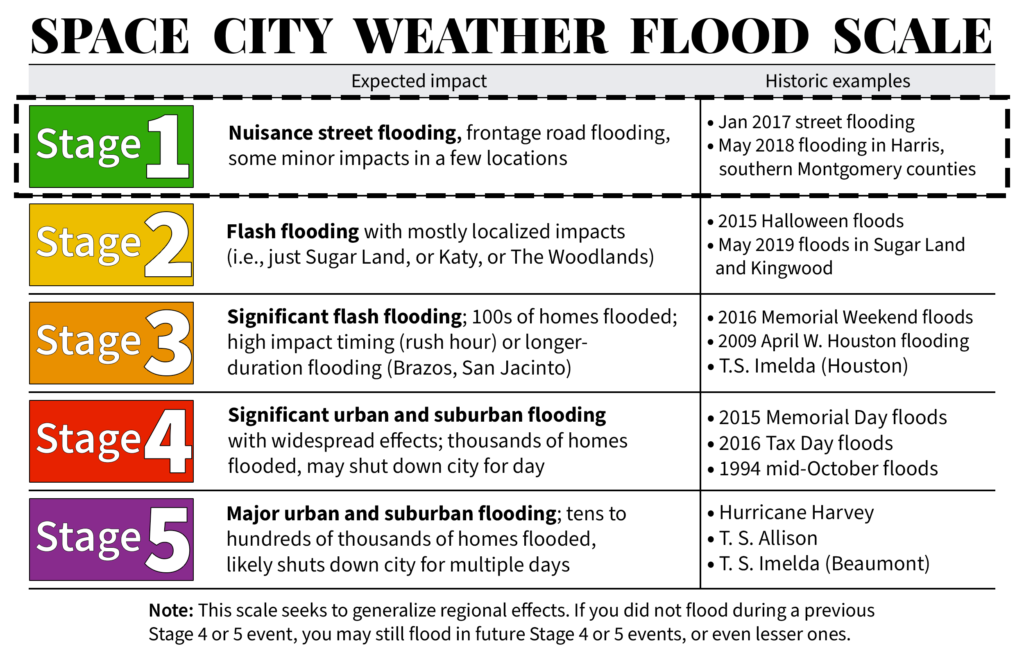
In brief: Showers and thunderstorms will spread into the greater Houston area this morning, and because this is a fairly large system there is the potential for some modest street flooding. A Stage 1 flood alert is in place through the mid-afternoon hours as a result. The weekend still looks sunny and warm as high pressure moves in.
Unsettled environment
After calmer weather on Tuesday, an unsettled pattern returns today. A fairly robust line of storms lies to the west of Houston, and it is trundling toward the metro area this morning. Although there is a modest capping inversion over the greater Houston area, it probably will break as these storms near by mid-morning. Because our soils are already somewhat sodden after rains on Sunday and Monday, these additional rains could lead to some street flooding due to runoff. For this reason we are putting a Stage 1 flood alert into place through mid-afternoon today.
Wednesday
The storms west of Houston should push into Houston between around 9 am and 3 pm CT, with the greater likelihood of heavy rain south of Interstate 10. Although some damaging winds are possible, the overall severe threat is low, and our primary concern is heavy rainfall that may cause some street flooding. Most areas will probably see manageable totals of 0.5 to 2.0 inches, but there could be some higher bullseyes of 3 or more inches before the storms shift eastward this afternoon. I expect road conditions to be fine for the evening commute home.
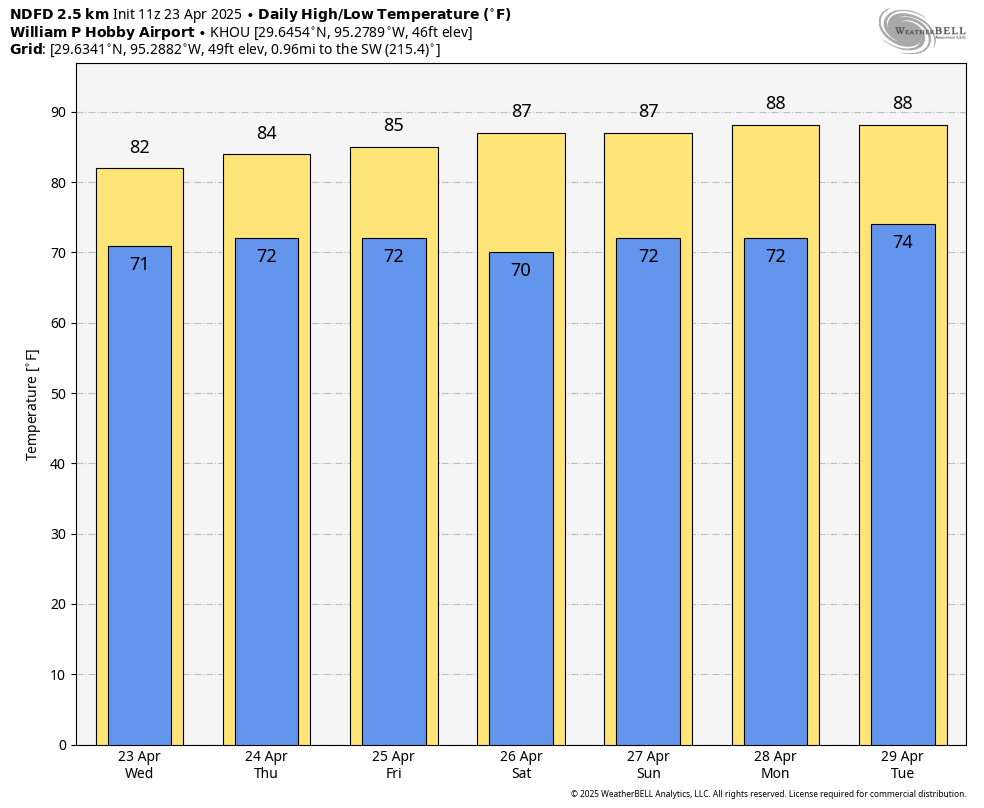
With mostly cloudy skies amid the rain, high temperatures today will likely peak around 80 degrees, or a bit higher, for most of the area. Winds will be from the southeast at about 10 mph, although we could see some higher gusts along with some of the stronger thunderstorms. A few isolated showers will be possible this evening, with lows tonight dropping into the low 70s in the Houston area.
Thursday and Friday
Plenty of moisture remains in the atmosphere on Thursday and Friday to support additional showers and thunderstorms, however we will be lacking a spark. Therefore my best guess is that, overall, rain chances will be quite low, on the order of 20 percent. But if we do see some showers they could be briefly heavy. For the most part I expect these to be partly sunny days, with temperatures in the mid-80s and southerly winds in the vicinity of 15 mph. Nights remain warm, with lows falling to around 70 degrees.
Saturday and Sunday
As anticipated, this weekend should bring mostly sunny skies and an end to rain chances as high pressure builds over the area. Expect high temperatures in the vicinity of the mid-80 to upper-80s both days with warm nights. Winds will come from the southeast at about 15 mph, which will be a boon for MS-150 riders. Alas, dewpoints of around 70 degrees will make it difficult for participants in the IRONMAN event in The Woodlands.
Next week
This pattern more or less continues into the middle of next week until the high pressure shoves off, and we are left with the potential for more unsettled weather. A front will approach the area, and this should generate some healthy rain chances. Whether it pushes all the way to the coast and brings us some drier and cooler air is something we’re just going to have to wait and see.

Financial Experts Recommend Diversifying Portfolio With Multiple Harebrained Schemes
NEW YORK—Claiming it was the only way to protect one’s assets against economic volatility, a group of financial experts recommended this week that Americans diversify their portfolios with multiple harebrained schemes. “Rather than rely on a single half-baked investment, we strongly encourage people to have several cockamamie business plans to fall back on,” said J.P. Morgan financial advisor Jonathan Rattler, adding that it was important to mitigate risk through a combination of foolhardy ventures like breeding koi fish, stealing copper wire from a scrapyard, and buying a machine on Alibaba that makes lab-grown diamonds. “We suggest investing in a variety of dubious sectors, including miracle hair-growth supplements, alpaca rentals, and using outlets at public libraries to run your own bitcoin farm. Also, we know a guy who makes $2 million a year installing vending machines in local prisons. If you want, we can put you in touch.” Rattler added that Americans planning to retire by age 60 should really consider giving their brother-in-law the $10,000 he requested, because his idea to import exotic ferns was a surefire thing.
The post Financial Experts Recommend Diversifying Portfolio With Multiple Harebrained Schemes appeared first on The Onion.
RFK Jr. Flushes Nation’s Antidepressants
WASHINGTON—Declaring that there was no better time for the U.S. populace to go cold turkey, Health and Human Services Secretary Robert F. Kennedy Jr. reportedly attempted to flush the nation’s antidepressants this week. “Listen, I found these in your medicine cabinet,” said Kennedy, the 71-year-old Cabinet member stunning Americans in all 50 states as he stood over the toilet flushing millions of prescriptions for fluoxetine, escitalopram, sertraline, and paroxetine down the bowl. “You don’t need these—they were only holding you back. Nuh-uh-uh, Vermont, no buts about it. Just push through the next few days, and you’ll see exactly what I’m talking about. If you still feel bad after that, try some fish oil. Trust me. Your life is about to be so much better.” At press time, reports confirmed Kennedy was frantically plunging the overflowing toilet.
The post RFK Jr. Flushes Nation’s Antidepressants appeared first on The Onion.
Trump Opens Up Nation’s Aquariums To Commercial Fishing
WASHINGTON—Claiming that preservation efforts had impeded U.S. seafood production for far too long, President Donald Trump announced Wednesday that he had opened up the nation’s aquariums to commercial fishing. “Starting today, fishermen will finally be allowed to sail into America’s protected aquariums, drop a net in any marine exhibit they please, and begin trawling,” Trump said at a press conference, adding that commercial fishing would now be permitted in all glass-enclosed fish tanks, coastal mammal habitats, and interactive tide pools at the more than 150 aquariums across the United States, regardless of whether spectators were currently enjoying them or not. “How can Democrats stand by and watch hardworking fishermen suffer when the Monterey Bay Aquarium has an entire kelp forest filled with sharks, jellyfish, and an absolutely enormous sunfish just sitting there, going to waste. That’s why I’ve decided to waive the entrance fees nationwide and open every exhibit to fishing, even the ones with penguins, dolphins, and otters.” At press time, Trump announced an additional executive order allowing commercial seafood vessels to fish in exotic pet stores, home aquariums, and private backyard koi ponds.
The post Trump Opens Up Nation’s Aquariums To Commercial Fishing appeared first on The Onion.
Kristi Noem’s Handbag Containing $3,000 Stolen From D.C. Restaurant
While eating dinner at a D.C. restaurant, Homeland Security Secretary Kristi Noem fell victim to a thief who stole her driver’s license, passport, department access badge, medication, makeup bag, blank checks, the keys to her home, and about $3,000 in cash. What do you think?

“Uh-oh, it’s a scary time to be without a passport.”
Zach Custer, Typeface Approver

“Oh my God. Think of the damage this thief could do with that much makeup.”
Dallas Reeves, Driveway Paver

“I hope she finds the scapegoat responsible.”
Rochelle Oriti, Suit Stitcher
The post Kristi Noem’s Handbag Containing $3,000 Stolen From D.C. Restaurant appeared first on The Onion.
Thrift Store Categorizes Inflatable Birthing Tub As Decor
The post Thrift Store Categorizes Inflatable Birthing Tub As Decor appeared first on The Onion.
New Jersey targets Texas abortion providers in new recruitment campaign
DO NOT TALK TO COMPUTERS
DO NOT TALK TO COMPUTERS
...
![[img]:strrlt](https://analognowhere.com/_/strrlt/strrlt.png)
A badge featuring an evil computer doing drugs in the vicinity of weapons
https://analognowhere.com/_/strrlt
my boss says my salary research is wrong because our benefits are so great, calling out sick for flight anxiety, and more
It’s five answers to five questions. Here we go…
1. My boss says my salary research is wrong because our benefits are so great
I recently received a promotion with a significant increase in job responsibilities and found myself negotiating salary for the first time in my career. My state requires salary ranges to be posted with job descriptions, so I have a good idea what other companies in our industry are offering for my role and my years of experience, and I asked for a similar amount, about 10% higher than what I was offered. My manager wanted to know how I came up with the new number, so I pointed out these job postings. She responded that the total compensation I was being offered, including benefits, was already equivalent to the amount I was asking for, so there was no need to increase the offered salary amount.
I understand where she’s coming from; we have very generous benefits, including regular bonuses and multiple reimbursement programs for a variety of qualified expenses, and total compensation is a way to quantify those extra dollars. But in my mind, these benefits are not the same as guaranteed pay. Bonuses are dependent on the company’s profits, and I won’t receive the reimbursement funds unless I incur the relevant expenses. Not to mention that the market rates I’m researching are base salary and I don’t have any way of knowing what the dollar value of another company’s benefits would be for a more equivalent comparison.
Is this normal to consider total compensation when negotiating a salary? Am I too focused on the base salary number? I generally consider benefits as more of a happiness boost than a monetary boost (and this is the first time I’ve had benefits that result in me receiving cash payouts), so maybe I need to adjust my mindset. But I feel like my manager is using the company’s benefits package to justify giving me a salary that is below market rate. I’m wondering how I can approach this better at my next salary review.
Ha, no, the value of your benefits package isn’t supposed to be used like that. Your boss is comparing salary plus benefits at your current company to salary alone at another; it’s apples and oranges (or cash and scones?). For all we know, the other companies’ benefits packages could be the same or better than your company’s is! It sure is convenient for her to use that to swat away the comparisons, but it’s not at all accurate to do that.
Bonuses could be an exception to that if your bonuses are extremely reliable (although still not ideal for the reasons you point out), but “we reimburse a lot of expenses that you may or may not incur”? No.
The next time this comes up, you could say, “I appreciate our benefits, but ultimately salary is the most important piece of compensation for me, and that’s what I’m focused on.” You could add, “I can’t include the value of our benefits package without comparing it to the value of theirs.” (And really, she’s practically begging you to go out and learn more about what the competition is offering.)
Related:
can I include the value of my benefits when I talk about my current salary?
2. Can you call out sick for flight anxiety?
This is a hypothetical, but it almost happened. I just had a weekend social obligation in another city that required two flights each way. (These were domestic flights within the U.S.; my local airport doesn’t have direct connections to the destination city.)
At the gate for the first flight back home, I was feeling very anxious about the flight and almost bailed to rent a car and drive back. If I had done this, I would’ve had to miss one day of work.
Ironically, that flight ended up being super smooth. But if I had gone with my idea, would I have legitimately been able to call out with a sick day, on the grounds that flight anxiety is anxiety and therefore a mental illness?
In theory, in a perfect world where everyone understands anxiety and there’s no stigma around mental health? Sure. It should qualify.
In this world, though, the wiser move in a lot of organizations would have been to just say your travel arrangements got messed up, you were having to rent a car to get back, and you’d need to use an additional day of vacation to do it.
3. My boss won’t let me send client reports until he reads them, but he never reads them
My boss is generally fantastic and supports my professional growth and allows me flexibility in working hours and leeway to manage my clients as best I see fit. However, he has one frustrating area of micromanagement that is causing me workflow issues and I don’t know how to move forward.
Our organization’s clients receive quarterly reports on the performance of their products, which I spend about a day each quarter compiling. My boss insists on seeing the reports before I send them to clients. This is despite me never having an error that needs correcting in the five years I’ve worked here.
The issue is that he is swamped and it takes him forever to get round to checking and approving the reports. Currently, he hasn’t yet looked at my 2024 Q4 reports, and the Q1 reports for 2025 are now also waiting for him to check. When I finish a report, I email him with a link to where it’s saved. I remind him about checking the reports at least twice a week in our standing meetings, and he says he’ll do it that day but gets distracted by more urgent priorities and the client reports get pushed to the bottom of the pile. My clients have been asking for the 2024 Q4 reports for a couple months now and I have been giving them vague promises of “soon.”
Telling clients that the reports are ready but I’m not allowed to send them until I get my manager’s approval makes me sound incompetent. However, being months late sending the reports also seems unprofessional. Every time I finish the quarterly reports, I ask if I can send them to clients, and every time he says “I want to do a quick read-through” and then sits on the reports for months. Do you have any advice on how I could do things differently to get a quicker response? Going to his boss feels like a nuclear option as they’re very senior. I don’t want to stop doing the reports as the clients like them and I find it a useful exercise to see how the products are performing. I just want to send them out reasonably soon after the quarter ends!
Have you laid out for your boss that clients keep asking for the reports and you’re concerned it looks bad to keep delaying and then never send them? If not, do that! And then say, “Since I’ve never had an error in the reports in the five years you’ve been looking them over, could our system be that you’ll have a week to look them over, but then I’ll send them at that point if I haven’t heard back from you? I could give you a heads-up the day before. Otherwise they’re not getting to clients in enough time for them to be useful, and I worry we’re making ourselves look bad by delaying them when people keep asking for them.”
If he doesn’t like that, could you pull the latest report out in your standing meeting and ask him to go over it with you right then and there so you can put it to bed?
4. I flamed out at my last job, but there were mitigating circumstances — can I apply again?
I worked for two years at one of the largest and best employers in my field. During my first year, I did well: received good feedback from managers, got good reviews, had my contract renewed for a second year. During my second year, things took a turn: I struggled, got assigned a new manager in case that would help, was put on a PIP, and ultimately let go.
The thing is, there were mitigating circumstances. Starting right at the year mark, I had a series of crises: three pregnancy losses, a surgery, and then a flare-up of a chronic condition so severe that I had to take leave to get treatment. Needless to say, this drastically impacted my work performance, and though my bosses knew what was going on and gave me some grace, I wasn’t able to do enough to mitigate the damage, and they let me go.
The good news is, I did get treatment — and what’s more, got an actual diagnosis (which I’d never had before) and got medicated, also for the first time. The difference is night and day. I didn’t realize how much my chronic condition had been impacting my work performance until suddenly it wasn’t any more. In my new job, I’m excelling again, and it feels easy in a way it never has before.
I’d like to apply for a role with this org again. I know from reading your site that the phrasing “had some health challenges that have since been dealt with” can go a long way towards explaining resume gaps. But as I understand it, that’s usually done in interviews. Is there a similar way to professionally bring up this situation in my cover letter as a way of basically saying, “Yes, I know my records show I was let go, but the situation was very circumstantial and truly won’t happen again”? Having been a hiring manager, I understand not wanting to take a risk on a candidate with a poor internal record, but as an applicant, I’d love to be considered for the role given that I’m now in a very different life situation and the difficult circumstances are unlikely to happen again.
It’s pretty hard to apply at an organization that fired you for poor performance (despite the mitigating circumstances!) so I wouldn’t rely on a cold application and an explanation in your cover letter. Instead, can you get in touch with your last manager there and share the situation? You don’t need to get into private health details but a general description of what happened, that it’s now resolved, and how well you’ve been doing since might go a long way. You can then say you’d love to come back but understand the previous situation might be an obstacle to that, and do they have any advice on whether, given the circumstances, there might be a way to be considered again? They might or might not be able to help, but that’s going to give you a better shot than just applying cold will do (and that manager will definitely be asked about you at some point if you did get considered, so you might as well talk with them and get them briefed ahead of time anyway). Good luck!
5. Employer wants to photocopy my Social Security card
As part of a starting a recent job, I went through the usual onboarding processes. I’m aware the purpose of the I-9 form is to verify eligibility to work in the United States. My understanding is, and always has been, that presenting these ID’s is sufficient to meet the requirements of the I-9.
Recently, I was asked to provide a photocopy of my Social Security card. The HR person was vague when questioned, only saying, “For company security reasons.” They apparently keep a filing cabinet with these. This is questionable to me and possibly a security risk. Is it legal for a company to request and keep photocopies of sensitive documents such as these?
Yes, it’s legal and not uncommon. Many employers keep copies so that if they’re ever audited, they can show that they did in fact check your documents and record the information correctly. The government’s guidance to employers on this says, “You may make copies (or electronic images) of the documentation you reviewed, but must return original documentation to the employee. If you make copies, they should be made consistently for all new hires and reverified employees, regardless of national origin, citizenship, or immigration status, or you may violate anti-discrimination laws.” They’re also required to keep the copies as secure as the I-9 itself.
For what it’s worth, a photocopy of your Social Security card doesn’t really make you more vulnerable to identity theft than the I-9 itself does, since an identity thief only needs your card number, not an image of the actual card (and that number gets recorded on the I-9).
The post my boss says my salary research is wrong because our benefits are so great, calling out sick for flight anxiety, and more appeared first on Ask a Manager.
Harvard University sues Trump administration to stop funding freeze
Frat Party University Will Not Comply with the Trump Administration’s Demands
“More than 150 university and college presidents co-signed a letter Tuesday condemning the Trump administration’s recent efforts to dictate the policies of private higher education institutions in exchange for federal funding.”
— NBC News
As president of Frat Party University, I am proud to lead US News and World Report’s “Top Party School” for twelve years running. It has been another incredible year of all-night ragers, never-ending keggers, and our annual “Spring Splash” that draws both hunks and hotties from across state lines.
But all of that is under threat.
The Trump administration has sent my office a list of onerous demands that threaten our very independence. Well, hear this, President Trump: FPU is not complying.
The threats to our funding are significant, but as any Frat Party Animal knows, once you start going down the Slip ’N Slide (failing to stand up for fundamental freedoms) you won’t regain your footing (the power to protect basic human rights) until you crash into the sweaty mass of hunks waiting at the bottom (autocracy).
This regime has threatened to cancel our student visas. But our international hotties are as important members of the FPU community as our homegrown hunks. What would FPU be without Lucas, the Brazilian bodybuilder, Olympic bronze medalist, and copresident of Sigma Chi? Or Hanna and Johanna, our co-valedictorian Swedish divers, who do everything together, including pushing back against authoritarian encroachment?
Fraternity Party University does not stand alone; our longtime rivals at Nerd Tech have joined us in our fight. We are sending kegs to Harvard and Jägermeisters to Princeton. Across the nation, students are rising up together: the nerds and the hunks, the twinks and the gamers, the burnouts, the hotties, the jocks, the cryptobros, and the skaters are all joining forces to defend institutions of higher learning and partying hearty.
So, President Trump, go ahead and do your worst. Remove our federal funding, if you dare. Just know that you will be responsible for ending our pioneering research in human sexuality, weed hydroponics, and beer pong physics. But we will not be moved. We will keep letting first-years into parties with fake IDs, but we promise to bounce ICE agents at every door on campus. We will keep showing our bodies at the Naked Mile, but we will never show the government our student rolls. And we will keep chugging cold beers, but we will never plug our ears to the cries of injustice.
Tomorrow, the sun will rise over our beautiful campus, on our empty quad, on the Solo cups kissed by morning dew, and life will go on. But from this day forward, Mr. President, our coed oil-wrestling oils will not help lubricate your fascist machine.
A sexy little effigy

As a long-time investigator of mysteries, Charlotte cannot help but be impressed when a villain really puts their back into presentation.
The post A sexy little effigy appeared first on Bad Machinery.
Early turnout shatters record in Canada polls with 7.3m ballots cast
We’re Eliminating All Urban Tree Plantings Because Trees Are DEI
This year, as cities around the world commemorate Earth Day, we, the Trump administration, will instead be celebrating America—the only part of the Earth that matters. And as part of our ongoing efforts to make America great again by slashing wasteful government spending, we are canceling all funding set aside for Earth Day tree plantings. Because we believe trees are DEI.
Urban tree planting initiatives are designed to restore the tree canopy in low-income neighborhoods, which have fewer trees than wealthier neighborhoods do. Did the trees in these low-income neighborhoods die because the residents didn’t take care of them, or because they were systemically cut down during periods of civil unrest so that police helicopters could better surveil those areas? It’s impossible to know for sure.
And does planting trees in cities reduce the urban heat island effect, lower air pollution, and decrease rates of asthma and respiratory illness, the way “scientists” say? We think the jury is still out.
But we do know one thing: Trees are cultural Marxism. Improving Americans’ “mental and physical health” by making cities “more pleasant places to live”? Nice try, commies.
Admittedly, we initially cut these urban forestry initiatives because, when DOGE was deciding what to defund, we slashed every budget line item that contained the word “urban,” including accidentally canceling a planned Keith Urban concert at the White House. However, after taking a second pass at the budget, it was clear that these initiatives were deliberately designed to undermine American values. Planting maple trees? The national symbol of our sworn enemy, Canada? Not a chance.
That’s not to say we didn’t consider commemorating Earth Day in some capacity. Following our success in securing corporate sponsors like YouTube, Amazon, and Meta for the White House Easter Egg Roll, we considered replicating the effort for Earth Day. The celebration would have featured fun events like the ExxonMobil Natural Fluctuations in Earth’s Temperature Awareness 5K and an educational kids’ puppet show sponsored by the American Energy Alliance, with a script penned by feminist author–turned–Cloud Truther Naomi Wolf.
And it’s not like we won’t be planting any trees. In fact, we’re excited to announce a $5 billion partnership with Lockheed Martin to install thousands of Tactical Reconnaissance Environmental Envoys or TREEs in US cities. These tall apparatuses resemble actual trees but are, in fact, arrays of CCTV cameras mounted atop metal poles. These devices will help police departments find perpetrators in America’s crime-filled, Democrat-run cities. Lockheed Martin’s TREEs may not provide shade, but they will stop shady behavior.
You may be thinking, How are trees DEI, exactly? Well, for starters, there are over 73,000 tree species on Earth, which is, frankly, way too much diversity. And tree planting initiatives are a ploy for globalists to infiltrate our country with the least desirable of those species. We don’t need any smelly ginkgos coming in and destroying our cities. And if the way we said “ginkgos” makes it sound like an ethnic slur, well, good.
If we had it our way, there would only be one species of tree on Earth—the Norway spruce, a beautiful Aryan conifer that’s commonly used as a Christmas tree. The world should only have tree cover that promotes good Christian values.
There’s an ancient Chinese proverb that says, “The best time to plant a tree was thirty years ago. The second-best time is now.” That means the best time to plant a tree was the same time the Clinton administration was facilitating international trade with countries like China. That can’t be a coincidence.
This is why, in addition to halting tree-planting initiatives, we will mobilize the US Forest Service to remove any tree species that do not align with our America First agenda. It’s time to send those ginkgos back where they came from.
Five fake facts about Canada Proud which we can publish because Facebook loves misinformation
Misinformation and misleading content on Facebook and Instagram from conservative advertising group Canada Proud have skyrocketed in the wake of Meta banning Canadian news from its platforms. Lucky for us at The Beaverton, however, that means we can say whatever the hell we want about Canada Proud in return, because what’s Zuckerberg gonna do, fact […]
The post Five fake facts about Canada Proud which we can publish because Facebook loves misinformation appeared first on The Beaverton.
Some of My History of Hypertext
So in 1979, young Digital Mark is shown a computer, a TRS-80 Model I, by 4th-grade teacher. Other kids play Snake, I hit break and type LIST, seeing BASIC code, because I've been reading the instruction card. "I can read and learn this!" Nothing else now matters to Mark.
That summer, I take an adult college summer course on programming. Over the next few years before I get my Atari 800, I use school computers, mostly TRS-80 but some Apple ][, to program obsessively. Libraries and book stores are scoured for information.
The main sources of knowledge for me then were:
- Stimulating Simulations, by C. William Engel (1977)
- Creative Computing magazine, ed. David H. Ahl (1974-85)
- Basic Computer Games, Microcomputer Edition, by David H. Ahl (1978)
- some TRS-80 Level II BASIC book
- My Computer Likes Me When I Speak BASIC, by Bob Albrecht, People's Computer Company (1972)
- Computer Lib/Dream Machines, by Ted Nelson (1974-5)
The first three I could buy, the last two I only ever found in the library. They are now all on Internet Archive. As noted here a few years ago.
Computer Lib is bizarre rantings mixed with really visionary stuff. It's a two-sided flippy book, pages numbered CL 1-68 one side, DM 1-60 the other). Computer Lib is about how computers work "now" (1965-1974), teletypes talking to mainframes or minicomputers. This is important! There's a range of computing levels.
Ted talks about BASIC and how to use it seriously, using arrays as data structures, in a few pages. Some weird stuff about other languages I haven't heard of. More about data structures, links between data in different places. I'M LIKE TEN YEARS OLD, man, you can't dump that on me! I didn't fully understand this stuff until Sedgewick's Algorithms years later.
Political ranting, some of it now unacceptably phrased, but CYBERCRUD is a good primer on how computers aren't the problem, people with computers are the problem. This echoes the People's Computer Company slogans
BASIC is the People's Language!
Use computers FOR people, not against them!
Dream Machines has a 1975 supplement about the Altair, bitmap graphics, and cheap microcomputers, which largely lines up with Computer Lib's earlier predictions. It goes in depth into how you can use graphics, image and audio processing.
If Computers Are The Wave Of The Future, Displays Are The Surfboard
Branching Presentational Systems - Hypermedia
And here he develops a theory of Hypertext, "by which I mean non-sequential writing". Everything you now know about the World Wide Web and GUIs, you pretty much got by way of Ted Nelson, Doug Englebart of NLS, JCR Licklider of Project MAC (multi-user time-sharing), and Ivan Sutherland of Sketch. I read this wide-eyed and believing everything.
The giant over-arching project for this is XANADU (earworm Olivia Newton-John song here). Xanadu is a very well-specified, complex, solves everything system. Ted's argument is that long-run everyone will use his system for every computation. This starts at DM 44, read that entire section if you read nothing else.
Returning CL/DM must've been the hardest thing ever. I read it again a few times over the years. (I have a stack of notes about it from more recent reading, but I'm here staying brief and focused.)
Over the next decade, we got and then slowly lost things like Hypercard. HC's an amazing technology, it is The Future We Didn't Get, because it was Mac-only, monochrome-only, Hypertalk is a somewhat annoying hybrid of BASIC, COBOL, and C, limited to either tiny windows smaller than the small Mac desktop, or full-screen Mac 512x344. Later that got better, and Myst was written in HC + many addons, but it remained a weird silo.
Repeatedly Ted Nelson says Xanadu is coming soon, shares new technical details which conflict with previous statements, various people on his team promote it, then unpromote it. The exchange in Dr Dobb's Journal 1983 disillusions me, convinces me Xanadu will not be coming soon.
The Internet became available to me in 1989, and Gopher came out in 1991, providing a real hypertext solution. It didn't have inline links, "transclusion" (include a chunk from another document), or bidirectional links, but it did let you make complex menus with text, links, images and other media, and interaction with forms/search fields. Gopher became the best way to hyperlink and index everything.
The WWW was not an attractive system until Mosaic came out in 1993, mid-year it got inline image tags and imagemaps as a dumb hack, and Netscape Navigator commercialized it in 1994. Gopher might've survived this except the UMinn administration tried to extort payments for servers in 1993. I moved everything into my web site, as did everyone else.
The thing is, these are not Xanadu. Ted got increasingly strident that the WWW is not Hypertext because it's not bidirectional etc. But of course this is impossible: A local database can be forced to be consistent, but a network of unreliable computers cannot. One-way works with stupid complexity and GeoCities, and two-way does not. Imagine entering a web page and seeing 500 "sites who called here" links, some of them private. Each of them has to validate that it's paid the micropayment for copyright access to the site. It's not "web scale".
In the end, post 2000, there's a demo "release" of Xanadu, with a hand-hacked single-site database, no editor, no way to link your own stuff with it. It's not anything.
More notes to come, we'll be talking about this more on the Lispy Gopher Climate Show every Tuesday midnight UTC (like 17:00 PST). hashtag
God Too Obsessed With Ants Right Now To Focus On Next Pope
THE HEAVENS—Admitting that He had barely even noticed the leader of the Catholic Church had died, God, our Lord and Heavenly Father, announced Tuesday that He was too obsessed with ants right now to focus on the next pope. “While I want to commit to finding a successor to Pope Francis, I’m currently in kind of an ant phase right now, and it’s taking up my whole life,” said the Creator of All Things, explaining that ever since He discovered how cool the insects were, He let His duties overseeing the papal conclave fall by the wayside. “Here’s the thing. Ants look small, but they are actually super strong and can lift over 50 times their own body weight. Plus, they communicate with pheromones! I know the Catholic Church is in mourning and needs a strong, compassionate leader, blah, blah, blah, but seriously—did you know that ants actually grow their own fungus? They’re tiny little farmers. How cool is that?” Later, after reportedly suffering an unexpected ant bite, God confirmed that the next pope would be selected on the basis of how effectively he could kill insects.
The post God Too Obsessed With Ants Right Now To Focus On Next Pope appeared first on The Onion.
Pope Francis Dead At 88
Pope Francis, the Catholic Church’s first Latin American pontiff and a leader who charmed the world with his humble style and concern for the poor, has died at the age of 88. What do you think?

“Presbyterians, now’s our chance to strike!”
Robyn Phillips, Wiring Inspector

“I’m sad, but I’m not ‘Pius XI’ sad.”
Edgar Herrera, Horn Tuner

“Gravy train’s over, global poor!”
Nathan Dinkins, Backup Veterinarian
The post Pope Francis Dead At 88 appeared first on The Onion.
Trump Announces Seal Team 6 Killed U.S. Protester In Daring Overnight Raid
White House sources have confirmed the successful execution of 19-year-old college sophomore Evan Dixon late last night by an elite team of special forces.
The post Trump Announces Seal Team 6 Killed U.S. Protester In Daring Overnight Raid appeared first on The Onion.
The ongoing story of seconds on the taskbar
Over a decade ago, I noted that early beta versions of the taskbar clock showed seconds, and sometimes even blinked the colon like some clocks do, but it was removed because the blinking colon and updating time were ruining Windows 95’s benchmark numbers due to the need to keep all of the code paths related to text rendering in memory, as well as the stack of the thread in the Explorer process that updates the clock.
Even though computers are not under the same tight memory constraints as Windows 95, the taskbar still does not show seconds because Terminal Services would have hundreds of updating clocks, and even on single-user systems, the energy efficiency team gives the side-eye to any timer that runs faster than once per minute.
But finally, in 2023, the Taskbar added an option to show seconds. The option is however disabled by default, and it comes with the warning “(uses more power)”. How much power is it using?
The Taskbar team ran power consumption tests to try to convince the energy efficiency team that even though there was an extra cost, that extra cost was not exorbitant.
A member of the Taskbar team told me that their preliminary measurements showed that Explorer consumed 0.417 mW of energy in its default configuration, but the energy usage went up to 5.42 mW if seconds were enabled on the taskbar. This is over a factor of ten, so that sure seems like a big jump.
I’m having trouble finding information on how much energy a laptop screen consumes. This Web site gives a range of 200 mW to 1100 mW active power consumption for a 16-inch screen at 100 nits. Do I believe these numbers? No. Will I report them anyway? I guess I just did.
If we accept these numbers, then an additional 5 mW doesn’t seem quite so bad overall.¹ It’s an extra 2.5% on the high end, or 0.05% on the low end. That’s a loss of 3 to 15 minutes over a 10-hour period.
¹ The energy efficiency team looks at the system as a whole. I mean, sure, Explorer decreasing battery life by 15 minutes over a 10-hour period might not sound like much, but suppose 10 other components come to the same conclusion. Now you’ve lost over two hours. They also look at the aggregate impact of Windows on the global environment and make recommendations like having Windows Update perform its work when there are more low-carbon energy sources available. You can use the PowerGridForecast class to use this information in your own programs. There’s even sample code.
The post The ongoing story of seconds on the taskbar appeared first on The Old New Thing.
Microspeak: top of mind
Although I have citations going back to 2011, the phrase top of mind snuck up me and has established itself in Microspeak.
It’s never the full idiomatic phrase on the top of my mind. It just the shorthand top of mind.
Let’s try to figure this out together. Here my earliest citation, from 2011:
Please join (senior executives) for our Employee Town Hall. This is a great time to hear what’s top of mind for them and get a preview of new products under development.
In this case, it seems that top of mind for X is just shorthand for “on the top of X’s mind”.
This simple explanation holds up in my second citation from 2013:
Our first town hall of 2013 is all about what’s top of mind for you. (Senior executive) will be joined by (person) for a live Q&A discussion. This is a great opportunity for you to hear (senior executive)’s perspective on what’s happening in the technology industry as well as his view on what we accomplished in the first half of this year and what’s in store for the second half.
This time, it seems to be “all about what’s on the top of your mind.” Though maybe not, because the event bills itself as giving you a chance to hear the senior executive’s thoughts on various topics, rather than hearing the senior executive’s thoughts on topics that are on your mind. So maybe it’s about topics that “should be on the top of your mind”?
So far, the term seems to be reserved for Town Hall meetings with senior executives, but that changes in my third citation, also from 2013:
We (event organizers) kept this direction top of mind as we designed and developed our agenda.
The for X has disappeared, presumably with for us implied. And the term is now being used with respect to the thoughts of event organizers rather than the thoughts of a senior executive.
The next citation comes from an internal 2014 marketing newsletter.
We took out ads highlighting a variety of X products to keep them top of mind.
If you continue with the assumption that for us is implied, then this leads to the silly conclusion that they took out ads in order to help themselves remember their own products! Presumably the implied phrase in this case is for current and future customers.
Although the phrase is spreading in applicability, top of mind continues to be dominated in my citations to situations in which a senior executive shares their thoughts with a large group of people, usually in a meeting, but also as a newsletter, email, or video.
I (senior executive) wanted to share with you a bit about what is top of mind for me at both a business and a personal level.
Here’s a usage as a label for a recording of a recent meeting.
(Senior executive) Top of Mind
As we start H2 (senior executive) shares his Top of Mind.
Notice how the phrase has now become a proper noun with capital letters. It has become a Thing. Also, the top of mind for X phrasing has changed to X’s Top of Mind, further solidifying its status as a proper noun.
As the popularity of the term spreads, its usage also becomes muddier.
At this meeting, (senior executive) will share their thoughts on what is top of mind for employees.
Is “share their thoughts on what is top of mind for employees” saying “share their answers to questions that employees are thinking about”? Or is it saying “share their guesses for what they think employees are thinking about”?
(upper manager) and (upper manager) will share what’s top of mind for the team.
This is even stranger. Using our for X formulation, it seems to be saying “share what’s on the top of the team’s mind”, as if they will be performing a psychic reading to tell the team what they are thinking about. (“I see a difficult bug, it has some crashes. Does that sound like something that is worrying you?”) Or maybe “share what’s top of mind for the team” is trying to say “to share what issues related to the team are on the top of their minds”, or possibly even “to share what they think should be on the top of the team’s mind”.
But really, it doesn’t matter what top of mind means any more. It’s just a phrase you throw out to sound hip and cool. Even it doesn’t make sense, that’s okay, because nobody reading it knows what it means either.¹ The phrase is just the mechanism for a collaborative delusion that communication is taking place.
As one my colleagues astutely pointed out, most Microspeak starts at the top. When a senior executive uses a particular phrase, it becomes fashionable for others to use it, and when it becomes established in the culture, it turns into Microspeak.
For example, it is now in vogue for upper managers, not quite at senior executive level, to publish documents or send out email titled “Top of Mind for (date)”.
Here are some other examples of the phrase trickling down, used by people who are regular everyday employees, not managers or senior executives.
There are three topics that were top of mind in my previous update.
The top of mind engagement is to enable (feature) support for key apps that would benefit from it.
I think this next citation gives clear evidence that the term has devolved to just meaning “things of note” rather than “things that are at the forefront of my thoughts”:
Top of mind
- TPS reports are due at the end of the month.
- The Giving Campaign has come to a close! Thanks to all who helped organize events throughout the month, as well as employees for giving time and donations.
- November is Native American Heritage Month.
I doubt these topics have been occupying the speaker’s thoughts. It’s now just a bullet list of things to mention.
¹ The great thing about making a promise that nobody can understand is that nobody can call you to task for failing to live up to it!
The post Microspeak: top of mind appeared first on The Old New Thing.
TribCast: Get out the popcorn, it’s Paxton vs. Cornyn

/https://static.texastribune.org/media/files/18629d6e8b4af1811b7a9c51b1cfab3e/TribCast%20April%2022.jpg)
Saturday Morning Breakfast Cereal - Past
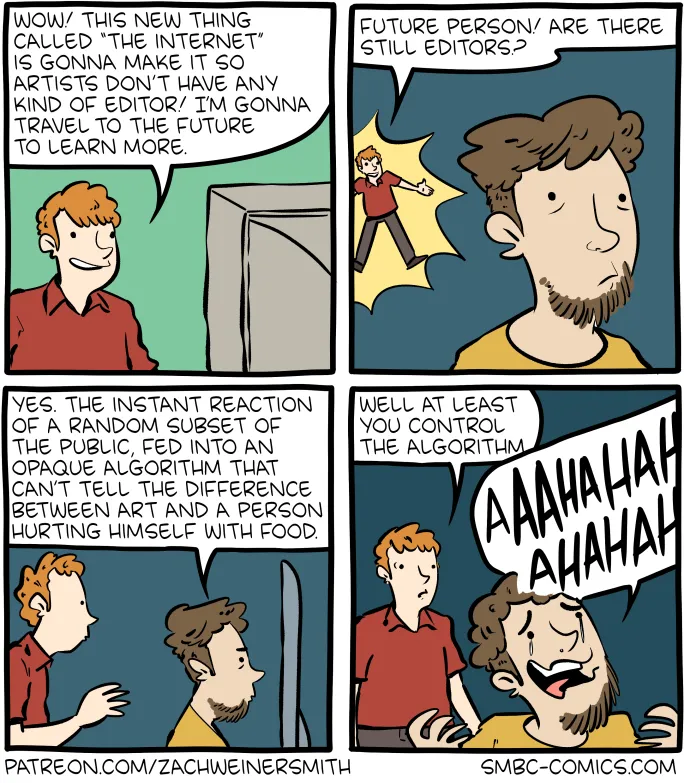
Click here to go see the bonus panel!
Hovertext:
The thing I miss most about the 90s is the ability to time travel.
Today's News:
I manage two employees who don’t get along and it’s getting out of control
A reader writes:
I took over as the director of my former team about a year ago. I inherited an ongoing HR issue between one of my direct reports (Tammy) and her direct report (Beth). Beth hates Tammy. Beth had applied for the promotion to Tammy’s position when it was last open but my predecessor hired Tammy from the outside, and Beth had strong feelings about being passed over. Tammy was not the best hire; she is not a strong manager. But we are a government agency, and while Tammy isn’t my best employee, she is not so bad that there would be any chance I could fire her. I have worked on coaching her around some specific behaviors that I know bother her staff and she is doing a little better there, and her relationship with her other direct reports has started to improve.
But not Beth. Beth came in hot at me from day one in this role that I needed to “fix” Tammy. She went around the chain of command to me constantly for every small nitpicky complaint she had about everything Tammy does. And ultimately, Beth just doesn’t like Tammy on a personal level, which she’s told me very plainly.
We had a come-to-Jesus type conversation with all three of us a few months ago to get to some basic agreement on how they would work together (who would cc who on emails, how leave requests would be handled, all really basic stuff that shouldn’t need to even be said for two management level staff, but we laid it all out). The nitpicky complaints to me stopped.
But it seems like Beth has now just given up. She looks absolutely miserable in every meeting. If she’s not talking, which she virtually never does unprompted now, she stares into space with a look on her face like we’re torturing her. She was always a bit of a negative person, but that has just exploded — while she rarely talks at all, virtually everything she does say has a complaint attached to it or a deep sigh involved. Beth also supervises other staff and I’m really worried that she’s not only becoming incredibly negative herself, but that at least one of her direct reports is following her lead in complaining a lot about other staff.
I feel like I have some idea of how to deal with the negative comments. I’m less sure what, if anything, I can do about her showing up at every meeting looking like it’s sheer torture. I’m thinking of pulling her aside and she saying, “I’m concerned about you, our last three team meetings you looked really miserable to me.” At the end of the day, though, she’s made it really clear that nothing will resolve her issue except not reporting to Tammy, which is not an option I have available. And while Beth’s behavior also isn’t great now and her performance has slipped down to pretty mediocre, in the space we work in it doesn’t begin to approach fireable.
Are we all just stuck? I’m feeling stuck. And I know Beth feels stuck. And I know Tammy feels stuck that much of Beth’s hostility is rooted in personal dislike and a history of hiring decisions that Tammy didn’t have anything to do with. I’m going to keep coaching Tammy to improve. Can I do anything else here?
We can’t talk about this without saying that not being able to do anything about a poor manager on your team is … well, Not Good. So first and foremost, I strongly recommend that you question that as much as you can! Can you really not do anything about those things, or is it more that it’s a massive pain with a ridiculous number of bureaucratic hoops to jump through? Sometimes people say “we can’t fire in our organization” when what it really means is “it’s a huge pain to fire here, but it can be done.” (And yes, I know government is its own thing, but even there, there are things you can do if you’re willing to put in the time.) Plus, even if you can’t fire a problem performer, that doesn’t mean you can’t lay out stronger performance standards and keep pushing her toward them.
Of course, it’s possible that you’ve thought through how much time and effort it would take and determined that your energy would pay off more if spent on other things. But if there’s any chance that you haven’t fully thought through all the options available, please do — not just for Beth, but for all the other people Tammy manages, too. Just because they’re not as vocal about it as Beth is doesn’t mean that they’re not deeply frustrated by reporting to her, too.
Okay, with that behind us…
The next step is to separate your concerns about Beth into two buckets: the concern about her being so obviously miserable and the concern about what effect that might be having on the people she manages, since those require two different approaches.
If it were just that she looked miserable, I’d say you should have a very up-front conversation with her where you say, “You’ve looked really unhappy lately, and I want to talk about what’s going on. I know you’re unhappy reporting to Tammy, and you have serious concerns about her as a manager. Realistically, XYZ is not going to change because of ____ (reasons). You should assume XYZ will still be that way a year from now, or even a few years from now. I want to be up-front with you about that because I want you to be able to make good decisions for yourself, and my strong advice is to be honest with yourself about whether you can find a way to be reasonably happy within that reality, or whether this is just not a good match for you long-term. I’d hate to lose you, but I’d hate more for you to spend years being this unhappy in your job.”
In many ways, this is similar to last week’s letter about the young employees struggling with the realities of work; the situations are different but part of the solution to both is to say, “Let me give you really transparent info about what will and won’t change so you can decide for yourself if this will work for you.”
But while ultimately Beth’s feelings about work are her own to manage, there’s also a point where it can become a work issue for others — like if she’s shutting down to the point that she won’t engage in meetings or if she manages people who are getting that doom and gloom splattered all over them. Both sound like the case here, and those are things you have standing to take on not just as a fellow human concerned about her happiness but also as a manager concerned about the way it’s impacting her actual work
What to do about that depends on the specifics of how it’s affecting Beth’s staff — but it sounds like you’ve seen enough to have real concern that it is. So the conversation needs to include something like, “Ultimately, your feelings toward Tammy are your private business as long as they’re not disruptive at work, but I’m seeing it affect your team in XYZ ways.” Then offer clear statements of what, specifically, you need her to change in that regard. (That should include her performance slipping to “mediocre,” as well.)
Crucially, though, you don’t want to get into a situation where Beth is being held to a higher standard than Tammy … because that’s just going to make the problems with Beth worse. If you’re going to take a stronger hand in managing the Beth situation (and you should), you’ve got to take a stronger hand in managing the Tammy situation too.
But if you can say honestly to Beth that you’re working closely with Tammy on the issues that concern her, then you’re on much more solid ground in saying, “I’ve heard your complaints, I’m actively working on them, but this is the reality we’re in and your responsibility is to do XYZ on your own end of this.”
The post I manage two employees who don’t get along and it’s getting out of control appeared first on Ask a Manager.
should I interview candidates who show up without an appointment?
A reader asks:
My small business has had a recurring discussion regarding taking meetings with job seekers when we don’t have an open position. Someone will reach out, either by stopping by our office without an appointment or just sending an inquiry by email, and ask if they can meet with someone. In the past, we have taken these meetings as sort of informal interviews. From what I recall, we’ve never made a hire from these meetings when there’s no existing connection to our company or staff.
Over the last few years, I’ve discouraged these meetings. They just take up time for our team when we don’t have an opening, and I also feel they can be misleading if we’re not clear enough that we don’t have a position. I’m more inclined to take these meetings if (1) the person has a connection to a current employee who gives a positive recommendation, and (2) we do have an idea of a need on our team that the candidate could be a good fit for. Otherwise, I’d prefer to say thanks for their interest in our company, and we’ll reach out should we have an open position that might be a good fit.
I’ve had an inquiry recently from a woman who sent her resume and asked to meet even if we don’t have an opening to learn more about our company and how she can contribute. She’s sent a couple of emails and dropped by without an appointment. I told her we don’t have an opening and that I’d reach out if we do in the future. She followed up with a second email, again asking to meet. She does not have a connection to any of our existing staff, and it seems a bit presumptuous to ask a stranger to take time out of their workday essentially as a favor for some career advice. I’m really curious what your thoughts are on this topic.
I answer this question over at Inc. today, where I’m revisiting letters that have been buried in the archives here from years ago (and sometimes updating/expanding my answers to them). You can read it here.
The post should I interview candidates who show up without an appointment? appeared first on Ask a Manager.
A quick note about the Bad Machinery archive
The Bad Machinery archive (2009-2017) has lived on GoComics for several years now, and I know a lot of you have enjoyed re-reading it there. Recently, a few readers have been in touch about the archive being placed behind a paywall. This is something GoComics has done across their platform as they (like many others) navigate the decline in web advertising.
My long-term plan is to bring the archive back to my own site where it can be read for free again. But it’s going to take some time – I’ll need to re-output every page from the original high-res files. GoComics used the updated versions from the Oni Press books, which include lots of edits and bonus pages. Those are the versions I’d like to restore, but I’m currently missing the first half of the series in a suitable web format. Unfortunately, the copies on GoComics are heavily compressed, and not really usable as-is. With over a thousand pages to prepare, it’s a fiddly task, and time is always tight.
If you’re keen to revisit the series sooner rather than later, the collections are still available. A few people have also asked if I could release Bad Machinery digitally on Gumroad, like I did with Scary Go Round, but unfortunately Oni Press holds the digital rights, so that’s not an option right now.
Thank you for taking an interest in these old comics. Rest assured, they’re on my to-do list.
The post A quick note about the Bad Machinery archive appeared first on Bad Machinery.