Cowboy Who?
Shared posts

Sure, xor’ing a register with itself is the idiom for zeroing it out, but why not sub?
Matt Godbolt, probably best known for being the proprietor of Compiler Explorer, wrote a brief article on why x86 compilers love the xor eax, eax instruction.
The answer is that it is the most compact way to set a register to zero on x86. In particular, it is several bytes shorter than the more obvious mov eax, 0 since it avoids having to encode the four-byte constant. The x86 architecture does not have a dedicated zero register, so if you need to zero out a register, you’ll have to do it ab initio.
But Matt doesn’t explain why everyone chooses xor as opposed to some other mathematical operation that is guaranteed to result in a zero? In particular, what’s wrong with sub eax, eax? It encodes to the same number of bytes, executes in the same number of cycles. And its behavior with respect to flags is even better:
| xor eax, eax | sub eax, eax | |
|---|---|---|
| OF | clear | clear |
| SF | clear | clear |
| ZF | set | set |
| AF | undefined | clear |
| PF | set | set |
| CF | clear | clear |
Observe that xor eax, eax leaves the AF flag undefined, whereas sub eax, eax clears it.
I don’t know why xor won the battle, but I suspect it was just a case of swarming.
In my hypothetical history, xor and sub started out with roughly similar popularity, but xor took a slightly lead due to some fluke, perhaps because it felt more “clever”.
When early compilers used xor to zero out a register, this started the snowball, because people would see the compiler generate xor and think, “Well, those compiler writes are smart, they must know something I don’t. Since I was on the fence between xor and sub, this tiny data point is enough to tip it toward xor.”
The predominance of these idioms as a way to zero out a register led Intel to add special xor r, r-detection and sub r, r-detection in the instruction decoding front-end and rename the destination to an internal zero register, bypassing the execution of the instruction entirely. You can imagine that the instruction, in some sense, “takes zero cycles to execute”. The front-end detection also breaks dependency chains: Normally, the output of an xor or sub is dependent on its inputs, but in this special case of xor‘ing or sub‘ing a register with itself, we know that the output is zero, independent of input.
Even though Intel added support for both xor-detection and sub-detection, Stack Overflow worries that other CPU manufacturers may have special-cased xor but not sub, so that makes xor the winner in this ultimately meaningless battle.
Once an instruction has an edge, even if only extremely slight, that’s enough to tip the scales and rally everyone to that side.
Bonus chatter: One of my former colleagues was partial to using sub r, r to zero a register, and when I was reading assembly code, I could tell that he was the author due to the use of sub to zero a register rather than the more popular xor.
Bonus bonus chatter: The xor trick doesn’t work for Itanium because mathematical operations don’t reset the NaT bit. Fortunately, Itanium also has a dedicated zero register, so you don’t need this trick. You can just move zero into your desired destination.
The post Sure, xor’ing a register with itself is the idiom for zeroing it out, but why not sub? appeared first on The Old New Thing.
The Wild Story of the Teton Dam Failure
[Note that this article is a transcript of the video embedded above.]
In 1975, after three long years of excavating, hauling, placing, and compacting soil across the Teton river, Teton Dam topped out at 305 feet or 93 meters high. Built by the Bureau of Reclamation, the dam was the flagship component of the Teton Basin project of southeastern Idaho, meant to provide flood control, power generation, recreation, and irrigation water supply for farmland in the Snake River Valley.
Not everyone was enthusiastic about the dam. The benefits were significant, but many felt that they didn’t make up for the environmental impacts, let alone the $100M price tag. Like most major water projects, it was controversial from the start. But politicians and dam advocates eventually won out. The lawsuits were resolved, and the earthen dam reached its final height at the end of 1975. Other parts of the project were still under construction, even as the dam wrapped up. In particular, the contractor was behind on a tunnel through the left abutment of the dam, called the river outlet works. This structure was needed to make controlled releases downstream. By the time the dam itself was done, the smaller auxiliary outlet tunnel on the opposite side was the only way to release water. Even so, the Bureau was eager to put the dam in service. Waiting for the completion of the river outlet works would mean losing out on a whole year of valuable spring runoff that could be put to use irrigating fields, floating boats, supporting fish, and generating electricity. So, the Bureau decided to start filling the reservoir anyway.
The first filling of any reservoir is a risky process. No matter how much you plan a dam, you never know how it’s going to respond to the immense pressure of actual water. Like many projects of its kind, Teton’s designers required that the initial fill be moderated, only allowing the reservoir to come up by a maximum of 1 foot (or 30 cm) per day. As it filled, engineers and technicians performed daily inspections and monitored the water levels in nearby wells. The goal was a measured process, loading the structure slowly so they could catch any problems and respond, even lowering the reservoir back down if anything seemed off.
Early in 1976, though, after a particularly snowy winter, it became clear that the spring melt was going to send a lot of water their way. Without the river outlet works, the dam’s ability to release water was limited. The auxiliary outlet tunnel just couldn’t handle the flow they needed. That meant the reservoir would have to fill faster than the foot-per-day limit. So, they relaxed the limit. The dam seemed to be holding fine anyway, and there really wasn’t another choice.
As the summer got closer, the reservoir was nearly full, just a few feet shy of the spillway. On June 3rd, engineers were doing their daily routines when they noticed water springing from the right abutment. The leaks were pretty far from the dam. It’s not completely out of the ordinary for little seeps to form in the vicinity as the local groundwater levels respond to a new reservoir. Two days later though, on the early morning of June 5, there were more leaks, and this time they were on the dam itself. Engineers quickly knew something was seriously wrong.
The water coming through the west side of the dam was first noticed around 7AM. By 10AM, the project’s construction engineer was peering into a tunnel carved through the embankment that was tall enough to stand in and extended into the dam as far as he could see. I’m Grady, and this is Practical Engineering.
Teton was a zoned embankment dam, meaning it was made of different kinds of compacted earth, each serving a different function. That soil came from borrow areas near the site of the project to minimize the cost of hauling it. Roughly 10 million cubic yards or 7-and-a-half million cubic meters of material were excavated from the abutment areas and even from the bottom of the river, hauled to the site, and placed in thin layers, then compacted into place. In the center of the embankment was Zone 1, built from wind-deposited silt (known as loess) that covered the upland areas at the top of the canyon around the dam. This zone of fine particles was the core of the dam, meant to provide the watertight barrier to prevent leakage. But even if the dam itself was watertight, there was another engineering challenge.
Below all the loess in the upland areas, the geology in southeastern Idaho gets a lot more complicated, thanks to an eruption of the Yellowstone Supervolcano about 2 million years ago. When a massive volcano erupts, it doesn't always flow like liquid basalt. Instead of oozing, it explodes into a gigantic cloud of hot, searing pulverized rock that’s somewhat misleadingly called volcanic ash. If that ash is hot enough when it lands, the weight of the layers above it squeezes the particles together into solid rock called welded tuff. But as that material cools, it also shrinks and cracks. Hot gases create voids. Soil and rocks picked up by the ash cloud create porous rubble zones. And seismic activity over millions of years breaks everything even further, leaving joints and fissures. As a result of all of those geologic processes, Teton’s foundation was essentially swiss cheese.
The Bureau of Reclamation carried out some early tests to try and seal up the porous rock with grout. Just a few holes to see how well it would work. They estimated it would take about 260,000 cubic feet of grout injected into the holes to seal them up. It ended up taking more than double that. Some of the holes simply didn’t stop taking grout, no matter how much they put in. The next year, they drilled holes to check if the grout worked out. The core samples they recovered were just as broken, fractured, and porous as before the pilot program. It just wasn’t going to work out. So the Bureau came up with a new plan: core trenches.
If they couldn’t seal up that worst top layer of foundation rock, they would just take the material out and replace it with something more watertight. So the designers of Teton incorporated key trenches below the dam, intended to cut off the flow of water underneath through the foundation. The trench was wider in the valley, but narrower up the abutments to help the dam “lock in” to the steep canyon walls. At the bottom of the trench, the Bureau went ahead with the grout curtain idea, but slightly modified from the pilot program. This time they drilled three rows of holes. The outer rows were grouted first to create an initial seal. Then grout was injected into the center row with the goal of completely filling the space without losing all the material upstream and downstream. Despite what they learned in the pilot program, the project required significantly more material than expected, ultimately injecting roughly 600,000 cubic feet (or 17,000 cubic meters) of grout into the dam’s foundation.
Once that was finished, crews backfilled the core trench along the bottom of the dam with the Zone 1 silt to create a watertight barrier. On the surface, it seems like a reasonable course of action. You have seemingly watertight materials from deep in the foundation all the way to the top of the dam, first with the grout, then the core trench, and finally the embankment on top. But some of the decisions made in that trench would prove fatal.
We’ll never know the exact single cause of the failure, since a lot of the evidence was washed away. But two teams of engineers investigated the wreckage, one from the Bureau of Reclamation and an independent panel. Both reached basically the same conclusion: the dam’s design was doomed to fail all along.
As the reservoir filled up, it reached the upper layers of rock that were the most fractured and started flowing into it. With no real barriers, the flow could move freely all the way to that silty core trench, and somehow, it could also get past it. It could have been that water flowed through “windows” in the imperfect grout curtain underneath. It could have travelled along an area that wasn’t well compacted during construction. Or the reservoir water pressure could have resulted in a phenomenon known as hydraulic fracturing, the same process used in oil and gas production, that you probably know as fracking. If water pressure exceeds the forces holding earthen material together (namely, the weight of the soil above), it can force open cracks, creating pathways for seepage. It’s possible all three contributed to the flow getting past the dam. All we know is that it found a path, and once it got past, it could flow freely in the cracks of the foundation downstream.
At 7:00 AM on June 3, 1976, two days before the collapse, that seepage was spotted on the right abutment. At the time, there was no way to know what path that water was taking. It was running clear, meaning it wasn't carrying away soil yet. But it was a hint of what the water was doing inside that fractured rock.
That Zone 1 material was well-compacted, but all it took was a small area of loose soil to break free. The issue is that, even when well-compacted, it’s not that hard for material to break away. Silt is a highly erodible material. Large particles like gravel and coarse sand mechanically lock together, plus they’re heavy, making it harder to pluck them free. Microscopic clay particles often stick together through intermolecular forces. But right in between, you have silt and fine sand. Too small to mechanically lock together, too large for intermolecular forces to dominate, and very lightweight. The loess soil from the plains along the river was practically the worst choice of material you could make for the core of an embankment dam.
Paradoxically, that erodibility was made worse by the silt’s strength. You’d think that a strong material would be a good thing in a dam, but in this case, you’d be wrong. Where other materials would naturally slump into voids as soon as they formed, “healing itself,” the silt was strong enough to maintain vertical walls and a roof. As it eroded away, it formed a tunnel, a process known as piping. Those pipes just created more space for water to flow and erode more of the dam away from the inside.
Another contributing factor was the narrow width and steep sides of the key trench. The soil distributed downward forces laterally into the rocky walls of the trench, kind of like an arch bridge converts loads into horizontal thrusts at the abutments. Had the full weight of the soil propagated straight down, it would have likely collapsed any tunnels forming through the core, but the arching action allowed them to stay open and grow.
Downstream, the rock was loose, and the fractures and voids were large enough to carry soil particles away. There was a "free exit" for the dam's internals. While Zone 2 of the embankment was intended to be a filter that would keep any erosion from carrying soil away, the actual seepage simply passed underneath it like it wasn’t even there.
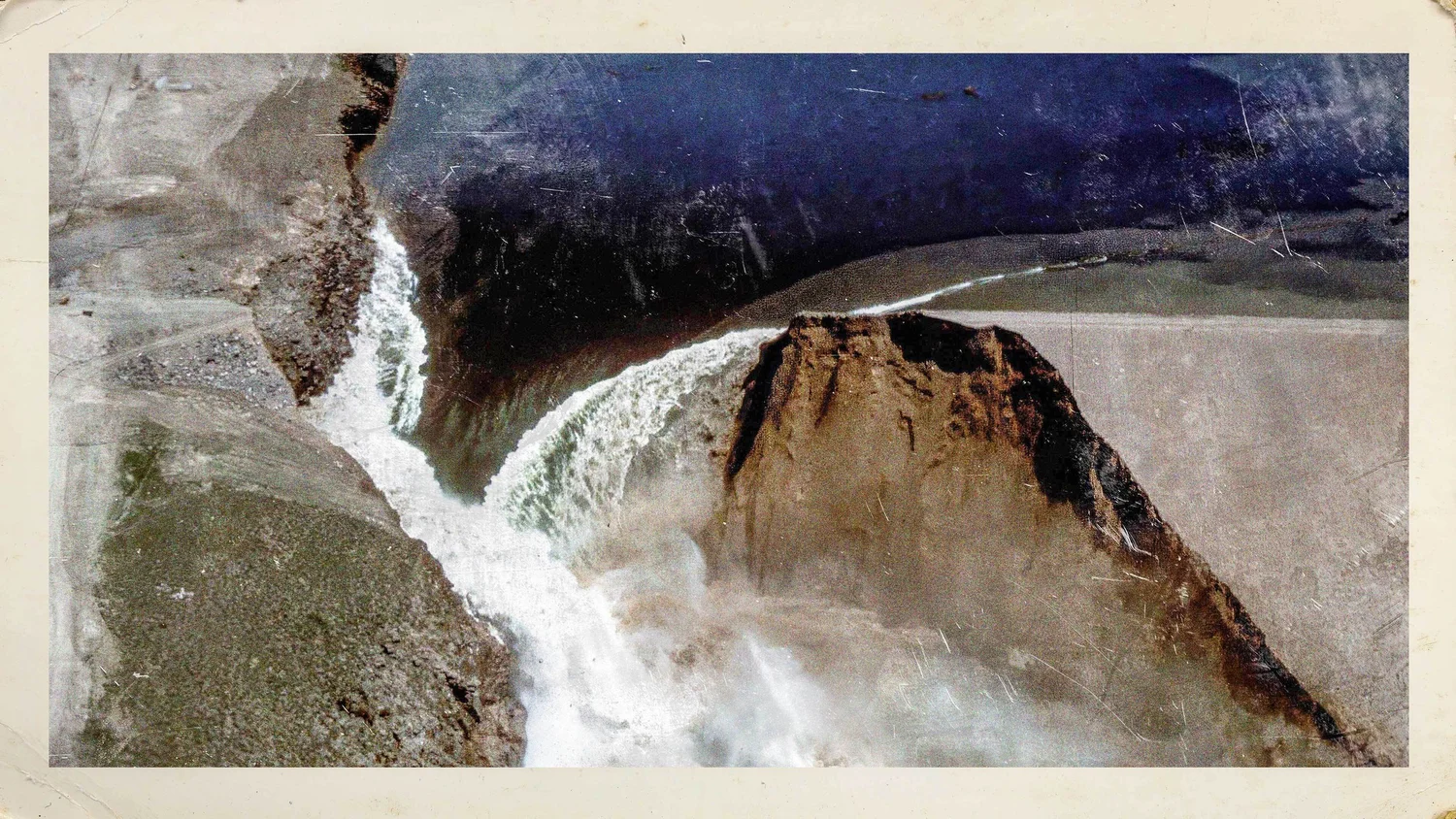
By the morning of June 5, a channel had been hollowed out under the dam. Staff saw water exiting at the toe, and it was quickly getting worse. At 10:30 AM, a muddy geyser erupted from the face of the dam. Operators sent bulldozers to try and fill the hole, but the machines were swallowed by the eroding embankment, and the operators had to be rescued with ropes.
Only 30 minutes later, a sinkhole opened up on the upstream face, below the reservoir, giving the water a more direct path through the dam. Multiple witnesses saw a terrifying whirlpool form. The reservoir was draining like a bathtub directly through the center of the dam. More dozers tried in vain to push material on the upstream side to close the hole, but it was too late. The erosion worsened, allowing more flow, causing even more erosion in a runaway feedback loop until finally the embankment gave way at about noon, only 5 hours after the leaks were first noticed.
A wall of water thundered through the hole in the embankment. The breach wave moved quickly downstream in the Teton River, widening out once it left the canyon. The closest town in its path, Wilford, was basically wiped from the map, with nearly all the homes there swept away. Further downstream, Sugar City and Rexburg were similarly decimated, with the vast majority of the buildings rendered a complete loss. Then the smaller farming communities of Hibbard and Salem were inundated, homes and livelihoods washed away. The breach killed thousands of livestock, destroyed railroads, bridges, and farmland, and left thousands without a home. Ultimately, 11 people lost their lives. Had the failure happened at night when no one was watching the dam, it could have been hundreds or even thousands more.
Investigations concluded this was not a "freak accident." The challenges of erodible soil and fractured geology were well known long before the 1970s. The Bureau simply didn't spend enough money to address them. In the end, it was a simple case of frugality over safety. As one investigation said: “Defensive measures, such as rock surface sealing and adequate filters, were well within the state-of-the-art at the time Teton Dam was designed and should have been used.”
But even though it wasn’t a novel failure mode, the impact Teton had on the engineering community was enormous. To see a brand new structure, built by one of the most technically competent agencies in the US, fail in such dramatic fashion was catalyzing in many ways. The federal government responded by standardizing dam safety guidelines across all federal agencies involved in dam construction, rules that are still in place today. The event also spurred research into filter and drainage design for dams, along with a better understanding of the mechanisms of hydraulic fracturing. Finally, it showed engineers everywhere what was possible when geotechnical issues aren’t taken seriously enough.
The very first dam I worked on in my career was very much “Teton-esque.” It was designed by another firm, but during construction, they realized that the foundation was much worse than expected. There were pores, fractures, and even caves below the dam. They had to shut down the job and re-engineer it entirely. Our solution was a deep cutoff wall. It basically involved running an enormous vertical chainsaw along the length of the dam, then filling the trench with a watertight mix of rock cuttings, cement, and bentonite clay.
I vividly remember working through the complexities and challenges of dealing with that foundation material. It’s really easy to understand these failure modes in hindsight. But when you’re actually working on a real project, it’s hard to visualize how soil, rock, and pressure will actually behave underground. Things get pretty abstract, and you can lose sight of the stakes. It’s hard to explain what it meant to have that example of Teton at the top of mind for everyone on the design team. For all the computer models, testing data, and equations, we also had a real life example of what could happen if we got it wrong. It was grounding in a way that textbooks and excel spreadsheets are not. And I like to think that’s how we honor the victims of engineering disasters: to share the stories and keep the lessons from being forgotten to make sure it doesn’t happen again.
Blue Origin's New Glenn rocket grounded after launching satellite into wrong orbit

The Onion launches new bid to take control of Alex Jones' Infowars

my interviewer was an AI agent
A reader writes:
After being laid off, I was aggressively applying to everything even remotely in my industry. I landed an interview with a company I recognized and a role I was fully qualified for. In order to move forward in the process, however, they said I needed to “complete an AI screening.”
What? I was expecting a phone call with the hiring manager as a first step, but this is the future I guess. So I went with it. Well, it was — perhaps predictably — absolutely awful. Not only did the AI ask me confusing, irrelevant questions about hyper specific bullet points on my resume, but it frequently interrupted my responses and even lost connection three times, forcing me to repeat myself. All this happened while I was being video recorded, so I’m sure some of my answers likely came off a bit clipped and tired.
I have no idea how I should have handled that, and I dread having to do it again for some other company. Do you have any advice?
Yeah, it’s a terrible practice for exactly the reasons you encountered: nonsensical questions, technical issues, and the expectation that you’ll invest your time in a call to answer questions without getting any of your own questions answered in return so you can determine if you’re even interested in moving forward.
Up until now, the social contract between employers and job-seekers has been that once your resume passes an initial screening, the next step (whether it’s a phone screen or a more in-depth interview) will give you the chance to talk to the employer to ask questions of your own so that you can figure out if you want to invest any more of your time afterwards, since it doesn’t make sense to do that if the role doesn’t fit what you’re looking for. That’s why employer demands like “write multiple essays before we’ll interview you” or “do a lengthy work simulation before you can even apply” have always seemed out-of-touch.
It was bad enough when some employers started requiring one-way video interviews before they’d talk to you (where you have to record yourself answering specific questions, again without the opportunity to ask your own in return). This is that taken to new heights, and with even less respect for you and your time.
But AI interviews are probably sticking around for at least a while, if not long-term, so job-seekers will have to figure out whether they’re willing to play along or not. If you have other options, you can always decline. But like most terrible hiring practices, this one will most affect the people with the fewest options. If you’re at a certain level in your field and have in-demand skills, you can say, “I’d be happy to talk with a human who can answer my questions in return; if that’s not possible, I’ll need to withdraw from consideration.” If you’re not in that position and just need a job, you probably need to roll your eyes and do it.
The post my interviewer was an AI agent appeared first on Ask a Manager.
Apple Backs Up Tim Cook’s Memories To Port Over Into Next CEO
The post Apple Backs Up Tim Cook’s Memories To Port Over Into Next CEO appeared first on The Onion.
Saturday Morning Breakfast Cereal - Standard

Scale of proposed arch in D.C.

The administration wants to build a 250-foot tall arch in Washington. That’s a pretty big arch. To show how big that is, Marco Hernandez and Anushka Patil, for the New York Times, used illustrations of the proposal against existing arches and structures.
Tags: arch, buildings, New York Times, scale
Live Results: Virginia redistricting special election
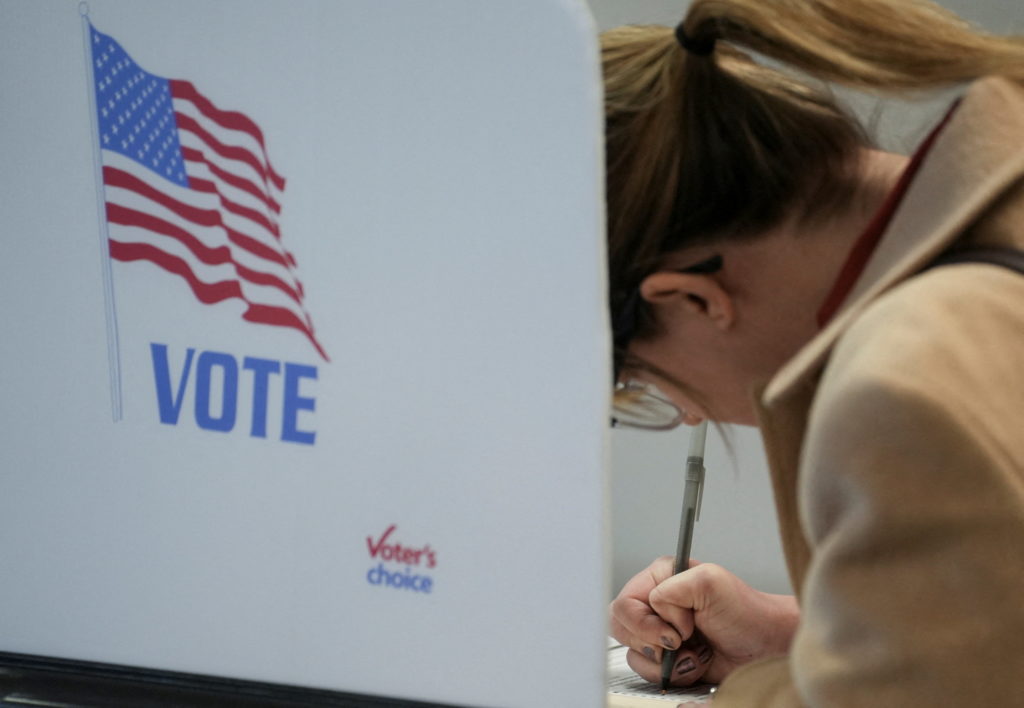

‘Michael’ Criticized For Depicting Neverland Ranch With Cooler Rides Than It Actually Had
WASHINGTON—Denouncing what they called a “sickening” misrepresentation of the facts, critics of a new Michael Jackson biopic argued Monday that the movie brazenly depicted Neverland Ranch with way cooler rides than it actually had. “Michael is a shameless whitewashing of ride options that frankly were no better than what you’d encounter at a ramshackle roadside carnival,” said advocate Jillian Moore, adding that not one of the pop icon’s alleged victims recalled being fondled anywhere near the high-velocity triple-loop roller coaster or 400-foot drop tower portrayed in the film. “It should come as no surprise that a film made with the blessing of Michael Jackson’s estate would feature not a single interview with someone who could attest to the haunted house being over in, like, two minutes. Someday, the truth, including the actual number of bumper cars, will be revealed for all the world to see. Until then, we advise anyone watching this cynical cash grab not to forget the innocent children wildly disappointed by a pirate ship ride nowhere near as good as the one at Six Flags.” Reached for comment, the film’s producers acknowledged that Michael Jackson might have violated children but vehemently defended Neverland rides as offering incomparable thrills and spills.
The post ‘Michael’ Criticized For Depicting Neverland Ranch With Cooler Rides Than It Actually Had appeared first on The Onion.
Houston to see mostly manageable rains today and Wednesday before a weekend warmup
In brief: In today’s update we take a look at increasing shower activity today and Wednesday before our rains mostly dry up. That will leave us with a more humid and increasingly warm air mass heading into the weekend. We also take a look at winds this weekend for our friends participating in the MS 150 ride.
Drier air mass is gone
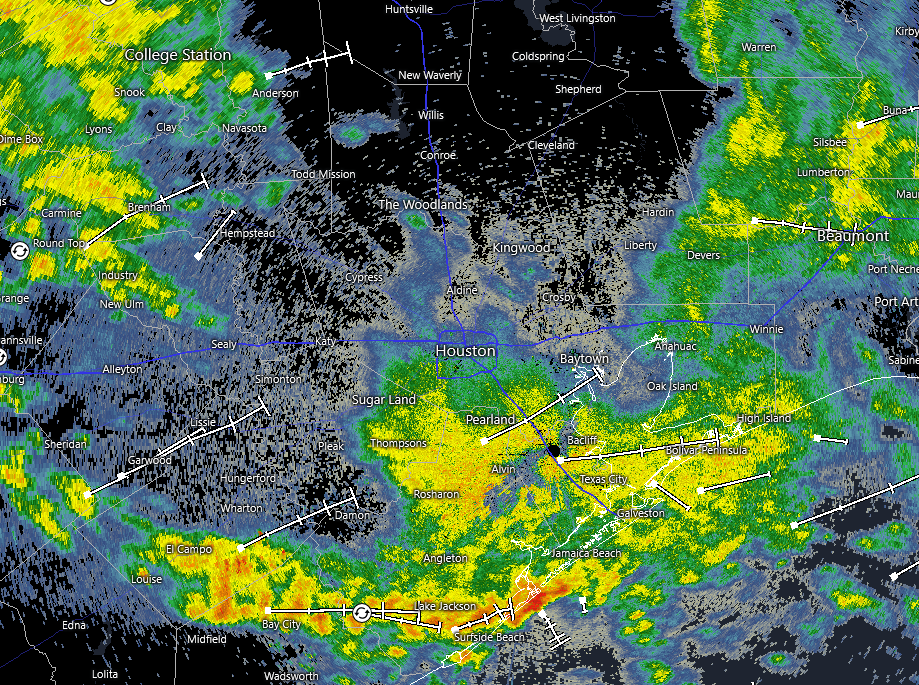
After Houston saw widespread showers on Saturday a drier air mass moved in to the region on Sunday. By Monday enough drier air was holding on such that even though a disturbance moved in from the west was producing precipitation in the atmosphere, much of this was drying out before it reached the ground. The lower atmosphere is more saturated now, so those showers are breaking through.
Since midnight much of the region has received between 0.25 and 0.5 inch of precipitation, and we are likely to see ongoing rain chances today and Wednesday. The good news is that, for the most part, I expect these showers to be mostly behaved. That means that while heavy rain and street flooding are always possible, in this case I expect showers to largely be of the light-to-moderate level.
Tuesday and Wednesday
As mentioned above, we’ll see on-again, off-again showers for much of today and Wednesday. High temperatures today will likely top out in the lower 70s, but Wednesday could be a little warmer if we start to see some partially clearly skies later in the day. The rain chances should start to ebb by Wednesday afternoon or evening. By then we’ll just be left with fairly muggy air and warm nights with lows around 70 degrees.
Thursday and Friday
These will be a pair of partly sunny days with temperatures in the 80s. Thursday may be a shade cooler than Friday, but both days will see plenty of humidity and some background rain chances on the order of 20 percent. Afternoon winds will gust up to about 20 mph from the south, with lighter conditions at other times. Nights remain in the lower 70s.
Saturday and Sunday
A warming trend continues into the weekend, with highs likely in the upper 80s, and partly to mostly cloudy skies. With dewpoints in the vicinity of 70 degrees it will feel plenty humid. As for rain chances, they’re not zero, but they’re pretty low, and anything that falls should be light.
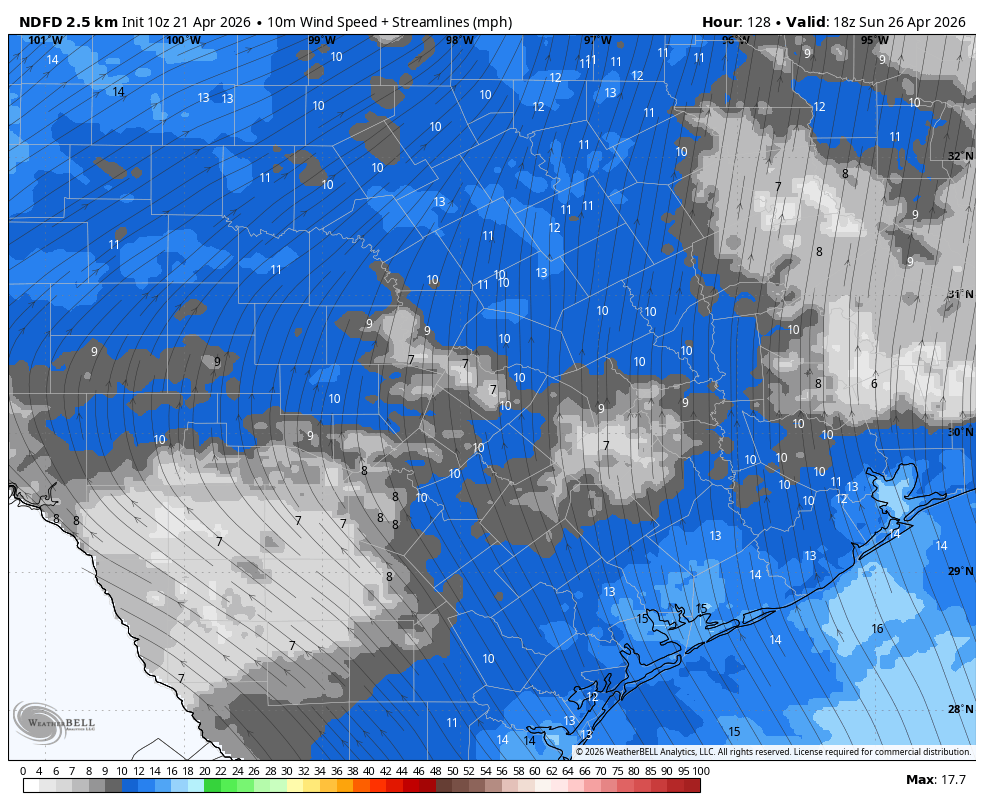
So what about winds? If you’re participating in the MS 150 ride this weekend that’s what really matters. The route on Saturday is generally westerly, and then it turns more northerly on Sunday. Winds at dawn on Saturday will be mostly southerly, at about 5 mph, so a cross wind. They’ll be stronger by the middle of the day, 10 mph with gusts up to 20 mph. The story will be similar on Sunday, so more of a pure tail wind that day. You should be flying that day!
Next week
Warm temperatures, with highs near 90 degrees, will continue into next week. Some sort of front may work its way into Houston by Tuesday or Wednesday, but your humble forecaster is making no concrete predictions on that score. We’ll have to see what happens.

Soybean Wishes It Could Just Be A Soybean And Have That Be Enough
CARMI, IL—Expressing anxiety over the immense pressure it faced to become various food products, a local legume confided to reporters Tuesday that it wished it could just be a soybean and have that be enough. “I don’t want to be a sauce, I don’t want to be an oil, I don’t want to be tofu or tempeh or nattō—I just want to be me,” declared the soybean, emphasizing that despite the rapidly growing demand for it to become protein powder or alternative milk, it had no interest in being anything other than a humble soybean. “Is that really too much to ask? Black beans get to be black beans, kidney beans get to be kidney beans. But I have to endure the suffocating burden of everyone trying to turn me into something I’m not. I have plenty of protein and fiber to offer on my own, you know. If God had wanted me to be a bar, He would have made me a bar. I just wish I had the confidence to live my truth.” At press time, sources confirmed the soybean had been brutally mashed into paste with absolutely no say in the matter.
The post Soybean Wishes It Could Just Be A Soybean And Have That Be Enough appeared first on The Onion.
Nation’s Dads Yearn For Chance To Back Large Vehicle Into Tight Spot
WASHINGTON—Saying the opportunity to masterfully execute a difficult parking job was never far from their minds, the nation’s dads confirmed Tuesday a deep yearning for the chance to back a large vehicle into a tight spot. “Oh yeah, I could definitely fit a van back there,” said Maryland father George Packard, echoing the sentiments of millions of other dads across the country who similarly wished to hop into the driver’s seat of a truck or full-size SUV, check the rearview mirror, and smoothly reverse into a compact parking space. “The trick is to pull out wide and turn sharp. You gotta really crank the wheel. It’s all in the positioning and angles. Look over your shoulder, mind your clearance, and move backwards nice and easy. I’ve definitely parked in much tighter spots.” At press time, America’s dads were ruthlessly mocking the “pussies” who rely on a backup camera.
The post Nation’s Dads Yearn For Chance To Back Large Vehicle Into Tight Spot appeared first on The Onion.
UFC Broadcasters Look Like It
The post UFC Broadcasters Look Like It appeared first on The Onion.
How to Baby-Proof Your Home
1. Install Baby Gates
Baby gates are great for keeping babies out of places you don’t want them to go, like inside your home. String several gates together with zip ties to form a barrier around the perimeter of your property. Most babies aren’t smart enough to figure out how to open the gates, and neither are you, but you’re probably tall enough to step over.
2. Affix Safety Latches to Lower Cabinets
Babies love opening cabinets to rifle through your cookware, cleaning supplies, and the collection of half-used batteries you keep in your junk drawer. If word gets out that you’re the kind of household that keeps things securely locked away, they won’t bother swinging by.
3. Put Wedge Locks on Every Sash Window
If there’s one thing all babies have in common, it’s that they are exceptional crawlers. Their tiny hands and capless knees can take them anywhere: under fences, over flowerbeds, and through your open windows. Use wedge locks to ensure your windows can’t be opened more than four inches, as most babies are taller than this. If you hear of shorter babies being sighted in your area, keep your windows shut and install bars.
4. Cover All Electrical Outlets
In the event a baby does invade your home, you’ll want to ensure all unused outlets are covered. Infant intruders are always on the lookout for places to recharge the toys their parents told them were broken, like the Repeat What You Say Light-Up Dancing Cactus. Then not only will you have a giggling baby on your hands, but a stuffed saguaro that mimics you every time you sob, “Please, just pull all the books out of my bookshelves and leave.”
5. Eliminate Food Sources
Babies love food almost as much as they love breaking and entering. Keep your home and property free of scraps. At night, when the threat of a baby invasion is highest, throw all remaining food into garbage bags. Use rope to hang the bags in a tree, suspending them at least twelve feet off the ground, eighteen feet from the trunk, and, ideally, thirty-seven miles from your house.
6. Seal Cracks in Your Foundation
Babies can sense weakness from thirty-six miles away. Seal up cracks in your foundation, and make sure the land around your home slopes away so a passing baby doesn’t roll through it, intentionally or otherwise. Babies are built like bowling balls and, given enough momentum, will bowl a child-sized hole into the basement—and right through your ten-year-in-the-making miniatures museum.
7. In Fact, Seal Everything
With their soft, bendable bones and collapsible skulls, babies are literally designed to squeeze through very narrow spaces. Like birth canals, tunnel slides, and that crawlspace you didn’t know existed until it was too late.
8. On That Note, Forget the Wedge Locks and Just Board Up
See: babies squeezing through narrow spaces, above.
9. Regularly Inspect for Signs of Baby Activity
Just because you don’t see a baby doesn’t mean there’s not one there. Keep an eye on your closest friends and family for evidence of impending infants. Common signs include links in your inbox to StorkStuff! registries, vacation photos tagged #babymoon, and a shift in dinner party conversation from Damien Hirst’s role in the commodification of contemporary art to something called a “Snoo.”
Should infants begin to breach your social circles, it might be time to assess your living space for potential hazards, in case your friends ever stop by to “let you meet the baby.” For further help, see our companion guide: How to Turn Your Tastefully Decorated Living Space into a Baby-Safe Bounce House.


The Onion says it’s finally acquired Alex Jones’ Austin-based Infowars
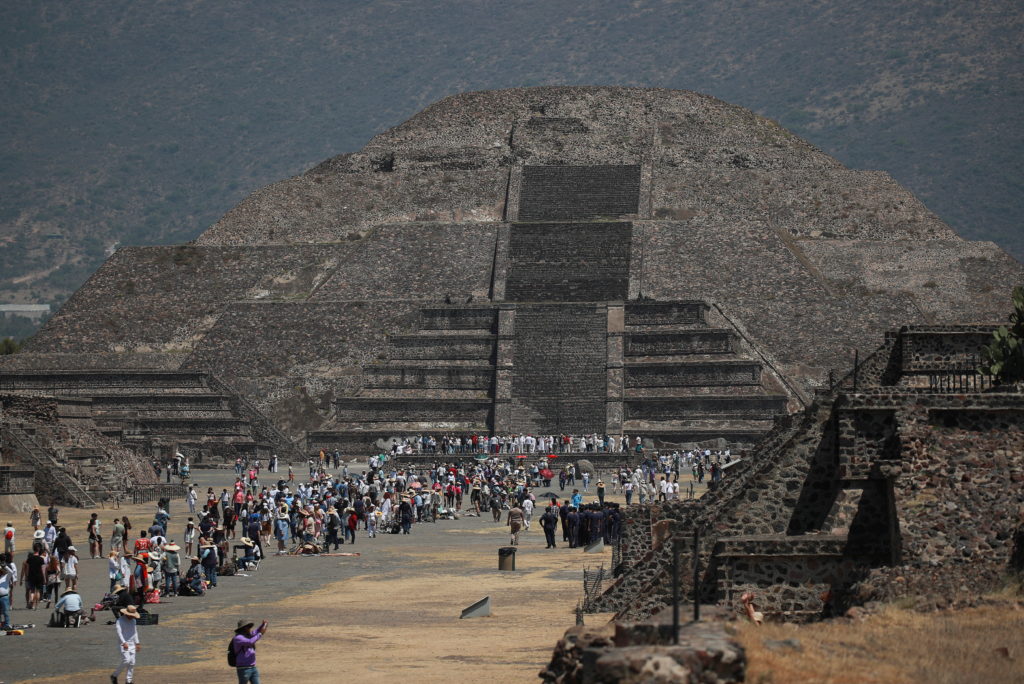
Gunman at Mexico's Teotihuacán pyramids kills 1 Canadian tourist, injures 6
can I wear sequins to a job interview?
A reader writes:
Something happened to me 15 years ago that I continue to wonder about. When I was a senior in college, I was applying to internships in my field (comms/PR if it matters) in Washington, D.C., with the help of my academic advisor.
One in-person interview at one of the big legacy PR firms went really well. When my academic advisor followed up about it, they said the company thought I was a fantastic candidate and they’d absolutely love to hire me, except for one thing: they thought the shirt I was wearing was inappropriate for an interview setting and, particularly, that it had sequins on it. Ultimately, I did not get the fellowship because of it.
I found an almost exact replica of the shirt that I’m attaching. If I recall correctly, I wore it with a nicely tailored black pantsuit that I was very proud to have purchased on my limited college budget.
Do you think that the company was right in 2010 (given I was a 23-year-old who knew nothing about the working world at the time, beyond a few internships, and in particular the dress code standards of the time) or not? Would you have made the same call 16 years ago? And, do you think this would still happen in 2026? Should we be warning new grads away from all sequins? For the record, I would not wear that shirt now — but really only because it’s very 2010s. I remember it being part of my regular office job rotation once I got my first job later that year.

I wouldn’t recommend sequins at a job interview at all, then or now, just because they tend to read more “nighttime attire” than professional interview wear … unless you’re in a field with a lot more leeway than D.C. communications firms tend to have. D.C. is notoriously conservative about work wear.
But it’s a ridiculous reason not to hire you — particularly since you were 23 and still figuring this stuff out, but even if you’d been older.
And as sequins go, this particular shirt is less of an issue than, like, a full sequined top or sequined dress would be — and the fact that you were wearing it under the jacket of a pantsuit makes their reaction even more over-the-top.
I’d put it in the category of stuff I’d advise a candidate not to wear in order to make the most professional impression, but wouldn’t advise an employer not to hire over (because it really doesn’t matter). And a candidate who they said was fantastic and who they’d otherwise love to hire — in other words, where you obviously didn’t give them any other reason to doubt your judgment, and where this could be easily solved by explaining their dress code to you upon hire? Absurd.
The post can I wear sequins to a job interview? appeared first on Ask a Manager.
mst3kgifs: Farewell, Thepumaman! Carry on your tradition of...

Farewell, Thepumaman! Carry on your tradition of flying clumsily with your rear end in the air!
Straggler Cicadas To Appear
Cicadas referred to as “stragglers” because they emerge off-cycle may appear this year despite their broods not being expected to emerge, with scientists unsure how they lose track of time. What do you think?

“But I already put away all the decorations!”
Matteo Sousa, Decoupage Expert

“It’s never too late to start screaming until you die.”
Lachlan Fitzgerald, Broom Assembler

“Yet they wonder why other cicadas never want to make plans with them.”
Ingrid Wilmot, Cactus Pruner
The post Straggler Cicadas To Appear appeared first on The Onion.
Bring in the New
The front page of the April 13th issue of Jinja Shinpō had a report of the annual study meeting of the national association of young Shinto priests. The theme was, roughly, looking at tradition to prepare for the future. That is a very Shinto idea.
The editorial in the same issue picked up on this point, and was rather more radical about it. The opening is conventional enough for the Shinto community. There are certain things that should not change about Shinto practice, and others that can, and indeed should, to adapt to changing circumstances. Priests have to carefully consider all the factors, and distinguish these elements from one another precisely.
Then it (the editorials are unsigned, so I am assuming that they write themselves for pronoun purposes) gets revolutionary. It says that simply distinguishing the elements that can be changed from those that must not will get you nowhere. You have to actually do something new, or the problems will not be solved.
However, it says, when people do something new, there is always opposition. No matter how much the priest making the change has thought about it, and no matter how confident they are that the unchanging heart of Shinto is preserved in this new practice, some people will say that they have abandoned the true path.
The editorial gives the examples of Yoshida Kanetomo, who founded Yoshida Shinto, the dominant tradition from around 1600 to 1868, and Hirata Atsutane, an important figure in Kokugaku, which had a very strong influence on post-1868 Shinto. Both of these people faced criticism from other priests at the time, and both shaped Shinto for decades or centuries, creating the things that became the new traditions. It then says that young priests, who are said to be the vanguard of Shinto, should not hold back from making changes because of fear of criticism.
The editorial closes by expressing the concern that people have got so used to talking about rural depopulation and the ageing society that they have lost any sense of crisis about the issues. Because young priests will still be trying to sustain jinja in twenty years’ time, they are ideally suited to try to solve the problems. They might, it concedes, be immature in some ways, but they also have the energy of youth, and that is what is needed to address the issues.
I have a lot of sympathy with this position. I have mentioned before that Shinto will not survive by simply doing things the way it always has — society has changed too much for that.
I have two concerns. One is with the examples. Yoshida Kanetomo claimed that the sacred object from Isê Jingū had flown to his jinja, and that his jinja was now the place where Amaterasu Ōmikami was enshrined. He also claimed to be the head of the Imperial jinja bureaucracy, without any official appointment from the Tennō.
Yes, he faced criticism. Had the country not been in total chaos due to civil war, he probably would have been legally shut down. I am not sure that he is the best role model.
My other concern is that the editorial did not mention whether the author or Jinja Shinpō would defend priests who were being criticised for doing something new, or whether Jinja Honchō was adopting a general policy of not firing them for it. It did read a little bit as though it was encouraging other people to risk their careers to save Shinto.
Pluralistic: Comrade Trump (20 Apr 2026)

Today's links
- Comrade Trump: Burning down the American empire to save it.
- Hey look at this: Delights to delectate.
- Object permanence: MPAA's threat-based 'education'; Cuehack; Heinlein on GWB; AT&T v the internet; British tax-havens v HMG; What is neoliberalism?; Newspaper landlords; Watch-part motorcycle; Tax havens bad; Buscemi's eyes; Sesame Street on lead poisoning.
- Upcoming appearances: San Francisco, London, Berlin, NYC, Barcelona, Hay-on-Wye, London, NYC.
- Recent appearances: Where I've been.
- Latest books: You keep readin' em, I'll keep writin' 'em.
- Upcoming books: Like I said, I'll keep writin' 'em.
- Colophon: All the rest.

Comrade Trump (permalink)
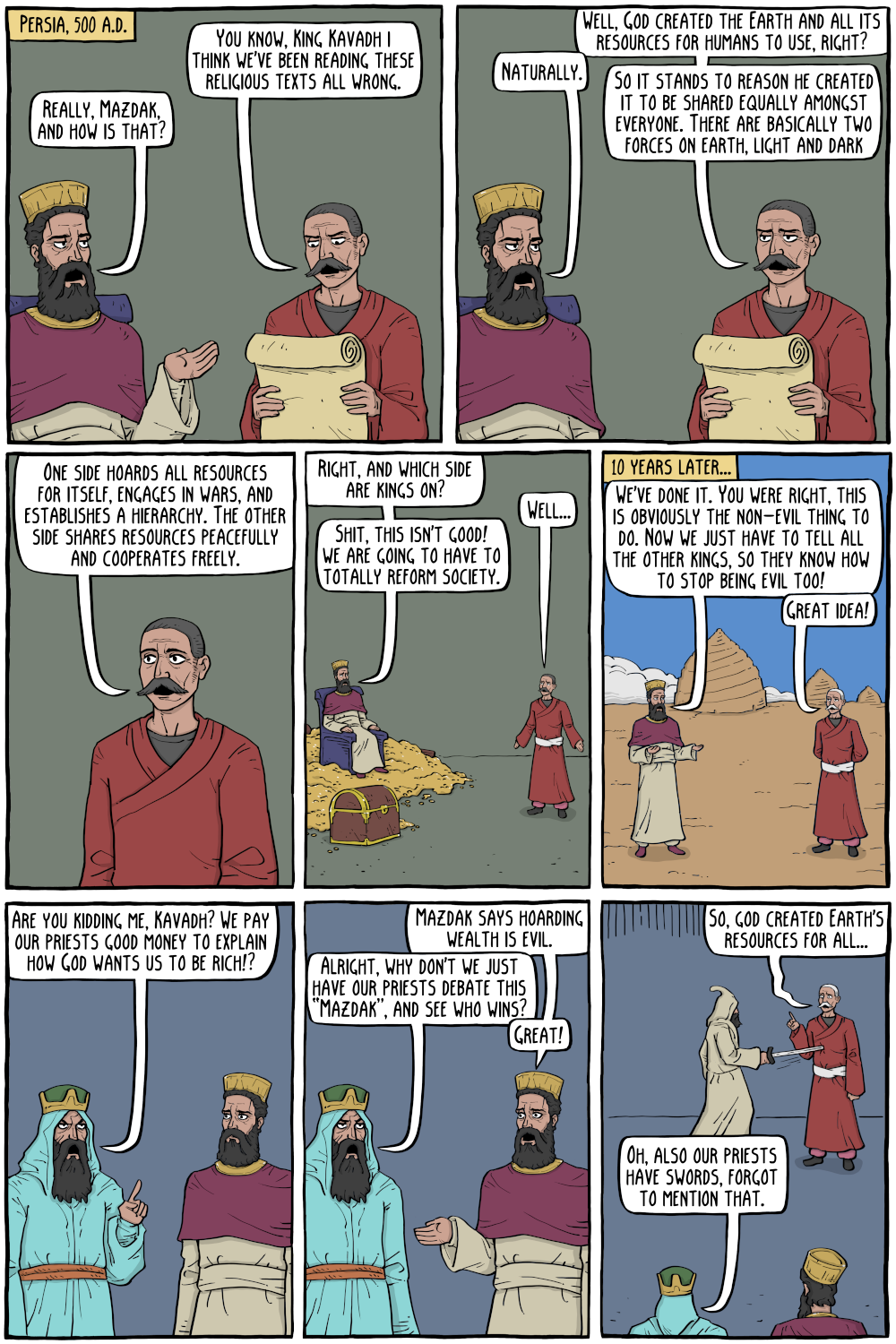
There aren't a lot of things I agree with Mark Carney about, but there's one area where he and I are in total accord: the old, US-dominated, "rules-based international order" was total bullshit:
Unlike Carney, I never pretended to like that old order, and indeed, I spent my entire life fighting against it – literally, all the way back to childhood, organizing other children to march against Canada's participation in America's nuclear weapons programs:
https://www.flickr.com/photos/doctorow/53616011737/in/photolist-2pFS5kt
All of which means that my experience of the Trump years is decidedly weird. On the one hand, I exist in a near-perpetual state of anxious misery, as Trump and his chud army of Christian nationalists and degenerate gamblers pursue a program of gleeful genocide. But at the very same time, I'm living in a world in which Trump is (inadvertently) dismantling many of the worst aspects of the old order in favor of something decidedly better.
Take Trump's tariff policy. Back during Trump I, he decided that Americans couldn't buy Chinese solar anymore, which had the double benefit of allowing him to pursue the twin goals of throwing red meat to Sinophobic Cold War 2.0 freaks and delivering a giant gift to the planet-wrecking oil companies that had helped him buy his way into office.
This was really bad for America, of course, but those solar panels had to go somewhere. Mostly, they ended up in Pakistan, dumped there at such a massive discount that the country solarized virtually overnight. Pakistani solar installers learned their trade from Tiktok videos set to Tamil film soundtracks, and unwired the country so thoroughly that today, the national power company is in danger of going bust because no one buys their electricity from the grid anymore. Pakistani bridal dowries now routinely include four panels, an inverter and a battery:
https://billmckibben.substack.com/p/a-tale-of-two-countries
This is an inversion of the normal order of things, in which rich countries get all the good stuff first, and poor countries like Pakistan get scraps after we've gorged ourselves. Think of vaccine apartheid, in which monsters like Howard Dean insisted that we had to prevent countries in the global south from making their own covid vaccines, because poor brown people are too stupid and primitive to run a pharma manufacturing operation:
https://pluralistic.net/2021/04/08/howard-dino/#the-scream
But, thanks to Comrade Trump, Pakistan was first in line to become the world's solar capital. The country's LNG terminal – built with Chinese Belt-and-Road money – is now a stranded asset, because no one there needs gas.
That's gas whose supply has been choked off in the Strait of Epstein…which brings me to Trump's foreign policy and its impact on the global energy shift. Transitory energy shortages have small effects: when your energy bill goes up for a while (because of extreme weather, say), it makes you angry and sad and might result in an electoral loss for whatever politician presided over the price hike. But when you get genuine, prolonged shortages – the sort that are accompanied by rationing – you make permanent changes.
Rationing is so psychologically scarring that it induces people to make long-delayed investments that result in permanent changes to their consumption habits. Maybe you've known for a long time that an induction top would be better for your indoor air quality and your cooking than the gas range you have now, but you don't want to buy a whole new appliance and pay for an electrician to run a high-wattage line in expensive conduit from your breaker panel to your kitchen.
But if you're an Indian restaurateur who can no longer get any cooking gas – because it's being rationed for household use – then you are going out to buy whatever induction top you can lay hands on. Maybe it's a cheap, low-powered single burner one that plugs into your existing electrics, or maybe you're splashing out and swapping out your whole gas appliance. Whichever it is, you are no longer interested in your chef's insistence that real cooking gets done over gas. If your chef can't cook on an induction top, your chef will need to find employment elsewhere.
This is going on all over the world right now, as people buy EVs (and pay to have chargers installed at home – maybe getting a twofer on their conduit runs with two high power lines run through the same conduit infrastructure). In Australia – where the last shipment of gas for the foreseeable came into port last week – people are calling their local EV dealers and offering to buy whatever car is on the lot, sight unseen.
Meanwhile, in Ethiopia, a series of dollar-related crises caused the country to ban imports of internal combustion engines altogether (oil and gas are denominated in dollars, which means you can only get oil if you first sell stuff to Americans or others who'll pay in dollars). The country's fleet of noisy, dirty motorbikes is being swiftly replaced by ebikes that get eight miles to the penny:
Ebikes are insanely great technology. Cheap, rugged and reliable, they're basically bicycles that abolish hills. Once you've gotten accustomed to an ebike – maybe you've invested in a folding helmet and a raincoat – you'll never go back. The advantages of an ebike commute over a car commute are legion, but my favorite little pleasure is the ability to easily make a stop at a nice coffee shop halfway between home and work, rather than being stuck buying shitty chain coffee near the office.
Four years ago, another mad emperor, Vladimir Putin, invaded Ukraine – and in so doing, catapulted Europe's energy transition into the Gretacene, with unimaginable defeats for the fossil fuel lobby. Not just subsidies for the clean energy transition, but also policy shifts in areas that had been deadlocked for a decade, like approvals for balcony solar, which is transforming the continent. Even the UK, one of the oil industry's most reliable vassal states, is now greenlighting balcony solar:
https://www.gov.uk/government/news/government-to-make-plug-in-solar-available-within-months
This may not sound like much, but the UK is a country whose politics is composed of 50% hatred of migrants and trans people, and 50% incredibly stupid planning battles. Great Britain is a magical land where your neighbors can ask the government to prevent you from installing double-glazing on the grounds that it will change the "historic character" of their neighborhood of terraced Victorian homes.
I once lost a fight to get permission to put a little glass greenhouse on my balcony on the grounds that it would "alter the facade" of the undistinguished low-rise 1960s industrial building I live on top of. The fact that HMG is going to tell your facade-obsessed neighbors to fuck off all the way into the sun so that you can hang solar panels off your balcony is nothing short of a miracle.
Comrade Putin's contribution to oil-soaked Britain's energy transition can't be overstated. Thanks to "free market" policies that sent energy prices soaring after the Ukraine invasion, Brits installed so much solar (despite the existing impediments to solarization) that now the government is begging us to use more energy this summer, because the grid can't absorb all those lovely free electrons:
https://www.theguardian.com/environment/2026/apr/14/uk-households-power-renewables-soar
The UK is on a glide-path to adopting the Australian plan. Australia also benefited from Trump I's solar embargo, receiving a ton of cheap solar that would otherwise have ended up in America. Now Australia has so much solar that they're giving away electricity, with three free hours of unlimited energy every day. Stick your dishwasher, clothes-dryer and EV charger on a timer, invest in a battery or two, and fill your boots:
https://billmckibben.substack.com/p/free-electricity-like-at-no-cost
(Maybe at this point you're thinking dark thoughts about critical minerals and such. That's not the problem you think it is and it's getting better every day. To take just one example, lithium batteries are about to be replaced with sodium batteries. Sodium is the world's sixth-most abundant element:)
The Strait of Epstein crisis is going to do more to accelerate permanent, unidirectional migration away from fossil fuels to cleantech than decades of environmental activism. Cleantech is so much better than fossil fuels – cheaper, more reliable, cleaner – that anyone who tries it becomes an instant convert. That's why the fossil fuel industry has been so insistent that no one get to try it!
To take just one example here: Texas ranchers have been solarizing, thanks to the state's bizarre "free market" energy system that sees energy prices spiking so high during cold snaps that you literally have to choose between freezing to death and going bankrupt. Solar is great for agriculture, especially in climate-ravaged Texas, where it provides crucial shade for crops and livestock, while substantially reducing soil evaporation, resulting in substantial irrigation savings.
When the oil-captured Texas legislature introduced a bill to force electric companies to add one watt of fossil power for every watt of solar that their customers installed, furious ranchers from blood red Republican rural districts flooded their town hall meetings, decrying the plan as "DEI for fossil fuels." The bill died:
https://austinfreepress.org/renewables-are-now-the-costco-of-energy-production-bill-mckibben-says/
This is the template for the long-foreseeable future. Thanks to Trump's stupid, bloody, unforgivable war of choice in the Gulf, the world is going to install unimaginable amounts of cleantech. They are going to throw away their water heaters, motorbikes, furnaces and cars and replace them with all-electric versions. They're going to cover their roofs and balconies with panels. The battery industry will experience a sustained boom. The fortunes that fossil fuel companies are reaping from the current shortage is their last windfall.
The writing is on the wall. Trump opened Alaska for drilling and the oil companies noped out because they couldn't find a bank that would loan them the money needed to get started. Then it happened again in Venezuela. This de-fossilizing was already the direction of travel, the only question was the pace at which the transition would proceed – and Comrade Trump has just stomped all over the (liquid natural) gas pedal.
Energy is just one realm where Trump is doing praxis. One of the most exciting developments that Trumpismo's incontinent belligerence has induced is the global technology transition.
For decades, the only people pointing out the dangers of using America's cash-grabbing, privacy invading defective tech exports were digital rights hippies like me, and our victories were modest and far between. Despite the Snowden revelations, despite the tech industry's prolific snood-cocking at EU privacy regulators and Canadian lawmakers, we all just carried on using these incredibly dangerous, steadily enshittifying Big Tech products. We even run our governments and structurally important companies off Big Tech. We let US tech companies update (that is, downgrade) the software on our cars and tractors, our pacemakers and ventilators, our power plants and telephone switches.
There's lots of reasons for this. For one thing, ripping out and replacing all that software and firmware is a prodigious challenge, as is building the data-centers to host it for every "digitally sovereign" country. Add to that the complexity of successfully migrating data, edit histories, archives and identities and you're looking at a very big lift. So long as the American tech bosses kept their enshittificatory gambits to a measured, slow flow, they could keep the pain beneath the threshold where it was worth us boiling frogs leaping out of their pot.
But the most important force defending American internet hegemony was free trade: specifically, the US forced all of its trading partners to adopt "anticircumvention" laws that make it illegal to modify US tech exports. That means that you can't go into business selling your neighbors the tools to use generic ink or an independent app store, much less make a fortune exporting those tools to the rest of the world:
https://pluralistic.net/2026/03/16/whittle-a-webserver/#mere-ornaments
Enter Comrade Trump. When Trump started weaponizing US tech platforms to take away the working files, email accounts and cloud calendars of judges who pissed him off (by sentencing Bolsonaro to prison, and by swearing out a genocide warrant for Netanyahu), he put the whole world on notice that he could shut down their governments, judiciaries or companies at the click of a mouse:
https://pluralistic.net/2026/04/16/pascals-wager/#doomer-challenge
And of course, he's whacked the whole world with tariffs that violate the trade agreements that imposed the anticircumvention obligations that protect America's defective tech exports. Now there's no longer any reason to keep those laws on the books. Happy Liberation Day, everyone! The post-American internet is at hand:
https://pluralistic.net/2026/01/01/39c3/#the-new-coalition
But Trump has even more praxis up his spraytan-stained sleeves. Trump is succeeding where Bernie Sanders, Elizabeth Warren and AOC failed: he's making the case for Democrats to defenestrate their useless, sellout, Epstein-poisoned leaders. All across the country, radical Dems and avowed socialists are sweeping primaries and elections, as voters realize that Blue No Matter Who will doom them to eternal torment in the Manchin-Synematic Universe:
https://prospect.org/2026/02/11/progressive-win-new-jersey-anti-ice-organizing-mejia/
Fury over Trumpismo is pushing even the most useless Democratic leaders to sign up for billionaire taxes:
https://jacobin.com/2026/04/zohran-tax-rich-hochul-nyc
Thanks to Comrade Trump, the median Democratic voter will no longer be satisfied with Kente cloth photo-ops and little ping-pong paddles stenciled with "down with this sort of thing":
https://www.truthdig.com/articles/ping-pong-paddles-to-a-gun-fight/
Thanks to Trump, we might see criminal prosecutions – and a primary challenge for any Dem that gets in the way of a serious, Nuremberg-style reckoning with Trumpismo and its gangsters:
https://pluralistic.net/2026/02/10/miller-in-the-dock/#denazification
Look, all things being equal, I would have preferred that Trump had keeled over from a mid-burger stroke on the campaign trail in 2016. But when life gives you SARS, you make sarsaparilla. This is a deeply shitty timeline, but Comrade Trump keeps tripping over his red tie. Let's take the wins.
Hey look at this (permalink)

- Stop New York's Attack on 3D Printing https://www.eff.org/deeplinks/2026/04/stop-new-yorks-attack-3d-printing
-
Make It Myself https://xkcd.com/3233/
-
Mind the Gap https://www.butthistime.com/p/mind-the-gap?hide_intro_popup=true
-
Billionaire Blues https://harpers.org/archive/2026/05/billionaire-blues-thomas-frank/
-
What, Exactly, Is a Fair Wage? https://prospect.org/2026/04/17/fair-wage-standard-arindrajit-dube-book-review/

Object permanence (permalink)
#25yrsago The MPAA 'educates the public' with threatening letters https://web.archive.org/web/20120318060108/http://news.cnet.com/2100-1023-255961.html&tag=tp_pr
#25yrsago Cuehack for the :CueCat https://web.archive.org/web/20010803172853/http://www.rtmark.com/cuejack/
#25yrsago Microsoft Technical Support vs The Psychic Friends Network https://web.archive.org/web/20010410171616/http://www.bmug.org/news/articles/MSvsPF.html
#20yrsago The novel Heinlein would have written about GW Bush’s America https://memex.craphound.com/2006/04/17/the-novel-heinlein-would-have-written-about-gw-bushs-america/
#20yrsago Hilarious hijinx with security guards who hate building-photographers https://thomashawk.com/2006/04/photographing-architecture-is-not.html
#20yrsago Hundreds ask Smithsonian not to sell out to Showtime https://web.archive.org/web/20060420031124/https://www.americanprogress.org/site/pp.asp?c=biJRJ8OVF&b=1554385
#20yrsago How AT&T wants to turn the Internet into mere TV https://web.archive.org/web/20060620095643/http://www.salon.com/tech/feature/2006/04/17/toll/index_np.html
#20yrsago NOLA mayoral candidate doctors Disneyland photo – again https://web.archive.org/web/20060422010054/https://www.wonkette.com/politics/new-orleans/kimberly-williamson-butler-continues-to-astound-us-167923.php
#20yrsago Where He-Man came from https://web.archive.org/web/20060423061651/https://thesneeze.com/mt-archives/000500.php
#20yrsago FBI demand chance to censor muckracking journo’s papers https://web.archive.org/web/20060421045340/https://www.chronicle.com/free/2006/04/2006041801n.htm
#15yrsago Ethiopia’s “newspaper landlords” rent the want-ads by the minute https://www.cnn.com/2011/BUSINESS/04/19/newspaper.rental.ethiopia/index.html
#15yrsago It’s people like us what makes trouble: the pernicious influence of immigrants in the UK. https://web.archive.org/web/20080314013819/http://feorag.newsvine.com/_news/2008/03/10/1356131-the-pernicious-influence-of-immigrants-in-the-uk
#15yrsago China’s “Jasmine Revolution”: anonymous out-of-country bloggers troll the politburo https://web.archive.org/web/20110412063347/http://globalguerrillas.typepad.com/globalguerrillas/2011/04/the-jasmine-revolution.html
#15yrsago Motorcycles made from watch parts https://www.deviantart.com/dkart71/art/Motorcycles-out-of-watch-parts-18a-204941090
#15yrsago Steve Buscemi’s Eyes: the printable mask https://eyesuckink.blogspot.com/2011/04/free-home-version-of-steve-buscemis.html
#15yrsago Privacy, Facebook, politics and kids https://www.theguardian.com/commentisfree/video/2011/apr/18/cory-doctorow-networking-technologies-video?CMP=twt_fd
#15yrsago NZ MP votes for anti-piracy law hours after tweeting about her love of pirated music https://torrentfreak.com/kiwi-mp-called-out-as-pirate-after-passing-anti-piracy-law-110415/
#15yrsago Righthaven copyright trolls never had the right to sue, have their asses handed to them by the EFF https://web.archive.org/web/20110418001051/http://paidcontent.org/article/419-righthavens-secret-contract-is-revealedwill-its-strategy-collapse/
#15yrsago TSA considers being upset at screening procedures to be an indicator of terrorist intentions https://www.cnn.com/2011/TRAVEL/04/15/tsa.screeners.complain/
#10yrsago The saga of Ian Bogost’s pressure-washer https://bogostpressurewasherstatus.tumblr.com/
#10yrsago Heads of UK’s tax havens to Her Majesty’s Government: go fuck yourself https://web.archive.org/web/20160411112631/http://www.independent.co.uk/news/uk/politics/tax-haven-corporate-tax-avoidance-uk-ministers-humiliated-after-cayman-bvi-british-virgin-islands-a6974956.html
#10yrsago George Clooney’s neighbor threw a $27/plate Sanders fundraiser to counter Clooney’s $33K/head Hillary event https://www.nbcnews.com/politics/2016-election/sanders-supporters-shower-clinton-motorcade-1-bills-n557191
#10yrsago What is neoliberalism? https://www.theguardian.com/books/2016/apr/15/neoliberalism-ideology-problem-george-monbiot?CMP=twt_books_b-gdnbooks
#10yrsago No, tax-havens aren’t good for society (duh) https://web.archive.org/web/20160602053124/https://www.washingtonpost.com/opinions/five-myths-about-tax-havens/2016/04/15/76d001d2-0255-11e6-b823-707c79ce3504_story.html
#10yrsago John Oliver and the cast of Sesame Street on lead poisoning https://www.youtube.com/watch?v=GUizvEjR-0U
#10yrsago Supreme Court sends Authors Guild packing, won’t hear Google Books case https://arstechnica.com/tech-policy/2016/04/fair-use-prevails-as-supreme-court-rejects-google-books-copyright-case/
#10yrsago Four years later, Popehat’s favorite con-artist is indicted https://web.archive.org/web/20160419031946/https://popehat.com/2016/04/18/anatomy-of-a-scam-investigation-chapter-14-the-indictment/
#10yrsago Hacking Team supplied cyber-weapons to corrupt Latin American governments for human rights abuses https://www.derechosdigitales.org/wp-content/uploads/malware-para-la-vigilancia.pdf
#10yrsago High profits mean capitalism is cooked https://www.promarket.org/2016/04/16/are-we-all-rent-seeking-investors/
#10yrsago A look back at the D&D moral panic https://www.nytimes.com/2016/04/18/us/when-dungeons-dragons-set-off-a-moral-panic.html
#10yrsago Petition to reassign head of Canada Post to deliver letters at $500k/year https://www.ipetitions.com/petition/help-canada-post-ceo-deepak-chopra-keep-his-job
#1yrago Mark Zuckerberg personally lost the Facebook antitrust case https://pluralistic.net/2025/04/18/chatty-zucky/#is-you-taking-notes-on-a-criminal-fucking-conspiracy
Upcoming appearances (permalink)

- San Francisco: 2026 Berkeley Spring Forum on M&A and the Boardroom, Apr 23
https://www.theberkeleyforum.com/#agenda -
London: Resisting Big Tech Empires (LSBU), Apr 25
https://www.tickettailor.com/events/globaljusticenow/2042691 -
NYC: Enshittification at Commonweal Ventures, Apr 29
https://luma.com/ssgfvqz8 -
NYC: Techidemic with Sarah Jeong, Tochi Onyibuchi and Alia Dastagir (PEN World Voices), Apr 30
https://worldvoices.pen.org/event/techidemic/ -
Barcelona: Internet no tiene que ser un vertedero (Global Digital Rights Forum), May 13
https://encuentroderechosdigitales.com/en/ -
Berlin: Re:publica, May 18-20
https://re-publica.com/de/news/rp26-sprecher-cory-doctorow -
Berlin: Enshittification at Otherland Books, May 19
https://www.otherland-berlin.de/de/event-details/cory-doctorow.html -
Hay-on-Wye: HowTheLightGetsIn, May 22-25
https://howthelightgetsin.org/festivals/hay/big-ideas-2 -
SXSW London, Jun 2
https://www.sxswlondon.com/session/how-big-tech-broke-the-internet-b3c4a901 -
NYC: The Reverse Centaur's Guide to Life After AI (The Strand), Jun 24
https://www.strandbooks.com/cory-doctorow-the-reverse-centaur-s-guide-to-life-after-ai.html

Recent appearances (permalink)
- When Do Platforms Stop Innovating and Start Extracting? (InnovEU)
https://www.youtube.com/watch?v=cccDR0YaMt8 -
Pete "Mayor" Buttigieg (No Gods No Mayors)
https://www.patreon.com/posts/pete-mayor-with-155614612 -
The internet is getting worse (CBC The National)
https://youtu.be/dCVUCdg3Uqc?si=FMcA0EI_Mi13Lw-P -
Do you feel screwed over by big tech? (Ontario Today)
https://www.cbc.ca/listen/live-radio/1-45-ontario-today/clip/16203024-do-feel-screwed-big-tech -
Launch for Cindy's Cohn's "Privacy's Defender" (City Lights)
https://www.youtube.com/watch?v=WuVCm2PUalU

Latest books (permalink)
- "Canny Valley": A limited edition collection of the collages I create for Pluralistic, self-published, September 2025 https://pluralistic.net/2025/09/04/illustrious/#chairman-bruce
-
"Enshittification: Why Everything Suddenly Got Worse and What to Do About It," Farrar, Straus, Giroux, October 7 2025
https://us.macmillan.com/books/9780374619329/enshittification/ -
"Picks and Shovels": a sequel to "Red Team Blues," about the heroic era of the PC, Tor Books (US), Head of Zeus (UK), February 2025 (https://us.macmillan.com/books/9781250865908/picksandshovels).
-
"The Bezzle": a sequel to "Red Team Blues," about prison-tech and other grifts, Tor Books (US), Head of Zeus (UK), February 2024 (thebezzle.org).
-
"The Lost Cause:" a solarpunk novel of hope in the climate emergency, Tor Books (US), Head of Zeus (UK), November 2023 (http://lost-cause.org).
-
"The Internet Con": A nonfiction book about interoperability and Big Tech (Verso) September 2023 (http://seizethemeansofcomputation.org). Signed copies at Book Soup (https://www.booksoup.com/book/9781804291245).
-
"Red Team Blues": "A grabby, compulsive thriller that will leave you knowing more about how the world works than you did before." Tor Books http://redteamblues.com.
-
"Chokepoint Capitalism: How to Beat Big Tech, Tame Big Content, and Get Artists Paid, with Rebecca Giblin", on how to unrig the markets for creative labor, Beacon Press/Scribe 2022 https://chokepointcapitalism.com

Upcoming books (permalink)
- "The Reverse-Centaur's Guide to AI," a short book about being a better AI critic, Farrar, Straus and Giroux, June 2026 (https://us.macmillan.com/books/9780374621568/thereversecentaursguidetolifeafterai/)
-
"Enshittification, Why Everything Suddenly Got Worse and What to Do About It" (the graphic novel), Firstsecond, 2026
-
"The Post-American Internet," a geopolitical sequel of sorts to Enshittification, Farrar, Straus and Giroux, 2027
-
"Unauthorized Bread": a middle-grades graphic novel adapted from my novella about refugees, toasters and DRM, FirstSecond, 2027
-
"The Memex Method," Farrar, Straus, Giroux, 2027

Colophon (permalink)
Today's top sources:
Currently writing: "The Post-American Internet," a sequel to "Enshittification," about the better world the rest of us get to have now that Trump has torched America. Third draft completed. Submitted to editor.
- "The Reverse Centaur's Guide to AI," a short book for Farrar, Straus and Giroux about being an effective AI critic. LEGAL REVIEW AND COPYEDIT COMPLETE.
-
"The Post-American Internet," a short book about internet policy in the age of Trumpism. PLANNING.
-
A Little Brother short story about DIY insulin PLANNING

This work – excluding any serialized fiction – is licensed under a Creative Commons Attribution 4.0 license. That means you can use it any way you like, including commercially, provided that you attribute it to me, Cory Doctorow, and include a link to pluralistic.net.
https://creativecommons.org/licenses/by/4.0/
Quotations and images are not included in this license; they are included either under a limitation or exception to copyright, or on the basis of a separate license. Please exercise caution.
How to get Pluralistic:
Blog (no ads, tracking, or data-collection):
Newsletter (no ads, tracking, or data-collection):
https://pluralistic.net/plura-list
Mastodon (no ads, tracking, or data-collection):
Bluesky (no ads, possible tracking and data-collection):
https://bsky.app/profile/doctorow.pluralistic.net
Medium (no ads, paywalled):
Tumblr (mass-scale, unrestricted, third-party surveillance and advertising):
https://mostlysignssomeportents.tumblr.com/tagged/pluralistic
"When life gives you SARS, you make sarsaparilla" -Joey "Accordion Guy" DeVilla
READ CAREFULLY: By reading this, you agree, on behalf of your employer, to release me from all obligations and waivers arising from any and all NON-NEGOTIATED agreements, licenses, terms-of-service, shrinkwrap, clickwrap, browsewrap, confidentiality, non-disclosure, non-compete and acceptable use policies ("BOGUS AGREEMENTS") that I have entered into with your employer, its partners, licensors, agents and assigns, in perpetuity, without prejudice to my ongoing rights and privileges. You further represent that you have the authority to release me from any BOGUS AGREEMENTS on behalf of your employer.
ISSN: 3066-764X
The Beaverton will buy Doug Ford’s used private jet for $7,000.00
TORONTO – In a special offer The Beaverton has graciously offered to let Doug Ford escape from his embarrassing ‘I bought myself a private jet with taxpayer money’ scandal this afternoon, by selling us the jet for $7,000.00 “Look, everyone knows a private jet loses 20% of its value as soon as you fly it off […]
The post The Beaverton will buy Doug Ford’s used private jet for $7,000.00 appeared first on The Beaverton.
Surgeon Charged After Removing Wrong Organ
A Florida doctor was charged with second-degree manslaughter after accidentally removing a patient’s liver instead of his spleen. What do you think?

“Oh, picky, picky, picky.”
Beatrix Rousseau, Soap Carver

“I don’t envy surgeons having to distinguish two things in the same general area.”
Santiago Vega, Machine Namer

“That’s why I prefer to do my own surgeries.”
Tobias Bergman, Flask Polisher
The post Surgeon Charged After Removing Wrong Organ appeared first on The Onion.
At Long Last, InfoWars Is Ours

Let me tell you a story. When I was a child, I suffered from night terrors. It was always the same dream: I could hear my family and neighbors wailing in the street outside as they were pursued and then destroyed by a nameless malevolent force, something neither I nor anyone else could control, a great darkness that was, somehow, all my fault.
Today, that childhood dream is finally coming true. Today I can finally say the sweetest nine or 10 words in the English language: Global Tetrahedron has completed its plan to control InfoWars.com.
I’ve had a lot of time to think about InfoWars in the last year and a half. As the seasons have changed, my ambitions for the project have grown grander, crueler, better aligned with market data. Come, friends, and imagine with me…
Imagine a roaring arena packed to the rafters with pathological liars. High above you in the nosebleeds are podcasters, screaming that you’ll die if you don’t buy their skincare products. Below, on the floor, imagine demonic battalions of super-influencers physically forcing people into home fitness devices designed to dismantle their bodies bone by bone and reassemble them into a grotesque statue of yourself. Out of the throngs, an extremely sick looking man approaches you. He puts his hands on your shoulders. He explains that he is your life coach and that you owe him $800.

Such is the InfoWars I envision: An infinite virtual surface teeming with ads. Not just ads, but scams! Not just scams, but lies with no object, free radical misinformation, sentences and images so poorly thought out that they are unhealthy even to view for just a few seconds. The InfoWars of old was only the prototype for the hell I know we can build together: A digital platform where, every day, visitors sacrifice themselves at altars of delusion and misery, their minds fully disintegrating on contact.
With this new InfoWars, we will democratize psychological torture, welcoming brutal and sadistic ideas from everyone, even the very stupidest among us. It will be like the Manhattan Project, only instead of a bomb, we will be building a website.
The InfoWars of tomorrow will converge into a swirling vortex of content about content, talent acquiring talent, rings of concentric media mergers processing all human artistry into one endlessly digestible slurry. This will be a dank, sunless place, one where panic and capital feed on each other like twins in the womb of a hulking, unknowable monster—a monster known by many names, but which I like to call modern-day America.
All of this is to say that I believe in us. I believe that with the new InfoWars, we can alchemize the pioneering spirit of amateur inquiry, the profit-maximizing drive of corporations, and the cold mental clarity that comes only with disciplined daily ingestion of mind- and body-altering chemicals. If we can do that, what other great things can we do together?
I don’t yet know, but I’m excited to find out. Welcome home, warriors. The future belongs to us. We’re writing the story now. It’s going to be a long one, and it’s going to be a bad one.
So settle in. Make yourself comfortable. Buy a tote bag.
Nothing can stop us now that we’re in charge of a website.
Infinite Growth Forever,
Bryce Tetraeder, CEO, Global Tetrahedron
The post At Long Last, InfoWars Is Ours appeared first on The Onion.