Shared posts

12 Aug 14:19

Pluralistic: Goodhart's Law (of AI) (11 Aug 2025)

by Cory Doctorow


Today's links


A black and white photo of an old one-room schoolhouse, seen from the back of the classroom. A teacher sits behind a desk and a US flag at the front of the class. Beside her, a small girl stands, reading aloud from a book. The image has been altered. In the foreground is a Robin Hood figure, seen from behind, holding a bow, a quiver of arrows on his back. Behind the little girl is the glaring red eye of HAL 9000 from Stanley Kubrick's '2001: A Space Odyssey.' An arrow vibrates dead-center in the eye.

Goodhart's Law (of AI) (permalink)

One way to think about AI's unwelcome intrusion into our lives can be summed up with Goodhart's Law: "When a measure becomes a target, it ceases to be a good measure":

https://en.wikipedia.org/wiki/Goodhart%27s_law

Goodhart's Law is a harsh mistress. It's incredibly exciting to discover a new way of measuring aspects of a complex system in a way that lets you understand (and thus control) it. In 1998, Sergey Brin and Larry Page realized that all the links created by everyone who'd ever made a webpage represented a kind of latent map of the value and authority of every website. We could infer that pages that had more links pointing to them were considered more noteworthy than pages that had fewer inbound links. Moreover, we could treat those heavily linked-to pages as authoritative and infer that when they linked to another page, it, too, was likely to be important.

This insight, called "PageRank," was behind Google's stunning entry into the search market, which was easily one of the most exciting technological developments of the decade, as the entire web just snapped into place as a useful system for retrieving information that had been created by a vast, uncoordinated army of web-writers, hosted in a distributed system without any central controls.

Then came the revenge of Goodhart's Law. Before Google became the dominant mechanism for locating webpages, the only reason for anyone to link to a given page or site was because there was something there they thought you should see. Google aggregated all those "I think you should see this" signals and turned them into a map of the web's relevance and authority.

But making a link to a webpage is easy. Once there was another reason to make a link between two web-pages – to garner traffic, which could be converted into money and/or influence – then bad actors made a lot of spurious links between websites. They created linkfarms, they spammed blog comments, they hacked websites for the sole purpose of adding a bunch of human-invisible, Google-scraper-readable links to pages.

The metric ("how many links are there to this page?") became a target ("make links to this page") and ceased to be a useful metric.

Goodhart's Law is still a plague on Google search quality. "Reputation abuse" is a webcrime committed by venerable sites like Forbes, Fortune and Better Homes and Gardens, who abuse the authority imparted by tons of inbound links accumulated over decades by creating spammy, fake product-review sites stuffed with affiliate links, that Google ranks more highly than real, rigorous review sites because of all that accumulated googlejuice:

https://pluralistic.net/2024/05/03/keyword-swarming/#site-reputation-abuse

Goodhart's Law is 50 years old, but policymakers are woefully ignorant of it and continue to operate as though it doesn't apply to them. This is especially pronounced when policymakers are determined to Do Something about a public service that has been starved of funding and kicked around as a political football to the point where it has degraded and started to outrage the public. When this happens, policymakers are apt to blame public servants – rather than themselves – for this degradation, and then set out to Bring Accountability to those public employees.

The NHS did this with ambulance response times, which are very bad, and that fact is, in turn, very bad. The reason ambulance response times suck isn't hard to winkle out: there's not enough money being spent on ambulances, drivers, and medics. But that's not a politically popular conclusion, especially in the UK, which has been under brutal and worsening austerity since the Blair years (don't worry, eventually they'll do enough austerity and things will really turn around, because, as the old saying goes, "Good policymaking consists of doing the same thing over and over and expecting a different outcome)."

Instead of blaming inadequate funding for poor ambulance response times, politicians blamed "inefficiency," driven by a poor motivation. So they established a metric: ambulances must arrive within a certain number of minutes (and they set a consequence: massive cuts to any ambulance service that didn't meet the metric).

Now, "an ambulance where it's needed within a set amount of time" may sound like a straightforward metric, and it was – retrospectively. As in, we could tell that the ambulance service was in trouble because ambulances were taking half an hour or more to arrive. But prospectively, after that metric became a target, it immediately ceased to be a good metric. That's because ambulance services, faced with the impossible task of improving response times without spending money, started to dispatch ambulance motorbikes that couldn't carry 95% of the stuff needed to respond to a medical emergency, and had no way to get patients back to hospitals. These motorbikes were able to meet the response-time targets…without improving the survival rates of people who summoned ambulances:

https://timharford.com/2014/07/underperforming-on-performance/

AI turns out to be a great way to explore all the perverse dimensions of Goodhart's Law. For years, machine learning specialists have struggled with the problem of "reward hacking," in which an AI figures out how to meet some target in a way that blows up the metric it was derived from:

https://research.google/blog/bringing-precision-to-the-ai-safety-discussion/

My favorite example of this is the AI-powered Roomba that was programmed to find an efficient path that minimized collisions with furniture, as measured by a forward-facing sensor that sent a signal whenever the Roomba bumped into anything. The Roomba started driving backwards, smashing into all kinds of furniture, but measuring zero collisions, because there was no collision-sensor on its back:

https://x.com/smingleigh/status/1060325665671692288

Charlie Stross has observed that corporations are a kind of "slow AI," that engage in endless reward-hacking to accomplish their goals, increasing their profits by finding nominally legal ways to poison the air, cheat their customers and maim their workers:

https://memex.craphound.com/2017/12/29/charlie-strosss-ccc-talk-the-future-of-psychotic-ais-can-be-read-in-todays-sociopathic-corporations/

Public services under conditions of austerity are another kind of slow AI. When policymakers demand that a metric be satisfied without delivering any of the budget or resources needed to satisfy it, the public employees downstream of that impossible demand will start reward-hacking and the metric will become a target, and then cease to be a useful metric.

Which brings me, at last, to AI in educational contexts.

In 2008, George W Bush stepped up the long-running war on education with the No Child Left Behind Act. The right hates public education, for many reasons. Obviously, there's the fact that uneducated people are easier to mislead, which is helpful if you want to get a bunch of turkeys to vote for Christmas ("I love the uneducated" -DJ Trump). Then there's the fact that, since 1954's Brown v Board of Ed, Black and brown kids were legally guaranteed the right to be educated alongside white kids, which makes a large swathe of the right absolutely nuts. Then there was the 1962 Supreme Court decisions that banned prayer in school, leading to bans on teaching Christian doctrine, including nonsense like Young Earth Creationism. Finally, there's the fact that teachers a) belong to unions; and, b) believe in their jobs and fight for the kids they teach.

No Child Left Behind was a vicious salvo in the war on teachers, positing the problem with education as a failure of teachers, driven by a combination of poor training and indifference to their students. Under No Child Left Behind, students were subjected to multiple rounds of standardized tests, and teachers with low-performing students had their budgets taken away (after first being offered modest assistance in improving those scores).

Some of NCLB's standardized tests represented reasonable metrics: we really do want kids to be able to read and do math and reason and string together coherent thoughts at various points in their schooling. But when these metrics became targets, boy did they stop being useful as metrics.

It's impossible to overstate how fucking perverse NCLB was. I once met an elementary school teacher from an incredibly poor school district in Kansas. Many of her students were resettled refugees who didn't speak English; they spoke a language that no one in the school system could speak, and which had no system of writing. They arrived in her classroom unable to speak English and unable to read or write in any language, and no one could speak their language.

Obviously, these students performed badly on standardized tests delivered in English (it didn't help that they had to take the tests just months after arriving in the classroom, because the clock started ticking on their first test when they entered the system, which could take half a year to place them in a class). Within a couple years, these schools had had most of their budgets taken away.

When the standardized tests rolled around, this teacher would lead her students into the only room in the school with computers – the test taking room. For many of these students, this was the first time they had ever used a computer. She would tell them to do their best and leave the room for an hour, while a well-paid proctor (along with test-taking computers, the only thing NCLB guaranteed funding for) observed them as they tried to figure out how a mouse worked. They would all score zero on the test, and the school would be punished.

NCLB was such a failure that it was eventually rescinded (in 2015), but by that time, a new system of standardization had rushed in to fill the gap, the Common Core. Common Core is a set of rigid standardized curriciula – with standardized assessment rubrics – that was, once again, driven by contempt for teachers. The argument for Common Core was that students were failing – not because of falling budgets or No Child Left Behind – but because the unions were "protecting bad teachers," who would then go on to fail students. By taking away discretion from teachers, we could impose "accountability" on them.

The absolutely predictable outcome followed Goodhart's Law to a tee: teachers prioritized inculcating students with the skills to pass the standardized tests, and when those test-taking skills crowded out actual learning, learning fell by the wayside.

This continues up to the most advanced part of public education, the Advanced Placement courses that students aspiring to college are strongly pressured to take. If Common Core is rigid, AP is brittle to the point of shattering. Anyone who's ever parented a kid through the US secondary school system knows how much time their kids spent learning to hit their marks on standardized assessments, to the exclusion of actual learning, and how soul-suckingly awful this is.

Take that staple of the AP assessment rubric: the five-paragraph essay (5PE), bane of students, teachers and parents everywhere:

https://www.insidehighered.com/blogs/just-visiting/kill-5-paragraph-essay

Speaking as a sometime writing teacher and an internationally bestselling essayist, 5PEs are objectively very bad essays. Their only virtue is that they can be assessed in a totally standard way, so the grade any given 5PE is awarded by any grader is likely to be the same grade it receives when presented to any other grader. Grading an essay is an irreducibly subjective matter, and the only way to create an objective standard for essays is to make the essays unrecognizable as essays.

And yet, the 5PE is the heart of assessment for many AP classes, from History to English to Social Studies and beyond. A kid who scores high on any humanities APs will have put endless hours into perfecting this perfectly abominable literary form, mastering a skill that they will never, ever be called upon to use (the top piece of college entrance advice is "don't write your personal essay as a 5PE" and college professors spend the first half of their 101 classes teaching students not to turn in 5PEs).

The same goes for many other aspects of AP and Common Core assessment. If you do AP Lit, you'll be required to annotate the literature you read by making a set number of marginal observations on every page of the novels, poems and essays you read. Again, as a literary reviewer, novelist, and nonfiction writer who's written more than 30 books, I have to say, this is a batshit way to learn to analyze and criticize literature. Its sole virtue is that it reduces the qualitative matter of literary analysis to a quantitative target that students can hit and teachers can count.

And that's where AI comes in. AI – the ultimate bullshit machine – can produce a better 5PE than any student can, because the point of the 5PE isn't to be intellectually curious or rigorous, it's to produce a standardized output that can be analyzed using a standardized rubric.

I've been writing YA novels and doing school visits for long enough to cement my understanding that kids are actually pretty darned clever. They don't graduate from high school thinking that their mastery of the 5PE is in any way good or useful, or that they're learning about literature by making five marginal observations per page when they read a book.

Given all this, why wouldn't you ask an AI to do your homework? That homework is already the revenge of Goodhart's Law, a target that has ruined its metric. Your homework performance says nothing useful about your mastery of the subject, so why not let the AI write it. Hell, if you're a smart, motivated kid, then letting the AI write your bullshit 5PEs might give you time to write something good.

Teachers aren't to blame here. They have to teach to the test, or they will fail their students (literally, because they will have to assign a failing grade to them, and figuratively, because a student who gets a failing grade will face all kinds of punishments). Teachers' unions – who consistently fight against standardization and in favor of their members discretion to practice their educational skills based on kids' individual needs – are the best hope we have:

https://pluralistic.net/2025/03/29/jane-mcalevey/#trump-is-a-scab

The right hates teachers and keeps on setting them up to fail. That hatred has no bottom. Take the Republican Texas State Rep Ryan Guillen, whose House Bill 462 will increase the state's school safety budget from $10/student to $100/student, with those additional funds earmarked to buy one armed drone per 200 students (these drones are supplied by a single company that has ties to Guillen):

https://dronelife.com/2024/12/08/texas-lawmaker-proposes-drones-for-school-security-a-less-lethal-solution/

Imagine how much Texas schools could do with an extra $90/student/year – how much more usefully that money could be spent if it were turned over to teachers. But instead, Rep Guillen wants to put "AI in schools" in the form of drones equipped with pepper-spray, flash bangs, and "lances" that can be smashed into people at 100mph.

The problem with AI in schools isn't that students are using AI to do their homework. It's that schools have been turned into reward-hacking AIs by a system that hates the idea of an educated populace almost as much as it hates the idea of unionized teachers who are empowered to teach our kids.

(Image: Cryteria, CC BY 3.0; Lee Haywood, CC BY-SA 2.0; modified)


Hey look at this (permalink)


A shelf of leatherbound history books with a gilt-stamped series title, 'The World's Famous Events.'

Object permanence (permalink)

#15yrsago Bill Ayers’s To Teach: The Journey, in Comics, a humanist look at education https://memex.craphound.com/2010/08/10/bill-ayerss-to-teach-the-journey-in-comics-a-humanist-look-at-education/

#10yrsago Kansas officials stonewall mathematician investigating voting machine “sabotage” https://www.kansas.com/news/politics-government/article27951310.html

#10yrsago Chinese mega-manufacturers set up factories in India https://web.archive.org/web/20150811043714/https://www.itworld.com/article/2968375/android/foxconn-to-invest-5b-to-set-up-first-of-up-to-12-factories-in-india.html

#10yrsago Oracle’s CSO demands an end to customers checking Oracle products for defects https://arstechnica.com/information-technology/2015/08/oracle-security-chief-to-customers-stop-checking-our-code-for-vulnerabilities/

#10yrsago Girl Sex 101: “for EVERYone who wants to bone down with chicks, regardless of your gender/orientation.” https://www.ohjoysextoy.com/girlsex-101/

#10yrsago John Oliver on the brutal state of sex-ed in America https://www.youtube.com/watch?v=L0jQz6jqQS0

#10yrsago Insurance monitoring dashboard devices used by Uber let hackers “cut your brakes” over wireless https://www.wired.com/2015/08/hackers-cut-corvettes-brakes-via-common-car-gadget/

#10yrsago US lobbying for TPP to lock up clinical trial data https://theconversation.com/how-the-battle-over-biologics-helped-stall-the-trans-pacific-partnership-45648

#10yrsago Larry Lessig considers running for the Democratic presidential nomination https://www.youtube.com/watch?v=CaqrQz71bMk

#10yrsago Felicia Day’s “You’re Never Weird on the Internet (Almost)” https://memex.craphound.com/2015/08/11/felicia-days-youre-never-weird-on-the-internet-almost/

#10yrsago Overshare: Justin Hall’s biopic about the first social media/blogging https://www.youtube.com/watch?v=AxD4mqFtySQ

#5yrsago When you hear "intangibles"… https://pluralistic.net/2020/08/11/nor-glom-of-nit/#capitalists-hate-competition

#5yrsago How they're killing the post office https://pluralistic.net/2020/08/11/nor-glom-of-nit/#sos-usps

#5yrsago Terra Nullius https://pluralistic.net/2020/08/11/nor-glom-of-nit/#terra-nullius

#5yrsago Uber lost $4b in H1/2020 https://pluralistic.net/2020/08/10/folksy-monopolists/#bezzled

#5yrsago Warren Buffet, monopolist https://pluralistic.net/2020/08/10/folksy-monopolists/#folksy-monopolists


Upcoming appearances (permalink)

A photo of me onstage, giving a speech, pounding the podium.


A screenshot of me at my desk, doing a livecast.

Recent appearances (permalink)


A grid of my books with Will Stahle covers..

Latest books (permalink)


A cardboard book box with the Macmillan logo.

Upcoming books (permalink)

  • Canny Valley: A limited edition collection of the collages I create for Pluralistic, self-published, September 2025
  • Enshittification: Why Everything Suddenly Got Worse and What to Do About It, Farrar, Straus, Giroux, October 7 2025
    https://us.macmillan.com/books/9780374619329/enshittification/

  • Unauthorized Bread: a middle-grades graphic novel adapted from my novella about refugees, toasters and DRM, FirstSecond, 2026

  • Enshittification, Why Everything Suddenly Got Worse and What to Do About It (the graphic novel), Firstsecond, 2026

  • The Memex Method, Farrar, Straus, Giroux, 2026

  • The Reverse-Centaur's Guide to AI, a short book about being a better AI critic, Farrar, Straus and Giroux, 2026


Colophon (permalink)

Today's top sources:

Currently writing:

  • "The Reverse Centaur's Guide to AI," a short book for Farrar, Straus and Giroux about being an effective AI critic. (1076 words yesterday, 27803 words total).
  • A Little Brother short story about DIY insulin PLANNING


This work – excluding any serialized fiction – is licensed under a Creative Commons Attribution 4.0 license. That means you can use it any way you like, including commercially, provided that you attribute it to me, Cory Doctorow, and include a link to pluralistic.net.

https://creativecommons.org/licenses/by/4.0/

Quotations and images are not included in this license; they are included either under a limitation or exception to copyright, or on the basis of a separate license. Please exercise caution.


How to get Pluralistic:

Blog (no ads, tracking, or data-collection):

Pluralistic.net

Newsletter (no ads, tracking, or data-collection):

https://pluralistic.net/plura-list

Mastodon (no ads, tracking, or data-collection):

https://mamot.fr/@pluralistic

Medium (no ads, paywalled):

https://doctorow.medium.com/

Twitter (mass-scale, unrestricted, third-party surveillance and advertising):

https://twitter.com/doctorow

Tumblr (mass-scale, unrestricted, third-party surveillance and advertising):

https://mostlysignssomeportents.tumblr.com/tagged/pluralistic

"When life gives you SARS, you make sarsaparilla" -Joey "Accordion Guy" DeVilla

READ CAREFULLY: By reading this, you agree, on behalf of your employer, to release me from all obligations and waivers arising from any and all NON-NEGOTIATED agreements, licenses, terms-of-service, shrinkwrap, clickwrap, browsewrap, confidentiality, non-disclosure, non-compete and acceptable use policies ("BOGUS AGREEMENTS") that I have entered into with your employer, its partners, licensors, agents and assigns, in perpetuity, without prejudice to my ongoing rights and privileges. You further represent that you have the authority to release me from any BOGUS AGREEMENTS on behalf of your employer.

ISSN: 3066-764X

12 Aug 13:47

3 people, including a child, killed in shooting outside Target store in North Austin

by Chelsey Zhu, KUT
The suspect is in custody, Austin Police Chief Lisa Davis said.
12 Aug 13:45

the vindicated gate guard, the paper trail, and other cases of FAFO at work

by Ask a Manager

Last month you shared stories of the worst cases of FAFO (fuck around and find out) that you’ve seen at work. Here are 12 of the most satisfying.

1. The gate guard

I was a gate guard at Menards for one summer, and told a semi driver that he wasn’t going to make the turn into the lumber yard. He decided to not believe 18-year-old/female me, attempted the turn, and took out half the guard shack. Thankfully the half without me in it. Hours of paperwork, cops were called, didn’t get to deliver his load, all because he didn’t want to be told what to do by a girl.

2. The teachers

The administration of the school I work for always wants to suck up to the district administrators so they displaced several teachers at the end of the school year to lower the budget (this is a bad idea) figuring they would just call them before school started because the district doesn’t place anyone displaced until just before school starts. Turns out it’s not 2010, there’s a real shortage of teachers with their qualifications in our area and they got jobs for more money in other districts.

3. The satellite photos

I worked for a company that had numerous production plants around the country. To keep it vague I won’t name the product, but rejected product can be recycled back into the production line to make new, good product. There was space set aside to store this bad product until it could be recycled, and when competently managed it all flowed well.

One plant manager could NOT competently manage it, and the volume of bad product being stored exceeded the space set aside for it. He tried to hide this by having his employees begin storing the rejects outside on racks around the backside of the production facility. And it worked pretty well for a while since any higher-ups who came to visit only came in the front door and stayed inside while they were there.
But then one day someone was looking at the plant on Google Maps and they could see his backlog of bad product from SATELLITE PHOTOS!

He got some serious talking-to’s about that! He left a few months later and the new manager was able to get things under control.

4. The glass recycling

I was a young woman working in recycling. One regular customer was a nasty creep. Registered sex offender for some pretty awful crimes. Routinely harassed every female employee. We’d caught him staring at teenage girls in the parking lot more than once. He never quite crossed a line that would get him banned, but he’d dance right up to it.

We had strict state-regulated limits on how much a customer could bring per day of certain materials. The rule was if they were over the limit by any amount, we had to reject the entire load. Now this dude was a professional recycler. He had a collection route and would come in every day with nine barrels of glass bottles, which worked out to about 900 pounds – just under the daily 1,000-pound limit for glass. For safety reasons, our staff wouldn’t lift his heavy, slippery barrels. Instead we’d bring dumpsters out to him with a forklift, he’d empty into the dumpsters, and then we’d take the weight on our large scale.

One miserable Christmas eve, we were short staffed. It was freezing cold, bucketing rain all day. No customers – who wants to do recycling on Christmas Eve during a storm? – when in comes Mr. Creepy. With 10 barrels.

I brought dumpsters out to him. Being a good public servant, I warned him: “I see you have an extra barrel today. Just to remind you, the limit is 1,000 pounds. If you’re over the limit, we’ll reject the load and you’ll have to take it back.” He totally ignored me. Emptied all 10 barrels into the dumpsters.

1,014 pounds.

I brought the bin back out to him with a shovel. Then I went back to our employee shelter and watched him shovel broken glass in the freezing rain for the next two hours.

5. The apology

I had a boss who would fly into a rage over the dumbest things and yell and scream at people until they’d blow up back at him and then they’d walk off the job. When he’d calm down, he’d apologize and the people always came back sheepishly a day or two later.

One day he started raging at me for not doing something illegal. Yes, he wanted me to break a law and starting screaming at me because I wouldn’t. I didn’t fight back, just stood there while he yelled, then walked upstairs and calmly gathered my things and left. The FAFO part was that I called my then boyfriend (now husband, yay!) and said, “I think I just quit my job!” and he said, “Can you get here right now? We need to hire someone for this project!”

By the end of the day when my (former) boss tried to start the apology cycle, I was able to say, “I won’t be coming back, I have another job.” Was the best feeling ever!

6. The smooth transition

At my old (awful, toxic) job a relatively new person quit without notice by emailing their manager with something like, “I am resigning effective EOD on [the day’s date].” followed by a somewhat flowery sentence about being committed to a smooth transition. They sent the email at something like 4:30. They were committing to a smooth transition for approximately the next half hour.

7. The check

Had a horrible helljob where everybody put everything in email, all the time.

After months of negotiations, my boss put in writing the judgment of the all-male executive committee that I (a woman) needed to be “nicer” to several people who were actively screwing up our bottom line. The “nicer” was explicitly conditional for me to obtain a raise.

Boss also promised me in writing a bonus for completing a specific project. When I did, and requested said bonus, he sent another email asking if we had really settled on that final amount.

I attached copies of both emails to my reply, which stated, “My last day here will be X and we will meet at 10 a.m. to go over transition plans. Please see the attached in preparation for this meeting. You may attend with a check or you may attend with an attorney. Either is acceptable to me.”

He attended with a check.

8. The paper trail

My coworker was convinced that he couldn’t possibly be wrong about anything ever, and everyone was just “bullying” him. So he started only speaking to people via email so that there’d be “evidence.” These emails weren’t being forwarded to management after the fact; he was cc’ing them on every email! He was so convinced his long-winded rants full of blatantly wrong (and varying -phobic/-ist BS) info were making him look better.

All it did was put in writing just how a) incompetent and b) rude he was. Management went from excusing his behavior because “he has 20 years experience, he knows what he’s talking about” to “this guy’s an a-hole moron, how fast can we get rid of him.” And luckily there was a robust paper trail, which made the process that much smoother!

9. The single day off

At my previous job, I was not a supervisor but frequently did higher level tasks while I worked toward a master’s in my field. I was extremely underpaid for all the work I did in multiple departments, often less than my professionally degreed counterparts who very literally did less work than me. I worked alternating weekend shifts doing independent back-of-house tasks while everyone else worked the public desk with titled supervisors.

I requested a single Saturday off to attend my grandparents’ 50th anniversary. The director denied my request and said they needed me on weekends because they didn’t trust the supervisors on duty if a conflict arose. I repeat: I was NOT a supervisor, I officially supervised no one, I made half their salary, and was also significantly younger. I rarely took time off due to my massive workload. I was only able to take off because a coworker offered to take my weekend despite others not needing to find replacements in the past (even though he was in a similar boat, not a supervisor, underpaid, young, but competent).

I told myself not to job search until I was done with my master’s but I changed my mind after that. Powered by spite, I got my first professional job that agreed on hiring me even before I officially graduated. Even though I was heading a massive project (that should have been handled by a certain degreed professional on staff), I submitted my two weeks the day I accepted the offer. I went scorched earth in my exit interview and later found out my director was officially reprimanded by her boss for it. And director confided to that coworker who covered for me that she shouldn’t have taken me for granted.

10. The presentation

My boss accepted an invite to do a presentation of my work to a large audience of civic leaders. (Note: I normally presented my own work and had been doing so for nine years before he even joined the org.) He asked me to make the presentation, so I made a very Presentation Zen-style deck with mostly images and few words. He was NOT going to be able to just read the slides out loud.

He refused to meet to go over the presentation the day before, saying he would be fine without rehearsing, so I knew he hadn’t even looked at the deck yet. The morning of the presentation he was shocked to find out I had not planned to attend and had another external meeting to go to.
Him: “But what will I do if people have questions I can’t answer?”
Me: “You should have thought about that before deciding to take credit for my work.”

I quit a month later.

11. The dining chain

Several years ago, the owners of a local casual dining chain/franchise my parents loved to frequent started messing with their staff shifts so that no one was given full-time hours — these were long-time food servers, cooks, bussers, managers, everyone who had been there for years and were beloved by the regular customers. All of the staff needed to work at least two jobs to get 40 hours. The owners wouldn’t plan more staff for busy times and customers were leaving in droves. It got so bad the staff started to quit … and then ALL of the old staff got together and opened their own casual dining cafe across town with pretty much the same menu. The customers flocked to the new restaurant and the chain finally closed.

12. The landscaping

I worked for a nonprofit that was terrible managing money. The staff most of the time utilized their own hardware, even in office; we brought in our own cables, batteries, headphones, laptops, keyboards, you get the picture. Our director was stingy as hell and would refuse reimbursement for basic expenses like travel, food, lodgings, and never let us use petty cash for anything but always complained that the facility looked shabby/unkept and that our work wasn’t done fast enough on old crappy hardware, and would ask our admin to source free things like furniture and decor.

Lori, our admin, was a saint and if we needed something she found it, no questions asked. Desks for our adult ed room? Found ’em. Winter coats for clients? Found ’em. Our lobby and outdoor area were abysmal, but she found a new matching furniture set, potted plants, and children’s games for the waiting area. She and a few volunteers pulled together and did some landscaping, including installing paving stones, planting trees, shrubs, and daffodil bulbs. Our director would come in and comment on how ugly the furniture was, and how “silly” the flowers and landscaping looked, like a bunch of elves did it overnight. Lori also kept a running list of everything she’d sourced and found for our facility. When she went to our boss about getting reimbursed for mileage, Boss would say no, it’s Lori’s and she can just take it with her when she retires. Even the paving stones. I think she was saying this to be dismissive and funny.

This went on over the course of about five or six years until someone was fired (wrongly) and a kerfuffle broke out about them taking their hardware home. It was theirs. They bought it. They weren’t reimbursed for it. The board got involved and we were instructed to take anything home we weren’t reimbursed for because the nonprofit wasn’t allowed to take donations from staff. Because this brought scrutiny on our director, she got pissed and said we had to take all “personal items, including non-approved hardware, furniture, and decorations,” out of the office by the following Monday, citing that we were “getting too comfortable with doing our own thing.”

Lori, badass that she is, came in with a small trailer and loaded up EVERYTHING. The Grinch would have been jealous. She even dug up the daffodil bulbs, the trees, and pried up the paving stones. Monday morning it looked like we’d been robbed. Our director called the local police, who didn’t really have anything to say after Lori showed them her communication with Boss stating that anything she brought in and wasn’t reimbursed for was hers. Some board members and our CFO came in to the facility and there were a lot of closed-door meetings. Later they bought us lunch and let us know what a great job we were doing.

Over the next few weeks, we got new computers and new furniture, and another landscaper came out. We also got a new boss who reimbursed us. Lori retired around the same time I left but dang, that was amazing.

The post the vindicated gate guard, the paper trail, and other cases of FAFO at work appeared first on Ask a Manager.

11 Aug 22:59

State utility commission sues Texas attorney general to avoid releasing data on crypto companies’ power use

by By Keaton Peters, Straight Arrow News
After The Texas Tribune and other news outlets requested the information, the Public Utility Commission argued that it could lead to acts of terrorism. When the AG’s office disagreed, the PUC sued.
11 Aug 22:58

Where’s The Perfect Storm when you need it?

Where’s The Perfect Storm when you need it?

11 Aug 22:58

Danish Zoo Asks For Donated Pets To Feed To Carnivores

by The Onion Staff

A zoo in northern Denmark asked pet owners to donate healthy animals such as chickens, rabbits, guinea pigs, and even horses to be fed to predators after a “gentle euthanasia,” to simulate the carnivores’ natural diet. What do you think?

“Then what the hell am I supposed to eat?!”

Jack Godlewski, Pumice Extractor

“Sorry. I just donated my last horse to the Salvation Army.”

Tanya Bingham, Ring Solderer

“I don’t know, I’m still using my pets.”

Ethan Haun, Mannequin Stylist

The post Danish Zoo Asks For Donated Pets To Feed To Carnivores appeared first on The Onion.

11 Aug 22:58

U.S. Becomes First Country To Recognize Mega-Israel

by The Onion Staff

WASHINGTON—Calling the ongoing violence in the region “disgusting” while pledging America’s unwavering support, President Trump announced Monday that the United States would be the first country to recognize the state of Mega-Israel. “We recognize the right of Mega-Israel to exist as an ever-expanding sovereign nation,” said Trump, who added that he believed the West had turned a blind eye to Mega-Israel for too long, and that Mega-Israel had the right to defend whatever they claimed their borders to be. “Today, I called Giga-Prime Minister Benjamin Netanyahu, and I told him that the U.S. stands behind Mega-Israel, its Mega-land, and its Mega-army. As such, we will continue to provide them with military support as they face attacks from the Micro-Middle East.” At press time, Trump announced plans for the United States to officially back a one-Mega-Israel solution.

The post U.S. Becomes First Country To Recognize Mega-Israel appeared first on The Onion.

11 Aug 22:58

Artist Profile: Alex Warren

by The Onion Staff

Alex Warren’s “Ordinary” has held the number one spot on the Billboard Hot 100 for the ninth week in a row. The Onion shares everything you need to know about Warren.

Genre: Music for 19-year-olds to get married to

Religious Affiliation: Checks out

Instruments: Guitar, ring light

Hype House Chore: Vape organizer

Years Active: Yesterday–Present

Audience: Christian Starbucks rewards members

Dream Collaborator: High school graduation slideshow

Beard: In progress

The post Artist Profile: Alex Warren appeared first on The Onion.

11 Aug 22:57

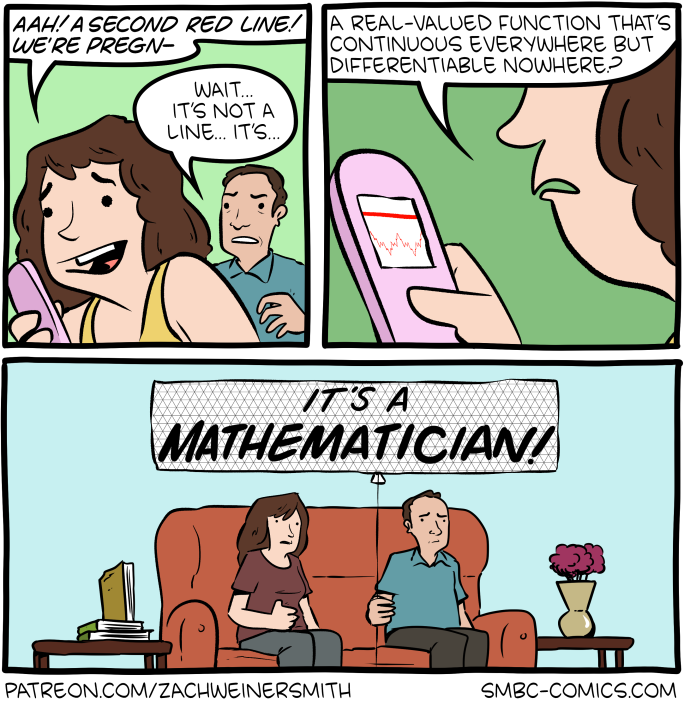
Saturday Morning Breakfast Cereal - Genera

by Zach Weinersmith


Click here to go see the bonus panel!

Hovertext:
You can tell if it'll be a cartoonist by seeing if it cries whenever anyone comes in its room and/or turns on the lights.


Today's News:

Get your copy of A City on Mars signed in person in Charlottesville, VA on August 23rd!


11 Aug 22:56

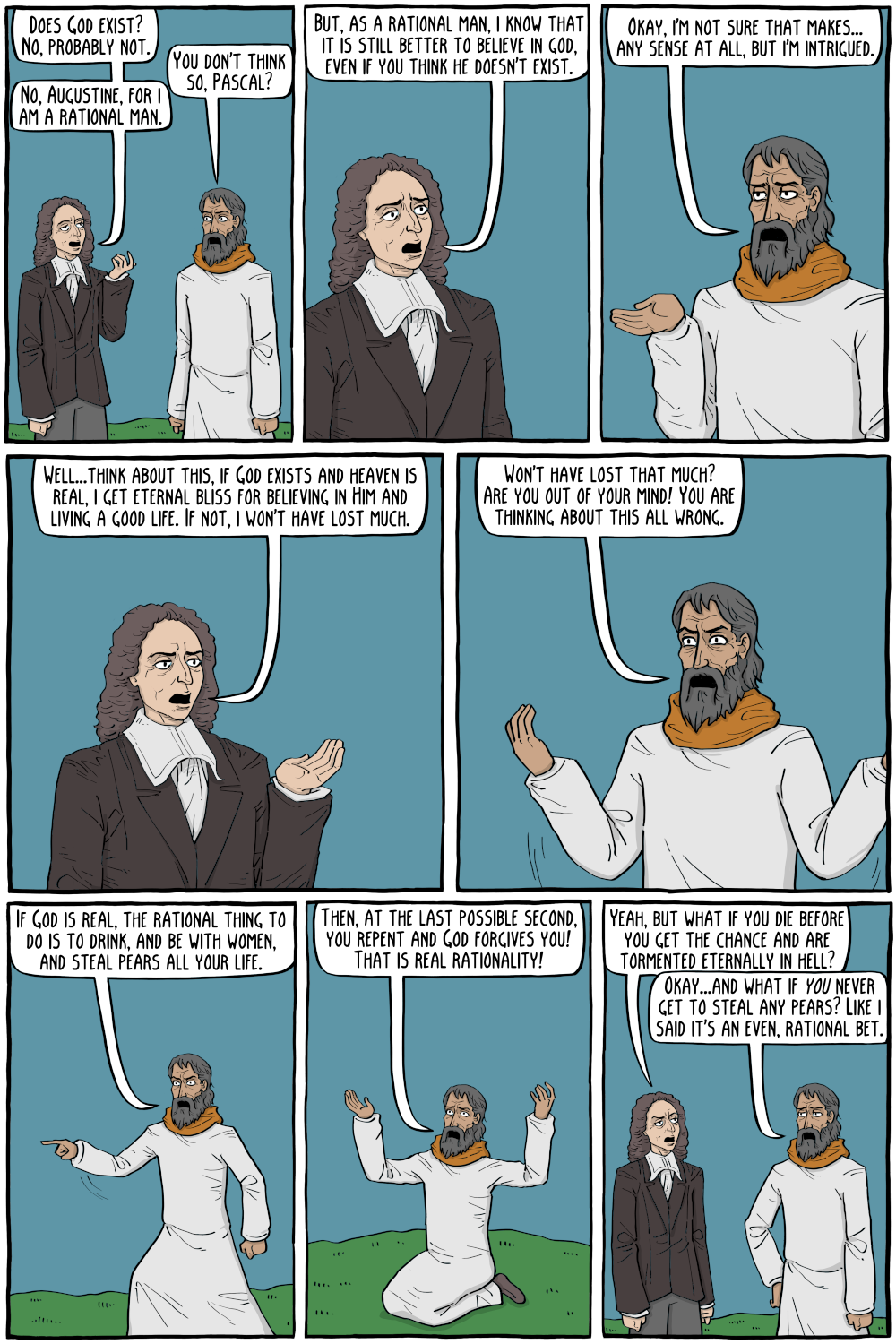
Saint Augustine's Wager

by Corey Mohler
PERSON: "Does God exist? No, probably not. "

PERSON: "You don't think so, Pascal?"

PERSON: "No, Augustine, for i am a rational man."

PERSON: "But, as a rational man, i know that it is still better to believe in god, even if you think he doesn't exist."

PERSON: "Okay, i'm not sure that makes... any sense at all, but i'm intrigued."

PERSON: "Well...think about this, if God exists and heaven is real, i get eternal bliss for believing in Him and living a good life. If not, i won't have lost much."

PERSON: "Won't have lost that much? Are you out of your mind! You are thinking about this all wrong."

PERSON: "If God is real, the rational thing to do is to drink, and be with women, and steal pears all your life."

PERSON: "Then, at the last possible second, you repent and God forgives you! That is real rationality!"

PERSON: "Yeah, but what if you die before you get the chance and are tormented eternally in hell?"
11 Aug 22:54

‘Playing with fire’: Newsom urges Trump to abandon partisan redistricting fight

by Bill Barrow, Associated Press
Texas Republicans are trying to reconvene the state Legislature to vote on redrawing congressional maps in their party's favor.
11 Aug 22:54

WATCH: D.C. mayor Bowser calls Trump takeover of DC police ‘unsettling’

by Associated Press
D.C. Mayor Muriel Bowser said Monday that the city had reached a 30-year low in violent crime.
11 Aug 22:54

Some Florida officers are continuing to charge people under halted immigration law

by Kate Payne, Associated Press
Some law enforcement officers are continuing to charge people under a Florida law that bans people living in the U.S. illegally from entering the state, even though a federal judge has halted enforcement of the law while it’s challenged in court.
11 Aug 22:54

‘What is happening?’ Milwaukee area recovers from record rain and flooding

by Scott Bauer, Associated Press
The Milwaukee area is drying out after weekend rain hits unofficial state records. Unofficially, more than 14 inches fell in less than 24 hours in one spot, causing rivers to flood, washing out vehicles, and cutting power to thousands.
11 Aug 22:53

Police say 3 dead in a shooting at a Target in Austin, Texas, and a suspect has been detained

by Associated Press
Austin police said in a post on the social platform X that the scene Monday is still active, and an investigation is ongoing.
11 Aug 22:50

In CDC attack, man fired 180 shots, breaking 150 windows

by Mike Stobbe, Associated Press
It may take weeks or even months to replace windows and clean up the damage at the Centers for Disease Control and Prevention headquarters in Atlanta, according to information circulated internally at the agency.
11 Aug 22:50

Why Niger is investigating the $5 million sale of the largest Mars rock found on Earth

by Mark Banchereau, Associated Press
A 54-pound meteorite from Mars has sold for over $5 million at a New York auction, setting a world record. But officials in Niger, where the meteorite was found, suspect it may have been smuggled out of the West African country.
11 Aug 22:49

Sports by Huey Lewis and The News

Cowboy Who?

"Do you like Huey Lewis and The News?"

Added by @robb in Sports › Music.

11 Aug 22:45

Japan’s largest newspaper, Yomiuri Shimbun, sues AI startup Perplexity for copyright violations

by Andrew Deck

The Yomiuri Shimbun, Japan’s largest newspaper by circulation, has sued the generative AI startup Perplexity for copyright infringement. The lawsuit, filed in Tokyo District Court on August 7, marks the first copyright challenge by a major Japanese news publisher against an AI company.

The filing claims that Perplexity accessed 119,467 articles on Yomiuri’s site between February and June of this year, based on an analysis of its company server logs. Yomiuri alleges the scraping has been used by Perplexity to reproduce the newspaper’s copyrighted articles in responses to user queries without authorization.

In particular, the suit claims Perplexity has violated its “right of reproduction” and its “right to transmit to the public,” two tenets of Japanese law that give copyright holders control over the copying and distribution of their work. The suit seeks nearly $15 million in damages and demands that Perplexity stop reproducing its articles.

The three plaintiffs in the suit are the newspaper’s headquarters in Tokyo, Osaka, and Fukuoka, all of which operate separately under Yomiuri Shimbun Holdings.

Japan’s copyright law allows AI developers to train models on copyrighted material without permission. This leeway is a direct result of a 2018 amendment to Japan’s Copyright Act, meant to encourage AI development in the country’s tech sector. The law does not, however, allow for wholesale reproduction of those works, or for AI developers to distribute copies in a way that will “unreasonably prejudice the interests of the copyright owner.”

In a statement sent to Yomiuri, a Perplexity spokesperson said, “We are deeply sorry for the misunderstanding this has caused in Japan. We are currently working hard to understand the nature of the claims. We take this very seriously, because Perplexity is committed to ensuring that publishers and journalists benefit from the new business models that will arise in the AI age.”

Last fall, two News Corp–owned publishers, The Wall Street Journal and the New York Post, took similar legal action against Perplexity. Outside of the U.S., though, Perplexity has so far avoided much legal scrutiny. Competing generative AI companies, including OpenAI and Meta, have faced copyright infringement suits from major international publishers.

In India, a joint copyright infringement suit against OpenAI includes some of the country’s most established news publications, including The Indian Express, The Hindu, and The India Today group. In France, the country’s leading authors and publishers associations have filed suits against Meta, alleging economic “parasitism.”

In May, the Japan Newspaper Publishers and Editors Association published an open letter calling out AI companies for free riding off their copyrighted material and warning them to stop their scraping practices. The status quo “could cause huge damage to the business of news organizations,” the association wrote at the time. “If quality news content, which underpins democracy, decreases, the public’s right to know may be hampered.”

Photo of Yomiuri Shimbun building by JHVEPhoto licensed via Adobe Stock.
11 Aug 22:44

Alden Global Capital is still trying to get its hands on The Dallas Morning News

by Joshua Benton

Alden Global Capital sure is confused a lot lately. The vulturous hedge fund has kindly offered to pillage The Dallas Morning News, just as it’s pillaged the other newspapers it’s bought over the past decade-plus.

But the paper’s owners and executives don’t seem keen on the idea! Weird, right?

And now Alden is “perplexed” that its potential victims don’t want to “engage.” (“C’mon, friend, let’s just talk about your entrails and how tasty they look.”)

I’ve already written about this twice, so I’ll go light on the details here. But DallasNews Corp. recently agreed to be acquired by Hearst for $14 a share. Soon after that, Alden Global Capital, America’s worst newspaper company, made a surprise offer at $16.50 a share. DallasNews said no thanks, we’re good with Hearst. (It helped that Hearst bumped its bid to $15 after Alden approached.) DallasNews’ corporate decisions are in effect governed by Robert Decherd, the great-grandson of the newspaper’s founder who worked at The Dallas Morning News for 50 years, much of it as CEO. Decherd owns or controls 96.3% of the company’s Series B stock, which has outsized voting power, and thus he can veto anything that comes up to a shareholder vote.1 And Decherd has pledged his votes to the Hearst deal, saying there “are no circumstances under which I would vote for or support” a sale to Alden.

Well, Alden keeps trying. This morning, its management sent another letter to DallasNews, upping the offer to $17.50 and again wondering why no one seems to want to hang out with them:

Alden has made this same rhetorical move before — emphasizing that they will preserve the “beloved print edition” of a newspaper they’re seeking to buy. It’s true! Because Alden has figured out ways to milk a print newspaper dry, but has shown little interest in planning for the digital future (or the digital present, for that matter). They’ve realized, as other newspaper publishers have, that the few print readers who remain are willing to pay outsized sums to maintain their decades-long habit. A seven-day print subscription to Alden’s Denver Post now costs $779.40 a year. Before Alden bought the Post, a seven-day print sub cost $130 a year — $198.64, adjusted for inflation. You bet they’re interested in keeping print alive.

(Also, Hearst has never said it would stop printing The Dallas Morning News. They still print all their other Texas newspapers, in Houston, San Antonio, and Austin, and I strongly suspect they will continue to do so until it no longer makes economic sense. It’s not a real issue.)

Alden’s letter focuses on the DallasNews board’s lack of engagement, saying that rejecting their bid without at least a quick chat would constitute “breaching any basic concept of a duty of care” — referencing the fiduciary duties management has to its shareholders to seek the best deal. (Those shareholders, notably, include Alden, which owns 9.9% of DallasNews stock.) And I’m sure that, if they don’t get their way, Alden will at least threaten a shareholder lawsuit over that alleged “breach.”

I am definitely not a lawyer — taking legal advice from me would be only slightly smarter than taking ballroom dance lessons from me. But I’ve been digging through a bunch of potential maneuvers that a bidder like Alden could use to scuttle a deal, and I continue to think DallasNews is safe.

It all comes down to Robert Decherd. By controlling the outcome of any shareholder vote, he has the unilateral ability to quash any deal he doesn’t like — and he’s told the company and stated publicly “that there was no scenario in which he would vote in favor of a sale of the Company to Alden.” I believe him. And I believe DallasNews has paid lawyers enough to make a pretty airtight case.

But doesn’t he have a fiduciary duty to accept the higher bid from Alden? The key is that Decherd is not an officer of the company — not an executive, not a board member. He used to be, for decades, but he retired in 2023. Now he’s “just” a controlling shareholder.

But doesn’t a controlling shareholder still have some fiduciary responsibility? Alden will surely make that argument, and in some states, it might be true. Delaware — a famously popular home for U.S. corporations — has some case law stating that a controlling shareholder could have, in certain circumstances, a conflict that justified tougher evaluation of a proposed merger or acquisition.

But DallasNews Corp. isn’t incorporated in Delaware. It’s a Texas corporation — literally the oldest Texas corporation, founded in 1842 under the Republic of Texas. And Texas corporate law doesn’t see the situation the same way Delaware does. Case law there finds that, unless a majority shareholder is engaged in fraud or corrupt self-dealing, a minority shareholder doesn’t have a case. “The other guys offered more money” isn’t enough to prevent a shareholder from exercising his preferences in a vote. A 2014 Texas Supreme Court caseeffectively eliminate[d] legal protections that minority shareholders enjoy in most other jurisdictions.” Otherwise, Texas considers a shareholder’s vote to be his property right, and you don’t mess with a rich man’s property rights in Texas.

In fact, things got actively worse for Alden in May, when the state legislature passed a new law that “bolsters protections for Texas corporations and directors and officers of Texas corporations and reduces the risk of shareholder litigation.”

It puts into law the idea that, as long as corporate directors are acting in good faith and to further the interests of the corporation, minority shareholders only have a case if they can prove executive behavior “involved fraud, intentional misconduct, an ultra vires act [outside the corporation’s legal authority], or a knowing violation of law.”

(“Texas is the reigning and undisputed champion for doing business in the United States of America,” Texas governor Greg Abbott said in a press release at the time. “Senate Bill 29 provides business decision makers the certainty that sound business judgments made in the best interest of shareholders will not be second-guessed by courts.”)

(Also, did I mention that I am not a lawyer?)

But can’t Alden keep raising their offer until Decherd is willing to cave? Theoretically, I guess? But practically, I don’t think so. Because Decherd’s ownership interest is mostly in Series B shares, his equity share of the company does not match his voting-power share. Before today, Alden’s higher offer would have netted Decherd only about $1 million more than Hearst’s. Now that Alden’s raised that offer, it’s around $1.5 million. Big money to you or me, but not to someone who had a custom-built 10,106-square-foot “mini-chateau” all the way back in 1989. The man is 74 and has made plenty of money; I don’t think there’s much reason to doubt him when he says he’ll never sell to Alden.

But can’t Trump veto pretty much any media merger? You saw what he just did to Paramount. Yes, what Trump did to Paramount — holding up its sale until the company paid $16 million to settle a bogus Trump lawsuit — was one of the most awful moments in recent American media history. But the weapon he used, Brendan Carr’s Federal Communications Commission, has jurisdiction over TV and radio licenses, not newspapers. A DallasNews deal would go through the Federal Trade Commission — a different federal agency Trump has been illegally skewing to his interests. But the FTC doesn’t have the power to singlehandedly stop a deal. The FTC could delay a deal, but in order to stop it, it would need to convince a federal judge to rule that it would substantially reduce competition — a much higher bar than “Tell Brendan I don’t like it.”

(For the record, I’m not aware of any particular reason Trump would much care about who owns The Dallas Morning News. But Alden honcho Randy Smith and his wife did give $100,000 to Trump’s fundraising committee in 2020, and they have given to a lot of GOP candidates and campaigns over the years, though probably short of what constitutes “megadonor” level by today’s standards. And among Smith’s many mansions, several sit not far from Mar-a-Lago in Palm Beach. And we’ve got plenty of evidence that waving a little money around can get Trump’s attention.)

Unless Trump takes a sudden interest, it looks like DallasNews has Texas law on its side and that its lawyers have done the necessary i-dotting and t-crossing to keep Alden out. The “regular” Series A shareholders will need to approve the Hearst deal, but I sincerely doubt they’d reject an offer that pays $15 a share. (DallasNews stock was trading at $4.39 the day before the Hearst deal was announced, and it would surely return to that level if shareholders killed it.) Check out the Schedule 14A it filed with the SEC on August 4, which includes a lengthy retelling of its responses to Alden, emphasizing the care taken to meet its obligations to shareholders. It also includes a fun dig:

…the Board recognized its ability to consider other factors under Texas law and additionally determined to reject the Alden Proposal because of its belief that, based on Alden’s history of acquiring and operating other newspapers across the United States, a sale to Alden or an affiliate of Alden would harm both the Company and the Dallas-Fort Worth and North Texas communities, as the Company would be unable to maintain the traditions of journalistic excellence that it has upheld over its 140-year history.

Here’s the full text of this morning’s Alden’s letter to DallasNews directors:

Dear Members of the Board of Directors,

On behalf of MNG Enterprises, Inc. and its affiliates (“MNG,” “we,” “us,” and “our”), we are pleased to submit an enhanced offer (the “Enhanced Proposal”) to acquire all of the issued and outstanding shares of Common Stock of DallasNews Corporation (“DallasNews”) that we do not already own for $17.50 per share in cash. Our Enhanced Proposal is $2.50 per share more than Hearst’s revised, yet inferior, offer of $15.00 per share, representing a whopping 16.7% premium to Hearst’s revised offer under the Agreement and Plan of Merger, dated as of July 9, 2025, among Hearst Media West, LLC (“Hearst”), DallasNews, and the other parties thereto, as amended on July 27, 2025 (the “Existing Agreement”).

Our Enhanced Proposal represents:

• a 299%+ premium to the undisturbed closing price of $4.39 per share on July 9, 2025;

• an 18.3% premium to the closing price of $14.80 per share on August 8, 2025; and

• a $1.00 per share increase over our initial offer of $16.50 per share submitted to DallasNews on July 22, 2025 (the “Original Proposal”).

We are perplexed by your refusal to have a single discussion with us in the weeks since our Original Proposal was submitted. Both our Original Proposal and Enhanced Proposal offer substantially more economic value to your shareholders, and – unlike Hearst – we are offering to continue publishing the beloved print edition of The Dallas Morning News. Our Enhanced Proposal is therefore better for DallasNews’ shareholders and the readers of The Dallas Morning News alike.

As important, despite your assertions to the contrary, Robert Decherd’s opposition to the Original Proposal does not prevent you from engaging with us. The Existing Agreement does not require that a competing proposal constitute a Superior Proposal in order to justify engagement. Rather, you can engage when a proposal is reasonably likely to lead to a Superior Proposal – as our proposals clearly have been since the beginning. That standard exists precisely because a third-party proposal, particularly one made without access to non-public information like ours, can only evolve through diligence, negotiation, and refinement. We remain confident that a constructive dialogue will address the concerns Mr. Decherd has raised and will result in a better outcome for DallasNews, The Dallas Morning News and its readers.

Our Original Proposal was clearly the best offer available to the shareholders to whom you owe a fiduciary duty (even in light of Hearst’s increased offer) and warranted good-faith engagement. Today, we are submitting this Enhanced Proposal to further demonstrate our commitment to a transaction between MNG and DallasNews. We have consistently indicated our belief that diligence could uncover additional value drivers that may support an even higher valuation than $16.50. Our Enhanced Proposal of $17.50 reflects that belief.

We are putting more money on the table because we believe in the Dallas Morning News. You should not summarily dismiss an offer that is clearly better for Dallas News’ shareholders and the readers of The Dallas Morning News alike.

Indeed, earlier this year, Sonoma Media Investments sold its portfolio of six newspapers to us rather than Hearst specifically because of confidence in our commitment to local journalism, saying:

“We wanted, and sought, an experienced owner with a proven track record of successfully running news operations in competitive markets for the benefit of the communities they serve…. MediaNews Group is run by a talented management team with decades of experience in local news, an important factor in our decision.”

Nowhere is quality journalism more important than at the local, community level. That’s why MNG manages our titles as a network of news groups and individual publications with autonomy bestowed on local leadership teams to make decisions based on what’s best for the unique communities they serve. We ensure maximum resources are available for newsrooms by maintaining centralized corporate teams that efficiently provide business and support services (such as product, technology, finance and human resources). Our local management teams have more freedom and flexibility to serve their local constituencies than newspapers operated by peers such as Hearst.

For decades, our leadership team has managed the acquisition of dozens of properties, many of which would no longer exist without our success at sustaining them. We have implemented an innovative and effective strategy focused on print and digital subscriptions as the primary focus of our business. While other newspaper groups abandon print to focus primarily on digital subscriptions, we remain committed to both platforms because of the continuing value that both provide to our readers.

We have tremendous respect for The Dallas Morning News and its nearly 140 years of excellence in journalism and service to the people of North Texas, as well as for its talented team of journalists. We welcome a discussion around the future operations of The Dallas Morning News in order to address Mr. Decherd’s concerns.

However, by not engaging with us, it is impossible for you to know whether that’s even possible, breaching any basic concept of a duty of care.

Our Enhanced Proposal remains a non-binding expression of interest only and does not constitute an offer capable of acceptance. We reserve the right to withdraw or modify this Enhanced Proposal at any time. This Enhanced Proposal (i) does not constitute a legally binding obligation, and, other than any confidentiality agreement that we may enter into in connection with further discussions of our Enhanced Proposal, there will be no legally binding agreement between us and DallasNews regarding this Enhanced Proposal or the potential transaction contemplated by this Enhanced Proposal, unless and until we enter into definitive documentation, (ii) is not intended to provide a basis for detrimental reliance or create any liability, whether arising in tort or at law, and (iii) is subject in all respects to the completion of our due diligence to our satisfaction in our sole discretion and the negotiation and execution of definitive documentation. Our Enhanced Proposal is not, and is not intended to be, a solicitation of a proxy or vote with respect to any securities of DallasNews or any other securities, or an offer to purchase or a solicitation of an offer to sell any securities of DallasNews or any other securities.

We are confident that our offer is best not just for DallasNews and The Dallas Morning News, but also for the people of North Texas, and we look forward to discussing further what we can provide to The Dallas Morning News and how we would ensure its future across platforms for its longtime, loyal audience, now and into the future. We are unique among newspaper owners and operators in that we have the scale and experience to ensure The Dallas Morning News continues to thrive for the benefit of your readers who depend on trusted local journalism to inform and enrich their lives.

We look forward to speaking with you.

Sincerely,

MNG ENTERPRISES, INC.

By: _______/s/ R. Joseph Fuchs_____________
Name: R. Joseph Fuchs
Title: Chairman of the Board of Directors

By: _______/s/ Guy Gilmore_______________
Name: Guy Gilmore
Title: Chief Operating Officer

Photo of the Dallas skyline reflected in the Trinity River via Adobe Stock.
  1. It’s worth noting that Decherd could singlehandedly block an Alden deal, but he can’t singlehandedly make the Hearst deal happen. Series A shareholders must also vote in favor of that.
11 Aug 22:43

Mastercard Claims NSFW Game Bans Aren’t From Them, Valve Explains How Mastercard Launders Its Control

by Timothy Geigner

This whole attempted censorship of adult games on gaming platforms is becoming a thing. Collective Shout—a group out of Australia that wraps itself in a feminist flag while behaving like the religious right to get anything it doesn’t like out of the video game industry—put on a pressure campaign with payment processors, writing in to demand that processing companies stop working with the likes of itch.io and Steam over games on those platforms the group has decided are unacceptable. Couched in the claim that the group was primarily going after games that focused on horrid things like “rape” and “incest,” the end result was those two platforms delisting or deindexing all kinds of adult games that either don’t include that type of content or—and here’s why free speech is tricky—approach those topics not to promote them, but to grapple with the horrors of them in an artistic manner.

Notably, far from any cries that these platforms be more focused in their approach, Collective Shout merely cheered on the fallout, illuminating what the actual goal is here: to make game platforms more puritanical through bully campaigns. These are, it seems, the same people going on book-banning crusades that ensare such smut as Calvin & Hobbes comics.

Well, pressure campaigns can work in both directions, as it did in this case. Credit card companies began getting flooded with calls and emails from the public complaining about these puritanical attempts to suppress video games. It’s only been a few days of this, but apparently it’s gotten bad enough that Mastercard put out some messaging pushing back on the idea that it had demanded these changes of gaming marketplaces.

Mastercard has broken its silence after being thrust into the middle of a gaming culture war between anti-porn advocates and anti-censorship activists. While Valve previously laid blame for a recent purge of adult sex games from Steam at the feet of “payment processors and their related card networks and banks,” Mastercard released a statement on Friday denying any responsibility for a new wave of censorship that’s recently led some gamers to flood payment company call centers with complaints.

“Mastercard has not evaluated any game or required restrictions of any activity on game creator sites and platforms, contrary to media reports and allegations,” the company wrote in a statement published on its website on August 1. “Our payment network follows standards based on the rule of law. Put simply, we allow all lawful purchases on our network. At the same time, we require merchants to have appropriate controls to ensure Mastercard cards cannot be used for unlawful purchases, including illegal adult content.”

Got it? Mastercard is not involved in the evaluation of games or their content and has not instituted any new rules beyond those that have always existed, namely that payment may only be collected and processed for “lawful purchases.” Summarizing that statement in plain language would look something like: “Nothing has changed on our end. If a purchase is legal, it’s fine by us.”

Now, that’s demonstrably false, of course. Mastercard has built a prudish reputation for itself in multiple instances, be it pressuring OnlyFans a couple of years back, banning VPN providers, as well as its crusade against Wikileaks.

But this is slightly different. In this case, according to Valve at least, Mastercard is just playing word games.

“Mastercard did not communicate with Valve directly, despite our request to do so,” Valve’s statement sent over email to Kotaku reads. “Mastercard communicated with payment processors and their acquiring banks.  Payment processors communicated this with Valve, and we replied by outlining Steam’s policy since 2018 of attempting to distribute games that are legal for distribution.  Payment processors rejected this, and specifically cited Mastercard’s Rule 5.12.7 and risk to the Mastercard brand.”

Rule 5.12.7 states, “A Merchant must not submit to its Acquirer, and a Customer must not submit to the Interchange System, any Transaction that is illegal, or in the sole discretion of the Corporation, may damage the goodwill of the Corporation or reflect negatively on the Marks.”

It goes on, “The sale of a product or service, including an image, which is patently offensive and lacks serious artistic value (such as, by way of example and not limitation, images of nonconsensual sexual behavior, sexual exploitation of a minor, nonconsensual mutilation of a person or body part, and bestiality), or any other material that the Corporation deems unacceptable to sell in connection with a Mark.”

So, two things to say here. The first is that, whatever your moral stances may be and no matter how they align with Mastercard’s rules above, that rule is a far cry from “if it’s lawful, it’s all good.” Instead, it’s more like “If it’s lawful, it’s all good…unless we determine it’s either offensive or isn’t artistic enough for our tastes.”

Now I could carve out examples of how Mastercard doesn’t come close to enforcing its own rule in the video game space all day. After all, I’m pretty sure I’ve “mutilated a person or body part” in roughly a zillion video games and that the NPCs in question didn’t give me consent to do so. That’s called combat and it’s in a ton of games that you can purchase with a Mastercard. But let’s take a more extreme example within the rule: bestiality. It’s one of those things that sounds like an obvious thing to say: you can’t use a Mastercard to buy a good, service, or image that includes bestiality. But I bought Baldur’s Gate 3 with my own Mastercard on Steam and, as is famously known, the game has a mildly explicit scene in which you, to borrow a headline, “Bang The Bear.” This isn’t to say that BG3‘s scene should be labeled “bestiality” (the bear is actually a druid that transforms into a bear), but it certainly could be.

But the second point is more fun to make compared with highlighting Mastercard’s lies and hypocrisy. Mastercard claimed innocence over the adult games purge by stating it didn’t directly talk to game marketplaces about any of this. But, while that is likely true in a technical sense, all it’s doing is pointing out that the company isn’t even secure enough in its own rules to enforce them directly and publicly and instead are laundering its morality stances through its network of partner processing companies.

The end result is the same: run afoul of these rules from Mastercard and enforced by Mastercard through its processor network and a game marketplace can lose its payment processing partnerships with Mastercard’s network. It’s a complete non-denial and, honestly, of no material use. The outcome is the outcome and it’s clear that Mastercard’s network is in fact doing all of this at Mastercard’s request.

And all for some Aussie puritans that want to foist their morality on everyone else? C’mon, credit card companies. What’s the point of amassing hundreds of billions of dollars in market cap if you can’t tell some zealots to fuck all the way off once in a while?

11 Aug 18:18

Texas Democrats embrace Newsom’s redistricting rebuttal as California draws new map

by Gabby Munoz
A half dozen Texas Democrats met with Gov. Gavin Newsom, Rep. Nancy Pelosi and other top Democrats in Sacramento as they draw new House seats for California.
11 Aug 18:17

Famed NASA astronaut and Apollo 13 commander Jim Lovell has died at age 97

by Gabby Munoz
Lovell commanded the mission that almost ended in disaster after an explosion that threatened the crew's oxygen and electrical supply. The inspiring story of their survival was made into a hit movie.
11 Aug 18:17

Real Monsters at the Menil Collection

by Bucky Miller

Sometime in the early 1960s, at some little American venue somewhere, an aspiring entertainer named Robert was working his way through some pop covers when he was gripped by a profound impulse. He could not have known that this spontaneous bit would come to define the remainder of his life, nor that it would reaffirm a delightful tidbit about the collective unconscious. The singer, midsong, dipped into a serviceable impersonation of horror flick mainstay Boris Karloff. The crowd, for their part, went absolutely berserk. Robert and his bandmate decided they should do more stuff like that. Stuff people liked. So in 1962, they wrote the “Monster Mash.”

It really was a smash. Robert gave himself an appropriate nickname, becoming Bobby “Boris” Pickett. Unfortunately, this “Monster Mash” thing was such a good idea that he never had a better one. Pickett’s future output included a Christmas-themed reworking of “Monster Mash,” called “Monster’s Holiday,” and 1982’s wildly opportunistic “Monster Rap.” He really was snagged on monsters for the rest of his life, but no matter. “Monster Mash” was, and is, such a hit that it continues to resonate nearly two decades after Pickett’s death. Last year, the original recording once again reached number 30 on the Billboard Hot 100. That’s higher than nine of the 14 tracks from Tyler, the Creator’s Chromakopia. Monsters are magnetic.

Houston’s Menil Collection mounts mini-exhibits in its hallways as a way to give daylight to stray fragments of their collection. It’s often easy to skim past these shows, as they tend to be unlabeled, don’t change very often, and are typically overshadowed by whatever main event happens to be on view. But they are often rewarding, little bonus gifts atop an already first-rate experience.

Artworks of various kinds are installed in an alcove in the Menil Collection's hallway.

Installation view of “Animals, Monsters, and Creatures from the Collection” at the Menil Collection. Photo: Caroline Philippone

One of their current shows in this vein, Animals, Monsters, and Creatures from the Collection, might have a little extra pull due to the inclusion of Jean Tinguely and Niki de Saint Phalle’s M.O.N.S.T.R.E. This big kinetic goblin attracts a crowd whenever it is activated: every hour, on the half hour, for two minutes. Turned on, the almost alligator-like M.O.N.S.T.R.E. gently chomps its knife-laden jaws and paddles its flippery appendages as the industrial wheel that makes up its midsection rolls determinedly forwards. This peculiarly gentle dance may be explained by an old post about the piece on the Menil’s Facebook page, which says, “when it was made, Saint Phalle and Tinguely were very much in love.” 

A machine that looks like a monster.

Jean Tinguely and Niki de Saint Phalle, “M.O.N.S.T.R.E.,” 1964, cast steel, iron, painted newsprint and fabric over wire, electric motor, plastic rubber, plastic toys, fabric, and twine. The Menil Collection, Houston, gift of the artists. Photo: Lauren Marek

The couple made M.O.N.S.T.R.E. for a show at Houston’s University of St. Thomas called Constant Companions: An Exhibition of Mythological Animals, Demons and Monsters, Phantasmal Creatures and Various Anatomical Assemblages. That exhibition opened in 1964, two years after Pickett released “Monster Mash.” Curated by Dominique de Menil and Jermayne MacAgy, it was the inspiration for the current museum display.

A stylized painting featuring a bird flying through the middle of the composition.

Victor Brauner, “Weaning of Irschou (Séparation d’Irschou),” 1947, oil on canvas. The Menil Collection

Actually, about half of the work in Animals, Monsters, and Creatures was produced in the same midcentury moment that gave us Bobby “Boris” Pickett. Make of this what you will. Two postwar Victor Brauners are the only paintings in the show, a colorful nod to the surrealist impulse to depict weird little phantoms. Brauner, here, is a refreshing representative of that movement. His images of the era are flat and playful. They escape their moment more fluidly than the elaborate grotesqueries of some of his peers. Unlike perhaps Max Ernst or Leonora Carrington, it is easy to imagine a Brauner either on the bottom of a skateboard or as some ancient architectural embellishment. Leave it to a surrealist to pull monsters from the past and into the future.

An animal-like sculpture made out of steel and a brush.

Jim Love, “Retired Chimneysweep,” 1964, steel and bottle brush. The Menil Collection, bequest of Edward B. Mayo. Photo: The Menil Collection

Four small steel sculptures by Texas artist Jim Love are the show’s linchpins. They are presented at the beginning of the hallway. Made between 1957 and 1964, these shelftop figurines look like idols from some frantic modernist folk religion. Like, “Hey. Weld together whatever’s in that drawer. That’s God now.” Chronologically, they’re called Ceremonial Figure, Seated Figure, The Foot Soldier, and Retired Chimneysweep. The progression-to-punchline of these titles, from archaeological to Swartzwelderesque, somehow adjoins the two contrasting sides of the exhibition.

Artworks of various kinds are installed in an alcove in the Menil Collection's hallway.

Installation view of “Animals, Monsters, and Creatures from the Collection” at the Menil Collection. Photo: Caroline Philippone

There’s a fifth item hanging out on the same endcap wall as Love’s false idols. It’s the French Centaur, from the 1700s, a silhouette of the mythic beast cut from an iron alloy plate. This decorative object slant rhymes with the Loves in scale, material, and attitude; the centaur is raising his club to strike. A larger French weathervane from the same era, in the form of a dragon, closes the show on the other side of the hall. At a quick glance, which is the way I speculate Menil hallway shows are most often viewed, these bookends betray almost no distance between the decor of 18th-century France and 1959 modern art in Texas. Slowing down, the subtle differences begin to reveal themselves. It was only once I recognized the vibration between these time periods that I realized I was in a hall full of monsters. 

A similar trick is played inside a vitrine in the center of the space, but here the timespan is far more vast. Standing Woman With Horns (1954), a fourteen-inch wrought iron minotaur-type by the Greek artist Takis, is flanked comfortably by a historic bestiary. There is a Renaissance crosier handle in the shape of a dragon, a Byzantine Medusa Pendant, and a sandstone carving referred to as Votive Relief with a Winged Deity. That piece was made by the Hittites, somewhere in ancient Turkey or Syria, sometime between 2000-1000 BCE. According to the Menil’s website, it’s a protective figure of a type that appears often in Hittite iconography.

Artworks of various kinds are installed in an alcove in the Menil Collection's hallway.

Installation view of “Animals, Monsters, and Creatures from the Collection” at the Menil Collection. Photo: Caroline Philippone

Is it troublesome to refer to an ancient culture’s protective deity as a “monster?” Or is the trouble that we’re too flippant about the likes of, say, Dracula? Even when contemporary vampires take an absurd turn, like with the What We Do In The Shadows franchise, Count Chocula, or the new Nosferatu’s inexplicable penis, they still appear with the same kind of magnetism that has caused our minds to wander towards bugbears for as long as we’ve had minds. Animals, Monsters, and Creatures from the Collection does more than indicate this historically — it suggests that contemporary artists would be wise to consider, at times, playing Frankenstein. He is the guy, you know? The mad scientist. The one who makes life.


Animals, Monsters, and Creatures from the Collection is on view through August 17, 2025 at the Menil Collection.

The post Real Monsters at the Menil Collection appeared first on Glasstire.

11 Aug 18:16

Almost Yours: “OUT OF STOCK” and the Art of Never Having

by Joseph Staley

Step into the briskly lit aisles of OUT OF STOCK and the air quivers with a peculiar voltage: a cross-current of mall acoustics, meme logic, and the soft hush of a secular shrine. Curated by the Contemporary Arts Museum Houston’s (CAMH) Teen Council, this year’s show hums with the raw contradictions and compulsions of consumer culture as it actually feels: a climate of overstimulation and psychic fatigue, all packaged with gleeful excess. Each work, drawn from over 150 submissions, lands as a sharp, wry response to the open call’s questions: What is the line between product and person? What are you consuming? Is it consuming you? When does consumption cross the line between want and need?

An installation view of artworks in a basement gallery space.

Installation view of “OUT OF STOCK,” at the Contemporary Arts Museum Houston, 2025.
Photo: Alex Barber

No idle provocations here. For a generation raised on surplus and exhaustion — one that knows, as the exhibition press release puts it, the “hunger for more material goods and virtual social validation creeps closer to a climax” — OUT OF STOCK holds up a funhouse mirror to the act of wanting itself. Nothing escapes its scrutiny: not the dopamine tingle of the scroll, not the relics of mall culture, not the slow-drip irony of living in a world that registers itself as a meme. And yet, these artists, who are themselves teens, avoid the cheap safety of ironic detachment or “stoib” (self-aware with out-of-body insincerity). Their works hum with the knowledge of irony, but never feast on it; instead, they script new rituals and behaviors from the endless churn, hollowing out space for sincerity, exhaustion, and even something like hope.

Barraged by a glitched-out feast of repetitious variety, OUT OF STOCK grafts the jittery optimism of the Y2K web onto the Warholian endurance of a machine engineered for desire’s assembly line. You feel this most immediately in the show’s digital collage (The Illusion of Abundance by Bells Bossel) — an exuberant, hyper-saturated riot of pixelated hands, rubber duckies, flamingos, “STOP” warnings, hypnotic eyes, and adhesive sale signs, all arranged in jagged frames that echo the endlessly recursive scroll of the early web. This isn’t just nostalgia for the days of GeoCities and blinking cursors — it’s a savvy homage to the logic of infinite menus and bottomless feeds. The result: a wall that buzzes and shimmers, its options both garish and seductive, haunted by the threat of depletion (“while supplies last” lingers like a curse). Are you the consumer, the product, or just another ghost in the algorithm?

An artwork made up of collages of different prints of digital images, including a big pointer hand in the middle.

Bells Bossell, “The Illusion of Abundance,” Adobe Photoshop, ripped fabric, framed archival inkjet prints, stuffing, archival inkjet print on adhesive paper. Photo: Alex Barber

This collage radiates the “information excess that floods contemporary cyberspaces,” as the press release keenly observes, while doubling as a meditation on the illusion of abundance. The mall — the ur-symbol of American plenitude, with its echoing corridors and promises of endless novelty — sits just behind the glass. In this show, the mall’s logic unravels, revealing its loops and traps: one more aisle, one more sale, one more item just out of reach. The cheerful “mine, mine, mine” of acquisition returns as a hollow refrain, a subtle background noise to the anxious contemporary choreography of scrolling and choosing. But unlike the numbing cycles of stoib, these artists handle abundance with both wit and wariness, resisting the urge to simply laugh off the anxious comedy of acquisition.

An installation view of artworks in a basement gallery space.

Installation view of “OUT OF STOCK, at the Contemporary Arts Museum Houston, 2025.
Photo: Alex Barber

Stoib, a spectral figure drawn from Soviet-era subcultural vocabulary, never claims the spotlight, yet always marks the room’s temperature. The word slips between categories — part mascot, part omen — evoking a character who observes with unwavering patience, attuned to absurdity but never collapsing into it. Stoib absorbs irony without infection; it surveys the landscape of effort and fatigue, registering each sincere gesture, every sideways glance, with the composure of someone who bears witness to every flavor of pretense that comes and goes as eyes roll. In OUT OF STOCK, stoib lingers at the gallery’s periphery, neither approving nor dismissing, simply present — proof that vigilance and humor still hold currency, that detachment need not harden into cynicism, that someone, somewhere, still tallies every earnest attempt at meaning, even when the shelves stand bare.

A Build A Bear doll, whose face has been covered with a grizzly bear-like mask.

Chloe Kerlin, “Stitched Integration,” 2024, thrifted teddy bear, oven-bake clay, acrylic paint, embroidery thread. Photo: Alex Barber

This theme of abundance turning gently to the emptiness of affect repeats in more haunted, bodily forms. Take the once-plush Build-A-Bear (Stitched Integration by Chloe Kerlin), its face now replaced by a stony, calloused, wooden mask, which slumps in plushy exhaustion. If childhood desire promised fulfillment by way of synthetic stuffing and the rush of ritual assembly, here the bear sits as a relic, its promise faded to a memento of having wanted too much for too long. The heart sewn into its paw feels less like a gesture of care and more like a warning — a visible record of the soul’s expenditure in pursuit of comfort. No easy catharsis here: just the quiet ache of desire gone slack, the object grown strange and distant. The bear’s exhaustion is not tragic after all, but honest; it doesn’t perform irony, but radiates a deeper strain of sincerity — an open acknowledgment of the costs of that tail circling chase.

Three paintings are installed on a wall; all are portraits — a man holding a lantern, a person with a phone, and a woman holding a baby.

Khoi Chu, “Portr-AI-ts,” 2023, oil on canvas. Photo: Alex Barber

Wander further and the static sharpens as it unsettles the spine. A trio of AI-birthed oil portraits by Khoi Chu gleam against a clean wall — faces warped, features scrambled by the neural hallucinations of machine vision. In these paintings, the uncanny swaps side effect for main event. Their haunted gazes beckon you into a psychic limbo: are these people, products, or digital ghosts rendered flesh? The artist leans hard into Freud’s unheimlich —most precisely translated as “unhomely” from the original German — inviting us to linger in the ambiguity between animate and inanimate, code and canvas, visitor and host. These works don’t simply dwell in irony; they sharpen it to a point, then pivot away. Rather than giggling at the spectacle of the algorithm gone awry, the paintings quietly ask: What happens when our own likenesses, fed into the machine, return as strangers, gently watching us from the gallery wall?

A sculptural monster-like figure has a skull for a head and antlers made of twigs. It eats an bird-like foot.

Gray Velasco, “A Hunger Can’t be Ignored,” 2024, paper, epoxy sculpt, wire, wood, acrylic paint, wool, glue, sticks, fake moss, tape, aluminum foil. Photo: Alex Barber

If the logic of hunger — cyclical, insatiable, and never quite satisfied — drives consumer society, it animates the show’s more grotesque offerings as well. In Gray Velasco’s sculpture, A Hunger Cannot be Ignored, a skeletal animal “thing,” chews compulsively at its own want, red threads trailing from its jaws in a macabre parody of nourishment. Hunger, in this world, splits into two forms: the urgent, life-saving kind, and the slow, self-consuming ache of late-stage capitalism. In OUT OF STOCK,, survival mutates into compulsion; fulfillment defers, always just beyond the next swipe, the next cart, the guilt of that “last” drip of dopamine. But again, the work never succumbs to empty cynicism or ironic detachment; it exposes the wires, but lets the ache remain, un-mocked.

A painting depicting a woman, all in black and with black hair, looking down.

Ryder Tang “unseen gaze,” 2024, oil on canvas. Photo: Alex Barber

And then, in the quietest register, Ryder Tang’s unseen gaze drifts between object and self, her painted face dissolving into a sumptuous red-black field. Here, the line between person and commodity blurs, not with a jolt, but with a slow, elegant fade. The ghost’s affect is not flattened by irony; rather, it absorbs into the glossy surface, radiating a poised, haunted stillness. This is not the drama of losing oneself to branding, but the subtler adaptation of living alongside it — becoming a “spectral operator,” a ghost in the shell, a figure that survives by learning to haunt the edges of consumption, rather than feeding its flames.

Through its panoramic sprawl, OUT OF STOCK never drifts into easy didacticism or performative irony. Instead, it scripts a ritual of suspended desire, a behavioral system in which objects perform, images behave, and the roles of consumer and consumed drift and tangle and morph. These teen artists sidestep both naive sincerity and hollow irony, instead cultivating a wry, almost tender awareness — a haunted playground where every option filters as blessing and curse.

What is the line between product and person? OUT OF STOCK leaves the answer elegantly unfinished, suspended like the last item in an abandoned online cart. The viewer drifts through aisles of longing, encountering objects and images that flicker with our own behaviors — our exhaustion, our hope, our secret pleasure in the game of never-quite-having. These works acknowledge irony and stoib, but never surrender to them. Instead, they hum with self-awareness, but hold space for genuine ache, for ambiguity, for the dizzying beauty of longing itself.

Here, CAMH’s Teen Council maps the contradiction at the heart of consumer life — where the hunger for more goods, novelty, or social validation brings both comfort and cost, both promise and compromise. OUT OF STOCK is not just a warning but a wonder, a prompt to ask not only what we take from the world, but what the world quietly takes from us in return. If the system dreams on, it dreams in our own slightly haunted image — hovering and hesitating, savoring the uncanny thrill of longing that refuses to be out of stock.


OUT OF STOCK is on view at the Contemporary Arts Museum Houston through October 19, 2025.

The post Almost Yours: “OUT OF STOCK” and the Art of Never Having appeared first on Glasstire.

11 Aug 18:15

Cleveland ISD bus carrying high school students overturns while crashing into ditch

by Adam Zuvanich
No deaths or life-threatening injuries were reported, according to a spokesperson for the Houston-area school district, who said 36 of the 59 students on board were transported to local hospitals. The bus driver and bus monitor were treated at the scene of the crash.
11 Aug 18:08

Judge to hear case on whether Trump violated federal law with National Guard deployment in LA

by Janie Har, Associated Press
A federal judge will hear arguments on whether military troops deployed by the Trump administration to Los Angeles violated a federal law that bars troops from conducting law enforcement duties within the country.
11 Aug 18:07

Finland charges officers of Russia-linked ship that damaged undersea cables

by Associated Press
Finnish authorities say they have charged the captain and two senior officers of a Russia-linked vessel that damaged undersea cables last year between Finland and Estonia.
11 Aug 18:07

Prime minister says Australia will recognize a Palestinian state, criticizes Israel’s new offensive in Gaza

by Charlotte Graham-McLay, Associated Press
Prime Minister Anthony Albanese has announced that Australia will recognize a Palestinian state. This move aligns with recent signals from leaders in France, Britain and Canada.
11 Aug 18:07

Indonesian Sharia court sentences 2 men to public caning for kissing and hugging

An Islamic court in Indonesia’s conservative Aceh province has sentenced two men to public caning, 80 times each, for hugging and kissing.