Shared posts

11 Aug 18:19

AOL Pulls the Plug on Dial-Up Service

by John Gruber

Mark Tyson at Tom’s Hardware:

AOL, now a Yahoo property, will end its dial-up internet service, the Public Switched Telephone Network (PSTN)-based internet connectivity service, on September 30, 2025. Its dial-up service has been publicly available for 34 years, and has provided many an internet surfer’s first taste of the WWW. AOL will also end its AOL Dialer software and AOL Shield browser. RIP slowband.

Thomas Ricker at The Verge:

You might be surprised that the service was still operating. I’m not. At last count, a 2019 US census estimated that 265,000 people in the United States were still using dial-up internet.

Unsurprisingly, I never used AOL, but, I of course did use dial-up service to access the Internet. First for a few years while still a student at Drexel, then through some sort of commercial service here in Philadelphia. I forget the name of the company. But I do remember using IPNetRouter, a terrific classic Mac utility by Peter Sichel/Sustainable Softworks that allowed you to share a dial-up connection with your LAN. (Amazingly, the Sustainable Softworks website is still up, seemingly unchanged for decades.)

So when my now-wife and I moved in together in 1999, I set up a LAN connecting our Macs and my HP LaserJet. My Mac was connected to a modem, which used a second phone line that was just for Internet access. When either of our Macs tried to access the Internet, IPNetRouter, running all the time on my PowerMac 9600/350, would initiate a dial-up connection that both of us could use at the same time. It felt like a pretty nifty setup.

I don’t recall when we first got a broadband connection — DSL for a few years, then cable — but I’m thinking it might have been as early as 2000 or 2001. It certainly wasn’t too long after that. So I think I only ever used dial-up modems for six or seven years. Maybe eight years, tops. But in hindsight those years feel like an entire era of my life. Those connections were just breathtakingly slow. But slow, finicky Internet service in your home was infinitely more amazing and fun and useful than what we were all used to — which was not having any sort of online connectivity at all. We all knew what it was like to have “real” Internet speeds in buildings on our college campuses or, for some of us, in offices where we went to work. So we knew that even the fastest dial-up connection was painfully slow. But we made do. Software was designed to treat bandwidth — each and every request — as a precious, limited resource. It was a deliberate choice, by you, the user, to “go online” to, say, check and send email. Developers took pains to make their apps as small as possible, because downloading even a few megabytes could take a while. Websites eschewed bloat, because if a website was bloated, no one would bother going there. In some ways, overall, things were better because the technology was so much worse. My nostalgia for that era is quite profound — exemplified, of course, by my Pavlovian affection for the distinctive grating sound of a modem initiating its connection.

11 Aug 18:19

#CowboyWho

11 Aug 18:18

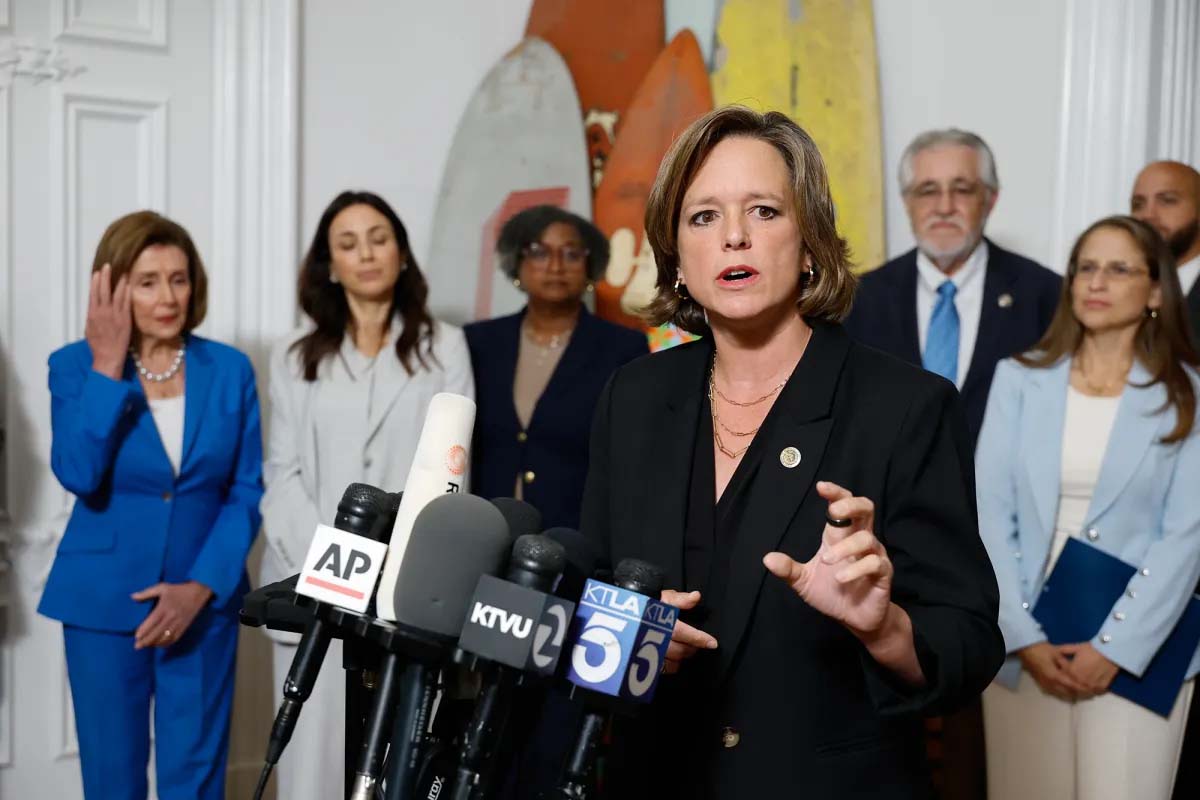
Texas Democrats embrace Newsom’s redistricting rebuttal as California draws new map

by Gabby Munoz
A half dozen Texas Democrats met with Gov. Gavin Newsom, Rep. Nancy Pelosi and other top Democrats in Sacramento as they draw new House seats for California.
11 Aug 18:17

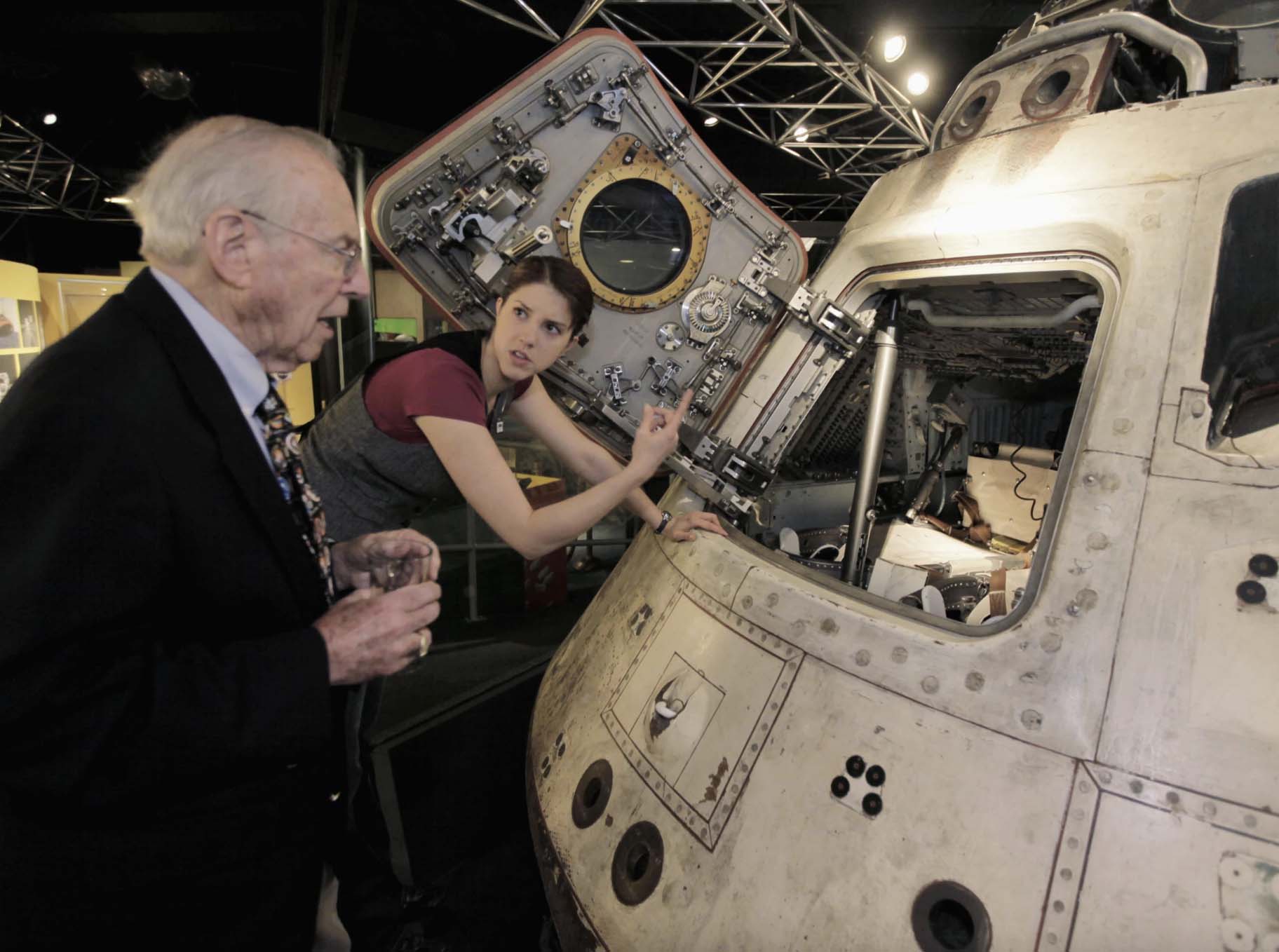
Famed NASA astronaut and Apollo 13 commander Jim Lovell has died at age 97

by Gabby Munoz
Lovell commanded the mission that almost ended in disaster after an explosion that threatened the crew's oxygen and electrical supply. The inspiring story of their survival was made into a hit movie.
11 Aug 18:17

Real Monsters at the Menil Collection

by Bucky Miller

Sometime in the early 1960s, at some little American venue somewhere, an aspiring entertainer named Robert was working his way through some pop covers when he was gripped by a profound impulse. He could not have known that this spontaneous bit would come to define the remainder of his life, nor that it would reaffirm a delightful tidbit about the collective unconscious. The singer, midsong, dipped into a serviceable impersonation of horror flick mainstay Boris Karloff. The crowd, for their part, went absolutely berserk. Robert and his bandmate decided they should do more stuff like that. Stuff people liked. So in 1962, they wrote the “Monster Mash.”

It really was a smash. Robert gave himself an appropriate nickname, becoming Bobby “Boris” Pickett. Unfortunately, this “Monster Mash” thing was such a good idea that he never had a better one. Pickett’s future output included a Christmas-themed reworking of “Monster Mash,” called “Monster’s Holiday,” and 1982’s wildly opportunistic “Monster Rap.” He really was snagged on monsters for the rest of his life, but no matter. “Monster Mash” was, and is, such a hit that it continues to resonate nearly two decades after Pickett’s death. Last year, the original recording once again reached number 30 on the Billboard Hot 100. That’s higher than nine of the 14 tracks from Tyler, the Creator’s Chromakopia. Monsters are magnetic.

Houston’s Menil Collection mounts mini-exhibits in its hallways as a way to give daylight to stray fragments of their collection. It’s often easy to skim past these shows, as they tend to be unlabeled, don’t change very often, and are typically overshadowed by whatever main event happens to be on view. But they are often rewarding, little bonus gifts atop an already first-rate experience.

Artworks of various kinds are installed in an alcove in the Menil Collection's hallway.

Installation view of “Animals, Monsters, and Creatures from the Collection” at the Menil Collection. Photo: Caroline Philippone

One of their current shows in this vein, Animals, Monsters, and Creatures from the Collection, might have a little extra pull due to the inclusion of Jean Tinguely and Niki de Saint Phalle’s M.O.N.S.T.R.E. This big kinetic goblin attracts a crowd whenever it is activated: every hour, on the half hour, for two minutes. Turned on, the almost alligator-like M.O.N.S.T.R.E. gently chomps its knife-laden jaws and paddles its flippery appendages as the industrial wheel that makes up its midsection rolls determinedly forwards. This peculiarly gentle dance may be explained by an old post about the piece on the Menil’s Facebook page, which says, “when it was made, Saint Phalle and Tinguely were very much in love.” 

A machine that looks like a monster.

Jean Tinguely and Niki de Saint Phalle, “M.O.N.S.T.R.E.,” 1964, cast steel, iron, painted newsprint and fabric over wire, electric motor, plastic rubber, plastic toys, fabric, and twine. The Menil Collection, Houston, gift of the artists. Photo: Lauren Marek

The couple made M.O.N.S.T.R.E. for a show at Houston’s University of St. Thomas called Constant Companions: An Exhibition of Mythological Animals, Demons and Monsters, Phantasmal Creatures and Various Anatomical Assemblages. That exhibition opened in 1964, two years after Pickett released “Monster Mash.” Curated by Dominique de Menil and Jermayne MacAgy, it was the inspiration for the current museum display.

A stylized painting featuring a bird flying through the middle of the composition.

Victor Brauner, “Weaning of Irschou (Séparation d’Irschou),” 1947, oil on canvas. The Menil Collection

Actually, about half of the work in Animals, Monsters, and Creatures was produced in the same midcentury moment that gave us Bobby “Boris” Pickett. Make of this what you will. Two postwar Victor Brauners are the only paintings in the show, a colorful nod to the surrealist impulse to depict weird little phantoms. Brauner, here, is a refreshing representative of that movement. His images of the era are flat and playful. They escape their moment more fluidly than the elaborate grotesqueries of some of his peers. Unlike perhaps Max Ernst or Leonora Carrington, it is easy to imagine a Brauner either on the bottom of a skateboard or as some ancient architectural embellishment. Leave it to a surrealist to pull monsters from the past and into the future.

An animal-like sculpture made out of steel and a brush.

Jim Love, “Retired Chimneysweep,” 1964, steel and bottle brush. The Menil Collection, bequest of Edward B. Mayo. Photo: The Menil Collection

Four small steel sculptures by Texas artist Jim Love are the show’s linchpins. They are presented at the beginning of the hallway. Made between 1957 and 1964, these shelftop figurines look like idols from some frantic modernist folk religion. Like, “Hey. Weld together whatever’s in that drawer. That’s God now.” Chronologically, they’re called Ceremonial Figure, Seated Figure, The Foot Soldier, and Retired Chimneysweep. The progression-to-punchline of these titles, from archaeological to Swartzwelderesque, somehow adjoins the two contrasting sides of the exhibition.

Artworks of various kinds are installed in an alcove in the Menil Collection's hallway.

Installation view of “Animals, Monsters, and Creatures from the Collection” at the Menil Collection. Photo: Caroline Philippone

There’s a fifth item hanging out on the same endcap wall as Love’s false idols. It’s the French Centaur, from the 1700s, a silhouette of the mythic beast cut from an iron alloy plate. This decorative object slant rhymes with the Loves in scale, material, and attitude; the centaur is raising his club to strike. A larger French weathervane from the same era, in the form of a dragon, closes the show on the other side of the hall. At a quick glance, which is the way I speculate Menil hallway shows are most often viewed, these bookends betray almost no distance between the decor of 18th-century France and 1959 modern art in Texas. Slowing down, the subtle differences begin to reveal themselves. It was only once I recognized the vibration between these time periods that I realized I was in a hall full of monsters. 

A similar trick is played inside a vitrine in the center of the space, but here the timespan is far more vast. Standing Woman With Horns (1954), a fourteen-inch wrought iron minotaur-type by the Greek artist Takis, is flanked comfortably by a historic bestiary. There is a Renaissance crosier handle in the shape of a dragon, a Byzantine Medusa Pendant, and a sandstone carving referred to as Votive Relief with a Winged Deity. That piece was made by the Hittites, somewhere in ancient Turkey or Syria, sometime between 2000-1000 BCE. According to the Menil’s website, it’s a protective figure of a type that appears often in Hittite iconography.

Artworks of various kinds are installed in an alcove in the Menil Collection's hallway.

Installation view of “Animals, Monsters, and Creatures from the Collection” at the Menil Collection. Photo: Caroline Philippone

Is it troublesome to refer to an ancient culture’s protective deity as a “monster?” Or is the trouble that we’re too flippant about the likes of, say, Dracula? Even when contemporary vampires take an absurd turn, like with the What We Do In The Shadows franchise, Count Chocula, or the new Nosferatu’s inexplicable penis, they still appear with the same kind of magnetism that has caused our minds to wander towards bugbears for as long as we’ve had minds. Animals, Monsters, and Creatures from the Collection does more than indicate this historically — it suggests that contemporary artists would be wise to consider, at times, playing Frankenstein. He is the guy, you know? The mad scientist. The one who makes life.


Animals, Monsters, and Creatures from the Collection is on view through August 17, 2025 at the Menil Collection.

The post Real Monsters at the Menil Collection appeared first on Glasstire.

11 Aug 18:16

Almost Yours: “OUT OF STOCK” and the Art of Never Having

by Joseph Staley

Step into the briskly lit aisles of OUT OF STOCK and the air quivers with a peculiar voltage: a cross-current of mall acoustics, meme logic, and the soft hush of a secular shrine. Curated by the Contemporary Arts Museum Houston’s (CAMH) Teen Council, this year’s show hums with the raw contradictions and compulsions of consumer culture as it actually feels: a climate of overstimulation and psychic fatigue, all packaged with gleeful excess. Each work, drawn from over 150 submissions, lands as a sharp, wry response to the open call’s questions: What is the line between product and person? What are you consuming? Is it consuming you? When does consumption cross the line between want and need?

An installation view of artworks in a basement gallery space.

Installation view of “OUT OF STOCK,” at the Contemporary Arts Museum Houston, 2025.
Photo: Alex Barber

No idle provocations here. For a generation raised on surplus and exhaustion — one that knows, as the exhibition press release puts it, the “hunger for more material goods and virtual social validation creeps closer to a climax” — OUT OF STOCK holds up a funhouse mirror to the act of wanting itself. Nothing escapes its scrutiny: not the dopamine tingle of the scroll, not the relics of mall culture, not the slow-drip irony of living in a world that registers itself as a meme. And yet, these artists, who are themselves teens, avoid the cheap safety of ironic detachment or “stoib” (self-aware with out-of-body insincerity). Their works hum with the knowledge of irony, but never feast on it; instead, they script new rituals and behaviors from the endless churn, hollowing out space for sincerity, exhaustion, and even something like hope.

Barraged by a glitched-out feast of repetitious variety, OUT OF STOCK grafts the jittery optimism of the Y2K web onto the Warholian endurance of a machine engineered for desire’s assembly line. You feel this most immediately in the show’s digital collage (The Illusion of Abundance by Bells Bossel) — an exuberant, hyper-saturated riot of pixelated hands, rubber duckies, flamingos, “STOP” warnings, hypnotic eyes, and adhesive sale signs, all arranged in jagged frames that echo the endlessly recursive scroll of the early web. This isn’t just nostalgia for the days of GeoCities and blinking cursors — it’s a savvy homage to the logic of infinite menus and bottomless feeds. The result: a wall that buzzes and shimmers, its options both garish and seductive, haunted by the threat of depletion (“while supplies last” lingers like a curse). Are you the consumer, the product, or just another ghost in the algorithm?

An artwork made up of collages of different prints of digital images, including a big pointer hand in the middle.

Bells Bossell, “The Illusion of Abundance,” Adobe Photoshop, ripped fabric, framed archival inkjet prints, stuffing, archival inkjet print on adhesive paper. Photo: Alex Barber

This collage radiates the “information excess that floods contemporary cyberspaces,” as the press release keenly observes, while doubling as a meditation on the illusion of abundance. The mall — the ur-symbol of American plenitude, with its echoing corridors and promises of endless novelty — sits just behind the glass. In this show, the mall’s logic unravels, revealing its loops and traps: one more aisle, one more sale, one more item just out of reach. The cheerful “mine, mine, mine” of acquisition returns as a hollow refrain, a subtle background noise to the anxious contemporary choreography of scrolling and choosing. But unlike the numbing cycles of stoib, these artists handle abundance with both wit and wariness, resisting the urge to simply laugh off the anxious comedy of acquisition.

An installation view of artworks in a basement gallery space.

Installation view of “OUT OF STOCK, at the Contemporary Arts Museum Houston, 2025.
Photo: Alex Barber

Stoib, a spectral figure drawn from Soviet-era subcultural vocabulary, never claims the spotlight, yet always marks the room’s temperature. The word slips between categories — part mascot, part omen — evoking a character who observes with unwavering patience, attuned to absurdity but never collapsing into it. Stoib absorbs irony without infection; it surveys the landscape of effort and fatigue, registering each sincere gesture, every sideways glance, with the composure of someone who bears witness to every flavor of pretense that comes and goes as eyes roll. In OUT OF STOCK, stoib lingers at the gallery’s periphery, neither approving nor dismissing, simply present — proof that vigilance and humor still hold currency, that detachment need not harden into cynicism, that someone, somewhere, still tallies every earnest attempt at meaning, even when the shelves stand bare.

A Build A Bear doll, whose face has been covered with a grizzly bear-like mask.

Chloe Kerlin, “Stitched Integration,” 2024, thrifted teddy bear, oven-bake clay, acrylic paint, embroidery thread. Photo: Alex Barber

This theme of abundance turning gently to the emptiness of affect repeats in more haunted, bodily forms. Take the once-plush Build-A-Bear (Stitched Integration by Chloe Kerlin), its face now replaced by a stony, calloused, wooden mask, which slumps in plushy exhaustion. If childhood desire promised fulfillment by way of synthetic stuffing and the rush of ritual assembly, here the bear sits as a relic, its promise faded to a memento of having wanted too much for too long. The heart sewn into its paw feels less like a gesture of care and more like a warning — a visible record of the soul’s expenditure in pursuit of comfort. No easy catharsis here: just the quiet ache of desire gone slack, the object grown strange and distant. The bear’s exhaustion is not tragic after all, but honest; it doesn’t perform irony, but radiates a deeper strain of sincerity — an open acknowledgment of the costs of that tail circling chase.

Three paintings are installed on a wall; all are portraits — a man holding a lantern, a person with a phone, and a woman holding a baby.

Khoi Chu, “Portr-AI-ts,” 2023, oil on canvas. Photo: Alex Barber

Wander further and the static sharpens as it unsettles the spine. A trio of AI-birthed oil portraits by Khoi Chu gleam against a clean wall — faces warped, features scrambled by the neural hallucinations of machine vision. In these paintings, the uncanny swaps side effect for main event. Their haunted gazes beckon you into a psychic limbo: are these people, products, or digital ghosts rendered flesh? The artist leans hard into Freud’s unheimlich —most precisely translated as “unhomely” from the original German — inviting us to linger in the ambiguity between animate and inanimate, code and canvas, visitor and host. These works don’t simply dwell in irony; they sharpen it to a point, then pivot away. Rather than giggling at the spectacle of the algorithm gone awry, the paintings quietly ask: What happens when our own likenesses, fed into the machine, return as strangers, gently watching us from the gallery wall?

A sculptural monster-like figure has a skull for a head and antlers made of twigs. It eats an bird-like foot.

Gray Velasco, “A Hunger Can’t be Ignored,” 2024, paper, epoxy sculpt, wire, wood, acrylic paint, wool, glue, sticks, fake moss, tape, aluminum foil. Photo: Alex Barber

If the logic of hunger — cyclical, insatiable, and never quite satisfied — drives consumer society, it animates the show’s more grotesque offerings as well. In Gray Velasco’s sculpture, A Hunger Cannot be Ignored, a skeletal animal “thing,” chews compulsively at its own want, red threads trailing from its jaws in a macabre parody of nourishment. Hunger, in this world, splits into two forms: the urgent, life-saving kind, and the slow, self-consuming ache of late-stage capitalism. In OUT OF STOCK,, survival mutates into compulsion; fulfillment defers, always just beyond the next swipe, the next cart, the guilt of that “last” drip of dopamine. But again, the work never succumbs to empty cynicism or ironic detachment; it exposes the wires, but lets the ache remain, un-mocked.

A painting depicting a woman, all in black and with black hair, looking down.

Ryder Tang “unseen gaze,” 2024, oil on canvas. Photo: Alex Barber

And then, in the quietest register, Ryder Tang’s unseen gaze drifts between object and self, her painted face dissolving into a sumptuous red-black field. Here, the line between person and commodity blurs, not with a jolt, but with a slow, elegant fade. The ghost’s affect is not flattened by irony; rather, it absorbs into the glossy surface, radiating a poised, haunted stillness. This is not the drama of losing oneself to branding, but the subtler adaptation of living alongside it — becoming a “spectral operator,” a ghost in the shell, a figure that survives by learning to haunt the edges of consumption, rather than feeding its flames.

Through its panoramic sprawl, OUT OF STOCK never drifts into easy didacticism or performative irony. Instead, it scripts a ritual of suspended desire, a behavioral system in which objects perform, images behave, and the roles of consumer and consumed drift and tangle and morph. These teen artists sidestep both naive sincerity and hollow irony, instead cultivating a wry, almost tender awareness — a haunted playground where every option filters as blessing and curse.

What is the line between product and person? OUT OF STOCK leaves the answer elegantly unfinished, suspended like the last item in an abandoned online cart. The viewer drifts through aisles of longing, encountering objects and images that flicker with our own behaviors — our exhaustion, our hope, our secret pleasure in the game of never-quite-having. These works acknowledge irony and stoib, but never surrender to them. Instead, they hum with self-awareness, but hold space for genuine ache, for ambiguity, for the dizzying beauty of longing itself.

Here, CAMH’s Teen Council maps the contradiction at the heart of consumer life — where the hunger for more goods, novelty, or social validation brings both comfort and cost, both promise and compromise. OUT OF STOCK is not just a warning but a wonder, a prompt to ask not only what we take from the world, but what the world quietly takes from us in return. If the system dreams on, it dreams in our own slightly haunted image — hovering and hesitating, savoring the uncanny thrill of longing that refuses to be out of stock.


OUT OF STOCK is on view at the Contemporary Arts Museum Houston through October 19, 2025.

The post Almost Yours: “OUT OF STOCK” and the Art of Never Having appeared first on Glasstire.

11 Aug 18:15

should I not have gifted money to an intern?

by Ask a Manager

A reader writes:

A college intern had joined us in the office last month, and I gave her what I thought was a kind gesture. I recently overheard her describe the gesture to another coworker as “really weird,” so I’m reaching out for feedback.

After meeting her on her first day at the office, I had bought $400 worth in Visa gift cards from the grocery store that she could use in the cafeteria (which doesn’t take cash, unfortunately). I calculated the amount based on the cafeteria’s prices, and I also bought a $5 gift card for myself to make sure the cards would actually work. I left them on her desk the next day with a note that said, “I remember what it was like being a broke college student. Feel free to use these in the cafeteria. They should last you a good part of the summer, if not the whole summer. Save as much money as you can from this job. Best, (my name).”

I was in college for my bachelor’s from 2015 to 2020. Although my STEM degree was marketable with well-paid internships, I was on a strict budget because I had to save money for student loans and emergencies. My tuition had granted me a limited number of meals per week that I had to ration, so I had to find creative ways to find food. I planned my meals around student organization events with free food, and I learned the locations of fridges throughout campus that usually had unmarked food (i.e., not in a lunchbag and likely meant for a group, such as a sheet cake). Sometimes, my breakfast was a few pieces of candy from the candy bowl in my department’s admissions office. I had also learned the schedule for a weekly faculty meeting so that I could grab one of their catered sandwiches from behind the door.

I wish I never had to do any of this, and I’m speaking as someone who was lucky to save enough money not to lose my mind entirely when I graduated in the middle of the pandemic. I had classmates who didn’t have the savings that I had who only had low-paying campus jobs or unpaid internships. Furthermore, I remember all these options disappearing in the summer when school was out, so I had to buy my own food.

Thankfully, those days are behind me now. I’m almost 30 years old with paid-off student loans, a paid-off car, savings accounts that total to a year’s worth of expenses, and a 401K that’s almost at one year’s gross income. But I wish that getting to where I was didn’t have to include starving myself, so meeting the college intern gave me the opportunity to give someone what I wished I had at her age.

I overheard her tell a coworker that she went to our manager because she was “weirded out,” and that our manager had told her there was probably no malicious intent behind it. Before I had overheard this conversation, I had noticed that she was acting more aloof with me than with other coworkers, and I had been confused over whether I had done something.

To be clear, we’re both straight women in relationships, so it’s not that I’m some creepy dude trying to flirt with her. I also don’t expect any favors back if that’s what she’s worried about, but perhaps I needed to make that clear? I thought my note had a sufficient explanation, but should I approach her about this? I don’t want her to feel uncomfortable around me.

This was very generous and thoughtful of you, and I’m sorry that it’s being misinterpreted!

I think what happened is likely because it was so generous. $400 is a lot of money to give someone right after meeting them, to the point that I can see how it would feel odd to the recipient.

I can easily imagine your train of thought: this is an intern, interns are underpaid, it’s an age where many people struggle financially, I’m in a position to help in a way I would have really appreciated at that age, so let me do something kind and the money might mean a lot more to her than it does to me. That’s a lovely impulse!

But because it’s so much money, and to someone who you didn’t actually know was in need (for all we know, she could have a trust fund or lots of parental help), it might be landing differently than you intended.

I think it might be different if you had gotten to know her a little more and she’d confided (or you could clearly see) that she was struggling. Or if it had been a smaller amount — “welcome to the office, I know the intern pay is tough, here’s a $20 gift card for the cafeteria.” It’s the combination of the amount and having just met her.

And while it seems like an overreaction that she went to your manager — because you and I know you were just trying to be nice — I can also see how she, without that context, wanted to reality-check that with someone. I don’t love your manager’s response (“probably no malicious intent”?!) but hopefully that’s just the intern’s paraphrase of what your boss actually said.

At this point, I’d check in with your manager to say, “I meant this to be kind, had no idea it would freak her out, and want to explain to her where I was coming from — but since she talked to you about it, I want to make sure I’m not about to inadvertently make it weirder somehow.”

But yeah, in the future I’d hold off on this kind of big gesture with a brand new coworker, as much as it sucks to squelch the impulse to help.

The post should I not have gifted money to an intern? appeared first on Ask a Manager.

11 Aug 18:09

Sorry, I was just taking a lavender bath.

Sorry, I was just taking a lavender bath.

11 Aug 18:09

Trump Rushed To Walter Reed To Watch Breast Exam

by The Onion Staff

WASHINGTON—In a chaotic and alarming scene that sent West Wing staffers springing into action, White House sources confirmed Tuesday that President Donald Trump had been rushed to Walter Reed National Military Medical Center to watch a woman’s breast exam.

Early this morning, Secret Service agents were seen whisking the president out of a Cabinet meeting and onto his Marine One helicopter after they received word that an attractive 27-year-old Army specialist had arrived at the Bethesda, MD medical facility for her routine cancer-screening procedure. Multiple commercial flights were said to have been grounded or rerouted to clear the airspace and ensure Trump arrived before the patient began to disrobe.

“I knew we were in a race against time when I saw the president’s eyes rolling back as he imagined this lady taking her shirt off,” said Trump aide Trent Dixon, who recalled how he prayed beside the president as they rode in the helicopter, asking God to keep the woman on the examination table as long as possible. “I kept telling him, ‘You’re going to make it, sir. You’re going to see those breasts.’”

The president was taken aboard Marine One and hurried to the reportedly topless woman’s checkup.

“And I really do think it was God who got us to the hospital in time to walk in on that woman just as she was lowering the top of her paper gown,” Dixon continued.

Upon his arrival at Walter Reed, the president was declared to be at severe risk of missing out on the exposed breasts, and he was hurried down the hall and into the women’s health clinic. Once there, Trump, his security detail, and a half dozen advisors were brought into the room where the clinical breast exam had reportedly just begun. According to hospital officials, the startled patient and her doctor were instructed to continue as if the heavy-breathing president weren’t standing there beside them and openly gaping at the naked torso.

As the physician began a visual examination of the woman’s breasts, asking her to raise her hands above her head and then place them on her hips, Trump was seen nodding in approval and whispering in consultation with his aides. He is said to have smiled broadly when the patient was asked to lie supine on the exam table and the doctor began to palpate her breast tissue.

“The president has so far responded very positively to watching a stranger’s nude breasts be examined for their shape, size, and texture,” said Trump’s personal physician, Sean Barbabella, noting that when the woman received her mammogram, the imaging machine’s compression of her breasts made the commander-in-chief feel “a little weird,” but he was still very glad to have observed it. “It was absolutely crucial that he got there in time to leer as the doctor felt the breasts for tenderness, using fingertips to probe every part of them, including the nipples.”

“To prevent any close calls like this in the future, cameras will be installed in all areas of Walter Reed in which women receive care, including the pelvic exam rooms,” Barbabella added.

White House officials have requested that media outlets keep their distance from hospital grounds out of respect for the president’s privacy as he ogles the bare chest.

Trump was reported to be in good spirits throughout his visit and at one point even cracked a joke, saying he might have to give up politics to become a “tit doctor” himself. To reassure his supporters, he posted a photo on Truth Social in which he could be seen gawking at the topless woman. It included a caption that read: “Made it in time and got a GREAT look. Best I’ve felt since I was in the Miss Teen USA changing room!”

Despite the president’s outward bravado about watching the breast exam, some close to him said they believed the experience would deeply change him.

“I think it really scared Donald to come so close to not getting an eyeful of what was, by all accounts, an amazing rack,” said mixed martial arts mogul Dana White, a longtime Trump confidant. “Once he gets back to work, you may see him using his influence to enshrine government access to all women’s most private, vulnerable medical experiences.”

The post Trump Rushed To Walter Reed To Watch Breast Exam appeared first on The Onion.

11 Aug 18:09

Space For The Whole Family

by The Onion Staff

Your in-laws will feel right at home insisting that this cozy one-bedroom condo is big enough to host them for two full weeks.

Reference #48151

The post Space For The Whole Family appeared first on The Onion.

11 Aug 18:08

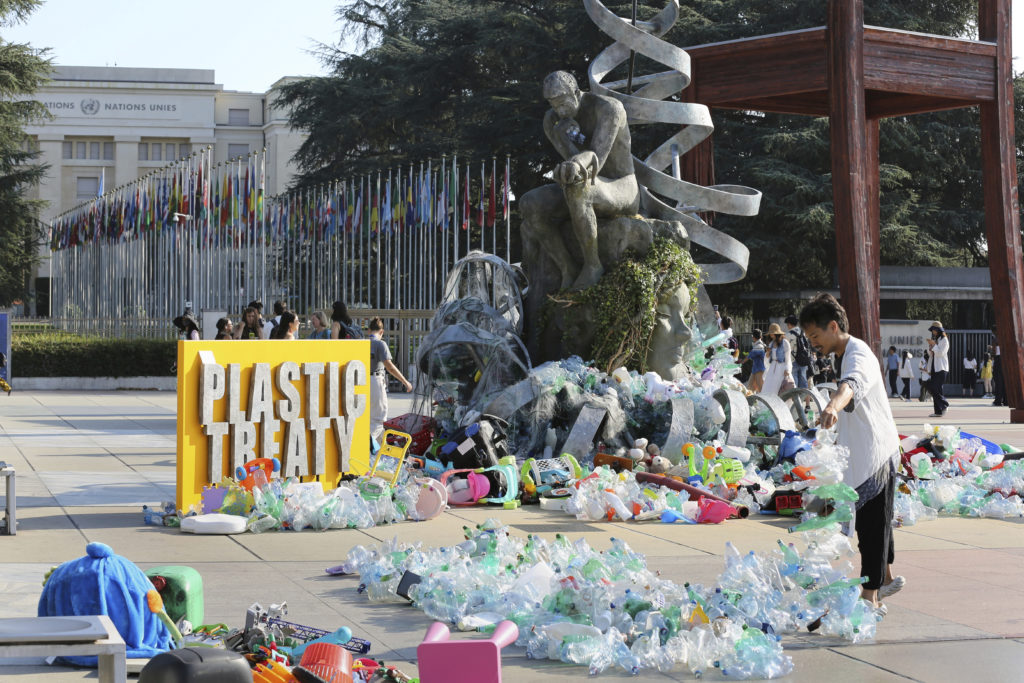
This sculpture at the UN is covered in more trash each day as nations work toward ending plastic pollution

by Jennifer McDermott, Associated Press
Delegates to the treaty talks pass by the sculpture daily, drowning in plastic, as a reminder of their responsibility to solve the plastic pollution crisis.
11 Aug 18:08

The Perseids will peak this week, but a bright moon will make the meteor shower harder to see

by Christina Larson, Associated Press
Under ideal viewing conditions with no moon, the shower can produce more than 60 meteors per hour - but moonlight will interfere this year.
11 Aug 18:08

Judge to hear case on whether Trump violated federal law with National Guard deployment in LA

by Janie Har, Associated Press
A federal judge will hear arguments on whether military troops deployed by the Trump administration to Los Angeles violated a federal law that bars troops from conducting law enforcement duties within the country.
11 Aug 18:07

Finland charges officers of Russia-linked ship that damaged undersea cables

by Associated Press
Finnish authorities say they have charged the captain and two senior officers of a Russia-linked vessel that damaged undersea cables last year between Finland and Estonia.
11 Aug 18:07

Prime minister says Australia will recognize a Palestinian state, criticizes Israel’s new offensive in Gaza

by Charlotte Graham-McLay, Associated Press
Prime Minister Anthony Albanese has announced that Australia will recognize a Palestinian state. This move aligns with recent signals from leaders in France, Britain and Canada.
11 Aug 18:07

Indonesian Sharia court sentences 2 men to public caning for kissing and hugging

An Islamic court in Indonesia’s conservative Aceh province has sentenced two men to public caning, 80 times each, for hugging and kissing.
11 Aug 16:26

Tropical Storm Erin Graphics

by nhcwebmaster@noaa.gov (NHC Webmaster)
Tropical Storm Erin 5-Day Uncertainty Track Image
5-Day Uncertainty Track last updated Mon, 11 Aug 2025 14:59:42 GMT

Tropical Storm Erin 34-Knot Wind Speed Probabilities
Wind Speed Probabilities last updated Mon, 11 Aug 2025 15:22:28 GMT
11 Aug 16:23

Beto O’Rourke, Texas Dems rail against GOP redistricting ‘power grab’ at Fort Worth rally

by Pablo Arauz Peña, KERA, Paul DeBenedetto
O'Rourke's Powered by People group has become a top funder for Democrats who broke quorum to prevent a vote on the maps, but the group was ordered to stop Friday. O'Rourke responded by suing Paxton.
11 Aug 16:23

Texas Legislature to take another swing at redistricting vote as Democrats extend their walkout

by Associated Press
Democratic-controlled states including California, New York and Illinois are threatening to retaliate against Texas and Trump by proposing their own redistricting, putting the nation on the brink of a tit-for-tat overhaul of congressional boundaries that are typically redrawn only once a decade.
11 Aug 16:22

Invest 97L likely to develop soon but not an urgent concern for land

by Matt Lanza

In brief: Invest 97L should become a tropical depression soon. While there is still plenty of uncertainty in the future, odds still currently favor a system heading out to sea ultimately. We explain more below. The rest of the tropics are ho hum for now. Strong heat in the West will gradually migrate back eastward this week, and we have details on that too.

Invest 97L on the cusp of developing

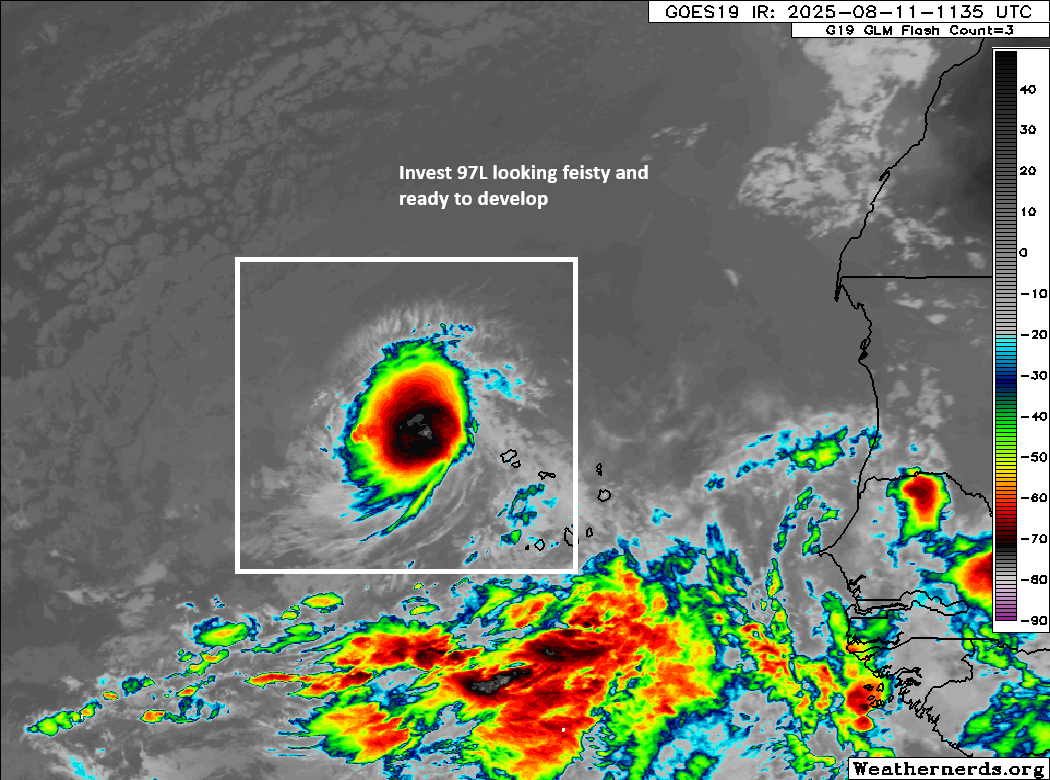
Our tropical disturbance in the eastern Atlantic is looking relatively healthy this morning, and it’s sitting just north of 15°N latitude. Development odds are up to 90 percent, and it’s entirely possible that we have a tropical depression here before this evening.

Invest 97L may be on the fringe of becoming a depression soon. (Weathernerds.org)

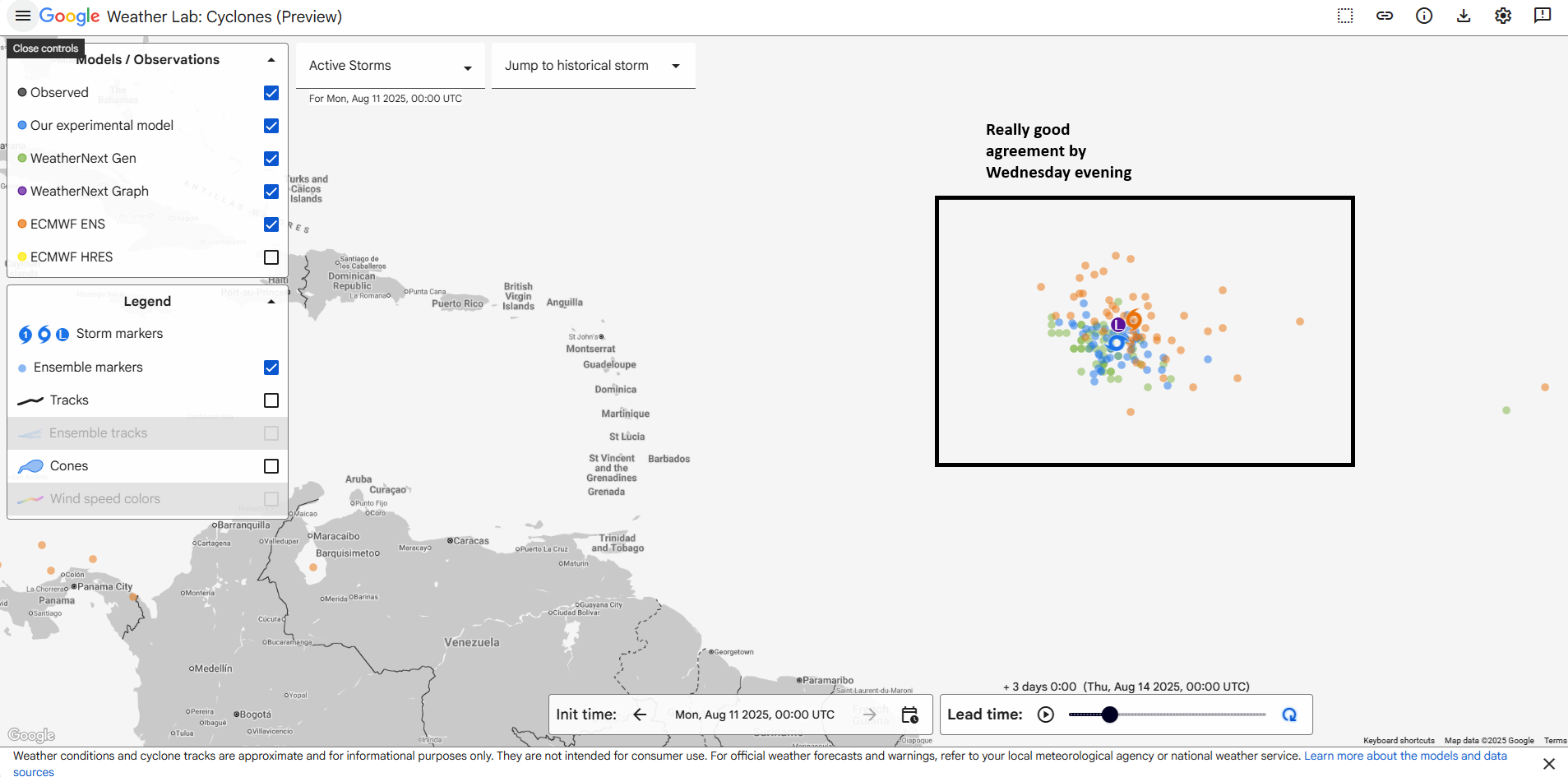
In a bit of an odd twist, weather modeling is actually in really, really good agreement on the general track of Invest 97L over the next 48 to 72 hours. Often in these nascent systems, there is uncertainty around exact location and placement and to some extent track. But in this case, the modeling all seems to be sniffing from the same bowl of food. In fact, you can see that European ensemble and experimental/operational AI ensemble members are all mostly packed together by Wednesday evening east of the islands.

Strong model agreement through 60 to 72 hours. (Google Weather Lab)

From there, the system will continue to track west or west-northwest across the basin arriving probably just northeast of the Leeward and Virgin Islands by late Friday or Saturday. A couple things have sort of changed since yesterday when looking at the upper-level weather pattern around whatever 97L is by Saturday or Sunday.

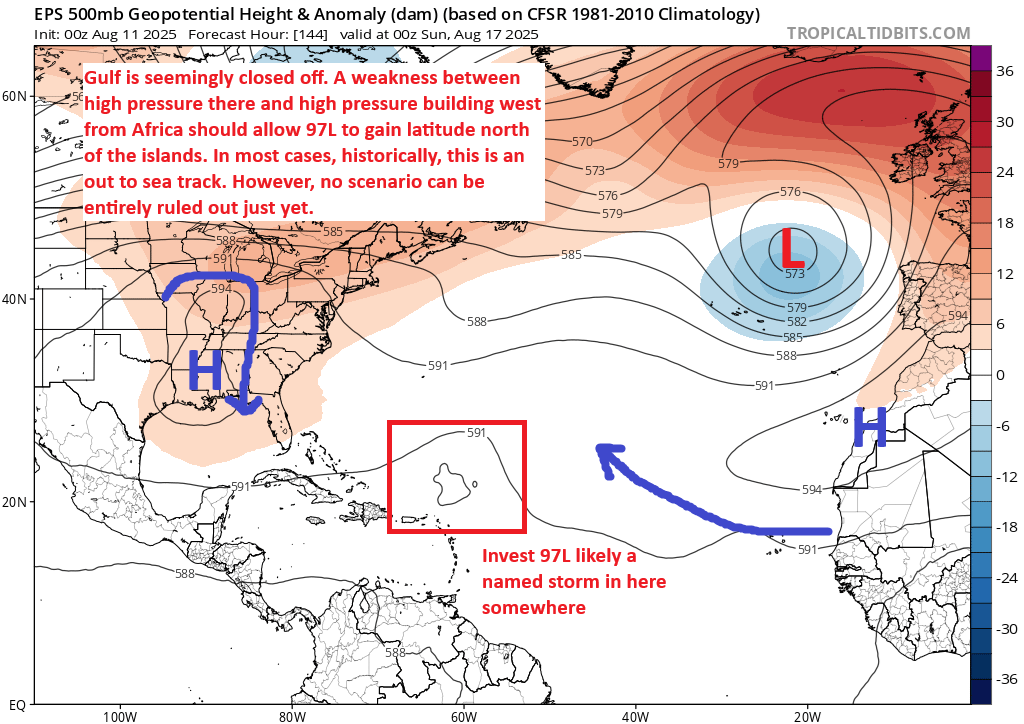
First, the weakness between high pressure over the Gulf and high pressure over Africa seems to have strengthened a little. This should allow 97L, likely a named storm by the weekend to gain more latitude just northeast of the islands. Historically, most storms end up tracking out to sea from there, perhaps threatening Bermuda on the way. And in this case, that’s still probably the likeliest outcome. However, there is still enough uncertainty around exactly how features orient and what intensity the storm itself has at that point that does keep the Bahamas, East Coast, and Atlantic Canada still in play here.

Invest 97L is likely a tropical storm or stronger this weekend. History suggests it will head out to sea, but there remains enough uncertainty on specifics for others to continue to monitor. (Tropical Tidbits)

But, I will say that at this time at least, the vast majority of ensemble model guidance from both AI and traditional modeling is sweeping this thing out to sea. As always, we will continue to watch and keep you posted on any changes, updates, etc.

Behind Invest 97L

There’s not a whole heck of a lot doing with any specificity right now behind 97L. There is another wave trailing it that may have some chance to develop a little farther south than 97L, but at this time, the AI modeling is most excited by this rather than the traditional ensembles. Some of the newer AI ensemble modeling has proven to be quite overzealous with tropical genesis this season, meaning anytime there’s a remote chance of development, they jump on it too quickly. For now, we’ll see if that next wave does anything, but there are no other urgent or specific concerns we’ve got heading through early next week at this time.

West Coast sizzle will migrate east this week

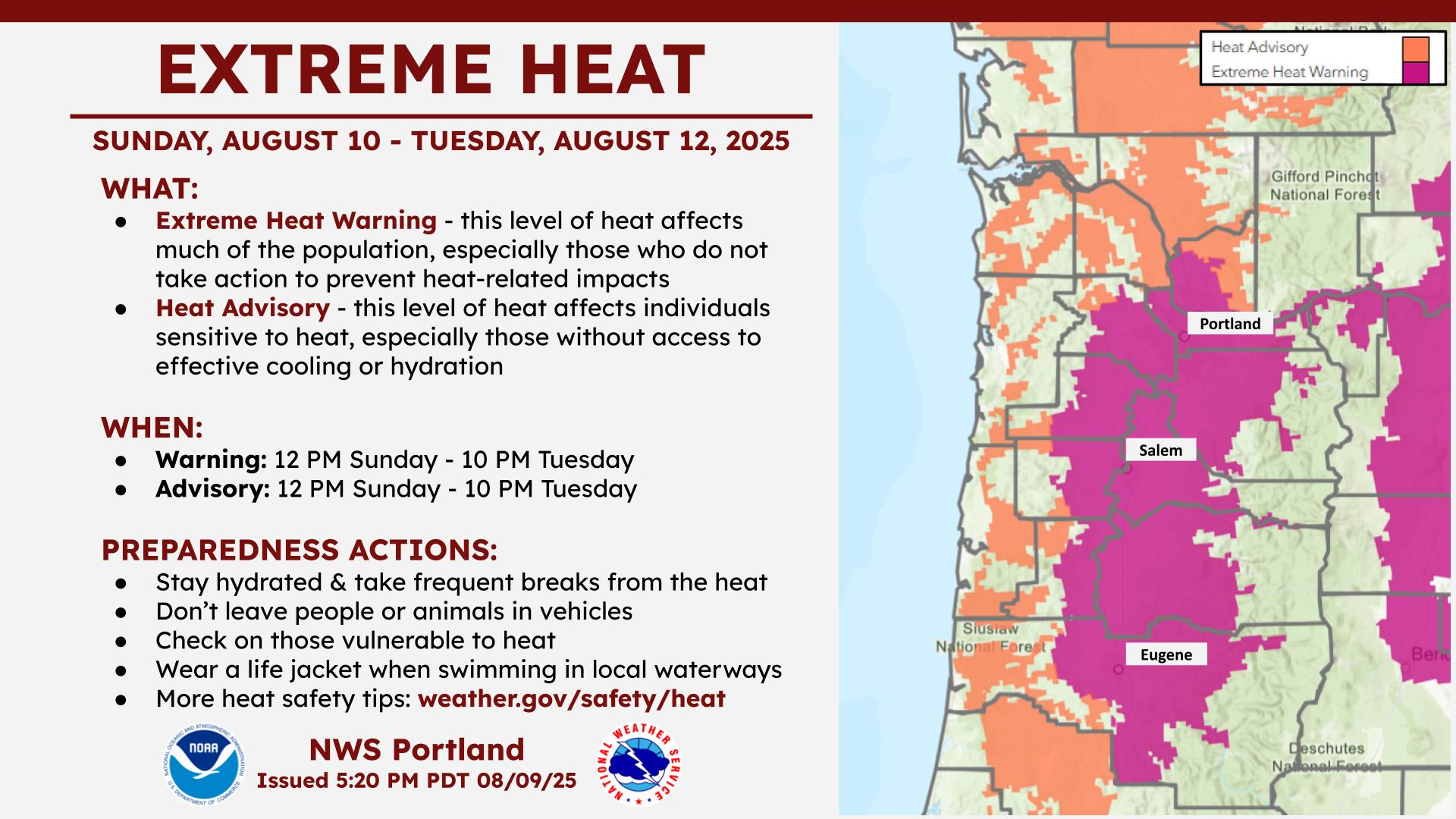
Ongoing heat in the Western U.S. continues. Portland had their hottest day since last summer yesterday, topping out at 99°, and today should be even a bit hotter.

(NWS Portland)

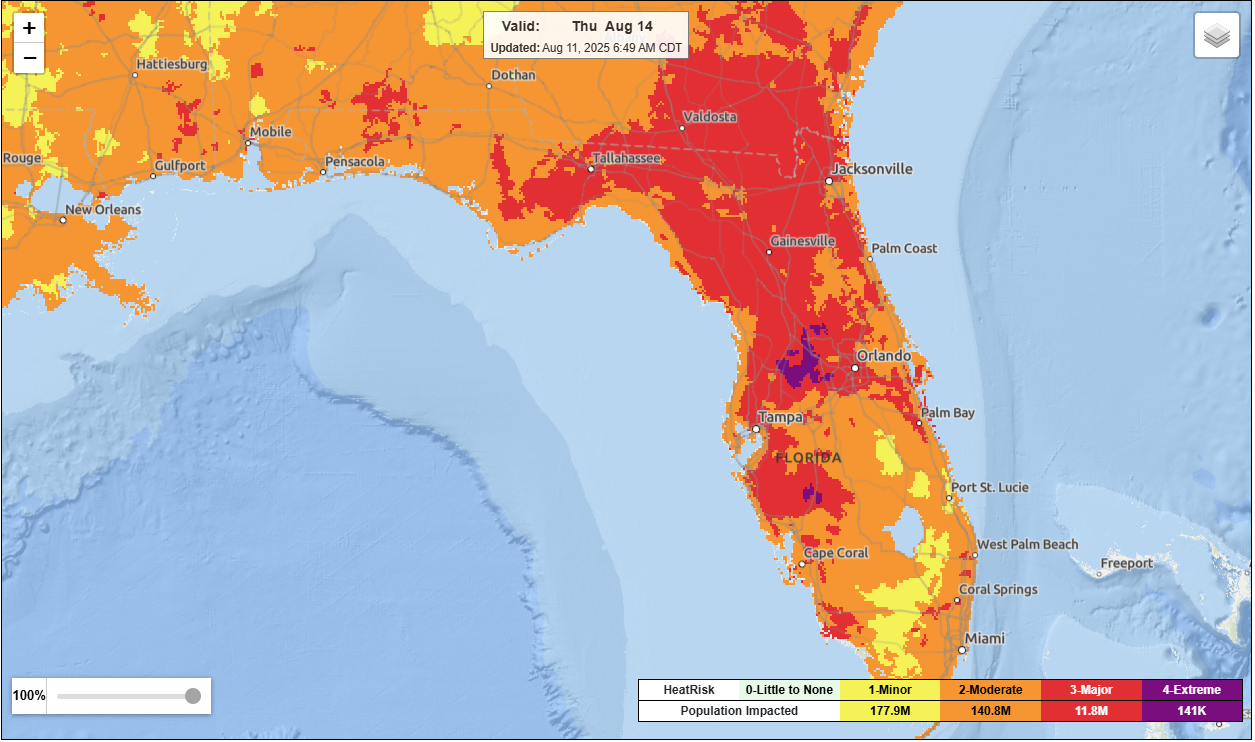
To the south, Las Vegas hit 110° yesterday, their 3rd hottest of this summer. They’ll come close to their hottest of summer today and tomorrow as well, with highs of 109-111° expected, near records for this time of year. Expect strong heat relative to normal today in Michigan and northern Maine as well. Heading through the week, the focus of heat will gradually shift back toward Florida and the Southeast.

Thursday’s heat risk peaks over Florida with near extreme heat between Tampa and Orlando. (NOAA)

Remember the high pressure system that sort of closes off the Gulf from Invest 97L? Well, it should keep the Gulf out of play from a tropical system, but it’ll definitely make you sweat!

11 Aug 16:22

Alan Dershowitz Sues Farmers Market Vendor For Refusing To Sell Him Child

by The Onion Staff

WEST TISBURY, MA—Following through on his threat of legal action, civil liberties lawyer Alan Dershowitz confirmed Monday that he had filed a lawsuit against a Martha’s Vineyard farmers market vendor for refusing to sell him a child. “This is an affront to the principles of the free market,” said the 86-year-old attorney, who can be seen in a viral video of the incident being driven from the outdoor market by a large crowd after he demanded the vendor “give [him] the big one filled with cheese.” “I’ve been buying children from this farmers market for decades, and now they’re trying to tell me my dollar’s no good here? They’re discriminating against me simply because I have differing political views on age of consent laws. Don’t test me. I’ll come back to that farmers market to try to buy a child every day until she turns 18.” At press time, Dershowitz had released a list of “woke sex trafficking rings” for his supporters to boycott.

The post Alan Dershowitz Sues Farmers Market Vendor For Refusing To Sell Him Child appeared first on The Onion.

11 Aug 16:21

A heatwave scorches parts of Europe and fans wildfire threat in southern France

by Thomas Adamson, Associated Press
11 Aug 16:21

Ukrainian drone strike kills 1 in Russia as fighting rages ahead of a planned Trump-Putin summit

by Associated Press
Russia's Defense Ministry said its air defenses intercepted and destroyed a total of 39 Ukrainian drones overnight and Monday morning over several Russian regions as well as over the Crimean peninsula that Russia annexed in 2014.
11 Aug 16:21

Colombian Sen. Miguel Uribe dies 2 months after being shot in the head during a rally

by Astrid Suárez, Associated Press
11 Aug 16:20

Trump says he’s placing Washington police under federal control and deploying the National Guard

by David Klepper, Associated Press
Trump has promised to address homelessness and crime. Trump posted online Monday the nation's capital would be "LIBERATED" and he'd end the "days of ruthlessly killing, or hurting, innocent people."
11 Aug 16:20

Judge won’t unseal transcripts of grand jury that indicted Epstein ex-girlfriend Maxwell

by Larry Neumeister, Associated Press
The judge says releasing the transcripts would risk unraveling the foundations of secrecy upon which the grand jury is premised.
11 Aug 16:20

Tropical Storm Erin forms in the Atlantic while Hurricane Henriette strengthens in the Pacific

by Associated Press
There were no coastal watches or warnings in effect for either storm, the Miami-based National Hurricane Center said.
11 Aug 16:20

ALT

A comic of two foxes, one of whom is blue, the other is green. In this one, Blue and Green are in bed. Green reaches eagerly towards Blue's side of the bed, while Blue squints his eyes tighter shut and lets out a wordless groan.
Green: Cuddles?
Blue: Möyrrnnnyöyggöh.

Green draws back to his own side of the bed.
Green: Was that a "no" or just sleepy sounds?"
Blue: Yes. I mean yes, it's a "no".

Content with the answer, Green turns around and curls up to sleep on his own side of the bed.
Green: Okay. Goodnight.
Blue: Night.ALT
11 Aug 16:19

Can nonprofit news mix with local TV? A Pennsylvania partnership aims to find out

by Sophie Culpepper

One of my favorite Nieman Lab predictions in recent years came from Nik Usher, associate professor of communication studies at the University of San Diego.

The prediction, “The future-of-journalism crowd stops ignoring local TV news,” used the film Mean Girls as an analogy to describe local news types. Usher describes how the “freaks and geeks” of the local news system — reporters from local newspapers and local news nonprofits (present company very much included) — tend to disregard or turn their noses up at local TV news (“the Plastics”).

They shouldn’t. Though local broadcasters face their own challenges with changing technology and audience habits, television remains the most common way Americans prefer to get local news, Pew found in 2024. What’s notable about local TV isn’t just the scale of its reach, but who it reaches. Usher wrote:

“For years, surveys have shown that TV is either a or the top source of local news for Americans,” said Press Forward director Dale Anglin. “Yet few nonprofit news outlets have experimented with partnerships that get their reporting on broadcast. We loved that this project combines the power of Spotlight PA’s reporting with the reach of TV, and we’re hoping to provide learnings from this project to the field.”

While there’s a fair amount of overlap between digital and print readers “we know that there’s less overlap between…text-based readers and TV [viewers],” said Spotlight PA founding editor and CEO Christopher Baxter. That means Nexstar “reaches a heck of a lot of people that we’re less likely to be reaching.”

“I’ve never been a huge fan of television news,” Baxter admitted, as someone with investigative reporting chops honed in print and digital news. “But the reality is that a lot of people watch, so it doesn’t really matter what I think.”

“I’m coming tomorrow for lunch”

Partnerships have been critical to expanding Spotlight PA’s reach and impact since the organization was founded in 2019, Baxter told me. Like many nonprofits dedicated to public service journalism, it takes the approach of sharing its reporting for free as widely as possible, with more than 100 local newsrooms across Pennsylvania — what it calls “the largest collaborative network of its kind in the U.S.” But much to his frustration, one kind of partnership eluded Baxter and Spotlight PA for years.

“As we were coming up with the strategy and partner network, I knew the value proposition didn’t work for TV,” he said. “But I didn’t have any answer as to how to make it work for them and make it work for us.”

Because of local TV’s reach, though, Baxter (who has pushed beyond the “local news choir” in other ways, too) was on a “personal mission” to make something work.

TV news, he said, “figured out some things well before its time, about relationships with viewers” that build trust with large audiences. In some ways, it created the playbook for connecting personally with an audience that influencers have adapted for the 21st century.

“People are looking for a genuine relationship with a real person who has a personality, who’s in the community, who has their own quirks and interests,” he said. “This is what local TV news has always done.” What’s more, local TV provides useful information on topics like school closings, weather, traffic, and upcoming local events.

For years, Baxter tried to get TV news directors to sit down with him and flesh out some kind of model that could work for both parties — “it just wasn’t obvious on its face,” he said. But “people in TV are so busy, it was hard to get the time of day.” Finally, last year, he heard from Phil Dubrow, the vice president and general manager of Nexstar’s local TV station in Altoona. Dubrow had seen Spotlight PA’s reporting on the city manager of DuBois and reached out, wondering about ways to collaborate.

“I wrote him back and said, ‘I’m coming tomorrow for lunch,'” Baxter recalled. He drove the two hours to Altoona the next day, and he and Dubrow ultimately spent several hours figuring out a framework that could work for both partners.

On Nexstar’s end, there was appeal to having more high-quality coverage on the air that it did not necessarily have bandwidth to report and produce itself. Spotlight PA, meanwhile, was interested in reaching Nexstar’s audience, wanted any work shared to be clearly branded as Spotlight’s reporting, and wanted to maintain control of production and quality.

Spotlight pitched the idea of a pilot partnership with Nexstar’s five Pennsylvania stations to one of its donors (the Jampart Charitable Trust, a Massachusetts-based family foundation). In his pitch, Baxter stressed the audience opportunity: “This group of five stations reaches five million households, 10 million people,” he said. “This is a nut that no one else in the country has cracked — how to translate what nonprofit newsrooms are doing for commercial TV.”

Jampart provided $50,000, and Spotlight PA secured an additional $10,000 from The Lenfest Institute, enough in total for a six- to eight-month pilot. The news org posted a contract position for a TV journalist and producer who could work with its staff to create news segments.

“The great obstacle,” Baxter said, “was: How do we translate what we do, which is often hard to visualize and more in depth, into quality television?”

“I did not know the answer,” he continued. “Mitch was the answer.”

“This is a translation”

Mitch Blacher is a Philly-based veteran investigative TV reporter whose resume includes stints at E.W. Scripps, NBCUniversal, and Sinclair. He was a longtime fan of Spotlight PA and had the mix of reporting and TV experience and entrepreneurial mindset to act as the bridge the two partners needed.

“This is a translation,” Blacher told me. “I’m not replacing the broadcast value of what they do great, and I’m not replacing what the print reporters are doing great. My goal is to complement them both [and] bring them together.”

Blacher, Baxter said, has a career’s worth of experience translating “hard-to-visualize stories to TV and [making] them engaging.”

Spotlight PA started out producing civic, election-focused video segments (“very processy,” Blacher said), then moved to segments and short series about its investigations, from failures of the state’s elder protection system to scrutinizing its medical marijuana program. In all, since the launch of the pilot, Spotlight PA has produced two to three segments each month that are distributed to the five Nexstar stations, including shorter versions for the morning newscasts and longer versions for evening.

Spotlight is still experimenting with the segments. “Generally, they’re not the cookie-cutter TV news segment format,” Baxter said, which he credited to Blacher’s vision to produce segments that stand out. “They’re as much about the story as they are about us and how we did the reporting” (they often feature Spotlight PA’s reporters). Baxter called this “sort of a hybrid 60 Minutes model.”

To create a partnership like this, “the production piece of this equation is the hardest piece,” Baxter said. Because Spotlight PA has piloted a model for that, though, with Blacher at its center, Baxter is considering the possibility of Spotlight PA serving as “a central hub for production” for other news nonprofits that partner with local TV stations (including, potentially, Nexstar stations in other states).

Baxter sees the broadcast pilot as part of a broader, necessary strategic effort for Spotlight PA to do more with the work it produces. As an organization that puts out a handful of in-depth stories per day (“the only thing you need to read on that topic and fully worth your time”), it’s never going to publish 10 or 15 stories per day, so “we need to extract maximum value from what we are producing, because we can’t fall back on quantity.”

He envisions the organization moving toward a kind of “assembly line” for story distribution, where a major investigation gets “Class A” treatment and is translated into several forms for maximal reach: full digital, interactive treatment; an abridged version for smaller newspaper partners; both long and short broadcast versions of the story; social video; an audio cut for public radio partners. “TV is just one piece of that larger vision,” he said. (Press Forward describes the broadcast pilot as Spotlight PA’s developing “centralized multimedia studio” to expand its reach across mediums including TV and social media. Spotlight PA’s original Press Forward grant application included audio, but only the video component received funding.)

For Spotlight PA’s reporters, working with Blacher on TV segments has helped “build the muscle and awareness to think about video, to think visually,” Baxter said. “It got them involved in that work without having to do more work.” The TV work has also benefitted Spotlight’s efforts to create more videos for social media. It’s “spurring other ideas, other creative connections,” Baxter said; for instance, the organization just put out its first social video preview for an investigation.

That said, “most people in our industry have been through one, if not two, if not three, probably traumatic pivots to video,” Baxter added. Mindful of this — and having been through it himself — “one non-negotiable for me was, I want to figure this out, but I will not put this burden on the reporters,” he said. “That’s why I had to have the money to have a Mitch to lead it.”

The earned revenue challenge

The $500,000 Press Forward grant essentially funds Blacher’s position for the next three years. That’s Spotlight PA’s timeline for figuring out how earned revenue can sustain the program long-term.

Within Spotlight PA’s broadcast work, Baxter sees the most potential for earned revenue in different forms of sponsorship. For instance, Blacher is in the end stages of creating Spotlight PA’s first mini documentary, based on its ongoing reporting about the state’s elder protection system failures. It takes material from segments Spotlight has already produced for Nexstar stations, combines that with new original footage, and wraps it into a 16-minute film that can be broken into three to 5-minute segments for the TV stations to air.

That’s the kind of product Spotlight PA can potentially sell a stand-alone sponsorship for, specifically to “industries that might be really interested in being associated with this topic,” Baxter said. Another potential opportunity he sees for sponsorship: Spotlight PA could produce a weekly TV segment out of the “good news Pennsylvania” piece that it includes in its weekly good news newsletter.

No money changes hands between Spotlight PA and Nexstar through this partnership. Spotlight PA currently covers the costs of the partnership through grant funding. Baxter said he’s “not sure” whether it would eventually split any earned revenue with Nexstar. Nexstar’s Dubrow would not speculate on how the two might split costs or revenue as the program matures.

Baxter told me he and Blacher are “in a little bit of a tug-of-war” about the potential of earned revenue. Baxter is more attuned to the challenges of selling sponsors on Spotlight PA’s reporting, which is often serious and investigative. “That can make earned revenue and sponsor revenue hard,” he said. A lot of businesses “don’t want to upset the apple cart, and don’t necessarily want to be around that kind of work.”

Blacher, meanwhile, is more optimistic, focused on Spotlight PA’s appeal for sponsors as a trusted brand with a highly engaged, active, influential audience.

In today’s information environment, Blacher said, “information is abundant, but trust is scarce.” In that context, he thinks trusted content like local reporting has an edge in value (especially entering an AI era, where he perceives a shift “from the attention media model to the credibility media model”). He sees “a huge opportunity for journalism as a standard and process for creating trusted content.”

“More of this, please”

I reached out to Usher to ask what they thought of the Spotlight PA-Nexstar partnership, in the context of their prediction.

“This Spotlight PA arrangement should be great for everyone, especially the public, but that cultural mismatch between TV news and reported investigative work will likely be a challenge,” they responded. “It’s a huge win for the public, who might not otherwise hear about Spotlight PA’s work — and gives Nexstar a great source of well-reported work especially about state government. My worry, generally, is that the stuff that wakes investigative state house reporters up in the morning will not be what keeps the audience’s attention when they’re drinking morning coffee or cruising the TV station’s website to rewatch videos of TV news stories or to see some clip.”

They added, “But yes, more of this, please. Who plugs the holes doesn’t matter, as far as I’m concerned. The stronger the news ecosystem, the better it is for everyone.”

I asked Blacher about the structural barriers he saw to partnerships like this. “I always, and still do, think of myself as a journalist,” he said. Yet “the TV medium, being on camera — that comes with stigma,” stemming from the idea of “the print reporters being the real journalists and the TV people just being a pretty face on TV.” (He and Baxter joke about this because “we both came up in it; we both saw it,” he added.)

Asked for advice for other local TV stations considering this kind of partnership, Dubrow said, “This is one of those ‘it never hurts to ask’ things. We realize that working together provides a greater impact and furthers opportunities [than] if we remain on an island. Other local stations should embrace opportunities when they present themselves and are mutually beneficial.”

Adobe Stock
11 Aug 13:18

Tips and Tricks: man Command

by abdulrahman mubarak

The man command, is short for manual. It provides access to the various up-to-date on-board documentation pages. This helps users utilize the Linux/Unix operating systems in a better manner.

What is man ?

The man command is a manual pager which provides the user with documentation about specific functions, system calls, and commands. The man command uses the less pager by default. (See man less for more information.)

Note that a man page is likely to contain better up-to-date information compared to what can be found on the internet. It is wise to compare the man page usage and options with that found on the web.

How to use man ?

To use the man command effectively we have to know the manual pages system. The manual pages are distributed in 8 sections. Each provides documentation on particular topics.

What are the manual page sections ?

  1. Programs, shell commands and daemons.
  2. System calls.
  3. Library calls.
  4. Special files, drivers, and hardware.
  5. Configuration files.
  6. Games.
  7. Miscellaneous commands.
  8. System administration commands and daemons.

Examples

To get the printf library function documentation (section 3):

# man 3 printf

To get the printf shell builtin documentation (section 1):

# man 1 printf

You can learn more about the man command and its options:

# man man

How to manage the index caches database

To update the existing database, or to create it, use the -c or –create flag with the mandb command:

# mandb --create

To do a correctness check on the documentation database use the -t or –test flag:

# mandb --test

How to export manual pages

To export a man page, use the -t flag with the man command:

man -t 5 dnf.conf > manual.ps  

This will create a PostScript file with the contents of the dnf.conf man page from section 5.

Alternatively, if you want to output a PDF file, use something like this instead:

man -Tpdf 5 dnf.conf > dnf.conf.pdf 

You will need the groff-perl package installed for this command to work.

Summary

The need to get information about commands, daemons, shell builtins, etc. to make them do what they are intended to do correctly, motivates us to use the system manual to learn not everything but the required knowledge to reach our goal.