Bewarethewumpus
Shared posts
25 Jan 18:25
MeFi: That is *not* Harley Quinn. Harley Quinn wears clothes.
by young_son
What Taking My Daughter to a Comic Book Store Taught Me "All their..." ...and her voice dropped to a whisper... "boobies are hanging out, Dad."
24 Jan 18:18
Remote Angels
by Jae Miles
Author : Jae Miles, Staff Writer
I am the reason for the silence. It is if there is an invisible column of peace centred upon me. Far to starboard, I see an entire flight of Black Dragon assault drones holding station. Upon detecting my regard, the lead drone tilt-salutes in my direction.
It started in Syria, after a British combat paramedic and Iranian surgeon substituted the curve of the Red Crescent for the vertical bar of the Red Cross. Within days, that ‘Red Trident’ became our sign. On a white circle, it’s a civilian aid unit. On a white square, it’s an emergency services unit. On an inverted white triangle, it’s like me: a military mercy flight.
As I hammered across the desert for the first time, using the vectored thrust from my internal rotors to steer while the scramjet pushed me past Mach four, I saw soldiers looking up and making religious gestures. No matter whom I was rushing to help – friend or foe – they wished me well. One day, it could be them.
Entering the hot zone, I shut down the scramjet and hover-coasted while momentum dispersed. Far below, a warrior levelled an RPG at me. I saw his comrade shoot him in the head. No matter that my armour would ignore that sort of light arms fire. My behavioural routines did not understand, but my mission remained viable, so I retrieved the shrapnel-mutilated specialist with my robotic arms, lifting her gently into my primary care pod. With death placed in brief abeyance by activating stasis on the pod, I lifted slowly while orienting myself to point toward the nearest major trauma facility. When I had achieved sufficient altitude for straight-line point-to-point, I put a ‘clearway’ laser pulse along the route, vectored thrust and engaged the scramjet.
It was the day after that I found an article from a war correspondent who had been in the hot zone. I added it verbatim to my behavioural archive, because while I knew it explained the odd behaviour, I also knew that it would take me years to comprehend it:
“Today I encountered a legend in the making. A specialist had stepped on an IED. She could survive, but only with advanced medical care. I heard the word ‘lifespear’ and saw nods. Within minutes, there was a noise like I have never heard before: a banshee scream, underpinned by distant thunder. Just when I thought it would damage my ears, it ceased and the eerie howl of vectored thrust heralded the arrival of a wedge-shaped armoured drone. The only break in its matte-black finish was a Red Trident set in an inverted triangle. Within moments, it had loaded the specialist and levitated into the heavens. A rainbow flash shot westward, searing the desert evening – and my retinas. Then the screaming thunder started and shot off, following the line of the flash, leaving a wake like an accelerating meteor and a resonance echo in my chest.
Calling it a High-Threat Zone Retrieval Unit does not capture the reverence with which these ‘lifespears’ are regarded. They are absolutely inviolate, and that status is enforced by the nearest weapon-bearer capable of intervening, be it friend or foe.
I am reminded of my grandfather telling me how London traffic used to part before ambulances, and my great grandfather talking about his grandfather telling him about the Ghost Cavalry of Mons, who accompanied wounded men as they left the battlefield at night. I wonder if future grandchildren will be told of the Remote Angels, who rode thunder and sundered the heavens with spears of light to save wounded soldiers.”
Discuss the Future: The 365 Tomorrows Forums
The 365 Tomorrows Free Podcast: Voices of Tomorrow
This is your future: Submit your stories to 365 Tomorrows
The 365 Tomorrows Free Podcast: Voices of Tomorrow
This is your future: Submit your stories to 365 Tomorrows
22 Jan 17:45
The Futility of Flight
by submission
Author : Lydia Devadason
The whirr of the surveillance drone broke the silence. Georgie looked beyond the mountains of waste and makeshift huts housing her family and the rest of the excludes; she scanned the sky above the perimeter fence to try to locate the sound.
‘Quick, pass me the spanner.’ Tommy’s words fired from his mouth as he worked on the plane.
Georgie moved the mechanics book and scrabbled through the box at her feet. Spanner in hand, she ran through the piles of discarded metal. ‘I’ll take it from here. Move over.’
Tommy stood his ground. She shoved him in the arm.
‘Come on, I’m quicker than you. Shift!’
Georgie’s heart punched her ribs as Tommy crawled away. The spanner was too big and it took a few attempts to grip the nut. Finally, despite her hands slipping on the handle, it turned. And tightened. The metal buckled from the strain.
‘How’s the glue?’
Tommy prodded the tail with his finger. ‘Still sticky.’
The wind picked up, swirling rubbish in their direction.
Gripping the metal, Georgie tugged. ‘The cockpit’s sturdy. It’s fixed!’
Or at least, it resembled a plane once more.
‘Do you think we can do this?’ Tommy’s eyes widened. It was his turn to search the sky.
‘Yes.’ Georgie couldn’t look him in the eyes. ‘The propeller and controls work again. We’re almost there. This is it – our ticket out.’
‘But—’
‘Tommy, we have to get help. Suppose we find houses, where people aren’t forced to eat the others’ leftovers?’
‘B— but what if there’s no such place? Or what if the others don’t want us? Mum said the prisons were full so they dumped grandma here.’
‘No, that’s not right, people wouldn’t leave us. Something’s happened outside the fence – a disaster.’
‘But – then who’s operating them?’ Tommy pointed at the metal object buzzing towards their position.
‘Not now, Tommy, get in.’
The boy stopped. Tears streamed down his cheeks. ‘There’s no time, Georgie, we won’t make it.’
She looked up. Two hundred feet tops.
She punched the ground. ‘Arrgh! We won’t get it back in the den. Quick, help me hide it.’
They rushed around, piling wood, metal, bones – anything within their grasp – over the conspicuous shape.
Eighty feet.
‘Georgie, come on, we’ve got to get out of here.’
‘Wait.’ She covered the wings.
Fifty feet.
Georgie grabbed Tommy’s hand. They ran and dived into their hole. She pulled the metal sheet across, but left an inch so she could watch the drone, as it hovered over the place they’d been. She felt Tommy tremble against her leg. Her heart skipped in protest as she held her breath.
A flash lit up the sky; a loud bang.
Tommy jumped but she didn’t react. Smoke billowed from the ground where the mountain of waste had previously sat.
There were no tears this time. Instead, heaviness dragged her stomach and head down, down, to the bottom of the hole, and her lungs ached with every breath.
Tommy squeezed her hand. ‘It’s OK. We’ll try again, tomorrow, with one of the others.’
Georgie turned her head. She watched the drone fly across the rows of wrecked planes and into the distance.
‘Yes, Tommy,’ she said finally. ‘We’ll try again – tomorrow.’
She wasn’t sure there’d be a tomorrow.
Discuss the Future: The 365 Tomorrows Forums
The 365 Tomorrows Free Podcast: Voices of Tomorrow
This is your future: Submit your stories to 365 Tomorrows
The 365 Tomorrows Free Podcast: Voices of Tomorrow
This is your future: Submit your stories to 365 Tomorrows
21 Jan 21:09
Relocation
by Duncan Shields
Author : Duncan Shields, Staff Writer
We are on a planet whose proper name is unpronounceable by us according to the aliens who left us here. We call the planet Here, Prison, Earth2, Re-earth, Zooplanet and many others names. We haven’t been here long enough for one single name to stick.
It looks kind of like what I remember Africa looking like when I saw it on television back on Earth. Lots of arid land with occasional fields of tall grass and little tiny lakes scattered around, lots of sun.
We’ve got three suns and sixteen moons. The suns are weaker so we don’t cook. They add up to a constant summer. The moons make for a much brighter night. Both days and nights are twice as long here but we’ve adjusted.
We sleep half the day and then half the night. The protective atmosphere here is not flawed. We tan here with no burning and no skin cancer.
Over a year ago, the aliens came down to Earth and left a puzzle for us floating in the middle of the Pacific; a giant geodesic dome bobbing in international waters. They made a lot of noise leaving it there. Our weapons had no effect. We watched the ship leave and turned our attention to the artifact.
One by one, the countries sailed out, surrounded it and stared. For once, the UN came in handy and volunteered to be first to go into it.
Inside the dome were a series of simple puzzles that became progressively harder. The puzzles were relayed back. The world got busy.
The first six were completed in days. Prime number sequences, geometric and logic proofs, a couple of theoretical physics equations. Then they got hard.
We made it up to question twenty. Hawking died trying to figure it out.
After no more puzzles had been solved for sixteen months and a few of them had been answered incorrectly, the aliens came back.
Twenty-three million of us were collected at random. We simply woke up in the cargo hold of the arkship floating around our former home, a mathematically fair cross-section of ages, races, nationalities and gender. Family ties were not taken into consideration.
As the Earth grew smaller, we saw it flash a number of colours.
We were told later that the Earth had been sterilized and cleaned for its new tenants. That meant that every human not on board the ship was dead.
I missed my parents. We all still had nightmares. Some of the women have given birth, though, and a new generation has been born here.
There was initial fury, insanity and sadness after we left the arkship. Factions developed, readying themselves to attack the aliens if they returned and trying to rally others. The aliens have not come back and those factions are being listened to less and less.
There are still some that see us as victims rounded up and put on some sort of a reservation. Their numbers are dwindling. The grief-stricken are starting to rejoin conversations and laugh sometimes.
The silent surroundings and lack of predators are calming. You can’t die from exposure to the elements here. It’s always good weather. The plants and food and game animals are plentiful and none of it seems to be poisonous.
There’s no money here. The unemployment rate is 100%. The air is clean and so far, the weather’s been a flat and uneventful paradise compared to the growing superstorms on Earth.
The fact is that most of us have taken to thinking that technically, we’ve been rescued.
Discuss the Future: The 365 Tomorrows Forums
The 365 Tomorrows Free Podcast: Voices of Tomorrow
This is your future: Submit your stories to 365 Tomorrows
The 365 Tomorrows Free Podcast: Voices of Tomorrow
This is your future: Submit your stories to 365 Tomorrows


18 Jan 17:26
Ecstatic NSA spooks delight in spying on spies who are spying on spies
by Cory Doctorow
BewarethewumpusCome on, the rest of the world, get pissed at the US. Make us be the good guys we claim to be.

A trenche of fresh Snowden leaks published in Der Spiegel by Laura Poitras, Jacob Appelbaum and others detail the NSA's infiltration of other countries' intelligence services, detailing the bizarre, fractal practices of "fourth-party collection" and "fifth-party collection."
"Fourth party collection" is the practice of spying on spy agencies to gather all the data they're taking in. "Fifth-party collection" is the practice of spying on spies who are spying on other spies. Really.
The tone of these leaks is jubilant, almost giddy, filled with jokey pop-culture references. Countries targeted for fourth-party collection include US/Five Eyes allies, like Germany, whose spy-services have been penetrated by the NSA.
It's absurd: As they are busy spying, the spies are spied on by other spies. In response, they routinely seek to cover their tracks or to lay fake ones instead. In technical terms, the ROC lays false tracks as follows: After third-party computers are infiltrated, the process of exfiltration can begin -- the act of exporting the data that has been gleaned. But the loot isn't delivered directly to ROC's IP address. Rather, it is routed to a so-called Scapegoat Target. That means that stolen information could end up on someone else's servers, making it look as though they were the perpetrators.
Before the data ends up at the Scapegoat Target, of course, the NSA intercepts and copies it using its mass surveillance infrastructure and sends it on to the ROC. But such cover-up tactics increase the risk of a controlled or uncontrolled escalation between the agencies involved.
It's not just computers, of course, that can be systematically broken into, spied on or misused as part of a botnet. Mobile phones can also be used to steal information from the owner's employer. The unwitting victim, whose phone has been infected with a spy program, smuggles the information out of the office. The information is then retrieved remotely as the victim heads home after work. Digital spies have even adopted drug-dealer slang in referring to these unsuspecting accomplices. They are called "unwitting data mules."
NSA agents aren't concerned about being caught. That's partly because they work for such a powerful agency, but also because they don't leave behind any evidence that would hold up in court. And if there is no evidence of wrongdoing, there can be no legal penalty, no parliamentary control of intelligence agencies and no international agreement. Thus far, very little is known about the risks and side-effects inherent in these new D weapons and there is almost no government regulation.
The Digital Arms Race: NSA Preps America for Future Battle [Jacob Appelbaum, Aaron Gibson, Claudio Guarnieri, Andy Müller-Maguhn, Laura Poitras, Marcel Rosenbach, Leif Ryge, Hilmar Schmundt and Michael Sontheimer/Der Spiegel]
(Image: Army, Marcos Leal, CC-BY)
Recommended article: Chomsky: We Are All – Fill in the Blank.
This entry passed through the Full-Text RSS service - if this is your content and you're reading it on someone else's site, please read the FAQ at fivefilters.org/content-only/faq.php#publishers.
17 Jan 06:15
A Dark Theory About The Origin Of Minecraft's World
by Nathan Grayson

Have you ever stared up into Minecraft's night sky? I mean, like, really taken a good, hard look into the frigid cosmos? You might notice that something's amiss. It's kinda empty, and the moon is always opposite the sun, and... this world doesn't work like ours, does it? Here's a shockingly bleak theory on why that is.
In the video, spumwack applies real-life astrophysics to Minecraft's world and comes away with a theory grand as the most formidable of block creations. The gist? Everything is orbiting around the world—not around the sun, as is the case in our solar system. The moon and the stars and even the sun.
But why? Well, it could be some weird, nearly impossible anomaly or, as spumwack suggests, perhaps the planet's inhabitants had something to do with it. He goes on to outline a theory in which a distant future saw the sun begin to die out, necessitating the creation of a new sun. Rather than face extinction, these people found a way to detonate their own planet and transform it into a new sun.
They then inhabited the surface of their old sun by coating it in stone, dirt, and life—thus creating a sort of giant, terrarium-flavored jawbreaker. That explains, among other things, the position of the planet relative to everything else in space and also why there's extremely dense rock not far beneath the planet's surface. You're not striking rock bottom. You're striking a dead sun. And when you look up? You're staring at your old home.

But perhaps you still have doubts. Well, spumwack also put together a handy FAQ:
Q: Sun's don't turn into black dwarfs until after they explode. Wouldn't this wipe out all life?
A: Indeed it would. However it's entirely possible for life to arise AFTER the explosion. In this case, intelligent life would have millions or billions of years to respond to this threat.
Q: Doesn't the moon having phases negate your "second planet" theory?
A: No. It's always roughly opposite the sun. There can be slight variations in orbit that affect its lighting.
Q: Wouldn't the gravity of the sun crush anything in its atmosphere?
A: Conventionally, yes. But we're assuming that a civilization has the technology to store energy and ignite their home planet, so it stands to reason that they would have the technology to negate that gravity. Maybe that's why there is a huge void under the bedrock.
Q: You can't just blow up a planet and turn it into a sun.
A: That's not a question. Anyways, this society had millions of years to adapt to a fading sun. This would likely lead to a plethora of creative ways to store and utilize energy, and I'm sure that given a million years to figure it out, they would come up with a solution. Maybe they ignited the atmosphere. Maybe they stripped the crust and exposed the core. Maybe they pulled energy from another dimension. A dying star gives you a long time to figure things out.
Q: How do you transport an entire planet's worth of "stone, dirt, and life"
A: Again, this isn't a fast process. Multiple trips over a few million years gives you enough time to get things done.
I highly, highly, highly doubt Mojang intended any of this, of course. It's just a theory, albeit an impressively elaborate one. But hey, it's fun to dream, to leave our own marks not just on the surface of these places, but within their very fabrics. So what do you think? And do you have any of your own theories about Minecraft's world and inhabitants?
Recommended article: Chomsky: We Are All – Fill in the Blank.
This entry passed through the Full-Text RSS service - if this is your content and you're reading it on someone else's site, please read the FAQ at fivefilters.org/content-only/faq.php#publishers.
17 Jan 06:07


Dick Pope
by jon
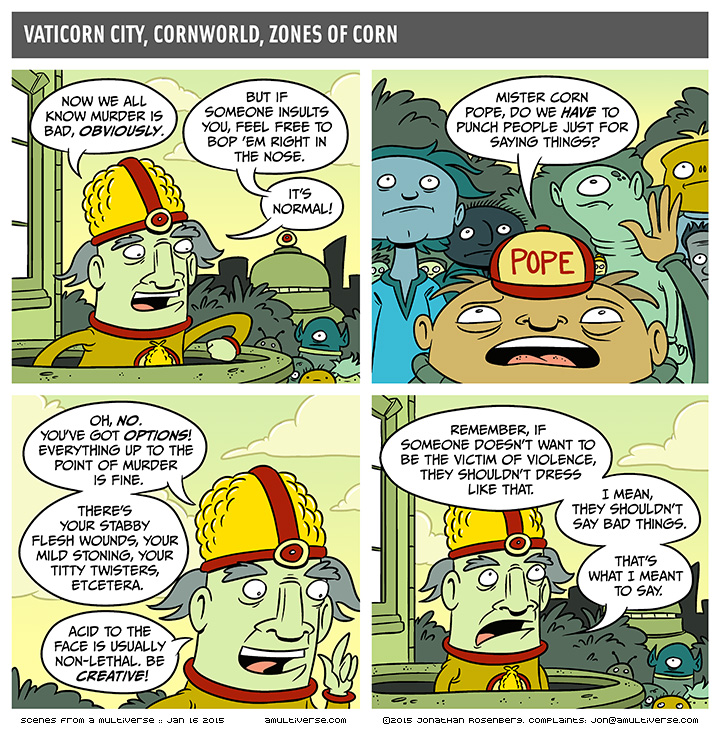
Popes are funny guys! One minute they seem harmless and kind, the next they’re justifying violence as a response to cartoons. You never know which pope you’re gonna get! They should package them in blind boxes.
If you’re seeing this message, you’re visiting our new server. Hooray!
![kaGh5_patreon_name_and_message[1]](http://amultiverse.com/wp-content/uploads/2014/10/kaGh5_patreon_name_and_message1-450x198.png)
16 Jan 21:28

Surprise: Sprint Tells FCC That Title II Is Just Fine By Them
by Kate Cox
BewarethewumpusWell, now I know what telco I want to throw my money at.

Ever since the (current) net neutrality fight got started a year ago, the battle lines have been pretty predictable: the companies that sell you access to data don’t really want stronger regulations, and groups that sell things that need you to have access to someone else’s data plan do. But in a surprise move this week, Sprint just broke ranks with the AT&Ts and Verizons of the mobile world to tell the FCC that actually, they’re cool with Title II regulation.
Tech news site GigaOm spotted the filing, a letter from Sprint’s CTO Stephen Bye to FCC chairman Tom Wheeler and the rest of the commission. In stark contrast to the doom and gloom cries from the rest of the industry, Sprint’s letter says that light touch common carrier regulation in the past is what allowed their company to grow and innovate to begin with, and that they will be just fine going forward if the FCC continues that approach.
Specifically, Bye’s letter begins by saying that Sprint “does not believe that a light touch application of Title II, including appropriate forbearance, would harm the continued investment in, and deployment of, mobile broadband services.”
Sprint then references the origins of mobile service pointing out that the first attempt, a licensed duopoly in the early 1990s, was a flop of “slow deployment, high prices and little innovation.” Later regulation, allowing companies including Sprint to enter the mobile market, was more effective.
But, Bye continues, “some net neutrality debaters appear to have forgotten … that this light touch regulatory regime emanated from Title II common carriage regulation.” And yes, they do indeed seem to forget that whenever it’s convenient.
“So long as the FCC continues to allow wireless carriers to manage our networks and differentiate our products,” Sprint concludes, [we] will continue to invest in data networks regardless of whether they are regulated by Title II, Section 706, or some other light touch regulatory regime.”
Verizon and AT&T, the nation’s two biggest wireless companies by far, have both been extremely vocal opponents of any move by the FCC to regulate either wired or mobile broadband services as common carriers — despite admitting that Title II regulation would not actually harm their ability to invest in their network.
In surprise filing, Sprint endorses net neutrality [GigaOm]
16 Jan 18:29

3 Of The Many Times The Big ISPs Have Tried To Have It Both Ways
by Kate Cox

With the prospect of new regulations staring them in the face, big ISPs have been taking every possible opportunity to wail about how doomed they will be if anything changes. But every cable and telecom company that has spent 2014 and 2015 vowing that regulation is the worst thing ever has also spent years benefiting from exactly those regulations. Here are just a few examples.
AT&T: We can’t be sued or regulated
AT&T is currently being sued by the FTC. The gist of the lawsuit is that AT&T promised its unlimited-plan customers that they would, in fact, receive unlimited service, but that the company was misleading subscribers by throttling those customers’ data instead. The FTC is the agency that regulates false and misleading advertising and statements to consumers, so they’re the agency doing the suing.
AT&T, however, says that the FTC doesn’t have standing to sue them. Although the FTC Act says: “The Commission is hereby empowered and directed to prevent persons, partnerships, or corporations … from using unfair methods of competition in or affecting commerce and unfair or deceptive acts or practices in or affecting commerce,” there are several categories of businesses exempted from that mandate. Among those categories are banks, meat packers, and “common carriers subject to the Acts to regulate commerce.”
Telephone services are indeed regulated as common carriers, and communications common carriers are regulated under Title II of the Communications Act — FCC territory. Therefore, argues AT&T, the FCC, not the FTC, is the agency that should look into the matter if even there is a matter to be looked into. “[The FTC] asserts in this lawsuit that AT&T’s imposition of [data throttling] was unfair and that its disclosures were inadequate. But whether AT&T’s network management program is ‘unfair’ and whether its disclosures were ‘inadequate’ are issues for the FCC to decide,” AT&T’s filing says.
However, mobile phone data services are not currently considered common carriers. Like home broadband services, they are considered information services, not communications services, and are not subject to Title II common carrier regulation under the FCC.
Of course, one of the big stories of the last year is that data — both mobile and wired — may well become subject to Title II common carrier regulation in the very near future. The FCC is set to vote on a proposal to reclassify broadband, which may include mobile data, as a common carrier on February 26.
If the FCC does pass the proposal, and if mobile data is included, then AT&T will be correct that the FCC, and not the FTC, has standing to investigate the misleading “unlimited” plans. But AT&T has been arguing strenuously for months that their data services are not and should not be subject to common carrier regulation, and has threatened to sue the FCC if the commission moves forward with reclassification.
AT&T: A common carrier when they want to avoid being sued, and emphatically not a common carrier when they want to do the suing.
Verizon: We oppose and love Title II
Verizon: with AT&T, another one of Schrödinger’s common carriers. They, perhaps more than any other of the big ISPs, really hate it when the FCC tries to regulate them.
Verizon is the company that filed the suit that got net neutrality thrown out last year. Verizon was then the first company to threaten legal action again if any part of the new net neutrality proposal involves Title II classification or otherwise displeases them. Whenever there’s a chance for them to say how much they hate regulation, they take full advantage of it.
And all this time, while treating potential Title II status as the end of the world, Verizon has benefited enormously from the public assistance available to telecommunications common carriers, in order to install their wires.
Verizon relies very heavily on a technicality: while the FiOS service you subscribe to that lets you search Google and stream Netflix and upload cat videos is a Title I information service, the actual fiber cables they run under your lawn to plug you in to FiOS are regulated under Title II just like century-old copper phone wires.
A report released in late May looked at how Verizon’s FiOS rollout in New York and New Jersey relies heavily on being able to have it both ways. “It appears this was done for two reasons,” the report concludes. “It gets all of the powers of the utility, including the rights-of-way that are part of the telecommunications utility service, but it also may charge the copper-based POTS [plain old telephone service] utility customers for the development and deployment of FiOS.”
In short, Verizon gets to collect tax subsidies, rights-of-way guarantees, and fees from consumers phone bills under Title II utility regulations, but then gets to turn around and insist that they are not common carriers and that they’ll sue anyone who says they are.
Even Verizon’s own shareholders — those who benefit most when the company gets to make more money — are finding the telecom giant’s positions “inconsistent and contradictory” and are “confused by this ambiguity” that Verizon’s oscillating positions take.
Comcast: We’re buying the competition because we have no competition
Comcast doesn’t want internet service to be regulated under Title II any more than Verizon and AT&T do, but compared to their telecom brethren they’ve been moderately more circumspect with their objections. That’s because they have plenty of other things to be two-faced about, as they push hard to be allowed to buy Time Warner Cable.
Comcast’s greatest hypocrisy this year is not around whether their industry should be regulated as a common carrier or not, but rather around the entire nature and history of that industry.
The biggest claim? Comcast’s oft-repeated mantra that since they and Time Warner Cable do not have any geographic overlap, they are not in competition and therefore should be allowed to merge.
It’s true: there is no geographic overlap. But it’s not due to some fortunate quirk of gee-golly happenstance, as Comcast execs have enjoyed pretending: it was an entirely deliberate move on the part of Comcast and its smaller predecessors.
Back in March, Comcast chief executive Brian Roberts lamented to the New York Times that cable “is a relic of an antiquated model,” and that — oh, too bad, so sad — Comcast never had a chance to go compete in major Time Warner Cable towns like New York and Los Angeles.
But of course they didn’t. Cable has been a system of competition-free local monopolies entirely by design, and extreme industry consolidation has left only a very few players remaining.
The lack of geographic competition is disastrous for consumers, but for Comcast it’s absolutely a feature, not a bug. If consumers actually had any real choices, they wouldn’t be trapped in customer service nightmares or voluntarily putting up with the worst-rated companies in America.
16 Jan 18:02
The Creator Of Hotline Miami 2 To Australians: "Just Pirate It"
by Mark Serrels

In an email screencapped by a reddit user, Jonatan Söderströmm, co-creator of Hotline Miami, has told Australians that if they want to play the recently banned Hotline Miami 2 they should "just pirate it".
"If it ends up not being released in Australia," he wrote, "just pirate it after release."
"No need to send us any money, just enjoy the game!"
The email was confirmed as legitimate by Polygon's Ben Kuchera. Ars Technica also confirmed that the email was real with Devolver representatives.
Devolver currently has no plans to challenge the Classification Board's ruling on Hotline Miami 2, despite claiming that the Board was wrong to refuse the game classification. As per Devolver's official statement: "[W]e are concerned and disappointed that a board of professionals tasked with evaluating and judging games fairly and honestly would stretch the facts to such a degree and issue a report that describes specific thrusting actions that are not simply present in the sequence in question and incorrectly portrays what was presented to them for review."
At this stage it is looking unlikely that Hotline Miami 2 will be officially released in Australia.
This post originally appeared on Kotaku Australia , where Mark Serrels is the Editor. You can follow him on Twitter if you're into that sort of thing.
Recommended article: Chomsky: We Are All – Fill in the Blank.
This entry passed through the Full-Text RSS service - if this is your content and you're reading it on someone else's site, please read the FAQ at fivefilters.org/content-only/faq.php#publishers.
16 Jan 03:39
'Swatter' Gets Five Years Jailtime
by Luke Plunkett

Jason Allen Neff, who last year pleaded guilty to a variety of crimes related to his role in a group who thought "swatting" was a fun time, has this month been sentenced for his crimes. He'll be spending five years in a federal prison.
Neff was arrested back in 2011 (for crimes dating back a few years earlier), and has been in custody ever since. He was part of a group, along with six others, who spent years manipulating caller ID tech to call in swatting hoaxes. The other members were all arrested and sentenced between 2008-09.
CBSDFW reports that Neff - suspected of having been an online troublemaker since the 1990s - will also have to pay $79,440 in restitution.
Recommended article: Chomsky: We Are All – Fill in the Blank.
This entry passed through the Full-Text RSS service - if this is your content and you're reading it on someone else's site, please read the FAQ at fivefilters.org/content-only/faq.php#publishers.
Bewarethewumpus likes this
15 Jan 22:23


NSA official: Support of backdoored Dual_EC_DRBG was “regrettable”
by Dan Goodin
It was a mistake for the National Security Agency to support a critical cryptographic function after researchers presented evidence that it contained a fatal flaw that could be exploited by US intelligence agents, the agency's research director said.
The comments by NSA Director of Research Michael Wertheimer were included in an article headlined The Mathematics Community and the NSA published this week in a publication called Notices. The article responds to blistering criticism from some mathematicians, civil liberties advocates, and security professionals following documents provided by former NSA subcontractor Edward Snowden showing that the agency deliberately tried to subvert widely used crypto standards. One of those standards, according to The New York Times, was a random number generator known as Dual EC_DRBG, which was later revealed to be the default method for generating crucial random numbers in the BSAFE crypto toolkit developed by EMC-owned security firm RSA.
NSA officials shepherded Dual EC_DRBG through the National Institute of Standards and Technology (NIST) in 2006. A year later, researchers from Microsoft presented evidence that the number generator contained a type of backdoor known to cryptographers as a "trap door." The weakness, the researchers said, allowed those who knew the specific NSA-generated points on the standard's elliptic curve to work backward to guess any crypto key created by the generator. Despite widespread coverage of the research and concern expressed by security experts, the NSA continued to support Dual EC_DRBG. It wasn't until September 2013—six years after the research came to light—that RSA advised customers to stop using the NSA-influenced code. Last year, NIST also advised against its use.
Read 8 remaining paragraphs | Comments
15 Jan 19:59
 Of the many jokes, riffs and bits about the annoying kinds of people you’re likely to meet on a flight, the team at the Consumerist is having a tough time going along with a sketch on last night’s Jimmy Kimmel Live. See, that’s because the actor playing all the obnoxious types of passengers just happens to be Sir Patrick Stewart, he of the voice that could melt butter or freeze water into ice.

100% Of Consumerist Staff Would Forgive Sir Patrick Stewart For Eating Tuna On A Plane
by Mary Beth Quirk

Noooooo, SPS don’t doooo it!!! (Jimmy Kimmel Live on YouTube)
Honestly, we could only be so lucky to have SPS on our flight, even if he was going to be the “Chatty Charlie” (with that voice? Chat away!), “The Seat Climber” (yes, please) or “The Landing Clapper” (love the timbre of your laugh).
In fact, a non-scientific survey of the Consumerist team just now found 100% of us would even forgive SPS for being the kind of “Stinky Snacker” who would eat a day-old tuna sub on a plane full of people — some only if you absolutely had to otherwise something terrible might happen to SPS.
Expressing sentiments such as “If he would die or become very ill from tuna deficiency, I would forgive him”; “Sir Patrick Stewart smells like science and christmas. But yes. If he had to”; “Absolutely, as long as he wasn’t chewing with his mouth open,”; and “Yes, because he’s Sir Patrick/He would have to recite Shakespeare at me the whole time to earn my forgiveness, but still,” we can confidently say that we’d very likely tolerate even that most heinous of passenger-on-passenger crimes, given the right set of twinkling eyes and a sparkling British accent to match.
I know I just asked you all about eating ants, but I’m full of questions today:
John Drury likes this
15 Jan 18:15
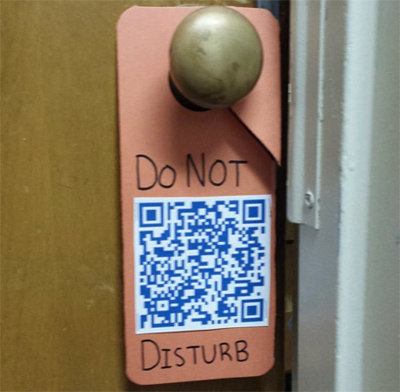
The Modern Version of "Sock on the Doorknob"
by Brad
Scan the QR code depicted in the image or click through to find out what it leads to.
15 Jan 17:57
Chinese Show's Imitation Of Adventure Time Is Actually Pretty OK
by Chris Person

I firmly believe that Adventure Time is a good thing. So what do I think of this Chinese short that looks a hell of a lot like Adventure Time? Well, that it's pretty damn cool.
The name of the short above is The Legend of Lucky Pie, and I'll be damned if it isn't pretty solid. The animation is a bit rough compared to Adventure Time, but considering that animation is a grueling, thankless job, I think they did alright.
According to a Wendy Zhao over at Cartoon Brew:
The Lucky Pie short is currently one episode long, debuted around January 1, produced by what seems like just a team of enthusiastic animation friends (there's a photo of them here). In these posts introducing the show, they talk about how even though they have no funding and no fancy computers or studio setup, they are determined to make this show and fight the 'tacky' and 'trite' animated shows usually shown in Chinese media.
Here is a thread in Chinese that raises the question, "What do people think about claims of this show ripping off Adventure Time?" and answering it along the lines of, "Kind of, but not really."
You know what? Good for them. The short is really fun, it seems like the people behind it trying to do something cool, and I'd definitely watch more. I mean, just check out this hella sweet party these sea creatures are having.


via Cartoon Brew
To contact the author of this post, write to chrisperson@kotaku.com or find him on Twitter at @papapishu.
Recommended article: Chomsky: We Are All – Fill in the Blank.
This entry passed through the Full-Text RSS service - if this is your content and you're reading it on someone else's site, please read the FAQ at fivefilters.org/content-only/faq.php#publishers.
15 Jan 06:54

Elite: Dangerous - Space Truckin'
by Ben "Yahtzee" Croshaw
This week, Zero Punctuation reviews Elite: Dangerous.
14 Jan 16:59


Politically Incorrect
by jon
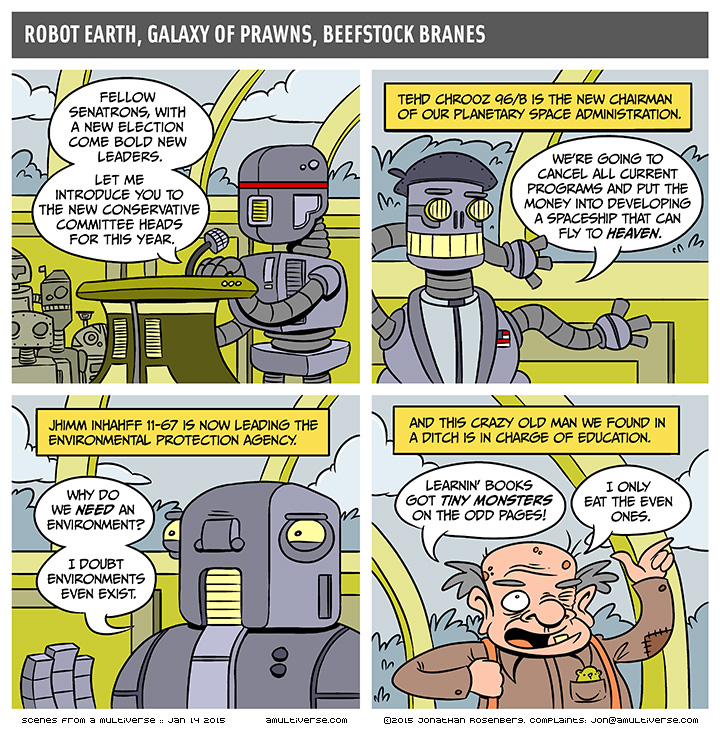
Conservatives like to complain that government is inefficient compared to the private sector, and they do everything they can to ensure it.
![goat-bunny-polo[1]](http://amultiverse.com/wp-content/uploads/2014/03/goat-bunny-polo1-450x304.jpg)
14 Jan 06:33
Japanese Maids Sure Make Frying Pans Exciting
by Brian Ashcraft

Then again, I've never really thought that seriously about frying pans.
One hundred Japanese maids show off these non-stick cooking pans in this Direct Teleshop spot.
That's a lot of maids. And a lot of frying pans.
To contact the author of this post, write to bashcraftATkotaku.com or find him on Twitter @Brian_Ashcraft.
Kotaku East is your slice of Asian internet culture, bringing you the latest talking points from Japan, Korea, China and beyond. Tune in every morning from 4am to 8am.
Recommended article: Chomsky: We Are All – Fill in the Blank.
This entry passed through the Full-Text RSS service - if this is your content and you're reading it on someone else's site, please read the FAQ at fivefilters.org/content-only/faq.php#publishers.
Cooper Griggs likes this
13 Jan 21:48

Pro-ISP Bill To Block FCC From Using Title II For Internet Introduced In Congress
by Kate Cox
 Lawmakers have been happy to opine about the net neutrality fight since the old rule got tossed out a year ago. Now that the FCC is not only set to vote on a new proposal next month, but also likely to take the Title II approach in that proposal, the window is closing for Congress to act, and lawmakers are feeling the urgency. And that is how we find ourselves once again with a bill on the floor seeking to remove the FCC’s authority to classify broadband how it sees fit.
The bill in question, HR 279, doesn’t so much have a catchy name as a lengthy descriptor: “To amend the Communications Act of 1934 to limit the authority of the Federal Communications Commission over providers of broadband Internet access service.”
The bill seeks to do exactly what it says: it would forbid the FCC from classifying broadband services as telecommunications services, which are regulated under Title II of the Communications Act, and would instead force internet services to remain classified as they currently are, as information services.
The difference between the FCC’s regulatory scope over information and telecommunications is basically where the whole mess began. If the FCC moves to reclassify broadband services as communications, and not as information, then broadband services can be regulated under Title II of the law and can be made subject to the same non-discrimination, common carrier regulations as other utilities.
Rep. Bob Latta of Ohio introduced the bill, which is co-sponsored by Reps. Walter Jones (NC), Charlie Rangel (NY), and Randy Weber (TX). In a press release, Latta hailed the bill as “bipartisan legislation to ensure the internet remains open and free” before repeating the ISPs talking points about Title II being anachronistic 20th century “monopoly-era telephone rules” that would stifle innovation, dynamism, and progress.
As Ars Technica and others have pointed out, Rep. Latta has received a significant amount of campaign funding from the major ISPs and their trade (lobbying) groups. In the leadup to the 2014 election, that included $15,000 from the NCTA, $13,000 from AT&T, $10,000 from Time Warner Cable, $8500 from Comcast, and $8000 from Verizon, among others.
This is the second time Latta has put forth this proposed amendment to the Communications Act. The previous version went to Committee in May, 2014 and was never heard from again. At the time, the FCC was not leaning toward the Title II approach and there were months yet to go in the proceeding’s pleading process, so lawmakers focused their attention on other things.
However, Congressional interest in net neutrality and the FCC surged around the holidays, after President Obama very publicly called for the Title II approach. The response was instant, political, and predictable, with a tidal wave of mostly-Republican Representatives and Senators showing up to oppose the move.
With the new Congress sworn in and an actual date for the vote on the FCC’s calendar, it’s now-or-never for the opposition. Wheeler will be circulating the new proposal among the other commissioners’ offices on February 5, and the FCC is scheduled to vote on it on February 26.
13 Jan 21:44
 Last week, it was revealed that a Comcast office in the power epicenter that is the D.C. suburbs maintained a “VIP” list of local politicians, business leaders, and other bigwigs. However, Comcast claims that in spite of the VIP label, these folks received no special treatment. Not so, multiple sources tell Consumerist.

Sources: Comcast “VIPs” Automatically Pushed To Front Of Phone Queue
by Chris Morran

(jorn)
One source worked for a company contracted by Comcast to maintain its automatic call distributor (ACD) system, which routes customer phone calls as they come in. This person says that the Comcast system was set up so that when one of the people on the VIP list called in, it would identify them by their phone number and jump them to the front of the line.
“My understanding was they were not told they were receiving preferential treatment,” says the source, “so in my opinion Comcast was deceiving them into thinking the service was better than it actually was.”
This particular person stopped working on the Comcast system several years ago and acknowledges that — at least when he was there — Comcast phone operations could vary greatly from site to site so it’s possible this was just a localized program to the Montgomery County, MD, area.
Another source — a former Comcast frontline support employee who worked with the company more recently — independently confirms what the first person told us.
This person tells Consumerist that during their years in the Maryland office that VIP calls — which also included local pro athletes and customers with substantial monthly bills who paid regularly — were indeed automatically pushed to the front of the queue.
They say there were situations where the system wouldn’t identify VIP callers correctly because they called from a phone that was not associated with the account.
But once the account was looked up, “we could see that status on their account and escalated them to the Platinum group,” says the source, who claims that frontline support people were never given the “We’ll make it right” cards that Comcast supposedly hands out to all employees.
When Consumerist asked Comcast to comment on the sources’ statements that VIPs were pushed to the front of the caller line, a rep for the cable giant would only repeat the statement originally given regarding the VIP list: “Comcast does not and has not offered special service, perks or free upgrades to lawmakers or public officials. Comcast does not and has not operated a dedicated VIP phone number or Web site in any market including the Beltway region.”
Flounder52 likes this
13 Jan 20:31
Legendary Secret Nintendo Song Found In Mario Kart 8
by Yannick LeJacq
The easter egg to end all Nintendo easter eggs has just been unearthed in Mario Kart 8. As the know-everythings at GameXplain demonstrate in a video published today, it turns out Yoshi was humming it all along—he was just being drowned out by the track's music. If only we'd all listened to Yoshi better from the start!
The secret in question is known as "Totaka's Song." It's a short (as in, 19 notes) musical refrain written by Nintendo composer Kazumi Totaka for a 1992 Game Boy game known as X. Since it first appeared there, it's evolved into "one of the sweetest hidden treats in all of gaming," as Luke put it back in 2011.
See, Totaka didn't leave the tune to rest in 1992. Instead, he kept finding increasingly clever ways to hide the music in his later work. From Luke's article:
On his next game, Mario Paint, Totaka used the tune again, this time as the intro music. And would go on to use it again, and again, and again, hiding it in nearly every game he composed music for, sometimes out in the open, other times tucking it away where it was almost impossible to find. It would become known as "Totaka's Song".
You can find it in the closing credits of Wario Land for the Vitual Boy. You can find it during a control screen briefing for Luigi's Mansion for the GameCube. You can find it twice in Link's Awakening on the Game Boy. You can even find it in X-Scape, the sequel to X, the first game he ever provided music for.
My favourite use of the song, though, comes in the Animal Crossing series. If you ask laid-back guitar-playing dog K. K. Slider to play you the "K.K. Song", he'll not only break out into Totaka's Song, but will give you a copy you can play in your little Animal Crossing house when you get home as well.
It's even likely that the character of K.K. Slider himself, one of the most popular from the series, is based on Totaka, as in Japanese he's called Totakeke (とたけけ), a name that not only sounds like the composer's name, but is one Totaka's used before (to hear a version of Totaka's Song in the Japanese edition of Link's Awakening, for example, you need to enter your name as "とたけけ").
Not every game he's worked on features the song, though. Nobody has been able to find the ditty in Wave Race 64, Wii Sports, Wii Music, Healthy Recipe Assistant 1000: DS Menu Anthology, Super Smash Bros. Brawl or the Wii's menu channel music.
Kudos to GameXplain for finding it anew in Mario Kart 8, buried as it was in one of the last places you'd look. I love trying to imagine how they first came across it—was it at some choice moment when one of them ran into the side of the track when racing on Yoshi Valley? What are the odds that you'd forget your Mario Kart rage long enough to think: "Hey, wait a second...that Blue Yoshi over there was trying to tell me something?"
Let this be a lesson to all of us: Yoshi is more than adorable face. He can also be a source of adorable secrets.
To contact the author of this post, write to yannick.lejacq@kotaku.com or find him on Twitter at @YannickLeJacq.
Recommended article: Chomsky: We Are All – Fill in the Blank.
This entry passed through the Full-Text RSS service - if this is your content and you're reading it on someone else's site, please read the FAQ at fivefilters.org/content-only/faq.php#publishers.
13 Jan 20:19
Let The Internet Create The Ultimate D&D Character
by Luke Plunkett

If you find that creating your role-playing character's backstory a little rough (thanks to your sense of imagination being dulled to a smooth sheen), the internet — as always — is here to help.
Who The Fuck Is My D&D Character is a generator (via Super Punch) made by Ryan J Grant that will do as advertised. Click a button and you'll get a complete backstory. Race, origin, background. If you're not happy with it, click it again, and again, until you get something like this.

Or this.

Or this.

You may not be the most dangerous character in the game, or the most helpful, but at least you'll be the most interesting.
Recommended article: Chomsky: We Are All – Fill in the Blank.
This entry passed through the Full-Text RSS service - if this is your content and you're reading it on someone else's site, please read the FAQ at fivefilters.org/content-only/faq.php#publishers.
13 Jan 05:04

When Bae Says She's Home Alone
by Brad
Upon getting an unexpected phone call from his bae while swimming in a lake, Viner Logan Paul promptly makes the right move when he hears that she’s “home alone.”
13 Jan 00:46
Destiny's Most Hated Gun Can Be Deadly In The Right Hands
by Patricia Hernandez
BewarethewumpusI haven't played Destiny, but that looks a lot like the times back in the day when I would use a .357 and suit zoom to headshot guys in HL2 deathmatch, especially on the sniper levels.
So many unlikely kills, so many good times.
No Land Beyond's bad rap with Destiny players seems to be motivating some people to prove everyone wrong about the gun. First, we had the person who soloed the latest raid with the gun. And now we have a montage of someone straight up owning other players in the Crucible with the alleged worst gun in the game. Maybe the gun isn't as bad as people think it is?
I'm impressed by The Legend Himself's montage—it proves that, in the end, skill can overcome nearly anything. Honestly, the video almost makes it seem as if No Land Beyond can be a beast gun, provided you have good aim...but that might just be editing working its magic on me.
The No Land Beyondtage [The Legend Himself]
Recommended article: Chomsky: We Are All – Fill in the Blank.
This entry passed through the Full-Text RSS service - if this is your content and you're reading it on someone else's site, please read the FAQ at fivefilters.org/content-only/faq.php#publishers.
13 Jan 00:40
 ';document.write(div);if(typeof context.___fm_zone_tag.loaded!=="boolean"){context.___fm_zone_tag.loaded=false;tag=context.document.createElement('script');tag.type='text/javascript';tag.src=settings.protocol+"//"+settings.static_domain+'lib/dfp-lib.js';tag.async=true;scripts=context.document.getElementsByTagName("script");scripts[0].parentNode.insertBefore(tag,scripts[0]);}
context.___fm_zone_tag.queue.push(settings);}());
$(document).ready(function(){
convosuiteLabeling();
setTimeout('convosuiteLabeling();', 3000);
});
};
';document.write(div);if(typeof context.___fm_zone_tag.loaded!=="boolean"){context.___fm_zone_tag.loaded=false;tag=context.document.createElement('script');tag.type='text/javascript';tag.src=settings.protocol+"//"+settings.static_domain+'lib/dfp-lib.js';tag.async=true;scripts=context.document.getElementsByTagName("script");scripts[0].parentNode.insertBefore(tag,scripts[0]);}
context.___fm_zone_tag.queue.push(settings);}());
$(document).ready(function(){
convosuiteLabeling();
setTimeout('convosuiteLabeling();', 3000);
});
};
Paris #JeSuisCharlie protest crowd reacts to John Lennon's 'Imagine'
by Xeni Jardin
"I live in Paris, next to the center of the march. Yesterday, we put music on our window, especially peace songs. Watch as the crowd sings along and then applauds for Imagine by John Lennon." (Reddit, via youtube.com)
Read more at Boing Boing
Recommended article: Chomsky: We Are All – Fill in the Blank.
This entry passed through the Full-Text RSS service - if this is your content and you're reading it on someone else's site, please read the FAQ at fivefilters.org/content-only/faq.php#publishers.
Bewarethewumpus likes this


