Shared posts

18 Jul 20:58

Along It Came

by submission

Author : Jake Teeny

When the first signs of alien life came, no one, of course, believed them. It took nearly every scientist from nearly every science to confirm that it was true:

Another form of life, on a planet other than our own was speaking to us.

Certainly there were doubters, as there are regardless of unanimity. But for the majority who believed that it was true, myriads of emotions shifted through them.

Rejoice. We are not alone!

Our God would not allow…

What does this mean for my children’s children?

The top analysts in cryptography from all across the world assembled to decipher the message, and with quiet breath, the world waited.

Every pundit with a camera had his or her most rational prediction. Water cooler chitchat. Late night whispers.

And then, one day, it happened.

At first, we only knew that there was some kind of disagreement between the code-breakers. A division. Seventy-two hours of heated debate.

But on a solemn day in late September, the lead analyst on the team held a press conference:
A warning. The message we had intercepted was a warning.

The extraterrestrial language had proved much more complex than ever possibly conceived. But as they augmented their understanding, an onyx message emerged:
They came for us. They’ll come for you.

The words that set fire to the globe as terror—seized—the world.

But after the shock, quick came denial. Surely they’d just read it wrong. Science’s made mistakes before. But as more of the alien tongue was unraveled, the certainty only cemented:
They came for us. They’ll come for you.

Within months, there wasn’t a news station talking about the amassing of weaponry. And as the ballooning power of nations was made aware, a subtle tension of wild destruction ensued.

One snap of a twig, and the world could crumble.

But humanity’s most superordinate category is human, and together, peace passed between brothers and sisters. The world.

It was one.

In unity, we waited. And waited. The communion between people did not falter, but the fear, admittedly, became less acute. And we waited. And waited. And waited. It seemed pointless to have all the weaponry divided, when we only had one foe. And we waited. In a single, world-shared bunker, all of humans’ capabilities for violence were harbored. And we waited. And waited.

And waited.

There came a time, when people tell stories of how there had once been a thing such as passports and wars. For left with only that single message from the aliens, we inevitably began to think, Well, now what?

To this day, there is speculation as to whether the intercepted message was the most elaborate scheme in human history. Fabricate a binding enemy, unite the disparate clans. And to this day, the scientists heartily deny it.

All the data’s there. Go and have a look right for yourself.

But even if you question, even if you doubt, the world’s a better place no matter how it turned out.

Discuss the Future: The 365 Tomorrows Forums
The 365 Tomorrows Free Podcast: Voices of Tomorrow
This is your future: Submit your stories to 365 Tomorrows

16 Jul 03:02

Woke Up, Fell Out Of Bed

by submission

Author : Gray Blix

He awoke to a darkness reverberating with car crash sounds from the street below, a helicopter’s whomp-whomp-whomp overhead, and screams of injured and frightened people radiating from the flats around him to the neighborhood beyond. Was Liverpool under attack? Attempting to get out of bed, he lurched dizzily and fell on his face. A deafening boom followed by a fireball that lit up the room sent him scrambling under the bed, where he cowered. His cell phone rang and he reached up and grabbed it off the bedside table.

“Paul, it’s Layla and I’m under the covers and I’m so woozy I can’t even lift my head and it sounds like a war going on outside. What’s happening?”

“Dunno. But if it’s happening to you in Old Swan and me in Allerton, then it’s something big, maybe all of Merseyside, maybe…”

“Maybe it’s a temporary phenomenon,” said the Prime Minister, hopefully, head on his desk, speaking into a secure line at 10 Downing Street.”

“And maybe it’s the end of the world as we know it,” said the President, flat on his back in bed as Air Force One flew high over the Pacific.

“Let’s not jump to conclusions. Fortunately, I’ve got a can of Vimto and a bag of Wotsits here to feast on, so all is well.”

“I have no idea what that is, but you’d better enjoy it. It may be your last meal.”

Suddenly serious, “When did you last talk to your pilot?”

“A few minutes ago. He and the co-pilot are slumped in their seats. Can’t hold their heads up long enough to fly this thing. It’s automatic pilot to the mainland. It could land itself if there were an airport without planes and debris blocking the runway. Haven’t found one.”

Lennie made his way through Wichita neighborhoods of tangled wreckage and burning structures, ignoring distractions as he’d been taught. A dog was biting the face of a man sprawled on the sidewalk, but that woman who talks to herself chased it away and started taking the man’s clothes off and tossing them into her shopping cart.

“Not supposed to do that,” Lennie said under his breath. “Not supposed to do that.”

Most of the morning crew was standing by the front door of the thrift shop. Dorothy had put her clothes on backwards again. George would have to send her to the bathroom with one of the other girls to fix that. Lennie’s watch, digital because he couldn’t read analog, said 9:03. George always unlocked the door at precisely 9:00. Something was wrong. He pushed aside the others and saw George lying face down just inside the door.

“Wake up, George. Please can we come in?” he said. “Wake up, George. Please can we come in?”

A conference call participant summarized, “So, you’re telling us the Sun’s orbit around the galaxy is taking it and the rest of the solar system through an interstellar cloud of cosmic dust and gas, and that’s why I have fallen and I can’t get up?”

“Yeah, that’s my theory. But I’m going to have a tough time proving it crawling around the floor of my lab.”

“We are so screwed. We’re gonna die right where we are, clutching cell phones…”

“Shut up all of you with that negative crap! We’re scientists. We’ve got enough collective intelligence to think our way out of this.”

“No, it’s just the opposite. Intelligence is the problem. I can see my neighbor’s retarded boy running around the yard like he always…”

“Don’t call him ‘retarded.'”

“Right. We should call him ‘King of the World.'”

Discuss the Future: The 365 Tomorrows Forums
The 365 Tomorrows Free Podcast: Voices of Tomorrow
This is your future: Submit your stories to 365 Tomorrows

06 Jul 04:16

Who Doesn't Like Pickles

school,burger,idiots,funny

Submitted by: Unknown

Tagged: school , burger , idiots , funny
05 Jul 16:10

EU plans to destroy net neutrality by allowing Internet fast lanes

by Glyn Moody

A two-tier Internet will be created in Europe as the result of a late-night "compromise" between the European Commission, European Parliament and the EU Council. The so-called "trilogue" meeting to reconcile the different positions of the three main EU institutions saw telecom companies gaining the right to offer "specialised services" on the Internet. These premium services will create a fast lane on the Internet and thus destroy net neutrality, which requires that equivalent traffic is treated in the same way.

In a fact sheet on the agreement, the European Commission tries to hide the reality that net neutrality is being destroyed by defining something called the open Internet : "Under today's agreement, paid prioritisation in the open Internet will be banned. Based on this new legislation, all content and application providers will have guaranteed access to end-users in the open Internet. This access should not be dependent on the will or particular commercial interest of Internet service providers."

But running alongside this "open Internet," on the same network, there will be "specialised services," which are not open and where paid prioritisation is permitted: "The new EU net neutrality rules guarantee the open Internet and enable the provision of specialised or innovative services on condition that they do not harm the open Internet access." The caveat is vague, and in practice will not prevent "specialised services" competing with those offered on the "open Internet"—the Commission mentions "internet TV" as an example of a specialised service—so large companies will be able to offer premium services at attractive prices, which startups with limited resources will find hard to match.

Read 7 remaining paragraphs | Comments

05 Jul 15:21

Obama Could Fix Dark Money, But Would Rather Just Yell at Republicans About It

by Jon Schwarz

President Obama has been denouncing “dark money” since 2010, when he declared it “a threat to our democracy.” And he’s right to be concerned: Dark money — in the form of donations to politically active nonprofit organizations that do not have to disclose their donors — now amounts to hundreds of millions of dollars each election.

If he actually wanted to do something about it, he could — without any involvement by Congress. He could issue an executive order requiring corporations that do business with the federal government to disclose their dark money contributions and those by their top executives.

But last week, as 104 congresspeople and 26 senators urged him to do that, he used his spokesperson Eric Schultz to wave them off. “We believe Republicans should be taking steps to fix the campaign finance system, not trying to protect their ability to accept dark money,” Schultz said.

It’s hard to disagree with that. But it would be just as hard to disagree if a Republican spokesperson said, “We believe the Democratic president should be taking steps to fix the campaign finance system, not trying to protect his party’s ability to accept dark money.”

The federal government buys about $500 billion in goods and services every year, and most of the biggest U.S. corporations get chunks of that money and would hate to give it up. Obama used this leverage twice in 2014, first requiring federal contractors to pay their workers at least $10.10 per hour, and then forbidding contractors from discriminating on the basis of sexual orientation or gender identity.

A new executive order on disclosure of political contributions would make a significant difference. According to a study by Public Citizen, 11 of the top 15 recipients of federal cash (including number one, Lockheed Martin) don’t fully disclose possible dark money contributions.

This past March, 50 organizations, including AFSCME, MoveOn, the NAACP and the Sierra Club, asked Obama to issue an executive order. Then in April the signatures of 550,000 people with the same request were delivered to the White House.

There’s no question that the GOP is scared of this. House Republicans tucked a provision that would protect corporations from disclosure into a spending bill — in fact, that’s what prompted Schultz’s comment.

And corporate America despises the idea. When the Obama administration floated issuing a dark money executive order in 2011, the top Chamber of Commerce lobbyist said: “We will fight it through all available means … all options are on the table.”

At that point Obama courageously gave up, and has continued giving up until today. But Republicans do still face the very real danger that his spokesperson will say mildly disapproving things about them.

Read also:

Photo: Yuri Gripas/Getty

(This post is from our blog: Unofficial Sources.)

The post Obama Could Fix Dark Money, But Would Rather Just Yell at Republicans About It appeared first on The Intercept.

05 Jul 15:10

XKEYSCORE: NSA’s Google for the World’s Private Communications

by Morgan Marquis-Boire

Illustrations by Blue Delliquanti and David Axe for The Intercept

One of the National Security Agency’s most powerful tools of mass surveillance makes tracking someone’s Internet usage as easy as entering an email address, and provides no built-in technology to prevent abuse. Today, The Intercept is publishing 48 top-secret and other classified documents about XKEYSCORE dated up to 2013, which shed new light on the breadth, depth and functionality of this critical spy system — one of the largest releases yet of documents provided by NSA whistleblower Edward Snowden.

The NSA’s XKEYSCORE program, first revealed by The Guardian, sweeps up countless people’s Internet searches, emails, documents, usernames and passwords, and other private communications. XKEYSCORE is fed a constant flow of Internet traffic from fiber optic cables that make up the backbone of the world’s communication network, among other sources, for processing. As of 2008, the surveillance system boasted approximately 150 field sites in the United States, Mexico, Brazil, United Kingdom, Spain, Russia, Nigeria, Somalia, Pakistan, Japan, Australia, as well as many other countries, consisting of over 700 servers.

These servers store “full-take data” at the collection sites — meaning that they captured all of the traffic collected — and, as of 2009, stored content for 3 to 5 days and metadata for 30 to 45 days. NSA documents indicate that tens of billions of records are stored in its database. “It is a fully distributed processing and query system that runs on machines around the world,” an NSA briefing on XKEYSCORE says. “At field sites, XKEYSCORE can run on multiple computers that gives it the ability to scale in both processing power and storage.”

XKEYSCORE also collects and processes Internet traffic from Americans, though NSA analysts are taught to avoid querying the system in ways that might result in spying on U.S. data. Experts and privacy activists, however, have long doubted that such exclusions are effective in preventing large amounts of American data from being swept up. One document The Intercept is publishing today suggests that FISA warrants have authorized “full-take” collection of traffic from at least some U.S. web forums.

The system is not limited to collecting web traffic. The 2013 document, “VoIP Configuration and Forwarding Read Me,” details how to forward VoIP data from XKEYSCORE into NUCLEON, NSA’s repository for voice intercepts, facsimile, video and “pre-released transcription.” At the time, it supported more than 8,000 users globally and was made up of 75 servers absorbing 700,000 voice, fax, video and tag files per day.

The reach and potency of XKEYSCORE as a surveillance instrument is astonishing. The Guardian report noted that NSA itself refers to the program as its “widest reaching” system. In February of this year, The Intercept reported that NSA and GCHQ hacked into the internal network of Gemalto, the world’s largest provider of cell phone SIM cards, in order to steal millions of encryption keys used to protect the privacy of cell phone communication. XKEYSCORE played a vital role in the spies’ hacking by providing government hackers access to the email accounts of Gemalto employees.

Numerous key NSA partners, including Canada, New Zealand and the U.K., have access to the mass surveillance databases of XKEYSCORE. In March, the New Zealand Herald, in partnership with The Intercept, revealed that the New Zealand government used XKEYSCORE to spy on candidates for the position of World Trade Organization director general and also members of the Solomon Islands government.

These newly published documents demonstrate that collected communications not only include emails, chats and web-browsing traffic, but also pictures, documents, voice calls, webcam photos, web searches, advertising analytics traffic, social media traffic, botnet traffic, logged keystrokes, computer network exploitation (CNE) targeting, intercepted username and password pairs, file uploads to online services, Skype sessions and more.

Bulk collection and population surveillance

XKEYSCORE allows for incredibly broad surveillance of people based on perceived patterns of suspicious behavior. It is possible, for instance, to query the system to show the activities of people based on their location, nationality and websites visited. For instance, one slide displays the search “germansinpakistn,” showing an analyst querying XKEYSCORE for all individuals in Pakistan visiting specific German language message boards.

As sites like Twitter and Facebook become increasingly significant in the world’s day-to-day communications (a Pew study shows that 71 percent of online adults in the U.S. use Facebook), they become a critical source of surveillance data. Traffic from popular social media sites is described as “a great starting point” for tracking individuals, according to an XKEYSCORE presentation titled “Tracking Targets on Online Social Networks.”

When intelligence agencies collect massive amounts of Internet traffic all over the world, they face the challenge of making sense of that data. The vast quantities collected make it difficult to connect the stored traffic to specific individuals.

Internet companies have also encountered this problem and have solved it by tracking their users with identifiers that are unique to each individual, often in the form of browser cookies. Cookies are small pieces of data that websites store in visitors’ browsers. They are used for a variety of purposes, including authenticating users (cookies make it possible to log in to websites), storing preferences, and uniquely tracking individuals even if they’re using the same IP address as many other people. Websites also embed code used by third-party services to collect analytics or host ads, which also use cookies to track users. According to one slide, “Almost all websites have cookies enabled.”

The NSA’s ability to piggyback off of private companies’ tracking of their own users is a vital instrument that allows the agency to trace the data it collects to individual users. It makes no difference if visitors switch to public Wi-Fi networks or connect to VPNs to change their IP addresses: the tracking cookie will follow them around as long as they are using the same web browser and fail to clear their cookies.

Apps that run on tablets and smartphones also use analytics services that uniquely track users. Almost every time a user sees an advertisement (in an app or in a web browser), the ad network is tracking users in the same way. A secret GCHQ and CSE program called BADASS, which is similar to XKEYSCORE but with a much narrower scope, mines as much valuable information from leaky smartphone apps as possible, including unique tracking identifiers that app developers use to track their own users. In May of this year, CBC, in partnership with The Intercept, revealed that XKEYSCORE was used to track smartphone connections to the app marketplaces run by Samsung and Google. Surveillance agency analysts also use other types of traffic data that gets scooped into XKEYSCORE to track people, such as Windows crash reports.

In a statement to The Intercept, the NSA reiterated its position that such sweeping surveillance capabilities are needed to fight the War on Terror:

“The U.S. Government calls on its intelligence agencies to protect the United States, its citizens, and its allies from a wide array of serious threats. These threats include terrorist plots from al-Qaeda, ISIL, and others; the proliferation of weapons of mass destruction; foreign aggression against the United States and our allies; and international criminal organizations.”

Indeed, one of the specific examples of XKEYSCORE applications given in the documents is spying on Shaykh Atiyatallah, an al Qaeda senior leader and Osama bin Laden confidant. A few years before his death, Atiyatallah did what many people have often done: He googled himself. He searched his various aliases, an associate and the name of his book. As he did so, all of that information was captured by XKEYSCORE.

XKEYSCORE has, however, also been used to spy on non-terrorist targets. The April 18, 2013 issue of the internal NSA publication Special Source Operations Weekly boasts that analysts were successful in using XKEYSCORE to obtain U.N. Secretary General Ban Ki-moon’s talking points prior to a meeting with President Obama.

XKEYSCORE for hacking: easily collecting user names, passwords and much more

XKEYSCORE plays a central role in how the U.S. government and its surveillance allies hack computer networks around the world. One top-secret 2009 NSA document describes how the system is used by the NSA to gather information for the Office of Tailored Access Operations, an NSA division responsible for Computer Network Exploitation (CNE) — i.e., targeted hacking.

Particularly in 2009, the hacking tactics enabled by XKEYSCORE would have yielded significant returns as use of encryption was less widespread than today. Jonathan Brossard, a security researcher and the CEO of Toucan Systems, told The Intercept: “Anyone could be trained to do this in less than one day: they simply enter the name of the server they want to hack into XKEYSCORE, type enter, and are presented login and password pairs to connect to this machine. Done. Finito.” Previous reporting by The Intercept revealed that systems administrators are a popular target of the NSA. “Who better to target than the person that already has the ‘keys to the kingdom?’” read a 2012 post on an internal NSA discussion board.

This system enables analysts to access web mail servers with remarkable ease.

The same methods are used to steal the credentials — user names and passwords — of individual users of message boards.

Hacker forums are also monitored for people selling or using exploits and other hacking tools. While the NSA is clearly monitoring to understand the capabilities developed by its adversaries, it is also monitoring locations where such capabilities can be purchased.

Other information gained via XKEYSCORE facilitates the remote exploitation of target computers. By extracting browser fingerprint and operating system versions from Internet traffic, the system allows analysts to quickly assess the exploitability of a target. Brossard, the security researcher, said that “NSA has built an impressively complete set of automated hacking tools for their analysts to use.”

Given the breadth of information collected by XKEYSCORE, accessing and exploiting a target’s online activity is a matter of a few mouse clicks. Brossard explains: “The amount of work an analyst has to perform to actually break into remote computers over the Internet seems ridiculously reduced — we are talking minutes, if not seconds. Simple. As easy as typing a few words in Google.”

These facts bolster one of Snowden’s most controversial statements, made in his first video interview published by The Guardian on June 9, 2013. “I, sitting at my desk,” said Snowden, could “wiretap anyone, from you or your accountant, to a federal judge to even the president, if I had a personal email.”

Indeed, training documents for XKEYSCORE repeatedly highlight how user-friendly the program is: with just a few clicks, any analyst with access to it can conduct sweeping searches simply by entering a person’s email address, telephone number, name or other identifying data. There is no indication in the documents reviewed that prior approval is needed for specific searches.

In addition to login credentials and other target intelligence, XKEYSCORE collects router configuration information, which it shares with Tailored Access Operations. The office is able to exploit routers and then feed the traffic traveling through those routers into their collection infrastructure. This allows the NSA to spy on traffic from otherwise out-of-reach networks. XKEYSCORE documents reference router configurations, and a document previously published by Der Spiegel shows that “active implants” can be used to “cop[y] traffic and direc[t]” it past a passive collector.

XKEYSCORE for counterintelligence

Beyond enabling the collection, categorization, and querying of metadata and content, XKEYSCORE has also been used to monitor the surveillance and hacking actions of foreign nation states and to gather the fruits of their hacking. The Intercept previously reported that NSA and its allies spy on hackers in order to collect what they collect.

Once the hacking tools and techniques of a foreign entity (for instance, South Korea) are identified, analysts can then extract the country’s espionage targets from XKEYSCORE, and gather information that the foreign power has managed to steal.

Monitoring of foreign state hackers could allow the NSA to gather techniques and tools used by foreign actors, including knowledge of zero-day exploits—software bugs that allow attackers to hack into systems, and that not even the software vendor knows about—and implants. Additionally, by monitoring vulnerability reports sent to vendors such as Kaspersky, the agency could learn when exploits they were actively using need to be retired because they’ve been discovered by a third party.

Seizure v. searching: oversight, audit trail and the Fourth Amendment

By the nature of how it sweeps up information, XKEYSCORE gathers communications of Americans, despite the Fourth Amendment protection against “unreasonable search and seizure” — including searching data without a warrant. The NSA says it does not target U.S. citizens’ communications without a warrant, but acknowledges that it “incidentally” collects and reads some of it without one, minimizing the information that is retained or shared.

But that interpretation of the law is dubious at best.

XKEYSCORE training documents say that the “burden is on user/auditor to comply with USSID-18 or other rules,” apparently including the British Human Rights Act (HRA), which protects the rights of U.K. citizens. U.S. Signals Intelligence Directive 18 (USSID 18) is the American directive that governs “U.S. person minimization.”

Kurt Opsahl, the Electronic Frontier Foundation’s general counsel, describes USSID 18 as “an attempt by the intelligence community to comply with the Fourth Amendment. But it doesn’t come from a court, it comes from the executive.”

If, for instance, an analyst searched XKEYSCORE for all iPhone users, this query would violate USSID 18 due to the inevitable American iPhone users that would be grabbed without a warrant, as the NSA’s own training materials make clear.

Opsahl believes that analysts are not prevented by technical means from making queries that violate USSID 18. “The document discusses whether auditors will be happy or unhappy. This indicates that compliance will be achieved by after-the-fact auditing, not by preventing the search.”

Screenshots of the XKEYSCORE web-based user interface included in slides show that analysts see a prominent warning message: “This system is audited for USSID 18 and Human Rights Act compliance.” When analysts log in to the system, they see a more detailed message warning that “an audit trail has been established and will be searched” in response to HRA complaints, and as part of the USSID 18 and USSID 9 audit process.

Because the XKEYSCORE system does not appear to prevent analysts from making queries that would be in violation of these rules, Opsahl concludes that “there’s a tremendous amount of power being placed in the hands of analysts.” And while those analysts may be subject to audits, “at least in the short term they can still obtain information that they shouldn’t have.”

During a symposium in January 2015 hosted at Harvard University, Edward Snowden, who spoke via video call, said that NSA analysts are “completely free from any meaningful oversight.” Speaking about the people who audit NSA systems like XKEYSCORE for USSID 18 compliance, he said, “The majority of the people who are doing the auditing are the friends of the analysts. They work in the same office. They’re not full-time auditors, they’re guys who have other duties assigned. There are a few traveling auditors who go around and look at the things that are out there, but really it’s not robust.”

In a statement to The Intercept, the NSA said:

“The National Security Agency’s foreign intelligence operations are 1) authorized by law; 2) subject to multiple layers of stringent internal and external oversight; and 3) conducted in a manner that is designed to protect privacy and civil liberties. As provided for by Presidential Policy Directive 28 (PPD-28), all persons, regardless of their nationality, have legitimate privacy interests in the handling of their personal information. NSA goes to great lengths to narrowly tailor and focus its signals intelligence operations on the collection of communications that are most likely to contain foreign intelligence or counterintelligence information.”

Coming next: A Look at the Inner Workings of XKEYSCORE

Source maps: XKS as a SIGDEV Tool, p. 15, and XKS Intro, p. 6

Documents published with this article:


The post XKEYSCORE: NSA’s Google for the World’s Private Communications appeared first on The Intercept.

05 Jul 14:11

Not a bug

by Cory Doctorow


[source]

This entry passed through the Full-Text RSS service - if this is your content and you're reading it on someone else's site, please read the FAQ at fivefilters.org/content-only/faq.php#publishers.

04 Jul 23:45

Sucked Dry

by submission

Author : Kevin L

Zaizo sipped on his beer as the ship’s proximity sensor started beeping loudly. His drone, MAX, inquired “You really think this is a good idea? That Kavryan dreadnought in front of us has enough firepower to take out half a planet. Getting rid of a parasite ship like us would be like swatting a fly.”

“Relax, MAX. You know the upgraded cloak can fool any of their sensors.”

“Any of their known sensors.”

“Well, the way I see it, in about 5 minutes we’re either going to be atomized specks of dust floating in space or we’ll be about 2 million credits richer. The Zyrians will pay at least that much for these schematics if it’ll turn the tide of the war.”

Zaizo watched as the parasite ship’s proboscis found a particular panel on the massive hull of the dreadnought. He watched the screens flicker through data until the upload bar showed “Complete.”

“Well MAX, looks like you’re going to be able to buy yourself a new body and I’ll be able to get myself to a beach planet! MAX beeped a few tones of relief and joy. Zaizo slapped the drone on its back and took a swig from his beer.

Suddenly the lights and screens all went off in the cramped cabin. Zaizo dropped his can in the darkness. “What the hell, MAX?!”

“Looks like that virus worked perfectly, MEL. Check to see if we got all the schematic data.”

“100% uploaded on our server, Captain. Good thing our new cloak can fool any sensors.” Myra undocked the Ripley’s proboscis from the larger parasite ship in front of her and set a course towards the Zyrian zone. It was a dog-eat-dog universe, but she would finally have enough money for her and her drones to retire. She started flipping through the brochure for a condo on a beach planet as her parasite ship sped away.

Discuss the Future: The 365 Tomorrows Forums
The 365 Tomorrows Free Podcast: Voices of Tomorrow
This is your future: Submit your stories to 365 Tomorrows

04 Jul 23:42

Now That's Progress

phones progress funny - 8094892544

Submitted by: Unknown

Tagged: phones , progress , funny
04 Jul 22:44

Celebrate the 4th of July with Video Gaming's Finest Fireworks!

by Stephen Totilo
Bewarethewumpus

For the Minecraft example, I would have offered this:

https://www.youtube.com/watch?v=hxHyso8m6l4

There's more going on than fireworks, but they're a helluva lot better than the video in the post.

Celebrate the 4th of July with Video Gaming's Finest Fireworks!

The evening sky is overrated. Don’t go there for awesome fireworks. Look at these clips of video gaming’s best fireworks. We’ve got to start with Mario.

Fantavision, the PlayStation 2’s fireworks-gaming classic.

Advertisement


Final Fantasy XIII: Fireworks Edition


Boom Boom Rocket (Like DDR but with fireworks)


Uh.. Disney Fireworks, anyone?


Big Bang Mini, an obscure one on the Nintendo DS.


Left 4 Dead? This seems wrong.


Assassin’s Creed II. Just the last bit of this clip.


Gran Turismo 5. Go figure.


Colonization (I love the name of this video: “Colonization Gameplay (SPOILER) - Video 18: INDEPENDENCE (End sequence)“ ... it’s like, spoiler: The British Empire loses!


Minecraft, of course.


Batman: Arkham Asylum. I forgot this game had any. Thanks, Giant Bomb, for your awesome fireworks-in-games list. I had to peek to remember this one.


Peggle. Well, Peggle hacked.

Animal Crossing.

Forza Horizon 2

Majora’s Mask, of course.

This entry passed through the Full-Text RSS service - if this is your content and you're reading it on someone else's site, please read the FAQ at fivefilters.org/content-only/faq.php#publishers.

04 Jul 15:23

Fabled CD-playing, SNES-compatible “Play Station” prototype found in a box

by Mark Walton

At the 1991 Consumer Electronics Show in Chicago, Nintendo of America's then-chairman Howard Lincoln took the stage to reveal some unexpected news: the company was partnering with European electronics firm Philips to make a CD-ROM-based games console. While the announcement took everyone in the audience by surprise, Sony engineer Ken Kutaragi was the most shocked of all. Just the night before, he and several Sony executives had been demonstrating a product developed in partnership with Nintendo. It was to be the world's first hybrid console, featuring an SNES cartridge slot and a CD drive, with both formats available to game developers. That product, called "Play Station" (with a space), would never see the light of day.

Industry lore suggests that only 200 of the Play Station consoles were ever produced, and hardly anyone has actually seen one of the fabled consoles in the flesh. However, pictures of the legendary original Play Station surfaced on reddit yesterday (retrieved via Nintendo Life thanks to the current furore over on the site), showing the hybrid console in all its grey and yellowed-plastic glory.

The reddit user claims that the console was discovered in a box of items given to him from a friend of his father who used to work at Nintendo. The pictures show that the Play Station featured an SNES cartridge slot on top (technically a Super Famicom slot, because it's a Japanese model), complete with a small LCD display and buttons that appear to be used for controlling playback of audio CDs. The rear of the Play Station shows a variety of audio and video outputs, while the familiar SNES controller bears Sony branding.

Read 6 remaining paragraphs | Comments

04 Jul 03:51

EFF's new certificate authority publishes an all-zero, pre-release transparency report

by Cory Doctorow


EFF, Mozilla and pals are launching Let's Encrypt, an all-free certificate authority, in September -- but they've released a transparency report months in advance.

Transparency reports document the number of law-enforcement requests a service has received, including the number of secret, gag-ordered, illegal-to-mention National Security Letters. These reports serve as "warrant canaries" -- it's not illegal to say that you haven't received an NSL, and it's not illegal not to mention whether you've gotten an NSL. But if this month's transparency report says "No NSLs received" and next month's transparency report has no information at all about NSLs, then careful observers can conclude that one or more NSLs have turned up on the service's doorstep.

While I'm on the subject, here's a status report on our effort to go all-HTTPS here on Boing Boing: our admin Ken has been assembling the hardware needed for it, and we've been going through all the WordPress plugins we use to find the ones that serve unencrypted content, patching them, and feeding them back into their developers' main branch. The trap we want to avoid is getting stuck with custom code in our plugins that stop us from updating from the main branch, which could leave us with a bunch of unpatchable code that leaves you vulnerable to drive-by malware, which is an even greater risk than serving unencrypted pages. But watch this space -- it's important to us, too.

This is actually pretty important for a variety of reasons. First, it clearly acts as something of a warrant canary. And by posting this now, before launch and before there's even been a chance for the government to request information, Let's Encrypt is actually able to say "0." That may seem like a strange thing to say but, with other companies, the government has told them that they're not allowed to claim "0," but can only give ranges -- such as 0 to 999 if they separate out the specific government requests, or 0 to 249 if they lump together different kinds of government orders. Twitter has been fighting back against these kinds of rules, and others have argued that revealing an accurate number should be protected speech under the First Amendment.

Let's Encrypt is, smartly, getting this first report out there -- with all the zeroes -- before the government can swoop in and insist that it has to only display ranges. In other words, this is getting in before any gag order can stop this kind of thing. Smart move. It's also nice to see them break down all of the different possible types of orders, rather than lumping them into more general buckets. That's an important step that it would be nice to see others follow as well.

[Mike Masnick/Techdirt]

ISRG Legal Transparency Report, January 2015 - June 2015 [Josh Aas/Let's Encrypt]

This entry passed through the Full-Text RSS service - if this is your content and you're reading it on someone else's site, please read the FAQ at fivefilters.org/content-only/faq.php#publishers.

04 Jul 03:48

Relax, Sarah Palin just solved California's drought crisis

by Mark Frauenfelder
palin-is-not-a-narcissist

People smart enough to pay $99.99 a year to subscribe to the Sarah Palin Channel learned that their winking maverick hero has solved the California drought crisis.

“You might ask, though, why don’t they just fix the infrastructure problem, why don’t they just build more reservoirs and plants? After all, California is a coastal state. It’s got a whole ocean right there, water all around ya.”

Why didn't Jerry Brown's college-boy scienticians think of it first? Because they are all a bunch of atheists and global warming propagandists! Image: Shutterstock

(Thanks. Matthew!)

This entry passed through the Full-Text RSS service - if this is your content and you're reading it on someone else's site, please read the FAQ at fivefilters.org/content-only/faq.php#publishers.

04 Jul 03:47

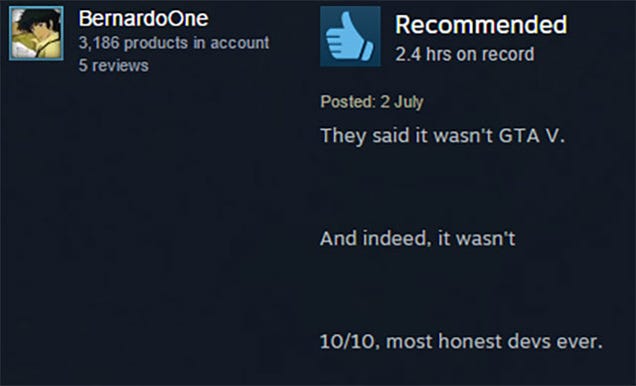
Latest Steam Hit Is NotGTAV, Which Is Not GTA V

by Luke Plunkett

Latest Steam Hit Is NotGTAV, Which Is Not GTA V

For the past day or so, the top-selling “popular new release title” on Steam has been a simple 74-cent game called NotGTAV, from which all proceeds go to charity. The PC is a strange and wonderful place.

Having been out on phones for a little while, the game was released on Steam on July 2, and has been blowing up ever since. It’s funny, it’s simple, and best of all, it’s got a good cause beneath all the piss-taking.

Advertisement

Latest Steam Hit Is NotGTAV, Which Is Not GTA V

From the developers:

This game is a parody.

It is definitely, positively and (hopefully) legally, not the game Grand Theft Auto Five.

Sure, it’s called NotGTAV, but those letters stand for Great Traffic Adventure and the V is silent. Like the one in “lawsuit” (which, you’ll notice, is also invisible).

This short tour of the glories of the UK’s M4 corridor is easy to play, hard to master, addictive, very funny, and cheap.

100% of the profits from this game go to young people’s charity Peer Productions. Without Peer Productions the NotGames team would never have met. By buying this game you can help us pay something back.

The game plays more like Snake than Grand Theft Auto (actually, it plays exactly like Snake), which helps in avoiding the lawvsuits. Given the name and the nature of NotGTAV, reviews are glowing:

Latest Steam Hit Is NotGTAV, Which Is Not GTA V

Latest Steam Hit Is NotGTAV, Which Is Not GTA V

You can grab it here.

Latest Steam Hit Is NotGTAV, Which Is Not GTA V

This entry passed through the Full-Text RSS service - if this is your content and you're reading it on someone else's site, please read the FAQ at fivefilters.org/content-only/faq.php#publishers.

03 Jul 16:56

Photo


03 Jul 14:45

My latest comic collection is available on my site and Amazon....

Bewarethewumpus

Also, there is a small strategic advantage in not allowing your opponent to track the cards in your hand.


My latest comic collection is available on my site and Amazon. Please check it out!

02 Jul 17:10

Clay Pepe Has Long Tongue, Anger

by Ari Spool
Hqdefault

Through the power of claymation, we finally get to see an Angry Pepe ree for the ages!

02 Jul 15:01

Having Bat Colonies In Your Secret Hideout Is Probably Not a Good Idea

by Gergo Vas

Having Bat Colonies In Your Secret Hideout Is Probably Not a Good Idea

Bats might be important for Batman’s identity, but they also spread diseases, poop everywhere and make a ton of extra work for Alfred. Dorkly’s video proves that it’s just not a good idea having them in your cave at all.

And besides all that, there are probably a few of them inside the Batcomputer too, chilling on one of the coolers or the motherboard. I’d be worried about that!

Advertisement

To contact the author of this post, write to: gergovas@kotaku.com

This entry passed through the Full-Text RSS service - if this is your content and you're reading it on someone else's site, please read the FAQ at fivefilters.org/content-only/faq.php#publishers.

02 Jul 14:54

America explained to non-Americans

by Matthew Inman
02 Jul 14:47

Anytime Is a Good Time for Pizza

Bewarethewumpus

And if you develop a taste for brains by the time the delivery guy arrives, then hey, you're covered.

sign,zombie,pizza,awesome

Submitted by: mandalore666

Tagged: sign , zombie , pizza , awesome
02 Jul 14:44

GCHQ spied on Amnesty International, Investigatory Powers Tribunal lied about it

by Cory Doctorow

Last week, the Investigatory Powers Tribunal said that the UK spy agency hadn't spied on Amnesty -- this week, they admitted that they had, and claimed they hadn't deliberately misled the organisation about the spying.

The Tribunal would not say why it spied on Amnesty, nor when, nor what they did with the information they gathered.

Gauri van Gulik, Amnesty International’s deputy director for Europe and Central Asia, marveled at the absurdity of the situation. The group had spent 18 months trying to determine which groups were surveilled, culminating in last week’s ruling, she explained to The Intercept. And now, she said, it turns out there was “a mistake made in the numbering of the complaints.” The mistake was apparently pointed out to the tribunal by GCHQ, she said. “Of course they sat on it for 10 days.”

“Most important to us is that privacy matters. Privacy matters to us. It’s harmed the trust that human rights defenders have in us,” she said. “This has gone too far.”

Naureen Shah, Director of Security and Human Rights for Amnesty International USA wrote in an email to The Intercept that her group is concerned that the U.K. “is sharing its collected intelligence from Amnesty with the US government, including communications from US citizens like me and/or communications about our documentation of human rights abuses committed by the US government.”

British Tribunal Flip-Flops on Wrongful Surveillance of Amnesty International [Jenna McLaughlin/The Intercept]

This entry passed through the Full-Text RSS service - if this is your content and you're reading it on someone else's site, please read the FAQ at fivefilters.org/content-only/faq.php#publishers.

02 Jul 03:38

Alone in the Dark: Illumination - Like Left 4 Dead But...

by Team Hollywood

This week, Zero Punctuation reviews Alone in the Dark: Illumination.

02 Jul 03:31

This is the best funny video on the entire internethole

by Xeni Jardin
Bewarethewumpus

Until the next one, anyway.

[unable to retrieve full-text content]

This. Looping. Forever. (more…)

01 Jul 20:48

Steam Players Make Their Own Justice, Virtually Imprison Troll

by Patricia Hernandez

Steam Players Make Their Own Justice, Virtually Imprison Troll

Steam’s hottest game has no built-in way to stop jerks from ruining your fun...which means that players have to get creative if they want to maintain the peace.

Ark: Survival Evolved is a dinosaur hunting game where players have to use the environment to, well, survive. You know the spiel: you can craft, you can build, and so on. Think of it like DayZ or Rust, but with dinosaurs. People like it so much that Ark has been tearing up the Steam charts since its release in early access.

It’s not perfect, of course. One thing players seem to agree on is that the game can be a messy hotbed for jerks and assholes. One of the most top-voted reviews on Ark’s store page says that it is “literally a griefers paradise” because “everything [you build] for can and will be destroyed, killed, and looted...while you’re sleeping ever so peacefully in your bed.” While some players feel helpless to this fact, others are being a bit more proactive when it comes to griefers.

Advertisement

Earlier last week, Ark player Barbaric Seagull took to the Steam forums pictures of what happened to a particularly infamous troll within the game:

Steam Players Make Their Own Justice, Virtually Imprison Troll

Steam Players Make Their Own Justice, Virtually Imprison Troll

“We have an infamous scoundrel and rapscallion locked in a cage,” Seagull reported. “Whenever he gets low health from punching the wall I tranq him and feed him blood until he’s full HP. We’ve had him in there for quite some time.

“This is what happens when you’re a jerk, justice is served.”

Seagull says that the player was imprisoned for ten hours in a virtual prison created by other Ark players. It allegedly took 30 minutes to trap the troll, and after he was captured, the players say they forced him to craft care packages for new players as “community service.”

This digital vigilante justice was met with both support and disgust from other Ark players. A few choice quotes...

“That, is....AWESOME,” one player wrote. “We could use a criminal system like that.”

“Maybe he will learn manners when he is released,” another mused.

“You are beyond the worst scum in the game mister Seagull,” one commenter said. “Like the absolute worst...If the police actively held a man in a 1x1x1 prison and repeatedly tranqed him and force-fed him blood for a reported 10 hours against his will and without trial then yes. I would call them scum and kick them in the nuts.

“The point stands you are effectively banning this player for little more then ruining your pixels.”

One commenter even notes that the developers totally intended for stuff like this to happen. Here is what Ark’s FAQ says in regards to the “unconsciousness” feature within the game:

When you log off your character, or if you suffer serious trauma, or eat the wrong thing, your body becomes unconscious. This will allow other Survivors to interact with you. They can steal your items, kill you, and even feed you! But there’s something else you can do in ARK... you can drag their ragdoll sleeping body around... move it to wherever you want... even move it into a prison cell and enslave it (or just put it in a very dangerous position for when it awakes)... you can force-feed an unconscious person food & water to keep them alive....

and by enslaving, we mean:

You can physically confine them and keep them alive indefinitely if you maintain their health. You can then do such useful things as extracting blood from them to create transfusion items, or using their poop as fertilizer, etc.

Mission accomplished, I guess!

The funny thing about this entire debacle is the final twist. Here’s Seagull, on the fate of the player that was imprisoned:

I just wanted to update this to provide some posterity to the situation and everyone commenting. We did imprison Ricky, for raiding and such, it was fun and we invited him to our TS and we all had a great time.

After getting to know him more, and finding out how absolutely insane (total headcases) some of the tribe leaders are on our server, we now play with him as a member of our tribe. Right now we have become friends and are having fun together and he is not destroying anybody’s stuff.

Maybe that’s stockholm syndrome. Or maybe it’s the brilliance of Ark: Survival Evolved and its players shining through.

This entry passed through the Full-Text RSS service - if this is your content and you're reading it on someone else's site, please read the FAQ at fivefilters.org/content-only/faq.php#publishers.

01 Jul 20:37

McKinney, TX wants $79K to retreive emails of the cop who tackled bikini-clad teen

by Cory Doctorow


McKinney is Texas's worst-ranked city for open records requests, and says that it will have to hire a programmer to write entirely new code to search its old, "unsearchable" email system for the emails of Officer Eric Casebolt, who made headlines by tackling a young black girl in a bikini at a pool party and threatening her with his gun.

Muckrock and Gawker filed Freedom of Information Act requests with the city, which replied that it would take over 2,200 programmer-hours to write a custom search-tool to retrieve emails from the system it used until March 1, 2014. This reeks of bullshit.

The next step is to complain to the State Attorney General.

Gawker's options here are pretty limited. It can either limit its request to post-March 2014 emails as suggested by the city's lawyers (pretty much useless if seeking a full representation of Eric Casebolt's career) or it can petition the state attorney general to take a look at the city's claims.

A person who believes the person has been overcharged for being provided with a copy of public information may complain to the attorney general in writing of the alleged overcharge, setting forth the reasons why the person believes the charges are excessive. The attorney general shall review the complaint and make a determination in writing as to the appropriate charge for providing the copy of the requested information.

This particular avenue of recourse has been used frequently in the past. A 2012 examination of Texas open records requests by the Center for Public Integrity found McKinney ranked highest in the state in the number of fee complaints to the state attorney general (per 100,000 residents). Not all of these were fee-related, but the ratio of referred requests suggests the local government is more reluctant to turn over responsive documents than its neighbors. A spokeswoman for the city notes in the article that requests related to the police department are treated with "an overabundance of caution." This response to Gawker, however, seems not so much cautious as confrontational -- a "shut up and go away" response in the form of a thoroughly ridiculous $79,000 price tag.

I have reached out to the city employees listed in the letter to Gawker, asking for details on the current and pre-2014 email systems, as well as any methods used by city employees to access older emails. I'm not expecting an answer, but if one should materialize, it will be passed on.

City Claims It Will Take 9,000 Hours And $79,000 To Fulfill Gawker's Request Emails Related To Abusive Police Officer [Tim Cushing/Techdirt]

This entry passed through the Full-Text RSS service - if this is your content and you're reading it on someone else's site, please read the FAQ at fivefilters.org/content-only/faq.php#publishers.

01 Jul 16:57

MeFi: Trans 101

by roomthreeseventeen
01 Jul 16:06

Strengths and Weaknesses

Do you need me to do a quicksort on the whiteboard or produce a generation of offspring or something? It might take me a bit, but I can do it.
01 Jul 14:29

Harry Potter As An R-rated Movie

by Gergo Vas
Bewarethewumpus

Totally nailed Dumbledore and the mirror.

Harry Potter As An R-rated Movie

Even right at the beginning at the Dursley family’s residence, things would get bloody real quick. Then, everything would turn into a giant mess after Harry arrives at Hogwarts in an adult version of Harry Potter.

The Fine Bros. imagined how quidditch, magic and everyday life would look in Harry Potter if it was an R rated movie instead of a light PG adventure.

Advertisement

To contact the author of this post, write to: gergovas@kotaku.com

This entry passed through the Full-Text RSS service - if this is your content and you're reading it on someone else's site, please read the FAQ at fivefilters.org/content-only/faq.php#publishers.

01 Jul 00:17

The World's Ugliest Dog Contest

by Ari Spool
Dogcontest

Gnarled, bug-eyed pups have competed annually for this vaunted American crown since the 1970s. We’ve generated a useful, hilarious, and weirdly cute photo-annotated timeline of all the winners from the last 15 years.

30 Jun 21:22

Meanwhile in Washington D.C.

by Brad
C8c